

- Industry Size (2026)
- USD 834.7 Mn
- Forecast (2036)
- USD 2783.7 Mn
- CAGR (2026 to 2036)
- 12.8%
Quantum Key Distribution Test Equipment Market Forecast and Outlook 2026 to 2036
Demand for quantum key distribution test equipment market is valued at USD 834.7 million in 2026 and is forecasted to reach USD 2,783.7 million by 2036, expanding at a CAGR of 12.8%. Demand growth is driven by rising adoption of quantum-safe communication, national cybersecurity programs, and deployment of quantum networks across telecom, defense, and critical infrastructure.
DV-QKD systems represent the leading QKD architecture in global demand due to maturity of discrete-variable protocols, compatibility with existing fiber networks, and well-established performance validation requirements. Test equipment adoption focuses on photon source characterization, detector efficiency measurement, timing synchronization, and error-rate analysis under real-world channel conditions.
China, Brazil, South Korea, USA, and United Kingdom rank among fastest-growing countries, supported by government-funded quantum initiatives and early-stage commercialization of quantum communication links. Keysight Technologies, ID Quantique, Rohde & Schwarz, Anritsu, VIAVI Solutions, Thorlabs, Tektronix, Hamamatsu Photonics, Toshiba, and QuantumCTek maintain strong positions through precision photonics instrumentation, protocol-aware test platforms, and close alignment with emerging quantum communication standards.
Quick Stats for Quantum Key Distribution Test Equipment Market
- Quantum Key Distribution Test Equipment Market Value (2026): USD 834.7 million
- Quantum Key Distribution Test Equipment Market Forecast Value (2036): USD 2,783.7 million
- Quantum Key Distribution Test Equipment Market Forecast CAGR (2026-2036): 12.8%
- Leading QKD Architecture in Global Demand: DV-QKD Systems
- Fastest-Growing Countries: China, Brazil, South Korea, USA, United Kingdom
- Top Players in Global Demand: Keysight Technologies, ID Quantique, Rohde & Schwarz, Anritsu, VIAVI Solutions, Thorlabs, Tektronix, Hamamatsu Photonics, Toshiba, QuantumCTek
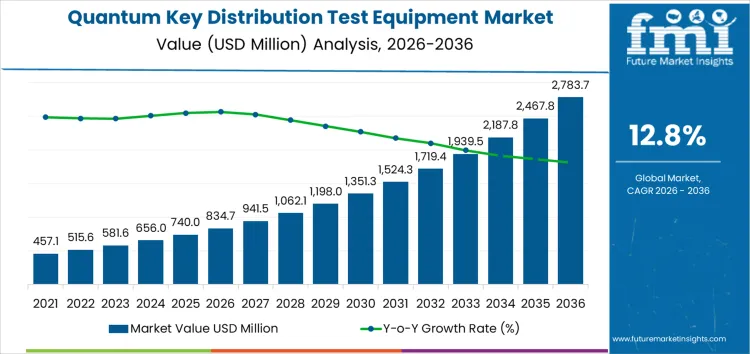
Quantum Key Distribution Test Equipment Market Key Takeaways
| Metric | Value |
|---|---|
| Market Value (2026) | USD 834.7 million |
| Market Forecast Value (2036) | USD 2,783.7 million |
| Forecast CAGR (2026-2036) | 12.8% |
Why is the Demand for Quantum Key Distribution Test Equipment Market Growing?
Demand for quantum key distribution test equipment is growing globally due to expanding deployment of quantum secure communication networks and rising cybersecurity priorities across government, finance, and critical infrastructure sectors. Quantum key distribution systems generate encryption keys based on quantum mechanics, which requires precise characterization of optical channels, single photon detectors, and quantum states using specialized test instruments. Network operators and research institutions invest in test equipment to verify system performance, key generation rates, channel loss, and error rates before field integration. Growth in cloud computing and distributed data centers increases interest in quantum resistant encryption to protect sensitive information and maintain long term confidentiality.
National security agencies and defense organizations expand quantum communication programs to secure strategic communication links. Standardization efforts and cross border research collaborations require rigorous evaluation of interoperability and compliance with emerging quantum communication protocols. Academic laboratories and technology developers use test platforms to support algorithm validation, component development, and scaling studies. Equipment suppliers design modular, high sensitivity diagnostic tools that support diverse quantum key distribution architectures, including fiber based and free space links. Demand is sustained by increasing investment in next generation secure networks and foundational quantum communication infrastructure worldwide.
How Are the Segments Classified in the Quantum Key Distribution Test Equipment Market?
Demand for quantum key distribution test equipment globally is shaped by secure communications mandates, maturation of quantum networks, and pre-deployment validation requirements. Stakeholders assess measurement fidelity, timing precision, protocol robustness, and interoperability across terrestrial and satellite links. Adoption patterns reflect parallel development of fiber-based and space-enabled QKD, supported by rigorous security testing and network integration across public and private infrastructures.
Which QKD Architecture Accounts for the Largest Share of Global Test Equipment Demand?

DV-QKD systems hold 36.0%, accounting for the largest share of global demand. Discrete-variable architectures rely on single-photon states, requiring precise source characterization and detector performance validation. Satellite QKD payload testing holds 24.0%, supporting space-to-ground links and orbital qualification of quantum sources. CV-QKD systems account for 22.0%, emphasizing coherent detection and noise characterization over standard telecom components. Network components and other architectures hold 18.0%, covering trusted nodes and hybrid configurations. Architecture distribution reflects stronger deployment maturity and validation intensity for DV-QKD while satellite programs expand testing scope.
Key Points
- DV-QKD leads due to deployment maturity and photon-level validation needs.
- Satellite payload testing supports space-enabled quantum links.
- CV-QKD emphasizes coherent detection and noise management.
Which Test Function Drives the Highest Share of Global QKD Testing Activity?
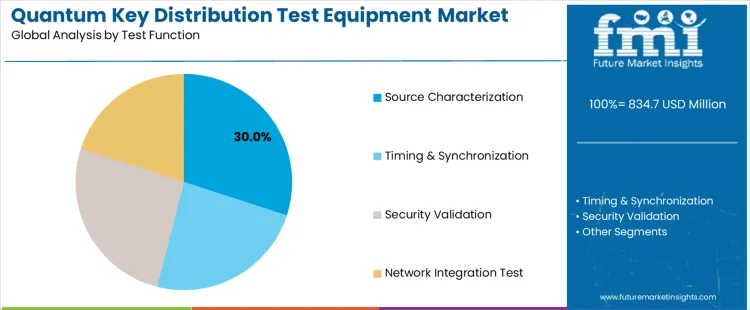
Source characterization holds 30.0%, driving the highest share of global testing activity. Accurate assessment of photon sources or coherent states underpins protocol security and key rate performance. Security validation accounts for 26.0%, addressing attack resilience, side-channel assessment, and protocol compliance. Timing and synchronization hold 24.0%, ensuring precise clock alignment essential for key exchange integrity. Network integration testing holds 20.0%, validating interoperability across nodes and classical control channels. Test-function distribution reflects foundational importance of source quality and security assurance in QKD deployments.
Key Points
- Source characterization leads due to foundational security dependence.
- Security validation ensures protocol and side-channel robustness.
- Timing accuracy underpins reliable key exchange.
Which End-User Segment Represents the Largest Share of Global Demand?
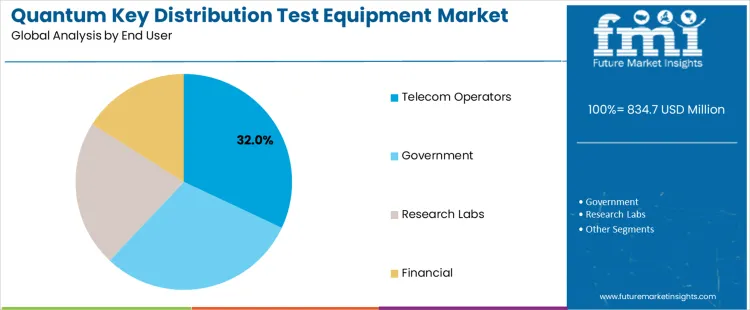
Telecom operators hold 32.0%, representing the largest end-user share globally. Operators require validation for metropolitan and long-haul quantum-secured networks integrated with existing fiber infrastructure. Government entities hold 30.0%, supporting national security communications and standards validation. Research laboratories account for 22.0%, advancing protocol development and experimental verification. Financial institutions hold 16.0%, validating secure links for high-value data protection. End-user distribution reflects early commercialization led by operators alongside sustained public-sector investment.
Key Points
- Telecom operators lead due to network deployment responsibilities.
- Government users prioritize secure national communications.
- Research and finance support development and high-value protection.
What are the Key Dynamics in the Quantum Key Distribution Test Equipment Market?
Global demand rises as research institutions, telecommunications companies, and cybersecurity solution providers invest in quantum key distribution (QKD) technologies to secure communication against emerging threats. Test equipment supports characterization, validation, and interoperability of QKD systems across optical fibers, free-space links, and quantum networks. Adoption aligns with national cybersecurity strategies, interest in quantum-safe infrastructure, and collaborative research programs spanning Asia-Pacific, Europe, North America, and the Middle East. Usage includes protocol testing, error-rate assessment, and secure link validation.
How do quantum-safe security initiatives and network infrastructure evolution shape demand globally?
Governments and critical infrastructure operators prioritize protection against future quantum-enabled threats, prompting pilot deployments of QKD across backbone fiber and metropolitan networks. Telecom operators evaluate QKD integration alongside conventional cryptography, requiring test equipment to assess key generation rates, channel loss tolerance, and error correction performance. Research consortia and standards bodies work to harmonize QKD protocols, enhancing interoperability testing needs. Link-level test systems measure photon count, timing jitter, and eavesdropping resilience. Free-space QKD trials support satellite-to-ground secure communication experiments. Demand grows where national cyber strategies and industry alliances emphasize quantum-safe communication architectures supported by robust test validation.
How do capital intensity, technical complexity, and standardization challenges influence global scalability?
QKD test equipment involves sophisticated optical sources, single-photon detectors, and synchronization systems, making cost a barrier for smaller research groups. Integration complexity across diverse physical media necessitates high expertise in quantum optics, signal processing, and network engineering. Lack of universal standards for QKD protocols and interfaces increases the need for customizable test platforms. Interoperability testing across vendor equipment raises engineering and coordination overhead. Geographic disparities in research infrastructure concentrate advanced capabilities in technology hubs, with emerging regions relying on collaboration or outsourced testing. Long-term market growth depends on broader protocol harmonization, modular test solutions that lower entry thresholds, and workforce development bridging quantum and classical communications expertise worldwide.
How Is Demand for Quantum Key Distribution Test Equipment Evolving?
Demand for quantum key distribution test equipment is increasing globally due to rising cybersecurity threats, post-quantum cryptography readiness, and national quantum communication programs. China leads with a 14.8% CAGR, supported by large-scale quantum network deployment and state-led infrastructure investment. Brazil follows at 14.0%, driven by academic research expansion and secure communication pilots. South Korea records a 12.6% CAGR, shaped by telecom-led quantum trials and defense applications. USA posts 12.1%, reflecting government-funded quantum initiatives and commercial testing needs. UK records 11.9%, supported by collaborative research networks and standardization efforts. Growth reflects urgency around secure key exchange validation and interoperability testing worldwide.
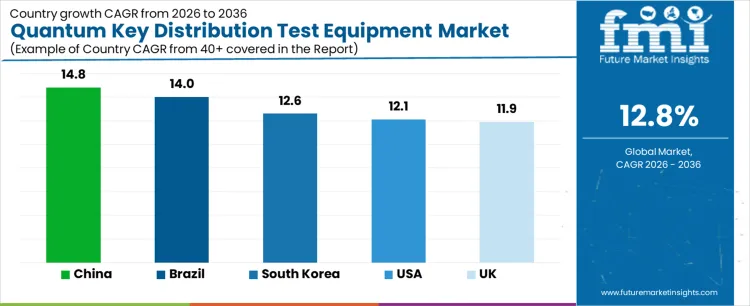
| Country | CAGR (%) |
|---|---|
| China | 14.8% |
| Brazil | 14.0% |
| South Korea | 12.6% |
| USA | 12.1% |
| UK | 11.9% |
What factors are accelerating adoption of QKD test equipment in China?
China drives demand through national quantum communication backbone projects, satellite-based QKD development, and government-backed cybersecurity priorities. Country’s CAGR of 14.8% reflects extensive testing of photon sources, detectors, synchronization modules, and key management interfaces. Test equipment supports validation of fiber-based and free-space QKD links under real-world conditions. Laboratories emphasize high-throughput testing, long-distance performance verification, and system stability assessment. Integration with existing telecom infrastructure increases testing complexity. Academic institutions and state laboratories expand parallel test capabilities. Growth remains policy-driven and scale-oriented, aligned with national security objectives and rapid rollout of quantum communication infrastructure.
- National quantum network and satellite QKD programs
- High-volume testing of photonic components
- Validation of long-distance and high-loss links
- Government-led infrastructure investment
Why is Brazil emerging as a fast-growing QKD test equipment market?
Brazil demand is shaped by expansion of quantum research programs, secure government communication pilots, and university-led innovation. Country’s CAGR of 14.0% reflects rising investment in laboratory-scale QKD testbeds and field trial validation systems. Test equipment supports protocol verification, error rate measurement, and environmental robustness testing. Shared research facilities enable efficient use of capital resources. Collaboration with international partners encourages alignment with global QKD standards. Demand favors modular and scalable test platforms suitable for experimental networks. Growth remains research-led and capability-focused, aligned with gradual development of national quantum communication competence.
- University and research-driven QKD experimentation
- Shared laboratory and testbed infrastructure
- Focus on protocol validation and error analysis
- Modular and scalable test equipment adoption
How does South Korea’s telecom ecosystem influence QKD test equipment demand?
South Korea demand reflects integration of QKD into next-generation telecom networks and secure data transmission services. Country’s CAGR of 12.6% is supported by trials conducted by major telecom operators and equipment vendors. Test equipment validates interoperability between QKD systems and classical network components. Emphasis remains on latency control, synchronization accuracy, and key generation stability. Government-backed programs promote standardization and commercial readiness. Demand favors compact, high-precision systems compatible with live network environments. Growth remains technology-driven, aligned with telecom modernization and cybersecurity assurance initiatives.
- Telecom-led QKD network trials
- Interoperability testing with classical infrastructure
- Emphasis on synchronization and latency accuracy
- Government-supported standardization programs
What dynamics are sustaining steady growth of QKD test equipment demand in the USA?
USA demand is driven by federal quantum initiatives, defense communications security, and private sector research. Country’s CAGR of 12.1% reflects need for testing quantum-safe key exchange across laboratory and field environments. National laboratories and contractors deploy test equipment to evaluate system resilience, scalability, and integration with existing encryption frameworks. Emphasis remains on compliance, repeatability, and data integrity. Commercial vendors invest in test platforms to support product validation and customer demonstrations. Growth remains program-driven, aligned with national security priorities and transition planning toward quantum-resilient communications.
- Federal and defense-led quantum programs
- Validation of resilience and scalability
- Integration with existing security architectures
- Commercial product and customer testing
How is the UK positioning itself within the global QKD test equipment landscape?
UK demand reflects strong academic research, public-private collaboration, and leadership in quantum standards development. Country’s CAGR of 11.9% is supported by investment in national quantum hubs and shared test facilities. Test equipment enables verification of protocols, component performance, and network interoperability. Collaboration between universities, startups, and government agencies strengthens testing depth. Emphasis remains on reproducibility, standards alignment, and export readiness. Growth remains ecosystem-driven, aligned with positioning as a center for quantum communication research and validation services.
- National quantum research hubs and testbeds
- Strong academia and industry collaboration
- Focus on standards and interoperability testing
- Export-oriented validation capability development
What is the competitive landscape of demand for quantum key distribution test equipment?
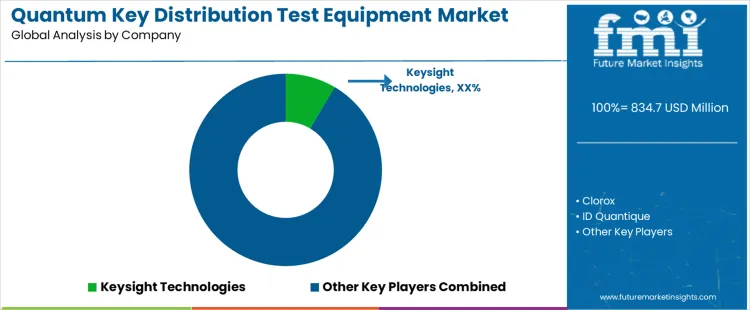
Demand for quantum key distribution test equipment is driven by government security programs, telecom research, and critical infrastructure protection initiatives. Testing activities focus on validating quantum signal integrity, photon detection accuracy, synchronization stability, and error correction performance. Buyers require precision optical instrumentation, low-noise measurement capability, and repeatable validation of quantum channel behavior. Procurement teams evaluate compatibility with fiber and free-space QKD architectures, latency measurement, and protocol verification capability. Reliability under laboratory and field trial conditions influences long-term supplier selection decisions. Trend in the global market reflects increased sovereign investment, pilot deployments, and standardization of quantum-safe communication frameworks.
Keysight Technologies maintains strong positioning through high-frequency test platforms and quantum optics measurement solutions. ID Quantique supplies QKD systems and associated test tools supporting protocol validation and system qualification. Rohde and Schwarz and Anritsu provide signal generation, synchronization testing, and optical measurement systems used in QKD validation. VIAVI Solutions supports fiber characterization and network testing required for quantum communication infrastructure assessment. Thorlabs contributes optical components, photon measurement tools, and laboratory instrumentation essential for QKD experimentation. Tektronix supplies high-speed oscilloscopes and signal analysis platforms supporting timing and noise evaluation. Hamamatsu Photonics delivers single-photon detectors and optoelectronic measurement devices critical for quantum testing. Toshiba and QuantumCTek operate integrated quantum communication programs supported by internal and partner test capabilities. Competitive differentiation depends on optical measurement precision, protocol awareness, integration flexibility, and alignment with emerging quantum standards.
Key Players in the Quantum Key Distribution Test Equipment Market
- Keysight Technologies
- ID Quantique
- Rohde & Schwarz
- Anritsu
- VIAVI Solutions
- Thorlabs
- Tektronix
- Hamamatsu Photonics
- Toshiba
- QuantumCTek
Scope of the Report
| Items | Values |
|---|---|
| Quantitative Units | USD million |
| QKD Architecture | DV-QKD Systems; CV-QKD Systems; Satellite QKD Payload Test Equipment; Network Components & Other Test Platforms |
| Test Function | Source Characterization; Timing & Synchronization; Security Validation; Network Integration Testing |
| End User | Telecom Operators; Government & Defense Agencies; Research Labs; Financial Institutions |
| Deployment Scenario | Metro Fiber Links; Long-Haul Fiber Networks; Free-Space Ground Links; Satellite Links |
| Regions Covered | Asia Pacific; Europe; North America; Latin America; Middle East & Africa |
| Countries Covered | China; USA; Brazil; Germany; UK; South Korea; and 40+ countries |
| Key Companies Profiled | Keysight Technologies; ID Quantique; Rohde & Schwarz; Anritsu; VIAVI Solutions; Thorlabs; Tektronix; Hamamatsu Photonics; Toshiba; QuantumCTek |
| Additional Attributes | Dollar sales by QKD architecture and test function; regional adoption trends across fiber and satellite QKD networks; emphasis on security validation and synchronization accuracy; integration with telecom infrastructure; influence of national quantum communication programs and cybersecurity regulations. |
Quantum Key Distribution Test Equipment Market by Segment
QKD Architecture:
- DV-QKD Systems
- CV-QKD Systems
- Satellite QKD Payload Test
- Network Components & Other
Test Function:
- Source Characterization
- Timing & Synchronization
- Security Validation
- Network Integration Test
End User:
- Telecom Operators
- Government
- Research Labs
- Financial
Deployment Scenario:
- Metro Fiber Links
- Long-Haul Fiber
- Free-Space Ground Links
- Satellite Links
Region:
- Asia Pacific
- China
- Japan
- South Korea
- India
- Australia & New Zealand
- ASEAN
- Rest of Asia Pacific
- Europe
- Germany
- United Kingdom
- France
- Italy
- Spain
- Nordic
- BENELUX
- Rest of Europe
- North America
- United States
- Canada
- Mexico
- Latin America
- Brazil
- Chile
- Rest of Latin America
- Middle East & Africa
- Kingdom of Saudi Arabia
- Other GCC Countries
- Turkey
- South Africa
- Other African Union
- Rest of Middle East & Africa
Frequently Asked Questions
How big is the quantum key distribution test equipment market in 2026?
The global quantum key distribution test equipment market is estimated to be valued at USD 834.7 million in 2026.
What will be the size of quantum key distribution test equipment market in 2036?
The market size for the quantum key distribution test equipment market is projected to reach USD 2,783.7 million by 2036.
How much will be the quantum key distribution test equipment market growth between 2026 and 2036?
The quantum key distribution test equipment market is expected to grow at a 12.8% CAGR between 2026 and 2036.
What are the key product types in the quantum key distribution test equipment market?
The key product types in quantum key distribution test equipment market are DV-QKD systems, CV-QKD systems, satellite QKD payload test and network components & other.
Which test function segment to contribute significant share in the quantum key distribution test equipment market in 2026?
In terms of test function, source characterization segment to command 30.0% share in the quantum key distribution test equipment market in 2026.
Preview the report firsthand - request a free sample
Get SampleGet the brochure for pricing and purchase details.
Get PDFTable of Content
- Executive Summary
- Global Market Outlook
- Demand-side Trends
- Supply-side Trends
- Technology Roadmap Analysis
- Analysis and Recommendations
- Market Overview
- Market Coverage / Taxonomy
- Market Definition / Scope / Limitations
- Market Background
- Market Dynamics
- Drivers
- Restraints
- Opportunity
- Trends
- Scenario Forecast
- Demand in Optimistic Scenario
- Demand in Likely Scenario
- Demand in Conservative Scenario
- Opportunity Map Analysis
- Product Life Cycle Analysis
- Supply Chain Analysis
- Investment Feasibility Matrix
- Value Chain Analysis
- PESTLE and Porter’s Analysis
- Regulatory Landscape
- Regional Parent Market Outlook
- Production and Consumption Statistics
- Import and Export Statistics
- Market Dynamics
- Global Market Analysis 2021 to 2025 and Forecast, 2026 to 2036
- Historical Market Size Value (USD Million) Analysis, 2021 to 2025
- Current and Future Market Size Value (USD Million) Projections, 2026 to 2036
- Y-o-Y Growth Trend Analysis
- Absolute $ Opportunity Analysis
- Global Market Pricing Analysis 2021 to 2025 and Forecast 2026 to 2036
- Global Market Analysis 2021 to 2025 and Forecast 2026 to 2036, By QKD Architecture
- Introduction / Key Findings
- Historical Market Size Value (USD Million) Analysis By QKD Architecture , 2021 to 2025
- Current and Future Market Size Value (USD Million) Analysis and Forecast By QKD Architecture , 2026 to 2036
- DV-QKD Systems
- CV-QKD Systems
- Satellite QKD Payload Test
- Network Components & Other
- DV-QKD Systems
- Y-o-Y Growth Trend Analysis By QKD Architecture , 2021 to 2025
- Absolute $ Opportunity Analysis By QKD Architecture , 2026 to 2036
- Global Market Analysis 2021 to 2025 and Forecast 2026 to 2036, By Test Function
- Introduction / Key Findings
- Historical Market Size Value (USD Million) Analysis By Test Function, 2021 to 2025
- Current and Future Market Size Value (USD Million) Analysis and Forecast By Test Function, 2026 to 2036
- Source Characterization
- Timing & Synchronization
- Security Validation
- Network Integration Test
- Source Characterization
- Y-o-Y Growth Trend Analysis By Test Function, 2021 to 2025
- Absolute $ Opportunity Analysis By Test Function, 2026 to 2036
- Global Market Analysis 2021 to 2025 and Forecast 2026 to 2036, By End User
- Introduction / Key Findings
- Historical Market Size Value (USD Million) Analysis By End User, 2021 to 2025
- Current and Future Market Size Value (USD Million) Analysis and Forecast By End User, 2026 to 2036
- Telecom Operators
- Government
- Research Labs
- Financial
- Telecom Operators
- Y-o-Y Growth Trend Analysis By End User, 2021 to 2025
- Absolute $ Opportunity Analysis By End User, 2026 to 2036
- Global Market Analysis 2021 to 2025 and Forecast 2026 to 2036, By Deployment Scenario
- Introduction / Key Findings
- Historical Market Size Value (USD Million) Analysis By Deployment Scenario, 2021 to 2025
- Current and Future Market Size Value (USD Million) Analysis and Forecast By Deployment Scenario, 2026 to 2036
- Metro Fiber Links
- Long-Haul Fiber
- Free-Space Ground Links
- Satellite Links
- Metro Fiber Links
- Y-o-Y Growth Trend Analysis By Deployment Scenario, 2021 to 2025
- Absolute $ Opportunity Analysis By Deployment Scenario, 2026 to 2036
- Global Market Analysis 2021 to 2025 and Forecast 2026 to 2036, By Region
- Introduction
- Historical Market Size Value (USD Million) Analysis By Region, 2021 to 2025
- Current Market Size Value (USD Million) Analysis and Forecast By Region, 2026 to 2036
- North America
- Latin America
- Western Europe
- Eastern Europe
- East Asia
- South Asia and Pacific
- Middle East & Africa
- Market Attractiveness Analysis By Region
- North America Market Analysis 2021 to 2025 and Forecast 2026 to 2036, By Country
- Historical Market Size Value (USD Million) Trend Analysis By Market Taxonomy, 2021 to 2025
- Market Size Value (USD Million) Forecast By Market Taxonomy, 2026 to 2036
- By Country
- USA
- Canada
- Mexico
- By QKD Architecture
- By Test Function
- By End User
- By Deployment Scenario
- By Country
- Market Attractiveness Analysis
- By Country
- By QKD Architecture
- By Test Function
- By End User
- By Deployment Scenario
- Key Takeaways
- Latin America Market Analysis 2021 to 2025 and Forecast 2026 to 2036, By Country
- Historical Market Size Value (USD Million) Trend Analysis By Market Taxonomy, 2021 to 2025
- Market Size Value (USD Million) Forecast By Market Taxonomy, 2026 to 2036
- By Country
- Brazil
- Chile
- Rest of Latin America
- By QKD Architecture
- By Test Function
- By End User
- By Deployment Scenario
- By Country
- Market Attractiveness Analysis
- By Country
- By QKD Architecture
- By Test Function
- By End User
- By Deployment Scenario
- Key Takeaways
- Western Europe Market Analysis 2021 to 2025 and Forecast 2026 to 2036, By Country
- Historical Market Size Value (USD Million) Trend Analysis By Market Taxonomy, 2021 to 2025
- Market Size Value (USD Million) Forecast By Market Taxonomy, 2026 to 2036
- By Country
- Germany
- UK
- Italy
- Spain
- France
- Nordic
- BENELUX
- Rest of Western Europe
- By QKD Architecture
- By Test Function
- By End User
- By Deployment Scenario
- By Country
- Market Attractiveness Analysis
- By Country
- By QKD Architecture
- By Test Function
- By End User
- By Deployment Scenario
- Key Takeaways
- Eastern Europe Market Analysis 2021 to 2025 and Forecast 2026 to 2036, By Country
- Historical Market Size Value (USD Million) Trend Analysis By Market Taxonomy, 2021 to 2025
- Market Size Value (USD Million) Forecast By Market Taxonomy, 2026 to 2036
- By Country
- Russia
- Poland
- Hungary
- Balkan & Baltic
- Rest of Eastern Europe
- By QKD Architecture
- By Test Function
- By End User
- By Deployment Scenario
- By Country
- Market Attractiveness Analysis
- By Country
- By QKD Architecture
- By Test Function
- By End User
- By Deployment Scenario
- Key Takeaways
- East Asia Market Analysis 2021 to 2025 and Forecast 2026 to 2036, By Country
- Historical Market Size Value (USD Million) Trend Analysis By Market Taxonomy, 2021 to 2025
- Market Size Value (USD Million) Forecast By Market Taxonomy, 2026 to 2036
- By Country
- China
- Japan
- South Korea
- By QKD Architecture
- By Test Function
- By End User
- By Deployment Scenario
- By Country
- Market Attractiveness Analysis
- By Country
- By QKD Architecture
- By Test Function
- By End User
- By Deployment Scenario
- Key Takeaways
- South Asia and Pacific Market Analysis 2021 to 2025 and Forecast 2026 to 2036, By Country
- Historical Market Size Value (USD Million) Trend Analysis By Market Taxonomy, 2021 to 2025
- Market Size Value (USD Million) Forecast By Market Taxonomy, 2026 to 2036
- By Country
- India
- ASEAN
- Australia & New Zealand
- Rest of South Asia and Pacific
- By QKD Architecture
- By Test Function
- By End User
- By Deployment Scenario
- By Country
- Market Attractiveness Analysis
- By Country
- By QKD Architecture
- By Test Function
- By End User
- By Deployment Scenario
- Key Takeaways
- Middle East & Africa Market Analysis 2021 to 2025 and Forecast 2026 to 2036, By Country
- Historical Market Size Value (USD Million) Trend Analysis By Market Taxonomy, 2021 to 2025
- Market Size Value (USD Million) Forecast By Market Taxonomy, 2026 to 2036
- By Country
- Kingdom of Saudi Arabia
- Other GCC Countries
- Turkiye
- South Africa
- Other African Union
- Rest of Middle East & Africa
- By QKD Architecture
- By Test Function
- By End User
- By Deployment Scenario
- By Country
- Market Attractiveness Analysis
- By Country
- By QKD Architecture
- By Test Function
- By End User
- By Deployment Scenario
- Key Takeaways
- Key Countries Market Analysis
- USA
- Pricing Analysis
- Market Share Analysis, 2025
- By QKD Architecture
- By Test Function
- By End User
- By Deployment Scenario
- Canada
- Pricing Analysis
- Market Share Analysis, 2025
- By QKD Architecture
- By Test Function
- By End User
- By Deployment Scenario
- Mexico
- Pricing Analysis
- Market Share Analysis, 2025
- By QKD Architecture
- By Test Function
- By End User
- By Deployment Scenario
- Brazil
- Pricing Analysis
- Market Share Analysis, 2025
- By QKD Architecture
- By Test Function
- By End User
- By Deployment Scenario
- Chile
- Pricing Analysis
- Market Share Analysis, 2025
- By QKD Architecture
- By Test Function
- By End User
- By Deployment Scenario
- Germany
- Pricing Analysis
- Market Share Analysis, 2025
- By QKD Architecture
- By Test Function
- By End User
- By Deployment Scenario
- UK
- Pricing Analysis
- Market Share Analysis, 2025
- By QKD Architecture
- By Test Function
- By End User
- By Deployment Scenario
- Italy
- Pricing Analysis
- Market Share Analysis, 2025
- By QKD Architecture
- By Test Function
- By End User
- By Deployment Scenario
- Spain
- Pricing Analysis
- Market Share Analysis, 2025
- By QKD Architecture
- By Test Function
- By End User
- By Deployment Scenario
- France
- Pricing Analysis
- Market Share Analysis, 2025
- By QKD Architecture
- By Test Function
- By End User
- By Deployment Scenario
- India
- Pricing Analysis
- Market Share Analysis, 2025
- By QKD Architecture
- By Test Function
- By End User
- By Deployment Scenario
- ASEAN
- Pricing Analysis
- Market Share Analysis, 2025
- By QKD Architecture
- By Test Function
- By End User
- By Deployment Scenario
- Australia & New Zealand
- Pricing Analysis
- Market Share Analysis, 2025
- By QKD Architecture
- By Test Function
- By End User
- By Deployment Scenario
- China
- Pricing Analysis
- Market Share Analysis, 2025
- By QKD Architecture
- By Test Function
- By End User
- By Deployment Scenario
- Japan
- Pricing Analysis
- Market Share Analysis, 2025
- By QKD Architecture
- By Test Function
- By End User
- By Deployment Scenario
- South Korea
- Pricing Analysis
- Market Share Analysis, 2025
- By QKD Architecture
- By Test Function
- By End User
- By Deployment Scenario
- Russia
- Pricing Analysis
- Market Share Analysis, 2025
- By QKD Architecture
- By Test Function
- By End User
- By Deployment Scenario
- Poland
- Pricing Analysis
- Market Share Analysis, 2025
- By QKD Architecture
- By Test Function
- By End User
- By Deployment Scenario
- Hungary
- Pricing Analysis
- Market Share Analysis, 2025
- By QKD Architecture
- By Test Function
- By End User
- By Deployment Scenario
- Kingdom of Saudi Arabia
- Pricing Analysis
- Market Share Analysis, 2025
- By QKD Architecture
- By Test Function
- By End User
- By Deployment Scenario
- Turkiye
- Pricing Analysis
- Market Share Analysis, 2025
- By QKD Architecture
- By Test Function
- By End User
- By Deployment Scenario
- South Africa
- Pricing Analysis
- Market Share Analysis, 2025
- By QKD Architecture
- By Test Function
- By End User
- By Deployment Scenario
- USA
- Market Structure Analysis
- Competition Dashboard
- Competition Benchmarking
- Market Share Analysis of Top Players
- By Regional
- By QKD Architecture
- By Test Function
- By End User
- By Deployment Scenario
- Competition Analysis
- Competition Deep Dive
- Keysight Technologies
- Overview
- Product Portfolio
- Profitability by Market Segments (Product/Age /Sales Channel/Region)
- Sales Footprint
- Strategy Overview
- Marketing Strategy
- Product Strategy
- Channel Strategy
- ID Quantique
- Rohde & Schwarz
- Anritsu
- VIAVI Solutions
- Thorlabs
- Tektronix
- Hamamatsu Photonics
- Toshiba
- QuantumCTek
- Keysight Technologies
- Competition Deep Dive
- Assumptions & Acronyms Used
- Research Methodology


