

- Industry Size (2026)
- USD 24.52 Bn
- Forecast (2036)
- USD 110.04 Bn
- CAGR (2026 to 2036)
- 16.2%
Encryption Software Market Size, Market Forecast and Outlook By FMI
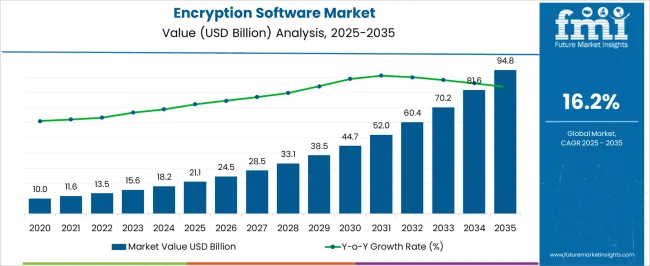
The encryption software market was valued at USD 21.10 billion in 2025, projected to reach USD 24.52 billion in 2026, and is forecast to expand to USD 110.04 billion by 2036 at a 16.2% CAGR. As per FMI, the combination of escalating ransomware attack frequency, expanding data sovereignty mandates, and mandatory encryption provisions embedded in updated regulatory frameworks is converting encryption software from a security best practice into a non-negotiable compliance expenditure line across enterprise IT budgets. Cloud deployment dominates new licence procurement as organisations require encryption capabilities that scale automatically with workload migration to IaaS, PaaS, and SaaS environments.
Summary of Encryption Software Market
- Market snapshot
- The encryption software market is valued at USD 21.10 billion in 2025 and is projected to reach USD 110.04 billion by 2036.
- The industry is expected to grow at a 16.2% CAGR from 2026 to 2036, creating an incremental opportunity of USD 85.52 billion.
- The market is an enterprise cybersecurity infrastructure category where regulatory encryption mandates, zero-trust architecture adoption, and ransomware threat escalation define procurement urgency.
- Demand and growth drivers
- Demand is driven by mandatory encryption provisions in GDPR, HIPAA, PCI DSS, LGPD, PIPL, and NIS2 Directive, converting encryption from discretionary to compliance-required expenditure.
- Zero-trust architecture adoption mandates encryption at every data interaction layer, expanding demand from disk/file encryption to database and communication encryption.
- Ransomware attack frequency escalation is accelerating encryption deployment as a primary data exfiltration prevention control.
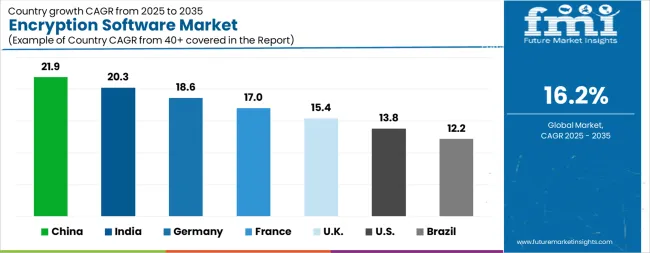
- Among key countries, China leads at 21.9% CAGR, followed by India at 20.3%, Germany at 18.6%, France at 17.0%, the UK at 15.4%, the USA at 13.8%, and Brazil at 12.2%.
- Product and segment view
- Encryption software comprises platform solutions for encrypting data at rest, in transit, and in use across cloud, on-premise, and hybrid enterprise environments.
- Applications include cloud encryption, disk encryption, file/folder encryption, database encryption, communication encryption, and network traffic encryption.
- Cloud Encryption leads by Application with 31.2% share in 2026 as enterprise workload migration to cloud environments drives the largest encryption software deployment category.
- Cloud leads by Deployment Type with 62.4% share in 2026 as organisations require encryption that scales with IaaS, PaaS, and SaaS workload expansion.
- Scope includes encryption software platforms and licences; excludes hardware security modules, VPN appliances, and general endpoint protection platforms without dedicated encryption modules.
- Geography and competitive outlook
- China and India are the fastest-growing markets as data protection laws mandate encryption. The USA and Germany anchor mature compliance demand from BFSI, healthcare, and government sectors.
- Competition is shaped by multi-environment coverage, encryption key lifecycle management, and regulatory compliance reporting capabilities.
- Key players include IBM Corporation, Microsoft, Cisco Systems, Broadcom, McAfee, Check Point Software Technologies, Trend Micro, Oracle, Sophos Ltd., Dell Inc., WinMagic, and Bloombase.
- Analyst opinion at FMI
- Sudip saha, Principal Consultant for Cybersecurity, opines: 'FMI is of the opinion that the encryption software market is being reshaped by the convergence of regulatory penalty economics and zero-trust architecture mandates. Enterprises that deploy encryption selectively across only the most sensitive data stores face audit findings and breach notification penalties that exceed the cost of full-estate encryption deployment. Vendors without unified management consoles that enforce consistent encryption policies across endpoints, databases, and cloud workloads will lose enterprise accounts as CISOs consolidate security tool sprawl. The cloud deployment model dominance is permanent because on-premise encryption management cannot keep pace with the velocity of cloud workload provisioning in DevOps environments.'
- Strategic implications / Executive takeaways
- CISOs must deploy unified encryption management platforms that enforce consistent cryptographic policies across endpoints, databases, cloud storage, and inter-service communications to satisfy zero-trust architecture requirements.
- IT procurement teams should prioritise encryption vendors with automated cloud workload discovery and encryption coverage gap detection to prevent audit exposure from shadow IT data stores.
- Compliance officers must establish encryption coverage metrics tied to regulatory framework requirements and integrate them into quarterly board-level cybersecurity reporting.
Encryption Software Market key takeaways
| Metric | Details |
|---|---|
| Industry Size (2026) | USD 24.52 billion |
| Industry Value (2036) | USD 110.04 billion |
| CAGR (2026 to 2036) | 16.2% |
Source: Future Market Insights, 2026
FMI analysts note that the application landscape is broadening beyond traditional disk and file encryption toward database-level and communication-level encryption as zero-trust architecture adoption mandates encryption at every data interaction layer. Large enterprises are deploying unified encryption management consoles that enforce consistent cryptographic policies across endpoints, databases, cloud storage, and inter-service communication channels. The BFSI and healthcare verticals drive the highest per-seat encryption expenditure because regulatory penalties for unencrypted data breaches in these sectors exceed the annualised cost of enterprise encryption platform licences by multiple orders of magnitude, eliminating the cost-benefit procurement debate.
China leads with a 21.9% CAGR through 2036 as data localisation and cross-border encryption mandates under the Cybersecurity Law and Data Security Law expand enterprise adoption. India follows at 20.3%, driven by DPDP Act compliance and rapid digitisation of BFSI and government operations. Germany registers an 18.6% pace as NIS2 Directive transposition and GDPR enforcement tighten encryption requirements for critical infrastructure operators. France expands at 17.0% on sovereign cloud and data residency encryption mandates. The United Kingdom maintains a 15.4% trajectory driven by ICO enforcement and financial services regulatory encryption expectations. The United States tracks at 13.8%, reflecting mature compliance demand from HIPAA, CMMC, and state privacy law encryption provisions. Brazil records a 12.2% expansion driven by LGPD enforcement and financial sector cybersecurity regulation.
Encryption Software Market definition
Encryption software encompasses platform solutions and application-level tools that apply cryptographic algorithms to protect digital data at rest, in transit, and in use across enterprise IT environments. The category covers cloud encryption, disk and file-level encryption, database encryption, communication encryption, and network traffic encryption deployed through cloud-delivered or on-premise software installations serving regulated and commercial enterprises.
Encryption Software Market inclusions
Market scope includes encryption platform licences, subscription services, and cloud-native encryption modules across all application categories. The report covers global and regional market sizes for 2026 to 2036 with segment breakdowns by application, deployment type, user type, and industry vertical.
Encryption Software Market exclusions
The scope excludes hardware security module appliances, standalone VPN gateway devices, endpoint detection and response platforms, and identity and access management solutions without integrated encryption key management.
Encryption Software Market research methodology
- Primary research: Analysts engaged with enterprise CISOs, IT security architects, and cloud platform security leads to map encryption software procurement criteria and deployment prioritisation.
- Desk research: Data collection aggregated regulatory framework encryption requirement specifications, data breach cost studies, and published enterprise cybersecurity spending benchmarks.
- Market sizing and forecasting: Baseline values derive from a bottom-up aggregation of encryption software licence revenues and cloud subscription values, applying regulatory mandate-driven adoption curves by vertical and geography.
- Data validation and update cycle: Projections are cross-validated against published cybersecurity company revenue disclosures and enterprise IT security budget survey data from industry associations.
Why is the Encryption Software Market Growing?
The Encryption Software market is witnessing significant growth, driven by the increasing need for secure data storage, transmission, and processing across industries. Rising cyber threats, regulatory compliance requirements, and growing adoption of cloud computing are compelling organizations to implement robust encryption solutions. The market is being shaped by advancements in cryptographic algorithms, secure key management systems, and integration with enterprise security platforms.
Cloud-based encryption solutions are increasingly deployed to provide scalable and flexible security for data residing both on-premises and in cloud environments. Organizations are leveraging encryption software to protect sensitive customer information, intellectual property, and financial data while ensuring adherence to data privacy regulations.
The growing focus on remote work, digital transformation, and cross-border data transfer is further driving adoption As enterprises prioritize cybersecurity strategies and risk mitigation measures, the encryption software market is expected to maintain strong momentum, with innovative solutions enhancing protection, compliance, and operational efficiency across diverse sectors.
Segmental Analysis
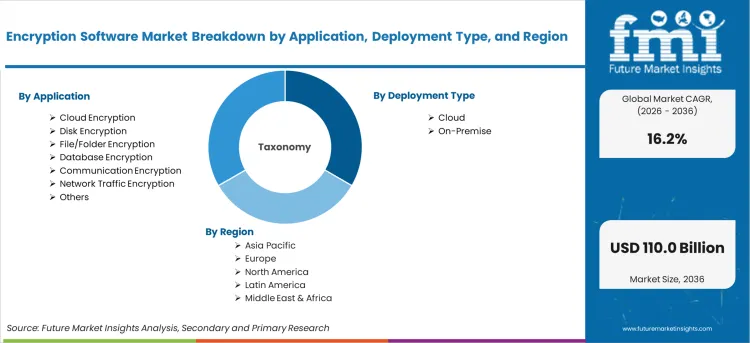
The encryption software market is segmented by application, deployment type, user type, industry vertical, and geographic regions. By application, encryption software market is divided into Cloud Encryption, Disk Encryption, File/Folder Encryption, Database Encryption, Communication Encryption, Network Traffic Encryption, and Others. In terms of deployment type, encryption software market is classified into Cloud and On-Premise. Based on user type, encryption software market is segmented into Large Enterprises and Small And Medium Enterprises (SMEs). By industry vertical, encryption software market is segmented into BFSI, Healthcare, Government & Public Sector, IT & Telecom, Retail, Aerospace & Defense, Manufacturing, and Others. Regionally, the encryption software industry is classified into North America, Latin America, Western Europe, Eastern Europe, Balkan & Baltic Countries, Russia & Belarus, Central Asia, East Asia, South Asia & Pacific, and the Middle East & Africa.
Insights into the Cloud Encryption Application Segment
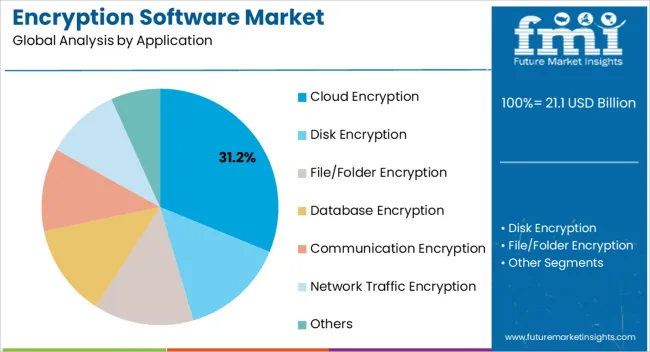
The cloud encryption application segment is projected to hold 31.2% of the market revenue in 2026, establishing it as the leading application category. Growth in this segment is being driven by the increasing migration of sensitive data to cloud environments and the need to ensure data confidentiality, integrity, and regulatory compliance. Cloud encryption solutions enable secure storage and transmission of information while providing centralized key management, access control, and real-time monitoring capabilities.
These solutions support multi-tenant environments, allowing enterprises to safeguard data across various cloud platforms without compromising performance or accessibility. Organizations are increasingly adopting cloud encryption to protect critical business information, reduce the risk of data breaches, and facilitate secure collaboration.
The ability to integrate encryption capabilities with existing cloud applications and enterprise systems enhances operational efficiency and scalability As cloud adoption accelerates globally, cloud encryption is expected to remain the primary driver of market growth, supported by continuous innovation in encryption standards, algorithms, and management tools.
Insights into the Cloud Deployment Type Segment
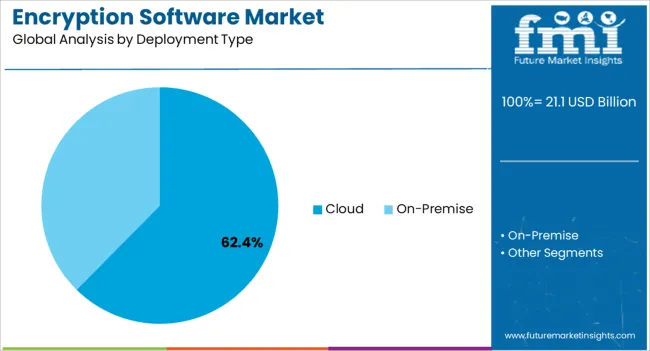
The cloud deployment type segment is anticipated to account for 62.4% of the market revenue in 2026, making it the leading deployment model. Its growth is being driven by the scalability, flexibility, and cost-effectiveness of cloud-based encryption solutions compared to traditional on-premises systems. Cloud deployment allows organizations to secure large volumes of data with minimal infrastructure investment while providing centralized management and real-time updates.
The ability to deploy encryption software across multiple geographies and integrate with cloud-native applications further enhances adoption. Enterprises benefit from reduced maintenance overhead, faster implementation cycles, and improved compliance with global data privacy regulations.
The increasing demand for remote collaboration, virtual work environments, and digital transformation initiatives is accelerating cloud deployment As organizations continue to embrace cloud strategies, this segment is expected to maintain its market dominance, supported by advancements in cloud security, encryption algorithms, and enterprise-grade management tools.
Insights into the Large Enterprises User Type Segment
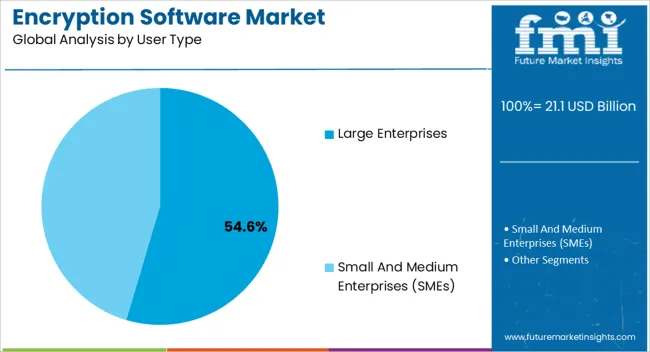
The large enterprises user type segment is projected to hold 54.6% of the market revenue in 2026, establishing it as the leading user category. Growth in this segment is being driven by the extensive data volumes and complex security requirements of large organizations operating across multiple locations and industries.
These enterprises are increasingly adopting encryption software to safeguard sensitive financial, customer, and operational data while ensuring compliance with regulatory standards. Large enterprises benefit from advanced encryption features such as centralized key management, access controls, and real-time monitoring, which enable effective risk mitigation and operational efficiency.
The ability to deploy encryption solutions at scale, integrate with existing IT infrastructure, and support hybrid cloud environments further reinforces adoption With rising cyber threats, regulatory scrutiny, and the need for secure cross-border data transfers, large enterprises are expected to remain the primary users driving market growth, leveraging encryption software to protect critical information assets and maintain trust among stakeholders.
Market Overview
Encryption Software Market Overview
Chrome now puts a little warning marker in the Address Bar next to any non-secure HTTP address. Encryption is very important, and not only for surfing. If you encrypt all of the sensitive documents on your computer, a hacker or laptop thief won't be able to parley their possession into identity theft, bank account takeover, or worse.
Recent developments in the mobile technology in terms of software and hardware, their distribution among businesses, and the increasing penetration of smartphones are further projected to offshoot the demand over the coming years. The increased number of enterprises moving toward cloud computing, combined with the Big data, demand the protection of sensitive data, thus raising the deployment for encryption software.
Analysis of Encryption Software Market By Key Countries
.webp "Top Country Growth Comparison Encryption Software Market Cagr (2026 2036)")
| Country | CAGR |
|---|---|
| China | 21.9% |
| India | 20.3% |
| Germany | 18.6% |
| France | 17.0% |
| UK | 15.4% |
| USA | 13.8% |
| Brazil | 12.2% |
Source: FMI analysis based on primary research and proprietary forecasting model
Country-wise Analysis
The Encryption Software Market is expected to register a CAGR of 16.2% during the forecast period, exhibiting varied country level momentum. China leads with the highest CAGR of 21.9%, followed by India at 20.3%. Developed markets such as Germany, France, and the UK continue to expand steadily, while the USA is likely to grow at consistent rates. Brazil posts the lowest CAGR at 12.2%, yet still underscores a broadly positive trajectory for the global Encryption Software Market. In 2024, Germany held a dominant revenue in the Western Europe market and is expected to grow with a CAGR of 18.6%. The USA Encryption Software Market is estimated to be valued at USD 7.4 billion in 2026 and is anticipated to reach a valuation of USD 26.7 billion by 2036. Sales are projected to rise at a CAGR of 13.8% over the forecast period between 2026 and 2036. While Japan and South Korea markets are estimated to be valued at USD 1.0 billion and USD 569.8 million respectively in 2026.
Key Players in the Encryption Software Market
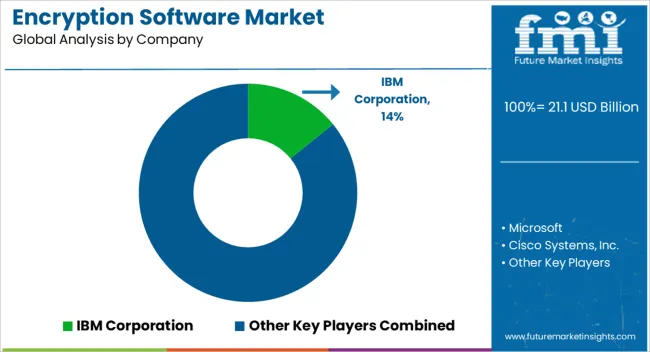
- IBM Corporation
- Microsoft
- Cisco Systems, Inc.
- Broadcom
- McAfee, LLC
- Check Point Software Technologies Ltd.
- Trend Micro Incorporated
- Oracle
- Sophos Ltd.
- Dell Inc.
- WinMagic
- Bloombase
Scope of the report
| Metric | Value |
|---|---|
| Quantitative Units | USD 24.52 billion to USD 110.04 billion, at a CAGR of 16.2% |
| Market Definition | Encryption software covers platform solutions applying cryptographic algorithms to protect data at rest, in transit, and in use across cloud, on-premise, and hybrid enterprise environments. |
| Application Segmentation | Cloud Encryption, Disk Encryption, File/Folder Encryption, Database Encryption, Communication Encryption, Network Traffic Encryption, Others |
| Deployment Type Segmentation | Cloud, On-Premise |
| User Type Segmentation | Large Enterprises, Small and Medium Enterprises |
| Industry Vertical Segmentation | BFSI, Healthcare, Government & Public Sector, IT & Telecom, Retail, Aerospace & Defense, Manufacturing, Others |
| Regions Covered | North America, Latin America, Europe, East Asia, South Asia, Oceania, Middle East & Africa |
| Countries Covered | China, India, Germany, France, UK, USA, Brazil, and 40 plus countries |
| Key Companies Profiled | IBM Corporation, Microsoft, Cisco Systems, Broadcom, McAfee, Check Point Software Technologies, Trend Micro, Oracle, Sophos Ltd., Dell Inc., WinMagic, Bloombase |
| Forecast Period | 2026 to 2036 |
| Approach | Bottom-up methodology starting with encryption software revenues, projecting regulatory mandate-driven adoption by vertical and geography. |
Encryption Software Market by Segments
Application:
- Cloud Encryption
- Disk Encryption
- File/Folder Encryption
- Database Encryption
- Communication Encryption
- Network Traffic Encryption
- Others
Deployment Type:
- Cloud
- On-Premise
User Type:
- Large Enterprises
- Small And Medium Enterprises (SMEs)
Industry Vertical:
- BFSI
- Healthcare
- Government & Public Sector
- IT & Telecom
- Retail
- Aerospace & Defense
- Manufacturing
- Others
Region:
- North America
- USA
- Canada
- Mexico
- Latin America
- Brazil
- Chile
- Rest of Latin America
- Western Europe
- Germany
- UK
- Italy
- Spain
- France
- Nordic
- BENELUX
- Rest of Western Europe
- Eastern Europe
- Russia
- Poland
- Hungary
- Balkan & Baltic
- Rest of Eastern Europe
- East Asia
- China
- Japan
- South Korea
- South Asia and Pacific
- India
- ASEAN
- Australia & New Zealand
- Rest of South Asia and Pacific
- Middle East & Africa
- Kingdom of Saudi Arabia
- Other GCC Countries
- Turkiye
- South Africa
- Other African Union
- Rest of Middle East & Africa
Bibliography
- 1. National Institute of Standards and Technology. (2024). FIPS 140-3: Security requirements for cryptographic modules. NIST.
- 2. European Union Agency for Cybersecurity. (2024). Encryption best practices for NIS2 Directive compliance. ENISA.
- 3. PCI Security Standards Council. (2024). PCI DSS v4.0: Data encryption and key management requirements. PCI SSC.
- 4. United States Department of Defense. (2024). CMMC 2.0: Encryption requirements for controlled unclassified information. DoD.
- 5. Autoridade Nacional de Protecao de Dados. (2024). LGPD enforcement guidance: Technical security measures including encryption. ANPD.
- 6. Organisation for Economic Co-operation and Development. (2024). Digital security risk management: Cryptographic policy frameworks. OECD.
This bibliography is provided for reader reference. The full Future Market Insights report contains the complete reference list with primary research documentation.
Frequently Asked Questions
How large is the demand for encryption software in 2026?
Demand for encryption software in the global market is estimated to be valued at USD 24.52 billion in 2026.
What will be the market size by 2036?
Market size for encryption software is projected to reach USD 110.04 billion by 2036.
What is the expected demand growth between 2026 and 2036?
Demand for encryption software is expected to grow at a CAGR of 16.2% between 2026 and 2036.
Which Application leads in 2026?
Cloud Encryption accounts for 31.2% in 2026 as enterprise workload migration to cloud environments drives the largest deployment category.
Which Deployment Type leads in 2026?
Cloud accounts for 62.4% in 2026 as organisations require encryption scaling with IaaS, PaaS, and SaaS workload expansion.
What is driving demand in China?
Data localisation and cross-border encryption mandates under the Cybersecurity Law and Data Security Law are expanding mandatory enterprise adoption.
What is included in the scope?
The scope covers encryption platform licences and cloud subscriptions; excludes HSM hardware, VPN appliances, and endpoint protection without encryption modules.
Preview the report firsthand - request a free sample
Get SampleGet the brochure for pricing and purchase details.
Get PDFTable of Content
- Executive Summary
- Global Market Outlook
- Demand-side Trends
- Supply-side Trends
- Technology Roadmap Analysis
- Analysis and Recommendations
- Market Overview
- Market Coverage / Taxonomy
- Market Definition / Scope / Limitations
- Research Methodology
- Chapter Orientation
- Analytical Lens and Working Hypotheses
- Market Structure, Signals, and Trend Drivers
- Benchmarking and Cross-market Comparability
- Market Sizing, Forecasting, and Opportunity Mapping
- Research Design and Evidence Framework
- Desk Research Programme (Secondary Evidence)
- Company Annual and Sustainability Reports
- Peer-reviewed Journals and Academic Literature
- Corporate Websites, Product Literature, and Technical Notes
- Earnings Decks and Investor Briefings
- Statutory Filings and Regulatory Disclosures
- Technical White Papers and Standards Notes
- Trade Journals, Industry Magazines, and Analyst Briefs
- Conference Proceedings, Webinars, and Seminar Materials
- Government Statistics Portals and Public Data Releases
- Press Releases and Reputable Media Coverage
- Specialist Newsletters and Curated Briefings
- Sector Databases and Reference Repositories
- FMI Internal Proprietary Databases and Historical Market Datasets
- Subscription Datasets and Paid Sources
- Social Channels, Communities, and Digital Listening Inputs
- Additional Desk Sources
- Expert Input and Fieldwork (Primary Evidence)
- Primary Modes
- Qualitative Interviews and Expert Elicitation
- Quantitative Surveys and Structured Data Capture
- Blended Approach
- Why Primary Evidence is Used
- Field Techniques
- Interviews
- Technical Specialists
- Domain Subject-matter Experts
- Scientists
- Physicians and Other Healthcare Professionals
- Governance, Ethics, and Data Stewardship
- Research Ethics
- Data Integrity and Handling
- Primary Modes
- Tooling, Models, and Reference Databases
- Desk Research Programme (Secondary Evidence)
- Data Engineering and Model Build
- Data Acquisition and Ingestion
- Cleaning, Normalisation, and Verification
- Synthesis, Triangulation, and Analysis
- Quality Assurance and Audit Trail
- Market Background
- Market Dynamics
- Drivers
- Restraints
- Opportunity
- Trends
- Scenario Forecast
- Demand in Optimistic Scenario
- Demand in Likely Scenario
- Demand in Conservative Scenario
- Opportunity Map Analysis
- Product Life Cycle Analysis
- Supply Chain Analysis
- Investment Feasibility Matrix
- Value Chain Analysis
- PESTLE and Porter’s Analysis
- Regulatory Landscape
- Regional Parent Market Outlook
- Production and Consumption Statistics
- Import and Export Statistics
- Market Dynamics
- Global Market Analysis 2021 to 2025 and Forecast, 2026 to 2036
- Historical Market Size Value (USD Million) Analysis, 2021 to 2025
- Current and Future Market Size Value (USD Million) Projections, 2026 to 2036
- Y-o-Y Growth Trend Analysis
- Absolute $ Opportunity Analysis
- Global Market Pricing Analysis 2021 to 2025 and Forecast 2026 to 2036
- Global Market Analysis 2021 to 2025 and Forecast 2026 to 2036, By Application
- Introduction / Key Findings
- Historical Market Size Value (USD Million) Analysis By Application , 2021 to 2025
- Current and Future Market Size Value (USD Million) Analysis and Forecast By Application , 2026 to 2036
- Cloud Encryption
- Disk Encryption
- File/Folder Encryption
- Database Encryption
- Communication Encryption
- Network Traffic Encryption
- Others
- Cloud Encryption
- Y-o-Y Growth Trend Analysis By Application , 2021 to 2025
- Absolute $ Opportunity Analysis By Application , 2026 to 2036
- Global Market Analysis 2021 to 2025 and Forecast 2026 to 2036, By Deployment Type
- Introduction / Key Findings
- Historical Market Size Value (USD Million) Analysis By Deployment Type, 2021 to 2025
- Current and Future Market Size Value (USD Million) Analysis and Forecast By Deployment Type, 2026 to 2036
- Cloud
- On-Premise
- Cloud
- Y-o-Y Growth Trend Analysis By Deployment Type, 2021 to 2025
- Absolute $ Opportunity Analysis By Deployment Type, 2026 to 2036
- Global Market Analysis 2021 to 2025 and Forecast 2026 to 2036, By User Type
- Introduction / Key Findings
- Historical Market Size Value (USD Million) Analysis By User Type, 2021 to 2025
- Current and Future Market Size Value (USD Million) Analysis and Forecast By User Type, 2026 to 2036
- Large Enterprises
- Small And Medium Enterprises
- Large Enterprises
- Y-o-Y Growth Trend Analysis By User Type, 2021 to 2025
- Absolute $ Opportunity Analysis By User Type, 2026 to 2036
- Global Market Analysis 2021 to 2025 and Forecast 2026 to 2036, By Industry Vertical
- Introduction / Key Findings
- Historical Market Size Value (USD Million) Analysis By Industry Vertical, 2021 to 2025
- Current and Future Market Size Value (USD Million) Analysis and Forecast By Industry Vertical, 2026 to 2036
- BFSI
- Healthcare
- Government & Public Sector
- IT & Telecom
- Retail
- Aerospace & Defense
- Manufacturing
- Others
- BFSI
- Y-o-Y Growth Trend Analysis By Industry Vertical, 2021 to 2025
- Absolute $ Opportunity Analysis By Industry Vertical, 2026 to 2036
- Global Market Analysis 2021 to 2025 and Forecast 2026 to 2036, By Region
- Introduction
- Historical Market Size Value (USD Million) Analysis By Region, 2021 to 2025
- Current Market Size Value (USD Million) Analysis and Forecast By Region, 2026 to 2036
- North America
- Latin America
- Western Europe
- Eastern Europe
- East Asia
- South Asia and Pacific
- Middle East & Africa
- Market Attractiveness Analysis By Region
- North America Market Analysis 2021 to 2025 and Forecast 2026 to 2036, By Country
- Historical Market Size Value (USD Million) Trend Analysis By Market Taxonomy, 2021 to 2025
- Market Size Value (USD Million) Forecast By Market Taxonomy, 2026 to 2036
- By Country
- USA
- Canada
- Mexico
- By Application
- By Deployment Type
- By User Type
- By Industry Vertical
- By Country
- Market Attractiveness Analysis
- By Country
- By Application
- By Deployment Type
- By User Type
- By Industry Vertical
- Key Takeaways
- Latin America Market Analysis 2021 to 2025 and Forecast 2026 to 2036, By Country
- Historical Market Size Value (USD Million) Trend Analysis By Market Taxonomy, 2021 to 2025
- Market Size Value (USD Million) Forecast By Market Taxonomy, 2026 to 2036
- By Country
- Brazil
- Chile
- Rest of Latin America
- By Application
- By Deployment Type
- By User Type
- By Industry Vertical
- By Country
- Market Attractiveness Analysis
- By Country
- By Application
- By Deployment Type
- By User Type
- By Industry Vertical
- Key Takeaways
- Western Europe Market Analysis 2021 to 2025 and Forecast 2026 to 2036, By Country
- Historical Market Size Value (USD Million) Trend Analysis By Market Taxonomy, 2021 to 2025
- Market Size Value (USD Million) Forecast By Market Taxonomy, 2026 to 2036
- By Country
- Germany
- UK
- Italy
- Spain
- France
- Nordic
- BENELUX
- Rest of Western Europe
- By Application
- By Deployment Type
- By User Type
- By Industry Vertical
- By Country
- Market Attractiveness Analysis
- By Country
- By Application
- By Deployment Type
- By User Type
- By Industry Vertical
- Key Takeaways
- Eastern Europe Market Analysis 2021 to 2025 and Forecast 2026 to 2036, By Country
- Historical Market Size Value (USD Million) Trend Analysis By Market Taxonomy, 2021 to 2025
- Market Size Value (USD Million) Forecast By Market Taxonomy, 2026 to 2036
- By Country
- Russia
- Poland
- Hungary
- Balkan & Baltic
- Rest of Eastern Europe
- By Application
- By Deployment Type
- By User Type
- By Industry Vertical
- By Country
- Market Attractiveness Analysis
- By Country
- By Application
- By Deployment Type
- By User Type
- By Industry Vertical
- Key Takeaways
- East Asia Market Analysis 2021 to 2025 and Forecast 2026 to 2036, By Country
- Historical Market Size Value (USD Million) Trend Analysis By Market Taxonomy, 2021 to 2025
- Market Size Value (USD Million) Forecast By Market Taxonomy, 2026 to 2036
- By Country
- China
- Japan
- South Korea
- By Application
- By Deployment Type
- By User Type
- By Industry Vertical
- By Country
- Market Attractiveness Analysis
- By Country
- By Application
- By Deployment Type
- By User Type
- By Industry Vertical
- Key Takeaways
- South Asia and Pacific Market Analysis 2021 to 2025 and Forecast 2026 to 2036, By Country
- Historical Market Size Value (USD Million) Trend Analysis By Market Taxonomy, 2021 to 2025
- Market Size Value (USD Million) Forecast By Market Taxonomy, 2026 to 2036
- By Country
- India
- ASEAN
- Australia & New Zealand
- Rest of South Asia and Pacific
- By Application
- By Deployment Type
- By User Type
- By Industry Vertical
- By Country
- Market Attractiveness Analysis
- By Country
- By Application
- By Deployment Type
- By User Type
- By Industry Vertical
- Key Takeaways
- Middle East & Africa Market Analysis 2021 to 2025 and Forecast 2026 to 2036, By Country
- Historical Market Size Value (USD Million) Trend Analysis By Market Taxonomy, 2021 to 2025
- Market Size Value (USD Million) Forecast By Market Taxonomy, 2026 to 2036
- By Country
- Kingdom of Saudi Arabia
- Other GCC Countries
- Turkiye
- South Africa
- Other African Union
- Rest of Middle East & Africa
- By Application
- By Deployment Type
- By User Type
- By Industry Vertical
- By Country
- Market Attractiveness Analysis
- By Country
- By Application
- By Deployment Type
- By User Type
- By Industry Vertical
- Key Takeaways
- Key Countries Market Analysis
- USA
- Pricing Analysis
- Market Share Analysis, 2025
- By Application
- By Deployment Type
- By User Type
- By Industry Vertical
- Canada
- Pricing Analysis
- Market Share Analysis, 2025
- By Application
- By Deployment Type
- By User Type
- By Industry Vertical
- Mexico
- Pricing Analysis
- Market Share Analysis, 2025
- By Application
- By Deployment Type
- By User Type
- By Industry Vertical
- Brazil
- Pricing Analysis
- Market Share Analysis, 2025
- By Application
- By Deployment Type
- By User Type
- By Industry Vertical
- Chile
- Pricing Analysis
- Market Share Analysis, 2025
- By Application
- By Deployment Type
- By User Type
- By Industry Vertical
- Germany
- Pricing Analysis
- Market Share Analysis, 2025
- By Application
- By Deployment Type
- By User Type
- By Industry Vertical
- UK
- Pricing Analysis
- Market Share Analysis, 2025
- By Application
- By Deployment Type
- By User Type
- By Industry Vertical
- Italy
- Pricing Analysis
- Market Share Analysis, 2025
- By Application
- By Deployment Type
- By User Type
- By Industry Vertical
- Spain
- Pricing Analysis
- Market Share Analysis, 2025
- By Application
- By Deployment Type
- By User Type
- By Industry Vertical
- France
- Pricing Analysis
- Market Share Analysis, 2025
- By Application
- By Deployment Type
- By User Type
- By Industry Vertical
- India
- Pricing Analysis
- Market Share Analysis, 2025
- By Application
- By Deployment Type
- By User Type
- By Industry Vertical
- ASEAN
- Pricing Analysis
- Market Share Analysis, 2025
- By Application
- By Deployment Type
- By User Type
- By Industry Vertical
- Australia & New Zealand
- Pricing Analysis
- Market Share Analysis, 2025
- By Application
- By Deployment Type
- By User Type
- By Industry Vertical
- China
- Pricing Analysis
- Market Share Analysis, 2025
- By Application
- By Deployment Type
- By User Type
- By Industry Vertical
- Japan
- Pricing Analysis
- Market Share Analysis, 2025
- By Application
- By Deployment Type
- By User Type
- By Industry Vertical
- South Korea
- Pricing Analysis
- Market Share Analysis, 2025
- By Application
- By Deployment Type
- By User Type
- By Industry Vertical
- Russia
- Pricing Analysis
- Market Share Analysis, 2025
- By Application
- By Deployment Type
- By User Type
- By Industry Vertical
- Poland
- Pricing Analysis
- Market Share Analysis, 2025
- By Application
- By Deployment Type
- By User Type
- By Industry Vertical
- Hungary
- Pricing Analysis
- Market Share Analysis, 2025
- By Application
- By Deployment Type
- By User Type
- By Industry Vertical
- Kingdom of Saudi Arabia
- Pricing Analysis
- Market Share Analysis, 2025
- By Application
- By Deployment Type
- By User Type
- By Industry Vertical
- Turkiye
- Pricing Analysis
- Market Share Analysis, 2025
- By Application
- By Deployment Type
- By User Type
- By Industry Vertical
- South Africa
- Pricing Analysis
- Market Share Analysis, 2025
- By Application
- By Deployment Type
- By User Type
- By Industry Vertical
- USA
- Market Structure Analysis
- Competition Dashboard
- Competition Benchmarking
- Market Share Analysis of Top Players
- By Regional
- By Application
- By Deployment Type
- By User Type
- By Industry Vertical
- Competition Analysis
- Competition Deep Dive
- IBM Corporation
- Overview
- Product Portfolio
- Profitability by Market Segments (Product/Age /Sales Channel/Region)
- Sales Footprint
- Strategy Overview
- Marketing Strategy
- Product Strategy
- Channel Strategy
- Microsoft
- Cisco Systems, Inc.
- Broadcom
- McAfee, LLC
- Check Point Software Technologies Ltd.
- Trend Micro Incorporated
- Oracle
- Sophos Ltd.
- Dell Inc.
- WinMagic
- Bloombase
- IBM Corporation
- Competition Deep Dive
- Assumptions & Acronyms Used


