

- Industry Size (2026)
- USD 2.26 Bn
- Forecast (2036)
- USD 6.08 Bn
- CAGR (2026 to 2036)
- 10.4%
Outdoor Payment Terminal Market Size, Market Forecast and Outlook By FMI
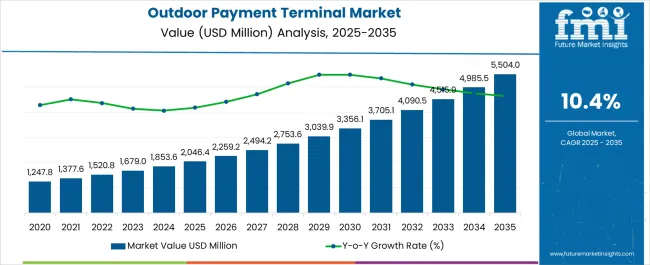
The outdoor payment terminal market was valued at USD 2.05 billion in 2025, projected to reach USD 2.26 billion in 2026, and is forecast to expand to USD 6.08 billion by 2036 at a 10.4% CAGR. Based on FMI's analysis, FMI analysts observe that the outdoor payment terminal market is being reshaped by two converging forces: the global EMV migration mandate that requires chip-capable terminals at every unattended payment point, and the rapid adoption of contactless payment methods that demand NFC-enabled hardware. Fuel retail, which represents the single largest outdoor payment application, is in the midst of a multi-billion-dollar terminal replacement cycle as legacy magnetic-stripe-only dispensers are upgraded to meet card network EMV liability shift deadlines.
Summary of Outdoor Payment Terminal Market
- Market Snapshot
- The outdoor payment terminal market is valued at USD 2.05 billion in 2025 and is projected to reach USD 6.08 billion by 2036.
- The industry is expected to grow at a 10.4% CAGR from 2026 to 2036, creating an incremental opportunity of USD 3.82 billion.
- The market is positioned within the payment technology and fuel retail infrastructure sector, where regulatory compliance, consumer preferences, and technology adoption define competitive entry barriers.
- Demand and Growth Drivers
- EMV liability shift at fuel dispensers: Visa and Mastercard enforced the EMV liability shift for automated fuel dispensers in the United States in April 2021, making fuel retailers financially liable for counterfeit fraud at non-EMV terminals.
- EV charging payment infrastructure build-out: The US National Electric Vehicle Infrastructure (NEVI) Formula Program requires all federally funded EV chargers to accept contactless payment cards without requiring a mobile app or account.
- Contactless transit fare collection expansion: Transit authorities in London, New York, Singapore, and Sydney have implemented open-loop contactless payment acceptance on buses and rail systems, replacing proprietary fare cards with bank-issued contactless cards and mobile wallets.
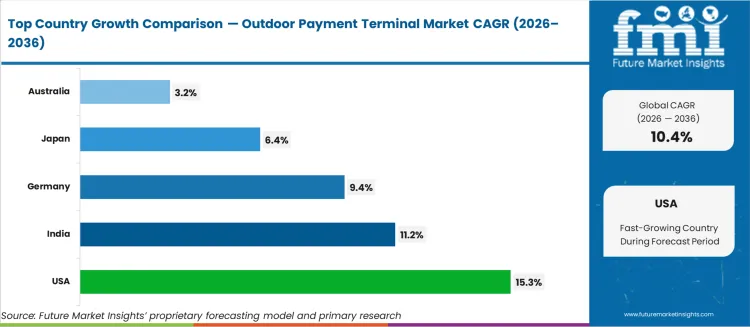
- As per FMI, among key countries, USA leads at 15.3% CAGR, followed by Germany at 9.4%, Japan at 6.4%, and India at 11.2%.
- Product and Segment View
- The market includes outdoor payment terminals are ruggedized, weather-resistant electronic payment acceptance devices designed for unattended or semi-attended outdoor environments including fuel dispensers, parking meters, ev charging stations, transit kiosks, and vending installations.
- Contactless Outdoor leads by Type with 58.3% share in 2026.
- Refuel leads by Application with 47.6% share in 2026.
- Scope includes outdoor payment terminals sold globally to fuel retailers, parking operators, ev charging networks, transit authorities, and unattended retail operators. The scope excludes indoor point-of-sale (POS) terminals, mobile card readers (Square, SumUp), cash-handling machines (ATMs, coin acceptors), and software-only payment processing platforms.
- Geography and Competitive Outlook
- USA and Germany are the fastest-growing markets, while Australia and India represent mature demand bases.
- Competition is shaped by Dover Fueling Solutions and Invenco Group compete in the fuel dispenser payment module niche.
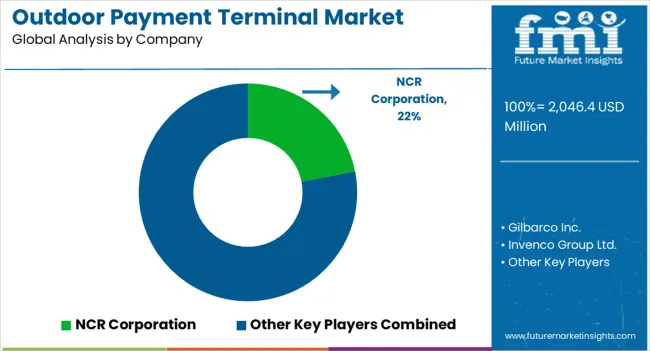
- Key companies include NCR Corporation, Gilbarco Inc., Invenco Group Ltd., Verifone, Inc., Dover Fueling Solutions, Scheidt & Bachmann GmbH, Apple Inc., Temenos AG.
- Analyst Opinion at FMI
- Sudip saha, Principal Consultant for Payment Technology, opines: 'The structural transition is the migration from single-purpose payment terminals to multi-application outdoor kiosks that combine payment acceptance with loyalty program enrollment, fleet card processing, mobile app integration, and real-time fuel pricing display. Contactless outdoor terminals now account for 58.3% of new shipments, driven by consumer preference for tap-to-pay convenience and card network incentives that reduce interchange fees for contactless transactions at unattended locations.'
- Strategic Implications / Executive Takeaways
- Procurement directors should evaluate supplier qualification timelines against planned expansion to avoid delays tied to sourcing dependencies in outdoor payment terminal.
- Product development teams must integrate evolving regulatory and performance specifications into design phases to maintain compliance across target markets.
- Channel strategy leaders should benchmark direct distribution capabilities against wholesale and e-commerce models to optimize margin capture and market reach.
The structural transition is the migration from single-purpose payment terminals to multi-application outdoor kiosks that combine payment acceptance with loyalty program enrollment, fleet card processing, mobile app integration, and real-time fuel pricing display. Contactless outdoor terminals now account for 58.3% of new shipments, driven by consumer preference for tap-to-pay convenience and card network incentives that reduce interchange fees for contactless transactions at unattended locations.
As per FMI, country-level growth trajectories reflect distinct market structures. USA leads at 15.3% CAGR, Germany registers at 9.4% CAGR, Japan registers at 6.4% CAGR, Australia registers at 3.2% CAGR, India registers at 11.2% CAGR.
Outdoor Payment Terminal Market Key Takeaways
| Metric | Details |
|---|---|
| Industry Size (2026) | USD 2.26 Billion |
| Industry Value (2036) | USD 6.08 Billion |
| CAGR (2026-2036) | 10.4% |
Source: Future Market Insights, 2026
Outdoor Payment Terminal Market Definition
Outdoor payment terminals are ruggedized, weather-resistant electronic payment acceptance devices designed for unattended or semi-attended outdoor environments including fuel dispensers, parking meters, EV charging stations, transit kiosks, and vending installations. These terminals process contactless (NFC/RFID), chip (EMV), magnetic stripe, and mobile wallet transactions while withstanding temperature extremes, moisture, dust, UV exposure, and vandalism. The category includes integrated dispenser payment modules, standalone outdoor PIN pads, and full-featured self-service payment kiosks.
Outdoor Payment Terminal Market Inclusions
Market scope covers outdoor payment terminals sold globally to fuel retailers, parking operators, EV charging networks, transit authorities, and unattended retail operators. The report includes regional and country-level market sizes, forecast values from 2026 to 2036, segmentation by type and application, along with competitive landscape, EMV migration analysis, and contactless adoption trend assessment.
Outdoor Payment Terminal Market Exclusions
The scope excludes indoor point-of-sale (POS) terminals, mobile card readers (Square, SumUp), cash-handling machines (ATMs, coin acceptors), and software-only payment processing platforms. In-store self-checkout systems installed within enclosed retail environments are also omitted.
Outdoor Payment Terminal Market Research Methodology
- Primary Research: Analysts engaged with payment technology and fuel retail infrastructure specialists, procurement managers, and end-user operators to map purchase decision triggers and replacement cycles.
- Desk Research: Data collection aggregated regulatory filings, trade association publications, company annual reports, and government statistics across all covered regions.
- Market-Sizing and Forecasting: Baseline values derive from a bottom-up aggregation of product shipments and contract values, applying region-specific adoption curves to project forward demand through 2036.
- Data Validation and Update Cycle: Projections are cross-validated against publicly reported revenue guidance from leading industry participants and independent tracking data.
Impact of Smartphone Penetration on Future Adoption of OPT
The increased usage of smartphones, as well as consumer awareness of online payments, face recognition, fingerprint software for smartphones, and the availability of online groceries, clothes, and electric items, is boosting demand for smart payment systems such as OPT.
Users have increased customer trust by providing a layer of authentication to payment gateways in order to safeguard information. Furthermore, real-time payment technology provides payment access 24 hours a day, seven days a week.
Challenges Restricting the Global Outdoor Payment Terminal Market
When deciding on new technologies, such as outdoor payment terminals (OTP), UPI, debit cards, and Internet banking, cost is a crucial factor to consider. High-security applications are usually costly. In most cases, the expense of integrating or giving access to an online payment gateway program is prohibitively high.
The high cost of components for real-time payment solutions, as well as the expense of introducing payment gateways into the online payment industry, is hindering market expansion. Furthermore, the installation of tight security to safeguard the interests of others is an expensive component. These are significant factors that limit the need for technology in both private and public enterprises.
As a result, high prices and complex implementation are projected to stymie the market's growth throughout the forecast period.
Regional Insights in the Outdoor Payment Terminal Market
.webp "Top Country Growth Comparison Outdoor Payment Terminal Market Cagr (2026 2036)")
| Countries | Market Share (2026) |
|---|---|
| United States | 15.3% |
| Germany | 9.4% |
| Japan | 6.4% |
| Australia | 3.2 |
Country-wise Insights in the Outdoor Payment Terminal Market
How is the United States Outdoor Payment Terminal Industry Faring?
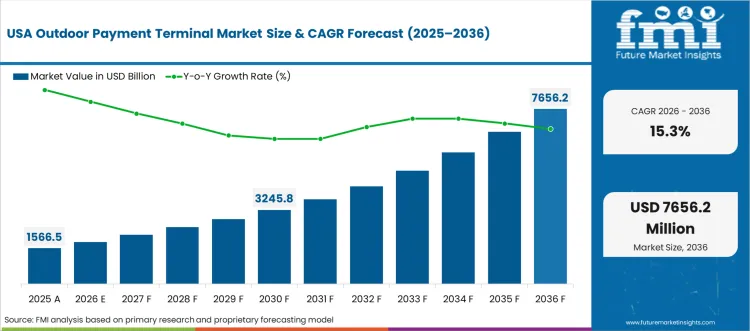
The United States dominated the outdoor payment terminal market, accounting for 15.6% of revenue in 2026. People in the United States are increasingly interested in payment methods such as credit, debit, and prepaid cards, which are driving the expansion of the outdoor payment terminals industry.
At the same time, the country's expanding number of self-service retail establishments is boosting development. Furthermore, the existence of important competitors in the area, such as MasterCard and Visa, among others, bodes well for market expansion.
Why is China’s Outdoor Payment Terminal Market Considered Lucrative?
The surge in the Adoption of Cloud-based Software to Boost Market Growth
The market for outdoor payment terminals in China is predicted to grow at a rapid rate during the forecast period. China is incorporating cloud-based software into OPTs. According to Future Market Insights, China is forecast to register a CAGR of 12.2% from 2026 to 2036.
This adoption simplifies operations by keeping data on a server, eliminating the need to set up an on-premise server for data storage. As a result, enterprises save money at the expense of developing infrastructure.
Category-wise Insights in the Outdoor Payment Terminal Market
By Application, which Outdoor Payment Terminals are expected to gain Momentum?
According to Future Market Insights, in 2026, the outdoor payment terminals malls accounted for 27.8% of revenue. Smart fueling is growing more popular as customers receive flexible payment choices with security requirements, reducing traffic at stations and making it easier for suppliers to control traffic.
Apart from that, the transaction records on OPTs are utilized to generate statistical data to investigate individuals' refueling patterns. This information enables suppliers to provide more accurate services and to implement cost-cutting techniques, such as moving working hours to peak hours. Furthermore, it eliminates the need for drivers to carry cash and decreases the hazards associated with lengthier travel routes, such as robbery and theft on highways.
Car Wash Industry emerges as a Key Beneficiary of Outdoor Payment Terminals
Outdoor payment terminals for car experience heightened demand, accruing a revenue share of 38% in 2026. Outdoor payment terminals allow consumers to access numerous payment alternatives, such as mobile-based payments at kiosks and card-based payments, at their leisure, reducing waiting time.
As a result, increased knowledge regarding the benefits of deploying OPTs is pushing segment development. Merchants now deliver customer-centric services while also improving their operations.
Which is the Most Popular Type in the Outdoor Payment Terminal Market?
Demand for Contact-based Payment Terminal to Remain High
In 2026, the contact payment terminal segment dominated the outdoor payment terminal sector, accounting for 52.4% of worldwide sales. The prevalence of contact OPTs is attributed to the fact that they are secure and cost-effective for businesses, as well as widely accepted by the general public.
One of the key reasons for the segment's development is the well-established infrastructure of contact payment terminals and their capacity to process debit and credit card-based payments. Moreover, many people, particularly the elderly, are still reliant on contact-based payments for a variety of reasons, including a lack of understanding and difficulty with alternative contactless payments.
The contactless payment terminal market is expected to expand the quickest throughout the projection period. The contactless payment terminal provides companies and consumers with a seamless experience and shorter checkout time, improving operational efficiency and removing the bother of carrying cash for customers.
Retailers that use these services generate additional cash through advertising and expand their existing consumer base. These features of OPT make it more beneficial than traditional methods.
Start-up Ecosystem Driving Innovation in the OPT Market
The whole e-commerce market is estimated to be worth USD 4.89 trillion in the coming years. As a result of this expansion, there is an urgent need for additional payment choices, payment technologies, and back-end processing infrastructure. Some of the most inventive and intriguing outdoor payment terminal firms that are changing the way people pay for online purchases:
- Rapyd: Rapyd, located in London, has created smooth ways to integrate Fintech services into any app, as well as cross-border payment solutions that settle transactions in different currencies. It was founded by Arik Shtilman, Arkady Karpman, and Omer Priel. Rapyd's entire payment and collection suite has evolved fast since 2020, solving unique payment difficulties for customers spanning B2B like Grupo Modelo, banks and fintech startups like Paysafe, marketplaces and platforms like Uber, and e-commerce like Ikea.
- Gr4vy: Gr4vy was founded by Ali Minaei, Cristiano Betta, and John Lunn in 2024. It is located in California. It leverages the cloud's immense flexibility and scale to enable a whole "payment orchestration platform" to handle a company's entire payment stack. Gr4vy consolidates vendor management (such as Klarna, PayPal, and Stripe) into a single platform. Gr4vy was designated one of Business Worldwide's Top 20 Innovative Companies to Watch in 2024 as a result of enterprise agreements with Braintree, PayPal, Stripe, and other top-tier payment providers.
Scope of the Report
| Metric | Value |
|---|---|
| Quantitative Units | USD 2.26 Billion to USD 6.08 Billion, at a CAGR of 10.4% |
| Market Definition | Outdoor payment terminals are ruggedized, weather-resistant electronic payment acceptance devices designed for unattended or semi-attended outdoor environments including fuel dispensers, parking meters, EV charging stations, transit kiosks, and vending installations. These terminals process contactless (NFC/RFID), chip (EMV), magnetic stripe, and mobile wallet transactions while withstanding temperature extremes, moisture, dust, UV exposure, and vandalism. |
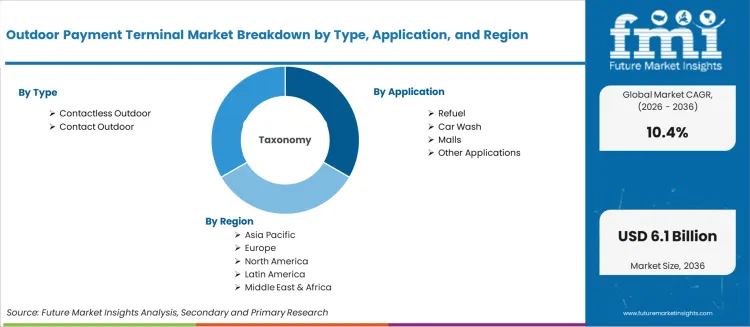
| Type Segmentation | Contactless Outdoor, Contact Outdoor |
| Application Segmentation | Refuel, Car Wash, Malls, Other Applications |
| Regions Covered | North America, Latin America, Europe, East Asia, South Asia, Oceania, Middle East & Africa |
| Countries Covered | USA, Germany, Japan, Australia, India, and 40 plus countries |
| Key Companies Profiled | NCR Corporation, Gilbarco Inc., Invenco Group Ltd., Verifone, Inc., Dover Fueling Solutions, Scheidt & Bachmann GmbH, Apple Inc., Temenos AG, Capgemini SE, Finastra Group Holdings Limited |
| Forecast Period | 2026 to 2036 |
| Approach | Forecasting models apply a bottom-up methodology starting with installed base and shipment data, projecting adoption rates based on regulatory and consumer trend curves. |
Top Segments Studied in the Outdoor Payment Terminal Market
By Type:
- Contactless Outdoor
- Contact Outdoor
By Application:
- Refuel
- Car Wash
- Malls
- Other Applications
By Region:
- North America
- Europe
- Asia Pacific
- Latin America
- Middle East & Africa
Bibliography
- 1. Visa Inc. (2024). EMV Chip Technology: Merchant Adoption Update. Visa.
- 2. United States Department of Transportation. (2024). National Electric Vehicle Infrastructure (NEVI) Formula Program Guidance. DOT.
- 3. European Commission. (2024). Alternative Fuels Infrastructure Regulation (AFIR). EC.
- 4. Gilbarco Veeder-Root. (2024). Product Documentation: Encore Experience Terminal. Gilbarco.
- 5. PCI Security Standards Council. (2024). PCI PTS Device Security Requirements v6.0. PCI SSC.
- 6. Transport for London. (2024). Contactless Payment Annual Report 2023-24. TfL.
This bibliography is provided for reader reference. The full Future Market Insights report contains the complete reference list with primary research documentation.
Frequently Asked Questions
How large is the demand for Outdoor Payment Terminal in the global market in 2026?
Demand for outdoor payment terminal in the global market is estimated to be valued at USD 2.26 billion in 2026.
What will be the market size of Outdoor Payment Terminal in the global market by 2036?
Market size for outdoor payment terminal is projected to reach USD 6.08 billion by 2036.
What is the expected demand growth for Outdoor Payment Terminal in the global market between 2026 and 2036?
Demand for outdoor payment terminal is expected to grow at a CAGR of 10.4% between 2026 and 2036.
Which Type is poised to lead global sales by 2026?
Contactless Outdoor accounts for 58.3% share in 2026, driven by established adoption patterns across primary end-use applications.
What is driving demand in USA?
USA leads with a 15.3% CAGR through 2036, driven by expanding capacity and increasing regulatory alignment with international standards.
What is the Germany growth outlook in this report?
Germany is projected to grow at a CAGR of 9.4% during 2026 to 2036.
What is Outdoor Payment Terminal and what is it mainly used for?
Outdoor payment terminals are ruggedized, weather-resistant electronic payment acceptance devices designed for unattended or semi-attended outdoor environments including fuel dispensers, parking meters, EV charging stations, transit kiosks, and vending installations. These terminals process contactless (NFC/RFID), chip (EMV), magnetic stripe, and mobile wallet transactions while withstanding temperature extremes, moisture, dust, UV exposure, and vandalism.
How does FMI build and validate the Outdoor Payment Terminal forecast?
Future Market Insights analysis applies a bottom-up methodology starting with global installed base metrics and cross-validates projections against reported industry revenue and independent tracking data.
Preview the report firsthand - request a free sample
Get SampleGet the brochure for pricing and purchase details.
Get PDFTable of Content
- Executive Summary
- Demand-side Trends
- Supply-side Trends
- Technology Roadmap Analysis
- Market Coverage / Taxonomy
- Market Definition / Scope / Limitations
- Research Methodology
- Chapter Orientation
- Analytical Lens and Working Hypotheses
- Market Structure, Signals, and Trend Drivers
- Benchmarking and Cross-market Comparability
- Market Sizing, Forecasting, and Opportunity Mapping
- Research Design and Evidence Framework
- Desk Research Programme (Secondary Evidence)
- Company Annual and Sustainability Reports
- Peer-reviewed Journals and Academic Literature
- Corporate Websites, Product Literature, and Technical Notes
- Earnings Decks and Investor Briefings
- Statutory Filings and Regulatory Disclosures
- Technical White Papers and Standards Notes
- Trade Journals, Industry Magazines, and Analyst Briefs
- Social Channels, Communities, and Digital Listening Inputs
- Additional Desk Sources
- Expert Input and Fieldwork (Primary Evidence)
- Primary Modes
- Qualitative Interviews and Expert Elicitation
- Quantitative Surveys and Structured Data Capture
- Blended Approach
- Why Primary Evidence is Used
- Field Techniques
- Interviews
- Surveys
- Focus Groups
- Observational and In-context Research
- Social and Community Interactions
- Stakeholder Universe Engaged
- C-suite Leaders
- Board Members
- Presidents and Vice Presidents
- R&D and Innovation Heads
- Technical Specialists
- Domain Subject-matter Experts
- Scientists
- Physicians and Other Healthcare Professionals
- Governance, Ethics, and Data Stewardship
- Research Ethics
- Data Integrity and Handling
- Primary Modes
- Tooling, Models, and Reference Databases
- Desk Research Programme (Secondary Evidence)
- Data Engineering and Model Build
- Data Acquisition and Ingestion
- Cleaning, Normalisation, and Verification
- Synthesis, Triangulation, and Analysis
- Quality Assurance and Audit Trail
- Market Background
- Market Dynamics
- Drivers
- Restraints
- Opportunity
- Trends
- Scenario Forecast
- Demand in Optimistic Scenario
- Demand in Likely Scenario
- Demand in Conservative Scenario
- Opportunity Map Analysis
- Product Life Cycle Analysis
- Supply Chain Analysis
- Investment Feasibility Matrix
- Value Chain Analysis
- PESTLE and Porter’s Analysis
- Regulatory Landscape
- Regional Parent Market Outlook
- Production and Consumption Statistics
- Import and Export Statistics
- Market Dynamics
- Global Market Analysis 2021 to 2025 and Forecast, 2026 to 2036
- Historical Market Size Value (USD Million) Analysis, 2021 to 2025
- Current and Future Market Size Value (USD Million) Projections, 2026 to 2036
- Y-o-Y Growth Trend Analysis
- Absolute $ Opportunity Analysis
- Global Market Pricing Analysis 2021 to 2025 and Forecast 2026 to 2036
- Global Market Analysis 2021 to 2025 and Forecast 2026 to 2036, By Type
- Introduction / Key Findings
- Historical Market Size Value (USD Million) Analysis By Type , 2021 to 2025
- Current and Future Market Size Value (USD Million) Analysis and Forecast By Type , 2026 to 2036
- Contactless Outdoor
- Contact Outdoor
- Contactless Outdoor
- Y-o-Y Growth Trend Analysis By Type , 2021 to 2025
- Absolute $ Opportunity Analysis By Type , 2026 to 2036
- Global Market Analysis 2021 to 2025 and Forecast 2026 to 2036, By Application
- Introduction / Key Findings
- Historical Market Size Value (USD Million) Analysis By Application, 2021 to 2025
- Current and Future Market Size Value (USD Million) Analysis and Forecast By Application, 2026 to 2036
- Refuel
- Car Wash
- Malls
- Other Applications
- Refuel
- Y-o-Y Growth Trend Analysis By Application, 2021 to 2025
- Absolute $ Opportunity Analysis By Application, 2026 to 2036
- Global Market Analysis 2021 to 2025 and Forecast 2026 to 2036, By Region
- Introduction
- Historical Market Size Value (USD Million) Analysis By Region, 2021 to 2025
- Current Market Size Value (USD Million) Analysis and Forecast By Region, 2026 to 2036
- North America
- Latin America
- Western Europe
- Eastern Europe
- East Asia
- South Asia and Pacific
- Middle East & Africa
- Market Attractiveness Analysis By Region
- North America Market Analysis 2021 to 2025 and Forecast 2026 to 2036, By Country
- Historical Market Size Value (USD Million) Trend Analysis By Market Taxonomy, 2021 to 2025
- Market Size Value (USD Million) Forecast By Market Taxonomy, 2026 to 2036
- By Country
- USA
- Canada
- Mexico
- By Type
- By Application
- By Country
- Market Attractiveness Analysis
- By Country
- By Type
- By Application
- Key Takeaways
- Latin America Market Analysis 2021 to 2025 and Forecast 2026 to 2036, By Country
- Historical Market Size Value (USD Million) Trend Analysis By Market Taxonomy, 2021 to 2025
- Market Size Value (USD Million) Forecast By Market Taxonomy, 2026 to 2036
- By Country
- Brazil
- Chile
- Rest of Latin America
- By Type
- By Application
- By Country
- Market Attractiveness Analysis
- By Country
- By Type
- By Application
- Key Takeaways
- Western Europe Market Analysis 2021 to 2025 and Forecast 2026 to 2036, By Country
- Historical Market Size Value (USD Million) Trend Analysis By Market Taxonomy, 2021 to 2025
- Market Size Value (USD Million) Forecast By Market Taxonomy, 2026 to 2036
- By Country
- Germany
- UK
- Italy
- Spain
- France
- Nordic
- BENELUX
- Rest of Western Europe
- By Type
- By Application
- By Country
- Market Attractiveness Analysis
- By Country
- By Type
- By Application
- Key Takeaways
- Eastern Europe Market Analysis 2021 to 2025 and Forecast 2026 to 2036, By Country
- Historical Market Size Value (USD Million) Trend Analysis By Market Taxonomy, 2021 to 2025
- Market Size Value (USD Million) Forecast By Market Taxonomy, 2026 to 2036
- By Country
- Russia
- Poland
- Hungary
- Balkan & Baltic
- Rest of Eastern Europe
- By Type
- By Application
- By Country
- Market Attractiveness Analysis
- By Country
- By Type
- By Application
- Key Takeaways
- East Asia Market Analysis 2021 to 2025 and Forecast 2026 to 2036, By Country
- Historical Market Size Value (USD Million) Trend Analysis By Market Taxonomy, 2021 to 2025
- Market Size Value (USD Million) Forecast By Market Taxonomy, 2026 to 2036
- By Country
- China
- Japan
- South Korea
- By Type
- By Application
- By Country
- Market Attractiveness Analysis
- By Country
- By Type
- By Application
- Key Takeaways
- South Asia and Pacific Market Analysis 2021 to 2025 and Forecast 2026 to 2036, By Country
- Historical Market Size Value (USD Million) Trend Analysis By Market Taxonomy, 2021 to 2025
- Market Size Value (USD Million) Forecast By Market Taxonomy, 2026 to 2036
- By Country
- India
- ASEAN
- Australia & New Zealand
- Rest of South Asia and Pacific
- By Type
- By Application
- By Country
- Market Attractiveness Analysis
- By Country
- By Type
- By Application
- Key Takeaways
- Middle East & Africa Market Analysis 2021 to 2025 and Forecast 2026 to 2036, By Country
- Historical Market Size Value (USD Million) Trend Analysis By Market Taxonomy, 2021 to 2025
- Market Size Value (USD Million) Forecast By Market Taxonomy, 2026 to 2036
- By Country
- Kingdom of Saudi Arabia
- Other GCC Countries
- Turkiye
- South Africa
- Other African Union
- Rest of Middle East & Africa
- By Type
- By Application
- By Country
- Market Attractiveness Analysis
- By Country
- By Type
- By Application
- Key Takeaways
- Key Countries Market Analysis
- USA
- Pricing Analysis
- Market Share Analysis, 2025
- By Type
- By Application
- Canada
- Pricing Analysis
- Market Share Analysis, 2025
- By Type
- By Application
- Mexico
- Pricing Analysis
- Market Share Analysis, 2025
- By Type
- By Application
- Brazil
- Pricing Analysis
- Market Share Analysis, 2025
- By Type
- By Application
- Chile
- Pricing Analysis
- Market Share Analysis, 2025
- By Type
- By Application
- Germany
- Pricing Analysis
- Market Share Analysis, 2025
- By Type
- By Application
- UK
- Pricing Analysis
- Market Share Analysis, 2025
- By Type
- By Application
- Italy
- Pricing Analysis
- Market Share Analysis, 2025
- By Type
- By Application
- Spain
- Pricing Analysis
- Market Share Analysis, 2025
- By Type
- By Application
- France
- Pricing Analysis
- Market Share Analysis, 2025
- By Type
- By Application
- India
- Pricing Analysis
- Market Share Analysis, 2025
- By Type
- By Application
- ASEAN
- Pricing Analysis
- Market Share Analysis, 2025
- By Type
- By Application
- Australia & New Zealand
- Pricing Analysis
- Market Share Analysis, 2025
- By Type
- By Application
- China
- Pricing Analysis
- Market Share Analysis, 2025
- By Type
- By Application
- Japan
- Pricing Analysis
- Market Share Analysis, 2025
- By Type
- By Application
- South Korea
- Pricing Analysis
- Market Share Analysis, 2025
- By Type
- By Application
- Russia
- Pricing Analysis
- Market Share Analysis, 2025
- By Type
- By Application
- Poland
- Pricing Analysis
- Market Share Analysis, 2025
- By Type
- By Application
- Hungary
- Pricing Analysis
- Market Share Analysis, 2025
- By Type
- By Application
- Kingdom of Saudi Arabia
- Pricing Analysis
- Market Share Analysis, 2025
- By Type
- By Application
- Turkiye
- Pricing Analysis
- Market Share Analysis, 2025
- By Type
- By Application
- South Africa
- Pricing Analysis
- Market Share Analysis, 2025
- By Type
- By Application
- USA
- Market Structure Analysis
- Competition Dashboard
- Competition Benchmarking
- Market Share Analysis of Top Players
- By Regional
- By Type
- By Application
- Competition Analysis
- Competition Deep Dive
- NCR Corporation
- Overview
- Product Portfolio
- Profitability by Market Segments (Product/Age /Sales Channel/Region)
- Sales Footprint
- Strategy Overview
- Marketing Strategy
- Product Strategy
- Channel Strategy
- Gilbarco Inc.
- Invenco Group Ltd.
- Verifone, Inc.
- Dover Fueling Solutions
- Scheidt & Bachmann GmbH
- Apple Inc.
- Temenos AG
- Capgemini SE
- Finastra Group Holdings Limited
- NCR Corporation
- Competition Deep Dive
- Assumptions & Acronyms Used


