

- Industry Size (2026)
- USD 42.44 Bn
- Forecast (2036)
- USD 82.71 Bn
- CAGR (2026 to 2036)
- 6.9%
Outdoor Apparel and Accessories Market Size, Market Forecast and Outlook By FMI
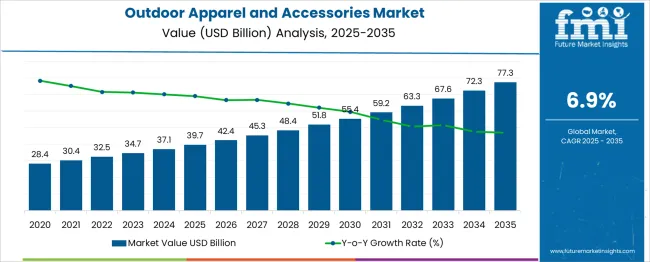
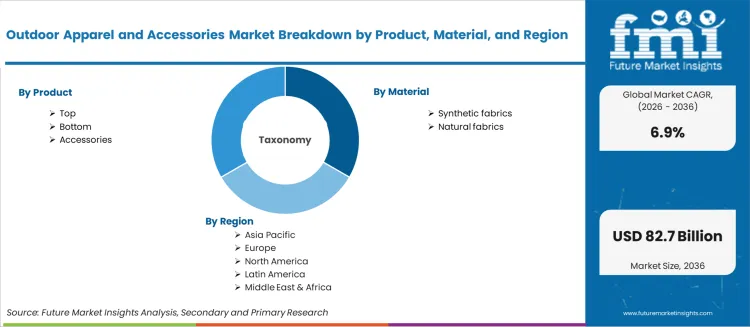
The outdoor apparel and accessories market was valued at USD 39.70 billion in 2025, projected to reach USD 42.44 billion in 2026, and is forecast to expand to USD 82.71 billion by 2036 at a 6.9% CAGR. Based on FMI's analysis, FMI analysts observe that the outdoor apparel and accessories market has expanded beyond its traditional base of dedicated outdoor enthusiasts to encompass a broader consumer segment that values functional, durable clothing for everyday use. The convergence of outdoor functionality with urban fashion, often called gorpcore, has repositioned technical outerwear from niche sporting goods into mainstream wardrobe staples.
Summary of Outdoor Apparel and Accessories Market
- Market Snapshot
- The outdoor apparel and accessories market is valued at USD 39.70 billion in 2025 and is projected to reach USD 82.71 billion by 2036.
- The industry is expected to grow at a 6.9% CAGR from 2026 to 2036, creating an incremental opportunity of USD 40.27 billion.
- The market is positioned within the consumer sportswear and outdoor recreation sector, where consumer preferences, regulatory frameworks, and distribution strategies shape competitive dynamics.
- Demand and Growth Drivers
- Outdoor participation growth post-pandemic: The Outdoor Industry Association reported that outdoor recreation participation in the United States reached 175 million people in 2023, a 4.
- Sustainability mandates reshaping material sourcing: The EU Strategy for Sustainable and Circular Textiles (2022) mandates that textile products sold in the EU meet minimum recycled content thresholds and durability standards by 2030.
- Direct-to-consumer channel expansion: Major outdoor brands are shifting distribution from wholesale-dependent models to owned retail and e-commerce platforms that capture higher gross margins.
- As per FMI, among key countries, China leads at 9.3% CAGR, followed by India at 8.6%, Germany at 7.9%, and Brazil at 5.2%.
- Product and Segment View
- The market includes outdoor apparel and accessories encompass clothing, footwear, and gear designed for outdoor recreational activities including hiking, climbing, camping, skiing, trail running, and general adventure travel.
- Top leads by Product with 47.8% share in 2026.
- Synthetic fabrics leads by Material with 61.3% share in 2026.
- Scope includes outdoor-specific apparel and accessories sold globally through specialty retail, department stores, brand direct-to-consumer channels, and e-commerce platforms. The scope excludes general athletic wear and athleisure products not specifically designed for outdoor activities, indoor fitness apparel, workwear and industrial protective clothing, and military tactical gear.
- Geography and Competitive Outlook
- China and India are the fastest-growing markets, while USA and Brazil represent mature demand bases.
- Competition is shaped by The North Face (VF Corporation), Columbia Sportswear, Patagonia, and Arc'teryx (Amer Sports) hold leading positions across different price and performance tiers.
- Key companies include The North Face, Inc., Arc'teryx Equipment Inc., Black Diamond Equipment Ltd., Columbia Sportswear Company, Eddie Bauer LLC, Helly Hansen AS, Patagonia, Inc., Prana Living, LLC.
- Analyst Opinion at FMI
- Rahul Pandita Principal Consultant for Consumer Sportswear, opines: 'The structural transition is the shift from petroleum-derived synthetic fabrics toward recycled and bio-based material platforms driven by consumer sustainability expectations and brand commitments. Patagonia, The North Face, and Arc'teryx have committed to using 100% recycled or renewable materials by 2025 to 2030, restructuring supply chains that have relied on virgin polyester and nylon for decades. Recycled polyester now commands a 10% to 15% price premium over virgin equivalents, but consumer willingness to pay for sustainable products is absorbing this differential in premium and mid-tier pricing segments.'
- Strategic Implications / Executive Takeaways
- Procurement directors should evaluate supplier qualification timelines against planned expansion to avoid delays tied to sourcing dependencies in outdoor apparel and accessories.
- Product development teams must integrate evolving regulatory and sustainability specifications into design phases to maintain compliance across target markets.
- Channel strategy leaders should benchmark direct-to-consumer capabilities against wholesale distribution to optimize margin capture and consumer data access.
Outdoor Apparel and Accessories Market Key Takeaways
| Metric | Details |
|---|---|
| Industry Size (2026) | USD 42.44 Billion |
| Industry Value (2036) | USD 82.71 Billion |
| CAGR (2026-2036) | 6.9% |
Source: Future Market Insights, 2026
The structural transition is the shift from petroleum-derived synthetic fabrics toward recycled and bio-based material platforms driven by consumer sustainability expectations and brand commitments. Patagonia, The North Face, and Arc'teryx have committed to using 100% recycled or renewable materials by 2025 to 2030, restructuring supply chains that have relied on virgin polyester and nylon for decades. Recycled polyester now commands a 10% to 15% price premium over virgin equivalents, but consumer willingness to pay for sustainable products is absorbing this differential in premium and mid-tier pricing segments. As per FMI, country-level growth trajectories reflect distinct market structures. China leads at 9.3% CAGR, India registers at 8.6% CAGR, Germany registers at 7.9% CAGR, France registers at 7.2% CAGR, UK registers at 6.6% CAGR, USA registers at 5.9% CAGR, Brazil registers at 5.2% CAGR.
Outdoor Apparel and Accessories Market Definition
Outdoor apparel and accessories encompass clothing, footwear, and gear designed for outdoor recreational activities including hiking, climbing, camping, skiing, trail running, and general adventure travel. The category includes technical outerwear (waterproof and insulated jackets), base layers, mid-layers, hiking pants, outdoor footwear, backpacks, gloves, hats, and UV-protective accessories. Products are engineered with performance fabrics such as Gore-Tex, Pertex, and proprietary synthetic membranes that provide weather protection, moisture management, and thermal regulation.
Outdoor Apparel and Accessories Market Inclusions
Market scope covers outdoor-specific apparel and accessories sold globally through specialty retail, department stores, brand direct-to-consumer channels, and e-commerce platforms. The report includes regional and country-level market sizes, forecast values from 2026 to 2036, segmentation by product, material, consumer group, pricing tier, and distribution channel, along with competitive landscape and consumer trend analysis.
Outdoor Apparel and Accessories Market Exclusions
The scope excludes general athletic wear and athleisure products not specifically designed for outdoor activities, indoor fitness apparel, workwear and industrial protective clothing, and military tactical gear. Fashion-oriented outerwear without technical performance specifications is also omitted.
Outdoor Apparel and Accessories Market Research Methodology
- Primary Research: Analysts engaged with consumer sportswear and outdoor recreation specialists, procurement managers, and distribution channel executives to map purchase decision triggers and upgrade cycles.
- Desk Research: Data collection aggregated regulatory filings, trade association publications, company annual reports, and government economic statistics across all covered regions.
- Market-Sizing and Forecasting: Baseline values derive from a bottom-up aggregation of product shipments and retail sales data, applying region-specific adoption and replacement curves to project forward demand through 2036.
- Data Validation and Update Cycle: Projections are cross-validated against publicly reported revenue guidance from leading industry participants and independent retail tracking data.
Why is the Outdoor Apparel and Accessories Market Growing?
The outdoor apparel and accessories market is undergoing notable growth as sustainability, functionality, and lifestyle trends converge to redefine consumer expectations and product innovations. Rising participation in outdoor recreational activities and increasing health consciousness among consumers are driving consistent demand for durable and performance-oriented products.
Brands are aligning their strategies with evolving fashion sensibilities and environmental awareness, integrating recycled materials and advanced textile technologies to meet these needs. Future expansion is expected to be supported by the growth of e-commerce channels, increasing urban adoption of outdoor-inspired apparel, and continuous innovation in lightweight and weather-resistant materials.
The market outlook remains positive as consumer groups across demographics embrace outdoor lifestyles, and companies continue to differentiate through sustainability initiatives, technological enhancements, and tailored designs.
Segmental Analysis
The outdoor apparel and accessories market is segmented by product, material, consumer group, pricing, distribution channel, and geographic regions. The outdoor apparel and accessories market is divided into Top, Bottom, and Accessories. The outdoor apparel and accessories market is classified into Synthetic fabrics and Natural fabrics. The consumer group of the outdoor apparel and accessories market is segmented into Male, Female, and Kids. The outdoor apparel and accessories market is segmented by price into Medium, Low, and High. The distribution channel of the outdoor apparel and accessories market is segmented into Offline and Online retail. Regionally, the outdoor apparel and accessories industry is classified into North America, Latin America, Western Europe, Eastern Europe, Balkan & Baltic Countries, Russia & Belarus, Central Asia, East Asia, South Asia & Pacific, and the Middle East & Africa.
Insights into the Top Product Segment
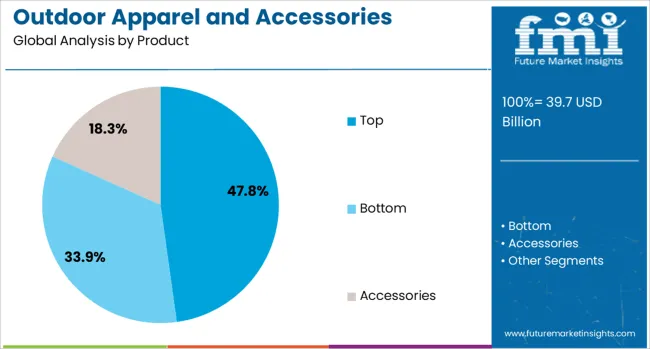
When segmented by product, the top segment is anticipated to contribute 47.8% of the total market revenue in 2026, establishing itself as the dominant product category. This leadership has been reinforced by the segment’s versatility, catering to a wide spectrum of outdoor activities while fulfilling both functional and aesthetic requirements.
The demand for tops has been amplified by continuous innovations in moisture-wicking fabrics, UV protection technologies, and adaptable layering designs that enhance user comfort across diverse weather conditions. This segment’s dominance has also been supported by strong consumer preference for practical yet fashionable options that transition seamlessly from outdoor settings to casual urban environments.
The ability to blend performance features with lifestyle appeal has firmly positioned tops as the most sought-after product category within the market.
Insights into the Synthetic Fabrics Material Segment
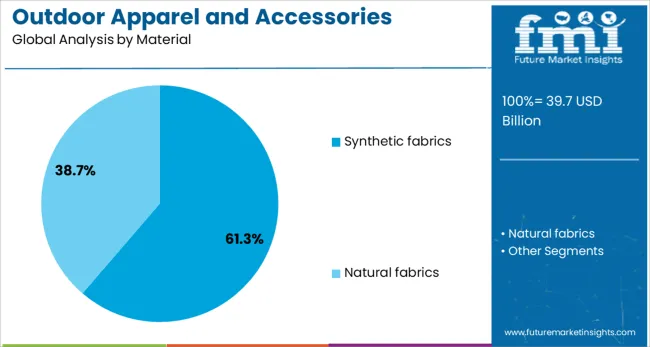
In terms of material, synthetic fabrics are projected to capture 61.3% of the market revenue in 2026, maintaining their leading position. This prominence has been driven by the superior functional properties of synthetic textiles, including high durability, water resistance, elasticity, and ease of maintenance, which are critical for outdoor performance.
Technological advancements in fiber engineering have further enhanced breathability and thermal regulation, solidifying consumer confidence in synthetic materials for extended outdoor use. The affordability and availability of synthetic fabrics compared to natural alternatives have supported their widespread adoption by both premium and mass-market brands.
These fabrics’ compatibility with advanced treatments and coatings has enabled continuous innovation in outdoor apparel, sustaining their leadership within the material segment.
Insights into the Male Consumer Group Segment
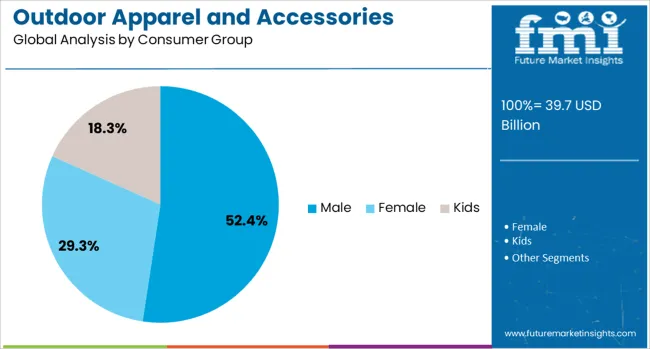
When analyzed by consumer group, the male segment is expected to account for 52.4% of the market revenue in 2026, making it the largest demographic. This dominance has been attributed to higher participation rates among men in outdoor sports, hiking, and adventure activities, which sustain demand for specialized apparel and accessories.
Men have shown a strong preference for durable and technical gear that offers functionality and resilience under demanding conditions, reinforcing this segment’s market share. The influence of male-focused marketing campaigns and sponsorships in outdoor and extreme sports has further strengthened brand engagement within this group.
The consistent introduction of innovative designs and performance features tailored to male consumers has helped maintain their significant contribution to the overall market revenue.
What are the Drivers, Restraints, and Key Trends of the Outdoor Apparel and Accessories Market?
The outdoor apparel and accessories market is experiencing robust growth as consumers prioritize function and style in active lifestyle segments. In 2024, demand increased for durable gear such as moisture-wicking jackets, reinforced hiking boots, and adaptive performance accessories. By 2026, growing interest in technical outdoor wear, featuring weather-resistant materials and ergonomic designs, drove expansion into broader retail and subscription services. Brands offering feature-rich, design-driven products with proven durability and comfort are positioned to lead in this evolving and competitive sector.
Performance-Oriented Design Drives Premium Product Adoption
As consumer expectations shift toward gear offering both durability and comfort, performance-oriented design has become central to product selection. In 2024, brands focused on activewear infused with reinforced seams, water-resistant fabrics, and breathable liners to meet rising demand for adventure-ready equipment. By 2026, apparel with tailored ergonomic cuts and stretch-weight materials gained prominence among outdoor enthusiasts seeking versatile performance across trail, travel, and daily use. These developments suggest that perceived utility is influencing purchase decisions. Manufacturers delivering apparel and accessories with verified durability, ergonomic construction, and functional versatility are likely to capture traction in performance-driven consumer segments.
Direct-to-Consumer Platforms Unlock Personalization Market Potential
Rapid expansion of direct-to-consumer (DTC) retail channels has enabled brands to offer personalized outdoor gear and bespoke accessories at scale. In 2024, companies introduced online platforms that allowed customization of fit, material selection, and color schemes tailored to individual preferences. By 2026, interactive product recommenders and virtual sizing tools enhanced user engagement and conversion across premium segments. This shift shows that tailored experiences-not only broad retail distribution-are opening value creation in outdoor apparel. Brands providing DTC platforms offering clear product information, easy customization, and responsive online support are poised to build stronger customer loyalty and premium pricing models in the active gear market.
High Pricing Strategies Limiting Wider Market Accessibility
In 2024 and 2026, premium pricing of outdoor apparel and accessories significantly restricted adoption among middle-income consumers. Products incorporating specialized fabrics, weather-resistant finishes, and advanced features were positioned at higher price brackets, making them less accessible in cost-sensitive regions. Retail reports highlighted slower sales in emerging markets where affordability plays a critical role in consumer decision-making. Additionally, promotional discounts and seasonal markdowns failed to fully offset the perceived high cost, reducing demand elasticity. Unless brands introduce value-driven collections without compromising performance standards, elevated pricing will continue to impede broader penetration of outdoor lifestyle products across global markets.
Personalized Design Features Enhancing Consumer Engagement and Loyalty
During 2024 and 2026, outdoor apparel and accessories experienced a surge in personalized product offerings. Leading brands introduced customization options for color combinations, monogramming, and fit adjustments through online platforms. This trend resonated strongly with younger demographics and outdoor enthusiasts seeking individuality in performance-oriented gear. Retailers also promoted limited-edition collections designed for specific activities such as trekking or alpine sports, which amplified consumer interest in exclusive items. By enabling tailored experiences, personalization became a key strategy for strengthening brand loyalty. This evolution represents a clear opportunity for companies to increase repeat purchases by focusing on bespoke design solutions.
Analysis of Outdoor Apparel and Accessories Market By Key Countries
.webp "Top Country Growth Comparison Outdoor Apparel And Accessories Market Cagr (2026 2036)")
| Country | CAGR |
|---|---|
| China | 9.3% |
| India | 8.6% |
| Germany | 7.9% |
| France | 7.2% |
| UK | 6.6% |
| USA | 5.9% |
| Brazil | 5.2% |
Source: FMI analysis based on primary research and proprietary forecasting model
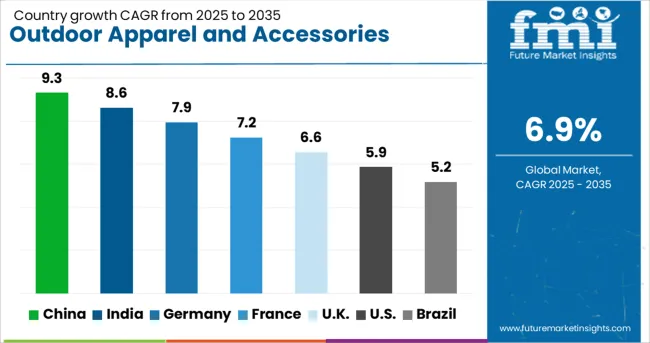
The global outdoor apparel and accessories market is expected to grow at a CAGR of 6.9% from 2026 to 2036. China leads with 9.3%, followed by India at 8.6% and Germany at 7.9%. France posts 7.2%, while the United Kingdom records 6.6%. Growth is supported by rising outdoor recreation activities, premiumization of activewear, and increasing penetration of e-commerce platforms. China and India dominate demand due to urban lifestyle shifts and adventure tourism trends. Germany emphasizes high-performance apparel for professional sports, while France and the UK focus on sustainable designs and functional accessories for outdoor enthusiasts.
Sales Outlook for Outdoor Apparel and Accessories Market in China
The outdoor apparel and accessories market in China is projected to grow at 9.3%, driven by growing participation in hiking, camping, and winter sports. Premium outdoor jackets and technical gear dominate sales across leading retail and e-commerce platforms. Manufacturers invest in advanced moisture-wicking fabrics for enhanced comfort. Collaborations with global sports brands boost China’s influence in outdoor performance apparel.
- Premium jackets and technical outdoor gear dominate consumer demand.
- Moisture-wicking and breathable fabrics improve product performance.
- Global brand partnerships strengthen premium segment positioning.
Demand Analysis for Outdoor Apparel and Accessories in India
The outdoor apparel and accessories market in India is expected to grow at 8.6%, supported by rising interest in trekking and adventure travel. Lightweight and affordable outdoor clothing dominates adoption in mid-range consumer segments. Manufacturers develop quick-dry fabrics to meet climate-specific needs. Expansion of online retail platforms drives product accessibility across urban and semi-urban areas.
- Lightweight apparel dominates trekking and adventure wear categories.
- Quick-dry technology enhances performance for multi-weather conditions.
- E-commerce platforms expand product reach to wider demographics.
In-depth Analysis of Outdoor Apparel and Accessories in Germany
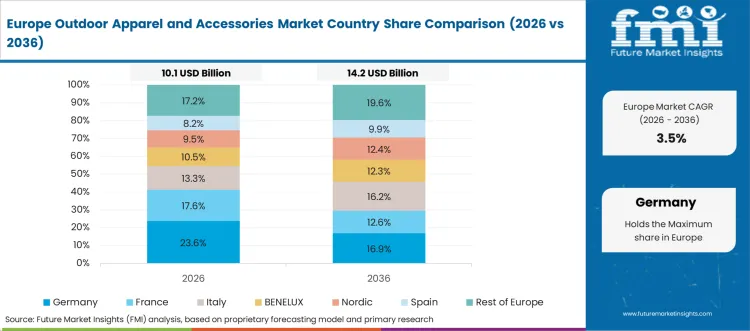
The outdoor apparel and accessories market in Germany is forecast to grow at 7.9%, driven by strong demand for high-performance gear among professional athletes and outdoor enthusiasts. Waterproof and windproof jackets dominate premium categories. Manufacturers integrate recyclable materials to align with EU sustainability policies. Growth of specialty sports stores and premium retail formats supports brand expansion.
- Waterproof jackets dominate premium outdoor apparel segments.
- Recyclable materials align with EU-driven eco-compliance goals.
- Specialty retail formats enhance visibility of performance apparel brands.
Opportunity Analysis for Outdoor Apparel and Accessories in France
The outdoor apparel and accessories market in France is projected to grow at 7.2%, supported by rising participation in winter sports and mountain tourism. Insulated jackets and multifunctional gloves dominate seasonal sales. Manufacturers invest in ergonomic design and temperature-regulation technology for comfort during extended use. Expansion of experiential retail strategies in urban centers boosts brand loyalty.
- Insulated jackets dominate winter sports and alpine activity segments.
- Temperature-regulating technologies enhance performance during extreme conditions.
- Experiential retail concepts improve consumer engagement in key markets.
Growth and Expansion Outlook for Outdoor Apparel and Accessories in the United Kingdom
The outdoor apparel and accessories market in the UK is forecast to grow at 6.6%, driven by demand for versatile outerwear suitable for unpredictable weather. Waterproof and layered apparel dominate adoption in hiking and travel segments. Manufacturers leverage digital customization platforms for personalized outdoor gear. Growth in premium athleisure collections further strengthens the outdoor performance category.
- Layered and waterproof designs dominate multi-weather performance needs.
- Digital customization platforms enable personalized gear experiences.
- Premium athleisure integration expands the outdoor apparel category.
Competitive Landscape of Outdoor Apparel and Accessories Market
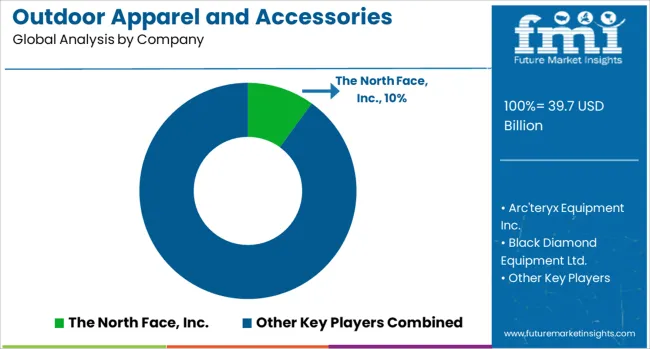
The outdoor apparel and accessories market is moderately consolidated, with The North Face, Inc. recognized as a leading player due to its comprehensive range of high-performance apparel and strong brand presence across global markets. The company’s emphasis on advanced material technologies, durability, and functionality for extreme outdoor conditions has strengthened its position among premium consumers. Key players include Arc'teryx Equipment Inc., Black Diamond Equipment Ltd., Columbia Sportswear Company, Eddie Bauer LLC, Helly Hansen AS, Patagonia, Inc., Prana Living, LLC, REI Co‑op, and Salomon S.A.
These companies offer a wide range of products including jackets, base layers, footwear, backpacks, and outdoor accessories tailored for hiking, climbing, skiing, and adventure sports. Market growth is fueled by increasing participation in outdoor recreation activities, rising demand for multifunctional apparel, and the fusion of outdoor fashion with urban lifestyle trends. Leading brands are investing in advanced fabrics for weather resistance, lightweight designs, and moisture management, while expanding through e-commerce and direct-to-consumer models.
Additionally, collaborations with adventure influencers and integration of sustainable materials are becoming key differentiators for premium positioning. The Asia-Pacific region is witnessing rapid growth due to a surge in outdoor leisure activities, while North America and Europe remain mature markets driven by high consumer spending and established retail networks.
Scope of the Report
| Metric | Value |
|---|---|
| Quantitative Units | USD 42.44 Billion to USD 82.71 Billion, at a CAGR of 6.9% |
| Market Definition | Outdoor apparel and accessories encompass clothing, footwear, and gear designed for outdoor recreational activities including hiking, climbing, camping, skiing, trail running, and general adventure travel. The category includes technical outerwear (waterproof and insulated jackets), base layers, mid-layers, hiking pants, outdoor footwear, backpacks, gloves, hats, and UV-protective accessories. |
| Product Segmentation | Top, Bottom, Accessories |
| Material Segmentation | Synthetic fabrics, Natural fabrics |
| Consumer Group Segmentation | Male, Female, Kids |
| Pricing Segmentation | Medium, Low, High |
| Distribution Channel Segmentation | Offline, Online retail |
| Regions Covered | North America, Latin America, Europe, East Asia, South Asia, Oceania, Middle East & Africa |
| Countries Covered | China, India, Germany, France, UK, USA, Brazil, and 40 plus countries |
| Key Companies Profiled | The North Face, Inc., Arc'teryx Equipment Inc., Black Diamond Equipment Ltd., Columbia Sportswear Company, Eddie Bauer LLC, Helly Hansen AS, Patagonia, Inc., Prana Living, LLC, REI Co-op, Salomon S.A. |
| Forecast Period | 2026 to 2036 |
| Approach | Forecasting models apply a bottom-up methodology starting with global installed base metrics and projecting conversion rates based on consumer adoption and regulatory compliance curves. |
Outdoor Apparel and Accessories Market by Segments
Product:
- Top
- Bottom
- Accessories
Material:
- Synthetic fabrics
- Natural fabrics
Consumer Group:
- Male
- Female
- Kids
Pricing:
- Medium
- Low
- High
Distribution Channel:
- Offline
- Online retail
Region:
- North America
- USA
- Canada
- Mexico
- Latin America
- Brazil
- Chile
- Rest of Latin America
- Western Europe
- Germany
- UK
- Italy
- Spain
- France
- Nordic
- BENELUX
- Rest of Western Europe
- Eastern Europe
- Russia
- Poland
- Hungary
- Balkan & Baltic
- Rest of Eastern Europe
- East Asia
- China
- Japan
- South Korea
- South Asia and Pacific
- India
- ASEAN
- Australia & New Zealand
- Rest of South Asia and Pacific
- Middle East & Africa
- Kingdom of Saudi Arabia
- Other GCC Countries
- Turkiye
- South Africa
- Other African Union
- Rest of Middle East & Africa
Bibliography
- 1. Outdoor Industry Association. (2024). Outdoor Participation Trends Report 2024. OIA.
- 2. European Commission. (2022). EU Strategy for Sustainable and Circular Textiles. EC.
- 3. VF Corporation. (2024). Annual Report FY2024. VF Corporation.
- 4. Patagonia Inc. (2024). Environmental and Social Initiatives Report 2023. Patagonia.
- 5. Amer Sports Corporation. (2024). Annual Report 2023. Amer Sports.
- 6. Textile Exchange. (2024). Preferred Fiber and Materials Market Report 2024. Textile Exchange.
This bibliography is provided for reader reference. The full Future Market Insights report contains the complete reference list with primary research documentation.
Frequently Asked Questions
How large is the demand for Outdoor Apparel and Accessories in the global market in 2026?
Demand for outdoor apparel and accessories in the global market is estimated to be valued at USD 42.44 billion in 2026.
What will be the market size of Outdoor Apparel and Accessories in the global market by 2036?
Market size for outdoor apparel and accessories is projected to reach USD 82.71 billion by 2036.
What is the expected demand growth for Outdoor Apparel and Accessories in the global market between 2026 and 2036?
Demand for outdoor apparel and accessories is expected to grow at a CAGR of 6.9% between 2026 and 2036.
Which Product is poised to lead global sales by 2026?
Top accounts for 47.8% share in 2026, driven by established consumer preferences and procurement patterns across primary end-use applications.
What is driving demand in China?
China leads with a 9.3% CAGR through 2036, driven by expanding consumer base and increasing alignment with international product standards.
What is the India growth outlook in this report?
India is projected to grow at a CAGR of 8.6% during 2026 to 2036.
What is Outdoor Apparel and Accessories and what is it mainly used for?
Outdoor apparel and accessories encompass clothing, footwear, and gear designed for outdoor recreational activities including hiking, climbing, camping, skiing, trail running, and general adventure travel. The category includes technical outerwear (waterproof and insulated jackets), base layers, mid-layers, hiking pants, outdoor footwear, backpacks, gloves, hats, and UV-protective accessories.
How does FMI build and validate the Outdoor Apparel and Accessories forecast?
Future Market Insights analysis applies a bottom-up methodology starting with global installed base and retail sales metrics and cross-validates projections against reported industry revenue and independent tracking data.
Preview the report firsthand - request a free sample
Get SampleGet the brochure for pricing and purchase details.
Get PDFTable of Content
- Executive Summary
- Global Market Outlook
- Demand-side Trends
- Supply-side Trends
- Technology Roadmap Analysis
- Analysis and Recommendations
- Market Overview
- Market Coverage / Taxonomy
- Market Definition / Scope / Limitations
- Research Methodology
- Chapter Orientation
- Analytical Lens and Working Hypotheses
- Market Structure, Signals, and Trend Drivers
- Benchmarking and Cross-market Comparability
- Market Sizing, Forecasting, and Opportunity Mapping
- Research Design and Evidence Framework
- Desk Research Programme (Secondary Evidence)
- Company Annual and Sustainability Reports
- Peer-reviewed Journals and Academic Literature
- Corporate Websites, Product Literature, and Technical Notes
- Earnings Decks and Investor Briefings
- Statutory Filings and Regulatory Disclosures
- Technical White Papers and Standards Notes
- Trade Journals, Industry Magazines, and Analyst Briefs
- Conference Proceedings, Webinars, and Seminar Materials
- Government Statistics Portals and Public Data Releases
- Press Releases and Reputable Media Coverage
- Specialist Newsletters and Curated Briefings
- Sector Databases and Reference Repositories
- FMI Internal Proprietary Databases and Historical Market Datasets
- Subscription Datasets and Paid Sources
- Social Channels, Communities, and Digital Listening Inputs
- Additional Desk Sources
- Expert Input and Fieldwork (Primary Evidence)
- Primary Modes
- Qualitative Interviews and Expert Elicitation
- Quantitative Surveys and Structured Data Capture
- Blended Approach
- Why Primary Evidence is Used
- Field Techniques
- Interviews
- Surveys
- Focus Groups
- Observational and In-context Research
- Social and Community Interactions
- Stakeholder Universe Engaged
- C-suite Leaders
- Board Members
- Presidents and Vice Presidents
- R&D and Innovation Heads
- Technical Specialists
- Domain Subject-matter Experts
- Scientists
- Physicians and Other Healthcare Professionals
- Governance, Ethics, and Data Stewardship
- Research Ethics
- Data Integrity and Handling
- Primary Modes
- Tooling, Models, and Reference Databases
- Desk Research Programme (Secondary Evidence)
- Data Engineering and Model Build
- Data Acquisition and Ingestion
- Cleaning, Normalisation, and Verification
- Synthesis, Triangulation, and Analysis
- Quality Assurance and Audit Trail
- Market Background
- Market Dynamics
- Drivers
- Restraints
- Opportunity
- Trends
- Scenario Forecast
- Demand in Optimistic Scenario
- Demand in Likely Scenario
- Demand in Conservative Scenario
- Opportunity Map Analysis
- Product Life Cycle Analysis
- Supply Chain Analysis
- Investment Feasibility Matrix
- Value Chain Analysis
- PESTLE and Porter’s Analysis
- Regulatory Landscape
- Regional Parent Market Outlook
- Production and Consumption Statistics
- Import and Export Statistics
- Market Dynamics
- Global Market Analysis 2021 to 2025 and Forecast, 2026 to 2036
- Historical Market Size Value (USD Million) Analysis, 2021 to 2025
- Current and Future Market Size Value (USD Million) Projections, 2026 to 2036
- Y-o-Y Growth Trend Analysis
- Absolute $ Opportunity Analysis
- Global Market Pricing Analysis 2021 to 2025 and Forecast 2026 to 2036
- Global Market Analysis 2021 to 2025 and Forecast 2026 to 2036, By Product
- Introduction / Key Findings
- Historical Market Size Value (USD Million) Analysis By Product , 2021 to 2025
- Current and Future Market Size Value (USD Million) Analysis and Forecast By Product , 2026 to 2036
- Top
- Bottom
- Accessories
- Top
- Y-o-Y Growth Trend Analysis By Product , 2021 to 2025
- Absolute $ Opportunity Analysis By Product , 2026 to 2036
- Global Market Analysis 2021 to 2025 and Forecast 2026 to 2036, By Material
- Introduction / Key Findings
- Historical Market Size Value (USD Million) Analysis By Material, 2021 to 2025
- Current and Future Market Size Value (USD Million) Analysis and Forecast By Material, 2026 to 2036
- Synthetic fabrics
- Natural fabrics
- Synthetic fabrics
- Y-o-Y Growth Trend Analysis By Material, 2021 to 2025
- Absolute $ Opportunity Analysis By Material, 2026 to 2036
- Global Market Analysis 2021 to 2025 and Forecast 2026 to 2036, By Consumer Group
- Introduction / Key Findings
- Historical Market Size Value (USD Million) Analysis By Consumer Group, 2021 to 2025
- Current and Future Market Size Value (USD Million) Analysis and Forecast By Consumer Group, 2026 to 2036
- Male
- Female
- Kids
- Male
- Y-o-Y Growth Trend Analysis By Consumer Group, 2021 to 2025
- Absolute $ Opportunity Analysis By Consumer Group, 2026 to 2036
- Global Market Analysis 2021 to 2025 and Forecast 2026 to 2036, By Pricing
- Introduction / Key Findings
- Historical Market Size Value (USD Million) Analysis By Pricing, 2021 to 2025
- Current and Future Market Size Value (USD Million) Analysis and Forecast By Pricing, 2026 to 2036
- Medium
- Low
- High
- Medium
- Y-o-Y Growth Trend Analysis By Pricing, 2021 to 2025
- Absolute $ Opportunity Analysis By Pricing, 2026 to 2036
- Global Market Analysis 2021 to 2025 and Forecast 2026 to 2036, By Distribution Channel
- Introduction / Key Findings
- Historical Market Size Value (USD Million) Analysis By Distribution Channel, 2021 to 2025
- Current and Future Market Size Value (USD Million) Analysis and Forecast By Distribution Channel, 2026 to 2036
- Offline
- Online retail
- Offline
- Y-o-Y Growth Trend Analysis By Distribution Channel, 2021 to 2025
- Absolute $ Opportunity Analysis By Distribution Channel, 2026 to 2036
- Global Market Analysis 2021 to 2025 and Forecast 2026 to 2036, By Region
- Introduction
- Historical Market Size Value (USD Million) Analysis By Region, 2021 to 2025
- Current Market Size Value (USD Million) Analysis and Forecast By Region, 2026 to 2036
- North America
- Latin America
- Western Europe
- Eastern Europe
- East Asia
- South Asia and Pacific
- Middle East & Africa
- Market Attractiveness Analysis By Region
- North America Market Analysis 2021 to 2025 and Forecast 2026 to 2036, By Country
- Historical Market Size Value (USD Million) Trend Analysis By Market Taxonomy, 2021 to 2025
- Market Size Value (USD Million) Forecast By Market Taxonomy, 2026 to 2036
- By Country
- USA
- Canada
- Mexico
- By Product
- By Material
- By Consumer Group
- By Pricing
- By Distribution Channel
- By Country
- Market Attractiveness Analysis
- By Country
- By Product
- By Material
- By Consumer Group
- By Pricing
- By Distribution Channel
- Key Takeaways
- Latin America Market Analysis 2021 to 2025 and Forecast 2026 to 2036, By Country
- Historical Market Size Value (USD Million) Trend Analysis By Market Taxonomy, 2021 to 2025
- Market Size Value (USD Million) Forecast By Market Taxonomy, 2026 to 2036
- By Country
- Brazil
- Chile
- Rest of Latin America
- By Product
- By Material
- By Consumer Group
- By Pricing
- By Distribution Channel
- By Country
- Market Attractiveness Analysis
- By Country
- By Product
- By Material
- By Consumer Group
- By Pricing
- By Distribution Channel
- Key Takeaways
- Western Europe Market Analysis 2021 to 2025 and Forecast 2026 to 2036, By Country
- Historical Market Size Value (USD Million) Trend Analysis By Market Taxonomy, 2021 to 2025
- Market Size Value (USD Million) Forecast By Market Taxonomy, 2026 to 2036
- By Country
- Germany
- UK
- Italy
- Spain
- France
- Nordic
- BENELUX
- Rest of Western Europe
- By Product
- By Material
- By Consumer Group
- By Pricing
- By Distribution Channel
- By Country
- Market Attractiveness Analysis
- By Country
- By Product
- By Material
- By Consumer Group
- By Pricing
- By Distribution Channel
- Key Takeaways
- Eastern Europe Market Analysis 2021 to 2025 and Forecast 2026 to 2036, By Country
- Historical Market Size Value (USD Million) Trend Analysis By Market Taxonomy, 2021 to 2025
- Market Size Value (USD Million) Forecast By Market Taxonomy, 2026 to 2036
- By Country
- Russia
- Poland
- Hungary
- Balkan & Baltic
- Rest of Eastern Europe
- By Product
- By Material
- By Consumer Group
- By Pricing
- By Distribution Channel
- By Country
- Market Attractiveness Analysis
- By Country
- By Product
- By Material
- By Consumer Group
- By Pricing
- By Distribution Channel
- Key Takeaways
- East Asia Market Analysis 2021 to 2025 and Forecast 2026 to 2036, By Country
- Historical Market Size Value (USD Million) Trend Analysis By Market Taxonomy, 2021 to 2025
- Market Size Value (USD Million) Forecast By Market Taxonomy, 2026 to 2036
- By Country
- China
- Japan
- South Korea
- By Product
- By Material
- By Consumer Group
- By Pricing
- By Distribution Channel
- By Country
- Market Attractiveness Analysis
- By Country
- By Product
- By Material
- By Consumer Group
- By Pricing
- By Distribution Channel
- Key Takeaways
- South Asia and Pacific Market Analysis 2021 to 2025 and Forecast 2026 to 2036, By Country
- Historical Market Size Value (USD Million) Trend Analysis By Market Taxonomy, 2021 to 2025
- Market Size Value (USD Million) Forecast By Market Taxonomy, 2026 to 2036
- By Country
- India
- ASEAN
- Australia & New Zealand
- Rest of South Asia and Pacific
- By Product
- By Material
- By Consumer Group
- By Pricing
- By Distribution Channel
- By Country
- Market Attractiveness Analysis
- By Country
- By Product
- By Material
- By Consumer Group
- By Pricing
- By Distribution Channel
- Key Takeaways
- Middle East & Africa Market Analysis 2021 to 2025 and Forecast 2026 to 2036, By Country
- Historical Market Size Value (USD Million) Trend Analysis By Market Taxonomy, 2021 to 2025
- Market Size Value (USD Million) Forecast By Market Taxonomy, 2026 to 2036
- By Country
- Kingdom of Saudi Arabia
- Other GCC Countries
- Turkiye
- South Africa
- Other African Union
- Rest of Middle East & Africa
- By Product
- By Material
- By Consumer Group
- By Pricing
- By Distribution Channel
- By Country
- Market Attractiveness Analysis
- By Country
- By Product
- By Material
- By Consumer Group
- By Pricing
- By Distribution Channel
- Key Takeaways
- Key Countries Market Analysis
- USA
- Pricing Analysis
- Market Share Analysis, 2025
- By Product
- By Material
- By Consumer Group
- By Pricing
- By Distribution Channel
- Canada
- Pricing Analysis
- Market Share Analysis, 2025
- By Product
- By Material
- By Consumer Group
- By Pricing
- By Distribution Channel
- Mexico
- Pricing Analysis
- Market Share Analysis, 2025
- By Product
- By Material
- By Consumer Group
- By Pricing
- By Distribution Channel
- Brazil
- Pricing Analysis
- Market Share Analysis, 2025
- By Product
- By Material
- By Consumer Group
- By Pricing
- By Distribution Channel
- Chile
- Pricing Analysis
- Market Share Analysis, 2025
- By Product
- By Material
- By Consumer Group
- By Pricing
- By Distribution Channel
- Germany
- Pricing Analysis
- Market Share Analysis, 2025
- By Product
- By Material
- By Consumer Group
- By Pricing
- By Distribution Channel
- UK
- Pricing Analysis
- Market Share Analysis, 2025
- By Product
- By Material
- By Consumer Group
- By Pricing
- By Distribution Channel
- Italy
- Pricing Analysis
- Market Share Analysis, 2025
- By Product
- By Material
- By Consumer Group
- By Pricing
- By Distribution Channel
- Spain
- Pricing Analysis
- Market Share Analysis, 2025
- By Product
- By Material
- By Consumer Group
- By Pricing
- By Distribution Channel
- France
- Pricing Analysis
- Market Share Analysis, 2025
- By Product
- By Material
- By Consumer Group
- By Pricing
- By Distribution Channel
- India
- Pricing Analysis
- Market Share Analysis, 2025
- By Product
- By Material
- By Consumer Group
- By Pricing
- By Distribution Channel
- ASEAN
- Pricing Analysis
- Market Share Analysis, 2025
- By Product
- By Material
- By Consumer Group
- By Pricing
- By Distribution Channel
- Australia & New Zealand
- Pricing Analysis
- Market Share Analysis, 2025
- By Product
- By Material
- By Consumer Group
- By Pricing
- By Distribution Channel
- China
- Pricing Analysis
- Market Share Analysis, 2025
- By Product
- By Material
- By Consumer Group
- By Pricing
- By Distribution Channel
- Japan
- Pricing Analysis
- Market Share Analysis, 2025
- By Product
- By Material
- By Consumer Group
- By Pricing
- By Distribution Channel
- South Korea
- Pricing Analysis
- Market Share Analysis, 2025
- By Product
- By Material
- By Consumer Group
- By Pricing
- By Distribution Channel
- Russia
- Pricing Analysis
- Market Share Analysis, 2025
- By Product
- By Material
- By Consumer Group
- By Pricing
- By Distribution Channel
- Poland
- Pricing Analysis
- Market Share Analysis, 2025
- By Product
- By Material
- By Consumer Group
- By Pricing
- By Distribution Channel
- Hungary
- Pricing Analysis
- Market Share Analysis, 2025
- By Product
- By Material
- By Consumer Group
- By Pricing
- By Distribution Channel
- Kingdom of Saudi Arabia
- Pricing Analysis
- Market Share Analysis, 2025
- By Product
- By Material
- By Consumer Group
- By Pricing
- By Distribution Channel
- Turkiye
- Pricing Analysis
- Market Share Analysis, 2025
- By Product
- By Material
- By Consumer Group
- By Pricing
- By Distribution Channel
- South Africa
- Pricing Analysis
- Market Share Analysis, 2025
- By Product
- By Material
- By Consumer Group
- By Pricing
- By Distribution Channel
- USA
- Market Structure Analysis
- Competition Dashboard
- Competition Benchmarking
- Market Share Analysis of Top Players
- By Regional
- By Product
- By Material
- By Consumer Group
- By Pricing
- By Distribution Channel
- Competition Analysis
- Competition Deep Dive
- The North Face, Inc.
- Overview
- Product Portfolio
- Profitability by Market Segments (Product/Age /Sales Channel/Region)
- Sales Footprint
- Strategy Overview
- Marketing Strategy
- Product Strategy
- Channel Strategy
- Arc'teryx Equipment Inc.
- Black Diamond Equipment Ltd.
- Columbia Sportswear Company
- Eddie Bauer LLC
- Helly Hansen AS
- Patagonia, Inc.
- Prana Living, LLC
- REI Co-op
- Salomon S.A.
- The North Face, Inc.
- Competition Deep Dive
- Assumptions & Acronyms Used


