

- Market Size (2026)
- USD 6.8 Bn
- Forecast (2036)
- USD 10.8 Bn
- CAGR (2026 to 2036)
- 4.7%
Packed Pickles Market Size, Market Forecast and Outlook By FMI
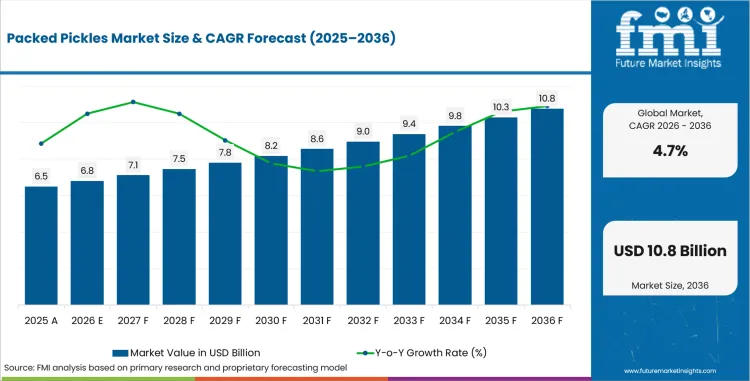
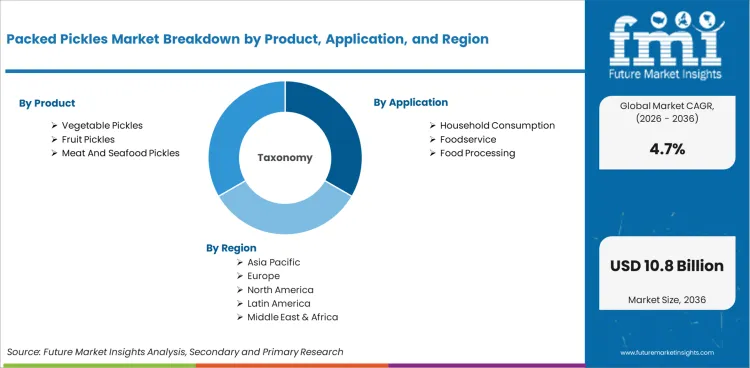
The packed pickles market was valued at USD 6.5 billion in 2025. The market is set to reach USD 6.8 billion by 2026-end and grow at a CAGR of 4.7% between 2026-2036 to reach USD 10.8 billion by 2036. Vegetable Pickles will dominate with a 60.0% share, while Household Consumption will lead with a 65.0% share.
Key Takeaways, Market Size, and Forecast
- The packed pickles market was valued at USD 6.5 billion in 2025.
- By 2036, the Packed Pickles Market is expected to be worth USD 10.77 billion.
- From 2026 to 2036, the market is projected to expand at a CAGR of 4.7%.
- The market is projected to create an incremental opportunity of USD 3.97 billion between 2026 and 2036.
- In 2026, vegetable pickles is expected to account for 60% of the product segment, driven by demand for oil-preserved and brine-preserved vegetable pickles consumed as condiments, side dishes, and snack items in household and foodservice settings.
- Canada (5.2%) and Spain (4.5%) are two of the fastest growing markets in the world.
Summary of the Packed Pickles Market
- Demand and Growth Drivers
- Fermentation and probiotic health positioning is elevating traditional pickles from basic condiments to functional food products, with gut health claims supporting premiumization in health-conscious consumer segments.
- Artisanal and specialty pickle brands are capturing premium shelf space through unique flavor profiles, small-batch production, and clean-label positioning that differentiates from mass-market commodity products.
- Foodservice channel demand from sandwich shops, burger chains, and casual dining provides stable procurement volume, with pickles serving as a standard accompaniment and flavor component in commercial food preparation.
- Product and Segment View
- Vegetable Pickles is likely to remain the leading product segment at 60% share, supported by established demand and procurement patterns.
- Household Consumption is likely to account for 65% of the application segment, reflecting buyer preference and consumption patterns.
- Retail Consumers is likely to lead the end use segment at 70% share during the forecast period.
- Geography and Competitive Outlook
- Canada is likely to remain a key market at 5.2% CAGR, supported by strong demand fundamentals and expanding adoption.
- Spain is likely to sustain growth at 4.5% CAGR owing to rising investment and expanding infrastructure.
- Companies with integrated capabilities and multi-channel distribution are likely to gain traction during the forecast period.
- Analyst Opinion
- The packed pickles market is evolving with clear segment leaders, established supply chains, and distribution patterns shaping competitive dynamics.
- Adoption is increasing due to rising demand fundamentals, expanding infrastructure investment, and growing awareness of product benefits across end-user segments.
- Demand is further supported by product format diversification and geographic expansion into developing markets with growing consumption or infrastructure potential.
- Companies that can deliver consistent quality while optimizing cost across key segments are likely to strengthen their position over the forecast period.
Packed Pickles Market Definition
The packed pickles market encompasses commercially traded preserved vegetable and fruit products in shelf-stable retail packaging. Product categories include vegetable pickles, fruit pickles, mixed pickles, and specialty pickles preserved through oil, brine, vinegar, and fermentation methods.
Packed Pickles Market Inclusions
Market scope covers all commercially traded packed pickle products categorized by product (vegetable pickles, fruit pickles, mixed pickles, specialty pickles), application (household consumption, foodservice, food processing), end use (retail consumers, restaurants, food manufacturers), distribution channel (offline retail, online retail), packaging (glass packaging, flexible packaging, plastic containers), preservation method (oil-based preservation, brine-based, vinegar-based, fermentation), and pricing tier (mid range, economy, premium). The revenue range spans from 2026 to 2036.
Packed Pickles Market Exclusions
The scope does not include fresh unpreserved vegetables, kimchi sold as a distinct fermented food category, or refrigerated pickled products requiring cold chain distribution.
Packed Pickles Market Research Methodology
- Primary Research: FMI analysts conducted interviews with pickle producers, condiment wholesalers, grocery store purchasers and foodservice buyers in key markets.
- Desk Research: Canned food trade associations, retail scanner databases and consumer condiment usage surveys aggregated data.
- Market Sizing & Forecasting: Bottom up aggregation of product types and distribution channels, with regional adoption curves adjusted for condiment consumption habits, culinary culture and preserving tradition intensity.
- Data validation: Cross-compared quarterly with preserved food retail data and manufacturer production volumes.
Why is the Packed Pickles Market Growing?
- Through fermentation and probiotic health positioning, traditional pickles are also being transformed from simple condiments into functional food products. Gut health claims are aiding premiumization in health-conscious consumer segments.
- Small-batch production, unique flavor profiles are earning artisanal and specialty pickle brands premium shelf space.
- Foodservice channel demand of sandwich shops, burger chains.
The packed pickles market is growing at a 4.7% CAGR with traditional preservation products benefiting from fermentation health trends and artisanal premiumization. Vegetable pickles account for 60.0% of the product segment and are characterized by cucumber, onion, pepper and mixed vegetable formats on retail shelves. Oil based preservation is the leader at 60.0% with traditional oil pickles dominating the South Asian and Middle Eastern markets and vinegar and brine methods catering to the Western markets.
Application demand of household consumption is 65.0%, pickles are used as condiments, side dishes and snack items. End user demand is being driven by retail consumers (70.0%) and they buy through supermarkets, specialty food stores and ethnic grocery channels. 75.0% is offline retail. Shelf-stable ambient storage facilitates broad retail distribution without refrigeration. Glass packaging is the market leader with 55.0% share, providing product visibility, reusability and premium shelf presentation.
Market Segmentation Analysis
- Vegetable Pickles accounts for 60% of the product segment, reflecting established demand patterns.
- Retail Consumers leads the end use segment at 70% share.
The packed pickles market is segmented by product, application, end use, distribution channel, packaging, preservation method, pricing tier.
Insights into the Vegetable Pickles Product Segment
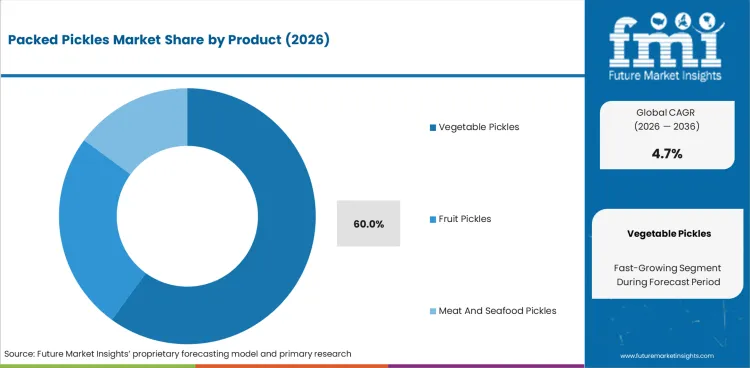
Vegetable pickles are expected to account for a 60.0% share in the product segment by 2026. Western markets are dominated by cucumber pickles while mixed vegetable, mango and lime pickles dominate South Asian markets . Regional flavor preferences make product assortments highly localized. Mass-market brands compete on price and distribution, while artisanal producers differentiate with unique recipes, small-batch production and premium ingredient sourcing.
Insights into the Offline Retail Distribution Channel
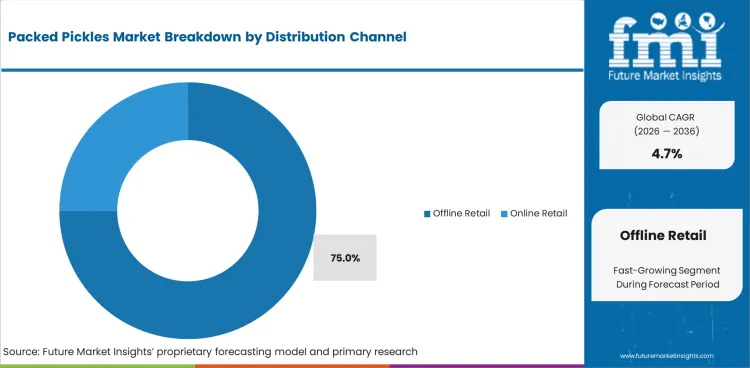
Distribution through offline retail is 75.0%. The main consumer access points are supermarket condiment aisles and ethnic food sections. Specialty Food Stores and Farmers Markets are for the artisanal and premium segment. Ethnic grocery stores have strongholds of region-specific pickle varieties. Shelf-stable packed pickles can be distributed widely without cold chain requirements, supporting mass retail logistics.
Packed Pickles Market Drivers, Restraints, and Opportunities
- Fermentation Health Trend and is creating structured demand across key segments.
- Commodity Pricing Pressure in is moderating growth in certain segments.
The packed pickles market is shaped by demand-side catalysts and supply-side constraints that vary by region, application, and price tier.
Fermentation Health Trend and Probiotic Positioning
Demand is driven by the growing consumer awareness of health benefits of fermentation, such as probiotic content and gut microbiome support. Naturally fermented pickles are being repositioned as functional foods and commanding a premium price point in health-conscious retail channels.
Artisanal and Specialty Brand Premiumization
“Growth is indicative of the emergence of artisanal pickle brands with unique flavor profiles, small-batch production and clean-label ingredients. These brands are found in premium shelf space at specialty food stores and through direct-to-consumer channels, driving category value beyond commodity pricing.
Commodity Pricing Pressure in Mass Market
Mass-market pickle categories face fierce commodity competition, which hampers the ability to charge premium prices for adoption. Price competition between private-label and economy brands is intense in the supermarket channels, limiting the potential for mainstream producers to expand their margins.
Foodservice Channel and Sandwich Culture Growth
Growth is driven in part by foodservice procurement of pickles as standard accompaniments in sandwich, burger and casual dining menus. The growth of quick-service restaurants in developing markets is proportional to the demand for preserved vegetable products.
Analysis of Packed Pickles Market By Key Countries
.webp "Top Country Growth Comparison Packed Pickles Market Cagr (2026 2036)")
| Country | CAGR |
|---|---|
| Canada | 5.2% |
| Spain | 4.5% |
| China | 4.3% |
| UK | 4.2% |
| India | 3.6% |
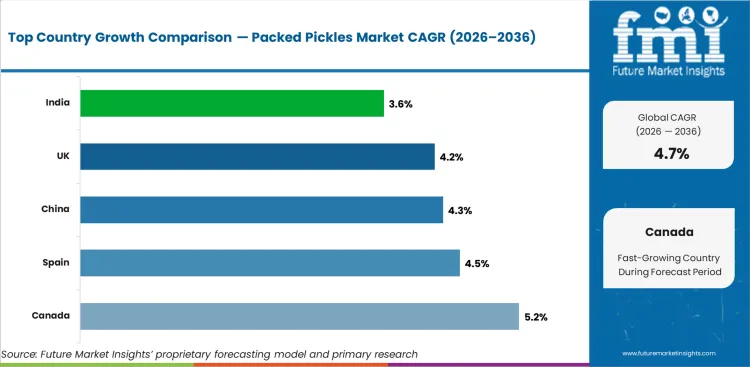
- Canada is leading with 5.2% CAGR, owing to the largest demand base and increasing adoption.
- Spain 4.5%. Investment growth and infrastructure expansion support strong demand.
- China (4.3%) and the UK (4.2%) continue to grow thanks to market development expansion.
The global packed pickles market is projected to expand at 4.7% per year from 2026 to 2036. The study covers more than 30 countries.
Future Outlook for Packed Pickles Market in Canada
Canada leads at 5.2% through 2036. Strong sandwich culture, growing artisanal food interest, and multicultural consumer demographics create diverse pickle demand. Canadian consumers show increasing preference for premium, organic, and locally produced pickle products.
- Sandwich culture and multicultural demographics create diverse pickle consumption patterns.
- Artisanal and locally produced pickle brands are gaining premium retail shelf space.
- Organic and clean-label product positioning resonates with Canadian consumer preferences.
Demand Outlook for Packed Pickles Market in Spain
Spain is expanding at 4.5% through 2036. Mediterranean culinary tradition includes olives and preserved vegetables as meal accompaniments. Spanish producers benefit from olive oil-based preservation expertise and access to high-quality vegetable inputs.
- Mediterranean culinary tradition integrates preserved vegetables as standard meal accompaniments.
- Olive oil preservation expertise provides quality advantages for Spanish pickle manufacturers.
- Tourism and foodservice sectors sustain demand for traditional Spanish preserved vegetable products.
In-depth Analysis of Packed Pickles Market in the United States
The USA grows at 4.2% until 2036. Kraft Heinz and Mt Olive have strong mass-market positions. Artisanal pickle brands are taking premium segments via farmers markets, specialty retail and direct-to-consumer channels.
- Supermarkets are a key to mass-market distribution, with Mt Olive Pickles and Kraft Heinz leading the way.
- Artisanal pickle brands see specialty retail and farmers markets as premium segments.
- Sandwich and burger chains provide stable volume demand for foodservice procurement.
In-depth Analysis of Packed Pickles Market in Germany
Germany’s economy grows 3.8% through 2036. Deep cultural integration through gherkin and sauerkraut pickling traditions. EU food safety standards assure product quality and organic and fermented product positioning supports premiumization.
- Traditions of gherkin and sauerkraut give deep cultural knowledge of preserved vegetables.
- Production requirements are dictated by EU food safety and organic certification standards.
- Health positioning of fermented products supports premium pricing in health-conscious segments.
In-depth Analysis of Packed Pickles Market in Japan
Japan is expanding at 3.5% through 2036. Tsukemono (Japanese pickled vegetables) culture: In-depth market integration. Japanese consumers value the quality, variety and seasonal pickle offerings that fit the customs of the traditional meal accompaniment.
- Tsukemono culture offers a built-in pickle consumption within Japanese food culture.
- Quality, variety and seasonal offerings are in keeping with traditional meal accompaniment customs
- We market premium and artisanal pickle products into retail and high-end foodservice channels.
Competitive Landscape and Strategic Positioning
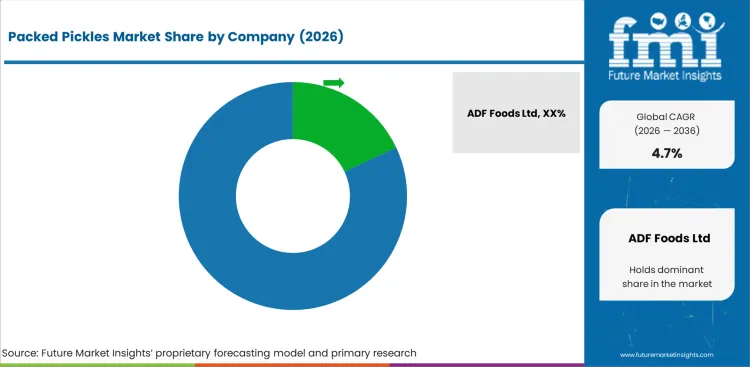
- The Kraft Heinz Company has a strong footprint in Western markets with its Heinz and Claussen pickle brands, offering mass-market distribution scale and brand recognition in supermarket condiment aisles.
- ADF Foods Ltd. and Nilons Enterprises are operating in the South Asian pickle market with brands of oil-preserved mango, lime and mixed vegetable pickles sold through ethnic grocery and modern retail channels.
- In the US, Mt Olive Pickles and Del Monte Foods compete on the basis of regional brand loyalty, specialization in cucumber pickles and established supermarket distribution relationships.
The competitive landscape is characterized by companies with integrated capabilities, established procurement relationships and multi-segment application coverage.
Key Companies in the Packed Pickles Market
Key global companies leading the packed pickles market include:
- The key players in the market are ADF Foods Ltd (India), The Kraft Heinz Company (USA), and Del Monte Foods (USA). They have established brand portfolios, mass-market retail distribution and multi-format pickle product ranges in vegetable, fruit and specialty categories.
- Pinnacle Foods Co (USA), Mt Olive Pickles (USA), and Reitzel India P Ltd (India) Capitalize on regional brand strength, expertise in preservation techniques, and strong sourcing relationships with retail and foodservice channels.
- Mitoku Company. Ltd. (Japan), Orkla (Norway), Nilons Enterprises Pvt Ltd (India) and Peter Piper’s Pickle Palace Inc. (USA) compete through regional specialization, artisanal positioning and ethnic market distribution expertise.
Competitive Benchmarking: Packed Pickles Market
| Company | Product Range | Preservation Expertise | Distribution Scale | Regional Strength |
|---|---|---|---|---|
| ADF Foods | High | High | Asia, Export | South Asia |
| Kraft Heinz | High | Medium | Global | N. America, Europe |
| Del Monte Foods | Medium | Medium | N. America | N. America |
| Pinnacle Foods | Medium | Medium | N. America | N. America |
| Mt Olive Pickles | Medium | High | N. America | USA (Regional) |
| Reitzel India | Medium | High | South Asia | South Asia |
| Mitoku | Medium | High | Japan, Export | Japan |
| Orkla | Medium | Medium | Europe | Scandinavia |
| Nilons Enterprises | High | High | South Asia | India |
| Peter Piper's | Low | High | N. America | USA (Artisanal) |
Source: Future Market Insights competitive analysis, 2026.
Key Developments in Packed Pickles Market
- In 2025, The Kraft Heinz Company expanded its Heinz pickle portfolio with new flavored and premium pickle offerings to address growing consumer demand for bold flavors and clean-label products; however, there is no confirmed evidence that the company launched a probiotic-focused naturally fermented dill pickle line positioned around live cultures and gut health benefits.
- In 2025, ADF Foods Ltd. expanded its portfolio of Indian pickles across brands such as Ashoka, Aeroplane, and Soul, strengthening its presence in international retail and ethnic grocery channels across North America and Europe through broader product offerings and modern packaging formats targeting rising global demand for authentic regional flavors.as
Key Players in the Packed Pickles Market
Major Global Players
- ADF Foods Ltd
- Pinnacle Foods Co
- The Kraft Heinz Company
- Del Monte Foods
- Reitzel India P Ltd
Emerging Players/Startups
- Mt Olive Pickles
- Mitoku Co., Ltd.
- Peter Piper's Pickle Palace, Inc.
- Orkla
- Nilons Enterprises Pvt Ltd
Report Scope and Coverage
| Parameter | Details |
|---|---|
| Quantitative Units | USD 6.81 billion to USD 10.77 billion, at a CAGR of 4.7% |
| Market Definition | The packed pickles market encompasses commercially traded preserved vegetable and fruit products in shelf-stable retail packaging. Product categories include vegetable pickles, fruit pickles, mixed pickles, and specialty pickles preserved through oil, brine, vinegar, and fermentation methods. |
| Regions Covered | North America, Latin America, Europe, East Asia, South Asia and Pacific, Middle East and Africa |
| Countries Covered | Canada, Spain, China, UK, India, 30 plus countries |
| Key Companies Profiled | ADF Foods Ltd, Pinnacle Foods Co, The Kraft Heinz Company, Del Monte Foods, Reitzel India P Ltd, Mt Olive Pickles, Mitoku Co., Ltd., Peter Piper's Pickle Palace, Inc. |
| Forecast Period | 2026 to 2036 |
| Approach | Hybrid bottom-up and top-down methodology starting with verified transaction data, projecting adoption velocity across segments and regions. |
Market Segmentation Analysis
Packed Pickles Market Segmented by Product:
- Vegetable Pickles
- Cucumber Pickles
- Whole Cucumbers
- Sliced Cucumbers
- Mixed Vegetable Pickles
- Traditional Mixes
- Spicy Variants
- Other Vegetable Pickles
- Carrot Pickles
- Chili Pickles
- Cucumber Pickles
- Fruit Pickles
- Mango Pickles
- Raw Mango Pickles
- Sweet Mango Pickles
- Lemon Pickles
- Salted Lemon
- Spiced Lemon
- Mango Pickles
- Meat And Seafood Pickles
- Meat Pickles
- Chicken Pickles
- Mutton Pickles
- Seafood Pickles
- Fish Pickles
- Shrimp Pickles
- Meat Pickles
Packed Pickles Market Segmented by Application:
- Household Consumption
- Daily Meals
- Traditional Diets
- Convenience Consumption
- Snacking
- Ready To Eat Use
- Side Dish Consumption
- Daily Meals
- Foodservice
- Restaurants
- Casual Dining
- Quick Service Restaurants
- Catering Services
- Event Catering
- Institutional Catering
- Restaurants
- Food Processing
- Ready Meals
- Packaged Meals
- Meal Kits
- Snack Industry
- Flavored Snacks
- Fusion Foods
- Ready Meals
Packed Pickles Market Segmented by End Use:
- Retail Consumers
- Urban Consumers
- Working Professionals
- Convenience Buyers
- Rural Consumers
- Traditional Buyers
- Bulk Buyers
- Urban Consumers
- Foodservice Industry
- Hotels And Restaurants
- Casual Dining
- Premium Dining
- Catering Services
- Corporate Catering
- Event Catering
- Hotels And Restaurants
- Food Manufacturers
- Processed Food Companies
- Ready Meal Producers
- Snack Manufacturers
- Processed Food Companies
Packed Pickles Market Segmented by Distribution Channel:
- Offline Retail
- Supermarkets And Hypermarkets
- Large Format Stores
- Discount Stores
- Traditional Grocery Stores
- Local Retailers
- Kirana Stores
- Specialty Stores
- Ethnic Food Stores
- Organic Stores
- Supermarkets And Hypermarkets
- Online Retail
- E Commerce Platforms
- Marketplace Platforms
- Brand Owned Websites
- Quick Commerce
- Instant Delivery Platforms
- App Based Grocery Delivery
- E Commerce Platforms
Packed Pickles Market Segmented by Packaging:
- Glass Packaging
- Glass Jars
- Reusable Jars
- Premium Packaging
- Glass Bottles
- Liquid Pickles
- Oil Based Pickles
- Glass Jars
- Plastic Packaging
- Plastic Containers
- Lightweight Containers
- Bulk Packaging
- Flexible Packaging
- Pouches
- Sachets
- Plastic Containers
Packed Pickles Market Segmented by Preservation Method:
- Oil Based Preservation
- Traditional Oil Pickles
- Spiced Oil Pickles
- Regional Variants
- Traditional Oil Pickles
- Vinegar Based Preservation
- Brined Pickles
- Salt Brine
- Sweet Brine
- Brined Pickles
- Fermented Pickles
- Natural Fermentation
- Probiotic Pickles
- Artisanal Pickles
- Natural Fermentation
Packed Pickles Market Segmented by Pricing Tier:
- Mid Range
- Branded Retail Products
- Standard Quality Pickles
- Branded Retail Products
- Economy
- Local And Unbranded Products
- Loose Packaging
- Bulk Supply
- Local And Unbranded Products
- Premium
- Gourmet And Organic Pickles
- Artisanal Products
- Export Quality Pickles
- Gourmet And Organic Pickles
Packed Pickles Market by Region:
- North America
- USA
- Canada
- Mexico
- Latin America
- Brazil
- Chile
- Rest of Latin America
- Western Europe
- Germany
- UK
- Italy
- Spain
- France
- Nordic
- BENELUX
- Rest of Western Europe
- Eastern Europe
- Russia
- Poland
- Hungary
- Balkan & Baltic
- Rest of Eastern Europe
- East Asia
- China
- Japan
- South Korea
- South Asia and Pacific
- India
- ASEAN
- Australia & New Zealand
- Rest of South Asia and Pacific
- Middle East & Africa
- Kingdom of Saudi Arabia
- Other GCC Countries
- Turkiye
- South Africa
- Other African Union
- Rest of Middle East & Africa
Research Sources and Bibliography
- 1. Food and Agriculture Organization. (2025). FAO Global Preserved and Fermented Foods Report. FAO.
- 2. USA Department of Agriculture. (2025). USDA Vegetables and Preserves Market Report. USDA.
- 3. European Commission. (2024). EU Food Preservation and Labeling Standards. EC.
- 4. International Fermented Foods Association. (2025). IFFA Global Fermented and Pickled Foods Report. IFFA.
- 5. Codex Alimentarius Commission. (2024). Codex Standard for Pickled Fruits and Vegetables. WHO/FAO.
This bibliography is provided for reader reference.
This Report Answers
- Estimating the market size and revenue generation from 2026 to 2036.
- Segmenting by product, application, end use, distribution channel, packaging, preservation method, and pricing tier.
- Providing regional insights across more than 30 markets.
- Analyzing fermentation health trends and artisanal premiumization.
- Assessing the competitive landscape across mass-market and specialty brands.
- Identifying investment opportunities in probiotic-positioned and premium pickles.
- Tracking preservation technology and packaging innovation trends.
- Delivering data in PDF and Excel formats.
Frequently Asked Questions
How big is the packed pickles market in 2026?
The global packed pickles market is estimated to be valued at USD 6.81 billion in 2026.
What will be the size of packed pickles market in 2036?
The market size for the packed pickles market is projected to reach USD 10.77 billion by 2036.
How much will be the packed pickles market growth between 2026 and 2036?
The packed pickles market is expected to grow at a 4.7% CAGR between 2026 and 2036.
What are the key product in the packed pickles market?
The key product in packed pickles market are vegetable pickles, fruit pickles and meat and seafood pickles.
Which application segment is expected to contribute significant share in the packed pickles market in 2026?
In terms of application, household consumption segment is expected to command 65.0% share in the packed pickles market in 2026.
Preview the report firsthand - request a free sample
Get SampleGet the brochure for pricing and purchase details.
Get PDFTable of Content
- Executive Summary
- Global Market Outlook
- Demand-side Trends
- Supply-side Trends
- Technology Roadmap Analysis
- Analysis and Recommendations
- Market Overview
- Market Coverage / Taxonomy
- Market Definition / Scope / Limitations
- Research Methodology
- Chapter Orientation
- Analytical Lens and Working Hypotheses
- Market Structure, Signals, and Trend Drivers
- Benchmarking and Cross-market Comparability
- Market Sizing, Forecasting, and Opportunity Mapping
- Research Design and Evidence Framework
- Desk Research Programme (Secondary Evidence)
- Company Annual and Sustainability Reports
- Peer-reviewed Journals and Academic Literature
- Corporate Websites, Product Literature, and Technical Notes
- Earnings Decks and Investor Briefings
- Statutory Filings and Regulatory Disclosures
- Technical White Papers and Standards Notes
- Trade Journals, Industry Magazines, and Analyst Briefs
- Conference Proceedings, Webinars, and Seminar Materials
- Government Statistics Portals and Public Data Releases
- Press Releases and Reputable Media Coverage
- Specialist Newsletters and Curated Briefings
- Sector Databases and Reference Repositories
- FMI Internal Proprietary Databases and Historical Market Datasets
- Subscription Datasets and Paid Sources
- Social Channels, Communities, and Digital Listening Inputs
- Additional Desk Sources
- Expert Input and Fieldwork (Primary Evidence)
- Primary Modes
- Qualitative Interviews and Expert Elicitation
- Quantitative Surveys and Structured Data Capture
- Blended Approach
- Why Primary Evidence is Used
- Field Techniques
- Interviews
- Surveys
- Focus Groups
- Observational and In-context Research
- Social and Community Interactions
- Stakeholder Universe Engaged
- C-suite Leaders
- Board Members
- Presidents and Vice Presidents
- R&D and Innovation Heads
- Technical Specialists
- Domain Subject-matter Experts
- Scientists
- Physicians and Other Healthcare Professionals
- Governance, Ethics, and Data Stewardship
- Research Ethics
- Data Integrity and Handling
- Primary Modes
- Tooling, Models, and Reference Databases
- Desk Research Programme (Secondary Evidence)
- Data Engineering and Model Build
- Data Acquisition and Ingestion
- Cleaning, Normalisation, and Verification
- Synthesis, Triangulation, and Analysis
- Quality Assurance and Audit Trail
- Market Background
- Market Dynamics
- Drivers
- Restraints
- Opportunity
- Trends
- Scenario Forecast
- Demand in Optimistic Scenario
- Demand in Likely Scenario
- Demand in Conservative Scenario
- Opportunity Map Analysis
- Product Life Cycle Analysis
- Supply Chain Analysis
- Investment Feasibility Matrix
- Value Chain Analysis
- PESTLE and Porter’s Analysis
- Regulatory Landscape
- Regional Parent Market Outlook
- Production and Consumption Statistics
- Import and Export Statistics
- Market Dynamics
- Global Market Analysis 2021 to 2025 and Forecast, 2026 to 2036
- Historical Market Size Value (USD Million) Analysis, 2021 to 2025
- Current and Future Market Size Value (USD Million) Projections, 2026 to 2036
- Y-o-Y Growth Trend Analysis
- Absolute $ Opportunity Analysis
- Global Market Pricing Analysis 2021 to 2025 and Forecast 2026 to 2036
- Global Market Analysis 2021 to 2025 and Forecast 2026 to 2036, By Product
- Introduction / Key Findings
- Historical Market Size Value (USD Million) Analysis By Product , 2021 to 2025
- Current and Future Market Size Value (USD Million) Analysis and Forecast By Product , 2026 to 2036
- Vegetable Pickles
- Cucumber Pickles
- Whole Cucumbers
- Sliced Cucumbers
- Mixed Vegetable Pickles
- Traditional Mixes
- Spicy Variants
- Other Vegetable Pickles
- Carrot Pickles
- Chili Pickles
- Fruit Pickles
- Mango Pickles
- Raw Mango Pickles
- Sweet Mango Pickles
- Lemon Pickles
- Salted Lemon
- Meat And Seafood Pickles
- Meat Pickles
- Chicken Pickles
- Mutton Pickles
- Seafood Pickles
- Fish Pickles
- Vegetable Pickles
- Y-o-Y Growth Trend Analysis By Product , 2021 to 2025
- Absolute $ Opportunity Analysis By Product , 2026 to 2036
- Global Market Analysis 2021 to 2025 and Forecast 2026 to 2036, By Application
- Introduction / Key Findings
- Historical Market Size Value (USD Million) Analysis By Application, 2021 to 2025
- Current and Future Market Size Value (USD Million) Analysis and Forecast By Application, 2026 to 2036
- Household Consumption
- Daily Meals
- Traditional Diets
- Convenience Consumption
- Snacking
- Ready To Eat Use
- Side Dish Consumption
- Foodservice
- Restaurants
- Casual Dining
- Quick Service Restaurants
- Catering Services
- Event Catering
- Food Processing
- Ready Meals
- Packaged Meals
- Meal Kits
- Snack Industry
- Flavored Snacks
- Household Consumption
- Y-o-Y Growth Trend Analysis By Application, 2021 to 2025
- Absolute $ Opportunity Analysis By Application, 2026 to 2036
- Global Market Analysis 2021 to 2025 and Forecast 2026 to 2036, By End Use
- Introduction / Key Findings
- Historical Market Size Value (USD Million) Analysis By End Use, 2021 to 2025
- Current and Future Market Size Value (USD Million) Analysis and Forecast By End Use, 2026 to 2036
- Retail Consumers
- Urban Consumers
- Working Professionals
- Convenience Buyers
- Rural Consumers
- Traditional Buyers
- Bulk Buyers
- Foodservice Industry
- Hotels And Restaurants
- Casual Dining
- Premium Dining
- Catering Services
- Corporate Catering
- Food Manufacturers
- Processed Food Companies
- Ready Meal Producers
- Snack Manufacturers
- Retail Consumers
- Y-o-Y Growth Trend Analysis By End Use, 2021 to 2025
- Absolute $ Opportunity Analysis By End Use, 2026 to 2036
- Global Market Analysis 2021 to 2025 and Forecast 2026 to 2036, By Distribution Channel
- Introduction / Key Findings
- Historical Market Size Value (USD Million) Analysis By Distribution Channel, 2021 to 2025
- Current and Future Market Size Value (USD Million) Analysis and Forecast By Distribution Channel, 2026 to 2036
- Offline Retail
- Supermarkets And Hypermarkets
- Large Format Stores
- Discount Stores
- Traditional Grocery Stores
- Local Retailers
- Kirana Stores
- Specialty Stores
- Ethnic Food Stores
- Organic Stores
- Online Retail
- E Commerce Platforms
- Marketplace Platforms
- Brand Owned Websites
- Quick Commerce
- Instant Delivery Platforms
- Offline Retail
- Y-o-Y Growth Trend Analysis By Distribution Channel, 2021 to 2025
- Absolute $ Opportunity Analysis By Distribution Channel, 2026 to 2036
- Global Market Analysis 2021 to 2025 and Forecast 2026 to 2036, By Packaging
- Introduction / Key Findings
- Historical Market Size Value (USD Million) Analysis By Packaging, 2021 to 2025
- Current and Future Market Size Value (USD Million) Analysis and Forecast By Packaging, 2026 to 2036
- Glass Packaging
- Glass Jars
- Reusable Jars
- Premium Packaging
- Glass Bottles
- Liquid Pickles
- Oil Based Pickles
- Plastic Packaging
- Plastic Containers
- Lightweight Containers
- Bulk Packaging
- Flexible Packaging
- Pouches
- Glass Packaging
- Y-o-Y Growth Trend Analysis By Packaging, 2021 to 2025
- Absolute $ Opportunity Analysis By Packaging, 2026 to 2036
- Global Market Analysis 2021 to 2025 and Forecast 2026 to 2036, By Preservation Method
- Introduction / Key Findings
- Historical Market Size Value (USD Million) Analysis By Preservation Method, 2021 to 2025
- Current and Future Market Size Value (USD Million) Analysis and Forecast By Preservation Method, 2026 to 2036
- Oil Based Preservation
- Traditional Oil Pickles
- Spiced Oil Pickles
- Regional Variants
- Vinegar Based Preservation
- Brined Pickles
- Salt Brine
- Sweet Brine
- Fermented Pickles
- Natural Fermentation
- Probiotic Pickles
- Artisanal Pickles
- Oil Based Preservation
- Y-o-Y Growth Trend Analysis By Preservation Method, 2021 to 2025
- Absolute $ Opportunity Analysis By Preservation Method, 2026 to 2036
- Global Market Analysis 2021 to 2025 and Forecast 2026 to 2036, By Pricing Tier
- Introduction / Key Findings
- Historical Market Size Value (USD Million) Analysis By Pricing Tier, 2021 to 2025
- Current and Future Market Size Value (USD Million) Analysis and Forecast By Pricing Tier, 2026 to 2036
- Mid Range
- Branded Retail Products
- Standard Quality Pickles
- Economy
- Local And Unbranded Products
- Loose Packaging
- Bulk Supply
- Premium
- Gourmet And Organic Pickles
- Artisanal Products
- Export Quality Pickles
- Mid Range
- Y-o-Y Growth Trend Analysis By Pricing Tier, 2021 to 2025
- Absolute $ Opportunity Analysis By Pricing Tier, 2026 to 2036
- Global Market Analysis 2021 to 2025 and Forecast 2026 to 2036, By Region
- Introduction
- Historical Market Size Value (USD Million) Analysis By Region, 2021 to 2025
- Current Market Size Value (USD Million) Analysis and Forecast By Region, 2026 to 2036
- North America
- Latin America
- Western Europe
- Eastern Europe
- East Asia
- South Asia and Pacific
- Middle East & Africa
- Market Attractiveness Analysis By Region
- North America Market Analysis 2021 to 2025 and Forecast 2026 to 2036, By Country
- Historical Market Size Value (USD Million) Trend Analysis By Market Taxonomy, 2021 to 2025
- Market Size Value (USD Million) Forecast By Market Taxonomy, 2026 to 2036
- By Country
- USA
- Canada
- Mexico
- By Product
- By Application
- By End Use
- By Distribution Channel
- By Packaging
- By Preservation Method
- By Pricing Tier
- By Country
- Market Attractiveness Analysis
- By Country
- By Product
- By Application
- By End Use
- By Distribution Channel
- By Packaging
- By Preservation Method
- By Pricing Tier
- Key Takeaways
- Latin America Market Analysis 2021 to 2025 and Forecast 2026 to 2036, By Country
- Historical Market Size Value (USD Million) Trend Analysis By Market Taxonomy, 2021 to 2025
- Market Size Value (USD Million) Forecast By Market Taxonomy, 2026 to 2036
- By Country
- Brazil
- Chile
- Rest of Latin America
- By Product
- By Application
- By End Use
- By Distribution Channel
- By Packaging
- By Preservation Method
- By Pricing Tier
- By Country
- Market Attractiveness Analysis
- By Country
- By Product
- By Application
- By End Use
- By Distribution Channel
- By Packaging
- By Preservation Method
- By Pricing Tier
- Key Takeaways
- Western Europe Market Analysis 2021 to 2025 and Forecast 2026 to 2036, By Country
- Historical Market Size Value (USD Million) Trend Analysis By Market Taxonomy, 2021 to 2025
- Market Size Value (USD Million) Forecast By Market Taxonomy, 2026 to 2036
- By Country
- Germany
- UK
- Italy
- Spain
- France
- Nordic
- BENELUX
- Rest of Western Europe
- By Product
- By Application
- By End Use
- By Distribution Channel
- By Packaging
- By Preservation Method
- By Pricing Tier
- By Country
- Market Attractiveness Analysis
- By Country
- By Product
- By Application
- By End Use
- By Distribution Channel
- By Packaging
- By Preservation Method
- By Pricing Tier
- Key Takeaways
- Eastern Europe Market Analysis 2021 to 2025 and Forecast 2026 to 2036, By Country
- Historical Market Size Value (USD Million) Trend Analysis By Market Taxonomy, 2021 to 2025
- Market Size Value (USD Million) Forecast By Market Taxonomy, 2026 to 2036
- By Country
- Russia
- Poland
- Hungary
- Balkan & Baltic
- Rest of Eastern Europe
- By Product
- By Application
- By End Use
- By Distribution Channel
- By Packaging
- By Preservation Method
- By Pricing Tier
- By Country
- Market Attractiveness Analysis
- By Country
- By Product
- By Application
- By End Use
- By Distribution Channel
- By Packaging
- By Preservation Method
- By Pricing Tier
- Key Takeaways
- East Asia Market Analysis 2021 to 2025 and Forecast 2026 to 2036, By Country
- Historical Market Size Value (USD Million) Trend Analysis By Market Taxonomy, 2021 to 2025
- Market Size Value (USD Million) Forecast By Market Taxonomy, 2026 to 2036
- By Country
- China
- Japan
- South Korea
- By Product
- By Application
- By End Use
- By Distribution Channel
- By Packaging
- By Preservation Method
- By Pricing Tier
- By Country
- Market Attractiveness Analysis
- By Country
- By Product
- By Application
- By End Use
- By Distribution Channel
- By Packaging
- By Preservation Method
- By Pricing Tier
- Key Takeaways
- South Asia and Pacific Market Analysis 2021 to 2025 and Forecast 2026 to 2036, By Country
- Historical Market Size Value (USD Million) Trend Analysis By Market Taxonomy, 2021 to 2025
- Market Size Value (USD Million) Forecast By Market Taxonomy, 2026 to 2036
- By Country
- India
- ASEAN
- Australia & New Zealand
- Rest of South Asia and Pacific
- By Product
- By Application
- By End Use
- By Distribution Channel
- By Packaging
- By Preservation Method
- By Pricing Tier
- By Country
- Market Attractiveness Analysis
- By Country
- By Product
- By Application
- By End Use
- By Distribution Channel
- By Packaging
- By Preservation Method
- By Pricing Tier
- Key Takeaways
- Middle East & Africa Market Analysis 2021 to 2025 and Forecast 2026 to 2036, By Country
- Historical Market Size Value (USD Million) Trend Analysis By Market Taxonomy, 2021 to 2025
- Market Size Value (USD Million) Forecast By Market Taxonomy, 2026 to 2036
- By Country
- Kingdom of Saudi Arabia
- Other GCC Countries
- Turkiye
- South Africa
- Other African Union
- Rest of Middle East & Africa
- By Product
- By Application
- By End Use
- By Distribution Channel
- By Packaging
- By Preservation Method
- By Pricing Tier
- By Country
- Market Attractiveness Analysis
- By Country
- By Product
- By Application
- By End Use
- By Distribution Channel
- By Packaging
- By Preservation Method
- By Pricing Tier
- Key Takeaways
- Key Countries Market Analysis
- USA
- Pricing Analysis
- Market Share Analysis, 2025
- By Product
- By Application
- By End Use
- By Distribution Channel
- By Packaging
- By Preservation Method
- By Pricing Tier
- Canada
- Pricing Analysis
- Market Share Analysis, 2025
- By Product
- By Application
- By End Use
- By Distribution Channel
- By Packaging
- By Preservation Method
- By Pricing Tier
- Mexico
- Pricing Analysis
- Market Share Analysis, 2025
- By Product
- By Application
- By End Use
- By Distribution Channel
- By Packaging
- By Preservation Method
- By Pricing Tier
- Brazil
- Pricing Analysis
- Market Share Analysis, 2025
- By Product
- By Application
- By End Use
- By Distribution Channel
- By Packaging
- By Preservation Method
- By Pricing Tier
- Chile
- Pricing Analysis
- Market Share Analysis, 2025
- By Product
- By Application
- By End Use
- By Distribution Channel
- By Packaging
- By Preservation Method
- By Pricing Tier
- Germany
- Pricing Analysis
- Market Share Analysis, 2025
- By Product
- By Application
- By End Use
- By Distribution Channel
- By Packaging
- By Preservation Method
- By Pricing Tier
- UK
- Pricing Analysis
- Market Share Analysis, 2025
- By Product
- By Application
- By End Use
- By Distribution Channel
- By Packaging
- By Preservation Method
- By Pricing Tier
- Italy
- Pricing Analysis
- Market Share Analysis, 2025
- By Product
- By Application
- By End Use
- By Distribution Channel
- By Packaging
- By Preservation Method
- By Pricing Tier
- Spain
- Pricing Analysis
- Market Share Analysis, 2025
- By Product
- By Application
- By End Use
- By Distribution Channel
- By Packaging
- By Preservation Method
- By Pricing Tier
- France
- Pricing Analysis
- Market Share Analysis, 2025
- By Product
- By Application
- By End Use
- By Distribution Channel
- By Packaging
- By Preservation Method
- By Pricing Tier
- India
- Pricing Analysis
- Market Share Analysis, 2025
- By Product
- By Application
- By End Use
- By Distribution Channel
- By Packaging
- By Preservation Method
- By Pricing Tier
- ASEAN
- Pricing Analysis
- Market Share Analysis, 2025
- By Product
- By Application
- By End Use
- By Distribution Channel
- By Packaging
- By Preservation Method
- By Pricing Tier
- Australia & New Zealand
- Pricing Analysis
- Market Share Analysis, 2025
- By Product
- By Application
- By End Use
- By Distribution Channel
- By Packaging
- By Preservation Method
- By Pricing Tier
- China
- Pricing Analysis
- Market Share Analysis, 2025
- By Product
- By Application
- By End Use
- By Distribution Channel
- By Packaging
- By Preservation Method
- By Pricing Tier
- Japan
- Pricing Analysis
- Market Share Analysis, 2025
- By Product
- By Application
- By End Use
- By Distribution Channel
- By Packaging
- By Preservation Method
- By Pricing Tier
- South Korea
- Pricing Analysis
- Market Share Analysis, 2025
- By Product
- By Application
- By End Use
- By Distribution Channel
- By Packaging
- By Preservation Method
- By Pricing Tier
- Russia
- Pricing Analysis
- Market Share Analysis, 2025
- By Product
- By Application
- By End Use
- By Distribution Channel
- By Packaging
- By Preservation Method
- By Pricing Tier
- Poland
- Pricing Analysis
- Market Share Analysis, 2025
- By Product
- By Application
- By End Use
- By Distribution Channel
- By Packaging
- By Preservation Method
- By Pricing Tier
- Hungary
- Pricing Analysis
- Market Share Analysis, 2025
- By Product
- By Application
- By End Use
- By Distribution Channel
- By Packaging
- By Preservation Method
- By Pricing Tier
- Kingdom of Saudi Arabia
- Pricing Analysis
- Market Share Analysis, 2025
- By Product
- By Application
- By End Use
- By Distribution Channel
- By Packaging
- By Preservation Method
- By Pricing Tier
- Turkiye
- Pricing Analysis
- Market Share Analysis, 2025
- By Product
- By Application
- By End Use
- By Distribution Channel
- By Packaging
- By Preservation Method
- By Pricing Tier
- South Africa
- Pricing Analysis
- Market Share Analysis, 2025
- By Product
- By Application
- By End Use
- By Distribution Channel
- By Packaging
- By Preservation Method
- By Pricing Tier
- USA
- Market Structure Analysis
- Competition Dashboard
- Competition Benchmarking
- Market Share Analysis of Top Players
- By Regional
- By Product
- By Application
- By End Use
- By Distribution Channel
- By Packaging
- By Preservation Method
- By Pricing Tier
- Competition Analysis
- Competition Deep Dive
- ADF Foods Ltd
- Overview
- Product Portfolio
- Profitability by Market Segments (Product/Age /Sales Channel/Region)
- Sales Footprint
- Strategy Overview
- Marketing Strategy
- Product Strategy
- Channel Strategy
- Pinnacle Foods Co
- The Kraft Heinz Company
- Del Monte Foods
- Reitzel India P Ltd
- Mt Olive Pickles
- Mitoku Co., Ltd.
- Peter Piper’s Pickle Palace, Inc.
- Orkla
- Nilons Enterprises Pvt Ltd
- ADF Foods Ltd
- Competition Deep Dive
- Assumptions & Acronyms Used


