

- Market Size (2026)
- USD 719.7 Mn
- Forecast (2036)
- USD 2316.4 Mn
- CAGR (2026 to 2036)
- 12.4%
How big is Perimenopause Nutrition Products Market in 2026?
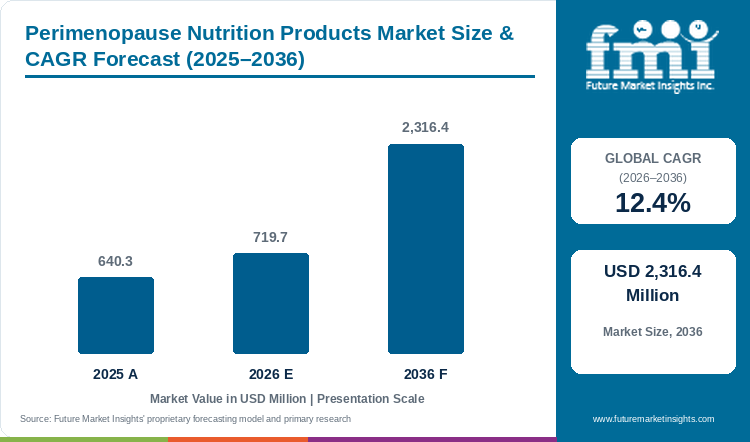
The market was valued at USD 640.3 Million in 2025 and is expected to reach USD 719.7 Million in 2026, with growth at a 12.4% CAGR from 2026 to 2036 taking its value to USD 2,316.4 Million by 2036.
A customer may first consider a perimenopause product because of sleep or hot-flash concerns, while another is reviewing ordinary nutrient intake and longer-term bone or muscle needs. Those purchasing situations call for a defined purpose and clear composition rather than a formula presented as an answer to every part of the transition. Ingredient identity and daily amounts allow the proposed addition to be considered alongside supplements and medicines already in use, particularly where several blends contain similar botanicals. Retail or online access can encourage trial, but realistic expectations and a manageable serving influence whether the buyer continues. Adjustable replenishment also helps quantities follow actual use instead of assuming that every introductory purchase should become a fixed subscription. Country requirements, including Germany’s scrutiny of isolated isoflavones, affect how the offer is explained. The forecast covers ingestible nutrition positioned for the menopausal transition and excludes prescription hormone therapy, devices, treatment and unrelated general nutrition. [5]
Key Market Trends & Insights
- Hormone-Balance Botanical Blends account for 41.4% of product type in 2026, grouping plant-based formulations whose ingredient identities and daily amounts need to be made clear.
- Phytoestrogens (Soy / S-Equol) represents 42.3% of key ingredient in 2026, combining different preparations that buyers need to distinguish by material, serving and relevant evidence.
- The 40-45 Years group accounts for 45.2% of age band in 2026, while suitability still depends on individual circumstances and products already in use.
- Capsules / Tablets account for 46.9% of form in 2026, providing compact daily servings of specified extracts or nutrients with amounts that can be reviewed.
Regional Highlights
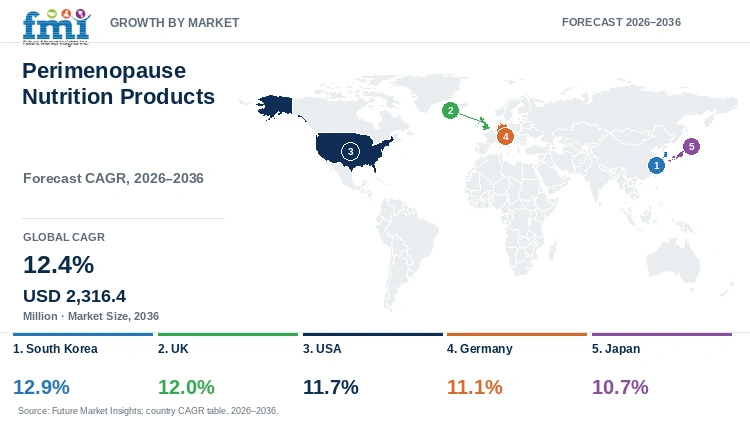
- South Korea has the highest profiled CAGR at 12.9% during 2026–2036.
- The next two profiled growth rates are UK at 12.0% and USA at 11.7% over the same period.
Market Size & Forecast
| Metric | Value |
|---|---|
| 2025 market value | USD 640.3 Million |
| 2026 market estimate | USD 719.7 Million |
| 2036 market forecast | USD 2,316.4 Million |
| Forecast CAGR, 2026–2036 | 12.4% |
The market covers ingestible nutrition and supplement products positioned for perimenopause or the menopausal transition. Prescription hormone therapy, medical treatment, devices and unrelated general nutrition products are outside the scope.
Perimenopause products differ from prescribed care, and the clinical nutrition comparison is useful only where an assessed nutritional need is present.
Nutrition evidence and practical use
| Documented operating context | Source |
|---|---|
| NHS guidance describes clinical treatment options for menopause symptoms, including hormone replacement therapy. | [1] |
| Ritual announced nationwide Walmart distribution for selected women’s supplements in October 2025. | [2] |
| Thorne announced a women’s health campaign in April 2026. | [3] |
| FDA distinguishes permissible structure/function claims from claims to diagnose, treat, cure or prevent disease. | [4] |
Analyst Perspective
A life-stage formula is easier to assess when buyers can identify its ingredients, daily amounts and intended nutritional role alongside the products already in use. Focused explanations and manageable replenishment give a customer a practical basis for continuing, with botanical positioning kept within the evidence for the actual preparation and claimed benefit.
- Anurag Sharma, Principal Analyst at Future Market Insights
How is the perimenopause nutrition products market segmented?
Product Type covers Hormone-Balance Botanical Blends, Hot-Flash & Sleep Support, Bone & Muscle Support, Mood & Cognition Blends and Others. Key Ingredient covers Phytoestrogens (Soy / S-Equol), Black Cohosh & Botanicals, Magnesium & B-Complex, Adaptogens and Others. Age Band covers 40-45 Years, 46-50 Years and 51-55 Years. Form covers Capsules / Tablets, Gummies, Powders & Drinks and Others. Sales Channel covers Online / DTC, Retail Pharmacy, Supermarkets & Hypermarkets, Specialty & Health Stores and Others.
The women’s health supplements market provides established life-stage merchandising, but perimenopause formulas need to explain their specific ingredient choices.
Why do Hormone-Balance Botanical Blends lead product type demand?
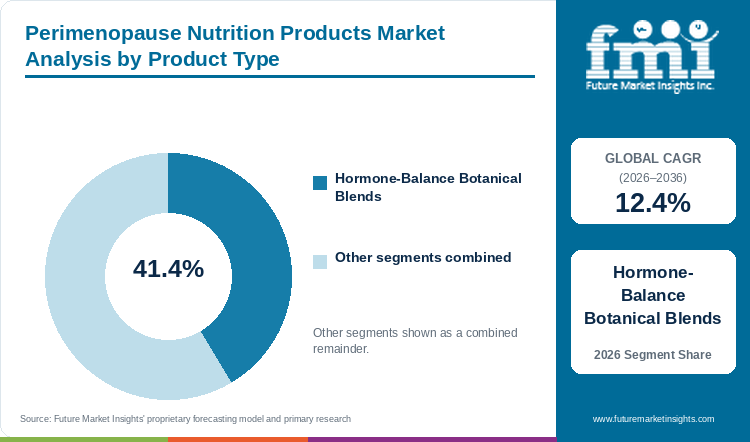
Hormone-Balance Botanical Blends: 41.4% of product type in 2026.
A botanical blend places several materials in one life-stage product, which can simplify purchasing while making individual contributions harder to identify. Buyers need the named ingredients and daily amounts to compare the formula with products already in use, particularly when two blends include the same material. Hormone-Balance Botanical Blends is the market-positioning category rather than confirmation of normalized hormone levels, so a limited, well-explained purpose and relevant evidence provide a more useful comparison than a longer list of ingredients.
- The Hormone-Balance Botanical Blends segment accounts for 41.4% of product type in 2026.
- A clearly identified botanical formula is easier to compare with existing products than an unspecified promise of hormone balance.
Why does Phytoestrogens (Soy / S-Equol) lead key ingredient demand?
Phytoestrogens (Soy / S-Equol): 42.3% of key ingredient in 2026.
Soy isoflavones and S-equol appear within one forecast category but describe different preparations, making exact ingredient identity central to an informed comparison. Some offers center on soy-derived compounds while others feature the metabolite itself, and evidence for one material and serving cannot simply be transferred to another. Clear naming and daily amounts help buyers understand the proposed role alongside their current routine, while keeping nutrition products distinguishable from prescribed hormone therapy.
- The Phytoestrogens (Soy / S-Equol) segment accounts for 42.3% of key ingredient in 2026.
- Changing the delivery format should not obscure which phytoestrogen preparation is present or the evidence relevant to it.
What are the drivers, restraints, and opportunities in the perimenopause nutrition products market?
Changing life-stage needs prompt regimen review
Perimenopause can prompt a reassessment of food intake and daily routines as needs change. A consumer may first look for a product positioned around sleep and later give more attention to bone or muscle nutrition. Suppliers need to explain the specific purpose of an offer rather than suggest that every symptom has the same nutritional answer. A simple regimen can be easier to maintain alongside ordinary meals and other care. The purchasing opportunity comes from that defined use and clear composition rather than the breadth of a wellness claim.
Ingredient variability complicates benefit comparisons
Botanical products need more precise comparison than a shared ingredient name, because the identified material, standardization and evidence may differ between formulations. Visible warnings and daily amounts help buyers review overlapping blends before adding another product to the routine. Suppliers can support that decision through a defined purpose and a clear account of the relevant evidence before asking customers to commit to continued use.
Clear formulation choices can reduce regimen complexity
Retail and direct channels can make product comparison easier when they explain the same formula in consistent language. The information should identify what is included and what benefit is actually being claimed. Specialist staff and professional education can help customers distinguish similar-looking products. This is more useful than simply increasing shelf space for broad hormone-balance blends. Flexible replenishment also lets buyers match purchases to real use. A transparent focused offer gives the consumer a clearer basis for deciding whether to continue than an expansive list of possible wellness effects.
Consumers comparing dietary supplements may encounter several overlapping blends, making a transparent daily regimen a practical competitive advantage.
Which country and market CAGRs are profiled for perimenopause nutrition products?
| Country | CAGR |
|---|---|
| South Korea | 12.9% |
| UK | 12.0% |
| USA | 11.7% |
| Germany | 11.1% |
| Japan | 10.7% |
Country-wise Analysis
South Korea
- Recognized functionality and serving conditions give South Korean buyers a more precise basis for comparison than a broad description of hormone balance. Suppliers can use that distinction to explain which botanical material is present and the purpose for which it is offered as the market grows at a forecast 12.9% CAGR from 2026 to 2036, the fastest profiled rate. Clear composition then supports a decision about whether another daily product belongs in the existing routine.
UK
- Wider discussion of menopause in the UK can bring buyers to a retailer before they understand how formulations differ, making accessible ingredient and safety information useful at the point of comparison. The UK’s forecast is a 12.0% CAGR from 2026 to 2036, with purchase decisions also influenced by medicines and supplements already in use. Plain descriptions help customers and professionals assess the combined routine without relying on a claim about the transition as a whole.
USA
- Retail and direct channels give American customers several ways to discover a perimenopause formula, but reach alone does not explain whether its ingredients support the advertised purpose. A focused formulation can make that assessment easier within a market forecast to grow at an 11.7% CAGR from 2026 to 2036. Adjustable replenishment also allows buyers to reconsider the quantity and continued relevance of the product as their circumstances change.
Germany
- Ingredient identity and safety information deserve particular attention in Germany, including when a product uses isolated isoflavones. Transparent amounts allow a proposed formula to be assessed against an existing regimen, where duplication and the number of daily servings may matter as much as the ingredient list. Germany’s 11.1% CAGR forecast for 2026 to 2036 therefore sits within a purchasing context that calls for a defined purpose and manageable use rather than broad promises of symptom relief.
Japan
- A Japanese perimenopause offer needs to explain its contribution alongside familiar nutrition products, with convenient formats helping only when the daily serving and intended use are clear. This comparison forms part of the market’s 10.7% CAGR forecast from 2026 to 2036, as buyers decide whether an additional product fits their established routine. Suppliers can support that review through precise composition and a nutritional purpose that remains distinguishable from medical treatment.
Who are the notable companies in the perimenopause nutrition products market?
Ritual; Thorne; Pharmavite; Otsuka Pharmaceutical; Womaness
Perimenopause nutrition suppliers compete across botanical blends, selected micronutrients and broader life-stage routines. The challenge is to make the formula understandable without implying that every changing symptom has the same nutritional solution.
Competitive Benchmarking: Perimenopause Nutrition Products Market
| Participant | Commercial focus | Buyer qualification priority |
|---|---|---|
| Ritual | Women’s life-stage supplements | Regimen clarity and evidence fit |
| Thorne | Women’s health nutrition | Ingredient dose and interaction review |
| Pharmavite | Vitamin and mineral portfolios | Retail access and repeat supply |
| Otsuka Pharmaceutical | Women’s health nutrition products | Formulation-specific evidence |
| Womaness | Menopause-oriented wellness products | Claims boundaries and user suitability |
Key Developments in the Perimenopause Nutrition Products Market
- Ritual announced nationwide Walmart distribution for selected women’s supplements in October 2025. [2]
- Thorne announced a women’s health campaign in April 2026. [3]
Key Players in the Perimenopause Nutrition Products Market
- Ritual
- Thorne
- Pharmavite
- Otsuka Pharmaceutical
- Womaness
Perimenopause Nutrition Products Market - Report Scope
| Coverage field | Report scope |
|---|---|
| Market breakdown | Product Type; Key Ingredient; Age Band; Form; Sales Channel; Region |
| Quantitative unit | USD Million |
| Market definition | The market covers ingestible nutrition and supplement products positioned for perimenopause or the menopausal transition. Prescription hormone therapy, medical treatment, devices and unrelated general nutrition products are outside the scope. |
| Regions covered | North America; Latin America; Western Europe; Eastern Europe; East Asia; South Asia and Pacific; Middle East and Africa |
| Countries / markets profiled | South Korea; UK; USA; Germany; Japan |
| Key companies profiled | Ritual; Thorne; Pharmavite; Otsuka Pharmaceutical; Womaness |
| Base year / forecast period | 2026 / 2026–2036 |
| Estimate coverage | 2025 and 2026 market estimates; 2036 forecast; segment shares and country / market CAGRs. |
Perimenopause Nutrition Products Market - Research Methodology
| Method | Application |
|---|---|
| Market definition | The analysis follows the stated product or service boundary and distinguishes direct category revenue from adjacent activities. |
| Secondary research | Official technical, regulatory, research and company publications provide the documented operating context and recent developments cited in this report. |
| Forecast and segmentation | Market estimates, segment shares and geographic forecasts are presented as analytical estimates within the stated commercial scope. |
| Competitive assessment | Participants are compared by their relevant products or services, commercial role and buyer qualification requirements. |
| Interpretation | The assessment considers purchasing conditions and the scope of the documented product, service or performance claim. |
Perimenopause Nutrition Products Market by Segments
Product Type
- Hormone-Balance Botanical Blends
- Hot-Flash & Sleep Support
- Bone & Muscle Support
- Mood & Cognition Blends
- Others
Key Ingredient
- Phytoestrogens (Soy / S-Equol)
- Black Cohosh & Botanicals
- Magnesium & B-Complex
- Adaptogens
- Others
Age Band
- 40-45 Years
- 46-50 Years
- 51-55 Years
Form
- Capsules / Tablets
- Gummies
- Powders & Drinks
- Others
Sales Channel
- Online / DTC
- Retail Pharmacy
- Supermarkets & Hypermarkets
- Specialty & Health Stores
- Others
Perimenopause Nutrition Products Market by Region
- North America
- United States
- Canada
- Latin America
- Brazil
- Mexico
- Argentina
- Chile
- Western Europe
- Germany
- France
- United Kingdom
- Italy
- Spain
- Benelux
- Nordics
- Eastern Europe
- Poland
- Czech Republic
- Romania
- Hungary
- East Asia
- China
- Japan
- South Korea
- South Asia and Pacific
- India
- ASEAN
- Australia and New Zealand
- Middle East and Africa
- GCC Countries
- South Africa
- Türkiye
- Israel
Research Sources and Bibliography
- [1] NHS. (n.d.). Menopause: Treatment.
- [2] Ritual. (2025, October 6). Ritual Expands Retail Footprint with Walmart Launch, Bringing Foundational Women’s Supplements Nationwide.
- [3] Thorne. (2026, April 6). THORNE DEBUTS WOMEN’S HEALTH CAMPAIGN WITH MISTY COPELAND AND LANA CONDOR, INTRODUCING NEW CLINICALLY FORMULATED PRODUCTS.
- [4] U.S. Food and Drug Administration. (n.d.). Structure/function claims.
- [5] Future Market Insights. (2026). Perimenopause Nutrition Products Market: Global industry analysis and opportunity assessment, 2026–2036.
This Report Answers
- How large is the perimenopause nutrition products market in 2026?
- What value and CAGR are forecast through 2036?
- Which product type segment leads in 2026?
- Which key ingredient segment has the largest share?
- Which profiled country or market has the fastest forecast growth?
- Which participants are covered in the competitive assessment?
Frequently Asked Questions
How large is the perimenopause nutrition products market in 2026?
The market was valued at USD 640.3 Million in 2025 and is expected to reach USD 719.7 Million in 2026.
What value and CAGR are forecast through 2036?
The market is projected to reach USD 2,316.4 Million by 2036, with a 12.4% CAGR during 2026–2036.
Which product type segment leads in 2026?
The Hormone-Balance Botanical Blends segment accounts for 41.4% of product type in 2026.
Which key ingredient segment has the largest share?
The Phytoestrogens (Soy / S-Equol) segment accounts for 42.3% of key ingredient in 2026.
Which profiled country or market has the fastest forecast growth?
South Korea has the highest profiled CAGR at 12.9% during 2026–2036.
Which participants are covered in the competitive assessment?
The assessment covers Ritual, Thorne, Pharmavite, Otsuka Pharmaceutical and Womaness.
Preview the report firsthand - request a free sample
Get SampleGet the brochure for pricing and purchase details.
Get PDFTable of Content
- Key Takeaways
- Market Size and CAGR
- Top Growth Driver
- Fastest Growing Segment
- Leading Region
- Key Companies
- Emerging Opportunities
- Executive Summary
- Global Market Outlook
- Demand-side Trends
- Supply-side Trends
- Technology Roadmap Analysis
- Analysis and Recommendations
- Analyst Perspective (What is happening? Why now? What should investors know?)
- Key Questions Answered
- How large is the market?
- What is the CAGR?
- What are key trends?
- Which region dominates?
- Who are the leaders?
- Market Overview
- Market Coverage / Taxonomy
- Market Definition / Scope / Limitations
- Research Methodology
- Chapter Orientation
- Analytical Lens and Working Hypotheses
- Market Structure, Signals, and Trend Drivers
- Benchmarking and Cross-market Comparability
- Market Sizing, Forecasting, and Opportunity Mapping
- Research Design and Evidence Framework
- Desk Research Programme (Secondary Evidence)
- Expert Input and Fieldwork (Primary Evidence)
- Tooling, Models, and Reference Databases
- Data Engineering and Model Build
- Quality Assurance and Audit Trail
- Market Background
- Market Dynamics (Drivers, Restraints, Opportunity, Trends)
- Scenario Forecast (Optimistic, Likely, Conservative)
- Impact Analysis
- AI Impact
- Sustainability Impact
- Regulatory Impact
- Technology Impact
- Consumer / Buyer Analysis
- Purchase Drivers
- Adoption Barriers
- Buyer Journey
- Opportunity Map Analysis
- Product Life Cycle Analysis
- Supply Chain Analysis
- Investment Feasibility Matrix
- Value Chain Analysis
- PESTLE and Porter's Analysis
- Regulatory Landscape
- Regional Parent Market Outlook
- Production and Consumption Statistics
- Import and Export Statistics
- Global Market Analysis and Forecast, 2021 to 2036
- Historical Market Size Value (USD Million) Analysis, 2021 to 2025
- Current and Future Market Size Value (USD Million) Projections, 2026 to 2036
- Y-o-Y Growth Trend Analysis
- Absolute $ Opportunity Analysis
- Global Market Pricing Analysis, 2021 to 2036
- Global Market Analysis and Forecast, By Product Type, 2021 to 2036
- Introduction / Key Findings
- Historical Market Size Value (USD Million) Analysis By Product Type, 2021 to 2025
- Current and Future Market Size Value (USD Million) Analysis and Forecast By Product Type, 2026 to 2036
- Hormone-Balance Botanical Blends
- Hot-Flash & Sleep Support
- Bone & Muscle Support
- Mood & Cognition Blends
- Others
- Y-o-Y Growth Trend Analysis By Product Type, 2021 to 2025
- Absolute $ Opportunity Analysis By Product Type, 2026 to 2036
- Global Market Analysis and Forecast, By Key Ingredient, 2021 to 2036
- Introduction / Key Findings
- Historical Market Size Value (USD Million) Analysis By Key Ingredient, 2021 to 2025
- Current and Future Market Size Value (USD Million) Analysis and Forecast By Key Ingredient, 2026 to 2036
- Phytoestrogens (Soy / S-Equol)
- Black Cohosh & Botanicals
- Magnesium & B-Complex
- Adaptogens
- Others
- Y-o-Y Growth Trend Analysis By Key Ingredient, 2021 to 2025
- Absolute $ Opportunity Analysis By Key Ingredient, 2026 to 2036
- Global Market Analysis and Forecast, By Age Band, 2021 to 2036
- Introduction / Key Findings
- Historical Market Size Value (USD Million) Analysis By Age Band, 2021 to 2025
- Current and Future Market Size Value (USD Million) Analysis and Forecast By Age Band, 2026 to 2036
- 40-45 Years
- 46-50 Years
- 51-55 Years
- Y-o-Y Growth Trend Analysis By Age Band, 2021 to 2025
- Absolute $ Opportunity Analysis By Age Band, 2026 to 2036
- Global Market Analysis and Forecast, By Form, 2021 to 2036
- Introduction / Key Findings
- Historical Market Size Value (USD Million) Analysis By Form, 2021 to 2025
- Current and Future Market Size Value (USD Million) Analysis and Forecast By Form, 2026 to 2036
- Capsules / Tablets
- Gummies
- Powders & Drinks
- Others
- Y-o-Y Growth Trend Analysis By Form, 2021 to 2025
- Absolute $ Opportunity Analysis By Form, 2026 to 2036
- Global Market Analysis and Forecast, By Sales Channel, 2021 to 2036
- Introduction / Key Findings
- Historical Market Size Value (USD Million) Analysis By Sales Channel, 2021 to 2025
- Current and Future Market Size Value (USD Million) Analysis and Forecast By Sales Channel, 2026 to 2036
- Online / DTC
- Retail Pharmacy
- Supermarkets & Hypermarkets
- Specialty & Health Stores
- Others
- Y-o-Y Growth Trend Analysis By Sales Channel, 2021 to 2025
- Absolute $ Opportunity Analysis By Sales Channel, 2026 to 2036
- Global Market Analysis and Forecast, By Region, 2021 to 2036
- Introduction
- Historical Market Size Value (USD Million) Analysis By Region, 2021 to 2025
- Current Market Size Value (USD Million) Analysis and Forecast By Region, 2026 to 2036
- North America
- Latin America
- Western Europe
- Eastern Europe
- East Asia
- South Asia and Pacific
- Middle East and Africa
- Market Attractiveness Analysis By Region
- North America Market Analysis and Forecast, By Country, 2021 to 2036
- Historical Market Size Value (USD Million) Trend Analysis By Market Taxonomy, 2021 to 2025
- Market Size Value (USD Million) Forecast By Market Taxonomy, 2026 to 2036
- By Country
- United States
- Canada
- By Product Type
- By Key Ingredient
- By Age Band
- By Form
- By Sales Channel
- By Country
- Market Attractiveness Analysis
- By Country
- By Product Type
- By Key Ingredient
- By Age Band
- By Form
- By Sales Channel
- Key Takeaways
- Latin America Market Analysis and Forecast, By Country
- Historical Market Size Value (USD Million) Trend Analysis By Market Taxonomy, 2021 to 2025
- Market Size Value (USD Million) Forecast By Market Taxonomy, 2026 to 2036
- By Country
- Brazil
- Mexico
- Argentina
- Chile
- By Product Type
- By Key Ingredient
- By Age Band
- By Form
- By Sales Channel
- By Country
- Market Attractiveness Analysis
- By Country
- By Product Type
- By Key Ingredient
- By Age Band
- By Form
- By Sales Channel
- Key Takeaways
- Western Europe Market Analysis and Forecast, By Country
- Historical Market Size Value (USD Million) Trend Analysis By Market Taxonomy, 2021 to 2025
- Market Size Value (USD Million) Forecast By Market Taxonomy, 2026 to 2036
- By Country
- Germany
- France
- United Kingdom
- Italy
- Spain
- Benelux
- Nordics
- By Product Type
- By Key Ingredient
- By Age Band
- By Form
- By Sales Channel
- By Country
- Market Attractiveness Analysis
- By Country
- By Product Type
- By Key Ingredient
- By Age Band
- By Form
- By Sales Channel
- Key Takeaways
- Eastern Europe Market Analysis and Forecast, By Country
- Historical Market Size Value (USD Million) Trend Analysis By Market Taxonomy, 2021 to 2025
- Market Size Value (USD Million) Forecast By Market Taxonomy, 2026 to 2036
- By Country
- Poland
- Czech Republic
- Romania
- Hungary
- By Product Type
- By Key Ingredient
- By Age Band
- By Form
- By Sales Channel
- By Country
- Market Attractiveness Analysis
- By Country
- By Product Type
- By Key Ingredient
- By Age Band
- By Form
- By Sales Channel
- Key Takeaways
- East Asia Market Analysis and Forecast, By Country
- Historical Market Size Value (USD Million) Trend Analysis By Market Taxonomy, 2021 to 2025
- Market Size Value (USD Million) Forecast By Market Taxonomy, 2026 to 2036
- By Country
- China
- Japan
- South Korea
- By Product Type
- By Key Ingredient
- By Age Band
- By Form
- By Sales Channel
- By Country
- Market Attractiveness Analysis
- By Country
- By Product Type
- By Key Ingredient
- By Age Band
- By Form
- By Sales Channel
- Key Takeaways
- South Asia and Pacific Market Analysis and Forecast, By Country
- Historical Market Size Value (USD Million) Trend Analysis By Market Taxonomy, 2021 to 2025
- Market Size Value (USD Million) Forecast By Market Taxonomy, 2026 to 2036
- By Country
- India
- ASEAN
- Australia and New Zealand
- By Product Type
- By Key Ingredient
- By Age Band
- By Form
- By Sales Channel
- By Country
- Market Attractiveness Analysis
- By Country
- By Product Type
- By Key Ingredient
- By Age Band
- By Form
- By Sales Channel
- Key Takeaways
- Middle East and Africa Market Analysis and Forecast, By Country
- Historical Market Size Value (USD Million) Trend Analysis By Market Taxonomy, 2021 to 2025
- Market Size Value (USD Million) Forecast By Market Taxonomy, 2026 to 2036
- By Country
- GCC Countries
- South Africa
- Türkiye
- Israel
- By Product Type
- By Key Ingredient
- By Age Band
- By Form
- By Sales Channel
- By Country
- Market Attractiveness Analysis
- By Country
- By Product Type
- By Key Ingredient
- By Age Band
- By Form
- By Sales Channel
- Key Takeaways
- Key Countries Market Analysis
- United States
- Pricing Analysis
- Market Share Analysis, 2025
- By Product Type
- By Key Ingredient
- By Age Band
- By Form
- By Sales Channel
- Canada
- Pricing Analysis
- Market Share Analysis, 2025
- By Product Type
- By Key Ingredient
- By Age Band
- By Form
- By Sales Channel
- Mexico
- Pricing Analysis
- Market Share Analysis, 2025
- By Product Type
- By Key Ingredient
- By Age Band
- By Form
- By Sales Channel
- Brazil
- Pricing Analysis
- Market Share Analysis, 2025
- By Product Type
- By Key Ingredient
- By Age Band
- By Form
- By Sales Channel
- Chile
- Pricing Analysis
- Market Share Analysis, 2025
- By Product Type
- By Key Ingredient
- By Age Band
- By Form
- By Sales Channel
- Germany
- Pricing Analysis
- Market Share Analysis, 2025
- By Product Type
- By Key Ingredient
- By Age Band
- By Form
- By Sales Channel
- United Kingdom
- Pricing Analysis
- Market Share Analysis, 2025
- By Product Type
- By Key Ingredient
- By Age Band
- By Form
- By Sales Channel
- Italy
- Pricing Analysis
- Market Share Analysis, 2025
- By Product Type
- By Key Ingredient
- By Age Band
- By Form
- By Sales Channel
- Spain
- Pricing Analysis
- Market Share Analysis, 2025
- By Product Type
- By Key Ingredient
- By Age Band
- By Form
- By Sales Channel
- France
- Pricing Analysis
- Market Share Analysis, 2025
- By Product Type
- By Key Ingredient
- By Age Band
- By Form
- By Sales Channel
- India
- Pricing Analysis
- Market Share Analysis, 2025
- By Product Type
- By Key Ingredient
- By Age Band
- By Form
- By Sales Channel
- ASEAN
- Pricing Analysis
- Market Share Analysis, 2025
- By Product Type
- By Key Ingredient
- By Age Band
- By Form
- By Sales Channel
- Australia and New Zealand
- Pricing Analysis
- Market Share Analysis, 2025
- By Product Type
- By Key Ingredient
- By Age Band
- By Form
- By Sales Channel
- China
- Pricing Analysis
- Market Share Analysis, 2025
- By Product Type
- By Key Ingredient
- By Age Band
- By Form
- By Sales Channel
- Japan
- Pricing Analysis
- Market Share Analysis, 2025
- By Product Type
- By Key Ingredient
- By Age Band
- By Form
- By Sales Channel
- South Korea
- Pricing Analysis
- Market Share Analysis, 2025
- By Product Type
- By Key Ingredient
- By Age Band
- By Form
- By Sales Channel
- Poland
- Pricing Analysis
- Market Share Analysis, 2025
- By Product Type
- By Key Ingredient
- By Age Band
- By Form
- By Sales Channel
- Hungary
- Pricing Analysis
- Market Share Analysis, 2025
- By Product Type
- By Key Ingredient
- By Age Band
- By Form
- By Sales Channel
- Türkiye
- Pricing Analysis
- Market Share Analysis, 2025
- By Product Type
- By Key Ingredient
- By Age Band
- By Form
- By Sales Channel
- South Africa
- Pricing Analysis
- Market Share Analysis, 2025
- By Product Type
- By Key Ingredient
- By Age Band
- By Form
- By Sales Channel
- United States
- Market Structure Analysis
- Competition Dashboard
- Competition Benchmarking
- Market Share Analysis of Top Players
- By Regional
- By Product Type
- By Key Ingredient
- By Age Band
- By Form
- By Sales Channel
- Emerging Startups
- Innovation Benchmarking
- Competition Analysis
- Competition Deep Dive
- Ritual
- Overview
- Product Portfolio
- Profitability by Market Segments
- Sales Footprint
- Strategy Overview
- Marketing Strategy
- Product Strategy
- Channel Strategy
- Thorne
- Pharmavite
- Otsuka Pharmaceutical
- Womaness
- Ritual
- Case Studies
- Success Stories
- Recent Developments
- Competition Deep Dive
- Assumptions & Acronyms Used


