

- Industry Size (2026)
- USD 0.37 Bn
- Forecast (2036)
- USD 1.51 Bn
- CAGR (2026 to 2036)
- 2.9%
pH Adjuster Market Size, Market Forecast and Outlook By FMI
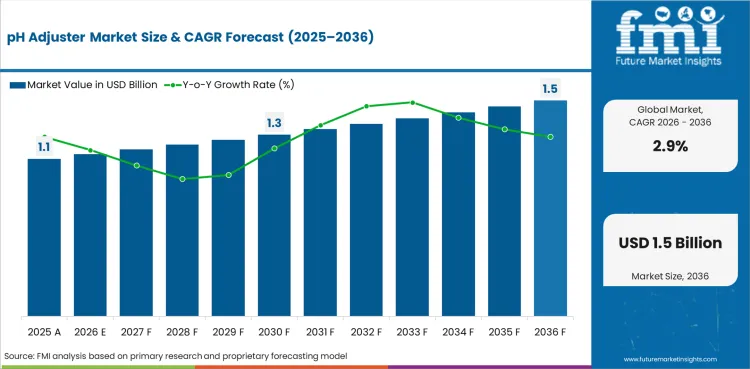
The ph adjuster market was valued at USD 1.1 billion in 2025. The market is set to reach USD 1.1 billion by 2026-end and grow at a CAGR of 2.9% between 2026-2036 to reach USD 1.5 billion by 2036. Adjuvants will dominate with a 27.8% share, while Stabilizers will lead with a 31.5% share.
Summary of the pH Adjuster Market
- Demand and Growth Drivers
- Sustainability-led reformulation and regulatory compliance requirements are supporting demand for ph adjuster as end users seek alternatives that align with evolving industry standards.
- Institutional and industrial procurement cycles in India and Japan are creating structured demand growth as modernization programs expand the addressable market.
- Policy-driven shifts toward compliance, quality certification, and performance benchmarking are expected to support adoption during the forecast period.
- Product and Segment View
- Adjuvants is expected to account for 27.8% of the type segment in 2026, supported by consistent demand across core applications.
- Stabilizers is expected to lead the application segment with 31.5% share, reflecting its established role in primary end-use applications.
- Cosmetics and Personal Care accounts for 29.6% of the end use segment, shaped by procurement channel preferences and buyer accessibility.
- Geography and Competitive Outlook
- India is projected to grow at 3.8%, supported by industrial expansion, institutional procurement, and evolving regulatory frameworks.
- Japan at 2.4% reflects rising investment in infrastructure modernization and organized distribution channel development.
- BASF SE and Air Products and Chemicals, Inc. maintain strong positions through production scale, distribution reach, and established customer relationships.
- Analyst Opinion
- Companies that strengthen production efficiency while maintaining quality consistency across adjuvants and stabilizers applications are positioned to gain market share over the forecast period. Cost competitiveness, regulatory compliance, and distribution infrastructure remain critical success factors. The shift toward certified and standards-compliant products is creating a structural advantage for manufacturers with established quality systems and multi-market presence.
- The ph adjuster market is transitioning from a fragmented supply base toward more consolidated procurement patterns.
- Adoption is being shaped by regulatory requirements, institutional modernization, and end-user demand for performance-validated products.
- Demand is further supported by the expansion of organized distribution channels and increasing specification standardization across regions.
Key Takeaways, Market Size, and Forecast
- The ph adjuster market was valued at USD 1.10 Billion in 2025.
- By 2036, the pH Adjuster Market is expected to be worth USD 1.51 Billion.
- From 2026 to 2036, the market is projected to expand at a CAGR of 2.9%.
- The market is projected to create an incremental opportunity of USD 0.37 Billion between 2026 and 2036.
- In 2026, Adjuvants is expected to account for 27.8% of the type segment, driven by demand for specialized adjuvants applications.
- India (3.8%) and Japan (2.4%) are two of the fastest growing markets in the world.
pH Adjuster Market Definition
The ph adjuster market encompasses all commercially traded products and solutions categorized under ph adjuster, serving diverse end-use applications across industrial, institutional, and consumer segments. The market includes products differentiated by type, application, end use, distributed through established B2B and retail channels across global markets.
pH Adjuster Market Inclusions
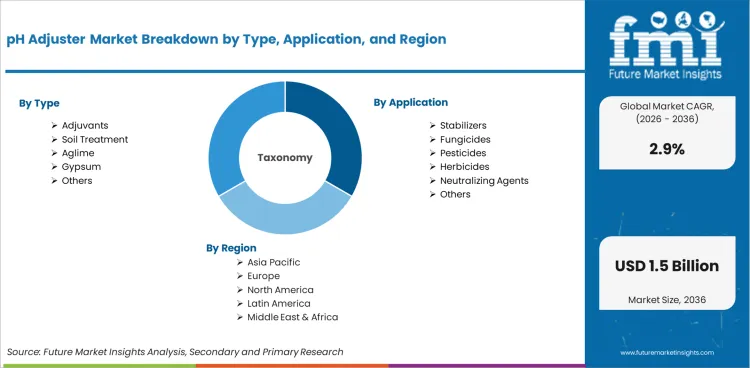
Market scope encompasses all commercially traded ph adjuster products categorized by Type (Adjuvants, Soil Treatment, Aglime, Gypsum, Others); Application (Stabilizers, Fungicides, Pesticides, Herbicides, Neutralizing Agents, Others); End Use (Cosmetics and Personal Care, Textile and Leather, Agrochemical, Pharmaceuticals, Others). Revenue sizing covers the period from 2026 to 2036 across North America, Latin America, Europe, East Asia, South Asia and Pacific, and Middle East and Africa.
pH Adjuster Market Exclusions
The scope does not include raw materials or intermediate products sold outside of finished ph adjuster applications. Products that do not meet commercial-grade specifications, experimental formulations not yet commercialized, and adjacent product categories with distinct end-use applications are excluded.
pH Adjuster Market Research Methodology
- Primary Research: FMI analysts conducted structured interviews with manufacturers, distributors, end-use buyers, and industry specialists across key markets.
- Desk Research: Combined data from industry associations, regulatory bodies, trade databases, and manufacturer disclosures.
- Market Sizing and Forecasting: Bottom-up aggregation across segments and regions, validated with top-down cross-checks against industry benchmarks.
- Data Validation: Cross-checked quarterly against production data, trade statistics, and manufacturer-reported figures.
Why is the pH Adjuster Market Growing?
- Regulatory compliance and quality certification requirements are creating structured demand for standardized ph adjuster products, supporting steady adoption across institutional and industrial buyers.
- India leads growth at 3.8%, reflecting industrial expansion, infrastructure modernization, and increasing procurement formalization across end-use sectors.
The ph adjuster market is expanding steadily as end-use industries across healthcare, industrial, and consumer segments increase procurement of standardized and certified products. Regulatory frameworks in Europe, North America, and Asia-Pacific are tightening product specifications, which in turn supports demand for compliant offerings from established manufacturers. This shift from informal to specification-driven procurement is a structural growth factor across the forecast period.
Demand patterns differ by region. In India and Japan, government-led programs and institutional modernization are expanding the addressable market. In North America and Europe, replacement cycles and technology upgrades sustain demand from an established installed base. The combination of volume growth in emerging markets and value growth in mature markets creates a balanced demand profile that supports the projected 2.9% CAGR from 2026 to 2036.
Market Segmentation Analysis
- Adjuvants accounts for 27.8% of the type segment, reflecting its established position in primary ph adjuster applications.
- Stabilizers leads the application segment at 31.5%, shaped by institutional procurement patterns and end-user demand.
The ph adjuster market is segmented by type, application, end use. Each segmentation dimension reflects distinct procurement drivers, application requirements, and competitive dynamics that influence supplier positioning and growth trajectories.
Insights into the Adjuvants Type Segment
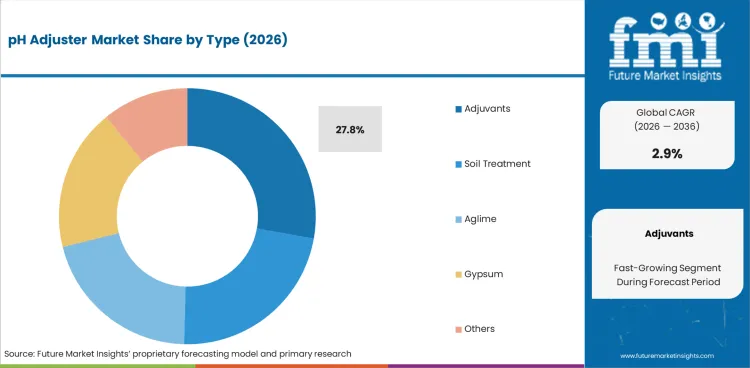
In 2026, Adjuvants is projected to hold 27.8% of the type segment. This leadership reflects established demand across core applications, supported by cost-effectiveness, wide availability, and compatibility with existing procurement standards. Manufacturers are optimizing formulations and production processes to maintain quality consistency while managing input cost variability.
Insights into the Stabilizers Application Segment
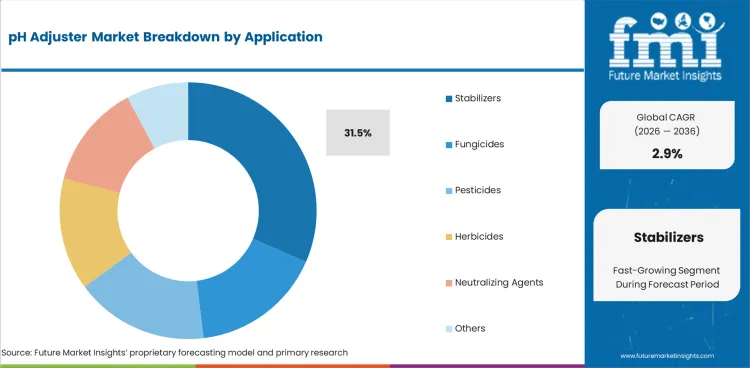
Stabilizers is expected to capture 31.5% of the application segment in 2026. Demand is shaped by institutional requirements, application-specific performance criteria, and regional procurement preferences. Growth in this segment is supported by expansion of organized distribution channels and increasing specification standardization.
pH Adjuster Market Drivers, Restraints, and Opportunities
- Regulatory compliance and quality certification mandates are creating structured demand for standardized ph adjuster products across institutional and industrial channels.
- Higher production costs and supply chain complexity limit adoption in price-sensitive market segments, concentrating growth in premium and certified categories.
- Geographic expansion into India and Japan represents the largest volume growth opportunity during the forecast period.
The ph adjuster market maintains a growth trajectory shaped by regulatory mandates, institutional procurement cycles, and geographic expansion. Structural demand drivers outweigh cyclical headwinds, though adoption velocity varies by region, segment, and buyer type.
Supply Chain Concentration and Sourcing Fragility in pH Adjuster
Supply chain concentration in pH Adjuster creates vulnerability to disruption at multiple points. Key components and materials are sourced from a limited number of qualified suppliers, particularly in precision manufacturing and specialty materials. Dual sourcing strategies are being adopted but add procurement complexity and inventory costs. BASF SE maintains supply security through vertical integration and strategic supplier partnerships. In India and Japan, domestic supplier development is reducing import dependency but quality consistency remains a challenge.
Pricing Asymmetry Across the pH Adjuster Value Chain
Pricing asymmetry across the pH Adjuster value chain reflects differences in competitive intensity, switching costs, and product differentiation at each stage. Raw material suppliers with concentrated capacity exercise pricing power during tight supply periods. Manufacturers with proprietary technology or specification advantages maintain premium pricing. Distribution margins vary by geographic market and customer concentration. BASF SE captures margin through scale and operational efficiency rather than pricing power alone.
Capacity Utilization Trends and Production Economics
Capacity utilization in pH Adjuster production facilities fluctuates with demand cycles and maintenance schedules. High utilization rates during demand peaks create delivery lead time extensions that push buyers toward dual sourcing. During downturns, excess capacity triggers competitive pricing that erodes industry margins. BASF SE maintains higher utilization rates through product mix flexibility and geographic demand diversification. New capacity investments in India are adding supply that may shift regional trade flows and price dynamics.
Regulatory Compliance Costs and Certification Dependencies
Regulatory compliance across pH Adjuster applications varies by jurisdiction and end-use sector. Mandatory certifications, testing requirements, and documentation obligations add cost that is disproportionately borne by smaller manufacturers. In Europe and North America, compliance costs are well-understood but continuously evolving. India and Japan are implementing stricter standards that align with international benchmarks, raising barriers for domestic producers. Industry associations play a role in shaping regulatory frameworks that balance safety objectives with commercial feasibility.
Analysis of pH Adjuster Market by Key Countries
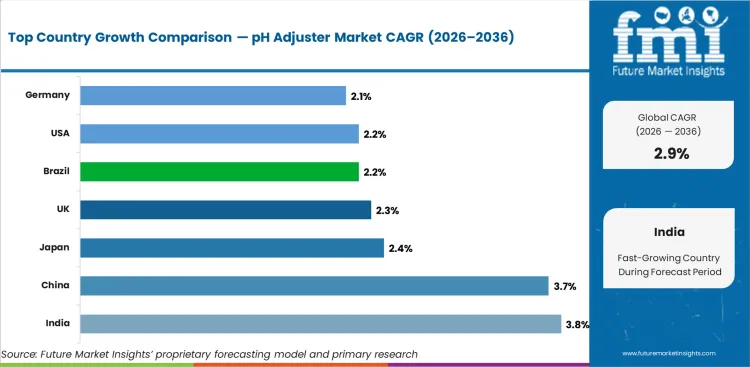
.webp "Top Country Growth Comparison Ph Adjuster Market Cagr (2026 2036)")
| Country | CAGR |
|---|---|
| India | 3.8% |
| Japan | 2.4% |
| UK | 2.3% |
| Brazil | 2.2% |
| USA | 2.2% |
| Germany | 2.1% |
- India leads at 3.8% CAGR, reflecting industrial expansion and increasing institutional procurement formalization.
- Japan at 2.4% shows strong growth on account of infrastructure modernization and rising quality standards.
- UK (2.3%) and Brazil (2.2%) maintain steady growth supported by regulatory compliance and organized distribution expansion.
The global ph adjuster market is projected to expand at a CAGR of 2.9% from 2026 to 2036. The analysis covers more than 30 countries, with key markets detailed below.
Demand Outlook for pH Adjuster Market in India
India is projected to grow at 3.8% through 2036. Demand reflects a combination of regulatory requirements, institutional spending patterns, and evolving end-user preferences that are reshaping ph adjuster procurement across the region.
- Rising institutional and industrial spending is creating new demand channels for pH Adjuster.
- Government modernization programs and policy reforms support structured growth.
- Price sensitivity remains high, favoring cost-competitive suppliers with local manufacturing.
Future Outlook for pH Adjuster Market in Japan
Japan is projected to grow at 2.4% through 2036. Demand reflects a combination of regulatory requirements, institutional spending patterns, and evolving end-user preferences that are reshaping ph adjuster procurement across the region.
- Precision manufacturing standards and quality requirements shape product specifications.
- Aging population demographics influence demand in healthcare and consumer segments.
- Technology adoption rates support premium product positioning and advanced applications.
Opportunity Analysis of pH Adjuster Market in the United Kingdom
The United Kingdom is projected to grow at 2.3% through 2036. Demand reflects a combination of regulatory requirements, institutional spending patterns, and evolving end-user preferences that are reshaping ph adjuster procurement across the region.
- Post-regulatory realignment is creating new compliance-driven procurement requirements.
- NHS and institutional spending cycles shape demand patterns in healthcare-adjacent segments.
- Innovation-oriented procurement programs favor differentiated product offerings.
In-depth Analysis of pH Adjuster Market in Brazil
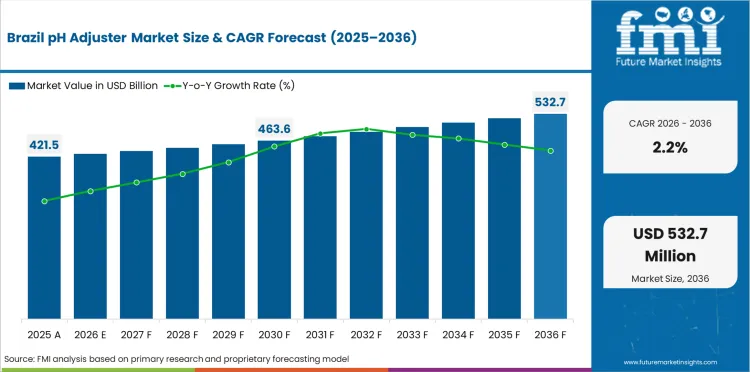
Brazil is projected to grow at 2.2% through 2036. Demand reflects a combination of regulatory requirements, institutional spending patterns, and evolving end-user preferences that are reshaping ph adjuster procurement across the region.
- Economic recovery and infrastructure investment are expanding the addressable market.
- Import dependency for specialty products creates foreign exchange exposure for buyers.
- Growing organized retail and institutional channels support distribution expansion.
Sales Analysis of pH Adjuster Market in the United States
The United States is projected to grow at 2.2% through 2036. Demand reflects a combination of regulatory requirements, institutional spending patterns, and evolving end-user preferences that are reshaping ph adjuster procurement across the region.
- Regulatory frameworks and compliance requirements shape procurement patterns in pH Adjuster.
- Enterprise and institutional spending cycles support steady replacement-driven demand.
- Established distribution infrastructure favors scale players with national reach.
Growth Assessment of pH Adjuster Market in Germany
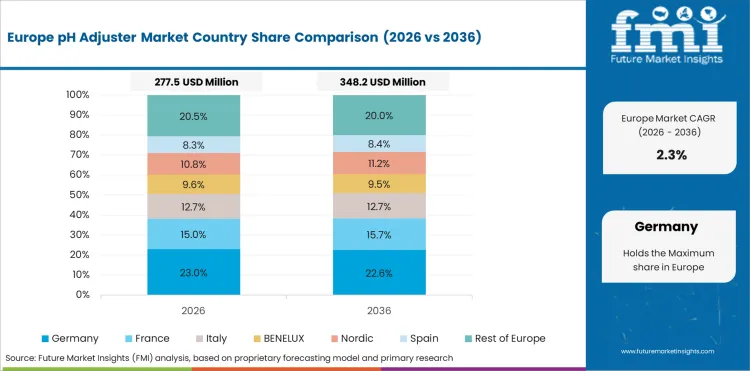
Germany is projected to grow at 2.1% through 2036. Demand reflects a combination of regulatory requirements, institutional spending patterns, and evolving end-user preferences that are reshaping ph adjuster procurement across the region.
- Stringent EU regulatory standards drive adoption of compliant and certified products.
- Advanced manufacturing infrastructure supports high-quality domestic production.
- Export orientation extends demand influence beyond the domestic market.
Competitive Landscape and Strategic Positioning
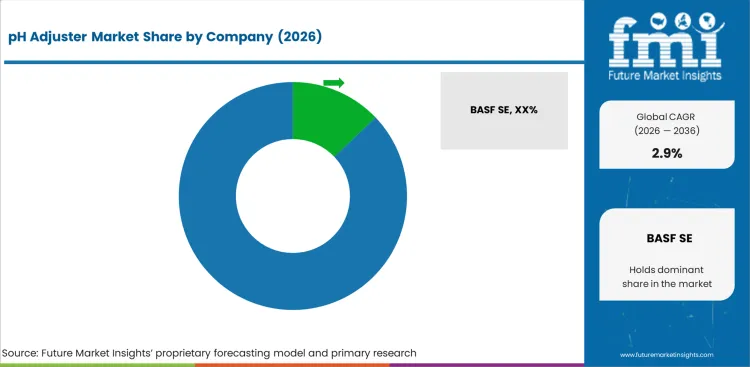
- BASF SE maintains a strong position through production scale, distribution infrastructure, and established customer relationships across key markets.
- Air Products and Chemicals, Inc. and Ashland Inc. compete through product specialization, regional presence, and pricing strategies.
- Emerging players are targeting niche applications and underserved geographic markets with differentiated offerings.
BASF SE occupies a leading position in the ph adjuster market through production capacity, global distribution, and long-term customer agreements. Air Products and Chemicals, Inc. competes on product breadth and regional presence.
Ashland Inc. and The Chemical Dow Company address specialized applications and regional demand requirements. Competitive barriers include production scale, regulatory certification, quality systems, and established supply chain relationships.
Strategic priorities across the competitive landscape include cost optimization, geographic expansion, product portfolio broadening, and investment in compliance and certification capabilities. Companies with multi-market presence and diversified segment coverage are better positioned to manage demand variability.
Key Companies in the pH Adjuster Market
Key global companies leading the ph adjuster market include:
- BASF SE, Air Products and Chemicals, Inc., Ashland Inc., The Chemical Dow Company maintain strong production infrastructure, established customer relationships, and broad geographic presence across key markets.
- Kemira Oyj, Wacker Chemie AG, Buckman have established positions through focused product portfolios, local market knowledge, and application-specific expertise.
- Spectrum Laboratory Products, Inc., Cortec Corporation, SUEZ Water Technologies and Solutions, Lonza Group, Budenheim, Ecolab Inc., Solenis LLC, Nouryon, Others are gaining traction through specialization in high-growth segments, technology differentiation, and targeted geographic strategies.
Competitive Benchmarking: pH Adjuster Market
| Company | Product Breadth | Technology | Customer Access | Geographic Reach |
|---|---|---|---|---|
| BASF SE | High | High | Strong | Global |
| Air Products and Chemicals, Inc. | High | High | Strong | Global |
| Ashland Inc. | Medium | High | Moderate | Regional |
| The Chemical Dow Company | Medium | Medium | Moderate | Regional |
| Kemira Oyj | Medium | Medium | Moderate | Regional |
| Wacker Chemie AG | Low | Medium | Low | Local |
| Buckman | Low | Medium | Low | Local |
| Spectrum Laboratory Products, Inc. | Low | Medium | Low | Local |
| Cortec Corporation | Low | Medium | Low | Local |
| SUEZ Water Technologies and Solutions | Low | Medium | Low | Local |
Source: Future Market Insights competitive analysis, 2026.
Key Players in the pH Adjuster Market
Major Global Players
- BASF SE
- Air Products and Chemicals, Inc.
- Ashland Inc.
- The Chemical Dow Company
- Kemira Oyj
- Wacker Chemie AG
- Buckman
Emerging Players/Startups
- Spectrum Laboratory Products, Inc.
- Cortec Corporation
- SUEZ Water Technologies and Solutions
- Lonza Group
- Budenheim
- Ecolab Inc.
- Solenis LLC
- Nouryon
- Others
Report Scope and Coverage
| Parameter | Details |
|---|---|
| Quantitative Units | USD 1.13 Billion to USD 1.51 Billion, at a CAGR of 2.9% |
| Market Definition | The ph adjuster market encompasses all commercially traded products categorized under ph adjuster, serving diverse end-use applications across industrial, institutional, and consumer segments. |
| Regions Covered | North America, Latin America, Europe, East Asia, South Asia and Pacific, Middle East and Africa |
| Countries Covered | India, Japan, UK, Brazil, USA, Germany, 30 plus countries |
| Key Companies Profiled | BASF SE, Air Products and Chemicals, Inc., Ashland Inc., The Chemical Dow Company, Kemira Oyj, Wacker Chemie AG, Buckman, Spectrum Laboratory Products, Inc., Cortec Corporation, SUEZ Water Technologies and Solutions, Lonza Group, Budenheim, Ecolab Inc., Solenis LLC, Nouryon, Others |
| Forecast Period | 2026 to 2036 |
| Approach | Hybrid bottom-up and top-down methodology starting with verified transaction data, projecting adoption velocity across segments and regions. |
Segmentation
pH Adjuster Market Segmented by Type:
- Adjuvants
- Soil Treatment
- Aglime
- Gypsum
- Others
pH Adjuster Market Segmented by Application:
- Stabilizers
- Fungicides
- Pesticides
- Herbicides
- Neutralizing Agents
- Others
pH Adjuster Market Segmented by End Use:
- Cosmetics and Personal Care
- Textile and Leather
- Agrochemical
- Pharmaceuticals
- Others
pH Adjuster Market by Region:
- North America
- USA
- Canada
- Mexico
- Latin America
- Brazil
- Chile
- Rest of Latin America
- Western Europe
- Germany
- UK
- Italy
- Spain
- France
- Nordic
- BENELUX
- Rest of Western Europe
- Eastern Europe
- Russia
- Poland
- Hungary
- Balkan & Baltic
- Rest of Eastern Europe
- East Asia
- China
- Japan
- South Korea
- South Asia and Pacific
- India
- ASEAN
- Australia & New Zealand
- Rest of South Asia and Pacific
- Middle East & Africa
- Kingdom of Saudi Arabia
- Other GCC Countries
- Turkiye
- South Africa
- Other African Union
- Rest of Middle East & Africa
Research Sources and Bibliography
- 1. World Bank. (2025). World Development Indicators: Industrial Production and Trade Statistics. World Bank Group.
- 2. International Organization for Standardization. (2025). ISO Industry Standards and Certification Requirements. ISO.
- 3. European Commission. (2025). EU Regulatory Framework for Industrial Products and Market Access. EC.
- 4. United Nations Industrial Development Organization. (2025). UNIDO Industrial Statistics Database. UNIDO.
- 5. USA Bureau of Economic Analysis. (2025). Industry Economic Accounts and Trade Data. BEA.
This bibliography is provided for reader reference.
This Report Answers
- Estimating the size of the market and revenue from 2026 to 2036.
- Segmentation by type, application, end use, and region.
- Insights across more than 30 regional markets.
- Competitive landscape assessment and company benchmarking.
- Technology and process analysis across key applications.
- Investment opportunity identification across type and application segments.
- Supply chain and distribution channel tracking.
- Delivery of data in PDF and Excel formats.
Frequently Asked Questions
What is the global market demand for pH Adjuster Market in 2026?
In 2026, the global ph adjuster market is expected to be worth USD 1.13 Billion.
How big will the pH Adjuster Market be in 2036?
By 2036, the ph adjuster market is expected to be worth USD 1.51 Billion.
How much is demand for pH Adjuster Market expected to grow between 2026 and 2036?
Between 2026 and 2036, demand for ph adjuster is expected to grow at a CAGR of 2.9%.
Which Type segment is expected to lead in 2026?
Adjuvants is projected to hold 27.8% of the type segment in 2026, reflecting its established position in primary applications.
What is driving pH Adjuster demand in India?
India is projected to grow at 3.8% through 2036 for the pH Adjuster Market, supported by industrial expansion, institutional procurement modernization, and evolving regulatory requirements.
What is driving pH Adjuster demand in Japan?
Japan is projected to grow at 2.4% through 2036 for the pH Adjuster Market, reflecting infrastructure investment, rising quality standards, and increasing adoption of certified products.
What does this report mean by 'pH Adjuster Market definition'?
The ph adjuster market encompasses all commercially traded products and solutions categorized under ph adjuster, serving diverse end-use applications across industrial, institutional, and consumer segments.
How does FMI develop and validate the pH Adjuster Market forecast?
Forecasting models use a hybrid bottom-up and top-down approach, starting with verified transaction data and checking against industry production statistics and manufacturer disclosures.
Preview the report firsthand - request a free sample
Get SampleGet the brochure for pricing and purchase details.
Get PDFTable of Content
- Executive Summary
- Global Market Outlook
- Demand-side Trends
- Supply-side Trends
- Technology Roadmap Analysis
- Analysis and Recommendations
- Market Overview
- Market Coverage / Taxonomy
- Market Definition / Scope / Limitations
- Research Methodology
- Chapter Orientation
- Analytical Lens and Working Hypotheses
- Market Structure, Signals, and Trend Drivers
- Benchmarking and Cross-market Comparability
- Market Sizing, Forecasting, and Opportunity Mapping
- Research Design and Evidence Framework
- Desk Research Programme (Secondary Evidence)
- Company Annual and Sustainability Reports
- Peer-reviewed Journals and Academic Literature
- Corporate Websites, Product Literature, and Technical Notes
- Earnings Decks and Investor Briefings
- Statutory Filings and Regulatory Disclosures
- Technical White Papers and Standards Notes
- Trade Journals, Industry Magazines, and Analyst Briefs
- Conference Proceedings, Webinars, and Seminar Materials
- Government Statistics Portals and Public Data Releases
- Press Releases and Reputable Media Coverage
- Specialist Newsletters and Curated Briefings
- Sector Databases and Reference Repositories
- FMI Internal Proprietary Databases and Historical Market Datasets
- Subscription Datasets and Paid Sources
- Social Channels, Communities, and Digital Listening Inputs
- Additional Desk Sources
- Expert Input and Fieldwork (Primary Evidence)
- Primary Modes
- Qualitative Interviews and Expert Elicitation
- Quantitative Surveys and Structured Data Capture
- Blended Approach
- Why Primary Evidence is Used
- Field Techniques
- Interviews
- Surveys
- Focus Groups
- Observational and In-context Research
- Social and Community Interactions
- Stakeholder Universe Engaged
- C-suite Leaders
- Board Members
- Presidents and Vice Presidents
- R&D and Innovation Heads
- Technical Specialists
- Domain Subject-matter Experts
- Scientists
- Physicians and Other Healthcare Professionals
- Governance, Ethics, and Data Stewardship
- Research Ethics
- Data Integrity and Handling
- Primary Modes
- Tooling, Models, and Reference Databases
- Desk Research Programme (Secondary Evidence)
- Data Engineering and Model Build
- Data Acquisition and Ingestion
- Cleaning, Normalisation, and Verification
- Synthesis, Triangulation, and Analysis
- Quality Assurance and Audit Trail
- Market Background
- Market Dynamics
- Drivers
- Restraints
- Opportunity
- Trends
- Scenario Forecast
- Demand in Optimistic Scenario
- Demand in Likely Scenario
- Demand in Conservative Scenario
- Opportunity Map Analysis
- Product Life Cycle Analysis
- Supply Chain Analysis
- Investment Feasibility Matrix
- Value Chain Analysis
- PESTLE and Porter’s Analysis
- Regulatory Landscape
- Regional Parent Market Outlook
- Production and Consumption Statistics
- Import and Export Statistics
- Market Dynamics
- Global Market Analysis 2021 to 2025 and Forecast, 2026 to 2036
- Historical Market Size Value (USD Million) Analysis, 2021 to 2025
- Current and Future Market Size Value (USD Million) Projections, 2026 to 2036
- Y-o-Y Growth Trend Analysis
- Absolute $ Opportunity Analysis
- Global Market Pricing Analysis 2021 to 2025 and Forecast 2026 to 2036
- Global Market Analysis 2021 to 2025 and Forecast 2026 to 2036, By Type
- Introduction / Key Findings
- Historical Market Size Value (USD Million) Analysis By Type, 2021 to 2025
- Current and Future Market Size Value (USD Million) Analysis and Forecast By Type, 2026 to 2036
- Adjuvants
- Soil Treatment
- Aglime
- Gypsum
- Others
- Adjuvants
- Y-o-Y Growth Trend Analysis By Type, 2021 to 2025
- Absolute $ Opportunity Analysis By Type, 2026 to 2036
- Global Market Analysis 2021 to 2025 and Forecast 2026 to 2036, By Application
- Introduction / Key Findings
- Historical Market Size Value (USD Million) Analysis By Application, 2021 to 2025
- Current and Future Market Size Value (USD Million) Analysis and Forecast By Application, 2026 to 2036
- Stabilizers
- Fungicides
- Pesticides
- Herbicides
- Neutralizing Agents
- Others
- Stabilizers
- Y-o-Y Growth Trend Analysis By Application, 2021 to 2025
- Absolute $ Opportunity Analysis By Application, 2026 to 2036
- Global Market Analysis 2021 to 2025 and Forecast 2026 to 2036, By End Use
- Introduction / Key Findings
- Historical Market Size Value (USD Million) Analysis By End Use, 2021 to 2025
- Current and Future Market Size Value (USD Million) Analysis and Forecast By End Use, 2026 to 2036
- Cosmetics and Personal Care
- Textile and Leather
- Agrochemical
- Pharmaceuticals
- Others
- Cosmetics and Personal Care
- Y-o-Y Growth Trend Analysis By End Use, 2021 to 2025
- Absolute $ Opportunity Analysis By End Use, 2026 to 2036
- Global Market Analysis 2021 to 2025 and Forecast 2026 to 2036, By Region
- Introduction
- Historical Market Size Value (USD Million) Analysis By Region, 2021 to 2025
- Current Market Size Value (USD Million) Analysis and Forecast By Region, 2026 to 2036
- North America
- Latin America
- Western Europe
- Eastern Europe
- East Asia
- South Asia and Pacific
- Middle East & Africa
- Market Attractiveness Analysis By Region
- North America Market Analysis 2021 to 2025 and Forecast 2026 to 2036, By Country
- Historical Market Size Value (USD Million) Trend Analysis By Market Taxonomy, 2021 to 2025
- Market Size Value (USD Million) Forecast By Market Taxonomy, 2026 to 2036
- By Country
- USA
- Canada
- Mexico
- By Type
- By Application
- By End Use
- By Country
- Market Attractiveness Analysis
- By Country
- By Type
- By Application
- By End Use
- Key Takeaways
- Latin America Market Analysis 2021 to 2025 and Forecast 2026 to 2036, By Country
- Historical Market Size Value (USD Million) Trend Analysis By Market Taxonomy, 2021 to 2025
- Market Size Value (USD Million) Forecast By Market Taxonomy, 2026 to 2036
- By Country
- Brazil
- Chile
- Rest of Latin America
- By Type
- By Application
- By End Use
- By Country
- Market Attractiveness Analysis
- By Country
- By Type
- By Application
- By End Use
- Key Takeaways
- Western Europe Market Analysis 2021 to 2025 and Forecast 2026 to 2036, By Country
- Historical Market Size Value (USD Million) Trend Analysis By Market Taxonomy, 2021 to 2025
- Market Size Value (USD Million) Forecast By Market Taxonomy, 2026 to 2036
- By Country
- Germany
- UK
- Italy
- Spain
- France
- Nordic
- BENELUX
- Rest of Western Europe
- By Type
- By Application
- By End Use
- By Country
- Market Attractiveness Analysis
- By Country
- By Type
- By Application
- By End Use
- Key Takeaways
- Eastern Europe Market Analysis 2021 to 2025 and Forecast 2026 to 2036, By Country
- Historical Market Size Value (USD Million) Trend Analysis By Market Taxonomy, 2021 to 2025
- Market Size Value (USD Million) Forecast By Market Taxonomy, 2026 to 2036
- By Country
- Russia
- Poland
- Hungary
- Balkan & Baltic
- Rest of Eastern Europe
- By Type
- By Application
- By End Use
- By Country
- Market Attractiveness Analysis
- By Country
- By Type
- By Application
- By End Use
- Key Takeaways
- East Asia Market Analysis 2021 to 2025 and Forecast 2026 to 2036, By Country
- Historical Market Size Value (USD Million) Trend Analysis By Market Taxonomy, 2021 to 2025
- Market Size Value (USD Million) Forecast By Market Taxonomy, 2026 to 2036
- By Country
- China
- Japan
- South Korea
- By Type
- By Application
- By End Use
- By Country
- Market Attractiveness Analysis
- By Country
- By Type
- By Application
- By End Use
- Key Takeaways
- South Asia and Pacific Market Analysis 2021 to 2025 and Forecast 2026 to 2036, By Country
- Historical Market Size Value (USD Million) Trend Analysis By Market Taxonomy, 2021 to 2025
- Market Size Value (USD Million) Forecast By Market Taxonomy, 2026 to 2036
- By Country
- India
- ASEAN
- Australia & New Zealand
- Rest of South Asia and Pacific
- By Type
- By Application
- By End Use
- By Country
- Market Attractiveness Analysis
- By Country
- By Type
- By Application
- By End Use
- Key Takeaways
- Middle East & Africa Market Analysis 2021 to 2025 and Forecast 2026 to 2036, By Country
- Historical Market Size Value (USD Million) Trend Analysis By Market Taxonomy, 2021 to 2025
- Market Size Value (USD Million) Forecast By Market Taxonomy, 2026 to 2036
- By Country
- Kingdom of Saudi Arabia
- Other GCC Countries
- Turkiye
- South Africa
- Other African Union
- Rest of Middle East & Africa
- By Type
- By Application
- By End Use
- By Country
- Market Attractiveness Analysis
- By Country
- By Type
- By Application
- By End Use
- Key Takeaways
- Key Countries Market Analysis
- USA
- Pricing Analysis
- Market Share Analysis, 2025
- By Type
- By Application
- By End Use
- Canada
- Pricing Analysis
- Market Share Analysis, 2025
- By Type
- By Application
- By End Use
- Mexico
- Pricing Analysis
- Market Share Analysis, 2025
- By Type
- By Application
- By End Use
- Brazil
- Pricing Analysis
- Market Share Analysis, 2025
- By Type
- By Application
- By End Use
- Chile
- Pricing Analysis
- Market Share Analysis, 2025
- By Type
- By Application
- By End Use
- Germany
- Pricing Analysis
- Market Share Analysis, 2025
- By Type
- By Application
- By End Use
- UK
- Pricing Analysis
- Market Share Analysis, 2025
- By Type
- By Application
- By End Use
- Italy
- Pricing Analysis
- Market Share Analysis, 2025
- By Type
- By Application
- By End Use
- Spain
- Pricing Analysis
- Market Share Analysis, 2025
- By Type
- By Application
- By End Use
- France
- Pricing Analysis
- Market Share Analysis, 2025
- By Type
- By Application
- By End Use
- India
- Pricing Analysis
- Market Share Analysis, 2025
- By Type
- By Application
- By End Use
- ASEAN
- Pricing Analysis
- Market Share Analysis, 2025
- By Type
- By Application
- By End Use
- Australia & New Zealand
- Pricing Analysis
- Market Share Analysis, 2025
- By Type
- By Application
- By End Use
- China
- Pricing Analysis
- Market Share Analysis, 2025
- By Type
- By Application
- By End Use
- Japan
- Pricing Analysis
- Market Share Analysis, 2025
- By Type
- By Application
- By End Use
- South Korea
- Pricing Analysis
- Market Share Analysis, 2025
- By Type
- By Application
- By End Use
- Russia
- Pricing Analysis
- Market Share Analysis, 2025
- By Type
- By Application
- By End Use
- Poland
- Pricing Analysis
- Market Share Analysis, 2025
- By Type
- By Application
- By End Use
- Hungary
- Pricing Analysis
- Market Share Analysis, 2025
- By Type
- By Application
- By End Use
- Kingdom of Saudi Arabia
- Pricing Analysis
- Market Share Analysis, 2025
- By Type
- By Application
- By End Use
- Turkiye
- Pricing Analysis
- Market Share Analysis, 2025
- By Type
- By Application
- By End Use
- South Africa
- Pricing Analysis
- Market Share Analysis, 2025
- By Type
- By Application
- By End Use
- USA
- Market Structure Analysis
- Competition Dashboard
- Competition Benchmarking
- Market Share Analysis of Top Players
- By Regional
- By Type
- By Application
- By End Use
- Competition Analysis
- Competition Deep Dive
- BASF SE
- Overview
- Product Portfolio
- Profitability by Market Segments (Product/Age /Sales Channel/Region)
- Sales Footprint
- Strategy Overview
- Marketing Strategy
- Product Strategy
- Channel Strategy
- Air Products and Chemicals, Inc.
- Ashland Inc.
- The Chemical Dow Company
- Kemira Oyj
- Wacker Chemie AG
- Buckman
- Spectrum Laboratory Products, Inc.
- Cortec Corporation
- SUEZ Water Technologies and Solutions
- Lonza Group
- Budenheim
- Ecolab Inc.
- Solenis LLC
- Nouryon
- Others
- BASF SE
- Competition Deep Dive
- Assumptions & Acronyms Used


