

- Market Size (2026)
- USD 980.6 Mn
- Forecast (2036)
- 1875.6 Mn
- CAGR (2026 to 2036)
- 6.7%
How big is Pharma Antifoams Market in 2026?
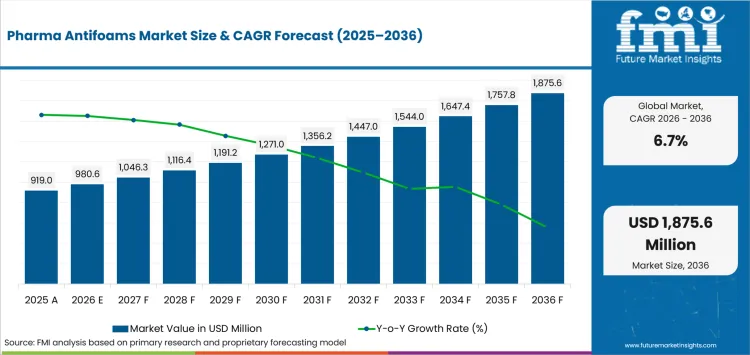
USD 980.6 million in 2026 and USD 1875.6 million by 2036 at a 6.7% CAGR.
Demand for pharma antifoams is projected to expand at 6.7% CAGR between 2026 and 2036, increasing valuation from USD 980.6 million in 2026 to USD 1875.6 million by 2036. Higher gas flow and concentrated cultures raise foam-control exposure as bioprocess technology puts more production inside aerated vessels. FUJIFILM Biotechnologies marked its Teesside expansion in February 2026 with 2,000 L and 5,000 L single-use bioreactors totaling up to 19,000 L. Larger aerated campaigns increase recurring antifoam use once a compatible chemistry and dose are qualified.
Country growth differs with production mix and manufacturing intensity carrying more emphasis than site counts alone. The FDA reported in June 2026 that its FY2025 site catalog showed United Kingdom manufacturing sites down 12% from FY2021 while Germany increased 5%. Yet the approved pharma antifoam CAGRs are 6.2% in the United Kingdom and 5.4% in Germany. The divergence makes local qualification support and documented pharmaceutical excipients supply more useful than plant counts for judging order conversion.
Key Takeaways of Pharma Antifoams Market
- Intensive fermentation and cell-culture production increases recurring demand for foam control compatible with validated bioprocess conditions.
- Based on chemistry, silicone antifoams are projected to account for 46.0% in 2026 due to dose efficiency in aerated pharmaceutical production.
- USP - NF grade is likely to capture 24.0% share in 2026 attributable to recognized specifications that simplify raw-material qualification.
- Emulsion is set to lead the form category with 47.0% share in 2026 due to reliable aqueous metering during bioreactor processing.
- Changing a qualified antifoam can alter oxygen transfer or filtration, so manufacturers require evidence prior to replacing validated chemistry.
- Wacker Chemie, Momentive, Dow, Evonik, Shin-Etsu Chemical, BASF, Ashland and Clariant compete across silicone and regulated pharmaceutical-ingredient routes.
Analyst Perspective
"Pharma manufacturers compare antifoams at the lowest dose that controls foam without weakening oxygen transfer or filtration. Batch records and change-control documentation reduce requalification work during later chemistry changes."
- Nikhil kaitwade, Principal Consultant, Future Market Insights
How is the Pharma Antifoams Market segmented?
The market is segmented by chemistry, grade, form, application, end use, sales model and region.
Chemistry includes silicone, non-silicone, polyether, mineral oil-free and emulsion antifoams. Grade includes USP - NF, EP, GMP process, bioprocess and excipient grades. Form includes emulsion, powder, concentrate and ready-to-use liquid. Applications are fermentation, bioreactors, API manufacturing, tablet / coating processing and sterile fill-finish support. End users are biopharma, API producers, formulation plants, CMOs / CDMOs and vaccine manufacturers. Sales models are direct specialty chemical supply, distributor supply and process service support.
What supports demand for fermentation within the application category?
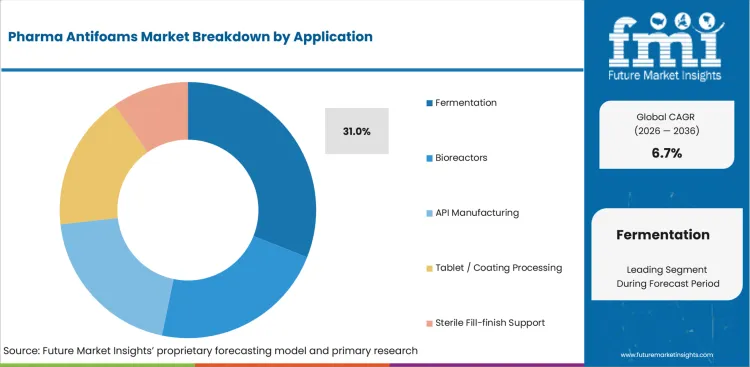
Fermentation produces recurring foam as gas flow meets proteins and other surface-active broth components. Lonza reported in April 2026 that its 4,000 L Visp microbial facility was upgraded and expanded during 2025. More scaled microbial runs increase the need for stable foam control across development and commercial manufacturing.
- Fermentation is projected to hold 31.0% share in 2026 owing to persistent aeration-related foam across scaled microbial production campaigns.
- Fermentation equipment operators qualify antifoams against actual media and gas rates to account for commercial batch conditions that laboratory knockdown tests cannot reproduce.
What makes silicone antifoams central to the chemistry category?
Silicone antifoams provide rapid interfacial foam collapse at low controlled doses across many aqueous pharmaceutical processes. The MHRA recorded a September 2025 inspection of Basildon Chemical Company in a July 2026 GMP certificate covering simethicone and simethicone emulsion manufacturing. The certificate gives pharmaceutical manufacturers a basis for simethicone qualification, although oxygen-transfer and filtration testing remains application-specific.
- By chemistry, silicone antifoams are estimated to hold 46.0% in 2026 owing to dose efficiency across demanding aerated pharmaceutical processes.
- Bioprocess engineers screen silicone materials against the actual culture or formulation to confirm repeatable performance prior to commercial batch qualification.
How does emulsion influence selection within the form category?
Emulsion antifoams suit aqueous processes that require fast dispersion and repeatable metering during changing foam loads. Their handling advantage depends on storage stability and predictable active content during controlled dosing events.
- The form category is forecast to be led by emulsion at 47.0% share in 2026 due to practical aqueous dosing and pumpability.
- In May 2025, Wacker Chemie brought new Zhangjiagang lines for silicone fluids and emulsions on stream. Pharmaceutical formulators can trial that regional silicone fluid supply and separately qualify each finished antifoam for commercial production.
How do biopharma manufacturers evaluate the end use category?
Biopharma manufacturers evaluate antifoams against cell health and mass transfer to avoid another uncontrolled production variable. Qualification covers the culture and separation sequence because foam knockdown alone cannot establish downstream compatibility.
- By end use, biopharma is forecast to represent 29.0% in 2026 driven by recurring foam-control needs in high-value cell-culture production.
- Samsung Biologics reported in May 2025 that Plant 5 opened in April with 180 kL of new capacity, taking total manufacturing capacity to 784 kL. At that scale, cell culture media and antifoam doses must preserve cell performance and downstream separation across long production campaigns.
What are the drivers, restraints and opportunities in the Pharma Antifoams Market?
Bioprocess expansion increases recurring foam-control demand as qualification friction slows switching and low-dose compatibility gives antifoam manufacturers a defined route into new production programs.
- Driver: Bioprocess expansion increases the number of aerated production campaigns that require repeatable foam suppression under validated manufacturing conditions.
- Restraint: A chemistry change can alter mass transfer or filtration inside an approved recipe, extending requalification for alternative antifoams.
- Opportunity: Antifoam manufacturers can qualify earlier in new bioprocess programs by pairing low-dose foam control with cell and filtration data.
Bioprocess Capacity Expands Recurring Foam-Control Use
Large aerated bioreactors consume antifoam repeatedly throughout commercial production campaigns as foam forms during gas transfer. Lonza reported that ramp-up activities at its large-scale mammalian drug substance facility in Visp are in advanced stages, with full commercial operations expected to begin in mid-2026. Bioprocessing systems at that scale require antifoams that preserve working volume without adding oxygen-transfer or separation problems.
Qualification Risk Slows Chemistry Switching
Antifoam substitution slows once chemistry and dose become part of a validated production recipe. The MHRA registered Basildon Chemical Company in May 2026 to manufacture and distribute simethicone and simethicone emulsion as active substances for human medicines. In closed-system bioprocessing, lot records and compatibility data reduce avoidable validation work during a material change.
Pre-Validation Programs Favor Early Antifoam Qualification
New bioprocess programs give antifoam manufacturers the clearest qualification window as the production recipe is being established. FUJIFILM completed its Toyama bio-CDMO facility in December 2025 with two 5,000 L and two 2,000 L mammalian bioreactors scheduled for 2027 operation. Cell culture engineers can compare dose efficiency and downstream compatibility during transfer work instead of challenging an established commercial formulation later.
Which country CAGRs are profiled in the Pharma Antifoams Market?
| Country | CAGR |
|---|---|
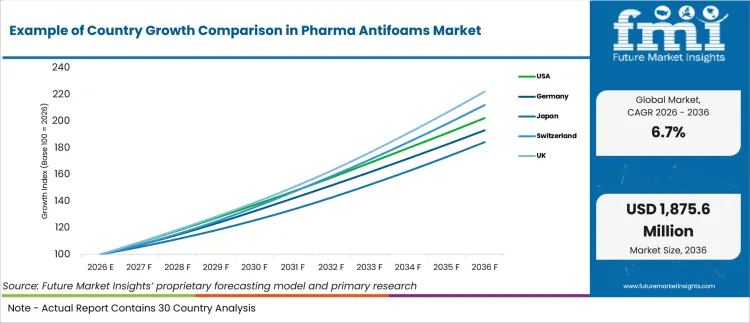
| United Kingdom | 6.2% |
| Switzerland | 6.0% |
| United States | 5.8% |
| Germany | 5.4% |
| Japan | 5.1% |
How do country-level CAGRs compare in the Pharma Antifoams Market?
The countries span 1.1 percentage points and form a compact growth band. The United Kingdom and Switzerland form the upper pair while the United States occupies the middle. Germany and Japan remain close below. The spacing points to differences in qualification and service conditions instead of current market size.
- United Kingdom growth follows biopharma scale-up and formal GMP transfer across manufacturing sites.
- Switzerland concentrates high-value biologics production that rewards consistent lots and nearby technical support.
- United States orders depend on traceable input supply across widely dispersed manufacturing sites.
- Germany applies stricter documentary controls to changes involving validated pharmaceutical process materials.
- Japan requires reproducible scale-up evidence prior to alternative inputs entering routine commercial production.
Comparable CAGRs therefore produce distinct entry conditions for pharma antifoam manufacturers. The full report provides country-level CAGR analysis across North America, Latin America, Europe, East Asia, South Asia, Oceania and the Middle East and Africa.
Country-wise Analysis
- United Kingdom biopharma manufacturers connect process development with GMP transfer across established sites, and Office for Life Sciences data published in October 2025 found manufacturing was the primary activity for 16% of biopharma companies. Pharma antifoam demand in the United Kingdom is forecast to rise at 6.2% CAGR over the forecast period, supported by early technical engagement during scale-up and regulated production transfer across domestic biopharma facilities. Nearby bioprocess expertise gives antifoam manufacturers direct application support, but documentary review and transfer risk slow order conversion unless dose performance remains reproducible across validated batches and customer change-control records across routine commercial campaigns.
- Swiss pharmaceutical manufacturers concentrate high-value biologics production within compact industrial clusters, giving antifoam manufacturers short service distances and direct access to biologics engineers during qualification for regulated production across sensitive commercial manufacturing programs. SECO reported in June 2026 that chemical and pharmaceutical value added declined 3.4% during the first quarter, increasing scrutiny of operating efficiency and discouraging chemistry changes that add avoidable validation work across facilities. Switzerland's pharma antifoam outlook is anticipated to advance at 6.0% CAGR over the assessment period, aided by nearby technical support but constrained by validation costs that reward consistent lots and documented filtration performance.
- United States pharmaceutical production spans a geographically dispersed regulated network that requires traceable process-material supply and responsive technical service across distant facilities serving specialized biopharma programs across multiple states and national supply corridors. The United States pharma antifoams sector is projected to record 5.8% CAGR during the assessment period, influenced by local service coverage that can shorten troubleshooting and qualification work across major domestic production regions. FDA reported in August 2025 that only 11% of manufacturers producing APIs used in FDA-approved products were USA manufacturers, making imported-input continuity and alternate-source documentation material parts of qualification planning for regulated domestic production.
- German pharmaceutical manufacturers operate inside mature quality systems that place formal controls around process-material changes across major integrated chemical clusters and medicine-manufacturing sites serving regulated European customers during formal raw-material qualification reviews. The Federal Ministry for Economic Affairs reported in February 2026 that pharmaceutical production fell 1.8% during December 2025, reinforcing the value of technical evaluation near plants as output changes tighten cost control. Germany is estimated to post 5.4% CAGR over the forecast period, shaped by established industrial infrastructure but constrained by revalidation work that makes antifoam replacement depend on documented continuity across customer quality systems and production records.
- Japanese pharmaceutical manufacturers emphasize controlled scale-up and dependable local supply for process-material changes across biologics facilities that rely on disciplined documentation and stable technical support during commercial qualification and routine production campaigns at commercial scale. The Ministry of Health reported in December 2025 that domestic pharmaceutical production increased 2.1% during 2024, giving antifoam manufacturers a substantial base for qualification discussions and local application support across established production clusters. Adoption of pharma antifoams in Japan is estimated to expand at 5.1% CAGR through 2036, reinforced by domestic manufacturing depth but constrained by change controls requiring reproducible dose data and downstream compatibility.
Who are the notable companies in the Pharma Antifoams Market?
Wacker Chemie, Momentive, Dow, Evonik, Shin-Etsu Chemical, BASF, Ashland and Clariant are the notable companies serving this market.
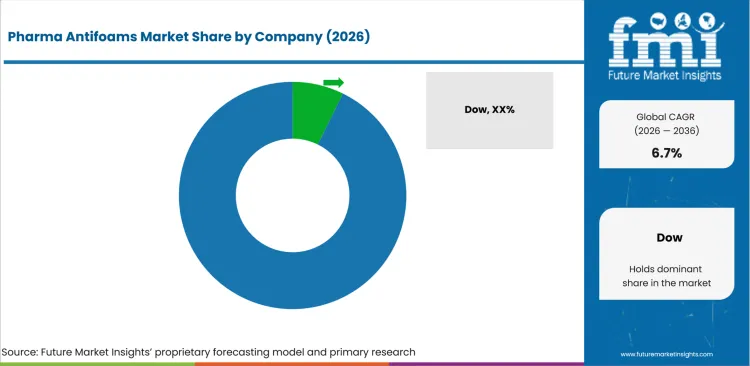
The market remains fragmented between pharmaceutical antifoam specialists and broader silicone or pharma-ingredient platforms. Changing a validated process aid can trigger new qualification work, so manufacturers using pharmaceutical machinery compare grade documentation and lot consistency.
- Momentive’s UK holding company has significant control over Basildon Chemical Company, linking the group to regulated simethicone manufacturing. Wacker Chemie combines silicone manufacturing with biotechnology research that broadens technical support beyond bulk material supply.
- Dow and Shin-Etsu Chemical provide regional silicone platforms, whereas Evonik brings fermentation-based pharmaceutical manufacturing experience and specialty-additive reach.
- BASF, Ashland and Clariant maintain regulated pharmaceutical ingredient channels that provide formulation accounts with regional manufacturing and technical support.
Competitive Benchmarking: Pharma Antifoams Market
| Company | Regulated Pharma Evidence | Foam-Control or Additive Breadth | Direct Technical Supply | Geographic Reach |
|---|---|---|---|---|
| Wacker Chemie | Medium | Medium | High | Europe, Americas and Asia |
| Momentive | High | High | Medium | Americas, Europe and Asia-Pacific |
| Dow | Unscored | Medium | High | North America, Europe and Asia-Pacific |
| Evonik | Medium | Low | Medium | Europe, Americas and Asia-Pacific |
| Shin-Etsu Chemical | Medium | Medium | Medium | Japan, China, North America and Europe |
| BASF | Medium | Low | Medium | Europe, North America and Asia-Pacific |
| Ashland | Medium | Medium | Medium | North America, Europe, Asia-Pacific and Latin America |
| Clariant | Medium | Low | Medium | Europe, North America, Asia-Pacific and Latin America |
Key Developments in the Pharma Antifoams Market
- In April 2026, Evonik announced an investment at its Slovakian Fermas site that is planned to add downstream fermentation technology for pharmaceutical drug-substance manufacturing.
- In March 2026, Clariant announced an expansion at Clear Lake in Texas for GMP-compliant pharmaceutical-grade PEG manufacturing serving North American pharmaceutical customers.
- In June 2025, BASF opened a GMP Solution Center in Michigan with clean-room packaging and high-sensitivity analytical testing for pharmaceutical ingredients.
Key Players in the Pharma Antifoams Market
Silicone Foam-Control and Regulated Supply Platforms
- Wacker Chemie
- Momentive
Silicone and Fermentation Additive Platforms
- Dow
- Evonik
- Shin-Etsu Chemical
Pharmaceutical Ingredient and Additive Platforms
- BASF
- Ashland
- Clariant
Pharma Antifoams Market - Report Scope
| Coverage field | Report scope |
|---|---|
| Market breakdown | chemistry, grade, form, application, end use, sales model and region. |
| Quantitative Units | Revenue in USD million and CAGR In % |
| Market Definition | Commercial revenue from pharmaceutical antifoams used as process aids, excipients or antifoaming ingredients within the stated segmentation. |
| Regions Covered | North America, Latin America, Europe, East Asia, South Asia and Pacific, and Middle East and Africa. |
| Countries Covered | United Kingdom, Switzerland, United States, Germany, Japan, and 20+ countries included in the full report. |
| Key Companies Profiled | Wacker Chemie, Momentive, Dow, Evonik, Shin-Etsu Chemical, BASF, Ashland and Clariant. |
| Forecast Period | 2026 to 2036. |
| Approach | Primary and secondary research with market triangulation. |
Pharma Antifoams Market - Research Methodology
| Method | Approach |
|---|---|
| Primary Research | FMI analysts gathered input from manufacturers, service providers, technology developers, distributors, end users, procurement teams, and subject-matter experts. Interviews examined purchasing decisions, product or service evaluation, adoption barriers, approval requirements, pricing considerations, and expectations for technical or commercial support. Respondents were also asked what evidence is required before a trial, pilot, or initial order develops into regular purchasing. |
| Desk Research | Desk research covered government statistics, regulatory publications, trade data, industry associations, technical literature, standards, company filings, product information, and official corporate announcements. Sources were reviewed for relevance, publication date, geographic coverage, and consistency with the defined market scope. Claims relating to performance, applications, approvals, capacity, investment, and commercial activity were retained only when supported by credible public evidence. |
| Market Sizing and Forecasting | The market model combined the baseline value with historical performance, segment structure, pricing and volume indicators, adoption levels, company participation, and country-level demand conditions. Forecast assumptions considered economic activity, investment trends, regulatory developments, technology adoption, purchasing cycles, supply availability, and barriers to wider market use. Segment and regional estimates were reconciled before the final market total was calculated. |
| Data Validation | Estimates were checked against multiple independent indicators, including public data, company activity, trade patterns, industry developments, and findings from primary interviews. Validation also tested whether products, services, applications, and company revenues fell within the defined market boundaries. Adjacent categories, unsupported claims, overlapping revenues, and activities without direct market relevance were excluded to reduce double counting and maintain consistency across segments and countries. |
Pharma Antifoams Market by Segments
Pharma Antifoams Market segmented by Chemistry:
- Silicone Antifoams
- Non-silicone Antifoams
- Polyether Antifoams
- Mineral Oil-free Antifoams
- Emulsion Antifoams
Pharma Antifoams Market segmented by Grade:
- USP - NF Grade
- EP Grade
- GMP Process Grade
- Bioprocess Grade
- Excipient Grade
Pharma Antifoams Market segmented by Form:
- Emulsion
- Powder
- Concentrate
- Ready-to-use Liquid
Pharma Antifoams Market segmented by Application:
- Fermentation
- Bioreactors
- API Manufacturing
- Tablet / Coating Processing
- Sterile Fill-finish Support
Pharma Antifoams Market segmented by End Use:
- Biopharma
- API Producers
- Formulation Plants
- CMOs / CDMOs
- Vaccine Manufacturers
Pharma Antifoams Market segmented by Sales Model:
- Direct Specialty Chemical Supply
- Distributor Supply
- Process Service Support
Pharma Antifoams Market by Region:
- North America
- United States
- Canada
- Latin America
- Brazil
- Mexico
- Chile
- Rest of Latin America
- Western Europe
- Germany
- United Kingdom
- Italy
- Spain
- France
- Nordics
- Benelux
- Rest of Western Europe
- Eastern Europe
- Russia
- Poland
- Hungary
- Balkan and Baltic States
- Rest of Eastern Europe
- East Asia
- China
- Japan
- South Korea
- South Asia and Pacific
- India
- ASEAN
- Australia and New Zealand
- Rest of South Asia and Pacific
- Middle East and Africa
- Kingdom of Saudi Arabia
- Other GCC Countries
- Türkiye
- South Africa
- Other African Union Countries
- Rest of Middle East and Africa
Research Sources and Bibliography
- FUJIFILM Biotechnologies. (2026, February 11). FUJIFILM Biotechnologies Unveils Biomanufacturing and Process Development Expansion in the United Kingdom.
- USA Food and Drug Administration. (2026, June 25). Report on the State of Pharmaceutical Quality FY2025.
- Medicines and Healthcare products Regulatory Agency. (2026, July 16). UK API 10336 Insp GMP 10336/1297-0015.
- Wacker Chemie AG. (2026, March 11). Highlights from 2025.
- Lonza Group AG. (2026, April 1). Specialized Modalities.
- Samsung Biologics. (2025, May 16). Plant 5: Re-shaping biopharma operations.
- Lonza Group AG. (2026, April 1). Integrated Biologics.
- Medicines and Healthcare products Regulatory Agency. (2026, May 13). UK API 10336.
- FUJIFILM Holdings Corporation. (2025, December 23). Fujifilm Celebrates the Completion of One of the Japan’s Largest Bio CDMO Facilities in Toyama Prefecture.
- Office for Life Sciences. (2025, October 2). Bioscience and health technology sector statistics 2023 to 2024.
- State Secretariat for Economic Affairs SECO. (2026, June 1). Gross domestic product in the first quarter of 2026: Growth picks up at the start of the year.
- USA Food and Drug Administration. (2025, August 7). FDA Announces New FDA PreCheck Program to Boost USA Drug Manufacturing.
- Federal Ministry for Economic Affairs and Energy. (2026, February 6). Entwicklung der Produktion im Produzierenden Gewerbe Berichtsmonat Dezember 2025.
- Ministry of Health, Labour and Welfare, Japan. (2025, December 24). 「令和6年 薬事工業生産動態統計年報」の公表について.
- Companies House. (2025, June 30). Change of details for Momentive Performance Materials Holdings Uk Limited as a person with significant control on 30 June 2025.
- Wacker Chemie AG. (2026, March 11). Research and Development.
- Dow Inc. (2026, June 23). Dow expands product and innovation capabilities to support continued growth in specialty silicones markets.
- Evonik Industries AG. (2026, April 22). Evonik strengthens biotechnology capabilities for drug substance manufacturing with new investment in Slovakia.
- Shin-Etsu Chemical Co., Ltd. (2025, March 28). Shin-Etsu Chemical to actively invest in pharmaceutical cellulose business in Japan and Europe.
- Shin-Etsu Chemical Co., Ltd. (2025, July 31). Uploaded Annual Report 2025.
- BASF Corporation. (2025, June 17). BASF strengthens its commitment to the biopharma and pharmaceutical ingredients industries through a new investment in North America.
- Ashland Inc. (2026, April 28). Ashland announces global distribution partnership with WACKER for cyclodextrins as excipients.
- Ashland Inc. (2025, April 1). Ashland expands pharmaceutical plant for Aquarius™ tablet coatings and commissions new microbial protection capability in Brazil, demonstrating strategy to globalize, innovate, and invest.
- Clariant. (2026, March 19). Clariant expands pharmaceutical-grade PEG manufacturing into North America with Texas facility.
This bibliography is provided for reader reference and is not exhaustive. The full report contains the complete reference list and detailed citations.
This Report Answers
- How large is the pharma antifoams market in 2026 and 2036?
- Which production conditions increase recurring antifoam use in pharmaceutical manufacturing?
- Why do silicone antifoams lead the chemistry category in 2026?
- How do emulsion formulations change dosing in aqueous pharmaceutical processes?
- Why does fermentation generate recurring foam-control demand across scaled microbial production campaigns?
- How do growth rates differ across the five profiled countries?
- Which qualification capabilities matter beyond unit price in pharmaceutical antifoam selection?
- What process-compatibility conditions slow switching between qualified pharmaceutical antifoam products?
- Which company investments expand regulated pharmaceutical ingredient manufacturing or fermentation services?
Frequently Asked Questions
How big is the Pharma Antifoams Market in 2026?
The pharma antifoams market is expected to be valued at USD 980.6 million in 2026 and reach USD 1,875.6 million by 2036. Recurring fermentation and bioprocess campaigns consume foam-control products each time a validated batch enters aerated production.
What is the CAGR of the Pharma Antifoams Market from 2026 to 2036?
The pharma antifoams market is projected to grow at a 6.7% CAGR from 2026 to 2036. Expansion is reinforced by larger bioprocess capacity and repeat consumption once an antifoam chemistry enters a validated manufacturing recipe.
Which chemistry segment is projected to dominate the Pharma Antifoams Market?
The pharma antifoams market is projected to derive 31.0% of application demand from fermentation in 2026. Aeration and changing broth composition generate recurring foam loads that require stable control across scaled production runs.
Which application segment is expected to lead the Pharma Antifoams Market?
The pharma antifoams market is projected to derive 46.0% of chemistry demand from silicone antifoams in 2026. Their position reflects strong foam knockdown at controlled doses and an established simethicone qualification route.
Which companies are active in the Pharma Antifoams Market?
The pharma antifoams market includes Wacker Chemie, Momentive, Dow, Evonik, Shin-Etsu Chemical, BASF, Ashland and Clariant. Their roles span pharmaceutical silicone antifoams plus broader silicone chemistry and regulated pharmaceutical-ingredient support across multiple commercial manufacturing routes.
Preview the report firsthand - request a free sample
Get SampleGet the brochure for pricing and purchase details.
Get PDFTable of Content
- Key Takeaways
- Market Size and CAGR
- Top Growth Driver
- Fastest Growing Segment
- Leading Region
- Key Companies
- Emerging Opportunities
- Executive Summary
- Global Market Outlook
- Demand-side Trends
- Supply-side Trends
- Technology Roadmap Analysis
- Analysis and Recommendations
- Analyst Perspective (What is happening? Why now? What should investors know?)
- Key Questions Answered
- How large is the market?
- What is the CAGR?
- What are key trends?
- Which region dominates?
- Who are the leaders?
- Market Overview
- Market Coverage / Taxonomy
- Market Definition / Scope / Limitations
- Research Methodology
- Chapter Orientation
- Analytical Lens and Working Hypotheses
- Market Structure, Signals, and Trend Drivers
- Benchmarking and Cross-market Comparability
- Market Sizing, Forecasting, and Opportunity Mapping
- Research Design and Evidence Framework
- Desk Research Programme (Secondary Evidence)
- Expert Input and Fieldwork (Primary Evidence)
- Tooling, Models, and Reference Databases
- Data Engineering and Model Build
- Quality Assurance and Audit Trail
- Market Background
- Market Dynamics (Drivers, Restraints, Opportunity, Trends)
- Scenario Forecast (Optimistic, Likely, Conservative)
- Impact Analysis
- AI Impact
- Sustainability Impact
- Regulatory Impact
- Technology Impact
- Consumer / Buyer Analysis
- Purchase Drivers
- Adoption Barriers
- Buyer Journey
- Opportunity Map Analysis
- Product Life Cycle Analysis
- Supply Chain Analysis
- Investment Feasibility Matrix
- Value Chain Analysis
- PESTLE and Porter's Analysis
- Regulatory Landscape
- Regional Parent Market Outlook
- Production and Consumption Statistics
- Import and Export Statistics
- Global Market Analysis and Forecast, 2021 to 2036
- Historical Market Size Value (USD Million) Analysis, 2021 to 2025
- Current and Future Market Size Value (USD Million) Projections, 2026 to 2036
- Y-o-Y Growth Trend Analysis
- Absolute $ Opportunity Analysis
- Global Market Pricing Analysis, 2021 to 2036
- Global Market Analysis and Forecast, By Chemistry, 2021 to 2036
- Introduction / Key Findings
- Historical Market Size Value (USD Million) Analysis By Chemistry, 2021 to 2025
- Current and Future Market Size Value (USD Million) Analysis and Forecast By Chemistry, 2026 to 2036
- Silicone Antifoams
- Non-silicone Antifoams
- Polyether Antifoams
- Mineral Oil-free Antifoams
- Emulsion Antifoams
- Silicone Antifoams
- Y-o-Y Growth Trend Analysis By Chemistry, 2021 to 2025
- Absolute $ Opportunity Analysis By Chemistry, 2026 to 2036
- Global Market Analysis and Forecast, By Grade, 2021 to 2036
- Introduction / Key Findings
- Historical Market Size Value (USD Million) Analysis By Grade, 2021 to 2025
- Current and Future Market Size Value (USD Million) Analysis and Forecast By Grade, 2026 to 2036
- GMP Process Grade
- USP / NF Grade
- EP Grade
- Bioprocess Grade
- Excipient Grade
- GMP Process Grade
- Y-o-Y Growth Trend Analysis By Grade, 2021 to 2025
- Absolute $ Opportunity Analysis By Grade, 2026 to 2036
- Global Market Analysis and Forecast, By Form, 2021 to 2036
- Introduction / Key Findings
- Historical Market Size Value (USD Million) Analysis By Form, 2021 to 2025
- Current and Future Market Size Value (USD Million) Analysis and Forecast By Form, 2026 to 2036
- Emulsion
- Powder
- Concentrate
- Ready-to-use Liquid
- Emulsion
- Y-o-Y Growth Trend Analysis By Form, 2021 to 2025
- Absolute $ Opportunity Analysis By Form, 2026 to 2036
- Global Market Analysis and Forecast, By Application, 2021 to 2036
- Introduction / Key Findings
- Historical Market Size Value (USD Million) Analysis By Application, 2021 to 2025
- Current and Future Market Size Value (USD Million) Analysis and Forecast By Application, 2026 to 2036
- Fermentation
- Bioreactors
- API Manufacturing
- Tablet / Coating Processing
- Sterile Fill-finish Support
- Fermentation
- Y-o-Y Growth Trend Analysis By Application, 2021 to 2025
- Absolute $ Opportunity Analysis By Application, 2026 to 2036
- Global Market Analysis and Forecast, By End Use, 2021 to 2036
- Introduction / Key Findings
- Historical Market Size Value (USD Million) Analysis By End Use, 2021 to 2025
- Current and Future Market Size Value (USD Million) Analysis and Forecast By End Use, 2026 to 2036
- Biopharma
- API Producers
- Formulation Plants
- CMOs / CDMOs
- Vaccine Manufacturers
- Biopharma
- Y-o-Y Growth Trend Analysis By End Use, 2021 to 2025
- Absolute $ Opportunity Analysis By End Use, 2026 to 2036
- Global Market Analysis and Forecast, By Region, 2021 to 2036
- Introduction
- Historical Market Size Value (USD Million) Analysis By Region, 2021 to 2025
- Current Market Size Value (USD Million) Analysis and Forecast By Region, 2026 to 2036
- North America
- Latin America
- Western Europe
- Eastern Europe
- East Asia
- South Asia and Pacific
- Middle East & Africa
- Market Attractiveness Analysis By Region
- North America Market Analysis and Forecast, By Country, 2021 to 2036
- Historical Market Size Value (USD Million) Trend Analysis By Market Taxonomy, 2021 to 2025
- Market Size Value (USD Million) Forecast By Market Taxonomy, 2026 to 2036
- By Country
- USA
- Canada
- By Chemistry
- By Grade
- By Form
- By Application
- By End Use
- By Country
- Market Attractiveness Analysis
- By Country
- By Chemistry
- By Grade
- By Form
- By Application
- By End Use
- Key Takeaways
- Latin America Market Analysis and Forecast, By Country
- Historical Market Size Value (USD Million) Trend Analysis By Market Taxonomy, 2021 to 2025
- Market Size Value (USD Million) Forecast By Market Taxonomy, 2026 to 2036
- By Country
- Brazil
- Mexico
- Chile
- Rest of Latin America
- By Chemistry
- By Grade
- By Form
- By Application
- By End Use
- By Country
- Market Attractiveness Analysis
- By Country
- By Chemistry
- By Grade
- By Form
- By Application
- By End Use
- Key Takeaways
- Western Europe Market Analysis and Forecast, By Country
- Historical Market Size Value (USD Million) Trend Analysis By Market Taxonomy, 2021 to 2025
- Market Size Value (USD Million) Forecast By Market Taxonomy, 2026 to 2036
- By Country
- Germany
- UK
- Italy
- Spain
- France
- Nordic
- BENELUX
- Rest of Western Europe
- By Chemistry
- By Grade
- By Form
- By Application
- By End Use
- By Country
- Market Attractiveness Analysis
- By Country
- By Chemistry
- By Grade
- By Form
- By Application
- By End Use
- Key Takeaways
- Eastern Europe Market Analysis and Forecast, By Country
- Historical Market Size Value (USD Million) Trend Analysis By Market Taxonomy, 2021 to 2025
- Market Size Value (USD Million) Forecast By Market Taxonomy, 2026 to 2036
- By Country
- Russia
- Poland
- Hungary
- Balkan & Baltic
- Rest of Eastern Europe
- By Chemistry
- By Grade
- By Form
- By Application
- By End Use
- By Country
- Market Attractiveness Analysis
- By Country
- By Chemistry
- By Grade
- By Form
- By Application
- By End Use
- Key Takeaways
- East Asia Market Analysis and Forecast, By Country
- Historical Market Size Value (USD Million) Trend Analysis By Market Taxonomy, 2021 to 2025
- Market Size Value (USD Million) Forecast By Market Taxonomy, 2026 to 2036
- By Country
- China
- Japan
- South Korea
- By Chemistry
- By Grade
- By Form
- By Application
- By End Use
- By Country
- Market Attractiveness Analysis
- By Country
- By Chemistry
- By Grade
- By Form
- By Application
- By End Use
- Key Takeaways
- South Asia and Pacific Market Analysis and Forecast, By Country
- Historical Market Size Value (USD Million) Trend Analysis By Market Taxonomy, 2021 to 2025
- Market Size Value (USD Million) Forecast By Market Taxonomy, 2026 to 2036
- By Country
- India
- ASEAN
- Australia & New Zealand
- Rest of South Asia and Pacific
- By Chemistry
- By Grade
- By Form
- By Application
- By End Use
- By Country
- Market Attractiveness Analysis
- By Country
- By Chemistry
- By Grade
- By Form
- By Application
- By End Use
- Key Takeaways
- Middle East & Africa Market Analysis and Forecast, By Country
- Historical Market Size Value (USD Million) Trend Analysis By Market Taxonomy, 2021 to 2025
- Market Size Value (USD Million) Forecast By Market Taxonomy, 2026 to 2036
- By Country
- Kingdom of Saudi Arabia
- Other GCC Countries
- Türkiye
- South Africa
- Other African Union
- Rest of Middle East & Africa
- By Chemistry
- By Grade
- By Form
- By Application
- By End Use
- By Country
- Market Attractiveness Analysis
- By Country
- By Chemistry
- By Grade
- By Form
- By Application
- By End Use
- Key Takeaways
- Key Countries Market Analysis
- USA
- Pricing Analysis
- Market Share Analysis, 2025
- By Chemistry
- By Grade
- By Form
- By Application
- By End Use
- Canada
- Pricing Analysis
- Market Share Analysis, 2025
- By Chemistry
- By Grade
- By Form
- By Application
- By End Use
- Mexico
- Pricing Analysis
- Market Share Analysis, 2025
- By Chemistry
- By Grade
- By Form
- By Application
- By End Use
- Brazil
- Pricing Analysis
- Market Share Analysis, 2025
- By Chemistry
- By Grade
- By Form
- By Application
- By End Use
- Chile
- Pricing Analysis
- Market Share Analysis, 2025
- By Chemistry
- By Grade
- By Form
- By Application
- By End Use
- Germany
- Pricing Analysis
- Market Share Analysis, 2025
- By Chemistry
- By Grade
- By Form
- By Application
- By End Use
- UK
- Pricing Analysis
- Market Share Analysis, 2025
- By Chemistry
- By Grade
- By Form
- By Application
- By End Use
- Italy
- Pricing Analysis
- Market Share Analysis, 2025
- By Chemistry
- By Grade
- By Form
- By Application
- By End Use
- Spain
- Pricing Analysis
- Market Share Analysis, 2025
- By Chemistry
- By Grade
- By Form
- By Application
- By End Use
- France
- Pricing Analysis
- Market Share Analysis, 2025
- By Chemistry
- By Grade
- By Form
- By Application
- By End Use
- India
- Pricing Analysis
- Market Share Analysis, 2025
- By Chemistry
- By Grade
- By Form
- By Application
- By End Use
- ASEAN
- Pricing Analysis
- Market Share Analysis, 2025
- By Chemistry
- By Grade
- By Form
- By Application
- By End Use
- Australia & New Zealand
- Pricing Analysis
- Market Share Analysis, 2025
- By Chemistry
- By Grade
- By Form
- By Application
- By End Use
- China
- Pricing Analysis
- Market Share Analysis, 2025
- By Chemistry
- By Grade
- By Form
- By Application
- By End Use
- Japan
- Pricing Analysis
- Market Share Analysis, 2025
- By Chemistry
- By Grade
- By Form
- By Application
- By End Use
- South Korea
- Pricing Analysis
- Market Share Analysis, 2025
- By Chemistry
- By Grade
- By Form
- By Application
- By End Use
- Russia
- Pricing Analysis
- Market Share Analysis, 2025
- By Chemistry
- By Grade
- By Form
- By Application
- By End Use
- Poland
- Pricing Analysis
- Market Share Analysis, 2025
- By Chemistry
- By Grade
- By Form
- By Application
- By End Use
- Hungary
- Pricing Analysis
- Market Share Analysis, 2025
- By Chemistry
- By Grade
- By Form
- By Application
- By End Use
- Kingdom of Saudi Arabia
- Pricing Analysis
- Market Share Analysis, 2025
- By Chemistry
- By Grade
- By Form
- By Application
- By End Use
- Türkiye
- Pricing Analysis
- Market Share Analysis, 2025
- By Chemistry
- By Grade
- By Form
- By Application
- By End Use
- South Africa
- Pricing Analysis
- Market Share Analysis, 2025
- By Chemistry
- By Grade
- By Form
- By Application
- By End Use
- USA
- Market Structure Analysis
- Competition Dashboard
- Competition Benchmarking
- Market Share Analysis of Top Players
- By Regional
- By Chemistry
- By Grade
- By Form
- By Application
- By End Use
- Emerging Startups
- Innovation Benchmarking
- Competition Analysis
- Competition Deep Dive
- Dow
- Overview
- Product Portfolio
- Profitability by Market Segments
- Sales Footprint
- Strategy Overview
- Marketing Strategy
- Product Strategy
- Channel Strategy
- Wacker Chemie
- Momentive
- Evonik
- Elkem
- Shin-Etsu Chemical
- BASF
- Ashland
- KCC Silicone
- Clariant
- Dow
- Case Studies
- Success Stories
- Recent Developments
- Competition Deep Dive
- Assumptions & Acronyms Used


