

- Market Size (2026)
- USD 1.7 Bn
- Forecast (2036)
- USD 4.2 Bn
- CAGR (2026 to 2036)
- 9.5%
How big is Pharmaceutical Impurity Synthesis Isolation Services Market in 2026?
USD 1.7 billion in 2026 and USD 4.2 billion by 2036 at a 9.5% CAGR.
Demand for pharmaceutical impurity synthesis isolation services is projected to expand at 9.5% CAGR between 2026 and 2036, increasing valuation from USD 1.7 billion in 2026 to USD 4.2 billion by 2036. Heightened regulatory scrutiny of pharmaceutical impurities and nitrosamine contamination is increasing demand for specialized analytical and impurity-characterization services. For instance, FDA updated its NDSRI implementation timelines in June 2025 and retained confirmatory testing for products with potential nitrosamine risks. The update creates assignments across healthcare analytical testing workflows because sponsors need validated methods and defensible impurity evidence within filing schedules. Specialist laboratories create value through route design and purification with certificates that prevent internal teams from repeating qualification work.
Regulatory execution differs across major countries despite broad alignment on nitrosamine controls and impurity documentation. EMA and CMDh published a July 2025 review of Europe’s coordinated scientific assessment and regulatory response for affected medicines. European programs therefore need regional filing knowledge beside analytical laboratory services and dependable shipment planning for low-volume standards. United States applications place greater weight on postapproval change timing while Japanese submissions require detailed mutagenic-impurity records during clinical development. Commercial acceptance depends on characterization that fits the sponsor’s method and reaches its laboratory within the remaining validation window. Service contracts must price failed routes and repeat analytical work clearly so urgent assignments do not erode project margins.
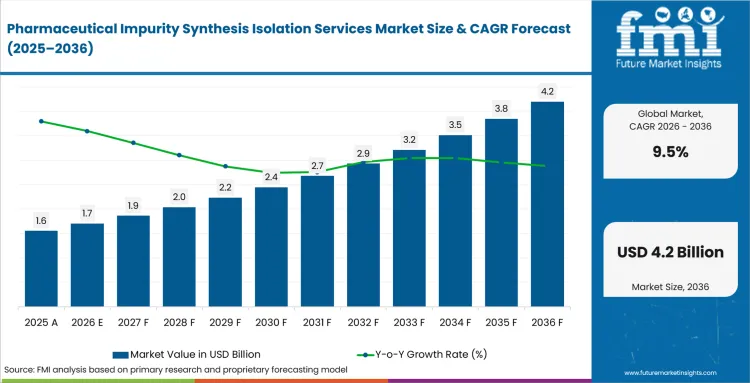
Key Takeaways of Pharmaceutical Impurity Synthesis Isolation Services Market
- Demand becomes revenue once identified impurity material prevents delays across method validation and regulated submission schedules.
- Reference standards are estimated to account for 31.0% share in 2026 as laboratories require traceable materials for identity and quantitative method performance.
- Drug development is projected to represent 34.0% share in 2026 as impurity assignments recur across route selection and stability work.
- Pharmaceutical companies are forecast to capture 43.0% share in 2026 because sponsors retain final accountability for limits and filing changes.
- Unknown structures and low-yield routes extend analytical confirmation and increase technical effort across small high-risk orders before usable material reaches release.
- The competitive set includes LGC Standards, Toronto Research Chemicals, SynZeal Research, Cayman Chemical, Simson Pharma Limited, BOC Sciences, Aarti Pharmalabs, and Cerilliant.
Analyst Perspective
"Pharmaceutical impurity synthesis and isolation becomes commercially valuable once a laboratory delivers a confirmed structure and characterized standard early enough to protect validation work. The strongest providers connect route design with analytical evidence and realistic delivery terms for unstable or low-yield compounds. Repeat orders favor laboratories that define failed-route costs clearly and release materials that fit the sponsor’s exact method and filing requirement."
- Anurag Sharma, Principal Analyst, Future Market Insights
How is the Pharmaceutical Impurity Synthesis Isolation Services Market segmented?
The pharmaceutical impurity synthesis isolation services market is assessed by product type, application, end user, and region.
The market is segmented by product type, application, end user, and region to separate material choice from workflow responsibility. Product type includes reference standards, impurity standards, metabolites, isotope-labeled materials, and custom compounds used for different analytical tasks. Application covers drug development, analytical method work, quality control testing, stability studies, and regulatory submission support across defined product stages. End-user analysis separates pharmaceutical and biotechnology companies, contract research organizations, academic institutes, and regulatory laboratories responsible for distinct purchasing decisions. Regional analysis compares regulatory routes, laboratory access, and shipment conditions that affect low-volume material delivery across major pharmaceutical jurisdictions.
What supports demand for reference standards within the product type category?
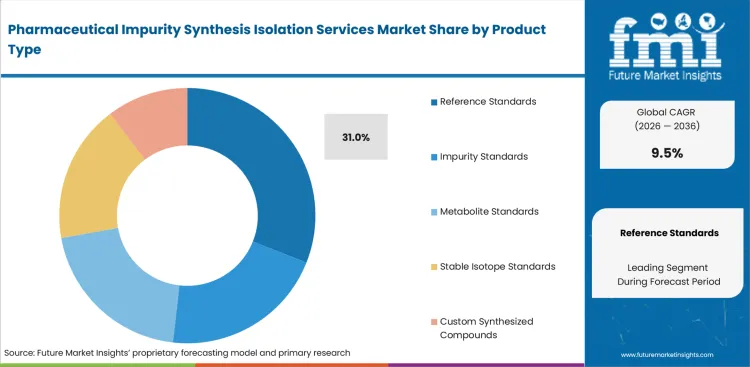
Reference standards give laboratories fixed materials for confirming identity and quantifying an impurity through an approved method. Health Canada revised its established acceptable-intake list in March 2026 with one additional impurity and seven changed limits. Each update can create a requirement for a dedicated standard or method revision within chemical testing services. Purchase decisions therefore depend on traceability and complete characterization rather than catalog breadth across unrelated compound classes.
- Based on product type, reference standards are projected to account for 31.0% in 2026 due to recurring calibration and method-transfer requirements. One qualified material can support identity checks and quantitative performance across several batches and laboratory sites. The segment concentrates spending that would otherwise be divided among repeated custom preparations for the same analytical target.
- Regulated laboratories are increasingly purchasing reference standards because stability programs and filing responses require repeatable materials across separate testing stages. Adoption depends on certificates that document identity and complete characterization for every released reference-material lot. Incomplete data or uncertain delivery dates can force analysts to repeat qualification work and reduce the remaining time for a regulatory change.
What keeps drug development ahead within the application category?
Development teams encounter impurity questions during route selection and again during forced degradation or stability studies. Cayman Chemical outlined custom organic synthesis and analytical chemistry services in February 2025 for pharmaceutical research and drug discovery programs. The official commercial article shows how sponsors can access specialized chemistry without carrying permanent internal capacity. Connected service laboratories can then support method transfer and later analytical decisions across successive development milestones.
- The drug development segment is likely to capture 34.0% share in 2026 attributable to repeated impurity investigations across one molecule’s lifecycle. Paid assignments can begin during route selection and continue through method validation and stability work. Providers gain recurring revenue if prepared standards remain suitable for later analytical and submission activities.
- Pharmaceutical development teams are expected to favor external impurity services over permanent internal capacity because difficult compounds create irregular low-volume workloads. Contracts support adoption once they define structure confirmation and failed-route ownership beside usable-material delivery terms. Successful handoffs between synthesis laboratories and sponsor analysts create broader relationships more reliably than isolated price quotations.
Which purchasing mechanism supports pharmaceutical companies within the end-user category?
Pharmaceutical companies retain final responsibility for impurity controls across both approved medicines and investigational drug programs. Health Canada stated in May 2026 that companies must review manufacturing processes and test products that could contain nitrosamine impurities. The regulator also requires companies to report their findings and take action that limits unacceptable levels. Purchase approval therefore follows a documented quality obligation rather than exploratory interest from clinical research organizations or internal laboratories.
- By end-user, pharmaceutical companies are estimated to hold 43.0% in 2026 owing to direct responsibility for specifications and filing changes. Their position reflects repeat impurity programs across regulated products with successive development stages and distinct filing schedules. Internal quality groups authorize spending once an analytical gap threatens validation or a regulatory schedule.
- Purchase activity for integrated impurity projects is anticipated to rise among pharmaceutical companies as one accountable service can combine synthesis with characterization and method support. Adoption grows through accepted certificates and dependable communication across chemistry and quality groups responsible for regulated portfolios. Projects lose momentum if quotations exclude failed-route work or released documents lack the evidence required for a formal application update.
What are the drivers, restraints, and opportunities in the Pharmaceutical Impurity Synthesis Isolation Services Market?
Compound-specific impurity limits support recurring synthesis and isolation work while uncertain structures constrain completion economics and integrated projects create premium openings for difficult low-volume compounds.
- Driver: Compound-specific impurity limits create recurring synthesis and analytical assignments across regulated medicine portfolios and development programs.
- Restraint: Uncertain structures and unstable materials can consume several laboratory routes without producing a usable standard.
- Opportunity: Integrated isolation with structure confirmation and method support can secure premium assignments for difficult low-volume compounds.
Compound-specific limits create direct work because each new impurity entry can require confirmatory testing and updated specifications. FDA updated its recommended NDSRI intake table on July 24, 2026 with named nitrosamines and associated drug substances. The revision gives outsourced testing services defined analytical targets instead of a broad compliance theme. Revenue follows through synthesis and method work tied to product decisions with documented acceptance criteria. Laboratories that can prepare uncommon standards quickly gain a commercial advantage during narrow filing windows for regulated products.
Difficult chemistry is one notable restraint in the market because unstable nitrosamines can resist practical synthesis and purification routes. Health Canada stated in May 2026 that extensive unsuccessful work may justify omitting confirmatory testing if experimental evidence supports the conclusion. The documented exception shows that substantial laboratory effort does not always produce material suitable for routine testing. Contracts therefore need staged fees and clear stopping rules that prevent failed routes from consuming the full project budget. Transparent feasibility reviews help project owners decide whether another technical route deserves additional funding and laboratory time.
Premium assignments emerge through impurity isolation and structure confirmation followed by transfer of a usable analytical method. Cayman Chemical documented impurity isolation and reference-standard production for regulated drug programs within its January 2025 manufacturing-services article. The integrated route connects pharmaceutical intermediates knowledge with an analytical package suitable for later method work. Providers can protect margins through milestone pricing that separates route feasibility from final material delivery. Successful method transfer creates a stronger basis for repeat assignments across the same product portfolio.
Which country CAGRs are profiled in the Pharmaceutical Impurity Synthesis Isolation Services Market?
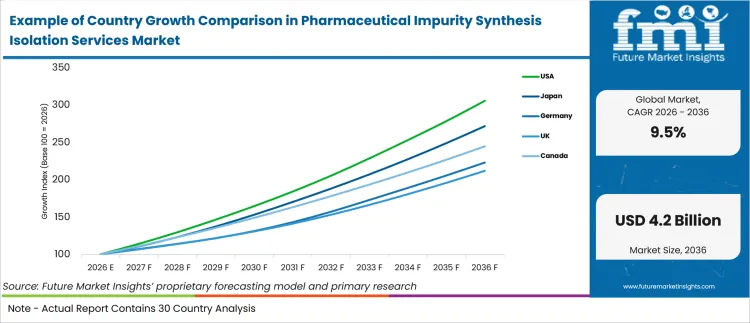
| Country | CAGR |
|---|---|
| USA | 11.8% |
| South Korea | 11.3% |
| Japan | 10.5% |
| Canada | 9.4% |
| Australia | 8.8% |
| Germany | 8.3% |
| UK | 7.8% |
How do country-level CAGRs compare in the Pharmaceutical Impurity Synthesis Isolation Services Market?
The forecasts span 4.0 percentage points between the USA and the UK without creating sharply separated country tiers. The USA and South Korea form a close upper pair through active pharmaceutical development and formal impurity documentation. Japan follows through detailed review expectations that increase documentation value and extend provider qualification and onboarding. Canada and Australia combine explicit nitrosamine controls with greater exposure to international shipment schedules and laboratory access. Germany and the UK operate through mature regulatory systems with different national filing routes and contracting requirements. Comparable rates can therefore produce different project economics across laboratory access and document review with shipment responsibility.
- The USA stands 0.5 percentage point above South Korea as frequent federal quality updates support recurring specification and reference-material assignments.
- South Korea remains close to the USA through direct regulator support for validated nitrosamine methods and local pharmaceutical development programs.
- Japan sits 0.8 percentage point below South Korea as detailed clinical-notification records increase documentation needs beside synthesis work.
- Canada begins the middle range through compound-specific limits and recall activity that creates defined testing and corrective-action requirements.
- Australia follows Canada by 0.6 percentage point as current TGA limits support demand and long shipment routes reduce urgent project time.
- Germany remains 0.5 percentage point below Australia through structured step-three submissions and dense access to European analytical laboratories.
- The UK closes the comparison 0.5 percentage point below Germany through lifecycle reporting duties and independent national submission procedures.
Comparable CAGRs can produce different market-entry conditions as local review routes and service coverage affect delivery economics. Expansion decisions should follow accepted assignments and documented repeat orders rather than percentage differences alone. The full report provides country-level CAGR analysis across North America, Latin America, Europe, East Asia, South Asia, Oceania and the Middle East and Africa.
Country-wise Analysis
- United States sponsors establish product-specific impurity specifications across new applications and post approval changes within regulated medicine portfolios. USA’s pharmaceutical impurity synthesis isolation services outlook is anticipated to advance at 11.8% CAGR over the assessment period, linked to recurring specification work across regulated portfolios. FDA issued draft guidance in April 2026 for organic impurity specifications in fermentation and semi-synthetic antibiotics. The proposed route creates direct assignments for custom standards and validated analytical methods across affected products. Domestic specialist laboratories support rapid exchange of spectra and method details throughout sponsor review and method transfer. Low-yield routes remain a material friction because unrecoverable chemistry can consume the validation budget without releasing usable material.
- South Korean pharmaceutical laboratories use regulator-supported methods for mutagenic impurities across drug substances and finished products. Pharmaceutical impurity synthesis isolation services demand in South Korea is forecast to rise at 11.3% CAGR over the forecast period, influenced by direct method guidance for complex nitrosamine testing. MFDS published a March 2026 collection containing twelve nitrosamine methods and additional procedures for selected impurities. The collection gives local laboratories a practical method-transfer route for prepared standards across regulated pharmaceutical programs. Dense research clusters support technical review and sample assessment across several active pharmaceutical development portfolios. Korean-language documentation and international shipment timing remain important frictions for overseas chemistry laboratories handling urgent low-volume assignments.
- Japanese applicants attach detailed quality records for DNA-reactive impurities during clinical trial notification review and early development. Adoption of pharmaceutical impurity synthesis isolation services in Japan is estimated to expand at 10.5% CAGR through 2036, shaped by exact documentation requirements across development programs. PMDA published a January 2025 example showing how applicants should present impurity assessment and control information. Specialized domestic laboratories support local method transfer and technical communication across several regulated pharmaceutical development programs. Overseas providers face longer onboarding if analytical records require repeated clarification in Japanese during formal review. Project schedules therefore need sufficient time for document review before synthesis and release commitments become commercially reliable.
- Canadian authorization holders work under compound-specific intake limits and formal corrective-action expectations for affected medicines. The Canadian pharmaceutical impurity synthesis isolation services sector is projected to record 9.4% CAGR during the assessment period, underpinned by recurring testing and product-remediation work. Health Canada added seven nitrosamine limits and revised five existing limits on December 17, 2025. The update creates direct requirements for confirmed materials and validated methods across affected medicine portfolios. GMP-compliant external laboratories provide a local route for specialized work across several Canadian pharmaceutical regions. Broad geography and cross-border shipping can reduce the remaining testing window for urgent standards requested outside major pharmaceutical hubs.
- Australian sponsors must monitor current acceptable-intake limits and assess affected medicines across every administration route. Pharmaceutical impurity synthesis isolation services sales in Australia are forecast to expand at 8.8% CAGR by 2036, aided by internationally aligned nitrosamine controls. TGA published updated limits on January 29, 2026, and included recently determined values for numerous impurities. Direct sponsor contracting gives custom laboratories a practical route into development and quality programs across major research hubs. Concentrated pharmaceutical centers can consolidate technical reviews for imported reference materials and related analytical documents. Long international freight paths remain a key friction because delayed delivery reduces the useful testing period for stability work and regulatory submissions.
- German authorization holders update affected marketing authorizations through step-three procedures aligned with European nitrosamine controls. By 2036, the German pharmaceutical impurity synthesis isolation services market is projected to grow at 8.3% CAGR supported by structured regulatory updates across established medicine portfolios. BfArM published current submission instructions in July 2025 for necessary marketing-authorization changes across affected products. Germany’s dense laboratory network supports local technical review and repeat analytical work across regulated portfolios. Contract terms need clear shipment responsibility for controlled or unstable materials moving between European sites. Formal change procedures can extend purchase timing if characterization documents require correction during authority review.
- United Kingdom authorization holders follow national lifecycle reporting and confirmatory-testing routes for nitrosamine risks across licensed medicines. In the UK, pharmaceutical impurity synthesis isolation services demand is predicted to advance at 7.8% CAGR through 2036 reinforced by updated national reporting responsibilities for affected medicine portfolios. MHRA updated its guidance on February 25, 2026 with new information on responsibilities and reporting for nitrosamine impurities. National submission routes create defined assignments for standards and supporting analytical evidence across licensed products. Domestic laboratories support technical communication and rapid handling for time-sensitive impurity investigations across established medicine portfolios. Separate UK procedures remain a friction for overseas providers that prepare one documentation package for several European jurisdictions.
Who are the notable companies in the Pharmaceutical Impurity Synthesis Isolation Services Market?
The competitive set includes LGC Standards, Toronto Research Chemicals, SynZeal Research, Cayman Chemical, Simson Pharma Limited, BOC Sciences, Aarti Pharmalabs, and Cerilliant. LGC Standards is estimated to hold 11.6% share in 2026.
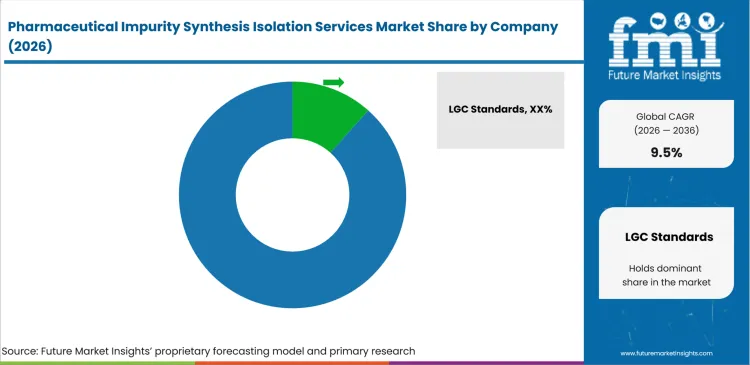
The competitive field combines reference-material manufacturers with chemistry specialists that identify and prepare difficult pharmaceutical impurities. LGC Standards and its Toronto Research Chemicals brand compete through broad standards portfolios and custom synthesis across degradants or metabolites. Cayman Chemical and Cerilliant add controlled reference-material production with detailed analytical characterization across several regulated compound classes. SynZeal Research and Simson Pharma Limited focus on unknown-impurity identification with on-demand preparation for pharmaceutical development programs. BOC Sciences connects isolation with custom synthesis through a broader chemistry platform serving complex low-volume assignments. Aarti Pharmalabs adds route development and larger-scale execution for programs that progress beyond milligram quantities. Repeat assignments depend on accepted material and dependable documentation rather than corporate size or general chemical manufacturing capacity.
- LGC Standards and Toronto Research Chemicals combine wide impurity coverage with custom preparation across metabolites and degradants. Cayman Chemical and Cerilliant add reference-material production with synthesis and tandem mass spectrometry characterization for regulated applications. Their advantage depends on compound availability and certificate detail with delivery that fits method schedules.
- SynZeal Research and Simson Pharma Limited focus on unknown-impurity identification with custom synthesis and analytical qualification. BOC Sciences adds isolation and chemical residue analysis through a broader chemistry service platform for regulated pharmaceutical laboratories. These companies need clear release criteria and failed-route terms that make recurring pharmaceutical assignments commercially workable.
- Aarti Pharmalabs connects impurity profiling with method development and scaled custom chemistry across small-molecule programs. Its role becomes relevant for sponsors needing route knowledge beyond milligram-scale material and initial characterization. Differentiation depends on controlled handoffs between analytical release and later process development rather than a broad capacity statement.
Competitive Benchmarking: Pharmaceutical Impurity Synthesis Isolation Services Market
| Company | Synthesis and Isolation Breadth | Characterization Evidence | Custom-Service Depth | Geographic Reach |
|---|---|---|---|---|
| LGC Standards | High | High | High | Global |
| Toronto Research Chemicals | High | Medium | High | Global |
| SynZeal Research | High | Medium | High | Multi-country |
| Cayman Chemical | High | High | High | Global |
| Simson Pharma Limited | High | High | Medium | Multi-country |
| BOC Sciences | High | Medium | High | Multi-country |
| Aarti Pharmalabs | Medium | Medium | High | Multi-country |
| Cerilliant | Medium | High | Medium | Global |
Key Developments in the Pharmaceutical Impurity Synthesis Isolation Services Market
- In January 2025, Cayman Chemical documented a reference-standard operation supplying more than four thousand two hundred standards worldwide. The range includes pharmaceutical impurities and degradants beside isotope-labeled compounds and custom organic synthesis workflows. The update confirms access to traceable materials supported by certificates and several complementary analytical techniques.
- In March 2025, Simson Pharma Limited detailed a total structure confirmation workflow for pharmaceutical impurities. The service combines chromatographic separation and mass spectrometry with one-dimensional and two-dimensional NMR techniques for difficult unknown compounds. Preparative HPLC can collect unknown compounds and support final structure reporting through a connected analytical workflow.
- In September 2025, Aarti Pharmalabs inaugurated the first phase of its Atali site with 440 kL capacity across 63 reactors. The facility expands small-molecule CDMO infrastructure for intermediates and regulated clinical or commercial manufacturing programs. Its analytical services include impurity profiling and method development beside custom synthesis for pharmaceutical compounds.
- In December 2025, LGC Standards reported a 203 thousand-square-foot organic chemistry center in Vaughan with 21 new API reference materials. The company connected the center with expanded synthesis capacity across its international pharmaceutical standards program. The development improves access to newly prepared materials supported by controlled analytical documentation and global distribution.
Pharmaceutical Impurity Synthesis Isolation Services Market - Report Scope
| Coverage field | Report scope |
|---|---|
| Market breakdown | Product Type, Application, End User, and region. |
| Quantitative Units | Revenus in USD Billion and CAGR in %. |
| Market Definition | Custom synthesis, isolation, characterization, purification, and supply of pharmaceutical impurities, degradants, metabolites, and reference standards. |
| Regions Covered | North America, Latin America, Western Europe, Eastern Europe, East Asia, South Asia and Pacific, and Middle East and Africa. |
| Countries Covered | USA, South Korea, Japan, Canada, Australia, Germany, and UK. |
| Key Companies Profiled | LGC Standards, Toronto Research Chemicals, SynZeal Research, Cayman Chemical, Simson Pharma Limited, BOC Sciences, Aarti Pharmalabs, and Cerilliant. |
| Forecast Period | 2026 to 2036. |
| Approach | Hybrid bottom-up and top-down market sizing supported by primary interviews and official desk research. |
Pharmaceutical Impurity Synthesis Isolation Services Market - Research Methodology
| Method | Approach |
|---|---|
| Primary Research | FMI analysts gathered input from manufacturers, service providers, technology developers, distributors, end users, procurement teams, and subject-matter experts. Interviews examined purchasing decisions, product or service evaluation, adoption barriers, approval requirements, pricing considerations, and expectations for technical or commercial support. Respondents were also asked what evidence is required before a trial, pilot, or initial order develops into regular purchasing. |
| Desk Research | Desk research covered government statistics, regulatory publications, trade data, industry associations, technical literature, standards, company filings, product information, and official corporate announcements. Sources were reviewed for relevance, publication date, geographic coverage, and consistency with the defined market scope. Claims relating to performance, applications, approvals, capacity, investment, and commercial activity were retained only when supported by credible public evidence. |
| Market Sizing and Forecasting | The market model combined the baseline value with historical performance, segment structure, pricing and volume indicators, adoption levels, company participation, and country-level demand conditions. Forecast assumptions considered economic activity, investment trends, regulatory developments, technology adoption, purchasing cycles, supply availability, and barriers to wider market use. Segment and regional estimates were reconciled before the final market total was calculated. |
| Data Validation | Estimates were checked against multiple independent indicators, including public data, company activity, trade patterns, industry developments, and findings from primary interviews. Validation also tested whether products, services, applications, and company revenues fell within the defined market boundaries. Adjacent categories, unsupported claims, overlapping revenues, and activities without direct market relevance were excluded to reduce double counting and maintain consistency across segments and countries. |
Pharmaceutical Impurity Synthesis Isolation Services Market by Segments
Pharmaceutical Impurity Synthesis Isolation Services Market, by Product Type
- Reference Standards
- Analytical Reference Standards
- Certified Reference Standards
- Impurity Standards
- Process Impurities
- Degradation Impurities
- Metabolite Standards
- Active Metabolites
- Inactive Metabolites
- Stable Isotope Standards
- Deuterated Standards
- ^13C Labeled Standards
- Custom Synthesized Compounds
- API Intermediates
- Specialty Chemical Standards
Pharmaceutical Impurity Synthesis Isolation Services Market, by Application
- Drug Development
- Preclinical Studies
- Clinical Studies
- Analytical Method Development
- Method Validation
- Method Optimization
- Quality Control Testing
- Raw Material Testing
- Finished Product Testing
- Regulatory Submission
- DMF Support
- ICH Compliance Studies
- Stability Studies
- Forced Degradation Studies
- Long-Term Stability Studies
Pharmaceutical Impurity Synthesis Isolation Services Market, by End User
- Pharmaceutical Companies
- Innovator Companies
- Generic Manufacturers
- Contract Research Organizations (CROs)
- Discovery CROs
- Analytical CROs
- Biotechnology Companies
- Early Stage Biotech
- Commercial Biotech
- Academic & Research Institutes
- Universities
- Public Research Institutes
- Regulatory Laboratories
- Government Laboratories
- Independent Testing Laboratories
Pharmaceutical Impurity Synthesis Isolation Services Market by Region:
- North America
- United States
- Canada
- Europe
- Germany
- United Kingdom
- France
- Italy
- Spain
- Asia Pacific
- China
- Japan
- South Korea
- Taiwan
- Singapore
- Latin America
- Brazil
- Mexico
- Argentina
- Middle East & Africa
- GCC Countries
- South Africa
- Israel
Research Sources and Bibliography
- USA Food and Drug Administration. (2026, July 24). CDER Nitrosamine Impurity Acceptable Intake Limits.
- European Medicines Agency. (2025, July 29). Nitrosamine impurities.
- Health Canada. (2026, March 11). Nitrosamine impurities in medications: Established acceptable intake limits.
- Cayman Chemical. (2025, February 4). Helping Make Research Possible: Custom Services from Essential Research to Drug Discovery.
- Health Canada. (2026, May 29). Nitrosamine impurities in medications: Overview.
- Cayman Chemical. (2025, January 22). Beyond Drug Discovery: From Molecule to Market with CGMP Manufacturing.
- USA Food and Drug Administration. (2026, April). Establishing Impurity Specifications for Antibiotics.
- Ministry of Food and Drug Safety. (2026, March 19).
- Pharmaceuticals and Medical Devices Agency. (2025, January 16). Example of Documents on Assessment and Control of DNA Reactive (Mutagenic) Impurities Attached to Clinical Trial Notification (Early Consideration).
- Therapeutic Goods Administration. (2026, January 29). Nitrosamine impurities acceptable intakes update - January 2026.
- Federal Institute for Drugs and Medical Devices. (2025, July 23). Information for marketing authorisation holders: Current information on submission for step 3.
- Medicines and Healthcare products Regulatory Agency. (2026, February 25). Medicines: Marketing Authorisation Holders' submission of Nitrosamine risk evaluation, risk assessment and confirmatory testing.
- Cayman Chemical. (2025, January 7). We Support Accurate Analysis Through High Quality Reference Standards.
- Simson Pharma Limited. (2025, March 21). Total structure confirmation service at Simson pharma.
- BOC Sciences. (n.d.). Organic Impurities Analysis & Characterization Services.
- Aarti Pharmalabs Limited. (n.d.). CDMO Pharma Services & Pharmaceuticals Contract Manufacturing in India.
- Aarti Pharmalabs Limited. (2025, September 3). Aarti Pharmalabs Limited inaugurates its new state-of-the-art manufacturing facility at Atali, Gujarat to expand its production capacity.
- LGC Standards. (2025, December 15). Five thought leadership crackers from 2025.
This bibliography is provided for reader reference and is not exhaustive. The full report contains the complete reference list and detailed citations
This Report Answers
- How large is the pharmaceutical impurity synthesis isolation services market in 2026 and 2036?
- Which regulatory and development conditions create demand for impurity synthesis and isolation services?
- Why do reference standards account for the largest product type share in 2026?
- How does drug development influence repeat custom chemistry and analytical work?
- Why do pharmaceutical companies represent the largest end-user share in 2026?
- How do country growth rates differ across the USA, South Korea, Japan, Canada, Australia, Germany, and the UK?
- Which companies provide reference materials, unknown-impurity services, or scaled custom chemistry?
- What technical and commercial risks limit service margins across difficult impurity projects?
- Which 2025 company developments changed capacity, standards access, or competitive positioning?
Frequently Asked Questions
How big is the Pharmaceutical Impurity Synthesis Isolation Services Market in 2026?
The pharmaceutical impurity synthesis isolation services market is valued at USD 1.7 billion in 2026 and is forecast to reach USD 4.2 billion by 2036. Growth is supported by heightened regulatory scrutiny of pharmaceutical impurities and nitrosamine contamination, which sustains recurring demand for specialized analytical and impurity-characterization services across regulated drug portfolios.
What is the CAGR of the Pharmaceutical Impurity Synthesis Isolation Services Market from 2026 to 2036?
The pharmaceutical impurity synthesis isolation services market grows at a CAGR of 9.5% between 2026 and 2036, supported by compound-specific impurity limits that create recurring synthesis and analytical assignments, prompting sponsors to rely on specialist laboratories for route design, purification, and validated characterization within tight filing windows.
Which product type leads the Pharmaceutical Impurity Synthesis Isolation Services Market?
Reference standards account for 31.0% of the pharmaceutical impurity synthesis isolation services market by product type in 2026, driven by recurring calibration and method-transfer needs that let one qualified, traceable material support identity checks and quantitative performance across multiple batches and laboratory sites.
How much will the Pharmaceutical Impurity Synthesis Isolation Services Market add between 2026 and 2036?
The pharmaceutical impurity synthesis isolation services market is set to add USD 2.5 billion between 2026 and 2036, growing from USD 1.7 billion to USD 4.2 billion as expanding nitrosamine and impurity documentation requirements push a widening base of pharmaceutical companies toward outsourced synthesis, isolation, and characterization services.
Who are the leading companies in the Pharmaceutical Impurity Synthesis Isolation Services Market?
Eight companies lead the pharmaceutical impurity synthesis isolation services market, including LGC Standards, Toronto Research Chemicals, SynZeal Research, Cayman Chemical, Simson Pharma Limited, BOC Sciences, Aarti Pharmalabs, and Cerilliant, competing through reference-standard portfolios, custom synthesis, unknown-impurity identification, and structure confirmation across regulated pharmaceutical development programs, with LGC Standards holding an estimated 11.6% share in 2026.
Preview the report firsthand - request a free sample
Get SampleGet the brochure for pricing and purchase details.
Get PDFTable of Content
- Key Takeaways
- Market Size and CAGR
- Top Growth Driver
- Fastest Growing Segment
- Leading Region
- Key Companies
- Emerging Opportunities
- Executive Summary
- Global Market Outlook
- Demand-side Trends
- Supply-side Trends
- Technology Roadmap Analysis
- Analysis and Recommendations
- Analyst Perspective (What is happening? Why now? What should investors know?)
- Key Questions Answered
- How large is the market?
- What is the CAGR?
- What are key trends?
- Which region dominates?
- Who are the leaders?
- Market Overview
- Market Coverage / Taxonomy
- Market Definition / Scope / Limitations
- Research Methodology
- Chapter Orientation
- Analytical Lens and Working Hypotheses
- Market Structure, Signals, and Trend Drivers
- Benchmarking and Cross-market Comparability
- Market Sizing, Forecasting, and Opportunity Mapping
- Research Design and Evidence Framework
- Desk Research Programme (Secondary Evidence)
- Expert Input and Fieldwork (Primary Evidence)
- Tooling, Models, and Reference Databases
- Data Engineering and Model Build
- Quality Assurance and Audit Trail
- Market Background
- Market Dynamics (Drivers, Restraints, Opportunity, Trends)
- Scenario Forecast (Optimistic, Likely, Conservative)
- Impact Analysis
- AI Impact
- Sustainability Impact
- Regulatory Impact
- Technology Impact
- Consumer / Buyer Analysis
- Purchase Drivers
- Adoption Barriers
- Buyer Journey
- Opportunity Map Analysis
- Product Life Cycle Analysis
- Supply Chain Analysis
- Investment Feasibility Matrix
- Value Chain Analysis
- PESTLE and Porter's Analysis
- Regulatory Landscape
- Regional Parent Market Outlook
- Production and Consumption Statistics
- Import and Export Statistics
- Global Market Analysis and Forecast, 2021 to 2036
- Historical Market Size Value (USD Billion) Analysis, 2021 to 2025
- Current and Future Market Size Value (USD Billion) Projections, 2026 to 2036
- Y-o-Y Growth Trend Analysis
- Absolute $ Opportunity Analysis
- Global Market Pricing Analysis, 2021 to 2036
- Global Market Analysis and Forecast, By Product Type, 2021 to 2036
- Introduction / Key Findings
- Historical Market Size Value (USD Billion) Analysis By Product Type, 2021 to 2025
- Current and Future Market Size Value (USD Billion) Analysis and Forecast By Product Type, 2026 to 2036
- Reference Standards
- Analytical Reference Standards
- Certified Reference Standards
- Impurity Standards
- Process Impurities
- Degradation Impurities
- Metabolite Standards
- Active Metabolites
- Inactive Metabolites
- Stable Isotope Standards
- Deuterated Standards
- 13C Labeled Standards
- Custom Synthesized Compounds
- API Intermediates
- Specialty Chemical Standards
- Reference Standards
- Y-o-Y Growth Trend Analysis By Product Type, 2021 to 2025
- Absolute $ Opportunity Analysis By Product Type, 2026 to 2036
- Global Market Analysis and Forecast, By Application, 2021 to 2036
- Introduction / Key Findings
- Historical Market Size Value (USD Billion) Analysis By Application, 2021 to 2025
- Current and Future Market Size Value (USD Billion) Analysis and Forecast By Application, 2026 to 2036
- Drug Development
- Preclinical Studies
- Clinical Studies
- Analytical Method Development
- Method Validation
- Method Optimization
- Quality Control Testing
- Raw Material Testing
- Finished Product Testing
- Regulatory Submission
- DMF Support
- ICH Compliance Studies
- Stability Studies
- Forced Degradation Studies
- Long-Term Stability Studies
- Drug Development
- Y-o-Y Growth Trend Analysis By Application, 2021 to 2025
- Absolute $ Opportunity Analysis By Application, 2026 to 2036
- Global Market Analysis and Forecast, By End User, 2021 to 2036
- Introduction / Key Findings
- Historical Market Size Value (USD Billion) Analysis By End User, 2021 to 2025
- Current and Future Market Size Value (USD Billion) Analysis and Forecast By End User, 2026 to 2036
- Pharmaceutical Companies
- Innovator Companies
- Generic Manufacturers
- Contract Research Organizations
- Discovery CROs
- Analytical CROs
- Biotechnology Companies
- Early Stage Biotech
- Commercial Biotech
- Academic & Research Institutes
- Universities
- Public Research Institutes
- Regulatory Laboratories
- Government Laboratories
- Independent Testing Laboratories
- Pharmaceutical Companies
- Y-o-Y Growth Trend Analysis By End User, 2021 to 2025
- Absolute $ Opportunity Analysis By End User, 2026 to 2036
- Global Market Analysis and Forecast, By Region, 2021 to 2036
- Introduction
- Historical Market Size Value (USD Billion) Analysis By Region, 2021 to 2025
- Current Market Size Value (USD Billion) Analysis and Forecast By Region, 2026 to 2036
- North America
- Latin America
- Western Europe
- Eastern Europe
- East Asia
- South Asia and Pacific
- Middle East & Africa
- Market Attractiveness Analysis By Region
- North America Market Analysis and Forecast, By Country, 2021 to 2036
- Historical Market Size Value (USD Billion) Trend Analysis By Market Taxonomy, 2021 to 2025
- Market Size Value (USD Billion) Forecast By Market Taxonomy, 2026 to 2036
- By Country
- USA
- Canada
- By Product Type
- By Application
- By End User
- By Country
- Market Attractiveness Analysis
- By Country
- By Product Type
- By Application
- By End User
- Key Takeaways
- Latin America Market Analysis and Forecast, By Country
- Historical Market Size Value (USD Billion) Trend Analysis By Market Taxonomy, 2021 to 2025
- Market Size Value (USD Billion) Forecast By Market Taxonomy, 2026 to 2036
- By Country
- Brazil
- Mexico
- Chile
- Rest of Latin America
- By Product Type
- By Application
- By End User
- By Country
- Market Attractiveness Analysis
- By Country
- By Product Type
- By Application
- By End User
- Key Takeaways
- Western Europe Market Analysis and Forecast, By Country
- Historical Market Size Value (USD Billion) Trend Analysis By Market Taxonomy, 2021 to 2025
- Market Size Value (USD Billion) Forecast By Market Taxonomy, 2026 to 2036
- By Country
- Germany
- UK
- Italy
- Spain
- France
- Nordic
- BENELUX
- Rest of Western Europe
- By Product Type
- By Application
- By End User
- By Country
- Market Attractiveness Analysis
- By Country
- By Product Type
- By Application
- By End User
- Key Takeaways
- Eastern Europe Market Analysis and Forecast, By Country
- Historical Market Size Value (USD Billion) Trend Analysis By Market Taxonomy, 2021 to 2025
- Market Size Value (USD Billion) Forecast By Market Taxonomy, 2026 to 2036
- By Country
- Russia
- Poland
- Hungary
- Balkan & Baltic
- Rest of Eastern Europe
- By Product Type
- By Application
- By End User
- By Country
- Market Attractiveness Analysis
- By Country
- By Product Type
- By Application
- By End User
- Key Takeaways
- East Asia Market Analysis and Forecast, By Country
- Historical Market Size Value (USD Billion) Trend Analysis By Market Taxonomy, 2021 to 2025
- Market Size Value (USD Billion) Forecast By Market Taxonomy, 2026 to 2036
- By Country
- China
- Japan
- South Korea
- By Product Type
- By Application
- By End User
- By Country
- Market Attractiveness Analysis
- By Country
- By Product Type
- By Application
- By End User
- Key Takeaways
- South Asia and Pacific Market Analysis and Forecast, By Country
- Historical Market Size Value (USD Billion) Trend Analysis By Market Taxonomy, 2021 to 2025
- Market Size Value (USD Billion) Forecast By Market Taxonomy, 2026 to 2036
- By Country
- India
- ASEAN
- Australia & New Zealand
- Rest of South Asia and Pacific
- By Product Type
- By Application
- By End User
- By Country
- Market Attractiveness Analysis
- By Country
- By Product Type
- By Application
- By End User
- Key Takeaways
- Middle East & Africa Market Analysis and Forecast, By Country
- Historical Market Size Value (USD Billion) Trend Analysis By Market Taxonomy, 2021 to 2025
- Market Size Value (USD Billion) Forecast By Market Taxonomy, 2026 to 2036
- By Country
- Kingdom of Saudi Arabia
- Other GCC Countries
- Türkiye
- South Africa
- Other African Union
- Rest of Middle East & Africa
- By Product Type
- By Application
- By End User
- By Country
- Market Attractiveness Analysis
- By Country
- By Product Type
- By Application
- By End User
- Key Takeaways
- Key Countries Market Analysis
- USA
- Pricing Analysis
- Market Share Analysis, 2025
- By Product Type
- By Application
- By End User
- Canada
- Pricing Analysis
- Market Share Analysis, 2025
- By Product Type
- By Application
- By End User
- Mexico
- Pricing Analysis
- Market Share Analysis, 2025
- By Product Type
- By Application
- By End User
- Brazil
- Pricing Analysis
- Market Share Analysis, 2025
- By Product Type
- By Application
- By End User
- Chile
- Pricing Analysis
- Market Share Analysis, 2025
- By Product Type
- By Application
- By End User
- Germany
- Pricing Analysis
- Market Share Analysis, 2025
- By Product Type
- By Application
- By End User
- UK
- Pricing Analysis
- Market Share Analysis, 2025
- By Product Type
- By Application
- By End User
- Italy
- Pricing Analysis
- Market Share Analysis, 2025
- By Product Type
- By Application
- By End User
- Spain
- Pricing Analysis
- Market Share Analysis, 2025
- By Product Type
- By Application
- By End User
- France
- Pricing Analysis
- Market Share Analysis, 2025
- By Product Type
- By Application
- By End User
- India
- Pricing Analysis
- Market Share Analysis, 2025
- By Product Type
- By Application
- By End User
- ASEAN
- Pricing Analysis
- Market Share Analysis, 2025
- By Product Type
- By Application
- By End User
- Australia & New Zealand
- Pricing Analysis
- Market Share Analysis, 2025
- By Product Type
- By Application
- By End User
- China
- Pricing Analysis
- Market Share Analysis, 2025
- By Product Type
- By Application
- By End User
- Japan
- Pricing Analysis
- Market Share Analysis, 2025
- By Product Type
- By Application
- By End User
- South Korea
- Pricing Analysis
- Market Share Analysis, 2025
- By Product Type
- By Application
- By End User
- Russia
- Pricing Analysis
- Market Share Analysis, 2025
- By Product Type
- By Application
- By End User
- Poland
- Pricing Analysis
- Market Share Analysis, 2025
- By Product Type
- By Application
- By End User
- Hungary
- Pricing Analysis
- Market Share Analysis, 2025
- By Product Type
- By Application
- By End User
- Kingdom of Saudi Arabia
- Pricing Analysis
- Market Share Analysis, 2025
- By Product Type
- By Application
- By End User
- Türkiye
- Pricing Analysis
- Market Share Analysis, 2025
- By Product Type
- By Application
- By End User
- South Africa
- Pricing Analysis
- Market Share Analysis, 2025
- By Product Type
- By Application
- By End User
- USA
- Market Structure Analysis
- Competition Dashboard
- Competition Benchmarking
- Market Share Analysis of Top Players
- By Regional
- By Product Type
- By Application
- By End User
- Emerging Startups
- Innovation Benchmarking
- Competition Analysis
- Competition Deep Dive
- LGC Standards
- Overview
- Product Portfolio
- Profitability by Market Segments
- Sales Footprint
- Strategy Overview
- Marketing Strategy
- Product Strategy
- Channel Strategy
- Toronto Research Chemicals
- SynZeal Research
- Cayman Chemical
- Bio-Techne
- CPC Scientific
- SimSon Pharma
- Aarti Pharmalabs
- BOC Sciences
- Cerilliant
- LGC Standards
- Case Studies
- Success Stories
- Recent Developments
- Competition Deep Dive
- Assumptions & Acronyms Used


