

- Market Size (2026)
- USD 1.1 Bn
- Forecast (2036)
- USD 2.3 Bn
- CAGR (2026 to 2036)
- 7.7%
Pharmaceutical Omega-3 API Market Size, Market Forecast and Outlook By FMI
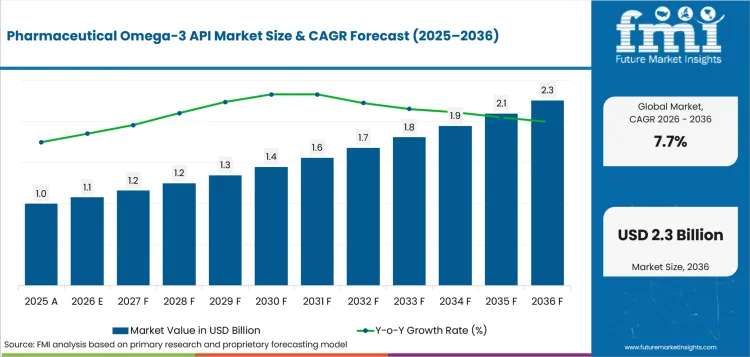
The pharmaceutical omega-3 API market value is expected to move from USD 1.0 billion in 2025 to USD 2.3 billion by 2036 at 7.7% CAGR, influenced by prescription cardiovascular therapies and pharma-grade marine lipid supply. Marine fish oil-derived APIs are anticipated to secure 81.3% share in 2026 since approved prescription products still rely on purified marine-origin omega-3 chemistry. Ethyl ester concentrates are projected to represent 64.2% share in 2026 as icosapent ethyl and omega-3-acid ethyl ester drug products require high-purity esterified inputs.
Key Takeaways, Market Size, and Forecast
- 2026 Market Size: USD 1.1 billion
- 2036 Market Size: USD 2.3 billion
- Forecast CAGR: 7.7% CAGR from 2026 to 2036
- Leading Source Material: Marine Fish Oil-derived APIs
- Marine Fish Oil-derived APIs Share in 2026: 81.3%
- Leading Product Form: Ethyl Ester Concentrates
- Ethyl Ester Concentrates Share in 2026: 64.2%
- Leading Regulatory Filing Type: DMF and CEP-supported APIs
- DMF and CEP-supported APIs Share in 2026: 58.4%
- Fastest-growing Country: Saudi Arabia
- Saudi Arabia CAGR: 9.2% CAGR through 2036
Summary of Pharmaceutical Omega-3 API Market
- Demand and Growth Drivers
- Prescription cardiovascular drug manufacturers are using purified omega-3 APIs for high-triglyceride and residual-risk treatment portfolios.
- Regulatory filings guide API selection as finished-dose manufacturers compare DMF access and product-specific documentation.
- Marine lipid supply is being consolidated into larger API-grade platforms with stronger control over purification and filling partnerships.
- Product and Segment View
- Marine fish oil-derived APIs are forecast to hold 81.3% share in 2026, driven by established prescription product pathways.
- Ethyl ester concentrates are projected to represent 64.2% share in 2026, influenced by EPA ethyl ester and omega-3-acid ethyl ester drug formats.
- DMF and CEP-supported APIs are expected to account for 58.4% share in 2026 due to dossier readiness across regulated countries.
- Geography and Competitive Outlook
- Saudi Arabia is projected to record 9.2% CAGR by 2036 owing to specialty cardiovascular care and SFDA drug-list clearance.
- South Korea is forecast to expand at 8.6% CAGR by 2036 due to dyslipidemia screening and high cardiometabolic treatment activity.
- KD Pharma, BASF Pharma Solutions, and Croda compete based on API-grade purification and regulatory file depth.
- Amarin-linked supply routes and Recordati commercialization support finished-dose demand in prescription EPA therapy markets.
- Analyst Opinion
- Anurag Sharma, Principal Consultant for Healthcare at FMI, observes, “Pharmaceutical omega-3 APIs have moved beyond bulk nutraceutical oils. Buyers now check dossier access and continuity of marine lipid supply before approving a supplier. API producers able to pair regulatory file depth with stable ethyl ester capacity should protect repeat supply programs more effectively.”
- Pharmaceutical Omega-3 API Market Value Analysis
- Market value is built from prescription-grade omega-3 API revenue before softgel conversion and finished-dose distribution add separate value.
- Supplier pricing reflects regulatory documentation and marine lipid feedstock availability.
- Revenue improves as cardiovascular drug programs need repeat API volumes for icosapent ethyl and omega-3-acid ethyl ester products.
- Buyer trust improves as API files show impurity control and country-specific registration support.
Generic entry risk is forcing omega-3 API suppliers to prove capsule behavior before pricing discussions start. FDA’s October 2024 icosapent ethyl guidance links 500 mg and 1 gm strengths to either in vitro or in vivo evidence and places comparative disintegration around 12 units per batch across three batches. Such shifts buyer screening toward API equivalence and softgel test readiness. Commercial coverage is becoming the second procurement filter. Amarin stated in its March 2025 Annual Report that VASCEPA had REDUCE-IT approval in 49 countries, including the United States and 27 EU Member States. Finished-dose manufacturers need API supply systems supporting partner-led commercialization without weakening lot continuity. Generic packaging discipline is also becoming more relevant. DailyMed updated the icosapent ethyl label in October 2024 and listed 0.5 gram and 1 gram capsules in 240-capsule bottles. API suppliers and softgel manufacturers need strength and pack alignment that supports substitution-ready prescription supply.
Why is Pharmaceutical Omega-3 API Market Growing?
- Cardiovascular drug makers are maintaining purified EPA and mixed ester API programs for high-risk patient populations.
- Dossier-backed API supply is gaining weight as finished-dose manufacturers need country-ready regulatory files before batch planning.
- Supply consolidation is improving buyer access to larger marine lipid networks and pharma-grade purification assets.
Growth is supported by disease burden and active prescription demand rather than supplement use. Centers for Disease Control and Prevention reported 919,032 cardiovascular disease deaths in the United States in 2023, and Public Health Agency of Canada reported ischemic heart disease diagnosis in 8.2% of Canadian adults for 2023 to 2024. EMA product information updated in March 2026 confirms Vazkepa contains icosapent ethyl and is used with statins for adult patients at high cardiovascular risk with raised triglycerides. Amarin reported Q1 2026 product revenue of USD 43.3 million, which indicates continued finished-dose demand for purified EPA supply.
Market Segmentation Analysis
- Icosapent ethyl is anticipated to account for 41.6% share in 2026 since single-molecule purified EPA drug products keep stronger prescription value than mixed low-purity oils.
- Ethyl ester concentrates are projected to capture 64.2% share in 2026 owing to established use in EPA ethyl ester and omega-3-acid ethyl ester drug products.
- DMF and CEP-supported APIs are forecast to hold 58.4% share in 2026, reflected by manufacturer preference for regulatory files accepted across large drug markets.
- Marine fish oil-derived APIs are expected to secure 81.3% share in 2026 as approved omega-3 drug products still depending on purified marine-origin inputs.
- Cardiovascular-risk reduction drug products are projected to represent 47.9% share in 2026 due to continued use of icosapent ethyl in high-risk patients.
- Contract supply to finished-dose manufacturers is forecast to hold 55.8% share in 2026 driven by softgel drug makers needing repeat API lots with audit-ready documentation.
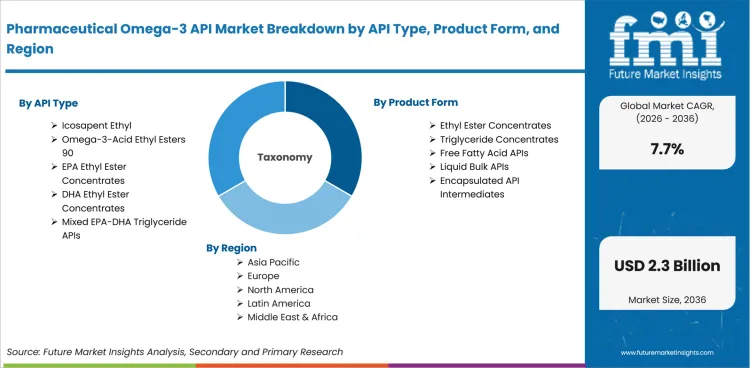
The pharmaceutical omega-3 API market is divided into six primary segment groups based on API type, product form, regulatory filing type, source material, end-use application, and sales and supply model. API type covers icosapent ethyl and omega-3-acid ethyl esters 90. EPA ethyl ester concentrates, DHA ethyl ester concentrates, and mixed EPA-DHA triglyceride APIs complete chemistry scope. Product form includes ethyl ester concentrates and triglyceride concentrates. Free fatty acid APIs, liquid bulk APIs, and encapsulated API intermediates complete format coverage. Regulatory filing type includes DMF-supported APIs and CEP-supported APIs. J-DMF-supported APIs, KR-DMF-supported APIs, and product-specific dossier APIs complete filing coverage. Source material includes marine fish oil-derived APIs and algae-derived APIs. Fermentation-derived lipids and recycled side-stream fish oil inputs remain small. End-use application includes cardiovascular-risk reduction and severe hypertriglyceridemia treatment. Softgel drug manufacturing and specialty hospital supply complete end-use coverage.
Insights into Pharmaceutical Omega-3 API Market by API Type
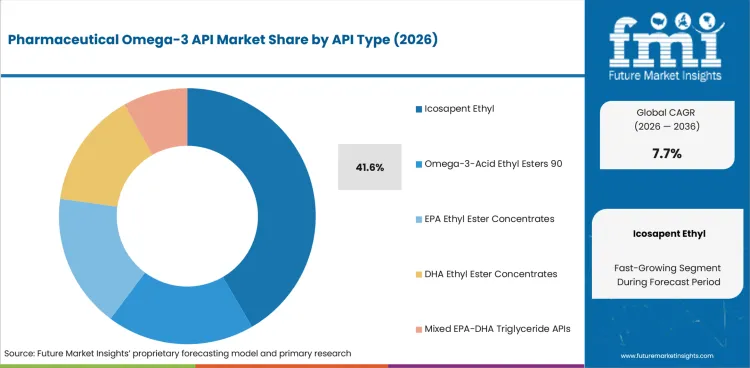
- Icosapent ethyl is projected to hold 41.6% share in 2026, led by prescription EPA drug products that need high-purity single-molecule API support.
- Omega-3-acid ethyl esters 90 remain important for mixed EPA-DHA drug products requiring compendial profiles and long-term manufacturing history.
Insights into Pharmaceutical Omega-3 API Market by Product Form
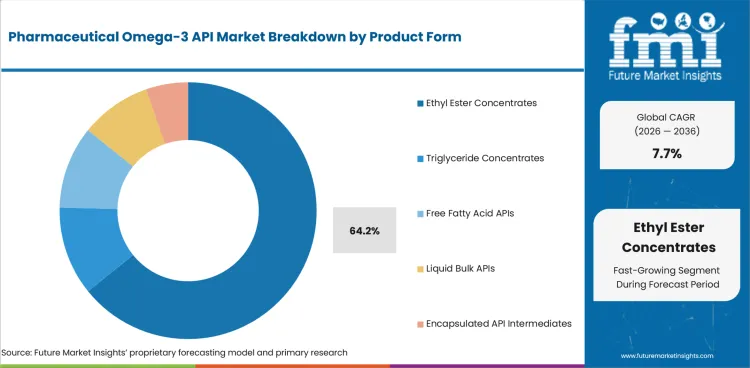
- Ethyl ester concentrates are forecast to hold 64.2% share in 2026, supported by softgel drug products and established esterification routes.
- Triglyceride concentrates retain use in selected prescription and hospital formulations requiring different absorption and formulation profiles.
Insights into Pharmaceutical Omega-3 API Market by Regulatory Filing Type
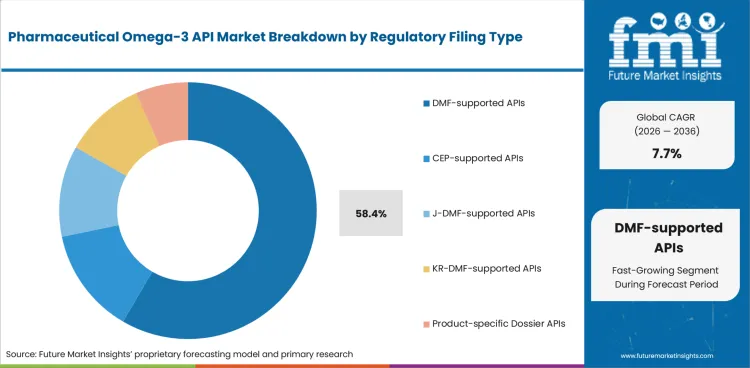
- DMF and CEP-supported APIs are expected to account for 58.4% share in 2026, backed by documentation needs across regulated markets.
- J-DMF and KR-DMF-supported APIs gain value as Japan and South Korea retain country-specific review expectations for imported APIs.
Insights into Pharmaceutical Omega-3 API Market by Source Material
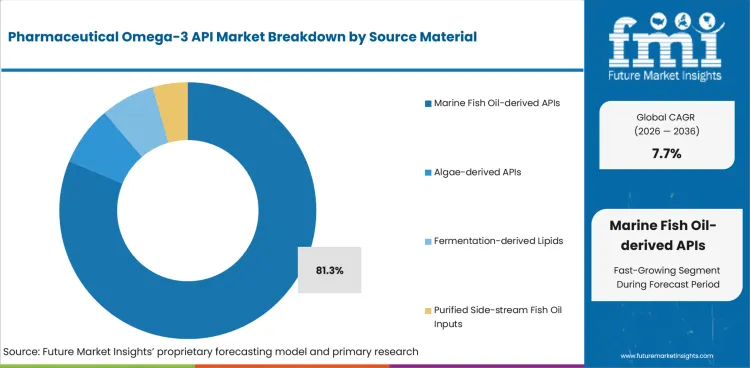
- Marine fish oil-derived APIs are anticipated to represent 81.3% share in 2026, reflected by approved drug histories and established purification controls.
- Algae-derived APIs remain limited in prescription omega-3 drugs, although non-marine lipid chemistry is watched by sponsors reviewing long-term supply risk.
Insights into Pharmaceutical Omega-3 API Market by End-use Application
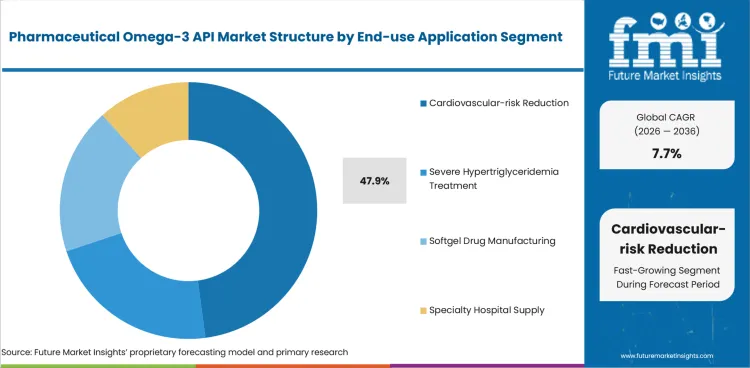
- Cardiovascular-risk reduction drug products are anticipated to represent 47.9% share in 2026, driven by label-backed use with statin therapy.
- Severe hypertriglyceridemia treatment keeps a separate volume base for mixed EPA-DHA and EPA-only prescription products.
Insights into Pharmaceutical Omega-3 API Market by Sales and Supply Model
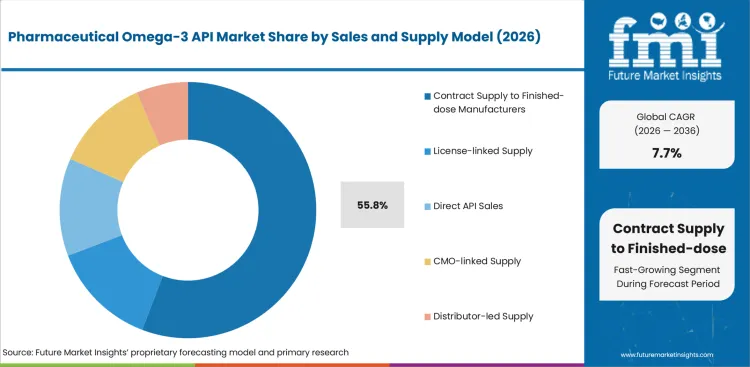
- Contract supply to finished-dose manufacturers is projected to hold 55.8% share in 2026, reflected by repeat softgel manufacturing programs.
- License-linked supply gains value as rights holders transfer commercialization work while retaining supply quality control.
Pharmaceutical Omega-3 API Market Drivers, Restraints and Opportunities
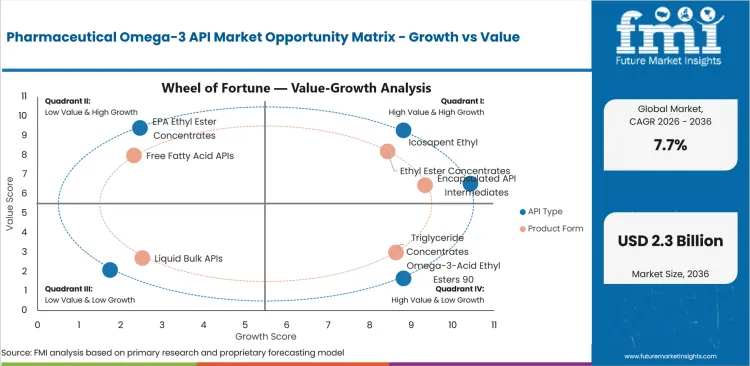
- Prescription EPA therapy keeps demand tied to cardiovascular risk management and specialist lipid treatment.
- Marine lipid purification cost can slow supplier switches among finished-dose manufacturers.
- License-led geographic expansion can move purified EPA products into more national reimbursement systems.
Prescription EPA Therapy Keeps API Demand Tied to Cardiovascular Care
Prescription EPA products keep pharmaceutical omega-3 API demand tied to chronic cardiovascular treatment rather than supplement consumption. Amarin stated in January 2026, VASCEPA had been prescribed more than 25.0 million times since launch, indicating repeat finished-dose demand across the omega-3 prescription drugs market. API suppliers benefit when sponsors need stable ethyl ester lots for long-running cardiovascular therapy programs.
Marine Lipid Qualification Cost Slows Supplier Switching
Supplier switching remains difficult as omega-3 capsule products need API equivalence and release proof before approval work can proceed. FDA’s October 2024 product-specific guidance for omega-3-acid ethyl esters Type A capsules refers to API release testing and capsule rupture testing evidence. Finished-dose sponsors connected with the pharmaceutical drug delivery market therefore need API partners able to support softgel performance evidence and batch traceability.
Commercial Rollout Expands National Supply Routes
Commercial rollout can lift API demand after licensing moves into pharmacy and specialist channels. Amarin reported in April 2026 that Recordati had started VAZKEPA commercial efforts in 10 countries, including an Italy launch in Q4 2025. API suppliers serving the cardiometabolic drugs market can gain when marketed prescription products move from authorization into repeat national ordering.
Drug Price and Benchmarking Analysis
Drug price benchmarking is expected to become more important for pharmaceutical omega-3 API suppliers as payers compare branded, specialty, and therapy-specific prescription products against negotiated reference prices. CMS reported in November 2025, 15 Medicare Part D drugs selected for the 2027 negotiation cycle accounted for USD 42.5 billion in gross covered prescription drug costs in 2024, while negotiated prices would have lowered net spending by about 44.0% if applied that year. This pricing pressure can influence API contracts as finished-dose sponsors benchmark purified EPA products against high-cost chronic therapies and lower-cost alternatives in the super generics market.
Value Chain Cost and Margin Analysis
Value chain cost analysis is expected to receive closer scrutiny as API suppliers, formulators, specialty distributors, PBMs, and pharmacies each affect final prescription economics. FTC reported in January 2025, the three largest PBMs and affiliated specialty pharmacies generated more than USD 7.3 billion in dispensing revenue above estimated acquisition costs on specialty generic drugs from 2017 to 2022, with some markups reaching hundreds or thousands of percent. For pharmaceutical omega-3 APIs, this supports stronger cost discipline across formulation and distribution because payers may push back on downstream margins before allowing wider prescription access through the ePharmacy market.
Analysis of Pharmaceutical Omega-3 API Market by Key Countries
.webp "Top Country Growth Comparison Pharmaceutical Omega 3 Api Market Cagr (2026 2036)")
| Country | CAGR |
|---|---|
| Saudi Arabia | 9.2% |
| South Korea | 8.6% |
| Australia | 8.1% |
| Canada | 7.8% |
| United States | 7.5% |
| United Kingdom | 7.2% |
| Japan | 6.8% |
Source: Future Market Insights, 2026.
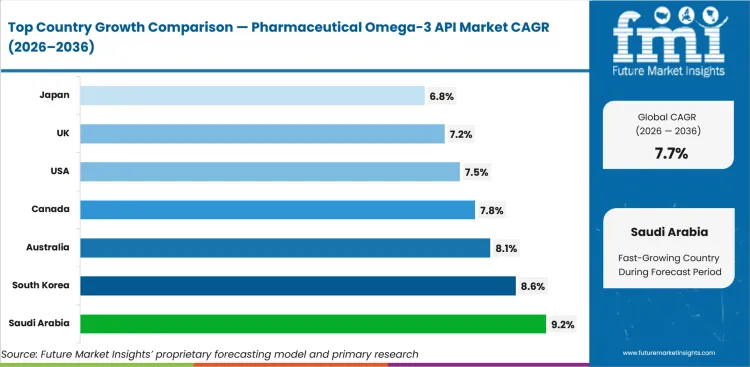
Pharmaceutical Omega-3 API Market CAGR Analysis by Country
- Saudi Arabia is projected to record 9.2% CAGR by 2036, led by specialty cardiovascular care and SFDA-linked finished-dose review.
- South Korea is expected to expand at 8.6% CAGR by 2036, supported by lipid screening and country-level drug documentation.
- Australia is forecast to grow at 8.1% CAGR by 2036, influenced by PBS-linked cardiovascular prescribing and specialist triglyceride care.
- Canada is expected to advance at 7.8% CAGR by 2036, aided by Vascepa access and provincial reimbursement routes.
- United States is projected to rise at 7.5% CAGR by 2036, reflected by prescription EPA demand and generic softgel competition.
- United Kingdom is forecast at 7.2% CAGR by 2036, guided by NHS lipid pathways and cholesterol management activity.
- Japan is expected to post 6.8% CAGR by 2036, shaped by EPA therapy history and PMDA safety review expectations.
Industry Analysis for Pharmaceutical Omega-3 API Market in Saudi Arabia
Specialty cardiovascular access and SFDA drug review center · 2026 to 2036
Country Market Snapshot Table
| Parameter | Value |
|---|---|
| Market Size in 2025 | USD 24.3 million |
| Market Size in 2026 | USD 26.5 million |
| Market Forecast in 2036 | USD 63.8 million |
| CAGR | 9.2% CAGR |
| Years Considered | 2021 to 2036 |
| Base Year | 2025 |
| Forecast Period | 2026 to 2036 |
| Units Considered | Value, USD million |
| Leading Sub-Region | Riyadh and Jeddah specialty care corridor |
Saudi Arabia Pharmaceutical Omega-3 API Market Outlook
Saudi Arabia pharmaceutical omega-3 API market is projected to record 9.2% CAGR from 2026 to 2036. Specialty clinics and hospital pharmacies are expected to review purified EPA products through finished-dose registration and local distributor support.
SFDA review practices make dossier quality central for imported cardiovascular capsules. Suppliers able to support finished product samples and Arabic-ready documentation should gain better access through Riyadh and Jeddah channels.
Key Growth Drivers
- Cardiometabolic patient management supports review of prescription EPA therapies. GASTAT reported adult chronic disease at 18.95%, hypertension at 7.9%, and cholesterol disease at 3.6% in the 2024 Health Status Statistics Publication.
- Hospital cardiovascular pathways can support specialist use of purified omega-3 drug products. A 2024 Saudi CVD study reported cardiovascular disease prevalence of 1.6% among people aged 15 years and above.
- Registered importers can support finished-dose sponsors after SFDA filing and distributor documentation are aligned.
- Riyadh and Jeddah private care corridors can support repeat prescription capsules through cardiology clinics and hospital-linked pharmacies.
Key Restraints
- Imported finished-dose programs can face longer qualification cycles. SFDA’s 2025 human drug submission guidance is issued as V4.0 and requires submitted samples to represent the final finished product marketed in Saudi Arabia.
- Price approval steps can slow premium cardiovascular capsule launch planning outside major city corridors.
- Limited local API purification capacity keeps sponsors exposed to marine lipid supply and overseas softgel conversion schedules.
What makes Saudi Arabia unique
Saudi Arabia combines specialty cardiovascular access with centralized finished-dose review through SFDA-linked processes.
Key Companies
- SPIMACO
- Tabuk Pharmaceuticals
- Jamjoom Pharma
- Riyadh Pharma
- DEEF Pharmaceutical Industries
- Sudair Pharma
Sales & Marketing Channels
- Registered drug distributors
- Hospital pharmacies
- Private specialty clinics
- Cardiology networks
- Government tender-linked supply
- Licensed importers
Country Segment Breakdown
| Segment | Sub-Segments |
|---|---|
| By API Type | Icosapent Ethyl · Omega-3-Acid Ethyl Esters 90 · EPA Ethyl Ester Concentrates · DHA Ethyl Ester Concentrates · Mixed EPA-DHA Triglyceride APIs |
| By Product Form | Ethyl Ester Concentrates · Triglyceride Concentrates · Free Fatty Acid APIs · Liquid Bulk APIs · Encapsulated API Intermediates |
| By Regulatory Filing Type | DMF-supported APIs · CEP-supported APIs · J-DMF-supported APIs · KR-DMF-supported APIs · Product-specific Dossier APIs |
| By Source Material | Marine Fish Oil-derived APIs · Algae-derived APIs · Fermentation-derived Lipids · Purified Side-stream Fish Oil Inputs |
| By End-use Application | Cardiovascular-risk Reduction · Severe Hypertriglyceridemia Treatment · Softgel Drug Manufacturing · Specialty Hospital Supply |
| By Sales and Supply Model | Contract Supply to Finished-dose Manufacturers · License-linked Supply · Direct API Sales · CMO-linked Supply · Distributor-led Supply |
| Key Sub-Regions Covered, Pharmaceutical and Cardiovascular Care Corridors | Riyadh · Jeddah · Eastern Province · Makkah · Madinah · Dammam |
Frequently Asked Questions
How fast is Saudi Arabia pharmaceutical omega-3 API market growing?
Saudi Arabia pharmaceutical omega-3 API market is forecast to record 9.2% CAGR from 2026 to 2036 through specialty cardiovascular access.
Who leads Saudi Arabia pharmaceutical omega-3 API market?
SPIMACO, Tabuk Pharmaceuticals, Jamjoom Pharma, Riyadh Pharma, DEEF Pharmaceutical Industries, and Sudair Pharma are key local participants.
What supports pharmaceutical omega-3 API demand in Saudi Arabia?
SFDA review routes, specialty cardiology care, and imported finished-dose demand support API-linked product planning in Saudi Arabia.
Industry Analysis for Pharmaceutical Omega-3 API Market in South Korea
Dyslipidemia screening and KR-DMF review center · 2026 to 2036
Country Market Snapshot Table
| Parameter | Value |
|---|---|
| Market Size in 2025 | USD 31.8 million |
| Market Size in 2026 | USD 34.5 million |
| Market Forecast in 2036 | USD 78.6 million |
| CAGR | 8.6% CAGR |
| Years Considered | 2021 to 2036 |
| Base Year | 2025 |
| Forecast Period | 2026 to 2036 |
| Units Considered | Value, USD million |
| Leading Sub-Region | Seoul metropolitan cardiometabolic care corridor |
South Korea Pharmaceutical Omega-3 API Market Outlook
South Korea pharmaceutical omega-3 API market is expected to expand at 8.6% CAGR from 2026 to 2036. Lipid testing and chronic disease treatment give finished-dose sponsors a defined patient base for prescription omega-3 products.
MFDS and reimbursement review keep supplier selection tied to dossier readiness and local clinical evidence. API suppliers with KR-DMF support and stable ethyl ester lots should gain stronger interest from Korean finished-dose manufacturers.
Key Growth Drivers
- Dyslipidemia screening supports prescription omega-3 review in specialist channels. Korea Society of Lipid and Atherosclerosis reported dyslipidemia prevalence of 47.4% under its revised HDL definition in September 2024.
- Hypertension comorbidity increases cardiometabolic treatment intensity. Korea Hypertension Fact Sheet 2024 reported nearly 30.0% of Korean adults had hypertension.
- Local finished-dose companies can use established softgel and chronic therapy portfolios to evaluate EPA capsule opportunities.
- Seoul-led hospital and clinic networks can support specialist uptake once label wording and reimbursement coding are accepted.
Key Restraints
- Payer scrutiny can limit premium therapy uptake. OECD reported Korea spent USD 4,797 per capita on health in 2025 analysis, equal to 8.4% of GDP.
- KR-DMF preparation raises supplier entry cost for imported omega-3 APIs.
- Generic cardiovascular drug competition can reduce tolerance for higher purified EPA API pricing.
What makes South Korea unique
South Korea has strong lipid screening and a local finished-dose base that can evaluate prescription EPA products quickly after documentation is complete.
Key Companies
- Chong Kun Dang
- Yuhan Corporation
- Hanmi Pharmaceutical
- Daewoong Pharmaceutical
- Boryung
- Dongkook Pharmaceutical
Sales & Marketing Channels
- Hospital pharmacies
- Specialty wholesalers
- Local drug manufacturers
- Regulatory filing agents
- Cardiology clinics
- Retail pharmacy chains
Country Segment Breakdown
| Segment | Sub-Segments |
|---|---|
| By API Type | Icosapent Ethyl · Omega-3-Acid Ethyl Esters 90 · EPA Ethyl Ester Concentrates · DHA Ethyl Ester Concentrates · Mixed EPA-DHA Triglyceride APIs |
| By Product Form | Ethyl Ester Concentrates · Triglyceride Concentrates · Free Fatty Acid APIs · Liquid Bulk APIs · Encapsulated API Intermediates |
| By Regulatory Filing Type | DMF-supported APIs · CEP-supported APIs · J-DMF-supported APIs · KR-DMF-supported APIs · Product-specific Dossier APIs |
| By Source Material | Marine Fish Oil-derived APIs · Algae-derived APIs · Fermentation-derived Lipids · Purified Side-stream Fish Oil Inputs |
| By End-use Application | Cardiovascular-risk Reduction · Severe Hypertriglyceridemia Treatment · Softgel Drug Manufacturing · Specialty Hospital Supply |
| By Sales and Supply Model | Contract Supply to Finished-dose Manufacturers · License-linked Supply · Direct API Sales · CMO-linked Supply · Distributor-led Supply |
| Key Sub-Regions Covered, Pharmaceutical and Cardiovascular Care Corridors | Seoul · Gyeonggi · Busan · Daegu · Incheon · Daejeon |
Frequently Asked Questions
How fast is South Korea pharmaceutical omega-3 API market growing?
South Korea pharmaceutical omega-3 API market is projected to expand at 8.6% CAGR from 2026 to 2036.
Who leads South Korea pharmaceutical omega-3 API market?
Chong Kun Dang, Yuhan Corporation, Hanmi Pharmaceutical, Daewoong Pharmaceutical, Boryung, and Dongkook Pharmaceutical are key local companies.
What supports pharmaceutical omega-3 API demand in South Korea?
Lipid screening, KR-DMF review, and local finished-dose manufacturing support prescription omega-3 API demand.
Industry Analysis for Pharmaceutical Omega-3 API Market in Australia
PBS-linked prescribing and triglyceride treatment center · 2026 to 2036
Country Market Snapshot Table
| Parameter | Value |
|---|---|
| Market Size in 2025 | USD 29.2 million |
| Market Size in 2026 | USD 31.6 million |
| Market Forecast in 2036 | USD 68.8 million |
| CAGR | 8.1% CAGR |
| Years Considered | 2021 to 2036 |
| Base Year | 2025 |
| Forecast Period | 2026 to 2036 |
| Units Considered | Value, USD million |
| Leading Sub-Region | New South Wales and Victoria prescribing corridor |
Australia Pharmaceutical Omega-3 API Market Outlook
Australia pharmaceutical omega-3 API market is forecast to grow at 8.1% CAGR from 2026 to 2036. TGA approval and PBS-related prescribing routes guide finished-dose review for icosapent ethyl products.
Specialist cardiology and general practice networks support therapy use for high-risk patients after reimbursement criteria are met. Suppliers with consistent API lots and softgel conversion support should be better placed in national pharmacy channels.
Key Growth Drivers
- Cardiovascular burden supports ongoing lipid therapy review. AIHW reported cardiovascular disease accounted for almost 12.0% of total disease burden in 2024.
- Approved triglyceride thresholds guide prescription use. Australian Prescriber stated in Decembe 2024, icosapent ethyl is indicated for high-risk statin-treated adults with elevated triglycerides of 1.7 mmol/L or greater
- PBS-linked prescribing can move therapy review from specialist clinics into primary care after eligibility checks.
- Domestic wholesalers can support national capsule distribution once sponsor inventory and pharmacy supply are stable.
Key Restraints
- Distribution concentration can reduce flexibility for new finished-dose sponsors. A December 2024 Australian filing identified 6 full-line pharmaceutical wholesalers in Australia.
- Reimbursement delays can slow scale-up even after regulatory approval.
- Long-distance distribution can raise working capital needs for imported cardiovascular capsules.
What makes Australia unique
Australia combines centralized therapeutic approval with PBS access rules and a concentrated pharmacy distribution structure.
Key Companies
- Arrotex Pharmaceuticals
- Sigma Healthcare
- Australian Pharmaceutical Industries
- Phebra
- Nova Pharmaceuticals
- Pharmacor
Sales & Marketing Channels
- Hospital pharmacies
- PBS-linked supply routes
- Specialist clinics
- National wholesalers
- Contract softgel manufacturers
- Private cardiology practices
Country Segment Breakdown
| Segment | Sub-Segments |
|---|---|
| By API Type | Icosapent Ethyl · Omega-3-Acid Ethyl Esters 90 · EPA Ethyl Ester Concentrates · DHA Ethyl Ester Concentrates · Mixed EPA-DHA Triglyceride APIs |
| By Product Form | Ethyl Ester Concentrates · Triglyceride Concentrates · Free Fatty Acid APIs · Liquid Bulk APIs · Encapsulated API Intermediates |
| By Regulatory Filing Type | DMF-supported APIs · CEP-supported APIs · J-DMF-supported APIs · KR-DMF-supported APIs · Product-specific Dossier APIs |
| By Source Material | Marine Fish Oil-derived APIs · Algae-derived APIs · Fermentation-derived Lipids · Purified Side-stream Fish Oil Inputs |
| By End-use Application | Cardiovascular-risk Reduction · Severe Hypertriglyceridemia Treatment · Softgel Drug Manufacturing · Specialty Hospital Supply |
| By Sales and Supply Model | Contract Supply to Finished-dose Manufacturers · License-linked Supply · Direct API Sales · CMO-linked Supply · Distributor-led Supply |
| Key Sub-Regions Covered, Pharmaceutical and Cardiovascular Care Corridors | New South Wales · Victoria · Queensland · Western Australia · South Australia · Australian Capital Territory |
Frequently Asked Questions
How fast is Australia pharmaceutical omega-3 API market growing?
Australia pharmaceutical omega-3 API market is forecast at 8.1% CAGR from 2026 to 2036.
Who leads Australia pharmaceutical omega-3 API market?
Arrotex Pharmaceuticals, Sigma Healthcare, Australian Pharmaceutical Industries, Phebra, Nova Pharmaceuticals, and Pharmacor are key local companies.
What supports pharmaceutical omega-3 API demand in Australia?
PBS access routes and specialist cardiovascular prescribing support pharmaceutical omega-3 API demand.
Industry Analysis for Pharmaceutical Omega-3 API Market in Canada
Provincial reimbursement and Vascepa access center · 2026 to 2036
Country Market Snapshot Table
| Parameter | Value |
|---|---|
| Market Size in 2025 | USD 42.0 million |
| Market Size in 2026 | USD 45.3 million |
| Market Forecast in 2036 | USD 96.0 million |
| CAGR | 7.8% CAGR |
| Years Considered | 2021 to 2036 |
| Base Year | 2025 |
| Forecast Period | 2026 to 2036 |
| Units Considered | Value, USD million |
| Leading Sub-Region | Ontario and Quebec specialty pharmacy corridor |
Canada Pharmaceutical Omega-3 API Market Outlook
Canada pharmaceutical omega-3 API market is expected to advance at 7.8% CAGR from 2026 to 2036. Provincial plan decisions and private coverage routes shape commercial uptake for prescription EPA products.
Canadian finished-dose access is linked to specialty pharmaceutical marketing and formulary progress. API suppliers should focus on lot reliability and regulatory support for sponsors serving multiple provinces.
Key Growth Drivers
- Ischemic heart disease prevalence supports demand for cardiovascular risk products. Public Health Agency of Canada reported 8.2% of adults lived with diagnosed ischemic heart disease in 2023 to 2024.
- Vascepa reimbursement coverage gives marketers a wider access base. HLS Therapeutics stated in July 2025 that Vascepa was available to more than 95.0% of eligible Canadians covered by a public plan or private insurance.
- Specialty pharmacy channels can support prescription EPA products after province-level eligibility rules are clear.
- Local generic and specialty pharma companies can assess API sourcing through Canadian regulatory and wholesaler routes.
Key Restraints
- Cardiovascular risk remains costly for the health system. Heart & Stroke reported in February 2026, more than 8.2 million Canadian adults had diagnosed high blood pressure.
- Provincial reimbursement differences can create uneven capsule volumes across Canada.
- Price-sensitive public plans can limit API cost pass-through for finished-dose sponsors.
What makes Canada unique
Canada has a defined Vascepa reimbursement pathway and a strong local specialty pharmaceutical commercialization base.
Key Companies
- HLS Therapeutics
- Apotex
- Pharmascience
- JAMP Pharma
- Pendopharm
- SteriMax
Sales & Marketing Channels
- Provincial formulary routes
- Specialty pharmacies
- Hospital pharmacies
- National drug wholesalers
- Contract manufacturers
- Regulatory affairs agents
Country Segment Breakdown
| Segment | Sub-Segments |
|---|---|
| By API Type | Icosapent Ethyl · Omega-3-Acid Ethyl Esters 90 · EPA Ethyl Ester Concentrates · DHA Ethyl Ester Concentrates · Mixed EPA-DHA Triglyceride APIs |
| By Product Form | Ethyl Ester Concentrates · Triglyceride Concentrates · Free Fatty Acid APIs · Liquid Bulk APIs · Encapsulated API Intermediates |
| By Regulatory Filing Type | DMF-supported APIs · CEP-supported APIs · J-DMF-supported APIs · KR-DMF-supported APIs · Product-specific Dossier APIs |
| By Source Material | Marine Fish Oil-derived APIs · Algae-derived APIs · Fermentation-derived Lipids · Purified Side-stream Fish Oil Inputs |
| By End-use Application | Cardiovascular-risk Reduction · Severe Hypertriglyceridemia Treatment · Softgel Drug Manufacturing · Specialty Hospital Supply |
| By Sales and Supply Model | Contract Supply to Finished-dose Manufacturers · License-linked Supply · Direct API Sales · CMO-linked Supply · Distributor-led Supply |
| Key Sub-Regions Covered, Pharmaceutical and Cardiovascular Care Corridors | Ontario · Quebec · British Columbia · Alberta · Manitoba · Saskatchewan |
Frequently Asked Questions
How fast is Canada pharmaceutical omega-3 API market growing?
Canada pharmaceutical omega-3 API market is projected at 7.8% CAGR from 2026 to 2036.
Who leads Canada pharmaceutical omega-3 API market?
HLS Therapeutics, Apotex, Pharmascience, JAMP Pharma, Pendopharm, and SteriMax are key local companies.
What supports pharmaceutical omega-3 API demand in Canada?
Vascepa reimbursement and specialty pharmacy access support pharmaceutical omega-3 API demand.
Industry Analysis for Pharmaceutical Omega-3 API Market in United States
Prescription EPA revenue and generic softgel center · 2026 to 2036
Country Market Snapshot Table
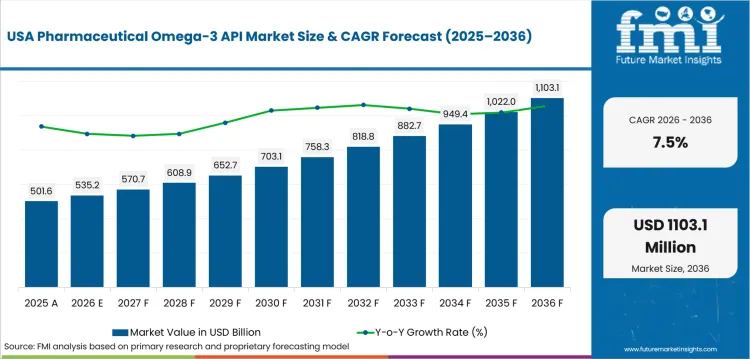
| Parameter | Value |
|---|---|
| Market Size in 2025 | USD 327.5 million |
| Market Size in 2026 | USD 352.1 million |
| Market Forecast in 2036 | USD 726.4 million |
| CAGR | 7.5% CAGR |
| Years Considered | 2021 to 2036 |
| Base Year | 2025 |
| Forecast Period | 2026 to 2036 |
| Units Considered | Value, USD million |
| Leading Sub-Region | Northeast and Sun Belt cardiovascular care corridors |
United States Pharmaceutical Omega-3 API Market Outlook
United States pharmaceutical omega-3 API market is projected to rise at 7.5% CAGR from 2026 to 2036. FDA-approved prescription EPA demand and generic capsule competition shape API sourcing decisions.
Finished-dose sponsors need supplier files that support brand and contract softgel routes. API suppliers with impurity control and commercial lot consistency can defend repeat programs under payer pressure.
Key Growth Drivers
- Cardiovascular disease burden sustains prescription EPA review. CDC reported 919,032 cardiovascular disease deaths in 2023.
- Active product revenue supports purified EPA supply planning. Amarin reported Q1 2026 product revenue of USD 43.3 million.
- Generic softgel manufacturers maintain repeat API demand for severe hypertriglyceridemia products.
- Contract manufacturers can qualify multiple omega-3 capsule programs through established FDA drug pathways.
Key Restraints
- Generic pathway requirements remain technically demanding. FDA’s October 2024 guidance requires 3 test lots against 3 RLD lots with quantitative capsule rupture testing for EPAee and DHAee release.
- PBM and payer controls can shift finished-dose volumes by formulary cycle.
- Legal disputes around label scope can make sponsors cautious about product claims and launch sequencing.
What makes United States unique
United States combines large prescription EPA demand with the deepest generic capsule and contract manufacturing base.
Key Companies
- Amarin Pharma Inc.
- Amneal Pharmaceuticals
- Viatris
- Catalent Pharma Solutions
- ANI Pharmaceuticals
- LGM Pharma
Sales & Marketing Channels
- Retail pharmacies
- Mail-order pharmacies
- Specialty wholesalers
- Contract softgel manufacturers
- PBM-linked supply
- Hospital outpatient pharmacies
Country Segment Breakdown
| Segment | Sub-Segments |
|---|---|
| By API Type | Icosapent Ethyl · Omega-3-Acid Ethyl Esters 90 · EPA Ethyl Ester Concentrates · DHA Ethyl Ester Concentrates · Mixed EPA-DHA Triglyceride APIs |
| By Product Form | Ethyl Ester Concentrates · Triglyceride Concentrates · Free Fatty Acid APIs · Liquid Bulk APIs · Encapsulated API Intermediates |
| By Regulatory Filing Type | DMF-supported APIs · CEP-supported APIs · J-DMF-supported APIs · KR-DMF-supported APIs · Product-specific Dossier APIs |
| By Source Material | Marine Fish Oil-derived APIs · Algae-derived APIs · Fermentation-derived Lipids · Purified Side-stream Fish Oil Inputs |
| By End-use Application | Cardiovascular-risk Reduction · Severe Hypertriglyceridemia Treatment · Softgel Drug Manufacturing · Specialty Hospital Supply |
| By Sales and Supply Model | Contract Supply to Finished-dose Manufacturers · License-linked Supply · Direct API Sales · CMO-linked Supply · Distributor-led Supply |
| Key Sub-Regions Covered, Pharmaceutical and Cardiovascular Care Corridors | Northeast · Midwest · South · West · California · Texas |
Frequently Asked Questions
How fast is United States pharmaceutical omega-3 API market growing?
United States pharmaceutical omega-3 API market is forecast to rise at 7.5% CAGR from 2026 to 2036.
Who leads United States pharmaceutical omega-3 API market?
Amarin Pharma, Amneal Pharmaceuticals, Viatris, Catalent Pharma Solutions, ANI Pharmaceuticals, and LGM Pharma are key local companies.
What supports pharmaceutical omega-3 API demand in United States?
FDA-approved prescription EPA demand and contract softgel capacity support pharmaceutical omega-3 API demand.
Industry Analysis for Pharmaceutical Omega-3 API Market in United Kingdom
NHS lipid pathway and community prescribing center · 2026 to 2036
Country Market Snapshot Table
| Parameter | Value |
|---|---|
| Market Size in 2025 | USD 58.5 million |
| Market Size in 2026 | USD 62.7 million |
| Market Forecast in 2036 | USD 125.6 million |
| CAGR | 7.2% CAGR |
| Years Considered | 2021 to 2036 |
| Base Year | 2025 |
| Forecast Period | 2026 to 2036 |
| Units Considered | Value, USD million |
| Leading Sub-Region | England NHS lipid clinic corridor |
United Kingdom Pharmaceutical Omega-3 API Market Outlook
United Kingdom pharmaceutical omega-3 API market is forecast at 7.2% CAGR from 2026 to 2036. NHS lipid pathways and NICE-backed prescribing language shape demand for icosapent ethyl products.
Hospital lipid clinics and community prescribing networks guide capsule uptake after eligibility is confirmed. Sponsors need API supply that can satisfy UK medicine access controls and pharmacy dispensing patterns.
Key Growth Drivers
- Raised cholesterol supports lipid pathway intervention. NHS Digital reported in January 2026 that 48.0% of adults in England had raised cholesterol in 2024.
- Community prescription scale supports pharmacy access for cardiovascular therapies. NHSBSA reported 1.26 billion community prescription items at GBP 11.2 billion cost in 2024 to 2025.
- NICE and NHS lipid pathway use gives prescribers a defined route for eligible icosapent ethyl patients.
- UK specialty distributors can support hospital and community pharmacy supply once formulary listing is clear.
Key Restraints
- Medicine cost review can restrict uptake speed. ONS reported total UK pharmaceutical expenditure of GBP 35.7 billion in 2024.
- NHS budget review can limit faster movement from specialist recommendation into routine prescribing.
- Medicine shortage concerns can make buyers favor suppliers with stronger inventory planning.
What makes United Kingdom unique
United Kingdom has centrally guided lipid management and community prescription scale that can support access after NHS eligibility rules are met.
Key Companies
- Pharmanovia
- Essential Pharma
- Thornton & Ross
- Aspire Pharma
- Crescent Pharma
- Accord Healthcare UK
Sales & Marketing Channels
- NHS hospital pharmacies
- Community pharmacies
- Specialist lipid clinics
- Licensed wholesalers
- Formulary committees
- Private cardiology clinics
Country Segment Breakdown
| Segment | Sub-Segments |
|---|---|
| By API Type | Icosapent Ethyl · Omega-3-Acid Ethyl Esters 90 · EPA Ethyl Ester Concentrates · DHA Ethyl Ester Concentrates · Mixed EPA-DHA Triglyceride APIs |
| By Product Form | Ethyl Ester Concentrates · Triglyceride Concentrates · Free Fatty Acid APIs · Liquid Bulk APIs · Encapsulated API Intermediates |
| By Regulatory Filing Type | DMF-supported APIs · CEP-supported APIs · J-DMF-supported APIs · KR-DMF-supported APIs · Product-specific Dossier APIs |
| By Source Material | Marine Fish Oil-derived APIs · Algae-derived APIs · Fermentation-derived Lipids · Purified Side-stream Fish Oil Inputs |
| By End-use Application | Cardiovascular-risk Reduction · Severe Hypertriglyceridemia Treatment · Softgel Drug Manufacturing · Specialty Hospital Supply |
| By Sales and Supply Model | Contract Supply to Finished-dose Manufacturers · License-linked Supply · Direct API Sales · CMO-linked Supply · Distributor-led Supply |
| Key Sub-Regions Covered, Pharmaceutical and Cardiovascular Care Corridors | England · Scotland · Wales · Northern Ireland · Greater London · Midlands |
Frequently Asked Questions
How fast is United Kingdom pharmaceutical omega-3 API market growing?
United Kingdom pharmaceutical omega-3 API market is expected to increase at 7.2% CAGR from 2026 to 2036.
Who leads United Kingdom pharmaceutical omega-3 API market?
Pharmanovia, Essential Pharma, Thornton & Ross, Aspire Pharma, Crescent Pharma, and Accord Healthcare UK are key local companies.
What supports pharmaceutical omega-3 API demand in United Kingdom?
NHS lipid pathways and specialty cardiovascular care support pharmaceutical omega-3 API demand.
Industry Analysis for Pharmaceutical Omega-3 API Market in Japan
EPA therapy heritage and PMDA safety review center · 2026 to 2036
Country Market Snapshot Table
| Parameter | Value |
|---|---|
| Market Size in 2025 | USD 91.7 million |
| Market Size in 2026 | USD 98.0 million |
| Market Forecast in 2036 | USD 189.4 million |
| CAGR | 6.8% CAGR |
| Years Considered | 2021 to 2036 |
| Base Year | 2025 |
| Forecast Period | 2026 to 2036 |
| Units Considered | Value, USD million |
| Leading Sub-Region | Kanto and Kansai cardiovascular care corridors |
Japan Pharmaceutical Omega-3 API Market Outlook
Japan pharmaceutical omega-3 API market is expected to post 6.8% CAGR from 2026 to 2036. Established EPA therapy use and PMDA review make Japan a documentation-intensive market for pharmaceutical omega-3 APIs.
Local sponsors evaluate imported API support through safety updates, J-DMF readiness, and finished-dose history. Suppliers with strong impurity controls and Japanese documentation support should remain better placed.
Key Growth Drivers
- Local EPA product heritage supports international expansion. Marubeni Pharma stated in January 2026 that Mochida’s EPADEL S, sold in Japan as Epadel S900, carries a 900 mg strength and has a China NMPA approval route for severe hypertriglyceridemia.
- PMDA review keeps prescription omega-3 products within active safety oversight. PMDA’s November 2024 investigation covered ethyl icosapentate and omega-3-acid ethyl esters after atrial fibrillation and flutter reports were evaluated. The safety revision covered ethyl icosapentate 300 mg, 600 mg, and 900 mg products, and PMDA noted that the approved maximum daily dose for hyperlipidaemia is 2,700 mg.
- Japanese finished-dose companies can work through existing cardiovascular portfolios and pharmacy relationships.
- Kanto and Kansai prescribing channels can support repeat therapy use after safety and price requirements are satisfied.
Key Restraints
- High clinical outcome standards can raise evidence expectations. OECD’s 2025 Japan note reported 30-day mortality after acute myocardial infarction at 4.9% and after stroke at 2.1% based on unlinked data.
- Price revision cycles can lower room for premium imported API pricing.
- PMDA safety updates can require label and patient monitoring changes for omega-3 drug products.
What makes Japan unique
Japan combines established EPA prescribing experience with a strict safety review structure for ethyl icosapentate and omega-3-acid ethyl esters.
Key Companies
- Mochida Pharmaceutical
- Meiji Seika Pharma
- Marubeni Pharma
- Sawai Group
- Towa Pharmaceutical
- Nichi-Iko Pharmaceutical
Sales & Marketing Channels
- Hospital pharmacies
- Community pharmacies
- Local finished-dose manufacturers
- Regulatory filing agents
- Specialist cardiology clinics
- National wholesalers
Country Segment Breakdown
| Segment | Sub-Segments |
|---|---|
| By API Type | Icosapent Ethyl · Omega-3-Acid Ethyl Esters 90 · EPA Ethyl Ester Concentrates · DHA Ethyl Ester Concentrates · Mixed EPA-DHA Triglyceride APIs |
| By Product Form | Ethyl Ester Concentrates · Triglyceride Concentrates · Free Fatty Acid APIs · Liquid Bulk APIs · Encapsulated API Intermediates |
| By Regulatory Filing Type | DMF-supported APIs · CEP-supported APIs · J-DMF-supported APIs · KR-DMF-supported APIs · Product-specific Dossier APIs |
| By Source Material | Marine Fish Oil-derived APIs · Algae-derived APIs · Fermentation-derived Lipids · Purified Side-stream Fish Oil Inputs |
| By End-use Application | Cardiovascular-risk Reduction · Severe Hypertriglyceridemia Treatment · Softgel Drug Manufacturing · Specialty Hospital Supply |
| By Sales and Supply Model | Contract Supply to Finished-dose Manufacturers · License-linked Supply · Direct API Sales · CMO-linked Supply · Distributor-led Supply |
| Key Sub-Regions Covered, Pharmaceutical and Cardiovascular Care Corridors | Kanto · Kansai · Chubu · Kyushu · Tohoku · Hokkaido |
Frequently Asked Questions
How fast is Japan pharmaceutical omega-3 API market growing?
Japan pharmaceutical omega-3 API market is expected to post 6.8% CAGR from 2026 to 2036.
Who leads Japan pharmaceutical omega-3 API market?
Mochida Pharmaceutical, Meiji Seika Pharma, Marubeni Pharma, Sawai Group, Towa Pharmaceutical, and Nichi-Iko Pharmaceutical are key local companies.
What supports pharmaceutical omega-3 API demand in Japan?
PMDA safety review and local finished-dose capability support pharmaceutical omega-3 API demand.
Competitive Landscape and Strategic Positioning
- Pharmaceutical omega-3 API suppliers compete on purity control and repeatable ethyl ester batch supply.
- Finished-dose manufacturers compare DMF access and softgel compatibility before approving API partners.
- Drug sponsors strengthen commercial reach through licensed supply routes and country-specific prescription access.
- Specialty lipid suppliers improve buyer confidence led by high-purity marine lipid processing and technical support for formulation programs.
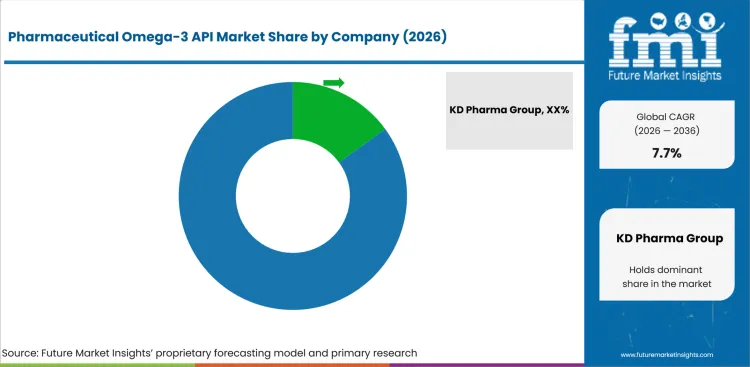
Competition in the pharmaceutical omega-3 API market is split between API producers, prescription EPA sponsors, specialty lipid suppliers, and finished-dose partners. API producers such as KD Pharma Group, BASF Pharma Solutions, Croda Pharma, and Epax compete based on purification capability and regulatory documentation. Drug sponsors such as Amarin and Recordati support demand through prescription EPA products and commercialization partnerships across regulated markets.
KD Pharma Group competes through vertically integrated marine lipid sourcing and API-grade purification. BASF Pharma Solutions draws strength from documented omega-3 API filing support across regulated markets. Croda Pharma serves drug makers through high-purity lipid concentrates and formulation-linked technical support. Epax competes through specialty omega-3 concentrate expertise and supply relationships with regulated product developers.
Manufacturing and dossier depth separate suppliers serving long-term pharmaceutical programs from lipid suppliers focused on nutraceutical volumes. Companies offering reliable ethyl ester capacity and country-ready documentation are better placed to win finished-dose supply programs. Suppliers aligned with softgel manufacturer and local pharmaceutical distributors can extend purified omega-3 API use across prescription cardiovascular channels.
Key Companies in the Pharmaceutical Omega-3 API Market
Competitive structure is better understood through API producers, drug sponsors, specialty lipid suppliers, and finished-dose partners.
- API Producers: KD Pharma Group and BASF Pharma Solutions compete through purified omega-3 APIs and country filing support for regulated drug markets.
- Drug Sponsors: Amarin and Recordati compete through prescription EPA products and licensing routes that sustain finished-dose demand.
- Specialty Lipid Suppliers: Croda Pharma and Epax compete through high-purity omega-3 concentrates and technical support for pharma-grade lipid programs.
- Finished-dose and Local Partners: HLS Therapeutics, Mochida Pharmaceutical, and selected softgel manufacturers compete through registered products and national distribution channels.
Competitive Benchmarking: Pharmaceutical Omega-3 API Market
| Company | API Filing Depth | Marine Lipid Control | EPA API Depth | Finished-dose Link | Geographic Footprint |
|---|---|---|---|---|---|
| KD Pharma Group | Very Strong | Very Strong | Strong | Strong | North America, Europe, Asia |
| BASF Pharma Solutions | Very Strong | Strong | Very Strong | Moderate | Global regulated markets |
| Amarin Corporation | Moderate | Moderate | Very Strong | Very Strong | United States, Europe, selected international markets |
| Recordati S.p.A. | Moderate | Moderate | Strong | Very Strong | Europe and selected international markets |
| Croda Pharma | Strong | Strong | Moderate | Moderate | Europe, North America, Asia |
| Epax | Moderate | Strong | Moderate | Weak | Europe, North America, Asia |
| HLS Therapeutics | Weak | Weak | Strong | Very Strong | Canada |
| Mochida Pharmaceutical | Strong | Moderate | Strong | Very Strong | Japan |
Source: Future Market Insights competitive analysis, 2026.
Key Developments in Pharmaceutical Omega-3 API Market
- In November 2024, PMDA completed a safety review of ethyl icosapentate and omega-3-acid ethyl esters, adding atrial fibrillation and atrial flutter to clinically significant adverse reactions for products including Epadel 300/S300/S600/S900, Epadel EM 2 g, and Lotriga 2 g.
- In March 2025, DailyMed listed Softgel Healthcare Private Limited’s ANDA-based icosapent ethyl capsules under ANDA217656, covering 0.5 g and 1 g strengths and supporting generic softgel supply routes for EPA-based prescription products.
- In January 2026, Marubeni Pharma announced that Mochida obtained China NMPA approval for EPADEL S, marketed in Japan as Epadel S900, with Nissui supplying the API and Meiji-linked commercialization supporting regional EPA product access.
Key Players in the Pharmaceutical Omega-3 API Market
- KD Pharma Group
- BASF Pharma Solutions
- Amarin Corporation
- Recordati S.p.A.
- Croda Pharma
- Epax
- HLS Therapeutics
- Mochida Pharmaceutical
- Generic icosapent ethyl manufacturers
- Softgel contract manufacturers
Pharmaceutical Omega-3 API Market - Report Scope
| Parameters | Details |
|---|---|
| Market size by 2036 | USD 2.3 billion |
| Growth rate | 7.7% CAGR from 2026 to 2036 |
| Forecast period | 2026 to 2036 |
| Base year value (2025) | USD 1.0 billion |
| By API type | Icosapent ethyl, omega-3-acid ethyl esters 90, EPA ethyl ester concentrates, DHA ethyl ester concentrates, mixed EPA-DHA triglyceride APIs |
| By product form | Ethyl ester concentrates, triglyceride concentrates, free fatty acid APIs, liquid bulk APIs, encapsulated API intermediates |
| By regulatory filing type | DMF-supported APIs, CEP-supported APIs, J-DMF-supported APIs, KR-DMF-supported APIs, product-specific dossier APIs |
| By source material | Marine fish oil-derived APIs, algae-derived APIs, fermentation-derived lipids, purified side-stream fish oil inputs |
| By end-use application | Cardiovascular-risk reduction, severe hypertriglyceridemia treatment, softgel drug manufacturing, specialty hospital supply |
| By sales and supply model | Contract supply to finished-dose manufacturers, license-linked supply, direct API sales, CMO-linked supply, distributor-led supply |
| Regions covered | North America, Latin America, Europe, East Asia, South Asia and Pacific, Middle East and Africa |
| Countries covered | Saudi Arabia, South Korea, Australia, Canada, United States, United Kingdom, Japan |
| Key companies profiled | KD Pharma Group, BASF Pharma Solutions, Amarin Corporation, Recordati S.p.A., Croda Pharma, Epax, HLS Therapeutics, Mochida Pharmaceutical |
| Approach | Bottom-up product-boundary approach using eligible API revenue, regulatory file coverage, product approvals, commercial drug revenue, partner supply, and country-level prescription activity |
Source: Future Market Insights, 2026.
Pharmaceutical Omega-3 API Market Breakdown by API Type, Product Form, Regulatory Filing Type, Source Material, End-use Application, Sales and Supply Model, and Region
By API Type:
- Icosapent Ethyl
- Omega-3-Acid Ethyl Esters 90
- EPA Ethyl Ester Concentrates
- DHA Ethyl Ester Concentrates
- Mixed EPA-DHA Triglyceride APIs
By Product Form:
- Ethyl Ester Concentrates
- Triglyceride Concentrates
- Free Fatty Acid APIs
- Liquid Bulk APIs
- Encapsulated API Intermediates
By Regulatory Filing Type:
- DMF-supported APIs
- CEP-supported APIs
- J-DMF-supported APIs
- KR-DMF-supported APIs
- Product-specific Dossier APIs
By Source Material:
- Marine Fish Oil-derived APIs
- Algae-derived APIs
- Fermentation-derived Lipids
- Purified Side-stream Fish Oil Inputs
By End-use Application:
- Cardiovascular-risk Reduction
- Severe Hypertriglyceridemia Treatment
- Softgel Drug Manufacturing
- Specialty Hospital Supply
By Sales and Supply Model:
- Contract Supply to Finished-dose Manufacturers
- License-linked Supply
- Direct API Sales
- CMO-linked Supply
- Distributor-led Supply
By Region:
- North America
- Latin America
- Europe
- East Asia
- South Asia and Pacific
- Middle East and Africa
This Report Answers
- What is the 2026 value and 2036 forecast for pharmaceutical omega-3 API market?
- What API type is projected to hold the leading share during the forecast period?
- What product form is expected to account for the leading 2026 share?
- How do DMF and KR-DMF files affect API supplier selection?
- What companies compete in pharmaceutical omega-3 API?
Bibliography and Research Sources
- Amarin Corporation. (2026, January 9). Amarin applauds breakthroughs for therapies for patients with elevated triglycerides. Amarin Corporation.
- Amarin Corporation. (2026, April 29). Amarin reports 2026 first quarter financial results. Amarin Corporation.
- Australian Institute of Health and Welfare. (2026, May 27). Heart, stroke and vascular disease: Australian facts: Burden of cardiovascular disease. Australian Government.
- Australian Prescriber. (2024, December 17). Icosapent ethyl for reduction in cardiovascular disease risk in adults with hypertriglyceridaemia. Therapeutic Guidelines Limited.
- Centers for Disease Control and Prevention. (2024, October 24). Heart disease facts. U.S. Department of Health and Human Services.
- Centers for Medicare & Medicaid Services. (2025, November 1). Medicare Drug Price Negotiation Program: Negotiated prices for initial price applicability year 2027. U.S. Department of Health and Human Services.
- DailyMed. (2025, March 1). Icosapent ethyl capsule: Drug label information. National Library of Medicine.
- European Medicines Agency. (2026, March 13). Vazkepa: EPAR product information. European Medicines Agency.
- Federal Trade Commission. (2025, January 14). Specialty generic drugs: A growing profit center for vertically integrated pharmacy benefit managers. Federal Trade Commission.
- General Authority for Statistics. (2024, December). Health Status Statistics Publication 2024. General Authority for Statistics.
- HLS Therapeutics. (2025, July 2). HLS Therapeutics announces reimbursement for Vascepa under Nova Scotia’s provincial drug plan. HLS Therapeutics.
- KD Pharma Group. (2024, October 1). KD Pharma Group completes acquisition of dsm-firmenich’s Marine Lipids business. KD Pharma Group.
- Korea Society of Lipid and Atherosclerosis. (2024, September 25). Dyslipidemia Fact Sheet in Korea 2024. Korea Society of Lipid and Atherosclerosis.
- Marubeni Pharma Corporation. (2026, January 8). Announcement of new drug approval for Epadel in China. Marubeni Pharma Corporation.
- Mochida Pharmaceutical Co., Ltd. (2026, March 2). Announcement of the launch of Epadel in Vietnam. Mochida Pharmaceutical Co., Ltd.
- National Health Service Digital. (2026, January 27). Health Survey for England, 2024. NHS England.
- North Central London Joint Formulary Committee. (2024, October 17). Guidance for the management of hypertriglyceridaemia. North Central London Integrated Care Board.
- Office for National Statistics. (2026, April 29). Healthcare expenditure, UK Health Accounts: 2024 and 2025. Office for National Statistics.
- Organization for Economic Co-operation and Development. (2025, November 13). Health at a Glance 2025: Japan. OECD.
- Pharmaceuticals and Medical Devices Agency. (2024, November 13). Summary of investigation results: Ethyl icosapentate and omega-3-acid ethyl esters. Pharmaceuticals and Medical Devices Agency.
- Public Health Agency of Canada. (2026, February 12). Heart disease: Monitoring. Government of Canada.
- Saudi Food and Drug Authority. (2025, August 3). Data requirements for human drugs submission. Saudi Food and Drug Authority.
- Sigma Healthcare Limited. (2024, December 18). Pathfinder prospectus. Sigma Healthcare Limited.
- U.S. Food and Drug Administration. (2024, October). Draft guidance on icosapent ethyl. U.S. Department of Health and Human Services.
- U.S. Food and Drug Administration. (2024, October). Draft guidance on Omega-3-Acid Ethyl Esters Type A oral capsules. U.S. Department of Health and Human Services.
This bibliography is provided for reader reference and is not exhaustive. The full report contains the complete reference list and detailed citations.
Pharmaceutical Omega-3 API Market - Scope & Definition
| Attribute | Detail |
|---|---|
| Market Definition | Purified active pharmaceutical ingredients containing EPA, DHA, mixed omega-3 ethyl esters, or triglyceride omega-3 APIs used in prescription drug products |
| Functions Covered | Cardiovascular risk therapy support, triglyceride reduction, softgel drug formulation, controlled active delivery, regulated batch release |
| Applications Covered | Icosapent ethyl capsules, omega-3-acid ethyl ester capsules, EPA ethyl ester drug products, DHA-rich prescription formats, mixed EPA-DHA therapies |
| End-Use Industries | Pharmaceutical industry, prescription cardiovascular therapy, softgel drug manufacturing, specialty hospital supply, contract pharmaceutical manufacturing |
| Grades Covered | DMF-supported APIs, CEP-supported APIs, J-DMF-supported APIs, KR-DMF-supported APIs, product-specific dossier APIs |
| Inclusions | All pharma-grade omega-3 APIs supplied for prescription products, including ethyl ester concentrates, triglyceride concentrates, free fatty acid APIs, liquid bulk APIs, and API intermediates |
| Exclusions | Dietary supplement fish oil, food-grade omega-3 concentrates, infant nutrition lipids, pet nutrition oils, cosmetic oils, crude fish oil, and nutraceutical concentrates without API dossier support |
Pharmaceutical Omega-3 API Market - Research Methodology
| Method | Description |
|---|---|
| Primary Research | FMI analyst interviews with API suppliers, finished-dose manufacturers, drug sponsors, softgel CMOs, regulatory consultants, and specialty pharmaceutical distributors across key markets |
| Desk Research | Review of FDA, EMA, SFDA, PMDA, Health Canada, public health agencies, company reports, product labels, regulatory filings, and pharmaceutical product records related to prescription omega-3 APIs |
| Market Sizing & Forecasting | Estimated using a bottom-up product-boundary approach. Eligible API revenue, regulatory file coverage, product approvals, commercial drug revenue, partner supply, and country-level prescription activity were used to construct the 2026 market estimate. |
| Data Validation | Cross-verification used product registrations, cardiovascular therapy demand, finished-dose sales disclosures, supplier filing depth, country access rules, and softgel manufacturing activity across priority countries |
Frequently Asked Questions
How large is the pharmaceutical omega-3 API market in 2026?
The pharmaceutical omega-3 API market is anticipated to cross USD 1.1 billion in 2026 and is projected to reach USD 2.3 billion by 2036.
What is the CAGR for pharmaceutical omega-3 API market?
The pharmaceutical omega-3 API market is forecast to expand at 7.7% CAGR from 2026 to 2036.
Which source material leads pharmaceutical omega-3 API market?
Marine fish oil-derived APIs lead with 81.3% share in 2026, reflected by approved prescription product histories and purification infrastructure.
Which product form leads pharmaceutical omega-3 API market?
Ethyl ester concentrates lead with 64.2% share in 2026 since EPA and mixed ester drug products use esterified inputs.
Which country is forecast to grow fastest?
Saudi Arabia is forecast to grow fastest at 9.2% CAGR by 2036 due to specialty cardiovascular access and drug-list review.
Preview the report firsthand - request a free sample
Get SampleGet the brochure for pricing and purchase details.
Get PDFTable of Content
- Key Takeaways
- Market Size and CAGR
- Top Growth Driver
- Fastest Growing Segment
- Leading Region
- Key Companies
- Emerging Opportunities
- Executive Summary
- Global Market Outlook
- Demand-side Trends
- Supply-side Trends
- Technology Roadmap Analysis
- Analysis and Recommendations
- Analyst Perspective (What is happening? Why now? What should investors know?)
- Key Questions Answered
- How large is the market?
- What is the CAGR?
- What are key trends?
- Which region dominates?
- Who are the leaders?
- Market Overview
- Market Coverage / Taxonomy
- Market Definition / Scope / Limitations
- Research Methodology
- Chapter Orientation
- Analytical Lens and Working Hypotheses
- Market Structure, Signals, and Trend Drivers
- Benchmarking and Cross-market Comparability
- Market Sizing, Forecasting, and Opportunity Mapping
- Research Design and Evidence Framework
- Desk Research Programme (Secondary Evidence)
- Expert Input and Fieldwork (Primary Evidence)
- Tooling, Models, and Reference Databases
- Data Engineering and Model Build
- Quality Assurance and Audit Trail
- Market Background
- Market Dynamics (Drivers, Restraints, Opportunity, Trends)
- Scenario Forecast (Optimistic, Likely, Conservative)
- Impact Analysis
- AI Impact
- Sustainability Impact
- Regulatory Impact
- Technology Impact
- Consumer / Buyer Analysis
- Purchase Drivers
- Adoption Barriers
- Buyer Journey
- Opportunity Map Analysis
- Product Life Cycle Analysis
- Supply Chain Analysis
- Investment Feasibility Matrix
- Value Chain Analysis
- PESTLE and Porter's Analysis
- Regulatory Landscape
- Regional Parent Market Outlook
- Production and Consumption Statistics
- Import and Export Statistics
- Global Market Analysis and Forecast, 2021 to 2036
- Historical Market Size Value (USD Billion) & Volume (Unit) Analysis, 2021 to 2025
- Current and Future Market Size Value (USD Billion) & Volume (Unit) Projections, 2026 to 2036
- Y-o-Y Growth Trend Analysis
- Absolute $ Opportunity Analysis
- Global Market Pricing Analysis, 2021 to 2036
- Global Market Analysis and Forecast, By API Type, 2021 to 2036
- Introduction / Key Findings
- Historical Market Size Value (USD Billion) & Volume (Unit) Analysis By API Type, 2021 to 2025
- Current and Future Market Size Value (USD Billion) & Volume (Unit) Analysis and Forecast By API Type, 2026 to 2036
- Icosapent Ethyl
- Omega-3-Acid Ethyl Esters 90
- EPA Ethyl Ester Concentrates
- DHA Ethyl Ester Concentrates
- Mixed EPA-DHA Triglyceride APIs
- Icosapent Ethyl
- Y-o-Y Growth Trend Analysis By API Type, 2021 to 2025
- Absolute $ Opportunity Analysis By API Type, 2026 to 2036
- Global Market Analysis and Forecast, By Product Form, 2021 to 2036
- Introduction / Key Findings
- Historical Market Size Value (USD Billion) & Volume (Unit) Analysis By Product Form, 2021 to 2025
- Current and Future Market Size Value (USD Billion) & Volume (Unit) Analysis and Forecast By Product Form, 2026 to 2036
- Ethyl Ester Concentrates
- Triglyceride Concentrates
- Free Fatty Acid APIs
- Liquid Bulk APIs
- Encapsulated API Intermediates
- Ethyl Ester Concentrates
- Y-o-Y Growth Trend Analysis By Product Form, 2021 to 2025
- Absolute $ Opportunity Analysis By Product Form, 2026 to 2036
- Global Market Analysis and Forecast, By Regulatory Filing Type, 2021 to 2036
- Introduction / Key Findings
- Historical Market Size Value (USD Billion) & Volume (Unit) Analysis By Regulatory Filing Type, 2021 to 2025
- Current and Future Market Size Value (USD Billion) & Volume (Unit) Analysis and Forecast By Regulatory Filing Type, 2026 to 2036
- DMF-supported APIs
- CEP-supported APIs
- J-DMF-supported APIs
- KR-DMF-supported APIs
- Product-specific Dossier APIs
- DMF-supported APIs
- Y-o-Y Growth Trend Analysis By Regulatory Filing Type, 2021 to 2025
- Absolute $ Opportunity Analysis By Regulatory Filing Type, 2026 to 2036
- Global Market Analysis and Forecast, By Source Material, 2021 to 2036
- Introduction / Key Findings
- Historical Market Size Value (USD Billion) & Volume (Unit) Analysis By Source Material, 2021 to 2025
- Current and Future Market Size Value (USD Billion) & Volume (Unit) Analysis and Forecast By Source Material, 2026 to 2036
- Marine Fish Oil-derived APIs
- Algae-derived APIs
- Fermentation-derived Lipids
- Purified Side-stream Fish Oil Inputs
- Marine Fish Oil-derived APIs
- Y-o-Y Growth Trend Analysis By Source Material, 2021 to 2025
- Absolute $ Opportunity Analysis By Source Material, 2026 to 2036
- Global Market Analysis and Forecast, By End-use Application, 2021 to 2036
- Introduction / Key Findings
- Historical Market Size Value (USD Billion) & Volume (Unit) Analysis By End-use Application, 2021 to 2025
- Current and Future Market Size Value (USD Billion) & Volume (Unit) Analysis and Forecast By End-use Application, 2026 to 2036
- Cardiovascular-risk Reduction
- Severe Hypertriglyceridemia Treatment
- Softgel Drug Manufacturing
- Specialty Hospital Supply
- Cardiovascular-risk Reduction
- Y-o-Y Growth Trend Analysis By End-use Application, 2021 to 2025
- Absolute $ Opportunity Analysis By End-use Application, 2026 to 2036
- Global Market Analysis and Forecast, By Sales and Supply Model
- Introduction / Key Findings
- Historical Market Size Value (USD Billion) & Volume (Unit) Analysis By Sales and Supply Model, 2021 to 2025
- Current and Future Market Size Value (USD Billion) & Volume (Unit) Analysis and Forecast By Sales and Supply Model, 2026 to 2036
- Contract Supply to Finished-dose Manufacturers
- License-linked Supply
- Direct API Sales
- CMO-linked Supply
- Distributor-led Supply
- Contract Supply to Finished-dose Manufacturers
- Y-o-Y Growth Trend Analysis By Sales and Supply Model, 2021 to 2025
- Absolute $ Opportunity Analysis By Sales and Supply Model, 2026 to 2036
- Global Market Analysis and Forecast, By Region, 2021 to 2036
- Introduction
- Historical Market Size Value (USD Billion) & Volume (Unit) Analysis By Region, 2021 to 2025
- Current Market Size Value (USD Billion) & Volume (Unit) Analysis and Forecast By Region, 2026 to 2036
- North America
- Latin America
- Western Europe
- Eastern Europe
- East Asia
- South Asia and Pacific
- Middle East & Africa
- Market Attractiveness Analysis By Region
- North America Market Analysis and Forecast, By Country, 2021 to 2036
- Historical Market Size Value (USD Billion) & Volume (Unit) Trend Analysis By Market Taxonomy, 2021 to 2025
- Market Size Value (USD Billion) & Volume (Unit) Forecast By Market Taxonomy, 2026 to 2036
- By Country
- USA
- Canada
- Mexico
- By API Type
- By Product Form
- By Regulatory Filing Type
- By Source Material
- By End-use Application
- By Sales and Supply Model
- By Country
- Market Attractiveness Analysis
- By Country
- By API Type
- By Product Form
- By Regulatory Filing Type
- By Source Material
- By End-use Application
- By Sales and Supply Model
- Key Takeaways
- Latin America Market Analysis and Forecast, By Country
- Historical Market Size Value (USD Billion) & Volume (Unit) Trend Analysis By Market Taxonomy, 2021 to 2025
- Market Size Value (USD Billion) & Volume (Unit) Forecast By Market Taxonomy, 2026 to 2036
- By Country
- Brazil
- Chile
- Rest of Latin America
- By API Type
- By Product Form
- By Regulatory Filing Type
- By Source Material
- By End-use Application
- By Sales and Supply Model
- By Country
- Market Attractiveness Analysis
- By Country
- By API Type
- By Product Form
- By Regulatory Filing Type
- By Source Material
- By End-use Application
- By Sales and Supply Model
- Key Takeaways
- Western Europe Market Analysis and Forecast, By Country
- Historical Market Size Value (USD Billion) & Volume (Unit) Trend Analysis By Market Taxonomy, 2021 to 2025
- Market Size Value (USD Billion) & Volume (Unit) Forecast By Market Taxonomy, 2026 to 2036
- By Country
- Germany
- UK
- Italy
- Spain
- France
- Nordic
- BENELUX
- Rest of Western Europe
- By API Type
- By Product Form
- By Regulatory Filing Type
- By Source Material
- By End-use Application
- By Sales and Supply Model
- By Country
- Market Attractiveness Analysis
- By Country
- By API Type
- By Product Form
- By Regulatory Filing Type
- By Source Material
- By End-use Application
- By Sales and Supply Model
- Key Takeaways
- Eastern Europe Market Analysis and Forecast, By Country
- Historical Market Size Value (USD Billion) & Volume (Unit) Trend Analysis By Market Taxonomy, 2021 to 2025
- Market Size Value (USD Billion) & Volume (Unit) Forecast By Market Taxonomy, 2026 to 2036
- By Country
- Russia
- Poland
- Hungary
- Balkan & Baltic
- Rest of Eastern Europe
- By API Type
- By Product Form
- By Regulatory Filing Type
- By Source Material
- By End-use Application
- By Sales and Supply Model
- By Country
- Market Attractiveness Analysis
- By Country
- By API Type
- By Product Form
- By Regulatory Filing Type
- By Source Material
- By End-use Application
- By Sales and Supply Model
- Key Takeaways
- East Asia Market Analysis and Forecast, By Country
- Historical Market Size Value (USD Billion) & Volume (Unit) Trend Analysis By Market Taxonomy, 2021 to 2025
- Market Size Value (USD Billion) & Volume (Unit) Forecast By Market Taxonomy, 2026 to 2036
- By Country
- China
- Japan
- South Korea
- By API Type
- By Product Form
- By Regulatory Filing Type
- By Source Material
- By End-use Application
- By Sales and Supply Model
- By Country
- Market Attractiveness Analysis
- By Country
- By API Type
- By Product Form
- By Regulatory Filing Type
- By Source Material
- By End-use Application
- By Sales and Supply Model
- Key Takeaways
- South Asia and Pacific Market Analysis and Forecast, By Country
- Historical Market Size Value (USD Billion) & Volume (Unit) Trend Analysis By Market Taxonomy, 2021 to 2025
- Market Size Value (USD Billion) & Volume (Unit) Forecast By Market Taxonomy, 2026 to 2036
- By Country
- India
- ASEAN
- Australia & New Zealand
- Rest of South Asia and Pacific
- By API Type
- By Product Form
- By Regulatory Filing Type
- By Source Material
- By End-use Application
- By Sales and Supply Model
- By Country
- Market Attractiveness Analysis
- By Country
- By API Type
- By Product Form
- By Regulatory Filing Type
- By Source Material
- By End-use Application
- By Sales and Supply Model
- Key Takeaways
- Middle East & Africa Market Analysis and Forecast, By Country
- Historical Market Size Value (USD Billion) & Volume (Unit) Trend Analysis By Market Taxonomy, 2021 to 2025
- Market Size Value (USD Billion) & Volume (Unit) Forecast By Market Taxonomy, 2026 to 2036
- By Country
- Kingdom of Saudi Arabia
- Other GCC Countries
- Türkiye
- South Africa
- Other African Union
- Rest of Middle East & Africa
- By API Type
- By Product Form
- By Regulatory Filing Type
- By Source Material
- By End-use Application
- By Sales and Supply Model
- By Country
- Market Attractiveness Analysis
- By Country
- By API Type
- By Product Form
- By Regulatory Filing Type
- By Source Material
- By End-use Application
- By Sales and Supply Model
- Key Takeaways
- Key Countries Market Analysis
- USA
- Pricing Analysis
- Market Share Analysis, 2025
- By API Type
- By Product Form
- By Regulatory Filing Type
- By Source Material
- By End-use Application
- By Sales and Supply Model
- Canada
- Pricing Analysis
- Market Share Analysis, 2025
- By API Type
- By Product Form
- By Regulatory Filing Type
- By Source Material
- By End-use Application
- By Sales and Supply Model
- Mexico
- Pricing Analysis
- Market Share Analysis, 2025
- By API Type
- By Product Form
- By Regulatory Filing Type
- By Source Material
- By End-use Application
- By Sales and Supply Model
- Brazil
- Pricing Analysis
- Market Share Analysis, 2025
- By API Type
- By Product Form
- By Regulatory Filing Type
- By Source Material
- By End-use Application
- By Sales and Supply Model
- Chile
- Pricing Analysis
- Market Share Analysis, 2025
- By API Type
- By Product Form
- By Regulatory Filing Type
- By Source Material
- By End-use Application
- By Sales and Supply Model
- Germany
- Pricing Analysis
- Market Share Analysis, 2025
- By API Type
- By Product Form
- By Regulatory Filing Type
- By Source Material
- By End-use Application
- By Sales and Supply Model
- UK
- Pricing Analysis
- Market Share Analysis, 2025
- By API Type
- By Product Form
- By Regulatory Filing Type
- By Source Material
- By End-use Application
- By Sales and Supply Model
- Italy
- Pricing Analysis
- Market Share Analysis, 2025
- By API Type
- By Product Form
- By Regulatory Filing Type
- By Source Material
- By End-use Application
- By Sales and Supply Model
- Spain
- Pricing Analysis
- Market Share Analysis, 2025
- By API Type
- By Product Form
- By Regulatory Filing Type
- By Source Material
- By End-use Application
- By Sales and Supply Model
- France
- Pricing Analysis
- Market Share Analysis, 2025
- By API Type
- By Product Form
- By Regulatory Filing Type
- By Source Material
- By End-use Application
- By Sales and Supply Model
- India
- Pricing Analysis
- Market Share Analysis, 2025
- By API Type
- By Product Form
- By Regulatory Filing Type
- By Source Material
- By End-use Application
- By Sales and Supply Model
- ASEAN
- Pricing Analysis
- Market Share Analysis, 2025
- By API Type
- By Product Form
- By Regulatory Filing Type
- By Source Material
- By End-use Application
- By Sales and Supply Model
- Australia & New Zealand
- Pricing Analysis
- Market Share Analysis, 2025
- By API Type
- By Product Form
- By Regulatory Filing Type
- By Source Material
- By End-use Application
- By Sales and Supply Model
- China
- Pricing Analysis
- Market Share Analysis, 2025
- By API Type
- By Product Form
- By Regulatory Filing Type
- By Source Material
- By End-use Application
- By Sales and Supply Model
- Japan
- Pricing Analysis
- Market Share Analysis, 2025
- By API Type
- By Product Form
- By Regulatory Filing Type
- By Source Material
- By End-use Application
- By Sales and Supply Model
- South Korea
- Pricing Analysis
- Market Share Analysis, 2025
- By API Type
- By Product Form
- By Regulatory Filing Type
- By Source Material
- By End-use Application
- By Sales and Supply Model
- Russia
- Pricing Analysis
- Market Share Analysis, 2025
- By API Type
- By Product Form
- By Regulatory Filing Type
- By Source Material
- By End-use Application
- By Sales and Supply Model
- Poland
- Pricing Analysis
- Market Share Analysis, 2025
- By API Type
- By Product Form
- By Regulatory Filing Type
- By Source Material
- By End-use Application
- By Sales and Supply Model
- Hungary
- Pricing Analysis
- Market Share Analysis, 2025
- By API Type
- By Product Form
- By Regulatory Filing Type
- By Source Material
- By End-use Application
- By Sales and Supply Model
- Kingdom of Saudi Arabia
- Pricing Analysis
- Market Share Analysis, 2025
- By API Type
- By Product Form
- By Regulatory Filing Type
- By Source Material
- By End-use Application
- By Sales and Supply Model
- Türkiye
- Pricing Analysis
- Market Share Analysis, 2025
- By API Type
- By Product Form
- By Regulatory Filing Type
- By Source Material
- By End-use Application
- By Sales and Supply Model
- South Africa
- Pricing Analysis
- Market Share Analysis, 2025
- By API Type
- By Product Form
- By Regulatory Filing Type
- By Source Material
- By End-use Application
- By Sales and Supply Model
- USA
- Market Structure Analysis
- Competition Dashboard
- Competition Benchmarking
- Market Share Analysis of Top Players
- By Regional
- By API Type
- By Product Form
- By Regulatory Filing Type
- By Source Material
- By End-use Application
- By Sales and Supply Model
- Emerging Startups
- Innovation Benchmarking
- Competition Analysis
- Competition Deep Dive
- KD Pharma Group
- Overview
- Product Portfolio
- Profitability by Market Segments (Product/Region/Sales Channel)
- Sales Footprint
- Strategy Overview
- Marketing Strategy
- Product Strategy
- Channel Strategy
- BASF Pharma Solutions
- Amarin Corporation
- Recordati S.p.A.
- Croda Pharma
- Epax
- HLS Therapeutics
- Mochida Pharmaceutical
- Generic icosapent ethyl manufacturers
- Softgel contract manufacturers
- KD Pharma Group
- Case Studies
- Success Stories
- Recent Developments
- Competition Deep Dive
- Assumptions & Acronyms Used


