

- Market Size (2026)
- USD 372.28 Mn
- Forecast (2036)
- USD 973.64 Mn
- CAGR (2026 to 2036)
- 10.1%
Apixaban Market Size, Market Forecast and Outlook By FMI
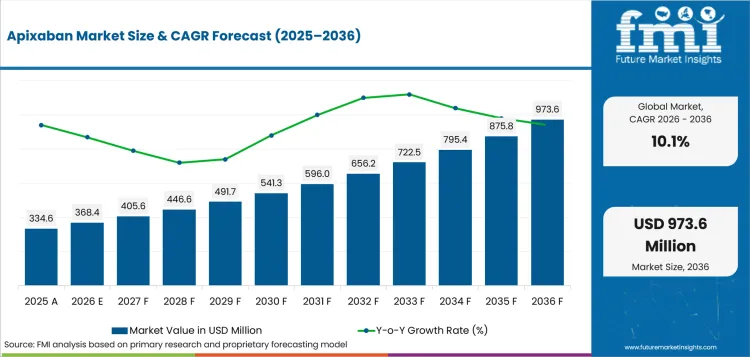
USD 372.28 million in 2026 and USD 973.64 million by 2036 at a 10.1% CAGR.
The apixaban industry value is anticipated to grow from USD 334.62 million in 2025 to USD 973.64 million by 2036 at 10.1% CAGR, led by generic sponsors qualifying validated API lots for oral anticoagulant filings and launch planning. The >=99.5% purity grade is projected to secure 68.2% share in 2026, supported by tighter impurity limits and repeatable assay values. Generic pharmaceutical manufacturers are forecast to account for 66.4% share in 2026, led by dossier preparation and repeat tablet production.
| Metric | Value |
|---|---|
| 2026 Market Size | USD 372.28 million |
| 2036 Market Size | USD 973.64 million |
| Forecast CAGR | 10.1% from 2026 to 2036 |
| Leading Purity Grade | ≥99.5% |
| ≥99.5% Purity Grade Share in 2026 | 68.2% |
| Leading Buyer Type | Generic Pharmaceutical Manufacturers |
| Generic Pharmaceutical Manufacturers Share in 2026 | 66.4% |
| Fastest-growing Country | India |
| India CAGR | 12.3% by 2036 |
Summary of the Apixaban Market
- Demand and Growth Drivers
- Generic launch planning is moving API qualification earlier as finished-dose sponsors need validated lots before filing windows open.
- Low aqueous solubility keeps particle-size control important, so micronized API is assessed as a development-risk input.
- Atrial fibrillation and VTE indications create repeat demand across chronic therapy and prophylaxis-linked production.
- Product and Segment View
- The >=99.5% purity grade is expected to secure 68.2% share in 2026, supported by regulated filings and tighter impurity profiles.
- Generic pharmaceutical manufacturers are forecast to account for 66.4% share in 2026, led by launch programs and dossier work.
- Micronized API is projected to hold 62.4% share in 2026, influenced by dissolution behavior and bioequivalence planning.
- Geography and Competitive Outlook
- India is projected to record 12.3% CAGR by 2036, backed by written confirmations and export-oriented API manufacturing.
- China is expected to expand at 11.2% CAGR by 2036 through finished-dose scale and local generic competition.
- Dr. Reddy’s Laboratories, MSN Laboratories, and Apitoria compete through filing depth, API scale, and micronization capability.
- Zhejiang Huahai, Hetero Drugs, Laurus Labs, and Zydus Lifesciences support competition through process chemistry and regulated-market documentation.
- Analyst Opinion
- Anurag Sharma, Principal Consultant for Healthcare at FMI, says, “Apixaban API is not a simple price-led generic opportunity. Buyers are qualifying suppliers around particle size and launch timing. Finished-dose sponsors need API partners that can support bioequivalence work and commercial scale without changing process behavior.”
- Which factors support expansion in the Apixaban market?
- Finished apixaban API revenue, purity control, and launch documentation support market value across regulated oral anticoagulant channels.
- Market value is supported by validated apixaban API lots before finished-dose launches reach commercial scale.
- Supplier pricing reflects micronization capability and impurity documentation before volume contracts shape final negotiations.
- Revenue improves as generic sponsors convert oral anticoagulant pipelines into repeat tablet manufacturing programs.
- Buyer trust rises as DMF access and deviation-response discipline reduce filing risk.
Apixaban demand is shaped by generic-drug review activity and label-maintenance discipline across regulated oral anticoagulant programs. FDA recorded 689 original ANDA approvals in FY 2025, giving API suppliers a large regulated generic environment for launch planning. FDA’s February 2026 apixaban guidance covers 0.5 mg, 2.5 mg, and 5 mg oral strengths, increasing attention on strength bridging and dissolution evidence. MHRA’s March 2026 medicine notification listed 8 affected Sandoz apixaban batch numbers, showing how patient-information control can influence finished-dose supply readiness.
Why is the Apixaban Market Growing?
Adult anticoagulant therapy and API supplier qualification are increasing demand for controlled apixaban active ingredient.
Generic-entry preparation is moving API purchases earlier than finished-dose commercialization. FDA’s apixaban guidance requires comparative dissolution studies using 12 units per additional strength for waiver requests, making API behavior and tablet performance central to formulation work. Regulated buyers therefore need apixaban sources that can support strength-specific development and stability batches. Suppliers with micronization depth and clean impurity evidence gain stronger buyer preference before price competition begins.
How is the Apixaban market segmented?
The Apixaban industry is segmented by form, purity grade, application, sales channel, and buyer type.
- Micronized API is projected to secure 62.4% share in 2026, led by dissolution control and reduced bioequivalence risk during tablet development.
- The >=99.5% purity grade is anticipated to hold 68.2% share in 2026, supported by tighter impurity limits and repeatable assay values before dossier submission.
- Stroke prevention in atrial fibrillation is expected to capture 54.5% share in 2026, supported by long-duration therapy and repeat finished-dose production.
- Direct supply is forecast to represent 61.5% share in 2026, guided by audit access, DMF references, and faster technical response.
- Generic pharmaceutical manufacturers are projected to account for 66.4% share in 2026, reflected by launch programs and commercial batch continuity.
Why does micronized API lead form demand?
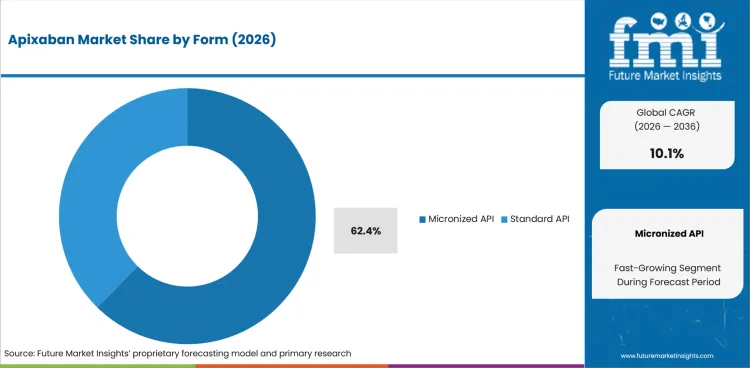
- Micronized API is projected to account for 62.4% share in 2026, influenced by dissolution control and tablet-performance risk.
- Standard API remains useful for development trials and channels requiring lower formulation complexity.
What keeps the >=99.5% grade ahead?
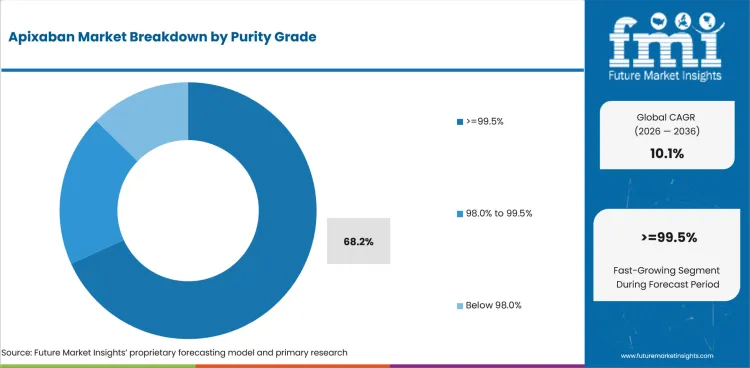
- The >=99.5% purity grade is anticipated to hold 68.2% share in 2026, supported by regulated filings and impurity control.
- Lower-purity API remains limited to early formulation experiments and price-sensitive non-premium channels.
Why does stroke prevention in atrial fibrillation lead application demand?
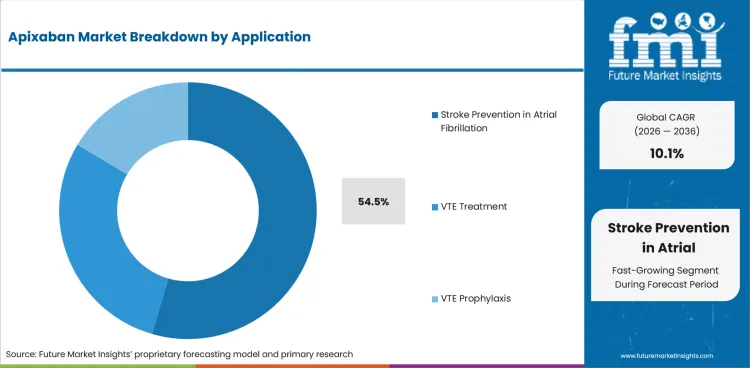
- Stroke prevention in atrial fibrillation is forecast to hold 54.5% share in 2026, led by chronic therapy and repeat tablet output.
- VTE treatment and prophylaxis remain important, with order timing being more episodic across acute-care and post-surgical use.
How does direct supply shape buyer behavior?
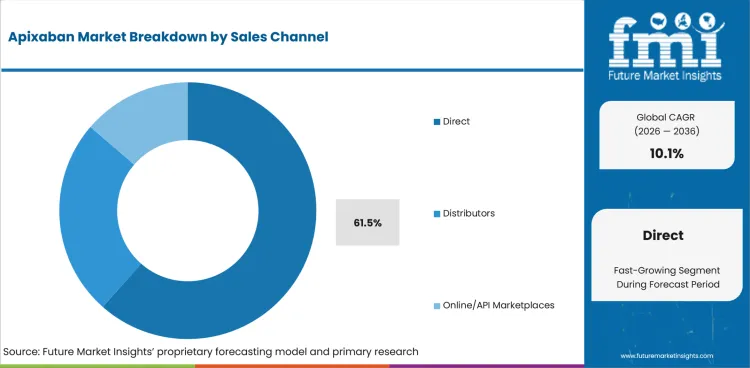
- Direct supply is expected to represent 61.5% share in 2026, shaped by DMF support and confidentiality during launch work.
- Distributors remain useful for samples and smaller markets requiring less technical supplier access.
Why do generic manufacturers set buyer expectations?
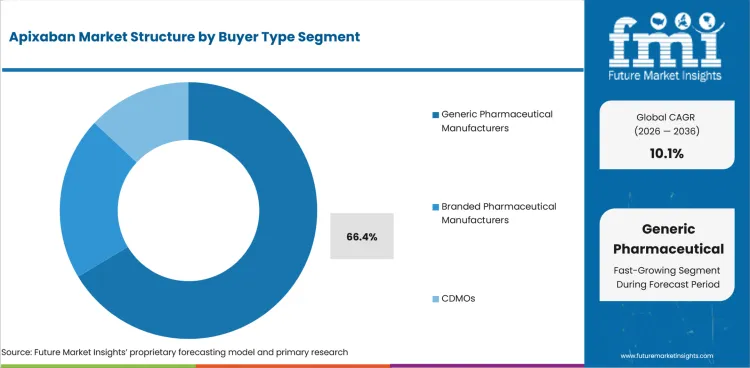
- Generic pharmaceutical manufacturers are projected to account for 66.4% share in 2026, led by launch programs and dossier work.
- CDMOs and development-stage sponsors support additional demand through formulation support and validation batch movement.
What are the driver, restraints, and opportunities in the Apixaban market?
Generic launch planning and regulated documentation support demand while filing risk and price pressure limit supplier entry.
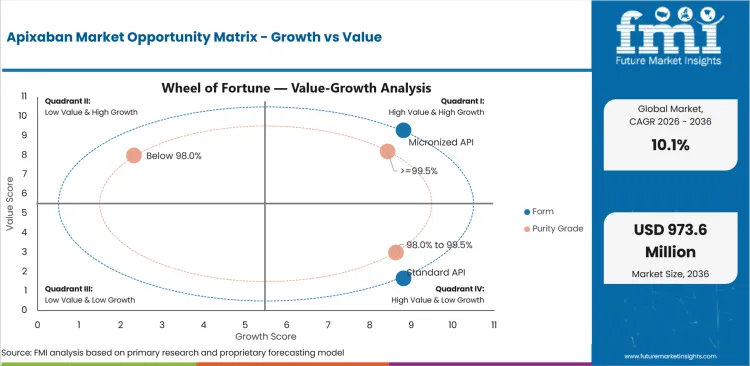
- Driver: Patent-window planning creates early API demand as finished-dose sponsors prepare dossiers and launch batches before commercial sales.
- Restraint: Weak filing support limits supplier entry as buyers avoid delays from incomplete DMF or impurity documentation.
- Opportunity: Pediatric and suspension-related presentations create demand for suppliers supporting low-dose and alternative oral formulation work.
Apixaban API Launch Qualification
Apixaban API demand is tied to regulated generic readiness, not only current finished-dose orders. FDA recorded 600 ANDA submissions and 100 complex product submissions in FY 2025, keeping launch teams active across filing pipelines. Apixaban suppliers that can support exhibit batches and strength-specific bioequivalence evidence gain earlier buyer contact. Filing teams will continue prioritizing controlled particle behavior and direct supplier communication.
Documentation Risk in Apixaban Filing
Regulated apixaban sourcing can slow if documentation lacks depth. FDA’s generic-drug program recorded 1,281 complete responses in FY 2025, showing how unresolved review questions can delay sponsors even after active development work. API suppliers are upstream, yet weak DMF support or slow change-control responses can raise the same risk for finished-dose applicants. Buyers therefore reject suppliers that cannot provide timely technical support and complete quality records.
Pediatric Formulation Support
Pediatric and suspension-linked apixaban development opens a technical opportunity for API suppliers. FDA’s 2025 Eliquis label includes pediatric VTE treatment and recurrent VTE risk reduction after at least 5 days of initial anticoagulant treatment. Pediatric dosing is weight-tiered from 2.6 kg to 35 kg and above, with dosing changing after 7 days of treatment across capsule, tablet-for-suspension, and tablet presentations. Finished-dose sponsors pursuing pediatric forms need API partners able to support low-dose uniformity and stability behavior. Micronized API suppliers with formulation support can therefore improve their position beyond standard tablet programs.
Who are the leading companies in the Apixaban market?
Dr. Reddy’s Laboratories, MSN Laboratories, Aurobindo Pharma / Apitoria, Hetero Drugs, Laurus Labs, Alivus Life Sciences, Zydus Lifesciences, Zhejiang Huahai, Optimus Drugs, and Nanjing Triastek.
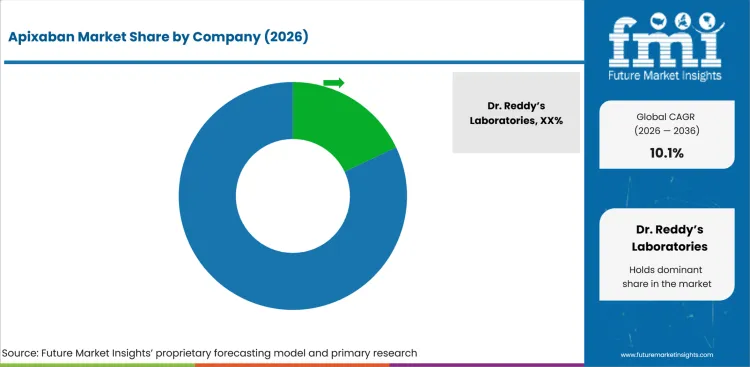
- Established Indian API suppliers hold an advantage led by written confirmations and export documentation.
- Chinese suppliers influence cost and finished-dose activity based on domestic generic manufacturing scale.
- Regulated-market suppliers gain preference by offering DMF support and stable micronized lots.
- Development-stage vendors need better documentation depth before entering commercial supply agreements.
Competition favors suppliers that combine regulated-market documentation and reliable commercial batch scale. Dr. Reddy’s Laboratories supports buyer confidence with customized particle sizes, purity above 99.5%, impurity control below 0.15%, and a 4-year retest period in its apixaban API material. Apitoria strengthens supply scale through 10 API manufacturing facilities and 19,000 MT installed API capacity. MSN, Alivus, Zydus, and Apitoria gain credibility through 2025 written-confirmation activity tied to active substance exports.
How do top Apixaban companies compare?
Dr. Reddy’s Laboratories, MSN Laboratories, and Apitoria score strongest on filing support and API manufacturing depth.
| Company | Relevance to Market Title | DMF Filing Breadth | Micronization Control Depth | Regulated Buyer Support | Channel Reach | Geographic Footprint |
|---|---|---|---|---|---|---|
| Dr. Reddy’s Laboratories | Very High | Very Strong | Very Strong | Very Strong | Strong | Global |
| MSN Laboratories | Very High | Very Strong | Strong | Very Strong | Strong | India, United States and Europe |
| Aurobindo Pharma / Apitoria | Very High | Very Strong | Strong | Strong | Strong | Global |
| Hetero Drugs | High | Strong | Strong | Moderate | Strong | India and global exports |
| Laurus Labs | High | Moderate | Moderate | Moderate | Moderate | India and global exports |
| Alivus Life Sciences | High | Moderate | Moderate | Moderate | Moderate | India and global exports |
| Zydus Lifesciences | High | Strong | Moderate | Strong | Strong | India and global exports |
| Zhejiang Huahai | High | Moderate | Moderate | Moderate | Strong | China and global exports |
| Optimus Drugs | Moderate to High | Moderate | Moderate | Moderate | Moderate | India and global exports |
| Nanjing Triastek | Moderate | Low | Medium | Low | Moderate | China |
Source: Future Market Insights competitive analysis, 2026.
Who are the key players in the Apixaban market?
Dr. Reddy’s Laboratories, MSN Laboratories, and Aurobindo Pharma / Apitoria are listed with Hetero Drugs and Zydus among other suppliers.
Key global companies leading the Apixaban market include:
- Dr. Reddy’s Laboratories
- MSN Laboratories
- Aurobindo Pharma / Apitoria
- Hetero Drugs
- Laurus Labs
- Alivus Life Sciences
- Zydus Lifesciences
- Zhejiang Huahai Pharmaceutical
- Optimus Drugs
- Nanjing Triastek
Key Developments in Apixaban Market
- In February 2026, FDA issued revised draft product-specific guidance for apixaban oral tablets and tablet-for-suspension development, reinforcing bioequivalence and dissolution-method work.
- In March 2026, MHRA issued a Class 4 medicines notification for Sandoz Apixaban 2.5 mg and 5 mg tablets, covering patient-leaflet updates for pediatric indication and spinal-catheter guidance.
- In August 2025, CDSCO issued a written confirmation for Zydus covering active substance export requirements, strengthening India’s documented API supply base.
Key Players in the Apixaban Market
Indian API Leaders
- Dr. Reddy’s Laboratories
- MSN Laboratories
- Aurobindo Pharma / Apitoria
- Hetero Drugs
- Laurus Labs
- Alivus Life Sciences
- Zydus Lifesciences
- Optimus Drugs
East Asian API and Finished-dose Players
- Zhejiang Huahai Pharmaceutical
- Nanjing Triastek
- Qilu Pharmaceutical
- Jiangsu Hengrui Medicine
- CSPC Pharmaceutical Group
Regulated-market Generic Suppliers
- Sandoz
- Teva
- Accord Healthcare
- Viatris
- Zentiva
- STADA
Which countries are growing fastest in the Apixaban market?
India 12.3% CAGR, China 11.2% CAGR, United States 9.6% CAGR, South Korea 9.4% CAGR, Germany 8.9% CAGR, United Kingdom 8.7% CAGR, France 8.6% CAGR, and Japan 7.8% CAGR through 2036.
.webp "Top Country Growth Comparison Apixaban Market Cagr (2026 2036)")
| Country | CAGR |
|---|---|
| India | 12.3% |
| China | 11.2% |
| United States | 9.6% |
| South Korea | 9.4% |
| Germany | 8.9% |
| United Kingdom | 8.7% |
| France | 8.6% |
| Japan | 7.8% |
Source: Future Market Insights, 2026.
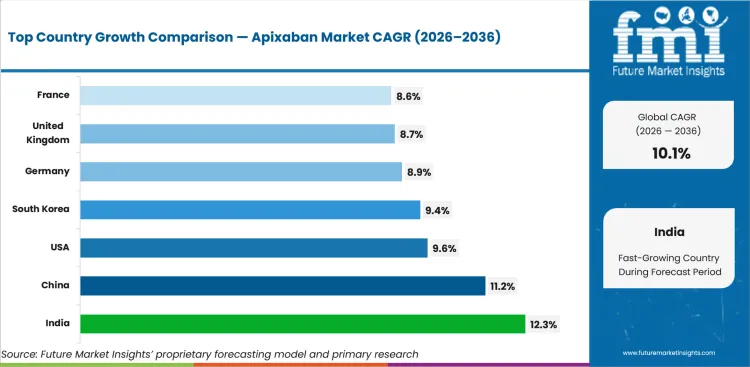
How do country-level CAGRs compare in the Apixaban market?
India leads country expansion while Japan records the most cautious outlook among profiled markets.
- India is forecast to record 12.3% CAGR by 2036, reflected by written confirmations and export-oriented API capacity supporting supplier qualification.
- China is expected to expand at 11.2% CAGR from 2026 to 2036 through finished-dose scale and price-led API competition.
- The United States is projected to grow at 9.6% CAGR through 2036 as FDA guidance and ANDA activity support launch planning.
- South Korea is estimated to rise at 9.4% CAGR by 2036 with quality-sensitive generic manufacturing and local filing discipline.
- Germany is expected to advance at 8.9% CAGR over the forecast period, led by EU documentation and chronic anticoagulant need influencing demand.
- The United Kingdom is forecast to grow at 8.7% CAGR through 2036, backed by MHRA oversight and NHS prescribing discipline shaping supplier behavior.
- France is projected to post 8.6% CAGR by 2036 as EU-quality supply chains and national substitution discipline support sourcing.
- Japan is expected to record 7.8% CAGR by 2036 as PMDA-aligned documentation and conservative supplier switching guide demand.
How fast is the Apixaban market growing in India?
A 12.3% CAGR through 2036 reflects regulated-market supplier qualification and country-specific buyer behavior.
Country Market Snapshot Table
| Parameter | Value |
|---|---|
| Market Size in 2025 (Value) | USD 37.4 million |
| Market Size in 2026 (Value) | USD 42.0 million |
| Market Forecast in 2036 (Value) | USD 134.0 million |
| CAGR (2026 to 2036) | 12.3% |
| Years Considered | 2021 to 2036 |
| Base Year | 2025 |
| Forecast Period | 2026 to 2036 |
| Units Considered | Value (USD million) |
| Leading Sub-Region | Hyderabad and western API manufacturing corridors |
India Apixaban Market Outlook
India apixaban API demand is influenced by export-oriented manufacturing and written-confirmation evidence. API suppliers already serve regulated markets, making apixaban suitable for firms with impurity controls and dossier support.
Buyer interest is expected to favor firms that can supply micronized lots with DMF references and audit-ready records. Cost competitiveness will help entry, with documentation quality likely to be dependent on separate development vendors from commercial partners.
Key Growth Drivers
- Export qualification improves buyer confidence in Indian apixaban API supply, supported by CDSCO issuing written confirmations for 4 apixaban-linked manufacturers during 2025.
- Manufacturing scale strengthens commercial batch availability, reflected by Apitoria’s API platform covering 10 manufacturing facilities and 19,000 MT installed capacity.
- Process chemistry experience helps Indian suppliers support cost-sensitive generic sponsors with repeatable development lots and scale-up assistance.
- Generic formulation relationships create early API discussions before full commercial tablet launch activity begins.
Key Restraints
- Filing-risk exposure limits weak supplier adoption, evidenced by FDA recording 18 original ANDA refuse-to-receive actions in FY 2025.
- Crowded API supply can pressure margins as more development-lot vendors compete before final launch windows mature.
- Buyers may delay supplier approval if micronization evidence or deviation records are incomplete.
What makes India unique
India is unique due to written-confirmation coverage and cost-competitive regulated-market supply.
Key Companies
- MSN Laboratories
- Aurobindo Pharma / Apitoria
- Alivus Life Sciences
- Zydus Lifesciences
- Dr. Reddy’s Laboratories
- Hetero Drugs
- Laurus Labs
- Optimus Drugs
Sales & Marketing Channels
- Direct API supply
- Regulated-market supply agreements
- Export distributors
- CDMO-linked sourcing
- Development sample channels
- Dossier-support partnerships
Country Segment Breakdown Table
| Segment | Sub-Segments |
|---|---|
| By Form | Micronized API · Standard API |
| By Purity Grade | >=99.5% · 98.0% to 99.5% · Below 98.0% |
| By Application | Stroke Prevention in Atrial Fibrillation · VTE Treatment · VTE Prophylaxis |
| By Sales Channel | Direct · Distributors · Online/API Marketplaces |
| By Buyer Type | Generic Pharmaceutical Manufacturers · Branded Pharmaceutical Manufacturers · CDMOs · Development-Stage Sponsors |
| Key Sub-Regions Covered, API Manufacturing Corridors | Hyderabad · Visakhapatnam · Ahmedabad · Ankleshwar · Mumbai · Pune |
Frequently Asked Questions
How fast is India Apixaban market growing?
India is projected to expand at 12.3% from 2026 to 2036, guided by regulated apixaban API sourcing.
Who leads India Apixaban market?
MSN Laboratories, Aurobindo Pharma / Apitoria, Alivus Life Sciences, Zydus Lifesciences, Dr. Reddy’s Laboratories compete through local supply and apixaban-related pharmaceutical channels.
What is driving adoption in India Apixaban market?
Supplier qualification and documentation discipline are supporting apixaban API use.
What is driving Apixaban growth in China?
A 11.2% CAGR through 2036 reflects regulated-market supplier qualification and country-specific buyer behavior.
Country Market Snapshot Table
| Parameter | Value |
|---|---|
| Market Size in 2025 (Value) | USD 66.5 million |
| Market Size in 2026 (Value) | USD 74.0 million |
| Market Forecast in 2036 (Value) | USD 214.0 million |
| CAGR (2026 to 2036) | 11.2% |
| Years Considered | 2021 to 2036 |
| Base Year | 2025 |
| Forecast Period | 2026 to 2036 |
| Units Considered | Value (USD million) |
| Leading Sub-Region | Zhejiang and coastal pharmaceutical clusters |
China Apixaban Market Outlook
China apixaban API demand is shaped by domestic generic manufacturing and finished-dose competition. Local buyers seek dependable quality at competitive cost, while regulated export ambitions keep documentation standards important.
Supplier selection is expected to favor firms that can support batch consistency and formulation evidence. Price pressure remains strong as more manufacturers target oral anticoagulant demand.
Key Growth Drivers
- Atrial fibrillation treatment need supports anticoagulant API demand, shown by a 2025 China study covering 2,825 AF patients.
- Non-valvular atrial fibrillation keeps factor Xa inhibitor use commercially important, indicated by 86.30% NVAF representation in the same China patient dataset.
- Local generic capacity creates a wider buyer base for API suppliers able to combine price discipline and documentation support.
- Finished-dose competition encourages sponsors to qualify suppliers early before volume tenders compress margins.
Key Restraints
- Clinical-risk screening can slow broad substitution, reinforced by a 2025 elderly AF anticoagulant review limited to patients aged 75 years or older.
- Heavy price competition can reduce premium API margins as domestic suppliers compete for large-volume tablet programs.
- Export-oriented suppliers must keep impurity files and change-control records aligned with regulated-market expectations.
What makes China unique
China is unique due to finished-dose scale and cost-sensitive API purchasing.
Key Companies
- Zhejiang Huahai Pharmaceutical
- Nanjing Triastek
- Jiangsu Hengrui Medicine
- Qilu Pharmaceutical
- CSPC Pharmaceutical Group
- Zhejiang Hisun Pharmaceutical
- Zhejiang Charioteer Pharmaceutical
Sales & Marketing Channels
- Direct API supply
- Domestic finished-dose manufacturer sourcing
- Export trading channels
- Hospital-linked formulation networks
- Development sample channels
- Online API directories
Country Segment Breakdown Table
| Segment | Sub-Segments |
|---|---|
| By Form | Micronized API · Standard API |
| By Purity Grade | >=99.5% · 98.0% to 99.5% · Below 98.0% |
| By Application | Stroke Prevention in Atrial Fibrillation · VTE Treatment · VTE Prophylaxis |
| By Sales Channel | Direct · Distributors · Online/API Marketplaces |
| By Buyer Type | Generic Pharmaceutical Manufacturers · Branded Pharmaceutical Manufacturers · CDMOs · Development-Stage Sponsors |
| Key Sub-Regions Covered, Pharmaceutical Clusters | Zhejiang · Jiangsu · Shanghai · Shandong · Guangdong · Beijing |
Frequently Asked Questions
How fast is China Apixaban market growing?
China is projected to expand at 11.2% from 2026 to 2036, guided by regulated apixaban API sourcing.
Who leads China Apixaban market?
Zhejiang Huahai Pharmaceutical, Nanjing Triastek, Jiangsu Hengrui Medicine, Qilu Pharmaceutical, CSPC Pharmaceutical Group compete due to regulated documentation and apixaban-related pharmaceutical channels.
What is driving adoption in China Apixaban market?
Supplier qualification and documentation discipline are promoting apixaban API use.
What is the Apixaban market outlook in the United States?
A 9.6% CAGR through 2036 reflects regulated-market supplier qualification and country-specific buyer behavior.
Country Market Snapshot Table
| Parameter | Value |
|---|---|
| Market Size in 2025 (Value) | USD 107.7 million |
| Market Size in 2026 (Value) | USD 118.0 million |
| Market Forecast in 2036 (Value) | USD 294.8 million |
| CAGR (2026 to 2036) | 9.6% |
| Years Considered | 2021 to 2036 |
| Base Year | 2025 |
| Forecast Period | 2026 to 2036 |
| Units Considered | Value (USD million) |
| Leading Sub-Region | Northeast and national generic launch networks |
United States Apixaban Market Outlook
United States apixaban API demand is shaped by FDA product-specific guidance and ANDA filing discipline. Generic sponsors need API partners that can support strength-specific bioequivalence and long-term commercial continuity.
Launch planning remains careful as patent timing and batch validation affect buyer schedules. Suppliers with DMF depth and clear impurity control should secure stronger positions.
Key Growth Drivers
- Generic review activity supports early API qualification, documented by FDA recording 137 first-cycle approvals in FY 2025.
- Apixaban formulation guidance strengthens development planning, clarified by FDA requiring 1 fasting in vivo bioequivalence study with pharmacokinetic endpoints for the 5 mg strength.
- Large regulated-market demand encourages sponsors to secure multiple API sources before commercial launches.
- Direct supplier relationships help USA buyers manage confidential DMF references and fast technical responses.
Key Restraints
- Patent and first-filer planning can slow immediate commercial pull, illustrated by FDA’s Paragraph IV list showing 5 ANDAs submitted for Eliquis tablets.
- Patent and exclusivity timing can slow near-term commercial pull despite early API preparation.
- Weak deviation response can make low-cost API offers unattractive for USA launch teams.
What makes United States unique
United States is unique due to FDA bioequivalence guidance and national generic-drug review scale.
Key Companies
- Dr. Reddy’s Laboratories
- MSN Laboratories
- Aurobindo Pharma / Apitoria
- Hetero Drugs
- Laurus Labs
- Zydus Lifesciences
- Zhejiang Huahai Pharmaceutical
Sales & Marketing Channels
- Direct API contracts
- DMF-linked supply agreements
- Generic sponsor sourcing teams
- CDMO sourcing channels
- Development sample supply
- Regulatory-support partnerships
Country Segment Breakdown Table
| Segment | Sub-Segments |
|---|---|
| By Form | Micronized API · Standard API |
| By Purity Grade | >=99.5% · 98.0% to 99.5% · Below 98.0% |
| By Application | Stroke Prevention in Atrial Fibrillation · VTE Treatment · VTE Prophylaxis |
| By Sales Channel | Direct · Distributors · Online/API Marketplaces |
| By Buyer Type | Generic Pharmaceutical Manufacturers · Branded Pharmaceutical Manufacturers · CDMOs · Development-Stage Sponsors |
| Key Sub-Regions Covered, Generic Launch Networks | New Jersey · New York · Pennsylvania · North Carolina · California · Illinois |
Frequently Asked Questions
How fast is United States Apixaban market growing?
United States is projected to expand at 9.6% from 2026 to 2036, guided by regulated apixaban API sourcing.
Who leads United States Apixaban market?
Dr. Reddy’s Laboratories, MSN Laboratories, Aurobindo Pharma / Apitoria, Hetero Drugs, Laurus Labs compete depending on local supply and apixaban-related pharmaceutical channels.
What is driving adoption in United States Apixaban market?
Supplier qualification and documentation discipline are supporting apixaban API use.
What is the Apixaban market forecast for South Korea?
A 9.4% CAGR through 2036 reflects regulated-market supplier qualification and country-specific buyer behavior.
Country Market Snapshot Table
| Parameter | Value |
|---|---|
| Market Size in 2025 (Value) | USD 24.7 million |
| Market Size in 2026 (Value) | USD 27.0 million |
| Market Forecast in 2036 (Value) | USD 66.2 million |
| CAGR (2026 to 2036) | 9.4% |
| Years Considered | 2021 to 2036 |
| Base Year | 2025 |
| Forecast Period | 2026 to 2036 |
| Units Considered | Value (USD million) |
| Leading Sub-Region | Seoul and Gyeonggi pharmaceutical corridors |
South Korea Apixaban Market Outlook
South Korea apixaban demand is supported by mature generic manufacturing and high qualification discipline. Buyers prefer API suppliers that can provide micronized lots and responsive regulatory support.
Market development is smaller than China, but qualification behavior is more selective. Suppliers that treat South Korea as a regulated launch market should retain better buyer confidence.
Key Growth Drivers
- Apixaban concentration monitoring deepens clinical familiarity, measured by a 2025 Korean study that analyzed 49 atrial fibrillation patients.
- Dose-performance evidence strengthens formulation attention, reported through mean apixaban plasma concentration of 160.3 ± 77.5 ng/mL in Korean patients.
- Generic manufacturers value suppliers that can resolve technical questions quickly during local filing and bioequivalence work.
- Micronized API demand benefits from buyer interest in predictable dissolution and batch consistency.
Key Restraints
- Reduced-dose use increases safety scrutiny for finished-dose sponsors, tracked by a 2025 Korean study reporting 69% low-dose use among direct oral anticoagulant patients with high bleeding risk.
- Smaller volume limits supplier flexibility compared with China and India.
- Repeated technical clarifications can slow adoption for suppliers lacking local documentation support.
What makes South Korea unique
South Korea is unique due to regulated generic discipline and close attention to apixaban concentration and safety evidence.
Key Companies
- Hanmi Pharmaceutical
- Celltrion Pharm
- Chong Kun Dang
- Daewoong Pharmaceutical
- Yuhan Corporation
- JW Pharmaceutical
- Dong-A ST
Sales & Marketing Channels
- Direct API supply
- Local generic manufacturer sourcing
- Distributor-led development lots
- CDMO-linked supply
- Hospital-formulary aligned channels
- Regulated filing partnerships
Country Segment Breakdown Table
| Segment | Sub-Segments |
|---|---|
| By Form | Micronized API · Standard API |
| By Purity Grade | >=99.5% · 98.0% to 99.5% · Below 98.0% |
| By Application | Stroke Prevention in Atrial Fibrillation · VTE Treatment · VTE Prophylaxis |
| By Sales Channel | Direct · Distributors · Online/API Marketplaces |
| By Buyer Type | Generic Pharmaceutical Manufacturers · Branded Pharmaceutical Manufacturers · CDMOs · Development-Stage Sponsors |
| Key Sub-Regions Covered, Pharmaceutical Corridors | Seoul · Gyeonggi · Incheon · Daejeon · Busan · Daegu |
Frequently Asked Questions
How fast is South Korea Apixaban market growing?
South Korea is projected to expand at 9.4% from 2026 to 2036, guided by regulated apixaban API sourcing.
Who leads South Korea Apixaban market?
Hanmi Pharmaceutical, Celltrion Pharm, Chong Kun Dang, Daewoong Pharmaceutical, Yuhan Corporation compete through local supply and apixaban-related pharmaceutical channels.
What is driving adoption in South Korea Apixaban market?
Anticoagulant treatment demand and documentation discipline are supporting apixaban API use.
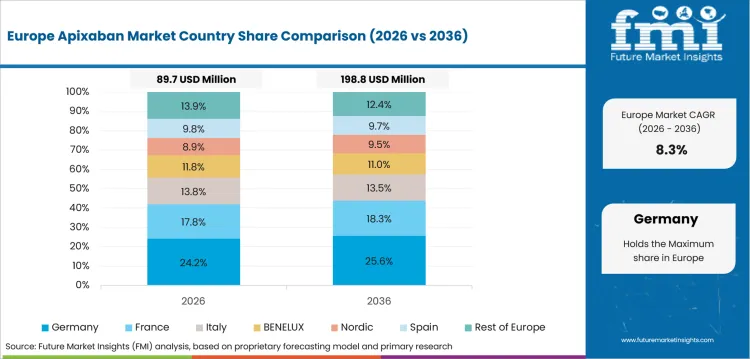
How is the Apixaban market performing in Germany?
A 8.9% CAGR through 2036 reflects regulated-market supplier qualification and country-specific buyer behavior.
Country Market Snapshot Table
| Parameter | Value |
|---|---|
| Market Size in 2025 (Value) | USD 34.9 million |
| Market Size in 2026 (Value) | USD 38.0 million |
| Market Forecast in 2036 (Value) | USD 89.0 million |
| CAGR (2026 to 2036) | 8.9% |
| Years Considered | 2021 to 2036 |
| Base Year | 2025 |
| Forecast Period | 2026 to 2036 |
| Units Considered | Value (USD million) |
| Leading Sub-Region | North Rhine-Westphalia and southern pharma networks |
Germany Apixaban Market Outlook
Germany apixaban demand is influenced by EU dossier standards and a large anticoagulant treatment base. Buyers are cautious about supplier additions and prefer API sources that can support variation work and traceability.
Price competition is present, but documentation comfort and delivery reliability remain stronger filters. Suppliers with stable quality records can serve Germany more effectively than vendors offering only low-cost development lots.
Key Growth Drivers
- Chronic anticoagulant need supports API pull, quantified by a 2025 European AF review reporting about 1.6 million affected people in Germany.
- Economic evaluation keeps apixaban assessment active, modelled through a 2025 German budget-impact study using 1,000 NVAF patients eligible for oral anticoagulation.
- EU bioequivalence guidance supports technical supplier evaluation before buyer approval.
- Chronic therapy demand encourages sponsors to maintain qualified API sources with consistent commercial supply.
Key Restraints
- Demand planning faces prevalence variation, cited through a 2025 adherence review placing adult NVAF prevalence at 2% to 4%.
- Health-insurance purchasing discipline can push finished-dose sponsors toward tighter API cost control.
- Buyer caution can delay new supplier approval until impurity and change-control records are fully reviewed.
What makes Germany unique
Germany is unique due to EU-quality discipline and cautious supplier qualification.
Key Companies
- Ratiopharm / Teva Germany
- STADA Arzneimittel
- Hexal / Sandoz
- Zentiva Pharma Germany
- Viatris Germany
- 1A Pharma
- Aristo Pharma
Sales & Marketing Channels
- Direct API supply
- EU dossier-linked sourcing
- Generic manufacturer contracts
- Distributor-supported backup supply
- CDMO sourcing teams
- Regulated-market technical partnerships
Country Segment Breakdown Table
| Segment | Sub-Segments |
|---|---|
| By Form | Micronized API · Standard API |
| By Purity Grade | >=99.5% · 98.0% to 99.5% · Below 98.0% |
| By Application | Stroke Prevention in Atrial Fibrillation · VTE Treatment · VTE Prophylaxis |
| By Sales Channel | Direct · Distributors · Online/API Marketplaces |
| By Buyer Type | Generic Pharmaceutical Manufacturers · Branded Pharmaceutical Manufacturers · CDMOs · Development-Stage Sponsors |
| Key Sub-Regions Covered, Pharma Networks | North Rhine-Westphalia · Bavaria · Baden-Württemberg · Hesse · Berlin · Hamburg |
Frequently Asked Questions
How fast is Germany Apixaban market growing?
Germany is projected to expand at 8.9% from 2026 to 2036, guided by regulated apixaban API sourcing.
Who leads Germany Apixaban market?
Ratiopharm / Teva Germany, STADA Arzneimittel, Hexal / Sandoz, Zentiva Pharma Germany, Viatris Germany compete led by regulated documentation and apixaban-related pharmaceutical channels.
What is driving adoption in Germany Apixaban market?
Supplier qualification and documentation discipline are supporting apixaban API use.
What is the Apixaban market outlook in the United Kingdom?
A 8.7% CAGR through 2036 reflects regulated-market supplier qualification and country-specific buyer behavior.
Country Market Snapshot Table
| Parameter | Value |
|---|---|
| Market Size in 2025 (Value) | USD 30.4 million |
| Market Size in 2026 (Value) | USD 33.0 million |
| Market Forecast in 2036 (Value) | USD 75.9 million |
| CAGR (2026 to 2036) | 8.7% |
| Years Considered | 2021 to 2036 |
| Base Year | 2025 |
| Forecast Period | 2026 to 2036 |
| Units Considered | Value (USD million) |
| Leading Sub-Region | England and national generic supply networks |
United Kingdom Apixaban Market Outlook
United Kingdom apixaban demand is shaped by MHRA product oversight and NHS prescribing discipline. Finished-dose suppliers need API partners that can support leaflet changes and batch traceability.
Market conditions reward suppliers that make compliance easier for authorization holders. API sellers with weak records may struggle even if development lots are available.
Key Growth Drivers
- Label-maintenance activity keeps apixaban supply under close review, confirmed by MHRA’s March 2026 notification covering Sandoz Apixaban 2.5 mg and 5 mg tablets.
- Pediatric wording adds formulation attention, detailed by the same notification referencing use in children aged 28 days to less than 18 years.
- NHS prescribing discipline supports consistent quality expectations for generic anticoagulants.
- Supplier preference shifts toward partners that provide prompt variation support and clean change-control files.
Key Restraints
- Patient-information issues can affect distribution confidence, listed through 10 not-yet-distributed packs in the Sandoz notification table.
- Frequent leaflet and safety updates add work for finished-dose holders and their API partners.
- Smaller suppliers may face slow approval if they cannot support rapid documentation updates.
What makes United Kingdom unique
United Kingdom is unique due to MHRA medicines notifications and NHS-linked generic supply discipline.
Key Companies
- Sandoz Limited
- Teva UK
- Accord Healthcare
- Viatris UK
- Zentiva UK
- Mylan UK
- Bristol Myers Squibb UK
Sales & Marketing Channels
- Direct API contracts
- UK marketing-authorization holder sourcing
- EU and UK distributor channels
- NHS-linked generic supply networks
- CDMO-supported supply
- Technical documentation partnerships
Country Segment Breakdown Table
| Segment | Sub-Segments |
|---|---|
| By Form | Micronized API · Standard API |
| By Purity Grade | >=99.5% · 98.0% to 99.5% · Below 98.0% |
| By Application | Stroke Prevention in Atrial Fibrillation · VTE Treatment · VTE Prophylaxis |
| By Sales Channel | Direct · Distributors · Online/API Marketplaces |
| By Buyer Type | Generic Pharmaceutical Manufacturers · Branded Pharmaceutical Manufacturers · CDMOs · Development-Stage Sponsors |
| Key Sub-Regions Covered, Generic Supply Networks | England · Scotland · Wales · Northern Ireland · London · Manchester |
Frequently Asked Questions
How fast is United Kingdom Apixaban market growing?
United Kingdom is projected to expand at 8.7% from 2026 to 2036, guided by regulated apixaban API sourcing.
Who leads United Kingdom Apixaban market?
Sandoz Limited, Teva UK, Accord Healthcare, Viatris UK, Zentiva UK compete through local supply, regulated documentation, and apixaban-related pharmaceutical channels.
What is driving adoption in United Kingdom Apixaban market?
Supplier qualification and documentation discipline are supporting apixaban API use.
What is the Apixaban market forecast for France?
A 8.6% CAGR through 2036 reflects regulated-market supplier qualification and country-specific buyer behavior.
Country Market Snapshot Table
| Parameter | Value |
|---|---|
| Market Size in 2025 (Value) | USD 28.5 million |
| Market Size in 2026 (Value) | USD 31.0 million |
| Market Forecast in 2036 (Value) | USD 70.7 million |
| CAGR (2026 to 2036) | 8.6% |
| Years Considered | 2021 to 2036 |
| Base Year | 2025 |
| Forecast Period | 2026 to 2036 |
| Units Considered | Value (USD million) |
| Leading Sub-Region | Île-de-France and national pharmacy networks |
France Apixaban Market Outlook
France apixaban sector is driven by EMA medicine information, and pharmacy substitution controls. Finished-dose sponsors need suppliers able to support EU-quality documentation and stable batch release.
France offers steady value rather than rapid supplier rotation. API firms with weak impurity records can compete on cost, but they struggle to enter preferred sourcing lists.
Key Growth Drivers
- Recurrent VTE prevention supports repeat API demand, specified by EMA information recommending 2.5 mg twice daily after completion of 6 months of treatment.
- French real-world evidence supports apixaban preference in high-risk patients, reported by a 2025 SNDS cohort study showing lower major bleeding versus rivaroxaban across all subgroups.
- National substitution discipline favors API sources with clean documentation and batch traceability.
- Buyer preference remains strongest for suppliers that reduce variation and pharmacovigilance support burden.
Key Restraints
- Adherence risk can weaken continuous tablet pull, measured by a 2025 French retrospective cohort reporting 24.2% non-adherence at 1 year.
- Bleeding-risk communication keeps anticoagulant supply under close safety review across pharmacies and prescribers.
- Supplier switching remains cautious as national systems value continuity and post-approval documentation.
What makes France unique
France is unique due to national medicine-safety oversight and EU-quality substitution discipline.
Key Companies
- Zentiva France
- Biogaran
- Sandoz France
- Teva Santé
- Viatris Santé
- Accord Healthcare France
- Bristol Myers Squibb France
Sales & Marketing Channels
- Direct API supply
- EU authorization-holder sourcing
- Pharmacy substitution channels
- Distributor-backed generic supply
- CDMO formulation networks
- Pharmacovigilance-linked documentation channels
Country Segment Breakdown Table
| Segment | Sub-Segments |
|---|---|
| By Form | Micronized API · Standard API |
| By Purity Grade | >=99.5% · 98.0% to 99.5% · Below 98.0% |
| By Application | Stroke Prevention in Atrial Fibrillation · VTE Treatment · VTE Prophylaxis |
| By Sales Channel | Direct · Distributors · Online/API Marketplaces |
| By Buyer Type | Generic Pharmaceutical Manufacturers · Branded Pharmaceutical Manufacturers · CDMOs · Development-Stage Sponsors |
| Key Sub-Regions Covered, Pharmacy Networks | Île-de-France · Auvergne-Rhône-Alpes · Provence-Alpes-Côte d’Azur · Occitanie · Nouvelle-Aquitaine · Hauts-de-France |
Frequently Asked Questions
How fast is France Apixaban market growing?
France is projected to expand at 8.6% from 2026 to 2036, guided by regulated apixaban API sourcing.
Who leads France Apixaban market?
Zentiva France, Biogaran, Sandoz France, Teva Santé, Viatris Santé compete through local supply and apixaban-related pharmaceutical channels.
What is driving adoption in France Apixaban market?
Anticoagulant treatment demand, and documentation discipline are supporting apixaban API use.
How is the Apixaban market performing in Japan?
A 7.8% CAGR through 2036 reflects regulated-market supplier qualification and country-specific buyer behavior.
Country Market Snapshot Table
| Parameter | Value |
|---|---|
| Market Size in 2025 (Value) | USD 24.1 million |
| Market Size in 2026 (Value) | USD 26.0 million |
| Market Forecast in 2036 (Value) | USD 55.3 million |
| CAGR (2026 to 2036) | 7.8% |
| Years Considered | 2021 to 2036 |
| Base Year | 2025 |
| Forecast Period | 2026 to 2036 |
| Units Considered | Value (USD million) |
| Leading Sub-Region | Tokyo and Osaka regulated medicine networks |
Japan Apixaban Market Outlook
Japan apixaban demand is supported by safety documentation and careful buyer qualification. Local license holders need API partners that can maintain impurity control and stable manufacturing records.
Growth is slower than India or China, yet value remains dependable for suppliers that can meet documentation standards. Supplier switching is selective and usually tied to quality confidence.
Key Growth Drivers
- Elderly anticoagulant demand supports apixaban use, noted by a 2025 Japanese study identifying around 11.6 million people aged 80 years and above in 2023.
- Apixaban outcomes strengthen finished-dose confidence, reported through lower stroke or systemic embolism risk with HR 0.75 versus warfarin in very elderly AF patients.
- PMDA-aligned safety documentation rewards suppliers with stable change-control records.
- Conservative prescribing behavior supports API continuity once suppliers are accepted.
Key Restraints
- Bleeding-risk management slows casual supplier changes, represented by the same Japanese evidence showing lower major bleeding risk with HR 0.69 versus warfarin.
- Very elderly treatment raises safety expectations and slows casual supplier changes.
- Local documentation cycles can delay API source changes even if alternative lots are available.
What makes Japan unique
Japan is unique due to elderly anticoagulant demand and conservative documentation-led supplier approval.
Key Companies
- Sawai Pharmaceutical
- Nichi-Iko Pharmaceutical
- Towa Pharmaceutical
- Meiji Seika Pharma
- Daiichi Sankyo Espha
- Pfizer Japan
- Bristol Myers Squibb Japan
Sales & Marketing Channels
- Direct API supply
- Local license-holder sourcing
- Regulated distributor channels
- Hospital-linked generic supply
- CDMO formulation supply
- PMDA-aligned technical partnerships
Country Segment Breakdown Table
| Segment | Sub-Segments |
|---|---|
| By Form | Micronized API · Standard API |
| By Purity Grade | >=99.5% · 98.0% to 99.5% · Below 98.0% |
| By Application | Stroke Prevention in Atrial Fibrillation · VTE Treatment · VTE Prophylaxis |
| By Sales Channel | Direct · Distributors · Online/API Marketplaces |
| By Buyer Type | Generic Pharmaceutical Manufacturers · Branded Pharmaceutical Manufacturers · CDMOs · Development-Stage Sponsors |
| Key Sub-Regions Covered, Regulated Medicine Networks | Tokyo · Osaka · Kanagawa · Aichi · Fukuoka · Hokkaido |
Frequently Asked Questions
How fast is Japan Apixaban market growing?
Japan is projected to expand at 7.8% from 2026 to 2036, guided by regulated apixaban API sourcing.
Who leads Japan Apixaban market?
Sawai Pharmaceutical, Nichi-Iko Pharmaceutical, Towa Pharmaceutical, Meiji Seika Pharma, Daiichi Sankyo Espha compete through local supply and apixaban-related pharmaceutical channels.
What is driving adoption in Japan Apixaban market?
Supplier qualification and anticoagulant treatment demand are supporting apixaban API use.
Apixaban Market - Report Scope
| Parameter | Details |
|---|---|
| Forecast period | 2026 to 2036 |
| Historical period | 2021 to 2025 |
| Quantitative unit | Revenue in USD million |
| By form | Micronized API, Standard API |
| By purity grade | >=99.5%, 98.0% to 99.5%, Below 98.0% |
| By application | Stroke Prevention in Atrial Fibrillation, VTE Treatment, VTE Prophylaxis |
| By sales channel | Direct, Distributors, Online/API Marketplaces |
| By buyer type | Generic Pharmaceutical Manufacturers, Branded Pharmaceutical Manufacturers, CDMOs, Development-Stage Sponsors |
| Regions covered | North America, Latin America, Europe, East Asia, South Asia and Pacific, Middle East and Africa |
| Countries covered | India, China, United States, South Korea, Germany, United Kingdom, France, Japan |
| Key companies profiled | Dr. Reddy’s Laboratories, MSN Laboratories, Aurobindo Pharma / Apitoria, Hetero Drugs, Laurus Labs, Alivus Life Sciences, Zydus Lifesciences, Zhejiang Huahai, Optimus Drugs, Nanjing Triastek |
| Approach | Hybrid bottom-up and top-down methodology using API volume logic, filing evidence, supplier qualification, dosage mix, and country channel behavior |
Source: Future Market Insights, 2026.
Apixaban Market Scope & Definition
| Attribute | Detail |
|---|---|
| Market Definition | Commercially supplied apixaban active pharmaceutical ingredient used in oral anticoagulant finished dosage forms |
| Functions Covered | Factor Xa inhibition, oral anticoagulant API supply, tablet formulation, dissolution support, bioequivalence-linked development |
| Applications Covered | Stroke prevention in atrial fibrillation, VTE treatment, VTE prophylaxis, pediatric VTE-linked formulation support |
| End-Use Industries | Generic pharmaceuticals, branded pharmaceuticals, contract development and manufacturing, API distribution |
| Grades Covered | >=99.5%, 98.0% to 99.5%, Below 98.0% |
| Inclusions | Micronized and standard apixaban API supplied for oral tablets, tablet-for-suspension development, regulated and development-grade material, direct supply, distributors, and online/API marketplaces |
| Exclusions | Eliquis brand revenue, finished generic tablet revenue, retail prescription revenue, clinical service spending, reversal agents, injectable anticoagulants, warfarin, heparins, rivaroxaban API, and unrelated clot-management ingredients |
Apixaban Market - Research Methodology
| Method | Description |
|---|---|
| Primary Research | FMI analyst interviews with API buyers, generic formulation sponsors, distributors, and regulated contract manufacturers across key markets |
| Desk Research | Review of FDA guidance, EMA product information, MHRA notifications, CDSCO written confirmations, PMDA materials, company API pages, and peer-reviewed anticoagulant research |
| Market Sizing & Forecasting | Hybrid model using API volume estimates, dosage strength mix, formulation route, purity grade, channel preference, country launch behavior, and buyer qualification patterns |
| Data Validation | Cross-verification using oral anticoagulant guidance, written-confirmation records, finished-dose launch readiness, company filings, and supplier documentation evidence |
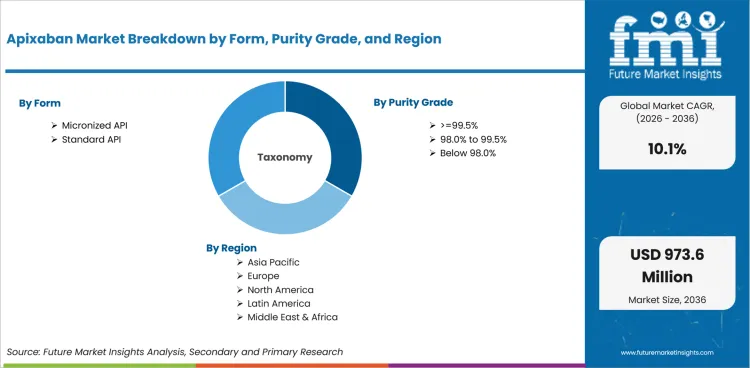
Apixaban Market Breakdown by Form, Purity Grade, Application, Sales Channel, Buyer Type, and Region
Apixaban Market Segmented by Form
- Micronized API
- Standard API
Apixaban Market Segmented by Purity Grade
- >=99.5%
- 98.0% to 99.5%
- Below 98.0%
Apixaban Market Segmented by Application
- Stroke Prevention in Atrial Fibrillation
- VTE Treatment
- VTE Prophylaxis
Apixaban Market Segmented by Sales Channel
- Direct
- Distributors
- Online/API Marketplaces
Apixaban Market Segmented by Buyer Type
- Generic Pharmaceutical Manufacturers
- Branded Pharmaceutical Manufacturers
- CDMOs
- Development-Stage Sponsors
Apixaban Market by Region
- North America
- Latin America
- Europe
- East Asia
- South Asia and Pacific
- Middle East and Africa
Research Sources and Bibliography
- Aurobindo Pharma Limited. (2026). Apitoria specialty pharmaceuticals and biologics business overview.
- Central Drugs Standard Control Organization. (2025, July 7). Written confirmation of MSN Laboratories Private Limited for active substances imported into the European Union.
- Central Drugs Standard Control Organization. (2025, August 8). Written confirmation of Apitoria Pharma Private Limited for active substances imported into the European Union.
- Central Drugs Standard Control Organization. (2025, August 29). Written confirmation of Zydus Lifesciences Limited for active substances imported into the European Union.
- Central Drugs Standard Control Organization. (2025, October 22). Written confirmation of Alivus Life Sciences Limited for active substances imported into the European Union.
- Dr. Reddy’s Laboratories. (2025, July). Technical product sheet: Apixaban API.
- European Medicines Agency. (2025, June 30). Apixaban film-coated tablet 2.5 and 5 mg product-specific bioequivalence guidance.
- European Medicines Agency. (2026, April). Eliquis: EPAR product information.
- Food and Drug Administration. (2025, November 24). Generic Drugs Program Activities Report - FY 2025 monthly performance.
- Food and Drug Administration. (2025). Eliquis prescribing information.
- Food and Drug Administration. (2026, February). Draft guidance on apixaban oral tablet and tablet for suspension.
- Food and Drug Administration. (2026, June 9). Paragraph IV patent certifications.
- Medicines and Healthcare products Regulatory Agency. (2026, March 26). Class 4 medicines defect notification: Sandoz Limited, Apixaban 2.5 mg and 5 mg tablets.
- Qi, F., et al. (2025). Clinical characteristics, adherence to anticoagulation therapy, and outcomes in atrial fibrillation patients. BMC Cardiovascular Disorders.
- Zhao, X., et al. (2025). Efficacy and safety of anticoagulants in elderly atrial fibrillation patients: A systematic review and network meta-analysis. BMC Cardiovascular Disorders.
- Lee, S. H., et al. (2025). Real-world apixaban concentration in Korean patients with atrial fibrillation. Blood Research.
- Matsuo-Ohsawa, A., et al. (2025). Safety and effectiveness of apixaban in very elderly patients with atrial fibrillation.
- Lip, G. Y. H., et al. (2025). Comparative safety and effectiveness of oral anticoagulants in key subgroups of patients with non-valvular atrial fibrillation and at high risk of gastrointestinal bleeding: A cohort study based on the French National Health Data System. PLOS One.
- Fuchs, V. A., et al. (2025). Non-adherence and non-persistence of direct oral anticoagulants among patients with non-valvular atrial fibrillation: A French retrospective cohort study. Scientific Reports.
- Therapeutic Goods Administration. (2025, May 29). Apixaban film-coated tablet 2.5 and 5 mg product-specific bioequivalence guidance.
- Food and Drug Administration. (2025). Eliquis prescribing information.
This bibliography is provided for reader reference and is not exhaustive. The full report contains the complete reference list and detailed citations.
This Report Answers
- Market size estimates for 2026 and forecasts through 2036 for the Apixaban market.
- Insights across more than 30 regional and country-level markets.
- Analysis of demand drivers and API sourcing decisions.
- Evaluation of key forms, purity grades, applications, sales channels, and buyer types.
- Assessment of regulatory guidance and medicine-safety updates.
- Identification of opportunities across micronized API and pediatric formulation support.
- Evaluation of supply chain dynamics and country-level manufacturing structures.
- Country-level analysis covering India, China, the United States, South Korea, Germany, the United Kingdom, France, and Japan.
- Assessment of competition, including leading apixaban API manufacturers and regulated-market suppliers.
- Analysis of buyer preferences and commercial batch continuity.
- Regional outlooks across North America, Latin America, Europe, East Asia, South Asia and Pacific, and the Middle East and Africa.
- Delivery of market data, forecasts, and supporting analysis in PDF and Excel formats.
Frequently Asked Questions
What is the growth prospect for Apixaban API?
Demand for apixaban API is expected to rise at a considerable pace as generic sponsors qualify suppliers for regulated oral anticoagulant launches.
Which companies are expected to shape the Apixaban market?
Dr. Reddy’s Laboratories, MSN Laboratories, Aurobindo Pharma / Apitoria, Hetero Drugs, Laurus Labs, Alivus Life Sciences, Zydus Lifesciences, Zhejiang Huahai, Optimus Drugs, and Nanjing Triastek are expected to shape competition.
Why are leading API companies investing in Apixaban?
Leading API companies are investing in apixaban to serve generic anticoagulant programs that need impurity control and commercial batch continuity.
Why is direct supply important in the Apixaban market?
Direct supply supports audit access and faster technical responses during regulated finished-dose filing work.
Which product formats are gaining attention in Apixaban API?
Micronized API and high-purity apixaban grades are gaining attention as buyers focus on dissolution behavior and impurity control.
How do regulations influence Apixaban API launches?
Regulations influence launches through product-specific guidance and quality-review discipline.
Why is purity important for Apixaban API?
Purity is important as tighter impurity profiles and repeatable assay values help finished-dose sponsors reduce review questions.
What role does micronization play in Apixaban API adoption?
Micronization supports dissolution control and helps buyers manage bioequivalence risk during oral tablet development.
How do CDMO channels support Apixaban API demand?
CDMO channels support formulation development and technical transfer for sponsors preparing generic anticoagulant launches.
Preview the report firsthand - request a free sample
Get SampleGet the brochure for pricing and purchase details.
Get PDFTable of Content
- Key Takeaways
- Market Size and CAGR
- Top Growth Driver
- Fastest Growing Segment
- Leading Region
- Key Companies
- Emerging Opportunities
- Executive Summary
- Global Market Outlook
- Demand-side Trends
- Supply-side Trends
- Technology Roadmap Analysis
- Analysis and Recommendations
- Analyst Perspective (What is happening? Why now? What should investors know?)
- Key Questions Answered
- How large is the market?
- What is the CAGR?
- What are key trends?
- Which region dominates?
- Who are the leaders?
- Market Overview
- Market Coverage / Taxonomy
- Market Definition / Scope / Limitations
- Research Methodology
- Chapter Orientation
- Analytical Lens and Working Hypotheses
- Market Structure, Signals, and Trend Drivers
- Benchmarking and Cross-market Comparability
- Market Sizing, Forecasting, and Opportunity Mapping
- Research Design and Evidence Framework
- Desk Research Programme (Secondary Evidence)
- Expert Input and Fieldwork (Primary Evidence)
- Tooling, Models, and Reference Databases
- Data Engineering and Model Build
- Quality Assurance and Audit Trail
- Market Background
- Market Dynamics (Drivers, Restraints, Opportunity, Trends)
- Scenario Forecast (Optimistic, Likely, Conservative)
- Impact Analysis
- AI Impact
- Sustainability Impact
- Regulatory Impact
- Technology Impact
- Consumer / Buyer Analysis
- Purchase Drivers
- Adoption Barriers
- Buyer Journey
- Opportunity Map Analysis
- Product Life Cycle Analysis
- Supply Chain Analysis
- Investment Feasibility Matrix
- Value Chain Analysis
- PESTLE and Porter's Analysis
- Regulatory Landscape
- Regional Parent Market Outlook
- Production and Consumption Statistics
- Import and Export Statistics
- Global Market Analysis and Forecast, 2021 to 2036
- Historical Market Size Value (USD Million) Analysis, 2021 to 2025
- Current and Future Market Size Value (USD Million) Projections, 2026 to 2036
- Y-o-Y Growth Trend Analysis
- Absolute $ Opportunity Analysis
- Global Market Pricing Analysis, 2021 to 2036
- Global Market Analysis and Forecast, By Form, 2021 to 2036
- Introduction / Key Findings
- Historical Market Size Value (USD Million) Analysis By Form, 2021 to 2025
- Current and Future Market Size Value (USD Million) Analysis and Forecast By Form, 2026 to 2036
- Micronized API
- Standard API
- Micronized API
- Y-o-Y Growth Trend Analysis By Form, 2021 to 2025
- Absolute $ Opportunity Analysis By Form, 2026 to 2036
- Global Market Analysis and Forecast, By Purity Grade, 2021 to 2036
- Introduction / Key Findings
- Historical Market Size Value (USD Million) Analysis By Purity Grade, 2021 to 2025
- Current and Future Market Size Value (USD Million) Analysis and Forecast By Purity Grade, 2026 to 2036
- >=99.5%
- 98.0% to 99.5%
- Below 98.0%
- >=99.5%
- Y-o-Y Growth Trend Analysis By Purity Grade, 2021 to 2025
- Absolute $ Opportunity Analysis By Purity Grade, 2026 to 2036
- Global Market Analysis and Forecast, By Application, 2021 to 2036
- Introduction / Key Findings
- Historical Market Size Value (USD Million) Analysis By Application, 2021 to 2025
- Current and Future Market Size Value (USD Million) Analysis and Forecast By Application, 2026 to 2036
- Stroke Prevention in Atrial Fibrillation
- VTE Treatment
- VTE Prophylaxis
- Stroke Prevention in Atrial Fibrillation
- Y-o-Y Growth Trend Analysis By Application, 2021 to 2025
- Absolute $ Opportunity Analysis By Application, 2026 to 2036
- Global Market Analysis and Forecast, By Sales Channel, 2021 to 2036
- Introduction / Key Findings
- Historical Market Size Value (USD Million) Analysis By Sales Channel, 2021 to 2025
- Current and Future Market Size Value (USD Million) Analysis and Forecast By Sales Channel, 2026 to 2036
- Direct
- Distributors
- Online/API Marketplaces
- Direct
- Y-o-Y Growth Trend Analysis By Sales Channel, 2021 to 2025
- Absolute $ Opportunity Analysis By Sales Channel, 2026 to 2036
- Global Market Analysis and Forecast, By Buyer Type, 2021 to 2036
- Introduction / Key Findings
- Historical Market Size Value (USD Million) Analysis By Buyer Type, 2021 to 2025
- Current and Future Market Size Value (USD Million) Analysis and Forecast By Buyer Type, 2026 to 2036
- Generic Pharmaceutical Manufacturers
- Branded Pharmaceutical Manufacturers
- CDMOs
- Generic Pharmaceutical Manufacturers
- Y-o-Y Growth Trend Analysis By Buyer Type, 2021 to 2025
- Absolute $ Opportunity Analysis By Buyer Type, 2026 to 2036
- Global Market Analysis and Forecast, By Region, 2021 to 2036
- Introduction
- Historical Market Size Value (USD Million) Analysis By Region, 2021 to 2025
- Current Market Size Value (USD Million) Analysis and Forecast By Region, 2026 to 2036
- North America
- Latin America
- Western Europe
- Eastern Europe
- East Asia
- South Asia and Pacific
- Middle East & Africa
- Market Attractiveness Analysis By Region
- North America Market Analysis and Forecast, By Country, 2021 to 2036
- Historical Market Size Value (USD Million) Trend Analysis By Market Taxonomy, 2021 to 2025
- Market Size Value (USD Million) Forecast By Market Taxonomy, 2026 to 2036
- By Country
- USA
- Canada
- Mexico
- By Form
- By Purity Grade
- By Application
- By Sales Channel
- By Buyer Type
- By Country
- Market Attractiveness Analysis
- By Country
- By Form
- By Purity Grade
- By Application
- By Sales Channel
- By Buyer Type
- Key Takeaways
- Latin America Market Analysis and Forecast, By Country
- Historical Market Size Value (USD Million) Trend Analysis By Market Taxonomy, 2021 to 2025
- Market Size Value (USD Million) Forecast By Market Taxonomy, 2026 to 2036
- By Country
- Brazil
- Chile
- Rest of Latin America
- By Form
- By Purity Grade
- By Application
- By Sales Channel
- By Buyer Type
- By Country
- Market Attractiveness Analysis
- By Country
- By Form
- By Purity Grade
- By Application
- By Sales Channel
- By Buyer Type
- Key Takeaways
- Western Europe Market Analysis and Forecast, By Country
- Historical Market Size Value (USD Million) Trend Analysis By Market Taxonomy, 2021 to 2025
- Market Size Value (USD Million) Forecast By Market Taxonomy, 2026 to 2036
- By Country
- Germany
- UK
- Italy
- Spain
- France
- Nordic
- BENELUX
- Rest of Western Europe
- By Form
- By Purity Grade
- By Application
- By Sales Channel
- By Buyer Type
- By Country
- Market Attractiveness Analysis
- By Country
- By Form
- By Purity Grade
- By Application
- By Sales Channel
- By Buyer Type
- Key Takeaways
- Eastern Europe Market Analysis and Forecast, By Country
- Historical Market Size Value (USD Million) Trend Analysis By Market Taxonomy, 2021 to 2025
- Market Size Value (USD Million) Forecast By Market Taxonomy, 2026 to 2036
- By Country
- Russia
- Poland
- Hungary
- Balkan & Baltic
- Rest of Eastern Europe
- By Form
- By Purity Grade
- By Application
- By Sales Channel
- By Buyer Type
- By Country
- Market Attractiveness Analysis
- By Country
- By Form
- By Purity Grade
- By Application
- By Sales Channel
- By Buyer Type
- Key Takeaways
- East Asia Market Analysis and Forecast, By Country
- Historical Market Size Value (USD Million) Trend Analysis By Market Taxonomy, 2021 to 2025
- Market Size Value (USD Million) Forecast By Market Taxonomy, 2026 to 2036
- By Country
- China
- Japan
- South Korea
- By Form
- By Purity Grade
- By Application
- By Sales Channel
- By Buyer Type
- By Country
- Market Attractiveness Analysis
- By Country
- By Form
- By Purity Grade
- By Application
- By Sales Channel
- By Buyer Type
- Key Takeaways
- South Asia and Pacific Market Analysis and Forecast, By Country
- Historical Market Size Value (USD Million) Trend Analysis By Market Taxonomy, 2021 to 2025
- Market Size Value (USD Million) Forecast By Market Taxonomy, 2026 to 2036
- By Country
- India
- ASEAN
- Australia & New Zealand
- Rest of South Asia and Pacific
- By Form
- By Purity Grade
- By Application
- By Sales Channel
- By Buyer Type
- By Country
- Market Attractiveness Analysis
- By Country
- By Form
- By Purity Grade
- By Application
- By Sales Channel
- By Buyer Type
- Key Takeaways
- Middle East & Africa Market Analysis and Forecast, By Country
- Historical Market Size Value (USD Million) Trend Analysis By Market Taxonomy, 2021 to 2025
- Market Size Value (USD Million) Forecast By Market Taxonomy, 2026 to 2036
- By Country
- Kingdom of Saudi Arabia
- Other GCC Countries
- Türkiye
- South Africa
- Other African Union
- Rest of Middle East & Africa
- By Form
- By Purity Grade
- By Application
- By Sales Channel
- By Buyer Type
- By Country
- Market Attractiveness Analysis
- By Country
- By Form
- By Purity Grade
- By Application
- By Sales Channel
- By Buyer Type
- Key Takeaways
- Key Countries Market Analysis
- USA
- Pricing Analysis
- Market Share Analysis, 2025
- By Form
- By Purity Grade
- By Application
- By Sales Channel
- By Buyer Type
- Canada
- Pricing Analysis
- Market Share Analysis, 2025
- By Form
- By Purity Grade
- By Application
- By Sales Channel
- By Buyer Type
- Mexico
- Pricing Analysis
- Market Share Analysis, 2025
- By Form
- By Purity Grade
- By Application
- By Sales Channel
- By Buyer Type
- Brazil
- Pricing Analysis
- Market Share Analysis, 2025
- By Form
- By Purity Grade
- By Application
- By Sales Channel
- By Buyer Type
- Chile
- Pricing Analysis
- Market Share Analysis, 2025
- By Form
- By Purity Grade
- By Application
- By Sales Channel
- By Buyer Type
- Germany
- Pricing Analysis
- Market Share Analysis, 2025
- By Form
- By Purity Grade
- By Application
- By Sales Channel
- By Buyer Type
- UK
- Pricing Analysis
- Market Share Analysis, 2025
- By Form
- By Purity Grade
- By Application
- By Sales Channel
- By Buyer Type
- Italy
- Pricing Analysis
- Market Share Analysis, 2025
- By Form
- By Purity Grade
- By Application
- By Sales Channel
- By Buyer Type
- Spain
- Pricing Analysis
- Market Share Analysis, 2025
- By Form
- By Purity Grade
- By Application
- By Sales Channel
- By Buyer Type
- France
- Pricing Analysis
- Market Share Analysis, 2025
- By Form
- By Purity Grade
- By Application
- By Sales Channel
- By Buyer Type
- India
- Pricing Analysis
- Market Share Analysis, 2025
- By Form
- By Purity Grade
- By Application
- By Sales Channel
- By Buyer Type
- ASEAN
- Pricing Analysis
- Market Share Analysis, 2025
- By Form
- By Purity Grade
- By Application
- By Sales Channel
- By Buyer Type
- Australia & New Zealand
- Pricing Analysis
- Market Share Analysis, 2025
- By Form
- By Purity Grade
- By Application
- By Sales Channel
- By Buyer Type
- China
- Pricing Analysis
- Market Share Analysis, 2025
- By Form
- By Purity Grade
- By Application
- By Sales Channel
- By Buyer Type
- Japan
- Pricing Analysis
- Market Share Analysis, 2025
- By Form
- By Purity Grade
- By Application
- By Sales Channel
- By Buyer Type
- South Korea
- Pricing Analysis
- Market Share Analysis, 2025
- By Form
- By Purity Grade
- By Application
- By Sales Channel
- By Buyer Type
- Russia
- Pricing Analysis
- Market Share Analysis, 2025
- By Form
- By Purity Grade
- By Application
- By Sales Channel
- By Buyer Type
- Poland
- Pricing Analysis
- Market Share Analysis, 2025
- By Form
- By Purity Grade
- By Application
- By Sales Channel
- By Buyer Type
- Hungary
- Pricing Analysis
- Market Share Analysis, 2025
- By Form
- By Purity Grade
- By Application
- By Sales Channel
- By Buyer Type
- Kingdom of Saudi Arabia
- Pricing Analysis
- Market Share Analysis, 2025
- By Form
- By Purity Grade
- By Application
- By Sales Channel
- By Buyer Type
- Türkiye
- Pricing Analysis
- Market Share Analysis, 2025
- By Form
- By Purity Grade
- By Application
- By Sales Channel
- By Buyer Type
- South Africa
- Pricing Analysis
- Market Share Analysis, 2025
- By Form
- By Purity Grade
- By Application
- By Sales Channel
- By Buyer Type
- USA
- Market Structure Analysis
- Competition Dashboard
- Competition Benchmarking
- Market Share Analysis of Top Players
- By Regional
- By Form
- By Purity Grade
- By Application
- By Sales Channel
- By Buyer Type
- Emerging Startups
- Innovation Benchmarking
- Competition Analysis
- Competition Deep Dive
- Dr. Reddy’s Laboratories
- Overview
- Product Portfolio
- Profitability by Market Segments (Product/Region/Sales Channel)
- Sales Footprint
- Strategy Overview
- Marketing Strategy
- Product Strategy
- Channel Strategy
- MSN Laboratories
- Aurobindo Pharma / Apitoria
- Hetero Drugs
- Laurus Labs
- Alivus Life Sciences
- Zydus Lifesciences
- Dr. Reddy’s Laboratories
- Case Studies
- Success Stories
- Recent Developments
- Competition Deep Dive
- Assumptions & Acronyms Used


