

- Market Size (2026)
- USD 16.8 Bn
- Forecast (2036)
- USD 38.7 Bn
- CAGR (2026 to 2036)
- 8.7%
How big is the HER2 Therapy Market in 2026?
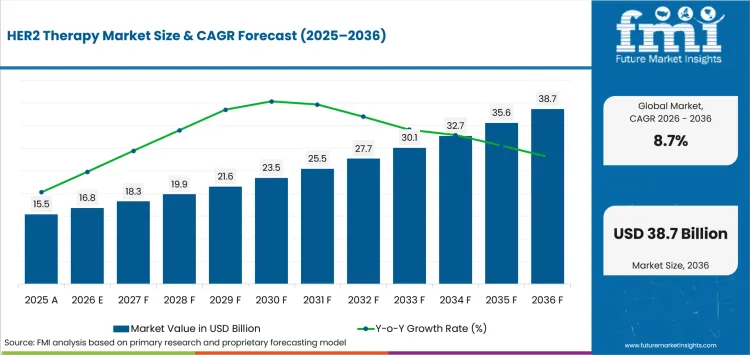
USD 16.8 billion in 2026 and USD 38.7 billion by 2036 at an 8.7% CAGR.
HER2 therapy demand is projected to drive the valuation from USD 16.8 billion in 2026 to USD 38.7 billion by 2036 at 8.7% CAGR. In January 2025, FDA expanded trastuzumab deruxtecan to HER2-low and HER2-ultralow breast cancer with an approved assay. The approval expands recurring companion diagnostics use across hospital laboratories by requiring validated eligibility confirmation. Pathology teams also need consistent breast cancer subtyping during routine specimen review and reporting workflows.
Market access can diverge significantly after regulatory approval because reimbursement authorities apply different evidence standards. NICE concluded its November 2025 appraisal of HER2-low disease without issuing a recommendation after no evidence submission was received, leaving routine NHS adoption dependent on local funding and value-assessment decisions.
Key Takeaways of HER2 Therapy Market
- Expanded HER2 categories increase treatment eligibility across breast cancer and selected solid tumors that require validated biomarker testing.
- Monoclonal antibodies are forecast at 42.0% of drug class demand in 2026, supported by established trastuzumab and pertuzumab sequences.
- HER2-positive breast cancer is projected at 61.0% share in 2026, reflecting use across early and metastatic treatment.
- Injectable therapy is estimated at 74.0% of route demand in 2026, owing to supervised antibody and conjugate administration.
- Resistance management and pulmonary surveillance raise clinical workload, while indication-specific reimbursement review can delay routine prescribing.
- Roche Holding AG, AstraZeneca PLC, Daiichi Sankyo Company, Limited, Pfizer Inc., Merck & Co., Inc., Amgen Inc., Zymeworks Inc., and Jazz Pharmaceuticals plc are some notable players.
Analyst Perspective
“HER2 portfolio strength depends on accurate placement across biomarker level, disease stage and prior exposure. Companies secure broader use by pairing treatment evidence with reproducible testing, toxicity protocols and an indication-specific reimbursement case.”
- Anurag Sharma, Principal Consultant, Future Market Insights
How is the HER2 Therapy Market segmented?
The HER2 therapy market is segmented by drug class, indication, route of administration, distribution channel and region.
The HER2 therapy market is segmented by drug class, indication, route of administration, distribution channel and region. Drug classes cover antibodies, conjugates, kinase inhibitors and bispecific or pipeline therapies. Indications include breast, gastric, lung and other solid tumors. Administration distinguishes injectable, oral and combination therapy, while distribution includes hospital, specialty, retail and online pharmacies.
What makes Monoclonal antibodies central to the Drug class category?
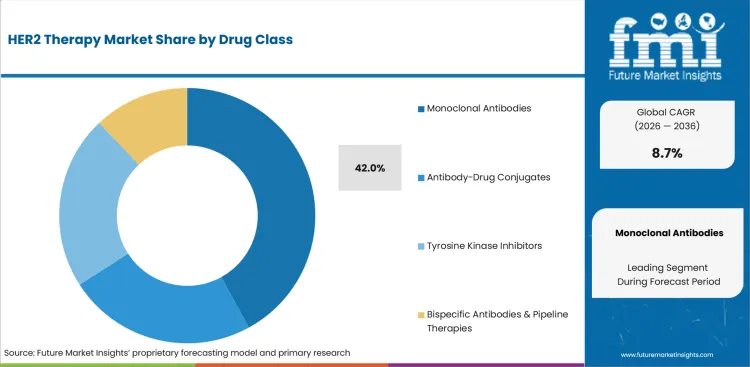
Monoclonal antibodies anchor HER2-positive treatment across early and metastatic pathways in specialist oncology services. Biomarker confirmation links their use with familiar combinations and established antibody therapeutics protocols across hospital care.
- By drug class, monoclonal antibodies are estimated to hold 42.0% in 2026 owing to trastuzumab and pertuzumab use across breast and gastric cancer.
- Oncology teams assess treatment line and prior exposure before selecting an antibody regimen for eligible patients. Conjugates and bispecific agents address resistant disease without displacing the antibody base across every approved setting.
How does HER2-positive breast cancer shape Indication demand?
HER2-positive breast cancer carries the broadest treatment sequence within the indication category across care settings. breast cancer medicines extend across neoadjuvant, adjuvant and metastatic care, while repeat testing clarifies eligibility following progression.
- HER2-positive breast cancer is projected to hold 61.0% share in 2026 owing to approved therapy across several disease stages and lines.
- Gastric cancer and HER2-mutant lung cancer follow narrower labels with different biomarker thresholds and sequencing rules. Their commercial scale depends on indication-specific evidence instead of breast cancer experience alone across national systems.
Why does Injectable therapy lead the Route of administration category?
Intravenous infusion and supervised subcutaneous injection provide controlled dosing for HER2 antibodies and antibody-drug conjugates. Hospital teams monitor infusion reactions and organ-specific risks, linking HER2 care with next-generation immunotherapies in specialist pathways.
- In 2026, injectable therapy is expected to lead route of administration with 74.0% share because approved biologics require supervised oncology settings.
- Oral tyrosine kinase inhibitors support longer treatment outside infusion units and broaden combination choices across care settings. Adoption depends on adherence management and sequencing with injectable agents that remain necessary across many approved regimens.
What supports Hospital pharmacies within the Distribution channel category?
Hospital pharmacies coordinate cold-chain receipt and protocol preparation for complex HER2 regimens across specialist oncology services. Their proximity supports dose verification and rapid safety response, connecting medicine supply with cancer biological therapy requirements.
- The distribution channel category is forecast to be led by hospital pharmacies at 52.0% share in 2026 due to supervised treatment coordination.
- Specialty pharmacies manage biologic distribution and oral refills for eligible patients across regional care networks. Retail and online channels support oral therapy access but cannot replace infusion preparation or antibody-regimen monitoring.
What are the drivers, restraints and opportunities in the HER2 Therapy Market?
Broader biomarker categories expand eligibility as specialist monitoring limits routine use and integrated evidence packages improve treatment placement.
- Driver: Expanded HER2 categories place more patients into treatment pathways that require validated testing and indication-specific sequencing.
- Restraint: Cardiac and pulmonary surveillance increase clinical workload and reimbursement evidence can delay access following authorization.
- Opportunity: Diagnostic support and differentiated delivery can improve treatment placement across hospital networks and national payer reviews.
Biomarker Expansion
HER2 categories extend beyond one positive classification across treatment planning, requiring pathology laboratories to reproduce low and ultralow scores across personalized medicine workflows. Expanded categories increase testing volume and specimen-control requirements that govern treatment eligibility across breast and solid-tumor pathways.
Monitoring and Access Burden
Antibodies and conjugates require cardiac or pulmonary surveillance that smaller centers cannot provide uniformly. Payers also assess indication-specific evidence across biosimilar biologics and newer modalities, concentrating prescribing in specialist hospitals.
Treatment Placement and Delivery
Companies can improve placement by pairing assays with clear toxicity protocols and practical delivery options. Project Orbis can shorten parallel review, while subcutaneous bispecific delivery can reduce chair time under established safety systems.
Which country CAGRs are profiled in the HER2 Therapy Market?
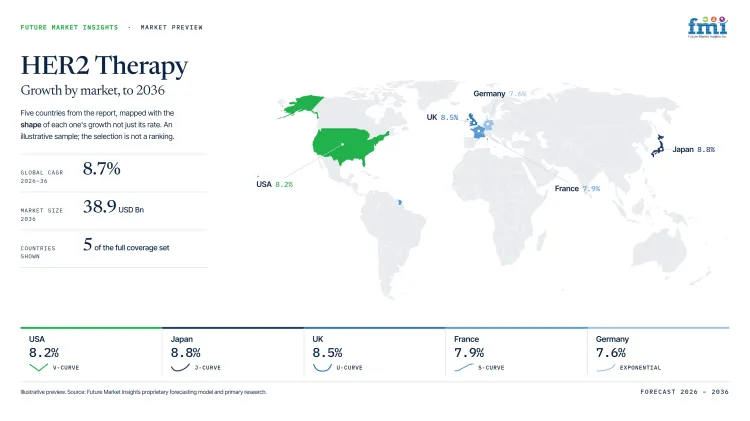
| Country | CAGR |
|---|---|
| Japan | 8.8% |
| United Kingdom | 8.5% |
| United States | 8.2% |
| France | 7.9% |
| Germany | 7.6% |
How do country-level CAGRs compare in the HER2 Therapy Market?
The country range spans 1.2 percentage points and reflects access pathways instead of current market size. Close CAGRs conceal different approval timing, reimbursement evidence and specialist treatment capacity.
- Japan’s pace reflects tumor-agnostic label expansion and domestic antibody-drug conjugate development across specialist oncology centers.
- United Kingdom growth reflects separate authorization and NHS value assessment across regional oncology services and formularies.
- United States growth reflects frequent label expansion alongside uneven payer requirements and community surveillance capacity.
- France combines specialist oncology infrastructure with indication-specific appraisal that can alter reimbursement timing following authorization.
- Germany’s benefit assessment provides a predictable route but requires comparative dossiers for every new indication.
Comparable CAGRs can produce different market entry conditions. The full report provides country-level CAGR analysis across North America, Latin America, Europe, East Asia, South Asia and Pacific, and the Middle East and Africa.
Country-wise Analysis
- Japan's HER2 therapy market is projected to expand at an 8.8% CAGR through 2036. The country benefits from close coordination between domestic drug developers and specialist oncology centers. Daiichi Sankyo's March 2026 tumor-agnostic approval for metastatic HER2-positive solid tumors broadened treatment opportunities for biomarker-defined patient populations. The decision strengthens the role of HER2-directed therapies across multiple tumor types. Assay standardization and interstitial lung disease monitoring remain important outside major referral hospitals.
- The United Kingdom is forecast to grow at an 8.5% CAGR through 2036. Access to HER2 therapies depends on both regulatory authorization and health-technology assessment. The MHRA authorized trastuzumab deruxtecan for previously treated HER2-positive solid tumors in April 2025. National pathology services provide broad testing coverage that supports patient identification. NICE reviews and local formulary decisions continue to influence prescribing consistency across NHS organizations.
- The United States is expected to record an 8.2% CAGR during the assessment period. Frequent label expansions continue to widen treatment opportunities across oncology settings. The FDA's December 2025 first-line approval was supported by a study involving 1,157 patients. Shared testing and infusion infrastructure allows academic centers and community practices to introduce new HER2 regimens efficiently. Payer requirements and pulmonary surveillance obligations can still affect uptake across provider networks.
- France is anticipated to advance at a 7.9% CAGR through 2036. Established pathology networks support routine identification of eligible HER2-positive patients. Haute Autorité de Santé granted early access for HER2-positive gastric or gastroesophageal cancer in February 2026. The decision created an additional pathway for patient access before broader commercialization. Hospital reimbursement priorities and treatment-position assessments continue to shape prescribing volumes.
- Germany is estimated to post a 7.6% CAGR over the forecast period. Certified cancer centers provide a structured environment for introducing new HER2 therapies. The Federal Joint Committee completed its HER2-low breast cancer assessment in October 2025. Comparative-evidence reviews help determine the positioning of new therapies within clinical practice. Statutory-insurance negotiations and indication-specific dossier requirements can extend the timeline for routine formulary adoption.
Who are the notable companies in the HER2 Therapy Market?
Roche Holding AG, AstraZeneca PLC, Daiichi Sankyo Company, Limited, Pfizer Inc., Merck & Co., Inc., Amgen Inc., Zymeworks Inc., and Jazz Pharmaceuticals plc serve this market.
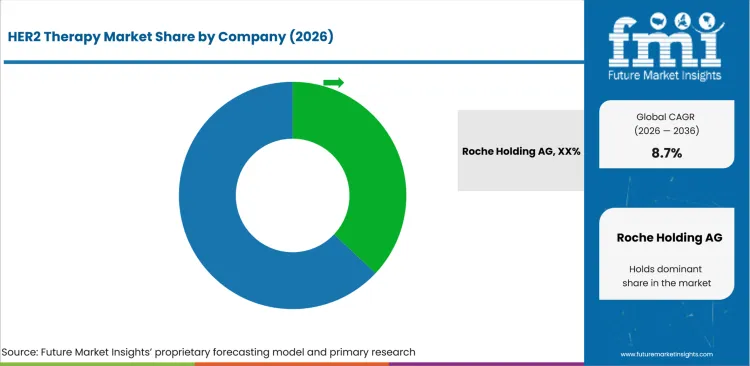
Competition combines originator antibodies, co-developed conjugates, biosimilars and licensed bispecific platforms, with entry dependent on biomarker-linked approvals and safety evidence across breast and non-breast programs. Non-breast expansion depends on gastroesophageal therapeutics evidence and hospital support that places each therapy within a defined sequence.
- Roche Holding AG, AstraZeneca PLC and Daiichi Sankyo Company, Limited combine established antibody franchises with broad conjugate development across several disease settings.
- Pfizer Inc., Merck & Co., Inc. and Amgen Inc. participate through kinase combinations, immunotherapy regimens and biosimilar exposure across defined indications.
- Zymeworks Inc. and Jazz Pharmaceuticals plc compete through a licensed bispecific platform whose value depends on additional approvals and regional commercialization.
Competitive Benchmarking: HER2 Therapy Market
| Company | Approved HER2 Modality Breadth | Breast Cancer Coverage | Non-Breast HER2 Coverage | Geographic Reach |
|---|---|---|---|---|
| Roche Holding AG | High | High | Medium | Global |
| AstraZeneca PLC | Medium | High | High | Global |
| Daiichi Sankyo Company, Limited | Medium | High | High | Global |
| Pfizer Inc. | High | High | Medium | Global |
| Merck & Co., Inc. | Low | Low | Medium | Global |
| Amgen Inc. | Low | Medium | Medium | Global |
| Zymeworks Inc. | Medium | Low | Medium | Global partner network |
| Jazz Pharmaceuticals plc | Medium | Low | Medium | North America and Europe |
Scoring basis: High modality breadth requires two approved direct HER2 modalities, Medium requires one approved multi-indication platform and Low identifies narrower biosimilar or combination participation. High breast coverage requires early and metastatic approvals, Medium represents one approved setting and Low represents no direct breast indication. Non-breast coverage uses equivalent thresholds, while geographic reach records verified commercial or partner regions.
Key Developments in the HER2 Therapy Market
- In June 2026, Pfizer Inc. received FDA approval for palbociclib with trastuzumab and endocrine therapy as maintenance treatment for HR-positive HER2-positive advanced breast cancer following induction therapy.
- In May 2026, AstraZeneca PLC and Daiichi Sankyo Company, Limited received FDA approval for trastuzumab deruxtecan in neoadjuvant treatment and residual disease following neoadjuvant therapy.
- In July 2025, Jazz Pharmaceuticals plc received European Commission authorization for Ziihera in previously treated HER2-positive biliary tract cancer, giving its bispecific platform a commercial non-breast route.
Key Players in the HER2 Therapy Market
Established HER2 Commercial Platforms
- Roche Holding AG
- AstraZeneca PLC
- Daiichi Sankyo Company, Limited
- Pfizer Inc.
Diversified Oncology and Biosimilar Participants
- Merck & Co., Inc.
- Amgen Inc.
HER2 Bispecific Platform Participants
- Zymeworks Inc.
- Jazz Pharmaceuticals plc
HER2 Therapy Market - Report Scope
| Coverage field | Report scope |
|---|---|
| Market breakdown | By drug class, indication, route of administration, distribution channel and region. |
| Quantitative Units | USD Billion. |
| Market Definition | Biomarker-defined HER2 therapies across breast cancer and included solid tumors. |
| Regions Covered | North America, Latin America, Europe, East Asia, South Asia and Pacific, and Middle East and Africa. |
| Countries Covered | Japan, United Kingdom, United States, France, Germany, and 20+ countries included in the full report. |
| Key Companies Profiled | Roche Holding AG, AstraZeneca PLC, Daiichi Sankyo Company, Limited, Pfizer Inc., Merck & Co., Inc., Amgen Inc., Zymeworks Inc., and Jazz Pharmaceuticals plc. |
| Forecast Period | 2026 to 2036. |
| Approach | Primary and secondary research with market triangulation. |
HER2 Therapy Market - Research Methodology
| Method | Approach |
|---|---|
| Primary Research | FMI analysts gathered input from manufacturers, service providers, technology developers, distributors, end users, procurement teams, and subject-matter experts. Interviews examined purchasing decisions, product or service evaluation, adoption barriers, approval requirements, pricing considerations, and expectations for technical or commercial support. Respondents were also asked what evidence is required before a trial, pilot, or initial order develops into regular purchasing. |
| Desk Research | Desk research covered government statistics, regulatory publications, trade data, industry associations, technical literature, standards, company filings, product information, and official corporate announcements. Sources were reviewed for relevance, publication date, geographic coverage, and consistency with the defined market scope. Claims relating to performance, applications, approvals, capacity, investment, and commercial activity were retained only when supported by credible public evidence. |
| Market Sizing and Forecasting | The market model combined the baseline value with historical performance, segment structure, pricing and volume indicators, adoption levels, company participation, and country-level demand conditions. Forecast assumptions considered economic activity, investment trends, regulatory developments, technology adoption, purchasing cycles, supply availability, and barriers to wider market use. Segment and regional estimates were reconciled before the final market total was calculated. |
| Data Validation | Estimates were checked against multiple independent indicators, including public data, company activity, trade patterns, industry developments, and findings from primary interviews. Validation also tested whether products, services, applications, and company revenues fell within the defined market boundaries. Adjacent categories, unsupported claims, overlapping revenues, and activities without direct market relevance were excluded to reduce double counting and maintain consistency across segments and countries. |
HER2 Therapy Market by Segments
HER2 Therapy Market segmented by Drug Class:
- Monoclonal Antibodies
- Antibody-Drug Conjugates
- Tyrosine Kinase Inhibitors
- Bispecific Antibodies and Pipeline Therapies
HER2 Therapy Market segmented by Indication:
- HER2-positive Breast Cancer
- Gastric and Gastroesophageal Cancer
- Non-small Cell Lung Cancer
- Other Solid Tumors
HER2 Therapy Market segmented by Route of Administration:
- Injectable
- Oral
- Combination Therapy
HER2 Therapy Market segmented by Distribution Channel:
- Hospital Pharmacies
- Specialty Pharmacies
- Retail and Online Pharmacies
HER2 Therapy Market by Region
- North America
- United States
- Canada
- Mexico
- Latin America
- Brazil
- Chile
- Rest of Latin America
- Western Europe
- Germany
- United Kingdom
- Italy
- Spain
- France
- Nordics
- Benelux
- Rest of Western Europe
- Eastern Europe
- Russia
- Poland
- Hungary
- Balkan and Baltic States
- Rest of Eastern Europe
- East Asia
- China
- Japan
- South Korea
- South Asia and Pacific
- India
- ASEAN
- Australia and New Zealand
- Rest of South Asia and Pacific
- Middle East and Africa
- Kingdom of Saudi Arabia
- Other GCC Countries
- Türkiye
- South Africa
- Other African Union Countries
- Rest of Middle East and Africa
Research Sources and Bibliography
- USA Food and Drug Administration. (2025, January 27). FDA approves fam-trastuzumab deruxtecan-nxki for unresectable or metastatic HR-positive, HER2-low or HER2-ultralow breast cancer.
- National Institute for Health and Care Excellence. (2025, November 19). Trastuzumab deruxtecan for treating hormone receptor-positive HER2-low metastatic breast cancer after 2 or more endocrine treatments (terminated appraisal).
- Daiichi Sankyo Company, Limited. (2026, March 23). ENHERTU Approved in Japan as First Tumor Agnostic HER2 Directed Medicine for Previously Treated Patients with HER2 Positive Metastatic Solid Tumors.
- Medicines and Healthcare products Regulatory Agency. (2025, April 9). Trastuzumab deruxtecan approved to treat adults with HER2-positive cancer that has spread or cannot be removed by surgery.
- USA Food and Drug Administration. (2025, December 15). FDA approves fam-trastuzumab deruxtecan-nxki with pertuzumab for unresectable or metastatic HER2-positive breast cancer.
- Haute Autorité de Santé. (2026, February 11). ENHERTU (trastuzumab déruxtécan) - Adénocarcinome gastrique ou de la jonction œsogastrique.
- Federal Joint Committee. (2025, October 16). Arzneimittel-Richtlinie/Anlage XII: Trastuzumab deruxtecan (Neues Anwendungsgebiet: Mammakarzinom, HR+, HER2-low oder -ultralow, nach mind. 1 endokrinen Therapie).
- USA Food and Drug Administration. (2026, June 24). FDA approves palbociclib with trastuzumab, with or without pertuzumab, and endocrine therapy for the maintenance treatment of HR-positive, HER2-positive metastatic breast cancer.
- USA Food and Drug Administration. (2026, May 15). FDA approves two separate indications for fam-trastuzumab deruxtecan-nxki in HER2-positive early-stage breast cancer.
- Jazz Pharmaceuticals plc. (2025, July 1). Jazz Pharmaceuticals Receives European Commission Marketing Authorization for Ziihera® (zanidatamab) for the Treatment of Advanced HER2-Positive Biliary Tract Cancer.
This bibliography is provided for reader reference and is not exhaustive. The full report contains the complete reference list and detailed citations
This Report Answers
- How does biomarker expansion change treatment eligibility?
- Which evidence requirements govern routine prescribing?
- Why do monoclonal antibodies remain central?
- Why does HER2-positive breast cancer lead?
- How do administration routes affect delivery?
- Why do hospital pharmacies lead distribution?
- How do national appraisal routes differ?
- Which capabilities shape company competition?
Frequently Asked Questions
How big is the HER2 therapy market in 2026?
The HER2 therapy market is estimated at USD 16.8 billion in 2026. Growth is driven by increasing use of HER2-targeted treatments across breast cancer and other HER2-positive solid tumors.
What is the CAGR of the HER2 therapy market from 2026 to 2036?
The HER2 therapy market is projected to grow at a CAGR of 8.7% between 2026 and 2036. Market expansion is supported by broader treatment indications and continued advances in targeted oncology therapies.
Which drug class is projected to account for 42.0% of the HER2 therapy market?
Monoclonal antibodies are projected to account for 42.0% of the market in 2026. Their leading position is supported by the widespread use of trastuzumab-based regimens in both early-stage and metastatic disease settings.
How much value is the HER2 therapy market projected to add from 2026 to 2036?
The HER2 therapy market is expected to add USD 22.08 billion in value between 2026 and 2036. Growth reflects expanding biomarker-defined patient populations and increasing adoption of targeted treatment options.
Which companies are active in the HER2 therapy market?
Key companies operating in the market include Roche Holding AG, AstraZeneca PLC, Daiichi Sankyo Company, Limited, Pfizer Inc., Merck & Co., Inc., Amgen Inc., Zymeworks Inc., and Jazz Pharmaceuticals plc. These companies are involved in developing monoclonal antibodies, antibody-drug conjugates, biosimilars, and bispecific therapies.
Preview the report firsthand - request a free sample
Get SampleGet the brochure for pricing and purchase details.
Get PDFTable of Content
- Key Takeaways
- Market Size and CAGR
- Top Growth Driver
- Fastest Growing Segment
- Leading Region
- Key Companies
- Emerging Opportunities
- Executive Summary
- Global Market Outlook
- Demand-side Trends
- Supply-side Trends
- Technology Roadmap Analysis
- Analysis and Recommendations
- Analyst Perspective (What is happening? Why now? What should investors know?)
- Key Questions Answered
- How large is the market?
- What is the CAGR?
- What are key trends?
- Which region dominates?
- Who are the leaders?
- Market Overview
- Market Coverage / Taxonomy
- Market Definition / Scope / Limitations
- Research Methodology
- Chapter Orientation
- Analytical Lens and Working Hypotheses
- Market Structure, Signals, and Trend Drivers
- Benchmarking and Cross-market Comparability
- Market Sizing, Forecasting, and Opportunity Mapping
- Research Design and Evidence Framework
- Desk Research Programme (Secondary Evidence)
- Expert Input and Fieldwork (Primary Evidence)
- Tooling, Models, and Reference Databases
- Data Engineering and Model Build
- Quality Assurance and Audit Trail
- Market Background
- Market Dynamics (Drivers, Restraints, Opportunity, Trends)
- Scenario Forecast (Optimistic, Likely, Conservative)
- Impact Analysis
- AI Impact
- Sustainability Impact
- Regulatory Impact
- Technology Impact
- Consumer / Buyer Analysis
- Purchase Drivers
- Adoption Barriers
- Buyer Journey
- Opportunity Map Analysis
- Product Life Cycle Analysis
- Supply Chain Analysis
- Investment Feasibility Matrix
- Value Chain Analysis
- PESTLE and Porter's Analysis
- Regulatory Landscape
- Regional Parent Market Outlook
- Production and Consumption Statistics
- Import and Export Statistics
- Global Market Analysis and Forecast, 2021 to 2036
- Historical Market Size Value (USD Billion) Analysis, 2021 to 2025
- Current and Future Market Size Value (USD Billion) Projections, 2026 to 2036
- Y-o-Y Growth Trend Analysis
- Absolute $ Opportunity Analysis
- Global Market Pricing Analysis, 2021 to 2036
- Global Market Analysis and Forecast, By Drug Class, 2021 to 2036
- Introduction / Key Findings
- Historical Market Size Value (USD Billion) Analysis By Drug Class, 2021 to 2025
- Current and Future Market Size Value (USD Billion) Analysis and Forecast By Drug Class, 2026 to 2036
- Monoclonal Antibodies
- Trastuzumab
- Pertuzumab
- Margetuximab
- Antibody-Drug Conjugates
- Trastuzumab Emtansine
- Trastuzumab Deruxtecan
- Next-generation HER2 ADCs
- Tyrosine Kinase Inhibitors
- Tucatinib
- Lapatinib
- Neratinib
- Bispecific Antibodies & Pipeline Therapies
- HER2-targeted Bispecific Antibodies
- Combination Immunotherapies
- Novel HER2-targeted Agents
- Monoclonal Antibodies
- Y-o-Y Growth Trend Analysis By Drug Class, 2021 to 2025
- Absolute $ Opportunity Analysis By Drug Class, 2026 to 2036
- Global Market Analysis and Forecast, By Indication, 2021 to 2036
- Introduction / Key Findings
- Historical Market Size Value (USD Billion) Analysis By Indication, 2021 to 2025
- Current and Future Market Size Value (USD Billion) Analysis and Forecast By Indication, 2026 to 2036
- HER2-positive Breast Cancer
- Early-stage Breast Cancer
- Metastatic Breast Cancer
- Neoadjuvant & Adjuvant Therapy
- Gastric & Gastroesophageal Cancer
- Advanced Gastric Cancer
- Metastatic Gastroesophageal Junction Cancer
- HER2-positive Gastric Adenocarcinoma
- Non-small Cell Lung Cancer
- HER2-mutant NSCLC
- Advanced NSCLC
- Recurrent NSCLC
- Other Solid Tumors
- Colorectal Cancer
- Biliary Tract Cancer
- Endometrial Cancer
- HER2-positive Breast Cancer
- Y-o-Y Growth Trend Analysis By Indication, 2021 to 2025
- Absolute $ Opportunity Analysis By Indication, 2026 to 2036
- Global Market Analysis and Forecast, By Route of Administration, 2021 to 2036
- Introduction / Key Findings
- Historical Market Size Value (USD Billion) Analysis By Route of Administration, 2021 to 2025
- Current and Future Market Size Value (USD Billion) Analysis and Forecast By Route of Administration, 2026 to 2036
- Injectable
- Intravenous Infusion
- Subcutaneous Injection
- Hospital-administered Therapy
- Oral
- Oral Tyrosine Kinase Inhibitors
- Daily Oral Therapy
- Combination Oral Regimens
- Combination Therapy
- Targeted Therapy - Chemotherapy
- Targeted Therapy - Immunotherapy
- Dual HER2 Blockade
- Injectable
- Y-o-Y Growth Trend Analysis By Route of Administration, 2021 to 2025
- Absolute $ Opportunity Analysis By Route of Administration, 2026 to 2036
- Global Market Analysis and Forecast, By Distribution Channel, 2021 to 2036
- Introduction / Key Findings
- Historical Market Size Value (USD Billion) Analysis By Distribution Channel, 2021 to 2025
- Current and Future Market Size Value (USD Billion) Analysis and Forecast By Distribution Channel, 2026 to 2036
- Hospital Pharmacies
- Inpatient Pharmacies
- Outpatient Hospital Pharmacies
- Oncology Pharmacy Units
- Specialty Pharmacies
- Biologic Drug Distribution
- Oncology Specialty Pharmacies
- Cold Chain Distribution
- Retail & Online Pharmacies
- Chain Pharmacies
- E-pharmacy Platforms
- Home Delivery Services
- Hospital Pharmacies
- Y-o-Y Growth Trend Analysis By Distribution Channel, 2021 to 2025
- Absolute $ Opportunity Analysis By Distribution Channel, 2026 to 2036
- Global Market Analysis and Forecast, By Route of Administration, 2021 to 2036
- Introduction / Key Findings
- Historical Market Size Value (USD Billion) Analysis By Route of Administration, 2021 to 2025
- Current and Future Market Size Value (USD Billion) Analysis and Forecast By Route of Administration, 2026 to 2036
- Injectable
- Intravenous Infusion
- Subcutaneous Injection
- Hospital-administered Therapy
- Oral
- Oral Tyrosine Kinase Inhibitors
- Daily Oral Therapy
- Combination Oral Regimens
- Combination Therapy
- Targeted Therapy - Chemotherapy
- Targeted Therapy - Immunotherapy
- Dual HER2 Blockade
- Injectable
- Y-o-Y Growth Trend Analysis By Route of Administration, 2021 to 2025
- Absolute $ Opportunity Analysis By Route of Administration, 2026 to 2036
- Global Market Analysis and Forecast, By Region, 2021 to 2036
- Introduction
- Historical Market Size Value (USD Billion) Analysis By Region, 2021 to 2025
- Current Market Size Value (USD Billion) Analysis and Forecast By Region, 2026 to 2036
- North America
- Latin America
- Western Europe
- Eastern Europe
- East Asia
- South Asia and Pacific
- Middle East & Africa
- Market Attractiveness Analysis By Region
- North America Market Analysis and Forecast, By Country, 2021 to 2036
- Historical Market Size Value (USD Billion) Trend Analysis By Market Taxonomy, 2021 to 2025
- Market Size Value (USD Billion) Forecast By Market Taxonomy, 2026 to 2036
- By Country
- USA
- Canada
- By Drug Class
- By Indication
- By Route of Administration
- By Distribution Channel
- By Route of Administration
- By Country
- Market Attractiveness Analysis
- By Country
- By Drug Class
- By Indication
- By Route of Administration
- By Distribution Channel
- By Route of Administration
- Key Takeaways
- Latin America Market Analysis and Forecast, By Country
- Historical Market Size Value (USD Billion) Trend Analysis By Market Taxonomy, 2021 to 2025
- Market Size Value (USD Billion) Forecast By Market Taxonomy, 2026 to 2036
- By Country
- Brazil
- Mexico
- Chile
- Rest of Latin America
- By Drug Class
- By Indication
- By Route of Administration
- By Distribution Channel
- By Route of Administration
- By Country
- Market Attractiveness Analysis
- By Country
- By Drug Class
- By Indication
- By Route of Administration
- By Distribution Channel
- By Route of Administration
- Key Takeaways
- Western Europe Market Analysis and Forecast, By Country
- Historical Market Size Value (USD Billion) Trend Analysis By Market Taxonomy, 2021 to 2025
- Market Size Value (USD Billion) Forecast By Market Taxonomy, 2026 to 2036
- By Country
- Germany
- UK
- Italy
- Spain
- France
- Nordic
- BENELUX
- Rest of Western Europe
- By Drug Class
- By Indication
- By Route of Administration
- By Distribution Channel
- By Route of Administration
- By Country
- Market Attractiveness Analysis
- By Country
- By Drug Class
- By Indication
- By Route of Administration
- By Distribution Channel
- By Route of Administration
- Key Takeaways
- Eastern Europe Market Analysis and Forecast, By Country
- Historical Market Size Value (USD Billion) Trend Analysis By Market Taxonomy, 2021 to 2025
- Market Size Value (USD Billion) Forecast By Market Taxonomy, 2026 to 2036
- By Country
- Russia
- Poland
- Hungary
- Balkan & Baltic
- Rest of Eastern Europe
- By Drug Class
- By Indication
- By Route of Administration
- By Distribution Channel
- By Route of Administration
- By Country
- Market Attractiveness Analysis
- By Country
- By Drug Class
- By Indication
- By Route of Administration
- By Distribution Channel
- By Route of Administration
- Key Takeaways
- East Asia Market Analysis and Forecast, By Country
- Historical Market Size Value (USD Billion) Trend Analysis By Market Taxonomy, 2021 to 2025
- Market Size Value (USD Billion) Forecast By Market Taxonomy, 2026 to 2036
- By Country
- China
- Japan
- South Korea
- By Drug Class
- By Indication
- By Route of Administration
- By Distribution Channel
- By Route of Administration
- By Country
- Market Attractiveness Analysis
- By Country
- By Drug Class
- By Indication
- By Route of Administration
- By Distribution Channel
- By Route of Administration
- Key Takeaways
- South Asia and Pacific Market Analysis and Forecast, By Country
- Historical Market Size Value (USD Billion) Trend Analysis By Market Taxonomy, 2021 to 2025
- Market Size Value (USD Billion) Forecast By Market Taxonomy, 2026 to 2036
- By Country
- India
- ASEAN
- Australia & New Zealand
- Rest of South Asia and Pacific
- By Drug Class
- By Indication
- By Route of Administration
- By Distribution Channel
- By Route of Administration
- By Country
- Market Attractiveness Analysis
- By Country
- By Drug Class
- By Indication
- By Route of Administration
- By Distribution Channel
- By Route of Administration
- Key Takeaways
- Middle East & Africa Market Analysis and Forecast, By Country
- Historical Market Size Value (USD Billion) Trend Analysis By Market Taxonomy, 2021 to 2025
- Market Size Value (USD Billion) Forecast By Market Taxonomy, 2026 to 2036
- By Country
- Kingdom of Saudi Arabia
- Other GCC Countries
- Türkiye
- South Africa
- Other African Union
- Rest of Middle East & Africa
- By Drug Class
- By Indication
- By Route of Administration
- By Distribution Channel
- By Route of Administration
- By Country
- Market Attractiveness Analysis
- By Country
- By Drug Class
- By Indication
- By Route of Administration
- By Distribution Channel
- By Route of Administration
- Key Takeaways
- Key Countries Market Analysis
- USA
- Pricing Analysis
- Market Share Analysis, 2025
- By Drug Class
- By Indication
- By Route of Administration
- By Distribution Channel
- By Route of Administration
- Canada
- Pricing Analysis
- Market Share Analysis, 2025
- By Drug Class
- By Indication
- By Route of Administration
- By Distribution Channel
- By Route of Administration
- Mexico
- Pricing Analysis
- Market Share Analysis, 2025
- By Drug Class
- By Indication
- By Route of Administration
- By Distribution Channel
- By Route of Administration
- Brazil
- Pricing Analysis
- Market Share Analysis, 2025
- By Drug Class
- By Indication
- By Route of Administration
- By Distribution Channel
- By Route of Administration
- Chile
- Pricing Analysis
- Market Share Analysis, 2025
- By Drug Class
- By Indication
- By Route of Administration
- By Distribution Channel
- By Route of Administration
- Germany
- Pricing Analysis
- Market Share Analysis, 2025
- By Drug Class
- By Indication
- By Route of Administration
- By Distribution Channel
- By Route of Administration
- UK
- Pricing Analysis
- Market Share Analysis, 2025
- By Drug Class
- By Indication
- By Route of Administration
- By Distribution Channel
- By Route of Administration
- Italy
- Pricing Analysis
- Market Share Analysis, 2025
- By Drug Class
- By Indication
- By Route of Administration
- By Distribution Channel
- By Route of Administration
- Spain
- Pricing Analysis
- Market Share Analysis, 2025
- By Drug Class
- By Indication
- By Route of Administration
- By Distribution Channel
- By Route of Administration
- France
- Pricing Analysis
- Market Share Analysis, 2025
- By Drug Class
- By Indication
- By Route of Administration
- By Distribution Channel
- By Route of Administration
- India
- Pricing Analysis
- Market Share Analysis, 2025
- By Drug Class
- By Indication
- By Route of Administration
- By Distribution Channel
- By Route of Administration
- ASEAN
- Pricing Analysis
- Market Share Analysis, 2025
- By Drug Class
- By Indication
- By Route of Administration
- By Distribution Channel
- By Route of Administration
- Australia & New Zealand
- Pricing Analysis
- Market Share Analysis, 2025
- By Drug Class
- By Indication
- By Route of Administration
- By Distribution Channel
- By Route of Administration
- China
- Pricing Analysis
- Market Share Analysis, 2025
- By Drug Class
- By Indication
- By Route of Administration
- By Distribution Channel
- By Route of Administration
- Japan
- Pricing Analysis
- Market Share Analysis, 2025
- By Drug Class
- By Indication
- By Route of Administration
- By Distribution Channel
- By Route of Administration
- South Korea
- Pricing Analysis
- Market Share Analysis, 2025
- By Drug Class
- By Indication
- By Route of Administration
- By Distribution Channel
- By Route of Administration
- Russia
- Pricing Analysis
- Market Share Analysis, 2025
- By Drug Class
- By Indication
- By Route of Administration
- By Distribution Channel
- By Route of Administration
- Poland
- Pricing Analysis
- Market Share Analysis, 2025
- By Drug Class
- By Indication
- By Route of Administration
- By Distribution Channel
- By Route of Administration
- Hungary
- Pricing Analysis
- Market Share Analysis, 2025
- By Drug Class
- By Indication
- By Route of Administration
- By Distribution Channel
- By Route of Administration
- Kingdom of Saudi Arabia
- Pricing Analysis
- Market Share Analysis, 2025
- By Drug Class
- By Indication
- By Route of Administration
- By Distribution Channel
- By Route of Administration
- Türkiye
- Pricing Analysis
- Market Share Analysis, 2025
- By Drug Class
- By Indication
- By Route of Administration
- By Distribution Channel
- By Route of Administration
- South Africa
- Pricing Analysis
- Market Share Analysis, 2025
- By Drug Class
- By Indication
- By Route of Administration
- By Distribution Channel
- By Route of Administration
- USA
- Market Structure Analysis
- Competition Dashboard
- Competition Benchmarking
- Market Share Analysis of Top Players
- By Regional
- By Drug Class
- By Indication
- By Route of Administration
- By Distribution Channel
- By Route of Administration
- Emerging Startups
- Innovation Benchmarking
- Competition Analysis
- Competition Deep Dive
- Roche Holding AG
- Overview
- Product Portfolio
- Profitability by Market Segments
- Sales Footprint
- Strategy Overview
- Marketing Strategy
- Product Strategy
- Channel Strategy
- AstraZeneca PLC
- Pfizer Inc.
- Daiichi Sankyo Company, Limited
- Merck & Co., Inc.
- Novartis AG
- Amgen Inc.
- MacroGenics, Inc.
- Zymeworks Inc.
- Jazz Pharmaceuticals plc
- Roche Holding AG
- Case Studies
- Success Stories
- Recent Developments
- Competition Deep Dive
- Assumptions & Acronyms Used


