

- Market Size (2026)
- USD 0.5 Bn
- Forecast (2036)
- USD 5.9 Bn
- CAGR (2026 to 2036)
- 28.1%
How big is the Treg Therapy Market in 2026?
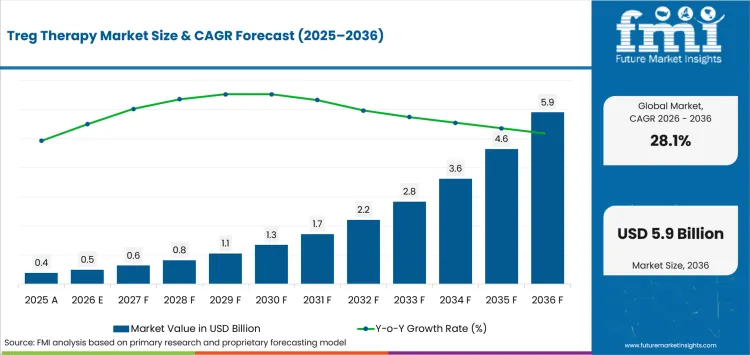
USD 0.5 billion in 2026 and USD 5.9 billion by 2036 at a 28.1% CAGR.
Sales in the Treg therapy market are projected to grow at 28.1% CAGR through 2036, driving valuation to USD 5.9 billion by 2036 from USD 0.5 billion in 2026. Regulatory experience with complex cellular products gives immune-tolerance programs a clearer development base, but every sponsor must establish product-specific potency and comparability evidence.
Recurring development demand comes from cell therapy clinical trials that require regulatory planning and manufacturing evidence at each stage. In January 2026, FDA reported that CBER had approved close to 50 cell and gene therapies during the prior decade. That approval base expands regulatory experience while preserving the need for Treg-specific release methods and treatment-site coordination.
Key Takeaways of Treg Therapy Market
- Clinical demand rises as developers test immune-tolerance strategies across autoimmune disease and transplantation without broad lifelong immunosuppression.
- Polyclonal Treg therapy is projected to represent 43.0% by therapy type in 2026 due to established expansion routes.
- Autologous Treg cells are estimated to account for 54.0% of cell source demand in 2026 owing to patient matching.
- Autoimmune diseases are forecast to capture 42.0% share in 2026 supported by biomarker-led development programs.
- Batch variability and individualized scheduling restrict scale as each product must preserve identity and suppressive potency across manufacturing changes.
- Abata Therapeutics, Cellenkos Inc., Coya Therapeutics, Quell Therapeutics, Sonoma Biotherapeutics, Nektar Therapeutics, Sangamo Therapeutics and Singulera Therapeutics serve distinct cell-based and in vivo Treg development routes.
Analyst Perspective
"Regulators and trial sites cannot judge a Treg product from cell identity alone during release testing. Commercial advantage depends on linking suppressive potency after expansion and thawing with disease-specific biomarkers before larger trials multiply batch and site variability."
- Anurag Sharma, Principal Consultant, Future Market Insights
How is the Treg Therapy Market segmented?
The Treg therapy industry is segmented by therapy type, cell source, application, end user, target indication and region.
The Treg therapy market is segmented by therapy type, cell source, application, end user, target indication and region. Therapy type covers polyclonal, antigen-specific and engineered Treg therapy, including autologous or allogeneic polyclonal cells, antigen- or autoantigen-specific cells, CAR-Tregs and gene-modified Tregs. Cell sources include patient-derived or ex vivo expanded autologous cells, donor-derived or off-the-shelf allogeneic cells, iTregs and stem cell-derived Tregs. Applications cover autoimmune disease, organ transplantation, acute or chronic graft-versus-host disease and inflammatory disorders including Crohn’s disease or inflammatory bowel disease. End users include tertiary or university hospitals, immunology or transplantation clinics, academic centers, clinical research organizations and specialized cell therapy facilities. Target indications cover autoimmune diabetes or islet transplantation, acute or chronic graft-versus-host disease, systemic autoimmune disease or lupus nephritis, Crohn’s disease or ulcerative colitis, kidney or liver transplantation, multiple sclerosis and allergic or inflammatory disorders.
What supports polyclonal Treg therapy within the therapy type category?
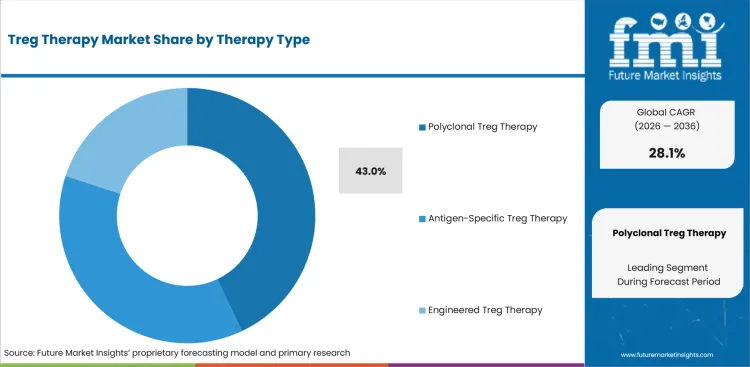
Polyclonal Treg therapy expands naturally occurring suppressive cells without adding a receptor to every product. The approach supports broad immune regulation across autologous programs and allogeneic T-cell therapies, although heterogeneous populations complicate dose selection and potency interpretation across manufacturing sites.
- By therapy type, polyclonal Treg therapy is estimated to hold 43.0% share in 2026 owing to established expansion methods and broad suppressive activity.
- Kidney-transplant programs provide a direct test of broad suppressive function across several clinically relevant alloantigens. ClinicalTrials.gov updated the RETIRE Phase 2 record in April 2026 for expanded autologous Tregs, which keeps release consistency and five-year follow-up central to wider use.
How does autologous Treg cell sourcing influence treatment planning?
Autologous Treg cells use each patient as starting material and connect cell therapy manufacturing records directly with the treated individual. ClinicalTrials.gov reported in July 2025 that ABA-101 remained an autologous Phase 1 product within engineered cell therapy workflows, underscoring variable starting material shaped by disease status and prior treatment.
- In 2026, autologous Treg cells are expected to lead the cell source category with 54.0% share because patient matching reduces compatibility risk.
- Gene therapy manufacturing partners can support receptor engineering and closed processing across individualized clinical workflows. Treatment centers must preserve chain-of-identity controls from collection through dosing as outsourced capacity cannot remove patient-specific scheduling.
What makes autoimmune diseases central to the application category?
Autoimmune diseases give Treg programs a direct tolerance objective as persistent immune attack damages healthy tissue. Existing autoimmune disease therapeutics provide established clinical comparators and biomarkers for testing whether regulatory cells change flare patterns or tissue injury.
- Based on application, autoimmune diseases are projected to account for 42.0% share in 2026 due to biomarker-supported development across chronic immune conditions.
- Longitudinal clinical studies must confirm durable disease control without prolonged generalized suppression across diverse patient groups. ClinicalTrials.gov updated the SBT-77-7101 rheumatoid arthritis study in April 2026, placing antigen-directed Tregs within established treatment pathways and monitoring schedules.
What role do hospitals play within the end user category?
Hospitals combine cell handling with specialist oversight and adverse-event management inside one coordinated clinical setting. ClinicalTrials.gov reported in May 2026 that the COYA 302 Phase 2 study was recruiting through 25 U.S. and Canadian locations across regenerative medicine infrastructure built for complex treatment protocols.
- The hospitals segment is likely to capture 46.0% share in 2026 attributable to integrated handling and specialist monitoring across complex treatment protocols.
- Distributed studies depend on trained clinical teams that can apply one protocol consistently across several sites. Coordinated collection and follow-up make hospitals central to accurate dosing and reliable long-term patient monitoring.
What are the drivers, restraints and opportunities in the Treg Therapy Market?
Clinical programs test targeted immune tolerance across autoimmune disease and transplantation despite variable starting material, with antigen-directed platforms supporting disease-specific development routes.
- Driver: Clinical programs connect suppressive activity with measurable immune and organ-specific endpoints across autoimmune disease and transplantation.
- Restraint: Variable starting material complicates release testing and weakens dose consistency across individualized manufacturing and treatment scheduling.
- Opportunity: Antigen-directed cells and selective in vivo stimulation align treatment design with disease biology and site capabilities.
Clinical credibility depends on endpoints that connect suppressive activity with organ function and immune markers across advanced therapy medicinal products. Quell reported in March 2026 that its LIBERATE study measured phenotype stability, durability and tissue trafficking for QEL-001. Those linked measures help sponsors distinguish functional persistence from a batch that passes identity testing alone.
Manufacturing variability slows adoption as starting material changes with disease status and prior treatment exposure. Biologics contract manufacturing can add capacity, but release testing must confirm suppressive function following expansion and thawing rather than rely on surface-marker identity. Programs without a clear assay-to-outcome relationship face longer comparability work each time the process or site changes.
Disease-specific development favors antigen-directed cells or selective in vivo stimulation across indications with clear tissue targets and biomarkers. Stem cell therapy experience informs storage and site readiness, but Treg potency methods require separate validation. Treg developers can match engineered cells with localized control, donor-derived products with scheduled dosing and biologics with repeat outpatient administration.
Which country CAGRs are profiled in the Treg Therapy Market?
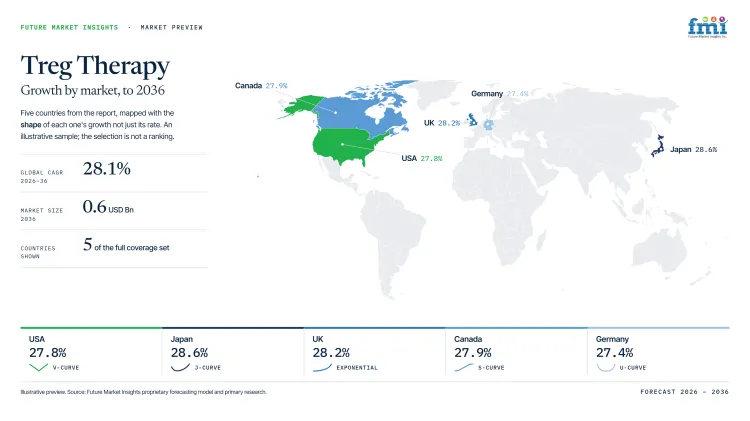
| Country | CAGR |
|---|---|
| South Korea | 30.1% |
| Japan | 28.6% |
| United Kingdom | 28.2% |
| United States | 27.8% |
| Germany | 27.4% |
How do country-level CAGRs compare in the Treg Therapy Market?
The displayed country CAGRs span 2.7 percentage points across five advanced regulatory systems and describe forecast pace rather than current market size.
- South Korea hints toward centralized cell-therapy oversight and specialist hospitals concentrated across major metropolitan treatment networks.
- Japan reflects structured consultation pathways and domestic regenerative medicine infrastructure across specialized urban clinical centers.
- The United Kingdom shows coordinated trial review and academic manufacturing networks that support complex multicenter programs.
- The United States presents broad clinical networks and established regulatory pathways for cellular biologics across major regions.
- Germany reflects strong ATMP expertise alongside demanding national and centralized European requirements for manufacturing evidence.
Comparable CAGRs can produce materially different entry conditions across national regulatory systems and specialized treatment networks. The full report covers country-level growth across North America, Latin America, Europe, East Asia, South Asia and Pacific, and the Middle East and Africa.
Country-wise Analysis
- South Korea combines specialist hospitals and domestic advanced cell-manufacturing clusters with centralized biopharmaceutical oversight for complex dosing programs that require potency testing and extended patient follow-up across regional research networks and clinical trial sites. South Korea is estimated to post 30.1% CAGR over the forecast period, driven by defined potency expectations despite limited specialist capacity beyond concentrated metropolitan hospitals and trained cell-processing teams outside major urban centers. In June 2025, MFDS issued stage-specific guidance covering potency method selection and validation across cell and gene therapy development as sponsors prepared consistent analytical packages for clinical progression and later-stage regulatory review nationwide.
- Japan combines dedicated PMDA consultation routes with metropolitan hospitals and domestic cell-processing partners that support regenerative product planning through translated quality records and tightly scheduled import or distribution arrangements for individualized therapeutic candidates nationwide. From June 2026, PMDA expanded the submission period for regenerative medical product consultation scheduling requests so sponsors gained additional filing flexibility during early quality and clinical planning across specialized regenerative medicine programs. Treg therapy sales in Japan are forecast to expand at 28.6% CAGR by 2036, influenced by structured consultations despite detailed Japanese dossiers and consistent release timing across multicenter studies at specialist domestic treatment centers.
- United Kingdom Treg programs use coordinated regulator review and academic hospital networks to connect patient screening with licensed advanced-therapy production and specialist follow-up across nationally distributed sites serving individualized cellular studies across the country. In April 2026, MHRA and HRA reported that combined review setup times fell from 169 days to 122 days as reforms streamlined safety and ethics decisions for clinical trials in commercial research programs. The United Kingdom's Treg therapy outlook is anticipated to advance at 28.2% CAGR over the assessment period, shaped by faster study activation despite demanding traceability and synchronized dosing across participating hospitals in distributed national networks.
- United States Treg programs use transplant centers and experienced cell-therapy investigators to coordinate patient collection with cryogenic delivery through established apheresis and transplant service routes across specialist networks that already handle individualized biologics. Adoption of Treg therapy in the United States is estimated to expand at 27.8% CAGR through 2036, supported by established FDA pathways and mature clinical infrastructure for cellular biologics across major regions. In May 2026, FDA issued guidance describing phase-appropriate CMC flexibility for cellular and gene therapy products as treatment centers retained responsibility for chain-of-identity controls and reliable administration during narrow dosing windows at distant specialist sites.
- Germany combines university hospitals and specialist manufacturing sites with early regulatory advice for advanced therapy studies that require coordinated quality planning across national trial centers and centralized European authorization procedures for individualized cellular products. The German Treg therapy sector is projected to record 27.4% CAGR during the assessment period, reinforced by product-specific consultation routes that address manufacturing and clinical development decisions across complex clinical programs. In July 2025, Paul-Ehrlich-Institut updated its national advice page covering manufacturing and clinical development as sponsors aligned German trial execution with European requirements and confirmed reliable transport logistics between regional hospitals and specialized manufacturing sites.
Who are the notable companies in the Treg Therapy Market?
Abata Therapeutics, Cellenkos Inc., Coya Therapeutics, Quell Therapeutics, Sonoma Biotherapeutics, Nektar Therapeutics, Sangamo Therapeutics and Singulera Therapeutics are the notable companies serving this market.
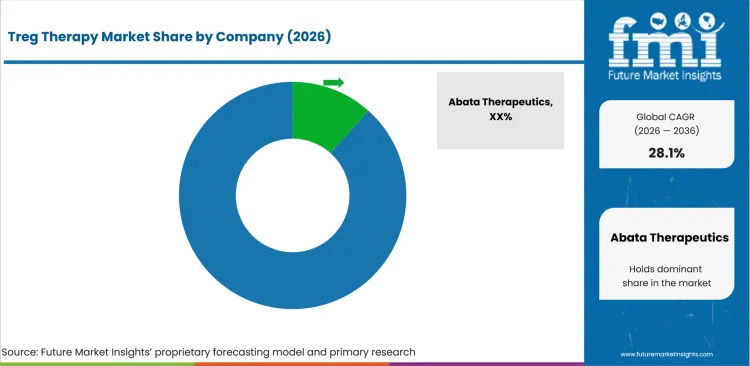
The field remains fragmented because each developer advances a distinct modality, indication or manufacturing route. Entry barriers come from Treg isolation, phenotype stability, potency testing, long-term follow-up and disease-specific regulatory evidence rather than commercial scale.
- Abata Therapeutics, Quell Therapeutics, Sonoma Biotherapeutics and Sangamo Therapeutics compete through antigen-directed engineered Treg products.
- Cellenkos Inc. and Singulera Therapeutics develop donor-derived or expanded non-engineered Treg products for hematology and transplantation.
- Coya Therapeutics and Nektar Therapeutics use injectable biologics that increase Treg number or function inside treated patients.
Competitive Benchmarking: Treg Therapy Market
| Company | Clinical Maturity | Target Specificity | Dosing Logistics | Geographic Reach |
|---|---|---|---|---|
| Abata Therapeutics | Low | High | Low | United States |
| Cellenkos Inc. | Medium | Low | High | United States |
| Coya Therapeutics | Medium | Medium | High | United States and Canada |
| Quell Therapeutics | Medium | High | Medium | United Kingdom, Germany and Spain |
| Sonoma Biotherapeutics | Low | High | Medium | United States |
| Nektar Therapeutics | High | Medium | High | Global |
| Sangamo Therapeutics | Medium | High | Low | Europe |
| Singulera Therapeutics | Medium | Low | Low | United States and Taiwan |
Key Developments in the Treg Therapy Market
- In July 2026, Nektar Therapeutics launched the first two 510-patient trials in the Phase 3 ZENITH AD program for rezpegaldesleukin.
- In July 2026, Sonoma Biotherapeutics signed a collaboration with Cellares to automate SBT-77-7101 manufacturing and release testing on the Cell Shuttle and Cell Q platforms.
- In March 2026, Quell Therapeutics launched the multinational CHILL Phase 1/2 study of QEL-005 following UK clinical trial authorization.
Key Players in the Treg Therapy Market
Engineered Treg Cell Developers
- Abata Therapeutics
- Quell Therapeutics
- Sonoma Biotherapeutics
- Sangamo Therapeutics
Allogeneic and Expanded Treg Platforms
- Cellenkos Inc.
- Singulera Therapeutics
Treg-Enhancing Biologics Platforms
- Coya Therapeutics
- Nektar Therapeutics
Treg Therapy Market - Report Scope
| Coverage field | Report scope |
|---|---|
| Market breakdown | By therapy type, cell source, application, end user, target indication and region. |
| Market Definition | Cell-based Treg therapies and Treg-enhancing therapeutic approaches for immune tolerance. |
| Regions Covered | North America, Latin America, Europe, East Asia, South Asia and Pacific, and Middle East and Africa. |
| Countries Covered | South Korea, Japan, United Kingdom, United States, Germany, and 20+ countries included in the full report. |
| Key Companies Profiled | Abata Therapeutics, Cellenkos Inc., Coya Therapeutics, Quell Therapeutics, Sonoma Biotherapeutics, Nektar Therapeutics, Sangamo Therapeutics and Singulera Therapeutics. |
| Forecast Period | 2026 to 2036. |
| Approach | Primary and secondary research with market triangulation. |
Treg Therapy Market - Research Methodology
| Method | Approach |
|---|---|
| Primary Research | FMI analysts gathered input from manufacturers, service providers, technology developers, distributors, end users, procurement teams, and subject-matter experts. Interviews examined purchasing decisions, product or service evaluation, adoption barriers, approval requirements, pricing considerations, and expectations for technical or commercial support. Respondents were also asked what evidence is required before a trial, pilot, or initial order develops into regular purchasing. |
| Desk Research | Desk research covered government statistics, regulatory publications, trade data, industry associations, technical literature, standards, company filings, product information, and official corporate announcements. Sources were reviewed for relevance, publication date, geographic coverage, and consistency with the defined market scope. Claims relating to performance, applications, approvals, capacity, investment, and commercial activity were retained only when supported by credible public evidence. |
| Market Sizing and Forecasting | The market model combined the baseline value with historical performance, segment structure, pricing and volume indicators, adoption levels, company participation, and country-level demand conditions. Forecast assumptions considered economic activity, investment trends, regulatory developments, technology adoption, purchasing cycles, supply availability, and barriers to wider market use. Segment and regional estimates were reconciled before the final market total was calculated. |
| Data Validation | Estimates were checked against multiple independent indicators, including public data, company activity, trade patterns, industry developments, and findings from primary interviews. Validation also tested whether products, services, applications, and company revenues fell within the defined market boundaries. Adjacent categories, unsupported claims, overlapping revenues, and activities without direct market relevance were excluded to reduce double counting and maintain consistency across segments and countries. |
Treg Therapy Market by Segments
Treg Therapy Market segmented by Therapy Type:
- Polyclonal Treg Therapy
- Autologous Polyclonal Tregs
- Allogeneic Polyclonal Tregs
- Antigen-Specific Treg Therapy
- Antigen-Specific Tregs
- Autoantigen-Specific Tregs
- Engineered Treg Therapy
- CAR-Treg Therapy
- Gene-Modified Treg Therapy
Treg Therapy Market segmented by Cell Source:
- Autologous Treg Cells
- Patient-Derived Tregs
- Ex Vivo Expanded Tregs
- Allogeneic Treg Cells
- Donor-Derived Tregs
- Off-the-Shelf Tregs
- Induced Treg Cells
- iTregs
- Stem Cell-Derived Tregs
Treg Therapy Market segmented by Application:
- Autoimmune Diseases
- Type 1 Diabetes
- Systemic Lupus Erythematosus
- Organ Transplantation
- Kidney Transplantation
- Liver Transplantation
- Graft-versus-Host Disease
- Acute GvHD
- Chronic GvHD
- Inflammatory Disorders
- Crohn’s Disease
- Inflammatory Bowel Disease
Treg Therapy Market segmented by End User:
- Hospitals
- Tertiary Care Hospitals
- University Hospitals
- Specialty Clinics
- Immunology Clinics
- Transplantation Clinics
- Research Institutes
- Academic Research Centers
- Clinical Research Organizations
- Cell Therapy Centers
- Specialized Cell Therapy Facilities
- Regenerative Medicine Centers
Treg Therapy Market segmented by Target Indication:
- Type 1 Diabetes
- Autoimmune Diabetes
- Islet Transplantation
- Graft-versus-Host Disease
- Acute GvHD
- Chronic GvHD
- Systemic Lupus Erythematosus
- Systemic Autoimmune Disease
- Lupus Nephritis
- Inflammatory Bowel Disease
- Crohn’s Disease
- Ulcerative Colitis
- Organ Transplantation
- Kidney Transplantation
- Liver Transplantation
- Others
- Multiple Sclerosis
- Allergic & Inflammatory Disorders
Treg Therapy Market by Region:
- North America
- United States
- Canada
- Mexico
- Latin America
- Brazil
- Chile
- Rest of Latin America
- Western Europe
- Germany
- United Kingdom
- Italy
- Spain
- France
- Nordics
- Benelux
- Rest of Western Europe
- Eastern Europe
- Russia
- Poland
- Hungary
- Balkan and Baltic States
- Rest of Eastern Europe
- East Asia
- China
- Japan
- South Korea
- South Asia and Pacific
- India
- ASEAN
- Australia and New Zealand
- Rest of South Asia and Pacific
- Middle East and Africa
- Kingdom of Saudi Arabia
- Other GCC Countries
- Türkiye
- South Africa
- Other African Union Countries
- Rest of Middle East and Africa
Research Sources and Bibliography
- USA Food and Drug Administration. (2026, January 11). FDA Increases Flexibility on Requirements for Cell and Gene Therapies to Advance Innovation.
- ClinicalTrials.gov. (2026, April 27). REgulatory T Cell Therapy to Achieve Immunosuppression REduction (RETIRE) (NCT06552169).
- ClinicalTrials.gov. (2025, July 3). ABA-101 in Participants With Progressive Multiple Sclerosis (NCT06566261).
- ClinicalTrials.gov. (2026, April 20). Study of Single Doses of SBT777101 in Subjects With Rheumatoid Arthritis (NCT06201416).
- ClinicalTrials.gov. (2026, May 20). Study of COYA 302 for the Treatment of ALS (NCT07161999).
- Quell Therapeutics. (2026, March 3). Quell Therapeutics Demonstrates Safety, Phenotypic Stability, Durability and Early Efficacy with Phenotype‑Locked™ CAR‑Tregs in LIBERATE Phase 1/2 Liver Transplant Study.
- Ministry of Food and Drug Safety. (2025, June 30).
- Pharmaceuticals and Medical Devices Agency. (2026, June).
- Medicines and Healthcare products Regulatory Agency & Health Research Authority. (2026, April 27). Launch of clinical trial reforms.
- U.S. Food and Drug Administration. (2026, May). Chemistry, Manufacturing, and Controls Flexibilities for Developing Human Cellular and Gene Therapy Products for a Biologics License Application.
- Paul-Ehrlich-Institut. (2025, July 1). Advice.
- ClinicalTrials.gov. (2026, April 3). CK0801 for Treatment of Aplastic Anemia (NCT07499102).
- Quell Therapeutics. (2026, March 3). Quell Therapeutics Initiates CHILL Phase 1/2 Trial of Novel QEL-005 CAR Treg Therapy in Refractory Rheumatoid Arthritis and Systemic Sclerosis Following UK CTA Approval.
- Nektar Therapeutics. (2026, July 21). Nektar Therapeutics Announces Start of Phase 3 ZENITH AD Program Evaluating Novel Regulatory T-Cell Biologic Rezpegaldesleukin in Moderate-to-Severe Atopic Dermatitis.
- ClinicalTrials.gov. (2025, February 10). Safety & Tolerability Study of Chimeric Antigen Receptor T-Reg Cell Therapy in Living Donor Renal Transplant Recipients (NCT04817774).
- Sonoma Biotherapeutics. (2026, July 13). Cellares and Sonoma Biotherapeutics Collaborate to Automate Manufacturing of SBT-77-7101 Engineered Treg Cell Therapy on the Cell Shuttle® Platform.
This bibliography is provided for reader reference and is not exhaustive. The full report contains the complete reference list and detailed citations.
This Report Answers
- How large is the Treg therapy market in 2026 and 2036?
- Which operating conditions support demand for Treg therapy across clinical programs?
- Which therapy type accounts for the significant 2026 share within Treg therapy?
- How does cell source selection shape manufacturing and treatment scheduling?
- Which application conditions support Treg therapy adoption across autoimmune disease?
- How do country growth rates differ for the Treg therapy market?
- Which companies develop engineered cells and Treg-enhancing biologics?
- What currently limits Treg therapy adoption across multicenter clinical environments?
Frequently Asked Questions
How big is the Treg therapy market in 2026?
The Treg therapy market is valued at USD 0.5 billion in 2026 and is forecast to reach USD 5.9 billion by 2036. Growth is supported by developers testing immune-tolerance strategies across autoimmune disease and transplantation as an alternative to broad lifelong immunosuppression.
What is the CAGR of the Treg therapy market from 2026 to 2036?
The Treg therapy market is projected to expand at 28.1% CAGR from 2026 to 2036 across multiple clinical sites. Clinical progress depends on reproducible manufacturing and disease-relevant biomarkers that demonstrate durable immune control without generalized suppression in larger patient programs worldwide.
Which therapy type is projected to account for 43.0% of the Treg therapy market?
Polyclonal Treg therapy is projected to account for 43.0% of the Treg therapy market by therapy type in 2026. Established expansion methods support broad suppressive activity across clinical programs even as heterogeneous cell populations require careful potency interpretation across batches and treatment centers.
How much will the Treg therapy market add between 2026 and 2036?
The Treg therapy market is set to add USD 5.4 billion between 2026 and 2036, growing from USD 0.5 billion to USD 5.9 billion as immune-tolerance programs expand across autoimmune disease, transplantation, and graft-versus-host disease clinical development.
Which companies are active in the Treg therapy market?
Companies active in the Treg therapy market include Abata Therapeutics, Cellenkos Inc., Coya Therapeutics and Quell Therapeutics. Sonoma Biotherapeutics, Nektar Therapeutics, Sangamo Therapeutics and Singulera Therapeutics extend the group across engineered cells and expanded Tregs with in vivo stimulation programs.
Preview the report firsthand - request a free sample
Get SampleGet the brochure for pricing and purchase details.
Get PDFTable of Content
- Key Takeaways
- Market Size and CAGR
- Top Growth Driver
- Fastest Growing Segment
- Leading Region
- Key Companies
- Emerging Opportunities
- Executive Summary
- Global Market Outlook
- Demand-side Trends
- Supply-side Trends
- Technology Roadmap Analysis
- Analysis and Recommendations
- Analyst Perspective (What is happening? Why now? What should investors know?)
- Key Questions Answered
- How large is the market?
- What is the CAGR?
- What are key trends?
- Which region dominates?
- Who are the leaders?
- Market Overview
- Market Coverage / Taxonomy
- Market Definition / Scope / Limitations
- Research Methodology
- Chapter Orientation
- Analytical Lens and Working Hypotheses
- Market Structure, Signals, and Trend Drivers
- Benchmarking and Cross-market Comparability
- Market Sizing, Forecasting, and Opportunity Mapping
- Research Design and Evidence Framework
- Desk Research Programme (Secondary Evidence)
- Expert Input and Fieldwork (Primary Evidence)
- Tooling, Models, and Reference Databases
- Data Engineering and Model Build
- Quality Assurance and Audit Trail
- Market Background
- Market Dynamics (Drivers, Restraints, Opportunity, Trends)
- Scenario Forecast (Optimistic, Likely, Conservative)
- Impact Analysis
- AI Impact
- Sustainability Impact
- Regulatory Impact
- Technology Impact
- Consumer / Buyer Analysis
- Purchase Drivers
- Adoption Barriers
- Buyer Journey
- Opportunity Map Analysis
- Product Life Cycle Analysis
- Supply Chain Analysis
- Investment Feasibility Matrix
- Value Chain Analysis
- PESTLE and Porter's Analysis
- Regulatory Landscape
- Regional Parent Market Outlook
- Production and Consumption Statistics
- Import and Export Statistics
- Global Market Analysis and Forecast, 2021 to 2036
- Historical Market Size Value (USD Billion) Analysis, 2021 to 2025
- Current and Future Market Size Value (USD Billion) Projections, 2026 to 2036
- Y-o-Y Growth Trend Analysis
- Absolute $ Opportunity Analysis
- Global Market Pricing Analysis, 2021 to 2036
- Global Market Analysis and Forecast, By Therapy Type, 2021 to 2036
- Introduction / Key Findings
- Historical Market Size Value (USD Billion) Analysis By Therapy Type, 2021 to 2025
- Current and Future Market Size Value (USD Billion) Analysis and Forecast By Therapy Type, 2026 to 2036
- Polyclonal Treg Therapy
- Autologous Polyclonal Tregs
- Allogeneic Polyclonal Tregs
- Antigen-Specific Treg Therapy
- Antigen-Specific Tregs
- Autoantigen-Specific Tregs
- Engineered Treg Therapy
- CAR-Treg Therapy
- Gene-Modified Treg Therapy
- Polyclonal Treg Therapy
- Y-o-Y Growth Trend Analysis By Therapy Type, 2021 to 2025
- Absolute $ Opportunity Analysis By Therapy Type, 2026 to 2036
- Global Market Analysis and Forecast, By Cell Source, 2021 to 2036
- Introduction / Key Findings
- Historical Market Size Value (USD Billion) Analysis By Cell Source, 2021 to 2025
- Current and Future Market Size Value (USD Billion) Analysis and Forecast By Cell Source, 2026 to 2036
- Autologous Treg Cells
- Patient-Derived Tregs
- Ex Vivo Expanded Tregs
- Allogeneic Treg Cells
- Donor-Derived Tregs
- Off-the-Shelf Tregs
- Induced Treg Cells
- iTregs
- Stem Cell-Derived Tregs
- Autologous Treg Cells
- Y-o-Y Growth Trend Analysis By Cell Source, 2021 to 2025
- Absolute $ Opportunity Analysis By Cell Source, 2026 to 2036
- Global Market Analysis and Forecast, By Application, 2021 to 2036
- Introduction / Key Findings
- Historical Market Size Value (USD Billion) Analysis By Application, 2021 to 2025
- Current and Future Market Size Value (USD Billion) Analysis and Forecast By Application, 2026 to 2036
- Autoimmune Diseases
- Type 1 Diabetes
- Systemic Lupus Erythematosus
- Organ Transplantation
- Kidney Transplantation
- Liver Transplantation
- Graft-versus-Host Disease
- Acute GvHD
- Chronic GvHD
- Inflammatory Disorders
- Crohn's Disease
- Inflammatory Bowel Disease
- Autoimmune Diseases
- Y-o-Y Growth Trend Analysis By Application, 2021 to 2025
- Absolute $ Opportunity Analysis By Application, 2026 to 2036
- Global Market Analysis and Forecast, By End User, 2021 to 2036
- Introduction / Key Findings
- Historical Market Size Value (USD Billion) Analysis By End User, 2021 to 2025
- Current and Future Market Size Value (USD Billion) Analysis and Forecast By End User, 2026 to 2036
- Hospitals
- Tertiary Care Hospitals
- University Hospitals
- Specialty Clinics
- Immunology Clinics
- Transplantation Clinics
- Research Institutes
- Academic Research Centers
- Clinical Research Organizations
- Cell Therapy Centers
- Specialized Cell Therapy Facilities
- Regenerative Medicine Centers
- Hospitals
- Y-o-Y Growth Trend Analysis By End User, 2021 to 2025
- Absolute $ Opportunity Analysis By End User, 2026 to 2036
- Global Market Analysis and Forecast, By Target Indication, 2021 to 2036
- Introduction / Key Findings
- Historical Market Size Value (USD Billion) Analysis By Target Indication, 2021 to 2025
- Current and Future Market Size Value (USD Billion) Analysis and Forecast By Target Indication, 2026 to 2036
- Type 1 Diabetes
- Autoimmune Diabetes
- Islet Transplantation
- Graft-versus-Host Disease
- Acute GvHD
- Chronic GvHD
- Systemic Lupus Erythematosus
- Systemic Autoimmune Disease
- Lupus Nephritis
- Inflammatory Bowel Disease
- Crohn's Disease
- Ulcerative Colitis
- Organ Transplantation
- Kidney Transplantation
- Liver Transplantation
- Others
- Multiple Sclerosis
- Allergic & Inflammatory Disorders
- Type 1 Diabetes
- Y-o-Y Growth Trend Analysis By Target Indication, 2021 to 2025
- Absolute $ Opportunity Analysis By Target Indication, 2026 to 2036
- Global Market Analysis and Forecast, By Region, 2021 to 2036
- Introduction
- Historical Market Size Value (USD Billion) Analysis By Region, 2021 to 2025
- Current Market Size Value (USD Billion) Analysis and Forecast By Region, 2026 to 2036
- North America
- Latin America
- Western Europe
- Eastern Europe
- East Asia
- South Asia and Pacific
- Middle East & Africa
- Market Attractiveness Analysis By Region
- North America Market Analysis and Forecast, By Country, 2021 to 2036
- Historical Market Size Value (USD Billion) Trend Analysis By Market Taxonomy, 2021 to 2025
- Market Size Value (USD Billion) Forecast By Market Taxonomy, 2026 to 2036
- By Country
- USA
- Canada
- By Therapy Type
- By Cell Source
- By Application
- By End User
- By Target Indication
- By Country
- Market Attractiveness Analysis
- By Country
- By Therapy Type
- By Cell Source
- By Application
- By End User
- By Target Indication
- Key Takeaways
- Latin America Market Analysis and Forecast, By Country
- Historical Market Size Value (USD Billion) Trend Analysis By Market Taxonomy, 2021 to 2025
- Market Size Value (USD Billion) Forecast By Market Taxonomy, 2026 to 2036
- By Country
- Brazil
- Mexico
- Chile
- Rest of Latin America
- By Therapy Type
- By Cell Source
- By Application
- By End User
- By Target Indication
- By Country
- Market Attractiveness Analysis
- By Country
- By Therapy Type
- By Cell Source
- By Application
- By End User
- By Target Indication
- Key Takeaways
- Western Europe Market Analysis and Forecast, By Country
- Historical Market Size Value (USD Billion) Trend Analysis By Market Taxonomy, 2021 to 2025
- Market Size Value (USD Billion) Forecast By Market Taxonomy, 2026 to 2036
- By Country
- Germany
- UK
- Italy
- Spain
- France
- Nordic
- BENELUX
- Rest of Western Europe
- By Therapy Type
- By Cell Source
- By Application
- By End User
- By Target Indication
- By Country
- Market Attractiveness Analysis
- By Country
- By Therapy Type
- By Cell Source
- By Application
- By End User
- By Target Indication
- Key Takeaways
- Eastern Europe Market Analysis and Forecast, By Country
- Historical Market Size Value (USD Billion) Trend Analysis By Market Taxonomy, 2021 to 2025
- Market Size Value (USD Billion) Forecast By Market Taxonomy, 2026 to 2036
- By Country
- Russia
- Poland
- Hungary
- Balkan & Baltic
- Rest of Eastern Europe
- By Therapy Type
- By Cell Source
- By Application
- By End User
- By Target Indication
- By Country
- Market Attractiveness Analysis
- By Country
- By Therapy Type
- By Cell Source
- By Application
- By End User
- By Target Indication
- Key Takeaways
- East Asia Market Analysis and Forecast, By Country
- Historical Market Size Value (USD Billion) Trend Analysis By Market Taxonomy, 2021 to 2025
- Market Size Value (USD Billion) Forecast By Market Taxonomy, 2026 to 2036
- By Country
- China
- Japan
- South Korea
- By Therapy Type
- By Cell Source
- By Application
- By End User
- By Target Indication
- By Country
- Market Attractiveness Analysis
- By Country
- By Therapy Type
- By Cell Source
- By Application
- By End User
- By Target Indication
- Key Takeaways
- South Asia and Pacific Market Analysis and Forecast, By Country
- Historical Market Size Value (USD Billion) Trend Analysis By Market Taxonomy, 2021 to 2025
- Market Size Value (USD Billion) Forecast By Market Taxonomy, 2026 to 2036
- By Country
- India
- ASEAN
- Australia & New Zealand
- Rest of South Asia and Pacific
- By Therapy Type
- By Cell Source
- By Application
- By End User
- By Target Indication
- By Country
- Market Attractiveness Analysis
- By Country
- By Therapy Type
- By Cell Source
- By Application
- By End User
- By Target Indication
- Key Takeaways
- Middle East & Africa Market Analysis and Forecast, By Country
- Historical Market Size Value (USD Billion) Trend Analysis By Market Taxonomy, 2021 to 2025
- Market Size Value (USD Billion) Forecast By Market Taxonomy, 2026 to 2036
- By Country
- Kingdom of Saudi Arabia
- Other GCC Countries
- Türkiye
- South Africa
- Other African Union
- Rest of Middle East & Africa
- By Therapy Type
- By Cell Source
- By Application
- By End User
- By Target Indication
- By Country
- Market Attractiveness Analysis
- By Country
- By Therapy Type
- By Cell Source
- By Application
- By End User
- By Target Indication
- Key Takeaways
- Key Countries Market Analysis
- USA
- Pricing Analysis
- Market Share Analysis, 2025
- By Therapy Type
- By Cell Source
- By Application
- By End User
- By Target Indication
- Canada
- Pricing Analysis
- Market Share Analysis, 2025
- By Therapy Type
- By Cell Source
- By Application
- By End User
- By Target Indication
- Mexico
- Pricing Analysis
- Market Share Analysis, 2025
- By Therapy Type
- By Cell Source
- By Application
- By End User
- By Target Indication
- Brazil
- Pricing Analysis
- Market Share Analysis, 2025
- By Therapy Type
- By Cell Source
- By Application
- By End User
- By Target Indication
- Chile
- Pricing Analysis
- Market Share Analysis, 2025
- By Therapy Type
- By Cell Source
- By Application
- By End User
- By Target Indication
- Germany
- Pricing Analysis
- Market Share Analysis, 2025
- By Therapy Type
- By Cell Source
- By Application
- By End User
- By Target Indication
- UK
- Pricing Analysis
- Market Share Analysis, 2025
- By Therapy Type
- By Cell Source
- By Application
- By End User
- By Target Indication
- Italy
- Pricing Analysis
- Market Share Analysis, 2025
- By Therapy Type
- By Cell Source
- By Application
- By End User
- By Target Indication
- Spain
- Pricing Analysis
- Market Share Analysis, 2025
- By Therapy Type
- By Cell Source
- By Application
- By End User
- By Target Indication
- France
- Pricing Analysis
- Market Share Analysis, 2025
- By Therapy Type
- By Cell Source
- By Application
- By End User
- By Target Indication
- India
- Pricing Analysis
- Market Share Analysis, 2025
- By Therapy Type
- By Cell Source
- By Application
- By End User
- By Target Indication
- ASEAN
- Pricing Analysis
- Market Share Analysis, 2025
- By Therapy Type
- By Cell Source
- By Application
- By End User
- By Target Indication
- Australia & New Zealand
- Pricing Analysis
- Market Share Analysis, 2025
- By Therapy Type
- By Cell Source
- By Application
- By End User
- By Target Indication
- China
- Pricing Analysis
- Market Share Analysis, 2025
- By Therapy Type
- By Cell Source
- By Application
- By End User
- By Target Indication
- Japan
- Pricing Analysis
- Market Share Analysis, 2025
- By Therapy Type
- By Cell Source
- By Application
- By End User
- By Target Indication
- South Korea
- Pricing Analysis
- Market Share Analysis, 2025
- By Therapy Type
- By Cell Source
- By Application
- By End User
- By Target Indication
- Russia
- Pricing Analysis
- Market Share Analysis, 2025
- By Therapy Type
- By Cell Source
- By Application
- By End User
- By Target Indication
- Poland
- Pricing Analysis
- Market Share Analysis, 2025
- By Therapy Type
- By Cell Source
- By Application
- By End User
- By Target Indication
- Hungary
- Pricing Analysis
- Market Share Analysis, 2025
- By Therapy Type
- By Cell Source
- By Application
- By End User
- By Target Indication
- Kingdom of Saudi Arabia
- Pricing Analysis
- Market Share Analysis, 2025
- By Therapy Type
- By Cell Source
- By Application
- By End User
- By Target Indication
- Türkiye
- Pricing Analysis
- Market Share Analysis, 2025
- By Therapy Type
- By Cell Source
- By Application
- By End User
- By Target Indication
- South Africa
- Pricing Analysis
- Market Share Analysis, 2025
- By Therapy Type
- By Cell Source
- By Application
- By End User
- By Target Indication
- USA
- Market Structure Analysis
- Competition Dashboard
- Competition Benchmarking
- Market Share Analysis of Top Players
- By Regional
- By Therapy Type
- By Cell Source
- By Application
- By End User
- By Target Indication
- Emerging Startups
- Innovation Benchmarking
- Competition Analysis
- Competition Deep Dive
- Abata Therapeutics
- Overview
- Product Portfolio
- Profitability by Market Segments
- Sales Footprint
- Strategy Overview
- Marketing Strategy
- Product Strategy
- Channel Strategy
- Cellenkos Inc.
- Coya Therapeutics
- Quell Therapeutics
- Sonoma Biotherapeutics
- Nektar Therapeutics
- Sangamo Therapeutics
- ILTOO Pharma
- TeraImmune
- TRACT Therapeutics
- Others
- Abata Therapeutics
- Case Studies
- Success Stories
- Recent Developments
- Competition Deep Dive
- Assumptions & Acronyms Used


