

- Market Size (2026)
- USD 1.4 Bn
- Forecast (2036)
- USD 3.6 Bn
- CAGR (2026 to 2036)
- 10.0%
How big is Radiotherapy Robotics & Positioning Market in 2026?
USD 1.4 billion in 2026 and USD 3.6 billion by 2036 at a 10.0% CAGR.
Demand for radiotherapy robotics & positioning is projected to push valuation from USD 1.4 billion in 2026 to USD 3.6 billion by 2036 at a 10.0% CAGR. Cancer caseloads are increasing the pressure on radiotherapy departments to deliver accurate treatment within fixed daily schedules. The National Cancer Institute reported in May 2025 that almost 20 million new cancer cases occurred worldwide during 2022. That volume supports investment in robotic delivery and positioning systems that can reduce repeated setup without widening safety margins. The broader radiotherapy device outlook explains why motion control and automated alignment carry more weight during equipment replacement.
Adoption differs between countries that replace established treatment fleets and countries that are building high-precision capacity. United States hospitals often assess robotic systems during replacement projects that build on established stereotactic workflows. Chinese hospitals are adding particle therapy and image-guided services through projects that need new positioning infrastructure. The National Cancer Institute reported in May 2025 that United States cancer care spending reached USD 208.9 billion in 2020. That cost base gives administrators a clear reason to compare throughput with retreatment risk during capital reviews. Facility planning links this market with hadron therapy systems through upright positioning that can remove a rotating gantry from selected room designs. This change can lower bunker requirements and alter the investment case for smaller treatment centers.
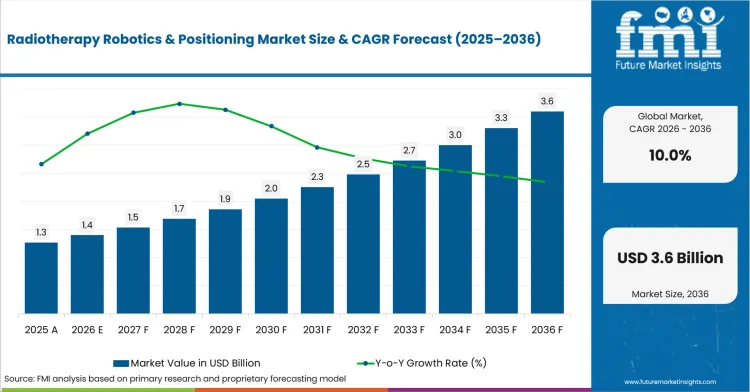
Key Takeaways of Radiotherapy Robotics & Positioning Market
- Demand for radiotherapy robotics and positioning systems is driven by motion management and repeatable setup requirements across stereotactic programs treating moving targets within narrow clinical margins.
- By component, systems are expected to lead with 62.0% share in 2026, reflecting the cost of delivery hardware plus imaging and positioning equipment.
- Intracranial radiosurgery is the dominant application segment, projected to hold 34.0% share in 2026, driven by frequent imaging and noncoplanar delivery requirements.
- Robotic radiosurgery systems are estimated to lead the product category with 38.0% share in 2026, supported by established use across intracranial and body stereotactic treatment.
- Automated positioning and beam-hold controls remain critical to clinical adoption, as hospitals increasingly review delivery hardware and positioning software as one integrated workflow.
- The United States and European Union are expected to lead growth at 10.0% and 9.5% CAGR respectively through 2036, with the US entering replacement cycles for an established treatment base and Europe advancing under national hospital budgets and common device requirements.
- Competition centers on Accuray, Varian, Brainlab, C-RAD, Vision RT, Leo Cancer Care, and RaySearch Laboratories, with vendors differentiating through motion tracking technology, surface-guided monitoring, and integration with third-party linear accelerators and planning software.
Analyst Perspective
"The radiotherapy robotics market is increasingly evaluated on its contribution to clinical throughput and treatment consistency rather than mechanical precision alone. Cancer centers are assessing how robotic systems integrate with planning, imaging, and treatment delivery workflows while minimizing additional validation and commissioning effort. Market adoption will depend on implementation efficiency, medical physics expertise, and the ability to support reliable, high-volume clinical operations without increasing complexity for care teams."
- Anurag Sharma, Principal Analyst at Future Market Insights
Source: FMI's proprietary forecasting model and primary research
How is the Radiotherapy Robotics & Positioning Market segmented?
The industry is segmented across product and application categories plus component and end user groups with business models and regions.
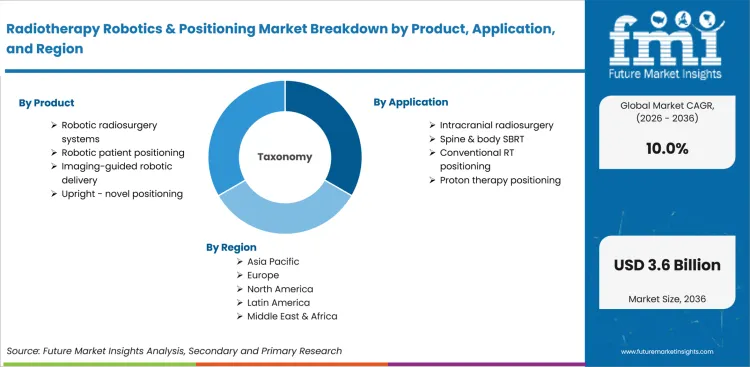
The market is divided into six segments that influence equipment selection and recurring revenue throughout a hospital investment cycle. Product analysis separates robotic radiosurgery systems from patient positioning and upright platforms according to delivery architecture. Application analysis covers intracranial radiosurgery and body stereotactic treatment together with conventional workflows and proton positioning. Component analysis distinguishes capital systems from planning software and services that create revenue after installation. End-user analysis compares cancer centers with university hospitals and private radiotherapy clinics according to purchasing needs. Business model analysis examines capital purchases alongside managed service and leasing arrangements that spread ownership costs. Regional analysis connects treatment capacity with regulation and facility readiness that influence installation timing across each country. This structure supports comparison with patient positioning accessories without treating accessories as complete robotic platforms.
What supports demand for robotic radiosurgery systems within the product category?
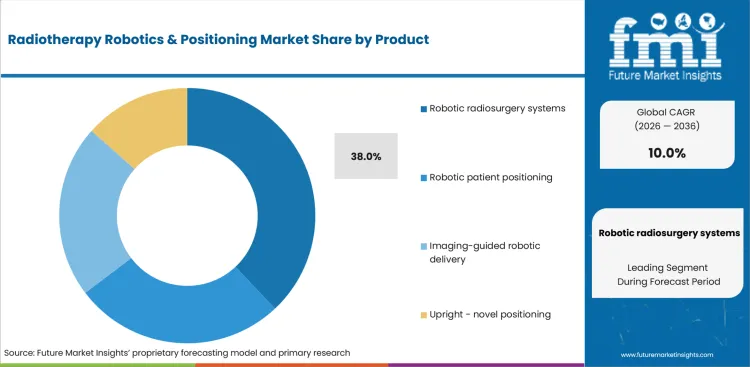
Robotic radiosurgery systems combine a compact linear accelerator with computer-controlled movement and repeated image checks during each treatment session. Accuray received NMPA approval in China for its CyberKnife S7 and Radixact SynC systems in January 2025. The company stated that China could require approximately 2,000 additional radiotherapy systems during the following five years. This approval shows that robotic delivery demand depends on regulatory access and treatment capacity.
- Based on product, robotic radiosurgery systems are forecast to represent 38.0% of revenue in 2026 through established use in stereotactic treatment. Noncoplanar beam paths and real-time tracking allow these systems to manage complex cranial and body cases within one platform.
- Radiation oncology departments are expected to compare robotic systems with fixed-gantry platforms according to treatment mix. The stereotactic radiation therapy category provides a useful benchmark for cases that need accurate setup across fewer fractions.
How does intracranial radiosurgery shape demand within the application category?
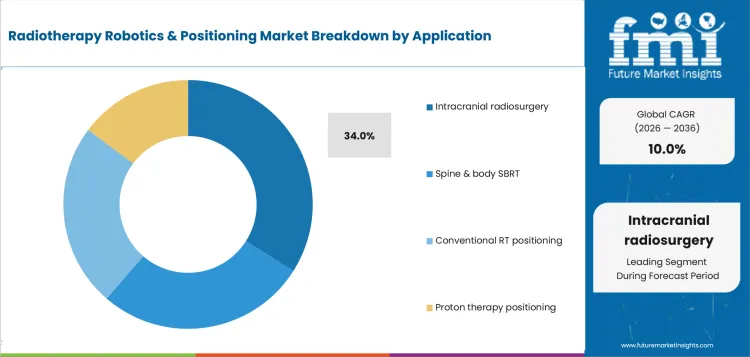
Small targeting errors can affect nearby brain structures, so intracranial radiosurgery needs tight geometric control throughout each treatment. The National Cancer Institute estimated in April 2025 that the United States would record 24,820 new brain and nervous system cancer cases during 2025. Specialist cranial workflows also treat metastatic lesions and selected benign disorders that do not appear in that primary cancer figure. The estimate identifies a measurable clinical base for systems that support accurate frameless treatment (National Cancer Institute, April 2025).
- In 2026, intracranial radiosurgery is forecast to represent 34.0% of application revenue through precise image registration and noncoplanar delivery. This workflow allows hospitals to treat selected lesions without open surgery while preserving a tightly controlled dose around sensitive structures. Commercial value depends on referral depth and specialist expertise that sustain regular case volumes throughout each year.
- Neurosurgical and radiation oncology teams are expected to favor integrated planning and positioning for complex cranial cases. The gamma knife systems category offers an adjacent benchmark for dedicated treatment and established referral patterns. Robotic platforms add frameless workflows together with treatment flexibility across selected body indications and treatment sites.
How are systems positioned within the component category?
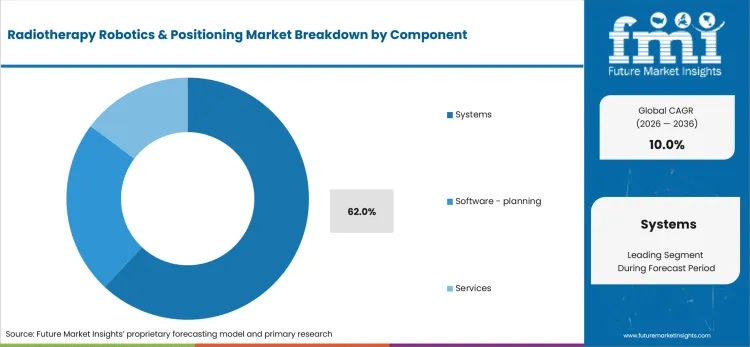
Delivery and positioning systems shape room design and daily throughput across radiotherapy departments during routine clinical use. C-RAD reported in May 2025 that it had introduced Catalyst+ LITE at ESTRO for clinics beginning surface-guided radiation therapy. The platform gives clinics a simpler entry point while preserving a path toward broader motion-management features. The oncology imaging software category shows how image data moves from setup into treatment review. Compatibility across installed linear accelerators can lower integration risk during a positioning upgrade.
- By component, systems are estimated to hold 62.0% share in 2026 due to the cost of delivery equipment and imaging hardware. This position reflects the capital needed for a complete treatment room and the related installation work. Service planning starts during purchase review and continues through commissioning plus routine quality assurance across the full system life.
- Hospital networks are anticipated to spend more on software as several treatment rooms begin sharing planning and motion data. Integration quality can influence throughput and retraining costs across a multi-room program during routine clinical use.
What are the drivers, restraints, and opportunities in the Radiotherapy Robotics & Positioning Market?
Motion control is expected to support demand; capital and commissioning requirements may delay adoption; upright workflows are projected to widen facility options for space-constrained treatment centers.
- Driver: Motion management is expected to support robotic delivery for tumors affected by breathing and patient movement.
- Restraint: Regulatory quality-system requirements and clinical commissioning are anticipated to extend product launches and hospital purchasing schedules.
- Opportunity: Upright positioning is projected to reduce room design constraints and create new options for particle therapy centers.
Treatments affected by breathing or patient movement need active motion control throughout radiotherapy beam delivery. Vision RT announced in July 2025 that AlignRT 7.4 had received a CE mark with Elekta's integrated gating interface. The release combines automatic beam hold with motion detection across six directions, extending surface-guided positioning from setup assistance into active delivery control. The respiratory gating systems category provides an adjacent view of motion control for moving tumors. A tested beam-control interface can reduce commissioning risk during equipment upgrades.
The United States Food and Drug Administration reported in February 2026 that its Quality Management System Regulation became effective for medical device manufacturers. The rule incorporates ISO 13485:2016 into 21 CFR Part 820 and updates inspections for regulated devices. Radiotherapy robotics and positioning manufacturers need aligned design controls plus production records that support inspection. Hospitals must complete acceptance testing and local commissioning before clinical use begins at each treatment site. These requirements protect treatment quality but can extend the path from product launch to dependable revenue.
Upright positioning creates a commercial opening for centers that cannot accommodate a large rotating gantry. RaySearch released RayStation v2025 in May 2025 with support for treatment planning around Leo Cancer Care's upright platform. Clinical use requires completed planning models and collision checks for each new positioning geometry at the treatment site. Fixed-beam layouts can reduce room requirements across selected particle therapy projects that face space or construction limits. Clinical adoption still depends on evidence and payment for treatment services supported by the new geometry.
Which country CAGRs are profiled in the Radiotherapy Robotics & Positioning Market?
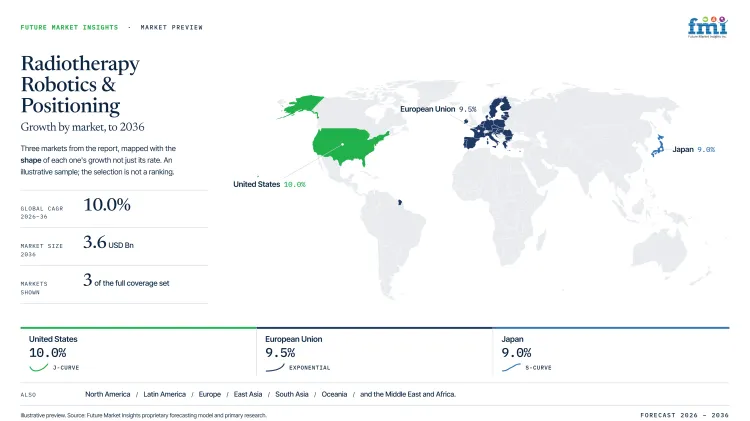
| Country | CAGR |
|---|---|
| United States | 10.0% |
| European Union | 9.5% |
| Japan | 9.0% |
Source: FMI's proprietary forecasting model and primary research.
How do country-level CAGRs compare in the Radiotherapy Robotics & Positioning Market?
The comparison spans 1.0 percentage point across the radiotherapy robotics & positioning market. The United States records the highest CAGR at 10.0%, followed by the European Union at 9.5% and Japan at 9.0%. The narrow range indicates a similar pace of investment in robotic positioning technologies for radiation therapy, with differences reflecting healthcare investment priorities and equipment replacement cycles.
- The United States leads with a CAGR of 10.0%. Healthcare providers continue investing in robotic patient positioning systems and automated radiotherapy platforms to improve treatment accuracy, workflow efficiency and positioning consistency during radiation therapy procedures.
- The European Union follows at 9.5%, 0.5 percentage points below the United States. Hospitals and cancer treatment centers are expanding the use of robotic positioning technologies as part of radiotherapy equipment modernization. Adoption varies among member states because healthcare infrastructure, capital budgets and procurement schedules are not uniform.
- Japan records a CAGR of 9.0%, 0.5 percentage points behind the European Union. Medical institutions are incorporating robotic positioning systems into radiotherapy services to improve treatment precision, support repeatable patient alignment and enhance clinical workflow.
Comparable CAGRs do not indicate identical market conditions. Differences in healthcare infrastructure, radiotherapy equipment investment, hospital modernization programs and clinical technology adoption influence purchasing decisions and long-term commercial opportunities. The full report provides country-level CAGR analysis across North America, Latin America, Europe, East Asia, South Asia, Oceania and the Middle East and Africa.
Country-wise Analysis
- United States adoption is shaped by an established stereotactic treatment base and regular replacement of aging radiation equipment. The market is projected to expand at 10.0% CAGR from 2026 to 2036, supported by demand for motion tracking and adaptive treatment workflows. In May 2025, the National Cancer Institute projected nearly 2.04 million new cancer cases in the United States for that year. This treatment burden supports investment in systems that can improve daily capacity without relaxing clinical quality controls. Cancer centers often compare software integration with service coverage during purchasing decisions for multi-room radiotherapy programs.
- European Union demand is anticipated to be driven by hospital capital cycles and common medical device requirements across national health systems. Radiotherapy robotics and positioning revenue is forecast to rise at 9.5% CAGR between 2026 and 2036 as hospitals modernize imaging and alignment. Data published by Eurostat in April 2026 showed 2,976 radiation therapy units across EU countries with available information for 2021. France accounted for 775 units and Italy reported 432 units within the same official dataset. Germany recorded another 398 units, showing that a multi-country installed base spans several national procurement systems. This distribution creates upgrade opportunities for vendors that can provide local clinical support and integration documentation across existing treatment rooms.
- Japan combines high-precision cancer care with careful technology evaluation across hospitals that manage concentrated referral volumes. Demand is estimated to advance at 9.0% CAGR by 2036, supported by continued renewal of stereotactic and image-guided treatment capacity. The February 2025 National Cancer Center overview recorded 1,636 new radiotherapy patients at its central hospital from April 2023 through March 2024. Its east hospital treated 2,000 new radiotherapy patients during the same reporting period at its specialist campus. Those volumes support investment in positioning and quality assurance systems that receive regular specialist use. Japanese hospitals are likely to favor products that fit established clinical protocols and provide dependable maintenance throughout the equipment life.
Who are the notable companies in the Radiotherapy Robotics & Positioning Market?
Notable companies include Accuray, Varian, Leo Cancer Care, Brainlab, C-RAD, RaySearch Laboratories, and Vision RT.
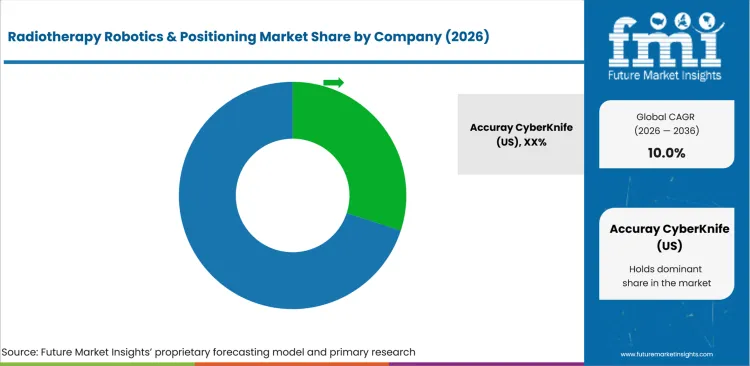
Competition spans robotic delivery and surface-guided positioning together with planning software that connects simulation with treatment. Accuray supplies CyberKnife for robotic stereotactic workflows, whereas Varian combines linear accelerators with positioning and oncology software. Brainlab provides room-based monitoring that can extend motion control across third-party treatment units (Brainlab AG, accessed July 2026). C-RAD and Vision RT add surface-guided tracking for departments that operate mixed equipment fleets across several treatment rooms. Leo Cancer Care and RaySearch Laboratories support upright treatment workflows for fixed-beam particle therapy centers. The oncology information systems category remains relevant to data continuity from planning through treatment review. Competitive strength depends on integration quality and service coverage throughout the full equipment life for hospitals.
- Accuray competes through CyberKnife robotic delivery and Synchrony tracking that adjusts the beam to patient or target motion. Cancer centers may favor the platform for frameless stereotactic programs that need cranial and body treatment flexibility within one dedicated robotic system across specialist referral programs.
- Varian combines treatment delivery with patient positioning and oncology software across hospital networks that operate several radiation rooms. Its portfolio can reduce interface work for organizations seeking consistent planning and alignment during capital replacement projects across multiple treatment sites within one service model.
- Brainlab and C-RAD provide room-based positioning or motion monitoring around linear accelerators from other manufacturers. Vision RT adds surface-guided tracking that can standardize motion control across mixed equipment fleets in hospitals. These approaches let hospitals improve accuracy without replacing the primary delivery unit during every capital review.
- Leo Cancer Care and RaySearch Laboratories connect upright positioning hardware with compatible planning models for particle therapy. Commercial progress depends on fixed-beam projects that need smaller room designs and dependable software support through commissioning and routine quality assurance across new treatment centers.
Competitive Benchmarking: Radiotherapy Robotics & Positioning Market
| Company | Robotic Delivery | Patient Positioning | Motion Management | Planning Integration | Geographic Reach |
|---|---|---|---|---|---|
| Accuray | High | Medium | High | High | High |
| Varian | Medium | High | High | High | High |
| Leo Cancer Care | Low | High | Medium | Medium | Medium |
| Brainlab | Low | High | High | High | High |
| C-RAD | Low | High | High | Medium | High |
| RaySearch Laboratories | Low | Medium | Medium | High | High |
| Vision RT | Low | High | High | Medium | High |
Scoring basis: Ratings compare verified product capability within the exact market together with the availability of integration support. High indicates broad direct capability across the defined market, whereas Medium reflects partial capability or partner dependence. Low indicates limited direct capability within the same market category or treatment workflow for the company.
Source: Official product pages and corporate releases from Accuray, Varian, Leo Cancer Care, Brainlab, C-RAD, RaySearch Laboratories, and Vision RT, accessed July 2026.
Key Developments in the Radiotherapy Robotics & Positioning Market
- In July 2025, Leo Cancer Care received FDA 510(k) clearance for the Marie upright radiotherapy platform. Marie combines upright patient positioning with an upright fan-beam CT scanner for particle therapy planning, daily imaging, and adaptive treatment delivery across fixed-beam treatment rooms. The clearance gives United States centers a regulated route to evaluate smaller room designs through an upright workflow.
- In September 2025, Varian announced Halcyon updates that included the PerfectKinetix Dynamic Couch and planned IDENTIFY motion monitoring integration. The company linked these features to faster alignment and automated beam control across high-volume treatment schedules. Selected capabilities remained subject to regulatory clearance at launch, limiting immediate availability across some markets.
- In February 2026, Vision RT launched AlignRT Core as a modular surface-guided radiation therapy platform with three-camera tracking and couch-move vector output. The platform supports active motion management through software modules that can expand its clinical use after installation.
Key Players in the Radiotherapy Robotics & Positioning Market
Robotic Delivery Platforms
- Accuray Incorporated
- Varian Medical Systems, Inc.
Patient Positioning and Motion Management
- Leo Cancer Care, Inc.
- Brainlab AG
- C-RAD AB
- Vision RT Ltd.
Treatment Planning and Workflow Integration
- RaySearch Laboratories AB
Radiotherapy Robotics & Positioning Market - Report Scope
| Coverage field | Report scope |
|---|---|
| Market breakdown | Product, application, component, end user, business model, and region. |
| Market Definition | Robotic radiotherapy delivery and patient positioning systems that automate beam movement or patient alignment for external beam treatment. |
| Regions Covered | North America, Latin America, Europe, East Asia, South Asia, Oceania, and the Middle East and Africa. |
| Countries Covered | United States, Canada, Brazil, Mexico, Germany, United Kingdom, France, Italy, Spain, China, Japan, South Korea, India, Australia, New Zealand, GCC countries, South Africa, and Türkiye. |
| Key Companies Profiled | Accuray, Varian as a Siemens Healthineers company, Leo Cancer Care, Brainlab, C-RAD, RaySearch Laboratories, and Vision RT. |
| Forecast Period | 2026 to 2036. |
| Approach | Hybrid supply-led and demand-led market sizing supported by primary interviews and official desk research sources. |
Source: FMI’s proprietary forecasting model and primary research.
Radiotherapy Robotics & Positioning Market - Research Methodology
| Method | Approach |
|---|---|
| Primary Research | FMI analysts gathered input from manufacturers, service providers, technology developers, distributors, end users, procurement teams, and subject-matter experts. Interviews examined purchasing decisions, product or service evaluation, adoption barriers, approval requirements, pricing considerations, and expectations for technical or commercial support. Respondents were also asked what evidence is required before a trial, pilot, or initial order develops into regular purchasing. |
| Desk Research | Desk research covered government statistics, regulatory publications, trade data, industry associations, technical literature, standards, company filings, product information, and official corporate announcements. Sources were reviewed for relevance, publication date, geographic coverage, and consistency with the defined market scope. Claims relating to performance, applications, approvals, capacity, investment, and commercial activity were retained only when supported by credible public evidence. |
| Market Sizing and Forecasting | The market model combined the baseline value with historical performance, segment structure, pricing and volume indicators, adoption levels, company participation, and country-level demand conditions. Forecast assumptions considered economic activity, investment trends, regulatory developments, technology adoption, purchasing cycles, supply availability, and barriers to wider market use. Segment and regional estimates were reconciled before the final market total was calculated. |
| Data Validation | Estimates were checked against multiple independent indicators, including public data, company activity, trade patterns, industry developments, and findings from primary interviews. Validation also tested whether products, services, applications, and company revenues fell within the defined market boundaries. Adjacent categories, unsupported claims, overlapping revenues, and activities without direct market relevance were excluded to reduce double counting and maintain consistency across segments and countries. |
Source: FMI's proprietary forecasting model and primary research.
Radiotherapy Robotics & Positioning Market by Segments
Radiotherapy Robotics & Positioning Market segmented by Product:
- Robotic Radiosurgery Systems
- Robotic Patient Positioning Platforms
- Imaging-Guided Robotic Delivery Systems
- Upright Positioning Platforms
Radiotherapy Robotics & Positioning Market segmented by Application:
- Intracranial Radiosurgery
- Spine and Body Stereotactic Body Radiotherapy
- Conventional Radiotherapy Positioning
- Proton Therapy Positioning
Radiotherapy Robotics & Positioning Market segmented by Component:
- Systems
- Treatment Planning Software
- Positioning and Motion Software
- Services
Radiotherapy Robotics & Positioning Market segmented by End User:
- Cancer Centers
- University Hospitals
- Private Radiotherapy Clinics
Radiotherapy Robotics & Positioning Market segmented by Business Model:
- Capital Purchase
- Managed Service
- Lease
- Software and Hardware Upgrades
Radiotherapy Robotics & Positioning Market by Region:
- North America
- United States
- Canada
- Latin America
- Brazil
- Mexico
- Europe
- Germany
- United Kingdom
- France
- Italy
- Spain
- Rest of Europe
- East Asia
- China
- Japan
- South Korea
- South Asia
- India
- Rest of South Asia
- Oceania
- Australia
- New Zealand
- Middle East and Africa
- GCC Countries
- South Africa
- Türkiye
- Rest of Middle East and Africa
Research Sources and Bibliography
- Accuray Incorporated. (2025, January 13). Accuray announces China NMPA approval of Radixact SynC and CyberKnife S7 systems.
- Accuray Incorporated. (2025, September 26). Accuray launches all-in-one radiotherapy solution with advanced capabilities.
- Brainlab AG. (n.d.). ExacTrac Dynamic: SRS and SBRT positioning with surface and X-ray tracking.
- C-RAD AB. (2025, May 7). Solid quarter in a wait-and-see market.
- European Commission, Eurostat. (2026, April 24). Cancer statistics.
- Leo Cancer Care. (2025, July 26). Leo Cancer Care receives FDA 510(k) clearance for Marie.
- National Cancer Center Japan. (2025, February). National Cancer Center overview.
- National Cancer Institute. (2025, April 15). Brain cancer specialized programs of research excellence.
- National Cancer Institute. (2025, May 7). Cancer statistics.
- RaySearch Laboratories AB. (2025, May 2). RaySearch releases RayStation v2025.
- Shanghai Municipal Government. (2026, January 14). Shanghai cancer center plans expansion to boost particle therapy capacity.
- Siemens Healthineers Cancer Care. (2025, September 28). Varian elevates Halcyon platform by redefining the patient experience.
- Soni, S., Sharma, A. K., Sundaram, V., & Katoch, C. D. S. (2025, March 21). Establishing a radiation oncology department in India: Key challenges and essential considerations from the perspective of radiation oncology professionals. Reports of Practical Oncology and Radiotherapy, 30(1), 114-121.
- United States Food and Drug Administration. (2026, February 2). Quality Management System Regulation.
- Vision RT Ltd. (2025, July 16). Vision RT certified with Elekta's integrated gating interface: AlignRT 7.4 gains CE mark.
- Vision RT Ltd. (2026, February 25). Vision RT introduces AlignRT Core, a flexible approach to SGRT adoption.
This bibliography is provided for reader reference and uses primary government, standards-body, official trade body, and company sources.
This Report Answers
- What is the estimated value of the radiotherapy robotics and positioning market in 2026?
- How is the market projected to change between 2026 and 2036?
- Which product and application segments account for the reported revenue shares?
- How do robotic delivery systems differ from patient positioning platforms?
- Which country growth rates are compared across the forecast period?
- What operational factors influence hospital purchasing and commissioning decisions?
- Which verified companies provide delivery, positioning, or planning capability?
- How are upright treatment workflows changing facility design choices?
- What evidence supports the driver, restraint, and opportunity assessment?
- Which capabilities determine competitive positioning across the defined market?
Frequently Asked Questions
What is driving growth in the radiotherapy robotics and positioning market?
Demand is supported by motion tracking and repeatable patient setup during shorter high-dose treatment schedules. These capabilities help hospitals protect geometric accuracy while maintaining capacity across selected stereotactic workflows in clinical departments.
Who are the key players in the radiotherapy robotics and positioning market?
Accuray and Varian supply treatment-delivery platforms across established hospital radiotherapy programs and specialist stereotactic workflows. Positioning support comes from Leo Cancer Care and Brainlab alongside C-RAD and Vision RT, with RaySearch Laboratories providing planning integration.
What is a notable restraint on market adoption?
High capital spending can delay approval for new treatment rooms across hospitals with limited budgets. Commissioning and staff training extend the interval before centers can deliver billable treatment with the equipment.
Why should executives track this market?
Robotic positioning can change treatment capacity and room design across an oncology network during capital planning. These changes can affect equipment budgets and service contracts at several treatment sites during investment reviews.
What business problem does the market address?
The market addresses patient movement and target motion during complex radiation treatment workflows in hospitals. Robotic systems help clinical teams align targets and maintain dose accuracy throughout each treatment fraction.
What should hospitals evaluate before purchase?
Equipment reviews should cover system integration and dependable service coverage across the complete installed treatment fleet. Commissioning support and motion-management compatibility determine whether equipment can enter routine clinical use without avoidable delays.
What limits return on investment?
Low patient referral volume can leave specialist systems underused across centers with narrow treatment programs. Delayed commissioning and poor software integration can further weaken returns from long-term capital spending in hospitals.
What supports long-term commercial confidence?
Clinical evidence and dependable service support continued use across high-precision radiation treatment programs in hospitals. Planning compatibility and regulatory clearance give hospitals clearer grounds for expanding robotic treatment workflows over time.
Preview the report firsthand - request a free sample
Get SampleGet the brochure for pricing and purchase details.
Get PDFTable of Content
- Key Takeaways
- Market Size and CAGR
- Top Growth Driver
- Fastest Growing Segment
- Leading Region
- Key Companies
- Emerging Opportunities
- Executive Summary
- Global Market Outlook
- Demand-side Trends
- Supply-side Trends
- Technology Roadmap Analysis
- Analysis and Recommendations
- Analyst Perspective (What is happening? Why now? What should investors know?)
- Key Questions Answered
- How large is the market?
- What is the CAGR?
- What are key trends?
- Which region dominates?
- Who are the leaders?
- Market Overview
- Market Coverage / Taxonomy
- Market Definition / Scope / Limitations
- Research Methodology
- Chapter Orientation
- Analytical Lens and Working Hypotheses
- Market Structure, Signals, and Trend Drivers
- Benchmarking and Cross-market Comparability
- Market Sizing, Forecasting, and Opportunity Mapping
- Research Design and Evidence Framework
- Desk Research Programme (Secondary Evidence)
- Expert Input and Fieldwork (Primary Evidence)
- Tooling, Models, and Reference Databases
- Data Engineering and Model Build
- Quality Assurance and Audit Trail
- Market Background
- Market Dynamics (Drivers, Restraints, Opportunity, Trends)
- Scenario Forecast (Optimistic, Likely, Conservative)
- Impact Analysis
- AI Impact
- Sustainability Impact
- Regulatory Impact
- Technology Impact
- Consumer / Buyer Analysis
- Purchase Drivers
- Adoption Barriers
- Buyer Journey
- Opportunity Map Analysis
- Product Life Cycle Analysis
- Supply Chain Analysis
- Investment Feasibility Matrix
- Value Chain Analysis
- PESTLE and Porter's Analysis
- Regulatory Landscape
- Regional Parent Market Outlook
- Production and Consumption Statistics
- Import and Export Statistics
- Global Market Analysis and Forecast, 2021 to 2036
- Historical Market Size Value (USD Bn) Analysis, 2021 to 2025
- Current and Future Market Size Value (USD Bn) Projections, 2026 to 2036
- Y-o-Y Growth Trend Analysis
- Absolute $ Opportunity Analysis
- Global Market Pricing Analysis, 2021 to 2036
- Global Market Analysis and Forecast, By Product, 2021 to 2036
- Introduction / Key Findings
- Historical Market Size Value (USD Bn) Analysis By Product, 2021 to 2025
- Current and Future Market Size Value (USD Bn) Analysis and Forecast By Product, 2026 to 2036
- Robotic radiosurgery systems
- Robotic patient positioning
- Imaging-guided robotic delivery
- Upright - novel positioning
- Robotic radiosurgery systems
- Y-o-Y Growth Trend Analysis By Product, 2021 to 2025
- Absolute $ Opportunity Analysis By Product, 2026 to 2036
- Global Market Analysis and Forecast, By Application, 2021 to 2036
- Introduction / Key Findings
- Historical Market Size Value (USD Bn) Analysis By Application, 2021 to 2025
- Current and Future Market Size Value (USD Bn) Analysis and Forecast By Application, 2026 to 2036
- Intracranial radiosurgery
- Spine & body SBRT
- Conventional RT positioning
- Proton therapy positioning
- Intracranial radiosurgery
- Y-o-Y Growth Trend Analysis By Application, 2021 to 2025
- Absolute $ Opportunity Analysis By Application, 2026 to 2036
- Global Market Analysis and Forecast, By Component, 2021 to 2036
- Introduction / Key Findings
- Historical Market Size Value (USD Bn) Analysis By Component, 2021 to 2025
- Current and Future Market Size Value (USD Bn) Analysis and Forecast By Component, 2026 to 2036
- Systems
- Software - planning
- Services
- Systems
- Y-o-Y Growth Trend Analysis By Component, 2021 to 2025
- Absolute $ Opportunity Analysis By Component, 2026 to 2036
- Global Market Analysis and Forecast, By End User, 2021 to 2036
- Introduction / Key Findings
- Historical Market Size Value (USD Bn) Analysis By End User, 2021 to 2025
- Current and Future Market Size Value (USD Bn) Analysis and Forecast By End User, 2026 to 2036
- Cancer centers
- University hospitals
- Private radiology chains
- Cancer centers
- Y-o-Y Growth Trend Analysis By End User, 2021 to 2025
- Absolute $ Opportunity Analysis By End User, 2026 to 2036
- Global Market Analysis and Forecast, By Business Model, 2021 to 2036
- Introduction / Key Findings
- Historical Market Size Value (USD Bn) Analysis By Business Model, 2021 to 2025
- Current and Future Market Size Value (USD Bn) Analysis and Forecast By Business Model, 2026 to 2036
- Capital purchase
- Managed service
- Lease
- Upgrades
- Capital purchase
- Y-o-Y Growth Trend Analysis By Business Model, 2021 to 2025
- Absolute $ Opportunity Analysis By Business Model, 2026 to 2036
- Global Market Analysis and Forecast, By Region, 2021 to 2036
- Introduction
- Historical Market Size Value (USD Bn) Analysis By Region, 2021 to 2025
- Current Market Size Value (USD Bn) Analysis and Forecast By Region, 2026 to 2036
- North America
- Latin America
- Western Europe
- Eastern Europe
- East Asia
- South Asia and Pacific
- Middle East & Africa
- Market Attractiveness Analysis By Region
- North America Market Analysis and Forecast, By Country, 2021 to 2036
- Historical Market Size Value (USD Bn) Trend Analysis By Market Taxonomy, 2021 to 2025
- Market Size Value (USD Bn) Forecast By Market Taxonomy, 2026 to 2036
- By Country
- USA
- Canada
- By Product
- By Application
- By Component
- By End User
- By Business Model
- By Country
- Market Attractiveness Analysis
- By Country
- By Product
- By Application
- By Component
- By End User
- By Business Model
- Key Takeaways
- Latin America Market Analysis and Forecast, By Country
- Historical Market Size Value (USD Bn) Trend Analysis By Market Taxonomy, 2021 to 2025
- Market Size Value (USD Bn) Forecast By Market Taxonomy, 2026 to 2036
- By Country
- Brazil
- Mexico
- Chile
- Rest of Latin America
- By Product
- By Application
- By Component
- By End User
- By Business Model
- By Country
- Market Attractiveness Analysis
- By Country
- By Product
- By Application
- By Component
- By End User
- By Business Model
- Key Takeaways
- Western Europe Market Analysis and Forecast, By Country
- Historical Market Size Value (USD Bn) Trend Analysis By Market Taxonomy, 2021 to 2025
- Market Size Value (USD Bn) Forecast By Market Taxonomy, 2026 to 2036
- By Country
- Germany
- UK
- Italy
- Spain
- France
- Nordic
- BENELUX
- Rest of Western Europe
- By Product
- By Application
- By Component
- By End User
- By Business Model
- By Country
- Market Attractiveness Analysis
- By Country
- By Product
- By Application
- By Component
- By End User
- By Business Model
- Key Takeaways
- Eastern Europe Market Analysis and Forecast, By Country
- Historical Market Size Value (USD Bn) Trend Analysis By Market Taxonomy, 2021 to 2025
- Market Size Value (USD Bn) Forecast By Market Taxonomy, 2026 to 2036
- By Country
- Russia
- Poland
- Hungary
- Balkan & Baltic
- Rest of Eastern Europe
- By Product
- By Application
- By Component
- By End User
- By Business Model
- By Country
- Market Attractiveness Analysis
- By Country
- By Product
- By Application
- By Component
- By End User
- By Business Model
- Key Takeaways
- East Asia Market Analysis and Forecast, By Country
- Historical Market Size Value (USD Bn) Trend Analysis By Market Taxonomy, 2021 to 2025
- Market Size Value (USD Bn) Forecast By Market Taxonomy, 2026 to 2036
- By Country
- China
- Japan
- South Korea
- By Product
- By Application
- By Component
- By End User
- By Business Model
- By Country
- Market Attractiveness Analysis
- By Country
- By Product
- By Application
- By Component
- By End User
- By Business Model
- Key Takeaways
- South Asia and Pacific Market Analysis and Forecast, By Country
- Historical Market Size Value (USD Bn) Trend Analysis By Market Taxonomy, 2021 to 2025
- Market Size Value (USD Bn) Forecast By Market Taxonomy, 2026 to 2036
- By Country
- India
- ASEAN
- Australia & New Zealand
- Rest of South Asia and Pacific
- By Product
- By Application
- By Component
- By End User
- By Business Model
- By Country
- Market Attractiveness Analysis
- By Country
- By Product
- By Application
- By Component
- By End User
- By Business Model
- Key Takeaways
- Middle East & Africa Market Analysis and Forecast, By Country
- Historical Market Size Value (USD Bn) Trend Analysis By Market Taxonomy, 2021 to 2025
- Market Size Value (USD Bn) Forecast By Market Taxonomy, 2026 to 2036
- By Country
- Kingdom of Saudi Arabia
- Other GCC Countries
- Türkiye
- South Africa
- Other African Union
- Rest of Middle East & Africa
- By Product
- By Application
- By Component
- By End User
- By Business Model
- By Country
- Market Attractiveness Analysis
- By Country
- By Product
- By Application
- By Component
- By End User
- By Business Model
- Key Takeaways
- Key Countries Market Analysis
- USA
- Pricing Analysis
- Market Share Analysis, 2025
- By Product
- By Application
- By Component
- By End User
- By Business Model
- Canada
- Pricing Analysis
- Market Share Analysis, 2025
- By Product
- By Application
- By Component
- By End User
- By Business Model
- Mexico
- Pricing Analysis
- Market Share Analysis, 2025
- By Product
- By Application
- By Component
- By End User
- By Business Model
- Brazil
- Pricing Analysis
- Market Share Analysis, 2025
- By Product
- By Application
- By Component
- By End User
- By Business Model
- Chile
- Pricing Analysis
- Market Share Analysis, 2025
- By Product
- By Application
- By Component
- By End User
- By Business Model
- Germany
- Pricing Analysis
- Market Share Analysis, 2025
- By Product
- By Application
- By Component
- By End User
- By Business Model
- UK
- Pricing Analysis
- Market Share Analysis, 2025
- By Product
- By Application
- By Component
- By End User
- By Business Model
- Italy
- Pricing Analysis
- Market Share Analysis, 2025
- By Product
- By Application
- By Component
- By End User
- By Business Model
- Spain
- Pricing Analysis
- Market Share Analysis, 2025
- By Product
- By Application
- By Component
- By End User
- By Business Model
- France
- Pricing Analysis
- Market Share Analysis, 2025
- By Product
- By Application
- By Component
- By End User
- By Business Model
- India
- Pricing Analysis
- Market Share Analysis, 2025
- By Product
- By Application
- By Component
- By End User
- By Business Model
- ASEAN
- Pricing Analysis
- Market Share Analysis, 2025
- By Product
- By Application
- By Component
- By End User
- By Business Model
- Australia & New Zealand
- Pricing Analysis
- Market Share Analysis, 2025
- By Product
- By Application
- By Component
- By End User
- By Business Model
- China
- Pricing Analysis
- Market Share Analysis, 2025
- By Product
- By Application
- By Component
- By End User
- By Business Model
- Japan
- Pricing Analysis
- Market Share Analysis, 2025
- By Product
- By Application
- By Component
- By End User
- By Business Model
- South Korea
- Pricing Analysis
- Market Share Analysis, 2025
- By Product
- By Application
- By Component
- By End User
- By Business Model
- Russia
- Pricing Analysis
- Market Share Analysis, 2025
- By Product
- By Application
- By Component
- By End User
- By Business Model
- Poland
- Pricing Analysis
- Market Share Analysis, 2025
- By Product
- By Application
- By Component
- By End User
- By Business Model
- Hungary
- Pricing Analysis
- Market Share Analysis, 2025
- By Product
- By Application
- By Component
- By End User
- By Business Model
- Kingdom of Saudi Arabia
- Pricing Analysis
- Market Share Analysis, 2025
- By Product
- By Application
- By Component
- By End User
- By Business Model
- Türkiye
- Pricing Analysis
- Market Share Analysis, 2025
- By Product
- By Application
- By Component
- By End User
- By Business Model
- South Africa
- Pricing Analysis
- Market Share Analysis, 2025
- By Product
- By Application
- By Component
- By End User
- By Business Model
- USA
- Market Structure Analysis
- Competition Dashboard
- Competition Benchmarking
- Market Share Analysis of Top Players
- By Regional
- By Product
- By Application
- By Component
- By End User
- By Business Model
- Emerging Startups
- Innovation Benchmarking
- Competition Analysis
- Competition Deep Dive
- Accuray CyberKnife (US)
- Overview
- Product Portfolio
- Profitability by Market Segments
- Sales Footprint
- Strategy Overview
- Marketing Strategy
- Product Strategy
- Channel Strategy
- Varian - Siemens Healthineers (US-DE)
- Elekta (SE)
- Leo Cancer Care (US-UK)
- Accuray CyberKnife (US)
- Case Studies
- Success Stories
- Recent Developments
- Competition Deep Dive
- Assumptions & Acronyms Used


