

- Market Size (2026)
- USD 1.7 Bn
- Forecast (2036)
- USD 2.6 Bn
- CAGR (2026 to 2036)
- 4.3%
Hadron Therapy Market Size, Market Forecast and Outlook By FMI
Summary of the Hadron Therapy Market
- Demand and Growth Drivers
- Growing clinical evidence for proton therapy dose conformity advantages in pediatric and skull base tumors is supporting new treatment center construction.
- Development of compact single-room proton therapy systems is reducing capital cost and facility requirements for adoption.
- Rising cancer incidence globally is increasing the patient population that could benefit from particle therapy.
- Product and Segment View
- Proton beam therapy is expected to hold 38.4% of the beam types segment in 2026, reflecting the established clinical evidence base and largest installed system base.
- Hospitals account for 44.9% of the end user segment, reflecting the institutional scale required for particle therapy operation.
- Single-room systems represent 52.0% of the system type segment, driven by compact systems that reduce capital cost and facility requirements.
- Geography and Competitive Outlook
- India leads at 4.3% CAGR through 2036, driven by rising cancer incidence, government investment in cancer infrastructure, and growing interest in advanced radiation therapy.
- Japan follows at 4.0%, reflecting advanced proton and carbon ion therapy infrastructure and clinical research leadership.
- IBA and Varian Medical Systems maintain competitive leadership through comprehensive proton therapy system portfolios and installed base management.
- Analyst Opinion
- The hadron therapy market is evolving from niche academic technology toward broader clinical adoption as compact single-room systems lower the capital threshold.
- Adoption is increasing due to expanding clinical evidence supporting proton therapy for specific tumor types where dose conformity provides measurable benefit.
- Demand is also shaped by carbon ion therapy development in Japan, Germany, and China.
- Companies that can deliver compact, cost-effective proton therapy systems with streamlined installation are positioned to accelerate adoption beyond large academic medical centers.
Key Takeaways, Market Size, and Forecast
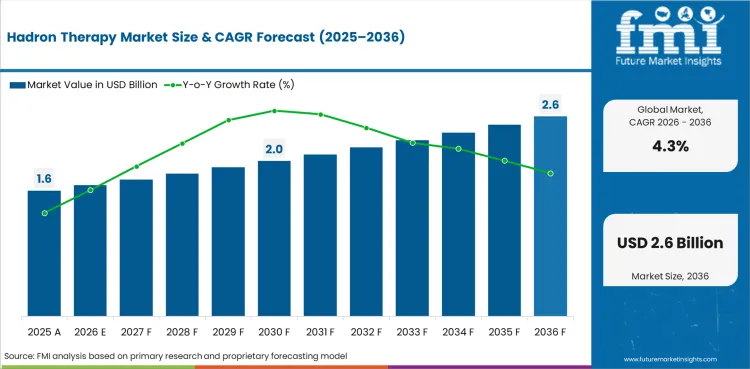
- The hadron therapy market was valued at USD 1.6 billion in 2025.
- The market is projected to reach USD 1.7 billion in 2026 and USD 2.6 billion by 2036, growing at a CAGR of 4.3%.
- By 2036, the hadron therapy market is expected to be worth USD 2.62 billion.
- From 2026 to 2036, the market is projected to expand at a CAGR of 4.3%.
- The market is projected to create an incremental opportunity of USD 0.90 billion between 2026 and 2036.
- In 2026, Proton Beam Therapy is expected to account for 38.4% of the beam types segment, driven by established clinical evidence for dose conformity advantages in pediatric cancers, skull base tumors, and radiation-sensitive anatomical locations.
- Pediatric Cancer is expected to lead the application segment with a 21.6% share.
- India (4.3%) and Japan (4.0%) are two of the fastest growing markets in the world.
Hadron Therapy Market Definition
The hadron therapy market encompasses particle beam radiation therapy systems that use protons, carbon ions, and other charged particles for the treatment of cancer. This includes proton beam therapy systems, carbon ion beam systems, and associated beam delivery, treatment planning, and patient positioning equipment used in hospitals, specialty cancer treatment centers, and research institutions for the treatment of pediatric cancers, skull base tumors, prostate, lung, liver, and eye cancers.
Hadron Therapy Market Inclusions
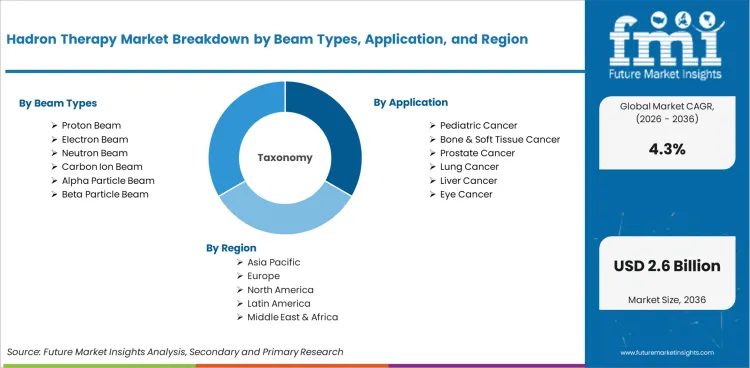
Market scope covers all commercially traded hadron therapy systems categorized by beam types (proton beam, electron beam, neutron beam, carbon ion beam, alpha particle beam, beta particle beam), application (pediatric cancer, bone and soft tissue cancer, prostate cancer, lung cancer, liver cancer, eye cancer), end user (hospitals, specialty cancer treatment centers, research and academic institutions), and system type (single-room systems, multi-room systems). Revenue is tracked from 2026 to 2036.
Hadron Therapy Market Exclusions
The scope does not include conventional X-ray based photon radiation therapy systems, brachytherapy equipment, or radioactive isotope-based therapy systems.
Hadron Therapy Market Research Methodology
- Primary Research: Interviews with industry practitioners, product specialists, and procurement managers across key markets.
- Desk Research: Compilation of regulatory filings, industry association data, and manufacturer disclosures.
- Market Sizing and Forecasting: Bottom-up aggregation across segments and regions with adoption curve modeling.
- Data Validation: Quarterly reconciliation against industry production data and manufacturer reported figures.
Why is the Hadron Therapy Market Growing?
- Development of compact single-room proton therapy systems is reducing the capital investment required for hadron therapy.
- Rising global cancer incidence is expanding the patient population that could benefit from particle therapy.
Growth reflects the maturation of proton therapy technology from large-scale academic installations toward more accessible single-room configurations. The proton beam segment leads at 38.4% of beam types. Single-room systems at 52.0% have significantly reduced the capital threshold by eliminating multi-room gantry halls.
Adoption is increasing due to growing clinical consensus on proton therapy benefits for specific indications. Pediatric cancers at 21.6% of the application segment represent a priority indication where reduced exit dose minimizes radiation exposure to developing tissues.
The competitive landscape is concentrated among a small number of system manufacturers. IBA leads with the largest installed base. Varian Medical Systems competes through its ProBeam platform. Japanese manufacturers Hitachi and Sumitomo have established positions in Asia.
Market Segmentation Analysis
- Proton Beam leads the beam types segment with 38.4% share in 2026.
- Pediatric Cancer leads the application segment at 21.6%,reflecting concentrated demand in this category.
The hadron therapy market is segmented by beam types (Proton Beam, Electron Beam, Neutron Beam, Carbon Ion Beam, Alpha Particle Beam); application (Pediatric Cancer, Bone and Soft Tissue Cancer, Prostate Cancer, Lung Cancer, Liver Cancer, Eye Cancer); end user (Hospitals, Specialty Cancer Treatment Centers, Research and Academic Institutions); system type (Single-room Systems, Multi-room Systems).
Insights into the Proton Beam Types Segment
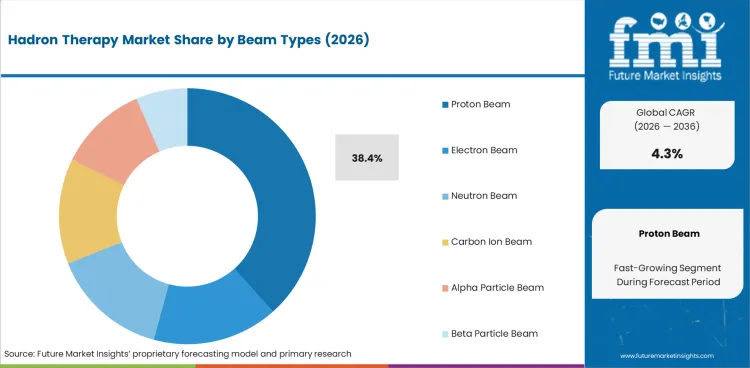
In 2026, proton beam is expected to lead the beam types segment. Demand is shaped by established clinical evidence for dose conformity advantages in pediatric cancers, skull base tumors, and radiation-sensitive anatomical locations. This segment maintains its position through established procurement channels and performance requirements aligned with end user operational standards.
Insights into the Pediatric Cancer application Segment
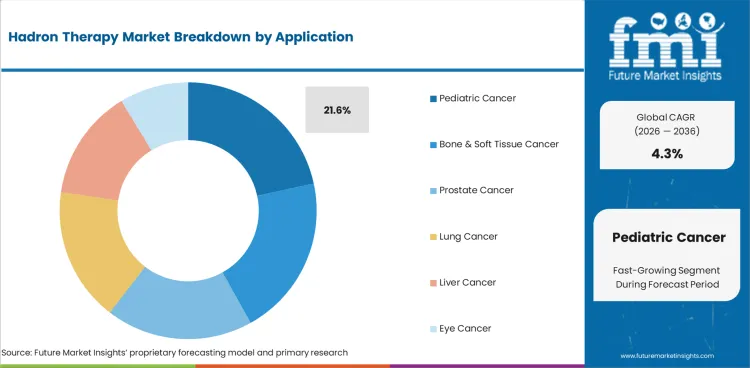
Pediatric Cancer leads the application segment with 21.6% share in 2026. Adoption in this segment reflects concentration of demand across established verticals where product performance, regulatory compliance, and procurement scale influence purchasing decisions.
Hadron Therapy Market Drivers, Restraints, and Opportunities
- Clinical evidence supporting proton therapy dose conformity is driving new treatment center construction.
- High capital cost ranging from USD 25 million to over USD 200 million limits adoption to well-funded institutions.
- Compact single-room systems are reducing cost and facility barriers, expanding the potential adopter base.
The hadron therapy market is shaped by clinical evidence development, capital cost dynamics, and technology evolution toward compact systems.
Clinical Evidence and Indication Expansion
Demand is shaped by growing clinical evidence supporting proton therapy for specific cancer indications. Randomized trials are establishing benefit for pediatric cancers, skull base tumors, and hepatocellular carcinoma.
Capital Cost as an Adoption Barrier
Adoption is constrained by high capital costs. Multi-room centers require USD 100 million to over USD 200 million. Single-room systems have reduced entry costs to USD 25 to 40 million but remain significantly more expensive than linear accelerators.
Compact System Development
Growth reflects compact single-room proton therapy systems from Mevion, IBA, and Varian that reduce facility footprint, shielding requirements, and installation timelines.
Analysis of Hadron Therapy Market By Key Countries
.webp "Top Country Growth Comparison Hadron Therapy Market Cagr (2026 2036)")
| Country | CAGR |
|---|---|
| India | 4.3% |
| Japan | 4.0% |
| Germany | 3.0% |
| UK | 2.1% |
| USA | 1.6% |
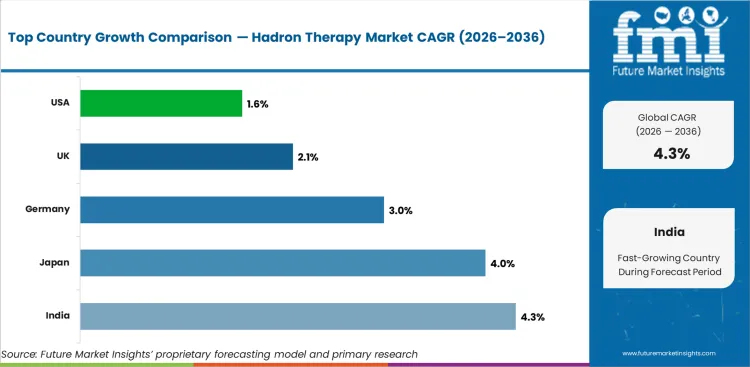
- India leads at 4.3% CAGR through 2036, driven by cancer incidence growth and government investment in cancer infrastructure.
- Japan at 4.0% reflects the most advanced hadron therapy infrastructure globally.
- Germany at 3.0% maintains growth through established proton therapy centers and carbon ion research.
- The USA at 1.6% reflects a mature installed base where growth is driven by compact system adoption.
The global hadron therapy market is projected to expand at a CAGR of 4.3% from 2026 to 2036.
Demand Outlook for Hadron Therapy Market in India
India is projected to grow at 4.3% CAGR through 2036, driven by rising cancer incidence and government investment in cancer treatment infrastructure.
- Rising cancer incidence expands the patient population.
- Government investment includes proton therapy center development.
- Major cancer hospitals are investing in proton therapy capability.
Future Outlook for Hadron Therapy Market in Japan
Japan is expected to grow at 4.0% CAGR through 2036, supported by the most advanced hadron therapy infrastructure globally.
- Multiple proton and carbon ion treatment centers are operational.
- Clinical research programs expand the evidence base.
- Domestic manufacturers support technology development.
Opportunity Analysis of Hadron Therapy Market in Germany
Germany is projected to register 3.0% CAGR through 2036, reflecting established proton therapy centers and carbon ion therapy research.
- Established proton therapy centers sustain treatment volumes.
- Carbon ion research generates incremental evidence.
- Reimbursement coverage supports patient access.
In-depth Analysis of Hadron Therapy Market in the United Kingdom
The UK is expected to register 2.1% CAGR through 2036, shaped by NHS proton beam therapy service development.
- NHS proton beam centers provide national access.
- Clinical referral pathways are being established.
- Clinical experience accumulation supports indication expansion.
Sales Analysis of Hadron Therapy Market in the United States
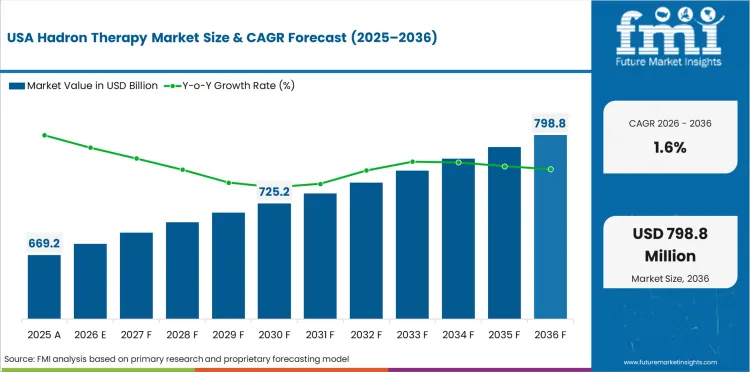
The USA is projected to grow at 1.6% CAGR through 2036, reflecting a mature installed base with growth from compact system adoption.
- Compact system adoption enables proton therapy at community centers.
- Expanding indications broaden the treatable population.
- Installed base management generates service revenue.
Competitive Landscape and Strategic Positioning
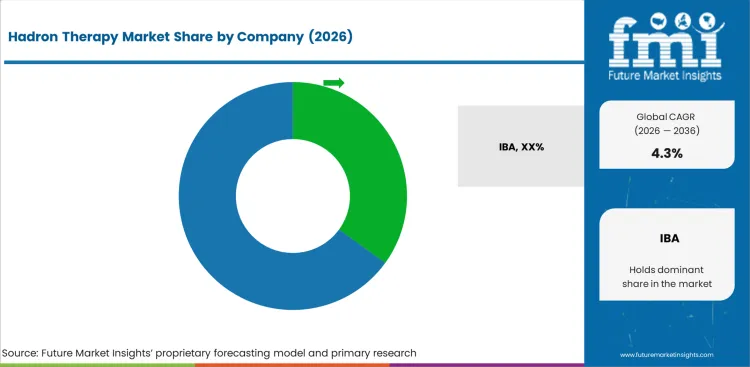
- IBA leads through the largest global installed base and comprehensive system portfolio.
- Varian Medical Systems competes through its ProBeam platform with advanced pencil beam scanning.
- Japanese manufacturers Hitachi and Sumitomo maintain positions through domestic installations and growing international presence.
IBA holds the leading position through the largest installed base and broadest system portfolio spanning compact and multi-room configurations.
Varian Medical Systems competes through its ProBeam platform featuring advanced pencil beam scanning and Eclipse treatment planning integration.
Mevion Medical Systems has established a position in compact single-room proton therapy. Japanese manufacturers Hitachi and Sumitomo serve both domestic and international markets.
Entry barriers include extreme engineering complexity, regulatory approval requirements, capital-intensive manufacturing, and specialized clinical support needs.
Key Companies in the Hadron Therapy Market
Key global companies leading the hadron therapy market include:
- IBA (Belgium), Varian Medical Systems (USA), Hitachi Ltd. (Japan) lead the market through broad product portfolios, established customer relationships, and global manufacturing and distribution capabilities.
- Mevion Medical Systems (USA), Sumitomo Heavy Industries (Japan), Mitsubishi Electric Corporation (Japan) maintain strong regional positions through specialized expertise and localized service capabilities.
- Advanced Oncotherapy plc (UK), ProTom International (USA), Shinva Medical Instrument Co. (China) are gaining traction through focused product innovation and targeted market positioning.
Competitive Benchmarking: Hadron Therapy Market
| Company | System Product Range | Clinical Installation Base | Compact System Offering | Geographic Footprint |
|---|---|---|---|---|
| IBA | High | Strong | Strong | Global |
| Varian Medical Systems | High | Strong | Strong | Global |
| Hitachi Ltd. | High | Strong | Medium | Asia, Global |
| Mevion Medical Systems | Medium | Medium | Strong | North America |
| Sumitomo Heavy Industries | Medium | Medium | Medium | Asia |
| Mitsubishi Electric Corporation | Medium | Medium | Medium | Asia |
| Advanced Oncotherapy plc | Low | Low | Medium | Europe |
| ProTom International | Low | Low | Medium | North America |
Source: Future Market Insights competitive analysis, 2026.
Key Players in the Hadron Therapy Market
Major Global Players
- IBA
- Varian Medical Systems
- Hitachi Ltd.
- Mevion Medical Systems
- Sumitomo Heavy Industries
- Advanced Oncotherapy plc
- ProTom International
Emerging Players/Startups
- Shinva Medical Instrument Co.
- Mitsubishi Electric Corporation
- Toshiba Energy Systems and Solutions
Report Scope and Coverage
| Parameter | Details |
|---|---|
| Quantitative Units | USD 1.72 billion to USD 2.62 billion, at a CAGR of 4.3% |
| Market Definition | The hadron therapy market encompasses particle beam radiation therapy systems that use protons, carbon ions, and other charged particles for the treatment of cancer. This includes proton beam therapy systems, carbon ion beam systems, and associated beam delivery, treatment planning, and patient positioning equipment used in hospitals, specialty cancer treatment centers, and research institutions for the treatment of pediatric cancers, skull base tumors, prostate, lung, liver, and eye cancers. |
| Regions Covered | North America, Latin America, Europe, East Asia, South Asia and Pacific, Middle East and Africa |
| Countries Covered | India, Japan, Germany, UK, USA, 30 plus countries |
| Key Companies Profiled | IBA, Varian Medical Systems, Hitachi Ltd., Mevion Medical Systems, Sumitomo Heavy Industries, Advanced Oncotherapy plc, ProTom International, Shinva Medical Instrument Co., Mitsubishi Electric Corporation, Toshiba Energy Systems and Solutions |
| Forecast Period | 2026 to 2036 |
| Approach | Hybrid bottom-up and top-down methodology starting with verified transaction data, projecting adoption velocity across segments and regions. |
Market Segmentation Analysis
Hadron Therapy Market Segmented by Beam Types:
- Proton Beam
- Electron Beam
- Neutron Beam
- Carbon Ion Beam
- Alpha Particle Beam
- Beta Particle Beam
Hadron Therapy Market Segmented by Application:
- Pediatric Cancer
- Bone & Soft Tissue Cancer
- Prostate Cancer
- Lung Cancer
- Liver Cancer
- Eye Cancer
Hadron Therapy Market Segmented by End User:
- Hospitals
- Specialty Cancer Treatment Centers
- Research and Academic Institutions
Hadron Therapy Market Segmented by System Type:
- Single-room Systems
- Multi-room Systems
Hadron Therapy Market by Region:
- North America
- USA
- Canada
- Mexico
- Latin America
- Brazil
- Chile
- Rest of Latin America
- Western Europe
- Germany
- UK
- Italy
- Spain
- France
- Nordic
- BENELUX
- Rest of Western Europe
- Eastern Europe
- Russia
- Poland
- Hungary
- Balkan & Baltic
- Rest of Eastern Europe
- East Asia
- China
- Japan
- South Korea
- South Asia and Pacific
- India
- ASEAN
- Australia & New Zealand
- Rest of South Asia and Pacific
- Middle East & Africa
- Kingdom of Saudi Arabia
- Other GCC Countries
- Turkiye
- South Africa
- Other African Union
- Rest of Middle East & Africa
Research Sources and Bibliography
- 1. World Health Organization. (2025). WHO Global Cancer Burden Report. WHO.
- 2. National Cancer Institute. (2025). NCI Proton Therapy Clinical Trial Registry and Outcomes Database. NCI.
- 3. European Society for Radiotherapy and Oncology. (2024). ESTRO Guidelines: Proton Beam Therapy Indications. ESTRO.
- 4. International Atomic Energy Agency. (2025). IAEA Technical Report: Particle Therapy Facility Planning. IAEA.
- 5. American Society for Radiation Oncology. (2025). ASTRO Model Policy: Proton Beam Therapy Coverage. ASTRO.
This bibliography is provided for reader reference.
This Report Answers
- Estimating the size of the market and revenue projections from 2026 to 2036.
- Segmentation analysis across all product, application, and end use categories.
- Regional and country level insights covering more than 30 markets.
- Technology analysis across key product and process categories.
- Competitive landscape assessment and company benchmarking.
- Investment opportunity identification across high-growth segments and regions.
- Supply chain and distribution channel analysis.
- Data delivery in PDF and Excel formats.
Frequently Asked Questions
What is the global market demand for Hadron Therapy in 2026?
In 2026, the global hadron therapy market is expected to be worth USD 1.72 billion.
How big will the Hadron Therapy Market be in 2036?
By 2036, the hadron therapy market is expected to be worth USD 2.62 billion.
How much is demand for Hadron Therapy expected to grow between 2026 and 2036?
Between 2026 and 2036, the demand for hadron therapy is expected to grow at a CAGR of 4.3%.
Which beam types segment is likely to lead in 2026?
Proton beam therapy is expected to account for 38.4% of the beam types segment in 2026, reflecting established clinical evidence for dose conformity advantages in pediatric cancers, skull base tumors, and radiation-sensitive anatomical locations.
What is causing demand to rise in India?
India is projected to grow at 4.3% CAGR through 2036, reflecting strong sector investment and regulatory support for market adoption.
What is causing demand to rise in Japan?
Japan is projected to grow at 4.0% CAGR through 2036, supported by industry expansion and increasing adoption across key application segments.
What does this report mean by 'Hadron Therapy Market definition'?
The hadron therapy market encompasses particle beam radiation therapy systems that use protons, carbon ions, and other charged particles for the treatment of cancer. This includes proton beam therapy systems, carbon ion beam systems, and associated beam delivery, treatment planning, and patient positioning equipment used in hospitals, specialty cancer treatment centers, and research institutions for the treatment of pediatric cancers, skull base tumors, prostate, lung, liver, and eye cancers.
How does FMI make the Hadron Therapy forecast and validate it?
Forecasting models use a hybrid bottom-up and top-down approach, starting with verified transaction data and checking it against industry production statistics and manufacturer disclosures.
Preview the report firsthand - request a free sample
Get SampleGet the brochure for pricing and purchase details.
Get PDFTable of Content
- Executive Summary
- Global Market Outlook
- Demand-side Trends
- Supply-side Trends
- Technology Roadmap Analysis
- Analysis and Recommendations
- Market Overview
- Market Coverage / Taxonomy
- Market Definition / Scope / Limitations
- Research Methodology
- Chapter Orientation
- Analytical Lens and Working Hypotheses
- Market Structure, Signals, and Trend Drivers
- Benchmarking and Cross-market Comparability
- Market Sizing, Forecasting, and Opportunity Mapping
- Research Design and Evidence Framework
- Desk Research Programme (Secondary Evidence)
- Company Annual and Sustainability Reports
- Peer-reviewed Journals and Academic Literature
- Corporate Websites, Product Literature, and Technical Notes
- Earnings Decks and Investor Briefings
- Statutory Filings and Regulatory Disclosures
- Technical White Papers and Standards Notes
- Trade Journals, Industry Magazines, and Analyst Briefs
- Conference Proceedings, Webinars, and Seminar Materials
- Government Statistics Portals and Public Data Releases
- Press Releases and Reputable Media Coverage
- Specialist Newsletters and Curated Briefings
- Sector Databases and Reference Repositories
- FMI Internal Proprietary Databases and Historical Market Datasets
- Subscription Datasets and Paid Sources
- Social Channels, Communities, and Digital Listening Inputs
- Additional Desk Sources
- Expert Input and Fieldwork (Primary Evidence)
- Primary Modes
- Qualitative Interviews and Expert Elicitation
- Quantitative Surveys and Structured Data Capture
- Blended Approach
- Why Primary Evidence is Used
- Field Techniques
- Interviews
- Surveys
- Focus Groups
- Observational and In-context Research
- Social and Community Interactions
- Stakeholder Universe Engaged
- C-suite Leaders
- Board Members
- Presidents and Vice Presidents
- R&D and Innovation Heads
- Technical Specialists
- Domain Subject-matter Experts
- Scientists
- Physicians and Other Healthcare Professionals
- Governance, Ethics, and Data Stewardship
- Research Ethics
- Data Integrity and Handling
- Primary Modes
- Tooling, Models, and Reference Databases
- Desk Research Programme (Secondary Evidence)
- Data Engineering and Model Build
- Data Acquisition and Ingestion
- Cleaning, Normalisation, and Verification
- Synthesis, Triangulation, and Analysis
- Quality Assurance and Audit Trail
- Market Background
- Market Dynamics
- Drivers
- Restraints
- Opportunity
- Trends
- Scenario Forecast
- Demand in Optimistic Scenario
- Demand in Likely Scenario
- Demand in Conservative Scenario
- Opportunity Map Analysis
- Product Life Cycle Analysis
- Supply Chain Analysis
- Investment Feasibility Matrix
- Value Chain Analysis
- PESTLE and Porter’s Analysis
- Regulatory Landscape
- Regional Parent Market Outlook
- Production and Consumption Statistics
- Import and Export Statistics
- Market Dynamics
- Global Market Analysis 2021 to 2025 and Forecast, 2026 to 2036
- Historical Market Size Value (USD Million) Analysis, 2021 to 2025
- Current and Future Market Size Value (USD Million) Projections, 2026 to 2036
- Y-o-Y Growth Trend Analysis
- Absolute $ Opportunity Analysis
- Global Market Pricing Analysis 2021 to 2025 and Forecast 2026 to 2036
- Global Market Analysis 2021 to 2025 and Forecast 2026 to 2036, By Beam Types
- Introduction / Key Findings
- Historical Market Size Value (USD Million) Analysis By Beam Types , 2021 to 2025
- Current and Future Market Size Value (USD Million) Analysis and Forecast By Beam Types , 2026 to 2036
- Proton Beam
- Electron Beam
- Neutron Beam
- Carbon Ion Beam
- Alpha Particle Beam
- Beta Particle Beam
- Proton Beam
- Y-o-Y Growth Trend Analysis By Beam Types , 2021 to 2025
- Absolute $ Opportunity Analysis By Beam Types , 2026 to 2036
- Global Market Analysis 2021 to 2025 and Forecast 2026 to 2036, By Application
- Introduction / Key Findings
- Historical Market Size Value (USD Million) Analysis By Application, 2021 to 2025
- Current and Future Market Size Value (USD Million) Analysis and Forecast By Application, 2026 to 2036
- Pediatric Cancer
- Bone & Soft Tissue Cancer
- Prostate Cancer
- Lung Cancer
- Liver Cancer
- Eye Cancer
- Pediatric Cancer
- Y-o-Y Growth Trend Analysis By Application, 2021 to 2025
- Absolute $ Opportunity Analysis By Application, 2026 to 2036
- Global Market Analysis 2021 to 2025 and Forecast 2026 to 2036, By End User
- Introduction / Key Findings
- Historical Market Size Value (USD Million) Analysis By End User, 2021 to 2025
- Current and Future Market Size Value (USD Million) Analysis and Forecast By End User, 2026 to 2036
- Hospitals
- Specialty Cancer Treatment Centers
- Research and Academic Institutions
- Hospitals
- Y-o-Y Growth Trend Analysis By End User, 2021 to 2025
- Absolute $ Opportunity Analysis By End User, 2026 to 2036
- Global Market Analysis 2021 to 2025 and Forecast 2026 to 2036, By System Type
- Introduction / Key Findings
- Historical Market Size Value (USD Million) Analysis By System Type, 2021 to 2025
- Current and Future Market Size Value (USD Million) Analysis and Forecast By System Type, 2026 to 2036
- Single-room Systems
- Multi-room Systems
- Single-room Systems
- Y-o-Y Growth Trend Analysis By System Type, 2021 to 2025
- Absolute $ Opportunity Analysis By System Type, 2026 to 2036
- Global Market Analysis 2021 to 2025 and Forecast 2026 to 2036, By Region
- Introduction
- Historical Market Size Value (USD Million) Analysis By Region, 2021 to 2025
- Current Market Size Value (USD Million) Analysis and Forecast By Region, 2026 to 2036
- North America
- Latin America
- Western Europe
- Eastern Europe
- East Asia
- South Asia and Pacific
- Middle East & Africa
- Market Attractiveness Analysis By Region
- North America Market Analysis 2021 to 2025 and Forecast 2026 to 2036, By Country
- Historical Market Size Value (USD Million) Trend Analysis By Market Taxonomy, 2021 to 2025
- Market Size Value (USD Million) Forecast By Market Taxonomy, 2026 to 2036
- By Country
- USA
- Canada
- Mexico
- By Beam Types
- By Application
- By End User
- By System Type
- By Country
- Market Attractiveness Analysis
- By Country
- By Beam Types
- By Application
- By End User
- By System Type
- Key Takeaways
- Latin America Market Analysis 2021 to 2025 and Forecast 2026 to 2036, By Country
- Historical Market Size Value (USD Million) Trend Analysis By Market Taxonomy, 2021 to 2025
- Market Size Value (USD Million) Forecast By Market Taxonomy, 2026 to 2036
- By Country
- Brazil
- Chile
- Rest of Latin America
- By Beam Types
- By Application
- By End User
- By System Type
- By Country
- Market Attractiveness Analysis
- By Country
- By Beam Types
- By Application
- By End User
- By System Type
- Key Takeaways
- Western Europe Market Analysis 2021 to 2025 and Forecast 2026 to 2036, By Country
- Historical Market Size Value (USD Million) Trend Analysis By Market Taxonomy, 2021 to 2025
- Market Size Value (USD Million) Forecast By Market Taxonomy, 2026 to 2036
- By Country
- Germany
- UK
- Italy
- Spain
- France
- Nordic
- BENELUX
- Rest of Western Europe
- By Beam Types
- By Application
- By End User
- By System Type
- By Country
- Market Attractiveness Analysis
- By Country
- By Beam Types
- By Application
- By End User
- By System Type
- Key Takeaways
- Eastern Europe Market Analysis 2021 to 2025 and Forecast 2026 to 2036, By Country
- Historical Market Size Value (USD Million) Trend Analysis By Market Taxonomy, 2021 to 2025
- Market Size Value (USD Million) Forecast By Market Taxonomy, 2026 to 2036
- By Country
- Russia
- Poland
- Hungary
- Balkan & Baltic
- Rest of Eastern Europe
- By Beam Types
- By Application
- By End User
- By System Type
- By Country
- Market Attractiveness Analysis
- By Country
- By Beam Types
- By Application
- By End User
- By System Type
- Key Takeaways
- East Asia Market Analysis 2021 to 2025 and Forecast 2026 to 2036, By Country
- Historical Market Size Value (USD Million) Trend Analysis By Market Taxonomy, 2021 to 2025
- Market Size Value (USD Million) Forecast By Market Taxonomy, 2026 to 2036
- By Country
- China
- Japan
- South Korea
- By Beam Types
- By Application
- By End User
- By System Type
- By Country
- Market Attractiveness Analysis
- By Country
- By Beam Types
- By Application
- By End User
- By System Type
- Key Takeaways
- South Asia and Pacific Market Analysis 2021 to 2025 and Forecast 2026 to 2036, By Country
- Historical Market Size Value (USD Million) Trend Analysis By Market Taxonomy, 2021 to 2025
- Market Size Value (USD Million) Forecast By Market Taxonomy, 2026 to 2036
- By Country
- India
- ASEAN
- Australia & New Zealand
- Rest of South Asia and Pacific
- By Beam Types
- By Application
- By End User
- By System Type
- By Country
- Market Attractiveness Analysis
- By Country
- By Beam Types
- By Application
- By End User
- By System Type
- Key Takeaways
- Middle East & Africa Market Analysis 2021 to 2025 and Forecast 2026 to 2036, By Country
- Historical Market Size Value (USD Million) Trend Analysis By Market Taxonomy, 2021 to 2025
- Market Size Value (USD Million) Forecast By Market Taxonomy, 2026 to 2036
- By Country
- Kingdom of Saudi Arabia
- Other GCC Countries
- Turkiye
- South Africa
- Other African Union
- Rest of Middle East & Africa
- By Beam Types
- By Application
- By End User
- By System Type
- By Country
- Market Attractiveness Analysis
- By Country
- By Beam Types
- By Application
- By End User
- By System Type
- Key Takeaways
- Key Countries Market Analysis
- USA
- Pricing Analysis
- Market Share Analysis, 2025
- By Beam Types
- By Application
- By End User
- By System Type
- Canada
- Pricing Analysis
- Market Share Analysis, 2025
- By Beam Types
- By Application
- By End User
- By System Type
- Mexico
- Pricing Analysis
- Market Share Analysis, 2025
- By Beam Types
- By Application
- By End User
- By System Type
- Brazil
- Pricing Analysis
- Market Share Analysis, 2025
- By Beam Types
- By Application
- By End User
- By System Type
- Chile
- Pricing Analysis
- Market Share Analysis, 2025
- By Beam Types
- By Application
- By End User
- By System Type
- Germany
- Pricing Analysis
- Market Share Analysis, 2025
- By Beam Types
- By Application
- By End User
- By System Type
- UK
- Pricing Analysis
- Market Share Analysis, 2025
- By Beam Types
- By Application
- By End User
- By System Type
- Italy
- Pricing Analysis
- Market Share Analysis, 2025
- By Beam Types
- By Application
- By End User
- By System Type
- Spain
- Pricing Analysis
- Market Share Analysis, 2025
- By Beam Types
- By Application
- By End User
- By System Type
- France
- Pricing Analysis
- Market Share Analysis, 2025
- By Beam Types
- By Application
- By End User
- By System Type
- India
- Pricing Analysis
- Market Share Analysis, 2025
- By Beam Types
- By Application
- By End User
- By System Type
- ASEAN
- Pricing Analysis
- Market Share Analysis, 2025
- By Beam Types
- By Application
- By End User
- By System Type
- Australia & New Zealand
- Pricing Analysis
- Market Share Analysis, 2025
- By Beam Types
- By Application
- By End User
- By System Type
- China
- Pricing Analysis
- Market Share Analysis, 2025
- By Beam Types
- By Application
- By End User
- By System Type
- Japan
- Pricing Analysis
- Market Share Analysis, 2025
- By Beam Types
- By Application
- By End User
- By System Type
- South Korea
- Pricing Analysis
- Market Share Analysis, 2025
- By Beam Types
- By Application
- By End User
- By System Type
- Russia
- Pricing Analysis
- Market Share Analysis, 2025
- By Beam Types
- By Application
- By End User
- By System Type
- Poland
- Pricing Analysis
- Market Share Analysis, 2025
- By Beam Types
- By Application
- By End User
- By System Type
- Hungary
- Pricing Analysis
- Market Share Analysis, 2025
- By Beam Types
- By Application
- By End User
- By System Type
- Kingdom of Saudi Arabia
- Pricing Analysis
- Market Share Analysis, 2025
- By Beam Types
- By Application
- By End User
- By System Type
- Turkiye
- Pricing Analysis
- Market Share Analysis, 2025
- By Beam Types
- By Application
- By End User
- By System Type
- South Africa
- Pricing Analysis
- Market Share Analysis, 2025
- By Beam Types
- By Application
- By End User
- By System Type
- USA
- Market Structure Analysis
- Competition Dashboard
- Competition Benchmarking
- Market Share Analysis of Top Players
- By Regional
- By Beam Types
- By Application
- By End User
- By System Type
- Competition Analysis
- Competition Deep Dive
- IBA
- Overview
- Product Portfolio
- Profitability by Market Segments (Product/Age /Sales Channel/Region)
- Sales Footprint
- Strategy Overview
- Marketing Strategy
- Product Strategy
- Channel Strategy
- Varian Medical Systems
- Hitachi, Ltd.
- Mevion Medical Systems
- Sumitomo Heavy Industries
- Advanced Oncotherapy plc
- ProTom International
- Shinva Medical Instrument Co.
- Mitsubishi Electric Corporation
- Toshiba Energy Systems & Solutions
- Others
- IBA
- Competition Deep Dive
- Assumptions & Acronyms Used


