

- Market Size (2026)
- USD 6.0 Bn
- Forecast (2036)
- USD 14.2 Bn
- CAGR (2026 to 2036)
- 9.0%
How big is Pharmacy Automation Robotics Market in 2026?
USD 6.0 billion in 2026 and USD 14.2 billion by 2036 at a 9.0% CAGR.
Sales in pharmacy automation robotics market are projected to increase from USD 6.0 billion in 2026 to USD 14.2 billion by 2036 at a 9.0% CAGR. Hospital systems are evaluating robotics as a way to protect pharmacist time without reducing clinical review. The USA Bureau of Labor Statistics reported in August 2025 that pharmacists earned a median annual wage of USD 137,480 in May 2024. This labor cost strengthens the financial case for automated storage and retrieval at high-volume sites. The broader pharmacy automation outlook shows why investment decisions increasingly combine labor savings with medication safety and service continuity.
Investment economics differ between the United States and the United Kingdom due to different labor and facility cost structures. The USA Bureau of Labor Statistics reported in April 2026 that pharmacy technicians earned a median annual wage of USD 43,460 in May 2024. The January 2025 UK impact assessment estimated that a large automated hub serving up to 200 spokes could cost GBP 5 million to GBP 8 million. Health systems must compare staffing exposure with building work and service coverage prior to equipment approval. An integrated medication management system improves the investment case by coordinating inventory and dispensing across several locations.
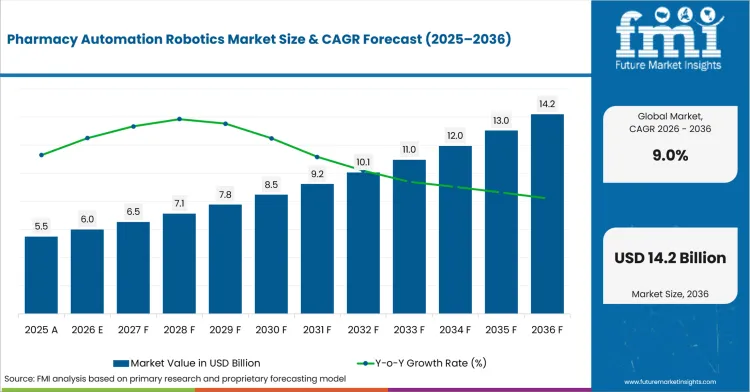
Key Takeaways of Pharmacy Automation Robotics Market
- Demand for pharmacy automation robotics is driven by labor pressure and rising prescription volume, turning automation into capacity protection for pharmacies unable to add staff at the same pace as demand.
- By component, hardware is expected to lead with 58.0% share in 2026, due to robots and storage modules that require facility installation and service access.
- Central hospital pharmacies are the dominant application segment, projected to hold 38.0% share in 2026, driven by consolidated medication handling across inpatient and outpatient care areas.
- Dispensing robots are estimated to lead the product category with 42.0% share in 2026, as high-volume sites seek faster storage and retrieval.
- Software gains commercial weight following installation, controlling inventory rules and device alerts across a growing network of pharmacy equipment, while centralized fulfillment extends controlled inventory access beyond normal staffing hours.
- The United States is expected to lead growth at 10.0% CAGR, supported by multi-site health systems spreading equipment costs across volume, while Germany and Japan combine established pharmacy infrastructure with demand for labor efficiency and prescription traceability.
- Competition centers on BD, Swisslog Healthcare, Omnicell, ARxIUM, YUYAMA, ScriptPro, Capsa Healthcare, and Deenova, with vendors differentiating through storage and unit-dose workflows, automated dispensing with compounding systems, and central-fill and closed-loop medication management.
Analyst Perspective
"Robotic pharmacy automation is no longer evaluated as a standalone technology investment but as part of a broader medication management strategy. The strongest business case emerges when automation improves dispensing capacity, reduces manual verification effort, and integrates seamlessly with established pharmacy workflows without introducing additional operational complexity. As health systems expand centralized and multi-site pharmacy operations, demand will increasingly favor vendors that deliver scalable platforms, reliable interoperability, and implementation expertise that translates automation into sustained operational gains."
- Anurag Sharma, Principal Analyst at Future Market Insights
Source: FMI's proprietary forecasting model and primary research
How is the Pharmacy Automation Robotics Market segmented?
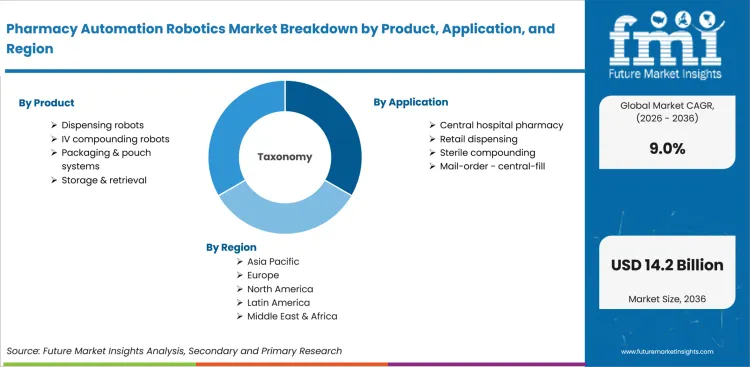
The industry is assessed by product, application, component, end user, sales channel, and region.
The segmentation separates equipment economics from the pharmacy settings that determine operating value and capital priorities. Product analysis covers dispensing robots and intravenous compounding systems together with packaging equipment and automated storage. Application coverage compares central hospital pharmacy with retail dispensing and sterile preparation across different service requirements. Component analysis separates physical equipment from software and support services that control alerts or inventory rules. End-user coverage includes hospitals and retail chains together with long-term care and central-fill facilities with distinct operating requirements. Sales-channel analysis compares direct purchase with leasing and service contracts that shift capital exposure over time. Regional analysis explains how budgets and prescription workflows shape adoption across different national pharmacy systems. The final structure connects pharmacy equipment with hospital service robotics used for medication handling and internal logistics.
What supports demand for dispensing robots within the product category?
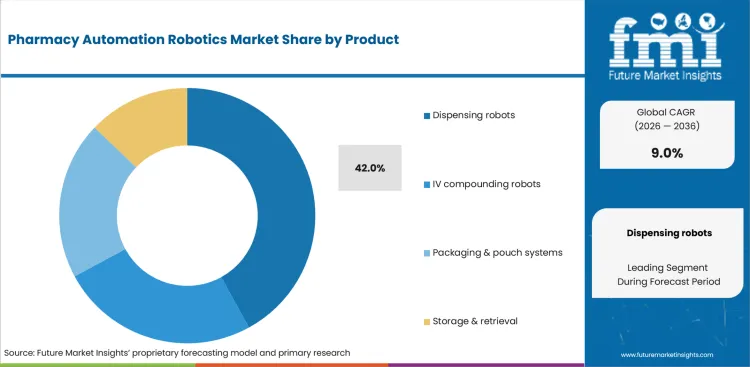
Dispensing robots address repeated picking and packaging work that limits daily pharmacy throughput during prescription peaks. YUYAMA MANUFACTURING CO., LTD. introduced RoboPick IIVC in June 2025 so pharmacy staff could change loaded medicines on site without tools. The feature reduces dependence on factory reconfiguration and supports more medicine types within one installed system across high-volume pharmacy operations at daily scale.
- By product, dispensing robots are projected to represent 42.0% of 2026 revenue through their fit with routine prescription volume. Automated picking reduces repeated shelf searches and preserves pharmacist review at the final dispensing stage. This balance gives high-volume pharmacies measurable throughput gains without forcing a complete redesign of every downstream task.
- Hospital outpatient pharmacies and retail chains are expected to favor systems that can handle medicine changes and exception work. Selection depends on verified accuracy and responsive service across the full installed life rather than stated machine speed alone. Related pharmaceutical robotics systems create additional options for packaging and internal medicine movement within high-volume sites.
How does central hospital pharmacy shape demand within the application category?
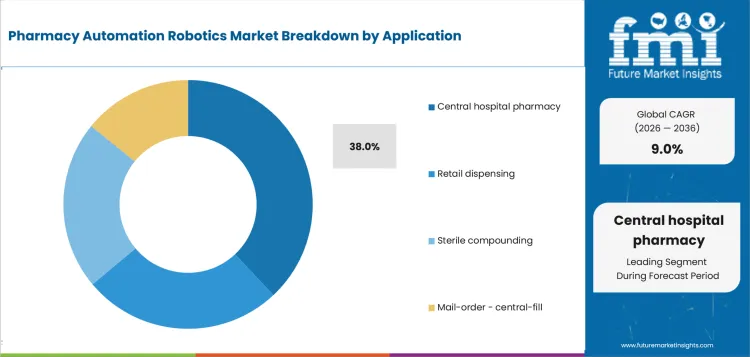
Central hospital pharmacies combine high prescription volume with inventory controls that benefit from consolidated automation across several care units. The Fujian Provincial Health Commission reported in January 2025 that a fully automated intravenous compounding robot prepared each bottle in 35 to 70 seconds. This operating range shows how hospitals can standardize repeated sterile work and retain pharmacist oversight for final release and clinical review.
- In 2026, central hospital pharmacy is expected to account for 38.0% of application revenue through consolidated medication handling. Hospitals can connect storage and compounding equipment with one inventory process that supports inpatient and outpatient demand. Centralization raises the value of uptime; a single equipment interruption can affect medicine availability across several care areas and disrupt planned service.
- Health systems are evaluating automation for sterile doses and urgent prescription retrieval across inpatient and outpatient services. These applications need controlled links with pharmacy information systems and cleanroom procedures that govern sterile work. Hospital approval therefore depends on a practical validation plan and a clear fallback process for routine care during equipment downtime.
How is hardware positioned within the component category?
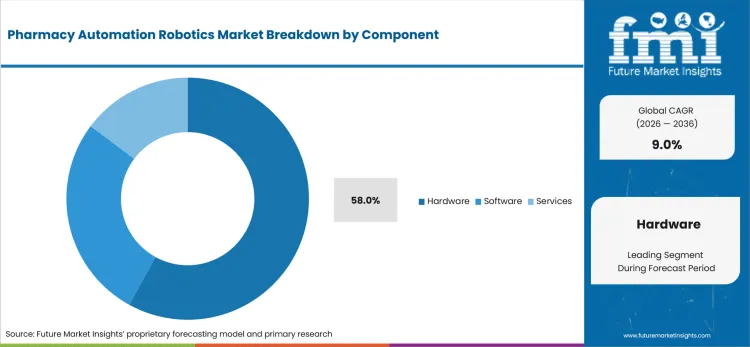
Hardware receives early capital because every automated workflow needs physical storage and controlled medication movement inside the pharmacy. ARxIUM reported in April 2026 that RIVA robotic compounding systems had prepared more than 19 million sterile doses in USP 797-compliant environments. This volume shows that installed equipment can support sustained daily production rather than a short demonstration or limited hospital pilot.
- By component, hardware is estimated to hold 58.0% share in 2026 due to the cost of robots and storage modules. Installation may need power upgrades and facility changes that place equipment within a multi-year capital plan. Service access and spare-part availability then influence the useful life and daily reliability of that investment.
- Software and services are expected to gain value as pharmacy networks monitor more equipment across several sites. Managers need inventory visibility and alert handling together with dependable mechanical throughput at every location. Companies that connect device data with daily operating decisions can earn recurring revenue well beyond the original hardware installation.
What are the drivers, restraints, and opportunities in the Pharmacy Automation Robotics Market?
Labor shortages support adoption. Facility investment slows projects. Connected medication workflows create recurring service revenue.
- Driver: Pharmacy labor pressure is expected to support robotic dispensing that transfers repeated storage and picking work from staff to controlled equipment.
- Restraint: Facility construction and workflow validation are anticipated to delay projects that cannot spread investment across several pharmacy locations.
- Opportunity: Connected platforms are projected to create recurring software and support revenue following installation of core robotic hardware across pharmacy operations.
Persistent labor pressure is shifting investment from isolated device replacement toward coordinated medication management across health systems. Omnicell announced Titan XT in December 2025 as an automated dispensing system built on its OmniSphere cloud platform. The launch extends centralized inventory controls into nursing care areas and supports consistent rules across several settings. Companies can gain recurring revenue as health systems purchase software support with installed equipment throughout long equipment lives. This model favors platforms that remain useful as a health system connects more care locations.
Capital requirements remain a practical barrier because automation can change the building and the pharmacy process at the same time. The United Kingdom issued hub-and-spoke dispensing regulations in June 2025 that require written operating arrangements and clear patient information. These obligations add planning work that must be completed prior to routine service from a shared automated hub. Project approval therefore depends on a realistic volume case and a tested continuity plan for medicine supply.
China shows how public hospital programs can create demand for domestic pharmacy robots and integration services. The Wuhan municipal government reported in April 2025 that a locally developed smart pharmacy system had reached more than 100 hospitals. Its replenishment robot processed over 800 medicine boxes per hour with a reported pick success rate above 99.999%. This operating evidence creates an opening for companies that connect physical automation with electronic batch records and hospital information systems.
Which country CAGRs are profiled in the Pharmacy Automation Robotics Market?
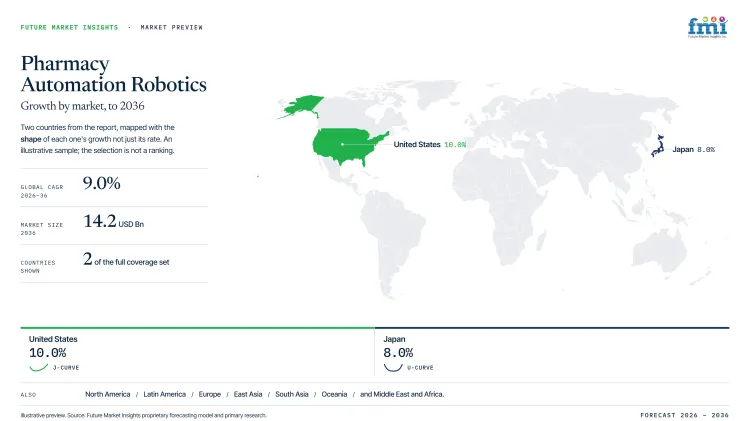
| Country | CAGR |
|---|---|
| United States | 10.0% |
| Japan | 8.0% |
Source: FMI's proprietary forecasting model and primary research.
How do country-level CAGRs compare in the Pharmacy Automation Robotics Market?
The comparison spans 2.0 percentage points and reflects a relatively close growth outlook across the pharmacy automation robotics market. The United States leads with a CAGR of 10.0%, while Japan follows at 8.0%. Both markets are investing in automation to improve medication dispensing and pharmacy workflow efficiency, although healthcare delivery models and pharmacy operations influence adoption in different ways.
- The United States records the higher CAGR at 10.0%. Hospitals, health systems and retail pharmacy operators are increasing investment in robotic dispensing, medication packaging and inventory management systems to improve prescription accuracy, reduce manual workloads and support higher dispensing volumes.
- Japan follows with a CAGR of 8.0%, remaining 2.0 percentage points behind the United States. Pharmacy automation is gaining attention as healthcare providers seek more efficient medication management and dispensing processes while responding to workforce constraints and growing demand for pharmaceutical services. Robotic systems are increasingly being evaluated to improve workflow consistency and optimize pharmacy operations.
Comparable CAGRs do not necessarily create identical commercial opportunities. Differences in pharmacy practice, medication distribution models, healthcare infrastructure and automation investment priorities influence deployment strategies and long-term supplier positioning. The full report provides country-level CAGR analysis across North America, Latin America, Europe, East Asia, South Asia, Oceania and the Middle East and Africa.
Country-wise Analysis
Country growth reflects the operating problem that automation must solve within each national pharmacy system. United States demand places greater weight on labor economics and multi-site systems with shared medication inventories. Japan relies on equipment companies familiar with medicine preparation routines. The outlook links physical equipment with clinical workflow solutions that coordinate medicine operations across several care settings. Replenishment decisions can draw on artificial intelligence inventory tools that support stock planning across pharmacy locations.
-
United States health systems are consolidating pharmacy work across larger networks that can use shared automation across several sites. Labor availability remains a practical constraint for repeated dispensing and inventory work during busy operating periods. The sector is projected to record 10.0% CAGR from 2026 to 2036 through multi-site investment and higher prescription volume. The USA Bureau of Labor Statistics reported in April 2026 that about 49,000 pharmacy technician openings were projected each year from 2024 to 2034. This staffing gap supports equipment that transfers inventory and filling tasks from limited personnel to controlled systems. Service response and software compatibility shape investment decisions across networks that cannot tolerate downtime at several connected locations.
- Japan has an established base of dispensing equipment and detailed medicine preparation practices that support gradual automation. Local pharmacies often need systems that fit medicine formats and established checking routines without disrupting existing service. Sales are forecast to expand at 8.0% CAGR from 2026 to 2036 as pharmacies seek more staff time for patient care. YUYAMA MANUFACTURING CO., LTD. reported JPY 58.2 billion in sales for the fiscal year ending March 2026. The figure shows meaningful domestic scale across pharmaceutical automation and medication management equipment within established pharmacy networks. Local maintenance and careful configuration are likely to remain important selection factors for pharmacies with specialized preparation routines.
Who are the notable companies in the Pharmacy Automation Robotics Market?
BD, Omnicell, ARxIUM, Swisslog Healthcare, YUYAMA MANUFACTURING CO., LTD., ScriptPro LLC, Capsa Healthcare, and Deenova are notable companies in this industry.
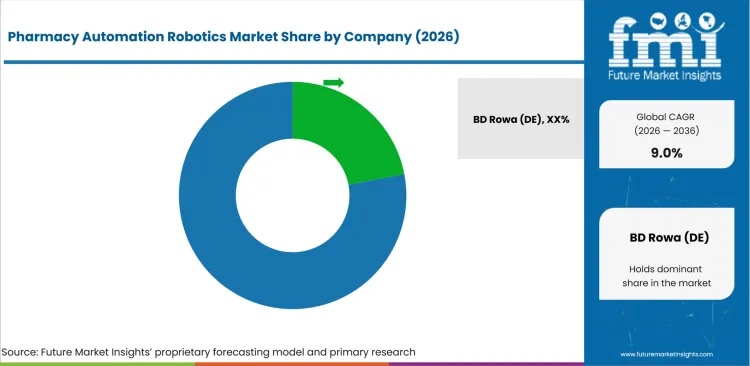
Competition spans robotic storage and sterile compounding together with software that manages medication access across several sites. BD and Swisslog Healthcare address hospital storage through pharmacy robotics supported by installation and service programs. Omnicell and ARxIUM combine automated dispensing with enterprise software and verified robotic intravenous compounding systems. YUYAMA and ScriptPro serve defined prescription preparation tasks through picking or vial-filling equipment in hospital or retail pharmacies. Capsa Healthcare supports counting and central-fill work and Deenova focuses on closed-loop hospital medication management. Related connected drug cabinets increase the value of reliable software links across care areas and nursing units. Broader medical automation systems raise expectations for coordinated service across several equipment categories over time.
- BD and Swisslog Healthcare compete in projects that need high-density storage and controlled medicine retrieval. BD Rowa Vmax serves hospital-based and community pharmacies and Swisslog Healthcare offers BoxPicker storage and PillPick unit-dose equipment. Installation planning and service response affect commercial value once each system becomes part of daily hospital infrastructure.
- Omnicell and ARxIUM address enterprise medication management through automated dispensing cabinets and connected software platforms. Both companies maintain verified robotic intravenous compounding systems that support controlled sterile preparation inside hospital pharmacies. Hospitals comparing these portfolios should examine inventory control and care-unit access together with cleanroom validation and ongoing software support.
- YUYAMA MANUFACTURING CO., LTD. and ScriptPro LLC focus on prescription preparation through automated picking and vial filling. Their equipment suits pharmacies seeking targeted workflow improvement without adopting one enterprise platform across every routine medication task. Medicine format and prescription volume matter as much as local maintenance coverage during system selection.
- Capsa Healthcare and Deenova address different stages within medication preparation and administration workflows across pharmacy networks. Capsa Healthcare provides counting and central-fill systems and Deenova connects pharmacy work with ward-level medicine use through closed-loop technology. Pharmacy networks may add medication pouch inspection if packaged-dose verification becomes part of the operating design.
Competitive Benchmarking: Pharmacy Automation Robotics Market
| Company | Dispensing Robotics | Sterile Compounding | Software Integration | Geographic Reach |
|---|---|---|---|---|
| BD | High | Low | High | High |
| Omnicell | High | High | High | High |
| ARxIUM | High | High | High | High |
| Swisslog Healthcare | High | Low | High | High |
| YUYAMA MANUFACTURING CO., LTD. |
High | High | High | Medium |
| ScriptPro LLC | High | Low | High | Medium |
| Capsa Healthcare | High | Low | Medium | Medium |
| Deenova | High | Low | High | Medium |
Scoring basis: Ratings reflect verified product scope and software coverage across the exact pharmacy automation categories shown. The assessment also considers sterile compounding capability and official operating regions for each company in the benchmark. High indicates broad verified coverage across the assessed categories; Medium indicates selective coverage and Low indicates limited verified coverage.
Source: Future Market Insights
Key Developments in the Pharmacy Automation Robotics Market
- In September 2025, BD announced a pharmacy automation partnership with Henry Ford Health to install BD Rowa Vmax storage and retrieval systems across hospital-based community pharmacies in Michigan. The first use case provides prescription retrieval throughout the day and night at participating locations. The agreement shows how one health system can apply the same robotic platform across several sites with coordinated service support.
- In December 2025, ARxIUM introduced MedSelect Aspire automated dispensing cabinets with expanded storage and connected medication management software. The product extends ARxIUM beyond central pharmacy equipment and sterile compounding into secure access workflows across care areas. Hospitals gain another option for applying common inventory rules and medication controls across a wider equipment network. This broader coverage can reduce the number of separate systems used across medication access points.
- In September 2025, Swisslog Healthcare formed a partnership with Diligent Robotics to add Moxi delivery robots to hospital logistics programs. Swisslog reported that Moxi had completed more than 300,000 pharmacy deliveries within over one million total hospital deliveries. The partnership connects central pharmacy automation with last-mile transport that can reduce staff travel between preparation areas and care units. Hospitals can use this link to extend automation beyond the pharmacy door without changing core medication controls.
- In January 2025, Capsa Healthcare launched the Kirby Lester KL1v prescription counting device for routine pharmacy filling. The product supports accurate tablet counting and repeatable preparation within community or retail pharmacy settings. The launch shows continued investment in compact automation that improves a defined dispensing step without the building changes associated with a large central-fill project. This product category remains relevant for pharmacies that need measured improvement within a limited physical footprint.
Key Players in the Pharmacy Automation Robotics Market
Hospital storage and unit-dose automation
- BD
- Swisslog Healthcare
- Deenova
Retail and central-fill dispensing robotics
- YUYAMA MANUFACTURING CO., LTD.
- ScriptPro LLC
- Capsa Healthcare
Enterprise dispensing and sterile compounding
- Omnicell
- ARxIUM
Pharmacy Automation Robotics Market - Report Scope
| Coverage field | Report scope |
|---|---|
| Market breakdown | Product, application, component, end user, sales channel, and region. |
| Quantitative units | Revenue in USD Million, CAGR in %. |
| Market definition | Robotic systems that store, retrieve, count, package, compound, or dispense medicines within pharmacy operations. |
| Regions covered | North America, Latin America, Europe, East Asia, South Asia, Oceania, and Middle East and Africa. |
| Countries covered | United States, Canada, Germany, United Kingdom, France, China, Japan, India, Australia, Brazil, and selected regional countries. |
| Key companies profiled | BD, Omnicell, ARxIUM, Swisslog Healthcare, YUYAMA MANUFACTURING CO., LTD., ScriptPro LLC, Capsa Healthcare, and Deenova. |
| Forecast period | The assessment covers 2026 to 2036 with historical context from 2024 onward. |
| Coverage | Market sizing is combined with segment analysis, country comparison, workflow economics, adoption barriers, and competitive positioning. |
Pharmacy Automation Robotics Market - Research Methodology
| Method | Approach |
|---|---|
| Primary Research | FMI analysts gathered input from manufacturers, service providers, technology developers, distributors, end users, sourcing teams, and subject-matter experts. Interviews examined purchasing decisions, product or service evaluation, adoption barriers, approval requirements, pricing considerations, and expectations for technical or commercial support. Respondents were also asked what evidence is required before a trial, pilot, or initial order develops into regular purchasing. |
| Desk Research | Desk research covered government statistics, regulatory publications, trade data, industry associations, technical literature, standards, company filings, product information, and official corporate announcements. Sources were reviewed for relevance, publication date, geographic coverage, and consistency with the defined market scope. Claims relating to performance, applications, approvals, capacity, investment, and commercial activity were retained only when supported by credible public evidence. |
| Market Sizing and Forecasting | The market model combined the baseline value with historical performance, segment structure, pricing and volume indicators, adoption levels, company participation, and country-level demand conditions. Forecast assumptions considered economic activity, investment trends, regulatory developments, technology adoption, purchasing cycles, supply availability, and barriers to wider market use. Segment and regional estimates were reconciled before the final market total was calculated. |
| Data Validation | Estimates were checked against multiple independent indicators, including public data, company activity, trade patterns, industry developments, and findings from primary interviews. Validation also tested whether products, services, applications, and company revenues fell within the defined market boundaries. Adjacent categories, unsupported claims, overlapping revenues, and activities without direct market relevance were excluded to reduce double counting and maintain consistency across segments and countries. |
Pharmacy Automation Robotics Market by Segments
By Product
- Dispensing robots
- IV compounding robots
- Packaging and pouch systems
- Storage and retrieval systems
By Application
- Central hospital pharmacy
- Retail dispensing
- Sterile compounding
- Mail-order and central-fill
By Component
- Hardware
- Software
- Services
By End User
- Hospital pharmacies
- Retail pharmacy chains
- Long-term care pharmacies
- Central-fill facilities
By Sales Channel
- Direct purchase
- Lease
- Service contract
- Pilot program
Pharmacy Automation Robotics Market by Region:
- North America
- United States
- Canada
- Latin America
- Brazil
- Mexico
- Europe
- Germany
- United Kingdom
- France
- Italy
- Spain
- Nordic countries
- East Asia
- China
- Japan
- South Korea
- South Asia
- India
- ASEAN countries
- Oceania
- Australia
- New Zealand
- Middle East and Africa
- GCC countries
- South Africa
- Türkiye
- Israel
Research Sources and Bibliography
- ABDA. (2026, January 13). 2025 pharmacy count falls to 16,601 operating sites.
- Apollo Hospitals Enterprise Limited. (2025, August). Annual Report 2024-25.
- ARxIUM. (2026, April 30). RIVA surpasses 19 million doses safely prepared in USP 797-compliant
- ARxIUM. (2025, December 1). ARxIUM launches MedSelect Aspire automated dispensing cabinets.
- BD. (2025, September 22). BD and Henry Ford Health sign pharmacy automation partnership.
- Capsa Healthcare. (2025, January 8). Capsa Healthcare unveils the Kirby Lester KL1v.
- Capsa Healthcare. (n.d.). Central-fill and mail-order pharmacy automation solutions.
- Deenova. (2026, June 22). Deenova to deliver an integrated medication management platform at Policlinico di Milano.
- Fujian Provincial Health Commission. (2025, January 15). Fujian introduces its first fully automated intravenous compounding robot.
- Omnicell. (2025, December 8). Omnicell announces Titan XT automated dispensing system. Automated-Dispensing-System-Designed-to-Empower-Autonomous-Medication-Management/default.aspx
- Omnicell. (n.d.). IVX Station automated intravenous compounding robot.
- Swisslog Healthcare. (n.d.). Pharmacy automation and systems.
- Swisslog Healthcare. (2025, September 15). Swisslog Healthcare partners with Diligent Robotics.
- United Kingdom Department of Health and Social Care. (2025, January 30). Extension of hub and spoke dispensing to different legal entities: Final impact assessment.
- United Kingdom Government. (2025, June 25). The Human Medicines Regulations 2025: Hub and spoke dispensing amendments.
- USA Bureau of Labor Statistics. (2025, August 28). Pharmacists: Occupational Outlook Handbook.
- USA Bureau of Labor Statistics. (2026, April 24). Pharmacy technicians: Occupational Outlook Handbook.
- Wuhan Municipal Government. (2025, April 8). Smart pharmacy automatic replenishment technology reaches hospitals across China.
- YUYAMA MANUFACTURING CO., LTD. (2025, June 1). RoboPick IIVC on-site medicine change feature.
This bibliography is provided for reader reference and uses primary government, standards-body, official trade body, and company sources.
This Report Answers
- How large is the pharmacy automation robotics industry in 2026 and what value is forecast for 2036?
- Which product and application categories account for the greatest share of 2026 revenue?
- How do labor economics and prescription volume influence investment in robotic dispensing systems?
- What limits adoption among smaller hospitals and independent community pharmacies?
- How do country growth paths differ across China and the United States?
- Which verified companies supply dispensing systems and sterile compounding or storage robotics?
- How should pharmacy operators compare equipment with software and service requirements?
- What commercial opportunity comes from connecting robots with enterprise medication information?
- Which recent company developments are changing competition within pharmacy automation robotics?
Frequently Asked Questions
What is driving growth in the pharmacy automation robotics market?
Labor pressure and prescription volume make repeated dispensing work harder to staff throughout each operating day. Robots protect pharmacist time and maintain service capacity across busy pharmacy locations.
Who are the key players in the pharmacy automation robotics market?
Verified companies include BD and Omnicell together with ARxIUM and Swisslog Healthcare across several automation categories. YUYAMA and other specialists serve defined dispensing or compounding workflows.
What is a notable restraint on pharmacy automation robotics adoption?
Facility changes and workflow validation can raise project costs prior to routine pharmacy service. Smaller pharmacies may lack enough prescription volume to recover that investment within a reasonable period.
Why should executives track the pharmacy automation robotics market?
Robotics can change labor allocation and medication handling costs across several hospital or retail pharmacy locations. Executives should track integration demands and long-term software dependence as they consider wider investment.
What business problem does pharmacy automation robotics address?
The equipment reduces repeated storage and dispensing tasks that consume staff time during routine pharmacy operations. It supports consistent medication handling during high prescription volume or limited staffing capacity.
What should procurement teams evaluate before selecting pharmacy automation robotics?
Selection should compare throughput and workflow fit with service coverage across every planned installation. Software interfaces and fallback procedures determine whether equipment delivers reliable savings during normal pharmacy operations.
What limits return on investment from pharmacy automation robotics?
Weak prescription volume can leave expensive robotic capacity unused during the expected investment period. Poor inventory data or building constraints can reduce the labor and service savings from automation.
What supports long-term commercial confidence in pharmacy automation robotics?
Verified deployments show that robots can support routine pharmacy work in hospital and retail settings. Confidence improves through dependable integration and maintenance across the expected equipment service life.
Preview the report firsthand - request a free sample
Get SampleGet the brochure for pricing and purchase details.
Get PDFTable of Content
- Key Takeaways
- Market Size and CAGR
- Top Growth Driver
- Fastest Growing Segment
- Leading Region
- Key Companies
- Emerging Opportunities
- Executive Summary
- Global Market Outlook
- Demand-side Trends
- Supply-side Trends
- Technology Roadmap Analysis
- Analysis and Recommendations
- Analyst Perspective (What is happening? Why now? What should investors know?)
- Key Questions Answered
- How large is the market?
- What is the CAGR?
- What are key trends?
- Which region dominates?
- Who are the leaders?
- Market Overview
- Market Coverage / Taxonomy
- Market Definition / Scope / Limitations
- Research Methodology
- Chapter Orientation
- Analytical Lens and Working Hypotheses
- Market Structure, Signals, and Trend Drivers
- Benchmarking and Cross-market Comparability
- Market Sizing, Forecasting, and Opportunity Mapping
- Research Design and Evidence Framework
- Desk Research Programme (Secondary Evidence)
- Expert Input and Fieldwork (Primary Evidence)
- Tooling, Models, and Reference Databases
- Data Engineering and Model Build
- Quality Assurance and Audit Trail
- Market Background
- Market Dynamics (Drivers, Restraints, Opportunity, Trends)
- Scenario Forecast (Optimistic, Likely, Conservative)
- Impact Analysis
- AI Impact
- Sustainability Impact
- Regulatory Impact
- Technology Impact
- Consumer / Buyer Analysis
- Purchase Drivers
- Adoption Barriers
- Buyer Journey
- Opportunity Map Analysis
- Product Life Cycle Analysis
- Supply Chain Analysis
- Investment Feasibility Matrix
- Value Chain Analysis
- PESTLE and Porter's Analysis
- Regulatory Landscape
- Regional Parent Market Outlook
- Production and Consumption Statistics
- Import and Export Statistics
- Global Market Analysis and Forecast, 2021 to 2036
- Historical Market Size Value (USD Bn) Analysis, 2021 to 2025
- Current and Future Market Size Value (USD Bn) Projections, 2026 to 2036
- Y-o-Y Growth Trend Analysis
- Absolute $ Opportunity Analysis
- Global Market Pricing Analysis, 2021 to 2036
- Global Market Analysis and Forecast, By Product, 2021 to 2036
- Introduction / Key Findings
- Historical Market Size Value (USD Bn) Analysis By Product, 2021 to 2025
- Current and Future Market Size Value (USD Bn) Analysis and Forecast By Product, 2026 to 2036
- Dispensing robots
- IV compounding robots
- Packaging & pouch systems
- Storage & retrieval
- Dispensing robots
- Y-o-Y Growth Trend Analysis By Product, 2021 to 2025
- Absolute $ Opportunity Analysis By Product, 2026 to 2036
- Global Market Analysis and Forecast, By Application, 2021 to 2036
- Introduction / Key Findings
- Historical Market Size Value (USD Bn) Analysis By Application, 2021 to 2025
- Current and Future Market Size Value (USD Bn) Analysis and Forecast By Application, 2026 to 2036
- Central hospital pharmacy
- Retail dispensing
- Sterile compounding
- Mail-order - central-fill
- Central hospital pharmacy
- Y-o-Y Growth Trend Analysis By Application, 2021 to 2025
- Absolute $ Opportunity Analysis By Application, 2026 to 2036
- Global Market Analysis and Forecast, By Component, 2021 to 2036
- Introduction / Key Findings
- Historical Market Size Value (USD Bn) Analysis By Component, 2021 to 2025
- Current and Future Market Size Value (USD Bn) Analysis and Forecast By Component, 2026 to 2036
- Hardware
- Software
- Services
- Hardware
- Y-o-Y Growth Trend Analysis By Component, 2021 to 2025
- Absolute $ Opportunity Analysis By Component, 2026 to 2036
- Global Market Analysis and Forecast, By End User, 2021 to 2036
- Introduction / Key Findings
- Historical Market Size Value (USD Bn) Analysis By End User, 2021 to 2025
- Current and Future Market Size Value (USD Bn) Analysis and Forecast By End User, 2026 to 2036
- Hospital pharmacies
- Retail chains
- Long-term care
- Central-fill facilities
- Hospital pharmacies
- Y-o-Y Growth Trend Analysis By End User, 2021 to 2025
- Absolute $ Opportunity Analysis By End User, 2026 to 2036
- Global Market Analysis and Forecast, By Sales Channel, 2021 to 2036
- Introduction / Key Findings
- Historical Market Size Value (USD Bn) Analysis By Sales Channel, 2021 to 2025
- Current and Future Market Size Value (USD Bn) Analysis and Forecast By Sales Channel, 2026 to 2036
- Direct
- Lease
- Service contracts
- Pilot programs
- Direct
- Y-o-Y Growth Trend Analysis By Sales Channel, 2021 to 2025
- Absolute $ Opportunity Analysis By Sales Channel, 2026 to 2036
- Global Market Analysis and Forecast, By Region, 2021 to 2036
- Introduction
- Historical Market Size Value (USD Bn) Analysis By Region, 2021 to 2025
- Current Market Size Value (USD Bn) Analysis and Forecast By Region, 2026 to 2036
- North America
- Latin America
- Western Europe
- Eastern Europe
- East Asia
- South Asia and Pacific
- Middle East & Africa
- Market Attractiveness Analysis By Region
- North America Market Analysis and Forecast, By Country, 2021 to 2036
- Historical Market Size Value (USD Bn) Trend Analysis By Market Taxonomy, 2021 to 2025
- Market Size Value (USD Bn) Forecast By Market Taxonomy, 2026 to 2036
- By Country
- USA
- Canada
- By Product
- By Application
- By Component
- By End User
- By Sales Channel
- By Country
- Market Attractiveness Analysis
- By Country
- By Product
- By Application
- By Component
- By End User
- By Sales Channel
- Key Takeaways
- Latin America Market Analysis and Forecast, By Country
- Historical Market Size Value (USD Bn) Trend Analysis By Market Taxonomy, 2021 to 2025
- Market Size Value (USD Bn) Forecast By Market Taxonomy, 2026 to 2036
- By Country
- Brazil
- Mexico
- Chile
- Rest of Latin America
- By Product
- By Application
- By Component
- By End User
- By Sales Channel
- By Country
- Market Attractiveness Analysis
- By Country
- By Product
- By Application
- By Component
- By End User
- By Sales Channel
- Key Takeaways
- Western Europe Market Analysis and Forecast, By Country
- Historical Market Size Value (USD Bn) Trend Analysis By Market Taxonomy, 2021 to 2025
- Market Size Value (USD Bn) Forecast By Market Taxonomy, 2026 to 2036
- By Country
- Germany
- UK
- Italy
- Spain
- France
- Nordic
- BENELUX
- Rest of Western Europe
- By Product
- By Application
- By Component
- By End User
- By Sales Channel
- By Country
- Market Attractiveness Analysis
- By Country
- By Product
- By Application
- By Component
- By End User
- By Sales Channel
- Key Takeaways
- Eastern Europe Market Analysis and Forecast, By Country
- Historical Market Size Value (USD Bn) Trend Analysis By Market Taxonomy, 2021 to 2025
- Market Size Value (USD Bn) Forecast By Market Taxonomy, 2026 to 2036
- By Country
- Russia
- Poland
- Hungary
- Balkan & Baltic
- Rest of Eastern Europe
- By Product
- By Application
- By Component
- By End User
- By Sales Channel
- By Country
- Market Attractiveness Analysis
- By Country
- By Product
- By Application
- By Component
- By End User
- By Sales Channel
- Key Takeaways
- East Asia Market Analysis and Forecast, By Country
- Historical Market Size Value (USD Bn) Trend Analysis By Market Taxonomy, 2021 to 2025
- Market Size Value (USD Bn) Forecast By Market Taxonomy, 2026 to 2036
- By Country
- China
- Japan
- South Korea
- By Product
- By Application
- By Component
- By End User
- By Sales Channel
- By Country
- Market Attractiveness Analysis
- By Country
- By Product
- By Application
- By Component
- By End User
- By Sales Channel
- Key Takeaways
- South Asia and Pacific Market Analysis and Forecast, By Country
- Historical Market Size Value (USD Bn) Trend Analysis By Market Taxonomy, 2021 to 2025
- Market Size Value (USD Bn) Forecast By Market Taxonomy, 2026 to 2036
- By Country
- India
- ASEAN
- Australia & New Zealand
- Rest of South Asia and Pacific
- By Product
- By Application
- By Component
- By End User
- By Sales Channel
- By Country
- Market Attractiveness Analysis
- By Country
- By Product
- By Application
- By Component
- By End User
- By Sales Channel
- Key Takeaways
- Middle East & Africa Market Analysis and Forecast, By Country
- Historical Market Size Value (USD Bn) Trend Analysis By Market Taxonomy, 2021 to 2025
- Market Size Value (USD Bn) Forecast By Market Taxonomy, 2026 to 2036
- By Country
- Kingdom of Saudi Arabia
- Other GCC Countries
- Türkiye
- South Africa
- Other African Union
- Rest of Middle East & Africa
- By Product
- By Application
- By Component
- By End User
- By Sales Channel
- By Country
- Market Attractiveness Analysis
- By Country
- By Product
- By Application
- By Component
- By End User
- By Sales Channel
- Key Takeaways
- Key Countries Market Analysis
- USA
- Pricing Analysis
- Market Share Analysis, 2025
- By Product
- By Application
- By Component
- By End User
- By Sales Channel
- Canada
- Pricing Analysis
- Market Share Analysis, 2025
- By Product
- By Application
- By Component
- By End User
- By Sales Channel
- Mexico
- Pricing Analysis
- Market Share Analysis, 2025
- By Product
- By Application
- By Component
- By End User
- By Sales Channel
- Brazil
- Pricing Analysis
- Market Share Analysis, 2025
- By Product
- By Application
- By Component
- By End User
- By Sales Channel
- Chile
- Pricing Analysis
- Market Share Analysis, 2025
- By Product
- By Application
- By Component
- By End User
- By Sales Channel
- Germany
- Pricing Analysis
- Market Share Analysis, 2025
- By Product
- By Application
- By Component
- By End User
- By Sales Channel
- UK
- Pricing Analysis
- Market Share Analysis, 2025
- By Product
- By Application
- By Component
- By End User
- By Sales Channel
- Italy
- Pricing Analysis
- Market Share Analysis, 2025
- By Product
- By Application
- By Component
- By End User
- By Sales Channel
- Spain
- Pricing Analysis
- Market Share Analysis, 2025
- By Product
- By Application
- By Component
- By End User
- By Sales Channel
- France
- Pricing Analysis
- Market Share Analysis, 2025
- By Product
- By Application
- By Component
- By End User
- By Sales Channel
- India
- Pricing Analysis
- Market Share Analysis, 2025
- By Product
- By Application
- By Component
- By End User
- By Sales Channel
- ASEAN
- Pricing Analysis
- Market Share Analysis, 2025
- By Product
- By Application
- By Component
- By End User
- By Sales Channel
- Australia & New Zealand
- Pricing Analysis
- Market Share Analysis, 2025
- By Product
- By Application
- By Component
- By End User
- By Sales Channel
- China
- Pricing Analysis
- Market Share Analysis, 2025
- By Product
- By Application
- By Component
- By End User
- By Sales Channel
- Japan
- Pricing Analysis
- Market Share Analysis, 2025
- By Product
- By Application
- By Component
- By End User
- By Sales Channel
- South Korea
- Pricing Analysis
- Market Share Analysis, 2025
- By Product
- By Application
- By Component
- By End User
- By Sales Channel
- Russia
- Pricing Analysis
- Market Share Analysis, 2025
- By Product
- By Application
- By Component
- By End User
- By Sales Channel
- Poland
- Pricing Analysis
- Market Share Analysis, 2025
- By Product
- By Application
- By Component
- By End User
- By Sales Channel
- Hungary
- Pricing Analysis
- Market Share Analysis, 2025
- By Product
- By Application
- By Component
- By End User
- By Sales Channel
- Kingdom of Saudi Arabia
- Pricing Analysis
- Market Share Analysis, 2025
- By Product
- By Application
- By Component
- By End User
- By Sales Channel
- Türkiye
- Pricing Analysis
- Market Share Analysis, 2025
- By Product
- By Application
- By Component
- By End User
- By Sales Channel
- South Africa
- Pricing Analysis
- Market Share Analysis, 2025
- By Product
- By Application
- By Component
- By End User
- By Sales Channel
- USA
- Market Structure Analysis
- Competition Dashboard
- Competition Benchmarking
- Market Share Analysis of Top Players
- By Regional
- By Product
- By Application
- By Component
- By End User
- By Sales Channel
- Emerging Startups
- Innovation Benchmarking
- Competition Analysis
- Competition Deep Dive
- BD Rowa (DE)
- Overview
- Product Portfolio
- Profitability by Market Segments
- Sales Footprint
- Strategy Overview
- Marketing Strategy
- Product Strategy
- Channel Strategy
- Omnicell (US)
- Yuyama (JP)
- ARxIUM (CA)
- BD Rowa (DE)
- Case Studies
- Success Stories
- Recent Developments
- Competition Deep Dive
- Assumptions & Acronyms Used


