

- Industry Size (2026)
- USD 571.2 Mn
- Forecast (2036)
- USD 1744 Mn
- CAGR (2026 to 2036)
- 12%
AI Hospital Inventory Market Forecast and Outlook 2026 to 2036
The AI hospital inventory market is expected to grow from USD 571.2 million in 2026 to USD 1,774.1 million by 2036, reflecting a compound annual growth rate (CAGR) of 12%. AI-driven inventory management solutions are transforming hospital operations by improving the accuracy and efficiency of inventory tracking, reducing waste, and ensuring that essential medical supplies are always available. These systems leverage artificial intelligence to predict demand, automate restocking processes, and provide real-time visibility into inventory levels, helping healthcare providers maintain optimal inventory without overstocking or understocking.
The market is driven by the increasing complexity of healthcare supply chains, the need for hospitals to manage costs effectively, and the rising adoption of AI technologies across various healthcare functions. With the growing pressure to improve operational efficiency and reduce healthcare costs, hospitals are turning to AI-based solutions for inventory management. Additionally, the need to streamline supply chain processes, prevent stockouts, and ensure the timely availability of critical medical supplies will continue to drive the market’s growth.
Quick Stats for AI Hospital Inventory Market
- AI Hospital Inventory Market Value (2026): USD 571.2 million
- AI Hospital Inventory Market Forecast Value (2036): USD 1,774.1 million
- AI Hospital Inventory Market Global Forecast CAGR (2026–2036): 12%
- Top Product Type by Share in AI Hospital Inventory Market: Inventory Optimization Engine (35%)
- Key Growth Regions in AI Hospital Inventory Market: India, China, USA, UK, Germany
- Top Players in AI Hospital Inventory Market: Oracle/NetSuite, IMPACT Analytics (startups), GE HealthCare, Cerner/Oracle, Siemens
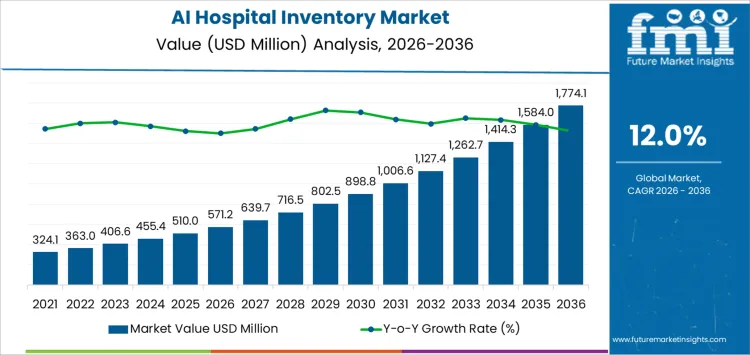
What is the Growth Forecast for the AI Hospital Inventory Market through 2036?
The 10-year growth comparison for the AI hospital inventory market shows steady growth with significant acceleration in the latter part of the forecast period. Starting at USD 571.2 million in 2026, the market grows to USD 639.74 million in 2027 and USD 716.51 million in 2028, reflecting early-stage adoption of AI-driven inventory management solutions in healthcare settings.
From 2028 to 2030, the market continues its upward trajectory, reaching USD 802.49 million in 2029 and USD 898.79 million in 2030. This period marks a phase of wider adoption, driven by the increasing recognition of AI’s ability to optimize hospital operations, reduce waste, and enhance supply chain management. From 2030 to 2035, the market accelerates significantly, reaching USD 1,006.65 million in 2031, USD 1,127.45 million in 2032, and USD 1,262.74 million in 2033.
By 2035, the market is projected to reach USD 1,414.27 million, and by 2036, it is expected to reach USD 1,774.1 million. The comparison shows how the market will grow steadily in the early years, with an acceleration in the latter part of the forecast period, driven by increased adoption of AI technologies in healthcare operations, improved cost management practices, and the growing demand for smart, efficient inventory management solutions in hospitals and healthcare facilities.
AI Hospital Inventory Market Key Takeaways
| Metric | Value |
|---|---|
| Industry Sales Value (2026) | USD 571.2 million |
| Industry Forecast Value (2036) | USD 1,744 million |
| Industry Forecast CAGR (2026-2036) | 12% |
What Is Driving the Demand for the AI Hospital Inventory Market Globally?
The global demand for AI hospital inventory solutions is driven by rising pressure on healthcare facilities to control costs, reduce waste, and ensure availability of critical medical supplies. Hospitals manage large inventories of drugs, implants, sterile kits, consumables, and high value devices. Manual inventory tracking often leads to errors, overstocking, stockouts, and expired products, all of which increase operational cost and risk to patient care. AI enabled inventory systems use machine learning and predictive analytics to forecast demand, optimise stock levels, and streamline replenishment cycles based on historical usage, procedural schedules, and seasonality. These systems improve accuracy of inventory records, reduce reliance on periodic manual counts, and enhance reporting for compliance. Integration with electronic health records, procurement platforms, and automated dispensing cabinets further strengthens real time visibility across departments. Adoption has grown as hospitals seek digital transformation to improve operational efficiency, support just in time inventory practices, and align supply availability with clinical needs without tying up capital in excess stock.
Future demand for AI hospital inventory solutions is expected to rise as healthcare providers prioritise resilience, cost efficiency, and supply reliability in a landscape marked by fluctuating patient volumes and supply chain disruptions. Advances in AI and data integration will enhance real time tracking, anomaly detection, and automated ordering, enabling facilities to adjust inventory dynamically in response to changes in care demand or supply availability. Regulatory emphasis on patient safety and traceability of critical items may further encourage adoption. Smaller and mid sized hospitals that previously lacked comprehensive inventory systems may increasingly invest in AI solutions as costs decline and cloud based platforms simplify deployment. In addition, linking inventory intelligence with analytics on utilisation patterns and outcomes can support broader clinical decision making and reduce waste from expired or unused supplies. As healthcare systems worldwide continue to seek value based care with tighter budgets, AI driven inventory platforms will play an expanding role in supporting efficient, data informed supply management across clinical and administrative functions.
What Are the Key Segments in AI Hospital Inventory Market?
The AI hospital inventory market is segmented by product type and application. Inventory optimization engine leads the product type segment with 35% of the market share, helping hospitals efficiently manage and optimize inventory. Surgical supply optimization dominates the application segment with 30%, driven by the critical need to ensure the availability and proper management of surgical supplies. The market is expanding as hospitals increasingly rely on AI solutions to streamline inventory management, reduce costs, and improve operational efficiency.
Which Product Type Drives AI Hospital Inventory Market Demand Globally?
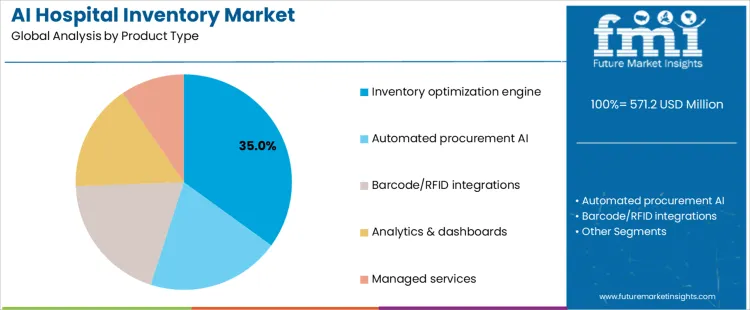
Inventory optimization engine accounts for 35% of the market share. These AI-driven engines help hospitals optimize their inventory by forecasting demand, automating stock management, and minimizing overstocking or stockouts. The optimization engine uses real-time data and advanced algorithms to predict future needs based on historical usage patterns, seasonal trends, and other relevant factors. This capability is particularly crucial in the healthcare sector, where managing inventory accurately can impact patient care, reduce operational inefficiencies, and cut costs. By automating and optimizing inventory management processes, hospitals can ensure they have the right supplies available at the right time while minimizing waste and storage costs. As hospitals and healthcare systems seek to improve their supply chain and reduce operational costs, demand for inventory optimization engines is expected to continue growing.
Which Application Drives AI Hospital Inventory Market Demand Globally?
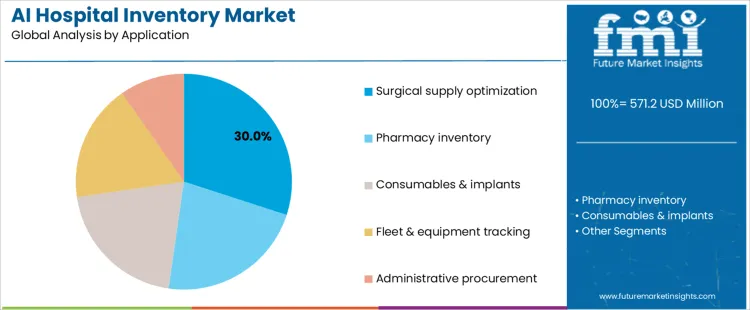
Surgical supply optimization leads the application segment with 30% of the market share. Managing surgical supplies effectively is critical to ensuring that necessary instruments and materials are available when needed for surgeries, without overstocking or understocking. AI-driven inventory solutions help hospitals optimize the management of surgical supplies by forecasting demand, tracking usage, and replenishing items automatically when required. Surgical supplies often have a high cost and tight usage requirements, so ensuring their efficient use is a priority for hospitals. AI solutions for surgical supply optimization not only help reduce waste but also enhance surgical team preparedness, improving patient outcomes. While other applications such as pharmacy inventory, consumables & implants, and fleet & equipment tracking also contribute to the market, surgical supply optimization remains the dominant application due to its direct impact on patient care and operational efficiency in hospital settings.
What are the Key Dynamics of the Global AI Hospital Inventory Market?
The global AI hospital inventory market is growing as healthcare providers adopt intelligent systems to manage medical supplies, pharmaceuticals and equipment more efficiently. Artificial intelligence helps hospitals forecast demand, automate ordering and track stock levels in real time, reducing waste and stockouts. Growth is supported by pressure on healthcare budgets, the need to improve patient care continuity and the rise of digital health strategies. Adoption spans acute care facilities, outpatient centres and large health systems seeking cost control and operational visibility in supply management.
What are the Key Drivers for the Global AI Hospital Inventory Market?
Demand for AI enabled inventory solutions is driven by hospitals aiming to optimise stock levels and reduce waste of expensive medical supplies and medications. Health systems face pressure to balance cost control with high standards of care, and predictive analytics helps forecast usage patterns. Increasing complexity of healthcare supply chains encourages use of digital solutions that provide visibility and automated alerts. Growth of electronic health records, integration of IoT sensors and adoption of data platforms create environments that support AI deployment. Healthcare leaders are investing in systems that strengthen resilience against disruptions and improve operational decision support.
What are the Restraints for the Global AI Hospital Inventory Market?
Challenges include integration of AI systems with existing hospital IT infrastructure that may be fragmented or reliant on legacy platforms. Variability in data quality across departments can limit accuracy of forecasting models and require significant data cleansing. High initial investment costs for software, hardware and training may deter smaller facilities or systems with constrained budgets. Staff may require training to interpret AI insights and adjust workflows, which can slow adoption. Regulatory compliance for healthcare data and concerns about privacy may require careful planning and governance when deploying AI inventory tools.
What is the Key Trends in the Global AI Hospital Inventory Market?
A trend is integration of AI with real time sensor data and automated dispensing systems to provide continuous, end to end inventory visibility. Hospitals are adopting platforms that combine machine learning with dashboards that highlight low stock alerts, demand variability and usage patterns. Vendors are developing modular solutions that can scale from single departments to enterprise wide deployment. Collaboration between AI software developers and clinical supply chain teams is increasing to tailor models to specific hospital needs. Expansion of cloud based solutions supports remote monitoring and reduced on site infrastructure, helping facilities of different sizes access intelligent inventory capabilities.
What is the Country-Wise Outlook for the AI Hospital Inventory Market?
The AI Hospital Inventory market is growing rapidly as healthcare providers increasingly adopt artificial intelligence (AI) technologies to optimize inventory management, reduce costs, and improve operational efficiency. AI-driven solutions offer real-time tracking, forecasting, and automation, which enhance the management of medical supplies, pharmaceuticals, and other hospital resources. Countries like India, China, and the USA are leading this market growth due to the growing demand for healthcare services, advancements in AI, and the increasing focus on operational efficiency within healthcare systems. As healthcare facilities strive to enhance supply chain management, reduce waste, and ensure the timely availability of resources, AI-powered inventory management solutions are expected to play a significant role in transforming hospital operations across these regions.
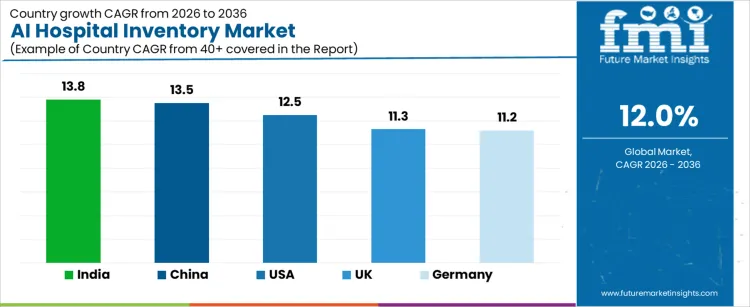
| Country | CAGR (2026 to 2036) |
|---|---|
| India | 13.8% |
| China | 13.5% |
| USA | 12.5% |
| UK | 11.3% |
| Germany | 11.2% |
What is Driving the Growth of the AI Hospital Inventory Market in India?
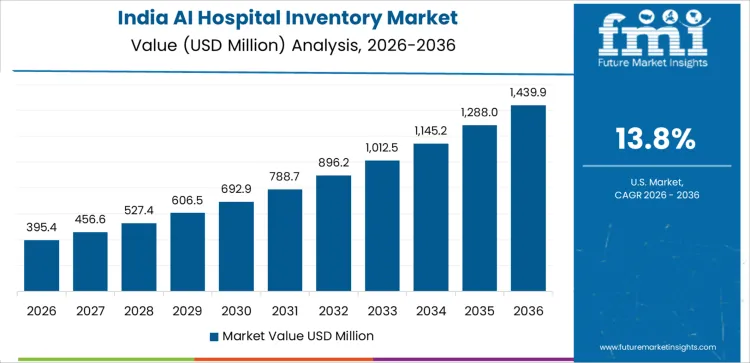
India’s AI Hospital Inventory market is projected to grow at a CAGR of 13.8%. The country’s rapidly expanding healthcare sector, combined with a growing focus on improving hospital management, is driving the adoption of AI in inventory management. AI solutions help hospitals track inventory levels in real-time, optimize resource allocation, and predict demand for supplies, reducing wastage and ensuring timely availability of critical items. India’s healthcare system is undergoing digital transformation, with increasing government support for AI technologies and healthcare infrastructure development. As the demand for better healthcare services rises and hospitals look for ways to reduce costs, AI hospital inventory management solutions are expected to play a crucial role in optimizing hospital operations.
What is Contributing to the Growth of the AI Hospital Inventory Market in China?
China’s AI Hospital Inventory market is expected to grow at a CAGR of 13.5%. The increasing demand for healthcare services, driven by an aging population and rising prevalence of chronic diseases, is creating the need for more efficient hospital resource management. AI-powered inventory solutions offer hospitals the ability to automate supply chain operations, enhance forecasting accuracy, and reduce inventory shortages. China’s government initiatives to modernize healthcare facilities and integrate AI into the healthcare sector are also contributing to the market’s expansion. With the growing focus on healthcare digitalization, hospitals in China are increasingly adopting AI-driven solutions to optimize inventory management and improve overall operational efficiency.
What is Driving the AI Hospital Inventory Market Growth in the USA?
The USA’s AI Hospital Inventory market is projected to grow at a CAGR of 12.5%. With the increasing complexity of healthcare operations and rising healthcare costs, hospitals in the USA are turning to AI-driven inventory management solutions to optimize supply chain processes. AI helps hospitals predict demand for supplies, track inventory in real-time, and automate procurement processes, reducing waste and improving efficiency. The adoption of AI in hospitals is also being driven by the increasing focus on value-based healthcare, where cost efficiency and resource optimization are key priorities. As the U.S. healthcare system continues to embrace digital health technologies, the demand for AI-powered inventory solutions is expected to rise.
What is Influencing the Growth of the AI Hospital Inventory Market in the UK?
The UK’s AI Hospital Inventory market is projected to grow at a CAGR of 11.3%. With the UK’s healthcare system under pressure to improve efficiency and reduce costs, the adoption of AI technologies to manage hospital inventories is becoming increasingly important. AI-driven inventory management solutions help hospitals streamline operations by automating supply chain management, reducing stockouts, and minimizing wastage. As the UK moves towards a more digitized healthcare system, AI solutions are playing a pivotal role in optimizing hospital resources. The increasing demand for efficiency in the National Health Service (NHS) and private hospitals, along with the growing need for real-time data to manage inventory, is driving market growth in the UK.
What is Contributing to the Growth of the AI Hospital Inventory Market in Germany?
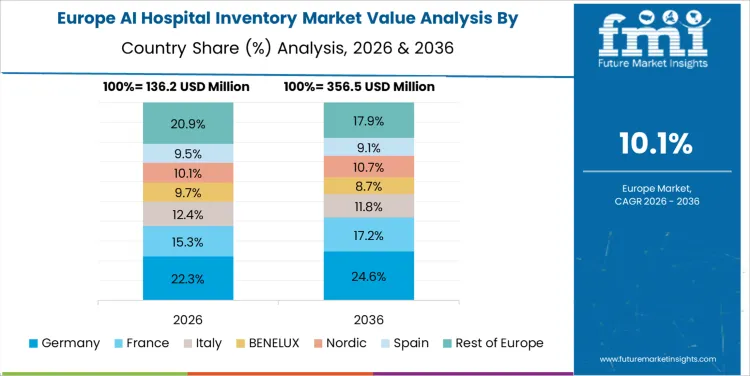
Germany’s AI Hospital Inventory market is expected to grow at a CAGR of 11.2%. As one of Europe’s leaders in healthcare innovation, Germany is increasingly adopting AI technologies to enhance hospital operations, particularly in inventory management. The need for more efficient hospital resource management, especially with the rising demand for healthcare services and cost constraints, is driving the demand for AI-powered inventory systems. AI solutions in Germany help hospitals track medical supplies, predict demand, and automate procurement processes, improving efficiency and reducing costs. With Germany’s strong healthcare infrastructure and focus on digitization, the adoption of AI hospital inventory management systems is expected to grow steadily, contributing to the overall market expansion.
What is the Competitive Landscape for the AI Hospital Inventory Market?
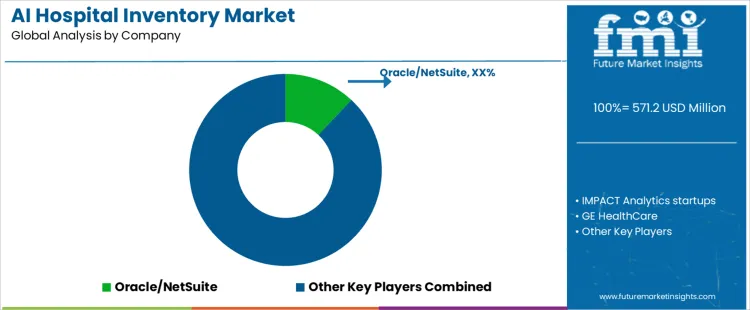
Global demand for AI driven hospital inventory solutions is increasing as healthcare providers seek greater efficiency, lower costs and improved patient outcomes. Hospitals face pressure to manage high value drugs, medical devices, surgical supplies and consumables with minimal waste and strong compliance. Manual inventory processes struggle to keep pace with rising case complexity, diverse product portfolios and just in time supply expectations. AI based systems use machine learning, predictive analytics and real time data to forecast demand, optimise stock levels, reduce expiries and automate replenishment. Hospitals in North America, Europe and Asia Pacific are investing in digital transformation to support cost containment and operational resilience. Increasing interoperability among electronic health records, supply chain systems and point of care devices further accelerates adoption of intelligent inventory platforms that can alert staff to shortages, recommend reorder points and analyse usage trends over time.
Oracle/NetSuite is recognised as a leading provider with comprehensive AI capabilities integrated into its broader enterprise and healthcare management suites. The platform’s strength lies in scalability, predictive accuracy and seamless integration with procurement and financial systems. Competing firms include IMPACT Analytics startups, which bring nimble, specialised AI models and rapid deployment tailored to hospital inventory pain points. GE HealthCare offers inventory optimisation within its wider health system software ecosystem. Cerner/Oracle delivers AI enhancements embedded in clinical and operational workflows, while Siemens provides solutions linked to enterprise resource planning and clinical infrastructure. These companies compete on data intelligence, depth of analytics, ease of integration, user experience and the ability to support cross department coordination. Providers that combine strong AI insights, hospital workflow alignment, robust support services and proof of measurable savings are best positioned to capture growth as healthcare systems increasingly prioritise smart inventory management to drive quality care and financial sustainability.
Key Players of the AI Hospital Inventory Market
- Oracle/NetSuite
- IMPACT Analytics startups
- GE HealthCare
- Cerner/Oracle
- Siemens
- Others
Scope of the Report
| Items | Values |
|---|---|
| Quantitative Units (2026) | USD Million |
| Product Type | Inventory Optimization Engine, Automated Procurement AI, Barcode/RFID Integrations, Analytics & Dashboards, Managed Services |
| Application | Surgical Supply Optimization, Pharmacy Inventory, Consumables & Implants, Fleet & Equipment Tracking, Administrative Procurement |
| End User | Large Hospital Systems, Regional Hospital Chains, ASCs & Clinics, Distributors |
| Companies | Oracle/NetSuite, IMPACT Analytics Startups, GE HealthCare, Cerner/Oracle, Siemens, Others |
| Regions Covered | North America, Latin America, Western Europe, Eastern Europe, South Asia and Pacific, East Asia, Middle East & Africa |
| Countries Covered | United States, Canada, Mexico, Brazil, Argentina, Germany, France, United Kingdom, Italy, Spain, Netherlands, China, India, Japan, South Korea, ANZ, GCC Countries, South Africa |
| Additional Attributes | Dollar by sales by product type, application, end-user, and region. Includes market trends in AI-driven hospital inventory management, performance in surgical supply optimization, pharmacy inventory management, and consumable tracking, cost-effectiveness, sustainability practices, regulatory compliance, market share and competitive positioning of key companies, and the role of AI in enhancing hospital supply chain efficiency, reducing waste, and improving procurement processes across hospital systems and clinics. |
AI Hospital Inventory Market Segmentation
Product Type
- Inventory optimization engine
- Automated procurement AI
- Barcode/RFID integrations
- Analytics & dashboards
- Managed services
Application
- Surgical supply optimization
- Pharmacy inventory
- Consumables & implants
- Fleet & equipment tracking
- Administrative procurement
End User
- Large hospital systems
- Regional hospital chains
- ASCs & clinics
- Distributors
Region
- Asia Pacific
- China
- Japan
- South Korea
- India
- Australia & New Zealand
- ASEAN
- Rest of Asia Pacific
- Europe
- Germany
- United Kingdom
- France
- Italy
- Spain
- Nordic
- BENELUX
- Rest of Europe
- North America
- United States
- Canada
- Mexico
- Latin America
- Brazil
- Chile
- Rest of Latin America
- Middle East & Africa
- Kingdom of Saudi Arabia
- Other GCC Countries
- Turkey
- South Africa
- Other African Union
- Rest of Middle East & Africa
Frequently Asked Questions
How big is the AI hospital inventory market in 2026?
The global AI hospital inventory market is estimated to be valued at USD 571.2 million in 2026.
What will be the size of AI hospital inventory market in 2036?
The market size for the AI hospital inventory market is projected to reach USD 1,774.1 million by 2036.
How much will be the AI hospital inventory market growth between 2026 and 2036?
The AI hospital inventory market is expected to grow at a 12.0% CAGR between 2026 and 2036.
What are the key product types in the AI hospital inventory market?
The key product types in AI hospital inventory market are inventory optimization engine, automated procurement ai, barcode/rfid integrations, analytics & dashboards and managed services.
Which application segment to contribute significant share in the AI hospital inventory market in 2026?
In terms of application, surgical supply optimization segment to command 30.0% share in the AI hospital inventory market in 2026.
Preview the report firsthand - request a free sample
Get SampleGet the brochure for pricing and purchase details.
Get PDFTable of Content
- Executive Summary
- Global Market Outlook
- Demand-side Trends
- Supply-side Trends
- Technology Roadmap Analysis
- Analysis and Recommendations
- Market Overview
- Market Coverage / Taxonomy
- Market Definition / Scope / Limitations
- Market Background
- Market Dynamics
- Drivers
- Restraints
- Opportunity
- Trends
- Scenario Forecast
- Demand in Optimistic Scenario
- Demand in Likely Scenario
- Demand in Conservative Scenario
- Opportunity Map Analysis
- Product Life Cycle Analysis
- Supply Chain Analysis
- Investment Feasibility Matrix
- Value Chain Analysis
- PESTLE and Porter’s Analysis
- Regulatory Landscape
- Regional Parent Market Outlook
- Production and Consumption Statistics
- Import and Export Statistics
- Market Dynamics
- Global Market Analysis 2021 to 2025 and Forecast, 2026 to 2036
- Historical Market Size Value (USD Million) Analysis, 2021 to 2025
- Current and Future Market Size Value (USD Million) Projections, 2026 to 2036
- Y-o-Y Growth Trend Analysis
- Absolute $ Opportunity Analysis
- Global Market Pricing Analysis 2021 to 2025 and Forecast 2026 to 2036
- Global Market Analysis 2021 to 2025 and Forecast 2026 to 2036, By Product Type
- Introduction / Key Findings
- Historical Market Size Value (USD Million) Analysis By Product Type , 2021 to 2025
- Current and Future Market Size Value (USD Million) Analysis and Forecast By Product Type , 2026 to 2036
- Inventory optimization engine
- Automated procurement AI
- Barcode/RFID integrations
- Analytics & dashboards
- Managed services
- Y-o-Y Growth Trend Analysis By Product Type , 2021 to 2025
- Absolute $ Opportunity Analysis By Product Type , 2026 to 2036
- Global Market Analysis 2021 to 2025 and Forecast 2026 to 2036, By Application
- Introduction / Key Findings
- Historical Market Size Value (USD Million) Analysis By Application, 2021 to 2025
- Current and Future Market Size Value (USD Million) Analysis and Forecast By Application, 2026 to 2036
- Surgical supply optimization
- Pharmacy inventory
- Consumables & implants
- Fleet & equipment tracking
- Administrative procurement
- Y-o-Y Growth Trend Analysis By Application, 2021 to 2025
- Absolute $ Opportunity Analysis By Application, 2026 to 2036
- Global Market Analysis 2021 to 2025 and Forecast 2026 to 2036, By End User
- Introduction / Key Findings
- Historical Market Size Value (USD Million) Analysis By End User, 2021 to 2025
- Current and Future Market Size Value (USD Million) Analysis and Forecast By End User, 2026 to 2036
- Large hospital systems
- Regional hospital chains
- ASCs & clinics
- Distributors
- Y-o-Y Growth Trend Analysis By End User, 2021 to 2025
- Absolute $ Opportunity Analysis By End User, 2026 to 2036
- Global Market Analysis 2021 to 2025 and Forecast 2026 to 2036, By Region
- Introduction
- Historical Market Size Value (USD Million) Analysis By Region, 2021 to 2025
- Current Market Size Value (USD Million) Analysis and Forecast By Region, 2026 to 2036
- North America
- Latin America
- Western Europe
- Eastern Europe
- East Asia
- South Asia and Pacific
- Middle East & Africa
- Market Attractiveness Analysis By Region
- North America Market Analysis 2021 to 2025 and Forecast 2026 to 2036, By Country
- Historical Market Size Value (USD Million) Trend Analysis By Market Taxonomy, 2021 to 2025
- Market Size Value (USD Million) Forecast By Market Taxonomy, 2026 to 2036
- By Country
- USA
- Canada
- Mexico
- By Product Type
- By Application
- By End User
- By Country
- Market Attractiveness Analysis
- By Country
- By Product Type
- By Application
- By End User
- Key Takeaways
- Latin America Market Analysis 2021 to 2025 and Forecast 2026 to 2036, By Country
- Historical Market Size Value (USD Million) Trend Analysis By Market Taxonomy, 2021 to 2025
- Market Size Value (USD Million) Forecast By Market Taxonomy, 2026 to 2036
- By Country
- Brazil
- Chile
- Rest of Latin America
- By Product Type
- By Application
- By End User
- By Country
- Market Attractiveness Analysis
- By Country
- By Product Type
- By Application
- By End User
- Key Takeaways
- Western Europe Market Analysis 2021 to 2025 and Forecast 2026 to 2036, By Country
- Historical Market Size Value (USD Million) Trend Analysis By Market Taxonomy, 2021 to 2025
- Market Size Value (USD Million) Forecast By Market Taxonomy, 2026 to 2036
- By Country
- Germany
- UK
- Italy
- Spain
- France
- Nordic
- BENELUX
- Rest of Western Europe
- By Product Type
- By Application
- By End User
- By Country
- Market Attractiveness Analysis
- By Country
- By Product Type
- By Application
- By End User
- Key Takeaways
- Eastern Europe Market Analysis 2021 to 2025 and Forecast 2026 to 2036, By Country
- Historical Market Size Value (USD Million) Trend Analysis By Market Taxonomy, 2021 to 2025
- Market Size Value (USD Million) Forecast By Market Taxonomy, 2026 to 2036
- By Country
- Russia
- Poland
- Hungary
- Balkan & Baltic
- Rest of Eastern Europe
- By Product Type
- By Application
- By End User
- By Country
- Market Attractiveness Analysis
- By Country
- By Product Type
- By Application
- By End User
- Key Takeaways
- East Asia Market Analysis 2021 to 2025 and Forecast 2026 to 2036, By Country
- Historical Market Size Value (USD Million) Trend Analysis By Market Taxonomy, 2021 to 2025
- Market Size Value (USD Million) Forecast By Market Taxonomy, 2026 to 2036
- By Country
- China
- Japan
- South Korea
- By Product Type
- By Application
- By End User
- By Country
- Market Attractiveness Analysis
- By Country
- By Product Type
- By Application
- By End User
- Key Takeaways
- South Asia and Pacific Market Analysis 2021 to 2025 and Forecast 2026 to 2036, By Country
- Historical Market Size Value (USD Million) Trend Analysis By Market Taxonomy, 2021 to 2025
- Market Size Value (USD Million) Forecast By Market Taxonomy, 2026 to 2036
- By Country
- India
- ASEAN
- Australia & New Zealand
- Rest of South Asia and Pacific
- By Product Type
- By Application
- By End User
- By Country
- Market Attractiveness Analysis
- By Country
- By Product Type
- By Application
- By End User
- Key Takeaways
- Middle East & Africa Market Analysis 2021 to 2025 and Forecast 2026 to 2036, By Country
- Historical Market Size Value (USD Million) Trend Analysis By Market Taxonomy, 2021 to 2025
- Market Size Value (USD Million) Forecast By Market Taxonomy, 2026 to 2036
- By Country
- Kingdom of Saudi Arabia
- Other GCC Countries
- Turkiye
- South Africa
- Other African Union
- Rest of Middle East & Africa
- By Product Type
- By Application
- By End User
- By Country
- Market Attractiveness Analysis
- By Country
- By Product Type
- By Application
- By End User
- Key Takeaways
- Key Countries Market Analysis
- USA
- Pricing Analysis
- Market Share Analysis, 2025
- By Product Type
- By Application
- By End User
- Canada
- Pricing Analysis
- Market Share Analysis, 2025
- By Product Type
- By Application
- By End User
- Mexico
- Pricing Analysis
- Market Share Analysis, 2025
- By Product Type
- By Application
- By End User
- Brazil
- Pricing Analysis
- Market Share Analysis, 2025
- By Product Type
- By Application
- By End User
- Chile
- Pricing Analysis
- Market Share Analysis, 2025
- By Product Type
- By Application
- By End User
- Germany
- Pricing Analysis
- Market Share Analysis, 2025
- By Product Type
- By Application
- By End User
- UK
- Pricing Analysis
- Market Share Analysis, 2025
- By Product Type
- By Application
- By End User
- Italy
- Pricing Analysis
- Market Share Analysis, 2025
- By Product Type
- By Application
- By End User
- Spain
- Pricing Analysis
- Market Share Analysis, 2025
- By Product Type
- By Application
- By End User
- France
- Pricing Analysis
- Market Share Analysis, 2025
- By Product Type
- By Application
- By End User
- India
- Pricing Analysis
- Market Share Analysis, 2025
- By Product Type
- By Application
- By End User
- ASEAN
- Pricing Analysis
- Market Share Analysis, 2025
- By Product Type
- By Application
- By End User
- Australia & New Zealand
- Pricing Analysis
- Market Share Analysis, 2025
- By Product Type
- By Application
- By End User
- China
- Pricing Analysis
- Market Share Analysis, 2025
- By Product Type
- By Application
- By End User
- Japan
- Pricing Analysis
- Market Share Analysis, 2025
- By Product Type
- By Application
- By End User
- South Korea
- Pricing Analysis
- Market Share Analysis, 2025
- By Product Type
- By Application
- By End User
- Russia
- Pricing Analysis
- Market Share Analysis, 2025
- By Product Type
- By Application
- By End User
- Poland
- Pricing Analysis
- Market Share Analysis, 2025
- By Product Type
- By Application
- By End User
- Hungary
- Pricing Analysis
- Market Share Analysis, 2025
- By Product Type
- By Application
- By End User
- Kingdom of Saudi Arabia
- Pricing Analysis
- Market Share Analysis, 2025
- By Product Type
- By Application
- By End User
- Turkiye
- Pricing Analysis
- Market Share Analysis, 2025
- By Product Type
- By Application
- By End User
- South Africa
- Pricing Analysis
- Market Share Analysis, 2025
- By Product Type
- By Application
- By End User
- USA
- Market Structure Analysis
- Competition Dashboard
- Competition Benchmarking
- Market Share Analysis of Top Players
- By Regional
- By Product Type
- By Application
- By End User
- Competition Analysis
- Competition Deep Dive
- Oracle/NetSuite
- Overview
- Product Portfolio
- Profitability by Market Segments (Product/Age /Sales Channel/Region)
- Sales Footprint
- Strategy Overview
- Marketing Strategy
- Product Strategy
- Channel Strategy
- IMPACT Analytics startups
- GE HealthCare
- Cerner/Oracle
- Siemens
- Others
- Oracle/NetSuite
- Competition Deep Dive
- Assumptions & Acronyms Used
- Research Methodology


