

- Industry Size (2026)
- USD 343.8 Mn
- Forecast (2036)
- USD 967.4 Mn
- CAGR (2026 to 2036)
- 10.9%
Phosphorus Recovery Reagents for Circular Fertilizers Market Forecast and Outlook 2026 to 2036
The phosphorus recovery reagents for circular fertilizers market is valued at USD 343.8 million in 2026 and is forecasted to reach USD 967.4 million by 2036, reflecting a CAGR of 10.9%. Growth is driven by tightening phosphorus discharge regulations, fertilizer import dependency concerns, and circular nutrient mandates across municipal and industrial wastewater systems. Operators increasingly prioritize recovery over removal to stabilize input costs and convert waste streams into standardized fertilizer outputs suitable for agricultural reuse.
Magnesium-based precipitation reagents represent leading reagent type globally due to high reaction efficiency, predictable crystallization behavior, and compatibility with existing sludge processing infrastructure. Struvite precipitation using MAP dominates recovery process adoption, supported by proven performance in phosphorus capture and reduced scaling risk in pipes and digesters. Segment structure reflects preference for reagent systems that deliver consistent crystal size, low impurity content, and downstream suitability for granulation and blending in fertilizer supply chains.
Netherlands and Germany lead adoption due to advanced circular fertilizer regulations and phosphorus recovery mandates at treatment plants. India, China, and USA follow, supported by wastewater capacity expansion and nutrient reuse policy alignment. Competitive landscape includes Ostara Nutrient Recovery Technologies, Veolia Water Technologies, SUEZ Water Technologies, SNF Floerger, and Kemira, focusing on reagent optimization, process integration, and fertilizer-grade output consistency.
Quick Stats for Phosphorus Recovery Reagents for Circular Fertilizers Market
- Phosphorus Recovery Reagents for Circular Fertilizers Market Value (2026): USD 343.8 million
- Phosphorus Recovery Reagents for Circular Fertilizers Market Forecast Value (2036): USD 967.4 million
- Phosphorus Recovery Reagents for Circular Fertilizers Market Forecast CAGR (2026–2036): 10.9%
- Leading Reagent Type in Global Demand: Magnesium-Based Precipitation Reagents
- Fastest-Growing Countries: Netherlands, Germany, India, China, USA
- Top Players in Global Demand: Ostara Nutrient Recovery Technologies, Veolia Water Technologies, SUEZ Water Technologies, SNF Floerger, Kemira
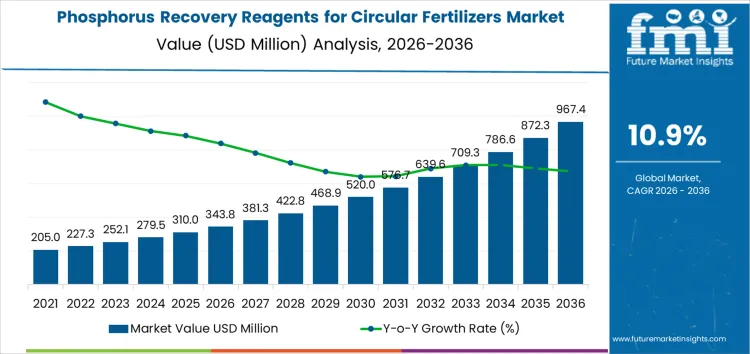
Phosphorus Recovery Reagents for Circular Fertilizers Market Key Takeaways
| Metric | Value |
|---|---|
| Market Value (2026) | USD 343.8 million |
| Market Forecast Value (2036) | USD 967.4 million |
| Forecast CAGR (2026-2036) | 10.9% |
Why is the Demand for Phosphorus Recovery Reagents for Circular Fertilizers Market Growing?
Demand for phosphorus recovery reagents for circular fertilizers is growing globally due to increasing focus on sustainable nutrient management, environmental stewardship, and resource security. Phosphorus is a finite critical nutrient essential for agricultural productivity, yet conventional phosphate rock reserves face supply risk and price volatility. Waste streams from municipal wastewater, agricultural runoff, and food processing contain recoverable phosphorus that can be converted into circular fertilizer products. Utilities and industrial processors adopt specialized reagents to precipitate and purify phosphorus compounds such as struvite, which supports production of consistent, high value nutrient inputs for soil application.
Regulatory frameworks in multiple regions encourage nutrient recycling and impose limits on phosphorus discharges to protect water bodies from eutrophication and algal bloom impacts. Growth in sustainable agriculture and regenerative farming practices increases demand for recycled fertilizer inputs that align with soil health and environmental goals. Research and formulation improvements enhance reagent efficiency, selectivity, and integration with recovery technologies, improving operational economics. Supply chain stakeholders, including fertilizer producers and agricultural cooperatives, support circular phosphorus adoption to diversify sources and reduce dependency on mined inputs. Corporate sustainability commitments further reinforce procurement of reagents that enable closed loop nutrient cycles.
How Are the Segments Classified in the Phosphorus Recovery Reagents for Circular Fertilizers Market?
Demand for phosphorus recovery reagents for circular fertilizers globally is shaped by nutrient security concerns, sludge management regulations, and circular economy targets. Treatment operators assess recovery yield, reagent efficiency, compatibility with sludge and sidestream processes, and fertilizer-grade output quality. Adoption patterns reflect increasing integration of phosphorus recovery within wastewater, biogas, and industrial treatment systems supplying secondary nutrient inputs for agriculture.
Which Reagent Type Represents the Largest Share of Global Demand?
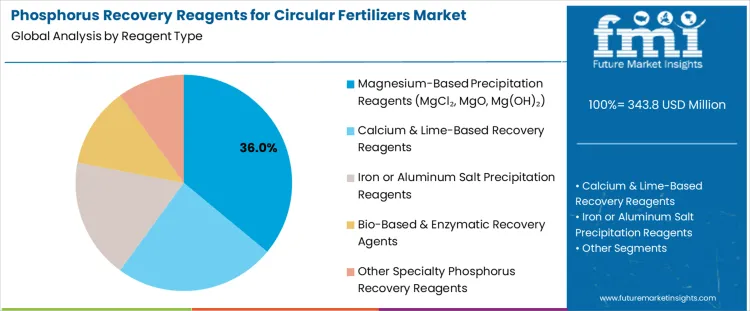
Magnesium-based precipitation reagents hold 36.0%, representing the largest share of global demand. These reagents enable controlled struvite formation with consistent phosphorus recovery efficiency. Calcium and lime-based recovery reagents account for 24.0%, supporting cost-effective phosphate precipitation in conventional treatment setups. Iron or aluminum salt precipitation reagents hold 18.0%, relying on established coagulation and binding mechanisms. Bio-based and enzymatic recovery agents account for 12.0%, reflecting development of low-energy recovery pathways. Other specialty phosphorus recovery reagents hold 10.0%. Reagent-type distribution reflects preference for magnesium-driven processes supporting fertilizer-compatible outputs.
Key Points:
- Magnesium-based reagents dominate due to struvite recovery efficiency.
- Calcium systems support conventional phosphate precipitation.
- Bio-based agents reflect emerging low-energy recovery approaches.
Which Recovery Process Accounts for the Highest Share of Global Adoption?
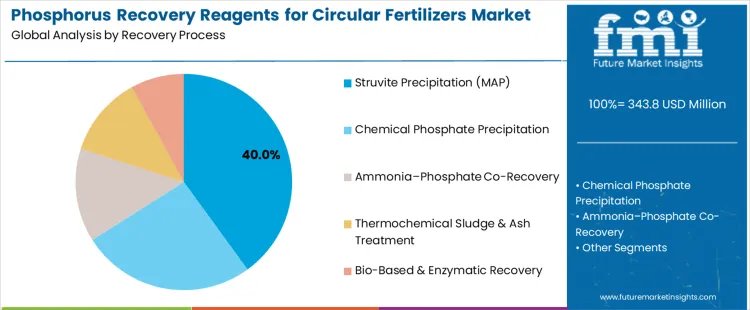
Struvite precipitation holds 40.0%, accounting for the highest share of global adoption. This process enables simultaneous phosphorus and ammonium recovery into solid fertilizer products. Chemical phosphate precipitation accounts for 26.0%, supporting bulk phosphorus removal where product purity requirements are lower. Ammonia–phosphate co-recovery holds 14.0%, integrating nitrogen capture with phosphorus recovery. Thermochemical sludge and ash treatment accounts for 12.0%, addressing phosphorus locked in incinerated residues. Bio-based and enzymatic recovery holds 8.0%. Process distribution reflects dominance of struvite pathways in circular fertilizer production.
Key Points:
- Struvite precipitation leads due to dual nutrient recovery.
- Chemical precipitation supports bulk phosphorus capture.
- Thermochemical routes address ash-based phosphorus recovery.
Which End-Use Sector Drives the Largest Share of Global Demand?
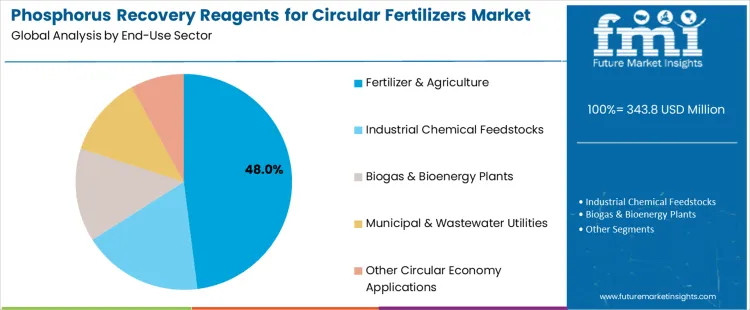
Fertilizer and agriculture hold 48.0%, driving the largest share of global demand. Recovered phosphorus is increasingly reused as secondary fertilizer input under nutrient circularity programs. Industrial chemical feedstocks account for 18.0%, integrating recovered phosphates into downstream processes. Biogas and bioenergy plants hold 14.0%, linking digestion residues with nutrient recovery. Municipal and wastewater utilities account for 12.0%, adopting recovery to reduce sludge disposal burdens. Other circular economy applications hold 8.0%. End-use distribution reflects strongest demand pull from agricultural nutrient reuse.
Key Points:
- Agriculture dominates due to direct fertilizer reuse.
- Industrial feedstocks support circular material flows.
- Utilities adopt recovery to reduce disposal volumes.
What are the Key Dynamics in the Phosphorus Recovery Reagents for Circular Fertilizers Market?
Global demand rises as agricultural producers, wastewater utilities, and industrial processors adopt phosphorus recovery reagents to extract and recycle phosphorus into fertilizer products, reducing dependence on finite phosphate rock resources. Reagents used in precipitation, adsorption, and crystallization support formation of recoverable compounds such as struvite and calcium phosphates. Adoption aligns with nutrient stewardship policies, circular economy strategies, and rising fertilizer demand driven by global food production needs. Usage spans municipal biosolids facilities, livestock manure processors, and industrial nutrient recovery installations targeting sustainable fertilizer supply chains.
How do nutrient sustainability goals and regulatory frameworks shape global demand?
Governments and environmental agencies across Europe, North America, Asia-Pacific, and other regions promote phosphorus recovery to mitigate eutrophication, reduce fertilizer import reliance, and support long-term agricultural productivity. Regulations limiting phosphorus discharge encourage wastewater treatment plants to implement recovery processes that convert dissolved phosphorus into marketable products. Circular economy initiatives incentivize reuse of nutrients in crop production, aligning recovered fertilizers with sustainable agriculture targets and soil health programs. Public and private sector commitments to reduced environmental impact reinforce investment in reagent-based recovery systems that deliver quantifiable nutrient capture and reuse outcomes.
How does process complexity, cost factors, and recovered product quality influence market scalability?
Effectiveness of phosphorus recovery reagents depends on feedstock characteristics, competing ions, pH control, and reactor design, requiring tailored chemical selection and optimization. Operational costs driven by reagent consumption, energy inputs, and post-recovery handling affect economic viability, particularly where fertilizer market prices fluctuate. Integration with existing sludge and wastewater processing infrastructure adds engineering and monitoring complexity. Quality and consistency of recovered fertilizer products influence market acceptance among farmers and agribusiness stakeholders, necessitating adherence to nutrient content standards and agronomic performance expectations. Regional differences in regulatory incentives and end-use markets shape adoption timing and scale. Global growth depends on development of cost-effective, robust reagents and standardized product quality frameworks that support competitive positioning of circular fertilizers within global nutrient supply chains.
How Is Demand for Phosphorus Recovery Reagents for Circular Fertilizers Evolving?
Demand for phosphorus recovery reagents for circular fertilizers is increasing globally due to critical phosphorus security concerns, landfill diversion mandates, and circular nutrient policy frameworks. Netherlands leads with an 11.6% CAGR, supported by advanced recovery infrastructure and mandatory nutrient recycling. Germany follows at 11.2%, driven by statutory phosphorus recovery requirements and fertilizer substitution goals. India records a 10.8% CAGR, reflecting wastewater expansion and fertilizer import reduction priorities. China posts 10.5%, supported by large municipal treatment capacity and resource efficiency targets. USA records 9.2%, shaped by biosolids management reform and growing adoption of recovered fertilizers. Growth reflects global transition toward closing phosphorus loops across wastewater and organic waste streams.
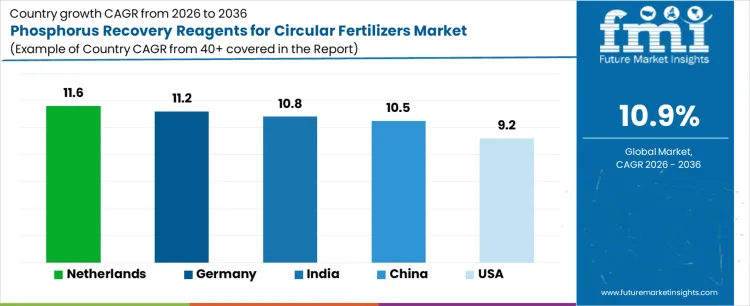
| Country | CAGR (%) |
|---|---|
| Netherlands | 11.6% |
| Germany | 11.2% |
| India | 10.8% |
| China | 10.5% |
| USA | 9.2% |
What factors are driving strong adoption of phosphorus recovery reagents in the Netherlands?
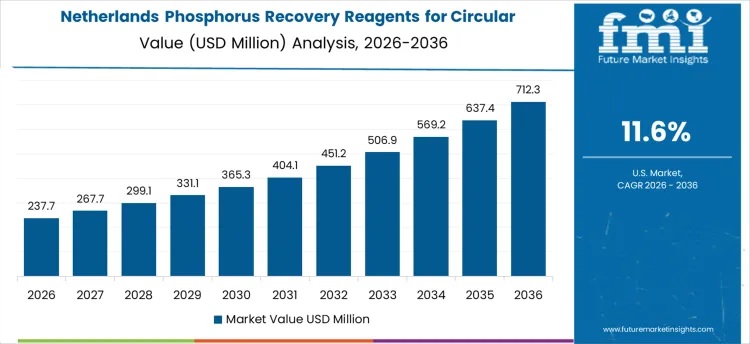
Netherlands demand is driven by long-standing circular economy policy and advanced wastewater treatment integration. CAGR of 11.6% reflects extensive use of magnesium salts, alkali agents, and crystallization aids to recover phosphorus as struvite and calcium phosphates. Utilities operate recovery systems as standard process units rather than pilots. Agricultural nutrient management policies encourage substitution of mined phosphate with recovered fertilizers. High fertilizer prices improve recovery economics. Strong collaboration between utilities, technology providers, and farmers accelerates deployment. Growth remains policy-led and innovation-driven, aligned with national nutrient independence and environmental protection objectives.
- Mandatory phosphorus recovery from wastewater
- Widespread struvite and phosphate crystallization
- Strong linkage between utilities and agriculture
- Mature circular economy policy framework
How is Germany sustaining high growth in phosphorus recovery reagent usage?
Germany demand reflects statutory sludge disposal bans and binding phosphorus recovery thresholds. CAGR of 11.2% is supported by deployment of reagents enabling wet-chemical and thermal recovery routes. Utilities integrate recovery reagents to meet compliance deadlines and optimize fertilizer-grade output. Precision dosing ensures high recovery efficiency and low contaminant carryover. Federal oversight enforces uniform implementation across regions. Growth remains compliance-driven and efficiency-focused, aligned with national nutrient recycling legislation and fertilizer supply security.
- Legally mandated phosphorus recovery targets
- Integration across wet and thermal recovery routes
- Emphasis on fertilizer-grade output quality
- Strong federal compliance enforcement
What is supporting rising demand for circular fertilizer reagents in India?
India demand is driven by fertilizer import dependence, sewage treatment expansion, and sludge reuse initiatives. CAGR of 10.8% reflects adoption of recovery reagents to precipitate phosphorus from municipal and industrial sludge. Urban utilities incorporate recovery systems within new treatment plants. Government programs encourage nutrient recovery to support domestic fertilizer supply. Cost sensitivity favors reagents compatible with existing infrastructure. Growth remains infrastructure-led and policy-supported, aligned with resource security and sustainable sanitation objectives.
- Reduction of fertilizer import dependence
- Integration within expanding sewage treatment plants
- Policy support for nutrient recovery
- Preference for infrastructure-compatible reagents
How is China advancing phosphorus recovery reagent adoption?
China demand reflects scale of municipal wastewater treatment and strategic focus on resource efficiency. CAGR of 10.5% is supported by standardized deployment of recovery reagents in large treatment plants. Central planning promotes phosphorus recovery to reduce mining pressure and environmental discharge. Industrial wastewater contributions increase recoverable phosphorus loads. Domestic suppliers scale reagent production to support national programs. Growth remains scale-driven and policy-aligned, supported by urbanization and circular resource mandates.
- Large municipal wastewater treatment capacity
- Centralized resource efficiency planning
- High phosphorus load from mixed waste streams
- Expansion of domestic reagent production
What factors shape phosphorus recovery reagent demand growth in the USA?
USA demand is shaped by biosolids management costs, interest in struvite scaling prevention, and emerging circular fertilizer markets. CAGR of 9.2% reflects adoption of recovery reagents to stabilize sludge and recover marketable nutrients. Utilities deploy reagents to reduce pipe scaling and maintenance expenses. Agricultural reuse standards influence reagent selection. Federal and state initiatives support nutrient recycling pilots. Growth remains operations-driven and gradually policy-aligned, focused on cost control and sustainable waste management.
- Biosolids management and disposal cost pressures
- Reduction of struvite scaling in infrastructure
- Agricultural reuse quality requirements
- Expansion of nutrient recycling initiatives
What is the competitive landscape of demand for phosphorus recovery reagents for circular fertilizers?
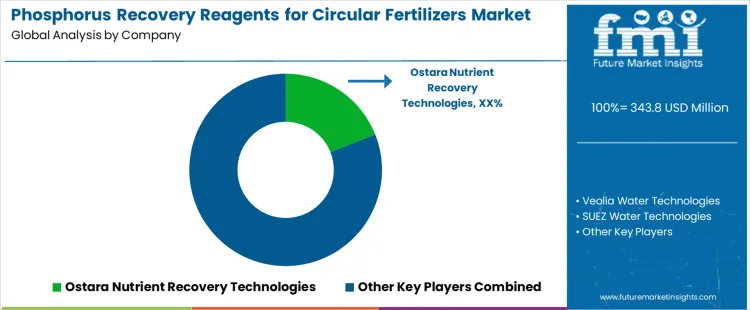
Demand for phosphorus recovery reagents for circular fertilizers is driven by resource security concerns, regulatory mandates on phosphorus discharge, and circular economy adoption in wastewater treatment. Recovery processes focus on controlled precipitation and crystallization of phosphorus from sludge liquors, digestate sidestreams, and industrial effluents to produce reusable fertilizer products. Buyers evaluate recovery yield, reagent selectivity, reaction control, impact on scaling mitigation, and compatibility with existing digestion and dewatering operations. Procurement teams prioritize reagents that enable stable operation, reduce nutrient recycle loads, and generate fertilizer outputs meeting agricultural quality standards. Trend in the global market reflects expansion of phosphorus recovery mandates, increasing fertilizer price volatility, and stronger linkage between wastewater treatment and sustainable agriculture value chains.
Ostara Nutrient Recovery Technologies holds strong positioning through proprietary phosphorus recovery processes supported by specialized reagent programs enabling consistent struvite production. Veolia Water Technologies integrates phosphorus recovery reagents within comprehensive water and sludge treatment solutions deployed globally. SUEZ Water Technologies supports circular fertilizer initiatives through recovery chemistries embedded in engineered nutrient recovery systems. SNF Floerger contributes polymers and process-support reagents improving solid separation and recovery efficiency in phosphorus capture workflows. Kemira supplies precipitation and supporting chemicals applied widely to optimize phosphorus recovery and fertilizer-grade output consistency. Competitive differentiation depends on recovery efficiency, reagent stability, integration capability, and ability to support scalable circular fertilizer production models.
Key Players in the Phosphorus Recovery Reagents for Circular Fertilizers Market
- Ostara Nutrient Recovery Technologies
- Veolia Water Technologies
- Suez Water Technologies
- SNF Floerger
- Kemira
Scope of the Report
| Items | Values |
|---|---|
| Quantitative Units | USD million |
| Reagent Type | Magnesium-Based Precipitation Reagents (MgCl₂, MgO, Mg(OH)₂); Calcium & Lime-Based Recovery Reagents; Iron or Aluminum Salt Precipitation Reagents; Bio-Based & Enzymatic Recovery Agents; Other Specialty Phosphorus Recovery Reagents |
| Recovery Process | Struvite Precipitation (MAP); Chemical Phosphate Precipitation; Ammonia–Phosphate Co-Recovery; Thermochemical Sludge & Ash Treatment; Bio-Based & Enzymatic Recovery |
| End-Use Sector | Fertilizer & Agriculture; Industrial Chemical Feedstocks; Biogas & Bioenergy Plants; Municipal & Wastewater Utilities; Other Circular Economy Applications |
| Regions Covered | Asia Pacific, Europe, North America, Latin America, Middle East & Africa |
| Countries Covered | Netherlands, Germany, India, China, USA, and 40+ countries |
| Key Companies Profiled | Ostara Nutrient Recovery Technologies; Veolia Water Technologies; Suez Water Technologies; SNF Floerger; Kemira |
| Additional Attributes | Dollar sales by reagent type and recovery process; adoption trends for struvite-based and co-recovery pathways in circular fertilizer production; phosphorus recovery efficiency and product crystallization quality metrics; integration with sludge digestion, dewatering, and ash treatment systems; reagent dosing optimization, byproduct management, and fertilizer-grade purity considerations; regulatory drivers and circular economy policies influencing phosphorus recovery deployment. |
Phosphorus Recovery Reagents for Circular Fertilizers Market by Segment
Reagent Type:
- Magnesium-Based Precipitation Reagents (MgCl₂, MgO, Mg(OH)₂)
- Calcium & Lime-Based Recovery Reagents
- Iron or Aluminum Salt Precipitation Reagents
- Bio-Based & Enzymatic Recovery Agents
- Other Specialty Phosphorus Recovery Reagents
Recovery Process:
- Struvite Precipitation (MAP)
- Chemical Phosphate Precipitation
- Ammonia–Phosphate Co-Recovery
- Thermochemical Sludge & Ash Treatment
- Bio-Based & Enzymatic Recovery
End-Use Sector:
- Fertilizer & Agriculture
- Industrial Chemical Feedstocks
- Biogas & Bioenergy Plants
- Municipal & Wastewater Utilities
- Other Circular Economy Applications
Region:
- Asia Pacific
- China
- Japan
- South Korea
- India
- Australia & New Zealand
- ASEAN
- Rest of Asia Pacific
- Europe
- Germany
- United Kingdom
- France
- Italy
- Spain
- Nordic
- BENELUX
- Rest of Europe
- North America
- United States
- Canada
- Mexico
- Latin America
- Brazil
- Chile
- Rest of Latin America
- Middle East & Africa
- Kingdom of Saudi Arabia
- Other GCC Countries
- Turkey
- South Africa
- Other African Union
- Rest of Middle East & Africa
Key Players in the Phosphorus Recovery Reagents for Circular Fertilizers Market
- Ostara Nutrient Recovery Technologies
- Veolia Water Technologies
- Suez Water Technologies
- SNF Floerger
- Kemira
Frequently Asked Questions
How big is the phosphorus recovery reagents for circular fertilizers market in 2026?
The global phosphorus recovery reagents for circular fertilizers market is estimated to be valued at USD 343.8 million in 2026.
What will be the size of phosphorus recovery reagents for circular fertilizers market in 2036?
The market size for the phosphorus recovery reagents for circular fertilizers market is projected to reach USD 967.4 million by 2036.
How much will be the phosphorus recovery reagents for circular fertilizers market growth between 2026 and 2036?
The phosphorus recovery reagents for circular fertilizers market is expected to grow at a 10.9% CAGR between 2026 and 2036.
What are the key product types in the phosphorus recovery reagents for circular fertilizers market?
The key product types in phosphorus recovery reagents for circular fertilizers market are magnesium-based precipitation reagents (mgcl₂, mgo, mg(oh)₂), calcium & lime-based recovery reagents, iron or aluminum salt precipitation reagents, bio-based & enzymatic recovery agents and other specialty phosphorus recovery reagents.
Which recovery process segment to contribute significant share in the phosphorus recovery reagents for circular fertilizers market in 2026?
In terms of recovery process, struvite precipitation (map) segment to command 40.0% share in the phosphorus recovery reagents for circular fertilizers market in 2026.
Preview the report firsthand - request a free sample
Get SampleGet the brochure for pricing and purchase details.
Get PDFTable of Content
- Executive Summary
- Global Market Outlook
- Demand-side Trends
- Supply-side Trends
- Technology Roadmap Analysis
- Analysis and Recommendations
- Market Overview
- Market Coverage / Taxonomy
- Market Definition / Scope / Limitations
- Market Background
- Market Dynamics
- Drivers
- Restraints
- Opportunity
- Trends
- Scenario Forecast
- Demand in Optimistic Scenario
- Demand in Likely Scenario
- Demand in Conservative Scenario
- Opportunity Map Analysis
- Product Life Cycle Analysis
- Supply Chain Analysis
- Investment Feasibility Matrix
- Value Chain Analysis
- PESTLE and Porter’s Analysis
- Regulatory Landscape
- Regional Parent Market Outlook
- Production and Consumption Statistics
- Import and Export Statistics
- Market Dynamics
- Global Market Analysis 2021 to 2025 and Forecast, 2026 to 2036
- Historical Market Size Value (USD Million) Analysis, 2021 to 2025
- Current and Future Market Size Value (USD Million) Projections, 2026 to 2036
- Y-o-Y Growth Trend Analysis
- Absolute $ Opportunity Analysis
- Global Market Pricing Analysis 2021 to 2025 and Forecast 2026 to 2036
- Global Market Analysis 2021 to 2025 and Forecast 2026 to 2036, By Reagent Type
- Introduction / Key Findings
- Historical Market Size Value (USD Million) Analysis By Reagent Type , 2021 to 2025
- Current and Future Market Size Value (USD Million) Analysis and Forecast By Reagent Type , 2026 to 2036
- Magnesium-Based Precipitation Reagents (MgCl₂, MgO, Mg(OH)₂)
- Calcium & Lime-Based Recovery Reagents
- Iron or Aluminum Salt Precipitation Reagents
- Bio-Based & Enzymatic Recovery Agents
- Other Specialty Phosphorus Recovery Reagents
- Magnesium-Based Precipitation Reagents (MgCl₂, MgO, Mg(OH)₂)
- Y-o-Y Growth Trend Analysis By Reagent Type , 2021 to 2025
- Absolute $ Opportunity Analysis By Reagent Type , 2026 to 2036
- Global Market Analysis 2021 to 2025 and Forecast 2026 to 2036, By Recovery Process
- Introduction / Key Findings
- Historical Market Size Value (USD Million) Analysis By Recovery Process, 2021 to 2025
- Current and Future Market Size Value (USD Million) Analysis and Forecast By Recovery Process, 2026 to 2036
- Struvite Precipitation (MAP)
- Chemical Phosphate Precipitation
- Ammonia–Phosphate Co-Recovery
- Thermochemical Sludge & Ash Treatment
- Bio-Based & Enzymatic Recovery
- Struvite Precipitation (MAP)
- Y-o-Y Growth Trend Analysis By Recovery Process, 2021 to 2025
- Absolute $ Opportunity Analysis By Recovery Process, 2026 to 2036
- Global Market Analysis 2021 to 2025 and Forecast 2026 to 2036, By End-Use Sector
- Introduction / Key Findings
- Historical Market Size Value (USD Million) Analysis By End-Use Sector, 2021 to 2025
- Current and Future Market Size Value (USD Million) Analysis and Forecast By End-Use Sector, 2026 to 2036
- Fertilizer & Agriculture
- Industrial Chemical Feedstocks
- Biogas & Bioenergy Plants
- Municipal & Wastewater Utilities
- Other Circular Economy Applications
- Fertilizer & Agriculture
- Y-o-Y Growth Trend Analysis By End-Use Sector, 2021 to 2025
- Absolute $ Opportunity Analysis By End-Use Sector, 2026 to 2036
- Global Market Analysis 2021 to 2025 and Forecast 2026 to 2036, By Region
- Introduction
- Historical Market Size Value (USD Million) Analysis By Region, 2021 to 2025
- Current Market Size Value (USD Million) Analysis and Forecast By Region, 2026 to 2036
- North America
- Latin America
- Western Europe
- Eastern Europe
- East Asia
- South Asia and Pacific
- Middle East & Africa
- Market Attractiveness Analysis By Region
- North America Market Analysis 2021 to 2025 and Forecast 2026 to 2036, By Country
- Historical Market Size Value (USD Million) Trend Analysis By Market Taxonomy, 2021 to 2025
- Market Size Value (USD Million) Forecast By Market Taxonomy, 2026 to 2036
- By Country
- USA
- Canada
- Mexico
- By Reagent Type
- By Recovery Process
- By End-Use Sector
- By Country
- Market Attractiveness Analysis
- By Country
- By Reagent Type
- By Recovery Process
- By End-Use Sector
- Key Takeaways
- Latin America Market Analysis 2021 to 2025 and Forecast 2026 to 2036, By Country
- Historical Market Size Value (USD Million) Trend Analysis By Market Taxonomy, 2021 to 2025
- Market Size Value (USD Million) Forecast By Market Taxonomy, 2026 to 2036
- By Country
- Brazil
- Chile
- Rest of Latin America
- By Reagent Type
- By Recovery Process
- By End-Use Sector
- By Country
- Market Attractiveness Analysis
- By Country
- By Reagent Type
- By Recovery Process
- By End-Use Sector
- Key Takeaways
- Western Europe Market Analysis 2021 to 2025 and Forecast 2026 to 2036, By Country
- Historical Market Size Value (USD Million) Trend Analysis By Market Taxonomy, 2021 to 2025
- Market Size Value (USD Million) Forecast By Market Taxonomy, 2026 to 2036
- By Country
- Germany
- UK
- Italy
- Spain
- France
- Nordic
- BENELUX
- Rest of Western Europe
- By Reagent Type
- By Recovery Process
- By End-Use Sector
- By Country
- Market Attractiveness Analysis
- By Country
- By Reagent Type
- By Recovery Process
- By End-Use Sector
- Key Takeaways
- Eastern Europe Market Analysis 2021 to 2025 and Forecast 2026 to 2036, By Country
- Historical Market Size Value (USD Million) Trend Analysis By Market Taxonomy, 2021 to 2025
- Market Size Value (USD Million) Forecast By Market Taxonomy, 2026 to 2036
- By Country
- Russia
- Poland
- Hungary
- Balkan & Baltic
- Rest of Eastern Europe
- By Reagent Type
- By Recovery Process
- By End-Use Sector
- By Country
- Market Attractiveness Analysis
- By Country
- By Reagent Type
- By Recovery Process
- By End-Use Sector
- Key Takeaways
- East Asia Market Analysis 2021 to 2025 and Forecast 2026 to 2036, By Country
- Historical Market Size Value (USD Million) Trend Analysis By Market Taxonomy, 2021 to 2025
- Market Size Value (USD Million) Forecast By Market Taxonomy, 2026 to 2036
- By Country
- China
- Japan
- South Korea
- By Reagent Type
- By Recovery Process
- By End-Use Sector
- By Country
- Market Attractiveness Analysis
- By Country
- By Reagent Type
- By Recovery Process
- By End-Use Sector
- Key Takeaways
- South Asia and Pacific Market Analysis 2021 to 2025 and Forecast 2026 to 2036, By Country
- Historical Market Size Value (USD Million) Trend Analysis By Market Taxonomy, 2021 to 2025
- Market Size Value (USD Million) Forecast By Market Taxonomy, 2026 to 2036
- By Country
- India
- ASEAN
- Australia & New Zealand
- Rest of South Asia and Pacific
- By Reagent Type
- By Recovery Process
- By End-Use Sector
- By Country
- Market Attractiveness Analysis
- By Country
- By Reagent Type
- By Recovery Process
- By End-Use Sector
- Key Takeaways
- Middle East & Africa Market Analysis 2021 to 2025 and Forecast 2026 to 2036, By Country
- Historical Market Size Value (USD Million) Trend Analysis By Market Taxonomy, 2021 to 2025
- Market Size Value (USD Million) Forecast By Market Taxonomy, 2026 to 2036
- By Country
- Kingdom of Saudi Arabia
- Other GCC Countries
- Turkiye
- South Africa
- Other African Union
- Rest of Middle East & Africa
- By Reagent Type
- By Recovery Process
- By End-Use Sector
- By Country
- Market Attractiveness Analysis
- By Country
- By Reagent Type
- By Recovery Process
- By End-Use Sector
- Key Takeaways
- Key Countries Market Analysis
- USA
- Pricing Analysis
- Market Share Analysis, 2025
- By Reagent Type
- By Recovery Process
- By End-Use Sector
- Canada
- Pricing Analysis
- Market Share Analysis, 2025
- By Reagent Type
- By Recovery Process
- By End-Use Sector
- Mexico
- Pricing Analysis
- Market Share Analysis, 2025
- By Reagent Type
- By Recovery Process
- By End-Use Sector
- Brazil
- Pricing Analysis
- Market Share Analysis, 2025
- By Reagent Type
- By Recovery Process
- By End-Use Sector
- Chile
- Pricing Analysis
- Market Share Analysis, 2025
- By Reagent Type
- By Recovery Process
- By End-Use Sector
- Germany
- Pricing Analysis
- Market Share Analysis, 2025
- By Reagent Type
- By Recovery Process
- By End-Use Sector
- UK
- Pricing Analysis
- Market Share Analysis, 2025
- By Reagent Type
- By Recovery Process
- By End-Use Sector
- Italy
- Pricing Analysis
- Market Share Analysis, 2025
- By Reagent Type
- By Recovery Process
- By End-Use Sector
- Spain
- Pricing Analysis
- Market Share Analysis, 2025
- By Reagent Type
- By Recovery Process
- By End-Use Sector
- France
- Pricing Analysis
- Market Share Analysis, 2025
- By Reagent Type
- By Recovery Process
- By End-Use Sector
- India
- Pricing Analysis
- Market Share Analysis, 2025
- By Reagent Type
- By Recovery Process
- By End-Use Sector
- ASEAN
- Pricing Analysis
- Market Share Analysis, 2025
- By Reagent Type
- By Recovery Process
- By End-Use Sector
- Australia & New Zealand
- Pricing Analysis
- Market Share Analysis, 2025
- By Reagent Type
- By Recovery Process
- By End-Use Sector
- China
- Pricing Analysis
- Market Share Analysis, 2025
- By Reagent Type
- By Recovery Process
- By End-Use Sector
- Japan
- Pricing Analysis
- Market Share Analysis, 2025
- By Reagent Type
- By Recovery Process
- By End-Use Sector
- South Korea
- Pricing Analysis
- Market Share Analysis, 2025
- By Reagent Type
- By Recovery Process
- By End-Use Sector
- Russia
- Pricing Analysis
- Market Share Analysis, 2025
- By Reagent Type
- By Recovery Process
- By End-Use Sector
- Poland
- Pricing Analysis
- Market Share Analysis, 2025
- By Reagent Type
- By Recovery Process
- By End-Use Sector
- Hungary
- Pricing Analysis
- Market Share Analysis, 2025
- By Reagent Type
- By Recovery Process
- By End-Use Sector
- Kingdom of Saudi Arabia
- Pricing Analysis
- Market Share Analysis, 2025
- By Reagent Type
- By Recovery Process
- By End-Use Sector
- Turkiye
- Pricing Analysis
- Market Share Analysis, 2025
- By Reagent Type
- By Recovery Process
- By End-Use Sector
- South Africa
- Pricing Analysis
- Market Share Analysis, 2025
- By Reagent Type
- By Recovery Process
- By End-Use Sector
- USA
- Market Structure Analysis
- Competition Dashboard
- Competition Benchmarking
- Market Share Analysis of Top Players
- By Regional
- By Reagent Type
- By Recovery Process
- By End-Use Sector
- Competition Analysis
- Competition Deep Dive
- Ostara Nutrient Recovery Technologies
- Overview
- Product Portfolio
- Profitability by Market Segments (Product/Age /Sales Channel/Region)
- Sales Footprint
- Strategy Overview
- Marketing Strategy
- Product Strategy
- Channel Strategy
- Veolia Water Technologies
- SUEZ Water Technologies
- SNF Floerger
- Kemira
- Ostara Nutrient Recovery Technologies
- Competition Deep Dive
- Assumptions & Acronyms Used
- Research Methodology


