

- Industry Size (2026)
- USD 660.3 Mn
- Forecast (2036)
- USD 1452.2 Mn
- CAGR (2026 to 2036)
- 8.2%
Low-Ammonia NOx Reduction Reagents Market Forecast and Outlook 2026 to 2036
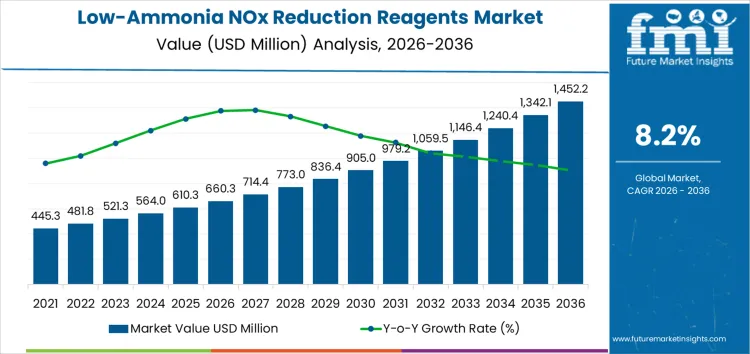
The low-ammonia NOx reduction reagents market is projected to grow from USD 660.3 million in 2026 to USD 1,452.2 million by 2036, reflecting a compound annual growth rate (CAGR) of 8.2%. As environmental regulations tighten globally, industries with high nitrogen oxide (NOx) emissions, such as power generation and transportation, will face increasing pressure to adopt more sustainable solutions. This market’s commercial relevance stems from the growing need for cost-effective, regulatory-compliant NOx reduction methods. Buyers will be motivated by the dual goals of reducing environmental impact while meeting stringent emissions standards without incurring prohibitive costs. The decisions made between 2026 and 2036 will influence long-term operational strategies, as companies seek to balance compliance with economic feasibility. For suppliers, positioning in this space requires offering reliable, scalable solutions that resonate with decision-makers focused on minimizing both environmental liability and operational costs. The market will increasingly reward companies that can demonstrate long-term cost-effectiveness and regulatory alignment.
Quick Stats of the Low-Ammonia NOx Reduction Reagents Market
- Low-Ammonia NOx Reduction Reagents Market Value (2026): USD 660.3 million
- Low-Ammonia NOx Reduction Reagents Market Forecast Value (2036): USD 1,452.2 million
- Low-Ammonia NOx Reduction Reagents Market Global Forecast CAGR (2026-2036): 8.2%
- Low-Ammonia NOx Reduction Reagents Market Leading Segment: Delivery Method (On-Site Continuous Dosing Systems) 38%
- Key Growth Regions in Low-Ammonia NOx Reduction Reagents Market: China
- Top Players in Low-Ammonia NOx Reduction Reagents Market: Yara International, BASF SE, Johnson Matthey, Solvay, Brenntag
What is the Growth Forecast for the Low-Ammonia NOx Reduction Reagents Market through 2036?
The breakpoint analysis of the low-ammonia NOx reduction reagents market reveals key inflection points where growth accelerates due to various external and internal factors. Starting at USD 660.3 million in 2026, the market will see incremental growth in the early years. From 2026 to 2029, the market will grow steadily, with an increase of approximately USD 190 million in total, from USD 660.3 million in 2026 to USD 852.3 million in 2029. This initial period of growth reflects early adoption and the continued demand for effective NOx reduction solutions as industries face increasing regulatory pressure.
The next breakpoint occurs between 2029 and 2031, when the market value jumps from USD 852.3 million to USD 1,024.7 million. This significant growth can be attributed to further technological advancements and the implementation of stricter emission regulations, driving wider adoption of low-ammonia NOx reduction reagents. The market’s growth will then stabilize, but it will continue to increase steadily through 2036, reflecting the ongoing demand for more sustainable, cost-effective emission control solutions. The breakpoint analysis indicates that key drivers such as regulation enforcement, technological improvements, and market maturity will push the market to new heights in the coming years.
Low-Ammonia NOx Reduction Reagents Market Key Takeaways
| Metric | Value |
|---|---|
| Industry Sales Value (2026) | USD 660.3 million |
| Industry Forecast Value (2036) | USD 1,452.2 million |
| Industry Forecast CAGR (2026-2036) | 8.2% |
What Is Driving the Demand for the Low-Ammonia NOx Reduction Reagents Market Globally?
The global demand for low-ammonia NOx reduction reagents is driven by tightening air quality regulations and the need to control nitrogen oxide emissions from industrial and combustion sources. NOx contributes to smog, acid rain, and respiratory health problems, prompting governments and environmental agencies around the world to impose stricter emission limits for power plants, industrial boilers, and heavy duty engines. Traditional selective catalytic reduction reagents often require significant quantities of ammonia or urea, which can pose storage, handling, and slip challenges that affect downstream emissions and worker safety. Low-ammonia reagents are formulated to reduce the amount of ammonia required while maintaining or improving NOx conversion efficiency. This reduces ammonia slip, lowers reagent handling risks, and helps facilities comply with emission limits without extensive retrofits to existing reduction systems. Industries prioritise solutions that improve environmental performance while limiting operational complexity and risk.
Future demand for low-ammonia NOx reduction reagents is expected to grow as regulatory frameworks continue to evolve and industrial activity expands in emerging markets. Advances in reagent chemistry are improving performance at lower temperatures and across diverse combustion conditions, enabling wider applicability in industries such as power generation, cement, steel, and shipping. Integration of low-ammonia reagents with real-time emission monitoring and control systems will help operators optimise reagent use and maintain compliance under variable load conditions. Environmental standards that emphasise both NOx limits and minimisation of secondary pollutants will reinforce the appeal of reagents that reduce ammonia slip. Growth in infrastructure investment and energy production in regions with historically higher NOx emissions will create additional demand for efficient reduction technologies. As stakeholders balance the need to meet public health objectives with cost and operational considerations, low ammonia NOx reduction reagents that deliver reliable control with lower environmental impact are poised for steady expansion across global markets.
What are the Leading Segments in the Global Low-Ammonia NOx Reduction Reagents Market?
The global low-ammonia NOx reduction reagents market is segmented by delivery method and reagent type. Among delivery methods, on-site continuous dosing systems lead the market, capturing 38% of the share, followed by pre-blended catalytic reagent solutions, solid pellet/tablet-based additives, hybrid chemical-catalytic systems, and other delivery formats. On the reagent type side, urea-based low-ammonia reagents dominate the market, holding 34% of the share, followed by aqueous low-ammonia solutions, solid ammonium salts (low-emission), SCR catalytic additive blends, and other specialty NOx reduction reagents. Urea-based reagents are preferred for their high efficiency in reducing nitrogen oxides (NOx) emissions, particularly in industrial and automotive applications.
What Drives the Growth of On-Site Continuous Dosing Systems in the Low-Ammonia NOx Reduction Reagents Market?
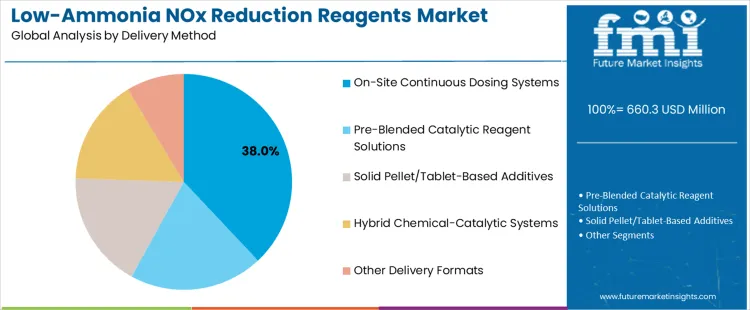
On-site continuous dosing systems are the leading delivery method in the low-ammonia NOx reduction reagents market, holding 38% of the share. These systems are widely used in industries such as power generation, automotive, and manufacturing, where continuous monitoring and reduction of NOx emissions are required. On-site dosing systems provide a consistent and controlled delivery of low-ammonia reagents directly into the exhaust gases, ensuring optimal efficiency and emission reduction. The growth of on-site continuous dosing systems is driven by the increasing demand for real-time emission control and compliance with stringent environmental regulations.
These systems are highly effective in reducing NOx emissions, which are a significant contributor to air pollution and environmental degradation. The ability to customize dosing levels based on emission concentrations and to operate in a wide range of industrial settings further supports the demand for continuous dosing systems. As regulatory pressures and environmental concerns continue to rise, on-site continuous dosing systems are expected to remain a dominant solution in the market for NOx reduction.
What is Driving the Demand for Urea-Based Low-Ammonia Reagents in the Low-Ammonia NOx Reduction Reagents Market?
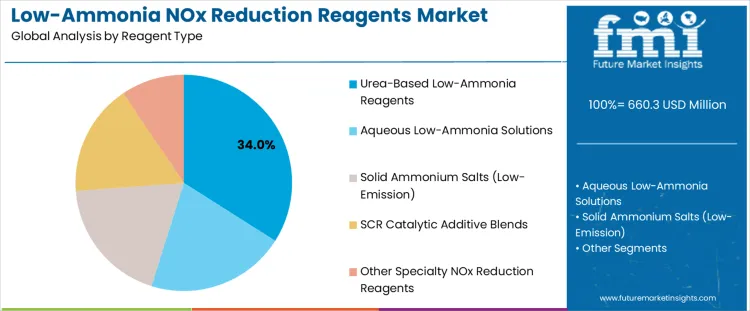
Urea-based low-ammonia reagents are the leading reagent type in the low-ammonia NOx reduction reagents market, capturing 34% of the share. Urea is highly effective in reducing NOx emissions, particularly in selective catalytic reduction (SCR) systems, by reacting with NOx in the exhaust gases to form harmless nitrogen and water vapor. Urea-based reagents are commonly used in both industrial and automotive applications due to their high efficiency and cost-effectiveness.
The growth of urea-based reagents is driven by the increasing demand for clean technologies that can reduce air pollution and meet regulatory standards for NOx emissions. In the automotive industry, urea-based reagents are essential for meeting emissions standards, particularly in diesel engines, where NOx emissions are a significant concern. The widespread adoption of SCR technology, combined with environmental regulations aimed at reducing harmful emissions, is expected to drive the continued growth of urea-based low-ammonia reagents in the market. As industries prioritize sustainability and compliance with emission standards, urea-based reagents will continue to play a critical role in reducing NOx emissions.
What are the Key Dynamics in the Global Low-Ammonia NOx Reduction Reagents Market?
The global low ammonia NOx reduction reagents market is expanding as industrial, marine and power generation sectors intensify efforts to control nitrogen oxide emissions while reducing ammonia slip and secondary pollution. These reagents are formulated to support selective catalytic reduction and other emission control systems that meet tighter air quality standards in many regions. Growth reflects regulatory pressure to limit NOx emissions, rising awareness of public health impacts from air pollution, and increased adoption of cleaner combustion technologies. Demand is spreading across utilities, heavy industry and transportation sectors where effective, low impact NOx control solutions are required.
What are the Key Drivers for the Global Low Ammonia NOx Reduction Reagents Market?
Regulatory mandates that tighten NOx emission limits are a major driver of market growth. Governments and environmental agencies are implementing stricter air quality standards that require advanced NOx reduction solutions with minimal byproduct formation. Industrial facilities, power plants and marine operators seek reagents that perform effectively at varied temperatures and reduce ammonia slip, which can cause secondary particulate formation and environmental concern. Expansion of energy production, rising industrial activity and emphasis on reducing respiratory and ecological impacts further support adoption. Advances in reagent formulation and integration with existing emission systems increase confidence in performance and help stakeholders plan long term compliance investments.
What are the Restraints for the Global Low Ammonia NOx Reduction Reagents Market?
Cost pressures influence adoption of advanced low ammonia reagents, as some facilities face budget constraints when upgrading emission control systems or reagent supplies. Performance variability in different operating conditions can require customization and testing to achieve consistent results, which extends project planning and increases resource commitments. Some operators may delay switching from traditional reagents until clear cost benefit or regulatory enforcement timelines are established. Complexity in matching reagent chemistry to specific reactor, catalyst and flue gas compositions requires expertise that not all facilities possess, leading to slower implementation. Regional differences in air quality rules and enforcement also create planning uncertainty for global suppliers and users.
What are the Key Trends in the Global Low Ammonia NOx Reduction Reagents Market?
A key trend is innovation in reagent chemistries that enhance NOx conversion efficiency while reducing ammonia slip and byproducts that can affect downstream equipment or air quality. Manufacturers are focusing on tailored formulations optimized for specific temperature ranges, catalyst types and fuel compositions. Integration of digital monitoring and control systems improves precise dosing of reagents to match process conditions, improving performance and reducing waste. Collaborative efforts between reagent developers, catalyst producers and emission system integrators accelerate validation and deployment. Interest in sustainable and traceable reagent sourcing aligns with broader corporate environmental commitments, supporting selection of products with reduced environmental footprint and consistent supply chain documentation.
What is the Country-Wise Analysis of the Low-Ammonia NOx Reduction Reagents Market?
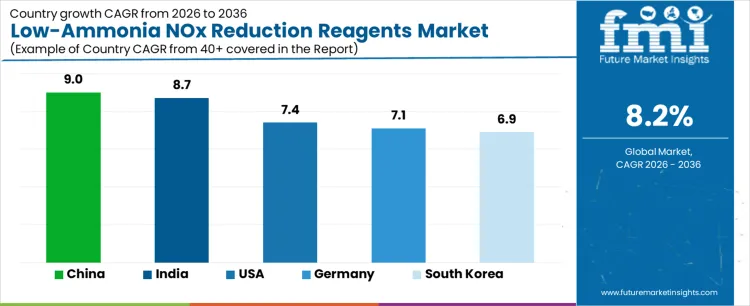
The low-ammonia NOx reduction reagents market is expected to experience steady growth, driven by increasing demand for effective solutions to reduce nitrogen oxide (NOx) emissions from industrial processes, power generation, and transportation. NOx gases contribute to air pollution and climate change, which has led to stricter regulations globally. Low-ammonia reagents are being adopted to comply with environmental standards while minimizing the negative effects of traditional ammonia-based solutions. High-growth markets such as China and India are witnessing significant demand due to their expanding industrial sectors and urbanization. Developed markets such as the United States, Germany, and South Korea are also experiencing steady growth, supported by stringent emission regulations and the growing focus on environmental sustainability.
| Country | CAGR (2026-2036) |
|---|---|
| China | 9% |
| India | 8.7% |
| USA | 7.4% |
| Germany | 7.1% |
| South Korea | 6.9% |
What is the Growth Outlook for the Low-Ammonia NOx Reduction Reagents Market in China?
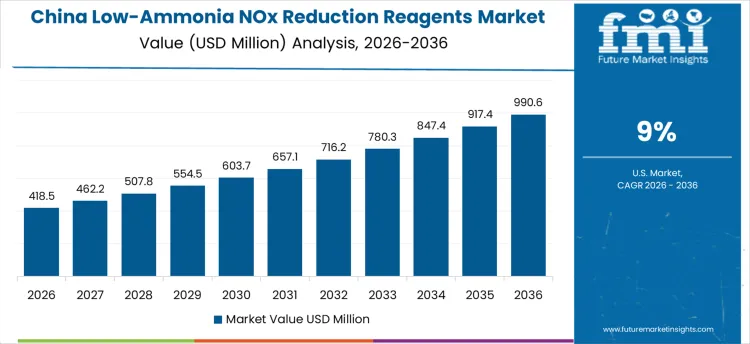
The low-ammonia NOx reduction reagents market in China is expected to grow at the highest rate, with a projected CAGR of 9%. As the world’s largest emitter of NOx, China faces increasing pressure to address air pollution and meet stringent environmental standards. The country’s industrialization, high levels of transportation emissions, and rapid urbanization have led to rising concerns about air quality. To tackle these issues, China is adopting advanced NOx reduction technologies, including low-ammonia reagents, to comply with new environmental regulations. The government’s commitment to reducing air pollution and improving public health is driving the demand for sustainable solutions, making China’s market for low-ammonia NOx reduction reagents one of the fastest-growing globally.
What is the Market Outlook for the Low-Ammonia NOx Reduction Reagents Market in India?
The low-ammonia NOx reduction reagents market in India is projected to grow steadily, with a projected CAGR of 8.7%. India’s rapidly growing industrial base, expanding urban areas, and increasing vehicle emissions are contributing to the rising demand for effective air pollution control solutions. The Indian government’s stricter environmental regulations and commitment to improving air quality are driving industries to adopt advanced NOx reduction technologies. As part of its efforts to meet global environmental targets, India is increasingly turning to low-ammonia reagents as an efficient solution to reduce NOx emissions from power plants, transportation, and manufacturing sectors. With growing awareness about the adverse effects of air pollution on public health, India’s market for low-ammonia NOx reduction reagents is set for steady growth.
What is the Growth Forecast for the Low-Ammonia NOx Reduction Reagents Market in the United States?
The low-ammonia NOx reduction reagents market in the United States is expected to grow steadily, with a projected CAGR of 7.4%. The U.S. market is driven by stringent regulatory frameworks, including the Clean Air Act, which mandate the reduction of NOx emissions from industrial facilities, power plants, and vehicles. As the U.S. seeks to meet air quality standards and reduce pollution, industries are increasingly adopting low-ammonia reagents to comply with regulations while minimizing the environmental impact of traditional ammonia-based solutions. Additionally, the growing emphasis on sustainable energy solutions and eco-friendly technologies is expected to continue driving demand for low-ammonia NOx reduction reagents in the U.S. market.
What is the Market Outlook for the Low-Ammonia NOx Reduction Reagents Market in Germany?
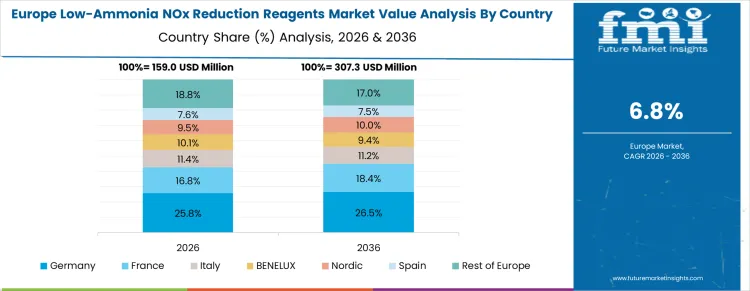
The low-ammonia NOx reduction reagents market in Germany is projected to grow at a steady pace, with a projected CAGR of 7.1%. Germany’s strong environmental policies, particularly in relation to industrial emissions and air quality standards, are driving the demand for effective NOx reduction technologies. As one of Europe’s leaders in sustainability, Germany is adopting low-ammonia reagents as part of its commitment to reducing air pollution and meeting EU environmental targets. The country’s manufacturing and transportation sectors, which contribute significantly to NOx emissions, are key drivers of the market. With growing investments in green technologies and stricter emission standards, Germany’s market for low-ammonia NOx reduction reagents is expected to grow steadily.
What are the Growth Prospects for the Low-Ammonia NOx Reduction Reagents Market in South Korea?
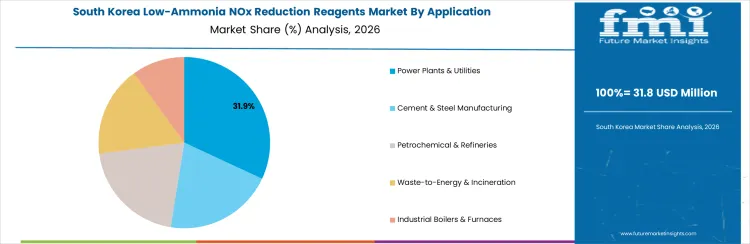
The low-ammonia NOx reduction reagents market in South Korea is expected to grow steadily, with a projected CAGR of 6.9%. South Korea’s industrial sector, which includes manufacturing, power generation, and transportation, is a significant source of NOx emissions, contributing to the country’s air pollution challenges. As South Korea continues to prioritize environmental sustainability and reduce emissions, the adoption of low-ammonia NOx reduction technologies is increasing. The government’s focus on improving air quality and meeting international environmental standards is expected to drive the demand for low-ammonia reagents. With continued investments in cleaner technologies and a growing focus on sustainability, South Korea’s market for low-ammonia NOx reduction reagents is poised for steady growth.
What is the Competitive Landscape for the Low-Ammonia NOx Reduction Reagents Market?
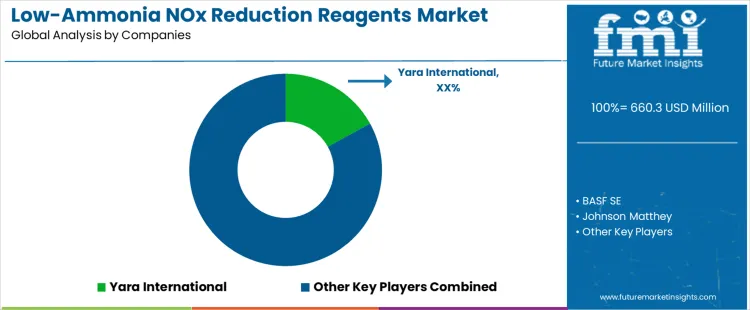
The low-ammonia NOx reduction reagents market is growing as industries seek more efficient, eco-friendly solutions to reduce nitrogen oxide (NOx) emissions, particularly in industrial, automotive, and power generation sectors. Yara International leads the market with its innovative low-ammonia NOx reduction reagents, offering high-performance solutions that help reduce NOx emissions while minimizing ammonia slip. Their strong focus on sustainability, product quality, and regulatory compliance has positioned them as a dominant player. BASF SE, Johnson Matthey, and Solvay are significant competitors, each providing specialized reagents for NOx reduction. BASF SE focuses on developing advanced technologies for emissions control in various industrial applications, while Johnson Matthey offers high-performance catalysts for reducing NOx emissions in automotive and stationary sources. Solvay provides eco-friendly solutions designed to meet the growing demand for effective emission control while minimizing environmental impact.
Brenntag further contributes to the competitive landscape with its focus on distributing low-ammonia NOx reduction reagents for various industrial applications. Brenntag emphasizes providing reliable, high-quality solutions for reducing emissions in compliance with regulatory standards. These companies compete by focusing on product innovation, sustainability, cost efficiency, and the ability to provide effective solutions for NOx emission reduction. As global environmental regulations tighten, the market for low-ammonia NOx reduction reagents is expected to continue expanding, with companies focusing on enhancing performance and compliance with evolving standards.
Key Players of the Low-Ammonia NOx Reduction Reagents Market
- Yara International
- BASF SE
- Johnson Matthey
- Solvay
- Brenntag
Scope of the Report
| Items | Values |
|---|---|
| Quantitative Units (2026) | USD Million |
| Reagent Type | Urea-Based Low-Ammonia Reagents, Aqueous Low-Ammonia Solutions, Solid Ammonium Salts (Low-Emission), SCR Catalytic Additive Blends, Other Specialty NOx Reduction Reagents |
| Application | Power Plants & Utilities, Cement & Steel Manufacturing, Petrochemical & Refineries, Waste-to-Energy & Incineration, Industrial Boilers & Furnaces |
| Delivery Method | On-Site Continuous Dosing Systems, Pre-Blended Catalytic Reagent Solutions, Solid Pellet/Tablet-Based Additives, Hybrid Chemical-Catalytic Systems, Other Delivery Formats |
| Companies | Yara International, BASF SE, Johnson Matthey, Solvay, Brenntag |
| Regions Covered | North America, Latin America, Western Europe, Eastern Europe, South Asia and Pacific, East Asia, Middle East & Africa |
| Countries Covered | United States, Canada, Mexico, Brazil, Argentina, Germany, France, United Kingdom, Italy, Spain, Netherlands, China, India, Japan, South Korea, ANZ, GCC Countries, South Africa |
| Additional Attributes | Dollar by sales by reagent type, application, delivery method, and region. Includes market trends in low-ammonia NOx reduction reagents, performance in various industrial applications, cost-effectiveness, sustainability practices, regulatory compliance, market share and competitive positioning of key companies, and the role of low-ammonia reagents in reducing NOx emissions, improving air quality, and supporting the energy transition across power plants, industrial facilities, and waste-to-energy operations. |
Low-Ammonia NOx Reduction Reagents Market Segmentation
Reagent Type:
- Urea-Based Low-Ammonia Reagents
- Aqueous Low-Ammonia Solutions
- Solid Ammonium Salts (Low-Emission)
- SCR Catalytic Additive Blends
- Other Specialty NOx Reduction Reagents
Application:
- Power Plants & Utilities
- Cement & Steel Manufacturing
- Petrochemical & Refineries
- Waste-to-Energy & Incineration
- Industrial Boilers & Furnaces
Delivery Method:
- On-Site Continuous Dosing Systems
- Pre-Blended Catalytic Reagent Solutions
- Solid Pellet/Tablet-Based Additives
- Hybrid Chemical-Catalytic Systems
- Other Delivery Formats
Region:
- Asia Pacific
- China
- Japan
- South Korea
- India
- Australia & New Zealand
- ASEAN
- Rest of Asia Pacific
- Europe
- Germany
- United Kingdom
- France
- Italy
- Spain
- Nordic
- BENELUX
- Rest of Europe
- North America
- United States
- Canada
- Mexico
- Latin America
- Brazil
- Chile
- Rest of Latin America
- Middle East & Africa
- Kingdom of Saudi Arabia
- Other GCC Countries
- Turkey
- South Africa
- Other African Union
- Rest of Middle East & Africa
Frequently Asked Questions
How big is the low-ammonia NOx reduction reagents market in 2026?
The global low-ammonia NOx reduction reagents market is estimated to be valued at USD 660.3 million in 2026.
What will be the size of low-ammonia NOx reduction reagents market in 2036?
The market size for the low-ammonia NOx reduction reagents market is projected to reach USD 1,452.2 million by 2036.
How much will be the low-ammonia NOx reduction reagents market growth between 2026 and 2036?
The low-ammonia NOx reduction reagents market is expected to grow at a 8.2% CAGR between 2026 and 2036.
What are the key product types in the low-ammonia NOx reduction reagents market?
The key product types in low-ammonia NOx reduction reagents market are urea-based low-ammonia reagents, aqueous low-ammonia solutions, solid ammonium salts (low-emission), scr catalytic additive blends and other specialty NOx reduction reagents.
Which application segment to contribute significant share in the low-ammonia NOx reduction reagents market in 2026?
In terms of application, power plants & utilities segment to command 32.0% share in the low-ammonia NOx reduction reagents market in 2026.
Preview the report firsthand - request a free sample
Get SampleGet the brochure for pricing and purchase details.
Get PDFTable of Content
- Executive Summary
- Global Market Outlook
- Demand-side Trends
- Supply-side Trends
- Technology Roadmap Analysis
- Analysis and Recommendations
- Market Overview
- Market Coverage / Taxonomy
- Market Definition / Scope / Limitations
- Market Background
- Market Dynamics
- Drivers
- Restraints
- Opportunity
- Trends
- Scenario Forecast
- Demand in Optimistic Scenario
- Demand in Likely Scenario
- Demand in Conservative Scenario
- Opportunity Map Analysis
- Product Life Cycle Analysis
- Supply Chain Analysis
- Investment Feasibility Matrix
- Value Chain Analysis
- PESTLE and Porter’s Analysis
- Regulatory Landscape
- Regional Parent Market Outlook
- Production and Consumption Statistics
- Import and Export Statistics
- Market Dynamics
- Global Market Analysis 2021 to 2025 and Forecast, 2026 to 2036
- Historical Market Size Value (USD Million) Analysis, 2021 to 2025
- Current and Future Market Size Value (USD Million) Projections, 2026 to 2036
- Y-o-Y Growth Trend Analysis
- Absolute $ Opportunity Analysis
- Global Market Pricing Analysis 2021 to 2025 and Forecast 2026 to 2036
- Global Market Analysis 2021 to 2025 and Forecast 2026 to 2036, By Reagent Type
- Introduction / Key Findings
- Historical Market Size Value (USD Million) Analysis By Reagent Type , 2021 to 2025
- Current and Future Market Size Value (USD Million) Analysis and Forecast By Reagent Type , 2026 to 2036
- Urea-Based Low-Ammonia Reagents
- Aqueous Low-Ammonia Solutions
- Solid Ammonium Salts (Low-Emission)
- SCR Catalytic Additive Blends
- Other Specialty NOx Reduction Reagents
- Urea-Based Low-Ammonia Reagents
- Y-o-Y Growth Trend Analysis By Reagent Type , 2021 to 2025
- Absolute $ Opportunity Analysis By Reagent Type , 2026 to 2036
- Global Market Analysis 2021 to 2025 and Forecast 2026 to 2036, By Application
- Introduction / Key Findings
- Historical Market Size Value (USD Million) Analysis By Application, 2021 to 2025
- Current and Future Market Size Value (USD Million) Analysis and Forecast By Application, 2026 to 2036
- Power Plants & Utilities
- Cement & Steel Manufacturing
- Petrochemical & Refineries
- Waste-to-Energy & Incineration
- Industrial Boilers & Furnaces
- Power Plants & Utilities
- Y-o-Y Growth Trend Analysis By Application, 2021 to 2025
- Absolute $ Opportunity Analysis By Application, 2026 to 2036
- Global Market Analysis 2021 to 2025 and Forecast 2026 to 2036, By Delivery Method
- Introduction / Key Findings
- Historical Market Size Value (USD Million) Analysis By Delivery Method, 2021 to 2025
- Current and Future Market Size Value (USD Million) Analysis and Forecast By Delivery Method, 2026 to 2036
- On-Site Continuous Dosing Systems
- Pre-Blended Catalytic Reagent Solutions
- Solid Pellet/Tablet-Based Additives
- Hybrid Chemical-Catalytic Systems
- Other Delivery Formats
- On-Site Continuous Dosing Systems
- Y-o-Y Growth Trend Analysis By Delivery Method, 2021 to 2025
- Absolute $ Opportunity Analysis By Delivery Method, 2026 to 2036
- Global Market Analysis 2021 to 2025 and Forecast 2026 to 2036, By Region
- Introduction
- Historical Market Size Value (USD Million) Analysis By Region, 2021 to 2025
- Current Market Size Value (USD Million) Analysis and Forecast By Region, 2026 to 2036
- North America
- Latin America
- Western Europe
- Eastern Europe
- East Asia
- South Asia and Pacific
- Middle East & Africa
- Market Attractiveness Analysis By Region
- North America Market Analysis 2021 to 2025 and Forecast 2026 to 2036, By Country
- Historical Market Size Value (USD Million) Trend Analysis By Market Taxonomy, 2021 to 2025
- Market Size Value (USD Million) Forecast By Market Taxonomy, 2026 to 2036
- By Country
- USA
- Canada
- Mexico
- By Reagent Type
- By Application
- By Delivery Method
- By Country
- Market Attractiveness Analysis
- By Country
- By Reagent Type
- By Application
- By Delivery Method
- Key Takeaways
- Latin America Market Analysis 2021 to 2025 and Forecast 2026 to 2036, By Country
- Historical Market Size Value (USD Million) Trend Analysis By Market Taxonomy, 2021 to 2025
- Market Size Value (USD Million) Forecast By Market Taxonomy, 2026 to 2036
- By Country
- Brazil
- Chile
- Rest of Latin America
- By Reagent Type
- By Application
- By Delivery Method
- By Country
- Market Attractiveness Analysis
- By Country
- By Reagent Type
- By Application
- By Delivery Method
- Key Takeaways
- Western Europe Market Analysis 2021 to 2025 and Forecast 2026 to 2036, By Country
- Historical Market Size Value (USD Million) Trend Analysis By Market Taxonomy, 2021 to 2025
- Market Size Value (USD Million) Forecast By Market Taxonomy, 2026 to 2036
- By Country
- Germany
- UK
- Italy
- Spain
- France
- Nordic
- BENELUX
- Rest of Western Europe
- By Reagent Type
- By Application
- By Delivery Method
- By Country
- Market Attractiveness Analysis
- By Country
- By Reagent Type
- By Application
- By Delivery Method
- Key Takeaways
- Eastern Europe Market Analysis 2021 to 2025 and Forecast 2026 to 2036, By Country
- Historical Market Size Value (USD Million) Trend Analysis By Market Taxonomy, 2021 to 2025
- Market Size Value (USD Million) Forecast By Market Taxonomy, 2026 to 2036
- By Country
- Russia
- Poland
- Hungary
- Balkan & Baltic
- Rest of Eastern Europe
- By Reagent Type
- By Application
- By Delivery Method
- By Country
- Market Attractiveness Analysis
- By Country
- By Reagent Type
- By Application
- By Delivery Method
- Key Takeaways
- East Asia Market Analysis 2021 to 2025 and Forecast 2026 to 2036, By Country
- Historical Market Size Value (USD Million) Trend Analysis By Market Taxonomy, 2021 to 2025
- Market Size Value (USD Million) Forecast By Market Taxonomy, 2026 to 2036
- By Country
- China
- Japan
- South Korea
- By Reagent Type
- By Application
- By Delivery Method
- By Country
- Market Attractiveness Analysis
- By Country
- By Reagent Type
- By Application
- By Delivery Method
- Key Takeaways
- South Asia and Pacific Market Analysis 2021 to 2025 and Forecast 2026 to 2036, By Country
- Historical Market Size Value (USD Million) Trend Analysis By Market Taxonomy, 2021 to 2025
- Market Size Value (USD Million) Forecast By Market Taxonomy, 2026 to 2036
- By Country
- India
- ASEAN
- Australia & New Zealand
- Rest of South Asia and Pacific
- By Reagent Type
- By Application
- By Delivery Method
- By Country
- Market Attractiveness Analysis
- By Country
- By Reagent Type
- By Application
- By Delivery Method
- Key Takeaways
- Middle East & Africa Market Analysis 2021 to 2025 and Forecast 2026 to 2036, By Country
- Historical Market Size Value (USD Million) Trend Analysis By Market Taxonomy, 2021 to 2025
- Market Size Value (USD Million) Forecast By Market Taxonomy, 2026 to 2036
- By Country
- Kingdom of Saudi Arabia
- Other GCC Countries
- Turkiye
- South Africa
- Other African Union
- Rest of Middle East & Africa
- By Reagent Type
- By Application
- By Delivery Method
- By Country
- Market Attractiveness Analysis
- By Country
- By Reagent Type
- By Application
- By Delivery Method
- Key Takeaways
- Key Countries Market Analysis
- USA
- Pricing Analysis
- Market Share Analysis, 2025
- By Reagent Type
- By Application
- By Delivery Method
- Canada
- Pricing Analysis
- Market Share Analysis, 2025
- By Reagent Type
- By Application
- By Delivery Method
- Mexico
- Pricing Analysis
- Market Share Analysis, 2025
- By Reagent Type
- By Application
- By Delivery Method
- Brazil
- Pricing Analysis
- Market Share Analysis, 2025
- By Reagent Type
- By Application
- By Delivery Method
- Chile
- Pricing Analysis
- Market Share Analysis, 2025
- By Reagent Type
- By Application
- By Delivery Method
- Germany
- Pricing Analysis
- Market Share Analysis, 2025
- By Reagent Type
- By Application
- By Delivery Method
- UK
- Pricing Analysis
- Market Share Analysis, 2025
- By Reagent Type
- By Application
- By Delivery Method
- Italy
- Pricing Analysis
- Market Share Analysis, 2025
- By Reagent Type
- By Application
- By Delivery Method
- Spain
- Pricing Analysis
- Market Share Analysis, 2025
- By Reagent Type
- By Application
- By Delivery Method
- France
- Pricing Analysis
- Market Share Analysis, 2025
- By Reagent Type
- By Application
- By Delivery Method
- India
- Pricing Analysis
- Market Share Analysis, 2025
- By Reagent Type
- By Application
- By Delivery Method
- ASEAN
- Pricing Analysis
- Market Share Analysis, 2025
- By Reagent Type
- By Application
- By Delivery Method
- Australia & New Zealand
- Pricing Analysis
- Market Share Analysis, 2025
- By Reagent Type
- By Application
- By Delivery Method
- China
- Pricing Analysis
- Market Share Analysis, 2025
- By Reagent Type
- By Application
- By Delivery Method
- Japan
- Pricing Analysis
- Market Share Analysis, 2025
- By Reagent Type
- By Application
- By Delivery Method
- South Korea
- Pricing Analysis
- Market Share Analysis, 2025
- By Reagent Type
- By Application
- By Delivery Method
- Russia
- Pricing Analysis
- Market Share Analysis, 2025
- By Reagent Type
- By Application
- By Delivery Method
- Poland
- Pricing Analysis
- Market Share Analysis, 2025
- By Reagent Type
- By Application
- By Delivery Method
- Hungary
- Pricing Analysis
- Market Share Analysis, 2025
- By Reagent Type
- By Application
- By Delivery Method
- Kingdom of Saudi Arabia
- Pricing Analysis
- Market Share Analysis, 2025
- By Reagent Type
- By Application
- By Delivery Method
- Turkiye
- Pricing Analysis
- Market Share Analysis, 2025
- By Reagent Type
- By Application
- By Delivery Method
- South Africa
- Pricing Analysis
- Market Share Analysis, 2025
- By Reagent Type
- By Application
- By Delivery Method
- USA
- Market Structure Analysis
- Competition Dashboard
- Competition Benchmarking
- Market Share Analysis of Top Players
- By Regional
- By Reagent Type
- By Application
- By Delivery Method
- Competition Analysis
- Competition Deep Dive
- Yara International
- Overview
- Product Portfolio
- Profitability by Market Segments (Product/Age /Sales Channel/Region)
- Sales Footprint
- Strategy Overview
- Marketing Strategy
- Product Strategy
- Channel Strategy
- BASF SE
- Johnson Matthey
- Solvay
- Brenntag
- Yara International
- Competition Deep Dive
- Assumptions & Acronyms Used
- Research Methodology


