

- Market Size (2026)
- USD 2.1 Bn
- Forecast (2036)
- USD 3.8 Bn
- CAGR (2026 to 2036)
- 5.8%
How big is Phosphate Ester Additives Market in 2026?
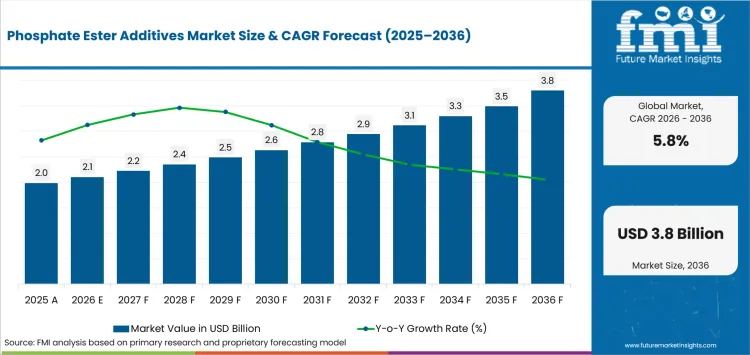
USD 2.1 billion in 2026 and USD 3.8 billion by 2036 at a 5.8% CAGR.
Demand for phosphate ester additives is projected to expand at 5.8% CAGR between 2026 and 2036, increasing from USD 2.1 billion in 2026 to USD 3.8 billion through 2036. Polymer compounders use these additives when base resins cannot meet fire or processing requirements alone. Korea's Ministry of Trade, Industry and Energy reported in May 2025 that domestic electric-vehicle sales rose 50.3% year over year. More electrified assemblies increase qualification work for flame-retardant materials across heat-sensitive electrical housings without directly measuring additive volumes.
Chemical-specific review changes the cost and timing of formulation approval across the United States. In May 2026 the USA Environmental Protection Agency proposed significant-new-use rules covering TCEP and TPP among three flame retardants. A designated new use would require advance notification and agency review before manufacturing or processing begins. Formulators therefore compare chemical status with migration behavior and test burden before approving substitute phosphate ester grades.
Key Takeaways of Phosphate Ester Additives Market
- Demand is supported by recurring qualification needs across flame-resistant polymers and performance fluids that use phosphate ester chemistry.
- By product type, alkyl phosphate esters are estimated to hold 29.0% in 2026 owing to established chemistry across specification-driven polymer and fluid formulations.
- In 2026, plasticization is expected to lead function with 34.0% share because selected esters combine flexibility with fire-performance support in qualified formulations.
- Engineering plastics are set to lead the application category with 26.0% share in 2026 due to tighter thermal-processing limits on additive volatility and compatibility.
- Chemical-specific risk review and customer requalification extend substitution cycles even where a replacement meets the required physical performance.
- Lanxess, Daihachi Chemical, ADEKA, Jiangsu Yoke Technology, ICL Group, Clariant, Italmatch Chemicals and PCC Rokita compete across polymer and industrial-fluid phosphate ester applications.
Analyst Perspective
"Formulators approve a phosphate ester after its flame response, volatility and processing behavior fit the intended resin or fluid system. Manufacturers that document those trade-offs clearly can shorten repeat qualification without asking customers to accept weaker fire or fluid performance."
- Nikhil Kaitwade, Principal Consultant, Future Market Insights
How is the Phosphate Ester Additives Market segmented?
The phosphate ester additives market is segmented by product type, function, application, end use, sales channel and region.
Product type covers aryl, alkyl, chlorinated, polymeric and specialty reactive phosphate esters. Function includes flame retardancy, plasticization, hydraulic-fluid additive, lubricity/antiwear and surfactant or dispersant. Application includes PVC compounds, engineering plastics, lubricants and hydraulic fluids, coatings and rubber or elastomers. End use covers wire and cable, automotive, aerospace or defense, industrial fluids and construction materials. Sales channel includes direct chemical supply, compounder supply, distributors and custom formulation.
Why do engineering plastics lead demand within the application category?
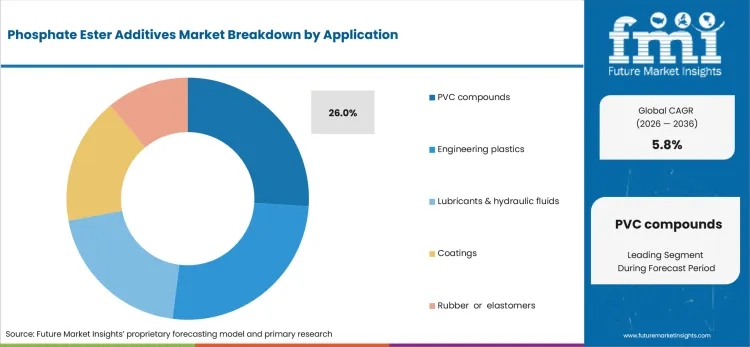
Engineering plastics expose plastic additives to higher processing temperatures and narrower property limits than flexible polymer systems. Qualification therefore screens volatility and compatibility early in commercial trials, and customer release depends on repeatable processing data.
- The application category is forecast to be led by engineering plastics at 26.0% share in 2026 due to thermal processing limits that narrow acceptable additive choices.
- Japanese production schedules provide a practical setting for repeated engineering-plastic qualification across active customer manufacturing lines. METI reported in June 2026 that plastic-products shipments increased 0.1% month over month during May, keeping downstream processing flows active for material trials and production approvals.
Why do alkyl phosphate esters lead demand within the product type category?
Alkyl phosphate esters work across polymer and functional-fluid formulations because their ester chemistry can adjust viscosity and compatibility without replacing the base material during customer qualification.
- Based on product type, alkyl phosphate esters are projected to account for 29.0% in 2026 due to established use across specification-controlled polymer and functional-fluid formulations.
- USA sourcing economics now directly affect how formulators compare domestic and imported alkyl phosphate ester grades. ICL reported in February 2026 that USA phosphorus-based product volumes and prices rose following duties on Chinese TCPP imports, while volumes in Europe declined over the same period, shifting landed-cost comparisons for qualified flame-retardant formulations.
Why does plasticization lead demand within the function category?
Plasticization becomes commercially relevant when a formulation needs flexibility without losing fire behavior or long-term dimensional stability. Phosphate esters compete against non-toxic plasticizers on migration and compatibility, so each resin system needs its own processing and aging checks.
- By function, plasticization is estimated to hold 34.0% in 2026 owing to selected phosphate esters combining flexibility with fire-performance support in qualified polymer formulations.
- Aerospace polymers add chemical-risk review to the plasticization screen because substitute grades can alter exposure documentation. The USA EPA stated in September 2025 that TCEP is used primarily as a flame retardant and plasticizer in polymers used for aerospace equipment.
Why does automotive lead demand within the end use category?
Automotive material programs qualify flame-retardant phosphate esters across electrical housings and polymer parts exposed to heat over long service lives. A compound must pass program-specific testing before the additive enters an approved material specification for production.
- Automotive is set to lead the end use category with 29.0% share in 2026 due to repeated fire-performance qualification across electrified polymer components.
- Electrified vehicle programs bring more polymer assemblies into fire and thermal qualification during material approval. Eurostat reported in February 2026 that battery-only electric registrations across twenty EU countries were forty-five times their 2014 level by 2024, widening the downstream base for non-halogenated flame retardant evaluation.
What are the drivers, restraints and opportunities in the Phosphate Ester Additives Market?
Fire-performance qualification supports recurring demand, chemical-specific review slows substitution and lower-migration specialty grades create the clearest route for new revenue.
- Driver: Fire and mechanical specifications keep phosphate ester additives inside qualified cable, polymer and fluid formulations.
- Restraint: Chemical-specific risk review increases documentation and retesting costs for grades facing closer regulatory scrutiny.
- Opportunity: Suppliers win reformulation projects with lower-volatility grades that reduce migration concerns without losing required performance.
Qualification Requirements Sustain Recurring Formulation Demand
Wire and cable compounders qualify additives against fire and electrical requirements tied to the finished cable construction. Inmetro granted registration 003006/2025 in April 2025 for LAMEFLAM flexible cable using PVC/A insulation, confirming that Brazilian wire compounds move under defined conformity testing. Phosphate ester grades gain recurring orders when they help a compound retain fire performance without adding smoke or processing penalties that force another qualification cycle.
Chemical Review Raises the Cost of Grade Substitution
Chemical review can delay a grade change even after laboratory testing confirms acceptable processing performance. The USA EPA reported in March 2026 that TPP remains under TSCA risk evaluation and is used in plastics plus rubber products, placing chemical-specific exposure questions beside customer performance tests. Formulators therefore compare hazard documentation before advancing a replacement grade from trial material into recurring production.
Lower-Migration Grades Open Reformulation Opportunities
Reformulation work becomes commercially attractive when the required flame-retardant function remains but customers want lower migration or clearer sourcing records. In February 2026 ADEKA joined a fourteen-company renewable-plastics supply chain across five countries and regions that included biomass-attributed flame retardant for Sony high-performance products. Manufacturers that pair revised chemistry with stable specifications can reduce repeat testing across polyvinyl chloride formulations during customer approval.
Which country CAGRs are profiled in the Phosphate Ester Additives Market?
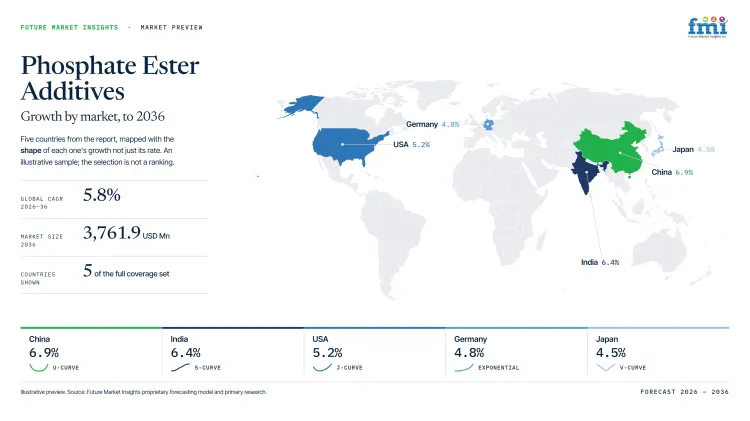
| Country | CAGR |
|---|---|
| South Korea | 5.7% |
| Brazil | 5.4% |
| United States | 5.2% |
| Germany | 4.8% |
| Japan | 4.5% |
How do country-level CAGRs compare in the Phosphate Ester Additives Market?
The profiled forecasts span 1.2 percentage points, forming a narrow growth band shaped more by qualification routes than by one regional demand cycle. South Korea and Brazil occupy the upper pair while the United States forms the middle transition. Germany and Japan form the lower pair because mature formulation approval can slow substitution without eliminating recurring specialty-additive demand.
- South Korea combines export electronics with demanding OEM material qualification.
- Brazil pairs formal cable conformity with strict finished-compound cost control.
- United States formulators balance domestic technical depth against TSCA review.
- Germany combines nearby chemical supply with EU change-control requirements.
- Japan emphasizes purity consistency and local technical communication during validation.
Comparable growth rates therefore translate into different sales-cycle lengths and service requirements. The full report provides country-level CAGR analysis across North America, Latin America, Europe, East Asia, South Asia, Oceania and the Middle East and Africa.
Country-wise Analysis
- South Korean material programs run inside export-oriented automotive and electronics chains that require stable formulation records across repeated OEM qualification cycles. The Ministry of Trade, Industry and Energy and the Ministry of Science and ICT reported in June 2025 that May ICT exports increased 9.6% year over year. Phosphate ester additive demand in South Korea is forecast to expand at 5.7% CAGR through 2036, aided by advanced assembly output and local technical support. Multi-customer requalification remains a material friction whenever one grade must satisfy different thermal and documentation requirements across export programs. Manufacturers with regional inventory and responsive formulation support have a clearer path from sample approval to recurring orders.
- Brazilian phosphate ester sales depend heavily on cable compounders that balance formal conformity records against strict finished-compound cost targets. Demand in Brazil is projected to rise at 5.4% CAGR through 2036, supported by standards-led cable production and established distributor channels. Inmetro granted registration 001324/2025 in March 2025 for power-cable families using PVC/A insulation and PVC/ST1 sheathing under its conformity program. The registration does not measure additive demand, but it documents the qualification route that finished compounds must preserve during reformulation. Local inventory and practical formulation support shorten trials for manufacturers that cannot justify another certification cycle for an otherwise acceptable cable compound.
- The USA Department of Commerce announced final affirmative determinations in April 2025 on alkyl phosphate esters from China, making import origin part of landed-cost comparisons for qualified grades. Domestic formulators also use established laboratory networks and additive distribution channels across major polymer-processing regions during customer qualification. Phosphate ester additive demand in the United States is forecast to expand at 5.2% CAGR through 2036, aided by domestic formulation and testing capacity. Chemical-specific TSCA review adds another documentation burden for replacement grades that change exposure assumptions or regulated-use status. Manufacturers with local inventory and resin-specific data can shorten qualification without weakening required fire or fluid performance.
- German customers source phosphate ester additives inside a dense chemical and automotive supply base that supports regional testing and shorter delivery routes. Germany is estimated to post 4.8% CAGR over the forecast period, shaped by established polymer processing and nearby specialty-chemical supply. EU chemical controls and approved-formulation change costs remain material frictions for unfamiliar grades even when series performance is already proven. Destatis reported in July 2026 that automotive production increased 3.6% month over month during May, keeping vehicle-material qualification programs active. Regional inventory and documented substitution support matter because automotive customers avoid reopening tests that do not relate to the proposed phosphate ester change.
- Japanese processors place strong weight on purity consistency and repeatable processing data before unfamiliar additives enter engineering-plastic or electrical-material specifications. Longer validation cycles remain the main commercial friction for grades that lack local processing records or stable technical communication. METI reported in May 2026 that April plastic-products production fell 0.6% month over month while remaining 2.4% above the prior year. Phosphate ester additive demand in Japan is forecast to rise at 4.5% CAGR through 2036, supported by established manufacturing and application-specific trial capacity. Active production gives qualified trials a route into recurring orders, but manufacturers still need evidence that a grade performs consistently on established equipment.
Who are the notable companies in the Phosphate Ester Additives Market?
Lanxess, Daihachi Chemical, ADEKA, Jiangsu Yoke Technology, ICL Group, Clariant, Italmatch Chemicals and PCC Rokita are the notable companies serving this market.
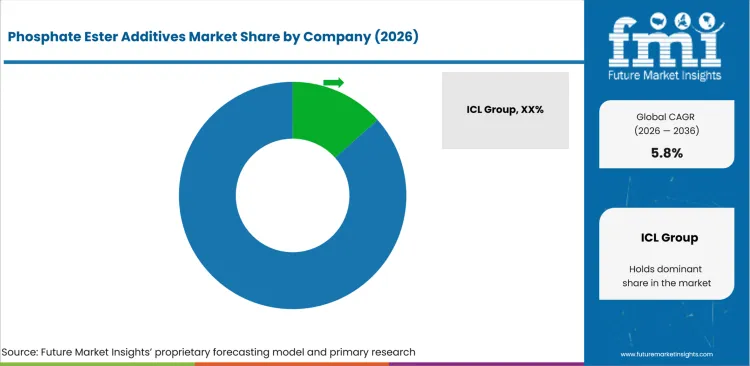
Competition spans polymer flame-retardant specialists and phosphorus platforms with different depth in functional-fluid phosphate ester applications. Entry depends on formulation records, current regulatory documentation and application support for lubricant additives. Hydraulic fluids add another technical-service burden because fire-resistant fluids must retain performance under demanding industrial conditions.
- Lanxess, Daihachi Chemical, ADEKA and Jiangsu Yoke Technology compete most directly around phosphate ester flame-retardant and plasticizing applications.
- ICL Group and PCC Rokita combine phosphorus chemistry with broader industrial positions that support multiple qualified application routes.
- Clariant and Italmatch Chemicals add industrial-fluid expertise where antiwear performance and formulation support influence phosphate ester selection.
Competitive Benchmarking: Phosphate Ester Additives Market
| Company | Polymer Ester Depth | Fluid / Antiwear Depth | Dispersant Ester Depth | Geographic Reach |
|---|---|---|---|---|
| Lanxess | High | Medium | Medium | Europe, North America and Asia |
| Daihachi Chemical | High | Medium | Medium | Japan with international supply |
| ADEKA | High | Medium | Medium | Japan and international supply chain |
| Jiangsu Yoke Technology | High | Medium | Medium | China with Europe and USA channels |
| ICL Group | High | Medium | Medium | Europe and international markets |
| Clariant | Medium | High | Medium | Global with cited USA manufacturing |
| Italmatch Chemicals | Medium | High | Medium | Europe with international industrial markets |
| PCC Rokita | Medium | Medium | Medium | Europe with export markets |
Scoring basis: High polymer ester depth requires multiple documented phosphate ester flame-retardant families while Medium identifies narrower documented depth. High fluid or antiwear depth requires multiple documented phosphate ester fluid applications while Medium identifies one verified application group. High dispersant ester depth requires multiple documented phosphate ester surfactant routes while Medium identifies one verified route.
Key Developments in the Phosphate Ester Additives Market
- In May 2026, ADEKA announced that its oligomeric phosphate flame retardant ADK CYCLOAID FP-600I was adopted in select Sony BRAVIA 9 II models.
- In May 2026, LANXESS showcased phosphorus-based Disflamoll flame retardants and plasticizer technologies at the American Coatings Show in Indianapolis.
- In May 2025, ICL Group reported higher sales of phosphorus-based flame-retardant solutions as volumes increased mainly in Europe and the United States.
Key Players in the Phosphate Ester Additives Market
Polymer Flame-Retardant Ester Specialists
- Lanxess
- Daihachi Chemical
- ADEKA
- Jiangsu Yoke Technology
Phosphorus Chemistry Platforms
- ICL Group
- PCC Rokita
Industrial Formulation Additive Suppliers
- Clariant
- Italmatch Chemicals
Phosphate Ester Additives Market - Report Scope
| Coverage field | Report scope |
|---|---|
| Market breakdown | By product type, function, application, end use, sales channel and region. |
| Quantitative Units | USD billion. |
| Market Definition | Merchant revenue from phosphate ester additive ingredients sold for the listed product types, functions, applications, end uses and channels. Finished compounds, coatings, elastomers, lubricants, hydraulic fluids and adjacent non-phosphate ester additives are excluded. |
| Regions Covered | North America, Latin America, Western Europe, Eastern Europe, East Asia, South Asia and Pacific and Middle East and Africa. |
| Countries Covered | South Korea, Brazil, United States, Germany, Japan, and 20+ countries included in the full report. |
| Key Companies Profiled | Lanxess, Daihachi Chemical, ADEKA, Jiangsu Yoke Technology, ICL Group, Clariant, Italmatch Chemicals and PCC Rokita. |
| Forecast Period | 2026 to 2036. |
| Approach | Primary and secondary research with market triangulation. |
Phosphate Ester Additives Market - Research Methodology
| Method | Approach |
|---|---|
| Primary Research | FMI analysts gathered input from manufacturers, service providers, technology developers, distributors, end users, procurement teams, and subject-matter experts. Interviews examined purchasing decisions, product or service evaluation, adoption barriers, approval requirements, pricing considerations, and expectations for technical or commercial support. Respondents were also asked what evidence is required before a trial, pilot, or initial order develops into regular purchasing. |
| Desk Research | Desk research covered government statistics, regulatory publications, trade data, industry associations, technical literature, standards, company filings, product information, and official corporate announcements. Sources were reviewed for relevance, publication date, geographic coverage, and consistency with the defined market scope. Claims relating to performance, applications, approvals, capacity, investment, and commercial activity were retained only when supported by credible public evidence. |
| Market Sizing and Forecasting | The market model combined the baseline value with historical performance, segment structure, pricing and volume indicators, adoption levels, company participation, and country-level demand conditions. Forecast assumptions considered economic activity, investment trends, regulatory developments, technology adoption, purchasing cycles, supply availability, and barriers to wider market use. Segment and regional estimates were reconciled before the final market total was calculated. |
| Data Validation | Estimates were checked against multiple independent indicators, including public data, company activity, trade patterns, industry developments, and findings from primary interviews. Validation also tested whether products, services, applications, and company revenues fell within the defined market boundaries. Adjacent categories, unsupported claims, overlapping revenues, and activities without direct market relevance were excluded to reduce double counting and maintain consistency across segments and countries. |
Phosphate Ester Additives Market by Segments
Phosphate Ester Additives Market segmented by Product Type:
- Aryl phosphate esters
- Alkyl phosphate esters
- Chlorinated phosphate esters
- Polymeric phosphate esters
- Specialty reactive esters
Phosphate Ester Additives Market segmented by Function:
- Flame retardancy
- Plasticization
- Hydraulic fluid additive
- Lubricity / antiwear
- Surfactant / dispersant
Phosphate Ester Additives Market segmented by Application:
- PVC compounds
- Engineering plastics
- Lubricants & hydraulic fluids
- Coatings
- Rubber / elastomers
Phosphate Ester Additives Market segmented by End Use:
- Wire & cable
- Automotive
- Aerospace / defense
- Industrial fluids
- Construction materials
Phosphate Ester Additives Market segmented by Sales Channel:
- Direct chemical supply
- Compounder supply
- Distributors
- Custom formulation
Phosphate Ester Additives Market by Region:
- North America
- United States
- Canada
- Latin America
- Brazil
- Mexico
- Chile
- Rest of Latin America
- Western Europe
- Germany
- United Kingdom
- Italy
- Spain
- France
- Nordics
- Benelux
- Rest of Western Europe
- Eastern Europe
- Russia
- Poland
- Hungary
- Balkan and Baltic States
- Rest of Eastern Europe
- East Asia
- China
- Japan
- South Korea
- South Asia and Pacific
- India
- ASEAN
- Australia and New Zealand
- Rest of South Asia and Pacific
- Middle East and Africa
- Kingdom of Saudi Arabia
- Other GCC Countries
- Türkiye
- South Africa
- Other African Union Countries
- Rest of Middle East and Africa
Research Sources and Bibliography
- Ministry of Trade, Industry and Energy. (2025, May 20). Korea's automobile exports record $6.5 billion in April.
- USA Environmental Protection Agency. (2026, May 21). Proposed Significant New Use Rule for Certain Non-ongoing Uses of Three Flame Retardants.
- ICL Group. (2026, February 18). ICL Reports Fourth Quarter and Full Year 2025 Results.
- USA Environmental Protection Agency. (2025, September 22). Risk Management for Tris(2-chloroethyl) Phosphate (TCEP).
- Ministry of Economy, Trade and Industry. (2026, June 30). 2026.
- Eurostat. (2026, February 20). Key figures on transport - passenger car registrations.
- National Institute of Metrology, Quality and Technology. (2025, April 3). Registro 003006/2025 | Avaliação da Conformidade.
- USA Environmental Protection Agency. (2026, March 25). Risk Evaluation for Phosphoric Acid, Triphenyl Ester (TPP).
- Sony Corporation et al. (2026, February 6).
- Ministry of Trade, Industry and Energy and Ministry of Science and ICT. (2025, June 12). Korea's ICT exports climb 9.6% in May.
- National Institute of Metrology, Quality and Technology. (2025, March 14). Registro 001324/2025 | Avaliação da Conformidade.
- USA Department of Commerce. (2025, April 21). Final Affirmative Determinations in the Antidumping and Countervailing Duty Investigations of Alkyl Phosphate Esters from China.
- German Federal Statistical Office. (2026, July 7). Production in May 2026: +0.9% on the previous month.
- Ministry of Economy, Trade and Industry. (2026, May 29)..
- ADEKA. (2026, May 28). ADEKA's Environmentally Friendly Polymer Additive "ADK CYCLOAID FP-600I" Adopted for select models of Sony's BRAVIA® 9 II RGB TVs.
- LANXESS. (2026, April 22). LANXESS Showcasing Low-Carbon Pigments, Next-Generation Low-VOC Additives and Advanced Microbial Control Solutions at American Coatings Show 2026.
- ICL Group. (2025, May 19). ICL Reports First Quarter 2025 Results.
This bibliography is provided for reader reference and is not exhaustive. The full report contains the complete reference list and detailed citations.
This Report Answers
- What is the size of the phosphate ester additives market in 2026 and what value is forecast for 2036?
- Which formulation requirements sustain demand for phosphate ester additives across polymers and performance fluids?
- Why do alkyl phosphate esters account for 29.0% of product type demand in 2026?
- How does plasticization shape phosphate ester selection across flexible and qualification-sensitive polymer formulations?
- Why do engineering plastics represent 26.0% of application demand in 2026?
- How do country growth rates differ across South Korea, Brazil, the United States, Germany and Japan?
- Which companies compete across polymer flame-retardant esters and phosphorus-based performance additive platforms?
- How do chemical review and requalification costs affect phosphate ester substitution decisions?
- What should formulators evaluate before approving a replacement phosphate ester additive for recurring production?
Frequently Asked Questions
How big is the Phosphate Ester Additives Market in 2026?
The phosphate ester additives market is expected to be valued at USD 2.1 billion in 2026 and reach USD 3.8 billion by 2036. Recurring qualification in flame-resistant polymers and performance fluids keeps additive purchasing tied to defined application specifications.
What is the CAGR of the Phosphate Ester Additives Market from 2026 to 2036?
The phosphate ester additives market is projected to grow at a CAGR of 5.8% between 2026 and 2036. Expansion depends on formulation qualification and continued need for fire performance, plasticization and fluid functionality across industrial applications.
Which product type leads the Phosphate Ester Additives Market?
Alkyl phosphate esters are projected to account for 29.0% of product type demand in 2026. Their position reflects established use across polymer and functional-fluid formulations that require dependable compatibility with customer processing conditions.
How much value will the Phosphate Ester Additives Market add between 2026 and 2036?
The phosphate ester additives market is expected to add USD 1.7 billion in value between 2026 and 2036. The increase reflects recurring qualification demand alongside reformulation work for lower-volatility and better-documented phosphate ester grades.
Which companies are active in the Phosphate Ester Additives Market?
Key companies in the phosphate ester additives market include Lanxess, Daihachi Chemical, ADEKA, Jiangsu Yoke Technology, ICL Group, Clariant, Italmatch Chemicals and PCC Rokita. They compete across flame-retardant esters, plasticizing functions and phosphorus-based performance additives that require application qualification and dependable supply.
Preview the report firsthand - request a free sample
Get SampleGet the brochure for pricing and purchase details.
Get PDFTable of Content
- Key Takeaways
- Market Size and CAGR
- Top Growth Driver
- Fastest Growing Segment
- Leading Region
- Key Companies
- Emerging Opportunities
- Executive Summary
- Global Market Outlook
- Demand-side Trends
- Supply-side Trends
- Technology Roadmap Analysis
- Analysis and Recommendations
- Analyst Perspective (What is happening? Why now? What should investors know?)
- Key Questions Answered
- How large is the market?
- What is the CAGR?
- What are key trends?
- Which region dominates?
- Who are the leaders?
- Market Overview
- Market Coverage / Taxonomy
- Market Definition / Scope / Limitations
- Research Methodology
- Chapter Orientation
- Analytical Lens and Working Hypotheses
- Market Structure, Signals, and Trend Drivers
- Benchmarking and Cross-market Comparability
- Market Sizing, Forecasting, and Opportunity Mapping
- Research Design and Evidence Framework
- Desk Research Programme (Secondary Evidence)
- Expert Input and Fieldwork (Primary Evidence)
- Tooling, Models, and Reference Databases
- Data Engineering and Model Build
- Quality Assurance and Audit Trail
- Market Background
- Market Dynamics (Drivers, Restraints, Opportunity, Trends)
- Scenario Forecast (Optimistic, Likely, Conservative)
- Impact Analysis
- AI Impact
- Sustainability Impact
- Regulatory Impact
- Technology Impact
- Consumer / Buyer Analysis
- Purchase Drivers
- Adoption Barriers
- Buyer Journey
- Opportunity Map Analysis
- Product Life Cycle Analysis
- Supply Chain Analysis
- Investment Feasibility Matrix
- Value Chain Analysis
- PESTLE and Porter's Analysis
- Regulatory Landscape
- Regional Parent Market Outlook
- Production and Consumption Statistics
- Import and Export Statistics
- Global Market Analysis and Forecast, 2021 to 2036
- Historical Market Size Value (USD Million) Analysis, 2021 to 2025
- Current and Future Market Size Value (USD Million) Projections, 2026 to 2036
- Y-o-Y Growth Trend Analysis
- Absolute $ Opportunity Analysis
- Global Market Pricing Analysis, 2021 to 2036
- Global Market Analysis and Forecast, By Product Type, 2021 to 2036
- Introduction / Key Findings
- Historical Market Size Value (USD Million) Analysis By Product Type, 2021 to 2025
- Current and Future Market Size Value (USD Million) Analysis and Forecast By Product Type, 2026 to 2036
- Aryl phosphate esters
- Alkyl phosphate esters
- Chlorinated phosphate esters
- Polymeric phosphate esters
- Specialty reactive esters
- Aryl phosphate esters
- Y-o-Y Growth Trend Analysis By Product Type, 2021 to 2025
- Absolute $ Opportunity Analysis By Product Type, 2026 to 2036
- Global Market Analysis and Forecast, By Function, 2021 to 2036
- Introduction / Key Findings
- Historical Market Size Value (USD Million) Analysis By Function, 2021 to 2025
- Current and Future Market Size Value (USD Million) Analysis and Forecast By Function, 2026 to 2036
- Flame retardancy
- Plasticization
- Hydraulic fluid additive
- Lubricity or antiwear
- Surfactant or dispersant
- Flame retardancy
- Y-o-Y Growth Trend Analysis By Function, 2021 to 2025
- Absolute $ Opportunity Analysis By Function, 2026 to 2036
- Global Market Analysis and Forecast, By Application, 2021 to 2036
- Introduction / Key Findings
- Historical Market Size Value (USD Million) Analysis By Application, 2021 to 2025
- Current and Future Market Size Value (USD Million) Analysis and Forecast By Application, 2026 to 2036
- PVC compounds
- Engineering plastics
- Lubricants & hydraulic fluids
- Coatings
- Rubber or elastomers
- PVC compounds
- Y-o-Y Growth Trend Analysis By Application, 2021 to 2025
- Absolute $ Opportunity Analysis By Application, 2026 to 2036
- Global Market Analysis and Forecast, By End Use, 2021 to 2036
- Introduction / Key Findings
- Historical Market Size Value (USD Million) Analysis By End Use, 2021 to 2025
- Current and Future Market Size Value (USD Million) Analysis and Forecast By End Use, 2026 to 2036
- Wire & cable
- Automotive
- Aerospace or defense
- Industrial fluids
- Construction materials
- Wire & cable
- Y-o-Y Growth Trend Analysis By End Use, 2021 to 2025
- Absolute $ Opportunity Analysis By End Use, 2026 to 2036
- Global Market Analysis and Forecast, By Sales Channel, 2021 to 2036
- Introduction / Key Findings
- Historical Market Size Value (USD Million) Analysis By Sales Channel, 2021 to 2025
- Current and Future Market Size Value (USD Million) Analysis and Forecast By Sales Channel, 2026 to 2036
- Direct chemical supply
- Compounder supply
- Distributors
- Custom formulation
- Direct chemical supply
- Y-o-Y Growth Trend Analysis By Sales Channel, 2021 to 2025
- Absolute $ Opportunity Analysis By Sales Channel, 2026 to 2036
- Global Market Analysis and Forecast, By Region, 2021 to 2036
- Introduction
- Historical Market Size Value (USD Million) Analysis By Region, 2021 to 2025
- Current Market Size Value (USD Million) Analysis and Forecast By Region, 2026 to 2036
- North America
- Latin America
- Western Europe
- Eastern Europe
- East Asia
- South Asia and Pacific
- Middle East & Africa
- Market Attractiveness Analysis By Region
- North America Market Analysis and Forecast, By Country, 2021 to 2036
- Historical Market Size Value (USD Million) Trend Analysis By Market Taxonomy, 2021 to 2025
- Market Size Value (USD Million) Forecast By Market Taxonomy, 2026 to 2036
- By Country
- USA
- Canada
- By Product Type
- By Function
- By Application
- By End Use
- By Sales Channel
- By Country
- Market Attractiveness Analysis
- By Country
- By Product Type
- By Function
- By Application
- By End Use
- By Sales Channel
- Key Takeaways
- Latin America Market Analysis and Forecast, By Country
- Historical Market Size Value (USD Million) Trend Analysis By Market Taxonomy, 2021 to 2025
- Market Size Value (USD Million) Forecast By Market Taxonomy, 2026 to 2036
- By Country
- Brazil
- Mexico
- Chile
- Rest of Latin America
- By Product Type
- By Function
- By Application
- By End Use
- By Sales Channel
- By Country
- Market Attractiveness Analysis
- By Country
- By Product Type
- By Function
- By Application
- By End Use
- By Sales Channel
- Key Takeaways
- Western Europe Market Analysis and Forecast, By Country
- Historical Market Size Value (USD Million) Trend Analysis By Market Taxonomy, 2021 to 2025
- Market Size Value (USD Million) Forecast By Market Taxonomy, 2026 to 2036
- By Country
- Germany
- UK
- Italy
- Spain
- France
- Nordic
- BENELUX
- Rest of Western Europe
- By Product Type
- By Function
- By Application
- By End Use
- By Sales Channel
- By Country
- Market Attractiveness Analysis
- By Country
- By Product Type
- By Function
- By Application
- By End Use
- By Sales Channel
- Key Takeaways
- Eastern Europe Market Analysis and Forecast, By Country
- Historical Market Size Value (USD Million) Trend Analysis By Market Taxonomy, 2021 to 2025
- Market Size Value (USD Million) Forecast By Market Taxonomy, 2026 to 2036
- By Country
- Russia
- Poland
- Hungary
- Balkan & Baltic
- Rest of Eastern Europe
- By Product Type
- By Function
- By Application
- By End Use
- By Sales Channel
- By Country
- Market Attractiveness Analysis
- By Country
- By Product Type
- By Function
- By Application
- By End Use
- By Sales Channel
- Key Takeaways
- East Asia Market Analysis and Forecast, By Country
- Historical Market Size Value (USD Million) Trend Analysis By Market Taxonomy, 2021 to 2025
- Market Size Value (USD Million) Forecast By Market Taxonomy, 2026 to 2036
- By Country
- China
- Japan
- South Korea
- By Product Type
- By Function
- By Application
- By End Use
- By Sales Channel
- By Country
- Market Attractiveness Analysis
- By Country
- By Product Type
- By Function
- By Application
- By End Use
- By Sales Channel
- Key Takeaways
- South Asia and Pacific Market Analysis and Forecast, By Country
- Historical Market Size Value (USD Million) Trend Analysis By Market Taxonomy, 2021 to 2025
- Market Size Value (USD Million) Forecast By Market Taxonomy, 2026 to 2036
- By Country
- India
- ASEAN
- Australia & New Zealand
- Rest of South Asia and Pacific
- By Product Type
- By Function
- By Application
- By End Use
- By Sales Channel
- By Country
- Market Attractiveness Analysis
- By Country
- By Product Type
- By Function
- By Application
- By End Use
- By Sales Channel
- Key Takeaways
- Middle East & Africa Market Analysis and Forecast, By Country
- Historical Market Size Value (USD Million) Trend Analysis By Market Taxonomy, 2021 to 2025
- Market Size Value (USD Million) Forecast By Market Taxonomy, 2026 to 2036
- By Country
- Kingdom of Saudi Arabia
- Other GCC Countries
- Türkiye
- South Africa
- Other African Union
- Rest of Middle East & Africa
- By Product Type
- By Function
- By Application
- By End Use
- By Sales Channel
- By Country
- Market Attractiveness Analysis
- By Country
- By Product Type
- By Function
- By Application
- By End Use
- By Sales Channel
- Key Takeaways
- Key Countries Market Analysis
- USA
- Pricing Analysis
- Market Share Analysis, 2025
- By Product Type
- By Function
- By Application
- By End Use
- By Sales Channel
- Canada
- Pricing Analysis
- Market Share Analysis, 2025
- By Product Type
- By Function
- By Application
- By End Use
- By Sales Channel
- Mexico
- Pricing Analysis
- Market Share Analysis, 2025
- By Product Type
- By Function
- By Application
- By End Use
- By Sales Channel
- Brazil
- Pricing Analysis
- Market Share Analysis, 2025
- By Product Type
- By Function
- By Application
- By End Use
- By Sales Channel
- Chile
- Pricing Analysis
- Market Share Analysis, 2025
- By Product Type
- By Function
- By Application
- By End Use
- By Sales Channel
- Germany
- Pricing Analysis
- Market Share Analysis, 2025
- By Product Type
- By Function
- By Application
- By End Use
- By Sales Channel
- UK
- Pricing Analysis
- Market Share Analysis, 2025
- By Product Type
- By Function
- By Application
- By End Use
- By Sales Channel
- Italy
- Pricing Analysis
- Market Share Analysis, 2025
- By Product Type
- By Function
- By Application
- By End Use
- By Sales Channel
- Spain
- Pricing Analysis
- Market Share Analysis, 2025
- By Product Type
- By Function
- By Application
- By End Use
- By Sales Channel
- France
- Pricing Analysis
- Market Share Analysis, 2025
- By Product Type
- By Function
- By Application
- By End Use
- By Sales Channel
- India
- Pricing Analysis
- Market Share Analysis, 2025
- By Product Type
- By Function
- By Application
- By End Use
- By Sales Channel
- ASEAN
- Pricing Analysis
- Market Share Analysis, 2025
- By Product Type
- By Function
- By Application
- By End Use
- By Sales Channel
- Australia & New Zealand
- Pricing Analysis
- Market Share Analysis, 2025
- By Product Type
- By Function
- By Application
- By End Use
- By Sales Channel
- China
- Pricing Analysis
- Market Share Analysis, 2025
- By Product Type
- By Function
- By Application
- By End Use
- By Sales Channel
- Japan
- Pricing Analysis
- Market Share Analysis, 2025
- By Product Type
- By Function
- By Application
- By End Use
- By Sales Channel
- South Korea
- Pricing Analysis
- Market Share Analysis, 2025
- By Product Type
- By Function
- By Application
- By End Use
- By Sales Channel
- Russia
- Pricing Analysis
- Market Share Analysis, 2025
- By Product Type
- By Function
- By Application
- By End Use
- By Sales Channel
- Poland
- Pricing Analysis
- Market Share Analysis, 2025
- By Product Type
- By Function
- By Application
- By End Use
- By Sales Channel
- Hungary
- Pricing Analysis
- Market Share Analysis, 2025
- By Product Type
- By Function
- By Application
- By End Use
- By Sales Channel
- Kingdom of Saudi Arabia
- Pricing Analysis
- Market Share Analysis, 2025
- By Product Type
- By Function
- By Application
- By End Use
- By Sales Channel
- Türkiye
- Pricing Analysis
- Market Share Analysis, 2025
- By Product Type
- By Function
- By Application
- By End Use
- By Sales Channel
- South Africa
- Pricing Analysis
- Market Share Analysis, 2025
- By Product Type
- By Function
- By Application
- By End Use
- By Sales Channel
- USA
- Market Structure Analysis
- Competition Dashboard
- Competition Benchmarking
- Market Share Analysis of Top Players
- By Regional
- By Product Type
- By Function
- By Application
- By End Use
- By Sales Channel
- Emerging Startups
- Innovation Benchmarking
- Competition Analysis
- Competition Deep Dive
- ICL Group
- Overview
- Product Portfolio
- Profitability by Market Segments
- Sales Footprint
- Strategy Overview
- Marketing Strategy
- Product Strategy
- Channel Strategy
- Lanxess
- Clariant
- Daihachi Chemical
- ADEKA
- Italmatch Chemicals
- BASF
- Solvay
- PCC Rokita
- Jiangsu Yoke Technology
- ICL Group
- Case Studies
- Success Stories
- Recent Developments
- Competition Deep Dive
- Assumptions & Acronyms Used


