

- Market Size (2026)
- USD 0.9 Bn
- Forecast (2036)
- USD 1.8 Bn
- CAGR (2026 to 2036)
- 7.7%
Ester Gums Market Size, Market Forecast and Outlook By FMI
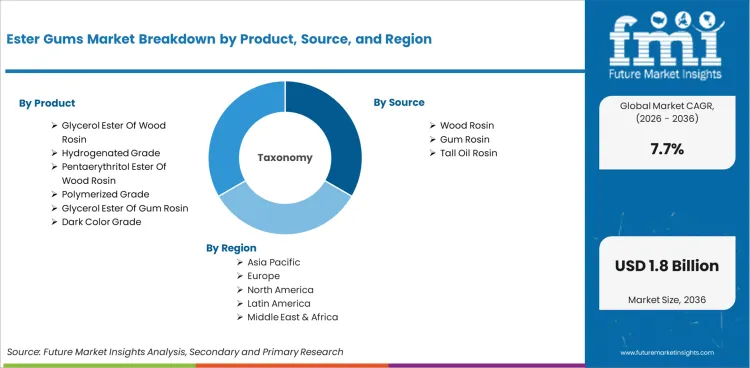
The ester gums market was valued at USD 0.8 billion in 2025. the market is set to reach USD 0.9 billion by 2026-end and grow at a CAGR of 7.7% between 2026-2036 to reach USD 1.8 billion by 2036. Glycerol Ester Of Wood Rosin will dominate with a 40.0% share, While Wood Rosin will lead with a 45.0% share.
Summary of the Ester Gums Market
- Demand and Growth Drivers
- The demand for tackifier resins in adhesive and sealant manufacturing is sustaining the use of ester gums as functional additives in hot melt and pressure-sensitive adhesive formulations.
- The food and beverage industry is creating a secondary consumption channel for ester gum-based emulsifiers and stabilizers in citrus-flavored beverages, with specification requirements driven by regulations.
- Ester gums continue to be used in printing ink and coating formulations as rheology modifiers and film-forming additives, with stable industrial demand.
- Product and Segment View
- The product segment is LED by glycerol ester of wood rosin at 40.0%, Owing to its established use as a tackifier in adhesive formulations and as an emulsifier in beverages.
- Wood rosin leads the source segment with 45.0% market share owing to stable supply chains of pine wood and established processing infrastructure.
- Based on the application, Adhesives & sealants are dominating the segment owing to hot melt adhesive and pressure sensitive adhesive manufacturing requirements for tackification performance.
- Geography and Competitive Outlook
- USA leads the market with a CAGR of 7.8% due to strong demand for adhesive manufacturing and ester gum-based emulsifier consumption in the food and beverage industry.
- 7.8% CAGR sustains demand for adhesive manufacturing scale, Expanding packaging industry needs in South Korea.
- Dual channel growth is on tap for companies with food grade certification and established supply relationships with adhesive manufacturers.
- Analyst Opinion
- Integrated rosin processing operations that can supply both food-grade and industrial-grade ester gums are poised to benefit from dual-channel demand growth across adhesive and beverage applications.
- “The market is gaining from increasing industrial adhesive applications and demand for food and beverage emulsifiers.
- Pine wood rosin sourcing provides competitive advantage in supply chain stability, as gum rosin supply from traditional sources is subject to collection and quality variability.
- The growing global packaging industry continues to support demand, Driving hot melt adhesives consumption and related purchases of tackifier resins.
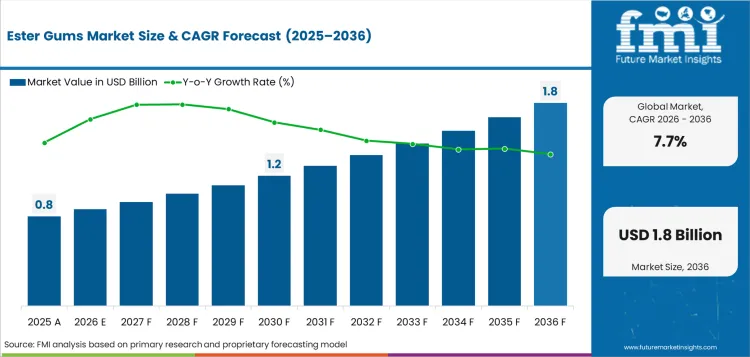
Key Takeaways, Market Size, And Forecast
- The ester gums market is expected to reach US$ 810.0 million by 2025.
- Ester Gums Market Expected To Reach USD 1.83 Billion By 2036.
- The market is expected to register a CAGR of 7.7% from 2026 to 2036.
- The market is expected to generate an incremental opportunity of USD 959.3 million from 2026 to 2036.
- The glycerol ester of wood rosin is projected to account for 40% of the product segment in 2026, Driven by the rising demand for tackification performance in hot melt adhesive and pressure-sensitive adhesive formulations.
- Among the fastest growing markets in the world are the USA (7.8%) and South Korea (7.8%).
Ester Gums Market Definition
The ester gums market includes rosin-derived ester gums used as tackifiers in adhesive formulations, as emulsifiers in food and beverage products, and as functional additives in printing inks, Coatings, and chewing gum. Market scope covers wood rosin and gum rosin glycerol esters in solid, Flake and granule forms.
Ester Gums Market Inclusions
The market scope covers all the commercially traded ester gums by product (glycerol ester of wood rosin, Hydrogenated grade, Standard grade), source (wood rosin, Gum rosin), form (solid, Flakes, Granules), application (adhesives and sealants, Printing inks, food and beverage, Others), end-use industry, function and distribution channel. Revenue sizing is carried out for the forecast period of 2026-2036.
Ester Gums Market Exclusions
Excluded from the scope are unprocessed rosin sold without esterification, Synthetic tackifier resins not derived from rosin, and rosin-based products used for pharmaceutical applications only.
Ester Gums Market Research Methodology
- Primary Research: FMI conducted interviews with manufacturers, Distributors, Procurement specialists and end-use application specialists in key markets.
- Desk Research: Data compiled from industry associations, regulatory disclosures, Certification bodies, and manufacturer disclosures.
- Market Sizing and Forecasting Bottom-up aggregation across product, source, form, application, end use industry, function, distribution channel segments with regional adoption curves and cross referencing against publicly available industry data.
- Data Validation: Examined each quarter against world production data, Trade statistics and figures submitted by manufacturers.
Why is the Ester Gums Market Growing?
- Adhesive manufacturing growth, Particularly hot melt and pressure-sensitive adhesive production, is creating sustained demand for ester gum tackifier resins.
- Food and beverage industry consumption of ester gum-based emulsifiers in citrus-flavored beverages is expanding with global beverage market growth.
- The USA and South Korea lead growth at 7.8% CAGR each, reflecting adhesive manufacturing scale and packaging industry expansion.
The ester gums market is estimated to be driven by the dual-channel consumption, which is driven by the growth of the adhesive manufacturing and the demand of emulsifiers in the food and beverage industry. Ester gums impart tackification performance critical to adhesive bond strength and application properties and are the major demand driver for the production of hot melt adhesive and pressure-sensitive adhesive for packaging applications. this growth showcases the growing global packaging industry and the cemented position of ester gums in beverage emulsification.
Glycerol ester of wood rosin is the highest percentage (40.0%) for wide range of uses in adhesive, beverage and coating. Wood rosin at 45.0% of source material supported through stable supply chains derived from pine wood. the market structure combines integrated rosin processors and specialty chemical companies, Supplying both food-grade and industrial-grade products.
Market Segmentation Analysis
- Glycerol Ester Of Wood Rosin leads the product segment with 40% market share, reflecting established supply and end-use preference.
- Wood Rosin holds the leading position in the source category at 45%.
- Solid accounts for the largest share in the form segment.
The ester gums market is segmented by product, source, form, application, end use industry, function, distribution channel. Each segment reflects distinct procurement criteria, end-use requirements, and pricing structures.
Insights into the Product Segment
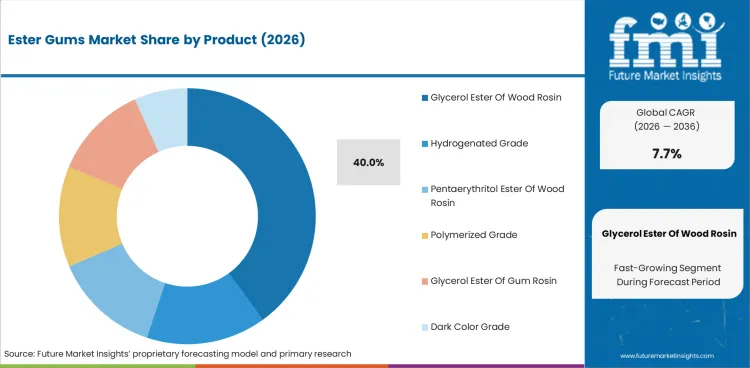
Glycerol Ester Of Wood Rosin holds 40% of the product segment. Demand is driven by existing end-use compatibility, Availability of supply chain and cost competitiveness relative to alternatives.
Standard Grade , Adhesives And Sealants , Printing Inks and other product categories cater to specific application requirements. There is diversity in technical specifications across end-use industries.
Insights into the Source Segment
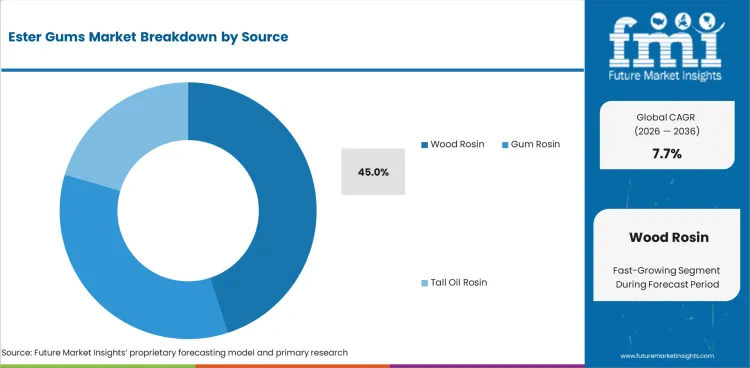
The source segment was 45% wood rosin. Demand is based on demonstrated end-use compatibility, Supply chain availability, and cost competitiveness with alternatives.
Other source categories are Pine Wood Derived, Stable Supply, industrial Use, All with specific application requirements and reflect the diversity of technical specifications across end-use industries.
Ester Gums Market Drivers, Restraints, and Opportunities
- Growing demand for adhesives in packaging applications is driving sustained demand for ester gum tackifier resins for use in hot melt and pressure sensitive formulations.
- Gum rosin collection regions may vary in rosin supply, Creating procurement risk, and favoring suppliers with access to stable wood rosin sources.
- The food and beverage emulsifiers demand adds a secondary consumption channel with higher-margin, regulatory compliant product specifications.
Regulatory drivers, Constraints in cost structure and new application opportunities are transforming the ester gums market. the adoption rate varies by segment, Geography and the price sensitivity of end use applications.
Packaging Adhesive Demand
Demand for hot melt adhesives and pressure-sensitive adhesives that rely on ester gum tackifier is driven by growth in packaging production, Particularly flexible packaging and labeling. a one percent increase in packaging production is associated with a similar increase in the consumption of tackifier resins.
Rosin Supply Chain Risk
The supply of gum rosin is dependent on labor intensive tapping operations which are concentrated in China and Southeast Asia, Causing variability in collections and inconsistency in quality. the supply of suppliers with access to wood rosin from sustainably managed forestry operations is more stable and predictable.
Food-Grade Emulsifier Channel
Ester gums, Higher-margin application with regulatory-driven specification requirements, are approved as food-grade emulsifiers for citrus-flavored drinks. consumption channel growth is being driven by the growth of the global beverage market, Particularly in emerging economies.
Analysis of Ester Gums Market By Key Countries
.webp "Top Country Growth Comparison Ester Gums Market Cagr (2026 2036)")
| Country | CAGR |
|---|---|
| USA | 7.8% |
| South Korea | 7.8% |
| EU | 7.7% |
| Japan | 7.7% |
| UK | 7.6% |
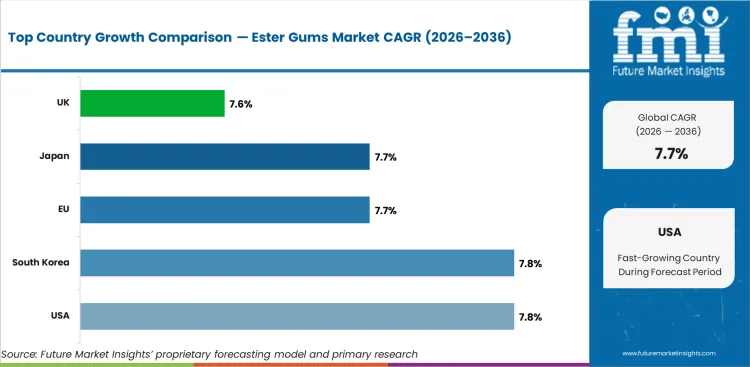
- USA leads with a 7.8% CAGR, reflecting established procurement networks.
- South Korea at 7.8% shows strong demand due to technology-LED adoption.
- EU (7.7%) and Japan (7.7%) continue growing, Supported by end-use industry expansion.
The global ester gums market is expected to grow at a rate of 7.7% per year from 2026 to 2036. the study covers more than 30 countries, and the main markets are listed below.
Demand Outlook for Ester Gums Market in USA
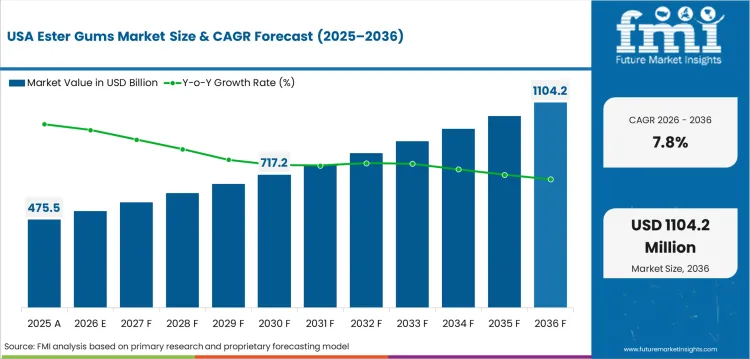
USA is projected to grow at a rate of 7.8% through 2036, reflecting established procurement networks, regulatory compliance investment, and strong end-use demand. Demand is supported by compliance-driven procurement, established distribution networks, and premium product demand.
- Compliance-LED procurement is sustaining demand for products meeting regulatory specifications.
- Established distribution networks support efficient supply chain coverage across end-use sectors.
- Premium product demand is creating value-added procurement channels alongside volume purchasing.
Future Outlook for Ester Gums Market in South Korea
South Korea is projected to grow at a rate of 7.8% through 2036, reflecting technology-LED adoption, manufacturing sector modernization, and export-oriented production capabilities. Demand is supported by manufacturing sector investment, technology adoption, and export-oriented capabilities.
- Technology-LED adoption is driving procurement modernization across industrial applications.
- Manufacturing sector investment supports domestic demand and export competitiveness.
- Regulatory development is raising product specification requirements across categories.
Opportunity Analysis of Ester Gums Market in Europe
Europe is projected to grow at a rate of 7.7% through 2036, reflecting EU regulatory frameworks, sustainability mandates, and advanced manufacturing infrastructure. Demand is supported by EU-wide regulatory harmonization, sustainability mandates, and advanced manufacturing infrastructure.
- EU regulatory frameworks are creating compliance-LED demand across member states.
- Sustainability mandates are accelerating adoption of compliant product specifications.
- Advanced manufacturing infrastructure supports efficient production and distribution.
In-depth Analysis of Ester Gums Market in Japan
Japan is projected to grow at a rate of 7.7% through 2036, reflecting advanced manufacturing capabilities, quality-driven procurement standards, and technology adoption. Demand is supported by quality-driven procurement standards, advanced manufacturing, and technology adoption.
- Quality-driven procurement standards sustain demand for high-specification products.
- Advanced manufacturing capabilities support domestic production and technology adoption.
- Established industry infrastructure enables efficient distribution across end-use sectors.
Sales Analysis of Ester Gums Market in UK
UK is projected to grow at a rate of 7.6% through 2036, reflecting regulatory alignment with quality standards and established distribution infrastructure. Demand is supported by regulatory alignment, established distribution channels, and quality-driven procurement.
- Regulatory standards alignment is shaping product specifications and procurement criteria.
- Established distribution infrastructure supports efficient market coverage across the region.
- Premium segment demand is creating opportunities for value-added product positioning.
Competitive Landscape and Strategic Positioning
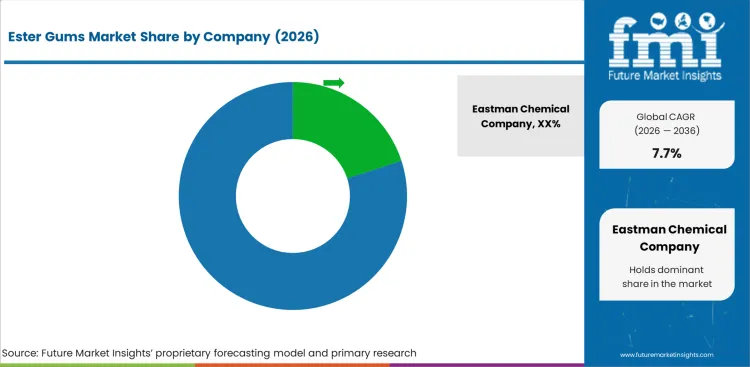
- Eastman Chemical Company holds a leading position based on established manufacturing infrastructure, Wide product portfolio and strong end-use customer relationships.
- DRT (Les Dérivés Résiniques et Terpéniques) and Arakawa Chemical Industries, Ltd. are the market leaders in their product portfolio and regional distribution.
- New entrants and smaller players are focusing on niche segments and specific applications to build market position.
Eastman Chemical Company is a key player due to its large scale manufacturing capacity and existing relationships with end-use customers in multiple regions. DRT (Les Dérivés Résiniques et Terpéniques) is comparable in terms of product range and distribution.
Symrise AG and Arakawa Chemical Industries, Ltd. are competitive in some product categories and regional markets. Barriers to entry are manufacturing scale requirements, regulatory certification timelines and established procurement relationships.
The strategic priorities are cost optimization, Geographic expansion, product specification upgrades and alignment with regulatory compliance timelines.
Key Companies in the Ester Gums Market
Key global companies leading the ester gums market include:
- Eastman Chemical Company, DRT (Les Dérivés Résiniques et Terpéniques), Arakawa Chemical Industries, Ltd. hold leading positions through established infrastructure and strong customer relationships.
- Symrise AG and Foreverest Resources Ltd. maintain competitive positions through regional expertise and product specialization.
Competitive Benchmarking: Ester Gums Market
| Company | Grade Range | Rosin Source Stability | Food-Grade Certification | Geographic Reach |
|---|---|---|---|---|
| Eastman Chemical Company | High | Strong | Strong | Global |
| DRT (Les Dérivés Résiniques et Terpéniques) | High | Strong | Strong | Global |
| Arakawa Chemical Industries, Ltd. | High | Strong | Strong | Global |
| Symrise AG | Medium | Moderate | Moderate | Regional |
| Foreverest Resources Ltd. | Medium | Moderate | Moderate | Regional |
Source: Future Market Insights competitive analysis, 2026.
Key Players in the Ester Gums Market
Major Global Players
- Eastman Chemical Company
- DRT (Les Dérivés Résiniques et Terpéniques)
- Arakawa Chemical Industries, Ltd.
- Symrise AG
- Foreverest Resources Ltd.
Emerging Players/Startups
- Symrise AG
- Foreverest Resources Ltd.
Report Scope and Coverage
| Metric | Value |
|---|---|
| Quantitative Units | USD 872.4 million to USD 1.83 billion, at a CAGR of 7.7% |
| Market Definition | The ester gums market encompasses products categorized by product, source, form, application, end use industry, function, distribution channel across all major end-use applications. |
| Regions Covered | North America, Latin America, Europe, East Asia, South Asia and Pacific, Middle East and Africa |
| Countries Covered | USA, South Korea, EU, Japan, UK, 30 plus countries |
| Key Companies Profiled | Eastman Chemical Company, DRT (Les Dérivés Résiniques et Terpéniques), Arakawa Chemical Industries, Ltd., Symrise AG, Foreverest Resources Ltd. |
| Forecast Period | 2026 to 2036 |
| Approach | Hybrid bottom-up and top-down methodology starting with verified transaction data, Projecting adoption velocity across segments and regions. |
Market Segmentation Analysis
Ester Gums Market Segmented by Product:
- Glycerol Ester Of Wood Rosin
- Standard Grade
- Adhesives And Sealants
- Printing Inks
- Standard Grade
- Hydrogenated Grade
-
- Improved Stability
- Food Applications
-
- Pentaerythritol Ester Of Wood Rosin
- Standard Grade
- Rubber Compounding
- Industrial Adhesives
- Standard Grade
- Polymerized Grade
-
- High Softening Point
- High Performance Applications
-
- Glycerol Ester Of Gum Rosin
- Light Color Grade
- Food And Beverage Use
- Chewing Gum Base
- Light Color Grade
- Dark Color Grade
-
- Industrial Applications
- Coatings
-
Ester Gums Market Segmented by Source:
- Wood Rosin
- Pine Wood Derived
- Stable Supply
- Industrial Use
- Pine Wood Derived
- Gum Rosin
- Tapped Pine Resin
- Natural Source
- Food Applications
- Tapped Pine Resin
- Tall Oil Rosin
- Pulp Industry Byproduct
- Cost Efficient
- Industrial Applications
- Pulp Industry Byproduct
Ester Gums Market Segmented by Form:
- Solid
- Flakes
- Easy Handling
- Bulk Supply
- Flakes
- Granules
-
- Uniform Size
- Controlled Usage
-
- Liquid
- Liquid Ester Gums
- Coatings
- Adhesives
- Liquid Ester Gums
Ester Gums Market Segmented by Application:
- Adhesives And Sealants
- Hot Melt Adhesives
- Packaging Adhesives
- Industrial Bonding
- Hot Melt Adhesives
- Pressure Sensitive Adhesives
-
- Tapes
- Labels
-
- Food And Beverage
- Beverage Stabilizers
- Flavor Emulsifiers
- Clouding Agents
- Beverage Stabilizers
- Chewing Gum Base
-
- Texture Enhancement
- Elasticity Control
-
- Inks And Coatings
- Printing Inks
- Packaging Inks
- Publication Inks
- Printing Inks
- Paints And Coatings
-
- Protective Coatings
- Decorative Coatings
-
- Rubber Compounding
- Tire Manufacturing
- Industrial Rubber
- Footwear
- Tire Manufacturing
Ester Gums Market Segmented by End Use Industry:
- Packaging
- Flexible Packaging
- Labels
- Tapes
- Flexible Packaging
- Food And Beverage
- Beverage Industry
- Soft Drinks
- Flavored Drinks
- Beverage Industry
- Automotive
- Tires
- Rubber Parts
- Sealants
- Tires
- Construction
- Adhesives
- Coatings
- Sealants
- Adhesives
- Printing And Publishing
- Printing Industry
- Packaging Printing
- Commercial Printing
- Printing Industry
Ester Gums Market Segmented by Function:
- Tackifier
- Adhesion Enhancement
- Hot Melt Adhesives
- Pressure Sensitive Adhesives
- Adhesion Enhancement
- Stabilizer
- Emulsion Stability
- Beverages
- Food Products
- Emulsion Stability
- Binder
- Coating Applications
- Paints
- Inks
- Coating Applications
Ester Gums Market Segmented by Distribution Channel:
- Direct Sales
- Industrial Contracts
- Bulk Supply
- Long Term Agreements
- Industrial Contracts
- Distributors And Suppliers
- Chemical Distributors
- Regional Supply
- Global Supply
- Chemical Distributors
- Online Sales
- Digital Platforms
- B2B Marketplaces
- Manufacturer Websites
- Digital Platforms
Ester Gums Market by Region:
- North America
- USA
- Canada
- Mexico
- Latin America
- Brazil
- Chile
- Rest of Latin America
- Western Europe
- Germany
- UK
- Italy
- Spain
- France
- Nordic
- BENELUX
- Rest of Western Europe
- Eastern Europe
- Russia
- Poland
- Hungary
- Balkan & Baltic
- Rest of Eastern Europe
- East Asia
- China
- Japan
- South Korea
- South Asia and Pacific
- India
- ASEAN
- Australia & New Zealand
- Rest of South Asia and Pacific
- Middle East & Africa
- Kingdom of Saudi Arabia
- Other GCC Countries
- Turkiye
- South Africa
- Other African Union
- Rest of Middle East & Africa
Research Sources and Bibliography
- Food and Agriculture Organization. (2025). Non-Wood Forest Products: Global Rosin Production and Trade Report. FAO.
- United States Food and Drug Administration. (2024). Food Additive Regulations: Ester Gum (GRAS) Status Review. FDA.
- European Food Safety Authority. (2025). Safety Assessment of Food-Grade Rosin Derivatives. EFSA.
- International Adhesives and Sealants Council. (2025). Global Adhesives Industry Production Report. IASC.
- Organisation for Economic Co-operation and Development. (2024). Specialty Chemicals and Bio-based Materials Outlook. OECD.
This bibliography is provided for reader reference.
This Report Answers
- Estimating the size of the ester gums market and revenue projections from 2026 to 2036.
- Segmentation by product, source, form, application, end use industry, function, distribution channel.
- Insights across more than 30 country and regional markets.
- Analysis of key growth drivers, Restraints, and emerging opportunities.
- Assessment of the competitive landscape and strategic positioning.
- Identification of investment opportunities across primary application segments.
- Supply chain structure and distribution channel analysis.
- Delivery of data in PDF and Excel formats.
Frequently Asked Questions
What is the global market demand for Ester Gums Market in 2026?
In 2026, the global ester gums market is expected to be worth USD 872.4 million.
How big will the Ester Gums Market be in 2036?
By 2036, the ester gums market is expected to be worth USD 1.83 billion.
How much is demand for Ester Gums Market expected to grow between 2026 and 2036?
Between 2026 and 2036, the ester gums market is expected to grow at a CAGR of 7.7%.
Which segment is likely to lead the Ester Gums Market in 2026?
In the Ester Gums Market, Glycerol Ester Of Wood Rosin is expected to account for 40% of the product segment in 2026, reflecting strong downstream demand and established procurement patterns.
What is causing demand to rise in USA for the Ester Gums Market?
In the Ester Gums Market, USA is projected to grow at 7.8% through 2036, reflecting established procurement networks, regulatory compliance investment, and strong end-use demand.
What is causing demand to rise in South Korea for the Ester Gums Market?
In the Ester Gums Market, South Korea is projected to grow at 7.8% through 2036, reflecting technology-LED adoption, manufacturing sector modernization, and export-oriented production capabilities.
What is the definition of the Ester Gums Market?
The ester gums market encompasses products categorized by product, source, form, application, end use industry, function, distribution channel across all major end-use applications.
How does FMI forecast and validate the Ester Gums Market?
Forecasting models use a hybrid bottom-up and top-down approach, starting with verified transaction data and cross-referencing against global production statistics and manufacturer disclosures.
Preview the report firsthand - request a free sample
Get SampleGet the brochure for pricing and purchase details.
Get PDFTable of Content
- Executive Summary
- Global Market Outlook
- Demand-side Trends
- Supply-side Trends
- Technology Roadmap Analysis
- Analysis and Recommendations
- Market Overview
- Market Coverage / Taxonomy
- Market Definition / Scope / Limitations
- Research Methodology
- Chapter Orientation
- Analytical Lens and Working Hypotheses
- Market Structure, Signals, and Trend Drivers
- Benchmarking and Cross-market Comparability
- Market Sizing, Forecasting, and Opportunity Mapping
- Research Design and Evidence Framework
- Desk Research Programme (Secondary Evidence)
- Company Annual and Sustainability Reports
- Peer-reviewed Journals and Academic Literature
- Corporate Websites, product Literature, and Technical Notes
- Earnings Decks and Investor Briefings
- Statutory Filings and Regulatory Disclosures
- Technical White Papers and Standards Notes
- Trade Journals, Industry Magazines, and Analyst Briefs
- Conference Proceedings, Webinars, and Seminar Materials
- Government Statistics Portals and Public Data Releases
- Press Releases and Reputable Media Coverage
- Specialist Newsletters and Curated Briefings
- Sector Databases and Reference Repositories
- FMI Internal Proprietary Databases and Historical Market Datasets
- Subscription Datasets and Paid Sources
- Social Channels, Communities, and Digital Listening Inputs
- Additional Desk Sources
- Expert Input and Fieldwork (Primary Evidence)
- Primary Modes
- Qualitative Interviews and Expert Elicitation
- Quantitative Surveys and Structured Data Capture
- Blended Approach
- Why Primary Evidence is Used
- Field Techniques
- Interviews
- Surveys
- Focus Groups
- Observational and In-context Research
- Social and Community Interactions
- Stakeholder Universe Engaged
- C-suite Leaders
- Board Members
- Presidents and Vice Presidents
- R&D and Innovation Heads
- Technical Specialists
- Domain Subject-matter Experts
- Scientists
- Physicians and Other Healthcare Professionals
- Governance, Ethics, and Data Stewardship
- Research Ethics
- Data Integrity and Handling
- Primary Modes
- Tooling, Models, and Reference Databases
- Desk Research Programme (Secondary Evidence)
- Data Engineering and Model Build
- Data Acquisition and Ingestion
- Cleaning, Normalisation, and Verification
- Synthesis, Triangulation, and Analysis
- Quality Assurance and Audit Trail
- Market Background
- Market Dynamics
- Drivers
- Restraints
- Opportunity
- Trends
- Scenario Forecast
- Demand in Optimistic Scenario
- Demand in Likely Scenario
- Demand in Conservative Scenario
- Opportunity Map Analysis
- Product Life Cycle Analysis
- Supply Chain Analysis
- Investment Feasibility Matrix
- Value Chain Analysis
- PESTLE and Porter’s Analysis
- Regulatory Landscape
- Regional Parent Market Outlook
- Production and Consumption Statistics
- Import and Export Statistics
- Market Dynamics
- Global Market Analysis 2021 to 2025 and Forecast, 2026 to 2036
- Historical Market Size Value (USD Million) Analysis, 2021 to 2025
- Current and Future Market Size Value (USD Million) Projections, 2026 to 2036
- Y-o-Y Growth Trend Analysis
- Absolute $ Opportunity Analysis
- Global Market Pricing Analysis 2021 to 2025 and Forecast 2026 to 2036
- Global Market Analysis 2021 to 2025 and Forecast 2026 to 2036, by Product
- Introduction / Key Findings
- Historical Market Size Value (USD Million) Analysis By Product , 2021 to 2025
- Current and Future Market Size Value (USD Million) Analysis and Forecast By Product , 2026 to 2036
- Glycerol Ester Of Wood Rosin
- Standard Grade
- Adhesives And Sealants
- Printing Inks
- Hydrogenated Grade
- Improved Stability
- Food Applications
- Pentaerythritol Ester Of Wood Rosin
- Standard Grade
- Rubber Compounding
- Industrial Adhesives
- Polymerized Grade
- High Softening Point
- High Performance Applications
- Glycerol Ester Of Gum Rosin
- Light Color Grade
- Food And Beverage Use
- Chewing Gum Base
- Dark Color Grade
- Industrial Applications
- Coatings
- Glycerol Ester Of Wood Rosin
- Y-o-Y Growth Trend Analysis By Product , 2021 to 2025
- Absolute $ Opportunity Analysis By Product , 2026 to 2036
- Global Market Analysis 2021 to 2025 and Forecast 2026 to 2036, by Source
- Introduction / Key Findings
- Historical Market Size Value (USD Million) Analysis By Source, 2021 to 2025
- Current and Future Market Size Value (USD Million) Analysis and Forecast By Source, 2026 to 2036
- Wood Rosin
- Pine Wood Derived
- Stable Supply
- Industrial Use
- Gum Rosin
- Tapped Pine Resin
- Natural Source
- Food Applications
- Tall Oil Rosin
- Pulp Industry Byproduct
- Cost Efficient
- Industrial Applications
- Wood Rosin
- Y-o-Y Growth Trend Analysis By Source, 2021 to 2025
- Absolute $ Opportunity Analysis By Source, 2026 to 2036
- Global Market Analysis 2021 to 2025 and Forecast 2026 to 2036, by Form
- Introduction / Key Findings
- Historical Market Size Value (USD Million) Analysis By Form, 2021 to 2025
- Current and Future Market Size Value (USD Million) Analysis and Forecast By Form, 2026 to 2036
- Solid
- Flakes
- Easy Handling
- Bulk Supply
- Granules
- Uniform Size
- Controlled Usage
- Liquid
- Liquid Ester Gums
- Coatings
- Adhesives
- Solid
- Y-o-Y Growth Trend Analysis By Form, 2021 to 2025
- Absolute $ Opportunity Analysis By Form, 2026 to 2036
- Global Market Analysis 2021 to 2025 and Forecast 2026 to 2036, by Application
- Introduction / Key Findings
- Historical Market Size Value (USD Million) Analysis By Application, 2021 to 2025
- Current and Future Market Size Value (USD Million) Analysis and Forecast By Application, 2026 to 2036
- Adhesives And Sealants
- Hot Melt Adhesives
- Packaging Adhesives
- Industrial Bonding
- Pressure Sensitive Adhesives
- Tapes
- Labels
- Food And Beverage
- Beverage Stabilizers
- Flavor Emulsifiers
- Clouding Agents
- Chewing Gum Base
- Texture Enhancement
- Elasticity Control
- Inks And Coatings
- Printing Inks
- Packaging Inks
- Publication Inks
- Paints And Coatings
- Protective Coatings
- Decorative Coatings
- Rubber Compounding
- Tire Manufacturing
- Industrial Rubber
- Footwear
- Adhesives And Sealants
- Y-o-Y Growth Trend Analysis By Application, 2021 to 2025
- Absolute $ Opportunity Analysis By Application, 2026 to 2036
- Global Market Analysis 2021 to 2025 and Forecast 2026 to 2036, by End Use Industry
- Introduction / Key Findings
- Historical Market Size Value (USD Million) Analysis By End Use Industry, 2021 to 2025
- Current and Future Market Size Value (USD Million) Analysis and Forecast By End Use Industry, 2026 to 2036
- Packaging
- Flexible Packaging
- Labels
- Tapes
- Food And Beverage
- Beverage Industry
- Soft Drinks
- Flavored Drinks
- Automotive
- Tires
- Rubber Parts
- Sealants
- Construction
- Adhesives
- Coatings
- Sealants
- Printing And Publishing
- Printing Industry
- Packaging Printing
- Commercial Printing
- Packaging
- Y-o-Y Growth Trend Analysis By End Use Industry, 2021 to 2025
- Absolute $ Opportunity Analysis By End Use Industry, 2026 to 2036
- Global Market Analysis 2021 to 2025 and Forecast 2026 to 2036, by Function
- Introduction / Key Findings
- Historical Market Size Value (USD Million) Analysis By Function, 2021 to 2025
- Current and Future Market Size Value (USD Million) Analysis and Forecast By Function, 2026 to 2036
- Tackifier
- Adhesion Enhancement
- Hot Melt Adhesives
- Pressure Sensitive Adhesives
- Stabilizer
- Emulsion Stability
- Beverages
- Food Products
- Binder
- Coating Applications
- Paints
- Inks
- Tackifier
- Y-o-Y Growth Trend Analysis By Function, 2021 to 2025
- Absolute $ Opportunity Analysis By Function, 2026 to 2036
- Global Market Analysis 2021 to 2025 and Forecast 2026 to 2036, by Distribution Channel
- Introduction / Key Findings
- Historical Market Size Value (USD Million) Analysis By Distribution Channel, 2021 to 2025
- Current and Future Market Size Value (USD Million) Analysis and Forecast By Distribution Channel, 2026 to 2036
- Direct Sales
- Industrial Contracts
- Bulk Supply
- Long Term Agreements
- Distributors And Suppliers
- Chemical Distributors
- Regional Supply
- Global Supply
- Online Sales
- Digital Platforms
- B2B Marketplaces
- Manufacturer Websites
- Direct Sales
- Y-o-Y Growth Trend Analysis By Distribution Channel, 2021 to 2025
- Absolute $ Opportunity Analysis By Distribution Channel, 2026 to 2036
- Global Market Analysis 2021 to 2025 and Forecast 2026 to 2036, by Region
- Introduction
- Historical Market Size Value (USD Million) Analysis By Region, 2021 to 2025
- Current Market Size Value (USD Million) Analysis and Forecast By Region, 2026 to 2036
- North America
- Latin America
- Western Europe
- Eastern Europe
- East Asia
- South Asia and Pacific
- Middle East & Africa
- Market Attractiveness Analysis By Region
- North America Market Analysis 2021 to 2025 and Forecast 2026 to 2036, by Country
- Historical Market Size Value (USD Million) Trend Analysis By Market Taxonomy, 2021 to 2025
- Market Size Value (USD Million) Forecast By Market Taxonomy, 2026 to 2036
- By Country
- USA
- Canada
- Mexico
- By Product
- By Source
- By Form
- By Application
- By End Use Industry
- By Function
- By Distribution Channel
- By Country
- Market Attractiveness Analysis
- By Country
- By Product
- By Source
- By Form
- By Application
- By End Use Industry
- By Function
- By Distribution Channel
- Key Takeaways
- Latin America Market Analysis 2021 to 2025 and Forecast 2026 to 2036, by Country
- Historical Market Size Value (USD Million) Trend Analysis By Market Taxonomy, 2021 to 2025
- Market Size Value (USD Million) Forecast By Market Taxonomy, 2026 to 2036
- By Country
- Brazil
- Chile
- Rest of Latin America
- By Product
- By Source
- By Form
- By Application
- By End Use Industry
- By Function
- By Distribution Channel
- By Country
- Market Attractiveness Analysis
- By Country
- By Product
- By Source
- By Form
- By Application
- By End Use Industry
- By Function
- By Distribution Channel
- Key Takeaways
- Western Europe Market Analysis 2021 to 2025 and Forecast 2026 to 2036, by Country
- Historical Market Size Value (USD Million) Trend Analysis By Market Taxonomy, 2021 to 2025
- Market Size Value (USD Million) Forecast By Market Taxonomy, 2026 to 2036
- By Country
- Germany
- UK
- Italy
- Spain
- France
- Nordic
- BENELUX
- Rest of Western Europe
- By Product
- By Source
- By Form
- By Application
- By End Use Industry
- By Function
- By Distribution Channel
- By Country
- Market Attractiveness Analysis
- By Country
- By Product
- By Source
- By Form
- By Application
- By End Use Industry
- By Function
- By Distribution Channel
- Key Takeaways
- Eastern Europe Market Analysis 2021 to 2025 and Forecast 2026 to 2036, by Country
- Historical Market Size Value (USD Million) Trend Analysis By Market Taxonomy, 2021 to 2025
- Market Size Value (USD Million) Forecast By Market Taxonomy, 2026 to 2036
- By Country
- Russia
- Poland
- Hungary
- Balkan & Baltic
- Rest of Eastern Europe
- By Product
- By Source
- By Form
- By Application
- By End Use Industry
- By Function
- By Distribution Channel
- By Country
- Market Attractiveness Analysis
- By Country
- By Product
- By Source
- By Form
- By Application
- By End Use Industry
- By Function
- By Distribution Channel
- Key Takeaways
- East Asia Market Analysis 2021 to 2025 and Forecast 2026 to 2036, by Country
- Historical Market Size Value (USD Million) Trend Analysis By Market Taxonomy, 2021 to 2025
- Market Size Value (USD Million) Forecast By Market Taxonomy, 2026 to 2036
- By Country
- China
- Japan
- South Korea
- By Product
- By Source
- By Form
- By Application
- By End Use Industry
- By Function
- By Distribution Channel
- By Country
- Market Attractiveness Analysis
- By Country
- By Product
- By Source
- By Form
- By Application
- By End Use Industry
- By Function
- By Distribution Channel
- Key Takeaways
- South Asia and Pacific Market Analysis 2021 to 2025 and Forecast 2026 to 2036, by Country
- Historical Market Size Value (USD Million) Trend Analysis By Market Taxonomy, 2021 to 2025
- Market Size Value (USD Million) Forecast By Market Taxonomy, 2026 to 2036
- By Country
- India
- ASEAN
- Australia & New Zealand
- Rest of South Asia and Pacific
- By Product
- By Source
- By Form
- By Application
- By End Use Industry
- By Function
- By Distribution Channel
- By Country
- Market Attractiveness Analysis
- By Country
- By Product
- By Source
- By Form
- By Application
- By End Use Industry
- By Function
- By Distribution Channel
- Key Takeaways
- Middle East & Africa Market Analysis 2021 to 2025 and Forecast 2026 to 2036, by Country
- Historical Market Size Value (USD Million) Trend Analysis By Market Taxonomy, 2021 to 2025
- Market Size Value (USD Million) Forecast By Market Taxonomy, 2026 to 2036
- By Country
- Kingdom of Saudi Arabia
- Other GCC Countries
- Turkiye
- South Africa
- Other African Union
- Rest of Middle East & Africa
- By Product
- By Source
- By Form
- By Application
- By End Use Industry
- By Function
- By Distribution Channel
- By Country
- Market Attractiveness Analysis
- By Country
- By Product
- By Source
- By Form
- By Application
- By End Use Industry
- By Function
- By Distribution Channel
- Key Takeaways
- Key Countries Market Analysis
- USA
- Pricing Analysis
- Market Share Analysis, 2025
- By Product
- By Source
- By Form
- By Application
- By End Use Industry
- By Function
- By Distribution Channel
- Canada
- Pricing Analysis
- Market Share Analysis, 2025
- By Product
- By Source
- By Form
- By Application
- By End Use Industry
- By Function
- By Distribution Channel
- Mexico
- Pricing Analysis
- Market Share Analysis, 2025
- By Product
- By Source
- By Form
- By Application
- By End Use Industry
- By Function
- By Distribution Channel
- Brazil
- Pricing Analysis
- Market Share Analysis, 2025
- By Product
- By Source
- By Form
- By Application
- By End Use Industry
- By Function
- By Distribution Channel
- Chile
- Pricing Analysis
- Market Share Analysis, 2025
- By Product
- By Source
- By Form
- By Application
- By End Use Industry
- By Function
- By Distribution Channel
- Germany
- Pricing Analysis
- Market Share Analysis, 2025
- By Product
- By Source
- By Form
- By Application
- By End Use Industry
- By Function
- By Distribution Channel
- UK
- Pricing Analysis
- Market Share Analysis, 2025
- By Product
- By Source
- By Form
- By Application
- By End Use Industry
- By Function
- By Distribution Channel
- Italy
- Pricing Analysis
- Market Share Analysis, 2025
- By Product
- By Source
- By Form
- By Application
- By End Use Industry
- By Function
- By Distribution Channel
- Spain
- Pricing Analysis
- Market Share Analysis, 2025
- By Product
- By Source
- By Form
- By Application
- By End Use Industry
- By Function
- By Distribution Channel
- France
- Pricing Analysis
- Market Share Analysis, 2025
- By Product
- By Source
- By Form
- By Application
- By End Use Industry
- By Function
- By Distribution Channel
- India
- Pricing Analysis
- Market Share Analysis, 2025
- By Product
- By Source
- By Form
- By Application
- By End Use Industry
- By Function
- By Distribution Channel
- ASEAN
- Pricing Analysis
- Market Share Analysis, 2025
- By Product
- By Source
- By Form
- By Application
- By End Use Industry
- By Function
- By Distribution Channel
- Australia & New Zealand
- Pricing Analysis
- Market Share Analysis, 2025
- By Product
- By Source
- By Form
- By Application
- By End Use Industry
- By Function
- By Distribution Channel
- China
- Pricing Analysis
- Market Share Analysis, 2025
- By Product
- By Source
- By Form
- By Application
- By End Use Industry
- By Function
- By Distribution Channel
- Japan
- Pricing Analysis
- Market Share Analysis, 2025
- By Product
- By Source
- By Form
- By Application
- By End Use Industry
- By Function
- By Distribution Channel
- South Korea
- Pricing Analysis
- Market Share Analysis, 2025
- By Product
- By Source
- By Form
- By Application
- By End Use Industry
- By Function
- By Distribution Channel
- Russia
- Pricing Analysis
- Market Share Analysis, 2025
- By Product
- By Source
- By Form
- By Application
- By End Use Industry
- By Function
- By Distribution Channel
- Poland
- Pricing Analysis
- Market Share Analysis, 2025
- By Product
- By Source
- By Form
- By Application
- By End Use Industry
- By Function
- By Distribution Channel
- Hungary
- Pricing Analysis
- Market Share Analysis, 2025
- By Product
- By Source
- By Form
- By Application
- By End Use Industry
- By Function
- By Distribution Channel
- Kingdom of Saudi Arabia
- Pricing Analysis
- Market Share Analysis, 2025
- By Product
- By Source
- By Form
- By Application
- By End Use Industry
- By Function
- By Distribution Channel
- Turkiye
- Pricing Analysis
- Market Share Analysis, 2025
- By Product
- By Source
- By Form
- By Application
- By End Use Industry
- By Function
- By Distribution Channel
- South Africa
- Pricing Analysis
- Market Share Analysis, 2025
- By Product
- By Source
- By Form
- By Application
- By End Use Industry
- By Function
- By Distribution Channel
- USA
- Market Structure Analysis
- Competition Dashboard
- Competition Benchmarking
- Market Share Analysis of Top Players
- By Regional
- By Product
- By Source
- By Form
- By Application
- By End Use Industry
- By Function
- By Distribution Channel
- Competition Analysis
- Competition Deep Dive
- Eastman Chemical Company
- Overview
- Product Portfolio
- Profitability by Market Segments (Product/Age /Sales Channel/Region)
- Sales Footprint
- Strategy Overview
- Marketing Strategy
- Product Strategy
- Channel Strategy
- DRT (Les Dérivés Résiniques et Terpéniques)
- Arakawa Chemical Industries, Ltd.
- Symrise AG
- Foreverest Resources Ltd.
- Other Ester Gum Manufacturers (combined)
- Eastman Chemical Company
- Competition Deep Dive
- Assumptions & Acronyms Used


