

- Industry Size (2025)
- USD 1.4 Bn
- Forecast (2035)
- USD 2.7 Bn
- CAGR (2025 to 2035)
- 6.5%
Phosphated Ester Market Size and Share Forecast Outlook 2025 to 2035
The Phosphated Ester Market is estimated to be valued at USD 1.4 billion in 2025 and is projected to reach USD 2.7 billion by 2035, registering a compound annual growth rate (CAGR) of 6.5% over the forecast period.
Quick Stats for Phosphated Ester Market
- Phosphated Ester Market Value (2025): USD 1.4 billion
- Phosphated Ester Market Forecast Value (2035): USD 2.7 billion
- Phosphated Ester Market Forecast CAGR: 6.5%
- Leading Segment in Phosphated Ester Market in 2025: Synthetic (60.0%)
- Key Growth Regions in Phosphated Ester Market: North America, Asia-Pacific, Europe
- Top Key Players in Phosphated Ester Market: LANXESS Deutschland GmbH, Exxon Mobil Corporation, Solvay, Eastman Chemical Company, Dow, Ashland, Castrol Limited, Croda International Plc
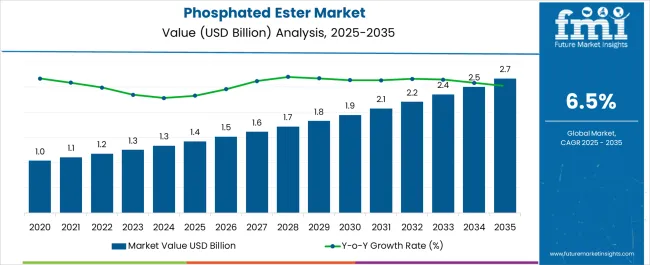
Phosphated Ester Market Key Takeaways
| Metric | Value |
|---|---|
| Phosphated Ester Market Estimated Value in (2025 E) | USD 1.4 billion |
| Phosphated Ester Market Forecast Value in (2035 F) | USD 2.7 billion |
| Forecast CAGR (2025 to 2035) | 6.5% |
Why is the Phosphated Ester Market Growing?
The Phosphated Ester market is experiencing steady growth driven by the increasing demand for high-performance additives in lubrication and industrial applications. The market’s future outlook is shaped by the rising emphasis on enhancing equipment efficiency, reducing wear and tear, and improving the operational life of machinery across automotive, industrial, and manufacturing sectors.
Continuous advancements in chemical formulations have led to phosphated esters offering superior anti-wear, anti-corrosion, and thermal stability properties, which further support market expansion. Increasing industrialization in emerging economies and the growing adoption of sustainable and high-performance lubricants are key factors propelling market growth.
Additionally, the ongoing need for energy-efficient operations and compliance with stricter environmental regulations is boosting the demand for high-quality synthetic phosphated esters As industries increasingly prioritize operational efficiency, cost reduction, and equipment longevity, the Phosphated Ester market is expected to witness sustained growth over the coming years.
Segmental Analysis
The phosphated ester market is segmented by source, types, application, end-use industry, and geographic regions. By source, phosphated ester market is divided into Synthetic and Natural. In terms of types, phosphated ester market is classified into Alkyl Aryl Phosphated Ester, Trialkyl Phosphated Ester, and Triaryl Phosphated Ester. Based on application, phosphated ester market is segmented into Lubricant, Surfactant, Fire Retardant, and Pesticides. By end-use industry, phosphated ester market is segmented into Automotive, Agrochemicals, Paints & Coatings, Plastic, and Other Industrial. Regionally, the phosphated ester industry is classified into North America, Latin America, Western Europe, Eastern Europe, Balkan & Baltic Countries, Russia & Belarus, Central Asia, East Asia, South Asia & Pacific, and the Middle East & Africa.
Insights into the Synthetic Source Segment
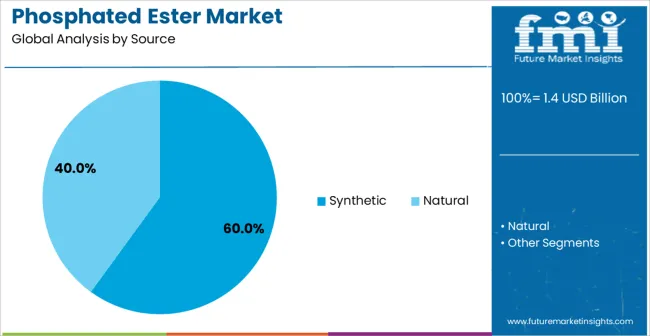
The synthetic source segment is projected to hold 60.0% of the Phosphated Ester market revenue share in 2025, making it the leading source type. This dominance is primarily driven by the superior chemical stability, performance consistency, and enhanced functionality offered by synthetic phosphated esters compared to natural sources.
The ability to customize formulations for specific industrial applications, coupled with their compatibility with high-performance lubricants, has reinforced their adoption. Additionally, the demand for synthetic phosphated esters is fueled by their efficiency in reducing wear and corrosion in machinery, thereby extending equipment life and lowering maintenance costs.
The segment’s growth is further supported by increasing investments in industrial infrastructure and the rising need for reliable and long-lasting lubricant additives The preference for synthetic phosphated esters in high-demand sectors underscores their continued market prominence.
Insights into the Alkyl Aryl Phosphated Ester Type Segment
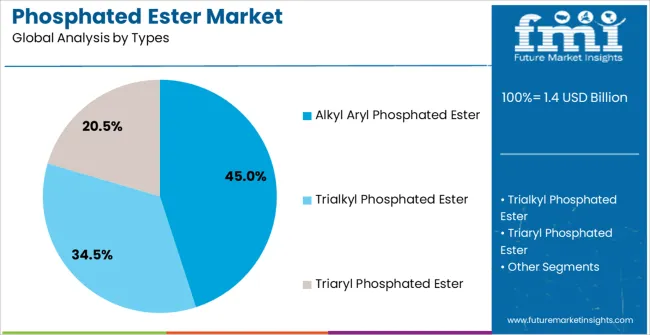
The alkyl aryl phosphated ester type segment is expected to account for 45.0% of the Phosphated Ester market revenue share in 2025, establishing it as the leading type. The growth of this segment is driven by its excellent anti-wear, anti-oxidation, and thermal stability properties, which make it suitable for high-performance lubrication systems.
Its ability to enhance lubricant effectiveness under extreme operating conditions has reinforced its adoption across industrial and automotive applications. Additionally, the chemical versatility of alkyl aryl phosphated esters allows customization for specific equipment requirements, improving operational efficiency and reliability.
The increasing need for long-lasting and energy-efficient lubricants further supports the segment’s growth As industries prioritize performance optimization and equipment longevity, alkyl aryl phosphated esters continue to maintain a leading position within the market.
Insights into the Lubricant Application Segment
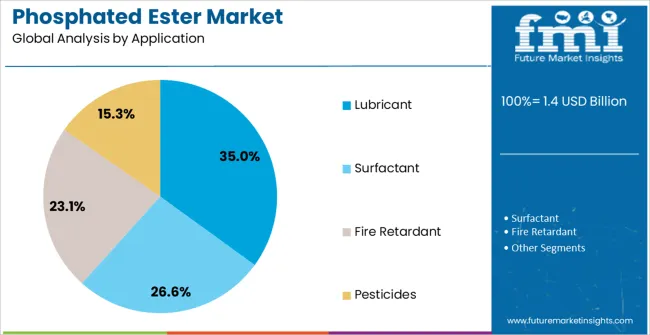
The lubricant application segment is anticipated to hold 35.0% of the Phosphated Ester market revenue share in 2025, making it the leading application. The growth of this segment has been influenced by the rising demand for high-performance lubricants that reduce friction, wear, and corrosion in automotive and industrial machinery.
Phosphated esters in lubricants provide enhanced thermal and oxidative stability, ensuring consistent performance under extreme conditions. The adoption of advanced machinery and high-speed equipment has increased the reliance on phosphated esters to maintain efficiency and prolong equipment life.
Furthermore, the growing focus on energy efficiency, operational cost reduction, and sustainability in lubricant formulations has further accelerated the demand for this application The segment’s prominence reflects the critical role of phosphated esters in optimizing lubricant performance and supporting industrial and automotive operational needs.
Market Overview
Phosphated Ester Market Overview 2025 - 2035
The global phosphated ester market witnessed significant growth over the last few years and is forecast to register a robust CAGR of around 6.7% between 2025 and 2035. Rising demand for phosphated esters from diverse end-use industries such as automotive, plastics and agrochemicals is the major force driving the global phosphate ester market.
Phosphated esters are group of organophosphate compounds generally manufactured from the reaction between alcohol and phosphoric acid. They act as active anionic surfactants and are being used for multitude of applications on account of their stability over a broad pH range, better solubility and corrosion inhibiting properties.
Growing adoption of phosphated esters as lubricants, fire retardants, surfactants and pesticides is providing a major impetus to the growth of phosphated ester market.
Phosphated esters are among the most commonly utilized fire resistant basestocks in several applications including hydraulic systems, compressors and turbines. Owing to their high ignition temperatures, anti-wear property and excellent oxidation stability, they are being increasingly added to consumer and industrial products where they reduce flammability.
Factors such as increasing sales of automotive, growing focus towards safety and rising demand for agrochemicals will continue to generate growth opportunities for the phosphated ester manufacturers during the forecast period.
Analysis of Phosphated Ester Market By Key Countries
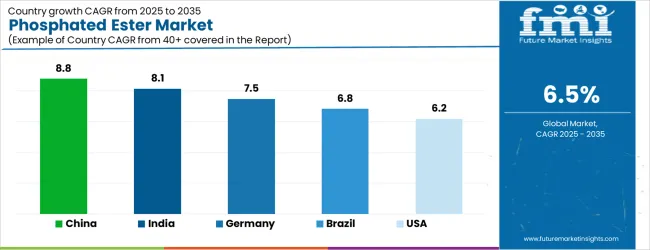
| Country | CAGR |
|---|---|
| China | 8.8% |
| India | 8.1% |
| Germany | 7.5% |
| Brazil | 6.8% |
| USA | 6.2% |
| UK | 5.5% |
| Japan | 4.9% |
Country-wise Analysis
The Phosphated Ester Market is expected to register a CAGR of 6.5% during the forecast period, exhibiting varied country level momentum. China leads with the highest CAGR of 8.8%, followed by India at 8.1%. Developed markets such as Germany, France, and the UK continue to expand steadily, while the USA is likely to grow at consistent rates. Japan posts the lowest CAGR at 4.9%, yet still underscores a broadly positive trajectory for the global Phosphated Ester Market. In 2024, Germany held a dominant revenue in the Western Europe market and is expected to grow with a CAGR of 7.5%. The USA Phosphated Ester Market is estimated to be valued at USD 529.0 million in 2025 and is anticipated to reach a valuation of USD 529.0 million by 2035. Sales are projected to rise at a CAGR of 0.0% over the forecast period between 2025 and 2035. While Japan and South Korea markets are estimated to be valued at USD 72.7 million and USD 48.2 million respectively in 2025.
Key Players in the Phosphated Ester Market
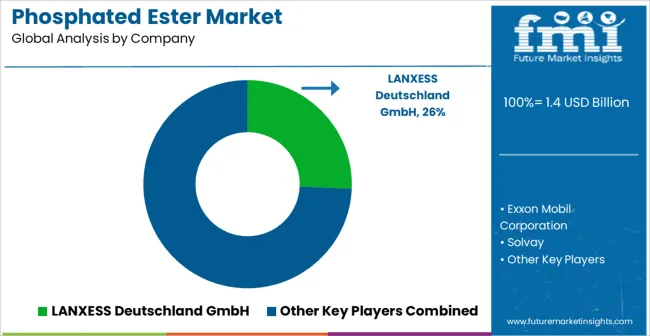
- LANXESS Deutschland GmbH
- Exxon Mobil Corporation
- Solvay
- Eastman Chemical Company
- Dow
- Ashland
- Castrol Limited
- Croda International Plc
Scope of the Report
| Item | Value |
|---|---|
| Quantitative Units | USD 1.4 Billion |
| Source | Synthetic and Natural |
| Types | Alkyl Aryl Phosphated Ester, Trialkyl Phosphated Ester, and Triaryl Phosphated Ester |
| Application | Lubricant, Surfactant, Fire Retardant, and Pesticides |
| End-Use Industry | Automotive, Agrochemicals, Paints & Coatings, Plastic, and Other Industrial |
| Regions Covered | North America, Europe, Asia-Pacific, Latin America, Middle East & Africa |
| Country Covered | United States, Canada, Germany, France, United Kingdom, China, Japan, India, Brazil, South Africa |
| Key Companies Profiled | LANXESS Deutschland GmbH, Exxon Mobil Corporation, Solvay, Eastman Chemical Company, Dow, Ashland, Castrol Limited, and Croda International Plc |
Phosphated Ester Market by Segments
Source:
- Synthetic
- Natural
Types:
- Alkyl Aryl Phosphated Ester
- Trialkyl Phosphated Ester
- Triaryl Phosphated Ester
Application:
- Lubricant
- Surfactant
- Fire Retardant
- Pesticides
End-Use Industry:
- Automotive
- Agrochemicals
- Paints & Coatings
- Plastic
- Other Industrial
Region:
- North America
- USA
- Canada
- Mexico
- Latin America
- Brazil
- Chile
- Rest of Latin America
- Western Europe
- Germany
- UK
- Italy
- Spain
- France
- Nordic
- BENELUX
- Rest of Western Europe
- Eastern Europe
- Russia
- Poland
- Hungary
- Balkan & Baltic
- Rest of Eastern Europe
- East Asia
- China
- Japan
- South Korea
- South Asia and Pacific
- India
- ASEAN
- Australia & New Zealand
- Rest of South Asia and Pacific
- Middle East & Africa
- Kingdom of Saudi Arabia
- Other GCC Countries
- Turkiye
- South Africa
- Other African Union
- Rest of Middle East & Africa
Frequently Asked Questions
How big is the phosphated ester market in 2025?
The global phosphated ester market is estimated to be valued at USD 1.4 billion in 2025.
What will be the size of phosphated ester market in 2035?
The market size for the phosphated ester market is projected to reach USD 2.7 billion by 2035.
How much will be the phosphated ester market growth between 2025 and 2035?
The phosphated ester market is expected to grow at a 6.5% CAGR between 2025 and 2035.
What are the key product types in the phosphated ester market?
The key product types in phosphated ester market are synthetic and natural.
Which types segment to contribute significant share in the phosphated ester market in 2025?
In terms of types, alkyl aryl phosphated ester segment to command 45.0% share in the phosphated ester market in 2025.
Preview the report firsthand - request a free sample
Get SampleGet the brochure for pricing and purchase details.
Get PDFTable of Content
- Executive Summary
- Global Market Outlook
- Demand-side Trends
- Supply-side Trends
- Technology Roadmap Analysis
- Analysis and Recommendations
- Market Overview
- Market Coverage / Taxonomy
- Market Definition / Scope / Limitations
- Market Background
- Market Dynamics
- Drivers
- Restraints
- Opportunity
- Trends
- Scenario Forecast
- Demand in Optimistic Scenario
- Demand in Likely Scenario
- Demand in Conservative Scenario
- Opportunity Map Analysis
- Product Life Cycle Analysis
- Supply Chain Analysis
- Investment Feasibility Matrix
- Value Chain Analysis
- PESTLE and Porter’s Analysis
- Regulatory Landscape
- Regional Parent Market Outlook
- Production and Consumption Statistics
- Import and Export Statistics
- Market Dynamics
- Global Market Analysis 2020 to 2024 and Forecast, 2025 to 2035
- Historical Market Size Value (USD Million) Analysis, 2020 to 2024
- Current and Future Market Size Value (USD Million) Projections, 2025 to 2035
- Y-o-Y Growth Trend Analysis
- Absolute $ Opportunity Analysis
- Global Market Pricing Analysis 2020 to 2024 and Forecast 2025 to 2035
- Global Market Analysis 2020 to 2024 and Forecast 2025 to 2035, By Source
- Introduction / Key Findings
- Historical Market Size Value (USD Million) Analysis By Source , 2020 to 2024
- Current and Future Market Size Value (USD Million) Analysis and Forecast By Source , 2025 to 2035
- Synthetic
- Natural
- Y-o-Y Growth Trend Analysis By Source , 2020 to 2024
- Absolute $ Opportunity Analysis By Source , 2025 to 2035
- Global Market Analysis 2020 to 2024 and Forecast 2025 to 2035, By Types
- Introduction / Key Findings
- Historical Market Size Value (USD Million) Analysis By Types, 2020 to 2024
- Current and Future Market Size Value (USD Million) Analysis and Forecast By Types, 2025 to 2035
- Alkyl Aryl Phosphated Ester
- Trialkyl Phosphated Ester
- Triaryl Phosphated Ester
- Y-o-Y Growth Trend Analysis By Types, 2020 to 2024
- Absolute $ Opportunity Analysis By Types, 2025 to 2035
- Global Market Analysis 2020 to 2024 and Forecast 2025 to 2035, By Application
- Introduction / Key Findings
- Historical Market Size Value (USD Million) Analysis By Application, 2020 to 2024
- Current and Future Market Size Value (USD Million) Analysis and Forecast By Application, 2025 to 2035
- Lubricant
- Surfactant
- Fire Retardant
- Pesticides
- Y-o-Y Growth Trend Analysis By Application, 2020 to 2024
- Absolute $ Opportunity Analysis By Application, 2025 to 2035
- Global Market Analysis 2020 to 2024 and Forecast 2025 to 2035, By End-Use Industry
- Introduction / Key Findings
- Historical Market Size Value (USD Million) Analysis By End-Use Industry, 2020 to 2024
- Current and Future Market Size Value (USD Million) Analysis and Forecast By End-Use Industry, 2025 to 2035
- Automotive
- Agrochemicals
- Paints & Coatings
- Plastic
- Other Industrial
- Y-o-Y Growth Trend Analysis By End-Use Industry, 2020 to 2024
- Absolute $ Opportunity Analysis By End-Use Industry, 2025 to 2035
- Global Market Analysis 2020 to 2024 and Forecast 2025 to 2035, By Region
- Introduction
- Historical Market Size Value (USD Million) Analysis By Region, 2020 to 2024
- Current Market Size Value (USD Million) Analysis and Forecast By Region, 2025 to 2035
- North America
- Latin America
- Western Europe
- Eastern Europe
- East Asia
- South Asia and Pacific
- Middle East & Africa
- Market Attractiveness Analysis By Region
- North America Market Analysis 2020 to 2024 and Forecast 2025 to 2035, By Country
- Historical Market Size Value (USD Million) Trend Analysis By Market Taxonomy, 2020 to 2024
- Market Size Value (USD Million) Forecast By Market Taxonomy, 2025 to 2035
- By Country
- USA
- Canada
- Mexico
- By Source
- By Types
- By Application
- By End-Use Industry
- By Country
- Market Attractiveness Analysis
- By Country
- By Source
- By Types
- By Application
- By End-Use Industry
- Key Takeaways
- Latin America Market Analysis 2020 to 2024 and Forecast 2025 to 2035, By Country
- Historical Market Size Value (USD Million) Trend Analysis By Market Taxonomy, 2020 to 2024
- Market Size Value (USD Million) Forecast By Market Taxonomy, 2025 to 2035
- By Country
- Brazil
- Chile
- Rest of Latin America
- By Source
- By Types
- By Application
- By End-Use Industry
- By Country
- Market Attractiveness Analysis
- By Country
- By Source
- By Types
- By Application
- By End-Use Industry
- Key Takeaways
- Western Europe Market Analysis 2020 to 2024 and Forecast 2025 to 2035, By Country
- Historical Market Size Value (USD Million) Trend Analysis By Market Taxonomy, 2020 to 2024
- Market Size Value (USD Million) Forecast By Market Taxonomy, 2025 to 2035
- By Country
- Germany
- UK
- Italy
- Spain
- France
- Nordic
- BENELUX
- Rest of Western Europe
- By Source
- By Types
- By Application
- By End-Use Industry
- By Country
- Market Attractiveness Analysis
- By Country
- By Source
- By Types
- By Application
- By End-Use Industry
- Key Takeaways
- Eastern Europe Market Analysis 2020 to 2024 and Forecast 2025 to 2035, By Country
- Historical Market Size Value (USD Million) Trend Analysis By Market Taxonomy, 2020 to 2024
- Market Size Value (USD Million) Forecast By Market Taxonomy, 2025 to 2035
- By Country
- Russia
- Poland
- Hungary
- Balkan & Baltic
- Rest of Eastern Europe
- By Source
- By Types
- By Application
- By End-Use Industry
- By Country
- Market Attractiveness Analysis
- By Country
- By Source
- By Types
- By Application
- By End-Use Industry
- Key Takeaways
- East Asia Market Analysis 2020 to 2024 and Forecast 2025 to 2035, By Country
- Historical Market Size Value (USD Million) Trend Analysis By Market Taxonomy, 2020 to 2024
- Market Size Value (USD Million) Forecast By Market Taxonomy, 2025 to 2035
- By Country
- China
- Japan
- South Korea
- By Source
- By Types
- By Application
- By End-Use Industry
- By Country
- Market Attractiveness Analysis
- By Country
- By Source
- By Types
- By Application
- By End-Use Industry
- Key Takeaways
- South Asia and Pacific Market Analysis 2020 to 2024 and Forecast 2025 to 2035, By Country
- Historical Market Size Value (USD Million) Trend Analysis By Market Taxonomy, 2020 to 2024
- Market Size Value (USD Million) Forecast By Market Taxonomy, 2025 to 2035
- By Country
- India
- ASEAN
- Australia & New Zealand
- Rest of South Asia and Pacific
- By Source
- By Types
- By Application
- By End-Use Industry
- By Country
- Market Attractiveness Analysis
- By Country
- By Source
- By Types
- By Application
- By End-Use Industry
- Key Takeaways
- Middle East & Africa Market Analysis 2020 to 2024 and Forecast 2025 to 2035, By Country
- Historical Market Size Value (USD Million) Trend Analysis By Market Taxonomy, 2020 to 2024
- Market Size Value (USD Million) Forecast By Market Taxonomy, 2025 to 2035
- By Country
- Kingdom of Saudi Arabia
- Other GCC Countries
- Turkiye
- South Africa
- Other African Union
- Rest of Middle East & Africa
- By Source
- By Types
- By Application
- By End-Use Industry
- By Country
- Market Attractiveness Analysis
- By Country
- By Source
- By Types
- By Application
- By End-Use Industry
- Key Takeaways
- Key Countries Market Analysis
- USA
- Pricing Analysis
- Market Share Analysis, 2024
- By Source
- By Types
- By Application
- By End-Use Industry
- Canada
- Pricing Analysis
- Market Share Analysis, 2024
- By Source
- By Types
- By Application
- By End-Use Industry
- Mexico
- Pricing Analysis
- Market Share Analysis, 2024
- By Source
- By Types
- By Application
- By End-Use Industry
- Brazil
- Pricing Analysis
- Market Share Analysis, 2024
- By Source
- By Types
- By Application
- By End-Use Industry
- Chile
- Pricing Analysis
- Market Share Analysis, 2024
- By Source
- By Types
- By Application
- By End-Use Industry
- Germany
- Pricing Analysis
- Market Share Analysis, 2024
- By Source
- By Types
- By Application
- By End-Use Industry
- UK
- Pricing Analysis
- Market Share Analysis, 2024
- By Source
- By Types
- By Application
- By End-Use Industry
- Italy
- Pricing Analysis
- Market Share Analysis, 2024
- By Source
- By Types
- By Application
- By End-Use Industry
- Spain
- Pricing Analysis
- Market Share Analysis, 2024
- By Source
- By Types
- By Application
- By End-Use Industry
- France
- Pricing Analysis
- Market Share Analysis, 2024
- By Source
- By Types
- By Application
- By End-Use Industry
- India
- Pricing Analysis
- Market Share Analysis, 2024
- By Source
- By Types
- By Application
- By End-Use Industry
- ASEAN
- Pricing Analysis
- Market Share Analysis, 2024
- By Source
- By Types
- By Application
- By End-Use Industry
- Australia & New Zealand
- Pricing Analysis
- Market Share Analysis, 2024
- By Source
- By Types
- By Application
- By End-Use Industry
- China
- Pricing Analysis
- Market Share Analysis, 2024
- By Source
- By Types
- By Application
- By End-Use Industry
- Japan
- Pricing Analysis
- Market Share Analysis, 2024
- By Source
- By Types
- By Application
- By End-Use Industry
- South Korea
- Pricing Analysis
- Market Share Analysis, 2024
- By Source
- By Types
- By Application
- By End-Use Industry
- Russia
- Pricing Analysis
- Market Share Analysis, 2024
- By Source
- By Types
- By Application
- By End-Use Industry
- Poland
- Pricing Analysis
- Market Share Analysis, 2024
- By Source
- By Types
- By Application
- By End-Use Industry
- Hungary
- Pricing Analysis
- Market Share Analysis, 2024
- By Source
- By Types
- By Application
- By End-Use Industry
- Kingdom of Saudi Arabia
- Pricing Analysis
- Market Share Analysis, 2024
- By Source
- By Types
- By Application
- By End-Use Industry
- Turkiye
- Pricing Analysis
- Market Share Analysis, 2024
- By Source
- By Types
- By Application
- By End-Use Industry
- South Africa
- Pricing Analysis
- Market Share Analysis, 2024
- By Source
- By Types
- By Application
- By End-Use Industry
- USA
- Market Structure Analysis
- Competition Dashboard
- Competition Benchmarking
- Market Share Analysis of Top Players
- By Regional
- By Source
- By Types
- By Application
- By End-Use Industry
- Competition Analysis
- Competition Deep Dive
- LANXESS Deutschland GmbH
- Overview
- Product Portfolio
- Profitability by Market Segments (Product/Age /Sales Channel/Region)
- Sales Footprint
- Strategy Overview
- Marketing Strategy
- Product Strategy
- Channel Strategy
- Exxon Mobil Corporation
- Solvay
- Eastman Chemical Company
- Dow
- Ashland
- Castrol Limited
- Croda International Plc
- LANXESS Deutschland GmbH
- Competition Deep Dive
- Assumptions & Acronyms Used
- Research Methodology


