

- Market Size (2026)
- USD 225.0 Mn
- Forecast (2036)
- USD 523.0 Mn
- CAGR (2026 to 2036)
- 8.8%
How big is the pharmaceutical blister vision verification market in 2026?
USD 225.0 million in 2026 and USD 523.0 million by 2036 at an 8.8% CAGR.
The pharmaceutical blister vision verification industry value is forecast to grow from USD 206.8 million in 2025 to USD 523.0 million by 2036 at 8.8% CAGR as drug makers replace manual blister checks with documented inline inspection. Inline systems are forecast to represent 68.5% share in 2026 because faulty blister packs must be rejected before cartoning and batch release. Tablet blisters are expected to secure 46.8% share in 2026, led by high solid-dose output and wider use of tablet packs across regulated manufacturing lines.
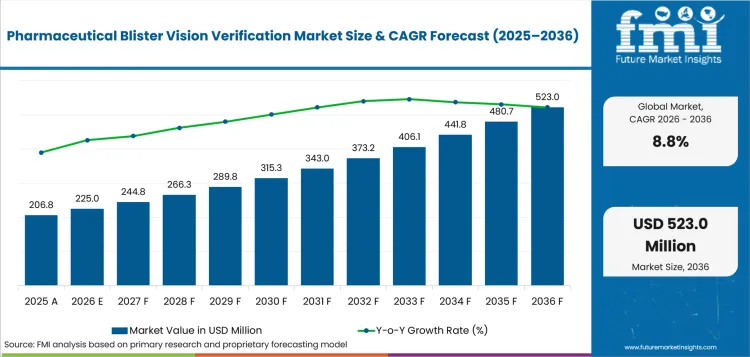
Pharmaceutical Blister Vision Verification Market Overview: Size and Forecast
- 2025 Market Size: USD 206.8 million
- 2026 Market Size: USD 225.0 million
- 2036 Market Size: USD 523.0 million
- Forecast CAGR: 8.8% from 2026 to 2036
- Leading Deployment: Inline
- Inline Share in 2026: 68.5%
- Leading Packaging Format: Tablet Blisters
- Tablet Blisters Share in 2026: 46.8%
- Fastest-growing Country: India
- India CAGR: 10.1% by 2036
Summary of the Pharmaceutical Blister Vision Verification Market
- Demand and Growth Drivers
- Drug manufacturers are shifting from visual sampling toward inline inspection systems that can record reject images and support batch-release decisions.
- Packaging teams are giving more attention to systems that verify tablet presence, cavity cleanliness, foil print quality, and readable code information.
- Automation suppliers are extending pharma inspection portfolios through software-led blister modules and line-integrated reject controls.
- Product and Segment View
- Inline systems are forecast to represent 68.5% share in 2026, led by the need to remove faulty blister packs before cartoning and aggregation.
- Tablet blisters are projected to hold 46.8% share in 2026, influenced by high-volume solid-dose packaging and frequent tablet pack inspection needs.
- High-speed lines are expected to secure 44.6% share in 2026, supported by faster blister output and tighter camera-trigger synchronization.
- Geography and Competitive Outlook
- India is projected to record 10.1% CAGR by 2036, backed by export-oriented pharmaceutical production and stronger packaging verification needs.
- China is expected to expand at 9.4% CAGR by 2036 through high-volume production scale and tighter packaging material quality rules.
- Antares Vision Group and SEA Vision compete through pharma line integration and blister-specific inspection modules.
- Cognex and KEYENCE support modular upgrades where buyers need cameras, lighting, and software without replacing full blister machines.
- Analyst Opinion
- Nandini Roy Choudhury, Principal Consultant at Future Market Insights for the industrial domain, says, “I see this market moving from a camera purchase to a batch-risk decision. Blister pack buyers are not asking only whether a system detects a missing tablet. They are asking whether it can prove the reject event, keep the recipe controlled, and fit into validated packaging records. Pressure is coming from compliance teams that want fewer manual checks and from plant heads that want fewer line stops. Suppliers gain an edge when they combine lighting know-how with simple validation support. Clients should watch integration cost closely. The cheapest camera package can become expensive if it needs too much engineering time or cannot handle low-contrast tablets.”
Packaging quality evidence is becoming a stronger purchase factor as regulators and manufacturers focus on traceable production records. FDA reported 4,619 CDER manufacturing sites globally at the end of FY2024, while FDA-conducted drug quality assurance inspections reached 972 in FY2024. China’s NMPA stated in November 2025 that its revised GMP contains 15 chapters and 132 articles, adding dedicated chapters for quality assurance and validation. Product capability is also improving as Cognex launched the In-Sight 3900 AI vision system in May 2026 for high-speed inspection at the edge without an external PC.
Which factors support expansion in the pharmaceutical blister vision verification market?
Finished inspection-system revenue and validation support services strengthen market value across regulated blister packaging lines.
- Market value is supported by inline blister inspection modules before validation services and software maintenance add incremental sales.
- Supplier pricing reflects camera count, lighting complexity, and line integration before software validation increases total project value.
- Revenue improves as pharmaceutical plants convert manual line clearance checks into documented image-based reject workflows.
- Buyer trust rises as reject images, recipe controls, and audit trails make batch-release decisions easier to defend.
Why is the pharmaceutical blister vision verification market growing?
Drug manufacturers are moving toward blister inspection systems with clearer reject control, product verification, and batch evidence.
Pharmaceutical packaging plants are changing how they treat blister inspection budgets. A camera package now has to protect batch-release speed as much as it protects product quality. FDA’s FY2024 annual inspections report counted 14,689 registered drug establishments, showing the broad regulated base where quality records matter during manufacturing oversight. Buyers are therefore selecting systems that link defect images, product recipes, user permissions, and reject decisions. This raises demand for software-rich inline inspection rather than low-cost camera-only upgrades.
How is the pharmaceutical blister vision verification market segmented?
The pharmaceutical blister vision verification industry is segmented by component, inspection type, deployment, line speed, and packaging format.
- Vision Software is projected to secure 30.8% share in 2026, led by pharmaceutical buyers requiring validated recipes, reject image storage, audit trails, and controlled user permissions.
- Defect Detection is anticipated to hold 34.2% share in 2026 since missing tablets, broken capsules, and contaminated cavities create direct batch rejection exposure.
- Inline systems are expected to capture 68.5% share in 2026 due to the need for real-time rejection before cartoning, aggregation, and batch release.
- High-Speed Lines are forecast to represent 44.6% share in 2026, guided by faster blister output, short reject windows, and tighter image-capture timing.
- Tablet Blisters are projected to account for 46.8% share in 2026, reflected by the high use of tablet packs across oral solid-dose manufacturing.
Why does vision software dominate the pharmaceutical blister vision verification market?
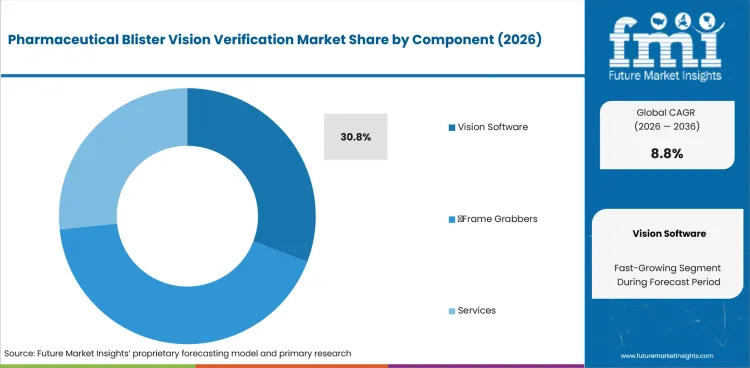
- Vision Software is projected to account for 30.8% component share in 2026, influenced by controlled recipes, defect libraries, reject images, user permissions, and audit-ready inspection records.
- Services gain use as older blister lines need lighting trials, recipe migration, validation scripts, and operator training before routine production approval.
Which inspection type leads the pharmaceutical blister vision verification market?
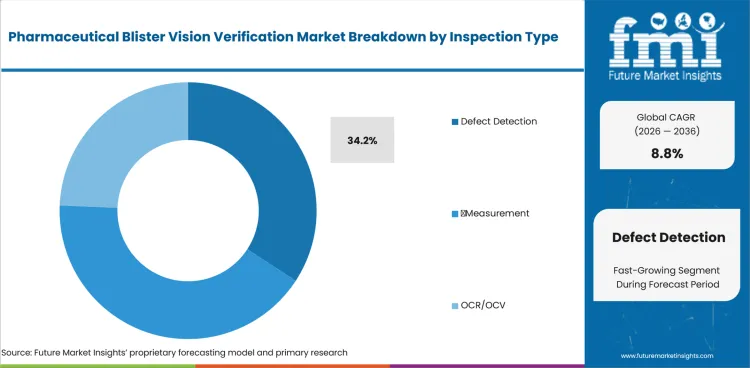
- Defect Detection is anticipated to hold 34.2% inspection type share in 2026 through direct exposure to missing tablets, broken capsules, wrong colors, and cavity contamination.
- OCR/OCV gains value as batch numbers, expiry dates, printed foil characters, and readable product information need verification before downstream packaging checks.
Which deployment leads the pharmaceutical blister vision verification market?
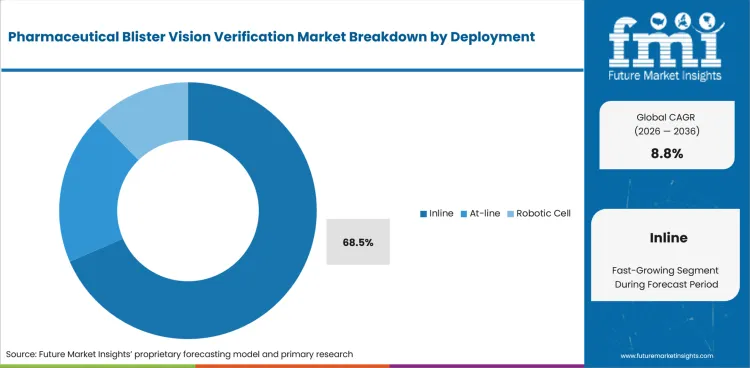
- Inline deployment is forecast to secure 68.5% share in 2026, reflected by the need to stop faulty packs before cartoning and batch release.
- At-line systems gain use for troubleshooting and audit support, although they cannot remove every nonconforming blister pack during active production.
Which line speed leads the pharmaceutical blister vision verification market?
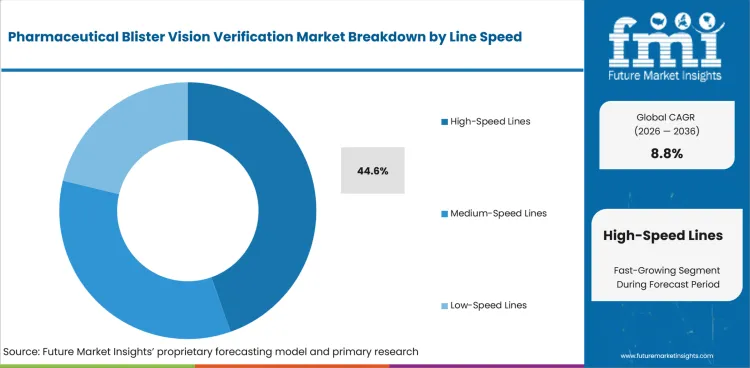
- High-Speed Lines are expected to represent 44.6% share in 2026, shaped by higher output pressure and stronger demand for synchronized image capture.
- Medium-Speed Lines remain important for contract packagers that need flexible inspection recipes across smaller and more frequent batch programs.
Which packaging format leads the pharmaceutical blister vision verification market?
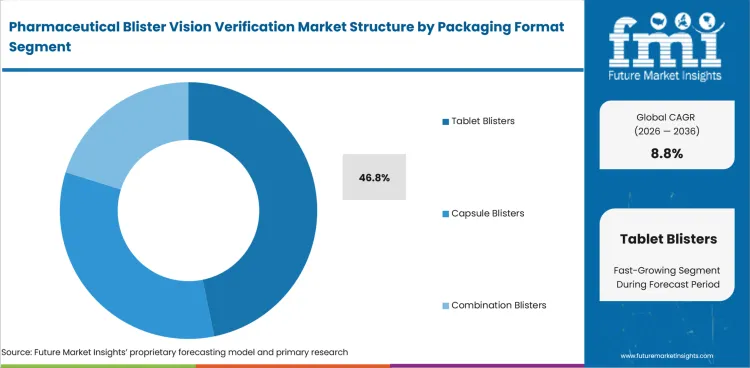
- Tablet Blisters are projected to account for 46.8% share in 2026, led by broad tablet packaging use across generic and branded oral solid-dose production.
- Capsule Blisters create added demand where color, shape, orientation, and cavity presence checks need stronger inspection before cartoning.
What are the drivers, restraints, and opportunities in the pharmaceutical blister vision verification market?
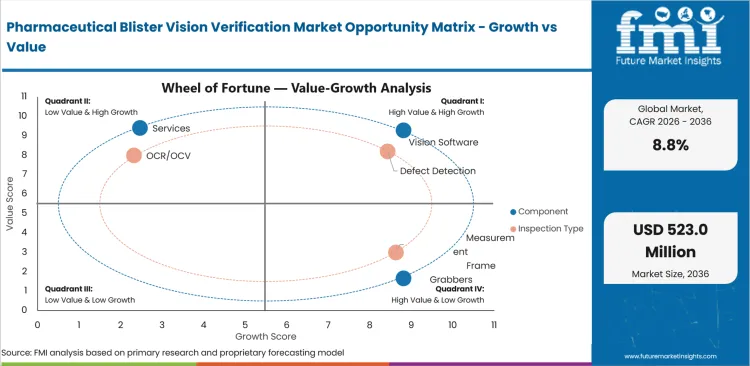
Batch risk and code verification support growth while false rejects and validation cost limit faster adoption.
- Pharmaceutical plants are adopting inline verification because documented reject images help quality teams defend defect detection and batch-release decisions.
- False rejects slow blister lines when lighting cannot handle foil glare or transparent cavities, forcing operators to recheck packs and protect line yield.
- Retrofit packages appeal to plants that need stronger inspection records without replacing complete blister machinery or reopening full packaging-line validation.
Export-Focused Quality Documentation
Export-focused pharmaceutical production is raising demand for inspection systems that prove product identity, cavity completeness, and readable pack data. India’s government reported pharmaceutical exports of USD 30.5 billion in 2024 to 2025, with exports to 191 countries. This exposure makes batch documentation more valuable for blister lines serving regulated destination markets. Vision suppliers can strengthen proposals when they show how reject images, OCR logs, and recipe records reduce inspection pressure for export-focused plants.
False Reject and Validation Pressure
False rejects remain a restraint because difficult blister materials can turn an inspection upgrade into a production bottleneck. FDA’s FY2024 annual inspections report counted 30,120 registered medical device establishments, showing the wider regulated manufacturing environment where technical documentation and inspection stability carry buyer weight. Pharmaceutical buyers hesitate when a system detects defects but cannot prove stable performance during qualification. Vendors must support product trials using real tablet colors, foil surfaces, cavity depths, and line speeds before final acceptance.
Retrofit Inspection Opportunity
Retrofit demand is widening as pharmaceutical manufacturers seek validated inspection upgrades without replacing full blister machinery. The UK Department for Business and Trade reported UK pharmaceutical product exports of £25.6 billion in 2023 and medical technology exports of £10.1 billion, showing a manufacturing base where line upgrades can protect export quality without full equipment renewal. Retrofit suppliers can win by offering compact camera stations, controlled lighting kits, OCR/OCV modules, and validation documents that shorten downtime for existing blister lines.
Which countries are growing fastest in the pharmaceutical blister vision verification market?
India 10.1% CAGR, China 9.4% CAGR, United States 8.9% CAGR, South Korea 8.6% CAGR, Germany 8.5% CAGR, United Kingdom 8.2% CAGR, France 8.0% CAGR, and Japan 7.7% CAGR through 2036.
.webp "Top Country Growth Comparison Pharmaceutical Blister Vision Verification Market Cagr (2026 2036)")
| Country | CAGR |
|---|---|
| United States | 8.9% |
| United Kingdom | 8.2% |
| Germany | 8.5% |
| France | 8.0% |
| Japan | 7.7% |
| China | 9.4% |
| South Korea | 8.6% |
| India | 10.1% |
Source: Future Market Insights, 2026.
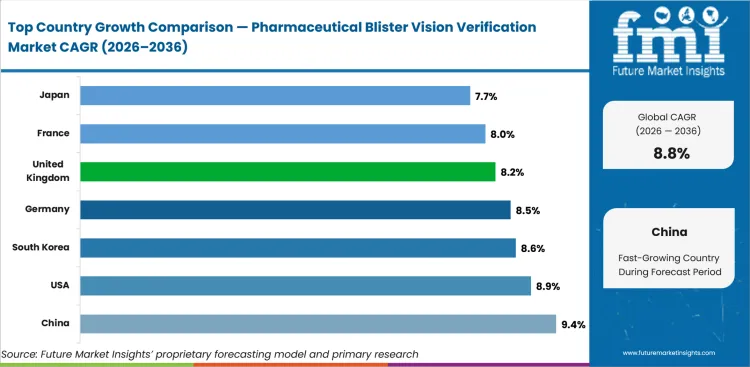
How do country-level CAGRs compare in the pharmaceutical blister vision verification market?
India leads country growth while Japan records the most measured expansion outlook among profiled markets.
- India is forecast to record 10.1% CAGR by 2036 as export-focused pharma plants expand verified packaging checks.
- China is expected to expand at 9.4% CAGR from 2026 to 2036 due to tighter drug packaging material quality rules.
- The United States is projected to grow at 8.9% CAGR through 2036 as FDA-aligned controls shape replacement demand.
- South Korea is estimated to rise at 8.6% CAGR by 2036 with biohealth manufacturing and precision automation supporting upgrades.
- Germany is expected to advance at 8.5% CAGR over the forecast period as packaging machinery strength supports integrated inspection.
- The United Kingdom is forecast to grow at 8.2% CAGR through 2036 as life sciences manufacturing supports modular upgrades.
- France is projected to post 8.0% CAGR by 2036 as mature production sites seek cost-controlled blister inspection retrofits.
- Japan is expected to record 7.7% CAGR through 2036 as reliability-first replacement cycles shape system selection.
How fast is the pharmaceutical blister vision verification market growing in the United States?
A 8.9% CAGR through 2036 reflects FDA-aligned packaging controls and premium retrofit demand across regulated drug plants.
Country Market Snapshot Table
| Parameter | Value |
|---|---|
| Market Size in 2025 (Value) | USD 62.4 million |
| Market Size in 2026 (Value) | USD 68.0 million |
| Market Forecast in 2036 (Value) | USD 159.5 million |
| CAGR (2026 to 2036) | 8.9% |
| Years Considered | 2021 to 2036 |
| Base Year | 2025 |
| Forecast Period | 2026 to 2036 |
| Units Considered | Value (USD million) |
| Leading Sub-Region | Northeast and Midwest pharmaceutical corridors |
United States Pharmaceutical Blister Vision Verification Market Outlook
United States pharmaceutical blister vision verification demand is shaped by audit exposure and packaging control rules. Large drug manufacturers need systems that can prove reject events and maintain controlled inspection recipes.
Retrofit demand is expected to remain steady as older blister lines face higher inspection-documentation expectations. Suppliers with validation-ready software and national service coverage should gain stronger buyer confidence.
Key Growth Drivers
- FDA-aligned quality surveillance supports inspection-system demand. FDA reported 4,619 CDER manufacturing sites globally at the end of FY2024.
- Drug-quality inspection activity creates stronger demand for audit-ready records. FDA-conducted drug quality assurance inspections reached 972 in FY2024.
- Multi-plant pharmaceutical companies prefer repeatable inspection platforms that can be rolled out across United States sites with consistent reject logic and recipe governance.
- High-value branded and specialty drug packaging raises the cost of missed defects, making verified blister inspection more important than basic camera checks.
Key Restraints
- Validation work can extend implementation timelines when inspection software changes batch records, reject handling, or user-permission structures.
- Price sensitivity remains visible in generic drug plants that need inspection upgrades without replacing full blister machinery.
- Compliance workload can strain buyer resources because FDA’s FY2024 inspection report counted 14,689 registered drug establishments.
What makes the United States unique
The United States is unique due to FDA-aligned packaging controls and a large base of regulated drug manufacturers needing validated inspection evidence.
Key Companies
- Cognex Corporation
- KEYENCE Corporation of America
- Antares Vision Group
- OPTEL Group
- Zebra Technologies
- SEA Vision USA
- Mettler-Toledo Product Inspection
Sales & Marketing Channels
- Direct enterprise sales
- Pharmaceutical plant tenders
- Blister line OEM partnerships
- Automation integrator channels
- Validation consultant referrals
- Aftermarket retrofit programs
Country Segment Breakdown Table
| Segment | Sub-Segments |
|---|---|
| By Component | Cameras · Lenses · Lighting · Frame Grabbers · Vision Software · Services |
| By Inspection Type | Defect Detection · Measurement · OCR/OCV · Presence/Absence · Guidance |
| By Deployment | Inline · At-line · Robotic Cell · Portable |
| By Line Speed | Low-Speed Lines · Medium-Speed Lines · High-Speed Lines · Ultra-High-Speed Lines |
| By Packaging Format | Tablet Blisters · Capsule Blisters · Combination Blisters · Unit-Dose Blisters · Clinical Trial Blisters |
| Key Sub-Regions Covered, Pharmaceutical Manufacturing Corridors | Northeast · Midwest · California · Texas · North Carolina · Puerto Rico |
Frequently Asked Questions
How fast is United States pharmaceutical blister vision verification market growing?
Sales in the United States are ready to scale at 8.9% CAGR from 2026 to 2036, guided by FDA-aligned packaging controls.
Who leads the United States pharmaceutical blister vision verification market?
Cognex, KEYENCE, Antares Vision Group, OPTEL, and Zebra compete through machine vision platforms and pharma inspection capability.
What is driving adoption in the United States pharmaceutical blister vision verification market?
FDA inspection exposure and batch-documentation needs are moving pharma plants toward inline blister verification systems.
What is the pharmaceutical blister vision verification market outlook in the United Kingdom?
A 8.2% CAGR through 2036 is supported by life sciences manufacturing, modular retrofit demand, and MHRA-aligned quality expectations.
Country Market Snapshot Table
| Parameter | Value |
|---|---|
| Market Size in 2025 (Value) | USD 16.6 million |
| Market Size in 2026 (Value) | USD 18.0 million |
| Market Forecast in 2036 (Value) | USD 39.6 million |
| CAGR (2026 to 2036) | 8.2% |
| Years Considered | 2021 to 2036 |
| Base Year | 2025 |
| Forecast Period | 2026 to 2036 |
| Units Considered | Value (USD million) |
| Leading Sub-Region | Cambridge, London, and Midlands manufacturing corridors |
United Kingdom Pharmaceutical Blister Vision Verification Market Outlook
United Kingdom demand is practical and service-led. Buyers look for blister verification systems that can be validated without long packaging-line downtime.
The market is shaped by refurbishment of existing blister equipment and flexible contract packaging needs. Suppliers with local integrators and validation partners can reduce adoption friction for mid-sized plants.
Key Growth Drivers
- Life sciences scale supports a steady buyer pool for packaging automation. The UK Office for Life Sciences reported 6,170 UK life sciences businesses in 2023 to 2024.
- Packaging upgrades are supported by a large manufacturing ecosystem. UK life sciences companies generated £146.9 billion in turnover during 2023 to 2024.
- Contract packaging work increases demand for faster recipe changeover and OCR/OCV checks across smaller production runs.
- Regional automation distributors support maintenance access, spare parts, and line-side troubleshooting for blister retrofit programs.
Key Restraints
- Mid-sized buyers can delay upgrades when validation cost exceeds the initial camera hardware budget.
- Imported components can raise spare-part risk for older blister line upgrades when specialized lighting or controller modules are needed.
- Capital approvals can become more cautious because UK pharmaceutical exports declined from £25.6 billion in 2023 to £24.7 billion in 2024.
What makes the United Kingdom unique
The United Kingdom is unique as a service-driven upgrade market where integrator quality often decides supplier selection.
Key Companies
- Cognex UK
- KEYENCE UK
- Zebra Technologies UK
- Antares Vision Group
- SEA Vision
- OPTEL Group
- Industrial Vision Systems Ltd.
Sales & Marketing Channels
- Direct sales to drug manufacturers
- Regional automation distributors
- Contract packaging company tenders
- OEM retrofit packages
- Validation consultant networks
- Pharma engineering service providers
Country Segment Breakdown Table
| Segment | Sub-Segments |
|---|---|
| By Component | Cameras · Lenses · Lighting · Frame Grabbers · Vision Software · Services |
| By Inspection Type | Defect Detection · Measurement · OCR/OCV · Presence/Absence · Guidance |
| By Deployment | Inline · At-line · Robotic Cell · Portable |
| By Line Speed | Low-Speed Lines · Medium-Speed Lines · High-Speed Lines · Ultra-High-Speed Lines |
| By Packaging Format | Tablet Blisters · Capsule Blisters · Combination Blisters · Unit-Dose Blisters · Clinical Trial Blisters |
| Key Sub-Regions Covered, Life Sciences and Contract Packaging Clusters | Cambridge · London · Oxford · Midlands · Manchester · Scotland |
Frequently Asked Questions
How fast is United Kingdom pharmaceutical blister vision verification market growing?
Industry in the United Kingdom is projected to increase at 8.2% CAGR from 2026 to 2036 through regulated packaging upgrades.
Who leads United Kingdom pharmaceutical blister vision verification market?
Cognex, KEYENCE, Zebra, Antares Vision Group, and SEA Vision compete through machine vision and pharma inspection channels.
What is driving adoption in United Kingdom pharmaceutical blister vision verification market?
Life sciences manufacturing and contract packaging needs are moving buyers toward validated blister inspection systems.
What is driving pharmaceutical blister vision verification growth in Germany?
An 8.5% CAGR through 2036 is supported by pharmaceutical output, packaging machinery strength, and specification-led automation buying.
Country Market Snapshot Table
| Parameter | Value |
|---|---|
| Market Size in 2025 (Value) | USD 20.3 million |
| Market Size in 2026 (Value) | USD 22.0 million |
| Market Forecast in 2036 (Value) | USD 49.7 million |
| CAGR (2026 to 2036) | 8.5% |
| Years Considered | 2021 to 2036 |
| Base Year | 2025 |
| Forecast Period | 2026 to 2036 |
| Units Considered | Value (USD million) |
| Leading Sub-Region | Baden-Württemberg and Bavaria pharma machinery corridors |
Germany Pharmaceutical Blister Vision Verification Market Outlook
Germany behaves like an engineering-led market. Pharmaceutical buyers expect inspection systems to fit precise line mechanics and strict documentation practices.
Packaging machinery suppliers influence vendor shortlists because vision modules must fit machine timing and operator workflow. This gives suppliers with OEM relationships a clear advantage.
Key Growth Drivers
- Pharmaceutical industry depth supports integrated inspection demand. Germany Trade & Invest reported EUR 59.8 billion pharmaceutical industry sales in 2023.
- Domestic scale strengthens automation demand. Germany Trade & Invest reported more than 600 pharmaceutical companies operating in the country.
- Domestic packaging machinery strength supports integrated blister verification during new line purchases and high-end retrofit projects.
- OEM relationships make Germany a strong reference market for global blister line standards and validation documentation.
Key Restraints
- Custom engineering raises project cost when standard modules cannot fit legacy blister machines or existing control systems.
- Longer technical approval cycles can delay conversion from pilot trials to full multi-line purchase.
- European investment pressure remains visible as North America accounted for 54.8% of estimated world pharmaceutical sales in 2024.
What makes Germany unique
Germany is unique due to specification-heavy buying and strong machine-builder influence across pharmaceutical packaging lines.
Key Companies
- Uhlmann Pac-Systeme GmbH & Co. KG
- Marchesini Group Germany
- SEA Vision
- Antares Vision Group
- Cognex Germany
- KEYENCE Deutschland
- SICK AG
Sales & Marketing Channels
- Packaging machinery OEM channels
- Direct sales to pharmaceutical plants
- Engineering consultant referrals
- Retrofit service agreements
- Trade fair-led lead generation
- Validation documentation support
Country Segment Breakdown Table
| Segment | Sub-Segments |
|---|---|
| By Component | Cameras · Lenses · Lighting · Frame Grabbers · Vision Software · Services |
| By Inspection Type | Defect Detection · Measurement · OCR/OCV · Presence/Absence · Guidance |
| By Deployment | Inline · At-line · Robotic Cell · Portable |
| By Line Speed | Low-Speed Lines · Medium-Speed Lines · High-Speed Lines · Ultra-High-Speed Lines |
| By Packaging Format | Tablet Blisters · Capsule Blisters · Combination Blisters · Unit-Dose Blisters · Clinical Trial Blisters |
| Key Sub-Regions Covered, Pharma and Machinery Manufacturing Areas | Baden-Württemberg · Bavaria · North Rhine-Westphalia · Hesse · Hamburg · Berlin-Brandenburg |
Frequently Asked Questions
How fast is Germany pharmaceutical blister vision verification market growing?
Demand in Germany is ready to rise at 8.5% CAGR from 2026 to 2036 with packaging machinery integration.
Who leads Germany pharmaceutical blister vision verification market?
Uhlmann, Marchesini Group, SEA Vision, Antares Vision Group, Cognex, KEYENCE, and SICK compete through line integration and machine vision.
What is driving adoption in Germany pharmaceutical blister vision verification market?
Engineering-led procurement and strong blister machinery channels are moving buyers toward integrated vision verification systems.
How is the pharmaceutical blister vision verification market performing in France?
A 8.0% CAGR through 2036 reflects mature pharmaceutical production and cost-controlled inspection upgrades.
Country Market Snapshot Table
| Parameter | Value |
|---|---|
| Market Size in 2025 (Value) | USD 14.8 million |
| Market Size in 2026 (Value) | USD 16.0 million |
| Market Forecast in 2036 (Value) | USD 34.5 million |
| CAGR (2026 to 2036) | 8.0% |
| Years Considered | 2021 to 2036 |
| Base Year | 2025 |
| Forecast Period | 2026 to 2036 |
| Units Considered | Value (USD million) |
| Leading Sub-Region | Île-de-France and Auvergne-Rhône-Alpes pharma corridors |
France Pharmaceutical Blister Vision Verification Market Outlook
France demand is shaped by a balance between quality improvement and capital discipline. Pharmaceutical plants need packaging reliability, but some buyers require clearer payback evidence before ordering premium inspection systems.
Retrofit packages are attractive where existing blister lines need better reject control without full replacement. Vendors that reduce validation work can win where site-level investment approvals are tightly reviewed.
Key Growth Drivers
- Clinical and biopharma activity supports manufacturing attention. EFPIA reported that France remained in third place in Europe for multinational clinical trials conducted domestically.
- Industrial policy supports health production capacity. France 2030 has a budget of EUR 54.0 billion for industrial competitiveness and future technologies.
- Mature drug production supports replacement demand for older blister inspection modules that struggle with low-contrast tablets and foil glare.
- Corporate quality teams push standard inspection records across French manufacturing sites to reduce rework and batch-release uncertainty.
Key Restraints
- Drug pricing pressure can reduce appetite for premium inspection packages when production teams cannot prove short payback.
- Site-level investment approvals can slow adoption when vendors do not provide defect-reduction evidence from product trials.
- European competitiveness pressure remains high because EFPIA estimated EUR 55.0 billion in pharmaceutical R&D investment across Europe in 2024.
What makes France unique
France is unique as a cost-disciplined upgrade market where proof of rework reduction can decide purchases.
Key Companies
- Antares Vision Group
- SEA Vision
- Cognex France
- KEYENCE France
- OPTEL Group
- Marchesini Group
- Schneider Electric automation partners
Sales & Marketing Channels
- Direct sales to pharmaceutical manufacturers
- Local automation integrator networks
- Corporate engineering approved-vendor lists
- OEM retrofit channels
- Validation service partners
- After-sales service contracts
Country Segment Breakdown Table
| Segment | Sub-Segments |
|---|---|
| By Component | Cameras · Lenses · Lighting · Frame Grabbers · Vision Software · Services |
| By Inspection Type | Defect Detection · Measurement · OCR/OCV · Presence/Absence · Guidance |
| By Deployment | Inline · At-line · Robotic Cell · Portable |
| By Line Speed | Low-Speed Lines · Medium-Speed Lines · High-Speed Lines · Ultra-High-Speed Lines |
| By Packaging Format | Tablet Blisters · Capsule Blisters · Combination Blisters · Unit-Dose Blisters · Clinical Trial Blisters |
| Key Sub-Regions Covered, Pharmaceutical Production and Service Corridors | Île-de-France · Auvergne-Rhône-Alpes · Normandy · Centre-Val de Loire · Grand Est · Nouvelle-Aquitaine |
Frequently Asked Questions
How fast is France pharmaceutical blister vision verification market growing?
Demand in France is expected to rise at 8.0% CAGR from 2026 to 2036 as mature plants upgrade inspection records.
Who leads France pharmaceutical blister vision verification market?
Antares Vision Group, SEA Vision, Cognex, KEYENCE, OPTEL, and Marchesini Group compete through inspection and integration portfolios.
What is driving adoption in France pharmaceutical blister vision verification market?
Mature pharmaceutical production and rework reduction needs are moving buyers toward cost-controlled blister inspection upgrades.
What is the pharmaceutical blister vision verification market forecast for Japan?
A 7.7% CAGR through 2036 reflects reliability-led replacement cycles and strict expectations for stable inspection performance.
Country Market Snapshot Table
| Parameter | Value |
|---|---|
| Market Size in 2025 (Value) | USD 13.0 million |
| Market Size in 2026 (Value) | USD 14.0 million |
| Market Forecast in 2036 (Value) | USD 29.4 million |
| CAGR (2026 to 2036) | 7.7% |
| Years Considered | 2021 to 2036 |
| Base Year | 2025 |
| Forecast Period | 2026 to 2036 |
| Units Considered | Value (USD million) |
| Leading Sub-Region | Kanto and Kansai pharmaceutical corridors |
Japan Pharmaceutical Blister Vision Verification Market Outlook
Japan demand favors reliability and repeatable inspection over aggressive speed claims. Pharmaceutical buyers often avoid systems that require frequent operator adjustment.
Suppliers with local service depth gain trust during recipe setup and post-installation support. Demand is concentrated in replacement cycles and hard-to-inspect products.
Key Growth Drivers
- Large pharmaceutical demand supports packaging-line refresh. The U.S. International Trade Administration listed Japan’s pharmaceutical market size at USD 84,042 million in 2024, with total pharmaceutical exports at USD 8,805 million, giving blister inspection suppliers a large regulated production and trade base.
- GMP inspection workload supports demand for stronger inspection records. PMDA reported 2,175 GMP inspections for drug manufacturing sites in FY2024, including 2,049 desk-top inspections and 126 on-site inspections.
- High expectations for product appearance encourage precise defect detection for print, count, color, and product-presence checks.
- Domestic automation suppliers support shorter service response times and more stable recipe tuning for Japanese pharmaceutical plants.
Key Restraints
- Conservative buying behavior can slow conversion from pilot trials to wider rollout when suppliers lack local validation references.
- High expectations for stability make false reject performance a tough acceptance hurdle for blister systems handling similar tablet and cavity colors.
- New-product qualification remains selective and can slow wider inspection-system rollouts. JPMA’s DATA BOOK 2026 reported 83,378 synthesized small-molecule compounds in FY2024 among surveyed companies, but only 3 approvals granted.
What makes Japan unique
Japan is unique due to reliability-first procurement where operator simplicity and stable inspection recipes shape buying decisions.
Key Companies
- KEYENCE Corporation
- Omron Corporation
- Cognex Japan
- SEA Vision
- Antares Vision Group
- SICK Japan
- OPTEL Group
Sales & Marketing Channels
- Direct technical sales teams
- Domestic automation distributors
- Packaging OEM partnerships
- Pharmaceutical plant engineering teams
- Service-led retrofit programs
- Validation support networks
Country Segment Breakdown Table
| Segment | Sub-Segments |
|---|---|
| By Component | Cameras · Lenses · Lighting · Frame Grabbers · Vision Software · Services |
| By Inspection Type | Defect Detection · Measurement · OCR/OCV · Presence/Absence · Guidance |
| By Deployment | Inline · At-line · Robotic Cell · Portable |
| By Line Speed | Low-Speed Lines · Medium-Speed Lines · High-Speed Lines · Ultra-High-Speed Lines |
| By Packaging Format | Tablet Blisters · Capsule Blisters · Combination Blisters · Unit-Dose Blisters · Clinical Trial Blisters |
| Key Sub-Regions Covered, Precision Manufacturing and Pharma Areas | Tokyo · Osaka · Kyoto · Saitama · Kanagawa · Aichi |
Frequently Asked Questions
How fast is Japan pharmaceutical blister vision verification market growing?
Demand in Japan is forecast to grow at 7.7% CAGR from 2026 to 2036 through selective inspection upgrades.
Who leads Japan pharmaceutical blister vision verification market?
KEYENCE, Omron, Cognex, SEA Vision, Antares Vision Group, and SICK compete through precision automation and inspection systems.
What is driving adoption in Japan pharmaceutical blister vision verification market?
Reliability expectations and mature pharmaceutical production are moving buyers toward stable inline blister inspection systems.
How quickly is the pharmaceutical blister vision verification market expanding in China?
A 9.4% CAGR through 2036 reflects packaging quality rules, drug manufacturing scale, and local integration capacity.
Country Market Snapshot Table
| Parameter | Value |
|---|---|
| Market Size in 2025 (Value) | USD 34.7 million |
| Market Size in 2026 (Value) | USD 38.0 million |
| Market Forecast in 2036 (Value) | USD 93.3 million |
| CAGR (2026 to 2036) | 9.4% |
| Years Considered | 2021 to 2036 |
| Base Year | 2025 |
| Forecast Period | 2026 to 2036 |
| Units Considered | Value (USD million) |
| Leading Sub-Region | Yangtze River Delta and Greater Bay Area pharma corridors |
China Pharmaceutical Blister Vision Verification Market Outlook
China demand is driven by production scale and regulatory discipline. Large domestic manufacturers need inspection systems that can support higher line speed without excessive rejects.
Buyers compare global suppliers with local integrators. Winning packages usually combine acceptable price, local service, and strong performance on difficult blister materials.
Key Growth Drivers
- Packaging material quality rules raise documentation needs. NMPA issued the pharmaceutical packaging materials GMP annex in June 2025.
- Revised GMP strengthens validation focus. NMPA stated in November 2025 that the revised GMP includes 15 chapters and 132 articles.
- High-volume generic drug plants need inline systems that can keep pace with faster blister lines and growing product variation.
- Local automation ecosystems support faster retrofit installation, maintenance access, and price-sensitive machine vision upgrades.
Key Restraints
- Price competition can push some buyers toward lower-cost systems with weaker validation support and limited recipe governance.
- Local service capability remains critical because inspection downtime can interrupt high-volume oral solid-dose packaging schedules.
- Export-facing suppliers face added scrutiny as FDA’s FY2024 inspection report counted 6,829 registered establishments in China across foreign regions of interest.
What makes China unique
China is unique due to fast packaging automation growth and tightening pharmaceutical packaging material quality responsibilities.
Key Companies
- Antares Vision Group China
- SEA Vision
- Cognex China
- KEYENCE China
- Hikrobot
- OPTEL Group
- Zebra Technologies
Sales & Marketing Channels
- Local automation integrators
- Direct sales to pharmaceutical groups
- Packaging equipment OEMs
- Regional service partners
- Distributor-led retrofit sales
- Pharma plant engineering tenders
Country Segment Breakdown Table
| Segment | Sub-Segments |
|---|---|
| By Component | Cameras · Lenses · Lighting · Frame Grabbers · Vision Software · Services |
| By Inspection Type | Defect Detection · Measurement · OCR/OCV · Presence/Absence · Guidance |
| By Deployment | Inline · At-line · Robotic Cell · Portable |
| By Line Speed | Low-Speed Lines · Medium-Speed Lines · High-Speed Lines · Ultra-High-Speed Lines |
| By Packaging Format | Tablet Blisters · Capsule Blisters · Combination Blisters · Unit-Dose Blisters · Clinical Trial Blisters |
| Key Sub-Regions Covered, High-Volume Pharma Manufacturing Clusters | Shanghai · Jiangsu · Zhejiang · Guangdong · Shandong · Beijing-Tianjin-Hebei |
Frequently Asked Questions
How fast is China pharmaceutical blister vision verification market growing?
Sales in China are projected to rise at 9.4% CAGR from 2026 to 2036 as packaging quality rules tighten.
Who leads China pharmaceutical blister vision verification market?
Antares Vision Group, SEA Vision, Cognex, KEYENCE, Hikrobot, OPTEL, and Zebra compete through local integration and inspection platforms.
What is driving adoption in China pharmaceutical blister vision verification market?
Packaging material quality rules and large solid-dose manufacturing scale are moving buyers toward inline blister verification.
What is the pharmaceutical blister vision verification market outlook in South Korea?
An 8.6% CAGR through 2036 reflects biohealth manufacturing strength and precision automation adoption.
Country Market Snapshot Table
| Parameter | Value |
|---|---|
| Market Size in 2025 (Value) | USD 8.3 million |
| Market Size in 2026 (Value) | USD 9.0 million |
| Market Forecast in 2036 (Value) | USD 20.5 million |
| CAGR (2026 to 2036) | 8.6% |
| Years Considered | 2021 to 2036 |
| Base Year | 2025 |
| Forecast Period | 2026 to 2036 |
| Units Considered | Value (USD million) |
| Leading Sub-Region | Seoul-Incheon and Chungcheong biohealth corridors |
South Korea Pharmaceutical Blister Vision Verification Market Outlook
South Korea demand is shaped by precision automation and biohealth manufacturing. Buyers value compact systems that can maintain stable performance on high-quality packaging lines.
The market benefits from suppliers that offer technical support and integration with existing plant controls. Adoption is strongest where drug makers need visual inspection records without increasing operator burden.
Key Growth Drivers
- Biohealth export momentum supports inspection-system demand. Korea.net reported biohealth exports reached USD 27.9 billion in 2025, marking record performance for biopharmaceuticals, medical devices, and cosmetics.
- Bio-industry expansion supports automation investment. Invest Korea reported bio-industry production of about KRW 23 trillion in 2024.
- Precision-oriented production encourages buyers to select lighting, software, and reject handling that can reduce manual rechecks.
- Domestic integrator capability supports quicker installation and troubleshooting for camera stations on existing blister lines.
Key Restraints
- Smaller plants may postpone upgrades when validation documents and service packages raise total project cost.
- Limited public country-specific blister inspection revenue data can make supplier benchmarking harder during procurement.
- Quality-management preparation can raise supplier workload. MFDS’s February 2026 English GMP compilation covers 4 medical-device quality management regulation areas.
What makes South Korea unique
South Korea is unique due to biohealth manufacturing strength and precision-led automation preferences.
Key Companies
- Cognex Korea
- KEYENCE Korea
- Omron Korea
- Zebra Technologies Korea
- Antares Vision Group
- SEA Vision
- Local automation integrators
Sales & Marketing Channels
- Direct technical sales
- Domestic automation integrators
- Pharma plant engineering teams
- Packaging OEM partnerships
- Service-led retrofit programs
- Validation support networks
Country Segment Breakdown Table
| Segment | Sub-Segments |
|---|---|
| By Component | Cameras · Lenses · Lighting · Frame Grabbers · Vision Software · Services |
| By Inspection Type | Defect Detection · Measurement · OCR/OCV · Presence/Absence · Guidance |
| By Deployment | Inline · At-line · Robotic Cell · Portable |
| By Line Speed | Low-Speed Lines · Medium-Speed Lines · High-Speed Lines · Ultra-High-Speed Lines |
| By Packaging Format | Tablet Blisters · Capsule Blisters · Combination Blisters · Unit-Dose Blisters · Clinical Trial Blisters |
| Key Sub-Regions Covered, Biohealth and Automation Clusters | Seoul · Incheon · Gyeonggi · Daejeon · Chungcheong · Busan |
Frequently Asked Questions
How fast is South Korea pharmaceutical blister vision verification market growing?
Industry in South Korea is expected to grow at 8.6% CAGR from 2026 to 2036 through precision packaging automation.
Who leads South Korea pharmaceutical blister vision verification market?
Cognex, KEYENCE, Omron, Zebra, Antares Vision Group, SEA Vision, and local integrators compete through inspection and automation channels.
What is driving adoption in South Korea pharmaceutical blister vision verification market?
Biohealth production and quality-system expectations are moving buyers toward documented blister inspection systems.
How fast is India?s pharmaceutical blister vision verification market growing?
A 10.1% CAGR through 2036 reflects export-oriented production and rising automation in regulated generic medicine plants.
Country Market Snapshot Table
| Parameter | Value |
|---|---|
| Market Size in 2025 (Value) | USD 15.4 million |
| Market Size in 2026 (Value) | USD 17.0 million |
| Market Forecast in 2036 (Value) | USD 44.5 million |
| CAGR (2026 to 2036) | 10.1% |
| Years Considered | 2021 to 2036 |
| Base Year | 2025 |
| Forecast Period | 2026 to 2036 |
| Units Considered | Value (USD million) |
| Leading Sub-Region | Hyderabad, Ahmedabad, and Baddi pharma corridors |
India Pharmaceutical Blister Vision Verification Market Outlook
India demand is supported by export-oriented generic medicine production and rising inspection expectations from regulated markets. Plants serving the United States and Europe need stronger proof of product identity, print accuracy, and reject control.
Automation spending is expected to rise where companies upgrade older blister lines without replacing full machinery. Suppliers that offer affordable retrofit packages and local service should gain stronger adoption.
Key Growth Drivers
- Export scale supports automated inspection demand. India’s government reported pharmaceutical exports of USD 30.5 billion in 2024 to 2025.
- Regulated-market exposure raises documentation needs. India exported pharmaceuticals to 191 countries in 2024 to 2025.
- Generic medicine producers need fast recipe changeover and OCR/OCV checks as product portfolios become more complex.
- Domestic integrator networks support affordable retrofit programs for older blister lines across pharmaceutical clusters.
Key Restraints
- Cost sensitivity can slow adoption among smaller manufacturers that prioritize basic cameras over validated inspection packages.
- Validation-resource gaps can extend commissioning timelines when plants add recipe controls and reject-image storage.
- Export-focused suppliers remain under close quality scrutiny because FDA’s FY2024 inspection report counted 1,280 registered establishments in India.
What makes India unique
India is unique due to export-oriented generic production and a strong need for affordable validated retrofit inspection systems.
Key Companies
- Cognex India
- KEYENCE India
- Omron Automation India
- Zebra Technologies India
- Antares Vision Group
- SEA Vision
- Local packaging automation integrators
Sales & Marketing Channels
- Direct sales to pharmaceutical manufacturers
- Automation integrator networks
- Blister line OEM partnerships
- Validation consultant referrals
- Distributor-led retrofit sales
- Export-focused plant tenders
Country Segment Breakdown Table
| Segment | Sub-Segments |
|---|---|
| By Component | Cameras · Lenses · Lighting · Frame Grabbers · Vision Software · Services |
| By Inspection Type | Defect Detection · Measurement · OCR/OCV · Presence/Absence · Guidance |
| By Deployment | Inline · At-line · Robotic Cell · Portable |
| By Line Speed | Low-Speed Lines · Medium-Speed Lines · High-Speed Lines · Ultra-High-Speed Lines |
| By Packaging Format | Tablet Blisters · Capsule Blisters · Combination Blisters · Unit-Dose Blisters · Clinical Trial Blisters |
| Key Sub-Regions Covered, Export-Oriented Pharmaceutical Clusters | Hyderabad · Ahmedabad · Baddi · Mumbai-Pune · Bengaluru · Visakhapatnam |
Frequently Asked Questions
How fast is India?s pharmaceutical blister vision verification market growing?
Sales in India are projected to rise at 10.1% CAGR from 2026 to 2036 as export-focused plants upgrade packaging inspection.
Who leads India pharmaceutical blister vision verification market?
Cognex, KEYENCE, Omron, Zebra, Antares Vision Group, SEA Vision, and local integrators compete through inspection and retrofit channels.
What is driving adoption in India pharmaceutical blister vision verification market?
Regulated-market exports and generic drug production scale are moving manufacturers toward validated blister verification systems.
Who are the leading companies in the pharmaceutical blister vision verification market?
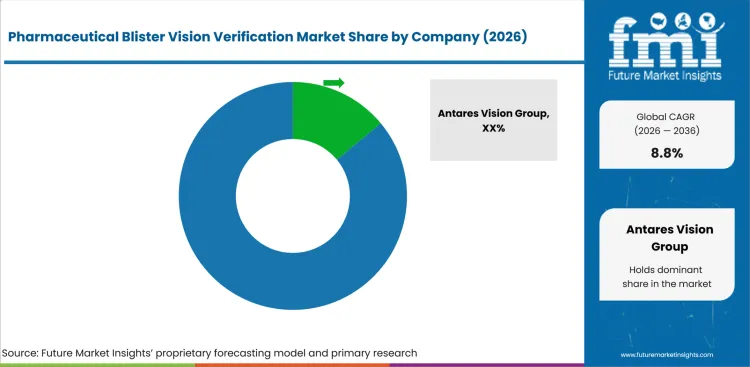
Antares Vision Group, SEA Vision, Cognex, KEYENCE, and Zebra Technologies.
- Pharma inspection specialists hold an advantage through blister-specific software modules and validated line integration experience.
- Machine vision platform suppliers gain share by offering cameras, lighting, AI tools, and edge inspection systems for high-speed packaging lines.
- Packaging machinery suppliers influence system selection when vision modules are integrated during new blister line purchases.
- Retrofit partners gain acceptance when they reduce downtime and support validation documents for older blister equipment.
Inspection suppliers in the market compete by combining defect detection with pharmaceutical validation support. Antares Vision Group and SEA Vision hold relevance through pharma inspection modules and line integration capability. Cognex and KEYENCE compete through camera platforms, software tools, and application support for machine vision users. Zebra Technologies strengthens its automation position through machine vision and 3D inspection capability.
Packaging machinery relationships remain important because blister vision systems must fit feeder timing, reject stations, HMI screens, and cartoning flow. Marchesini Group and Uhlmann influence buyer preferences where inspection is purchased as part of a wider blister packaging line. Vendors with stronger integration support can reduce qualification risk for pharmaceutical buyers. Camera-only vendors face more pressure when buyers require recipes, audit trails, and reject-image storage.
Regional and retrofit players can win through service proximity and shorter commissioning cycles. India and China create faster retrofit demand because export-oriented and high-volume plants need affordable validation-ready upgrades. The United States and Europe reward suppliers that can prove compliance support and reduce false rejects. Japan and South Korea favor suppliers that provide stable inspection performance and local technical response.
How do top pharmaceutical blister vision verification companies compare?
Antares Vision Group and SEA Vision score strongest on blister-line integration while Cognex and KEYENCE lead camera platform relevance.
| Company | Relevance to Market Title | Blister Line Integration | OCR/OCV Software Depth | Validation Support Fit | Channel Reach | Geographic Footprint |
|---|---|---|---|---|---|---|
| Antares Vision Group | Very High | Very Strong | Very Strong | Very Strong | Strong | Global |
| SEA Vision | Very High | Very Strong | Very Strong | Very Strong | Strong | Global |
| Cognex | High | Moderate | Strong | Moderate | Very Strong | Global |
| KEYENCE | High | Moderate | Strong | Moderate | Very Strong | Global |
| Zebra Technologies | High | Moderate | Strong | Moderate | Strong | Global |
| OPTEL Group | High | Strong | Strong | Strong | Moderate | Global |
| Marchesini Group | High | Very Strong | Moderate | Strong | Strong | Global |
| Uhlmann | High | Very Strong | Moderate | Strong | Strong | Global |
| Omron | Moderate to High | Moderate | Moderate | Moderate | Strong | Global |
| SICK | Moderate | Low to Moderate | Moderate | Moderate | Strong | Global |
Source: Future Market Insights competitive analysis, 2026.
Who are the key players in the pharmaceutical blister vision verification market?
Antares Vision Group, SEA Vision, Cognex, KEYENCE, and Zebra Technologies are listed with OPTEL and Marchesini Group among other suppliers.
Key global companies leading the pharmaceutical blister vision verification market include:
- Antares Vision Group
- SEA Vision
- OPTEL Group
- Marchesini Group
- Uhlmann Pac-Systeme
- Cognex Corporation
- KEYENCE Corporation
- Zebra Technologies
- Omron Corporation
- SICK AG
- Basler AG
- Teledyne Technologies
Key Developments in Pharmaceutical Blister Vision Verification Market
- In July 2025, SEA Vision published a pharma blister packaging line case study using Harleblister and Databox on a Marchesini INTEGRA 320 line for blister completeness, tablet correctness, and Alucode verification.
- In March 2025, Zebra Technologies completed the acquisition of Photoneo, expanding its 3D machine vision use cases for industrial automation customers.
- In May 2025, Marchesini Group exhibited pharmaceutical processing and packaging machinery at Pharmintech in Milan, supporting integrated inspection and packaging workflows.
Key Players in the Pharmaceutical Blister Vision Verification Market
Pharma Inspection Specialists
- Antares Vision Group
- SEA Vision
- OPTEL Group
- Marchesini Group
- Uhlmann Pac-Systeme
Machine Vision Platform Suppliers
- Cognex Corporation
- KEYENCE Corporation
- Zebra Technologies
- Omron Corporation
- SICK AG
- Basler AG
- Teledyne Technologies
Regional Integration and Retrofit Partners
- Regional automation integrators
- Packaging line retrofit firms
- Validation service providers
- Blister machinery service partners
Pharmaceutical Blister Vision Verification Market - Report Scope
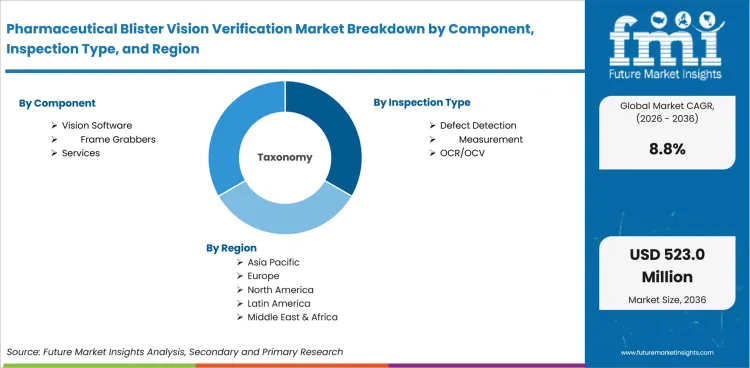
| Parameter | Details |
|---|---|
| Forecast period | 2026 to 2036 |
| Historical period | 2021 to 2025 |
| Quantitative unit | Revenue in USD million |
| By component | Cameras, lenses, lighting, frame grabbers, vision software, services |
| By inspection type | Defect detection, measurement, OCR/OCV, presence/absence, guidance |
| By deployment | Inline, at-line, robotic cell, portable |
| By line speed | Low-speed lines, medium-speed lines, high-speed lines, ultra-high-speed lines |
| By packaging format | Tablet blisters, capsule blisters, combination blisters, unit-dose blisters, clinical trial blisters |
| Regions covered | North America, Latin America, Europe, East Asia, South Asia and Pacific, Middle East and Africa |
| Countries covered | United States, United Kingdom, Germany, France, Japan, China, South Korea, India |
| Key companies profiled | Antares Vision Group, SEA Vision, OPTEL, Marchesini Group, Uhlmann, Cognex, KEYENCE, Zebra Technologies, Omron, SICK, Basler, Teledyne |
| Approach | Hybrid bottom-up and top-down methodology based on blister line activity, inspection system pricing, replacement cycles, country packaging demand, and validation intensity |
Source: Future Market Insights, 2026.
Pharmaceutical Blister Vision Verification Market - Scope & Definition
| Attribute | Detail |
|---|---|
| Market Definition | Machine vision systems used to inspect pharmaceutical blister packs on production lines for product presence, tablet or capsule correctness, print quality, OCR/OCV text, code readability, cavity defects, selected seal flaws, and reject confirmation |
| Functions Covered | Defect detection, product verification, OCR/OCV inspection, measurement, guidance, reject confirmation, audit-trail support, and recipe-controlled inspection |
| Applications Covered | Solid-dose blister lines, tablet blister packs, capsule blister packs, printed foil verification, cavity inspection, foil code checks, and inline reject systems |
| End-Use Industries | Pharmaceuticals |
| Grades Covered | Low-speed, medium-speed, high-speed, and ultra-high-speed blister inspection environments |
| Inclusions | Cameras, lenses, lighting, frame grabbers, vision software, services, defect detection, measurement, OCR/OCV, presence/absence, guidance, inline, at-line, robotic cell, portable, and pharmaceutical blister-line applications |
| Exclusions | Generic machine vision systems for electronics, automotive, food, metals, non-drug consumer blister packs, standalone barcode scanners without blister vision verification, manual visual inspection benches, laboratory microscopy, and secondary carton-only serialization systems |
Pharmaceutical Blister Vision Verification Market - Research Methodology
| Method | Description |
|---|---|
| Primary Research | FMI analysts reviewed inputs from pharmaceutical packaging engineers, automation integrators, blister line OEMs, QA managers, validation consultants, and inspection equipment suppliers across key markets. |
| Desk Research | The study used regulatory references, official pharma manufacturing indicators, company product information, inspection equipment disclosures, and drug packaging rules to define the addressable product pool. |
| Market Sizing & Forecasting | The model combined blister line installations, inspection system pricing, replacement cycles, country-level pharmaceutical packaging activity, inline penetration, OCR/OCV requirements, and validation intensity. |
| Data Validation | Forecasts were checked against pharmaceutical packaging equipment demand, machine vision adoption in regulated factories, inspection system replacement cycles, and company portfolios with direct blister or pharma packaging relevance. |
Pharmaceutical Blister Vision Verification Market Breakdown by Component, Inspection Type, Deployment, Line Speed, Packaging Format, and Region
Pharmaceutical Blister Vision Verification Market Segmented by Component
- Cameras
- Lenses
- Lighting
- Frame Grabbers
- Vision Software
- Services
Pharmaceutical Blister Vision Verification Market Segmented by Inspection Type
- Defect Detection
- Measurement
- OCR/OCV
- Presence/Absence
- Guidance
Pharmaceutical Blister Vision Verification Market Segmented by Deployment
- Inline
- At-line
- Robotic Cell
- Portable
Pharmaceutical Blister Vision Verification Market Segmented by Line Speed
- Low-Speed Lines
- Medium-Speed Lines
- High-Speed Lines
- Ultra-High-Speed Lines
Pharmaceutical Blister Vision Verification Market Segmented by Packaging Format
- Tablet Blisters
- Capsule Blisters
- Combination Blisters
- Unit-Dose Blisters
- Clinical Trial Blisters
Pharmaceutical Blister Vision Verification Market by Region
- North America
- Latin America
- Europe
- East Asia
- South Asia and Pacific
- Middle East and Africa
Research Sources and Bibliography
- Cognex Corporation. (2026, May 5). Cognex launches In-Sight 3900 high-performance AI vision system.
- Electronic Code of Federal Regulations. (2026). 21 CFR Part 211 Subpart G - Packaging and labeling control.
- Electronic Code of Federal Regulations. (2026). 21 CFR Part 11 - Electronic records; electronic signatures.
- European Commission. (2024). Falsified medicines.
- European Federation of Pharmaceutical Industries and Associations. (2025). The pharmaceutical industry in figures 2025.
- European Federation of Pharmaceutical Industries and Associations. (2026). A comparative analysis of biopharmaceutical strategies in 10 countries.
- European Federation of Pharmaceutical Industries and Associations. (2026). Assessing Europe’s competitiveness as a location for the life sciences industry.
- Germany Trade & Invest. (2025). The pharmaceutical industry in Germany.
- GOV.UK. (2025, October 2). Bioscience and health technology sector statistics 2023 to 2024.
- GOV.UK. (2025, July 16). Life sciences sector plan.
- GOV.UK. (2026, March 23). Life sciences competitiveness indicators 2026: Summary.
- Invest Korea. (2026, April 9). Current status of Korea’s pharmaceutical and biotechnology industry competitiveness and industry policy.
- Korea.net. (2026, March 6). Biohealth exports reach record high of USD 27.9 billion in 2025.
- Marchesini Group. (2025, April 17). Marchesini Group at Pharmintech powered by Ipack-Ima.
- Marchesini Group. (2026). Vision systems.
- Ministry of Food and Drug Safety. (2026, February 11). Medical Device Good Manufacturing Practice (GMP) Regulations.
- National Medical Products Administration. (2025, June 11). Announcement on issuing the pharmaceutical excipients annex and pharmaceutical packaging materials annex of the good manufacturing practice for drugs.
- National Medical Products Administration. (2025, November 7). Revision and release of the good manufacturing practice for drugs.
- Pharmaceuticals and Medical Devices Agency. (2025, September 5). FY 2024 GMP/GCTP annual report.
- Press Information Bureau. (2026, March 21). India’s pharmaceuticals in global healthcare.
- SEA Vision. (2025, July 23). Case study: Vision inspection for a pharma blister packaging line.
- U.S. Department of Commerce, International Trade Administration. (2025, November 20). Japan - Pharmaceuticals.
- U.S. Department of Commerce, International Trade Administration. (2026, June 8). Germany healthcare over-the-counter pharmaceuticals.
- U.S. Food and Drug Administration. (2025). FY 2024 annual report on inspections of establishments.
- U.S. Food and Drug Administration. (2025, December 12). Report on the state of pharmaceutical quality.
- U.S. Food and Drug Administration. (2025, November 21). Current good manufacturing practice regulations.
- Zebra Technologies. (2025, March 3). Zebra Technologies completes acquisition of Photoneo.
- International Trade Administration. (2025, November 20). Japan - Pharmaceuticals. U.S. Department of Commerce.
- Japan Pharmaceutical Manufacturers Association. (2026, March 1). DATA BOOK 2026. Japan Pharmaceutical Manufacturers Association.
- Pharmaceuticals and Medical Devices Agency. (2025, September 5). FY 2024 GMP/GCTP annual report. PMDA.
This bibliography is provided for reader reference and is not exhaustive. The full report contains the complete reference list and detailed citations.
This Report Answers
- Market size estimates for 2026 and forecasts through 2036 for the pharmaceutical blister vision verification market.
- Insights across regional and country-level markets for regulated pharmaceutical packaging inspection.
- Analysis of demand drivers, batch-risk controls, quality documentation needs, and inline inspection adoption.
- Evaluation of component demand including cameras, lighting, vision software, frame grabbers, and services.
- Assessment of inspection types including defect detection, measurement, OCR/OCV, presence/absence, and guidance.
- Identification of deployment opportunities across inline, at-line, robotic cell, and portable inspection systems.
- Evaluation of line-speed demand across low-speed, medium-speed, high-speed, and ultra-high-speed blister lines.
- Evaluation of packaging format demand across tablet blisters, capsule blisters, combination blisters, unit-dose blisters, and clinical trial blisters.
- Country-level growth analysis covering the United States, United Kingdom, Germany, France, Japan, China, South Korea, and India.
- Assessment of the competitive landscape including pharma inspection specialists, machine vision suppliers, and integration partners.
- Analysis of regulatory influence from CGMP controls, electronic records, medicine safety features, and packaging material quality rules.
- Review of recent company developments related to blister inspection case studies, packaging machinery showcases, and 3D machine vision acquisitions.
Frequently Asked Questions
What is the growth prospect for pharmaceutical blister vision verification?
Demand for pharmaceutical blister vision verification is expected to rise at a considerable pace as drug makers shift toward documented inline inspection and audit-ready reject records.
Which companies are expected to shape the pharmaceutical blister vision verification market?
Antares Vision Group, SEA Vision, OPTEL, Marchesini Group, Uhlmann, Cognex, KEYENCE, Zebra Technologies, Omron, SICK, Basler, and Teledyne are expected to shape market competition through pharma inspection, machine vision, and integration capabilities.
Why are leading inspection suppliers investing in pharmaceutical blister vision verification?
Leading suppliers are investing in pharmaceutical blister vision verification to support batch-risk control, OCR/OCV checks, defect detection, and validated quality records for regulated packaging lines.
Why is inline inspection important in the pharmaceutical blister vision verification market?
Inline inspection is important because it catches and rejects faulty packs before cartoning, aggregation, and batch release.
Which component segment is expected to lead in 2026?
Vision software is anticipated to lead with 30.8% share in 2026 as buyers need recipes, audit trails, user permissions, and defect libraries.
Which inspection type is expected to lead demand in 2026?
Defect Detection is expected to lead with 34.2% share in 2026 due to missing tablet, broken capsule, and cavity contamination risk.
Which deployment segment is expected to lead in 2026?
Inline systems are predicted to lead with 68.5% share in 2026 because reject control must happen before cartoning and batch release.
Which packaging format is expected to lead in 2026?
Tablet Blisters are projected to lead with 46.8% share in 2026 as oral solid-dose tablet packs remain the largest inspection base.
Which country is expected to grow fastest through 2036?
India is set to grow fastest at 10.1% CAGR through 2036 as export-focused pharma plants expand packaging verification.
What does the Pharmaceutical Blister Vision Verification Market include?
The market includes cameras, lighting, software, services, OCR/OCV checks, defect detection, and inline verification used on pharmaceutical blister lines.
How is the market forecast built?
The forecast combines blister line activity, inspection system pricing, replacement cycles, country demand, and validation intensity across the 2026 to 2036 period.
Preview the report firsthand - request a free sample
Get SampleGet the brochure for pricing and purchase details.
Get PDFTable of Content
- Key Takeaways
- Market Size and CAGR
- Top Growth Driver
- Fastest Growing Segment
- Leading Region
- Key Companies
- Emerging Opportunities
- Executive Summary
- Global Market Outlook
- Demand-side Trends
- Supply-side Trends
- Technology Roadmap Analysis
- Analysis and Recommendations
- Analyst Perspective (What is happening? Why now? What should investors know?)
- Key Questions Answered
- How large is the market?
- What is the CAGR?
- What are key trends?
- Which region dominates?
- Who are the leaders?
- Market Overview
- Market Coverage / Taxonomy
- Market Definition / Scope / Limitations
- Research Methodology
- Chapter Orientation
- Analytical Lens and Working Hypotheses
- Market Structure, Signals, and Trend Drivers
- Benchmarking and Cross-market Comparability
- Market Sizing, Forecasting, and Opportunity Mapping
- Research Design and Evidence Framework
- Desk Research Programme (Secondary Evidence)
- Expert Input and Fieldwork (Primary Evidence)
- Tooling, Models, and Reference Databases
- Data Engineering and Model Build
- Quality Assurance and Audit Trail
- Market Background
- Market Dynamics (Drivers, Restraints, Opportunity, Trends)
- Scenario Forecast (Optimistic, Likely, Conservative)
- Impact Analysis
- AI Impact
- Sustainability Impact
- Regulatory Impact
- Technology Impact
- Consumer / Buyer Analysis
- Purchase Drivers
- Adoption Barriers
- Buyer Journey
- Opportunity Map Analysis
- Product Life Cycle Analysis
- Supply Chain Analysis
- Investment Feasibility Matrix
- Value Chain Analysis
- PESTLE and Porter's Analysis
- Regulatory Landscape
- Regional Parent Market Outlook
- Production and Consumption Statistics
- Import and Export Statistics
- Global Market Analysis and Forecast, 2021 to 2036
- Historical Market Size Value (USD Million) & Volume (Unit) Analysis, 2021 to 2025
- Current and Future Market Size Value (USD Million) & Volume (Unit) Projections, 2026 to 2036
- Y-o-Y Growth Trend Analysis
- Absolute $ Opportunity Analysis
- Global Market Pricing Analysis, 2021 to 2036
- Global Market Analysis and Forecast, By Component, 2021 to 2036
- Introduction / Key Findings
- Historical Market Size Value (USD Million) & Volume (Unit) Analysis By Component, 2021 to 2025
- Current and Future Market Size Value (USD Million) & Volume (Unit) Analysis and Forecast By Component, 2026 to 2036
- Frame Grabbers
- Vision Software
- Services
- Cameras
- Lenses
- Lighting
- Frame Grabbers
- Y-o-Y Growth Trend Analysis By Component, 2021 to 2025
- Absolute $ Opportunity Analysis By Component, 2026 to 2036
- Global Market Analysis and Forecast, By Inspection Type, 2021 to 2036
- Introduction / Key Findings
- Historical Market Size Value (USD Million) & Volume (Unit) Analysis By Inspection Type, 2021 to 2025
- Current and Future Market Size Value (USD Million) & Volume (Unit) Analysis and Forecast By Inspection Type, 2026 to 2036
- Defect Detection
- Measurement
- OCR/OCV
- Presence/Absence
- Guidance
- Defect Detection
- Y-o-Y Growth Trend Analysis By Inspection Type, 2021 to 2025
- Absolute $ Opportunity Analysis By Inspection Type, 2026 to 2036
- Global Market Analysis and Forecast, By Deployment, 2021 to 2036
- Introduction / Key Findings
- Historical Market Size Value (USD Million) & Volume (Unit) Analysis By Deployment, 2021 to 2025
- Current and Future Market Size Value (USD Million) & Volume (Unit) Analysis and Forecast By Deployment, 2026 to 2036
- Inline
- At-line
- Robotic Cell
- Portable
- Inline
- Y-o-Y Growth Trend Analysis By Deployment, 2021 to 2025
- Absolute $ Opportunity Analysis By Deployment, 2026 to 2036
- Global Market Analysis and Forecast, By Line Speed, 2021 to 2036
- Introduction / Key Findings
- Historical Market Size Value (USD Million) & Volume (Unit) Analysis By Line Speed, 2021 to 2025
- Current and Future Market Size Value (USD Million) & Volume (Unit) Analysis and Forecast By Line Speed, 2026 to 2036
- High-Speed Lines
- Low-Speed Lines
- Medium-Speed Lines
- Ultra-High-Speed Lines
- High-Speed Lines
- Y-o-Y Growth Trend Analysis By Line Speed, 2021 to 2025
- Absolute $ Opportunity Analysis By Line Speed, 2026 to 2036
- Global Market Analysis and Forecast, By Packaging Format, 2021 to 2036
- Introduction / Key Findings
- Historical Market Size Value (USD Million) & Volume (Unit) Analysis By Packaging Format, 2021 to 2025
- Current and Future Market Size Value (USD Million) & Volume (Unit) Analysis and Forecast By Packaging Format, 2026 to 2036
- Tablet Blisters
- Capsule Blisters
- Combination Blisters
- Value (USD Million) & Volume (Unit)-Dose Blisters
- Clinical Trial Blisters
- Tablet Blisters
- Y-o-Y Growth Trend Analysis By Packaging Format, 2021 to 2025
- Absolute $ Opportunity Analysis By Packaging Format, 2026 to 2036
- Global Market Analysis and Forecast, By Region, 2021 to 2036
- Introduction
- Historical Market Size Value (USD Million) & Volume (Unit) Analysis By Region, 2021 to 2025
- Current Market Size Value (USD Million) & Volume (Unit) Analysis and Forecast By Region, 2026 to 2036
- North America
- Latin America
- Western Europe
- Eastern Europe
- East Asia
- South Asia and Pacific
- Middle East & Africa
- Market Attractiveness Analysis By Region
- North America Market Analysis and Forecast, By Country, 2021 to 2036
- Historical Market Size Value (USD Million) & Volume (Unit) Trend Analysis By Market Taxonomy, 2021 to 2025
- Market Size Value (USD Million) & Volume (Unit) Forecast By Market Taxonomy, 2026 to 2036
- By Country
- USA
- Canada
- Mexico
- By Component
- By Inspection Type
- By Deployment
- By Line Speed
- By Packaging Format
- By Country
- Market Attractiveness Analysis
- By Country
- By Component
- By Inspection Type
- By Deployment
- By Line Speed
- By Packaging Format
- Key Takeaways
- Latin America Market Analysis and Forecast, By Country
- Historical Market Size Value (USD Million) & Volume (Unit) Trend Analysis By Market Taxonomy, 2021 to 2025
- Market Size Value (USD Million) & Volume (Unit) Forecast By Market Taxonomy, 2026 to 2036
- By Country
- Brazil
- Chile
- Rest of Latin America
- By Component
- By Inspection Type
- By Deployment
- By Line Speed
- By Packaging Format
- By Country
- Market Attractiveness Analysis
- By Country
- By Component
- By Inspection Type
- By Deployment
- By Line Speed
- By Packaging Format
- Key Takeaways
- Western Europe Market Analysis and Forecast, By Country
- Historical Market Size Value (USD Million) & Volume (Unit) Trend Analysis By Market Taxonomy, 2021 to 2025
- Market Size Value (USD Million) & Volume (Unit) Forecast By Market Taxonomy, 2026 to 2036
- By Country
- Germany
- UK
- Italy
- Spain
- France
- Nordic
- BENELUX
- Rest of Western Europe
- By Component
- By Inspection Type
- By Deployment
- By Line Speed
- By Packaging Format
- By Country
- Market Attractiveness Analysis
- By Country
- By Component
- By Inspection Type
- By Deployment
- By Line Speed
- By Packaging Format
- Key Takeaways
- Eastern Europe Market Analysis and Forecast, By Country
- Historical Market Size Value (USD Million) & Volume (Unit) Trend Analysis By Market Taxonomy, 2021 to 2025
- Market Size Value (USD Million) & Volume (Unit) Forecast By Market Taxonomy, 2026 to 2036
- By Country
- Russia
- Poland
- Hungary
- Balkan & Baltic
- Rest of Eastern Europe
- By Component
- By Inspection Type
- By Deployment
- By Line Speed
- By Packaging Format
- By Country
- Market Attractiveness Analysis
- By Country
- By Component
- By Inspection Type
- By Deployment
- By Line Speed
- By Packaging Format
- Key Takeaways
- East Asia Market Analysis and Forecast, By Country
- Historical Market Size Value (USD Million) & Volume (Unit) Trend Analysis By Market Taxonomy, 2021 to 2025
- Market Size Value (USD Million) & Volume (Unit) Forecast By Market Taxonomy, 2026 to 2036
- By Country
- China
- Japan
- South Korea
- By Component
- By Inspection Type
- By Deployment
- By Line Speed
- By Packaging Format
- By Country
- Market Attractiveness Analysis
- By Country
- By Component
- By Inspection Type
- By Deployment
- By Line Speed
- By Packaging Format
- Key Takeaways
- South Asia and Pacific Market Analysis and Forecast, By Country
- Historical Market Size Value (USD Million) & Volume (Unit) Trend Analysis By Market Taxonomy, 2021 to 2025
- Market Size Value (USD Million) & Volume (Unit) Forecast By Market Taxonomy, 2026 to 2036
- By Country
- India
- ASEAN
- Australia & New Zealand
- Rest of South Asia and Pacific
- By Component
- By Inspection Type
- By Deployment
- By Line Speed
- By Packaging Format
- By Country
- Market Attractiveness Analysis
- By Country
- By Component
- By Inspection Type
- By Deployment
- By Line Speed
- By Packaging Format
- Key Takeaways
- Middle East & Africa Market Analysis and Forecast, By Country
- Historical Market Size Value (USD Million) & Volume (Unit) Trend Analysis By Market Taxonomy, 2021 to 2025
- Market Size Value (USD Million) & Volume (Unit) Forecast By Market Taxonomy, 2026 to 2036
- By Country
- Kingdom of Saudi Arabia
- Other GCC Countries
- Türkiye
- South Africa
- Other African Union
- Rest of Middle East & Africa
- By Component
- By Inspection Type
- By Deployment
- By Line Speed
- By Packaging Format
- By Country
- Market Attractiveness Analysis
- By Country
- By Component
- By Inspection Type
- By Deployment
- By Line Speed
- By Packaging Format
- Key Takeaways
- Key Countries Market Analysis
- USA
- Pricing Analysis
- Market Share Analysis, 2025
- By Component
- By Inspection Type
- By Deployment
- By Line Speed
- By Packaging Format
- Canada
- Pricing Analysis
- Market Share Analysis, 2025
- By Component
- By Inspection Type
- By Deployment
- By Line Speed
- By Packaging Format
- Mexico
- Pricing Analysis
- Market Share Analysis, 2025
- By Component
- By Inspection Type
- By Deployment
- By Line Speed
- By Packaging Format
- Brazil
- Pricing Analysis
- Market Share Analysis, 2025
- By Component
- By Inspection Type
- By Deployment
- By Line Speed
- By Packaging Format
- Chile
- Pricing Analysis
- Market Share Analysis, 2025
- By Component
- By Inspection Type
- By Deployment
- By Line Speed
- By Packaging Format
- Germany
- Pricing Analysis
- Market Share Analysis, 2025
- By Component
- By Inspection Type
- By Deployment
- By Line Speed
- By Packaging Format
- UK
- Pricing Analysis
- Market Share Analysis, 2025
- By Component
- By Inspection Type
- By Deployment
- By Line Speed
- By Packaging Format
- Italy
- Pricing Analysis
- Market Share Analysis, 2025
- By Component
- By Inspection Type
- By Deployment
- By Line Speed
- By Packaging Format
- Spain
- Pricing Analysis
- Market Share Analysis, 2025
- By Component
- By Inspection Type
- By Deployment
- By Line Speed
- By Packaging Format
- France
- Pricing Analysis
- Market Share Analysis, 2025
- By Component
- By Inspection Type
- By Deployment
- By Line Speed
- By Packaging Format
- India
- Pricing Analysis
- Market Share Analysis, 2025
- By Component
- By Inspection Type
- By Deployment
- By Line Speed
- By Packaging Format
- ASEAN
- Pricing Analysis
- Market Share Analysis, 2025
- By Component
- By Inspection Type
- By Deployment
- By Line Speed
- By Packaging Format
- Australia & New Zealand
- Pricing Analysis
- Market Share Analysis, 2025
- By Component
- By Inspection Type
- By Deployment
- By Line Speed
- By Packaging Format
- China
- Pricing Analysis
- Market Share Analysis, 2025
- By Component
- By Inspection Type
- By Deployment
- By Line Speed
- By Packaging Format
- Japan
- Pricing Analysis
- Market Share Analysis, 2025
- By Component
- By Inspection Type
- By Deployment
- By Line Speed
- By Packaging Format
- South Korea
- Pricing Analysis
- Market Share Analysis, 2025
- By Component
- By Inspection Type
- By Deployment
- By Line Speed
- By Packaging Format
- Russia
- Pricing Analysis
- Market Share Analysis, 2025
- By Component
- By Inspection Type
- By Deployment
- By Line Speed
- By Packaging Format
- Poland
- Pricing Analysis
- Market Share Analysis, 2025
- By Component
- By Inspection Type
- By Deployment
- By Line Speed
- By Packaging Format
- Hungary
- Pricing Analysis
- Market Share Analysis, 2025
- By Component
- By Inspection Type
- By Deployment
- By Line Speed
- By Packaging Format
- Kingdom of Saudi Arabia
- Pricing Analysis
- Market Share Analysis, 2025
- By Component
- By Inspection Type
- By Deployment
- By Line Speed
- By Packaging Format
- Türkiye
- Pricing Analysis
- Market Share Analysis, 2025
- By Component
- By Inspection Type
- By Deployment
- By Line Speed
- By Packaging Format
- South Africa
- Pricing Analysis
- Market Share Analysis, 2025
- By Component
- By Inspection Type
- By Deployment
- By Line Speed
- By Packaging Format
- USA
- Market Structure Analysis
- Competition Dashboard
- Competition Benchmarking
- Market Share Analysis of Top Players
- By Regional
- By Component
- By Inspection Type
- By Deployment
- By Line Speed
- By Packaging Format
- Emerging Startups
- Innovation Benchmarking
- Competition Analysis
- Competition Deep Dive
- Antares Vision Group
- Overview
- Product Portfolio
- Profitability by Market Segments (Product/Region/Sales Channel)
- Sales Footprint
- Strategy Overview
- Marketing Strategy
- Product Strategy
- Channel Strategy
- SEA Vision
- OPTEL Group
- Marchesini Group
- Uhlmann Pac-Systeme
- Cognex Corporation
- KEYENCE Corporation
- Zebra Technologies
- Omron Corporation
- SICK AG
- Basler AG
- Teledyne Technologies
- Antares Vision Group
- Case Studies
- Success Stories
- Recent Developments
- Competition Deep Dive
- Assumptions & Acronyms Used


