

- Market Size (2026)
- USD 2.4 Bn
- Forecast (2036)
- USD 8.7 Bn
- CAGR (2026 to 2036)
- 13.5%
How big is Phosphatidylcholine Market in 2026?
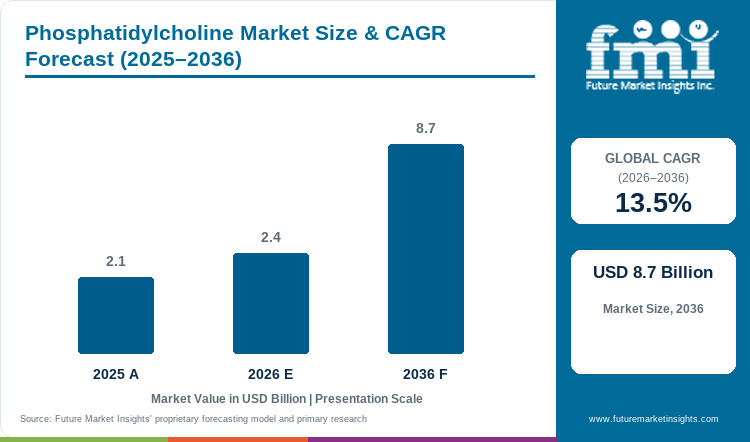
USD 2.4 Billion in 2026 and USD 8.7 Billion by 2036 at a 13.5% CAGR.
Sales of phosphatidylcholine are estimated to grow at a 13.5% CAGR from USD 2.4 Billion in 2026 to USD 8.7 Billion by 2036. The market was valued at USD 2.1 Billion in 2025. Demand is strongest where buyers need a defined phospholipid rather than a generic lipid input. Nutrition companies use phosphatidylcholine as a choline-containing ingredient, while pharmaceutical and formulation teams use it for emulsification, membrane-compatible delivery systems, and high-specification excipient applications.
The commercial mechanism changes by application. Food and supplement buyers often begin with source identity, phosphatidylcholine concentration, and handling format, while pharmaceutical users place more weight on purity and reproducibility. This creates overlap with the broader phospholipid market, but phosphatidylcholine suppliers compete on a narrower molecular specification. Growth therefore depends on the ability to provide consistent PC content, traceable botanical origin, and documentation that fits the finished product and its qualification process.
Key Takeaways
- Phosphatidylcholine demand is supported by its dual role in nutrition and formulation, which makes specification-based selling more important than commodity volume alone.
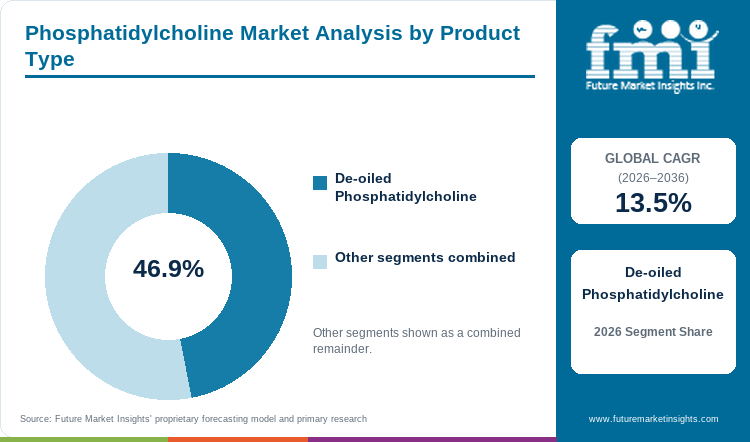
- De-oiled Phosphatidylcholine leads Product Type with a 46.9% share in 2026 because oil removal concentrates phospholipids and supports dry handling.
- Soybean Phosphatidylcholine leads Source with a 50.5% share in 2026, supported by established oilseed processing and a broad ladder of commercial PC grades.
- Powder leads Form with a 49.0% share in 2026 because dry dosing, storage, and incorporation suit supplements, instant mixes, and other batch processes.
- Qualification remains the main purchasing restraint as buyers compare PC content, botanical origin, identity-preserved status, oxidation control, and end-use requirements.
- Key suppliers include Cargill, ADM, Lipoid GmbH, American Lecithin Company, Lasenor Emul S.L., Sonic Biochem Extractions, VAV Life Sciences, and Wilmar International.
Analyst Perspective
Revenue grows when a supplier can match source identity and PC concentration with the quality package required by the intended application. The market rewards usable specifications and dependable formulation support, not phospholipid content alone.
- Nandini Roy Choudhury, Principal Analyst at Future Market Insights
How is the phosphatidylcholine market segmented?
The phosphatidylcholine market is segmented by Product Type, Source, Form, Nature, Purity, and End Use.
Product Type comprises De-oiled Phosphatidylcholine, Fluid Phosphatidylcholine, and Modified Phosphatidylcholine. Source comprises Soybean Phosphatidylcholine, Chemically Modified Phosphatidylcholine, Refined Phosphatidylcholine, Others (corn Phosphatidylcholine, etc.), Sunflower Phosphatidylcholine, Rapeseed Phosphatidylcholine, and Canola Phosphatidylcholine. Form comprises Powder, Liquid, and Wax. Nature comprises Non-GMO and GMO. Purity comprises Phosphatidylcholine 35, 50, 30, 40, 90, 70, and Lyso Lecithin/Phosphatidylcholine 98+. End Use comprises Dietary Supplements & Pharmaceuticals, Cosmetics, Infant & Dietetic Food Products, Ready to Eat Food, Bakery & Confectionery, Other Foods, Animal Feed, and Dairy Products.
Why does De-oiled Phosphatidylcholine lead demand within the Product Type category?
De-oiling removes neutral oil and raises the relative concentration of phospholipids, producing a dry ingredient that is easier to meter and disperse. This supports powder supplements, instant foods, bakery systems, and other applications where liquid oil can complicate handling. Cargill describes de-oiled lecithin as oil-free and enriched in phospholipids, while current industry supply includes powder and granular formats. Demand also benefits from adjacent growth in the fractionated lecithin market, where buyers increasingly specify functional phospholipid composition rather than generic lecithin alone.
- De-oiled Phosphatidylcholine holds 46.9% of Product Type demand in 2026, supported by concentrated phospholipid content and practical dry handling.
- Current supplier portfolios combine de-oiled formats with source-specific and identity-preserved options, giving formulators more control over both functionality and label positioning.
Why does Soybean Phosphatidylcholine lead demand within the Source category?
Soy remains embedded in commercial lecithin processing because phospholipid streams are recovered alongside large-scale vegetable-oil refining and can be standardized into several PC concentrations. Sonic Biochem lists soy phosphatidylcholine grades across multiple concentration levels, while American Lecithin Company supplies soy lecithin and PC-enriched products. This installed processing base gives soybean-derived PC an availability advantage even as sunflower and rapeseed alternatives expand. The same feedstock depth also supports the wider soy lecithin market.
- Soybean Phosphatidylcholine holds 50.5% of Source demand in 2026, reflecting mature oilseed processing and a broad commercial grade range.
- Supplier differentiation increasingly comes from PC concentration, non-GMO identity preservation, and application documentation rather than soy origin alone.
Why does Powder lead demand within the Form category?
Powder reduces handling friction in dry blends and supports accurate dosing without adding a liquid oil phase. De-oiled lecithin is commonly supplied in powder or granular form after neutral oil removal, which makes it practical for supplements, instant mixes, bakery formulations, and other processes that depend on dry incorporation. The format also simplifies storage and transfer where formulators want phospholipid functionality without redesigning liquid-handling steps.
- Powder holds 49.0% of Form demand in 2026 as dry dosing and easier incorporation support batch manufacturing and instantization workflows.
- Powder demand is reinforced by de-oiled and PC-enriched grades that combine higher phospholipid concentration with easier handling.
Why does Non-GMO lead demand within the Nature category?
Non-GMO sourcing converts a label preference into a procurement requirement when customers sell into source-sensitive nutrition and food channels. Identity-preserved programs depend on segregation, dedicated handling, traceability, and documentation. Sunflower-based phospholipid systems create another route for buyers that want non-soy positioning. This makes nature status commercially relevant because the claim must survive the complete supply chain, not just the raw-material purchase.
- Non-GMO holds 69.6% of Nature demand in 2026 as source traceability and identity preservation remain important in nutrition and clean-label applications.
- In March 2025, Lipoid GmbH launched a sunflower-based pre-formulated liposome system positioned for clean-label supplement development, reinforcing demand for non-GMO phospholipid options.
Why does Phosphatidylcholine 35 lead demand within the Purity category?
Phosphatidylcholine 35 sits between commodity lecithin and very high-purity specialty phospholipids. It gives formulators a defined PC specification while avoiding the purification intensity required for 70%, 90%, or near-pure grades. This position is useful in mainstream nutrition and functional formulation where reproducibility matters but the application does not need a highly purified pharmaceutical excipient. Suppliers can therefore compete on a balance of specification, cost, and application performance.
- Phosphatidylcholine 35 holds 21.9% of Purity demand in 2026 because it provides a defined PC level suitable for mainstream nutrition and formulation requirements.
- Sonic Biochem continued presenting soy- and sunflower-derived lecithins and phosphatidylcholine at SupplySide West 2025, keeping defined PC grades visible to nutrition buyers.
Why do Dietary Supplements & Pharmaceuticals lead demand within the End Use category?
This end-use group captures two high-value purchasing roles. Supplement companies use phosphatidylcholine as a choline-containing ingredient, while pharmaceutical developers use defined phospholipids as excipients and delivery-system components. VAV Life Sciences currently lists synthetic phosphatidylcholines such as DMPC, DPPC, and DSPC for pharmaceutical delivery applications. Lipoid supplies natural and synthetic phospholipid systems for health and pharmaceutical uses. These applications connect PC demand with the expanding liposomes market, where membrane-forming lipids are selected for delivery performance as well as ingredient identity.
- Dietary Supplements & Pharmaceuticals hold 45.6% of End Use demand in 2026 because phosphatidylcholine can serve as both a nutritional ingredient and a formulation excipient.
- In 2025 and 2026, VAV Life Sciences continued to present phospholipid and lipid-delivery capabilities through industry events and current product releases, supporting its pharmaceutical and nutrition positioning.
What are the drivers, restraints and opportunities in the Phosphatidylcholine Market?
Nutrition and formulation demand support growth, qualification requirements restrain supplier switching, and source-diverse or high-purity systems create room for differentiated supply.
- Driver: Choline-related nutrition demand and phospholipid functionality support PC use across supplements, pharmaceuticals, and formulated foods.
- Restraint: Botanical origin, PC concentration, identity-preservation, oxidation control, and end-use compliance requirements increase qualification cost and slow switching.
- Opportunity: Sunflower-based non-GMO grades and defined high-purity PC systems can serve source-sensitive nutrition and controlled delivery applications.
The driver is specification-led demand across more than one application channel. Supplement brands can buy PC-containing ingredients, pharmaceutical formulators can use defined phospholipid excipients, and food processors can obtain emulsification from PC-rich lecithin. This broadens the commercial role of PC beyond a single end market. Suppliers gain when one production platform can serve different customers without weakening compositional control or documentation quality.
The restraint appears during qualification. A technically suitable grade can still face delays if the customer must repeat analytical, stability, labeling, or change-control work. Non-GMO programs add traceability requirements, while higher-purity grades need tighter compositional control. These costs make established suppliers harder to displace and reduce the value of a small purchase-price advantage.
The opportunity is to move value away from generic lecithin and toward defined PC systems. Sunflower-based products address buyers seeking source diversification, while synthetic and high-purity phosphatidylcholines support delivery applications that demand tighter molecular control. This creates overlap with the lecithin market, but PC suppliers can capture a premium when they provide a measurable composition, application support, and a dependable qualification package.
Which country CAGRs are profiled in the Phosphatidylcholine Market?
| Country | CAGR |
|---|---|
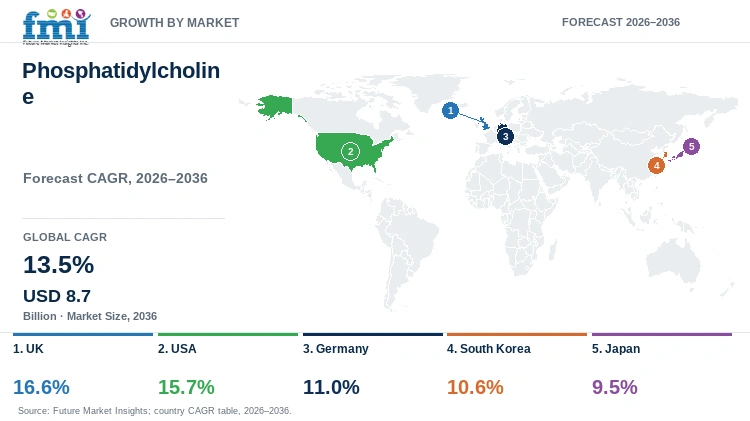
| UK | 16.6% |
| USA | 15.7% |
| Germany | 11.0% |
| South Korea | 10.6% |
| Japan | 9.5% |
How do country-level CAGRs compare in the Phosphatidylcholine Market?
The profiled rates form three practical bands. The UK and USA are above 15%, Germany and South Korea are near 10% to 11%, and Japan is at 9.5%. The 7.1 percentage-point spread shows different growth speeds across the five markets, while purchasing conditions remain shaped by regulatory treatment, domestic supply, import documentation, and the maturity of nutrition and pharmaceutical channels.
- The UK has the fastest profiled growth rate at 16.6% CAGR from 2026 to 2036. Current Food Standards Agency materials list lecithins as E322, giving formulators a clear additive identity while retaining application-specific requirements. Suppliers that can support source, PC content, and intended-use documentation are better positioned to convert formulation interest into repeat purchasing.
- The USA is profiled at 15.7% CAGR. The market combines nutrition demand with food and pharmaceutical formulation uses, which gives PC suppliers several buyer groups. Commercial success still depends on a grade-specific case built around concentration, botanical source, quality control, and manufacturing consistency.
- Germany is profiled at 11.0% CAGR and combines a mature supplier base with demanding qualification standards. Domestic phospholipid and lecithin production supports availability, while customers continue to differentiate by source, concentration, process history, and end-use documentation. Technical service and reproducibility therefore remain important competitive factors.
- South Korea is profiled at 10.6% CAGR. Current import records for lecithin additives show the importance of product-level documentation for imported ingredients. Suppliers need clear origin, additive-category, and application information when serving food, nutrition, or other regulated formulation channels.
- Japan is profiled at 9.5% CAGR. The market rewards precise ingredient specifications and documented fit with the intended food, nutrition, cosmetic, or pharmaceutical use. Source diversification can create opportunities, but switching still depends on composition, consistency, and buyer qualification rather than source novelty alone.
Who are the notable companies in the Phosphatidylcholine Market?
Cargill, ADM, Lipoid GmbH, American Lecithin Company, Lasenor Emul S.L., Sonic Biochem Extractions, VAV Life Sciences, and Wilmar International are notable companies in the phosphatidylcholine market.
Competition spans integrated oilseed ingredient groups, specialist phospholipid suppliers, and focused lecithin processors. Cargill and ADM connect lecithin supply with large food-ingredient and oilseed platforms. Lipoid GmbH, American Lecithin Company, and VAV Life Sciences place greater emphasis on defined phospholipid or PC grades. Lasenor Emul S.L. and Sonic Biochem Extractions compete through source-diverse lecithin and higher-value phospholipid formats, while Wilmar International participates through its broader processing network.
- Integrated ingredient platforms: Cargill, ADM, and Wilmar International.
- Specialist phospholipid and PC suppliers: Lipoid GmbH, American Lecithin Company, and VAV Life Sciences.
- Lecithin specialists with defined phospholipid offerings: Lasenor Emul S.L. and Sonic Biochem Extractions.
Competitive Benchmarking: Phosphatidylcholine Market
| Company | Source Diversification | PC Grade Specificity | Application Breadth | Geographic Reach |
|---|---|---|---|---|
| Cargill | High | High | High | North America, Europe, and broader global operations |
| ADM | High | Unscored | High | Global ingredient network |
| Lipoid GmbH | High | High | High | Germany production with international distribution |
| American Lecithin Company | High | High | High | United States with international group distribution |
| Lasenor Emul S.L. | High | Medium | High | Europe, Asia, Americas, and South Africa |
| Sonic Biochem Extractions | Medium | High | High | India manufacturing with exports to more than 55 countries |
| VAV Life Sciences | High | High | High | India production with international pharmaceutical and nutrition reach |
| Wilmar International | Medium | Unscored | Medium | Asia-centered processing network with international operations |
Scoring basis: Source Diversification is High when three or more relevant botanical or animal sources are documented and Medium when one or two are documented. PC Grade Specificity is High for multiple explicit PC concentrations or chemically defined PC grades and Medium for a narrower specified range. Application Breadth is High when the portfolio spans at least three relevant end-use classes and Medium when coverage is narrower. Unscored is used where no rating is assigned for the criterion.
Key Developments in the Phosphatidylcholine Market
- In August 2025, Lipoid GmbH reported that logistics, administration, quality, and production areas at its Cologne site were prepared for planned commissioning, supporting additional specialist phospholipid capacity.
- In March 2025, Lipoid GmbH launched LIPOID Liposome Basic H, a sunflower-based pre-formulated liposome concentrate made with natural phospholipids and positioned for clean-label supplement development.
- In 2025, Sonic Biochem Extractions showcased soy- and sunflower-derived lecithins and phosphatidylcholine at SupplySide West, reinforcing its commercial focus on nutrition-grade phospholipid ingredients.
Key Players in the Phosphatidylcholine Market
Integrated Ingredient Platforms
- Cargill
- ADM
- Wilmar International
Specialist Phospholipid and PC Suppliers
- Lipoid GmbH
- American Lecithin Company
- VAV Life Sciences
Lecithin Specialists with Defined Phospholipid Offerings
- Lasenor Emul S.L.
- Sonic Biochem Extractions
Phosphatidylcholine Market - Report Scope
| Coverage field | Report scope |
|---|---|
| Market breakdown | Product Type; Source; Form; Nature; Purity; End Use |
| Quantitative Units | USD Billion |
| Market Definition | Revenue includes phosphatidylcholine ingredients and PC-enriched phospholipid products sold within the stated segmentation. Finished supplements, foods, pharmaceuticals, cosmetics, adjacent substitutes, and non-PC ingredient revenue are excluded. For bundled delivery systems, only separately attributable phosphatidylcholine ingredient value is included. |
| Regions Covered | North America; Latin America; Western Europe; Eastern Europe; East Asia; South Asia and Pacific; Middle East and Africa |
| Countries Covered | USA; UK; Germany; Japan; South Korea |
| Key Companies Profiled | Cargill; ADM; Lipoid GmbH; American Lecithin Company; Lasenor Emul S.L.; Sonic Biochem Extractions; VAV Life Sciences; Wilmar International |
| Forecast Period | 2026 to 2036 |
| Approach | Primary and secondary research with market triangulation. |
Phosphatidylcholine Market - Research Methodology
| Method | Approach |
|---|---|
| Primary Research | FMI analysts gathered input from manufacturers, distributors, end users, procurement teams, and subject-matter experts. Interviews examined purchasing decisions, product evaluation, adoption barriers, approval requirements, pricing considerations, and expectations for technical or commercial support. |
| Desk Research | Desk research covered government and regulatory publications, trade data, industry associations, technical literature, standards, company filings, product information, and official corporate announcements. |
| Market Sizing and Forecasting | The market model combined the baseline value with historical performance, segment structure, pricing and volume indicators, adoption levels, company participation, and country-level demand conditions. |
| Data Validation | Estimates were checked against multiple indicators, including company activity, industry developments, trade patterns, and findings from primary interviews, while maintaining the defined market boundary. |
Phosphatidylcholine Market by Segments
Phosphatidylcholine Market segmented by Product Type:
- De-oiled Phosphatidylcholine
- Fluid Phosphatidylcholine
- Modified Phosphatidylcholine
Phosphatidylcholine Market segmented by Source:
- Soybean Phosphatidylcholine
- Chemically Modified Phosphatidylcholine
- Refined Phosphatidylcholine
- Others (corn Phosphatidylcholine, etc.)
- Sunflower Phosphatidylcholine
- Rapeseed Phosphatidylcholine
- Canola Phosphatidylcholine
Phosphatidylcholine Market segmented by Form:
- Powder
- Liquid
- Wax
Phosphatidylcholine Market segmented by Nature:
- Non-GMO
- GMO
Phosphatidylcholine Market segmented by Purity:
- Phosphatidylcholine 35
- Phosphatidylcholine 50
- Phosphatidylcholine 30
- Phosphatidylcholine 40
- Phosphatidylcholine 90
- Phosphatidylcholine 70
- Lyso Lecithin/Phosphatidylcholine 98+
Phosphatidylcholine Market segmented by End Use:
- Dietary Supplements & Pharmaceuticals
- Cosmetics
- Infant & Dietetic Food Products
- Ready to Eat Food
- Bakery & Confectionery
- Other Foods (salad dressings, sauces)
- Animal Feed
- Dairy Products
Phosphatidylcholine Market by Region:
- North America
- United States
- Canada
- Latin America
- Brazil
- Mexico
- Argentina
- Chile
- Western Europe
- Germany
- France
- United Kingdom
- Italy
- Spain
- Benelux
- Nordics
- Eastern Europe
- Poland
- Czech Republic
- Romania
- Hungary
- East Asia
- China
- Japan
- South Korea
- South Asia and Pacific
- India
- ASEAN
- Australia and New Zealand
- Middle East and Africa
- GCC Countries
- South Africa
- Türkiye
- Israel
Research Sources and Bibliography
- National Institutes of Health, Office of Dietary Supplements. Choline: Fact Sheet for Health Professionals.
- U.S. Food and Drug Administration. Substances Added to Food: Lecithin.
- Food Standards Agency (2026). Approved additives and E numbers.
- Food Standards Agency (2025). Lecithins [All animal species].
- Ministry of Food and Drug Safety, Republic of Korea. Imported food product records for lecithin additives.
- Cargill. Fractionated Deoiled and Fluid Lecithin.
- Cargill. Deoiled Lecithin.
- Cargill Pharmaceutical. Liquid Dosage Forms and Phospholipids.
- Lipoid GmbH (2025). LIPOID Liposome Basic H: Pre-formulated High-quality Liposomes.
- Lipoid GmbH (2025). New milestone reached at the Cologne site: logistics, administration, and production areas ready for planned commissioning in 2026.
- American Lecithin Company. Lecithins and Phospholipids: More Than Just Emulsifiers.
- Lasenor Emul S.L. (2025). Lecithin News Q1 2025.
- Sonic Biochem Extractions (2025). SupplySide West Exhibition 2025.
- VAV Life Sciences (2025-2026). Synthetic Lipids, phosphatidylcholine products, and industry event materials.
- Wilmar International. Food Products: Processing - Soy Lecithin.
This bibliography is provided for reader reference and is not exhaustive. The full report contains the complete reference list and detailed citations.
This Report Answers
- How large is the Phosphatidylcholine Market in 2025 and 2026, and what value is forecast for 2036?
- Which nutrition and formulation pressures are supporting phosphatidylcholine demand?
- Why does De-oiled Phosphatidylcholine lead the Product Type category?
- Why does Soybean Phosphatidylcholine lead the Source category?
- Why do Dietary Supplements & Pharmaceuticals lead End Use?
- How do the profiled country growth rates differ from 2026 to 2036?
- Which companies supply relevant phosphatidylcholine and PC-enriched phospholipid products?
- What should buyers evaluate before purchasing or switching a phosphatidylcholine grade?
Frequently Asked Questions
How big is the Phosphatidylcholine Market in 2026, and what is forecast for 2036?
The market is valued at USD 2.4 Billion in 2026 and is forecast to reach USD 8.7 Billion by 2036. The 2025 market value is USD 2.1 Billion.
What is the CAGR of the Phosphatidylcholine Market from 2026 to 2036?
The market is forecast to grow at a 13.5% CAGR from 2026 to 2036.
Which Product Type leads the Phosphatidylcholine Market?
De-oiled Phosphatidylcholine leads Product Type with a 46.9% share in 2026, supported by concentrated phospholipid content and practical dry handling.
Which Source leads the Phosphatidylcholine Market?
Soybean Phosphatidylcholine leads Source with a 50.5% share in 2026, supported by established oilseed processing and a mature range of commercial PC grades.
Which Form leads the Phosphatidylcholine Market?
Powder leads Form with a 49.0% share in 2026 because dry dosing, storage, and incorporation fit a wide range of formulation workflows.
Which profiled countries have the highest growth rates?
The UK has the highest profiled CAGR at 16.6%, followed by the USA at 15.7% from 2026 to 2036.
Which companies are active in the Phosphatidylcholine Market?
Key suppliers include Cargill, ADM, Lipoid GmbH, American Lecithin Company, Lasenor Emul S.L., Sonic Biochem Extractions, VAV Life Sciences, and Wilmar International.
Preview the report firsthand - request a free sample
Get SampleGet the brochure for pricing and purchase details.
Get PDFTable of Content
- Key Takeaways
- Market Size and CAGR
- Top Growth Driver
- Fastest Growing Segment
- Leading Region
- Key Companies
- Emerging Opportunities
- Executive Summary
- Global Market Outlook
- Demand-side Trends
- Supply-side Trends
- Technology Roadmap Analysis
- Analysis and Recommendations
- Analyst Perspective (What is happening? Why now? What should investors know?)
- Key Questions Answered
- How large is the market?
- What is the CAGR?
- What are key trends?
- Which region dominates?
- Who are the leaders?
- Market Overview
- Market Coverage / Taxonomy
- Market Definition / Scope / Limitations
- Research Methodology
- Chapter Orientation
- Analytical Lens and Working Hypotheses
- Market Structure, Signals, and Trend Drivers
- Benchmarking and Cross-market Comparability
- Market Sizing, Forecasting, and Opportunity Mapping
- Research Design and Evidence Framework
- Desk Research Programme (Secondary Evidence)
- Expert Input and Fieldwork (Primary Evidence)
- Tooling, Models, and Reference Databases
- Data Engineering and Model Build
- Quality Assurance and Audit Trail
- Market Background
- Market Dynamics (Drivers, Restraints, Opportunity, Trends)
- Scenario Forecast (Optimistic, Likely, Conservative)
- Impact Analysis
- AI Impact
- Sustainability Impact
- Regulatory Impact
- Technology Impact
- Consumer / Buyer Analysis
- Purchase Drivers
- Adoption Barriers
- Buyer Journey
- Opportunity Map Analysis
- Product Life Cycle Analysis
- Supply Chain Analysis
- Investment Feasibility Matrix
- Value Chain Analysis
- PESTLE and Porter's Analysis
- Regulatory Landscape
- Regional Parent Market Outlook
- Production and Consumption Statistics
- Import and Export Statistics
- Global Market Analysis and Forecast, 2021 to 2036
- Historical Market Size Value (USD Billion) Analysis, 2021 to 2025
- Current and Future Market Size Value (USD Billion) Projections, 2026 to 2036
- Y-o-Y Growth Trend Analysis
- Absolute $ Opportunity Analysis
- Global Market Pricing Analysis, 2021 to 2036
- Global Market Analysis and Forecast, By Source, 2021 to 2036
- Introduction / Key Findings
- Historical Market Size Value (USD Billion) Analysis By Source, 2021 to 2025
- Current and Future Market Size Value (USD Billion) Analysis and Forecast By Source, 2026 to 2036
- Soybean Phosphatidylcholine
- Chemically Modified Phosphatidylcholine
- Refined Phosphatidylcholine
- Others (corn Phosphatidylcholine, etc.)
- Sunflower Phosphatidylcholine
- Rapeseed Phosphatidylcholine
- Canola Phosphatidylcholine
- Soybean Phosphatidylcholine
- Y-o-Y Growth Trend Analysis By Source, 2021 to 2025
- Absolute $ Opportunity Analysis By Source, 2026 to 2036
- Global Market Analysis and Forecast, By Form, 2021 to 2036
- Introduction / Key Findings
- Historical Market Size Value (USD Billion) Analysis By Form, 2021 to 2025
- Current and Future Market Size Value (USD Billion) Analysis and Forecast By Form, 2026 to 2036
- Powder
- Liquid
- Wax
- Powder
- Y-o-Y Growth Trend Analysis By Form, 2021 to 2025
- Absolute $ Opportunity Analysis By Form, 2026 to 2036
- Global Market Analysis and Forecast, By Nature, 2021 to 2036
- Introduction / Key Findings
- Historical Market Size Value (USD Billion) Analysis By Nature, 2021 to 2025
- Current and Future Market Size Value (USD Billion) Analysis and Forecast By Nature, 2026 to 2036
- Non-GMO
- GMO
- Non-GMO
- Y-o-Y Growth Trend Analysis By Nature, 2021 to 2025
- Absolute $ Opportunity Analysis By Nature, 2026 to 2036
- Global Market Analysis and Forecast, By End Use, 2021 to 2036
- Introduction / Key Findings
- Historical Market Size Value (USD Billion) Analysis By End Use, 2021 to 2025
- Current and Future Market Size Value (USD Billion) Analysis and Forecast By End Use, 2026 to 2036
- Dietary Supplements & Pharmaceuticals
- Cosmetics
- Infant & Dietetic Food Products
- Ready to Eat Food
- Bakery & Confectionery
- Other Foods
- Salad dressings
- Sauces
- Animal Feed
- Dairy Products
- Dietary Supplements & Pharmaceuticals
- Y-o-Y Growth Trend Analysis By End Use, 2021 to 2025
- Absolute $ Opportunity Analysis By End Use, 2026 to 2036
- Global Market Analysis and Forecast, By Region, 2021 to 2036
- Introduction
- Historical Market Size Value (USD Billion) Analysis By Region, 2021 to 2025
- Current Market Size Value (USD Billion) Analysis and Forecast By Region, 2026 to 2036
- North America
- Latin America
- Western Europe
- Eastern Europe
- East Asia
- South Asia and Pacific
- Middle East & Africa
- Market Attractiveness Analysis By Region
- North America Market Analysis and Forecast, By Country, 2021 to 2036
- Historical Market Size Value (USD Billion) Trend Analysis By Market Taxonomy, 2021 to 2025
- Market Size Value (USD Billion) Forecast By Market Taxonomy, 2026 to 2036
- By Country
- USA
- Canada
- By Source
- By Form
- By Nature
- By End Use
- By Country
- Market Attractiveness Analysis
- By Country
- By Source
- By Form
- By Nature
- By End Use
- Key Takeaways
- Latin America Market Analysis and Forecast, By Country
- Historical Market Size Value (USD Billion) Trend Analysis By Market Taxonomy, 2021 to 2025
- Market Size Value (USD Billion) Forecast By Market Taxonomy, 2026 to 2036
- By Country
- Brazil
- Mexico
- Chile
- Rest of Latin America
- By Source
- By Form
- By Nature
- By End Use
- By Country
- Market Attractiveness Analysis
- By Country
- By Source
- By Form
- By Nature
- By End Use
- Key Takeaways
- Western Europe Market Analysis and Forecast, By Country
- Historical Market Size Value (USD Billion) Trend Analysis By Market Taxonomy, 2021 to 2025
- Market Size Value (USD Billion) Forecast By Market Taxonomy, 2026 to 2036
- By Country
- Germany
- UK
- Italy
- Spain
- France
- Nordic
- BENELUX
- Rest of Western Europe
- By Source
- By Form
- By Nature
- By End Use
- By Country
- Market Attractiveness Analysis
- By Country
- By Source
- By Form
- By Nature
- By End Use
- Key Takeaways
- Eastern Europe Market Analysis and Forecast, By Country
- Historical Market Size Value (USD Billion) Trend Analysis By Market Taxonomy, 2021 to 2025
- Market Size Value (USD Billion) Forecast By Market Taxonomy, 2026 to 2036
- By Country
- Russia
- Poland
- Hungary
- Balkan & Baltic
- Rest of Eastern Europe
- By Source
- By Form
- By Nature
- By End Use
- By Country
- Market Attractiveness Analysis
- By Country
- By Source
- By Form
- By Nature
- By End Use
- Key Takeaways
- East Asia Market Analysis and Forecast, By Country
- Historical Market Size Value (USD Billion) Trend Analysis By Market Taxonomy, 2021 to 2025
- Market Size Value (USD Billion) Forecast By Market Taxonomy, 2026 to 2036
- By Country
- China
- Japan
- South Korea
- By Source
- By Form
- By Nature
- By End Use
- By Country
- Market Attractiveness Analysis
- By Country
- By Source
- By Form
- By Nature
- By End Use
- Key Takeaways
- South Asia and Pacific Market Analysis and Forecast, By Country
- Historical Market Size Value (USD Billion) Trend Analysis By Market Taxonomy, 2021 to 2025
- Market Size Value (USD Billion) Forecast By Market Taxonomy, 2026 to 2036
- By Country
- India
- ASEAN
- Australia & New Zealand
- Rest of South Asia and Pacific
- By Source
- By Form
- By Nature
- By End Use
- By Country
- Market Attractiveness Analysis
- By Country
- By Source
- By Form
- By Nature
- By End Use
- Key Takeaways
- Middle East & Africa Market Analysis and Forecast, By Country
- Historical Market Size Value (USD Billion) Trend Analysis By Market Taxonomy, 2021 to 2025
- Market Size Value (USD Billion) Forecast By Market Taxonomy, 2026 to 2036
- By Country
- Kingdom of Saudi Arabia
- Other GCC Countries
- Türkiye
- South Africa
- Other African Union
- Rest of Middle East & Africa
- By Source
- By Form
- By Nature
- By End Use
- By Country
- Market Attractiveness Analysis
- By Country
- By Source
- By Form
- By Nature
- By End Use
- Key Takeaways
- Key Countries Market Analysis
- USA
- Pricing Analysis
- Market Share Analysis, 2025
- By Source
- By Form
- By Nature
- By End Use
- Canada
- Pricing Analysis
- Market Share Analysis, 2025
- By Source
- By Form
- By Nature
- By End Use
- Mexico
- Pricing Analysis
- Market Share Analysis, 2025
- By Source
- By Form
- By Nature
- By End Use
- Brazil
- Pricing Analysis
- Market Share Analysis, 2025
- By Source
- By Form
- By Nature
- By End Use
- Chile
- Pricing Analysis
- Market Share Analysis, 2025
- By Source
- By Form
- By Nature
- By End Use
- Germany
- Pricing Analysis
- Market Share Analysis, 2025
- By Source
- By Form
- By Nature
- By End Use
- UK
- Pricing Analysis
- Market Share Analysis, 2025
- By Source
- By Form
- By Nature
- By End Use
- Italy
- Pricing Analysis
- Market Share Analysis, 2025
- By Source
- By Form
- By Nature
- By End Use
- Spain
- Pricing Analysis
- Market Share Analysis, 2025
- By Source
- By Form
- By Nature
- By End Use
- France
- Pricing Analysis
- Market Share Analysis, 2025
- By Source
- By Form
- By Nature
- By End Use
- India
- Pricing Analysis
- Market Share Analysis, 2025
- By Source
- By Form
- By Nature
- By End Use
- ASEAN
- Pricing Analysis
- Market Share Analysis, 2025
- By Source
- By Form
- By Nature
- By End Use
- Australia & New Zealand
- Pricing Analysis
- Market Share Analysis, 2025
- By Source
- By Form
- By Nature
- By End Use
- China
- Pricing Analysis
- Market Share Analysis, 2025
- By Source
- By Form
- By Nature
- By End Use
- Japan
- Pricing Analysis
- Market Share Analysis, 2025
- By Source
- By Form
- By Nature
- By End Use
- South Korea
- Pricing Analysis
- Market Share Analysis, 2025
- By Source
- By Form
- By Nature
- By End Use
- Russia
- Pricing Analysis
- Market Share Analysis, 2025
- By Source
- By Form
- By Nature
- By End Use
- Poland
- Pricing Analysis
- Market Share Analysis, 2025
- By Source
- By Form
- By Nature
- By End Use
- Hungary
- Pricing Analysis
- Market Share Analysis, 2025
- By Source
- By Form
- By Nature
- By End Use
- Kingdom of Saudi Arabia
- Pricing Analysis
- Market Share Analysis, 2025
- By Source
- By Form
- By Nature
- By End Use
- Türkiye
- Pricing Analysis
- Market Share Analysis, 2025
- By Source
- By Form
- By Nature
- By End Use
- South Africa
- Pricing Analysis
- Market Share Analysis, 2025
- By Source
- By Form
- By Nature
- By End Use
- USA
- Market Structure Analysis
- Competition Dashboard
- Competition Benchmarking
- Market Share Analysis of Top Players
- By Regional
- By Source
- By Form
- By Nature
- By End Use
- Emerging Startups
- Innovation Benchmarking
- Competition Analysis
- Competition Deep Dive
- Cargill
- Overview
- Product Portfolio
- Profitability by Market Segments
- Sales Footprint
- Strategy Overview
- Marketing Strategy
- Product Strategy
- Channel Strategy
- ADM
- Lipoid GmbH
- American Lecithin Company
- Sonic Biochem Extractions
- VAV Life Sciences
- Wilmar International
- Cargill
- Case Studies
- Success Stories
- Recent Developments
- Competition Deep Dive
- Assumptions & Acronyms Used


