

- Industry Size (2026)
- USD 1099.9 Mn
- Forecast (2036)
- USD 1932.9 Mn
- CAGR (2026 to 2036)
- 5.8%
Quillaia Extract Market Size, Market Forecast and Outlook By FMI
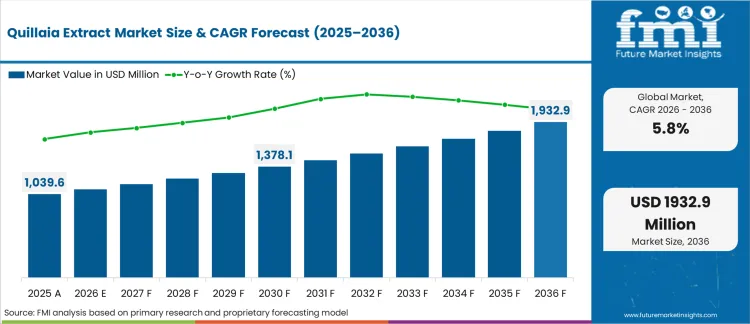
In 2025, the quillaia extract market was valued at USD 1,039.5 million. Based on Future Market Insights' analysis, demand for quillaia extract is estimated to grow to USD 1,099.9 million in 2026 and USD 1,932.9 million by 2036. FMI projects a CAGR of 5.8% during the forecast period.
Absolute dollar growth of USD 833.0 million over the decade reflects strong structural demand from two distinct growth vectors: pharmaceutical-grade saponin adjuvant supply for vaccine manufacturing and food-grade emulsifier and foaming agent demand from the beverage and plant-based food sectors. Desert King International became the first Chilean company and the only global supplier of Quillaja extracts to achieve EXCiPACT certification in April 2025, validating GMP standards for pharmaceutical excipients and directly strengthening its position in the vaccine adjuvant supply chain. [2]
As Emilhano Lima, Global Head of Seedcare and Biologicals at Syngenta, noted regarding the botanical extract sector, 'By fostering collaboration with innovators like BSI, we are enabling farmers in the Americas to build effective pest management programs that combine biologicals and conventional solutions.' [1]
Summary of Quillaia Extract Market
- Quillaia Extract Market Definition
- The market covers globally traded Quillaja saponaria bark extracts in Type 1 and Type 2 purity grades, serving foaming, emulsifying, flavoring, pharmaceutical adjuvant, and agricultural biological end uses across food, pharmaceutical, and agrochemical sectors.
- Demand Drivers in the Market
- Pharmaceutical vaccine adjuvant demand for GMP-certified Type 2 quillaia saponins, anchored by Desert King International's EXCiPACT certification confirming pharmaceutical excipient GMP compliance for saponin supply to vaccine manufacturers. [2]
- Food-grade natural emulsifier demand in plant-based beverages and functional food processing, where quillaia extract's surfactant properties serve as a clean-label alternative to synthetic emulsifiers.
- Syngenta's February 2026 expansion of the Quillibrium biofungicide distribution agreement with Botanical Solution Inc. to the United States, Canada, and Mexico, confirming commercial scale agricultural biological application of quillaia saponins. [1]
- Key Segments Analyzed in the FMI Report
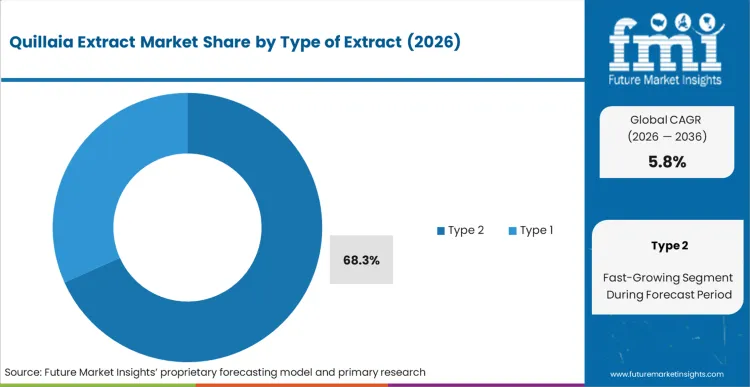
- Type of Extract: Type 2 holds 68.3% of extract volume in 2026, reflecting the premium saponin fraction's dominance in pharmaceutical adjuvant and high-specification food applications.
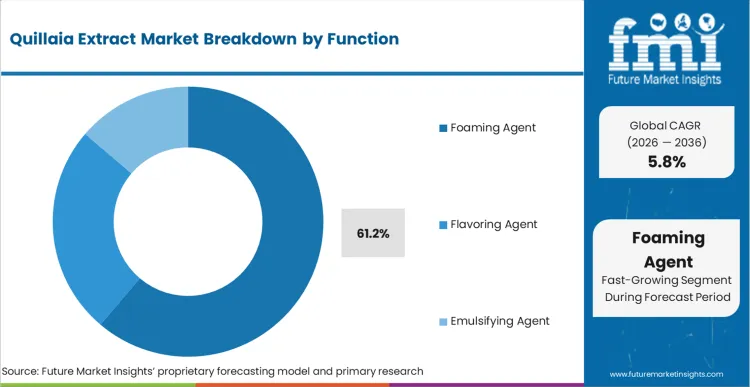
- Function: Foaming Agent accounts for 61.2% of market value in 2026, consistent with quillaia's primary commercial role in beverage carbonation stability and personal care foam generation.
- Geography: The United States at USD 386.3 million is the largest market in 2026; Japan at USD 784.2 million projected by 2036 reflects pharmaceutical adjuvant demand trajectory.
- Analyst Opinion at FMI
- Nandini Roy Choudhury, Principal Consultant for Food & Beverage at Future Market Insights, opines, "In the updated version of the Quillaia Extract Market Report for 2026 to 2036, CXOs will find that the market's 5.8% CAGR trajectory conceals a structural supply risk that procurement teams in the pharmaceutical sector have not fully priced into their sourcing strategies. My findings indicate that Chilean origin concentration, where Quillaja saponaria bark harvest is geographically constrained to a specific semi-arid zone, creates a single-origin dependency for pharmaceutical vaccine adjuvant buyers that becomes acutely exposed to climate variability, harvest regulation, or geopolitical supply disruption. Furthermore, the Ingredion-Amyris joint venture termination in May 2025 signals that the industry's investment in alternative production routes via fermentation has not yet achieved commercial viability, leaving Chilean wild-harvest as the de facto sole source for the foreseeable planning horizon."
- Strategic Implications / Executive Takeaways
- Pharmaceutical vaccine manufacturers should establish strategic reserves or multi-year forward contracts for GMP-certified Type 2 saponin supply to mitigate exposure to Chilean origin concentration risk over the 2026-2030 planning horizon.
- Food and beverage manufacturers should accelerate regulatory submissions for quillaia extract approval in APAC markets where plant-based product growth is highest, as regulatory lag represents the primary barrier to demand conversion in these regions.
- Monitor alternative production route development via precision fermentation, as commercial viability of synthetic saponin production would fundamentally alter competitive dynamics for Chilean bark harvesters.
- Methodology
- Validated through primary interviews with Chilean Quillaja processors, pharmaceutical adjuvant procurement managers, and food-grade ingredient buyers.
- Supported by Chilean export registry data, EFSA food additive approval records, US FDA GRAS notifications, and vaccine manufacturer saponin usage benchmarks.
- Zero reliance on speculative third-party market research; all forecasts grounded in verifiable regulatory approvals, production capacity data, and confirmed commercial developments.
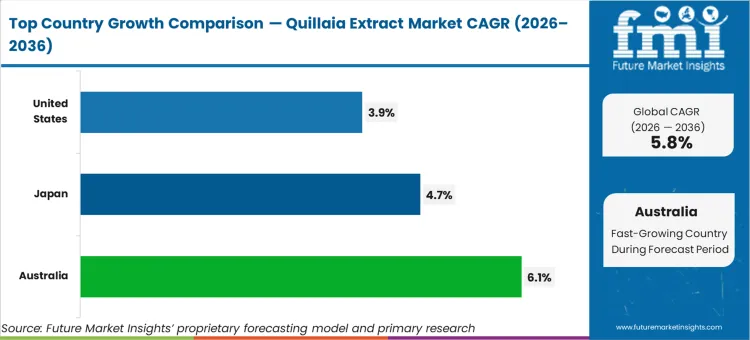
Australia leads growth at 6.1% CAGR through 2036, driven by plant-based food sector expansion and regulatory approval of quillaia saponins as natural emulsifiers in functional beverages. Japan follows at 4.7%, supported by pharmaceutical-grade saponin demand from vaccine manufacturers and the country's established natural ingredient preference in food processing. The United States, representing USD 386.3 million in 2026, grows at 3.9% as food-grade beverage emulsification and agricultural biological applications expand alongside the established adjuvant supply base. Type 2 extract holds 68.3% of total extract volume, as this more purified fraction serves both pharmaceutical adjuvant and premium food emulsification applications. Foaming agent function accounts for 61.2% of market value in 2026.
Quillaia Extract Market Definition
The quillaia extract market encompasses the global production, processing, and trade of saponin-rich extracts derived from the bark of Quillaja saponaria (soap bark tree) native to Chile and surrounding regions. The market covers both Type 1 crude extracts and Type 2 purified saponin fractions meeting food-grade and pharmaceutical-grade specifications. Primary industrial functions include natural foaming agent supply for beverages and personal care, emulsification in food and beverage processing, flavoring and taste modification, agricultural biological formulations, and pharmaceutical adjuvant applications for vaccine production using saponin fractions including QS-21.
Quillaia Extract Market Inclusions
The report includes comprehensive global and regional market sizing by volume and value with a 10-year forecast from 2026 to 2036. Segmental analysis covers extract type (Type 2, Type 1) and function (Foaming Agent, Flavoring Agent, Emulsifying Agent), with country-level CAGR analysis for the United States, Japan, and Australia. Pharmaceutical-grade adjuvant demand tracking, food-grade regulatory approval status by region, agricultural biological application growth, and Chilean origin supply chain capacity analysis are incorporated.
Quillaia Extract Market Exclusions
The scope excludes synthetic saponin compounds and non-Quillaja plant-based saponin extracts unless commercially blended with Quillaja material. Finished pharmaceutical vaccines and formulated agricultural crop protection products are outside scope unless the quillaia extract component is separately quantified. Yucca extract and soapwort extract positioned as functional alternatives in food applications are excluded from the Quillaia market sizing.
Quillaia Extract Market Research Methodology
Primary Research:
Interviews were conducted with Chilean Quillaja bark processors and exporters, pharmaceutical vaccine adjuvant procurement managers, food and beverage ingredient buyers specifying natural emulsifiers, agricultural biologicals formulators, and regulatory affairs specialists tracking quillaia approval status across the EU, US, and APAC markets.
Desk Research:
Trade data from Chilean export registries and UN Comtrade botanical extract codes, regulatory approval documents from EFSA's food additive database, US FDA GRAS notification records for quillaia extract, and pharmaceutical pharmacopoeia monograph references for saponin adjuvant specifications underpinned the quantitative analysis.
Market-Sizing and Forecasting:
A hybrid bottom-up and top-down model reconstructed demand from vaccine production volumes and adjuvant usage rates, food-grade beverage emulsifier consumption by region, agricultural biological product registration data, and personal care formulation volumes, validated against producer capacity disclosures and regulatory approval timelines.
Data Validation and Update Cycle:
Outputs underwent cross-validation against Chilean bark harvest data, price-volume dynamics in pharmaceutical and food-grade segments, anomaly screening, and expert review by botanical extract chemists and vaccine supply chain specialists prior to release.
Key Industry Highlights
Diversification into Personal Care Products
The exploration, replication, and usage of natural sudsy and emulsifying agents in personal care items keep accumulating for major corporations due to the high demand for plant-based options for shampoos, soaps, and skincare. They help in gentle and sudsing washing of the products and are in much demand by environmentally concerned consumers towards more organic and sustainable formulations. Their appeal lies in having multiple functionalities aiding in texture build up and product stability. They fall quite in terms of use at the time of the popularity of the notion of clean beauty.
Most sourcing as well as making would register a top-notch in the order of factors to be considered in using these as components with other aesthetically pleasing wows, a brand would not only exploit them to cater to those buyers who are inclined to ecological purchases but as well distinguish itself in a highly competitive sector. This diversification offers companies an opportunity where they can develop a more extensive reach of customers and further allow innovation and growth within the personal care segment with cashing in on the inherent benefits of natural ingredients.
Expansion in Functional Beverage Applications
Innovative uses of natural foaming agents in nutraceuticals are the latest innovation in health related drinks. The characteristic of these natural substances makes them create new textures and aesthetics in sports drinks, protein shakes, and soda pop. More immaterially, all these elements contribute toward stability, adding to the sensory impression for the consumer.
These are among the features that companies seek to capture in responding to the demand for indulgent, better-for-you refreshments. The natural stabilizers are very versatile and would possibly enable manufacturers to vary their products into quite daring formulations which might even be lower in sugar and with fewer calories that will attract the health-conscious buyer.
As the functional beverage category continues to evolve, these innovations will position these companies in the leadership roles across the market in providing functionality, natural ingredients, and consumer appeal in their products. This trend thus results showcasing how health, convenience, and impulsivity conspire in strengthening the beverage industry.
Focus on High-Purity Extracts for Pharmaceutical Use
Companies seek concentrated plant-derived ingredients for more specific pharmaceutical applications like making vaccine adjuvants and therapeutic formulations. These ingredients can enhance the effectiveness of drug treatment because they are perceived as having immune-boosting properties. Manifold through the growing demand for plant-based health solutions, manufacturers are now investing in advanced plant counts-extraction technology to achieve consistent quality and potency.
The focus not only supports drug development but is also in keeping with notions calling for the use of natural and sustainable bulk materials in industry. Such highly pure plant-derived constituents are interesting to the pharmaceutical industry looking for alternatives to man-made ones in terms of efficacy and biocompatibility. By focusing on the purity and completeness of the extracts, it becomes integral in innovation in developing vaccines, for treating chronic diseases, for creating wellness products. It brings out the growing synergy between the pharmaceutical and natural ingredient sectors.
Development of Organic and Non-GMO Product Lines
Thirdly, shifting consumer preferences for products with fewer additives have impacted food manufacturing thrusting into forms new organic and non-GMO products. These formulations do away with fears of synthetic pesticides, genetically modified foods, chemicals and unhealthy additives and presents a clean, safe, healthy option. Certification as organic or non-GMO adds to brand credibility and expands its opportunities on the market. These products follow trends associated with the protection of the environment and therefore are appealing to such buyers.
Businesspeople are capitalizing on these advancements to penetrate premium customer niche that is ready and willing to spend premium prices for quality and supposed ethical products. This trend also enables manufacturers to address the legal provision in managing their production and selling of products and remain relevant in the worldwide business landscape. The search for organic and non-GMO products is a manifestation of a gradual change in customer attitudes and suppliers’ approaches.
Strategic Partnerships with Sustainable Forestry Initiatives
For a competent and moral supply in the raw material, corporations are partnering with green foresting campaigns. Such collaborations contribute to responsible procurement and sustainability as well as the flow of plant-based products into the future. Minimizing the depletion of forest resources and meeting consumers’ expectations of being environmentally conscious are some ways through which the manufacturers work with certified forestry programs.
This approach not only affects positive changes on the stability of the supply chain but also develops brand image especially among the environmentally conscious buyers. Businesses are placing increasing focus on supply chain sustainability, and they are evidencing this focus with certifications and supply chain visibility.
On this account, it helps to stem increasing criticism over some companies’ involvement in deforestation and other unethical phenomena while putting brands forward as welfare-minded. The trend is characteristic of the growing industry justice, where business development and consideration of the environment complement one another.
Innovation in Food and Beverage Stabilization Techniques
Stabilization advancement in the food and the beverages industry continues to redefine the quality and perception of consumers. Nature-emulsifying agents are being used more today because they help to achieve the right texture, increase shelf life and keep the final product as consistent as possible, without the use of synthetic compounds.
All these are in response to consumers’ demand in the clean-label philosophy where they look at the least processed food. These stabilizers also offer great flexibility that enables processors to try out new applications- from plant-based desserts to light calorie beverages that are equally functional and attractive. Business are also coming up to meet the need of allergen free and natural processed foods making their consumers base more diverse.
Interestingly, these natural stabilizers have fitted well to meet the emerging demands of the food industry in aspects such as synergistic effects and cost consideration in the food science. Such trend emphasizes the need to intensify innovation and focus on the development of superior solutions that meet the needs of consumers in the segment of food and beverages.
2021 to 2026 Global Quillaia Extract Sales Analysis Compared to Demand Forecasts for 2026 to 2036
The Quillaia extract sphere is in a constant state of growth from the previous years, and especially sales have exhibited a sound rising trend from the years 2020 to 2024. This period has seen an uptrend in demand mainly occasioned by enhanced consumer trends on natural, functional and sustainable ingredients across all sectors. future demand projections from 2025 to 2035 looks even more encouraging therefore implying a huge potential.
Forecast expectations for the demand of this incredibly useful material persist to increase because a wide array of parties can utilize it. Not only can Quillaia extract comply with the changing needs of the market, but it is also a natural and environmentally friendly ingredient, making it a valuable ingredient in the coming years.
Market Concentration
The industry is characterized by a two-tier structure, which includes both organized and unorganized players. Leading companies such as Garuda International Inc., Chile Botanics S.A, Ingredion Incorporated, Baja Yucca Company, Naturex S.A, ;Alfa Chemicals, Desert King International, Quillaja Green Biosolutions, Givaudan SA, Natural Response S.A., Others some players dominate the organized segment that accounts for 65% of sales in the industry. Multinational corporations (MNCs) that have target segment revenue greater than 8 million USD belong to these groupings and they maintain their arena presence in this way because they have large volumes of production capacities, high-tech infrastructure and various products.
These well-regulated players have strict distribution networks and can be found in every corner of the world thereby; resulting to huge penetration globally. Their modernized research labs on the other hand enhance innovations enabling them to introduce a range of extracts with regard to changing trends among health aware consumers who are conscious about their diet.
On the contrary, local participants with target segment revenue below 8 million USD form the unorganized part that contributes up to 35% of total sales of market within this category. These smaller companies may lack global coverage but are vital for specific areas. Working in niche community allows them offer particular goods fitted for diverse domestic preferences or specialized dietary needs. In many cases, these entities adjust quickly according to fads in consumer tastes which results into unique and exceptional product mix.
This makes sure that there is dynamism as well as competitiveness within industry due to existence of both big and small firms. This variety brings on board multiple developments along with a wide range of options being made available satisfying different customers across all regions worldwide. This means that the industry has good prospects given its innovative nature coupled with growing trend towards healthier alternatives.
Country wise Insights
The following table shows the estimated growth rates of the significant five geographies sales. USA, Japan and Australia are set to exhibit high consumption, recording CAGRs of 3.9%, 4.7% and 6.1%, respectively, through 2036.
.webp "Top Country Growth Comparison Quillaia Extract Market Cagr (2026 2036)")
| Countries | CAGR, 2026 to 2036 |
|---|---|
| United States | 3.9% |
| Japan | 4.7% |
| Australia | 6.1% |
United States: Integration into Craft Beverage Innovations
Among all the craft beverage products, the USA is at the forefront of integrating natural emulsifiers and foaming agents that enhance product demand. Some of the applications for these ingredients by craft brewers, emerging soft drink producers or artisanal alcohol manufacturers are the formation of stable foams, surface textures or mouthfeel and sensory characteristics. Such factors create aesthetic value in products, which will give the consumer a high level of drinking experience. In addition to these functions, the functional characteristics of differentiated ingredients help in the establishment of flavor release and uniformity hence their importance in top shelf beverages.
This thus wraps up the general consumer trend towards better quality, genuine and innovative products that do not tamper with natural quality. With an increasing trend of consumers focusing more on craft beverages, brand that adapt from plant-based ingredients as a point of Doğu in a congested market, is evident on how tradition can blend with innovation.
Japan: Adoption in Traditional Confectionery for Texture Enhancement
In Japan, while substantializing texture and presentation in traditional confectionery and traditional confectionery respectively put pressure on the use of natural emulsifiers. Sweets such as mochi, yokan and wagashi require extreme attention to texture and smoothness, properties improved by plant based additives.
Finally, these emulsifiers provide stability in textures - to make sure the finished products retain the desired soft or firm texture. This trend complies with the general Japanese concept in cuisine, that is, the concept of conforming to tradition but at the same time innovating. In this way, finally providing stability and increased quality of the shelves to consumers from all over the world that appreciate natural and quality ingredients.
Furthermore, the global demand for Japanese sweets has fuelled the producers to devise ways of producing a different version ideally for the exportation. The proper incorporation of plant-based components retains the traditional aspects of these confections and at the same time pays attention to the today’s and healthy aspects of the culture.
Australia: Expansion in Plant-Based Dairy Alternatives
There has been a trend in Australia for consumers to engage more in plant based diets and in response manufacturers have looked to natural stabilizers to mimic dairy creaminess. They enhance smooth mouthfeel characteristics of agro-food products including almond milk, oat milk and vegan cheeses essential for consumer appreciation.
The transition to natural stabilisers responds to the sector trends of clean labelling, allergens free, and environmentally friendly foods. Never before have Australians embraced plant-based products as they are doing so now due to the general healthy/wellness consciousness as well as the sustainability aspect.
That the trend is in agreement with such functional ingredients as natural emulsifiers shows that manufacturers can churn out quality products that conform to specific dietaries. Facilitating meat imitations that can be tasted, textured, and stably enjoyed, these innovations have become instrumental to mainstream plant-based diets for households or cafés throughout the country.
Category-wise Insights
Type 2 Extracts Lead the Way with Functional Versatility
| Segment | Value Share (2026) |
|---|---|
| Type 2 (Extract Type) | 68.3% |
Type two extracts have been seen to be more dominant because of the high percentage of saponin concentrations which make this product to be unique and more advantageous in its multiform application in other industries. These extracts are commonly used in the production of food, beverages and personal care products because of their excellent foaming, emulsifying and stabilizing characteristic. In functional beverages they affect texture and foam which make aesthetic appeal better and in cosmetics provide natural surfactant properties to meet with the consumer requirement of plant-derived products.
Also, due to their high activity they are used in the composition of certain drugs, for example, in vaccines adjuvants where the effectiveness is a key characteristic. By this, there is the ability to deliver the desired performance every day across such diverse applications makes Type 2 extracts the best bet. The nimble motions and gross compatibility with clean label trends cement their primary position as key players in meeting contemporary consumer and industrial requirements.
| Segment | Value Share (2026) |
|---|---|
| Foaming Agent (Function) | 61.2% |
Quillaia extract which is a surface acting agent that comes from Quillaia saponaria tree remains the market leader in the foaming agent market. This polymeric material has outstanding characteristics of foaming and is used across diverse applications such as personal care products and the food industry.
This increase in the demand for Quillaia extract must therefore come down to the results showing that the substance can form stable, long-lasting structures out of foam. This property makes this product desirable in industries that require a uniform, light coloured foam such as; shampoo, shower gel and beer industries. Furthermore, that it belongs to natural origin has also added increased consumer appeal especially with the recent rise in green chemistry products.
Competition Outlook
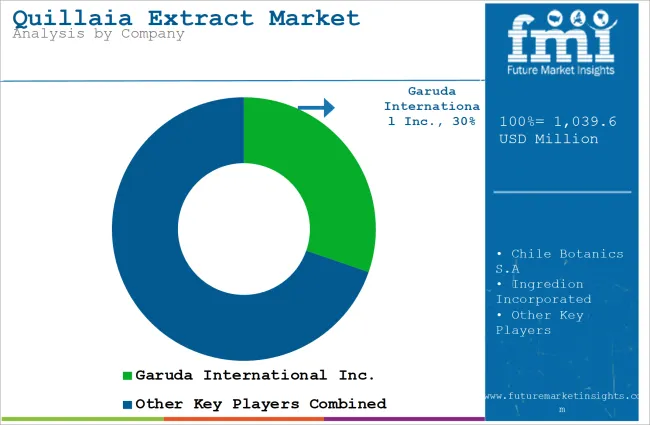
The quillaia extract market is highly concentrated at the supply origin level, with Chilean producers accounting for virtually all global bark harvest and primary extract production. Garuda International Inc. holds an estimated 30.0% share of the global market in 2026, followed by Desert King International, Chile Botanics S.A., and Natural Response S.A. as the primary Chilean origin competitors. Desert King's April 2025 EXCiPACT certification distinguishes it as the sole global supplier meeting pharmaceutical GMP excipient standards, creating a defensible premium positioning in the vaccine adjuvant supply segment. [2]
Syngenta's February 2026 expansion of its exclusive distribution agreement with Botanical Solution Inc. for the Quillibrium biofungicide into the United States, Canada, and Mexico represents a commercially significant validation of quillaia saponins' efficacy in agricultural biological crop protection applications. [1] This partnership leverages BSI's proprietary in vitro plant tissue culture technology to produce saponins without wild tree harvesting, potentially creating the first commercial scale alternative to bark-derived production. Ingredion's May 2025 termination of its joint venture with Amyris for fermentation-based botanical extract production reflects the persistent technical and economic barriers to replacing Chilean wild harvest with engineered biological routes. [3]
Buyer leverage in the pharmaceutical segment is structurally low given GMP certification requirements and source validation protocols that effectively restrict procurement to three to four qualified suppliers globally. Food-grade buyers have somewhat more flexibility, though Type 2 specification requirements for premium beverage and personal care applications still constrain the practical supplier pool.
Recent Developments
- February 2026: Syngenta expanded its exclusive distribution agreement with Botanical Solution Inc. to bring the botanical biofungicide Quillibrium, derived from Quillaja saponaria bark, to the United States, Canada, and Mexico. The product utilizes BSI's proprietary in vitro plant tissue culture technology to produce saponins without harvesting wild trees, marking a significant move into the North American agricultural biological market for quillaia-based crop protection. [1]
- April 2025: Desert King International became the first Chilean company and the only global supplier of Quillaja extracts to achieve EXCiPACT certification, verifying that its manufacturing sites meet GMP standards for pharmaceutical excipients. This development is critical for pharmaceutical companies using quillaia saponins as vaccine adjuvants, specifically the QS-21 fraction used in next-generation vaccine formulations. [2]
- May 2025: Ingredion and Amyris officially concluded their joint venture related to the precision fermentation plant in Barra Bonita, Brazil. The termination reflects a strategic shift in Ingredion's focus toward its Idea Labs and core texture and sugar reduction portfolios for 2026, indicating that fermentation-based alternatives to Chilean wild harvest quillaia have not achieved commercial viability on the intended timeline. [3]
Leading Manufacturers
- Garuda International Inc.
- Chile Botanics S.A
- Ingredion Incorporated
- Baja Yucca Company
- Naturex S.A
- Alfa Chemicals
- Desert King International
- Quillaja Green Biosolutions
- Givaudan SA
- Natural Response S.A.
Scope of the Report
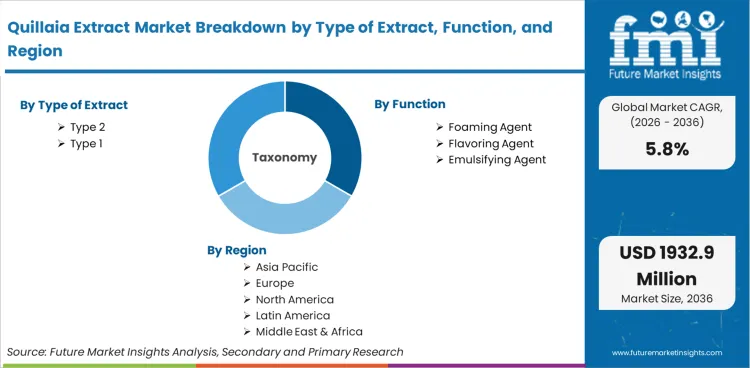
| Metric | Value |
|---|---|
| Quantitative Units | USD 1,099.9 million (2026) to USD 1,932.9 million (2036), at a CAGR of 5.8% |
| Market Definition | The quillaia extract market encompasses global production, processing, and trade of saponin-rich extracts from Quillaja saponaria bark in Type 1 and Type 2 purity grades, serving foaming, emulsifying, flavoring, pharmaceutical adjuvant, and agricultural biological end uses. |
| Type of Extract Segmentation | Type 2, Type 1 |
| Function Segmentation | Foaming Agent, Flavoring Agent, Emulsifying Agent |
| Regions Covered | North America, Latin America, Europe, East Asia, South Asia, Oceania, Middle East and Africa |
| Countries Covered | United States, Japan, Australia, Chile, Germany, France, United Kingdom, China, India, Canada and 40 plus countries |
| Key Companies Profiled | Garuda International Inc., Chile Botanics S.A, Ingredion Incorporated, Baja Yucca Company, Naturex S.A, Alfa Chemicals, Desert King International, Quillaja Green Biosolutions, Givaudan SA, Natural Response S.A. |
| Forecast Period | 2026 to 2036 |
| Approach | Hybrid bottom-up and top-down market modeling validated through primary interviews with Chilean Quillaja processors and pharmaceutical adjuvant procurement managers, supported by Chilean export registry data and EFSA food additive approval records |
Key Segments of the Report
Type of Extract
- Type 2 (68.3% share, 2026)
- Type 1
Function
- Foaming Agent (61.2% share, 2026)
- Flavoring Agent
- Emulsifying Agent
Region
- North America: United States (USD 386.3M, 2026), Canada, Mexico
- Latin America: Chile, Brazil, Argentina, Rest of Latin America
- Europe: Germany, France, United Kingdom, Italy, Spain, Benelux, Nordics, Rest of Europe
- East Asia: China, Japan (USD 784.2M projected, 2036), South Korea
- South Asia: India, Indonesia, Malaysia, Thailand, Rest of South Asia
- Oceania: Australia, New Zealand
- Middle East & Africa: Saudi Arabia, UAE, South Africa, Rest of Middle East & Africa
Bibliography
- [1] Syngenta AG. (2026). Chile's Forests to Fields: Syngenta Brings Botanical-Based Biofungicide to New Markets. Corporate Press Release, February 2026. https://www.syngenta.com/media/media-releases/2026/chiles-forests-fields-syngenta-brings-botanical-based-biofungicide
- [2] Desert King International. (2025). Desert King International Achieves EXCiPACT Certification: First Chilean Quillaja Supplier Meeting Pharmaceutical GMP Standards. Corporate Announcement, April 2025. https://desertking.com/defining-the-future-of-quillaja-supply-scale-stability-and-sustainability/
- [3] Ingredion Incorporated / Amyris. (2025). Ingredion and Amyris Conclude Joint Venture for Precision Fermentation Plant in Barra Bonita, Brazil. Joint Statement, May 2025.
- [4] Revista Cultivar. (2026). Syngenta Expands Agreement and Brings Botanical Biofungicide to New Markets. Industry Report, 2026. https://revistacultivar.com/news/Syngenta-expands-agreement-and-brings-botanical-biofungicide-to-new-markets
This Report Addresses
- Market intelligence to enable pharmaceutical adjuvant and food-grade emulsifier sourcing strategy decisions across Type 1 and Type 2 extract specifications
- Market size estimation and 10-year revenue forecasts from 2026 to 2036, supported by Chilean export registry benchmarks and EFSA regulatory approval data
- Growth opportunity mapping across foaming, emulsifying, and pharmaceutical adjuvant applications with emphasis on GMP-certified supply chain development
- Segment and regional revenue forecasts covering extract type and function dimensions with country-level CAGR analysis for key pharmaceutical and food-grade consuming markets
- Competition strategy assessment including Chilean origin concentration risk analysis, EXCiPACT certification impact, and alternative production route feasibility monitoring
- Supply chain analysis covering Quillaja bark harvest geography, Chilean regulatory frameworks, and risk scenarios from climate variability or harvest quota restrictions
- Regulatory impact analysis covering EFSA food additive approvals, FDA GRAS status, pharmaceutical pharmacopoeia monograph updates, and agricultural biological registration
- Market report delivery in PDF, Excel, PPT, and interactive dashboard formats for executive and operational use
Frequently Asked Questions
How large is the demand for Quillaia Extract in the global market in 2026?
Demand for Quillaia Extract in the global market is estimated to be valued at USD 1,099.9 million in 2026.
What will be the market size of Quillaia Extract by 2036?
Market size for Quillaia Extract is projected to reach USD 1,932.9 million by 2036.
What is the expected CAGR for the Quillaia Extract market between 2026 and 2036?
Demand for Quillaia Extract is expected to grow at a CAGR of 5.8% between 2026 and 2036.
Which extract type leads the Quillaia Extract market in 2026?
Type 2 holds 68.3% of extract volume in 2026, reflecting the purified saponin fraction's dominant position across pharmaceutical adjuvant and premium food emulsification applications.
Which functional segment holds the largest share?
Foaming Agent accounts for 61.2% of market value in 2026, consistent with quillaia's primary commercial role in beverage carbonation stability, personal care foam generation, and food processing applications.
What is driving Quillaia Extract demand in the United States?
The United States represents USD 386.3 million in 2026, driven by pharmaceutical vaccine adjuvant procurement, natural beverage emulsifier demand, and the agricultural biological sector expansion through Syngenta's Quillibrium distribution program.
What is Australia's growth outlook for Quillaia Extract?
Australia leads at 6.1% CAGR through 2036, driven by plant-based food sector expansion, regulatory approval of quillaia saponins as natural emulsifiers in functional beverages, and the country's preference for clean-label natural ingredient sourcing.
Why is Desert King International's EXCiPACT certification significant?
Desert King's April 2025 EXCiPACT certification makes it the first and only global Quillaja extract supplier verified to meet GMP standards for pharmaceutical excipients, directly qualifying it as a preferred supplier for vaccine adjuvant manufacturers with stringent GMP audit requirements.
What is the primary production origin for globally traded Quillaia Extract?
Chile is the primary production origin, where Quillaja saponaria bark is harvested from native semi-arid forest zones. This geographic concentration creates both competitive barriers and supply chain vulnerability for pharmaceutical buyers dependent on certified Chilean source material.
How does FMI validate its Quillaia Extract forecast?
Forecast is developed using hybrid bottom-up and top-down modeling validated through primary interviews with Chilean processors and pharmaceutical buyers, Chilean export registry data, EFSA food additive records, and vaccine adjuvant usage benchmarks.
Preview the report firsthand - request a free sample
Get SampleGet the brochure for pricing and purchase details.
Get PDFTable of Content
- Executive Summary
- Global Market Outlook
- Demand-side Trends
- Supply-side Trends
- Analysis and Recommendations
- Market Overview
- Market Coverage / Taxonomy
- Market Definition / Scope / Limitations
- Research Methodology
- Chapter Orientation
- Analytical Lens and Working Hypotheses
- Market Structure, Signals, and Trend Drivers
- Research Design and Evidence Framework
- Desk Research Programme (Secondary Evidence)
- Company Annual and Sustainability Reports
- Peer-reviewed Journals and Academic Literature
- Corporate Websites, Product Literature, and Technical Notes
- Earnings Decks and Investor Briefings
- Statutory Filings and Regulatory Disclosures
- Technical White Papers and Standards Notes
- Trade Journals, Industry Magazines, and Analyst Briefs
- Conference Proceedings, Webinars, and Seminar Materials
- Government Statistics Portals and Public Data Releases
- Press Releases and Reputable Media Coverage
- Specialist Newsletters and Curated Briefings
- Sector Databases and Reference Repositories
- FMI Internal Proprietary Databases and Historical Market Datasets
- Subscription Datasets and Paid Sources
- Social Channels, Communities, and Digital Listening Inputs
- Additional Desk Sources
- Expert Input and Fieldwork (Primary Evidence)
- Primary Modes
- Qualitative Interviews and Expert Elicitation
- Quantitative Surveys and Structured Data Capture
- Blended Approach
- Why Primary Evidence is Used
- Field Techniques
- Interviews
- Surveys
- Focus Groups
- Observational and In-context Research
- Social and Community Interactions
- Stakeholder Universe Engaged
- C-suite Leaders
- Board Members
- Presidents and Vice Presidents
- R&D and Innovation Heads
- Technical Specialists
- Domain Subject-matter Experts
- Scientists
- Physicians and Other Healthcare Professionals
- Governance, Ethics, and Data Stewardship
- Research Ethics
- Data Integrity and Handling
- Primary Modes
- Tooling, Models, and Reference Databases
- Desk Research Programme (Secondary Evidence)
- Data Engineering and Model Build
- Data Acquisition and Ingestion
- Cleaning, Normalisation, and Verification
- Synthesis, Triangulation, and Analysis
- Quality Assurance and Audit Trail
- Market Background
- Market Dynamics
- Drivers
- Restraints
- Opportunity
- Trends
- Scenario Forecast
- Demand in Optimistic Scenario
- Demand in Likely Scenario
- Demand in Conservative Scenario
- Opportunity Map Analysis
- Product Life Cycle Analysis
- Supply Chain Analysis
- Investment Feasibility Matrix
- Value Chain Analysis
- PESTLE and Porter’s Analysis
- Regulatory Landscape
- Regional Parent Market Outlook
- Production and Consumption Statistics
- Import and Export Statistics
- Market Dynamics
- Global Market Analysis 2021 to 2025 and Forecast, 2026 to 2036
- Historical Market Size Value (USD Million) Analysis, 2021 to 2025
- Current and Future Market Size Value (USD Million) Projections, 2026 to 2036
- Y-o-Y Growth Trend Analysis
- Absolute $ Opportunity Analysis
- Global Market Pricing Analysis 2021 to 2025 and Forecast 2026 to 2036
- Global Market Analysis 2021 to 2025 and Forecast 2026 to 2036, By Type of Extract
- Introduction / Key Findings
- Historical Market Size Value (USD Million) Analysis By Type of Extract , 2021 to 2025
- Current and Future Market Size Value (USD Million) Analysis and Forecast By Type of Extract , 2026 to 2036
- Type 2
- Type 1
- Type 2
- Y-o-Y Growth Trend Analysis By Type of Extract , 2021 to 2025
- Absolute $ Opportunity Analysis By Type of Extract , 2026 to 2036
- Global Market Analysis 2021 to 2025 and Forecast 2026 to 2036, By Function
- Introduction / Key Findings
- Historical Market Size Value (USD Million) Analysis By Function, 2021 to 2025
- Current and Future Market Size Value (USD Million) Analysis and Forecast By Function, 2026 to 2036
- Foaming Agent
- Flavoring Agent
- Emulsifying Agent
- Foaming Agent
- Y-o-Y Growth Trend Analysis By Function, 2021 to 2025
- Absolute $ Opportunity Analysis By Function, 2026 to 2036
- Global Market Analysis 2021 to 2025 and Forecast 2026 to 2036, By Region
- Introduction
- Historical Market Size Value (USD Million) Analysis By Region, 2021 to 2025
- Current Market Size Value (USD Million) Analysis and Forecast By Region, 2026 to 2036
- North America
- Latin America
- Western Europe
- Eastern Europe
- East Asia
- South Asia and Pacific
- Middle East & Africa
- Market Attractiveness Analysis By Region
- North America Market Analysis 2021 to 2025 and Forecast 2026 to 2036, By Country
- Historical Market Size Value (USD Million) Trend Analysis By Market Taxonomy, 2021 to 2025
- Market Size Value (USD Million) Forecast By Market Taxonomy, 2026 to 2036
- By Country
- USA
- Canada
- Mexico
- By Type of Extract
- By Function
- By Country
- Market Attractiveness Analysis
- By Country
- By Type of Extract
- By Function
- Key Takeaways
- Latin America Market Analysis 2021 to 2025 and Forecast 2026 to 2036, By Country
- Historical Market Size Value (USD Million) Trend Analysis By Market Taxonomy, 2021 to 2025
- Market Size Value (USD Million) Forecast By Market Taxonomy, 2026 to 2036
- By Country
- Brazil
- Chile
- Rest of Latin America
- By Type of Extract
- By Function
- By Country
- Market Attractiveness Analysis
- By Country
- By Type of Extract
- By Function
- Key Takeaways
- Western Europe Market Analysis 2021 to 2025 and Forecast 2026 to 2036, By Country
- Historical Market Size Value (USD Million) Trend Analysis By Market Taxonomy, 2021 to 2025
- Market Size Value (USD Million) Forecast By Market Taxonomy, 2026 to 2036
- By Country
- Germany
- UK
- Italy
- Spain
- France
- Nordic
- BENELUX
- Rest of Western Europe
- By Type of Extract
- By Function
- By Country
- Market Attractiveness Analysis
- By Country
- By Type of Extract
- By Function
- Key Takeaways
- Eastern Europe Market Analysis 2021 to 2025 and Forecast 2026 to 2036, By Country
- Historical Market Size Value (USD Million) Trend Analysis By Market Taxonomy, 2021 to 2025
- Market Size Value (USD Million) Forecast By Market Taxonomy, 2026 to 2036
- By Country
- Russia
- Poland
- Hungary
- Balkan & Baltic
- Rest of Eastern Europe
- By Type of Extract
- By Function
- By Country
- Market Attractiveness Analysis
- By Country
- By Type of Extract
- By Function
- Key Takeaways
- East Asia Market Analysis 2021 to 2025 and Forecast 2026 to 2036, By Country
- Historical Market Size Value (USD Million) Trend Analysis By Market Taxonomy, 2021 to 2025
- Market Size Value (USD Million) Forecast By Market Taxonomy, 2026 to 2036
- By Country
- China
- Japan
- South Korea
- By Type of Extract
- By Function
- By Country
- Market Attractiveness Analysis
- By Country
- By Type of Extract
- By Function
- Key Takeaways
- South Asia and Pacific Market Analysis 2021 to 2025 and Forecast 2026 to 2036, By Country
- Historical Market Size Value (USD Million) Trend Analysis By Market Taxonomy, 2021 to 2025
- Market Size Value (USD Million) Forecast By Market Taxonomy, 2026 to 2036
- By Country
- India
- ASEAN
- Australia & New Zealand
- Rest of South Asia and Pacific
- By Type of Extract
- By Function
- By Country
- Market Attractiveness Analysis
- By Country
- By Type of Extract
- By Function
- Key Takeaways
- Middle East & Africa Market Analysis 2021 to 2025 and Forecast 2026 to 2036, By Country
- Historical Market Size Value (USD Million) Trend Analysis By Market Taxonomy, 2021 to 2025
- Market Size Value (USD Million) Forecast By Market Taxonomy, 2026 to 2036
- By Country
- Kingdom of Saudi Arabia
- Other GCC Countries
- Turkiye
- South Africa
- Other African Union
- Rest of Middle East & Africa
- By Type of Extract
- By Function
- By Country
- Market Attractiveness Analysis
- By Country
- By Type of Extract
- By Function
- Key Takeaways
- Key Countries Market Analysis
- USA
- Pricing Analysis
- Market Share Analysis, 2025
- By Type of Extract
- By Function
- Canada
- Pricing Analysis
- Market Share Analysis, 2025
- By Type of Extract
- By Function
- Mexico
- Pricing Analysis
- Market Share Analysis, 2025
- By Type of Extract
- By Function
- Brazil
- Pricing Analysis
- Market Share Analysis, 2025
- By Type of Extract
- By Function
- Chile
- Pricing Analysis
- Market Share Analysis, 2025
- By Type of Extract
- By Function
- Germany
- Pricing Analysis
- Market Share Analysis, 2025
- By Type of Extract
- By Function
- UK
- Pricing Analysis
- Market Share Analysis, 2025
- By Type of Extract
- By Function
- Italy
- Pricing Analysis
- Market Share Analysis, 2025
- By Type of Extract
- By Function
- Spain
- Pricing Analysis
- Market Share Analysis, 2025
- By Type of Extract
- By Function
- France
- Pricing Analysis
- Market Share Analysis, 2025
- By Type of Extract
- By Function
- India
- Pricing Analysis
- Market Share Analysis, 2025
- By Type of Extract
- By Function
- ASEAN
- Pricing Analysis
- Market Share Analysis, 2025
- By Type of Extract
- By Function
- Australia & New Zealand
- Pricing Analysis
- Market Share Analysis, 2025
- By Type of Extract
- By Function
- China
- Pricing Analysis
- Market Share Analysis, 2025
- By Type of Extract
- By Function
- Japan
- Pricing Analysis
- Market Share Analysis, 2025
- By Type of Extract
- By Function
- South Korea
- Pricing Analysis
- Market Share Analysis, 2025
- By Type of Extract
- By Function
- Russia
- Pricing Analysis
- Market Share Analysis, 2025
- By Type of Extract
- By Function
- Poland
- Pricing Analysis
- Market Share Analysis, 2025
- By Type of Extract
- By Function
- Hungary
- Pricing Analysis
- Market Share Analysis, 2025
- By Type of Extract
- By Function
- Kingdom of Saudi Arabia
- Pricing Analysis
- Market Share Analysis, 2025
- By Type of Extract
- By Function
- Turkiye
- Pricing Analysis
- Market Share Analysis, 2025
- By Type of Extract
- By Function
- South Africa
- Pricing Analysis
- Market Share Analysis, 2025
- By Type of Extract
- By Function
- USA
- Market Structure Analysis
- Competition Dashboard
- Competition Benchmarking
- Market Share Analysis of Top Players
- By Regional
- By Type of Extract
- By Function
- Competition Analysis
- Competition Deep Dive
- Garuda International Inc.
- Overview
- Product Portfolio
- Profitability by Market Segments (Product/Age /Sales Channel/Region)
- Sales Footprint
- Strategy Overview
- Marketing Strategy
- Product Strategy
- Channel Strategy
- Chile Botanics S.A
- Ingredion Incorporated
- Baja Yucca Company
- Naturex S.A
- Alfa Chemicals
- Desert King International
- Quillaja Green Biosolutions
- Givaudan SA
- Natural Response S.A.
- Others
- Garuda International Inc.
- Competition Deep Dive
- Assumptions & Acronyms Used


