

- Industry Size (2025)
- USD 174.8 Mn
- Forecast (2035)
- USD 768.2 Mn
- CAGR (2025 to 2035)
- 15.9%
Pile Turner Market Forecast and Outlook (2025-2035)
The global pile turner market is projected to reach USD 768.2 million by 2035, recording an absolute increase of USD 593.4 million over the forecast period. The market is valued at USD 174.8 million in 2025 and is set to rise at a CAGR of 15.9% during the assessment period. The overall market size is expected to grow by nearly 4.4 times during the same period, supported by increasing demand for material handling automation across printing, construction, and logistics applications worldwide, driving demand for efficient pile manipulation solutions and increasing investments in facility productivity optimization projects globally.
Pile turners represent specialized material handling equipment designed to rotate stacked materials 90 or 180 degrees for orientation change, quality inspection, or production sequencing operations. These systems feature clamping mechanisms that secure material stacks between adjustable plates, with hydraulic, pneumatic, or electric actuators providing rotation force while maintaining stack stability throughout the turning cycle. The technology enables operator-safe handling of heavy material piles weighing up to 5,000 kilograms without manual lifting or repositioning risks. Printing industry applications require pile turners that handle paper stacks without sheet displacement, maintaining precise registration for subsequent processing through folder equipment, cutting machines, or packaging systems where material orientation proves critical.
Quick Stats for Pile Turner Market
- Pile Turner Market Value (2025): USD 174.8 million
- Pile Turner Market Forecast Value (2035): USD 768.2 million
- Pile Turner Market Forecast CAGR: 15.9%
- Leading Operating Mechanism in Pile Turner Market: Hydraulic Pile Turner
- Key Growth Regions in Pile Turner Market: Asia Pacific, North America, and Europe
- Top Key Players in Pile Turner Market: Gerhard Busch EBB GmbH, Toppy Packaging, Baumannperfecta, Krifft & Zipsner, SAMZON, POLAR, Komori Corporation, Baust & Co. GmbH, Albo System, Koenig & Bauer MetalPrint GmbH
- Pile Turner Market Year-over-Year Forecast (2025-2035)
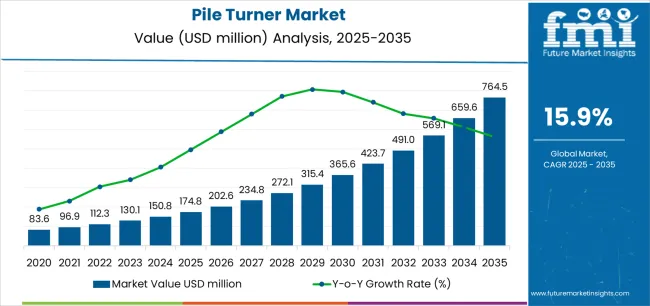
The market expansion reflects fundamental shifts toward automation and ergonomic improvement across material-intensive industries. Infrastructure construction operations adopt pile turners to rotate precast concrete panels and steel plate stacks for surface inspection, coating application, or assembly orientation, eliminating manual handling that creates worker injury risks and productivity bottlenecks. New energy engineering facilities deploy pile turning systems for solar panel stack manipulation during quality control inspection, enabling efficient examination of both surfaces without manual repositioning that risks product damage. Municipal engineering projects specify pile turners for handling drainage components and modular construction elements, improving material flow efficiency through manufacturing and installation sequences.
Technology advancement in control systems and safety integration enables next-generation pile turners with improved productivity and operator protection. Programmable logic controllers provide customizable turning cycles with variable rotation speeds matching material characteristics, preventing stack shifting in loosely bound materials while maximizing throughput for stable loads. Dual-action clamping systems distribute pressure evenly across material surfaces, accommodating varying stack heights and material compressibility without surface damage. Safety interlocks prevent rotation initiation until operators clear designated zones, with light curtains and emergency stops providing redundant protection meeting international machinery safety standards.
Industrial retrofit applications demand pile turners that integrate with existing production workflows without extensive facility modifications. Modular frame designs accommodate installation in confined floor spaces typical of printing plants and fabrication shops operating in older buildings with limited expansion capability. Mobile configurations mounted on casters enable repositioning across production areas, supporting flexible manufacturing arrangements responding to changing product mixes. Universal material interface capabilities handle diverse stack dimensions and material types through adjustable clamping plate configurations, eliminating dedicated equipment requirements for different production runs.
Government regulations promoting workplace safety and material handling best practices accelerate pile turner adoption across manufacturing sectors. Occupational safety standards mandate mechanical assistance for loads exceeding manual handling weight limits, creating regulatory drivers for pile turning equipment in facilities processing heavy material stacks. Industrial insurance requirements recognize material handling automation in premium calculations, incentivizing pile turner investment through reduced workers' compensation costs. Ergonomics guidelines specify mechanical aids for repetitive lifting operations, driving pile turner deployment in high-volume production environments where manual stack manipulation creates cumulative trauma risks.
Technical challenges constrain adoption in certain material handling scenarios and facility configurations. Achieving stable rotation for loosely stacked materials requires sophisticated clamping pressure control, as excessive force damages products while insufficient clamping permits stack shifting during rotation. Initial capital costs ranging from $15,000 to $80,000 per unit create barriers in small-scale operations, despite productivity gains and injury reduction justifying investments through improved operational efficiency. Floor space requirements for pile turner installation may exceed available area in congested facilities, particularly for larger capacity systems handling oversized material stacks common in construction component manufacturing.
Between 2025 and 2030, the pile turner market is projected to expand from USD 174.8 million to USD 449.4 million, resulting in a value increase of USD 274.6 million, which represents 46.3% of the total forecast growth for the decade. This phase of development will be shaped by rising demand for printing industry automation and construction material handling efficiency, product innovation in electronic control systems and safety integration technologies, as well as expanding integration with production line automation and quality inspection workflows. Companies are establishing competitive positions through investment in clamping system technology, control system sophistication, and strategic partnerships with printing equipment manufacturers and construction material producers.
From 2030 to 2035, the market is forecast to grow from USD 449.4 million to USD 768.2 million, adding another USD 318.8 million, which constitutes 53.7% of the overall ten-year expansion. This period is expected to be characterized by the expansion of specialized turner configurations, including ultra-heavy capacity systems for construction applications and compact designs for space-constrained production environments, strategic collaborations between pile turner manufacturers and material handling system integrators, and an enhanced focus on Industry 4.0 connectivity and predictive maintenance capabilities. The growing emphasis on workplace safety and production efficiency will drive demand for advanced, high-reliability pile turner solutions across diverse material handling applications.
Pile Turner Market Key Takeaways
| Metric | Value |
|---|---|
| Market Value (2025) | USD 174.8 million |
| Market Forecast Value (2035) | USD 768.2 million |
| Forecast CAGR (2025-2035) | 15.9% |
Why is the Pile Turner Market Growing?
The pile turner market grows by enabling facility operators to achieve superior material handling efficiency and workplace safety while meeting production throughput requirements across material-intensive industries. Manufacturing and construction operations face mounting pressure to eliminate manual handling injuries and improve productivity, with pile turner solutions typically providing 40-60% reduction in material handling time compared to manual repositioning while eliminating lifting injuries associated with heavy stack manipulation, making automated pile turning technologies essential for competitive facility operations. The workplace safety movement creates demand for material handling equipment that can eliminate ergonomic risks across printing, construction, and manufacturing environments where heavy stack manipulation occurs frequently throughout production shifts.
Government initiatives promoting workplace safety and manufacturing automation drive adoption in printing, construction, and municipal engineering applications, where material handling efficiency has a direct impact on facility productivity and worker injury rates. The global shift toward automated production workflows accelerates pile turner demand as manufacturers seek proven technologies that eliminate manual material handling bottlenecks while improving worker safety and product quality through controlled material orientation changes. High initial capital costs compared to manual handling practices and floor space requirements for equipment installation may constrain adoption rates among smaller facilities and operations with limited capital budgets for material handling equipment investment.
Which Market Segments Are Fueling the Pile Turner Market’s Expansion?
The market is segmented by operating mechanism, application, and region. By operating mechanism, the market is divided into hydraulic pile turner, mechanical pile turner, electric pile turner, and others. Based on application, the market is categorized into infrastructure construction, new energy engineering, municipal engineering, and others. Regionally, the market is divided into Asia Pacific, Europe, North America, Latin America, and Middle East & Africa.
By Operating Mechanism, the Hydraulic Pile Turner Segment Accounts for a Dominant Market Share
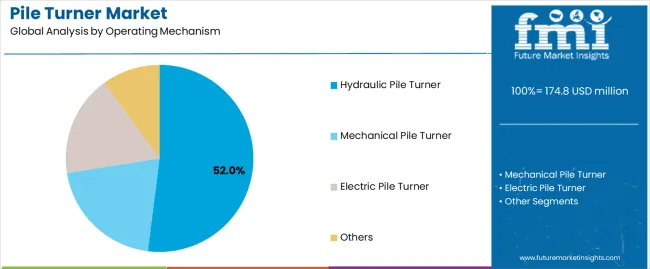
The hydraulic pile turner segment represents the dominant force in the pile turner market, capturing approximately 52% of total market share in 2025. This advanced category encompasses systems utilizing hydraulic cylinders and pumps to provide rotation force and clamping pressure, delivering high-capacity material handling with precise force control suitable for heavy construction materials and large-format printing applications. The hydraulic pile turner segment leads through its exceptional load capacity handling stacks weighing 3,000-5,000 kilograms, proven reliability across demanding industrial environments, and smooth operation characteristics enabling gentle material handling without shock loads that could damage sensitive products.
The electric pile turner segment maintains a substantial 28% market share, serving applications requiring clean operation through electric motor-driven systems without hydraulic fluid. The mechanical pile turner accounts for 14% market share, while other operating mechanisms collectively represent 6% market share. Key advantages driving the hydraulic pile turner segment include superior force generation achieving high clamping pressures necessary for large material stacks without excessive equipment size, precise speed control through hydraulic flow regulation enabling customized rotation cycles matching material characteristics, robust construction withstanding continuous operation in industrial production environments including printing plants and fabrication facilities, and proven service infrastructure with established maintenance procedures and readily available replacement components supporting long equipment service life in demanding applications.
By Application, the Infrastructure Construction Segment Accounts for the Largest Market Share
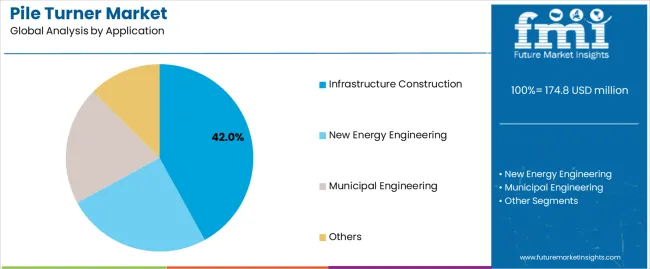
Infrastructure construction applications dominate the pile turner market with approximately 42% market share in 2025, reflecting the extensive deployment across precast concrete panel fabrication, structural steel processing, and modular construction component manufacturing requiring heavy material stack rotation for surface inspection and coating operations. The infrastructure construction segment leads through deployment in concrete panel production facilities requiring surface quality inspection, steel fabrication shops processing plate material requiring both-side examination, and bridge component manufacturers managing large structural elements requiring orientation changes during assembly sequences.
The new energy engineering segment represents 31% market share through applications in solar panel manufacturing, wind turbine component production, and battery module assembly operations. Municipal engineering accounts for 17% market share, while other applications collectively represent 10% market share. Key market dynamics supporting application preferences include infrastructure construction requiring heavy-capacity equipment handling concrete panels and steel plates weighing 2,000-5,000 kilograms per stack, new energy engineering emphasizing product protection through controlled handling preventing damage to sensitive photovoltaic cells and electronic components, municipal engineering facilities requiring versatile equipment handling diverse component types including drainage elements and street furniture, and specialized segments including packaging printing and logistics operations utilizing pile turners for material preparation and quality control inspection in high-volume production environments with continuous material flow requirements.
What are the Drivers, Restraints, and Key Trends of the Pile Turner Market?
The market is driven by three concrete demand factors tied to workplace safety and productivity optimization. First, occupational safety regulations create increasing requirements for mechanical material handling, with workplace safety standards mandating mechanical assistance for loads exceeding 25 kilograms when repetitive handling occurs, affecting printing plants and construction fabrication facilities processing multiple material stacks hourly. Second, productivity improvement initiatives drive automation investment, with pile turner installations eliminating 15-25 minutes per material stack handling cycle compared to manual methods while reducing product damage risks that create quality losses and rework costs. Third, construction industrialization requires efficient material handling, with precast concrete production growing 8-12% annually requiring pile turning equipment to manage inspection workflow for building panels, infrastructure components, and modular construction elements.
Market restraints include capital cost barriers affecting equipment adoption in small operations, particularly in regional printing shops and construction subcontractors where $20,000-$60,000 pile turner investments compete with other equipment priorities despite safety and productivity benefits. Floor space limitations pose installation challenges in existing facilities, as pile turner systems requiring 15-30 square meters operational area may exceed available space in older printing plants and fabrication shops operating in constrained buildings. Material handling complexity creates operational barriers, since achieving reliable performance with loosely stacked or irregular materials requires operator training and clamping system adjustment expertise that may be unavailable in facilities lacking experienced material handling personnel.
Key trends indicate accelerated adoption in Asia Pacific markets, particularly China and India where infrastructure construction expansion and manufacturing automation drive material handling equipment demand. Technology advancement trends toward IoT-enabled monitoring providing operational data for predictive maintenance, automated material positioning systems integrating pile turners with robotic handling, and modular design approaches enabling capacity upgrades without complete equipment replacement enable next-generation production efficiency. The market faces potential disruption if robotic manipulation technologies achieve cost-effectiveness sufficient to handle material stacks directly without dedicated pile turning equipment, potentially reducing addressable market in applications where flexible robotic systems provide superior versatility.
How Are Global Shifts in Industrial Automation Shaping the Pile Turner Market?
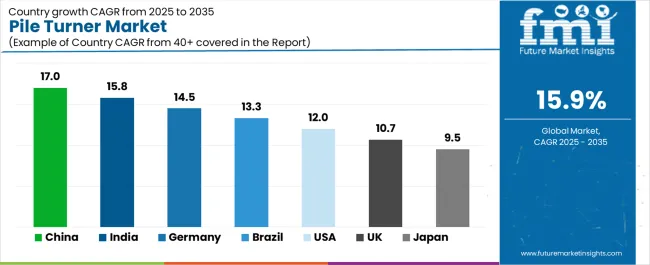
| Country | CAGR (2025-2035) |
|---|---|
| China | 17% |
| India | 15.8% |
| Germany | 14.5% |
| Brazil | 13.3% |
| USA | 12% |
| UK | 10.7% |
| Japan | 9.5% |
The pile turner market is gaining momentum worldwide, with China taking the lead thanks to aggressive infrastructure construction programs and manufacturing automation initiatives. Close behind, India benefits from construction sector expansion and industrial development, positioning itself as a strategic growth hub in the Asia Pacific region. Germany shows strong advancement, where established printing industry and precision manufacturing strengthen its role in European material handling equipment supply chains. The USA demonstrates robust growth through construction equipment modernization and workplace safety emphasis, signaling continued investment in material handling automation. Meanwhile, Japan stands out for its printing technology leadership and manufacturing automation with quality emphasis, while UK continues to record consistent progress driven by construction sector development and industrial facility upgrades. Together, China and India anchor the global expansion story, while established markets build stability and technical sophistication into the market growth path.
The report covers an in-depth analysis of 40+ countries, the top-performing countries are highlighted below.
How Is China Impacting the Global Pile Turner Market?
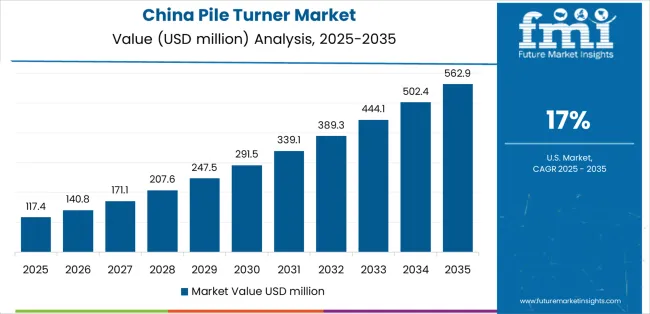
China demonstrates the strongest growth potential in the Pile Turner Market with a CAGR of 17% through 2035. The country leads through comprehensive infrastructure construction expansion, manufacturing automation programs, and printing industry modernization driving adoption of efficient material handling technologies. Growth is concentrated in major industrial regions, including Guangdong, Jiangsu, Zhejiang, and Shandong, where construction equipment manufacturers and printing facilities are implementing automated material handling systems for productivity improvement and worker safety. Distribution channels through material handling equipment distributors, construction equipment dealers, and direct facility relationships expand deployment across concrete panel production, printing operations, and solar panel manufacturing applications. The country's manufacturing upgrade initiatives provide policy support for automation investment, while construction sector growth creates sustained demand for material handling equipment.
Key market factors:
- Construction industry intensity in infrastructure development zones with comprehensive precast concrete and modular construction production
- Government support through manufacturing automation programs and workplace safety regulations promoting mechanical material handling
- Comprehensive supply chain ecosystem including domestic pile turner manufacturers and material handling equipment suppliers with proven capabilities
- Technology integration featuring automated production systems, quality inspection workflows, and facility safety management platforms
What Role Does India Play in the Growth of the Pile Turner Market?
In the Maharashtra, Gujarat, Tamil Nadu, and Karnataka industrial regions, the adoption of pile turner systems is accelerating across infrastructure construction projects, solar panel manufacturing facilities, and printing operations, driven by Make in India programs and increasing emphasis on workplace safety standards. The market demonstrates strong growth momentum with a CAGR of 15.8% through 2035, linked to comprehensive infrastructure development and increasing focus on manufacturing automation. Indian facility operators are implementing pile turning equipment and material handling automation to improve productivity while meeting emerging safety requirements for heavy material manipulation. The country's infrastructure investment programs create sustained demand for construction material handling equipment, while increasing emphasis on manufacturing competitiveness drives adoption of automated material handling solutions improving operational efficiency.
- Leading industrial development regions, including Pune, Ahmedabad, Chennai, and Bangalore, driving pile turner adoption
- Government incentive programs enabling manufacturing infrastructure development and workplace safety improvement supporting automation investment
- Technology collaboration agreements accelerating deployment with international material handling equipment manufacturers and system integrators
- Policy support through infrastructure development programs and manufacturing promotion initiatives linked to automation and safety requirements
How Is Germany’s Technological Advancement Shaping the Pile Turner Market?
Germany's advanced printing and manufacturing sector demonstrates sophisticated implementation of pile turner systems, with documented case studies showing 45-60% productivity improvement in material handling operations. The country's material handling equipment industry in major manufacturing regions, including Baden-Württemberg, Bavaria, North Rhine-Westphalia, and Hesse, showcases integration of pile turning technologies with existing production systems, leveraging expertise in automation engineering and workplace safety. German facility operators emphasize equipment reliability and safety compliance, creating demand for premium pile turner solutions that support operational efficiency objectives and regulatory requirements. The market maintains strong growth through focus on technology leadership and export market service, with a CAGR of 14.5% through 2035.
Key development areas:
- Integrated production automation enabling comprehensive material flow optimization with advanced control technologies
- Technical service channels providing installation support with documented 40-55% improvement in material handling efficiency
- Strategic partnerships between pile turner manufacturers and printing equipment suppliers expanding market reach across industrial segments
- Integration of Industry 4.0 technologies and comprehensive safety management systems for intelligent production operations
What Is Driving Brazil’s Demand for Pile Turners in the Market?
The Brazilian market leads in infrastructure investment based on integration with construction programs and industrial facility expansion driving material handling equipment requirements. The country shows solid potential with a CAGR of 13.3% through 2035, driven by construction sector growth and manufacturing facility development across major regions, including São Paulo, Minas Gerais, Paraná, and Rio de Janeiro. Brazilian construction operations are adopting pile turner systems for compliance with productivity objectives in precast concrete production, particularly in applications requiring surface quality inspection and in facilities managing worker safety requirements. Technology deployment channels through construction equipment suppliers, material handling distributors, and direct facility relationships expand coverage across diverse construction and manufacturing applications.
Leading market segments:
- Precast concrete production facilities implementing automated material handling for inspection workflow optimization
- Technology partnerships with international equipment manufacturers achieving operational efficiency capabilities
- Strategic collaborations between construction material producers and equipment suppliers enabling integrated handling solutions
- Focus on infrastructure development and construction industrialization driving facility automation with material handling requirements
How Are USA Developments in Manufacturing Shaping the Pile Turner Market?
The USA market leads in workplace safety technology based on integration with occupational health regulations and sophisticated material handling practices for injury prevention. The country shows solid potential with a CAGR of 12% through 2035, driven by printing industry automation and construction facility modernization across major regions, including the Midwest industrial corridor, Southeast manufacturing clusters, and Pacific Coast construction markets. American facility operators are adopting specialized pile turners for compliance with OSHA material handling requirements in printing applications, particularly in commercial printing operations managing heavy paper stacks and in construction facilities handling precast components requiring both-side inspection. Technology deployment channels through material handling equipment distributors, safety equipment suppliers, and direct facility procurement relationships expand coverage across printing, construction, and manufacturing applications.
Leading market segments:
- Printing facilities implementing automated material handling for worker safety compliance and productivity improvement
- Technology partnerships between equipment manufacturers and facility operators achieving system integration optimization
- Strategic collaborations between material handling suppliers and safety consultants enabling comprehensive workplace safety programs
- Focus on injury prevention and operational efficiency driving material handling automation across industrial facilities
Why Is the UK Emerging as a Key Market for Pile Turners?
The UK market demonstrates sophisticated implementation focused on printing industry automation and construction facility upgrades, with documented integration of pile turner systems achieving operational efficiency improvement in commercial printing and prefabrication operations. The country maintains steady growth momentum with a CAGR of 10.7% through 2035, driven by printing sector modernization and construction industry development aligned with workplace safety commitments. Major industrial regions, including Midlands printing clusters, Southeast manufacturing areas, and Northern construction facilities, showcase advanced material handling implementations where pile turner systems integrate seamlessly with existing production workflows and safety management programs.
Key market characteristics:
- Printing industry applications and construction facility operations driving pile turner requirements with emphasis on safety and efficiency
- Technology partnerships enabling system optimization through collaborative development programs and installation support
- Collaboration between equipment suppliers and facility operators ensuring performance validation and technical advancement
- Emphasis on workplace safety and productivity including comprehensive facility operational efficiency improvement strategies
How Is Japan’s Focus on Automation Enhancing the Pile Turner Market?
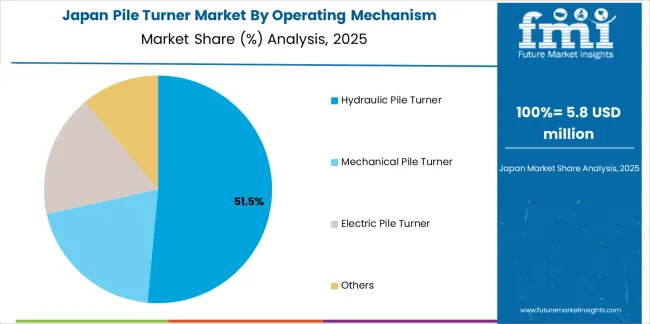
In Tokyo, Osaka, Aichi, and Kanagawa industrial regions, printing facilities are implementing pile turner programs to enhance material handling efficiency and meet safety requirements, with documented case studies showing integration in commercial printing operations and precision manufacturing environments. The market shows solid growth potential with a CAGR of 9.5% through 2035, linked to Japanese printing industry quality standards, manufacturing automation sophistication, and emphasis on workplace safety. Japanese facility operators are adopting specialized pile turning technologies and advanced integration methods to maintain operational efficiency while achieving safety objectives through automated material handling eliminating manual lifting risks.
Market development factors:
- Printing industry applications leading pile turner adoption with comprehensive material handling efficiency requirements
- Technical precision requirements providing incentives for advanced control systems with monitoring and safety integration capabilities
- Strategic partnerships between equipment manufacturers and printing facilities expanding implementation capabilities
- Emphasis on quality assurance and continuous improvement integrated with lean manufacturing principles in printing production
What Regional Factors Are Shaping the Pile Turner Market in Europe?
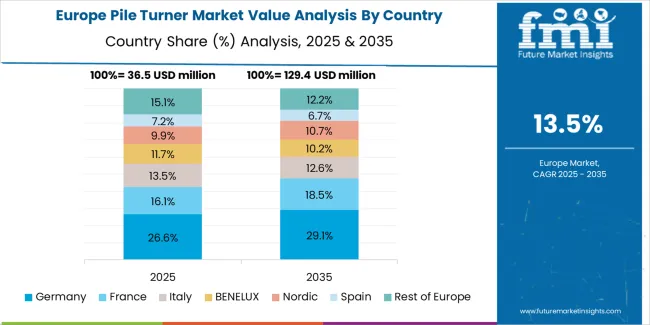
The pile turner market in Europe is projected to grow from USD 48.3 million in 2025 to USD 200.4 million by 2035, registering a CAGR of 15.3% over the forecast period. Germany is expected to maintain its leadership position with a 29.8% market share in 2025, declining slightly to 29.2% by 2035, supported by its advanced printing industry and major manufacturing centers including Baden-Württemberg and Bavaria production clusters. France follows with a 20.5% share in 2025, projected to reach 21% by 2035, driven by comprehensive printing equipment production and construction material manufacturing initiatives. The United Kingdom holds a 17.2% share in 2025, expected to decrease to 16.8% by 2035 through established printing operations and construction facility markets. Italy commands a 13% share, while Spain accounts for 9.5% in 2025. The Rest of Europe region is anticipated to gain momentum, expanding its collective share from 10% to 10.7% by 2035, attributed to increasing pile turner adoption in Nordic countries and emerging Eastern European manufacturing implementing automated material handling programs.
International Suppliers Lead Technical Integration in South Korea
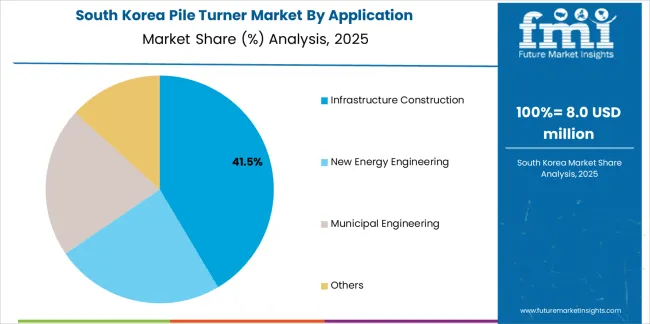
The South Korean pile turner market is characterized by growing international technology provider presence, with companies maintaining significant positions through comprehensive installation services and technical integration capabilities for printing and construction applications. The market demonstrates increasing emphasis on facility automation and operational efficiency optimization, as Korean printing facilities and construction operations increasingly demand advanced pile turner systems that integrate with domestic production equipment and sophisticated control platforms deployed across manufacturing facilities. Regional material handling equipment suppliers are gaining market share through strategic partnerships with international pile turner manufacturers, offering specialized services including Korean industrial standard compliance support and application-specific installation programs for printing and construction operations. The competitive landscape shows increasing collaboration between multinational equipment companies and Korean facility automation specialists, creating hybrid service models that combine international material handling expertise with local facility integration knowledge and production system requirements.
How Are Major Players Performing in the Pile Turner Market?
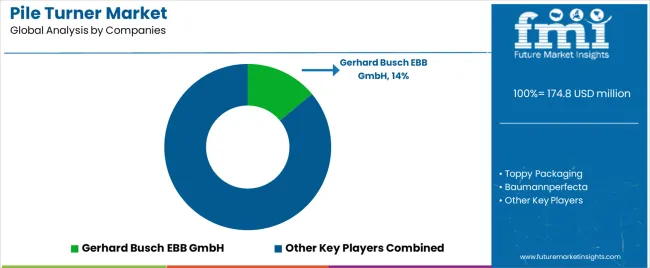
The pile turner market features approximately 25-30 meaningful players with moderate fragmentation, where the top three companies control roughly 32-38% of global market share through established engineering expertise and comprehensive product portfolios. Competition centers on load capacity, safety integration, and application engineering support rather than price competition alone. Gerhard Busch EBB GmbH leads with approximately 14% market share through its comprehensive material handling equipment portfolio including pile turning systems for diverse industrial applications.
Market leaders include Gerhard Busch EBB GmbH, Toppy Packaging, and Baumannperfecta, which maintain competitive advantages through decades of material handling engineering experience, established safety integration technology portfolios ensuring operator protection, and deep expertise in printing industry and construction applications, creating trust and reliability advantages with commercial printing facilities and construction material producers. These companies leverage engineering capabilities in clamping system design and control system development alongside ongoing application support networks to defend market positions while expanding into emerging markets and specialized applications.
Challengers encompass Krifft & Zipsner and SAMZON, which compete through specialized system configurations and strong positions in printing equipment and construction material handling markets. Product specialists, including POLAR, Komori Corporation, and Baust & Co. GmbH, focus on specific mechanism types or application segments, offering differentiated capabilities in printing industry systems, heavy-capacity construction equipment, and compact production environment solutions.
Regional players and emerging material handling equipment companies create competitive pressure through innovative design approaches and competitive pricing strategies, particularly in high-growth markets including China and India, where domestic manufacturers provide advantages in delivery lead times and responsive technical support for local facility operators. Market dynamics favor companies that combine reliable pile turning performance with comprehensive installation services and ongoing maintenance support addressing the complete material handling workflow from initial system specification through installation, operator training, and long-term operational service.
Global Pile Turner Market - Stakeholder Contribution Framework
Pile turners represent critical material handling technologies that enable facility operators to achieve 40-60% reduction in material handling time while eliminating manual lifting injuries, delivering superior productivity and workplace safety with validated effectiveness in demanding printing, construction, and manufacturing applications. With the market projected to grow from USD 174.8 million in 2025 to USD 768.2 million by 2035 at a 15.9% CAGR, these specialized handling systems offer compelling advantages for infrastructure construction applications (42% market share), new energy engineering (31% share), and municipal engineering (17% share) seeking efficient material orientation solutions with proven reliability. Scaling market adoption and technology advancement requires coordinated action across material handling equipment manufacturers, facility operators, safety equipment distributors, workplace safety advocates, and industrial automation investment capital.
How Governments Could Spur Local Production and Adoption?
- Workplace Safety Programs: Include pile turners in occupational safety equipment incentive schemes, provide grants for material handling automation improving worker safety, and establish domestic manufacturing capabilities that reduce import dependencies in material handling equipment supply chains.
- Research & Innovation Funding: Fund university research on clamping system optimization, control system development, and material handling safety engineering. Invest in manufacturer-research partnerships that advance practical application techniques for diverse material types and handling scenarios.
- Safety Standards Development: Establish equipment requirements for heavy material handling in industrial facilities, develop testing protocols for pile turner safety system validation, and create harmonized international standards that facilitate trade of certified material handling equipment to global markets.
- Manufacturing Support: Provide incentives for facilities adopting workplace safety automation, support technology demonstration projects validating pile turner productivity benefits, and establish programs that accelerate injury prevention across industrial material handling operations.
- Construction Industry Programs: Promote industrialized construction methods requiring efficient material handling, support precast concrete facility development with equipment subsidies, and establish funding programs that accelerate automation across construction material production sectors.
How Industry Bodies Could Support Market Development?
- Safety Standards & Testing: Define standardized protocols for clamping force control, rotation stability, and operator protection across hydraulic pile turner (52% market dominance) and other mechanism types, enabling reliable safety comparison and facility manager confidence in equipment specifications.
- Application Guidelines: Develop comprehensive practices for pile turner selection based on material characteristics, installation planning considering facility layout, and operator training ensuring safe and effective equipment utilization across diverse applications.
- Integration Standards: Create frameworks for pile turner integration with production line automation, quality inspection workflows, and facility safety systems that facilitate effective material handling specification across printing, construction, and manufacturing facilities.
- Technical Training & Education: Establish training programs for material handling engineers, safety managers, and equipment operators on pile turner technology, safe operating procedures, and maintenance requirements that ensure successful equipment deployment and sustained performance.
How OEMs and Technology Players Could Strengthen the Ecosystem?
- Advanced Product Development: Develop next-generation electronic control systems with programmable handling cycles, ultra-heavy capacity configurations for construction applications, and compact designs for space-constrained facilities while maintaining safety certification compliance.
- Safety Technology Innovation: Provide advanced operator protection systems with redundant safety interlocks, intelligent clamping control preventing material damage, and remote monitoring capabilities enabling predictive maintenance and operational optimization.
- Application-Specific Solutions: Offer facility-tailored configurations for infrastructure construction requiring heavy-capacity equipment, printing industry emphasizing gentle material handling, and new energy engineering demanding product protection through controlled manipulation.
- Technical Support Services: Build comprehensive facility operator assistance including equipment sizing consultation, installation planning support, and operator training programs that help facilities achieve productivity targets while maintaining workplace safety and equipment reliability.
How Suppliers Could Navigate the Shift?
- Application-Focused Product Lines: Develop specialized pile turners for infrastructure construction applications (42% market dominance), new energy engineering (31% share), and municipal engineering (17% share), with designs optimized for each application's material characteristics and handling requirements.
- Geographic Market Strategy: Establish manufacturing and service capabilities in high-growth markets like China (17% CAGR) and India (15.8% CAGR), while maintaining engineering expertise in established markets like USA (12% CAGR) and Europe.
- Technology Differentiation: Invest in proprietary clamping system designs, advanced control technologies, and integrated safety systems that provide superior performance and enable premium positioning in material handling equipment markets.
- Customer Partnership Models: Develop long-term relationships with printing facilities, construction material producers, and manufacturing operations through performance warranties, maintenance service programs, and productivity validation that strengthen customer loyalty.
How Investors and Financial Enablers Could Unlock Value?
- Manufacturing Capacity: Finance established material handling equipment companies for pile turner production expansion, control system development, and safety technology advancement that serve growing demand in construction and printing markets.
- Supply Chain Infrastructure: Provide capital for establishing regional service centers, application engineering resources, and distribution networks that reduce lead times while ensuring consistent equipment availability across industrial facility development regions.
- Innovation & Technology: Back industrial automation startups developing advanced control systems, intelligent clamping technologies, and integrated safety platforms that enhance pile turner effectiveness while addressing efficiency requirements and operator protection capabilities.
- Market Integration & Consolidation: Support strategic partnerships between pile turner manufacturers and facility automation integrators, finance application engineering program expansion, and enable market consolidation that creates comprehensive material handling solution providers serving multiple industrial application segments.
Who Are the Top Companies Driving Growth in the Pile Turner Market?
- Gerhard Busch EBB GmbH
- Toppy Packaging
- Baumannperfecta
- Krifft & Zipsner
- SAMZON
- POLAR
- Komori Corporation
- Baust & Co. GmbH
- Albo System
- Koenig & Bauer MetalPrint GmbH
- Dongguan Winner Printing Technology
- FENATEK
- Meech Static Eliminators
- Lennart Group B.V
- Ergopal GmbH
Scope of the Report
| Item | Value |
|---|---|
| Quantitative Units | USD 174.8 million |
| Operating Mechanism | Hydraulic Pile Turner, Mechanical Pile Turner, Electric Pile Turner, Others |
| Application | Infrastructure Construction, New Energy Engineering, Municipal Engineering, Others |
| Regions Covered | Asia Pacific, Europe, North America, Latin America, Middle East & Africa |
| Country Covered | China, India, Germany, Brazil, USA, UK, Japan, and 40+ countries |
| Key Companies Profiled | Gerhard Busch EBB GmbH, Toppy Packaging, Baumannperfecta, Krifft & Zipsner, SAMZON, POLAR, Komori Corporation, Baust & Co. GmbH, Albo System, Koenig & Bauer MetalPrint GmbH |
| Additional Attributes | Dollar sales by operating mechanism and application categories, regional adoption trends across Asia Pacific, North America, and Europe, competitive landscape with material handling equipment manufacturers and facility automation integrators, installation requirements and specifications, integration with production line automation and safety systems, innovations in control technologies and safety integration, and development of specialized configurations with enhanced capacity and reliability capabilities. |
Pile Turner Market by Segments
Operating Mechanism:
- Hydraulic Pile Turner
- Mechanical Pile Turner
- Electric Pile Turner
- Others
Application:
- Infrastructure Construction
- New Energy Engineering
- Municipal Engineering
- Others
Region:
- Asia Pacific
- China
- India
- Japan
- South Korea
- Australia & New Zealand
- ASEAN
- Rest of Asia Pacific
- Europe
- Germany
- United Kingdom
- France
- Italy
- Spain
- Netherlands
- Nordic
- BENELUX
- Rest of Europe
- North America
- United States
- Canada
- Mexico
- Latin America
- Brazil
- Argentina
- Rest of Latin America
- Middle East & Africa
- Kingdom of Saudi Arabia
- Other GCC Countries
- Turkey
- South Africa
- Other African Union
- Rest of Middle East & Africa
Frequently Asked Questions
How big is the pile turner market in 2025?
The global pile turner market is estimated to be valued at USD 174.8 million in 2025.
What will be the size of pile turner market in 2035?
The market size for the pile turner market is projected to reach USD 764.5 million by 2035.
How much will be the pile turner market growth between 2025 and 2035?
The pile turner market is expected to grow at a 15.9% CAGR between 2025 and 2035.
What are the key product types in the pile turner market?
The key product types in pile turner market are hydraulic pile turner, mechanical pile turner, electric pile turner and others.
Which application segment to contribute significant share in the pile turner market in 2025?
In terms of application, infrastructure construction segment to command 42.0% share in the pile turner market in 2025.
Preview the report firsthand - request a free sample
Get SampleGet the brochure for pricing and purchase details.
Get PDFTable of Content
- Executive Summary
- Global Market Outlook
- Demand-side Trends
- Supply-side Trends
- Technology Roadmap Analysis
- Analysis and Recommendations
- Market Overview
- Market Coverage / Taxonomy
- Market Definition / Scope / Limitations
- Market Background
- Market Dynamics
- Drivers
- Restraints
- Opportunity
- Trends
- Scenario Forecast
- Demand in Optimistic Scenario
- Demand in Likely Scenario
- Demand in Conservative Scenario
- Opportunity Map Analysis
- Product Life Cycle Analysis
- Supply Chain Analysis
- Investment Feasibility Matrix
- Value Chain Analysis
- PESTLE and Porter’s Analysis
- Regulatory Landscape
- Regional Parent Market Outlook
- Production and Consumption Statistics
- Import and Export Statistics
- Market Dynamics
- Global Market Analysis 2020 to 2024 and Forecast, 2025 to 2035
- Historical Market Size Value (USD Million) Analysis, 2020 to 2024
- Current and Future Market Size Value (USD Million) Projections, 2025 to 2035
- Y-o-Y Growth Trend Analysis
- Absolute $ Opportunity Analysis
- Global Market Pricing Analysis 2020 to 2024 and Forecast 2025 to 2035
- Global Market Analysis 2020 to 2024 and Forecast 2025 to 2035, By Operating Mechanism
- Introduction / Key Findings
- Historical Market Size Value (USD Million) Analysis By Operating Mechanism , 2020 to 2024
- Current and Future Market Size Value (USD Million) Analysis and Forecast By Operating Mechanism , 2025 to 2035
- Hydraulic Pile Turner
- Mechanical Pile Turner
- Electric Pile Turner
- Others
- Y-o-Y Growth Trend Analysis By Operating Mechanism , 2020 to 2024
- Absolute $ Opportunity Analysis By Operating Mechanism , 2025 to 2035
- Global Market Analysis 2020 to 2024 and Forecast 2025 to 2035, By Application
- Introduction / Key Findings
- Historical Market Size Value (USD Million) Analysis By Application, 2020 to 2024
- Current and Future Market Size Value (USD Million) Analysis and Forecast By Application, 2025 to 2035
- Infrastructure Construction
- New Energy Engineering
- Municipal Engineering
- Others
- Y-o-Y Growth Trend Analysis By Application, 2020 to 2024
- Absolute $ Opportunity Analysis By Application, 2025 to 2035
- Global Market Analysis 2020 to 2024 and Forecast 2025 to 2035, By Region
- Introduction
- Historical Market Size Value (USD Million) Analysis By Region, 2020 to 2024
- Current Market Size Value (USD Million) Analysis and Forecast By Region, 2025 to 2035
- North America
- Latin America
- Western Europe
- Eastern Europe
- East Asia
- South Asia and Pacific
- Middle East & Africa
- Market Attractiveness Analysis By Region
- North America Market Analysis 2020 to 2024 and Forecast 2025 to 2035, By Country
- Historical Market Size Value (USD Million) Trend Analysis By Market Taxonomy, 2020 to 2024
- Market Size Value (USD Million) Forecast By Market Taxonomy, 2025 to 2035
- By Country
- USA
- Canada
- Mexico
- By Operating Mechanism
- By Application
- By Country
- Market Attractiveness Analysis
- By Country
- By Operating Mechanism
- By Application
- Key Takeaways
- Latin America Market Analysis 2020 to 2024 and Forecast 2025 to 2035, By Country
- Historical Market Size Value (USD Million) Trend Analysis By Market Taxonomy, 2020 to 2024
- Market Size Value (USD Million) Forecast By Market Taxonomy, 2025 to 2035
- By Country
- Brazil
- Chile
- Rest of Latin America
- By Operating Mechanism
- By Application
- By Country
- Market Attractiveness Analysis
- By Country
- By Operating Mechanism
- By Application
- Key Takeaways
- Western Europe Market Analysis 2020 to 2024 and Forecast 2025 to 2035, By Country
- Historical Market Size Value (USD Million) Trend Analysis By Market Taxonomy, 2020 to 2024
- Market Size Value (USD Million) Forecast By Market Taxonomy, 2025 to 2035
- By Country
- Germany
- UK
- Italy
- Spain
- France
- Nordic
- BENELUX
- Rest of Western Europe
- By Operating Mechanism
- By Application
- By Country
- Market Attractiveness Analysis
- By Country
- By Operating Mechanism
- By Application
- Key Takeaways
- Eastern Europe Market Analysis 2020 to 2024 and Forecast 2025 to 2035, By Country
- Historical Market Size Value (USD Million) Trend Analysis By Market Taxonomy, 2020 to 2024
- Market Size Value (USD Million) Forecast By Market Taxonomy, 2025 to 2035
- By Country
- Russia
- Poland
- Hungary
- Balkan & Baltic
- Rest of Eastern Europe
- By Operating Mechanism
- By Application
- By Country
- Market Attractiveness Analysis
- By Country
- By Operating Mechanism
- By Application
- Key Takeaways
- East Asia Market Analysis 2020 to 2024 and Forecast 2025 to 2035, By Country
- Historical Market Size Value (USD Million) Trend Analysis By Market Taxonomy, 2020 to 2024
- Market Size Value (USD Million) Forecast By Market Taxonomy, 2025 to 2035
- By Country
- China
- Japan
- South Korea
- By Operating Mechanism
- By Application
- By Country
- Market Attractiveness Analysis
- By Country
- By Operating Mechanism
- By Application
- Key Takeaways
- South Asia and Pacific Market Analysis 2020 to 2024 and Forecast 2025 to 2035, By Country
- Historical Market Size Value (USD Million) Trend Analysis By Market Taxonomy, 2020 to 2024
- Market Size Value (USD Million) Forecast By Market Taxonomy, 2025 to 2035
- By Country
- India
- ASEAN
- Australia & New Zealand
- Rest of South Asia and Pacific
- By Operating Mechanism
- By Application
- By Country
- Market Attractiveness Analysis
- By Country
- By Operating Mechanism
- By Application
- Key Takeaways
- Middle East & Africa Market Analysis 2020 to 2024 and Forecast 2025 to 2035, By Country
- Historical Market Size Value (USD Million) Trend Analysis By Market Taxonomy, 2020 to 2024
- Market Size Value (USD Million) Forecast By Market Taxonomy, 2025 to 2035
- By Country
- Kingdom of Saudi Arabia
- Other GCC Countries
- Turkiye
- South Africa
- Other African Union
- Rest of Middle East & Africa
- By Operating Mechanism
- By Application
- By Country
- Market Attractiveness Analysis
- By Country
- By Operating Mechanism
- By Application
- Key Takeaways
- Key Countries Market Analysis
- USA
- Pricing Analysis
- Market Share Analysis, 2024
- By Operating Mechanism
- By Application
- Canada
- Pricing Analysis
- Market Share Analysis, 2024
- By Operating Mechanism
- By Application
- Mexico
- Pricing Analysis
- Market Share Analysis, 2024
- By Operating Mechanism
- By Application
- Brazil
- Pricing Analysis
- Market Share Analysis, 2024
- By Operating Mechanism
- By Application
- Chile
- Pricing Analysis
- Market Share Analysis, 2024
- By Operating Mechanism
- By Application
- Germany
- Pricing Analysis
- Market Share Analysis, 2024
- By Operating Mechanism
- By Application
- UK
- Pricing Analysis
- Market Share Analysis, 2024
- By Operating Mechanism
- By Application
- Italy
- Pricing Analysis
- Market Share Analysis, 2024
- By Operating Mechanism
- By Application
- Spain
- Pricing Analysis
- Market Share Analysis, 2024
- By Operating Mechanism
- By Application
- France
- Pricing Analysis
- Market Share Analysis, 2024
- By Operating Mechanism
- By Application
- India
- Pricing Analysis
- Market Share Analysis, 2024
- By Operating Mechanism
- By Application
- ASEAN
- Pricing Analysis
- Market Share Analysis, 2024
- By Operating Mechanism
- By Application
- Australia & New Zealand
- Pricing Analysis
- Market Share Analysis, 2024
- By Operating Mechanism
- By Application
- China
- Pricing Analysis
- Market Share Analysis, 2024
- By Operating Mechanism
- By Application
- Japan
- Pricing Analysis
- Market Share Analysis, 2024
- By Operating Mechanism
- By Application
- South Korea
- Pricing Analysis
- Market Share Analysis, 2024
- By Operating Mechanism
- By Application
- Russia
- Pricing Analysis
- Market Share Analysis, 2024
- By Operating Mechanism
- By Application
- Poland
- Pricing Analysis
- Market Share Analysis, 2024
- By Operating Mechanism
- By Application
- Hungary
- Pricing Analysis
- Market Share Analysis, 2024
- By Operating Mechanism
- By Application
- Kingdom of Saudi Arabia
- Pricing Analysis
- Market Share Analysis, 2024
- By Operating Mechanism
- By Application
- Turkiye
- Pricing Analysis
- Market Share Analysis, 2024
- By Operating Mechanism
- By Application
- South Africa
- Pricing Analysis
- Market Share Analysis, 2024
- By Operating Mechanism
- By Application
- USA
- Market Structure Analysis
- Competition Dashboard
- Competition Benchmarking
- Market Share Analysis of Top Players
- By Regional
- By Operating Mechanism
- By Application
- Competition Analysis
- Competition Deep Dive
- Gerhard Busch EBB GmbH
- Overview
- Product Portfolio
- Profitability by Market Segments (Product/Age /Sales Channel/Region)
- Sales Footprint
- Strategy Overview
- Marketing Strategy
- Product Strategy
- Channel Strategy
- Toppy Packaging
- Baumannperfecta
- Krifft & Zipsner
- SAMZON
- POLAR
- Komori Corporation
- Baust & Co. GmbH
- Albo System
- Koenig & Bauer MetalPrint GmbH
- Dongguan Winner Printing Technology
- FENATEK
- Meech Static Eliminators
- Lennart Group B.V
- Ergopal GmbH
- Gerhard Busch EBB GmbH
- Competition Deep Dive
- Assumptions & Acronyms Used
- Research Methodology


