

- Industry Size (2026)
- USD 0.5 Bn
- Forecast (2036)
- USD 1.6 Bn
- CAGR (2026 to 2036)
- 12.4%
Pollinator-Safe Floral Attractant & Repellent Blend Market Forecast and Outlook 2026 to 2036
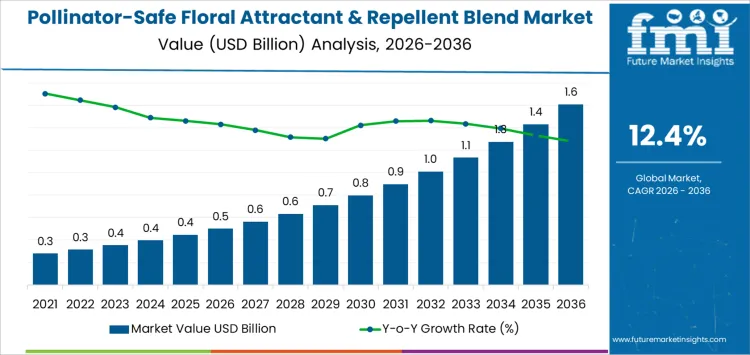
The global pollinator-safe floral attractant & repellent blend market is set to grow from USD 0.5 billion in 2026 to USD 1.6 billion by 2036, with a robust CAGR of 12.4%. Key segments driving this growth include attractant-dominant blends, which hold the largest market share at 34%. These blends are effective at attracting pollinators like bees and butterflies while being safe for them, enhancing pollination and improving crop yield without harming non-target species. Other significant segments include repellent-dominant blends, balanced attractant-repellent systems, and crop-specific floral mimic blends, which cater to specific pest control and pollinator interaction needs.
Quick Stats for Pollinator-Safe Floral Attractant & Repellent Blend Market
- Pollinator-Safe Floral Attractant & Repellent Blend Market Value (2026): USD 0.5 billion
- Pollinator-Safe Floral Attractant & Repellent Blend Market Forecast Value (2036): USD 1.6 billion
- Pollinator-Safe Floral Attractant & Repellent Blend Market Forecast CAGR: 12.4%
- Leading Functional Blend Type in Pollinator-Safe Floral Attractant & Repellent Blend Market: Attractant-Dominant Blends
- Key Growth Regions in Pollinator-Safe Floral Attractant & Repellent Blend Market: USA, France, Germany, China, India
- Key Players in Pollinator-Safe Floral Attractant & Repellent Blend Market: Bayer CropScience, BASF SE, Syngenta Group, ISCA Technologies, Russell IPM
In terms of application modes, foliar spray leads the market with a 46% share, offering broad coverage and efficient pest management while protecting pollinators. Dispenser/lure systems follow closely, providing targeted, long-lasting solutions for attracting pollinators and repelling pests. Seed & soil-adjacent applications and drone/precision placement are also gaining traction, offering more precise and effective delivery. The rising demand for eco-friendly pest control solutions, advancements in species-specific formulations, and regulatory pressure are further driving the adoption of these technologies, supporting both sustainability and pollinator conservation efforts in agriculture.
Pollinator‑Safe Floral Attractant & Repellent Blend Market Key Takeaways
| Metric | Value |
|---|---|
| Industry Value (2026) | USD 0.5 billion |
| Forecast Value (2036) | USD 1.6 billion |
| Forecast CAGR (2026 to 2036) | 12.4% |
How is the Global Pollinator‑Safe Floral Attractant & Repellent Blend Sector Advancing?
The global pollinator‑safe floral attractant & repellent blend market is expanding as growers and environmental stakeholders seek crop protection solutions that safeguard beneficial insect populations while managing pest pressure. These blends are engineered to attract pollinators like bees and butterflies to crop flowers while repelling harmful pests, enabling improved pollination and yield without exposing non‑target species to harmful chemicals. With growing awareness of pollinator declines due to habitat loss, pesticide exposure, and environmental stressors, demand for crop care products that support pollinator health has increased across agriculture sectors including fruits, vegetables, nuts, and specialty crops.
Traditional pest control systems often rely on broad‑spectrum chemical pesticides that can inadvertently harm pollinators or disrupt foraging behavior. Pollinator‑safe attractant and repellent technologies provide a more targeted approach, combining natural or bio‑based attractants that encourage pollinator visitation with repellents that deter pests without endangering beneficial insects. Advances in formulation science are improving the stability, specificity, and field performance of these blends, enabling growers to integrate them into existing integrated pest management (IPM) strategies.
The market is expected to grow strongly as sustainability becomes a central priority for agriculture and regulators tighten restrictions on pollinator‑harmful substances. Ongoing research into plant‑insect interactions and semiochemical signaling is driving the development of more effective and crop‑specific blends. Certification programs and consumer demand for sustainably produced food are encouraging adoption of pollinator‑safe solutions. Challenges such as the need for species‑specific optimization, variability in field conditions, and education on proper application may influence adoption rates. The increasing focus on ecological crop protection and pollinator conservation will continue to drive demand for floral attractant and repellent technologies that help balance crop protection with environmental stewardship.
What Is the Segment-Wise Analysis for the Global Pollinator-Safe Floral Attractant & Repellent Blend Market?
The global pollinator-safe floral attractant & repellent blend market is segmented by functional blend type and application mode. Attractant-dominant blends lead the market with a 34% share due to their ability to effectively draw in pollinators while being safe for them. Other key blend types include repellent-dominant blends, balanced attractant-repellent systems, and crop-specific floral mimic blends. In terms of application modes, foliar spray holds the largest share at 46%, followed by dispenser/lure systems, seed & soil-adjacent applications, and drone & precision placement.
Why Do Attractant-Dominant Blends Lead the Global Pollinator-Safe Floral Attractant & Repellent Blend Market?
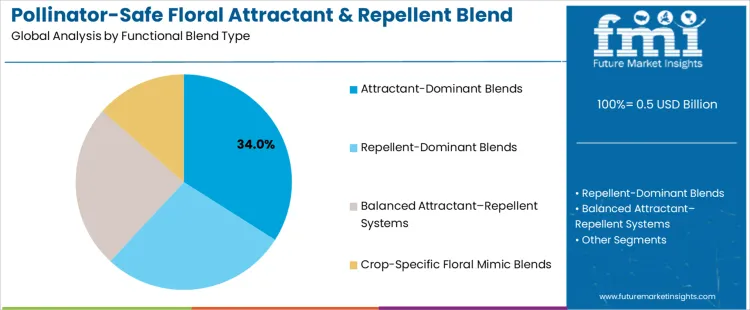
Attractant-dominant blends hold a 34% share in the global pollinator-safe floral attractant & repellent blend market due to their ability to effectively draw in pollinators, such as bees, while being safe for them. These blends are particularly valuable in agriculture and horticulture, where enhancing pollination efficiency is crucial for improving crop yields and ensuring biodiversity. Attractant-dominant blends are carefully formulated to attract pollinators without harming them, making them a sustainable and environmentally friendly option for farmers and gardeners. With increasing awareness of the importance of protecting pollinators and the demand for eco-friendly solutions, these blends have become the leading choice in the market, driving their dominance in pollinator-safe pest management.
How Does Foliar Spray Hold the Largest Market Share in the Global Pollinator-Safe Floral Attractant & Repellent Blend Market?
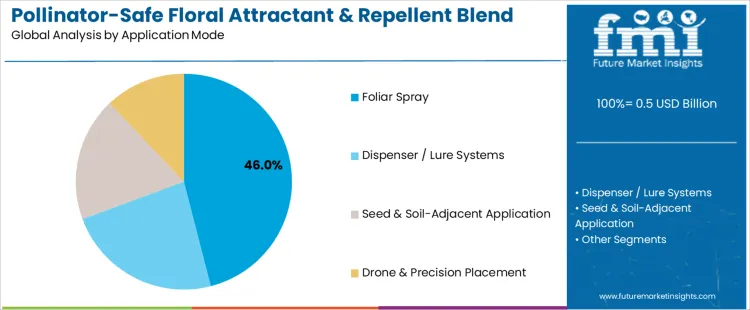
Foliar spray holds the largest share of 46% in the global pollinator-safe floral attractant & repellent blend market due to its efficiency in delivering active ingredients directly to plant leaves. This application method ensures broad coverage and consistent delivery of attractants or repellents, enabling effective management of pollinator populations and pests. Foliar spray is especially valuable in large-scale agricultural applications, where it can quickly cover vast areas with minimal labor. Its effectiveness, ease of application, and quick results make it the preferred method for ensuring crop protection and pollination management without harming beneficial pollinators. The ability to rapidly apply solutions across extensive areas has solidified foliar spray’s dominant position in the market.
What Is Shaping the Pollinator‑Safe Floral Attractant & Repellent Blend Market?
The pollinator‑safe floral attractant & repellent blend market is shaped by growing awareness of pollinator health and biodiversity conservation alongside the need for effective pest and pollinator management in agriculture, landscaping, and urban green spaces. These blends are designed to attract beneficial pollinators (like bees and butterflies) to target plants while repelling harmful insects without harming pollinators. Regulatory pressure to reduce pesticide risks, consumer demand for eco‑friendly products, and a rise in pollinator‑friendly certification programs are influencing market growth.
What Challenges Are Limiting Adoption of Pollinator‑Safe Floral Attractant & Repellent Blends?
Adoption can be limited by variable field performance and perception barriers. Efficacy of attractant and repellent blends can differ based on crop type, environmental conditions, and local pollinator species, making it challenging for growers to predict outcomes. Higher upfront costs compared with conventional pest control products can deter budget‑sensitive users. Limited awareness or expertise in integrating these blends into existing crop protection or landscape management programs may also slow uptake. Regulatory clarity around claims of ‘pollinator safety’ varies across regions.
What Key Trends Are Shaping the Pollinator‑Safe Floral Attractant & Repellent Blend Market?
Key trends include the development of highly targeted, species‑specific attractant and repellent chemistries that support precision pollinator guidance while minimizing attraction of unwanted insects. There is rising interest in bio‑based and natural ingredient blends that align with organic and sustainable agriculture practices. Integration with digital and precision agriculture tools such as sensor‑based monitoring and AI‑driven application timing is improving effectiveness. Partnerships between research institutions, chemical formulators, and grower organizations are accelerating adoption and education. Consumer demand for pollinator‑friendly products in home and commercial landscaping is also expanding market reach.
What is the Growth Outlook for the Pollinator-Safe Floral Attractant & Repellent Blend Market by Country?
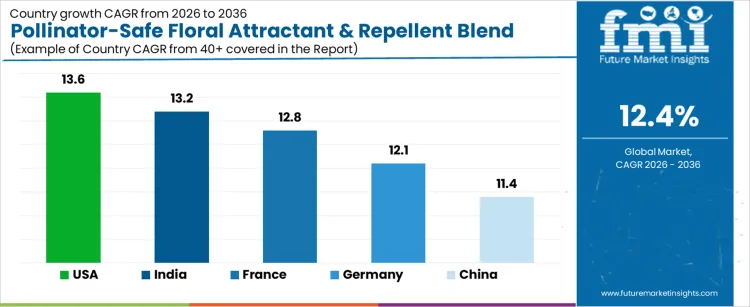
| Country | CAGR (%) |
|---|---|
| USA | 13.6% |
| France | 12.8% |
| Germany | 12.1% |
| China | 11.4% |
| India | 13.2% |
Source: FMI analysis based on primary research and proprietary forecasting model
The pollinator-safe floral attractant and repellent blend market is growing rapidly, with the USA leading at a 13.6% CAGR, driven by increasing awareness about pollinator health and the need for sustainable solutions in agriculture and horticulture. France follows closely with 12.8%, fueled by its focus on ecological farming and biodiversity protection. Germany’s market grows at 12.1%, supported by strong environmental regulations and sustainability initiatives. China’s market grows at 11.4%, driven by the need for effective pest management without harming pollinators. India shows steady growth at 13.2%, with a growing agricultural base and a rising focus on pollinator-friendly practices.
Why is the USA Leading in the Pollinator-Safe Floral Attractant & Repellent Blend Market?
The USA’s pollinator-safe floral attractant and repellent blend market is growing at 13.6%, driven by increasing concerns over the decline of pollinators like bees and butterflies, which are essential to agriculture and ecosystem health. As awareness of pollinator protection grows, there is rising demand for alternatives to chemical pesticides that do not harm these beneficial species. These floral blends attract pollinators while repelling harmful pests, offering a safer way to manage pest control in agriculture and landscaping. Government regulations encouraging sustainable farming practices and growing consumer demand for eco-friendly gardening products are also fueling market growth. With continued emphasis on biodiversity and the importance of pollinators, the USA’s market for pollinator-safe blends is expected to see steady expansion.
What is Driving the Growth of the Pollinator-Safe Floral Attractant & Repellent Blend Market in France?
France’s pollinator-safe floral attractant and repellent blend market is growing at 12.8%, driven by the country’s strong commitment to ecological farming practices and biodiversity conservation. France has been a leader in promoting sustainability in agriculture, and there is increasing interest in products that support pollinators while controlling pests. These blends are gaining popularity as they allow farmers and gardeners to manage pests without negatively affecting pollinator populations, which are critical for crop pollination. With the French government’s strong focus on reducing pesticide use and protecting the environment, demand for pollinator-safe products is rising. As France continues to push for green agriculture and greater biodiversity protection, the market for these blends is expected to grow steadily.
How is the Pollinator-Safe Floral Attractant & Repellent Blend Market Expanding in Germany?
Germany’s pollinator-safe floral attractant and repellent blend market is growing at 12.1%, supported by the country’s strict environmental regulations and commitment to sustainability in agriculture. With the decline in pollinator populations becoming a growing concern, German farmers and horticulturists are increasingly turning to safer alternatives for pest management. These blends attract pollinators while keeping harmful pests at bay, making them an ideal solution for sustainable agriculture. Germany’s agricultural policies, which promote biodiversity and the reduction of harmful chemical pesticides, are driving the adoption of pollinator-friendly products. As environmental protection remains a priority in the country, the demand for these floral blends is expected to continue growing.
What is Contributing to the Growth of the Pollinator-Safe Floral Attractant & Repellent Blend Market in China?
China’s pollinator-safe floral attractant and repellent blend market is growing at 11.4%, driven by the country’s large agricultural base and increasing focus on sustainable farming practices. With China facing growing concerns over pollinator health and the need to reduce chemical pesticide use, the adoption of eco-friendly alternatives is rising. Pollinator-safe floral blends help attract bees and other pollinators while deterring harmful pests, promoting healthier crop production. As the government enforces stricter regulations on pesticide use and emphasizes ecological farming, the demand for these blends is expected to increase. The growing awareness of the importance of pollinators in China’s agriculture is contributing to the steady growth of this market.
What is Driving the Growth of the Pollinator-Safe Floral Attractant & Repellent Blend Market in India?
India’s pollinator-safe floral attractant and repellent blend market is growing at 13.2%, driven by the country’s expanding agricultural sector and the increasing recognition of the importance of pollinators in crop production. As India faces challenges from pesticide use and the loss of pollinators, farmers are increasingly turning to eco-friendly alternatives that protect pollinator species while managing pests. These blends are gaining popularity as they offer a natural way to support pollination and improve crop yields. With rising awareness of environmental issues and government initiatives to promote sustainable farming practices, the demand for pollinator-safe floral blends is set to grow, helping India maintain its agricultural productivity in an environmentally responsible way.
How Are Companies Competing in the Pollinator‑Safe Floral Attractant & Repellent Blend Market?
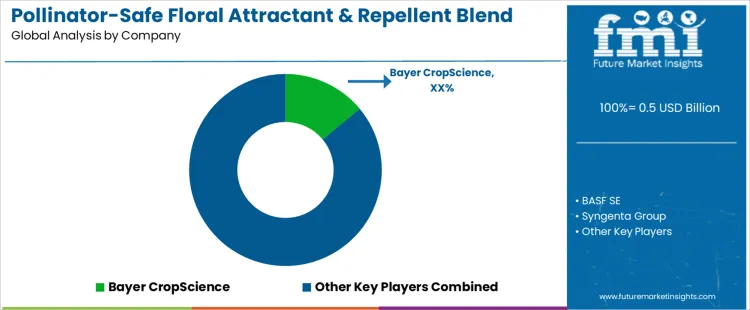
In the pollinator‑safe floral attractant and repellent blend market Bayer CropScience, BASF SE, Syngenta Group, ISCA Technologies, and Russell IPM are positioned with brochures that highlight selective attractant chemistries and repellent systems designed to protect crops while safeguarding pollinators. At Bayer CropScience the product literature showcases attractant blends that are described with field trial performance and pollinator safety data. Application timing recommendations and crop compatibility charts are provided. At BASF SE brochures present blended formulations that are marketed for tailoring pest behavior disruption without deterring beneficial species. Technical summaries include mode‑of‑action explanations and usage guidance.
Syngenta Group materials emphasize integrated floral attractant and repellent solutions that are positioned as part of wider crop protection programs. Efficacy results are highlighted and comparisons with conventional chemistries are shown. ISCA Technologies is featured with product brochures that detail semiochemical‑based attractants that support targeted pest interaction while pollinator exposure is minimized. Deployment instructions and dispenser guidelines are included. Russell IPM collateral presents attractant and repellent blends designed for specialty crops and orchard systems, with clear placement strategies and performance expectations under varied environmental conditions.
Key Players in Pollinator-Safe Floral Attractant & Repellent Blend Market
- Bayer CropScience
- BASF SE
- Syngenta Group
- ISCA Technologies
- Russell IPM
Scope of Report
| Items | Values |
|---|---|
| Quantitative Units (2026) | USD billion |
| Functional Blend Type | Attractant-Dominant Blends, Repellent-Dominant Blends, Balanced Attractant-Repellent Systems, Crop-Specific Floral Mimic Blends |
| Application Mode | Foliar Spray, Dispenser/Lure Systems, Seed & Soil-Adjacent Application, Drone & Precision Placement |
| Regions Covered | Asia Pacific, Europe, North America, Latin America, Middle East & Africa |
| Countries Covered | USA, China, Japan, South Korea, India, Australia & New Zealand, ASEAN, Germany, UK, France, Italy, Spain, Nordic, BENELUX, Brazil, Chile, Mexico, Saudi Arabia, Other GCC Countries, Turkey, South Africa, Other African Union |
| Key Companies Profiled | Bayer CropScience, BASF SE, Syngenta Group, ISCA Technologies, Russell IPM |
| Additional Attributes | Dollar sales by functional blend type, application mode, and region; regional CAGR and growth outlook; distribution channels including biocontrol service providers, pheromone-based solutions, and chemical suppliers; innovation trends in pollinator-safe floral attractants; competitive positioning of global vs regional suppliers. |
Pollinator-Safe Floral Attractant & Repellent Blend Market by Segments
By Functional Blend Type:
- Attractant-Dominant Blends
- Repellent-Dominant Blends
- Balanced Attractant-Repellent Systems
- Crop-Specific Floral Mimic Blends
By Application Mode
- Foliar Spray
- Dispenser / Lure Systems
- Seed & Soil-Adjacent Application
- Drone & Precision Placement
By Region:
- Asia Pacific
- China
- Japan
- South Korea
- India
- Australia & New Zealand
- ASEAN
- Rest of Asia Pacific
- Europe
- Germany
- United Kingdom
- France
- Italy
- Spain
- Nordic
- BENELUX
- Rest of Europe
- North America
- United States
- Canada
- Mexico
- Latin America
- Brazil
- Chile
- Rest of Latin America
- Middle East & Africa
- Kingdom of Saudi Arabia
- Other GCC Countries
- Turkey
- South Africa
- Other African Union
- Rest of Middle East & Africa
Bibliography
- United States Department of Agriculture. (2023). Pollinator health and integrated pest management practices including attractant and repellent strategies. USDA Technical and Guidance Publications.
- Pollinator Partnership. (2023). Best practice guidelines for pollinator-safe crop protection and habitat management. Pollinator Partnership Conservation Publications.
- Environmental Protection Agency. (2023). EPA guidance on pesticide formulation components and pollinator protection measures. EPA Regulatory and Guidance Publications.
- International Union for Conservation of Nature. (2023). Conservation strategies for pollinators and guidelines for pollinator-friendly agricultural inputs. IUCN Technical Reports.
Frequently Asked Questions
How big is the pollinator-safe floral attractant & repellent blend market in 2026?
The global pollinator-safe floral attractant & repellent blend market is estimated to be valued at USD 0.5 billion in 2026.
What will be the size of pollinator-safe floral attractant & repellent blend market in 2036?
The market size for the pollinator-safe floral attractant & repellent blend market is projected to reach USD 1.6 billion by 2036.
How much will be the pollinator-safe floral attractant & repellent blend market growth between 2026 and 2036?
The pollinator-safe floral attractant & repellent blend market is expected to grow at a 12.4% CAGR between 2026 and 2036.
What are the key product types in the pollinator-safe floral attractant & repellent blend market?
The key product types in pollinator-safe floral attractant & repellent blend market are attractant-dominant blends, repellent-dominant blends, balanced attractant–repellent systems and crop-specific floral mimic blends.
Which application mode segment to contribute significant share in the pollinator-safe floral attractant & repellent blend market in 2026?
In terms of application mode, foliar spray segment to command 46.0% share in the pollinator-safe floral attractant & repellent blend market in 2026.
Preview the report firsthand - request a free sample
Get SampleGet the brochure for pricing and purchase details.
Get PDFTable of Content
- Executive Summary
- Global Market Outlook
- Demand-side Trends
- Supply-side Trends
- Technology Roadmap Analysis
- Analysis and Recommendations
- Market Overview
- Market Coverage / Taxonomy
- Market Definition / Scope / Limitations
- Market Background
- Market Dynamics
- Drivers
- Restraints
- Opportunity
- Trends
- Scenario Forecast
- Demand in Optimistic Scenario
- Demand in Likely Scenario
- Demand in Conservative Scenario
- Opportunity Map Analysis
- Product Life Cycle Analysis
- Supply Chain Analysis
- Investment Feasibility Matrix
- Value Chain Analysis
- PESTLE and Porter’s Analysis
- Regulatory Landscape
- Regional Parent Market Outlook
- Production and Consumption Statistics
- Import and Export Statistics
- Market Dynamics
- Global Market Analysis 2021 to 2025 and Forecast, 2026 to 2036
- Historical Market Size Value (USD Million) Analysis, 2021 to 2025
- Current and Future Market Size Value (USD Million) Projections, 2026 to 2036
- Y-o-Y Growth Trend Analysis
- Absolute $ Opportunity Analysis
- Global Market Pricing Analysis 2021 to 2025 and Forecast 2026 to 2036
- Global Market Analysis 2021 to 2025 and Forecast 2026 to 2036, By Functional Blend Type
- Introduction / Key Findings
- Historical Market Size Value (USD Million) Analysis By Functional Blend Type , 2021 to 2025
- Current and Future Market Size Value (USD Million) Analysis and Forecast By Functional Blend Type , 2026 to 2036
- Attractant-Dominant Blends
- Repellent-Dominant Blends
- Balanced Attractant-Repellent Systems
- Crop-Specific Floral Mimic Blends
- Y-o-Y Growth Trend Analysis By Functional Blend Type , 2021 to 2025
- Absolute $ Opportunity Analysis By Functional Blend Type , 2026 to 2036
- Global Market Analysis 2021 to 2025 and Forecast 2026 to 2036, By Application Mode
- Introduction / Key Findings
- Historical Market Size Value (USD Million) Analysis By Application Mode, 2021 to 2025
- Current and Future Market Size Value (USD Million) Analysis and Forecast By Application Mode, 2026 to 2036
- Foliar Spray
- Dispenser / Lure Systems
- Seed & Soil-Adjacent Application
- Drone & Precision Placement
- Y-o-Y Growth Trend Analysis By Application Mode, 2021 to 2025
- Absolute $ Opportunity Analysis By Application Mode, 2026 to 2036
- Global Market Analysis 2021 to 2025 and Forecast 2026 to 2036, By Region
- Introduction
- Historical Market Size Value (USD Million) Analysis By Region, 2021 to 2025
- Current Market Size Value (USD Million) Analysis and Forecast By Region, 2026 to 2036
- North America
- Latin America
- Western Europe
- Eastern Europe
- East Asia
- South Asia and Pacific
- Middle East & Africa
- Market Attractiveness Analysis By Region
- North America Market Analysis 2021 to 2025 and Forecast 2026 to 2036, By Country
- Historical Market Size Value (USD Million) Trend Analysis By Market Taxonomy, 2021 to 2025
- Market Size Value (USD Million) Forecast By Market Taxonomy, 2026 to 2036
- By Country
- USA
- Canada
- Mexico
- By Functional Blend Type
- By Application Mode
- By Country
- Market Attractiveness Analysis
- By Country
- By Functional Blend Type
- By Application Mode
- Key Takeaways
- Latin America Market Analysis 2021 to 2025 and Forecast 2026 to 2036, By Country
- Historical Market Size Value (USD Million) Trend Analysis By Market Taxonomy, 2021 to 2025
- Market Size Value (USD Million) Forecast By Market Taxonomy, 2026 to 2036
- By Country
- Brazil
- Chile
- Rest of Latin America
- By Functional Blend Type
- By Application Mode
- By Country
- Market Attractiveness Analysis
- By Country
- By Functional Blend Type
- By Application Mode
- Key Takeaways
- Western Europe Market Analysis 2021 to 2025 and Forecast 2026 to 2036, By Country
- Historical Market Size Value (USD Million) Trend Analysis By Market Taxonomy, 2021 to 2025
- Market Size Value (USD Million) Forecast By Market Taxonomy, 2026 to 2036
- By Country
- Germany
- UK
- Italy
- Spain
- France
- Nordic
- BENELUX
- Rest of Western Europe
- By Functional Blend Type
- By Application Mode
- By Country
- Market Attractiveness Analysis
- By Country
- By Functional Blend Type
- By Application Mode
- Key Takeaways
- Eastern Europe Market Analysis 2021 to 2025 and Forecast 2026 to 2036, By Country
- Historical Market Size Value (USD Million) Trend Analysis By Market Taxonomy, 2021 to 2025
- Market Size Value (USD Million) Forecast By Market Taxonomy, 2026 to 2036
- By Country
- Russia
- Poland
- Hungary
- Balkan & Baltic
- Rest of Eastern Europe
- By Functional Blend Type
- By Application Mode
- By Country
- Market Attractiveness Analysis
- By Country
- By Functional Blend Type
- By Application Mode
- Key Takeaways
- East Asia Market Analysis 2021 to 2025 and Forecast 2026 to 2036, By Country
- Historical Market Size Value (USD Million) Trend Analysis By Market Taxonomy, 2021 to 2025
- Market Size Value (USD Million) Forecast By Market Taxonomy, 2026 to 2036
- By Country
- China
- Japan
- South Korea
- By Functional Blend Type
- By Application Mode
- By Country
- Market Attractiveness Analysis
- By Country
- By Functional Blend Type
- By Application Mode
- Key Takeaways
- South Asia and Pacific Market Analysis 2021 to 2025 and Forecast 2026 to 2036, By Country
- Historical Market Size Value (USD Million) Trend Analysis By Market Taxonomy, 2021 to 2025
- Market Size Value (USD Million) Forecast By Market Taxonomy, 2026 to 2036
- By Country
- India
- ASEAN
- Australia & New Zealand
- Rest of South Asia and Pacific
- By Functional Blend Type
- By Application Mode
- By Country
- Market Attractiveness Analysis
- By Country
- By Functional Blend Type
- By Application Mode
- Key Takeaways
- Middle East & Africa Market Analysis 2021 to 2025 and Forecast 2026 to 2036, By Country
- Historical Market Size Value (USD Million) Trend Analysis By Market Taxonomy, 2021 to 2025
- Market Size Value (USD Million) Forecast By Market Taxonomy, 2026 to 2036
- By Country
- Kingdom of Saudi Arabia
- Other GCC Countries
- Turkiye
- South Africa
- Other African Union
- Rest of Middle East & Africa
- By Functional Blend Type
- By Application Mode
- By Country
- Market Attractiveness Analysis
- By Country
- By Functional Blend Type
- By Application Mode
- Key Takeaways
- Key Countries Market Analysis
- USA
- Pricing Analysis
- Market Share Analysis, 2025
- By Functional Blend Type
- By Application Mode
- Canada
- Pricing Analysis
- Market Share Analysis, 2025
- By Functional Blend Type
- By Application Mode
- Mexico
- Pricing Analysis
- Market Share Analysis, 2025
- By Functional Blend Type
- By Application Mode
- Brazil
- Pricing Analysis
- Market Share Analysis, 2025
- By Functional Blend Type
- By Application Mode
- Chile
- Pricing Analysis
- Market Share Analysis, 2025
- By Functional Blend Type
- By Application Mode
- Germany
- Pricing Analysis
- Market Share Analysis, 2025
- By Functional Blend Type
- By Application Mode
- UK
- Pricing Analysis
- Market Share Analysis, 2025
- By Functional Blend Type
- By Application Mode
- Italy
- Pricing Analysis
- Market Share Analysis, 2025
- By Functional Blend Type
- By Application Mode
- Spain
- Pricing Analysis
- Market Share Analysis, 2025
- By Functional Blend Type
- By Application Mode
- France
- Pricing Analysis
- Market Share Analysis, 2025
- By Functional Blend Type
- By Application Mode
- India
- Pricing Analysis
- Market Share Analysis, 2025
- By Functional Blend Type
- By Application Mode
- ASEAN
- Pricing Analysis
- Market Share Analysis, 2025
- By Functional Blend Type
- By Application Mode
- Australia & New Zealand
- Pricing Analysis
- Market Share Analysis, 2025
- By Functional Blend Type
- By Application Mode
- China
- Pricing Analysis
- Market Share Analysis, 2025
- By Functional Blend Type
- By Application Mode
- Japan
- Pricing Analysis
- Market Share Analysis, 2025
- By Functional Blend Type
- By Application Mode
- South Korea
- Pricing Analysis
- Market Share Analysis, 2025
- By Functional Blend Type
- By Application Mode
- Russia
- Pricing Analysis
- Market Share Analysis, 2025
- By Functional Blend Type
- By Application Mode
- Poland
- Pricing Analysis
- Market Share Analysis, 2025
- By Functional Blend Type
- By Application Mode
- Hungary
- Pricing Analysis
- Market Share Analysis, 2025
- By Functional Blend Type
- By Application Mode
- Kingdom of Saudi Arabia
- Pricing Analysis
- Market Share Analysis, 2025
- By Functional Blend Type
- By Application Mode
- Turkiye
- Pricing Analysis
- Market Share Analysis, 2025
- By Functional Blend Type
- By Application Mode
- South Africa
- Pricing Analysis
- Market Share Analysis, 2025
- By Functional Blend Type
- By Application Mode
- USA
- Market Structure Analysis
- Competition Dashboard
- Competition Benchmarking
- Market Share Analysis of Top Players
- By Regional
- By Functional Blend Type
- By Application Mode
- Competition Analysis
- Competition Deep Dive
- Bayer CropScience
- Overview
- Product Portfolio
- Profitability by Market Segments (Product/Age /Sales Channel/Region)
- Sales Footprint
- Strategy Overview
- Marketing Strategy
- Product Strategy
- Channel Strategy
- BASF SE
- Syngenta Group
- ISCA Technologies
- Russell IPM
- Bayer CropScience
- Competition Deep Dive
- Assumptions & Acronyms Used
- Research Methodology


