
- Market Size (2026)
- USD 192.8 Bn
- Forecast (2036)
- USD 249.2 Bn
- CAGR (2026 to 2036)
- 2.6%
How Big Is the Pork Meat Market in 2026?
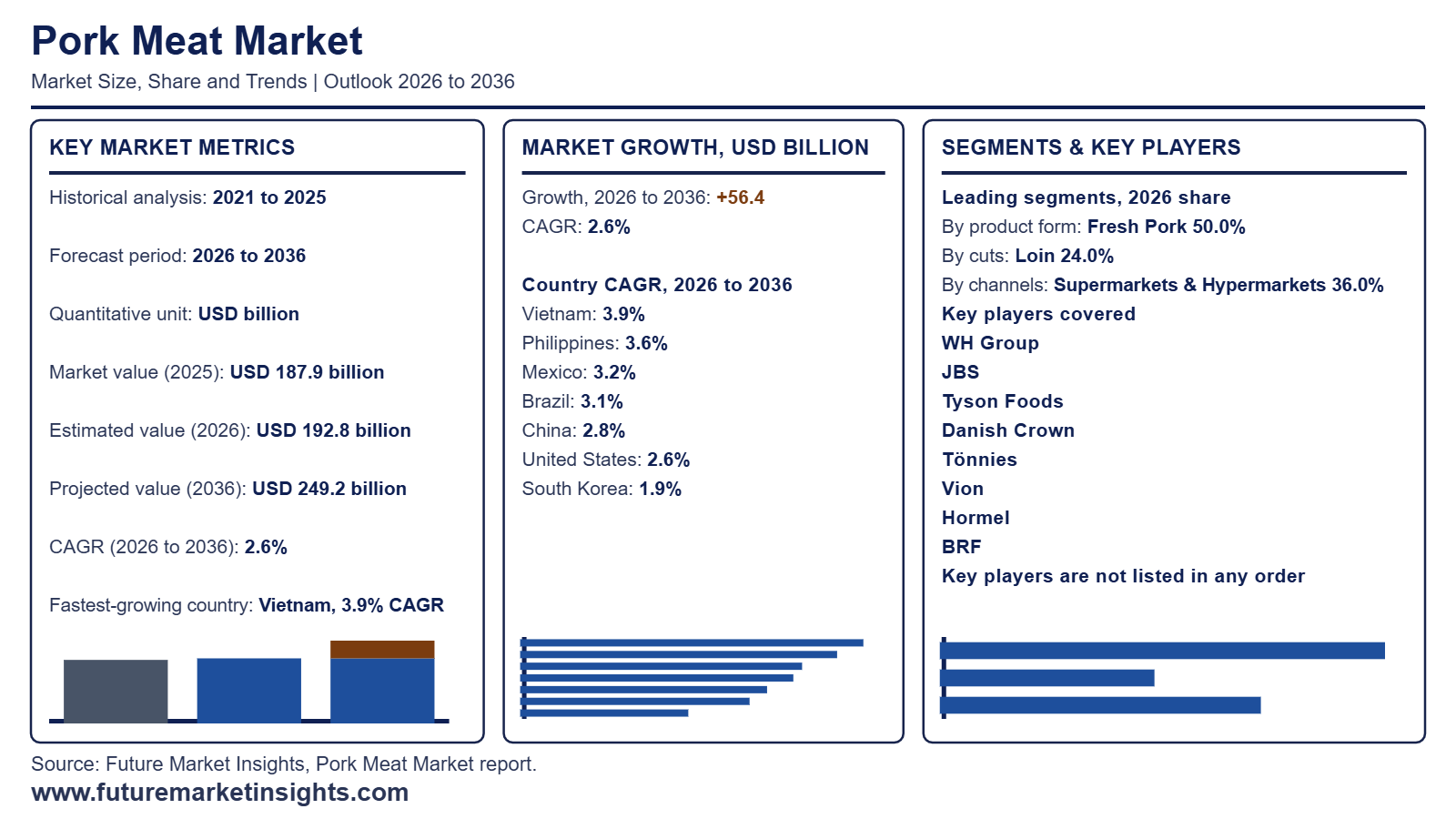
The global pork meat market is valued at USD 192.8 billion in 2026, up from USD 187.9 billion in 2025, and is projected by Future Market Insights (FMI) to reach USD 249.2 billion by 2036, expanding at a 2.6% CAGR from 2026 to 2036 and generating USD 56.4 billion in incremental revenue over the 10-year forecast period.
| Market Metric | Valuation / Share / Forecast Benchmark |
|---|---|
| 2025 Market Size (Historical) | USD 187.9 billion |
| 2026 Market Size (Estimated) | USD 192.8 billion |
| 2036 Market Size (Projected) | USD 249.2 billion |
| Compound Annual Growth Rate (2026 to 2036) | 2.6% CAGR |
| Incremental Dollar Opportunity (2026 to 2036) | USD 56.4 billion |
| Dominant Product Form (2026 to 2036 Share) | Fresh Pork (50.0% in 2026, 47.7% by 2036) | Processed fastest at 3.1% CAGR |
| Leading & Fastest-Growing Cuts | Loin (24.0% share in 2026; 2.8% CAGR) | Ribs (fastest, 3.0% CAGR) |
| Leading & Fastest-Growing Channels | Supermarkets & Hypermarkets (36.0% share in 2026; 2.2% CAGR) | Online Grocery (fastest, 8.0% CAGR) |
| Largest Country Markets (2026 Global Share) | China (45.0%), United States (11.0%), Germany and Japan (4.0% each) |
| Fastest-Growing Country Markets (2026 to 2036) | Vietnam (3.9% CAGR), Philippines (3.6% CAGR), Mexico (3.2% CAGR) |
| Leading Tier-1 Companies | WH Group, JBS, Tyson Foods, Danish Crown, Tönnies, Vion, Hormel, BRF |
Source: Future Market Insights analysis of the pork meat market, 2026.
Executive Market Overview
Sales of pork meat are rising in volume but not in price in 2026, as more hogs reached slaughter in the main producing regions while household demand stayed weak. WH Group (October 2026), the world's largest pork company, reported that its pork sales volume rose 3.0% in the first nine months, yet its revenue grew only 0.6% and profit before fair value adjustments fell 13%, as it described widespread price declines caused by regional oversupply. Low hog prices squeeze farm margins, which usually leads producers to cut herds and supports a price recovery one to two years later. Over the full forecast period, the market is set to grow at about 2.6% a year, led more by population, income and processed products than by price.
Revenue opportunities in the pork meat market are concentrated in processed products, foodservice and online grocery, where buyers pay more per kilogram than for fresh cuts sold at markets. Processed pork such as bacon, sausages and ready meals holds around 28% of revenue in 2026 and will grow at about 3.1% a year, faster than fresh pork. Restaurants and quick-service chains are adding pork dishes as eating out recovers, and foodservice will add about USD 18.4 billion by 2036. Online sales are the fastest-growing channel at about 8.0% a year, because cold-chain delivery now reaches more city households.
Analyst Perspective
"Hog prices are falling in all three main producing regions at the same time, so the large pork companies are relying on packaged meats to protect their profit. Disease closures are teaching importers to buy from more countries, and exporters from the Americas will keep part of the markets they won from Spain in 2026. Most of the new revenue over the next ten years will still come from Asia."
- Nandini Roy Choudhury, Principal Consultant, Future Market Insights (FMI)
Major Market Trends and Insights
- Animal Disease Is Reshaping Export Flows: African swine fever was found in wild boar near Barcelona in November 2025, and several importing countries closed their markets to Spanish pork. Spanish exports to Japan fell 73.9% in the first half of 2026 and exports to Mexico stopped, with an estimated loss of about EUR 350 million. Denmark, France and the United States have filled part of the gap. Buyers that rely on one supplying country are now spreading purchases across more origins, and exporters are pushing importers to accept regional zoning, so that only affected areas are closed. The Philippines accepted zoning for Spain in May 2026.
- Trade Duties Are Moving European Supply: New anti-dumping duties on selected European pork and the Spanish disease outbreak are expected to cut European Union pork exports by about 9% in 2026 to 2.75 million tonnes. More pork is staying inside Europe, which pushes down local hog prices and speeds up the exit of smaller farms in Spain, the Netherlands, Denmark and France. Lower European output will make room for exporters in the Americas over the next few years. Integrated firms with farms, plants and brands in several regions are already moving sales between markets as rules change.
- Processed and Ready-to-Cook Products Gain Shelf Space: Busy households in cities are buying more marinated cuts, sliced bacon, sausages and ready meals that save cooking time. Processed pork earns more per kilogram and keeps longer, which helps retailers cut waste. Packaged meat brands also hold prices better than fresh cuts when hog prices fall, which is why integrated pork companies are investing in branded products. Tyson Foods and WH Group both depend on packaged meats for a large share of their profit, while fresh pork margins move with the hog cycle.
What Are the Main Drivers, Restraints, and Opportunities?
Population growth, rising incomes in Asia and Latin America and the spread of processed and foodservice pork are driving steady growth in pork meat, while animal disease, trade duties and shifts towards poultry and plant-based foods restrain growth, and processed products, online sales and fast-growing Asian markets offer the largest new revenue.
Driver: Population, Income and Eating Out
Pork is the most eaten meat in East Asia and much of Europe, and more people and higher incomes in Asia and Latin America add steady demand. Pork is usually cheaper than beef, which makes it a main protein for many households. Eating out is recovering, and restaurants use pork belly, ribs and shoulder in many popular dishes. Fresh pork will add about USD 22.6 billion of revenue by 2036, the largest gain by product form, because most pork in Asia is still bought fresh.
Restraint: Animal Disease, Trade Rules and Changing Diets
African swine fever has caused large losses in Asia and Europe since 2018, and new outbreaks can close export markets quickly. Anti-dumping duties and other trade measures move supply between regions and add price risk. Some consumers in Europe and North America are eating less red meat for health and environmental reasons, and poultry is gaining share because it is cheaper to produce. Hog prices fell across the main regions in 2026, which cut producer profits.
Opportunity: Processed Pork, Online Sales and Southeast Asia
Processed pork will grow at about 3.1% a year and add around USD 19.3 billion by 2036. Online grocery is the fastest-growing channel at about 8.0% a year. Foodservice will grow at around 3.4% a year. Vietnam is projected to grow at about 3.9% a year, the fastest of the profiled countries, as incomes rise and herds recover from disease, while the Philippines will grow at about 3.6%.
How Is the Pork Meat Market Segmented?
The pork meat market is segmented into product form, cut, distribution channel and region, with values shown in USD billion.
| Segmentation Axis | Sub-Segments Covered | 2026 Leading Segment & Share | Main Growth Benchmark (2026 to 2036) |
|---|---|---|---|
| Product Form | Fresh, Processed, Frozen | Fresh Pork (50.0% revenue share) | Processed (3.1% CAGR) vs. Fresh (2.1% CAGR) |
| Cut | Loin, Belly, Ham, Shoulder, Ribs, Others | Loin (24.0% revenue share) | Ribs (3.0% CAGR) vs. Ham (2.2% CAGR) |
| Distribution Channel | Supermarkets & Hypermarkets, Traditional Markets & Butchers, Foodservice, Online Grocery, Others | Supermarkets & Hypermarkets (36.0% revenue share) | Online Grocery leads growth at an 8.0% CAGR vs. Traditional Markets at 1.2% |
| Region | East Asia, Europe, North America, South Asia & Pacific, Latin America, Middle East & Africa | East Asia (53.0% revenue share) | South Asia & Pacific leads regional growth at a 3.8% CAGR; Vietnam leads national growth at a 3.9% CAGR |
Source: Future Market Insights analysis of the pork meat market, 2026.
Why Does the Fresh Pork Segment Lead by Product Form?
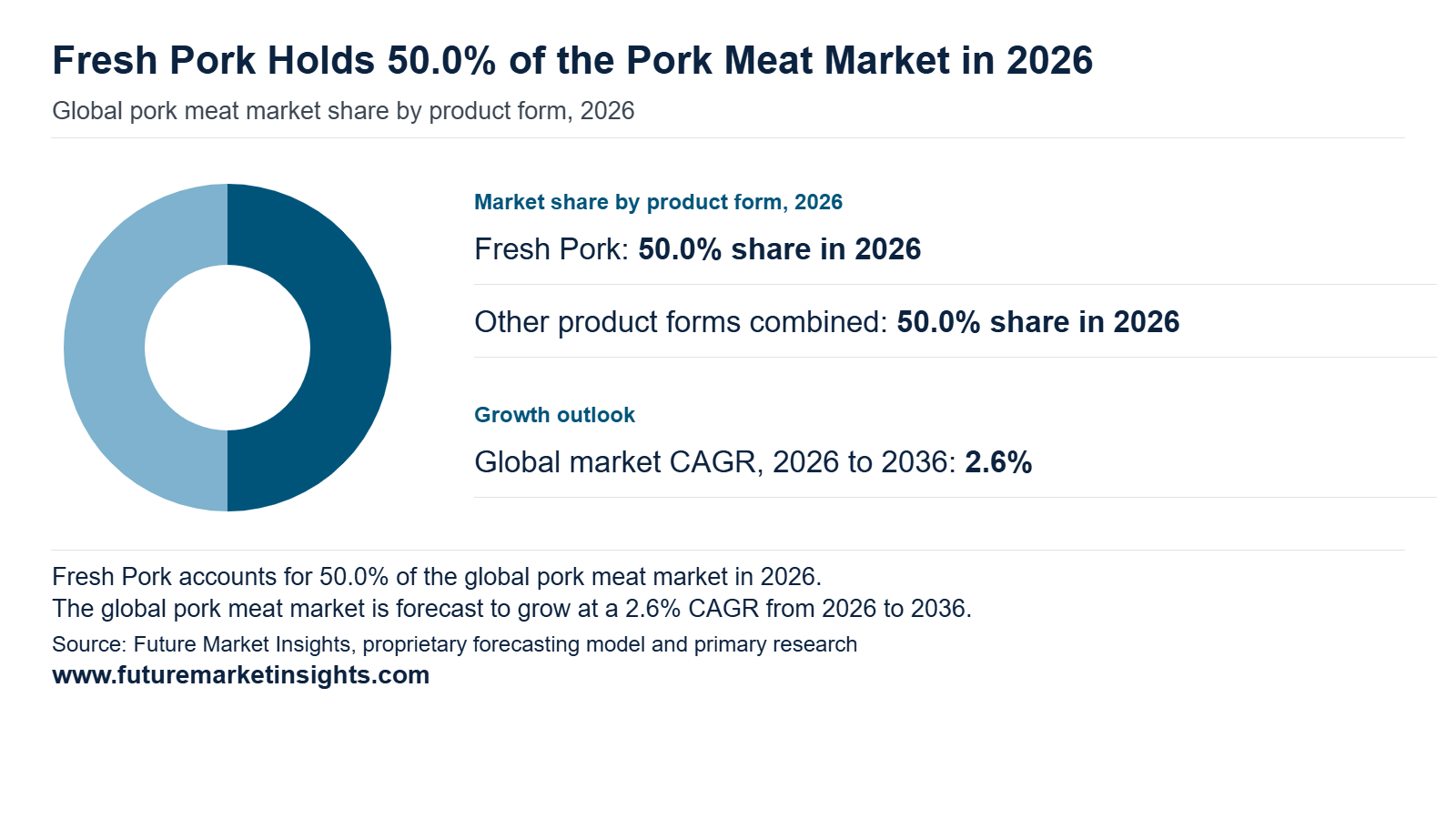
Most households in Asia and Europe buy pork fresh from markets, butchers and supermarkets and cook it at home, which gives fresh pork around 50% of revenue in 2026, worth about USD 96.4 billion. It is likely to grow at around 2.1% a year, slower than the market, as more buyers choose processed and ready-to-cook products. Processed pork holds about 28% and will grow at close to 3.1%, the fastest form. Frozen pork, used in trade, foodservice and food processing, holds about 22% and will grow at around 3.0% a year.
Why Does the Loin Segment Lead by Cut?
Loin chops and tenderloin are lean, easy to cook and sold in almost every market, which makes loin the largest cut, with around 24% of revenue in 2026, worth about USD 46.3 billion. This segment is likely to grow at about 2.8% a year through 2036. Belly holds about 22% and will grow at around 2.8%, supported by bacon in the West and grilled belly in Korea and other Asian markets. Ham holds about 20% and will grow at close to 2.2%. Shoulder holds about 16%, while ribs hold about 8% and are the fastest-growing cut at around 3.0% a year.
Why Does the Supermarket Segment Lead by Distribution Channel?
Supermarkets and hypermarkets sell packed fresh and processed pork with chilled storage and steady quality, and they account for about 36% of revenue in 2026, worth around USD 69.4 billion. This channel is likely to grow at about 2.2% a year through 2036. Traditional markets and butchers hold about 28% and will grow at only around 1.2%, as shoppers in Asian cities move to supermarkets and online stores. Foodservice holds about 24% and will grow at close to 3.4%. Online grocery holds about 5% and is the fastest-growing channel at around 8.0% a year.
Pork Meat Market by Region and Country (2026 to 2036)
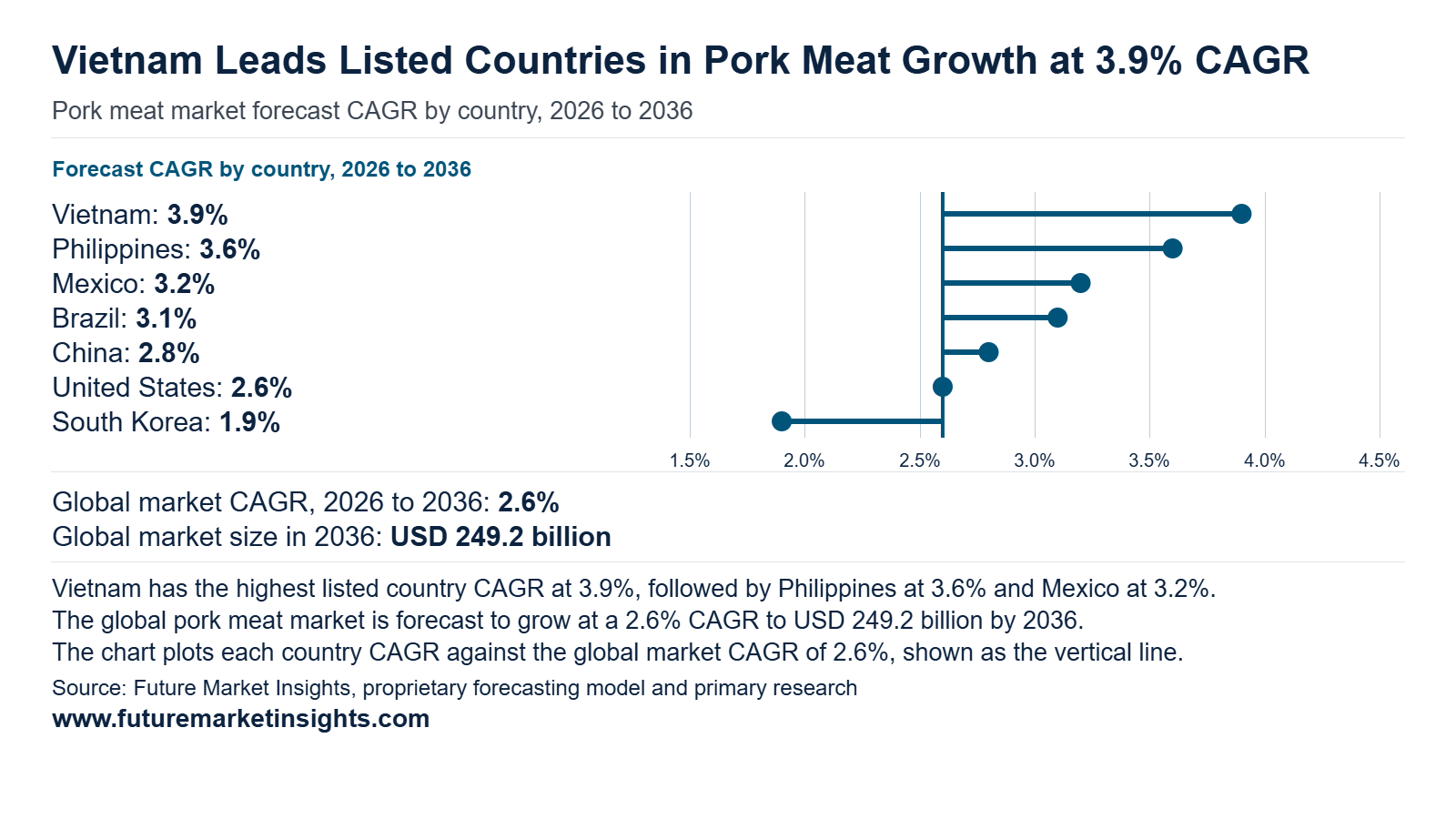
Backed by the world's largest pork-eating population, East Asia is likely to remain the highest market for pork meat, with around 53% of global revenue in 2026. East Asia will grow at about 2.8% a year. Europe holds about 20% and will grow at close to 1.5%, the slowest region, as herds shrink and exports fall. North America accounts for roughly 14% and will grow at around 2.6%. South Asia and Pacific will be the fastest-growing region at about 3.8% a year, led by Vietnam and the Philippines. Latin America will grow at about 3.2% and the Middle East and Africa at around 3.0%. The ten profiled countries make up around 80.5% of global revenue.
| Country | 2026 Revenue | 2036 Revenue | 10-Year Addition | 2026 to 2036 CAGR | Global Share (2026 → 2036) |
|---|---|---|---|---|---|
| China | USD 86.8 billion | USD 114.4 billion | +USD 27.6 billion | 2.8% | 45.0% → 45.9% |
| United States | USD 21.2 billion | USD 27.4 billion | +USD 6.2 billion | 2.6% | 11.0% → 11.0% |
| Germany | USD 7.7 billion | USD 8.5 billion | +USD 0.8 billion | 1.0% | 4.0% → 3.4% |
| Japan | USD 7.7 billion | USD 8.9 billion | +USD 1.2 billion | 1.4% | 4.0% → 3.6% |
| Vietnam | USD 6.7 billion | USD 9.9 billion | +USD 3.1 billion | 3.9% | 3.5% → 4.0% |
| Spain | USD 5.8 billion | USD 6.9 billion | +USD 1.1 billion | 1.8% | 3.0% → 2.8% |
| South Korea | USD 5.8 billion | USD 7.0 billion | +USD 1.2 billion | 1.9% | 3.0% → 2.8% |
| Brazil | USD 4.8 billion | USD 6.5 billion | +USD 1.7 billion | 3.1% | 2.5% → 2.6% |
| Mexico | USD 4.8 billion | USD 6.6 billion | +USD 1.8 billion | 3.2% | 2.5% → 2.7% |
| Philippines | USD 3.9 billion | USD 5.5 billion | +USD 1.6 billion | 3.6% | 2.0% → 2.2% |
Source: Future Market Insights analysis of the pork meat market, 2026.
China
China eats about half of the world's pork, which makes it by far the largest pork meat market, worth about USD 86.8 billion in 2026. It will grow at around 2.8% a year to nearly USD 114.4 billion by 2036. The government is cutting the national sow herd towards its target of about 37.5 million head to stop prices falling further, after strong slaughter in 2026 kept supply high. Large integrated farms now produce a growing share of hogs, replacing small backyard farms that were hit by African swine fever. Imports have fallen as local output has risen, and anti-dumping duties on selected European pork have shifted the remaining imports between suppliers. WH Group, through its Shuanghui business, is a leading processor. China will add about USD 27.6 billion of revenue, around 49% of new global value.
United States
The United States is the second-largest pork market and one of the largest exporters, with a market valued at about USD 21.2 billion in 2026. It will grow at around 2.6% a year to nearly USD 27.4 billion by 2036. Tyson Foods said in September 2026 that larger hog supplies had pushed down hog and wholesale pork prices, and it expected pork operating income of USD 200 million to USD 250 million for its fiscal year. Bacon, sausages and ham hold a large share of sales through supermarkets and restaurants. US exporters are gaining sales in Japan and Mexico where Spanish pork is restricted. Smithfield, owned mainly by WH Group, and Hormel are leading packaged pork brands. The United States will add about USD 6.2 billion of revenue, around 11% of new global value.
Germany
Germany has long been Europe's largest pork eater, but its market is valued at about USD 7.7 billion in 2026 and will grow at only around 1.0% a year, the slowest of the profiled countries, to nearly USD 8.5 billion by 2036. Pork eating per person has fallen for many years as more people choose poultry, plant-based foods or less meat. Stricter animal welfare rules and new labels on farming methods raise costs for farms and slaughterhouses. Many small pig farms have closed, and exports to Asia have not recovered since African swine fever was found in German wild boar in 2020. Tönnies and Vion are the largest processors. Germany will add close to USD 0.81 billion of revenue, while its share falls from 4.0% to about 3.4%.
Japan
Pork is the most eaten meat in Japan, which supports a market valued at around USD 7.7 billion in 2026. It will grow at about 1.4% a year to nearly USD 8.9 billion by 2036. Japan imports about half of its pork, and the closure to Spanish pork after the 2025 disease outbreak cut Spanish shipments to Japan by 73.9% in the first half of 2026. Suppliers from Denmark, France and the United States have filled much of the gap. A shrinking population limits volume growth, but demand for ready meals, convenience store food and processed pork remains steady. Nippon Ham is a leading processor. Japan will add about USD 1.2 billion of revenue, while its global share falls from 4.0% to about 3.6%.
Vietnam
Pork makes up most of the meat eaten in Vietnam, and the pork meat market there is worth about USD 6.7 billion in 2026. It will grow at around 3.9% a year, the fastest of the profiled countries, to nearly USD 9.9 billion by 2036. Herds have recovered from African swine fever, helped by a locally developed vaccine and larger, better-protected farms. Large firms such as Masan MEATLife and CP Vietnam are building modern slaughterhouses and branded chilled pork lines to replace sales at wet markets. Rising incomes and the growth of supermarkets in Hanoi and Ho Chi Minh City support demand for packed pork. Spain has increased exports to Vietnam since 2025. Vietnam will add about USD 3.1 billion of revenue, around 5.6% of new global value.
Spain
Spain is the European Union's largest pork producer and exporter, and its domestic pork meat market is valued at around USD 5.8 billion in 2026. It will grow at about 1.8% a year to nearly USD 6.9 billion by 2036. The African swine fever outbreak in wild boar near Barcelona in November 2025 closed several export markets and cut Spanish pork prices sharply. More pork is now sold inside Spain and other EU countries, which keeps local prices low. Exporters are working to reopen markets through regional zoning agreements, and the Philippines reopened in May 2026. Cured ham and sausages remain important processed products, and tourism adds strong restaurant demand in coastal regions. Spain will add about USD 1.1 billion of revenue, around 2.0% of new global value.
South Korea
Grilled pork belly is one of the most popular dishes in South Korea, supporting a pork meat market worth about USD 5.8 billion in 2026. It will grow at around 1.9% a year to nearly USD 7.0 billion by 2036. Korea imports a large share of its pork, mainly from the United States, Europe and Chile, and Spain has increased its shipments in 2026. Demand for belly and shoulder cuts is high, which raises their prices compared with loin. Restaurants and barbecue chains are major buyers, and online grocery delivery is growing quickly in large cities. Farmers face pressure from rules on odour and waste. South Korea will add close to USD 1.2 billion of revenue, around 2.1% of new global value.
Brazil
Brazil is a fast-growing pork exporter with low feed costs, and its domestic market is valued at around USD 4.8 billion in 2026. It will grow at about 3.1% a year to nearly USD 6.5 billion by 2036. BRF and JBS, through Seara, are the leading producers and sell branded sausages, ham and fresh cuts. Pork is cheaper than beef in Brazil, which supports home eating as beef prices stay high. The country is free of African swine fever and is gaining export sales in Asia and Latin America. Southern states such as Santa Catarina hold most of the herd, and new plants are being built there to meet export rules. Brazil will add about USD 1.7 billion of revenue, around 3.1% of new global value.
Mexico
Rising incomes and a growing population support pork demand in Mexico, where the market is worth about USD 4.8 billion in 2026. It will grow at around 3.2% a year to nearly USD 6.6 billion by 2036. Mexico is one of the largest buyers of US pork, and imports have grown as Spanish supply stopped in 2026. Tacos al pastor, carnitas and other popular dishes use large volumes of shoulder and leg. Large local producers such as Granjas Carroll and Porcícola Kekén are adding farms and plants. Supermarkets and convenience stores are growing, but traditional markets still sell much of the fresh pork, often from local slaughterhouses. Mexico will add about USD 1.8 billion of revenue, around 3.2% of new global value.
Philippines
Pork is the main meat in the Philippine diet, and the market is valued at around USD 3.9 billion in 2026. It will grow at about 3.6% a year to nearly USD 5.5 billion by 2036. African swine fever cut local herds sharply after 2019, and imports rose to fill the gap. The government has started vaccination and herd rebuilding programmes and uses import quotas and lower tariffs to keep prices in check. The Philippines reopened its market to Spanish pork in May 2026 after accepting regional zoning. Fast food chains and wet markets are major outlets, and cold storage capacity is expanding around Manila to handle imported frozen pork. The Philippines will add about USD 1.6 billion of revenue, around 2.9% of new global value.
Competitive Environment and Notable Companies
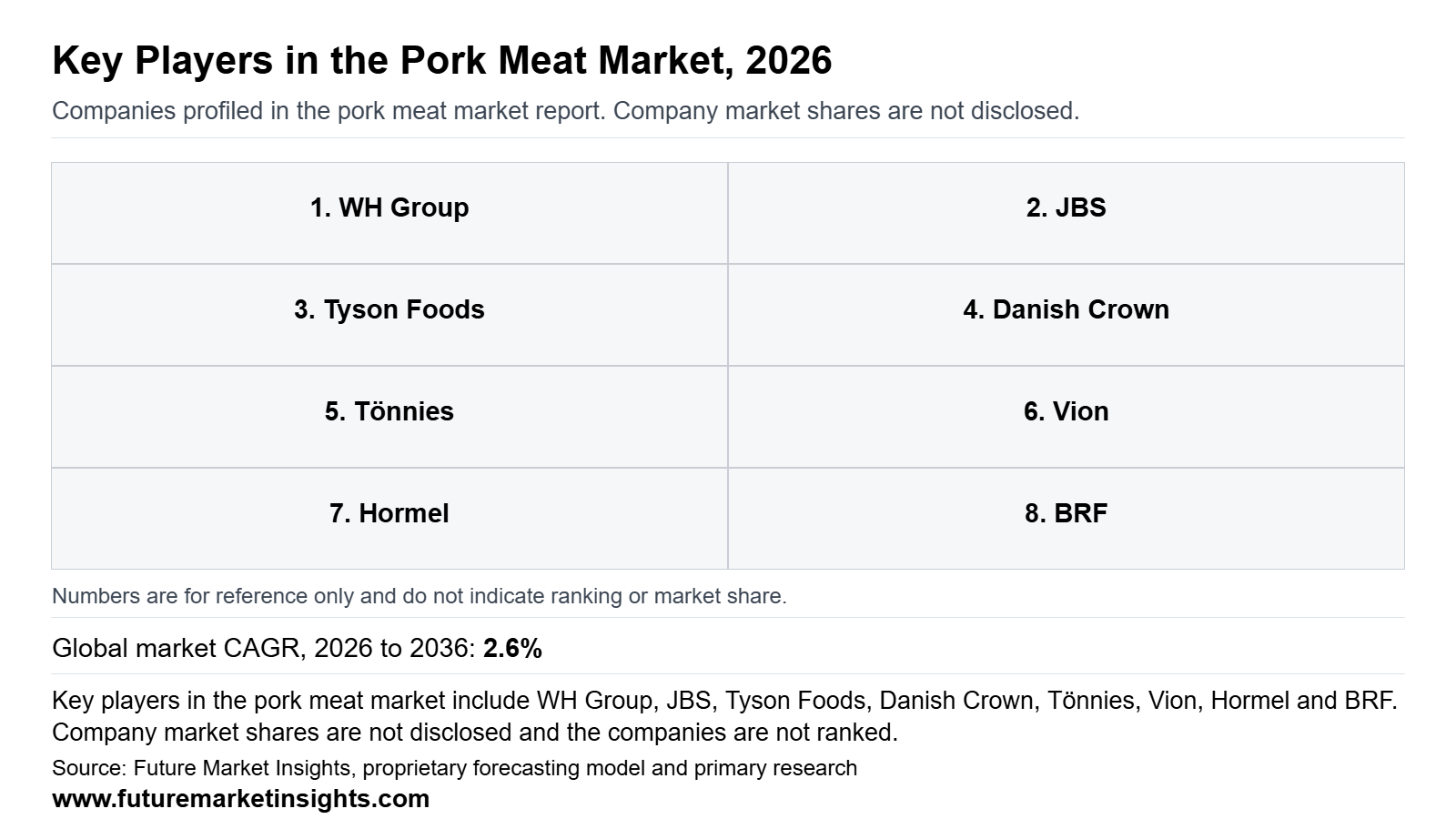
WH Group (including Smithfield and Shuanghui), JBS, Tyson Foods, Danish Crown, Tönnies, Vion, Hormel, Seaboard, Nippon Ham and BRF are among the leading pork companies. Large integrated firms own farms, slaughterhouses and brands, which helps them manage hog price swings. Competition is concentrated on cost per kilogram, food safety, disease control, export access and brand strength in packaged meats. Many local processors compete in fresh pork in each country.
How Are Companies Positioned in the Pork Meat Market?
WH Group (October 2026) reported 3.0% higher pork sales volume in the first nine months but lower profit as prices fell. Tyson Foods (September 2026) cited larger hog supplies and softer pork prices in its updated outlook. Exporters are shifting sales between markets as disease and trade rules change.
How Do Retailers and Food Companies Choose a Pork Supplier?
Price per kilogram, food safety records, steady supply, product range and animal welfare standards are the main points buyers compare. Large retailers also ask for traceability back to the farm and stable delivery schedules.
Which Capabilities Distinguish Supplier Offers?
Control of the full chain from farm to brand, strong disease protection, export approvals in many countries, processed and ready-to-cook product lines and cold-chain logistics set suppliers apart.
How Does Geographic Reach Affect Competition?
Disease outbreaks and trade duties can close markets quickly, so companies with plants in several countries can move sales more easily. Exporters from the United States, Brazil, Denmark and Spain compete for buyers in Asia and Mexico.
| Verified Company Evidence (2026) | Commercial Effect | Buyer Action |
|---|---|---|
| October 2026: WH Group reported nine-month revenue of USD 20.61 billion, up 0.6%, with pork volume up 3.0% and profit before fair value adjustments down about 13%, citing price declines from regional oversupply (The Standard, October 2026). | Higher volumes are not lifting revenue while hog prices fall. | Use low prices to fix longer supply contracts for fresh and frozen pork. |
| 3 September 2026: Tyson Foods said larger hog supplies had softened hog and wholesale pork prices and set fiscal 2026 pork operating income at USD 200 million to USD 250 million (Tyson Foods, September 2026). | Confirms oversupply in North America. | Review pricing terms in contracts linked to wholesale pork indices. |
| September 2026: ANICE estimated that African swine fever restrictions cut Spanish pork exports to Japan by 73.9% in the first half of 2026 and stopped exports to Mexico, a loss of about EUR 350 million (Pig333, September 2026). | Moves import demand to Danish, French and US suppliers. | Approve more than one origin country for key cuts. |
Source: Verified corporate disclosures and Future Market Insights analysis, 2026.
| Company | Core Positioning | Verified Activity & Source Attribution |
|---|---|---|
| WH Group (Smithfield, Shuanghui) | World's largest pork company | Nine-month 2026 pork volume up 3.0%; profit down about 13% (The Standard, October 2026). |
| Tyson Foods | US pork processor and packaged meats | Fiscal 2026 pork operating income outlook of USD 200-250 million (Tyson Foods, September 2026). |
| JBS (Seara) | Pork in Brazil, the United States and Europe | Company information. |
| Danish Crown | Leading European pork exporter | Company information. |
Source: Verified corporate disclosures and Future Market Insights analysis, 2026.
Pork Meat Market Report Scope and Research Methodology
Pork consumption in each country, taken from national statistics, USDA and FAO data, is multiplied by average retail and foodservice prices for each product form to build FMI's estimate. Forecasts are based on population, income, herd size, disease risk, trade rules and diet changes. Results are checked against the reported pork and packaged meat revenue of listed companies.
| Coverage Field | Report Scope |
|---|---|
| Market definition | Meat from pigs sold fresh, frozen or processed to households, restaurants and food companies. |
| Product forms | Fresh, processed and frozen. |
| Cuts | Loin, belly, ham, shoulder, ribs and others. |
| Distribution channels | Supermarkets and hypermarkets, traditional markets and butchers, foodservice, online grocery and others. |
| Processed products | Bacon, sausages, ham products, marinated cuts and ready meals with pork as the main ingredient. |
| Customer types | Households, restaurants and quick-service chains, and food manufacturers. |
| Trade coverage | Domestic sales and imports, valued in the country of consumption. |
| Exclusions | Live pigs, pork by-products for pet food and non-food uses, and lard. |
| Quantitative units | USD billion for value. |
| Volume basis | Tonnes carcass weight equivalent, used to check value estimates. |
| Value basis | Retail and foodservice value in the country of consumption. |
| Regions covered | East Asia, Europe, North America, South Asia & Pacific, Latin America, and Middle East & Africa. |
| National coverage | China, United States, Germany, Japan, Vietnam, Spain, South Korea, Brazil, Mexico, Philippines. |
| Companies covered | WH Group, JBS, Tyson Foods, Danish Crown, Tönnies, Vion, Hormel, Seaboard, Nippon Ham and BRF. |
Source: Future Market Insights analysis of the pork meat market, 2026.
Research Sources and Bibliography
- The Standard. (2026, October). World's largest pork producer net profit drops 13 pc.
- Tyson Foods, Inc. (2026, September 3). Tyson Foods updates fiscal 2026 outlook.
- Pig333 (3tres3). (2026, September 8). ANICE assesses the impact of ASF on Spanish pork exports.
- S&P Global Commodity Insights. (2026, March 16). EU pork exports to slump in 2026 as ASF, China tariffs trigger restructuring: USDA.
- Pig333 (3tres3), with USDA FAS data. (2026, October 9). ASF and weak China demand to reshape 2027 pork trade.
- Pig333 (3tres3). (2026, May 27). Spain can now issue export certificates for pork to the Philippines.
Table of Content
- Key Takeaways
- Market Size and CAGR
- Top Growth Driver
- Fastest Growing Segment
- Leading Region
- Key Companies
- Emerging Opportunities
- Executive Summary
- Global Market Outlook
- Demand-side Trends
- Supply-side Trends
- Technology Roadmap Analysis
- Analysis and Recommendations
- Analyst Perspective (What is happening? Why now? What should investors know?)
- Key Questions Answered
- How large is the market?
- What is the CAGR?
- What are key trends?
- Which region dominates?
- Who are the leaders?
Read More...
- Market Overview
- Market Coverage / Taxonomy
- Market Definition / Scope / Limitations
- Research Methodology
- Chapter Orientation
- Analytical Lens and Working Hypotheses
- Market Structure, Signals, and Trend Drivers
- Benchmarking and Cross-market Comparability
- Market Sizing, Forecasting, and Opportunity Mapping
- Research Design and Evidence Framework
- Desk Research Programme (Secondary Evidence)
- Expert Input and Fieldwork (Primary Evidence)
- Tooling, Models, and Reference Databases
- Data Engineering and Model Build
- Quality Assurance and Audit Trail
- Market Background
- Market Dynamics (Drivers, Restraints, Opportunity, Trends)
- Scenario Forecast (Optimistic, Likely, Conservative)
- Impact Analysis
- AI Impact
- Sustainability Impact
- Regulatory Impact
- Technology Impact
- Consumer / Buyer Analysis
- Purchase Drivers
- Adoption Barriers
- Buyer Journey
- Opportunity Map Analysis
- Product Life Cycle Analysis
- Supply Chain Analysis
- Investment Feasibility Matrix
- Value Chain Analysis
- PESTLE and Porter's Analysis
- Regulatory Landscape
- Regional Parent Market Outlook
- Production and Consumption Statistics
- Import and Export Statistics
- Global Pork Meat Market Analysis and Forecast, 2021 to 2036
- Historical Market Size Value (USD Billion) Analysis, 2021 to 2025
- Current and Future Market Size Value (USD Billion) Projections, 2026 to 2036
- Y-o-Y Growth Trend Analysis
- Absolute $ Opportunity Analysis
- Global Pork Meat Market Pricing Analysis, 2021 to 2036
- Global Pork Meat Market Analysis and Forecast, By Product Form, 2021 to 2036
- Introduction / Key Findings
- Historical Market Size Value (USD Billion) Analysis By Product Form, 2021 to 2025
- Current and Future Market Size Value (USD Billion) Analysis and Forecast By Product Form, 2026 to 2036
- Fresh
- Processed
- Frozen
- Y-o-Y Growth Trend Analysis By Product Form, 2021 to 2025
- Absolute $ Opportunity Analysis By Product Form, 2026 to 2036
- Global Pork Meat Market Analysis and Forecast, By Cut, 2021 to 2036
- Introduction / Key Findings
- Historical Market Size Value (USD Billion) Analysis By Cut, 2021 to 2025
- Current and Future Market Size Value (USD Billion) Analysis and Forecast By Cut, 2026 to 2036
- Loin
- Belly
- Ham
- Shoulder
- Ribs
- Others
- Y-o-Y Growth Trend Analysis By Cut, 2021 to 2025
- Absolute $ Opportunity Analysis By Cut, 2026 to 2036
- Global Pork Meat Market Analysis and Forecast, By Distribution Channel, 2021 to 2036
- Introduction / Key Findings
- Historical Market Size Value (USD Billion) Analysis By Distribution Channel, 2021 to 2025
- Current and Future Market Size Value (USD Billion) Analysis and Forecast By Distribution Channel, 2026 to 2036
- Supermarkets & Hypermarkets
- Traditional Markets & Butchers
- Foodservice
- Online Grocery
- Others
- Y-o-Y Growth Trend Analysis By Distribution Channel, 2021 to 2025
- Absolute $ Opportunity Analysis By Distribution Channel, 2026 to 2036
- Global Pork Meat Market Analysis and Forecast, By Region, 2021 to 2036
- Introduction
- Historical Market Size Value (USD Billion) Analysis By Region, 2021 to 2025
- Current Market Size Value (USD Billion) Analysis and Forecast By Region, 2026 to 2036
- East Asia
- Europe
- North America
- South Asia & Pacific
- Latin America
- Middle East & Africa
- Market Attractiveness Analysis By Region
- East Asia Pork Meat Market Analysis and Forecast, By Country, 2021 to 2036
- Historical Market Size Value (USD Billion) Trend Analysis By Market Taxonomy, 2021 to 2025
- Market Size Value (USD Billion) Forecast By Market Taxonomy, 2026 to 2036
- By Country
- China
- Japan
- South Korea
- Rest of East Asia
- By Product Form
- By Cut
- By Distribution Channel
- By Country
- Market Attractiveness Analysis
- By Country
- By Product Form
- By Cut
- By Distribution Channel
- Key Takeaways
- Europe Pork Meat Market Analysis and Forecast, By Country, 2021 to 2036
- Historical Market Size Value (USD Billion) Trend Analysis By Market Taxonomy, 2021 to 2025
- Market Size Value (USD Billion) Forecast By Market Taxonomy, 2026 to 2036
- By Country
- Germany
- Spain
- Rest of Europe
- By Product Form
- By Cut
- By Distribution Channel
- By Country
- Market Attractiveness Analysis
- By Country
- By Product Form
- By Cut
- By Distribution Channel
- Key Takeaways
- North America Pork Meat Market Analysis and Forecast, By Country, 2021 to 2036
- Historical Market Size Value (USD Billion) Trend Analysis By Market Taxonomy, 2021 to 2025
- Market Size Value (USD Billion) Forecast By Market Taxonomy, 2026 to 2036
- By Country
- United States
- Rest of North America
- By Product Form
- By Cut
- By Distribution Channel
- By Country
- Market Attractiveness Analysis
- By Country
- By Product Form
- By Cut
- By Distribution Channel
- Key Takeaways
- South Asia & Pacific Pork Meat Market Analysis and Forecast, By Country, 2021 to 2036
- Historical Market Size Value (USD Billion) Trend Analysis By Market Taxonomy, 2021 to 2025
- Market Size Value (USD Billion) Forecast By Market Taxonomy, 2026 to 2036
- By Country
- Vietnam
- Philippines
- Rest of South Asia & Pacific
- By Product Form
- By Cut
- By Distribution Channel
- By Country
- Market Attractiveness Analysis
- By Country
- By Product Form
- By Cut
- By Distribution Channel
- Key Takeaways
- Latin America Pork Meat Market Analysis and Forecast, By Country, 2021 to 2036
- Historical Market Size Value (USD Billion) Trend Analysis By Market Taxonomy, 2021 to 2025
- Market Size Value (USD Billion) Forecast By Market Taxonomy, 2026 to 2036
- By Country
- Brazil
- Mexico
- Rest of Latin America
- By Product Form
- By Cut
- By Distribution Channel
- By Country
- Market Attractiveness Analysis
- By Country
- By Product Form
- By Cut
- By Distribution Channel
- Key Takeaways
- Middle East & Africa Pork Meat Market Analysis and Forecast, By Country, 2021 to 2036
- Historical Market Size Value (USD Billion) Trend Analysis By Market Taxonomy, 2021 to 2025
- Market Size Value (USD Billion) Forecast By Market Taxonomy, 2026 to 2036
- By Country
- Rest of Middle East & Africa
- By Product Form
- By Cut
- By Distribution Channel
- By Country
- Market Attractiveness Analysis
- By Country
- By Product Form
- By Cut
- By Distribution Channel
- Key Takeaways
- Key Countries Market Analysis
- China
- Pricing Analysis
- Market Share Analysis, 2025
- By Product Form
- By Cut
- By Distribution Channel
- United States
- Pricing Analysis
- Market Share Analysis, 2025
- By Product Form
- By Cut
- By Distribution Channel
- Germany
- Pricing Analysis
- Market Share Analysis, 2025
- By Product Form
- By Cut
- By Distribution Channel
- Japan
- Pricing Analysis
- Market Share Analysis, 2025
- By Product Form
- By Cut
- By Distribution Channel
- Vietnam
- Pricing Analysis
- Market Share Analysis, 2025
- By Product Form
- By Cut
- By Distribution Channel
- Spain
- Pricing Analysis
- Market Share Analysis, 2025
- By Product Form
- By Cut
- By Distribution Channel
- South Korea
- Pricing Analysis
- Market Share Analysis, 2025
- By Product Form
- By Cut
- By Distribution Channel
- Brazil
- Pricing Analysis
- Market Share Analysis, 2025
- By Product Form
- By Cut
- By Distribution Channel
- Mexico
- Pricing Analysis
- Market Share Analysis, 2025
- By Product Form
- By Cut
- By Distribution Channel
- Philippines
- Pricing Analysis
- Market Share Analysis, 2025
- By Product Form
- By Cut
- By Distribution Channel
- China
- Market Structure Analysis
- Competition Dashboard
- Competition Benchmarking
- Market Share Analysis of Top Players
- By Regional
- By Product Form
- By Cut
- By Distribution Channel
- Emerging Startups
- Innovation Benchmarking
- Competition Analysis
- Competition Deep Dive
- WH Group
- Overview
- Product Portfolio
- Profitability by Market Segments
- Sales Footprint
- Strategy Overview
- Marketing Strategy
- Product Strategy
- Channel Strategy
- JBS
- Tyson Foods
- Danish Crown
- Tönnies
- Vion
- Hormel
- Seaboard
- Nippon Ham
- BRF
- WH Group
- Case Studies
- Success Stories
- Recent Developments
- Competition Deep Dive
- Assumptions & Acronyms Used
List of Tables
- Table 1: Global Pork Meat Market Value (USD Billion) Forecast by Region, 2021 to 2036
- Table 2: Global Pork Meat Market Value (USD Billion) Forecast by Product Form, 2021 to 2036
- Table 3: Global Pork Meat Market Value (USD Billion) Forecast by Cut, 2021 to 2036
- Table 4: Global Pork Meat Market Value (USD Billion) Forecast by Distribution Channel, 2021 to 2036
- Table 5: East Asia Pork Meat Market Value (USD Billion) Forecast by Country, 2021 to 2036
- Table 6: East Asia Pork Meat Market Value (USD Billion) Forecast by Product Form, 2021 to 2036
- Table 7: East Asia Pork Meat Market Value (USD Billion) Forecast by Cut, 2021 to 2036
- Table 8: East Asia Pork Meat Market Value (USD Billion) Forecast by Distribution Channel, 2021 to 2036
- Table 9: Europe Pork Meat Market Value (USD Billion) Forecast by Country, 2021 to 2036
- Table 10: Europe Pork Meat Market Value (USD Billion) Forecast by Product Form, 2021 to 2036
- Table 11: Europe Pork Meat Market Value (USD Billion) Forecast by Cut, 2021 to 2036
- Table 12: Europe Pork Meat Market Value (USD Billion) Forecast by Distribution Channel, 2021 to 2036
- Table 13: North America Pork Meat Market Value (USD Billion) Forecast by Country, 2021 to 2036
- Table 14: North America Pork Meat Market Value (USD Billion) Forecast by Product Form, 2021 to 2036
- Table 15: North America Pork Meat Market Value (USD Billion) Forecast by Cut, 2021 to 2036
- Table 16: North America Pork Meat Market Value (USD Billion) Forecast by Distribution Channel, 2021 to 2036
- Table 17: South Asia & Pacific Pork Meat Market Value (USD Billion) Forecast by Country, 2021 to 2036
- Table 18: South Asia & Pacific Pork Meat Market Value (USD Billion) Forecast by Product Form, 2021 to 2036
- Table 19: South Asia & Pacific Pork Meat Market Value (USD Billion) Forecast by Cut, 2021 to 2036
- Table 20: South Asia & Pacific Pork Meat Market Value (USD Billion) Forecast by Distribution Channel, 2021 to 2036
- Table 21: Latin America Pork Meat Market Value (USD Billion) Forecast by Country, 2021 to 2036
- Table 22: Latin America Pork Meat Market Value (USD Billion) Forecast by Product Form, 2021 to 2036
- Table 23: Latin America Pork Meat Market Value (USD Billion) Forecast by Cut, 2021 to 2036
- Table 24: Latin America Pork Meat Market Value (USD Billion) Forecast by Distribution Channel, 2021 to 2036
- Table 25: Middle East & Africa Pork Meat Market Value (USD Billion) Forecast by Country, 2021 to 2036
- Table 26: Middle East & Africa Pork Meat Market Value (USD Billion) Forecast by Product Form, 2021 to 2036
- Table 27: Middle East & Africa Pork Meat Market Value (USD Billion) Forecast by Cut, 2021 to 2036
- Table 28: Middle East & Africa Pork Meat Market Value (USD Billion) Forecast by Distribution Channel, 2021 to 2036
List of Figures
- Figure 1: Global Pork Meat Market Pricing Analysis
- Figure 2: Global Pork Meat Market Value (USD Billion) Forecast 2021-2036
- Figure 3: Global Pork Meat Market Value Share and BPS Analysis by Product Form, 2026 and 2036
- Figure 4: Global Pork Meat Market Y-o-Y Growth Comparison by Product Form, 2026-2036
- Figure 5: Global Pork Meat Market Attractiveness Analysis by Product Form
- Figure 6: Global Pork Meat Market Value Share and BPS Analysis by Cut, 2026 and 2036
- Figure 7: Global Pork Meat Market Y-o-Y Growth Comparison by Cut, 2026-2036
- Figure 8: Global Pork Meat Market Attractiveness Analysis by Cut
- Figure 9: Global Pork Meat Market Value Share and BPS Analysis by Distribution Channel, 2026 and 2036
- Figure 10: Global Pork Meat Market Y-o-Y Growth Comparison by Distribution Channel, 2026-2036
- Figure 11: Global Pork Meat Market Attractiveness Analysis by Distribution Channel
- Figure 12: Global Pork Meat Market Value (USD Billion) Share and BPS Analysis by Region, 2026 and 2036
- Figure 13: Global Pork Meat Market Y-o-Y Growth Comparison by Region, 2026-2036
- Figure 14: Global Pork Meat Market Attractiveness Analysis by Region
- Figure 15: East Asia Pork Meat Market Incremental Dollar Opportunity, 2026-2036
- Figure 16: Europe Pork Meat Market Incremental Dollar Opportunity, 2026-2036
- Figure 17: North America Pork Meat Market Incremental Dollar Opportunity, 2026-2036
- Figure 18: South Asia & Pacific Pork Meat Market Incremental Dollar Opportunity, 2026-2036
- Figure 19: Latin America Pork Meat Market Incremental Dollar Opportunity, 2026-2036
- Figure 20: Middle East & Africa Pork Meat Market Incremental Dollar Opportunity, 2026-2036
- Figure 21: East Asia Pork Meat Market Value Share and BPS Analysis by Country, 2026 and 2036
- Figure 22: East Asia Pork Meat Market Value Share and BPS Analysis by Product Form, 2026 and 2036
- Figure 23: East Asia Pork Meat Market Y-o-Y Growth Comparison by Product Form, 2026-2036
- Figure 24: East Asia Pork Meat Market Attractiveness Analysis by Product Form
- Figure 25: East Asia Pork Meat Market Value Share and BPS Analysis by Cut, 2026 and 2036
- Figure 26: East Asia Pork Meat Market Y-o-Y Growth Comparison by Cut, 2026-2036
- Figure 27: East Asia Pork Meat Market Attractiveness Analysis by Cut
- Figure 28: East Asia Pork Meat Market Value Share and BPS Analysis by Distribution Channel, 2026 and 2036
- Figure 29: East Asia Pork Meat Market Y-o-Y Growth Comparison by Distribution Channel, 2026-2036
- Figure 30: East Asia Pork Meat Market Attractiveness Analysis by Distribution Channel
- Figure 31: Europe Pork Meat Market Value Share and BPS Analysis by Country, 2026 and 2036
- Figure 32: Europe Pork Meat Market Value Share and BPS Analysis by Product Form, 2026 and 2036
- Figure 33: Europe Pork Meat Market Y-o-Y Growth Comparison by Product Form, 2026-2036
- Figure 34: Europe Pork Meat Market Attractiveness Analysis by Product Form
- Figure 35: Europe Pork Meat Market Value Share and BPS Analysis by Cut, 2026 and 2036
- Figure 36: Europe Pork Meat Market Y-o-Y Growth Comparison by Cut, 2026-2036
- Figure 37: Europe Pork Meat Market Attractiveness Analysis by Cut
- Figure 38: Europe Pork Meat Market Value Share and BPS Analysis by Distribution Channel, 2026 and 2036
- Figure 39: Europe Pork Meat Market Y-o-Y Growth Comparison by Distribution Channel, 2026-2036
- Figure 40: Europe Pork Meat Market Attractiveness Analysis by Distribution Channel
- Figure 41: North America Pork Meat Market Value Share and BPS Analysis by Country, 2026 and 2036
- Figure 42: North America Pork Meat Market Value Share and BPS Analysis by Product Form, 2026 and 2036
- Figure 43: North America Pork Meat Market Y-o-Y Growth Comparison by Product Form, 2026-2036
- Figure 44: North America Pork Meat Market Attractiveness Analysis by Product Form
- Figure 45: North America Pork Meat Market Value Share and BPS Analysis by Cut, 2026 and 2036
- Figure 46: North America Pork Meat Market Y-o-Y Growth Comparison by Cut, 2026-2036
- Figure 47: North America Pork Meat Market Attractiveness Analysis by Cut
- Figure 48: North America Pork Meat Market Value Share and BPS Analysis by Distribution Channel, 2026 and 2036
- Figure 49: North America Pork Meat Market Y-o-Y Growth Comparison by Distribution Channel, 2026-2036
- Figure 50: North America Pork Meat Market Attractiveness Analysis by Distribution Channel
- Figure 51: South Asia & Pacific Pork Meat Market Value Share and BPS Analysis by Country, 2026 and 2036
- Figure 52: South Asia & Pacific Pork Meat Market Value Share and BPS Analysis by Product Form, 2026 and 2036
- Figure 53: South Asia & Pacific Pork Meat Market Y-o-Y Growth Comparison by Product Form, 2026-2036
- Figure 54: South Asia & Pacific Pork Meat Market Attractiveness Analysis by Product Form
- Figure 55: South Asia & Pacific Pork Meat Market Value Share and BPS Analysis by Cut, 2026 and 2036
- Figure 56: South Asia & Pacific Pork Meat Market Y-o-Y Growth Comparison by Cut, 2026-2036
- Figure 57: South Asia & Pacific Pork Meat Market Attractiveness Analysis by Cut
- Figure 58: South Asia & Pacific Pork Meat Market Value Share and BPS Analysis by Distribution Channel, 2026 and 2036
- Figure 59: South Asia & Pacific Pork Meat Market Y-o-Y Growth Comparison by Distribution Channel, 2026-2036
- Figure 60: South Asia & Pacific Pork Meat Market Attractiveness Analysis by Distribution Channel
- Figure 61: Latin America Pork Meat Market Value Share and BPS Analysis by Country, 2026 and 2036
- Figure 62: Latin America Pork Meat Market Value Share and BPS Analysis by Product Form, 2026 and 2036
- Figure 63: Latin America Pork Meat Market Y-o-Y Growth Comparison by Product Form, 2026-2036
- Figure 64: Latin America Pork Meat Market Attractiveness Analysis by Product Form
- Figure 65: Latin America Pork Meat Market Value Share and BPS Analysis by Cut, 2026 and 2036
- Figure 66: Latin America Pork Meat Market Y-o-Y Growth Comparison by Cut, 2026-2036
- Figure 67: Latin America Pork Meat Market Attractiveness Analysis by Cut
- Figure 68: Latin America Pork Meat Market Value Share and BPS Analysis by Distribution Channel, 2026 and 2036
- Figure 69: Latin America Pork Meat Market Y-o-Y Growth Comparison by Distribution Channel, 2026-2036
- Figure 70: Latin America Pork Meat Market Attractiveness Analysis by Distribution Channel
- Figure 71: Middle East & Africa Pork Meat Market Value Share and BPS Analysis by Country, 2026 and 2036
- Figure 72: Middle East & Africa Pork Meat Market Value Share and BPS Analysis by Product Form, 2026 and 2036
- Figure 73: Middle East & Africa Pork Meat Market Y-o-Y Growth Comparison by Product Form, 2026-2036
- Figure 74: Middle East & Africa Pork Meat Market Attractiveness Analysis by Product Form
- Figure 75: Middle East & Africa Pork Meat Market Value Share and BPS Analysis by Cut, 2026 and 2036
- Figure 76: Middle East & Africa Pork Meat Market Y-o-Y Growth Comparison by Cut, 2026-2036
- Figure 77: Middle East & Africa Pork Meat Market Attractiveness Analysis by Cut
- Figure 78: Middle East & Africa Pork Meat Market Value Share and BPS Analysis by Distribution Channel, 2026 and 2036
- Figure 79: Middle East & Africa Pork Meat Market Y-o-Y Growth Comparison by Distribution Channel, 2026-2036
- Figure 80: Middle East & Africa Pork Meat Market Attractiveness Analysis by Distribution Channel
- Figure 81: Global Pork Meat Market - Tier Structure Analysis
- Figure 82: Global Pork Meat Market - Company Share Analysis
Frequently Asked Questions
How big is the pork meat market in 2026?
Future Market Insights estimates the global pork meat market at USD 192.8 billion in 2026, up from USD 187.9 billion in 2025.
How fast is the pork meat market expected to grow through 2036?
FMI projects a 2.6% CAGR from 2026 to 2036, taking the global pork meat market to USD 249.2 billion by 2036 and generating USD 56.4 billion in incremental revenue.
Which product form leads the pork meat market?
Fresh pork leads with 50.0% of 2026 revenue, while processed pork grows fastest at about 3.1% per year.
Which cut leads the pork meat market?
Loin holds 24.0% of 2026 revenue, while ribs grow fastest at about 3.0% per year.
Which distribution channel leads the pork meat market?
Supermarkets and hypermarkets account for 36.0% of 2026 revenue, while online grocery grows fastest at about 8.0% per year from 2026 to 2036.
Which country is the largest pork meat market?
China is the largest pork meat market, with 45.0% of global revenue in 2026 (USD 86.8 billion), followed by the United States at 11.0% (USD 21.2 billion) and Germany and Japan at 4.0% each (USD 7.7 billion).
Which countries are expected to grow fastest in the pork meat market?
Vietnam is projected to grow fastest, at a 3.9% CAGR from 2026 to 2036, followed by the Philippines at 3.6% and Mexico at 3.2%.
What drives demand for pork meat?
Population and income growth in Asia and Latin America, the lower price of pork compared with beef, eating out and rising sales of processed and ready-to-cook pork are the main factors.
Preview the report firsthand - request a free sample
Get SampleGet the brochure for pricing and purchase details.
Get PDF
