

- Market Size (2026)
- USD 321.6 Mn
- Forecast (2036)
- USD 789.7 Mn
- CAGR (2026 to 2036)
- 9.4%
How Big is the Pouring Fondant Market in 2026?
The pouring fondant market is estimated at USD 321.6 million in 2026.
The global pouring fondant market was valued at USD 294.0 million in 2025 and is estimated to reach USD 321.6 million in 2026. The market is projected to reach USD 789.7 million by 2036, expanding at a compound annual growth rate (CAGR) of 9.4% between 2026 and 2036. Pouring fondant accounted for the largest share of the Product Type breakdown, contributing 41.0% of total revenue in 2026. Sugar, the main ingredient of fondant, has become more expensive on world markets. The Food and Agriculture Organization of the United Nations (FAO) Sugar Price Index rose by 14.7% year on year in September 2026 to its highest level since April 2025[8], and the International Sugar Organization (ISO) halved its 2025/26 global surplus estimate to 1.1 million tonnes while forecasting a 0.2 million tonne deficit in 2026/27[6]. European conditions differ. Südzucker reported that revenue in its sugar segment fell to EUR 1.3 billion in the first half of 2026/27 from EUR 1.4 billion, on lower sugar prices and volumes, although drought since June has reduced expected beet yields[5]. Product handling also shapes demand, as Zeelandia specifies an optimum handling range of 40-45°C for its partly diluted fondant[1], and Bakels uses stock syrup for consistency adjustment[2].
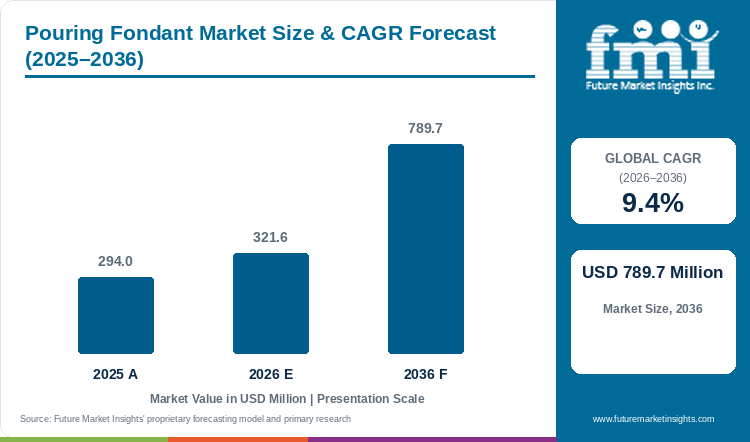
Table 1: Pouring Fondant Market Size and Forecast (USD million), 2025 to 2036
| Market size and forecast | Value |
|---|---|
| 2025 market size | USD 294.0 million |
| Estimated market size in 2026 | USD 321.6 million |
| Projected market size by 2036 | USD 789.7 million |
| CAGR (2026-2036) | 9.4% |
| Added revenue, 2026 to 2036 | USD 468.1 million |
Key Market Trends & Insights
- By Product Type: The Pouring fondant segment accounted for the largest share of the Product Type breakdown in 2026, representing 41.0% of total market revenue.
- By Form: Powder / dry products held the leading market position with a share of 49.0% in 2026, placing mixing and consistency control within the bakery's preparation work.
- By Application: Bread & rolls remained the largest application segment, accounting for 37.0% of the market in 2026.
Regional Highlights
- Fastest-growing country: The UAE is expected to record the highest growth rate among the eight profiled countries, with a projected CAGR of 10.8% between 2026 and 2036.
- Growth across other countries: Saudi Arabia is projected to expand at a CAGR of 10.4%, followed by the USA at 10.1% and South Korea at 9.8%. Japan is expected to register comparatively slower growth, with a CAGR of 8.5% during the forecast period.
The world sugar balance has tightened. UkrAgroConsult reported that the ISO cut its 2025/26 global sugar surplus forecast from 2.2 million tonnes to 1.1 million tonnes and expects a deficit of 0.2 million tonnes in 2026/27, with the ISA daily raw sugar price averaging 17.4 cents per pound in August 2026[6]. In the US, the US Department of Agriculture (USDA) expects retail prices for sugar and sweets to rise by 6.6% in 2026[7]. Higher sugar costs feed into fondant prices, which gives bakeries a reason to limit waste. Zeelandia describes a partly diluted fondant with an optimum handling range of 40-45°C and guidance for water adjustment[1]. For bakery coatings of this kind, the relevant reference is the set finish on the actual shape being produced.
European sugar producers face different pressures. Südzucker's sugar segment reduced its negative operating EBITDA to EUR -24 million in the first half of 2026/27 from EUR -46 million, helped by lower production costs in the 2025 campaign[5]. Persistent heat, very low rainfall and drought since June have reduced expected beet yields, and Südzucker expects clearly lower sugar production in the current campaign[5], which could tighten European supply in 2027. Preparation method also matters in supplier comparison. Bakels' Fondant White Standard has its own warming procedure and specifies stock syrup for consistency adjustment[2], while dry mixes add a separate mixing responsibility.
Colour claims are a further consideration. The FDA announced in February 2026 enforcement discretion for certain voluntary no-artificial-colours wording on foods without petroleum-based colours[3]. For coloured fondant, the actual formulation and proposed wording remain connected. Flavour or colour additions can also change coating behaviour and ingredient information, for which the FDA's January 2025 allergen guidance provides a separate reference[4]. Supplier consolidation is also changing the market, with Puratos agreeing in March 2026 to acquire Dawn Foods, one of the profiled fondant suppliers[9].
Table 2: Supporting Industry Indicators for the Pouring Fondant Market, 2025 to 2026
| Indicator | Data point | Why it matters | Source |
|---|---|---|---|
| World sugar prices | The FAO Sugar Price Index rose by 14.7% year on year in September 2026, to its highest level since April 2025. | Sugar is the main ingredient of fondant. | [8] |
| World sugar balance | The ISO cut its 2025/26 surplus forecast to 1.1 million tonnes and expects a 0.2 million tonne deficit in 2026/27. | Tighter supply supports higher fondant costs. | [6] |
| Raw sugar price | The ISA daily raw sugar price averaged 17.4 cents per pound in August 2026. | Raw sugar prices feed into refined sugar costs. | [6] |
| US retail prices | USDA expects sugar and sweets prices to rise by 6.6% in 2026. | Sweet bakery products face higher input costs. | [7] |
| European sugar revenue | Südzucker's sugar segment revenue fell to EUR 1.3 billion in H1 2026/27 from EUR 1.4 billion. | Lower European sugar prices ease costs for EU bakeries. | [5] |
| European beet crop | Drought since June reduced Südzucker's expected beet yields and 2026 sugar production. | A smaller crop could tighten European supply. | [5] |
| Supplier consolidation | Puratos agreed to acquire Dawn Foods in March 2026. | Consolidation affects fondant supply to industrial bakeries. | [9] |
| Product handling range | Zeelandia specifies 40-45°C as the optimum handling range for its partly diluted fondant. | Temperature control determines coating weight and set. | [1] |
| Consistency adjustment | Bakels specifies product-specific warming and stock syrup adjustment for Fondant White Standard. | Preparation methods differ between suppliers. | [2] |
| Colour-claim approach | FDA announced enforcement discretion for certain no-artificial-colours claims in February 2026. | Coloured fondant formulation and wording are linked. | [3] |
Demand Intensity Analysis
A comparison of world and European sugar markets shows how differently fondant costs are moving by region. The FAO Sugar Price Index rose by 14.7% year on year in September 2026[8], while Südzucker's European sugar segment revenue fell by approximately 8.6% in the first half of 2026/27 on lower prices and volumes[5]. Fondant producers buying sugar in Europe faced easier costs than those exposed to world prices, although the drought-hit 2026 beet campaign may reverse this.
Retail prices offer another reference point. USDA expects prices for sugar and sweets to rise by 6.6% in 2026, compared with 2.9% for all food, more than twice the rate[7]. Iced sweet bakery products are becoming more expensive relative to other foods, which makes efficient fondant use more important. Bread & rolls accounted for USD 119.0 million of the market in 2026, linking fondant revenue with recurring sweet-bakery coating.
The ISO's move from a 1.1 million tonne surplus in 2025/26 to a 0.2 million tonne deficit in 2026/27 represents a swing of 1.3 million tonnes, equivalent to approximately 0.7% of global consumption of around 179.6 million tonnes[6]. A small change in balance can move prices significantly, which explains the rise in the FAO index.
Segment values show where demand is concentrated. Pouring fondant was worth USD 131.9 million in 2026, while the separate Powder / dry Form category was valued at USD 157.6 million and Direct to industrial bakeries at USD 154.4 million. FMI projects USD 468.1 million in added revenue between 2026 and 2036, with the market reaching approximately 2.5 times its 2026 value.
Table 3: Demand Intensity Metrics for the Pouring Fondant Market, 2025 to 2036
| Demand intensity metric | Value | Basis |
|---|---|---|
| FAO Sugar Price Index, September 2026 | +14.7% | Year-on-year change. |
| Südzucker sugar segment revenue, H1 2026/27 | Approximately -8.6% | EUR 1.3 billion against EUR 1.4 billion. |
| US sugar and sweets price outlook, 2026 | +6.6% | USDA forecast, against +2.9% for all food. |
| World sugar balance swing, 2025/26 to 2026/27 | 1.3 million tonnes | Surplus of 1.1 million tonnes to deficit of 0.2 million tonnes. |
| Swing as share of global consumption | Approximately 0.7% | 1.3 million tonnes against 179.6 million tonnes. |
| Bread & rolls revenue, 2026 | USD 119.0 million | 37.0% of market revenue. |
| Pouring fondant revenue, 2026 | USD 131.9 million | 41.0% of market revenue. |
| Powder / dry revenue, 2026 | USD 157.6 million | 49.0% of market revenue. |
| Specified handling temperature | 40-45°C | Zeelandia partly diluted fondant.[1] |
| Added revenue, 2026 to 2036 | USD 468.1 million | FMI pouring fondant market forecast. |
Analyst Perspective
"World sugar prices are up by almost 15.0% in a year, so bakeries will favour fondants that give the same coating weight on every run and leave little material in the pan at the end of the shift."
- Nandini Roy Choudhury, Principal Analyst at Future Market Insights
How is the pouring fondant market segmented?
The pouring fondant market is segmented by product type, form, application, claim and sales channel. The Product Type range includes Pouring fondant, Dry fondant mixes, Flavoured, and Organic / clean label preparations. Form determines how much preparation the bakery performs, Application identifies the coated item, and Claim and Sales Channel add composition and supply requirements.
Why does Pouring fondant lead Product Type demand?
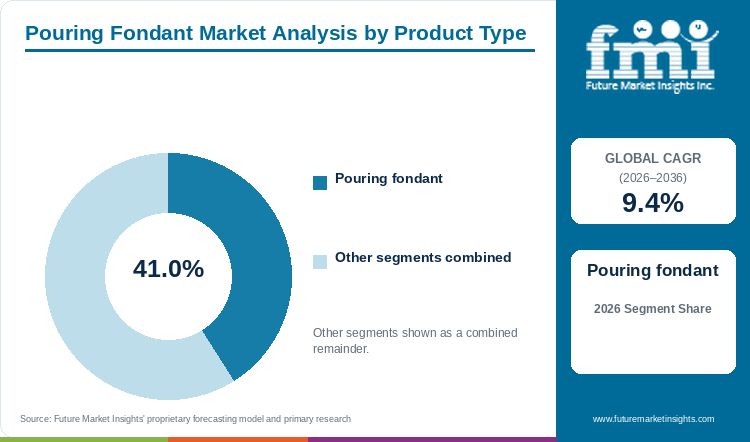
Pouring fondant represents 41.0% of Product Type revenue in 2026.
Prepared pouring fondant generated approximately USD 131.9 million in 2026, as it gives the bakery a starting consistency for a smooth sugar coating. Warming and adjustment then bring the material to the required flow, with Zeelandia specifying 40-45°C for its partly diluted fondant[1]. The relevant reference is the set coating on the actual pastry, bun or cake. With sugar prices rising[8], controlled coating weight helps hold the cost of each item while preserving opacity and set.
- Pouring fondant represents 41.0% of Product Type revenue in 2026.
- The relevant reference is the set coating on the actual pastry, bun or cake.
What sustains Powder / dry as the largest Form category?
Powder / dry holds 49.0% of Form revenue in 2026.
Dry formats generated approximately USD 157.6 million in 2026. Dry mixes require the bakery to establish the coating consistency through a defined preparation procedure before application, which adds mixing labour but offers storage and transport benefits. Leftover prepared material belongs in the comparison with ready fondant, as unused coating at the end of a run consumes sugar without producing saleable output.
- Powder / dry holds 49.0% of Form revenue in 2026.
- Mixing labor and leftover prepared material belong in the comparison with ready fondant.
How do Bread & rolls applications anchor fondant purchases?
Bread & rolls account for 37.0% of Application revenue in 2026.
Sweet buns and decorated rolls accounted for approximately USD 119.0 million in 2026. Coating weight connects their visual finish with sweetness and ingredient consumption, and normal shape variation needs to be represented when drainage and pickup are measured. As USDA expects sugar and sweets prices to rise by 6.6% in 2026[7], small reductions in excess coating per item can make a measurable difference to cost across recurring production.
- Bread & rolls account for 37.0% of Application revenue in 2026.
- Normal shape variation needs to be represented when drainage and pickup are measured.
Why does Conventional dominate the Claim mix?
Conventional represents 55.0% of Claim revenue in 2026.
Conventional formulations held 55.0% of Claim revenue in 2026, as flow, opacity and set provide the technical basis for selecting them. Colour or flavour changes add a formulation question, and the FDA's February 2026 approach to no-artificial-colours wording is relevant where a coloured fondant uses no petroleum-based colours[3]. A changed colour or flavour needs assessment of both the coating and any proposed claims.
- Conventional represents 55.0% of Claim revenue in 2026.
- A changed color or flavor needs assessment of the coating and any proposed claims.
What favors Direct to industrial bakeries in Sales Channel?
Direct to industrial bakeries holds 48.0% of Sales Channel revenue in 2026.
Direct supply to industrial bakeries accounted for approximately USD 154.4 million in 2026. Industrial coating lines require delivered fondant to match a defined target pickup and application method across repeated batches, so direct relationships allow suppliers to agree flow, temperature and pack format with the customer. Consolidation, such as Puratos' agreement to acquire Dawn Foods[9], may change how some industrial customers source their fondant.
- Direct to industrial bakeries holds 48.0% of Sales Channel revenue in 2026.
- Delivered flow has to match the line's target coating weight through repeated batches.
What are the drivers, restraints and opportunities in the pouring fondant market?
A consistent sugar finish can simplify recurring sweet-bakery programs, although temperature and dilution leave little room for generic handling rules, while controlled color and flavor options can extend an established finish.
A consistent sugar finish can simplify recurring sweet-bakery programs
Controlled coating processes preserve a recognisable iced finish across a range of established sweet-bakery items. Repeated correction at the coating stage slows output, so a fondant that delivers consistent pickup and set reduces labour and waste. Developing coatings alongside sweet bakery mixes helps match the finish to the base product, and with sugar costs rising[6][8], a dependable coating weight helps hold the cost of each iced item steady.
Temperature and dilution leave little room for generic handling rules
Rising and volatile sugar costs are a restraint. The FAO Sugar Price Index rose by 14.7% year on year in September 2026[8], and the ISO expects a deficit in 2026/27[6], while Europe faces a drought-affected beet crop[5]. Similar-looking fondants can also require different operating methods, as Zeelandia specifies an optimum handling range of 40-45°C, while Bakels uses its own warming procedure and stock syrup[1][2]. Switching suppliers to save cost requires a new trial of the application method.
Controlled color and flavor options can extend an established finish
Established fondant processes support additional colours and flavours when the revised preparations remain compatible with the original application method. Work with bakery flavor ingredients can extend a standard white fondant into a range of finishes, and the FDA's February 2026 approach to no-artificial-colours claims[3] gives coloured fondants without petroleum-based colours a clearer route to positioning. Each addition still needs to retain the approved flow, opacity and set.
Which country CAGRs are profiled in the pouring fondant market?
Table 4: Country growth outlook for the pouring fondant market
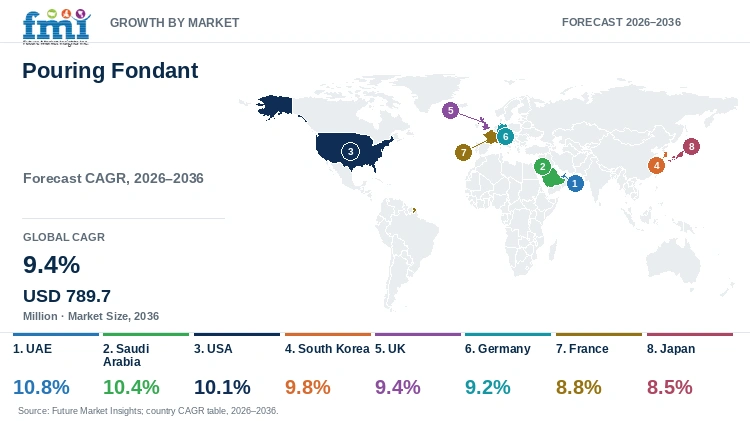
| Country | CAGR |
|---|---|
| UAE | 10.8% |
| Saudi Arabia | 10.4% |
| USA | 10.1% |
| South Korea | 9.8% |
| UK | 9.4% |
| Germany | 9.2% |
| France | 8.8% |
| Japan | 8.5% |
UAE
- The UAE is the fastest-growing market among the profiled countries, with a projected CAGR of 10.8% from 2026 to 2036. Distribution of iced bakery products in the UAE makes coating condition at outlet arrival part of the finishing specification, as heat and handling can affect set and appearance. Trials that follow the product through transport and display show whether the chosen fondant retains its finish.
Saudi Arabia
- Saudi Arabia is forecast to grow at a CAGR of 10.4% from 2026 to 2036. On a Saudi sweet-roll line, target pickup makes fondant use measurable by linking the amount of coating applied with the number of acceptable items. With world sugar prices rising[8], material left in the applicator or removed during correction adds directly to cost, so observing a full run shows whether the approved finish is maintained.
USA
- The USA market is forecast to grow at a CAGR of 10.1% from 2026 to 2036. USDA expects prices for sugar and sweets to rise by 6.6% in 2026[7], which makes efficient coating weight important for US bakeries. Colour extensions also involve a positioning decision, as the FDA's February 2026 approach to no-artificial-colours wording applies to foods without petroleum-based colours[3]. Each revised finish still needs a trial on the bakery's own item, where opacity, flow and set can be compared with the existing reference.
South Korea
- With a projected CAGR of 9.8% from 2026 to 2036, South Korea ranks fourth among the profiled countries. In compact South Korean cake and pastry formats, fondant thickness directly affects the balance between coating and base, so a thin, even layer is often needed. Application conditions must be controlled closely, and trials on representative items show whether the set coating keeps a neat appearance through packing.
UK
- The UK market is projected to grow at a CAGR of 9.4% from 2026 to 2036. Differences in product shape and coating weight determine whether UK iced ranges can share a fondant specification or need separate preparations. A shared specification simplifies stock and training, but only where each item reaches the required opacity and set within its normal packing schedule.
Germany
- Germany is projected to grow at a CAGR of 9.2% from 2026 to 2036. German producers buy sugar in a European market where prices have been lower, as Südzucker's sugar segment revenue fell by approximately 8.6% in the first half of 2026/27 on lower prices and volumes[5]. The drought since June, however, has reduced expected beet yields[5]. Dry and prepared fondants reach the coating stage through different amounts of work, so manufacturers can compare mixing labour against storage benefits.
France
- France is projected to grow at a CAGR of 8.8% from 2026 to 2036. Small French pastry formats such as éclairs require an even fondant surface that preserves the shape and proportions of the unit. Application weight must suit the design, and with European beet yields reduced by drought[5], French bakeries may face firmer sugar costs in 2027, making controlled use more valuable.
Japan
- Japan is expected to register the slowest growth among the profiled countries, with a forecast CAGR of 8.5% from 2026 to 2036. Individual wrapping requires fondant to reach the appropriate set within the bakery item's normal packing sequence, as a soft coating can mark the film. Trials after cooling and handling establish whether the initially smooth finish remains intact in the package.
Who are the notable companies in the pouring fondant market?
Zeelandia; Bakels; Barry Callebaut / Carma; Dawn Foods; IRCA Group
Zeelandia, Bakels, Barry Callebaut through Carma, Dawn Foods and IRCA Group offer identifiable fondants for sweet-bakery coating or icing, with differences in consistency, handling instructions and intended use. These product-level differences matter more to a finishing task than the breadth of each company's portfolio. In March 2026, Puratos agreed to acquire Dawn Foods[9], which would add Dawn's fondant range to a larger bakery ingredient group.
Sugar handling links fondant with the wider confectionery ingredient range. With world sugar prices rising[8], the required coating gives the comparison its practical basis: the amount of fondant needed for each acceptable item.
Competitive Benchmarking: Pouring Fondant Market
Table 5: Company capabilities in the pouring fondant market
| Company | Product capability | Application emphasis |
|---|---|---|
| Zeelandia | Partly diluted sugar-based fondant | Opaque sweet-bakery coatings |
| Bakels | White standard and flavored fondants | Dipping and flooding baked goods |
| Barry Callebaut / Carma | White Fondant | Pastries, petits fours and éclairs |
| Dawn Foods | Fondant Sublime and Fondant Extra | Coating donuts, pastries and desserts |
| IRCA Group | Zucchero Fondente di Canna | Confectionery and pastry icing |
Key Developments in the Pouring Fondant Market
- In February 2026, the FDA announced an enforcement-discretion approach for certain voluntary no-artificial-colours claims on foods without petroleum-based colours[3].
- In March 2026, Puratos agreed to acquire Dawn Foods, one of the profiled fondant suppliers[9].
- In September 2026, the ISO halved its 2025/26 global sugar surplus estimate to 1.1 million tonnes and forecast a 0.2 million tonne deficit for 2026/27[6].
- In October 2026, Südzucker reported a fall in first-half sugar segment revenue to EUR 1.3 billion and warned of lower beet yields after drought[5].
- In January 2025, the FDA published the fifth edition of its allergen labelling guidance, which is relevant when a fondant's flavour, colour or other components change[4].
Key Players in the Pouring Fondant Market
- Zeelandia
- Bakels
- Barry Callebaut / Carma
- Dawn Foods
- IRCA Group
Pouring Fondant Market - Report Scope
Table 6: Report scope for the pouring fondant market
| Coverage field | Report scope |
|---|---|
| Market breakdown | Product Type; Form; Application; Claim; Sales Channel |
| Quantitative Units | USD Million |
| Market Definition | Revenue from qualifying pouring fondant preparations and closely defined fondant variants sold for bakery finishing within the stated product forms and channels. Excludes revenue from finished bakery goods, separately sold rolled sugar paste, chocolate and fruit glazes, raw sugar and glucose syrup inputs, and other adjacent finishes. Bundled products are counted only to the extent the qualifying fondant ingredient is identifiable. |
| Regions Covered | North America; Latin America; Western Europe; Eastern Europe; East Asia; South Asia and Pacific; Middle East and Africa |
| Countries Covered | UAE; Saudi Arabia; USA; South Korea; UK; Germany; France; Japan |
| Key Companies Profiled | Zeelandia; Bakels; Barry Callebaut / Carma; Dawn Foods; IRCA Group |
| Forecast Period | 2026 to 2036 |
| Approach | Market assessment supported by official technical and regulatory publications, company product information and country operating conditions. |
Pouring Fondant Market - Research Methodology
Table 7: Research approach for the pouring fondant market
| Method | Approach |
|---|---|
| Market definition | The assessment covers pouring fondant preparations and the stated related fondant variants sold as ingredients for bakery finishing, with rolled sugar paste and unrelated coatings treated separately. |
| Desk research | Government and regulatory publications, technical literature and official product information establish the application and supply context. |
| Commercial assessment | The commercial review considers preparation temperature, dilution method, opacity, coating weight, drainage, set and the handling of finished iced products. |
| Comparability | Market values, segment allocations and country growth rates use consistent units and the stated 2026 to 2036 forecast period. Company comparisons describe product roles and purchasing relevance. |
Pouring Fondant Market by Segments
Product Type
- Pouring fondant
- Dry fondant mixes
- Flavored
- Organic / clean label
Form
- Powder / dry
- Liquid
- Paste / semi-solid
- Granules / pieces
Application
- Bread & rolls
- Cakes & muffins
- Biscuits & cookies
- Viennoiserie & pastry
- Other bakery & snacks
Claim
- Conventional
- Clean label
- Organic
- Non-GMO / identity preserved
Sales Channel
- Direct to industrial bakeries
- Ingredient distributors
- Foodservice & artisan supply
- Online B2B
Pouring Fondant Market by Region
- North America
- United States
- Canada
- Latin America
- Brazil
- Mexico
- Argentina
- Chile
- Western Europe
- Germany
- France
- United Kingdom
- Italy
- Spain
- Benelux
- Nordics
- Eastern Europe
- Poland
- Czech Republic
- Romania
- Hungary
- East Asia
- China
- Japan
- South Korea
- South Asia and Pacific
- India
- ASEAN
- Australia and New Zealand
- Middle East and Africa
- GCC Countries
- South Africa
- Türkiye
- Israel
Research Sources and Bibliography
- [1] Zeelandia International. (n.d.). Fondant: Coatings and Application Characteristics.
- [2] Australian Bakels. (n.d.). Fondant White Standard.
- [3] U.S. Food and Drug Administration. (2026, February 5). FDA Takes New Approach to No Artificial Colors Claims.
- [4] U.S. Food and Drug Administration. (2025, January). Guidance for industry: Questions and answers regarding food allergen labeling (Edition 5).
- [5] Glasfort, M. (2026, October 8). Lebensmittel Praxis. Halbjahresbilanz: Südzucker steigert operatives Ergebnis deutlich.
- [6] UkrAgroConsult. (2026, September 3). ISO halves global sugar surplus estimate.
- [7] USDA Economic Research Service. (2026, September 25). Food price outlook: Summary findings.
- [8] Food and Agriculture Organization of the United Nations. (2026, October 2). FAO Food Price Index.
- [9] Food Ingredients First. (2026, March 12). Puratos strikes deal to acquire Dawn Foods in bakery industry shakeup.
Future Market Insights. (2026). Pouring Fondant Market: Global Industry Analysis and Opportunity Assessment 2036.
This Report Answers
- What is the size of the pouring fondant market in 2026 and its forecast value in 2036?
- Which bakery operating pressures support demand for prepared pouring fondant?
- Why does Pouring fondant lead the Product Type category?
- Why does Powder / dry lead the Form category?
- How do forecast growth rates differ across the eight profiled countries?
- Which companies offer fondant for pouring, dipping and coating sweet bakery products?
Frequently Asked Questions
How big is the pouring fondant market in 2026, and what is forecast for 2036?
The market is valued at USD 321.6 million in 2026 and is expected to reach USD 789.7 million by 2036.
What is the pouring fondant market CAGR from 2026 to 2036?
The market is forecast to grow at a CAGR of 9.4% from 2026 to 2036.
Which Product Type segment leads the pouring fondant market?
Pouring fondant leads Product Type with 41.0% in 2026.
Which Form segment has the largest 2026 share?
Powder / dry leads Form with 49.0% in 2026.
Which profiled countries have the highest pouring fondant market CAGRs?
The UAE leads at 10.8%, followed by Saudi Arabia at 10.4% and the USA at 10.1% from 2026 to 2036.
Which companies participate in the pouring fondant market?
The report profiles Zeelandia, Bakels, Barry Callebaut / Carma, Dawn Foods and IRCA Group, whose named products cover pouring, dipping and coating applications.
Preview the report firsthand - request a free sample
Get SampleGet the brochure for pricing and purchase details.
Get PDFTable of Content
- Key Takeaways
- Market Size and CAGR
- Top Growth Driver
- Fastest Growing Segment
- Leading Region
- Key Companies
- Emerging Opportunities
- Executive Summary
- Global Market Outlook
- Demand-side Trends
- Supply-side Trends
- Technology Roadmap Analysis
- Analysis and Recommendations
- Analyst Perspective (What is happening? Why now? What should investors know?)
- Key Questions Answered
- How large is the market?
- What is the CAGR?
- What are key trends?
- Which region dominates?
- Who are the leaders?
- Market Overview
- Market Coverage / Taxonomy
- Market Definition / Scope / Limitations
- Research Methodology
- Chapter Orientation
- Analytical Lens and Working Hypotheses
- Market Structure, Signals, and Trend Drivers
- Benchmarking and Cross-market Comparability
- Market Sizing, Forecasting, and Opportunity Mapping
- Research Design and Evidence Framework
- Desk Research Programme (Secondary Evidence)
- Expert Input and Fieldwork (Primary Evidence)
- Tooling, Models, and Reference Databases
- Data Engineering and Model Build
- Quality Assurance and Audit Trail
- Market Background
- Market Dynamics (Drivers, Restraints, Opportunity, Trends)
- Scenario Forecast (Optimistic, Likely, Conservative)
- Impact Analysis
- AI Impact
- Sustainability Impact
- Regulatory Impact
- Technology Impact
- Consumer / Buyer Analysis
- Purchase Drivers
- Adoption Barriers
- Buyer Journey
- Opportunity Map Analysis
- Product Life Cycle Analysis
- Supply Chain Analysis
- Investment Feasibility Matrix
- Value Chain Analysis
- PESTLE and Porter's Analysis
- Regulatory Landscape
- Regional Parent Market Outlook
- Production and Consumption Statistics
- Import and Export Statistics
- Global Market Analysis and Forecast, 2021 to 2036
- Historical Market Size Value (USD Million) Analysis, 2021 to 2025
- Current and Future Market Size Value (USD Million) Projections, 2026 to 2036
- Y-o-Y Growth Trend Analysis
- Absolute $ Opportunity Analysis
- Global Market Pricing Analysis, 2021 to 2036
- Global Market Analysis and Forecast, By Product Type, 2021 to 2036
- Introduction / Key Findings
- Historical Market Size Value (USD Million) Analysis By Product Type, 2021 to 2025
- Current and Future Market Size Value (USD Million) Analysis and Forecast By Product Type, 2026 to 2036
- Pouring fondant
- Dry fondant mixes
- Flavored
- Organic / clean label
- Y-o-Y Growth Trend Analysis By Product Type, 2021 to 2025
- Absolute $ Opportunity Analysis By Product Type, 2026 to 2036
- Global Market Analysis and Forecast, By Form, 2021 to 2036
- Introduction / Key Findings
- Historical Market Size Value (USD Million) Analysis By Form, 2021 to 2025
- Current and Future Market Size Value (USD Million) Analysis and Forecast By Form, 2026 to 2036
- Powder / dry
- Liquid
- Paste / semi-solid
- Granules / pieces
- Y-o-Y Growth Trend Analysis By Form, 2021 to 2025
- Absolute $ Opportunity Analysis By Form, 2026 to 2036
- Global Market Analysis and Forecast, By Application, 2021 to 2036
- Introduction / Key Findings
- Historical Market Size Value (USD Million) Analysis By Application, 2021 to 2025
- Current and Future Market Size Value (USD Million) Analysis and Forecast By Application, 2026 to 2036
- Bread & rolls
- Cakes & muffins
- Biscuits & cookies
- Viennoiserie & pastry
- Other bakery & snacks
- Y-o-Y Growth Trend Analysis By Application, 2021 to 2025
- Absolute $ Opportunity Analysis By Application, 2026 to 2036
- Global Market Analysis and Forecast, By Claim, 2021 to 2036
- Introduction / Key Findings
- Historical Market Size Value (USD Million) Analysis By Claim, 2021 to 2025
- Current and Future Market Size Value (USD Million) Analysis and Forecast By Claim, 2026 to 2036
- Conventional
- Clean label
- Organic
- Non-GMO / identity preserved
- Y-o-Y Growth Trend Analysis By Claim, 2021 to 2025
- Absolute $ Opportunity Analysis By Claim, 2026 to 2036
- Global Market Analysis and Forecast, By Sales Channel, 2021 to 2036
- Introduction / Key Findings
- Historical Market Size Value (USD Million) Analysis By Sales Channel, 2021 to 2025
- Current and Future Market Size Value (USD Million) Analysis and Forecast By Sales Channel, 2026 to 2036
- Direct to industrial bakeries
- Ingredient distributors
- Foodservice & artisan supply
- Online B2B
- Y-o-Y Growth Trend Analysis By Sales Channel, 2021 to 2025
- Absolute $ Opportunity Analysis By Sales Channel, 2026 to 2036
- Global Market Analysis and Forecast, By Region, 2021 to 2036
- Introduction
- Historical Market Size Value (USD Million) Analysis By Region, 2021 to 2025
- Current Market Size Value (USD Million) Analysis and Forecast By Region, 2026 to 2036
- North America
- Latin America
- Western Europe
- Eastern Europe
- East Asia
- South Asia and Pacific
- Middle East and Africa
- Market Attractiveness Analysis By Region
- North America Market Analysis and Forecast, By Country, 2021 to 2036
- Historical Market Size Value (USD Million) Trend Analysis By Market Taxonomy, 2021 to 2025
- Market Size Value (USD Million) Forecast By Market Taxonomy, 2026 to 2036
- By Country
- United States
- Canada
- By Product Type
- By Form
- By Application
- By Claim
- By Sales Channel
- By Country
- Market Attractiveness Analysis
- By Country
- By Product Type
- By Form
- By Application
- By Claim
- By Sales Channel
- Key Takeaways
- Latin America Market Analysis and Forecast, By Country
- Historical Market Size Value (USD Million) Trend Analysis By Market Taxonomy, 2021 to 2025
- Market Size Value (USD Million) Forecast By Market Taxonomy, 2026 to 2036
- By Country
- Brazil
- Mexico
- Argentina
- Chile
- By Product Type
- By Form
- By Application
- By Claim
- By Sales Channel
- By Country
- Market Attractiveness Analysis
- By Country
- By Product Type
- By Form
- By Application
- By Claim
- By Sales Channel
- Key Takeaways
- Western Europe Market Analysis and Forecast, By Country
- Historical Market Size Value (USD Million) Trend Analysis By Market Taxonomy, 2021 to 2025
- Market Size Value (USD Million) Forecast By Market Taxonomy, 2026 to 2036
- By Country
- Germany
- France
- United Kingdom
- Italy
- Spain
- Benelux
- Nordics
- By Product Type
- By Form
- By Application
- By Claim
- By Sales Channel
- By Country
- Market Attractiveness Analysis
- By Country
- By Product Type
- By Form
- By Application
- By Claim
- By Sales Channel
- Key Takeaways
- Eastern Europe Market Analysis and Forecast, By Country
- Historical Market Size Value (USD Million) Trend Analysis By Market Taxonomy, 2021 to 2025
- Market Size Value (USD Million) Forecast By Market Taxonomy, 2026 to 2036
- By Country
- Poland
- Czech Republic
- Romania
- Hungary
- By Product Type
- By Form
- By Application
- By Claim
- By Sales Channel
- By Country
- Market Attractiveness Analysis
- By Country
- By Product Type
- By Form
- By Application
- By Claim
- By Sales Channel
- Key Takeaways
- East Asia Market Analysis and Forecast, By Country
- Historical Market Size Value (USD Million) Trend Analysis By Market Taxonomy, 2021 to 2025
- Market Size Value (USD Million) Forecast By Market Taxonomy, 2026 to 2036
- By Country
- China
- Japan
- South Korea
- By Product Type
- By Form
- By Application
- By Claim
- By Sales Channel
- By Country
- Market Attractiveness Analysis
- By Country
- By Product Type
- By Form
- By Application
- By Claim
- By Sales Channel
- Key Takeaways
- South Asia and Pacific Market Analysis and Forecast, By Country
- Historical Market Size Value (USD Million) Trend Analysis By Market Taxonomy, 2021 to 2025
- Market Size Value (USD Million) Forecast By Market Taxonomy, 2026 to 2036
- By Country
- India
- ASEAN
- Australia and New Zealand
- By Product Type
- By Form
- By Application
- By Claim
- By Sales Channel
- By Country
- Market Attractiveness Analysis
- By Country
- By Product Type
- By Form
- By Application
- By Claim
- By Sales Channel
- Key Takeaways
- Middle East and Africa Market Analysis and Forecast, By Country
- Historical Market Size Value (USD Million) Trend Analysis By Market Taxonomy, 2021 to 2025
- Market Size Value (USD Million) Forecast By Market Taxonomy, 2026 to 2036
- By Country
- GCC Countries
- South Africa
- Türkiye
- Israel
- By Product Type
- By Form
- By Application
- By Claim
- By Sales Channel
- By Country
- Market Attractiveness Analysis
- By Country
- By Product Type
- By Form
- By Application
- By Claim
- By Sales Channel
- Key Takeaways
- Key Countries Market Analysis
- United States
- Pricing Analysis
- Market Share Analysis, 2025
- By Product Type
- By Form
- By Application
- By Claim
- By Sales Channel
- Canada
- Pricing Analysis
- Market Share Analysis, 2025
- By Product Type
- By Form
- By Application
- By Claim
- By Sales Channel
- Mexico
- Pricing Analysis
- Market Share Analysis, 2025
- By Product Type
- By Form
- By Application
- By Claim
- By Sales Channel
- Brazil
- Pricing Analysis
- Market Share Analysis, 2025
- By Product Type
- By Form
- By Application
- By Claim
- By Sales Channel
- Chile
- Pricing Analysis
- Market Share Analysis, 2025
- By Product Type
- By Form
- By Application
- By Claim
- By Sales Channel
- Germany
- Pricing Analysis
- Market Share Analysis, 2025
- By Product Type
- By Form
- By Application
- By Claim
- By Sales Channel
- United Kingdom
- Pricing Analysis
- Market Share Analysis, 2025
- By Product Type
- By Form
- By Application
- By Claim
- By Sales Channel
- Italy
- Pricing Analysis
- Market Share Analysis, 2025
- By Product Type
- By Form
- By Application
- By Claim
- By Sales Channel
- Spain
- Pricing Analysis
- Market Share Analysis, 2025
- By Product Type
- By Form
- By Application
- By Claim
- By Sales Channel
- France
- Pricing Analysis
- Market Share Analysis, 2025
- By Product Type
- By Form
- By Application
- By Claim
- By Sales Channel
- India
- Pricing Analysis
- Market Share Analysis, 2025
- By Product Type
- By Form
- By Application
- By Claim
- By Sales Channel
- ASEAN
- Pricing Analysis
- Market Share Analysis, 2025
- By Product Type
- By Form
- By Application
- By Claim
- By Sales Channel
- Australia and New Zealand
- Pricing Analysis
- Market Share Analysis, 2025
- By Product Type
- By Form
- By Application
- By Claim
- By Sales Channel
- China
- Pricing Analysis
- Market Share Analysis, 2025
- By Product Type
- By Form
- By Application
- By Claim
- By Sales Channel
- Japan
- Pricing Analysis
- Market Share Analysis, 2025
- By Product Type
- By Form
- By Application
- By Claim
- By Sales Channel
- South Korea
- Pricing Analysis
- Market Share Analysis, 2025
- By Product Type
- By Form
- By Application
- By Claim
- By Sales Channel
- Poland
- Pricing Analysis
- Market Share Analysis, 2025
- By Product Type
- By Form
- By Application
- By Claim
- By Sales Channel
- Hungary
- Pricing Analysis
- Market Share Analysis, 2025
- By Product Type
- By Form
- By Application
- By Claim
- By Sales Channel
- Türkiye
- Pricing Analysis
- Market Share Analysis, 2025
- By Product Type
- By Form
- By Application
- By Claim
- By Sales Channel
- South Africa
- Pricing Analysis
- Market Share Analysis, 2025
- By Product Type
- By Form
- By Application
- By Claim
- By Sales Channel
- UAE
- Pricing Analysis
- Market Share Analysis, 2025
- By Product Type
- By Form
- By Application
- By Claim
- By Sales Channel
- Saudi Arabia
- Pricing Analysis
- Market Share Analysis, 2025
- By Product Type
- By Form
- By Application
- By Claim
- By Sales Channel
- United States
- Market Structure Analysis
- Competition Dashboard
- Competition Benchmarking
- Market Share Analysis of Top Players
- By Regional
- By Product Type
- By Form
- By Application
- By Claim
- By Sales Channel
- Emerging Startups
- Innovation Benchmarking
- Competition Analysis
- Competition Deep Dive
- Zeelandia
- Overview
- Product Portfolio
- Profitability by Market Segments
- Sales Footprint
- Strategy Overview
- Marketing Strategy
- Product Strategy
- Channel Strategy
- Bakels
- Barry Callebaut / Carma
- Dawn Foods
- IRCA Group
- Zeelandia
- Case Studies
- Success Stories
- Recent Developments
- Competition Deep Dive
- Assumptions & Acronyms Used


