

- Market Size (2026)
- USD 111.0 Mn
- Forecast (2036)
- USD 309.6 Mn
- CAGR (2026 to 2036)
- 10.8%
How big is Preeclampsia Support Nutrition Market in 2026?
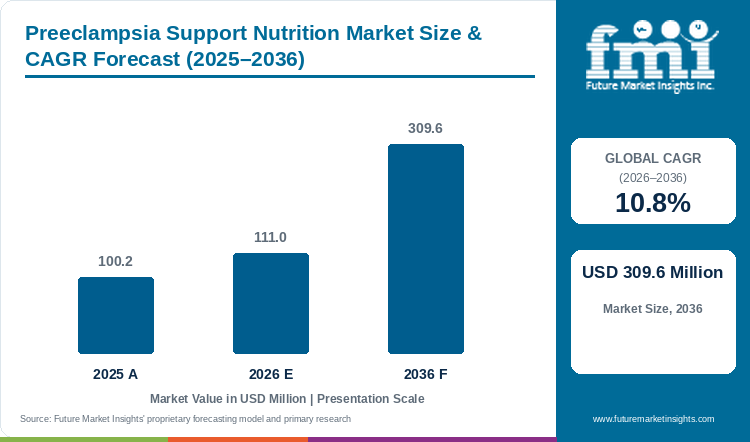
The market was valued at USD 100.2 Million in 2025 and is expected to reach USD 111.0 Million in 2026, with growth at a 10.8% CAGR from 2026 to 2036 taking its value to USD 309.6 Million by 2036.
A dietary review within maternity care may identify a role for an additional nutrient, with the decision depending on individual intake and the wider care plan. Products positioned for this context need amounts that can be compared with existing supplements and prescribed care, especially where a formulation is described as high dose. Tablet size, the number of daily units and reliable delivery influence whether that routine is manageable, while adjustable pack quantities may fit the care period better than a long subscription. Suppliers need to keep communication consistent with the current evidence, since nutritional positioning does not establish that a product prevents preeclampsia. The forecast covers targeted nutrition within the stated formulation and care-context categories, excluding medicines, monitoring devices and clinical treatment services. The five country growth rates span 1.9 percentage points and describe commercial demand within those markets. [5]
Key Market Trends & Insights
- High-Dose Calcium Products account for 44.7% of product type in 2026, with daily amounts needing review against the individual diet, existing supplements and clinical plan.
- High-Risk Prophylaxis (With Clinical Care) represents 48.6% of use context in 2026, describing a care context in which the product’s composition is reviewed alongside professional maternity supervision.
- First (Early Prophylaxis) holds 46.8% of trimester in 2026, providing an early window for reviewing risk history and baseline intake within the individual care plan.
- Tablets / Capsules holds 44.4% of form in 2026, allowing nutrient amounts to be labeled precisely while the number of daily units affects the practicality of use.
Regional Highlights
- South Korea has the highest profiled CAGR at 10.9% during 2026–2036.
- The next two profiled growth rates are USA at 10.6% and UK at 10.3% over the same period.
Market Size & Forecast
| Metric | Value |
|---|---|
| 2025 market value | USD 100.2 Million |
| 2026 market estimate | USD 111.0 Million |
| 2036 market forecast | USD 309.6 Million |
| Forecast CAGR, 2026–2036 | 10.8% |
The market covers pregnancy-targeted nutrition products within the specified formulation and care-context categories. Inclusion identifies a nutritional purchasing context rather than a proven preeclampsia-prevention benefit. Medicines, monitoring devices and clinical treatment services are excluded.
Preeclampsia-related nutrition belongs within an assessed care context, and the wider clinical nutrition category should not be interpreted as evidence of preventive efficacy.
Nutrition evidence and practical use
| Documented operating context | Source |
|---|---|
| WHO’s October 2026 fact sheet describes pre-eclampsia as a condition requiring timely clinical assessment and management. | [1] |
| Cochrane’s December 2025 reassessment questions calcium supplementation as a means of preventing pre-eclampsia. | [2] |
| NIH’s pregnancy nutrition guidance distinguishes nutrient requirements, dietary sources and supplement-related safety considerations. | [3] |
| FDA distinguishes permissible structure/function claims from claims to diagnose, treat, cure or prevent disease. | [4] |
Analyst Perspective
Buyers need to understand what a targeted nutrient adds to an existing prenatal routine and how many daily units that serving requires. Suppliers can make an appropriately selected product easier to use through clear composition, adjustable quantities and dependable replenishment, keeping its nutritional purpose distinct from clinical prevention or treatment.
- Anurag Sharma, Principal Analyst at Future Market Insights
How is the preeclampsia support nutrition market segmented?
Product Type covers High-Dose Calcium Products, Vitamin D Support, L-Arginine & Antioxidant Blends and Others. Use Context covers High-Risk Prophylaxis (With Clinical Care), History of Preeclampsia and General Risk Reduction. Trimester covers First (Early Prophylaxis), Second and Third. Form covers Tablets / Capsules, Powders, Chews and Others. Sales Channel covers Online / DTC, Retail Pharmacy, Supermarkets & Hypermarkets, Specialty & Health Stores and Others.
Distribution through women’s health supplements channels can improve product access, but it cannot turn a risk-specific label into a clinically justified indication.
Why do High-Dose Calcium Products lead product type demand?
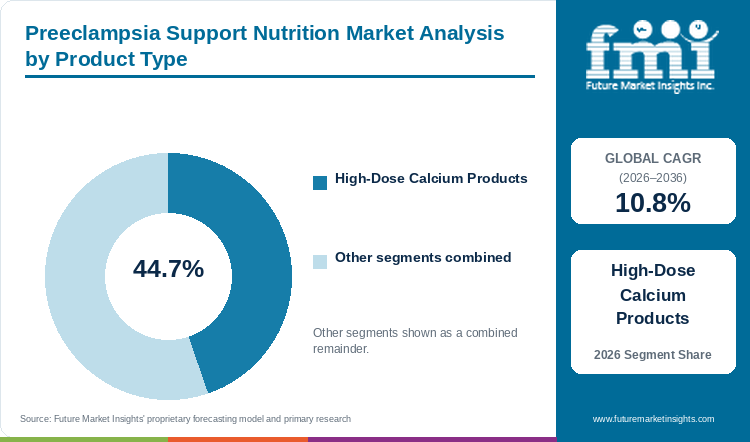
High-Dose Calcium Products: 44.7% of product type in 2026.
High-Dose Calcium Products specify a nutrient and serving level more narrowly than a broad prenatal blend, making the amount per day and the number of tablets central to review. Selection needs to take account of dietary intake, supplements already in use and the individual care plan, since a larger stated dose does not by itself establish suitability or a preventive effect. Suppliers can make comparison easier by presenting composition and serving requirements clearly, with claims kept within the evidence for the intended nutritional use.
- The High-Dose Calcium Products segment accounts for 44.7% of product type in 2026.
- Tablet size and the number of daily units can determine whether an appropriately selected calcium product is practical to use.
Why does High-Risk Prophylaxis (With Clinical Care) lead use context demand?
High-Risk Prophylaxis (With Clinical Care): 48.6% of use context in 2026.
High-Risk Prophylaxis (With Clinical Care) identifies the commercial use-context category for products positioned alongside closer maternity supervision. Buyers need composition and serving information that can be reviewed against the existing care plan, followed by dependable supply if a nutritional addition is considered appropriate. The segment’s role is to make that selected regimen practical to obtain and use, while prescribed prevention and treatment remain separate clinical decisions.
- The High-Risk Prophylaxis (With Clinical Care) segment accounts for 48.6% of use context in 2026.
- A product description should make its nutritional purpose distinguishable from prescribed preventive or treatment measures.
What are the drivers, restraints, and opportunities in the preeclampsia support nutrition market?
Clinical review defines a legitimate nutrition role
Maternity assessment can identify a dietary shortfall that merits a targeted nutritional product. A specific mineral formulation may be easier to review than another comprehensive prenatal pack. The supplier needs to state the nutrient and intended serving clearly so that the product can be considered alongside existing care. Once selected its practical value depends on usability and reliable availability. Awareness of pregnancy complications may prompt the conversation but is not enough to justify the purchase. Demand is more defensible when the product answers an identified need rather than anxiety about a possible outcome.
Prevention claims require stronger evidence than positioning
Customers may interpret a preeclampsia-related label as a preventive promise even when the intended role is only nutritional. High-dose products also need careful review of combined intake. Overstatement can undermine confidence among clinicians and retailers. Suppliers should keep product pages and practitioner materials aligned with the evidence supporting each claim. Changes in that evidence may require different wording or positioning even when the formulation itself is unchanged. Clear communication is therefore necessary to sell the product responsibly rather than a secondary matter left to packaging.
Practical formats improve regimen continuity
A manageable serving and a pack sized for the relevant care period can make an appropriately selected nutrition product easier to use without imposing a long subscription. Clear comparisons help buyers understand the targeted contribution alongside routine prenatal nutrition, while questions of suitability remain with maternity care. Development can focus on that practical access and use instead of increasing dose or ingredient count without a defined nutritional reason.
General dietary supplements compete for the same household budget, which makes a clear explanation of the selected product’s nutritional role necessary.
Which country and market CAGRs are profiled for preeclampsia support nutrition?
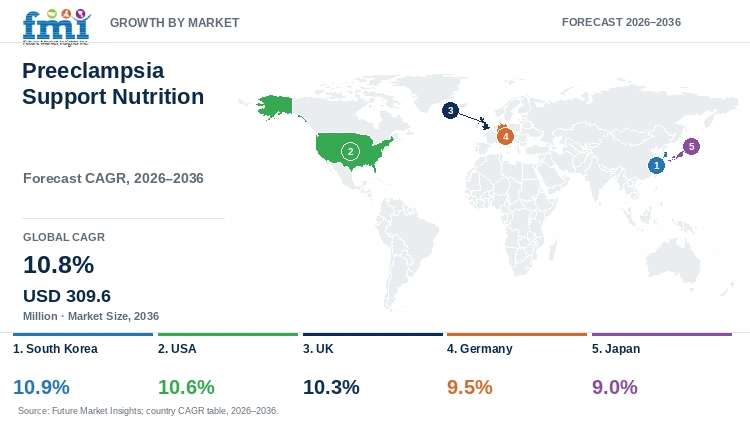
| Country | CAGR |
|---|---|
| South Korea | 10.9% |
| USA | 10.6% |
| UK | 10.3% |
| Germany | 9.5% |
| Japan | 9.0% |
Country-wise Analysis
South Korea
- South Korea’s national Dietary Reference Intakes provide a basis for nutrition assessment rather than a reason for universal supplementation. South Korea has the highest profiled rate at a 10.9% CAGR from 2026 to 2036. Suppliers can make targeted products easier to assess by stating daily amounts and practical serving instructions. Small studies should not be treated as national prevalence measures. A formulation needs to fit the individual maternity plan and remain distinguishable from the clinical steps used to prevent or manage preeclampsia.
USA
- American purchasers may consider separate calcium or vitamin D products when dietary review identifies insufficient intake. The USA is forecast to grow at a 10.6% CAGR from 2026 to 2036. That context does not mean every buyer needs high-dose supplementation. A large label amount may require several tablets or capsules, so clear directions and dependable replenishment need to be considered alongside the nutrient contribution. The product should add an identifiable contribution to the existing routine rather than create a more elaborate wellness bundle without a defined purpose.
UK
- UK maternity advice places clinical review ahead of self-starting calcium or aspirin for preeclampsia prevention. The UK is forecast to grow at a 10.3% CAGR from 2026 to 2036. Suppliers need to make the nutritional role of a product clear enough to fit that care pathway. Preventive language can create confusion when the formulation has not been selected for an individual. Straightforward information and appropriate referral offer a more credible basis for growth. High-risk pregnancies should not be treated as interchangeable supplement purchases simply because they share a risk label.
Germany
- Germany’s food-first approach gives targeted supplementation a specific dietary or care-based rationale, with a 9.5% CAGR forecast from 2026 to 2036. General pregnancy guidance discusses selected nutrients under defined conditions, so the amount in a calcium or vitamin D product needs assessment within the complete regimen. Clear composition allows care teams to judge the proposed addition without treating disease-related packaging as proof of suitability.
Japan
- Japanese buyers need a nutrition product that fits an individual maternity plan without adding unnecessary complexity. Japan has the lowest profiled rate at a 9.0% CAGR from 2026 to 2036. Transparent amounts and straightforward packaging can help families use and replenish an appropriately selected product. The offer should explain its contribution to intake within the individual’s diet and clinical circumstances, keeping a higher stated dose separate from any claim to improve pregnancy outcomes. Serving practicality provides a useful basis for comparison without turning a general prenatal product into a disease treatment.
Who are the notable companies in the preeclampsia support nutrition market?
Needed; Pharmavite; Ritual; Thorne; FullWell
Products positioned around preeclampsia need particularly clear boundaries between nutritional purpose and clinical benefit. Suppliers can distinguish themselves through understandable serving amounts and reliable availability. The disease association does not replace the evidence needed for a claim.
Competitive Benchmarking: Preeclampsia Support Nutrition Market
| Participant | Commercial focus | Buyer qualification priority |
|---|---|---|
| Needed | Maternal nutrition products | Nutrient dose and combined-regimen review |
| Pharmavite | Mainstream vitamin and mineral products | Label accuracy and accessible replenishment |
| Ritual | Life-stage supplement programs | Formulation transparency and adherence |
| Thorne | Practitioner-oriented supplements | Nutrient specification and professional review |
| FullWell | Prenatal and maternal supplements | Serving burden and suitability assessment |
Key Developments in the Preeclampsia Support Nutrition Market
- WHO’s October 2026 fact sheet describes pre-eclampsia as a condition requiring timely clinical assessment and management. [1]
- Cochrane’s December 2025 reassessment questions calcium supplementation as a means of preventing pre-eclampsia. [2]
Key Players in the Preeclampsia Support Nutrition Market
- Needed
- Pharmavite
- Ritual
- Thorne
- FullWell
Preeclampsia Support Nutrition Market - Report Scope
| Coverage field | Report scope |
|---|---|
| Market breakdown | Product Type; Use Context; Trimester; Form; Sales Channel; Region |
| Quantitative unit | USD Million |
| Market definition | The market covers pregnancy-targeted nutrition products within the specified formulation and care-context categories. Inclusion identifies a nutritional purchasing context rather than a proven preeclampsia-prevention benefit. Medicines, monitoring devices and clinical treatment services are excluded. |
| Regions covered | North America; Latin America; Western Europe; Eastern Europe; East Asia; South Asia and Pacific; Middle East and Africa |
| Countries / markets profiled | South Korea; USA; UK; Germany; Japan |
| Key companies profiled | Needed; Pharmavite; Ritual; Thorne; FullWell |
| Base year / forecast period | 2026 / 2026–2036 |
| Estimate coverage | 2025 and 2026 market estimates; 2036 forecast; segment shares and country / market CAGRs. |
Preeclampsia Support Nutrition Market - Research Methodology
| Method | Application |
|---|---|
| Market definition | The analysis follows the stated product or service boundary and distinguishes direct category revenue from adjacent activities. |
| Secondary research | Official technical, regulatory, research and company publications provide the documented operating context and recent developments cited in this report. |
| Forecast and segmentation | Market estimates, segment shares and geographic forecasts are presented as analytical estimates within the stated commercial scope. |
| Competitive assessment | Participants are compared by their relevant products or services, commercial role and buyer qualification requirements. |
| Interpretation | The assessment considers purchasing conditions and the scope of the documented product, service or performance claim. |
Preeclampsia Support Nutrition Market by Segments
Product Type
- High-Dose Calcium Products
- Vitamin D Support
- L-Arginine & Antioxidant Blends
- Others
Use Context
- High-Risk Prophylaxis (With Clinical Care)
- History of Preeclampsia
- General Risk Reduction
Trimester
- First (Early Prophylaxis)
- Second
- Third
Form
- Tablets / Capsules
- Powders
- Chews
- Others
Sales Channel
- Online / DTC
- Retail Pharmacy
- Supermarkets & Hypermarkets
- Specialty & Health Stores
- Others
Preeclampsia Support Nutrition Market by Region
- North America
- United States
- Canada
- Latin America
- Brazil
- Mexico
- Argentina
- Chile
- Western Europe
- Germany
- France
- United Kingdom
- Italy
- Spain
- Benelux
- Nordics
- Eastern Europe
- Poland
- Czech Republic
- Romania
- Hungary
- East Asia
- China
- Japan
- South Korea
- South Asia and Pacific
- India
- ASEAN
- Australia and New Zealand
- Middle East and Africa
- GCC Countries
- South Africa
- Türkiye
- Israel
Research Sources and Bibliography
- [1] World Health Organization. (2026, October 6). Pre-eclampsia.
- [2] Cochrane. (2025, December 3). New evidence questions benefit of calcium supplements in pregnancy for preventing pre-eclampsia.
- [3] National Institutes of Health, Office of Dietary Supplements. (n.d.). Dietary supplements and life stages: Pregnancy.
- [4] U.S. Food and Drug Administration. (n.d.). Structure/function claims.
- [5] Future Market Insights. (2026). Preeclampsia Support Nutrition Market: Global industry analysis and opportunity assessment, 2026–2036.
This Report Answers
- How large is the preeclampsia support nutrition market in 2026?
- What value and CAGR are forecast through 2036?
- Which product type segment leads in 2026?
- Which use context segment has the largest share?
- Which profiled country or market has the fastest forecast growth?
- Which participants are covered in the competitive assessment?
Frequently Asked Questions
How large is the preeclampsia support nutrition market in 2026?
The market was valued at USD 100.2 Million in 2025 and is expected to reach USD 111.0 Million in 2026.
What value and CAGR are forecast through 2036?
The market is projected to reach USD 309.6 Million by 2036, with a 10.8% CAGR during 2026–2036.
Which product type segment leads in 2026?
The High-Dose Calcium Products segment accounts for 44.7% of product type in 2026.
Which use context segment has the largest share?
The High-Risk Prophylaxis (With Clinical Care) segment accounts for 48.6% of use context in 2026.
Which profiled country or market has the fastest forecast growth?
South Korea has the highest profiled CAGR at 10.9% during 2026–2036.
Which participants are covered in the competitive assessment?
The assessment covers Needed, Pharmavite, Ritual, Thorne and FullWell.
Preview the report firsthand - request a free sample
Get SampleGet the brochure for pricing and purchase details.
Get PDFTable of Content
- Key Takeaways
- Market Size and CAGR
- Top Growth Driver
- Fastest Growing Segment
- Leading Region
- Key Companies
- Emerging Opportunities
- Executive Summary
- Global Market Outlook
- Demand-side Trends
- Supply-side Trends
- Technology Roadmap Analysis
- Analysis and Recommendations
- Analyst Perspective (What is happening? Why now? What should investors know?)
- Key Questions Answered
- How large is the market?
- What is the CAGR?
- What are key trends?
- Which region dominates?
- Who are the leaders?
- Market Overview
- Market Coverage / Taxonomy
- Market Definition / Scope / Limitations
- Research Methodology
- Chapter Orientation
- Analytical Lens and Working Hypotheses
- Market Structure, Signals, and Trend Drivers
- Benchmarking and Cross-market Comparability
- Market Sizing, Forecasting, and Opportunity Mapping
- Research Design and Evidence Framework
- Desk Research Programme (Secondary Evidence)
- Expert Input and Fieldwork (Primary Evidence)
- Tooling, Models, and Reference Databases
- Data Engineering and Model Build
- Quality Assurance and Audit Trail
- Market Background
- Market Dynamics (Drivers, Restraints, Opportunity, Trends)
- Scenario Forecast (Optimistic, Likely, Conservative)
- Impact Analysis
- AI Impact
- Sustainability Impact
- Regulatory Impact
- Technology Impact
- Consumer / Buyer Analysis
- Purchase Drivers
- Adoption Barriers
- Buyer Journey
- Opportunity Map Analysis
- Product Life Cycle Analysis
- Supply Chain Analysis
- Investment Feasibility Matrix
- Value Chain Analysis
- PESTLE and Porter's Analysis
- Regulatory Landscape
- Regional Parent Market Outlook
- Production and Consumption Statistics
- Import and Export Statistics
- Global Market Analysis and Forecast, 2021 to 2036
- Historical Market Size Value (USD Million) Analysis, 2021 to 2025
- Current and Future Market Size Value (USD Million) Projections, 2026 to 2036
- Y-o-Y Growth Trend Analysis
- Absolute $ Opportunity Analysis
- Global Market Pricing Analysis, 2021 to 2036
- Global Market Analysis and Forecast, By Product Type, 2021 to 2036
- Introduction / Key Findings
- Historical Market Size Value (USD Million) Analysis By Product Type, 2021 to 2025
- Current and Future Market Size Value (USD Million) Analysis and Forecast By Product Type, 2026 to 2036
- High-Dose Calcium Products
- Vitamin D Support
- L-Arginine & Antioxidant Blends
- Others
- Y-o-Y Growth Trend Analysis By Product Type, 2021 to 2025
- Absolute $ Opportunity Analysis By Product Type, 2026 to 2036
- Global Market Analysis and Forecast, By Use Context, 2021 to 2036
- Introduction / Key Findings
- Historical Market Size Value (USD Million) Analysis By Use Context, 2021 to 2025
- Current and Future Market Size Value (USD Million) Analysis and Forecast By Use Context, 2026 to 2036
- High-Risk Prophylaxis (With Clinical Care)
- History of Preeclampsia
- General Risk Reduction
- Y-o-Y Growth Trend Analysis By Use Context, 2021 to 2025
- Absolute $ Opportunity Analysis By Use Context, 2026 to 2036
- Global Market Analysis and Forecast, By Trimester, 2021 to 2036
- Introduction / Key Findings
- Historical Market Size Value (USD Million) Analysis By Trimester, 2021 to 2025
- Current and Future Market Size Value (USD Million) Analysis and Forecast By Trimester, 2026 to 2036
- First (Early Prophylaxis)
- Second
- Third
- Y-o-Y Growth Trend Analysis By Trimester, 2021 to 2025
- Absolute $ Opportunity Analysis By Trimester, 2026 to 2036
- Global Market Analysis and Forecast, By Form, 2021 to 2036
- Introduction / Key Findings
- Historical Market Size Value (USD Million) Analysis By Form, 2021 to 2025
- Current and Future Market Size Value (USD Million) Analysis and Forecast By Form, 2026 to 2036
- Tablets / Capsules
- Powders
- Chews
- Others
- Y-o-Y Growth Trend Analysis By Form, 2021 to 2025
- Absolute $ Opportunity Analysis By Form, 2026 to 2036
- Global Market Analysis and Forecast, By Sales Channel, 2021 to 2036
- Introduction / Key Findings
- Historical Market Size Value (USD Million) Analysis By Sales Channel, 2021 to 2025
- Current and Future Market Size Value (USD Million) Analysis and Forecast By Sales Channel, 2026 to 2036
- Online / DTC
- Retail Pharmacy
- Supermarkets & Hypermarkets
- Specialty & Health Stores
- Others
- Y-o-Y Growth Trend Analysis By Sales Channel, 2021 to 2025
- Absolute $ Opportunity Analysis By Sales Channel, 2026 to 2036
- Global Market Analysis and Forecast, By Region, 2021 to 2036
- Introduction
- Historical Market Size Value (USD Million) Analysis By Region, 2021 to 2025
- Current Market Size Value (USD Million) Analysis and Forecast By Region, 2026 to 2036
- North America
- Latin America
- Western Europe
- Eastern Europe
- East Asia
- South Asia and Pacific
- Middle East and Africa
- Market Attractiveness Analysis By Region
- North America Market Analysis and Forecast, By Country, 2021 to 2036
- Historical Market Size Value (USD Million) Trend Analysis By Market Taxonomy, 2021 to 2025
- Market Size Value (USD Million) Forecast By Market Taxonomy, 2026 to 2036
- By Country
- United States
- Canada
- By Product Type
- By Use Context
- By Trimester
- By Form
- By Sales Channel
- By Country
- Market Attractiveness Analysis
- By Country
- By Product Type
- By Use Context
- By Trimester
- By Form
- By Sales Channel
- Key Takeaways
- Latin America Market Analysis and Forecast, By Country
- Historical Market Size Value (USD Million) Trend Analysis By Market Taxonomy, 2021 to 2025
- Market Size Value (USD Million) Forecast By Market Taxonomy, 2026 to 2036
- By Country
- Brazil
- Mexico
- Argentina
- Chile
- By Product Type
- By Use Context
- By Trimester
- By Form
- By Sales Channel
- By Country
- Market Attractiveness Analysis
- By Country
- By Product Type
- By Use Context
- By Trimester
- By Form
- By Sales Channel
- Key Takeaways
- Western Europe Market Analysis and Forecast, By Country
- Historical Market Size Value (USD Million) Trend Analysis By Market Taxonomy, 2021 to 2025
- Market Size Value (USD Million) Forecast By Market Taxonomy, 2026 to 2036
- By Country
- Germany
- France
- United Kingdom
- Italy
- Spain
- Benelux
- Nordics
- By Product Type
- By Use Context
- By Trimester
- By Form
- By Sales Channel
- By Country
- Market Attractiveness Analysis
- By Country
- By Product Type
- By Use Context
- By Trimester
- By Form
- By Sales Channel
- Key Takeaways
- Eastern Europe Market Analysis and Forecast, By Country
- Historical Market Size Value (USD Million) Trend Analysis By Market Taxonomy, 2021 to 2025
- Market Size Value (USD Million) Forecast By Market Taxonomy, 2026 to 2036
- By Country
- Poland
- Czech Republic
- Romania
- Hungary
- By Product Type
- By Use Context
- By Trimester
- By Form
- By Sales Channel
- By Country
- Market Attractiveness Analysis
- By Country
- By Product Type
- By Use Context
- By Trimester
- By Form
- By Sales Channel
- Key Takeaways
- East Asia Market Analysis and Forecast, By Country
- Historical Market Size Value (USD Million) Trend Analysis By Market Taxonomy, 2021 to 2025
- Market Size Value (USD Million) Forecast By Market Taxonomy, 2026 to 2036
- By Country
- China
- Japan
- South Korea
- By Product Type
- By Use Context
- By Trimester
- By Form
- By Sales Channel
- By Country
- Market Attractiveness Analysis
- By Country
- By Product Type
- By Use Context
- By Trimester
- By Form
- By Sales Channel
- Key Takeaways
- South Asia and Pacific Market Analysis and Forecast, By Country
- Historical Market Size Value (USD Million) Trend Analysis By Market Taxonomy, 2021 to 2025
- Market Size Value (USD Million) Forecast By Market Taxonomy, 2026 to 2036
- By Country
- India
- ASEAN
- Australia and New Zealand
- By Product Type
- By Use Context
- By Trimester
- By Form
- By Sales Channel
- By Country
- Market Attractiveness Analysis
- By Country
- By Product Type
- By Use Context
- By Trimester
- By Form
- By Sales Channel
- Key Takeaways
- Middle East and Africa Market Analysis and Forecast, By Country
- Historical Market Size Value (USD Million) Trend Analysis By Market Taxonomy, 2021 to 2025
- Market Size Value (USD Million) Forecast By Market Taxonomy, 2026 to 2036
- By Country
- GCC Countries
- South Africa
- Türkiye
- Israel
- By Product Type
- By Use Context
- By Trimester
- By Form
- By Sales Channel
- By Country
- Market Attractiveness Analysis
- By Country
- By Product Type
- By Use Context
- By Trimester
- By Form
- By Sales Channel
- Key Takeaways
- Key Countries Market Analysis
- United States
- Pricing Analysis
- Market Share Analysis, 2025
- By Product Type
- By Use Context
- By Trimester
- By Form
- By Sales Channel
- Canada
- Pricing Analysis
- Market Share Analysis, 2025
- By Product Type
- By Use Context
- By Trimester
- By Form
- By Sales Channel
- Mexico
- Pricing Analysis
- Market Share Analysis, 2025
- By Product Type
- By Use Context
- By Trimester
- By Form
- By Sales Channel
- Brazil
- Pricing Analysis
- Market Share Analysis, 2025
- By Product Type
- By Use Context
- By Trimester
- By Form
- By Sales Channel
- Chile
- Pricing Analysis
- Market Share Analysis, 2025
- By Product Type
- By Use Context
- By Trimester
- By Form
- By Sales Channel
- Germany
- Pricing Analysis
- Market Share Analysis, 2025
- By Product Type
- By Use Context
- By Trimester
- By Form
- By Sales Channel
- United Kingdom
- Pricing Analysis
- Market Share Analysis, 2025
- By Product Type
- By Use Context
- By Trimester
- By Form
- By Sales Channel
- Italy
- Pricing Analysis
- Market Share Analysis, 2025
- By Product Type
- By Use Context
- By Trimester
- By Form
- By Sales Channel
- Spain
- Pricing Analysis
- Market Share Analysis, 2025
- By Product Type
- By Use Context
- By Trimester
- By Form
- By Sales Channel
- France
- Pricing Analysis
- Market Share Analysis, 2025
- By Product Type
- By Use Context
- By Trimester
- By Form
- By Sales Channel
- India
- Pricing Analysis
- Market Share Analysis, 2025
- By Product Type
- By Use Context
- By Trimester
- By Form
- By Sales Channel
- ASEAN
- Pricing Analysis
- Market Share Analysis, 2025
- By Product Type
- By Use Context
- By Trimester
- By Form
- By Sales Channel
- Australia and New Zealand
- Pricing Analysis
- Market Share Analysis, 2025
- By Product Type
- By Use Context
- By Trimester
- By Form
- By Sales Channel
- China
- Pricing Analysis
- Market Share Analysis, 2025
- By Product Type
- By Use Context
- By Trimester
- By Form
- By Sales Channel
- Japan
- Pricing Analysis
- Market Share Analysis, 2025
- By Product Type
- By Use Context
- By Trimester
- By Form
- By Sales Channel
- South Korea
- Pricing Analysis
- Market Share Analysis, 2025
- By Product Type
- By Use Context
- By Trimester
- By Form
- By Sales Channel
- Poland
- Pricing Analysis
- Market Share Analysis, 2025
- By Product Type
- By Use Context
- By Trimester
- By Form
- By Sales Channel
- Hungary
- Pricing Analysis
- Market Share Analysis, 2025
- By Product Type
- By Use Context
- By Trimester
- By Form
- By Sales Channel
- Türkiye
- Pricing Analysis
- Market Share Analysis, 2025
- By Product Type
- By Use Context
- By Trimester
- By Form
- By Sales Channel
- South Africa
- Pricing Analysis
- Market Share Analysis, 2025
- By Product Type
- By Use Context
- By Trimester
- By Form
- By Sales Channel
- United States
- Market Structure Analysis
- Competition Dashboard
- Competition Benchmarking
- Market Share Analysis of Top Players
- By Regional
- By Product Type
- By Use Context
- By Trimester
- By Form
- By Sales Channel
- Emerging Startups
- Innovation Benchmarking
- Competition Analysis
- Competition Deep Dive
- Needed
- Overview
- Product Portfolio
- Profitability by Market Segments
- Sales Footprint
- Strategy Overview
- Marketing Strategy
- Product Strategy
- Channel Strategy
- Pharmavite
- Ritual
- Thorne
- FullWell
- Needed
- Case Studies
- Success Stories
- Recent Developments
- Competition Deep Dive
- Assumptions & Acronyms Used


