

- CAGR (2025 to 2035)
- 8.4%
Prenatal Nutrition Market Size and Share Forecast Outlook 2025 to 2035
The global prenatal nutrition market is valued at USD 995.5 million in 2025 and is expected to reach USD 2,227.5 million by 2035, reflecting a CAGR of 8.4%.
Quick Stats for Prenatal Nutrition Market
- Market Value (2025): USD 995.5 million
- Forecast Value (2035): USD 2,227.5 million
- Forecast CAGR: 8.4%
- Product Leader in 2025: Supplements (52% Market Share)
- Top Sales Channel: Over-the-counter Supplements (58% Market Share)
- Key Growth Region: Asia Pacific (fastest-growing market in Japan with 6.7% CAGR)
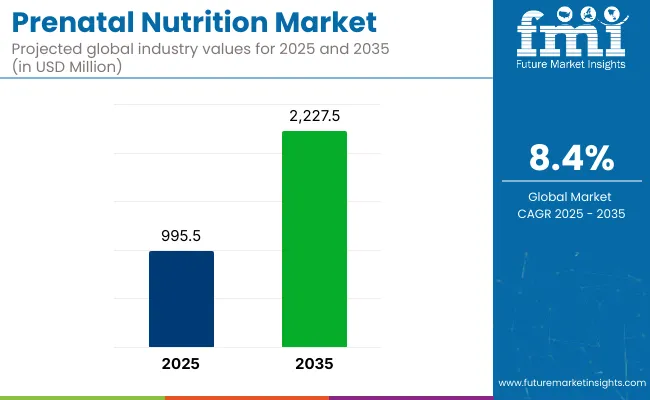
| Metric | Values |
|---|---|
| Estimated Size (2025) | USD 995.5 million |
| Projected value (2035) | USD 2,227.5 million |
| CAGR (2025 to 2035) | 8.4% |
Factors driving this growth include the rising aging maternal population, growing awareness of targeted nutritional supplementation during pregnancy, and the increasing prevalence of nutritional deficiencies such as iron and folic acid. Moreover, the market expansion is likely to be supported by premiumization trends as more women invest in specialized prenatal products addressing age-related needs, gestational health, and fetal development.
The USA is projected to remain the largest market for prenatal nutrition products, driven by robust innovations in nutritional formulations, though expanding at a moderate CAGR of 5.6%. In contrast, Japan and Germany are anticipated to register significant growth, rising at significant CAGRs of 6.7% and 6.4% respectively. Supplement sare projected to lead the product type with a prominent market share of 52%.Over-the-counter supplements account for 58% of the market share by sales channel.
The market accounts for approximately 6-8% of the overall maternal and child nutrition market, reflecting its niche yet essential role in targeted maternal health. Within the broader dietary supplements market, prenatal nutrition contributes around 1-2%, driven by its specialized consumer base of pregnant women.
It holds nearly 0.5-1% share in the functional foods and beverages market, where fortified foods are a minor category. In the health and wellness nutrition market, prenatal products represent less than 1% due to their focused demographic. However, within women’s health nutrition, prenatal nutrition commands a significant 15-18% share, reflecting its critical positioning.
Analyzing Prenatal Nutrition Market by Top Investment Segments
The market is segmented into product type, primary ingredients, sales channels, and region. By product type, it is segmented into functional food (protein bars, protein powders, cereals, cookies, soups, nutrient-rich stews, crisps & others [snacks, meal replacements]), beverages (herbal teas, fortified milk, ready-to-drink smoothies, electrolyte drinks), and supplements (vitamins and minerals, herbal supplements, calcium supplements, iron supplements, omega-3 fatty acids, probiotics, magnesium supplements and others [multivitamins, DHA blends]).
By primary ingredients, it includes folic acid, iron, calcium, vitamin D, omega-3 fatty acids, magnesium, protein, zinc, choline, and vitamin C. By sales channel, it is segmented into prescription supplements (institutional sales - hospitals and clinics), over-the-counter supplements (drug stores and pharmacies, hypermarkets/supermarkets, convenience stores, health and wellness stores, specialty stores, departmental stores, other retail store) and online retail (company website, third-party/mass merchandiser). By region, it covers North America, Latin America, Europe, East Asia, South Asia, Oceania, and MEA.
By Product Type, Supplements Account for 52% of the Market Share
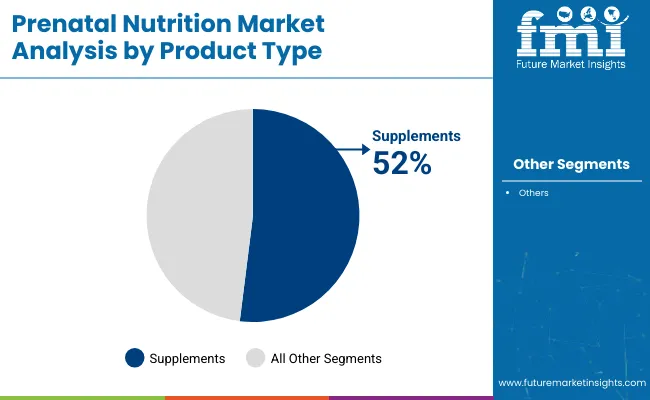
The supplements segment is likely to remain the largest within product types, accounting for over 52% share in 2025, due to their ability to deliver targeted nutrients such as iron, folic acid, and omega-3, which are essential for maternal and fetal health.
- Rising adoption driven by targeted nutrient formulations
- Gummy and chewable supplement formats are gaining popularity
- Iron and omega-3 supplements remain highly recommended products
By Primary Ingredient, Iron Accounts for 25% of the Market Share
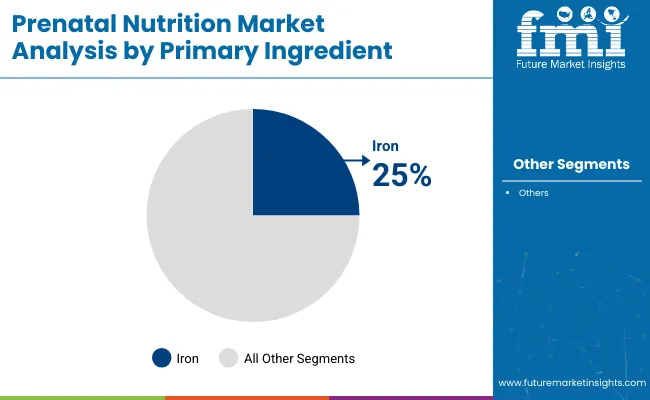
Iron is projected to be the leading primary ingredient segment with a market share of around 25% in 2025. Its dominance is attributed to its crucial role in hemoglobin production and oxygen transport, especially as blood volume increases during pregnancy.
- Addresses anemia risk during pregnancy
- Widely recommended as part of standard prenatal care
- Fortified foods with iron are gaining traction among consumers
By Sales Channel, Over-the-Counter (OTC) Supplements Account for 58% of the Market Share
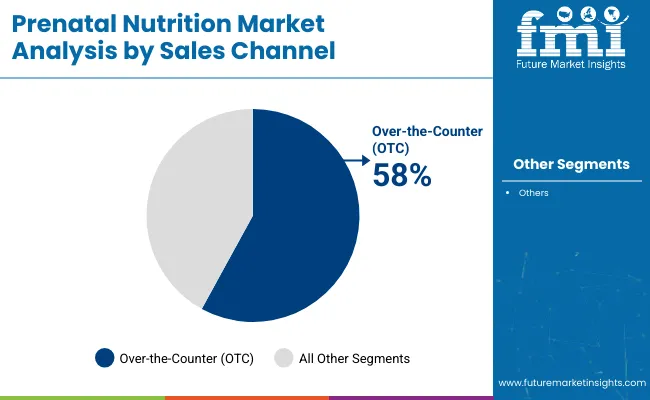
The over-the-counter supplements segment is anticipated to dominate sales channels, holding nearly 58% market share in 2025. Its growth is driven by the widespread availability of prenatal products in pharmacies, supermarkets, and health stores, making them easily accessible to consumers without requiring a prescription.
- High accessibility through pharmacies and supermarkets
- Rising consumer preference for self-managed prenatal care
- Expanded shelf space for prenatal products in retail stores
Top Prenatal Nutrition Market Dynamics
Recent Trends in the Prenatal Nutrition Market
- Rising adoption of personalized prenatal supplements tailored to genetic and health profiles.
- Increasing preference for clean-label, organic, and non-GMO prenatal products among health-conscious consumers.
Challenges in the Prenatal Nutrition Market
- The high cost of premium prenatal nutrition products limits adoption in low-income regions.
- Limited awareness about comprehensive prenatal nutrition beyond iron and folic acid in developing countries.
Analyzing Top Countries Manufacturing and Supplying Prenatal Nutrition Products
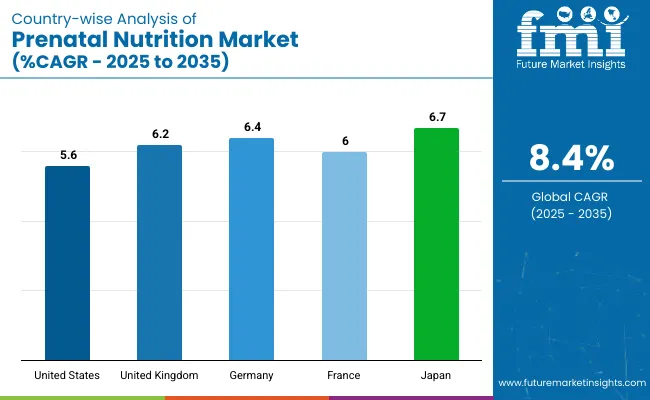
Among the top five countries in the prenatal nutrition market, Japan is projected to record the highest CAGR at 6.7% from 2025 to 2035, driven by strong government programs and cultural emphasis on maternal health. Germany follows with a CAGR of 6.4%, supported by preventive healthcare initiatives and high organic product demand.
The United Kingdom is expected to grow at 6.2% CAGR, reflecting NHS-backed nutrition guidelines and plant-based trends. France is projected at 6.0% CAGR, driven by public health campaigns and premium product demand, while the USA records the lowest among these at 5.6% CAGR, despite its strong market size and innovation focus.
The report covers an in-depth analysis of 40+ countries; five top-performing OECD countries are highlighted below.
United States Prenatal Nutrition Market Analysis
The prenatal nutrition revenue in the USA is projected to grow at a CAGR of 5.6% from 2025 to 2035. Growth is driven by high awareness about maternal health, continuous innovation in nutritional formulations, and the strong presence of major companies offering advanced supplements such as probiotics, omega-3 enriched products, and organic blends.
- Continuous innovation in prenatal supplement formulations.
- High awareness and physician-recommended prenatal care driving demand.
- Strong dominance of clean-label and organic prenatal nutrition products.
Prenatal Nutrition Demand Analysis in the UK
The prenatal nutrition market in the UK is anticipated to expand at a CAGR of around 6.2% between 2025 and 2035. Growth is supported by the NHS’s robust prenatal care programs that emphasize maternal nutrition, increasing consumer preference for fortified foods and supplements, and the rising adoption of plant-based prenatal products.
- NHS guidelines emphasize prenatal nutrition during pregnancy.
- Growing demand for plant-based and sustainable prenatal products.
- Strong retail network offering extensive prenatal nutrition product ranges.
Germany Prenatal Nutrition Sales Analysis
The revenue from prenatal nutrition in Germany is expected to rise at a CAGR of 6.4% from 2025 to 2035. This growth is underpinned by the country’s strong emphasis on preventive maternal healthcare, which integrates nutritional guidelines into routine prenatal check-ups.
- Preventive maternal healthcare is driving prenatal supplement adoption.
- High demand for organic and allergen-free prenatal nutrition products.
- Stringent EU regulations ensure superior product quality and safety.
Prenatal Nutrition Demand Analysis in France
The sales of prenatal nutrition products in France are predicted to flourish at a CAGR of approximately 6.0% from 2025 to 2035. Growth is driven by increasing awareness among expectant mothers about the importance of targeted prenatal nutrition, coupled with the influence of public health campaigns promoting folic acid and iron intake.
- Public health campaigns promoting essential prenatal nutrient intake.
- Strong nutraceutical industry ensuring product availability.
- Growing demand for premium and sustainably sourced prenatal products.
Japan Prenatal Nutrition Market Analysis
The prenatal nutrition market in Japan is projected to grow at a CAGR of 6.7% between 2025 and 2035. Growth is driven by high maternal health awareness, extensive government health programs promoting prenatal care, and the cultural emphasis on nutrition during pregnancy.
- Extensive government programs promoting prenatal health and nutrition.
- Rising demand for functional foods fortified with prenatal nutrients.
- Innovation in convenient delivery formats is enhancing market adoption.
Leading Prenatal Nutrition Product Suppliers
The market is moderately fragmented, with a mix of multinational leaders and numerous small to medium enterprises competing across product categories. Top companies such as Nestlé, Abbott Nutrition, Unilever, Church & Dwight Co. Inc., and Garden of Life are leveraging strong brand portfolios, broad distribution networks, and innovation capabilities to maintain market dominance.
Competition centers on differentiated formulations, clean-label certifications, pricing strategies, and regional expansions to capture emerging markets.
Company strategies increasingly focus on developing personalized and targeted prenatal supplements, expanding organic and non-GMO product lines, and forming partnerships with healthcare providers and digital health platforms to build trust and credibility.
Recent Prenatal Nutrition Industry News
In 2024, Nestlé launched Materna Pre and Materna Nausea, two new nutritional solutions designed for women’s fertility and to ease pregnancy-related symptoms such as nausea and vomiting.
Prenatal Nutrition Market Report Scope
| Report Attributes | Details |
|---|---|
| Current Total Market Size (2025) | USD 995.5 million |
| Projected Market Size (2035) | USD 2,227.5 million |
| CAGR (2025 to 2035) | 8.4% |
| Base Year for Estimation | 2024 |
| Historical Period | 2020 to 2024 |
| Projections Period | 2025 to 2035 |
| Market Analysis Parameters | Revenue in USD million/Volume in units |
| By Product Type | Functional Food (Protein Bars, Protein Powders, Cereals, Cookies, Soups, Nutrient-Rich Stews, Crisps, Others [snacks, meal replacements]), Beverages (Herbal Teas, Fortified Milk, Ready-to-Drink Smoothies, Electrolyte Drinks), Supplements (Vitamins and Minerals, Herbal Supplements, Calcium Supplements, Iron Supplements, Omega-3 Fatty Acids, Probiotics, Magnesium Supplements, Others (multivitamins, DHA blends)) |
| By Primary Ingredient | Folic Acid, Iron, Calcium, Vitamin D, Omega-3 Fatty Acids, Magnesium, Protein, Zinc, Choline, Vitamin C |
| By Sales Channel | Prescription Supplements (Institutional Sales - Hospitals and Clinics), Over the Counter Supplements (Drug Stores and Pharmacies, Hypermarkets/Supermarkets, Convenience Stores, Health and Wellness Stores, Specialty Stores, Departmental Stores, Other Retail Stores), Online Retail (Company Website, Third Party/Mass Merchandiser) |
| Regions Covered | North America, Latin America, Europe, East Asia, South Asia, Oceania, the Middle East and Africa |
| Countries Covered | United States, Canada, United Kingdom, Germany, France, China, Japan, South Korea, Brazil, Australia |
| Key Players | Nestlé S.A., Country Life LLC, Abbott Nutrition, Church & Dwight Co. Inc., Garden of Life, Vitamin Angels, Ritual, New Chapter Inc., Rainbow Light, PlusPlus Lifesciences LLP, CE CHEM, Avion Pharmaceuticals LLC, Perdays Health Functional Food Pty Ltd, Exeltis USA Inc., Mead Johnson & Company LLC, AdvaCare Pharma, Unilever, Otsuka Pharmaceutical Co. Ltd, Gelita AG, Mead Johnson & Company LLC. |
| Additional Attributes | Dollar sales by value, market share analysis by region, and country-wise analysis |
Key Segmentation
By Product Type:
As per product type, the industry has been categorized into Functional Food (Protein Bars, Protein Powders, Cereals, Cookies, Soups, Nutrient-Rich Stews, Crips, Others), Beverages (Herbal Teas, Fortified Milk, Ready-To-Drink Smoothies, Electrolyte Drinks), Supplements (Vitamins and Minerals, Herbal Supplements, Calcium Supplements, Iron Supplements, Omega-3 Fatty Acids, Probiotics, Herbal Supplements, Magnesium Supplements, Others)
By Primary Ingredient:
This segment is further categorized into Folic Acid, Iron, Calcium, Vitamin D, Omega-3 Fatty Acids, Magnesium, Protein, Zinc, Choline, and Vitamin C.
By Sales Channel:
As per sales channel, the industry has been categorized into Prescription Supplements (Rx)/ (Institutional Sales (Hospital and Clinics)), Over the Counter Supplements (OTC) (Drug Stores and Pharmacies, Hypermarkets/Supermarkets, Convenience Stores, Health and wellness Stores, Specialty Stores, Departmental Stores, Other Retail Stores), Online Retail (Company Website, 3rd party/Mass Merchandiser)
By Region:
As per Region, North America, Latin America, Western Europe, Eastern Europe, East Asia, South Asia & Pacific, Middle East and Africa
Frequently Asked Questions
What is the projected size of the prenatal nutrition market in 2025?
The market size is valued at USD 995.5 million in 2025.
What is the outlook on prenatal nutrition demand by 2035?
The market is forecasted to reach USD 2,227.5 million by 2035, reflecting a CAGR of 8.4%.
Which product type leads the prenatal nutrition market in 2025?
Supplements are expected to lead the market with over 52% share in 2025.
What is the projected share of iron in the primary ingredient segment of the prenatal nutrition market by 2025?
Iron is projected to hold approximately a 25% share of the market in 2025.
Which country is projected to have the fastest-growing prenatal nutrition market?
Japan is anticipated to be the fastest-growing market with a CAGR of 6.7% from 2025 to 2035.
Preview the report firsthand - request a free sample
Get SampleGet the brochure for pricing and purchase details.
Get PDFTable of Content
- Executive Summary
- Global Market Outlook
- Demand-side Trends
- Supply-side Trends
- Technology Roadmap Analysis
- Analysis and Recommendations
- Market Overview
- Market Coverage/Taxonomy
- Market Definition/Scope/Limitations
- Market Background
- Market Dynamics
- Drivers
- Restraints
- Opportunity
- Trends
- Scenario Forecast
- Demand in Optimistic Scenario
- Demand in Likely Scenario
- Demand in Conservative Scenario
- Opportunity Map Analysis
- Product Life Cycle Analysis
- Supply Chain Analysis
- Supply Side Participants and their Roles
- Producers
- Mid-Level Participants (Traders/ Agents/ Brokers)
- Wholesalers and Distributors
- Value Added and Value Created at Node in the Supply Chain
- List of Raw Material Suppliers
- List of Existing and Potential Buyer’s
- Supply Side Participants and their Roles
- Investment Feasibility Matrix
- Value Chain Analysis
- Profit Margin Analysis
- Wholesalers and Distributors
- Retailers
- PESTLE and Porter’s Analysis
- Regulatory Landscape
- By Key Regions
- By Key Countries
- Regional Parent Market Outlook
- Production and Consumption Statistics
- Import and Export Statistics
- Market Dynamics
- Global Market Analysis 2020 to 2024 and Forecast, 2025 to 2035
- Historical Market Size Value (USD Million) & Volume (units) Analysis, 2020 to 2024
- Current and Future Market Size Value (USD Million) & Volume (units) Projections, 2025 to 2035
- Y-o-Y Growth Trend Analysis
- Absolute $ Opportunity Analysis
- Global Market Pricing Analysis 2020 to 2024 and Forecast 2025 to 2035
- Global Market Analysis 2020 to 2024 and Forecast 2025 to 2035, By Product Type
- Introduction/Key Findings
- Historical Market Size Value (USD Million) & Volume (units) Analysis By Product Type, 2020 to 2024
- Current and Future Market Size Value (USD Million) & Volume (units) Analysis and Forecast By Product Type, 2025 to 2035
- Functional Food
- Protein Bars
- Protein Powders
- Cereals
- Cookies
- Soups
- Nutrient-Rich Stews
- Crisps
- Others
- Beverages
- Herbal Teas
- Fortified Milk
- Ready-To-Drink Smoothies
- Electrolyte Drinks
- Supplements
- Vitamins and Minerals
- Herbal Supplements
- Calcium Supplements
- Iron Supplements
- Omega-3 Fatty Acids, Probiotics, Herbal Supplements, Magnesium Supplements, Others.
- Functional Food
- Y-o-Y Growth Trend Analysis By Product Type, 2020 to 2024
- Absolute $ Opportunity Analysis By Product Type, 2025 to 2035
- Global Market Analysis 2020 to 2024 and Forecast 2025 to 2035, By Primary Ingredients
- Introduction/Key Findings
- Historical Market Size Value (USD Million) & Volume (units) Analysis By Primary Ingredients, 2020 to 2024
- Current and Future Market Size Value (USD Million) & Volume (units) Analysis and Forecast By Primary Ingredients, 2025 to 2035
- Folic Acid
- Iron
- Calcium
- Vitamin D
- Omega-3 Fatty Acids
- Magnesium
- Protein
- Zinc
- Choline
- Vitamin C
- Y-o-Y Growth Trend Analysis By Primary Ingredients, 2020 to 2024
- Absolute $ Opportunity Analysis By Primary Ingredients, 2025 to 2035
- Global Market Analysis 2020 to 2024 and Forecast 2025 to 2035, By Sales Channel
- Introduction/Key Findings
- Historical Market Size Value (USD Million) & Volume (units) Analysis By Sales Channel, 2020 to 2024
- Current and Future Market Size Value (USD Million) & Volume (units) Analysis and Forecast By Sales Channel, 2025 to 2035
- Prescription Supplements (Rx)/ (Institutional Sales (Hospital and Clinics))
- Over the Counter Supplements (OTC)
- Drug Stores and Pharmacies
- Hypermarkets/Supermarkets
- Convenience Stores
- Health and Wellness Stores
- Specialty Stores
- Departmental Stores
- Other Retail Stores
- Online Retail
- Company Website
- 3rd Party/Mass Merchandiser
- Y-o-Y Growth Trend Analysis By Sales Channel, 2020 to 2024
- Absolute $ Opportunity Analysis By Sales Channel, 2025 to 2035
- Global Market Analysis 2020 to 2024 and Forecast 2025 to 2035, By Region
- Introduction
- Historical Market Size Value (USD Million) & Volume (units) Analysis By Region, 2020 to 2024
- Current Market Size Value (USD Million) & Volume (units) Analysis and Forecast By Region, 2025 to 2035
- North America
- Latin America
- Western Europe
- Eastern Europe
- East Asia
- South Asia & Pacific
- Middle East and Africa
- Market Attractiveness Analysis By Region
- North America Market Analysis 2020 to 2024 and Forecast 2025 to 2035, By Country
- Historical Market Size Value (USD Million) & Volume (units) Trend Analysis By Market Taxonomy, 2020 to 2024
- Market Size Value (USD Million) & Volume (units) Forecast By Market Taxonomy, 2025 to 2035
- By Country
- USA
- Canada
- Mexico
- By Product Type
- By Primary Ingredients
- By Sales Channel
- By Country
- Market Attractiveness Analysis
- By Country
- By Product Type
- By Primary Ingredients
- By Sales Channel
- Key Takeaways
- Latin America Market Analysis 2020 to 2024 and Forecast 2025 to 2035, By Country
- Historical Market Size Value (USD Million) & Volume (units) Trend Analysis By Market Taxonomy, 2020 to 2024
- Market Size Value (USD Million) & Volume (units) Forecast By Market Taxonomy, 2025 to 2035
- By Country
- Brazil
- Argentina
- Rest of LATAM
- By Product Type
- By Primary Ingredients
- By Sales Channel
- By Country
- Market Attractiveness Analysis
- By Country
- By Product Type
- By Primary Ingredients
- By Sales Channel
- Key Takeaways
- Western Europe Market Analysis 2020 to 2024 and Forecast 2025 to 2035, By Country
- Historical Market Size Value (USD Million) & Volume (units) Trend Analysis By Market Taxonomy, 2020 to 2024
- Market Size Value (USD Million) & Volume (units) Forecast By Market Taxonomy, 2025 to 2035
- By Country
- Germany
- Italy
- France
- UK
- Spain
- BENELUX
- Nordic
- Rest of W.Europe
- By Product Type
- By Primary Ingredients
- By Sales Channel
- By Country
- Market Attractiveness Analysis
- By Country
- By Product Type
- By Primary Ingredients
- By Sales Channel
- Key Takeaways
- Eastern Europe Market Analysis 2020 to 2024 and Forecast 2025 to 2035, By Country
- Historical Market Size Value (USD Million) & Volume (units) Trend Analysis By Market Taxonomy, 2020 to 2024
- Market Size Value (USD Million) & Volume (units) Forecast By Market Taxonomy, 2025 to 2035
- By Country
- Russia
- Hungary
- Poland
- Balkan & Baltics
- Rest of E. Europe
- By Product Type
- By Primary Ingredients
- By Sales Channel
- By Country
- Market Attractiveness Analysis
- By Country
- By Product Type
- By Primary Ingredients
- By Sales Channel
- Key Takeaways
- East Asia Market Analysis 2020 to 2024 and Forecast 2025 to 2035, By Country
- Historical Market Size Value (USD Million) & Volume (units) Trend Analysis By Market Taxonomy, 2020 to 2024
- Market Size Value (USD Million) & Volume (units) Forecast By Market Taxonomy, 2025 to 2035
- By Country
- China
- Japan
- South Korea
- By Product Type
- By Primary Ingredients
- By Sales Channel
- By Country
- Market Attractiveness Analysis
- By Country
- By Product Type
- By Primary Ingredients
- By Sales Channel
- Key Takeaways
- South Asia & Pacific Market Analysis 2020 to 2024 and Forecast 2025 to 2035, By Country
- Historical Market Size Value (USD Million) & Volume (units) Trend Analysis By Market Taxonomy, 2020 to 2024
- Market Size Value (USD Million) & Volume (units) Forecast By Market Taxonomy, 2025 to 2035
- By Country
- India
- Australia & New Zealand
- ASEAN
- Rest of SAP
- By Product Type
- By Primary Ingredients
- By Sales Channel
- By Country
- Market Attractiveness Analysis
- By Country
- By Product Type
- By Primary Ingredients
- By Sales Channel
- Key Takeaways
- Middle East and Africa Market Analysis 2020 to 2024 and Forecast 2025 to 2035, By Country
- Historical Market Size Value (USD Million) & Volume (units) Trend Analysis By Market Taxonomy, 2020 to 2024
- Market Size Value (USD Million) & Volume (units) Forecast By Market Taxonomy, 2025 to 2035
- By Country
- GCC Countries
- Northern Africa
- South Africa
- Turkiye
- Rest of MEA
- By Product Type
- By Primary Ingredients
- By Sales Channel
- By Country
- Market Attractiveness Analysis
- By Country
- By Product Type
- By Primary Ingredients
- By Sales Channel
- Key Takeaways
- Key Countries Market Analysis
- USA
- Pricing Analysis
- Market Share Analysis, 2024
- By Product Type
- By Primary Ingredients
- By Sales Channel
- Canada
- Pricing Analysis
- Market Share Analysis, 2024
- By Product Type
- By Primary Ingredients
- By Sales Channel
- Brazil
- Pricing Analysis
- Market Share Analysis, 2024
- By Product Type
- By Primary Ingredients
- By Sales Channel
- Mexico
- Pricing Analysis
- Market Share Analysis, 2024
- By Product Type
- By Primary Ingredients
- By Sales Channel
- Argentina
- Pricing Analysis
- Market Share Analysis, 2024
- By Product Type
- By Primary Ingredients
- By Sales Channel
- USA
- Market Structure Analysis
- Competition Dashboard
- Competition Benchmarking
- Market Share Analysis of Top Players
- By Regional
- By Product Type
- By Primary Ingredients
- By Sales Channel
- Competition Analysis
- Competition Deep Dive
- Nestlé, S.A.
- Overview
- Product Portfolio
- Profitability by Market Segments (Product/Age /Sales Channel/Region)
- Sales Footprint
- Strategy Overview
- Marketing Strategy
- Product Strategy
- Channel Strategy
- Country Life, LLC.
- Overview
- Product Portfolio
- Profitability by Market Segments (Product/Age /Sales Channel/Region)
- Sales Footprint
- Strategy Overview
- Marketing Strategy
- Product Strategy
- Channel Strategy
- Abbott Nutrition
- Overview
- Product Portfolio
- Profitability by Market Segments (Product/Age /Sales Channel/Region)
- Sales Footprint
- Strategy Overview
- Marketing Strategy
- Product Strategy
- Channel Strategy
- Church & Dwight Co. Inc.
- Overview
- Product Portfolio
- Profitability by Market Segments (Product/Age /Sales Channel/Region)
- Sales Footprint
- Strategy Overview
- Marketing Strategy
- Product Strategy
- Channel Strategy
- Garden of Life
- Overview
- Product Portfolio
- Profitability by Market Segments (Product/Age /Sales Channel/Region)
- Sales Footprint
- Strategy Overview
- Marketing Strategy
- Product Strategy
- Channel Strategy
- Vitamin Angels
- Overview
- Product Portfolio
- Profitability by Market Segments (Product/Age /Sales Channel/Region)
- Sales Footprint
- Strategy Overview
- Marketing Strategy
- Product Strategy
- Channel Strategy
- Ritual
- Overview
- Product Portfolio
- Profitability by Market Segments (Product/Age /Sales Channel/Region)
- Sales Footprint
- Strategy Overview
- Marketing Strategy
- Product Strategy
- Channel Strategy
- New Chapter, Inc.
- Overview
- Product Portfolio
- Profitability by Market Segments (Product/Age /Sales Channel/Region)
- Sales Footprint
- Strategy Overview
- Marketing Strategy
- Product Strategy
- Channel Strategy
- Rainbow Light
- Overview
- Product Portfolio
- Profitability by Market Segments (Product/Age /Sales Channel/Region)
- Sales Footprint
- Strategy Overview
- Marketing Strategy
- Product Strategy
- Channel Strategy
- PlusPlus Lifesciences LLP.
- Overview
- Product Portfolio
- Profitability by Market Segments (Product/Age /Sales Channel/Region)
- Sales Footprint
- Strategy Overview
- Marketing Strategy
- Product Strategy
- Channel Strategy
- CE CHEM
- Overview
- Product Portfolio
- Profitability by Market Segments (Product/Age /Sales Channel/Region)
- Sales Footprint
- Strategy Overview
- Marketing Strategy
- Product Strategy
- Channel Strategy
- Avion Pharmaceuticals, LLC
- Overview
- Product Portfolio
- Profitability by Market Segments (Product/Age /Sales Channel/Region)
- Sales Footprint
- Strategy Overview
- Marketing Strategy
- Product Strategy
- Channel Strategy
- Perdays Health Functional Food Pty Ltd
- Overview
- Product Portfolio
- Profitability by Market Segments (Product/Age /Sales Channel/Region)
- Sales Footprint
- Strategy Overview
- Marketing Strategy
- Product Strategy
- Channel Strategy
- Exeltis USA, Inc.
- Overview
- Product Portfolio
- Profitability by Market Segments (Product/Age /Sales Channel/Region)
- Sales Footprint
- Strategy Overview
- Marketing Strategy
- Product Strategy
- Channel Strategy
- Mead Johnson & Company, LLC
- Overview
- Product Portfolio
- Profitability by Market Segments (Product/Age /Sales Channel/Region)
- Sales Footprint
- Strategy Overview
- Marketing Strategy
- Product Strategy
- Channel Strategy
- AdvaCare Pharma
- Overview
- Product Portfolio
- Profitability by Market Segments (Product/Age /Sales Channel/Region)
- Sales Footprint
- Strategy Overview
- Marketing Strategy
- Product Strategy
- Channel Strategy
- Unilever
- Overview
- Product Portfolio
- Profitability by Market Segments (Product/Age /Sales Channel/Region)
- Sales Footprint
- Strategy Overview
- Marketing Strategy
- Product Strategy
- Channel Strategy
- Otsuka Pharmaceutical Co., Ltd
- Overview
- Product Portfolio
- Profitability by Market Segments (Product/Age /Sales Channel/Region)
- Sales Footprint
- Strategy Overview
- Marketing Strategy
- Product Strategy
- Channel Strategy
- Gelita AG
- Overview
- Product Portfolio
- Profitability by Market Segments (Product/Age /Sales Channel/Region)
- Sales Footprint
- Strategy Overview
- Marketing Strategy
- Product Strategy
- Channel Strategy
- Mead Johnson & Company, LLC
- Overview
- Product Portfolio
- Profitability by Market Segments (Product/Age /Sales Channel/Region)
- Sales Footprint
- Strategy Overview
- Marketing Strategy
- Product Strategy
- Channel Strategy
- Nestlé, S.A.
- Competition Deep Dive
- Assumptions & Acronyms Used
- Research Methodology


