

- Market Size (2026)
- USD 4.1 Bn
- Forecast (2036)
- USD 9.4 Bn
- CAGR (2026 to 2036)
- 8.6%
How big is Prenatal & Maternal Nutrition Ingredients Market in 2026?
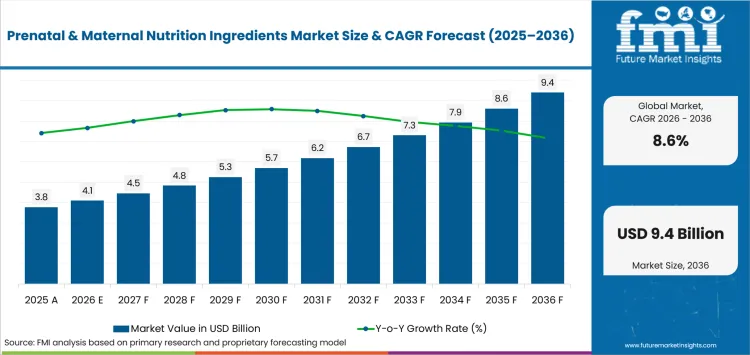
USD 4.1 billion in 2026 and USD 9.4 billion by 2036 at an 8.6% CAGR.
Sales of prenatal and maternal nutrition ingredients are projected to expand at 8.6% CAGR from 2026 to 2036, increasing the value from USD 4.1 billion in 2026 to USD 9.4 billion by 2036. The industry is being supported by established maternal nutrition guidelines that reinforce demand for clinically recognized prenatal nutrients and specialized ingredient formulations. NIH updated its pregnancy fact sheet in April 2025 and retained recommended intakes of 600 mcg DFE for folate and 27 mg for iron. Defined intake levels require precise nutrient identity and dependable bioavailability across commercial prenatal vitamin ingredients programs. Formulators also use EPA DHA ingredients that preserve declared potency through storage and finished-dose preparation.
Maternal formulations combine nutrients with different stability limits and delivery requirements across every stage from preconception through lactation. WHO issued its second consolidated maternal health recommendations in March 2025 and aligned preventive guidance with care across pregnancy and postnatal settings. United States supplement manufacturers manage safety and label compliance through company-controlled documentation across national retail channels. Japanese brands must fit nutrient-function limits and prescribed label statements across every eligible maternal product. Indian health programs create institutional demand for iron and folate across public maternal care pathways. Chinese maternal foods require ingredient use under specific national standards for pregnant and lactating consumers. Microencapsulation technologies can protect sensitive lipids during processing without replacing contaminant testing or release controls.
Key Takeaways of Prenatal & Maternal Nutrition Ingredients Market
- Demand expands as prenatal formulators require verified nutrient identity and reproducible delivery from preconception through pregnancy and lactation products.
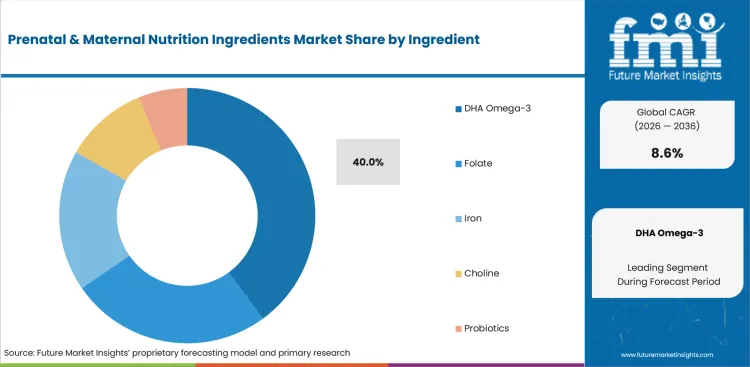
- By ingredient, DHA omega-3 is expected to lead with 40.0% share in 2026 due to its specialized maternal lipid role.
- Powder is projected to capture 45.2% share in 2026 within form demand through measured serving preparation and multi-ingredient blending.
- Fish is anticipated to represent 63.1% share in 2026 within source demand owing to established refining capacity and commercial DHA availability.
- Oxidation risk and nutrient tolerability remain major constraints; country dosage rules further narrow acceptable formulation choices across maternal products.
- Competition spans dsm-firmenich, Balchem, Gnosis by Lesaffre, KD Pharma Group, Lallemand Health Solutions, Novonesis, Glanbia Nutritionals, and Aker BioMarine.
Analyst Perspective
"Prenatal ingredient programs succeed through coordinated control of nutrient form and serving accuracy across the complete maternal product. DHA requires oxidation protection and folate requires an approved chemical form; iron also requires acceptable tolerance within the same daily serving. Commercially stronger portfolios connect these controls with application data that survives scale-up and shelf life across country-specific maternal labels."
- Nandini Roy Choudhury, Principal Analyst, Future Market Insights
How is the Prenatal & Maternal Nutrition Ingredients Market segmented?
The prenatal and maternal nutrition ingredients industry is segmented by ingredient, form, source, and region.
The prenatal and maternal nutrition ingredients market is segmented by ingredient, form, source, and region. Ingredient segmentation covers DHA omega-3, folate, iron, choline, and probiotics according to physiological role and formulation risk. Form segmentation compares powder, liquid, granules, and paste through mixing behavior and shelf-life needs across maternal products. Source segmentation separates fish and algal inputs according to origin, purification, sensory profile, and contaminant controls. Regional analysis examines ingredient permissions, maternal nutrition guidance, manufacturing routes, and commercial channels across national markets. Prenatal vitamin supplements provide a common use route, whereas folate ingredients and lipids follow different stability and labeling requirements.
What makes DHA omega-3 central to the ingredient category?
Maternal DHA specifications require source identity and oxidation control throughout evaluation of any broad omega-3 claim. dsm-firmenich reported on World Prematurity Day (November 17, 2025) that high-dose algal DHA could deliver 350 mg DHA per serving in softgels, and 350 mg DHA across two servings in gummies, enabling smaller formats without weakening declared dose delivery. The documented formats show how higher concentration can reduce capsule size and sensory barriers without weakening declared dose delivery. Omega-3 products offer a wider commercial route, although maternal applications require dedicated impurity limits and shelf-life evidence.
- DHA omega-3 is projected to hold 40.0% share in 2026 owing to its defined role in fetal brain and eye development. The segment earns higher technical value through concentrated dosing and strict oxidation control across maternal formats. Repeat purchasing depends on assay consistency and source traceability across every commercial production lot within maternal manufacturing programs.
- Prenatal brands combine DHA with folate and choline supplements to cover separate nutritional roles within one finished product. Adoption improves through ingredients that tolerate encapsulation and preserve declared potency throughout the stated commercial shelf life. Commercial risk rises if odor control or testing methods change between pilot production and routine release.
Why does powder lead the form category?
Powder formats support multi-ingredient blending and measured serving preparation across prenatal products containing several active nutrients. Mineral premixes require uniform distribution across small serving sizes and dependable reconstitution during normal consumer preparation. Lallemand Health Solutions published clinical trial results in June 2025 confirming the efficacy of Prenatis in a large cohort of healthy pregnant women and their infants. Prenatis is available in sachets, sticks, orodispersible powders, and capsules, connecting maternal evidence with practical administration choices across maternal formats.
- Powder is likely to capture 45.2% share in 2026 attributable to efficient blending across vitamins and minerals. The format also supports measured sachets and drink preparations that carry several nutrients within one serving. Commercial performance depends on dose uniformity across individual packages rather than the average result for a complete batch.
- Contract manufacturers use powder programs with established mixing and filling equipment across several maternal formulations. Microencapsulated omega-3 powders improve lipid handling through moisture protection and controlled dispersion during normal storage conditions. The format loses its advantage if reconstitution creates sediment or sensitive nutrients degrade throughout expected distribution conditions.
How does fish shape the source category?
Fish-derived DHA remains commercially relevant through refining routes that supply concentrated omega-3 ingredients at industrial scale. Maternal product developers require contaminant controls and traceable species information during qualification for repeat production. KD Pharma reported in February 2025 that its German and Canadian laboratories ranked first and second in an AOCS proficiency program for nutraceutical oils. The result explains why analytical consistency influences source qualification alongside price and available supply volume.
- Based on source, fish is projected to account for 63.1% in 2026 due to established refining capacity for concentrated marine oils. Familiar analytical methods and long-standing supply contracts shorten qualification across established maternal product manufacturing systems. Maternal products require strict contaminant and oxidation limits, so production scale must operate with documented purification performance.
- Large supplement manufacturers qualify fish-derived DHA through consistent concentrates and recognized analytical methods across commercial production programs. Algal alternatives gain attention through vegetarian positioning and controlled fermentation routes with different source documentation. Fish retains wider commercial use through established supply contracts, traceable species data, and purification documentation that reduce reformulation risk across multi-batch maternal production programs.
What are the drivers, restraints, and opportunities in the Prenatal & Maternal Nutrition Ingredients Market?
Defined maternal nutrient requirements support demand; stability limits and country-specific serving rules constrain adoption; new approvals and regional distribution routes expand commercial access.
- Driver: Clinical nutrient guidance creates recurring demand for ingredients that deliver defined maternal serving levels across commercial products.
- Restraint: Narrow tolerability ranges and oxidation sensitivity increase testing requirements across complex prenatal and maternal formulations.
- Opportunity: New approvals and regional distribution routes expand access to evidence-backed maternal ingredients across regulated supplement channels.
Clinical guidance creates recurring ingredient demand by defining the nutrient levels that prenatal products must deliver. NIH updated its omega-3 fact sheet in August 2025 and summarized clinical guidance for additional DHA intake during pregnancy. The guidance increases demand for concentrated lipid ingredients that reach the intended serving without excessive capsule volume. Repeat purchasing depends on assay results that remain consistent through commercial manufacturing and completed shelf-life testing.
Several nutrients must fit inside one acceptable daily serving, which creates a formulation restraint. NIH updated its iron fact sheet in September 2025 and retained a 27 mg pregnancy recommendation with a 45 mg upper intake level. The narrow operating range increases the value of precise assays and bioavailable mineral forms across each released batch. High mineral loading also affects taste and tablet size across products that combine several required nutrients. Commercial adoption slows if maternal product developers cannot balance effective delivery with routine gastrointestinal tolerance.
New distribution agreements offer a practical opportunity for maternal formulas that need vegetarian DHA sources and flexible delivery formats. Aker BioMarine announced in March 2025 that two European distributors would introduce its Revervia algal DHA across France and Benelux as well as Spain and Portugal. The agreements extend local access to a high-concentration DHA ingredient without treating distribution as proof of product adoption. Maternal brands can use the added route to shorten sample access and technical coordination across regional launches.
Which country CAGRs are profiled in the Prenatal & Maternal Nutrition Ingredients Market?
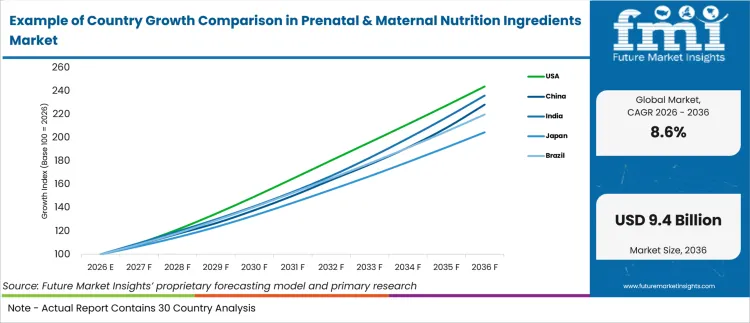
| Country | CAGR |
|---|---|
| USA | 7.8% |
| China | 8.6% |
| India | 9.0% |
| Japan | 7.4% |
| Brazil | 8.2% |
How do country-level CAGRs compare in the Prenatal & Maternal Nutrition Ingredients Market?
The country comparison spans 1.6 percentage points and reflects broadly consistent growth across the prenatal & maternal nutrition ingredients market. India and China remain at the upper end of the comparison, supported by expanding maternal health awareness and increasing use of nutritional supplementation during pregnancy. Brazil follows closely behind and creates a gradual transition between the higher-growth and lower-growth markets. The USA and Japan form a closely aligned group with only a limited difference between their forecasts.
- India shows a notable position within the comparison as rising focus on maternal nutrition and growing access to prenatal supplements continue to support demand for specialized nutritional ingredients.
- China remains closely aligned with India as manufacturers expand products containing vitamins, minerals and functional ingredients designed to support maternal and fetal health.
- Brazil reflects steady market development through increasing awareness of pregnancy nutrition and broader availability of fortified maternal health products.
- The USA benefits from a mature prenatal supplement category where innovation is increasingly focused on bioavailability, ingredient quality and targeted nutritional support.
- Japan maintains a meaningful position within the comparison as demand is supported by preventive healthcare practices and continued interest in scientifically formulated maternal nutrition products.
Comparable CAGRs do not create identical market conditions across countries. Differences in healthcare guidance, supplement usage patterns, birth rates and regulatory requirements influence how prenatal and maternal nutrition products are formulated and commercialized. Similar growth forecasts may therefore reflect different product strategies and consumer adoption pathways. The full report provides country-level CAGR analysis across North America, Latin America, Europe, East Asia, South Asia, Oceania and the Middle East and Africa.
Country-wise Analysis
- United States prenatal supplements operate under manufacturer responsibility for safety and label substantiation across national retail channels. The NIH Office of Dietary Supplements convened a workshop in June 2025 to examine whether nutrient levels in current prenatal products support maternal and infant health. Prenatal and maternal nutrition ingredient sales in the USA are forecast to expand at 7.8% CAGR by 2036, supported by established retail access and contract manufacturing. The workshop focused on appropriate nutrient ranges and evidence gaps across products marketed in the United States. Contract manufacturers and testing laboratories support tablet and powder programs alongside softgel production across established national channels. The absence of routine premarket approval remains a challenge; each brand carries independent compliance responsibility.
- Chinese maternal products must meet national composition standards and label declarations for foods intended for pregnant and lactating consumers. In China, prenatal and maternal nutrition ingredient demand is predicted to advance at 8.6% CAGR through 2036 supported by domestic manufacturing and regulated maternal product categories. China's State Administration for Market Regulation reported in November 2025 that a powder marketed for pregnancy and lactation failed folate content and label-value checks. The finding makes batch accuracy and label alignment direct operating requirements for ingredient manufacturers serving this category. Domestic processing and regional distribution support approved maternal formats across national channels for pregnant and lactating consumers.
- Indian maternal nutrition demand spans private supplements and public iron-folic acid programs delivered through pregnancy care. The Press Information Bureau reported in April 2025 that pregnant and lactating women receive daily iron-folic acid tablets for 180 days. The program establishes a recurring institutional route for standard iron and folic acid inputs nationwide. India's prenatal and maternal nutrition ingredients market outlook is anticipated to advance at 9.0% CAGR over the assessment period, underpinned by institutional supplementation and domestic nutraceutical production. Public specifications give ingredient manufacturers a clear qualification target across high-volume maternal care programs nationwide. Price sensitivity and program requirements remain a restraint for premium bioavailable forms across large-volume tenders.
- Japanese functional-food routes require defined intake ranges and prescribed caution statements for every eligible maternal nutrient. The Consumer Affairs Agency updated its notification platform in April 2025 and requires safety information with manufacturing details and functional evidence for new filings. Adoption of prenatal and maternal nutrition ingredients in Japan is estimated to expand at 7.4% CAGR through 2036, influenced by established quality expectations and precise labeling practice. The notification route supports products that fit an eligible function and documented intake range in Japan. Domestic quality systems and established retail channels support focused maternal product launches throughout the country. Fixed statements and detailed filing duties remain material frictions for novel claims or imported formulations.
- Brazilian maternal supplements use population-specific ingredient permissions and consumption limits under the current Anvisa framework. Prenatal and maternal nutrition ingredient demand in Brazil is forecast to rise at 8.2% CAGR over the forecast period, aided by specialized supplement channels and national retail distribution. Anvisa updated its guidance in November 2025 and confirmed distinct ingredient permissions and intake limits for pregnant and lactating consumers. The official database supports early screening of maternal formulas during national commercialization planning in Brazil. Established pharmacy chains support compliant supplement launches across Brazil's major urban markets and regional distribution hubs. Restricted ingredients and approved claim wording remain frictions for rapid transfer from products developed elsewhere.
Who are the notable companies in the Prenatal & Maternal Nutrition Ingredients Market?
dsm-firmenich, Balchem, Gnosis by Lesaffre, KD Pharma Group, Lallemand Health Solutions, Novonesis, Glanbia Nutritionals, and Aker BioMarine are the notable companies shaping this market.
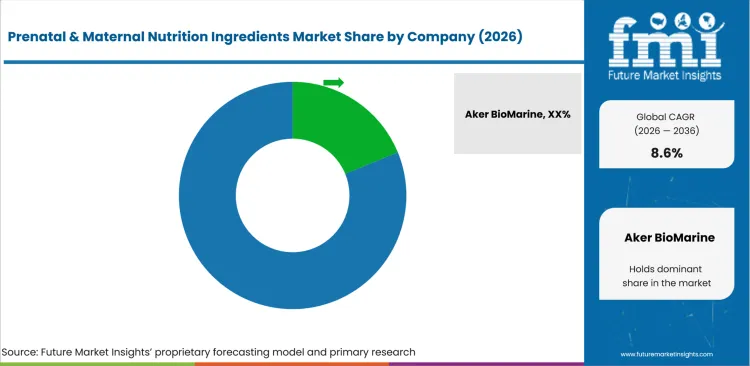
Competition depends on nutrient breadth and maternal application support across several commercial delivery formats and national markets. dsm-firmenich and Balchem combine broad nutrient portfolios with prenatal formulation guidance across several delivery formats and regulatory routes. Glanbia Nutritionals supplies premix capabilities for products that need several vitamins and minerals in one specification. Gnosis by Lesaffre focuses on active folate; KD Pharma Group and Aker BioMarine address marine or algal lipid routes. Lallemand Health Solutions and Novonesis compete through maternal probiotic programs with strain-specific evidence for pregnancy and lactation products. Balchem combines active folate and choline capabilities for prenatal formats that require stable dosage and complementary methyl-donor functions. Commercial selection depends on country-ready documentation and exact nutrient scope rather than corporate scale across unrelated nutrition categories.
- Integrated maternal nutrition platforms include dsm-firmenich and Balchem alongside the prenatal premix capabilities of Glanbia Nutritionals. Their portfolios cover lipids and folate with choline and minerals across premix or finished-format support. Commercial advantage comes from connecting ingredient supply with application guidance that fits each delivery format and national permission route.
- Specialized folate and lipid manufacturers include Gnosis by Lesaffre with KD Pharma Group and Aker BioMarine. Their offers span active folate and concentrated marine oils with algae-derived DHA for maternal formats. Selection depends on source traceability and analytical control across the intended dose and delivery system.
- Maternal probiotic specialists include Lallemand Health Solutions and Novonesis through pregnancy-focused strain combinations with exact-market evidence. Commercial relevance depends on strain identity and country-specific claim permissions across each intended maternal product. Probiotic ingredients also require storage conditions that preserve viable counts across national distribution and the complete labeled shelf life.
Competitive Benchmarking: Prenatal & Maternal Nutrition Ingredients Market
| Company | Prenatal Ingredient Coverage | Maternal Evidence Depth | Formulation Support | Geographic Reach |
|---|---|---|---|---|
| dsm-firmenich | High | High | High | Global |
| Balchem | High | High | High | Global |
| Gnosis by Lesaffre | Low | High | Medium | Global |
| KD Pharma Group | Low | Medium | High | Global |
| Lallemand Health Solutions | Low | High | High | Global |
| Novonesis | Low | Medium | Medium | Global |
| Glanbia Nutritionals | High | Medium | High | Global |
| Aker BioMarine | Low | Medium | High | Global |
Key Developments in the Prenatal & Maternal Nutrition Ingredients Market
- In January 2025, Gnosis by Lesaffre announced that Quatrefolic had received Chinese approval (granted December 2024) for use in nutrient supplementary food for pregnant and lactating women at daily folate dosages up to 400 mcg. The authorization also covered solid beverages and widened the available delivery route for maternal formulations. The decision gave maternal product developers a defined active-folate pathway inside China's special dietary food framework.
- In January 2026, Aker BioMarine introduced Revervia algae-derived DHA for Indian nutraceutical brands and appointed a national distribution partner. The ingredient supports maternal and fetal health across capsules and powders as well as other functional formats. Local distribution and formulation support shorten sample access and technical coordination for domestic product launches.
- In December 2025, Lallemand Health Solutions announced new Canadian claims for Prenatis covering maternal and newborn microbiome support. The company confirmed sachets and sticks as well as orodispersible powders and capsules as available formats. The claims provide a defined regulatory reference for maternal probiotic products sold through Canadian supplement channels.
- In November 2025, dsm-firmenich outlined a maternal nutrition development framework covering DHA concentration and stage-specific supplementation. The program also addressed microbiome support and acceptable delivery formats across products from preconception through postpartum care. The update broadened commercial development beyond single-nutrient products toward coordinated maternal formulations with clearer stage-specific roles for supplement manufacturers across national markets.
Prenatal & Maternal Nutrition Ingredients Market - Report Scope
| Coverage field | Report scope |
|---|---|
| Market breakdown | Ingredient, form, source, and region. |
| Quantitative Units | Revenue in USD Billion and CAGR in %. |
| Market Definition | DHA omega-3, folate, iron, choline, probiotics, and related nutrient ingredients formulated for preconception, pregnancy, and lactation products. Finished infant formula and finished prenatal supplements are excluded. |
| Regions Covered | North America, Latin America, Western Europe, Eastern Europe, East Asia, South Asia and Pacific, and Middle East and Africa. |
| Countries Covered | USA, China, India, Japan, and Brazil with additional country coverage across the regional taxonomy. |
| Key Companies Profiled | dsm-firmenich, Balchem, Gnosis by Lesaffre, KD Pharma Group, Lallemand Health Solutions, Novonesis, Glanbia Nutritionals, and Aker BioMarine. |
| Forecast Period | 2026 to 2036. |
| Approach | Hybrid bottom-up and top-down market sizing supported by primary interviews and official desk research. |
Prenatal & Maternal Nutrition Ingredients Market - Research Methodology
| Method | Approach |
|---|---|
| Primary Research | FMI analysts gathered input from manufacturers, service providers, technology developers, distributors, end users, procurement teams, and subject-matter experts. Interviews examined purchasing decisions, product or service evaluation, adoption barriers, approval requirements, pricing considerations, and expectations for technical or commercial support. Respondents were also asked what evidence is required before a trial, pilot, or initial order develops into regular purchasing. |
| Desk Research | Desk research covered government statistics, regulatory publications, trade data, industry associations, technical literature, standards, company filings, product information, and official corporate announcements. Sources were reviewed for relevance, publication date, geographic coverage, and consistency with the defined market scope. Claims relating to performance, applications, approvals, capacity, investment, and commercial activity were retained only when supported by credible public evidence. |
| Market Sizing and Forecasting | The market model combined the baseline value with historical performance, segment structure, pricing and volume indicators, adoption levels, company participation, and country-level demand conditions. Forecast assumptions considered economic activity, investment trends, regulatory developments, technology adoption, purchasing cycles, supply availability, and barriers to wider market use. Segment and regional estimates were reconciled before the final market total was calculated. |
| Data Validation | Estimates were checked against multiple independent indicators, including public data, company activity, trade patterns, industry developments, and findings from primary interviews. Validation also tested whether products, services, applications, and company revenues fell within the defined market boundaries. Adjacent categories, unsupported claims, overlapping revenues, and activities without direct market relevance were excluded to reduce double counting and maintain consistency across segments and countries. |
Prenatal & Maternal Nutrition Ingredients Market by Segments
Prenatal & Maternal Nutrition Ingredients Market segmented by Ingredient:
- DHA Omega-3
- Folate
- Iron
- Choline
- Probiotics
Prenatal & Maternal Nutrition Ingredients Market segmented by Form:
- Powder
- Liquid
- Granules
- Paste
Prenatal & Maternal Nutrition Ingredients Market segmented by Source:
- Fish
- Algal
Prenatal & Maternal Nutrition Ingredients Market by Region:
- North America
- United States
- Canada
- Latin America
- Brazil
- Mexico
- Argentina
- Chile
- Western Europe
- Germany
- France
- United Kingdom
- Italy
- Spain
- Benelux
- Nordics
- Eastern Europe
- Poland
- Czech Republic
- Romania
- Hungary
- East Asia
- China
- Japan
- South Korea
- South Asia and Pacific
- India
- ASEAN
- Australia and New Zealand
- Middle East and Africa
- GCC Countries
- South Africa
- Türkiye
- Israel
Research Sources and Bibliography
- National Institutes of Health, Office of Dietary Supplements. (2025, April 3). Dietary Supplements and Life Stages: Pregnancy-Health Professional Fact Sheet.
- World Health Organization. (2025, March 21). WHO recommendations on maternal health: guidelines approved by the WHO Guidelines Review Committee, 2nd ed.
- dsm-firmenich. (2025, November 17). World Prematurity Day 2025: How DHA supplement innovation across different prenatal formats supports expectant mothers and their babies.
- Lallemand Health Solutions. (2025, June 2). New published results of a new trial on the effect of probiotics on health in pregnancy and infants.
- KD Pharma Group. (2025, February 14). TOP TWO PLACES IN THE AOCS LABORATORY PROFICIENCY PROGRAMME!
- National Institutes of Health, Office of Dietary Supplements. (2025, August 22). Omega-3 Fatty Acids-Health Professional Fact Sheet.
- National Institutes of Health, Office of Dietary Supplements. (2025, September 4). Iron-Health Professional Fact Sheet.
- Gnosis by Lesaffre. (2025, January 10). Quatrefolic® Approved in China for Maternal Nutrition: A Breakthrough for Pregnant and Lactating Women.
- National Institutes of Health, Office of Dietary Supplements. (2025, June 30-July 1). NIH Workshop on Prenatal Dietary Supplements: Evidence Gaps and Research Needs.
- State Administration for Market Regulation. (2025, November 14). 市场监管总局办公厅关于39批次食品抽检不合格情况的通报.
- Press Information Bureau, Government of India. (2025, April 1). Update on Anemia Mukt Bharat.
- Consumer Affairs Agency. (2025, April 1). 【食品関連事業者向け】機能性表示食品の届出について.
- Agência Nacional de Vigilância Sanitária. (2025, November 12). 5. Crianças, gestantes e lactantes podem consumir suplementos?.
- Balchem. (2026, January 14). New Trends for 2026 in Prenatal Nutrition: How Optifolin+® Supports Maternal Health.
- Aker BioMarine. (2025, March 27). Aker BioMarine Partners with Two Distributors to Introduce New Marine Ingredients in Europe.
- Aker BioMarine. (2026, January 13). Aker BioMarine Expands Its Presence in India Through Strategic Leadership, Partnerships, and Product Innovation Ahead of Vitafoods India 2026.
- Lallemand Health Solutions. (2025, December 2). Prenatis by Lallemand Obtains New Canadian Health Claims.
- dsm-firmenich. (2025, November 28). Science-driven solutions for maternal nutrition: Closing the gaps from preconception to postpartum.
This bibliography is provided for reader reference and is not exhaustive. The full report contains the complete reference list and detailed citations.
This Report Answers
- How large is the prenatal and maternal nutrition ingredients market in 2026 and 2036?
- Which nutrient and processing conditions convert maternal nutrition demand into repeat ingredient orders?
- Why does DHA omega-3 hold the leading ingredient position during 2026?
- How does powder influence commercial adoption within the form category?
- Why does fish retain the leading source position across maternal DHA formulations?
- How do country growth rates differ across the USA, China, India, Japan, and Brazil?
- Which companies provide broad platforms and specialized ingredient capabilities across this market?
- How do tolerability limits and country-specific rules constrain formulation and market entry?
- What should decision-makers evaluate during qualification of a prenatal or maternal nutrition ingredient?
Frequently Asked Questions
How big is the Prenatal & Maternal Nutrition Ingredients Market in 2026?
The prenatal & maternal nutrition ingredients market is valued at USD 4.1 billion in 2026 and is forecast to reach USD 9.4 billion by 2036. Growth is supported by established maternal nutrition guidelines that reinforce recurring demand for clinically recognized prenatal nutrients and specialized ingredient formulations across preconception, pregnancy, and lactation products.
What is the CAGR of the Prenatal & Maternal Nutrition Ingredients Market from 2026 to 2036?
The prenatal & maternal nutrition ingredients market grows at a CAGR of 8.6% between 2026 and 2036, supported by defined maternal nutrient requirements that sustain ingredient demand once clinical guidance specifies precise serving levels across commercial prenatal vitamin programs and regulated supplement channels in established and emerging national markets.
Which ingredient leads the Prenatal & Maternal Nutrition Ingredients Market?
DHA omega-3 accounts for 40.0% of the prenatal & maternal nutrition ingredients market by ingredient in 2026, driven by its defined role in fetal brain and eye development and the higher technical value created through concentrated dosing, strict oxidation control, and source traceability requirements across maternal manufacturing programs.
How much will the Prenatal & Maternal Nutrition Ingredients Market add between 2026 and 2036?
The prenatal & maternal nutrition ingredients market is set to add USD 5.3 billion between 2026 and 2036, growing from USD 4.1 billion to USD 9.4 billion as evidence-backed nutrient ingredients enter funded maternal supplement channels across a widening base of national markets with expanding pregnancy care infrastructure and rising supplementation awareness.
Who are the leading companies in the Prenatal & Maternal Nutrition Ingredients Market?
Eight companies shape the prenatal & maternal nutrition ingredients market, including dsm-firmenich, Balchem, Gnosis by Lesaffre, KD Pharma Group, Lallemand Health Solutions, Novonesis, Glanbia Nutritionals, and Aker BioMarine, competing through broad nutrient portfolios, active folate and marine lipid specialization, premix capabilities, and maternal probiotic programs across global supplement channels.
Preview the report firsthand - request a free sample
Get SampleGet the brochure for pricing and purchase details.
Get PDFTable of Content
- Key Takeaways
- Market Size and CAGR
- Top Growth Driver
- Fastest Growing Segment
- Leading Region
- Key Companies
- Emerging Opportunities
- Executive Summary
- Global Market Outlook
- Demand-side Trends
- Supply-side Trends
- Technology Roadmap Analysis
- Analysis and Recommendations
- Analyst Perspective (What is happening? Why now? What should investors know?)
- Key Questions Answered
- How large is the market?
- What is the CAGR?
- What are key trends?
- Which region dominates?
- Who are the leaders?
- Market Overview
- Market Coverage / Taxonomy
- Market Definition / Scope / Limitations
- Research Methodology
- Chapter Orientation
- Analytical Lens and Working Hypotheses
- Market Structure, Signals, and Trend Drivers
- Benchmarking and Cross-market Comparability
- Market Sizing, Forecasting, and Opportunity Mapping
- Research Design and Evidence Framework
- Desk Research Programme (Secondary Evidence)
- Expert Input and Fieldwork (Primary Evidence)
- Tooling, Models, and Reference Databases
- Data Engineering and Model Build
- Quality Assurance and Audit Trail
- Market Background
- Market Dynamics (Drivers, Restraints, Opportunity, Trends)
- Scenario Forecast (Optimistic, Likely, Conservative)
- Impact Analysis
- AI Impact
- Sustainability Impact
- Regulatory Impact
- Technology Impact
- Consumer / Buyer Analysis
- Purchase Drivers
- Adoption Barriers
- Buyer Journey
- Opportunity Map Analysis
- Product Life Cycle Analysis
- Supply Chain Analysis
- Investment Feasibility Matrix
- Value Chain Analysis
- PESTLE and Porter's Analysis
- Regulatory Landscape
- Regional Parent Market Outlook
- Production and Consumption Statistics
- Import and Export Statistics
- Global Market Analysis and Forecast, 2021 to 2036
- Historical Market Size Value (USD Billion) Analysis, 2021 to 2025
- Current and Future Market Size Value (USD Billion) Projections, 2026 to 2036
- Y-o-Y Growth Trend Analysis
- Absolute $ Opportunity Analysis
- Global Market Pricing Analysis, 2021 to 2036
- Global Market Analysis and Forecast, By Ingredient, 2021 to 2036
- Introduction / Key Findings
- Historical Market Size Value (USD Billion) Analysis By Ingredient, 2021 to 2025
- Current and Future Market Size Value (USD Billion) Analysis and Forecast By Ingredient, 2026 to 2036
- DHA Omega-3
- Folate
- Iron
- Choline
- Probiotics
- DHA Omega-3
- Y-o-Y Growth Trend Analysis By Ingredient, 2021 to 2025
- Absolute $ Opportunity Analysis By Ingredient, 2026 to 2036
- Global Market Analysis and Forecast, By Form, 2021 to 2036
- Introduction / Key Findings
- Historical Market Size Value (USD Billion) Analysis By Form, 2021 to 2025
- Current and Future Market Size Value (USD Billion) Analysis and Forecast By Form, 2026 to 2036
- Powder
- Liquid
- Granules
- Paste
- Powder
- Y-o-Y Growth Trend Analysis By Form, 2021 to 2025
- Absolute $ Opportunity Analysis By Form, 2026 to 2036
- Global Market Analysis and Forecast, By Source, 2021 to 2036
- Introduction / Key Findings
- Historical Market Size Value (USD Billion) Analysis By Source, 2021 to 2025
- Current and Future Market Size Value (USD Billion) Analysis and Forecast By Source, 2026 to 2036
- Fish
- Algal
- Fish
- Y-o-Y Growth Trend Analysis By Source, 2021 to 2025
- Absolute $ Opportunity Analysis By Source, 2026 to 2036
- Global Market Analysis and Forecast, By Region, 2021 to 2036
- Introduction
- Historical Market Size Value (USD Billion) Analysis By Region, 2021 to 2025
- Current Market Size Value (USD Billion) Analysis and Forecast By Region, 2026 to 2036
- North America
- Latin America
- Western Europe
- Eastern Europe
- East Asia
- South Asia and Pacific
- Middle East & Africa
- Market Attractiveness Analysis By Region
- North America Market Analysis and Forecast, By Country, 2021 to 2036
- Historical Market Size Value (USD Billion) Trend Analysis By Market Taxonomy, 2021 to 2025
- Market Size Value (USD Billion) Forecast By Market Taxonomy, 2026 to 2036
- By Country
- USA
- Canada
- By Ingredient
- By Form
- By Source
- By Country
- Market Attractiveness Analysis
- By Country
- By Ingredient
- By Form
- By Source
- Key Takeaways
- Latin America Market Analysis and Forecast, By Country
- Historical Market Size Value (USD Billion) Trend Analysis By Market Taxonomy, 2021 to 2025
- Market Size Value (USD Billion) Forecast By Market Taxonomy, 2026 to 2036
- By Country
- Brazil
- Mexico
- Chile
- Rest of Latin America
- By Ingredient
- By Form
- By Source
- By Country
- Market Attractiveness Analysis
- By Country
- By Ingredient
- By Form
- By Source
- Key Takeaways
- Western Europe Market Analysis and Forecast, By Country
- Historical Market Size Value (USD Billion) Trend Analysis By Market Taxonomy, 2021 to 2025
- Market Size Value (USD Billion) Forecast By Market Taxonomy, 2026 to 2036
- By Country
- Germany
- UK
- Italy
- Spain
- France
- Nordic
- BENELUX
- Rest of Western Europe
- By Ingredient
- By Form
- By Source
- By Country
- Market Attractiveness Analysis
- By Country
- By Ingredient
- By Form
- By Source
- Key Takeaways
- Eastern Europe Market Analysis and Forecast, By Country
- Historical Market Size Value (USD Billion) Trend Analysis By Market Taxonomy, 2021 to 2025
- Market Size Value (USD Billion) Forecast By Market Taxonomy, 2026 to 2036
- By Country
- Russia
- Poland
- Hungary
- Balkan & Baltic
- Rest of Eastern Europe
- By Ingredient
- By Form
- By Source
- By Country
- Market Attractiveness Analysis
- By Country
- By Ingredient
- By Form
- By Source
- Key Takeaways
- East Asia Market Analysis and Forecast, By Country
- Historical Market Size Value (USD Billion) Trend Analysis By Market Taxonomy, 2021 to 2025
- Market Size Value (USD Billion) Forecast By Market Taxonomy, 2026 to 2036
- By Country
- China
- Japan
- South Korea
- By Ingredient
- By Form
- By Source
- By Country
- Market Attractiveness Analysis
- By Country
- By Ingredient
- By Form
- By Source
- Key Takeaways
- South Asia and Pacific Market Analysis and Forecast, By Country
- Historical Market Size Value (USD Billion) Trend Analysis By Market Taxonomy, 2021 to 2025
- Market Size Value (USD Billion) Forecast By Market Taxonomy, 2026 to 2036
- By Country
- India
- ASEAN
- Australia & New Zealand
- Rest of South Asia and Pacific
- By Ingredient
- By Form
- By Source
- By Country
- Market Attractiveness Analysis
- By Country
- By Ingredient
- By Form
- By Source
- Key Takeaways
- Middle East & Africa Market Analysis and Forecast, By Country
- Historical Market Size Value (USD Billion) Trend Analysis By Market Taxonomy, 2021 to 2025
- Market Size Value (USD Billion) Forecast By Market Taxonomy, 2026 to 2036
- By Country
- Kingdom of Saudi Arabia
- Other GCC Countries
- Türkiye
- South Africa
- Other African Union
- Rest of Middle East & Africa
- By Ingredient
- By Form
- By Source
- By Country
- Market Attractiveness Analysis
- By Country
- By Ingredient
- By Form
- By Source
- Key Takeaways
- Key Countries Market Analysis
- USA
- Pricing Analysis
- Market Share Analysis, 2025
- By Ingredient
- By Form
- By Source
- Canada
- Pricing Analysis
- Market Share Analysis, 2025
- By Ingredient
- By Form
- By Source
- Mexico
- Pricing Analysis
- Market Share Analysis, 2025
- By Ingredient
- By Form
- By Source
- Brazil
- Pricing Analysis
- Market Share Analysis, 2025
- By Ingredient
- By Form
- By Source
- Chile
- Pricing Analysis
- Market Share Analysis, 2025
- By Ingredient
- By Form
- By Source
- Germany
- Pricing Analysis
- Market Share Analysis, 2025
- By Ingredient
- By Form
- By Source
- UK
- Pricing Analysis
- Market Share Analysis, 2025
- By Ingredient
- By Form
- By Source
- Italy
- Pricing Analysis
- Market Share Analysis, 2025
- By Ingredient
- By Form
- By Source
- Spain
- Pricing Analysis
- Market Share Analysis, 2025
- By Ingredient
- By Form
- By Source
- France
- Pricing Analysis
- Market Share Analysis, 2025
- By Ingredient
- By Form
- By Source
- India
- Pricing Analysis
- Market Share Analysis, 2025
- By Ingredient
- By Form
- By Source
- ASEAN
- Pricing Analysis
- Market Share Analysis, 2025
- By Ingredient
- By Form
- By Source
- Australia & New Zealand
- Pricing Analysis
- Market Share Analysis, 2025
- By Ingredient
- By Form
- By Source
- China
- Pricing Analysis
- Market Share Analysis, 2025
- By Ingredient
- By Form
- By Source
- Japan
- Pricing Analysis
- Market Share Analysis, 2025
- By Ingredient
- By Form
- By Source
- South Korea
- Pricing Analysis
- Market Share Analysis, 2025
- By Ingredient
- By Form
- By Source
- Russia
- Pricing Analysis
- Market Share Analysis, 2025
- By Ingredient
- By Form
- By Source
- Poland
- Pricing Analysis
- Market Share Analysis, 2025
- By Ingredient
- By Form
- By Source
- Hungary
- Pricing Analysis
- Market Share Analysis, 2025
- By Ingredient
- By Form
- By Source
- Kingdom of Saudi Arabia
- Pricing Analysis
- Market Share Analysis, 2025
- By Ingredient
- By Form
- By Source
- Türkiye
- Pricing Analysis
- Market Share Analysis, 2025
- By Ingredient
- By Form
- By Source
- South Africa
- Pricing Analysis
- Market Share Analysis, 2025
- By Ingredient
- By Form
- By Source
- USA
- Market Structure Analysis
- Competition Dashboard
- Competition Benchmarking
- Market Share Analysis of Top Players
- By Regional
- By Ingredient
- By Form
- By Source
- Emerging Startups
- Innovation Benchmarking
- Competition Analysis
- Competition Deep Dive
- Aker BioMarine
- Overview
- Product Portfolio
- Profitability by Market Segments
- Sales Footprint
- Strategy Overview
- Marketing Strategy
- Product Strategy
- Channel Strategy
- dsm-firmenich
- BASF
- Balchem
- Corbion
- DSM (algal DHA)
- Aker BioMarine
- Case Studies
- Success Stories
- Recent Developments
- Competition Deep Dive
- Assumptions & Acronyms Used


