

- Market Size (2026)
- USD 641.5 Mn
- Forecast (2036)
- USD 1390.0 Mn
- CAGR (2026 to 2036)
- 8.0%
How big is High-Protein Infant Nutrition Ingredients Market size?
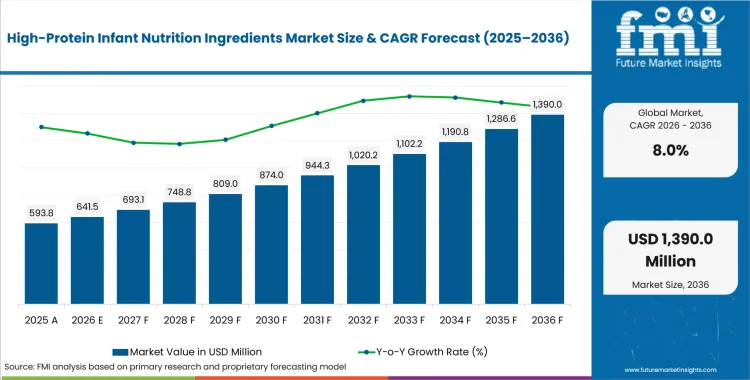
USD 641.5 million in 2026 and USD 1,390.0 million by 2036 at an 8.0% CAGR.
Demand for high-protein infant nutrition ingredients is projected to expand at 8.0% CAGR between 2026 and 2036, increasing valuation from USD 641.5 million in 2026 to USD 1,390.0 million by 2036. Manufacturers actively seek out ingredients providing precise amino-acid levels and dependable processing performance to create reliable infant formulas. In September 2025, Arla Foods Ingredients reported stating 61.0% of mothers in a global survey chose healthy growth among their 3 favorite formula benefits. This strong consumer preference directly motivates food scientists to improve protein quality and deliver documented child-development outcomes.
Sourcing teams across global markets adopt distinct sourcing strategies on selecting high-protein ingredients. Companies in the United States and Germany heavily favor traditional dairy proteins featuring extensive safety records. Infant nutrition producers in India and Japan prioritize localized regulatory approvals and demand specialized technical support for their customized recipes. In June 2026, the Office for Health Improvement and Disparities reported claiming 72.0% of babies aged four to seven months drank milk other than breast milk. Formula brands continually drive strong commercial demand for stable proteins and specialized nutritional components since an extensive cohort of infants rely on such products.
Key Takeaways for the High-Protein Infant Nutrition Ingredients Market
- Demand for high-protein infant nutrition ingredients is driven by formula developers seeking controlled protein quality and dependable processing across regulated infant-feeding applications.
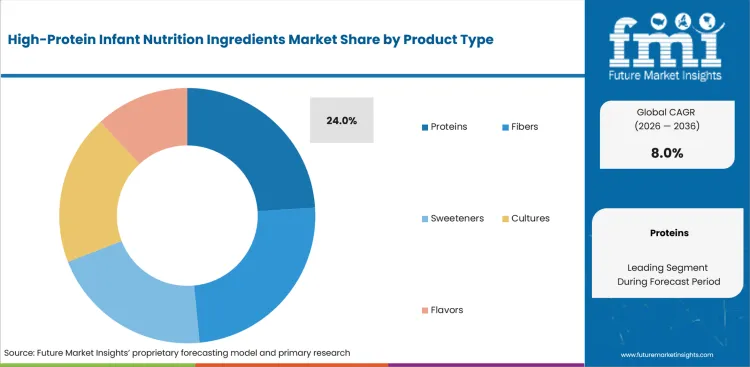
- Proteins are likely to garner 24.0% share of product type demand in 2026, backed by amino-acid requirements and established dairy-protein evidence.
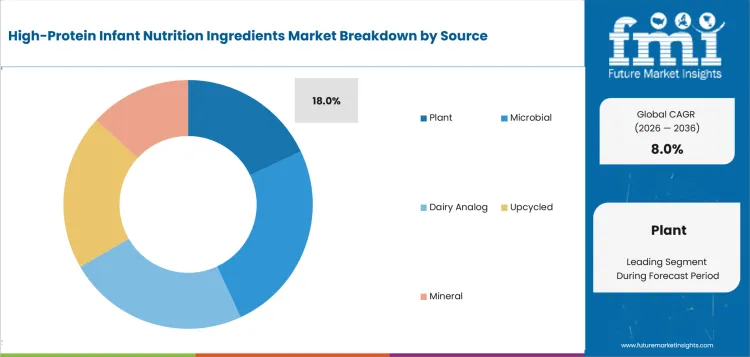
- Plant is predicted to lead source demand with 18.0% share in 2026, reflecting interest in soy and hydrolyzed rice formulations supported by recognized safety pathways.
- Clinical qualification and contaminant control represent primary barriers limiting rapid supplier substitution across infant nutrition programs.
- Competition focusses on dsm-firmenich, Arla Foods Ingredients, Fonterra, FrieslandCampina Ingredients, Kerry, Ingredia, Lactalis Ingredients, and Glanbia Nutritionals, with suppliers differentiating depending on protein quality and infant-nutrition evidence.
Analyst Perspective
“Commercial value in high-protein infant nutrition ingredients depends on consistent composition and proven performance across regulated formula programs. Development teams compare digestibility records and infant-safety documentation during supplier qualification. Long-term adoption reflects dependable production control and responsive regulatory support across regional launches.”
- Nandini Roy Choudhury, Principal Analyst for Food and Beverage at Future Market Insights
How is High-Protein Infant Nutrition Ingredients Market segmented?
The high-protein infant nutrition ingredients industry is segmented by product type, source, application, end user, and region.
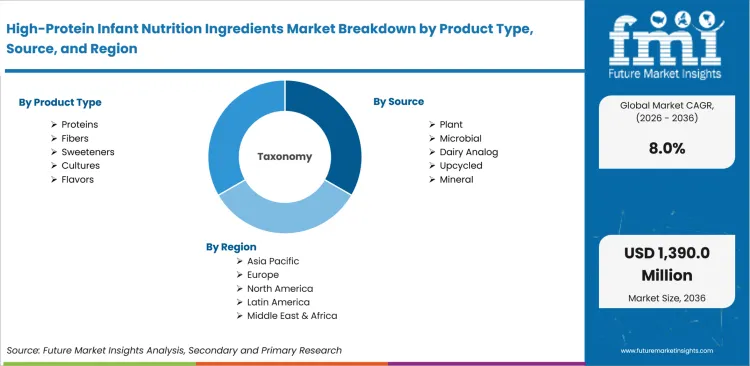
The high-protein infant nutrition ingredients sector is segmented by product type, source, application, end user, and region. Product type coverage includes proteins, fibers, sweeteners, cultures, and flavors serving distinct nutritional requirements. Source coverage addresses plant and microbial ingredients together with dairy analog alternatives. Upcycled and mineral ingredients complete source coverage across specialized formulation programs. Application coverage spans bakery, beverages, snacks, infant nutrition, and ready meals. End-user coverage includes food manufacturers, beverage manufacturers, foodservice operators, contract manufacturers, and retail brands. Regional coverage includes North America and Latin America together with Western Europe. Eastern Europe and East Asia extend analysis across established nutrition industries. South Asia and Pacific with Middle East and Africa complete geographic assessment.
Why do proteins lead product type demand?
Proteins provide essential amino acids and support controlled nutritional density across infant-feeding formulations. Whey protein ingredients remain prominent through digestibility and established use within milk-based formulas. Fleddermann and colleagues reported in January 2024 stating a combined analysis to have covered 346 infants exposed to extensively hydrolyzed or intact-protein formulas. Comparable growth outcomes reinforced requirements for product-specific evidence during protein selection and formula approval.
- Proteins are likely to represent 24.0% share of product type in 2026, guided by infant-specific amino-acid requirements and extensive formula experience. Manufacturers assess digestibility and heat response before approving protein ingredients for commercial production.
- Fibers and cultures support digestive-function formulations across specialized infant products, with clinical documentation varying among strains and ingredient systems. Sweeteners and flavors remain controlled based on age-specific formulation rules and strict sensory limitations.
What keeps plant central to source demand?
Plant sources support specialized feeding requirements and product development beyond conventional cow-milk proteins. Soy and hydrolyzed rice provide established routes for selected formula applications and infant nutrition hydrolysate ingredients. ILSI Europe reported in November 2025 claiming only 2 plant protein sources having received established European formula use, comprising soy and hydrolyzed rice. Emerging pea and legume proteins require further digestibility and infant-safety validation prior to commercial formula acceptance.
- By source, plant is predicted to secure 18.0% share in 2026 owing to established soy use and specialized hydrolyzed rice applications. Supplier assessment centers on amino-acid correction and heat stability across tightly controlled formula processes.
- Microbial and upcycled sources offer research potential across specialized nutritional ingredients. Dairy analog and mineral options address defined formulation functions under individual regulatory and technical assessments.
Why does infant nutrition support application demand?
Infant nutrition converts ingredient functionality into age-specific nutritional formulations requiring strict evidence and production controls. Infant formula development combines protein quality with tolerance and normal-growth assessments. Shen and colleagues reported in February 2026 noting a controlled formula study included 218 infants across hydrolyzed-protein and reference groups. Study results supported nutritional suitability assessment without proving commercial demand or universal product interchangeability.
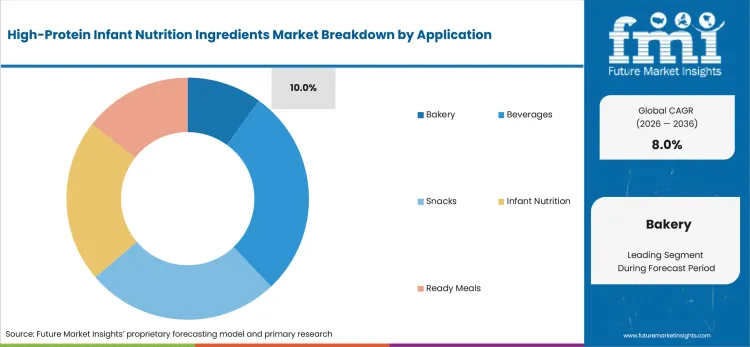
- Infant nutrition is set to garner 10.0% share in 2026, backed by concentrated nutritional requirements and strict formulation controls. Ingredient suppliers maintain application records covering solubility and tolerance across final formula systems.
- Bakery and Beverages use high-protein ingredients within products serving older infants or maternal nutrition programs. Snacks and Ready Meals require age-appropriate texture and nutrient delivery across later feeding stages.
What supports Food Manufacturers across End User demand?
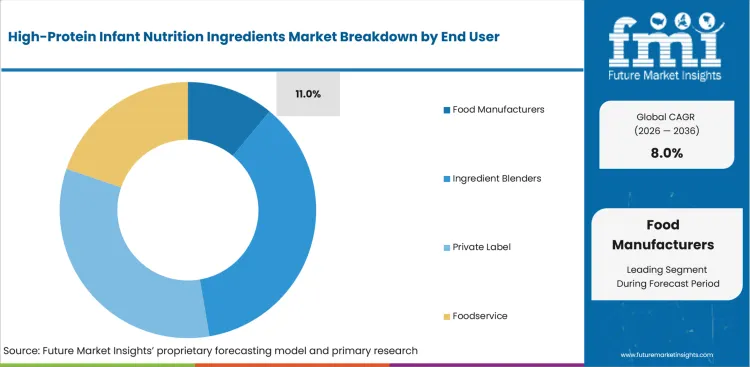
Food Manufacturers control formulation approval and production transfer across infant nutrition products. Supplier records must connect ingredient identity with processing behavior and finished-product nutrient compliance. Food and Drug Administration initiated a comprehensive infant-formula nutrient review in May 2025, requiring manufacturers to reassess scientific evidence behind established nutrient specifications. Such regulatory activity supports demand for milk ingredients backed by maintained technical documentation.
- In 2026, food manufacturers are expected to hold 11.0% share in 2026 since being influenced by direct responsibility for formula composition and production controls. Technical teams examine ingredient consistency and supplier change procedures during commercial approval.
- Beverage manufacturers address liquid and powdered nutrition formats requiring solubility under defined processing conditions. Contract manufacturers and retail brands rely on approved suppliers and controlled specification files during outsourced production.
What are drivers, restraints, and opportunities in High-Protein Infant Nutrition Ingredients Market?
Formula use supports recurring ingredient demand and extensive safety requirements lengthen supplier qualification. Specialized proteins create expansion potential across allergy management and immune-support formulations.
- Driver: Formula producers need dense protein systems preserving essential amino-acid delivery within tightly controlled serving volumes. Efficient dispersion supports uniform nutrient distribution during powder blending and liquid preparation.
- Restraint: Infant-specific safety studies prolong approval timelines for unfamiliar protein sources entering commercial formula programs. Expanded contaminant screening increases laboratory work across raw-material qualification and finished-product release.
- Opportunity: Hydrolyzed proteins create product-development openings for infants requiring easier digestion or reduced allergen exposure. Bioactive dairy fractions support differentiated formulas addressing immunity and early developmental needs.
Institutional nutrition programs support repeat formula demand under defined nutritional standards. United States Department of Agriculture reported in July 2025 highlighting WIC having served approximately 41.0% of United States infants during fiscal 2024. Program coverage supports recurring demand for compliant whey protein and formula ingredients meeting federal nutrient requirements. Supplier access remains subject to manufacturer contracts and approved product specifications.
Intensive contaminant assessment increases evidence and testing duties across ingredient suppliers. Food and Drug Administration reported in April 2026 stating its market-basket examination covered 312 infant formula samples across different formats and protein sources. Extensive testing reinforces supplier responsibility for contaminant controls and traceable raw-material qualification. Smaller producers face heavier documentation demands during entry into regulated formula programs.
Immune-support positioning creates development potential for lactoferrin and human milk oligosaccharides. Kerry reported in August 2025 for 69.5% of surveyed parents sought products supporting infant immunity and future health. Documented bioactive proteins provide formula brands with specific nutritional functions beyond basic protein delivery. Commercial acceptance requires regulatory permission and age-specific clinical evidence.
How are country CAGRs aligned in High-Protein Infant Nutrition Ingredients Market?

| Country or Market | CAGR |
|---|---|
| India | 10.8% |
| United States | 10.0% |
| Germany | 9.2% |
| Japan | 8.4% |
| France | 7.6% |
| United Kingdom | 6.8% |
Source: Future Market Insights analysis, 2026.
How do country-level CAGRs compare in the High-Protein Infant Nutrition Ingredients Market?
The country comparison shows a gradual step-down in growth across the markets covered. India and the United States occupy the upper end of the range. Germany and Japan form the middle tier. France and the United Kingdom follow with lower growth rates. A 4.0 percentage-point spread separates India from the United Kingdom. The six profiled markets share a positive growth outlook, with their positions reflecting different levels of market momentum.
- India leads the comparison and establishes South Asia as the principal growth cluster among the markets shown.
- The United States follows closely, indicating a limited difference between the first and second positions.
- Germany and Japan form the next growth band and maintain a measured gap from the upper tier.
- France and the United Kingdom complete the comparison, with the United Kingdom recording the lowest CAGR among the listed markets.
- The pattern resembles a gradual downward slope instead of a sharp separation between higher-growth and lower-growth markets.
Markets carrying similar CAGRs are likely to present different entry conditions due to local formula regulations and ingredient approval requirements. The full report provides country-level analysis across North America, Latin America, Europe, East Asia, South Asia and Pacific, and the Middle East and Africa.
Country-wise Analysis
- High-protein infant nutrition ingredients market in India is forecast to expand at 10.8% CAGR between 2026 and 2036, helped by specialized nutrition demand and ingredient approval activity. Local formula developers require supplier records covering infant safety and application performance. dsm-firmenich reported approval for 2'-FL at a maximum level of 1.2 g/L in April 2025, expanding formulation options for early-life nutrition manufacturers.
- National Center for Health Statistics recorded 3,628,934 births during 2024 through its July 2025 publication, preserving a substantial potential base for formula ingredient demand. Established regulatory review encourages detailed protein qualification across commercial formula programs. Demand in the United States is projected to rise at 10.0% CAGR during the assessment period, guided by institutional feeding access and specialized formula development.
- Formal ingredient review and established dairy processing promote supplier participation across Germany. Industry in Germany is predicted to grow at 9.2% CAGR during the assessment period, backed by documented protein performance and controlled manufacturing requirements. German Federal Statistical Office recorded 677,117 live births during 2024 in July 2025, supporting continuing formula requirements despite a reduced infant cohort.
- Sales in Japan are anticipated to scale at 8.4% CAGR during the forecast period, aided by clinical documentation and specialized nutritional formulations. Local qualification practices encourage detailed digestibility and safety evidence for each protein system. Ministry of Health, Labour and Welfare recorded 686,061 births during 2024 in its September 2025 final natality data. This defined infant cohort sustains demand for specialized formulas and functional protein ingredients across regulated nutrition programs.
- National Institute of Statistics and Economic Studies reported 660,800 births during 2024 in its July 2025 release, sustaining a defined consumer base for infant nutrition products. Established dairy capabilities support controlled protein supply and customer formulation assistance. Industry in France is estimated to increase at 7.6% CAGR by 2036, reflected by regulated formula production and differentiated ingredient development.
- Regulated formula composition supports detailed supplier assessment across the United Kingdom. High-protein infant nutrition ingredient sector in the United Kingdom is projected to record 6.8% CAGR between 2026 and 2036, influenced by established feeding products and controlled nutritional requirements. Office for National Statistics recorded 594,677 live births across England and Wales during 2024 in July 2025, preserving commercial need for compliant formula ingredients.
Who are notable companies in High-Protein Infant Nutrition Ingredients Market?
dsm-firmenich, Arla Foods Ingredients, Fonterra, FrieslandCampina Ingredients, Kerry, Ingredia, Lactalis Ingredients, and Glanbia Nutritionals are the prominent companies driving this market.
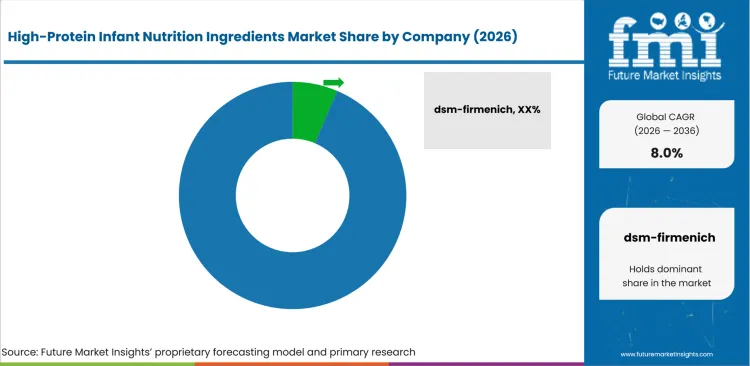
Competition in the sector centers on protein quality and infant-specific evidence across commercial formulation programs. Dairy specialists use application laboratories and controlled production records during customer development. Nutrition groups focus on clinical documentation and regional approval assistance. Protein suppliers connect processing knowledge with formula stability and nutrient delivery. Buyer review covers ingredient consistency and technical assistance during qualification and renewal.
- dsm-firmenich and Arla Foods Ingredients compete based on early-life nutrition knowledge connected with specialized ingredient development. Formula teams assess regulatory records and clinical evidence during product qualification.
- Fonterra and FrieslandCampina Ingredients compete depending on dairy-protein expertise connected with controlled manufacturing capabilities. Customers examine supply consistency and technical response across formula development programs.
- Kerry and Ingredia compete through nutrition formulation assistance and specialized protein portfolios. Product developers assess digestibility evidence and processing performance during ingredient review.
- Lactalis Ingredients and Glanbia Nutritionals compete due to dairy proteins serving infant and childhood nutrition applications. Customer evaluation covers portfolio suitability and application assistance across regulated formula products.
Competitive Benchmarking: High-Protein Infant Nutrition Ingredients Market
| Company | Protein Portfolio | Infant Nutrition Evidence | Application Support | Service Reach |
|---|---|---|---|---|
| dsm-firmenich | High | High | High | Global |
| Arla Foods Ingredients | High | High | High | Global |
| Fonterra | High | High | High | Global |
| FrieslandCampina Ingredients | High | High | High | Global |
| Kerry | Medium | High | High | Global |
| Ingredia | Medium | Medium | High | International programs |
| Lactalis Ingredients | High | High | Medium | Global |
| Glanbia Nutritionals | High | Medium | High | Global |
Source: Future Market Insights competitive analysis, 2026.
Key Developments in High-Protein Infant Nutrition Ingredients Market
- In January 2025, FrieslandCampina Ingredients achieved Generally Recognized as Safe status for Vivinal Lactoferrin across specified United States infant nutrition applications. Company information expanded regulatory access for a bioactive dairy protein serving specialized formula development.
- In March 2026, FrieslandCampina Ingredients completed expansion of its Borculo production facility for specialty dairy proteins. Company information strengthened commercial supply capacity for whey protein isolate and milk fat globule membrane ingredients used in early-life nutrition.
Key Players in the High-Protein Infant Nutrition Ingredients Market
Early-Life Nutrition and Protein Specialists
- dsm-firmenich
- Arla Foods Ingredients
- FrieslandCampina Ingredients
- Fonterra
Dairy Ingredient Suppliers
- Lactalis Ingredients
- Ingredia
Nutrition and Formulation Specialists
- Kerry
- Glanbia Nutritionals
High-Protein Infant Nutrition Ingredients Market Report Scope
| Coverage field | Report scope |
|---|---|
| Market breakdown | High-protein infant nutrition ingredients market breakdown includes product type, source, application, end user, and region. |
| Quantitative Units | Revenue in USD Million, CAGR in %. |
| Market Definition | High-protein infant nutrition ingredients include concentrated proteins and supporting nutritional components used in infant formula. Protein concentrates and hydrolysates support targeted amino-acid delivery. Functional cultures and fibers complete defined ingredient coverage. General food ingredients without infant nutrition positioning are excluded. |
| Regions Covered | North America, Latin America, Western Europe, Eastern Europe, East Asia, South Asia and Pacific, Middle East and Africa. |
| Countries Covered | India, United States, Germany, Japan, France, United Kingdom, and more than 30 countries complete full report coverage. |
| Key Companies Profiled | dsm-firmenich, Arla Foods Ingredients, Fonterra, FrieslandCampina Ingredients, Kerry, Ingredia, Lactalis Ingredients, and Glanbia Nutritionals. |
| Forecast Period | 2026 to 2036 |
| Approach | Hybrid bottom-up and top-down methodology uses segment shares and country CAGRs. Company activity and buyer adoption support final market reconciliation. |
Source: Future Market Insights analysis, 2026.
High-Protein Infant Nutrition Ingredients Market - Research Methodology
| Method | Approach |
|---|---|
| Primary Research | FMI analysts gathered input from manufacturers, service providers, technology developers, distributors, end users, procurement teams, and subject-matter experts. Interviews examined purchasing decisions, product or service evaluation, adoption barriers, approval requirements, pricing considerations, and expectations for technical or commercial support. Respondents were also asked what evidence is required before a trial, pilot, or initial order develops into regular purchasing. |
| Desk Research | Desk research covered government statistics, regulatory publications, trade data, industry associations, technical literature, standards, company filings, product information, and official corporate announcements. Sources were reviewed for relevance, publication date, geographic coverage, and consistency with the defined market scope. Claims relating to performance, applications, approvals, capacity, investment, and commercial activity were retained only when supported by credible public evidence. |
| Market Sizing and Forecasting | The market model combined the baseline value with historical performance, segment structure, pricing and volume indicators, adoption levels, company participation, and country-level demand conditions. Forecast assumptions considered economic activity, investment trends, regulatory developments, technology adoption, purchasing cycles, supply availability, and barriers to wider market use. Segment and regional estimates were reconciled before the final market total was calculated. |
| Data Validation | Estimates were checked against multiple independent indicators, including public data, company activity, trade patterns, industry developments, and findings from primary interviews. Validation also tested whether products, services, applications, and company revenues fell within the defined market boundaries. Adjacent categories, unsupported claims, overlapping revenues, and activities without direct market relevance were excluded to reduce double counting and maintain consistency across segments and countries. |
Source: Future Market Insights analysis, 2026.
High-Protein Infant Nutrition Ingredients Market by Segments
High-Protein Infant Nutrition Ingredients Market Segmented by Product Type:
- Proteins
- Fibers
- Sweeteners
- Cultures
- Flavors
High-Protein Infant Nutrition Ingredients Market Segmented by Source:
- Plant
- Microbial
- Dairy Analog
- Upcycled
- Mineral
High-Protein Infant Nutrition Ingredients Market Segmented by Application:
- Bakery
- Beverages
- Snacks
- Infant Nutrition
- Ready Meals
High-Protein Infant Nutrition Ingredients Market Segmented by End User:
- Food Manufacturers
- Beverage Manufacturers
- Foodservice Operators
- Contract Manufacturers
- Retail Brands
High-Protein Infant Nutrition Ingredients Market by Region:
- North America
- United States
- Canada
- Mexico
- Latin America
- Brazil
- Chile
- Rest of Latin America
- Western Europe
- Germany
- UK
- Italy
- Spain
- France
- Nordic
- BENELUX
- Rest of Western Europe
- Eastern Europe
- Russia
- Poland
- Hungary
- Balkan and Baltic
- Rest of Eastern Europe
- East Asia
- China
- Japan
- South Korea
- South Asia and Pacific
- India
- ASEAN
- Australia and New Zealand
- Rest of South Asia and Pacific
- Middle East and Africa
- Kingdom of Saudi Arabia
- Other GCC Countries
- Turkiye
- South Africa
- Other African Union
- Rest of Middle East and Africa
Research Sources and Bibliography
- Arla Foods Ingredients. (2025, September 30). Healthy growth and immunity top mothers’ infant formula wish list.
- Arla Foods Ingredients. (2025, July 22). Australia approves Arla Foods Ingredients’ MFGM for use in infant formula.
- Fleddermann, M., Knoll, A., & Koletzko, B. (2024, January 12). Safety and suitability of infant formula manufactured from extensively hydrolyzed whey protein compared to intact protein: A combined analysis of two randomized controlled studies. Nutrients, 16(2), 245.
- Food and Drug Administration. (2025, May 13). HHS, FDA initiate comprehensive review of nutrients in infant formula.
- Food and Drug Administration. (2026, April 29). FDA releases results from largest-ever testing of infant formula in the United States.
- FrieslandCampina Ingredients. (2025, January 16). FrieslandCampina Ingredients’ Vivinal Lactoferrin achieves GRAS status for United States infant nutrition market.
- FrieslandCampina Ingredients. (2026, March 19). FrieslandCampina Ingredients completes strategic expansion of Borculo facility.
- German Federal Statistical Office. (2025, July 17). Live births by age of mother.
- Hettinga, K. A., van den Akker, C. H. P., Billecke, N., Cardinaals, R., Chang, C. Y., Dupont, D., Furber, M., Grimshaw, K., Hallam, P., de Jong, P., Keppler, J. K., van Loo-Bouwman, C. A., Mersh, C., Mulder, K. A., Oliveros, E., Ozanne, S., Petersen, I. L., Tomé, D., Vandenplas, Y., van de Velde, F., & Verbruggen, S. C. A. T. (2025, November 19). Plant-based proteins for infant formula: Findings and recommendations from the ILSI Europe workshop. Frontiers in Nutrition, 12, 1677243.
- Kerry. (2025, August 25). Human milk probiotics: The next development in maternal and infant health.
- Martin, J. A., Hamilton, B. E., & Osterman, M. J. K. (2025, July 24). Births in the United States, 2024. National Center for Health Statistics.
- Ministry of Health, Labour and Welfare. (2025, September 16). Vital statistics of Japan: Final data, natality, 2024 [Data set]. Statistics of Japan.
- Office for Health Improvement and Disparities. (2026, June 4). Infant feeding survey 2024: Full report.
- Office for National Statistics. (2025, July 1). Births in England and Wales: 2024.
- Shen, Q., Jiang, H., Mao, S., Luo, S., Hao, Y., Liang, W., He, T., Jacobsen, L. N., Sheng, N., Yin, J., Feng, X., Jia, X., Vandenplas, Y., & Zhang, Y. (2026, February 26). An infant formula with partially hydrolyzed whey and intact protein demonstrates adequate growth and safety: A six-month randomized controlled trial. Nutrients, 18(5), 770.
- Thélot, H. (2025, July 29). Births in 2024. National Institute of Statistics and Economic Studies.
- United States Department of Agriculture Economic Research Service. (2025, July 22). WIC program.
- dsm-firmenich. (2025, April 11). Boost for infant health: India approves dsm-firmenich’s 2'-FL HMO.
This bibliography is provided for reader reference and is not exhaustive. The full report contains the complete reference list and detailed citations.
This Report Answers
- How do product type and source segments influence high-protein infant nutrition ingredient demand?
- Why do proteins retain priority across infant nutrition formulation programs?
- How do plant sources support specialized infant formula development?
- What evidence requirements influence ingredient approval across formula manufacturers?
- Why do country growth rates differ across profiled national markets?
- What supplier capabilities support successful infant nutrition ingredient qualification?
- How do regulatory reviews influence formulation and supplier-selection processes?
- What barriers delay adoption of new protein sources across infant nutrition products?
- How do allergy-sensitive formulas create openings for specialized proteins?
- What company capabilities support recurring customer confidence across infant nutrition programs?
Frequently Asked Questions
What supports demand in high-protein infant nutrition ingredients market?
Demand receives support from formula manufacturers seeking controlled protein quality and dependable nutritional performance. Ingredient suppliers strengthen acceptance through clinical documentation and stable production specifications.
Who are key players in high-protein infant nutrition ingredients market?
Key companies are anticipated to include dsm-firmenich and Arla Foods Ingredients among others. Competition is likely to reflect protein quality and technical support across established and developing infant nutrition programs.
What restraint affects high-protein infant nutrition ingredients market?
Clinical qualification and contaminant testing extend development schedules across infant-specific ingredient programs. Supplier changes require revised safety records and finished-formula assessments prior to commercial approval.
Why do executives track high-protein infant nutrition ingredients market?
Executives monitor ingredient availability since protein supply influences formula continuity and nutritional specifications. Regulatory changes create additional reformulation duties across technical and quality functions.
What business problem does high-protein infant nutrition ingredients market address?
High-protein ingredients deliver concentrated nutrition within tightly controlled infant-feeding formulations. Specialized proteins support digestibility and allergy management together with age-specific nutritional needs.
What do formula teams evaluate prior to selecting companies?
Formula teams evaluate protein quality and clinical evidence together with processing consistency and regional permissions. Supplier service includes specification control and production assistance across regulated formula programs.
What limits return across new ingredient programs?
Commercial return weakens through lengthy clinical testing and incomplete regional approval coverage. Unstable solubility or heat response creates further development work during formula transfer.
How do companies build long-term customer confidence?
Companies build confidence through repeatable ingredient performance and controlled production records. Maintained regulatory documentation supports recurring use across infant nutrition product families.
Preview the report firsthand - request a free sample
Get SampleGet the brochure for pricing and purchase details.
Get PDFTable of Content
- Key Takeaways
- Market Size and CAGR
- Top Growth Driver
- Fastest Growing Segment
- Leading Region
- Key Companies
- Emerging Opportunities
- Executive Summary
- Global Market Outlook
- Demand-side Trends
- Supply-side Trends
- Technology Roadmap Analysis
- Analysis and Recommendations
- Analyst Perspective (What is happening? Why now? What should investors know?)
- Key Questions Answered
- How large is the market?
- What is the CAGR?
- What are key trends?
- Which region dominates?
- Who are the leaders?
- Market Overview
- Market Coverage / Taxonomy
- Market Definition / Scope / Limitations
- Research Methodology
- Chapter Orientation
- Analytical Lens and Working Hypotheses
- Market Structure, Signals, and Trend Drivers
- Benchmarking and Cross-market Comparability
- Market Sizing, Forecasting, and Opportunity Mapping
- Research Design and Evidence Framework
- Desk Research Programme (Secondary Evidence)
- Expert Input and Fieldwork (Primary Evidence)
- Tooling, Models, and Reference Databases
- Data Engineering and Model Build
- Quality Assurance and Audit Trail
- Market Background
- Market Dynamics (Drivers, Restraints, Opportunity, Trends)
- Scenario Forecast (Optimistic, Likely, Conservative)
- Impact Analysis
- AI Impact
- Sustainability Impact
- Regulatory Impact
- Technology Impact
- Consumer / Buyer Analysis
- Purchase Drivers
- Adoption Barriers
- Buyer Journey
- Opportunity Map Analysis
- Product Life Cycle Analysis
- Supply Chain Analysis
- Investment Feasibility Matrix
- Value Chain Analysis
- PESTLE and Porter's Analysis
- Regulatory Landscape
- Regional Parent Market Outlook
- Production and Consumption Statistics
- Import and Export Statistics
- Global Market Analysis and Forecast, 2021 to 2036
- Historical Market Size Value (USD Million) Analysis, 2021 to 2025
- Current and Future Market Size Value (USD Million) Projections, 2026 to 2036
- Y-o-Y Growth Trend Analysis
- Absolute $ Opportunity Analysis
- Global Market Pricing Analysis, 2021 to 2036
- Global Market Analysis and Forecast, By Product Type, 2021 to 2036
- Introduction / Key Findings
- Historical Market Size Value (USD Million) Analysis By Product Type, 2021 to 2025
- Current and Future Market Size Value (USD Million) Analysis and Forecast By Product Type, 2026 to 2036
- Proteins
- Fibers
- Sweeteners
- Cultures
- Flavors
- Proteins
- Y-o-Y Growth Trend Analysis By Product Type, 2021 to 2025
- Absolute $ Opportunity Analysis By Product Type, 2026 to 2036
- Global Market Analysis and Forecast, By Source, 2021 to 2036
- Introduction / Key Findings
- Historical Market Size Value (USD Million) Analysis By Source, 2021 to 2025
- Current and Future Market Size Value (USD Million) Analysis and Forecast By Source, 2026 to 2036
- Plant
- Microbial
- Dairy Analog
- Upcycled
- Mineral
- Plant
- Y-o-Y Growth Trend Analysis By Source, 2021 to 2025
- Absolute $ Opportunity Analysis By Source, 2026 to 2036
- Global Market Analysis and Forecast, By Application, 2021 to 2036
- Introduction / Key Findings
- Historical Market Size Value (USD Million) Analysis By Application, 2021 to 2025
- Current and Future Market Size Value (USD Million) Analysis and Forecast By Application, 2026 to 2036
- Bakery
- Beverages
- Snacks
- Infant Nutrition
- Ready Meals
- Bakery
- Y-o-Y Growth Trend Analysis By Application, 2021 to 2025
- Absolute $ Opportunity Analysis By Application, 2026 to 2036
- Global Market Analysis and Forecast, By End User, 2021 to 2036
- Introduction / Key Findings
- Historical Market Size Value (USD Million) Analysis By End User, 2021 to 2025
- Current and Future Market Size Value (USD Million) Analysis and Forecast By End User, 2026 to 2036
- Food Manufacturers
- Ingredient Blenders
- Private Label
- Foodservice
- Food Manufacturers
- Y-o-Y Growth Trend Analysis By End User, 2021 to 2025
- Absolute $ Opportunity Analysis By End User, 2026 to 2036
- Global Market Analysis and Forecast, By Region, 2021 to 2036
- Introduction
- Historical Market Size Value (USD Million) Analysis By Region, 2021 to 2025
- Current Market Size Value (USD Million) Analysis and Forecast By Region, 2026 to 2036
- North America
- Latin America
- Western Europe
- Eastern Europe
- East Asia
- South Asia and Pacific
- Middle East & Africa
- Market Attractiveness Analysis By Region
- North America Market Analysis and Forecast, By Country, 2021 to 2036
- Historical Market Size Value (USD Million) Trend Analysis By Market Taxonomy, 2021 to 2025
- Market Size Value (USD Million) Forecast By Market Taxonomy, 2026 to 2036
- By Country
- USA
- Canada
- By Product Type
- By Source
- By Application
- By End User
- By Country
- Market Attractiveness Analysis
- By Country
- By Product Type
- By Source
- By Application
- By End User
- Key Takeaways
- Latin America Market Analysis and Forecast, By Country
- Historical Market Size Value (USD Million) Trend Analysis By Market Taxonomy, 2021 to 2025
- Market Size Value (USD Million) Forecast By Market Taxonomy, 2026 to 2036
- By Country
- Brazil
- Mexico
- Chile
- Rest of Latin America
- By Product Type
- By Source
- By Application
- By End User
- By Country
- Market Attractiveness Analysis
- By Country
- By Product Type
- By Source
- By Application
- By End User
- Key Takeaways
- Western Europe Market Analysis and Forecast, By Country
- Historical Market Size Value (USD Million) Trend Analysis By Market Taxonomy, 2021 to 2025
- Market Size Value (USD Million) Forecast By Market Taxonomy, 2026 to 2036
- By Country
- Germany
- UK
- Italy
- Spain
- France
- Nordic
- BENELUX
- Rest of Western Europe
- By Product Type
- By Source
- By Application
- By End User
- By Country
- Market Attractiveness Analysis
- By Country
- By Product Type
- By Source
- By Application
- By End User
- Key Takeaways
- Eastern Europe Market Analysis and Forecast, By Country
- Historical Market Size Value (USD Million) Trend Analysis By Market Taxonomy, 2021 to 2025
- Market Size Value (USD Million) Forecast By Market Taxonomy, 2026 to 2036
- By Country
- Russia
- Poland
- Hungary
- Balkan & Baltic
- Rest of Eastern Europe
- By Product Type
- By Source
- By Application
- By End User
- By Country
- Market Attractiveness Analysis
- By Country
- By Product Type
- By Source
- By Application
- By End User
- Key Takeaways
- East Asia Market Analysis and Forecast, By Country
- Historical Market Size Value (USD Million) Trend Analysis By Market Taxonomy, 2021 to 2025
- Market Size Value (USD Million) Forecast By Market Taxonomy, 2026 to 2036
- By Country
- China
- Japan
- South Korea
- By Product Type
- By Source
- By Application
- By End User
- By Country
- Market Attractiveness Analysis
- By Country
- By Product Type
- By Source
- By Application
- By End User
- Key Takeaways
- South Asia and Pacific Market Analysis and Forecast, By Country
- Historical Market Size Value (USD Million) Trend Analysis By Market Taxonomy, 2021 to 2025
- Market Size Value (USD Million) Forecast By Market Taxonomy, 2026 to 2036
- By Country
- India
- ASEAN
- Australia & New Zealand
- Rest of South Asia and Pacific
- By Product Type
- By Source
- By Application
- By End User
- By Country
- Market Attractiveness Analysis
- By Country
- By Product Type
- By Source
- By Application
- By End User
- Key Takeaways
- Middle East & Africa Market Analysis and Forecast, By Country
- Historical Market Size Value (USD Million) Trend Analysis By Market Taxonomy, 2021 to 2025
- Market Size Value (USD Million) Forecast By Market Taxonomy, 2026 to 2036
- By Country
- Kingdom of Saudi Arabia
- Other GCC Countries
- Türkiye
- South Africa
- Other African Union
- Rest of Middle East & Africa
- By Product Type
- By Source
- By Application
- By End User
- By Country
- Market Attractiveness Analysis
- By Country
- By Product Type
- By Source
- By Application
- By End User
- Key Takeaways
- Key Countries Market Analysis
- USA
- Pricing Analysis
- Market Share Analysis, 2025
- By Product Type
- By Source
- By Application
- By End User
- Canada
- Pricing Analysis
- Market Share Analysis, 2025
- By Product Type
- By Source
- By Application
- By End User
- Mexico
- Pricing Analysis
- Market Share Analysis, 2025
- By Product Type
- By Source
- By Application
- By End User
- Brazil
- Pricing Analysis
- Market Share Analysis, 2025
- By Product Type
- By Source
- By Application
- By End User
- Chile
- Pricing Analysis
- Market Share Analysis, 2025
- By Product Type
- By Source
- By Application
- By End User
- Germany
- Pricing Analysis
- Market Share Analysis, 2025
- By Product Type
- By Source
- By Application
- By End User
- UK
- Pricing Analysis
- Market Share Analysis, 2025
- By Product Type
- By Source
- By Application
- By End User
- Italy
- Pricing Analysis
- Market Share Analysis, 2025
- By Product Type
- By Source
- By Application
- By End User
- Spain
- Pricing Analysis
- Market Share Analysis, 2025
- By Product Type
- By Source
- By Application
- By End User
- France
- Pricing Analysis
- Market Share Analysis, 2025
- By Product Type
- By Source
- By Application
- By End User
- India
- Pricing Analysis
- Market Share Analysis, 2025
- By Product Type
- By Source
- By Application
- By End User
- ASEAN
- Pricing Analysis
- Market Share Analysis, 2025
- By Product Type
- By Source
- By Application
- By End User
- Australia & New Zealand
- Pricing Analysis
- Market Share Analysis, 2025
- By Product Type
- By Source
- By Application
- By End User
- China
- Pricing Analysis
- Market Share Analysis, 2025
- By Product Type
- By Source
- By Application
- By End User
- Japan
- Pricing Analysis
- Market Share Analysis, 2025
- By Product Type
- By Source
- By Application
- By End User
- South Korea
- Pricing Analysis
- Market Share Analysis, 2025
- By Product Type
- By Source
- By Application
- By End User
- Russia
- Pricing Analysis
- Market Share Analysis, 2025
- By Product Type
- By Source
- By Application
- By End User
- Poland
- Pricing Analysis
- Market Share Analysis, 2025
- By Product Type
- By Source
- By Application
- By End User
- Hungary
- Pricing Analysis
- Market Share Analysis, 2025
- By Product Type
- By Source
- By Application
- By End User
- Kingdom of Saudi Arabia
- Pricing Analysis
- Market Share Analysis, 2025
- By Product Type
- By Source
- By Application
- By End User
- Türkiye
- Pricing Analysis
- Market Share Analysis, 2025
- By Product Type
- By Source
- By Application
- By End User
- South Africa
- Pricing Analysis
- Market Share Analysis, 2025
- By Product Type
- By Source
- By Application
- By End User
- USA
- Market Structure Analysis
- Competition Dashboard
- Competition Benchmarking
- Market Share Analysis of Top Players
- By Regional
- By Product Type
- By Source
- By Application
- By End User
- Emerging Startups
- Innovation Benchmarking
- Competition Analysis
- Competition Deep Dive
- dsm-firmenich
- Overview
- Product Portfolio
- Profitability by Market Segments
- Sales Footprint
- Strategy Overview
- Marketing Strategy
- Product Strategy
- Channel Strategy
- Arla Foods Ingredients
- Fonterra
- FrieslandCampina Ingredients
- Kerry
- Ingredia
- Lactalis Ingredients
- Glanbia Nutritionals
- dsm-firmenich
- Case Studies
- Success Stories
- Recent Developments
- Competition Deep Dive
- Assumptions & Acronyms Used


