

- Industry Size (2025)
- USD 174.0 Mn
- CAGR
- 4.1% (2025)
Pressotherapy Systems Market Outlook (2022-2032)
[250 Pages Report] The global pressotherapy systems market size was valued at US$ 174.0 Mn in 2021 and is further projected to expand at a CAGR of 4.1% during the forecast period (2022-2032). Growing usage of pressotherapy systems across medical spas and specialty clinics for performing lymphatic drainage massage and other functions is driving sales of pressotherapy systems in the market.
|
Attribute |
Key Statistics |
|
Pressotherapy Systems Market Size (2021) |
USD 174.0 Million |
|
Value-based CAGR 2022-2032 |
4.1% |
|
Market Share of Top 5 Countries |
46.9% |
Lower limb lymphedema, which affects people with chronic venous insufficiency, is caused by problems with tissue fluid, lymphatic and venous blood circulation. As a result, the affected limb area appears noticeably different from the surrounding area, has reduced joint mobility, and frequently develops skin, blood vessels, and lymph node inflammation. In order to treat this medical condition, treatments like compression therapy are used.
Compression therapy is a technique that applies pressure to the limb from the outside, increasing lymphatic and vein outflow to stop fluid from building up in the extravascular region. Pneumatic massagers, multilayer limb bandages, and compression clothing with different levels of pressure are all components of compression therapy.
Numerous bibliographic references show that intermittent pneumatic compression (IPC), or pressotherapy, is a common physical technique in both sports and medicine. Thus, growing adoption of pressotherapy across healthcare industry will eventually boost the sales of pressotherapy systems during the forecast period.
According to a recent study by Future Market Insights, systems/pump segment by product will continue to lead the global pressotherapy market, accounting for the largest share of about 87.9% in 2021.
2012-2021 Global Pressotherapy Systems Outlook Compared to 2022-2032 Forecast
The global demand for pressotherapy systems is slated to grow at 4.1% between 2022 and 2032. Total market value for pressotherapy systems was approximately 5.0% of the overall ~US$ 3.5 Bn of the global compression therapy market in 2021.
Hospitalization can result in a potentially fatal condition called venous thromboembolism (VTE). In order to minimize the risk of VTE, intermittent pneumatic compression (pressotherapy) or IPC is being increasingly performed.
Hospital-associated VTE has a considerable monetary expense. According to a 2017 UK survey by the All-Party Parliamentary Thrombosis Group Annual Review, the average cost of treating VTE in each local National Health Service (NHS) region was £938 357. In terms of individual patients, the review found that VTE patients spent $14 000 more on initial diagnosis and the first year of treatment than non-VTE patients.
A person's psychosocial wellbeing can be significantly impacted by VTE, and research indicates that it may be a traumatic, life-changing event that might result in post-traumatic stress disorder.
Even though manual lymphatic drainage has been helpful in treating lymphedema, it cannot be used on the millions of individuals who suffer from the condition worldwide. The only alternative is to make mechanical devices for pneumatic compression affordable and widely available (IPC). Pressotherapy performed post-exercise (Po-E) has been shown to affect physiological attributes, training performance, and recuperation.
With the global ageing population, rising prevalence of chronic diseases such as diabetes-induced diabetic foot ulcers, growing adoption of pressotherapy for physical relief in sports industry, and increasing popularity of compression therapy products, the market for pressotherapy systems is expected to display a high growth rate over the forecast years.
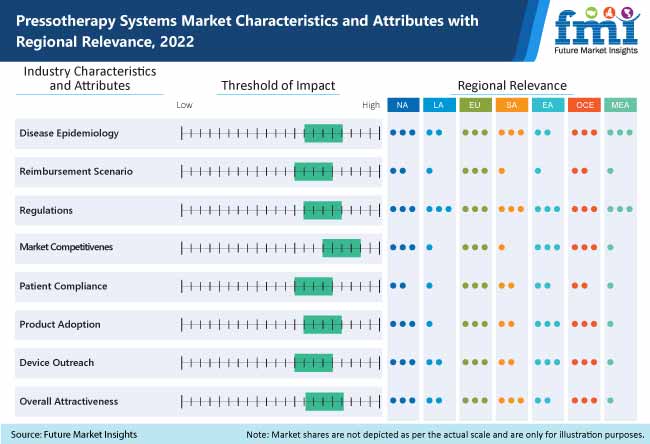
What are the Key Opportunities for the Pressotherapy Systems Market Manufacturers?
“Introduction of Products with Advanced Features to Boost Sales in Pressotherapy Systems Market”
It has been noted that patient compliance is related to the product features and comfort during pressotherapy based relief regimen. The manufacturers in the global pressotherapy systems market display frequent product revisions to cater to the requirements of the users.
For instance, The Platinum GMT Presotherapy System, a device made specifically for pressotherapy treatments by Global Medical Technology, when used in combination with infrared heat and electrostimulation, can achieve great results in the reduction of localised fat.
Given that numerous treatments are bundled into one system, one of the primary features of this system is its ease of use. Muscular electrostimulation, body massage, weight loss, blood flow, and lymphatic drainage, are some of these that can be achieved without the machine operator constantly intervening.
With the addition of features, which apply towards ease of use and greater adoption by patients, sales of pressotherapy systems are expected to rise at a steady pace over the next 10 years.
What are the Factors Limiting Growth in the Pressotherapy Systems Market?
The selection of an appropriate compression is the main challenge in maximising the conservative therapy of a resistive lymphedema. The fact that a pneumatic pressotherapy's compression value has been observed to be excessive between the cuff and the skin has exacerbated the issue. Due to this, the therapeutic pressure has been reduced to a minimal extent, neglecting the compliance of the support against which the pressure is placed.
The compliance of the compressed element appears to be a first-order parameter in the interfacial pressure and therefore in an efficient decongestion procedure.
Moreover, discrepancies in the adherence to the pressotherapy systems, as reported through several meta-analyses, acts as a hindrance to the growth of the market.
Thus, inconsistencies in pressure distribution during compression through pressotherapy acts as an obstructing factor limiting the growth pressotherapy systems market.
Country-wise Insights
Will the U.S. Retain its Dominance in the Global Pressotherapy Systems Market?
“Rising Incidence of Peripheral Edema is Pushing Demand for Pressotherapy Systems in the U.S,”
The U.S. dominated the global pressotherapy systems market with a total market share of about 30.6% in 2021, and is expected to continue to experience the same growth throughout the forecast period. Rising prevalence of peripheral edema due to conditions like obesity and overweight, rapid expansion of healthcare industry, high level of health awareness among people, and growing popularity of treatments like pressotherapy are some of the key factors driving growth in the U.S. pressotherapy systems market.
Similarly, strong presence of leading pressotherapy system manufacturers who offer unique and customized product portfolios to cater to the growing demand for compression therapy is positively influencing the pressotherapy system sales in the country.
What Makes China a Highly Lucrative Market for Pressotherapy Systems?
“Easy Availability of Cost Effective Pressotherapy Systems Augmenting Growth in China Market”
China held approximately 5.5% share in the global pressotherapy systems market in 2021 and is expected to grow at a steady pace during the forecast period (2022-2032). Growth in China’s pressotherapy systems market is driven by rising healthcare spending, availability of pressotherapy systems at lower prices, surge in diseases like diabetes and obesity, and favourable government support.
Over the years, China has become the hub for cost-efficient medical device manufacturing, including pressotherapy machines and devices. With industrial manufacturing seeing significant expansion, this sector will exhibit a profitable growth trajectory over the anticipated years.
What is the Outlook for the U.K. Pressotherapy Systems Market?
“Growing Popularity of Compression Therapy Propelling Sales of Pressotherapy Systems in the U.K.”
The U.K. remains the third largest market for pressotherapy systems, accounting for a market share value of around 4.5% in the global pressotherapy systems market. Increasing incidence of varicose veins and chronic venous insufficiency, rising adoption of pressotherapy, and presence of a well-established healthcare sector ate some of the factors influencing sales of pressotherapy systems in the U.K.
The establishment of regulations in European nations for the prescription and usage of different types of compression clothing for lymphedema is positively impacting the pressotherapy systems market in the U.K. A new scientifically developed classification of compression hosiery that is in accordance with other European criteria has recently led to the inclusion of compression garments on the UK Drug Tariff.
Additionally, the EWMA is presently engaged in a project to assist in the best application of compression therapy (CT) for the treatment of leg ulcers throughout Europe.
Category-wise Insights
Which is the Top Selling Product in Pressotherapy Systems Market?
“Higher Effectiveness and User-Friendly Nature of Pressotherapy Systems/Pumps Ramping up Their Sales”
As per FMI, the system/pump segment held a market share value of about 87.9% in 2021 and is expected to grow at a CAGR of 4.3% during the forecast period (2022-2032). This can be attributed to the pumps' effectiveness in lymphatic drainage, their lack of discomfort or associated adverse effects, and their need for little manual assistance.
Who is the Leading End User of Pressotherapy Systems?
“Sales of Pressotherapy to Remain High in Specialty Clinics”
Specialty clinics held the highest market share value of 64.0% of the global pressotherapy systems market in 2021. This can be attributed to the rising patient preference for opting treatments like lymphatic drainage at specialty clinics due to presence of competent staff and qualified doctors.
Furthermore, availability of advanced equipment and instruments for pressotherapy within these specialty clinics is expected to favour the segment growth in the upcoming years.
Competitive Landscape
With several competitors in the pressotherapy systems production sphere, the overall market is moderately fragmented. To meet consumer demand and expand their customer base, leading companies are adopting strategies such as mergers and acquisitions, partnerships, collaborations, and new product launches.
Instances of key developmental strategies by the industry players in the pressotherapy systems market are given below:
- In 2019, Mego Afek ltd. launched of the LymphaTrack™ application to easily track lymphedema symptoms with a user-friendly application interface.
- In March 2019, the Baldan Group launched InfraBaldan 3.0, the latest non-invasive device along with a novel pressotherapy system.
Similarly, startups like Winback Go East (founded in 2017) and Guangzhou Beautylife Electronic Technology Co., Ltd. (2008) are continuously introducing new medical devices like pressotherapy systems to enable therapists to deliver enhanced and faster treatments to patients.
Report Scope as per Pressotherapy Systems Industry Analysis
|
Attribute |
Details |
|
Base Market Value (2021) |
US$ 174.0 Mn |
|
Projected Growth Rate (2022-2032) |
4.1% |
|
Forecast Period |
2012-2021 |
|
Historical Data Available for |
2022-2032 |
|
Market Analysis |
US$ Mn for Value |
|
Key Regions Covered |
North America, Latin America, Europe, South Asia, East Asia, Oceania, and Middle East & Africa |
|
Key Countries Covered |
U.S., Canada, Brazil, Mexico, Argentina, U.K., Germany, Italy, Russia, Spain, France, BENELUX, Nordic Countries, India, Thailand, Indonesia, Malaysia, Japan, China, South Korea, Australia, New Zealand, Turkey, GCC, North Africa, and South Africa |
|
Key Market Segments Covered |
Product, End User, and Region |
|
Key Companies Profiled |
|
|
Report Coverage |
Market Forecast, Company Share Analysis, Competition Intelligence, DROT Analysis, Market Dynamics and Challenges, and Strategic Growth Initiatives |
Key Market Segments Covered in Pressotherapy Systems Industry Research
By Product:
- System/Pump
- Sleeves and other Accessories
By End User:
- Medical Spas
- Specialty Clinics
By Region:
- North America
- Latin America
- Europe
- South Asia
- East Asia
- Oceania
- Middle East and Africa (MEA)
Frequently Asked Questions
What was the pressotherapy systems market size in 2021?
The global pressotherapy systems market size reached US$ 174.0 Mn in 2021.
At what rate will the global pressotherapy systems market grow by 2032?
The pressotherapy systems market is expected to grow at 4.1% CAGR over the forecast period.
What are the key trends shaping the pressotherapy systems industry?
Growing incidence of injury, rising aging population, increasing awareness regarding compression therapy, and increasing disposable income are some of the key trends shaping growth in the pressotherapy systems market.
Which are the top five countries driving demand for pressotherapy systems?
The U.S., China, UK, Germany, and Brazil are the top five countries driving demand for the pressotherapy systems.
What is the U.S. market outlook for pressotherapy systems?
The U.S. accounts for about 30.6% share of the global pressotherapy systems market in 2021.
What is the demand outlook for pressotherapy systems market in Europe?
Demand for pressotherapy systems in Europe is expected to register a growth of 3.9% over the next ten years.
Which countries are the key producers of pressotherapy systems?
The U.S., U.K., and China, are the key producers of pressotherapy systems.
Who are the key players in the pressotherapy systems market sphere?
Global Medical Technology, Zemits, ALVI PRAGUE COMPANY, IBP Uniuso (Inversiones Blanco París, S.L.), NOVASONIX, Recovery Plus, Panestetic srl Ciserano (Bg), EUREDUC, KMSLASER Beauty Equipment, Mego Afek ltd., and Baldan Group, are some of the key players in the pressotherapy systems industry.
At what percentage is the demand for pressotherapy systems expected to rise in East Asia?
Demand for pressotherapy systems in East Asia is expected to grow at 5.6% CAGR over the next ten years.
What is the stance of the North America in the pressotherapy systems industry space?
North America holds the highest market share of about 33.2% in the global pressotherapy systems market in 2021.
Preview the report firsthand - request a free sample
Get SampleGet the brochure for pricing and purchase details.
Get PDFTable of Content
1. Executive Summary
1.1. Global Market Outlook
1.2. Demand Side Trends
1.3. Supply Side Trends
1.4. Analysis and Recommendations
2. Market Overview
2.1. Market Coverage / Taxonomy
2.2. Market Definition / Scope / Limitations
2.3. Inclusions and Exclusions
3. Key Market Trends
3.1. Key Trends Impacting the Market
3.2. Product Innovation / Development Trends
4. Key Success Factors
4.1. Product USPs and Features
4.2. Key Regulations
4.3. Value Chain Analysis
4.4. Promotional Strategies, By Key Manufacturers
4.5. PESTEL Analysis
4.6. Porter’s Analysis
5. Market Background
5.1. Macro-Economic Factors
5.1.1. Global GDP Growth Outlook
5.1.2. Global Healthcare Expenditure Outlook
5.1.3. Global Compression Therapy Market Outlook
5.2. Forecast Factors - Relevance & Impact
5.2.1. Prevalence of Injury
5.2.2. Growing Trend of Physical Aesthetics
5.2.3. Evolution of Non-Invasive Therapeutic Techniques
5.2.4. Prevalence of Venus Ulcers
5.2.5. Prevalence of Circulation Problems and Fluid Retention in Geriatric Population
5.2.6. Growing Incidence of Diabetes
5.2.7. Rise in Cosmetic Procedures
5.2.8. Increasing Disposable Income
5.3. Market Dynamics
5.3.1. Drivers
5.3.2. Restraints
5.3.3. Opportunity Analysis
6. COVID-19 Crisis Analysis
6.1. COVID-19 and Impact Analysis
6.1.1. By Product
6.1.2. By End User
6.1.3. By Country
6.2. 2021 Market Scenario
7. Global Market - Pricing Analysis
7.1. Regional Pricing Analysis By Product
7.2. Pricing Break-up
7.2.1. Manufacturer Level Pricing
7.2.2. Distributor Level Pricing
7.3. Global Average Pricing Analysis Benchmark
7.4. Pricing Assumptions
8. Global Market Demand (in Value or Size in US$ Mn) Analysis 2012–2021 and Forecast, 2022–2032
8.1. Historical Market Value (US$ Mn) Analysis, 2012-2021
8.2. Current and Future Market Value (US$ Mn) Projections, 2022–2032
8.2.1. Y-o-Y Growth Trend Analysis
8.2.2. Absolute $ Opportunity Analysis
9. Global Market Analysis 2012-2021 and Forecast 2022–2032, By Product
9.1. Introduction / Key Findings
9.2. Historical Market Size (US$ Mn) Analysis By Product, 2012 - 2021
9.3. Current and Future Market Size (US$ Mn) and Volume Analysis and Forecast By Product, 2022 - 2032
9.3.1. System/Pump
9.3.2. Sleeves and other Accessories
9.4. Market Attractiveness Analysis By Product
10. Global Market Analysis 2012-2021 and Forecast 2022–2032, By End User
10.1. Introduction / Key Findings
10.2. Historical Market Size (US$ Mn) Analysis By End User, 2012 - 2021
10.3. Current and Future Market Size (US$ Mn) Analysis and Forecast By End User, 2022 - 2032
10.3.1. Medical Spas
10.3.2. Specialty Clinics
10.4. Market Attractiveness Analysis By End User
11. Global Market Analysis 2012-2021 and Forecast 2022–2032, By Region
11.1. Introduction / Key Findings
11.2. Historical Market Size (US$ Mn) Analysis By Region, 2012-2021
11.3. Current and Future Market Size (US$ Mn) Analysis and Forecast By Region, 2022–2032
11.3.1. North America
11.3.2. Latin America
11.3.3. Europe
11.3.4. East Asia
11.3.5. South Asia
11.3.6. Oceania
11.3.7. Middle East and Africa
11.4. Market Attractiveness Analysis By Region
12. North America Market Analysis 2012–2021 and Forecast 2022–2032
12.1. Introduction
12.2. Historical Market Size (US$ Mn) Trend Analysis By Market Taxonomy, 2012–2021
12.3. Current and Future Market Size (US$ Mn) Analysis & Forecast By Market Taxonomy, 2022–2032
12.3.1. By Country
12.3.1.1. U.S.
12.3.1.2. Canada
12.3.2. By Product
12.3.3. By End User
12.4. Market Attractiveness Analysis
12.4.1. By Country
12.4.2. By Product
12.4.3. By End User
12.5. Market Trends
12.6. Key Market Participants - Intensity Mapping
12.7. Drivers and Restraints - Impact Analysis
12.8. Country Level Analysis & Forecast
12.8.1. U.S. Market Analysis
12.8.1.1. Introduction
12.8.1.2. Market Analysis and Forecast By Market Taxonomy
12.8.1.2.1. By Country
12.8.1.2.2. By Product
12.8.1.2.3. By End User
12.8.2. Canada Market Analysis
12.8.2.1. Introduction
12.8.2.2. Market Analysis and Forecast By Market Taxonomy
12.8.2.2.1. By Country
12.8.2.2.2. By Product
12.8.2.2.3. By End User
13. Latin America Market Analysis 2012–2021 and Forecast 2022–2032
13.1. Introduction
13.2. Historical Market Size (US$ Mn) Trend Analysis By Market Taxonomy, 2012–2021
13.3. Current and Future Market Size (US$ Mn) Analysis & Forecast By Market Taxonomy, 2022–2032
13.3.1. By Country
13.3.1.1. Mexico
13.3.1.2. Brazil
13.3.1.3. Argentina
13.3.1.4. Rest of Latin America
13.3.1.4.1. By Country
13.3.1.4.2. By Product
13.3.1.4.3. By End User
13.4. Market Attractiveness Analysis
13.4.1.1.1. By Country
13.4.1.1.2. By Product
13.4.1.1.3. By End User
13.5. Market Trends
13.6. Key Market Participants - Intensity Mapping
13.7. Drivers and Restraints - Impact Analysis
13.8. Country Level Analysis & Forecast
13.8.1. Mexico Market Analysis
13.8.1.1. Introduction
13.8.1.2. Market Analysis and Forecast By Market Taxonomy
13.8.1.2.1. By Product
13.8.1.2.2. By End User
13.8.2. Brazil Market Analysis
13.8.2.1. Introduction
13.8.2.2. Market Analysis and Forecast By Market Taxonomy
13.8.2.2.1. By Country
13.8.2.2.2. By Product
13.8.2.2.3. By End User
13.8.3. Argentina Market Analysis
13.8.3.1. Introduction
13.8.3.2. Market Analysis and Forecast By Market Taxonomy
13.8.3.2.1. By Product
13.8.3.2.2. By End User
14. Europe Market Analysis 2012–2021 and Forecast 2022–2032
14.1. Introduction
14.2. Historical Market Size (US$ Mn) Trend Analysis By Market Taxonomy, 2012–2021
14.3. Current and Future Market Size (US$ Mn) Analysis & Forecast By Market Taxonomy, 2022–2032
14.3.1. By Country
14.3.1.1. Germany
14.3.1.2. Italy
14.3.1.3. France
14.3.1.4. U.K.
14.3.1.5. Spain
14.3.1.6. BENELUX
14.3.1.7. Nordic Countries
14.3.1.8. Russia
14.3.1.9. Rest of Europe
14.3.2. By Product
14.3.3. By End User
14.4. Market Attractiveness Analysis
14.4.1. By Country
14.4.2. By Product
14.4.3. By End User
14.5. Market Trends
14.6. Key Market Participants - Intensity Mapping
14.7. Drivers and Restraints - Impact Analysis
14.8. Country Level Analysis & Forecast
14.8.1. Germany Market Analysis
14.8.1.1. Introduction
14.8.1.2. Market Analysis and Forecast By Market Taxonomy
14.8.1.2.1. By Product
14.8.1.2.2. By End User
14.8.2. Italy Market Analysis
14.8.2.1. Introduction
14.8.2.2. Market Analysis and Forecast By Market Taxonomy
14.8.2.2.1. By Product
14.8.2.2.2. By End User
14.8.3. France Market Analysis
14.8.3.1. Introduction
14.8.3.2. Market Analysis and Forecast By Market Taxonomy
14.8.3.2.1. By Product
14.8.3.2.2. By End User
14.8.4. U.K. Market Analysis
14.8.4.1. Introduction
14.8.4.2. Market Analysis and Forecast By Market Taxonomy
14.8.4.2.1. By Product
14.8.4.2.2. By End User
14.8.5. Spain Market Analysis
14.8.5.1. Introduction
14.8.5.2. Market Analysis and Forecast By Market Taxonomy
14.8.5.2.1. By Product
14.8.5.2.2. By End User
14.8.6. BENELUX Market Analysis
14.8.6.1. Introduction
14.8.6.2. Market Analysis and Forecast By Market Taxonomy
14.8.6.2.1. By Product
14.8.6.2.2. By End User
14.8.7. Nordic Countries Market Analysis
14.8.7.1. Introduction
14.8.7.2. Market Analysis and Forecast By Market Taxonomy
14.8.7.2.1. By Product
14.8.7.2.2. By End User
14.8.8. Russia Market Analysis
14.8.8.1. Introduction
14.8.8.2. Market Analysis and Forecast By Market Taxonomy
14.8.8.2.1. By Product
14.8.8.2.2. By End User
15. East Asia Market Analysis 2012–2021 and Forecast 2022–2032
15.1. Introduction
15.2. Historical Market Size (US$ Mn) Trend Analysis By Market Taxonomy, 2012–2021
15.3. Current and Future Market Size (US$ Mn) Analysis & Forecast By Market Taxonomy, 2022–2032
15.3.1. By Country
15.3.1.1. China
15.3.1.2. Japan
15.3.1.3. South Korea
15.3.2. By Product
15.3.3. By End User
15.4. Market Attractiveness Analysis
15.4.1. By Country
15.4.2. By Product
15.4.3. By End User
15.5. Market Trends
15.6. Key Market Participants - Intensity Mapping
15.7. Drivers and Restraints - Impact Analysis
15.8. Country Level Analysis & Forecast
15.8.1. China Market Analysis
15.8.1.1. Introduction
15.8.1.2. Market Analysis and Forecast By Market Taxonomy
15.8.1.2.1. By Product
15.8.1.2.2. By End User
15.8.2. Japan Market Analysis
15.8.2.1. Introduction
15.8.2.2. Market Analysis and Forecast By Market Taxonomy
15.8.2.2.1. By Product
15.8.2.2.2. By End User
15.8.3. South Korea Market Analysis
15.8.3.1. Introduction
15.8.3.2. Market Analysis and Forecast By Market Taxonomy
15.8.3.2.1. By Product
15.8.3.2.2. By End User
16. South Asia Market Analysis 2012–2021 and Forecast 2022–2032
16.1. Introduction
16.2. Historical Market Size (US$ Mn) Trend Analysis By Market Taxonomy, 2012–2021
16.3. Current and Future Market Size (US$ Mn) Analysis & Forecast By Market Taxonomy, 2022–2032
16.3.1. By Country
16.3.1.1. India
16.3.1.2. Indonesia
16.3.1.3. Malaysia
16.3.1.4. Thailand
16.3.1.5. Rest of South Asia
16.3.2. By Product
16.3.3. By End User
16.4. Market Attractiveness Analysis
16.4.1. By Country
16.4.2. By Product
16.4.3. By End User
16.5. Market Trends
16.6. Key Market Participants - Intensity Mapping
16.7. Drivers and Restraints - Impact Analysis
16.8. Country Level Analysis & Forecast
16.8.1. India Market Analysis
16.8.1.1. Introduction
16.8.1.2. Market Analysis and Forecast By Market Taxonomy
16.8.1.2.1. By Product
16.8.1.2.2. By End User
16.8.2. Indonesia Market Analysis
16.8.2.1. Introduction
16.8.2.2. Market Analysis and Forecast By Market Taxonomy
16.8.2.2.1. By Product
16.8.2.2.2. By End User
16.8.3. Thailand Market Analysis
16.8.3.1. Introduction
16.8.3.2. Market Analysis and Forecast By Market Taxonomy
16.8.3.2.1. By Product
16.8.3.2.2. By End User
16.8.4. Malaysia Market Analysis
16.8.4.1. Introduction
16.8.4.2. Market Analysis and Forecast By Market Taxonomy
16.8.4.2.1. By Product
16.8.4.2.2. By End User
17. Oceania Market 2012-2021 and Forecast 2022-2032
17.1. Introduction
17.2. Historical Market Size (US$ Mn) Trend Analysis By Market Taxonomy, 2012–2021
17.3. Current and Future Market Size (US$ Mn) Analysis & Forecast By Market Taxonomy, 2022–2032
17.3.1. By Country
17.3.1.1. Australia
17.3.1.2. New Zealand
17.3.2. By Product
17.3.3. By End User
17.4. Market Attractiveness Analysis
17.4.1. By Country
17.4.2. By Product
17.4.3. By End User
17.5. Key Market Participants - Intensity Mapping
17.6. Drivers and Restraints - Impact Analysis
17.7. Country Level Analysis & Forecast
17.7.1. Australia Market Analysis
17.7.1.1. Introduction
17.7.1.2. Market Analysis and Forecast By Market Taxonomy
17.7.1.2.1. By Product
17.7.1.2.2. By End User
17.7.2. New Zealand Market Analysis
17.7.2.1. Introduction
17.7.2.2. Market Analysis and Forecast By Market Taxonomy
17.7.2.2.1. By Product
17.7.2.2.2. By End User
18. Middle East and Africa (MEA) Market Analysis 2012–2021 and Forecast 2022–2032
18.1. Introduction
18.2. Historical Market Size (US$ Mn) Trend Analysis By Market Taxonomy, 2012–2021
18.3. Current and Future Market Size (US$ Mn) Analysis & Forecast By Market Taxonomy, 2022–2032
18.3.1. By Country
18.3.1.1. GCC Countries
18.3.1.2. Turkey
18.3.1.3. South Africa
18.3.1.4. North Africa
18.3.1.5. Rest of Middle East and Africa
18.3.2. By Product
18.3.3. By End User
18.4. Market Attractiveness Analysis
18.4.1. By Country
18.4.2. By Product
18.4.3. By End User
18.5. Market Trends
18.6. Key Market Participants - Intensity Mapping
18.7. Drivers and Restraints - Impact Analysis
18.8. Country Level Analysis & Forecast
18.8.1. GCC Countries Market Analysis
18.8.1.1. Introduction
18.8.1.2. Market Analysis and Forecast By Market Taxonomy
18.8.1.2.1. By Product
18.8.1.2.2. By End User
18.8.2. Turkey Market Analysis
18.8.2.1. Introduction
18.8.2.2. Market Analysis and Forecast By Market Taxonomy
18.8.2.2.1. By Product
18.8.2.2.2. By End User
18.8.3. South Africa Market Analysis
18.8.3.1. Introduction
18.8.3.2. Market Analysis and Forecast By Market Taxonomy
18.8.3.2.1. By Product
18.8.3.2.2. By End User
18.8.4. North Africa Market Analysis
18.8.4.1. Introduction
18.8.4.2. Market Analysis and Forecast By Market Taxonomy
18.8.4.2.1. By Product
18.8.4.2.2. By End User
19. Market Structure Analysis
19.1. Market Analysis By Tier of Companies
19.2. Market Concentration
19.3. Market Share Analysis of Top Players
19.4. Market Presence Analysis
20. Competition Analysis
20.1. Competition Dashboard
20.2. Competition Benchmarking
20.3. Competition Deep Dive
20.3.1. Global Medical Technology
20.3.1.1. Overview
20.3.1.2. Product Portfolio
20.3.1.3. Sales Footprint
20.3.1.4. Key Financials
20.3.1.5. SWOT Analysis
20.3.1.6. Strategic Overview
20.3.2. Zemits
20.3.2.1. Overview
20.3.2.2. Product Portfolio
20.3.2.3. Sales Footprint
20.3.2.4. Key Financials
20.3.2.5. SWOT Analysis
20.3.2.6. Strategic Overview
20.3.3. ALVI PRAGUE COMPANY
20.3.3.1. Overview
20.3.3.2. Product Portfolio
20.3.3.3. Sales Footprint
20.3.3.4. Key Financials
20.3.3.5. SWOT Analysis
20.3.3.6. Strategic Overview
20.3.4. IBP Uniuso (Inversiones Blanco París, S.L.)
20.3.4.1. Overview
20.3.4.2. Product Portfolio
20.3.4.3. Sales Footprint
20.3.4.4. Key Financials
20.3.4.5. SWOT Analysis
20.3.4.6. Strategic Overview
20.3.5. NOVASONIX
20.3.5.1. Overview
20.3.5.2. Product Portfolio
20.3.5.3. Sales Footprint
20.3.5.4. Key Financials
20.3.5.5. SWOT Analysis
20.3.5.6. Strategic Overview
20.3.6. Recovery Plus
20.3.6.1. Overview
20.3.6.2. Product Portfolio
20.3.6.3. Sales Footprint
20.3.6.4. Key Financials
20.3.6.5. SWOT Analysis
20.3.6.6. Strategic Overview
20.3.7. Panestetic srl Ciserano (Bg)
20.3.7.1. Overview
20.3.7.2. Product Portfolio
20.3.7.3. Sales Footprint
20.3.7.4. Key Financials
20.3.7.5. SWOT Analysis
20.3.7.6. Strategic Overview
20.3.8. EUREDUC
20.3.8.1. Overview
20.3.8.2. Product Portfolio
20.3.8.3. Sales Footprint
20.3.8.4. Key Financials
20.3.8.5. SWOT Analysis
20.3.8.6. Strategic Overview
20.3.9. KMSLASER Beauty Equipment
20.3.9.1. Overview
20.3.9.2. Product Portfolio
20.3.9.3. Sales Footprint
20.3.9.4. Key Financials
20.3.9.5. SWOT Analysis
20.3.9.6. Strategic Overview
20.3.10. Mego Afek ltd.
20.3.10.1. Overview
20.3.10.2. Product Portfolio
20.3.10.3. Sales Footprint
20.3.10.4. Key Financials
20.3.10.5. SWOT Analysis
20.3.10.6. Strategic Overview
20.3.11. Baldan Group
20.3.11.1. Overview
20.3.11.2. Product Portfolio
20.3.11.3. Sales Footprint
20.3.11.4. Key Financials
20.3.11.5. SWOT Analysis
20.3.11.6. Strategic Overview
21. Assumptions and Acronyms Used
22. Research Methodology


