

- Market Size (2026)
- USD 55.4 Bn
- Forecast (2036)
- USD 126.4 Bn
- CAGR (2026 to 2036)
- 8.6%
Probiotics after Antibiotic Recovery Market Size, Market Forecast and Outlook By FMI
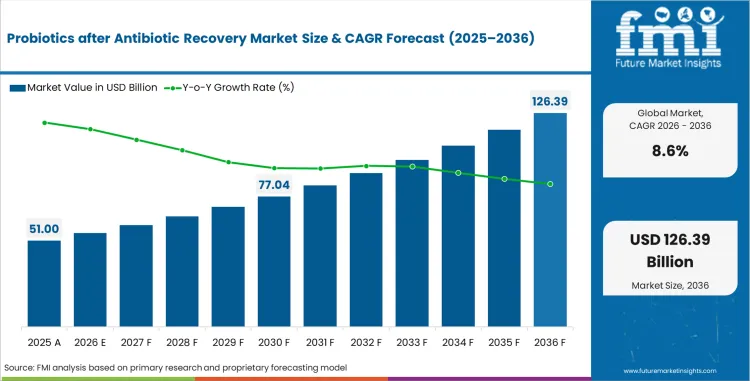
The probiotics after antibiotic recovery market was valued at USD 51.0 billion in 2025. The market is set to reach USD 55.4 billion by 2026-end and grow at a CAGR of 8.6% between 2026-2036 to reach USD 126.4 billion by 2036. Capsules will dominate with a 45.0% share, while Gut Health Restoration will lead with a 60.0% share.
Summary of the Probiotics after Antibiotic Recovery Market
- Demand and Growth Drivers
- Clinical evidence supporting microbiome restoration after antibiotic treatment is driving adoption of targeted probiotic formulations, with gut health restoration accounting for 60.0% of application demand.
- Multi-strain formulations account for 65.0% of formulation demand, reflecting clinical preference for products that address multiple aspects of microbiome disruption.
- Online retail accounts for 55.0% of distribution, reflecting the consumer health orientation of probiotic supplementation and the growing role of e-commerce in health product purchasing.
- Product and Segment View
- Leading positions of Danone, DuPont, Nestle are due to their established manufacturing infrastructure, distribution networks and broad product portfolios.
- Chr. BioGaia, Hansen, Yakult Honsha have strong presence in certain regions or segments and specialized capabilities.
- Seed Health, Biome Therapeutics and Pendulum Therapeutics are new entrants that are growing through technology innovation and niche market positioning.
- Geography and Competitive Outlook
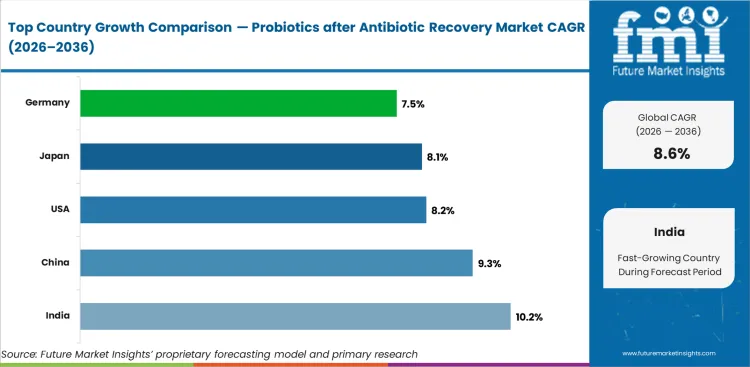
- India (10.2%) accounts for the highest growth globally, owing to high antibiotic consumption rates, increasing healthcare consciousness and growth in e-commerce distribution.
- North America and Europe hold premium positioning needing clinical evidence and healthcare provider recommendation networks.
- Danone (18.0%) is leading the pack, building on its medical nutrition platform and existing relationships with healthcare providers.
- Analyst Opinion
- Nandini Roy Choudhury, Principal Consultant at FMI says, 'Companies investing in strain-specific clinical trials and building healthcare provider recommendation networks are likely to capture disproportionate share as the market transitions from general probiotic supplementation to clinically positioned post-antibiotic recovery products.'
- The probiotics after antibiotic recovery market is evolving from a general wellness category into a clinically positioned functional health segment.
- Strain specificity is replacing generic probiotic branding as the primary competitive differentiator.
- Healthcare provider recommendations significantly increase conversion rates, making clinical detailing and professional education critical commercial investments.
Key Takeaways, Market Size, and Forecast
- The probiotics after antibiotic recovery market was valued at USD 51.00 billion in 2025.
- By 2036, the Probiotics after Antibiotic Recovery Market is expected to be worth USD 126.39 billion.
- From 2026 to 2036, the market is projected to expand at a CAGR of 8.6%.
- The market is projected to create an incremental opportunity of USD 71.00 billion between 2026 and 2036.
- In 2026, gut health restoration is expected to account for 60% of the application segment, driven by clinical recognition of antibiotic-associated microbiome disruption and growing healthcare provider recommendations.
- India (10.2%) and China (9.3%) are two of the fastest growing markets in the world.
Probiotics after Antibiotic Recovery Market Definition
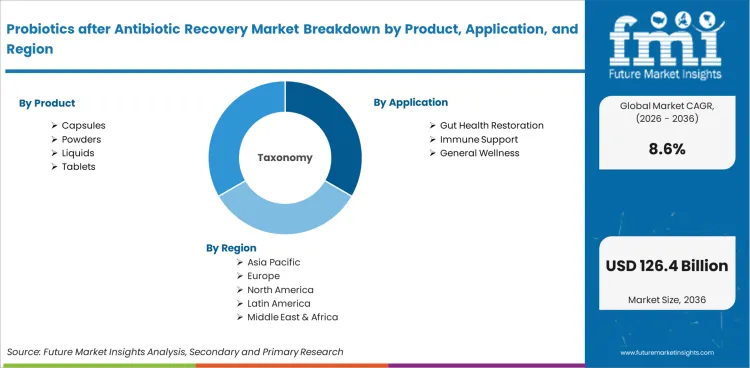
The probiotics after antibiotic recovery market includes probiotic supplements, functional foods, and clinical nutrition products specifically formulated or positioned for microbiome restoration during and after antibiotic treatment. Products include capsules, powders, liquids, and tablets containing single-strain or multi-strain probiotic formulations.
Probiotics after Antibiotic Recovery Market Inclusions
Market scope encompasses all commercially traded probiotic products for antibiotic recovery categorized by product (capsules, powders, liquids, tablets), application (gut health restoration, immune support, general wellness), end use (adults, pediatric population, geriatric population), distribution channel (online retail, offline retail), formulation (multi-strain probiotics, single-strain probiotics), and strain type (Lactobacillus, Bifidobacterium, other strains). Revenue estimates cover the period from 2026 to 2036.
Probiotics after Antibiotic Recovery Market Exclusions
The scope does not include general-purpose probiotic supplements without post-antibiotic positioning, probiotic food products not marketed for antibiotic recovery, or prebiotic supplements without live probiotic cultures.
Probiotics after Antibiotic Recovery Market Research Methodology
- Primary Research: FMI conducted its primary research through interviews with probiotic manufacturers, clinical nutritionists, healthcare providers and pharmacy channel distributors in key markets.
- Desk Research: Data compiled from clinical trial databases, health claims approvals for regulatory purposes and tracking of consumer health supplement markets.
- Market sizing and forecasting: Bottom up approach to the market size of probiotic supplements based on sales across pharmacy, retail and e-commerce channels, adjusted for healthcare provider recommendation rates.
- Data validation: Quarterly review of consumer health market tracking data and manufacturer sales disclosures.
Why is the Probiotics after Antibiotic Recovery Market Growing?
- The growing clinical awareness of microbiome disruption due to antibiotics is resulting in targeted probiotic formulations, especially multi-strain products with demonstrated efficacy.
- In markets with active recommendation practices, healthcare provider recommendations during antibiotic prescribing are increasing probiotic supplementation attach rates.
The probiotics after antibiotic recovery market is estimated at USD 55.39 billion in 2026 and is projected to reach USD 126.39 billion by 2036, at a CAGR of 8.6%. Demand is being driven by increasing clinical awareness of microbiome disruption, increasing healthcare provider recommendation and increasing consumer awareness of gut health restoration.
The market is in the space between clinical nutrition and consumer health. Distribution: Online retail accounts for 55.0% of distribution, reflecting the health orientation of consumers and the growing role of e-commerce. This channel mix creates different competitive dynamics than conventional pharmaceutical distribution.
India is growing at the highest CAGR of 10.2% due to high antibiotics usage and the growth of organized retail and e-commerce distribution. China is supported by a large consumer health market and the rising spend by the middle class on preventive health products at 9.3% CAGR .
Market Segmentation Analysis
- 45.0% of the product share is in capsules, with standard capsules and delayed-release capsules serving different clinical and consumer needs for probiotic delivery.
- Gut health restoration makes up 60.0% of the application demand, with the primary clinical sub-segments being microbiome balance and diarrhea management.
- Distribution: 55.0% of distribution is via online retail, with e-commerce platforms and subscription services providing direct consumer access to specialized probiotic products.
The probiotics market after antibiotic recovery is segmented into product, application, end use, distribution channel, formulation, and strain type. The demand for antibiotics is determined by the prescription volume, the practices of healthcare providers in prescribing them and the health awareness of consumers.
Insights into the Gut Health Restoration Application Segment
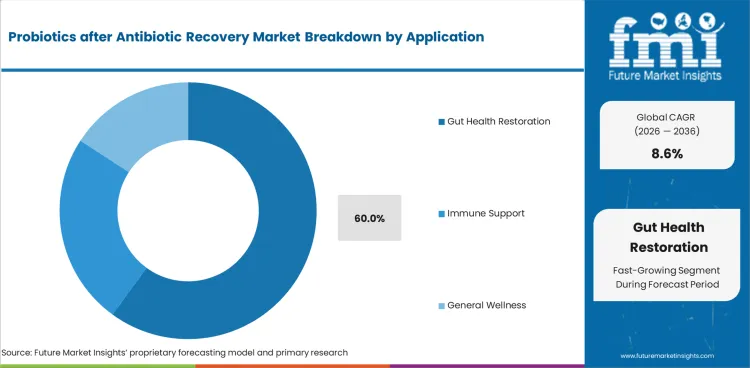
The gut health restoration segment is projected to drive the application segment in 2026, accounting for 60.0% of the application segment. Major sub-segments include microbiome balance and diarrhea management . There is increasing clinical evidence to support the use of specific strain formulations for specific post-antibiotic conditions.
The second-largest application is the immune support category, which is driven by the growing knowledge of the gut-immune system connections and the role of probiotics in immune recovery after antibiotic therapy.
Insights into the Multi-Strain Probiotics Formulation Segment
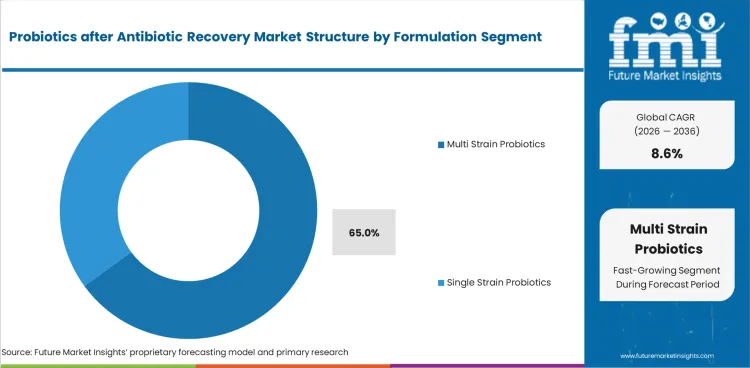
Multi-strain probiotics represent 65.0% of formulation demand. Lactobacillus blends and Bifidobacterium blends are the largest sub-segments, which are aimed at targeting several aspects of microbiome disruption simultaneously.
Single-strain probiotics represent 35.0% and are used in clinically targeted applications where specific strain efficacy has been shown in randomized controlled trials.
Probiotics after Antibiotic Recovery Market Drivers, Restraints, and Opportunities
- The addressable market is directly determined by antibiotic prescribing patterns, with large consumer bases found in high-prescribing markets like India and China.
- Regulatory fragmentation across markets creates commercial complexity for manufacturers looking for a consistent clinical positioning.
- The upshot: Recommendations from healthcare providers boost conversion rates dramatically, so clinical detailing and professional education are essential investments.
The market is driven by clinical evidence, shaped by regulatory frameworks and constrained by commercial complexity from the fragmentation of health claims across jurisdictions.
Antibiotic Prescribing Patterns and Market Size
Addressable market correlates with volumes of antibiotic prescriptions. The world’s largest potential consumer markets are in India, China and Southeast Asia, where per capita usage rates are some of the highest. In markets with antibiotic stewardship programs, the volumes may be lower but the recommendation rates may be higher.
Regulatory Fragmentation
The rules for probiotic health claims vary, with Europe and Japan having strict pharmaceutical-grade standards, and the USA and India having more lax supplement regulations. Manufacturers will need to have different strategies for different jurisdictions.
Clinical Evidence and Strain Specificity
Clinical evidence is moving away from generic supplementation to specific formulations for conditions. Products backed by evidence from randomized controlled trials command premium pricing and preferential recommendations from healthcare providers.
Channel Diversification
The market comprises pharmaceutical distribution, pharmacy retail, health food retail and direct-to-consumer e-commerce. Diversified consumer health companies have structural advantages, because winning across multiple channels requires different commercial capabilities.
Analysis of Probiotics after Antibiotic Recovery Market By Key Countries
.webp "Top Country Growth Comparison Probiotics After Antibiotic Recovery Market Cagr (2026 2036)")
| Country | CAGR |
|---|---|
| India | 10.2% |
| China | 9.3% |
| USA | 8.2% |
| Japan | 8.1% |
| Germany | 7.5% |
- India is leading the pack with a 10.2% CAGR, driven by high antibiotic prescription rates, growing healthcare awareness, and the growth of e-commerce distribution.
- Demand is strong at 9.3%, driven by strong growth in large-scale consumer health spending and advanced e-commerce infrastructure.
Regional demand reflects antibiotic usage patterns, regulatory frameworks, healthcare provider recommendation practices, and consumer health spending levels. Asia leads volume growth, while Europe and North America sustain premium positioning.
Demand Outlook for Probiotics after Antibiotic Recovery Market in India
India leads at 10.2% CAGR through 2036. High antibiotic prescribing rates across both urban and rural healthcare, combined with growing awareness of gut health and expanding e-commerce distribution, create a large and rapidly growing addressable market.
- Ayushman Bharat and private healthcare expansion are increasing patient touchpoints where probiotic recommendations accompany antibiotic prescriptions.
- E-commerce platforms are enabling distribution of specialized probiotic supplements beyond traditional pharmacy channels.
- High antibiotic usage rates create a large addressable consumer base for post-treatment microbiome restoration products.
Future Outlook for Probiotics after Antibiotic Recovery Market in China
China is projected to grow at 9.3% CAGR through 2036. The market benefits from large antibiotic prescribing volumes, an expanding middle-class consumer health market, and advanced e-commerce infrastructure.
- Large-scale e-commerce infrastructure enables rapid distribution and consumer education for probiotic supplements.
- Government antibiotic stewardship programs are increasing consumer awareness of microbiome disruption and recovery needs.
- Growing middle-class health spending supports premium multi-strain probiotic formulations.
Opportunity Analysis of Probiotics after Antibiotic Recovery Market in the United States
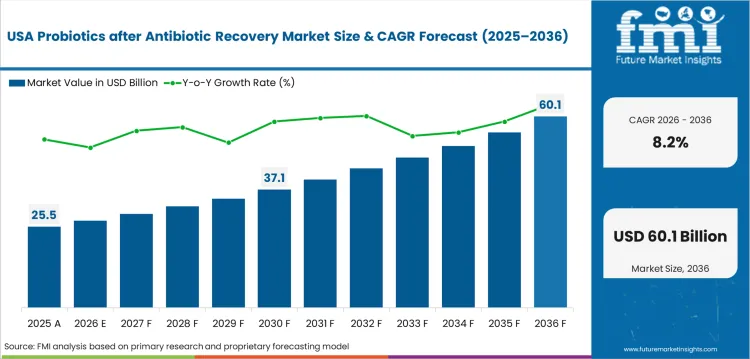
The USA is projected to grow at 8.2% CAGR through 2036. Demand is supported by healthcare provider recommendations, established supplement distribution channels, and strong consumer awareness of gut health.
- Healthcare provider recommendations during antibiotic prescribing are increasing probiotic supplementation attach rates.
- Direct-to-consumer e-commerce and subscription models are expanding distribution beyond traditional pharmacy channels.
- Clinical evidence for strain-specific post-antibiotic efficacy supports premium product positioning and pricing.
In-depth Analysis of Probiotics after Antibiotic Recovery Market in Japan
Japan is projected to grow at 8.1% CAGR through 2036. The established functional food regulatory framework and healthcare provider recommendation culture support sustained demand for clinically positioned probiotic products.
- Functional food regulatory framework supports health claim positioning for specific probiotic strains.
- Healthcare provider recommendation practices integrate probiotic supplementation into antibiotic treatment protocols.
- Domestic manufacturer capabilities in fermentation and strain development sustain competitive positioning.
Sales Analysis of Probiotics after Antibiotic Recovery Market in Germany
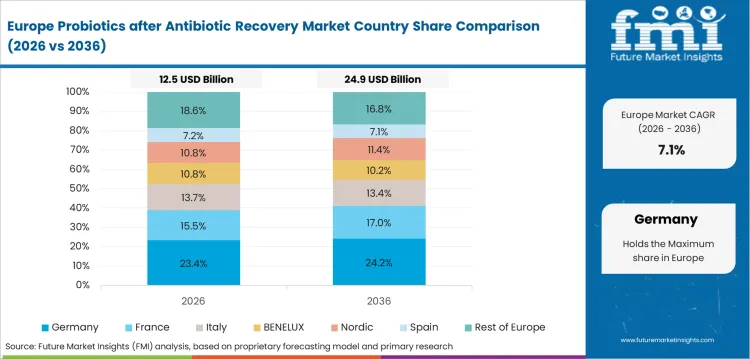
Germany is projected to grow at 7.5% CAGR through 2036. Demand reflects healthcare system integration of probiotic recommendations, pharmacy channel strength, and regulatory frameworks supporting specific health claims.
- Healthcare system reimbursement for specific probiotic preparations supports pharmaceutical-grade product demand.
- Pharmacy channel strength enables professional recommendation and consumer education at point of purchase.
- EU health claims regulation maintains high barriers for market entry with clinical positioning.
Competitive Landscape and Strategic Positioning
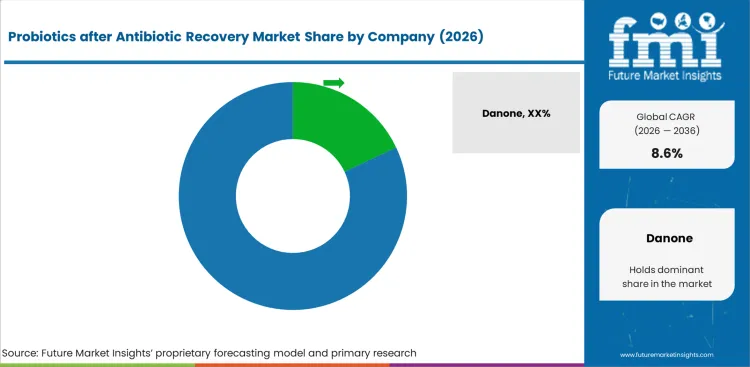
- Danone (18.0%) is a leader in multiple markets with its medical nutrition platform and relationships with healthcare providers.
- Chr. Hansen and BioGaia are well positioned with proprietary strain portfolios that have documented clinical efficacy.
- Yakult Honsha established a functional food distribution to build regional strength in Asia.
Key Companies in the Probiotics after Antibiotic Recovery Market
Key global companies leading the probiotics after antibiotic recovery market include:
- Leading positions of Danone, DuPont, Nestle are due to their established manufacturing infrastructure, distribution networks and broad product portfolios.
- Chr. BioGaia, Hansen, Yakult Honsha have strong presence in certain regions or segments and specialized capabilities.
- Seed Health, Biome Therapeutics and Pendulum Therapeutics are new entrants that are growing through technology innovation and niche market positioning.
Competitive Benchmarking: Probiotics after Antibiotic Recovery Market
| Company | Strain Portfolio | Clinical Evidence | Distribution Reach | Geographic Presence |
|---|---|---|---|---|
| Danone | High | Strong | Strong | Global |
| DuPont | High | Strong | Strong | Global |
| Nestle | High | Moderate | Strong | Global |
| Chr. Hansen | Very High | Strong | Moderate | Global |
| BioGaia | High | Strong | Moderate | Europe, N. America |
| Yakult Honsha | Medium | Strong | Strong | Asia, Global |
Source: Future Market Insights competitive analysis, 2026.
Key Developments in Probiotics after Antibiotic Recovery Market
- In 2025, Danone expanded its medical nutrition probiotic portfolio through its Nutricia division by advancing multi-strain probiotic formulations designed to support gut health and microbiome balance in patients undergoing antibiotic treatment, reinforcing its focus on clinical nutrition and digestive health applications.
- In 2025, Chr. Hansen, operating as part of Novonesis, strengthened its scientific and regulatory presence in Europe by expanding documentation and regulatory support for its Lactobacillus and Bifidobacterium probiotic portfolios, supporting microbiome restoration and digestive health applications following antibiotic use and medical interventions.
Key Players in the Probiotics after Antibiotic Recovery Market
Major Global Players
- Danone
- DuPont
- Nestle
- Chr. Hansen
- BioGaia
- Yakult Honsha
Emerging Players/Startups
- Seed Health
- Biome Therapeutics
- Pendulum Therapeutics
- Sun Genomics
- Synlogic
Report Scope and Coverage
| Parameter | Details |
|---|---|
| Quantitative Units | USD 55.39 billion to USD 126.39 billion, at a CAGR of 8.6% |
| Market Definition | The probiotics after antibiotic recovery market includes probiotic supplements, functional foods, and clinical nutrition products specifically formulated or positioned for microbiome restoration during and after antibiotic treatment. Products include capsules, powders, liquids, and tablets containing single-strain or multi-strain probiotic formulations. |
| Regions Covered | North America, Latin America, Europe, East Asia, South Asia and Pacific, Middle East and Africa |
| Countries Covered | India, China, USA, Japan, Germany, 30 plus countries |
| Key Companies Profiled | Danone, DuPont, Nestlé, DowDuPont, Chr. Hansen, BioGaia, Yakult Honsha, Other Emerging Players |
| Forecast Period | 2026 to 2036 |
| Approach | Hybrid bottom-up and top-down methodology starting with verified transaction data, projecting adoption velocity across segments and regions. |
Market Segmentation Analysis
Probiotics after Antibiotic Recovery Market Segmented by Product:
- Capsules
- Standard Capsules
- Gelatin Capsules
- Vegetarian Capsules
- Delayed Release Capsules
- Enteric Coated Capsules
- Targeted Release Capsules
- Standard Capsules
- Powders
- Single Dose Sachets
- Stick Packs
- Travel Packs
- Bulk Powder
- Multi Serving Packs
- Mixable Formulations
- Single Dose Sachets
- Liquids
- Ready To Drink
- Probiotic Shots
- Functional Beverages
- Drops
- Infant Drops
- Concentrated Liquid Drops
- Ready To Drink
- Tablets
- Chewable Tablets
- Flavored Tablets
- Kids Friendly Formats
- Standard Tablets
- Compressed Tablets
- Coated Tablets
- Chewable Tablets
Probiotics after Antibiotic Recovery Market Segmented by Application:
- Gut Health Restoration
- Microbiome Balance
- Post Antibiotic Recovery
- Digestive Health Support
- Diarrhea Management
- Antibiotic Associated Diarrhea
- Traveler Diarrhea
- Microbiome Balance
- Immune Support
- Immune System Recovery
- Infection Resistance
- Inflammation Reduction
- Immune System Recovery
- General Wellness
- Daily Supplementation
- Preventive Health
- Nutritional Balance
- Daily Supplementation
Probiotics after Antibiotic Recovery Market Segmented by End Use:
- Adults
- General Consumers
- Post Treatment Users
- Preventive Users
- Health Conscious Consumers
- Lifestyle Users
- Diet Focused Consumers
- General Consumers
- Pediatric Population
- Infants
- Drop Based Supplements
- Digestive Support
- Children
- Chewable Supplements
- Immune Support
- Infants
- Geriatric Population
- Digestive Support Users
- Chronic Condition Patients
- Recovery Nutrition Users
- Digestive Support Users
Probiotics after Antibiotic Recovery Market Segmented by Distribution Channel:
- Online Retail
- E Commerce Platforms
- Marketplace Platforms
- Brand Owned Websites
- Subscription Services
- Auto Replenishment Plans
- Personalized Supplement Plans
- E Commerce Platforms
- Offline Retail
- Pharmacy And Drug Stores
- Chain Pharmacies
- Independent Pharmacies
- Health And Wellness Stores
- Nutrition Stores
- Organic Product Stores
- Supermarkets And Hypermarkets
- Large Format Stores
- Convenience Stores
- Pharmacy And Drug Stores
Probiotics after Antibiotic Recovery Market Segmented by Formulation:
- Multi Strain Probiotics
- Lactobacillus Blends
- High Potency Blends
- Targeted Gut Health Blends
- Bifidobacterium Blends
- Digestive Health Blends
- Immune Support Blends
- Lactobacillus Blends
- Single Strain Probiotics
- Lactobacillus Strains
- Clinical Strains
- General Wellness Strains
- Bifidobacterium Strains
- Infant Focused Strains
- Adult Focused Strains
- Lactobacillus Strains
Probiotics after Antibiotic Recovery Market Segmented by Strain Type:
- Lactobacillus
- Lactobacillus Acidophilus
- Digestive Support
- Post Antibiotic Recovery
- Lactobacillus Rhamnosus
- Immune Support
- Diarrhea Management
- Lactobacillus Acidophilus
- Bifidobacterium
- Bifidobacterium Longum
- Gut Health
- Inflammation Reduction
- Bifidobacterium Bifidum
- Digestive Health
- Immune Balance
- Bifidobacterium Longum
- Other Probiotic Strains
- Saccharomyces Boulardii
- Antibiotic Associated Diarrhea
- Gut Flora Restoration
- Saccharomyces Boulardii
Probiotics after Antibiotic Recovery Market by Region:
- North America
- USA
- Canada
- Mexico
- Latin America
- Brazil
- Chile
- Rest of Latin America
- Western Europe
- Germany
- UK
- Italy
- Spain
- France
- Nordic
- BENELUX
- Rest of Western Europe
- Eastern Europe
- Russia
- Poland
- Hungary
- Balkan & Baltic
- Rest of Eastern Europe
- East Asia
- China
- Japan
- South Korea
- South Asia and Pacific
- India
- ASEAN
- Australia & New Zealand
- Rest of South Asia and Pacific
- Middle East & Africa
- Kingdom of Saudi Arabia
- Other GCC Countries
- Turkiye
- South Africa
- Other African Union
- Rest of Middle East & Africa
Research Sources and Bibliography
- 1. World Health Organization. (2025). WHO Guidelines on Antibiotic Stewardship and Microbiome Health. WHO.
- 2. International Scientific Association for Probiotics and Prebiotics. (2024). ISAPP Consensus Statement on Probiotic Use During Antibiotic Treatment. ISAPP.
- 3. European Food Safety Authority. (2024). EFSA Scientific Opinion on Health Claims for Probiotic Strains. EFSA.
- 4. USA National Institutes of Health. (2025). NIH Human Microbiome Project: Antibiotic Impact and Recovery Data. NIH.
- 5. Food and Agriculture Organization. (2025). FAO/WHO Guidelines for Evaluation of Probiotics in Food. FAO.
This bibliography is provided for reader reference. The full Future Market Insights report contains the complete reference list with publication dates, URLs, and supporting data for all cited works.
This Report Answers
- Estimating the size of the market and revenue projections from 2026 to 2036.
- Segmentation by product, application, end use, distribution channel, formulation, and strain type.
- Insights about more than 30 country markets.
- Analysis of clinical evidence and strain-specific efficacy trends.
- Assessment of the competitive landscape and strain portfolio differentiation.
- Finding investment opportunities in healthcare-grade and consumer probiotic segments.
- Tracking regulatory developments for probiotic health claims across jurisdictions.
- Delivery of data in PDF and Excel formats.
Frequently Asked Questions
How big is the probiotics after antibiotic recovery market in 2026?
The global probiotics after antibiotic recovery market is estimated to be valued at USD 55.39 billion in 2026.
What will be the size of probiotics after antibiotic recovery market in 2036?
The market size for the probiotics after antibiotic recovery market is projected to reach USD 126.39 billion by 2036.
How much will be the probiotics after antibiotic recovery market growth between 2026 and 2036?
The probiotics after antibiotic recovery market is expected to grow at a 8.6% CAGR between 2026 and 2036.
What are the key product types in the probiotics after antibiotic recovery market?
The key product types in probiotics after antibiotic recovery market are capsules, powders, liquids and tablets.
Which application segment is expected to contribute significant share in the probiotics after antibiotic recovery market in 2026?
In terms of application, gut health restoration segment is expected to command 60.0% share in the probiotics after antibiotic recovery market in 2026.
Preview the report firsthand - request a free sample
Get SampleGet the brochure for pricing and purchase details.
Get PDFTable of Content
- Executive Summary
- Global Market Outlook
- Demand-side Trends
- Supply-side Trends
- Technology Roadmap Analysis
- Analysis and Recommendations
- Market Overview
- Market Coverage / Taxonomy
- Market Definition / Scope / Limitations
- Research Methodology
- Chapter Orientation
- Analytical Lens and Working Hypotheses
- Market Structure, Signals, and Trend Drivers
- Benchmarking and Cross-market Comparability
- Market Sizing, Forecasting, and Opportunity Mapping
- Research Design and Evidence Framework
- Desk Research Programme (Secondary Evidence)
- Company Annual and Sustainability Reports
- Peer-reviewed Journals and Academic Literature
- Corporate Websites, Product Literature, and Technical Notes
- Earnings Decks and Investor Briefings
- Statutory Filings and Regulatory Disclosures
- Technical White Papers and Standards Notes
- Trade Journals, Industry Magazines, and Analyst Briefs
- Conference Proceedings, Webinars, and Seminar Materials
- Government Statistics Portals and Public Data Releases
- Press Releases and Reputable Media Coverage
- Specialist Newsletters and Curated Briefings
- Sector Databases and Reference Repositories
- FMI Internal Proprietary Databases and Historical Market Datasets
- Subscription Datasets and Paid Sources
- Social Channels, Communities, and Digital Listening Inputs
- Additional Desk Sources
- Expert Input and Fieldwork (Primary Evidence)
- Primary Modes
- Qualitative Interviews and Expert Elicitation
- Quantitative Surveys and Structured Data Capture
- Blended Approach
- Why Primary Evidence is Used
- Field Techniques
- Interviews
- Surveys
- Focus Groups
- Observational and In-context Research
- Social and Community Interactions
- Stakeholder Universe Engaged
- C-suite Leaders
- Board Members
- Presidents and Vice Presidents
- R&D and Innovation Heads
- Technical Specialists
- Domain Subject-matter Experts
- Scientists
- Physicians and Other Healthcare Professionals
- Governance, Ethics, and Data Stewardship
- Research Ethics
- Data Integrity and Handling
- Primary Modes
- Tooling, Models, and Reference Databases
- Desk Research Programme (Secondary Evidence)
- Data Engineering and Model Build
- Data Acquisition and Ingestion
- Cleaning, Normalisation, and Verification
- Synthesis, Triangulation, and Analysis
- Quality Assurance and Audit Trail
- Market Background
- Market Dynamics
- Drivers
- Restraints
- Opportunity
- Trends
- Scenario Forecast
- Demand in Optimistic Scenario
- Demand in Likely Scenario
- Demand in Conservative Scenario
- Opportunity Map Analysis
- Product Life Cycle Analysis
- Supply Chain Analysis
- Investment Feasibility Matrix
- Value Chain Analysis
- PESTLE and Porter’s Analysis
- Regulatory Landscape
- Regional Parent Market Outlook
- Production and Consumption Statistics
- Import and Export Statistics
- Market Dynamics
- Global Market Analysis 2021 to 2025 and Forecast, 2026 to 2036
- Historical Market Size Value (USD Million) Analysis, 2021 to 2025
- Current and Future Market Size Value (USD Million) Projections, 2026 to 2036
- Y-o-Y Growth Trend Analysis
- Absolute $ Opportunity Analysis
- Global Market Pricing Analysis 2021 to 2025 and Forecast 2026 to 2036
- Global Market Analysis 2021 to 2025 and Forecast 2026 to 2036, By Product
- Introduction / Key Findings
- Historical Market Size Value (USD Million) Analysis By Product , 2021 to 2025
- Current and Future Market Size Value (USD Million) Analysis and Forecast By Product , 2026 to 2036
- Capsules
- Standard Capsules
- Gelatin Capsules
- Vegetarian Capsules
- Delayed Release Capsules
- Enteric Coated Capsules
- Targeted Release Capsules
- Powders
- Single Dose Sachets
- Stick Packs
- Travel Packs
- Bulk Powder
- Multi Serving Packs
- Liquids
- Ready To Drink
- Probiotic Shots
- Functional Beverages
- Drops
- Infant Drops
- Tablets
- Chewable Tablets
- Flavored Tablets
- Kids Friendly Formats
- Standard Tablets
- Compressed Tablets
- Capsules
- Y-o-Y Growth Trend Analysis By Product , 2021 to 2025
- Absolute $ Opportunity Analysis By Product , 2026 to 2036
- Global Market Analysis 2021 to 2025 and Forecast 2026 to 2036, By Application
- Introduction / Key Findings
- Historical Market Size Value (USD Million) Analysis By Application, 2021 to 2025
- Current and Future Market Size Value (USD Million) Analysis and Forecast By Application, 2026 to 2036
- Gut Health Restoration
- Microbiome Balance
- Post Antibiotic Recovery
- Digestive Health Support
- Diarrhea Management
- Antibiotic Associated Diarrhea
- Traveler Diarrhea
- Immune Support
- Immune System Recovery
- Infection Resistance
- Inflammation Reduction
- General Wellness
- Daily Supplementation
- Preventive Health
- Nutritional Balance
- Gut Health Restoration
- Y-o-Y Growth Trend Analysis By Application, 2021 to 2025
- Absolute $ Opportunity Analysis By Application, 2026 to 2036
- Global Market Analysis 2021 to 2025 and Forecast 2026 to 2036, By End Use
- Introduction / Key Findings
- Historical Market Size Value (USD Million) Analysis By End Use, 2021 to 2025
- Current and Future Market Size Value (USD Million) Analysis and Forecast By End Use, 2026 to 2036
- Adults
- General Consumers
- Post Treatment Users
- Preventive Users
- Health Conscious Consumers
- Lifestyle Users
- Diet Focused Consumers
- Pediatric Population
- Infants
- Drop Based Supplements
- Digestive Support
- Children
- Chewable Supplements
- Geriatric Population
- Digestive Support Users
- Chronic Condition Patients
- Recovery Nutrition Users
- Adults
- Y-o-Y Growth Trend Analysis By End Use, 2021 to 2025
- Absolute $ Opportunity Analysis By End Use, 2026 to 2036
- Global Market Analysis 2021 to 2025 and Forecast 2026 to 2036, By Distribution Channel
- Introduction / Key Findings
- Historical Market Size Value (USD Million) Analysis By Distribution Channel, 2021 to 2025
- Current and Future Market Size Value (USD Million) Analysis and Forecast By Distribution Channel, 2026 to 2036
- Online Retail
- E Commerce Platforms
- Marketplace Platforms
- Brand Owned Websites
- Subscription Services
- Auto Replenishment Plans
- Personalized Supplement Plans
- Offline Retail
- Pharmacy And Drug Stores
- Chain Pharmacies
- Independent Pharmacies
- Health And Wellness Stores
- Nutrition Stores
- Online Retail
- Y-o-Y Growth Trend Analysis By Distribution Channel, 2021 to 2025
- Absolute $ Opportunity Analysis By Distribution Channel, 2026 to 2036
- Global Market Analysis 2021 to 2025 and Forecast 2026 to 2036, By Formulation
- Introduction / Key Findings
- Historical Market Size Value (USD Million) Analysis By Formulation, 2021 to 2025
- Current and Future Market Size Value (USD Million) Analysis and Forecast By Formulation, 2026 to 2036
- Multi Strain Probiotics
- Lactobacillus Blends
- High Potency Blends
- Targeted Gut Health Blends
- Bifidobacterium Blends
- Digestive Health Blends
- Immune Support Blends
- Single Strain Probiotics
- Lactobacillus Strains
- Clinical Strains
- General Wellness Strains
- Bifidobacterium Strains
- Infant Focused Strains
- Multi Strain Probiotics
- Y-o-Y Growth Trend Analysis By Formulation, 2021 to 2025
- Absolute $ Opportunity Analysis By Formulation, 2026 to 2036
- Global Market Analysis 2021 to 2025 and Forecast 2026 to 2036, By Strain Type
- Introduction / Key Findings
- Historical Market Size Value (USD Million) Analysis By Strain Type, 2021 to 2025
- Current and Future Market Size Value (USD Million) Analysis and Forecast By Strain Type, 2026 to 2036
- Lactobacillus
- Lactobacillus Acidophilus
- Digestive Support
- Post Antibiotic Recovery
- Lactobacillus Rhamnosus
- Immune Support
- Diarrhea Management
- Bifidobacterium
- Bifidobacterium Longum
- Gut Health
- Inflammation Reduction
- Bifidobacterium Bifidum
- Digestive Health
- Other Probiotic Strains
- Saccharomyces Boulardii
- Antibiotic Associated Diarrhea
- Gut Flora Restoration
- Lactobacillus
- Y-o-Y Growth Trend Analysis By Strain Type, 2021 to 2025
- Absolute $ Opportunity Analysis By Strain Type, 2026 to 2036
- Global Market Analysis 2021 to 2025 and Forecast 2026 to 2036, By Region
- Introduction
- Historical Market Size Value (USD Million) Analysis By Region, 2021 to 2025
- Current Market Size Value (USD Million) Analysis and Forecast By Region, 2026 to 2036
- North America
- Latin America
- Western Europe
- Eastern Europe
- East Asia
- South Asia and Pacific
- Middle East & Africa
- Market Attractiveness Analysis By Region
- North America Market Analysis 2021 to 2025 and Forecast 2026 to 2036, By Country
- Historical Market Size Value (USD Million) Trend Analysis By Market Taxonomy, 2021 to 2025
- Market Size Value (USD Million) Forecast By Market Taxonomy, 2026 to 2036
- By Country
- USA
- Canada
- Mexico
- By Product
- By Application
- By End Use
- By Distribution Channel
- By Formulation
- By Strain Type
- By Country
- Market Attractiveness Analysis
- By Country
- By Product
- By Application
- By End Use
- By Distribution Channel
- By Formulation
- By Strain Type
- Key Takeaways
- Latin America Market Analysis 2021 to 2025 and Forecast 2026 to 2036, By Country
- Historical Market Size Value (USD Million) Trend Analysis By Market Taxonomy, 2021 to 2025
- Market Size Value (USD Million) Forecast By Market Taxonomy, 2026 to 2036
- By Country
- Brazil
- Chile
- Rest of Latin America
- By Product
- By Application
- By End Use
- By Distribution Channel
- By Formulation
- By Strain Type
- By Country
- Market Attractiveness Analysis
- By Country
- By Product
- By Application
- By End Use
- By Distribution Channel
- By Formulation
- By Strain Type
- Key Takeaways
- Western Europe Market Analysis 2021 to 2025 and Forecast 2026 to 2036, By Country
- Historical Market Size Value (USD Million) Trend Analysis By Market Taxonomy, 2021 to 2025
- Market Size Value (USD Million) Forecast By Market Taxonomy, 2026 to 2036
- By Country
- Germany
- UK
- Italy
- Spain
- France
- Nordic
- BENELUX
- Rest of Western Europe
- By Product
- By Application
- By End Use
- By Distribution Channel
- By Formulation
- By Strain Type
- By Country
- Market Attractiveness Analysis
- By Country
- By Product
- By Application
- By End Use
- By Distribution Channel
- By Formulation
- By Strain Type
- Key Takeaways
- Eastern Europe Market Analysis 2021 to 2025 and Forecast 2026 to 2036, By Country
- Historical Market Size Value (USD Million) Trend Analysis By Market Taxonomy, 2021 to 2025
- Market Size Value (USD Million) Forecast By Market Taxonomy, 2026 to 2036
- By Country
- Russia
- Poland
- Hungary
- Balkan & Baltic
- Rest of Eastern Europe
- By Product
- By Application
- By End Use
- By Distribution Channel
- By Formulation
- By Strain Type
- By Country
- Market Attractiveness Analysis
- By Country
- By Product
- By Application
- By End Use
- By Distribution Channel
- By Formulation
- By Strain Type
- Key Takeaways
- East Asia Market Analysis 2021 to 2025 and Forecast 2026 to 2036, By Country
- Historical Market Size Value (USD Million) Trend Analysis By Market Taxonomy, 2021 to 2025
- Market Size Value (USD Million) Forecast By Market Taxonomy, 2026 to 2036
- By Country
- China
- Japan
- South Korea
- By Product
- By Application
- By End Use
- By Distribution Channel
- By Formulation
- By Strain Type
- By Country
- Market Attractiveness Analysis
- By Country
- By Product
- By Application
- By End Use
- By Distribution Channel
- By Formulation
- By Strain Type
- Key Takeaways
- South Asia and Pacific Market Analysis 2021 to 2025 and Forecast 2026 to 2036, By Country
- Historical Market Size Value (USD Million) Trend Analysis By Market Taxonomy, 2021 to 2025
- Market Size Value (USD Million) Forecast By Market Taxonomy, 2026 to 2036
- By Country
- India
- ASEAN
- Australia & New Zealand
- Rest of South Asia and Pacific
- By Product
- By Application
- By End Use
- By Distribution Channel
- By Formulation
- By Strain Type
- By Country
- Market Attractiveness Analysis
- By Country
- By Product
- By Application
- By End Use
- By Distribution Channel
- By Formulation
- By Strain Type
- Key Takeaways
- Middle East & Africa Market Analysis 2021 to 2025 and Forecast 2026 to 2036, By Country
- Historical Market Size Value (USD Million) Trend Analysis By Market Taxonomy, 2021 to 2025
- Market Size Value (USD Million) Forecast By Market Taxonomy, 2026 to 2036
- By Country
- Kingdom of Saudi Arabia
- Other GCC Countries
- Turkiye
- South Africa
- Other African Union
- Rest of Middle East & Africa
- By Product
- By Application
- By End Use
- By Distribution Channel
- By Formulation
- By Strain Type
- By Country
- Market Attractiveness Analysis
- By Country
- By Product
- By Application
- By End Use
- By Distribution Channel
- By Formulation
- By Strain Type
- Key Takeaways
- Key Countries Market Analysis
- USA
- Pricing Analysis
- Market Share Analysis, 2025
- By Product
- By Application
- By End Use
- By Distribution Channel
- By Formulation
- By Strain Type
- Canada
- Pricing Analysis
- Market Share Analysis, 2025
- By Product
- By Application
- By End Use
- By Distribution Channel
- By Formulation
- By Strain Type
- Mexico
- Pricing Analysis
- Market Share Analysis, 2025
- By Product
- By Application
- By End Use
- By Distribution Channel
- By Formulation
- By Strain Type
- Brazil
- Pricing Analysis
- Market Share Analysis, 2025
- By Product
- By Application
- By End Use
- By Distribution Channel
- By Formulation
- By Strain Type
- Chile
- Pricing Analysis
- Market Share Analysis, 2025
- By Product
- By Application
- By End Use
- By Distribution Channel
- By Formulation
- By Strain Type
- Germany
- Pricing Analysis
- Market Share Analysis, 2025
- By Product
- By Application
- By End Use
- By Distribution Channel
- By Formulation
- By Strain Type
- UK
- Pricing Analysis
- Market Share Analysis, 2025
- By Product
- By Application
- By End Use
- By Distribution Channel
- By Formulation
- By Strain Type
- Italy
- Pricing Analysis
- Market Share Analysis, 2025
- By Product
- By Application
- By End Use
- By Distribution Channel
- By Formulation
- By Strain Type
- Spain
- Pricing Analysis
- Market Share Analysis, 2025
- By Product
- By Application
- By End Use
- By Distribution Channel
- By Formulation
- By Strain Type
- France
- Pricing Analysis
- Market Share Analysis, 2025
- By Product
- By Application
- By End Use
- By Distribution Channel
- By Formulation
- By Strain Type
- India
- Pricing Analysis
- Market Share Analysis, 2025
- By Product
- By Application
- By End Use
- By Distribution Channel
- By Formulation
- By Strain Type
- ASEAN
- Pricing Analysis
- Market Share Analysis, 2025
- By Product
- By Application
- By End Use
- By Distribution Channel
- By Formulation
- By Strain Type
- Australia & New Zealand
- Pricing Analysis
- Market Share Analysis, 2025
- By Product
- By Application
- By End Use
- By Distribution Channel
- By Formulation
- By Strain Type
- China
- Pricing Analysis
- Market Share Analysis, 2025
- By Product
- By Application
- By End Use
- By Distribution Channel
- By Formulation
- By Strain Type
- Japan
- Pricing Analysis
- Market Share Analysis, 2025
- By Product
- By Application
- By End Use
- By Distribution Channel
- By Formulation
- By Strain Type
- South Korea
- Pricing Analysis
- Market Share Analysis, 2025
- By Product
- By Application
- By End Use
- By Distribution Channel
- By Formulation
- By Strain Type
- Russia
- Pricing Analysis
- Market Share Analysis, 2025
- By Product
- By Application
- By End Use
- By Distribution Channel
- By Formulation
- By Strain Type
- Poland
- Pricing Analysis
- Market Share Analysis, 2025
- By Product
- By Application
- By End Use
- By Distribution Channel
- By Formulation
- By Strain Type
- Hungary
- Pricing Analysis
- Market Share Analysis, 2025
- By Product
- By Application
- By End Use
- By Distribution Channel
- By Formulation
- By Strain Type
- Kingdom of Saudi Arabia
- Pricing Analysis
- Market Share Analysis, 2025
- By Product
- By Application
- By End Use
- By Distribution Channel
- By Formulation
- By Strain Type
- Turkiye
- Pricing Analysis
- Market Share Analysis, 2025
- By Product
- By Application
- By End Use
- By Distribution Channel
- By Formulation
- By Strain Type
- South Africa
- Pricing Analysis
- Market Share Analysis, 2025
- By Product
- By Application
- By End Use
- By Distribution Channel
- By Formulation
- By Strain Type
- USA
- Market Structure Analysis
- Competition Dashboard
- Competition Benchmarking
- Market Share Analysis of Top Players
- By Regional
- By Product
- By Application
- By End Use
- By Distribution Channel
- By Formulation
- By Strain Type
- Competition Analysis
- Competition Deep Dive
- Danone
- Overview
- Product Portfolio
- Profitability by Market Segments (Product/Age /Sales Channel/Region)
- Sales Footprint
- Strategy Overview
- Marketing Strategy
- Product Strategy
- Channel Strategy
- DuPont
- Nestlé
- DowDuPont
- Chr. Hansen
- BioGaia
- Yakult Honsha
- Other Emerging Players
- Danone
- Competition Deep Dive
- Assumptions & Acronyms Used


