

- Market Size (2026)
- USD 205.6 Mn
- Forecast (2036)
- USD 452.1 Mn
- CAGR (2026 to 2036)
- 8.2%
How big is Sepsis Recovery Nutrition Market in 2026?
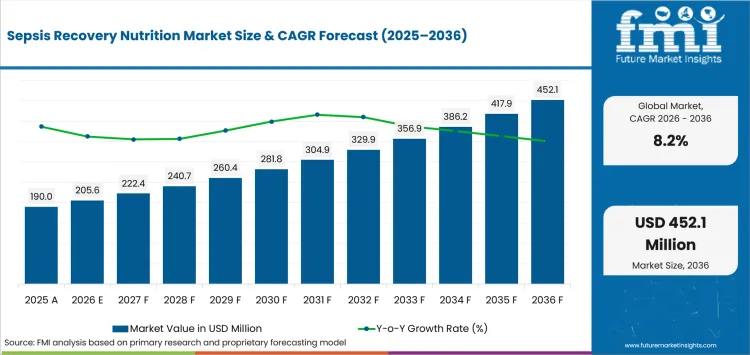
USD 205.6 million in 2026 and USD 452.1 million by 2036 at an 8.2% CAGR.
Demand for sepsis recovery nutrition is projected to expand at 8.2% CAGR between 2026 and 2036, increasing valuation from USD 205.6 million to USD 452.1 million. The Society of Critical Care Medicine published the 2026 Surviving Sepsis Campaign guideline in March 2026 and suggests enteral nutrition within 72 hours for adults with sepsis or septic shock. Earlier route decisions give approved formulas a defined starting point for continued use during step-down recovery.
South Korea is forecast to expand significantly as compared tothe United States, as the country starts from a broader clinical burden. CDC’s August 2026 update states that about 1.7 million USA adults develop sepsis each year. That caseload sustains substantial inpatient and discharge-planning flows for clinical nutrition, while South Korea is projected to rise at 8.6% CAGR by 2036 indicates faster adoption from its own starting base.
Key Takeaways of Sepsis Recovery Nutrition Market
- Critical-care teams initiate nutrition earlier in severe sepsis, which moves formula selection into the first treatment window and extends purchasing decisions into recovery.
- Based on formulation, high-protein enteral feeds are projected to account for 42.1% in 2026 due to concentrated protein delivery after feeding becomes clinically appropriate.
- By phase, the acute ICU phase is estimated to hold 51.1% in 2026 owing to repeated route and tolerance decisions during high-acuity care.
- In 2026, enteral tube feeds are expected to lead product form with 39.1% share because controlled delivery is necessary before normal oral intake returns.
- Hemodynamic instability and gastrointestinal intolerance can interrupt feeding advancement, which limits automatic use of aggressive protein targets or specialized adjunct formulas.
- Some of the key players in this market include Fresenius Kabi, Abbott, Nestlé Health Science, Danone Nutricia, Baxter, B. Braun, Megalabs USA LLC, and Medtrition.
Analyst Perspective
"Hospital accounts should evaluate sepsis recovery nutrition by route flexibility and protocol fit before comparing unit price. Commercial value rises when one portfolio supports ICU feeding and later oral recovery without breaking the clinician’s nutrition plan."
- Nandini Roy Choudhury, Principal Consultant, Future Market Insights
How is the Sepsis Recovery Nutrition Market segmented?
The sepsis recovery nutrition market is segmented by formulation, phase, product form, end user, sales channel and region.
Formulation includes high-protein enteral feeds, immune-modulating formulas, antioxidant and micronutrient blends, and others. Phase covers acute ICU phase, ward step-down, and post-discharge recovery. Product form includes enteral tube feeds, RTD ONS, powder modules, and others. End users comprise ICUs, hospitals (general wards), homecare, and others. Sales channels include hospital pharmacy, retail pharmacy, online, institutional tender, and others.
What supports ICUs as the leading End User category?
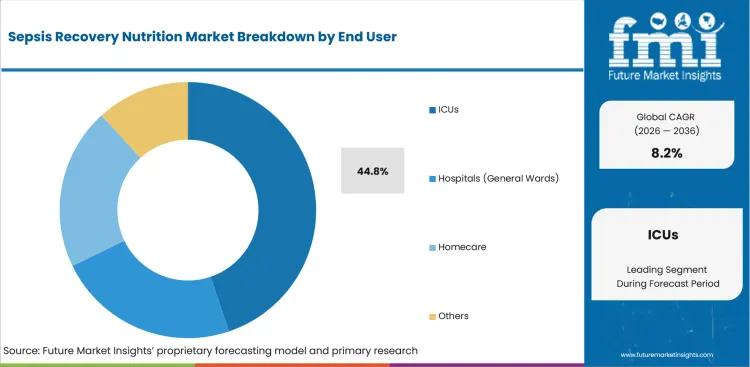
ICUs direct the first structured nutrition plan for severe sepsis and document tolerance for the ward team. Dietitians work with intensivists and pharmacists on feeding interruptions, fluid exposure, and nutrient delivery before any step-down format is selected.
- By end user, ICUs are forecast to represent 44.8% of demand in 2026, owing to their control of early formula orders and repeated nutrition reassessment.
- Fresenius Kabi released an interactive ICU patient case in February 2026 focused on early screening and progressive nutrition therapy. The training case reinforces repeated bedside decisions that keep intensive care central to clinical nutrition planning.
What makes High-Protein enteral feeds central to the Formulation category?
Sepsis recovery often leaves clinicians balancing muscle loss against fluid limits and feeding tolerance during early rehabilitation. Protein-dense enteral formulas and adjacent high-protein formats concentrate nutrient delivery inside an established feeding plan without requiring several separate modules.
- By formulation, high-protein enteral feeds are estimated to hold 42.1% share in 2026, attributable to protein delivery remaining a core recovery objective after hemodynamic stabilization.
- Fresenius Kabi and ESICM outlined their critical-care nutrition programme in January 2026, including research on protein dosing in acute kidney injury. The programme keeps dose evidence central when hospitals evaluate protein-dense formulas for complex ICU recovery.
Why does the acute ICU phase lead the Phase category?
The acute ICU phase concentrates the first prescribed nutrition decisions because shock and ventilation frequently delay normal intake. Intensivists reassess route and rate as organ function changes, so the initial hospital order can influence later ward use.
- The acute ICU phase is projected to hold 51.1% of phase demand in 2026, supported by repeated nutrition adjustments during the highest-acuity part of the sepsis episode.
- Fresenius Kabi reported in December 2025 that clinical nutrition fellows trained inside intensive-care units in Belgium and Sweden. The programme gives hospital clinicians direct exposure to nutrition routines used during persistent critical illness and rehabilitation.
How do Enteral tube feeds influence selection within the Product form category?
Enteral tube feeds provide measurable delivery for patients who cannot meet needs by mouth during stabilization. Ready-to-hang formats also fit continuous hospital workflows and provide a route toward later oral nutrition supplements after swallowing and appetite improve.
- In 2026, enteral tube feeds are expected to lead product form with 39.1% share, driven by controlled delivery before a recovering patient can sustain normal oral intake.
- Otsuka Pharmaceutical Factory launched ENOSOLID Semi Solid for Enteral Use in January 2025 for patients requiring enteral nutrition management. The launch shows continued demand for tube-delivered formats that adjust to specific energy needs.
What are the drivers, restraints and opportunities in the Sepsis Recovery Nutrition Market?
Earlier nutrition inside the sepsis pathway supports demand, patient-specific tolerance limits wider use, and structured discharge nutrition provides the clearest route to repeat purchasing.
- Driver: Critical-care protocols bring nutrition into the early sepsis episode, which establishes an initial formula order before the patient reaches rehabilitation.
- Restraint: Shock physiology and uneven tolerance prevent one protein target or formula strategy from fitting every patient during the full recovery period.
- Opportunity: Companies can preserve a clinician-approved nutrition plan by supplying tube, oral, and modular formats that fit successive recovery phases.
Protocol timing increases the number of nutrition decisions made during acute treatment instead of after ICU discharge. Germany’s S3 sepsis guideline was issued in April 2025 and suggests early enteral or parenteral nutrition after hemodynamic stabilization with tolerance monitoring. That recommendation favors medical nutrition companies whose formulas fit hospital protocols and remain usable after stabilization.
Tolerance limits routine escalation because sepsis can alter gastrointestinal function and fluid management. The Japanese Society of Intensive Care Medicine’s September 2025 guideline gives protein above 1.2 g/kg/day a weak recommendation with very low evidence certainty. Companies therefore need tube-feeding formulas that permit rate adjustment without treating higher delivery as automatically appropriate.
Post-discharge revenue depends on a hospital nutrition plan that patients can follow outside the ward. ONS reported in July 2026 that paid employment among sepsis survivors was 2.5 percentage points lower five years after hospitalization. Portable medical food formats and clinician instructions can extend nutrition support into recovery that lasts well beyond discharge.
Which country CAGRs are profiled in the Sepsis Recovery Nutrition Market?
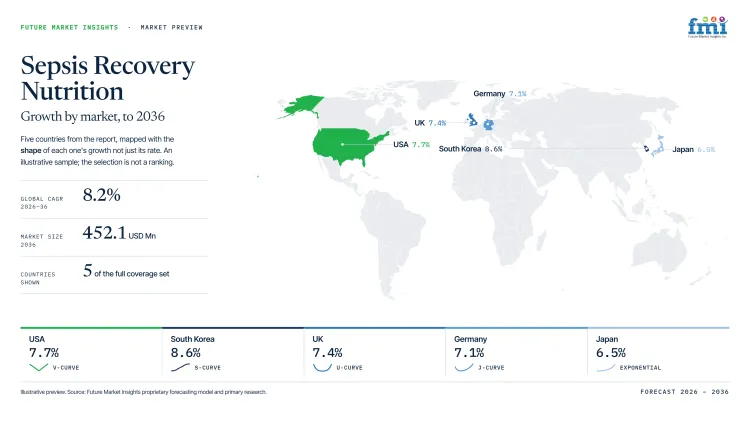
| Country | CAGR |
|---|---|
| South Korea | 8.6% |
| USA | 7.7% |
| UK | 7.4% |
| Germany | 7.1% |
| Japan | 6.5% |
How do country-level CAGRs compare in the Sepsis Recovery Nutrition Market?
The 2.1 percentage-point range separates South Korea from Japan, while the United States, UK, and Germany form a tighter middle band within established hospital systems. The pattern indicates different adoption speeds instead of current revenue rank. Faster rates can emerge as clinical pathways deepen from a smaller installed base.
- South Korea’s higher CAGR supports faster channel buildout despite a smaller base.
- USA hospital scale preserves account opportunity despite a slower forecast.
- UK growth tracks Germany closely, making account differentiation more important than rate separation.
- Germany’s broad hospital base offsets a slower adoption pace than Asian markets.
- Japan’s lower rate places greater emphasis on evidence fit and protocol positioning.
Rate differences influence investment timing without identifying which country holds the largest current revenue pool. The full report provides country-level CAGR analysis across North America, Latin America, Europe, East Asia, South Asia, Oceania and the Middle East and Africa.
Country-wise Analysis
- In South Korea’s concentrated tertiary-care networks, critical-care dietitians apply shared feeding protocols while staffing pressure can interrupt planned protein delivery during busy ward transfers and discharge preparation for step-down care. KDCA’s December 2025 Chronic Disease Factbook records 7,730 sepsis deaths during 2024 and gives hospital teams a current national burden measure for post-ICU recovery planning after prolonged critical illness. Sepsis recovery nutrition demand in South Korea is forecast to rise at 8.6% CAGR through 2036, supported by protocol uptake while companies still need formats that tolerate route changes and fit ward handoffs without losing the original nutrition target.
- USA hospital systems set their own formularies and discharge arrangements, so a nutrition product accepted in one network may face different coverage or home-supply rules elsewhere. Sepsis recovery nutrition demand in the USA is projected to advance at 7.7% CAGR over the projection period, because the acute-care base produces substantial clinical nutrition volume despite fragmented post-discharge coverage. CDC’s August 2026 update states that at least 350,000 adults with sepsis die in hospital or enter hospice each year, keeping severe disease burden visible while manufacturers need institutional access plus oral or modular formats that clinicians can continue after transfer safely.
- After acute NHS care ends, hospitals must pass a workable nutrition plan into community services, making discharge instructions and product availability part of the same purchasing decision. NHS England documented 133,484 hospital admissions with a primary sepsis diagnosis in 2024/25 and gave nutrition teams a current national measure of the inpatient pathway and post-ICU planning work. The UK sepsis recovery nutrition outlook is anticipated to advance at 7.4% CAGR through 2036, aided by integrated care pathways while budget discipline limits extended oral or modular support unless hospitals define who needs continuation and how community services should review it clearly.
- A large inpatient network gives German hospital nutrition teams direct access to specialist acute-care services and wards, yet conservative evidence standards can slow routine formula escalation after ICU transfer decisions. Germany is estimated to post 7.1% CAGR by 2036, reflecting broad institutional access and domestic clinical-nutrition activity while tolerance limits keep formula changes patient specific. Destatis stated in November 2025 that Germany operated about 26,000 intensive-care beds in 2024 and gives enteral nutrition companies a sizeable hospital channel while requiring products that fit local protocols during step-down recovery periods instead of assuming one recovery regimen suits every ward.
- Working under formal national sepsis guidance and detailed critical-care nutrition recommendations, Japanese ICU teams treat protocol fit as a stronger entry condition than broad claims about higher nutrient delivery. In March 2025 the Japanese Society of Intensive Care Medicine published the English J-SSCG2024 guideline, giving hospitals a current national reference for sepsis management while dietitian capacity and conservative dosing practice still limit rapid formula change. Sepsis recovery nutrition sales in Japan are forecast to expand at 6.5% CAGR during the forecast period, tied to protocol-led adoption and favoring companies that document route flexibility without overstating protein escalation during complex recovery care.
Who are the notable companies in the Sepsis Recovery Nutrition Market?
Fresenius Kabi, Abbott, Nestlé Health Science, Danone Nutricia, Baxter, B. Braun, Megalabs USA LLC, and Medtrition are the notable companies profiled in this market.
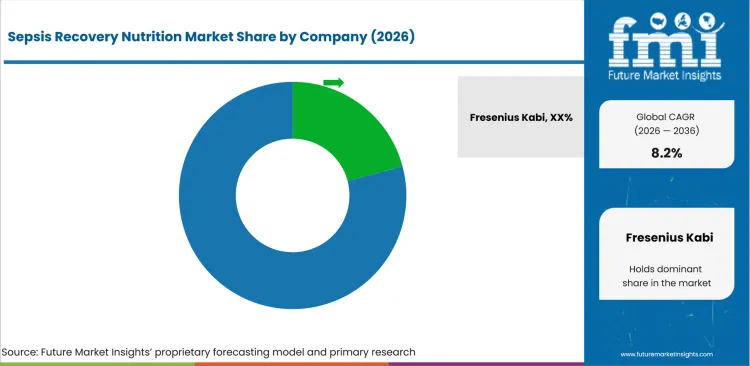
Competition centers on hospital access and continuity between prescribed feeding routes during prolonged recovery. Large medical-nutrition groups pair broad protein supplements and enteral portfolios with clinical account coverage. Baxter also brings adjacent parenteral nutrition strength, though its role is narrower inside this enteral and recovery revenue boundary.
- Broad enteral and recovery portfolios: Abbott, Nestlé Health Science, and Danone Nutricia cover tube feeding plus oral medical-nutrition formats used during care transitions.
- Hospital-integrated nutrition companies: Fresenius Kabi, Baxter, and B. Braun bring acute-care account relationships and clinical-nutrition infrastructure into hospital purchasing decisions.
- Specialist recovery and modular nutrition: Megalabs USA LLC and Medtrition address targeted nutrition needs through specialized formulas and protein modules.
Competitive Benchmarking: Sepsis Recovery Nutrition Market
| Company | High-Protein & Enteral Depth | Step-Down Format Breadth | Acute-Care Nutrition Integration | Geographic Reach |
|---|---|---|---|---|
| Fresenius Kabi | High | Medium | High | Global |
| Abbott | High | High | Medium | Global |
| Nestlé Health Science | High | High | Medium | Global |
| Danone Nutricia | High | High | High | Global |
| Baxter | Low | Low | High | Global |
| B. Braun | Medium | Medium | High | Global |
| Megalabs USA LLC | Medium | Medium | Low | North America and Latin America |
| Medtrition | Medium | High | Medium | United States and 50+ countries |
Scoring basis: High depth requires broad documented coverage of three or more relevant product or care routes, Medium reflects two documented routes, and Low identifies a narrower verified role. High acute-care integration requires multiple hospital-facing systems or education routes, Medium reflects one established route, and Low denotes limited documented integration inside the defined enteral and recovery boundary.
Key Developments in the Sepsis Recovery Nutrition Market
- In March 2025, Medtrition launched the ProSource Cup and ProSource Cup Plant portfolio with 20 grams of complete protein per cup for oral and tube-fed patients.
- In October 2025, Danone Nutricia launched savory-flavored Fortimel PlantBased Protein, a high-protein, high-energy plant-based medical nutrition drink for patients with disease-related malnutrition.
- In January 2025, Fresenius Kabi renewed its ESICM collaboration with a nutrition research award, critical-illness nutrition eCourse, and ten fellowship places.
Key Players in the Sepsis Recovery Nutrition Market
Enteral and Recovery-Formula Platforms
- Abbott
- Nestlé Health Science
- Danone Nutricia
Hospital-Integrated Nutrition Systems
- Fresenius Kabi
- Baxter
- B. Braun
Specialist Modular and Recovery Nutrition
- Megalabs USA LLC
- Medtrition
Sepsis Recovery Nutrition Market - Report Scope
| Coverage field | Report scope |
|---|---|
| Market breakdown | By formulation, phase, product form, end user, sales channel and region. |
| Quantitative Units | USD Million. |
| Market Definition | Commercial revenue from clinically directed enteral, oral, and modular nutrition products used during sepsis recovery within the defined segmentation boundary. |
| Regions Covered | North America, Latin America, Europe, East Asia, South Asia and Pacific, and Middle East and Africa. |
| Countries Covered | South Korea, USA, UK, Germany, Japan, and 20+ countries included in the full report. |
| Key Companies Profiled | Fresenius Kabi, Abbott, Nestlé Health Science, Danone Nutricia, Baxter, B. Braun, Megalabs USA LLC, Medtrition. |
| Forecast Period | 2026 to 2036. |
| Approach | Primary and secondary research with market triangulation. |
Sepsis Recovery Nutrition Market - Research Methodology
| Method | Approach |
|---|---|
| Primary Research | FMI analysts gathered input from manufacturers, service providers, technology developers, distributors, end users, procurement teams, and subject-matter experts. Interviews examined purchasing decisions, product or service evaluation, adoption barriers, approval requirements, pricing considerations, and expectations for technical or commercial support. Respondents were also asked what evidence is required before a trial, pilot, or initial order develops into regular purchasing. |
| Desk Research | Desk research covered government statistics, regulatory publications, trade data, industry associations, technical literature, standards, company filings, product information, and official corporate announcements. Sources were reviewed for relevance, publication date, geographic coverage, and consistency with the defined market scope. Claims relating to performance, applications, approvals, capacity, investment, and commercial activity were retained only when supported by credible public evidence. |
| Market Sizing and Forecasting | The market model combined the baseline value with historical performance, segment structure, pricing and volume indicators, adoption levels, company participation, and country-level demand conditions. Forecast assumptions considered economic activity, investment trends, regulatory developments, technology adoption, purchasing cycles, supply availability, and barriers to wider market use. Segment and regional estimates were reconciled before the final market total was calculated. |
| Data Validation | Estimates were checked against multiple independent indicators, including public data, company activity, trade patterns, industry developments, and findings from primary interviews. Validation also tested whether products, services, applications, and company revenues fell within the defined market boundaries. Adjacent categories, unsupported claims, overlapping revenues, and activities without direct market relevance were excluded to reduce double counting and maintain consistency across segments and countries. |
Sepsis Recovery Nutrition Market by Segments
Sepsis Recovery Nutrition Market segmented by Formulation:
- High-Protein Enteral Feeds
- Immune-Modulating Formulas
- Antioxidant & Micronutrient Blends
- Others
Sepsis Recovery Nutrition Market segmented by Phase:
- Acute ICU Phase
- Ward Step-Down
- Post-Discharge Recovery
Sepsis Recovery Nutrition Market segmented by Product Form:
- Enteral Tube Feeds
- RTD ONS
- Powder Modules
- Others
Sepsis Recovery Nutrition Market segmented by End User:
- ICUs
- Hospitals (General Wards)
- Homecare
- Others
Sepsis Recovery Nutrition Market segmented by Sales Channel:
- Hospital Pharmacy
- Retail Pharmacy
- Online
- Institutional Tender
- Others
Sepsis Recovery Nutrition Market by Region:
- North America
- United States
- Canada
- Latin America
- Brazil
- Mexico
- Chile
- Rest of Latin America
- Western Europe
- Germany
- United Kingdom
- Italy
- Spain
- France
- Nordics
- Benelux
- Rest of Western Europe
- Eastern Europe
- Russia
- Poland
- Hungary
- Balkan and Baltic States
- Rest of Eastern Europe
- East Asia
- China
- Japan
- South Korea
- South Asia and Pacific
- India
- ASEAN
- Australia and New Zealand
- Rest of South Asia and Pacific
- Middle East and Africa
- Kingdom of Saudi Arabia
- Other GCC Countries
- Türkiye
- South Africa
- Other African Union Countries
- Rest of Middle East and Africa
Research Sources and Bibliography
- Society of Critical Care Medicine. (2026, March 23). Surviving Sepsis Campaign: International Guidelines for Management of Sepsis and Septic Shock 2026.
- Centers for Disease Control and Prevention. (2026, August 17). About Sepsis.
- Medtrition, Inc. (2025, March 25). Medtrition, Inc. launches the ProSource Cup portfolio.
- Fresenius Kabi. (2025, January 29). Fresenius Kabi and ESICM renew their 2025 collaboration programme.
- Japanese Society of Intensive Care Medicine. (2025, March 14). Publication of the English version of the Japanese Clinical Practice Guidelines for Management of Sepsis and Septic Shock 2024 (J-SSCG2024).
- German Sepsis Society and participating medical societies. (2025, April 30). S3-Leitlinie: Sepsis - Prävention, Diagnose, Therapie und Nachsorge - Update 2025.
- Japanese Society of Intensive Care Medicine. (2025, September 30). The Japanese Critical Care Nutrition Guideline 2024.
- Office for National Statistics. (2026, July 29). The impact of hospitalisation for sepsis on employee earnings and employment status, England: April 2014 to December 2024.
- Korea Disease Control and Prevention Agency. (2025, December 29). 2025 Chronic Disease Status and Issues Factbook.
- Statistisches Bundesamt. (2025, November 6). 2.0% more inpatient hospital treatments in 2024.
- Danone. (2025, February 25). Nutricia launches Fortimel Plantbased Protein, a new fully plant-based high-protein oral nutritional supplement.
- Fresenius Kabi. (2025, June 26). New R&D center in India strengthens Fresenius Kabi’s innovation network.
- Danone. (2025, July 1). Danone completes acquisition of Kate Farms.
- Baxter International Inc. (2025, September 26). Baxter is first manufacturer to achieve Gold Resiliency Badge for IV Solutions, Nutrition Solutions and Premix Drugs from HIRC.
- Abbott. (2025, November 13). Abbott launches new and advanced Ensure Diabetes Care, a clinically proven formula to help manage blood sugar.
- Nestlé. (2026, March 30). Nestlé introduces an innovative complete nutritional solution for children with special medical nutrition needs.
- B. Braun. (2026, June 5). Expanded Strategic Collaboration to shape the next era of connected Acute Care.
- Medtrition, Inc. (2025, October 27). Medtrition, Inc. launches NutriConnect - a portfolio brand for personalized modular nutrition.
- Imprenta Nacional de Costa Rica. (2025, August 11). Industrial property registry notice for change of name from Victus Inc. to Megalabs USA LLC.
- Fresenius Kabi. (2026, January 23). Fresenius Kabi and ESICM: Driving Progress in Medical Nutrition in Critical Care.
- Fresenius Kabi. (2025, December 2). Fresenius Kabi & ESICM: Three Years of Critical Illness Nutrition Fellowships.
- Otsuka Pharmaceutical Factory, Inc. (2025, January 17). Otsuka Pharmaceutical Factory launches “ENOSOLID Semi Solid for Enteral Use”.
- Fresenius Kabi. (2026, February 23). Experience the New Interactive ICU Patient Case for Critical Care Learning.
- NHS England. (2026, July 14). Sepsis modern service framework.
This bibliography is provided for reader reference and is not exhaustive. The full report contains the complete reference list and detailed citations
This Report Answers
- How large is the sepsis recovery nutrition market in 2026 and what value is forecast for 2036?
- Which clinical timing change is increasing early demand for sepsis recovery nutrition?
- Why do high-protein enteral feeds hold the largest approved formulation share in 2026?
- How do acute ICU nutrition decisions influence later recovery formats and hospital purchasing?
- Why do enteral tube feeds remain central while oral intake is still inadequate?
- How do country growth rates differ among South Korea, USA, UK, Germany, and Japan?
- Which eight companies are profiled in the defined sepsis recovery nutrition market?
- What operating frictions limit routine use of higher-protein or specialized nutrition formulas?
- How can hospital-to-home continuity convert discharge planning into repeat nutrition demand?
Frequently Asked Questions
How big is the Sepsis Recovery Nutrition Market in 2026?
The sepsis recovery nutrition market is valued at USD 205.6 million in 2026 and is projected to reach USD 452.1 million by 2036. Earlier enteral feeding decisions and longer recovery needs support continued clinical nutrition use.
What is the CAGR of the Sepsis Recovery Nutrition Market from 2026 to 2036?
The sepsis recovery nutrition market is projected to grow at a CAGR of 8.2% between 2026 and 2036. Expansion follows earlier critical-care nutrition decisions and continued support as patients move into ward and post-discharge recovery.
Which formulation leads the Sepsis Recovery Nutrition Market?
The high-protein enteral feeds segment is expected to hold 42.1% of the sepsis recovery nutrition market in 2026, driven by concentrated protein delivery after feeding becomes clinically appropriate. Hospitals can use the format within established enteral protocols while adjusting delivery to tolerance during stabilization.
How much value will the Sepsis Recovery Nutrition Market add between 2026 and 2036?
The sepsis recovery nutrition market is expected to add USD 246.5 million in value between 2026 and 2036. Growth follows sustained clinical nutrition needs from ICU stabilization into ward and home recovery.
Which companies are active in the Sepsis Recovery Nutrition Market?
Key companies operating in the sepsis recovery nutrition market include Fresenius Kabi, Abbott, Nestlé Health Science, Danone Nutricia, Baxter, B. Braun, Megalabs USA LLC, and Medtrition. Their positions differ by enteral depth, hospital integration, and step-down format breadth.
Preview the report firsthand - request a free sample
Get SampleGet the brochure for pricing and purchase details.
Get PDFTable of Content
- Key Takeaways
- Market Size and CAGR
- Top Growth Driver
- Fastest Growing Segment
- Leading Region
- Key Companies
- Emerging Opportunities
- Executive Summary
- Global Market Outlook
- Demand-side Trends
- Supply-side Trends
- Technology Roadmap Analysis
- Analysis and Recommendations
- Analyst Perspective (What is happening? Why now? What should investors know?)
- Key Questions Answered
- How large is the market?
- What is the CAGR?
- What are key trends?
- Which region dominates?
- Who are the leaders?
- Market Overview
- Market Coverage / Taxonomy
- Market Definition / Scope / Limitations
- Research Methodology
- Chapter Orientation
- Analytical Lens and Working Hypotheses
- Market Structure, Signals, and Trend Drivers
- Benchmarking and Cross-market Comparability
- Market Sizing, Forecasting, and Opportunity Mapping
- Research Design and Evidence Framework
- Desk Research Programme (Secondary Evidence)
- Expert Input and Fieldwork (Primary Evidence)
- Tooling, Models, and Reference Databases
- Data Engineering and Model Build
- Quality Assurance and Audit Trail
- Market Background
- Market Dynamics (Drivers, Restraints, Opportunity, Trends)
- Scenario Forecast (Optimistic, Likely, Conservative)
- Impact Analysis
- AI Impact
- Sustainability Impact
- Regulatory Impact
- Technology Impact
- Consumer / Buyer Analysis
- Purchase Drivers
- Adoption Barriers
- Buyer Journey
- Opportunity Map Analysis
- Product Life Cycle Analysis
- Supply Chain Analysis
- Investment Feasibility Matrix
- Value Chain Analysis
- PESTLE and Porter's Analysis
- Regulatory Landscape
- Regional Parent Market Outlook
- Production and Consumption Statistics
- Import and Export Statistics
- Global Market Analysis and Forecast, 2021 to 2036
- Historical Market Size Value (USD Million) Analysis, 2021 to 2025
- Current and Future Market Size Value (USD Million) Projections, 2026 to 2036
- Y-o-Y Growth Trend Analysis
- Absolute $ Opportunity Analysis
- Global Market Pricing Analysis, 2021 to 2036
- Global Market Analysis and Forecast, By Formulation, 2021 to 2036
- Introduction / Key Findings
- Historical Market Size Value (USD Million) Analysis By Formulation, 2021 to 2025
- Current and Future Market Size Value (USD Million) Analysis and Forecast By Formulation, 2026 to 2036
- High-Protein Enteral Feeds
- Immune-Modulating Formulas
- Antioxidant & Micronutrient Blends
- Others
- High-Protein Enteral Feeds
- Y-o-Y Growth Trend Analysis By Formulation, 2021 to 2025
- Absolute $ Opportunity Analysis By Formulation, 2026 to 2036
- Global Market Analysis and Forecast, By Phase, 2021 to 2036
- Introduction / Key Findings
- Historical Market Size Value (USD Million) Analysis By Phase, 2021 to 2025
- Current and Future Market Size Value (USD Million) Analysis and Forecast By Phase, 2026 to 2036
- Acute ICU Phase
- Ward Step-Down
- Post-Discharge Recovery
- Acute ICU Phase
- Y-o-Y Growth Trend Analysis By Phase, 2021 to 2025
- Absolute $ Opportunity Analysis By Phase, 2026 to 2036
- Global Market Analysis and Forecast, By Product Form, 2021 to 2036
- Introduction / Key Findings
- Historical Market Size Value (USD Million) Analysis By Product Form, 2021 to 2025
- Current and Future Market Size Value (USD Million) Analysis and Forecast By Product Form, 2026 to 2036
- Enteral Tube Feeds
- RTD ONS
- Powder Modules
- Others
- Enteral Tube Feeds
- Y-o-Y Growth Trend Analysis By Product Form, 2021 to 2025
- Absolute $ Opportunity Analysis By Product Form, 2026 to 2036
- Global Market Analysis and Forecast, By End User, 2021 to 2036
- Introduction / Key Findings
- Historical Market Size Value (USD Million) Analysis By End User, 2021 to 2025
- Current and Future Market Size Value (USD Million) Analysis and Forecast By End User, 2026 to 2036
- ICUs
- Hospitals (General Wards)
- Homecare
- Others
- ICUs
- Y-o-Y Growth Trend Analysis By End User, 2021 to 2025
- Absolute $ Opportunity Analysis By End User, 2026 to 2036
- Global Market Analysis and Forecast, By Sales Channel, 2021 to 2036
- Introduction / Key Findings
- Historical Market Size Value (USD Million) Analysis By Sales Channel, 2021 to 2025
- Current and Future Market Size Value (USD Million) Analysis and Forecast By Sales Channel, 2026 to 2036
- Hospital Pharmacy
- Retail Pharmacy
- Online
- Institutional Tender
- Others
- Hospital Pharmacy
- Y-o-Y Growth Trend Analysis By Sales Channel, 2021 to 2025
- Absolute $ Opportunity Analysis By Sales Channel, 2026 to 2036
- Global Market Analysis and Forecast, By Region, 2021 to 2036
- Introduction
- Historical Market Size Value (USD Million) Analysis By Region, 2021 to 2025
- Current Market Size Value (USD Million) Analysis and Forecast By Region, 2026 to 2036
- North America
- Latin America
- Western Europe
- Eastern Europe
- East Asia
- South Asia and Pacific
- Middle East & Africa
- Market Attractiveness Analysis By Region
- North America Market Analysis and Forecast, By Country, 2021 to 2036
- Historical Market Size Value (USD Million) Trend Analysis By Market Taxonomy, 2021 to 2025
- Market Size Value (USD Million) Forecast By Market Taxonomy, 2026 to 2036
- By Country
- USA
- Canada
- By Formulation
- By Phase
- By Product Form
- By End User
- By Sales Channel
- By Country
- Market Attractiveness Analysis
- By Country
- By Formulation
- By Phase
- By Product Form
- By End User
- By Sales Channel
- Key Takeaways
- Latin America Market Analysis and Forecast, By Country
- Historical Market Size Value (USD Million) Trend Analysis By Market Taxonomy, 2021 to 2025
- Market Size Value (USD Million) Forecast By Market Taxonomy, 2026 to 2036
- By Country
- Brazil
- Mexico
- Chile
- Rest of Latin America
- By Formulation
- By Phase
- By Product Form
- By End User
- By Sales Channel
- By Country
- Market Attractiveness Analysis
- By Country
- By Formulation
- By Phase
- By Product Form
- By End User
- By Sales Channel
- Key Takeaways
- Western Europe Market Analysis and Forecast, By Country
- Historical Market Size Value (USD Million) Trend Analysis By Market Taxonomy, 2021 to 2025
- Market Size Value (USD Million) Forecast By Market Taxonomy, 2026 to 2036
- By Country
- Germany
- UK
- Italy
- Spain
- France
- Nordic
- BENELUX
- Rest of Western Europe
- By Formulation
- By Phase
- By Product Form
- By End User
- By Sales Channel
- By Country
- Market Attractiveness Analysis
- By Country
- By Formulation
- By Phase
- By Product Form
- By End User
- By Sales Channel
- Key Takeaways
- Eastern Europe Market Analysis and Forecast, By Country
- Historical Market Size Value (USD Million) Trend Analysis By Market Taxonomy, 2021 to 2025
- Market Size Value (USD Million) Forecast By Market Taxonomy, 2026 to 2036
- By Country
- Russia
- Poland
- Hungary
- Balkan & Baltic
- Rest of Eastern Europe
- By Formulation
- By Phase
- By Product Form
- By End User
- By Sales Channel
- By Country
- Market Attractiveness Analysis
- By Country
- By Formulation
- By Phase
- By Product Form
- By End User
- By Sales Channel
- Key Takeaways
- East Asia Market Analysis and Forecast, By Country
- Historical Market Size Value (USD Million) Trend Analysis By Market Taxonomy, 2021 to 2025
- Market Size Value (USD Million) Forecast By Market Taxonomy, 2026 to 2036
- By Country
- China
- Japan
- South Korea
- By Formulation
- By Phase
- By Product Form
- By End User
- By Sales Channel
- By Country
- Market Attractiveness Analysis
- By Country
- By Formulation
- By Phase
- By Product Form
- By End User
- By Sales Channel
- Key Takeaways
- South Asia and Pacific Market Analysis and Forecast, By Country
- Historical Market Size Value (USD Million) Trend Analysis By Market Taxonomy, 2021 to 2025
- Market Size Value (USD Million) Forecast By Market Taxonomy, 2026 to 2036
- By Country
- India
- ASEAN
- Australia & New Zealand
- Rest of South Asia and Pacific
- By Formulation
- By Phase
- By Product Form
- By End User
- By Sales Channel
- By Country
- Market Attractiveness Analysis
- By Country
- By Formulation
- By Phase
- By Product Form
- By End User
- By Sales Channel
- Key Takeaways
- Middle East & Africa Market Analysis and Forecast, By Country
- Historical Market Size Value (USD Million) Trend Analysis By Market Taxonomy, 2021 to 2025
- Market Size Value (USD Million) Forecast By Market Taxonomy, 2026 to 2036
- By Country
- Kingdom of Saudi Arabia
- Other GCC Countries
- Türkiye
- South Africa
- Other African Union
- Rest of Middle East & Africa
- By Formulation
- By Phase
- By Product Form
- By End User
- By Sales Channel
- By Country
- Market Attractiveness Analysis
- By Country
- By Formulation
- By Phase
- By Product Form
- By End User
- By Sales Channel
- Key Takeaways
- Key Countries Market Analysis
- USA
- Pricing Analysis
- Market Share Analysis, 2025
- By Formulation
- By Phase
- By Product Form
- By End User
- By Sales Channel
- Canada
- Pricing Analysis
- Market Share Analysis, 2025
- By Formulation
- By Phase
- By Product Form
- By End User
- By Sales Channel
- Mexico
- Pricing Analysis
- Market Share Analysis, 2025
- By Formulation
- By Phase
- By Product Form
- By End User
- By Sales Channel
- Brazil
- Pricing Analysis
- Market Share Analysis, 2025
- By Formulation
- By Phase
- By Product Form
- By End User
- By Sales Channel
- Chile
- Pricing Analysis
- Market Share Analysis, 2025
- By Formulation
- By Phase
- By Product Form
- By End User
- By Sales Channel
- Germany
- Pricing Analysis
- Market Share Analysis, 2025
- By Formulation
- By Phase
- By Product Form
- By End User
- By Sales Channel
- UK
- Pricing Analysis
- Market Share Analysis, 2025
- By Formulation
- By Phase
- By Product Form
- By End User
- By Sales Channel
- Italy
- Pricing Analysis
- Market Share Analysis, 2025
- By Formulation
- By Phase
- By Product Form
- By End User
- By Sales Channel
- Spain
- Pricing Analysis
- Market Share Analysis, 2025
- By Formulation
- By Phase
- By Product Form
- By End User
- By Sales Channel
- France
- Pricing Analysis
- Market Share Analysis, 2025
- By Formulation
- By Phase
- By Product Form
- By End User
- By Sales Channel
- India
- Pricing Analysis
- Market Share Analysis, 2025
- By Formulation
- By Phase
- By Product Form
- By End User
- By Sales Channel
- ASEAN
- Pricing Analysis
- Market Share Analysis, 2025
- By Formulation
- By Phase
- By Product Form
- By End User
- By Sales Channel
- Australia & New Zealand
- Pricing Analysis
- Market Share Analysis, 2025
- By Formulation
- By Phase
- By Product Form
- By End User
- By Sales Channel
- China
- Pricing Analysis
- Market Share Analysis, 2025
- By Formulation
- By Phase
- By Product Form
- By End User
- By Sales Channel
- Japan
- Pricing Analysis
- Market Share Analysis, 2025
- By Formulation
- By Phase
- By Product Form
- By End User
- By Sales Channel
- South Korea
- Pricing Analysis
- Market Share Analysis, 2025
- By Formulation
- By Phase
- By Product Form
- By End User
- By Sales Channel
- Russia
- Pricing Analysis
- Market Share Analysis, 2025
- By Formulation
- By Phase
- By Product Form
- By End User
- By Sales Channel
- Poland
- Pricing Analysis
- Market Share Analysis, 2025
- By Formulation
- By Phase
- By Product Form
- By End User
- By Sales Channel
- Hungary
- Pricing Analysis
- Market Share Analysis, 2025
- By Formulation
- By Phase
- By Product Form
- By End User
- By Sales Channel
- Kingdom of Saudi Arabia
- Pricing Analysis
- Market Share Analysis, 2025
- By Formulation
- By Phase
- By Product Form
- By End User
- By Sales Channel
- Türkiye
- Pricing Analysis
- Market Share Analysis, 2025
- By Formulation
- By Phase
- By Product Form
- By End User
- By Sales Channel
- South Africa
- Pricing Analysis
- Market Share Analysis, 2025
- By Formulation
- By Phase
- By Product Form
- By End User
- By Sales Channel
- USA
- Market Structure Analysis
- Competition Dashboard
- Competition Benchmarking
- Market Share Analysis of Top Players
- By Regional
- By Formulation
- By Phase
- By Product Form
- By End User
- By Sales Channel
- Emerging Startups
- Innovation Benchmarking
- Competition Analysis
- Competition Deep Dive
- Fresenius Kabi
- Overview
- Product Portfolio
- Profitability by Market Segments
- Sales Footprint
- Strategy Overview
- Marketing Strategy
- Product Strategy
- Channel Strategy
- Abbott
- Nestle Health Science
- Danone Nutricia
- Baxter
- B. Braun
- Victus
- Medtrition
- Fresenius Kabi
- Case Studies
- Success Stories
- Recent Developments
- Competition Deep Dive
- Assumptions & Acronyms Used


