

- Market Size (2026)
- USD 257.9 Mn
- Forecast (2036)
- USD 526.5 Mn
- CAGR (2026 to 2036)
- 7.4%
How big is Burn Recovery Nutrition Market in 2026?
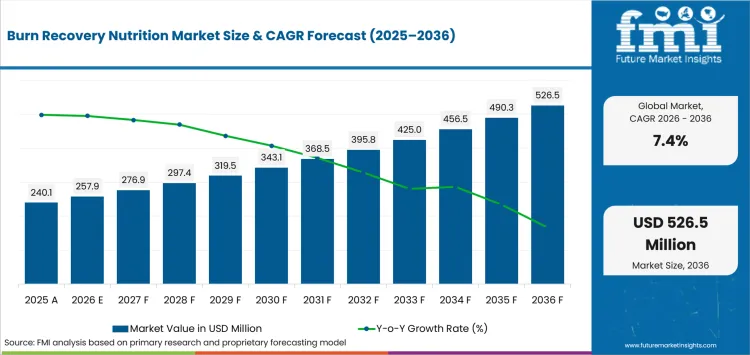
USD 257.9 million in 2026 and USD 526.5 million by 2036 at a 7.4% CAGR.
Sales in the burn recovery nutrition market are projected to grow at 7.4% CAGR through 2036, driving valuation to USD 526.5 million by 2036 from USD 257.9 million in 2026. Burn teams need concentrated protein and energy during periods of poor intake caused by pain, procedures, ventilation, or appetite loss. Fresenius opened a medical-nutrition innovation center in Bad Homburg in June 2026 to place product development, laboratory work, and clinical nutrition expertise at one site. The investment concentrates formulation, laboratory and clinical-nutrition work at one site, shortening iteration on tightly specified recovery formulas.
Country demand will not convert at one rate because burn incidence, specialist capacity, and post-acute supply routes differ. Japan's Fire and Disaster Management Agency recorded 5,949 people injured in fires during 2025 in its May 2026 provisional release, 2.5% more than a year earlier. The figure establishes a continuing burn care workload, but product conversion depends on access to tube feeds, oral supplements, and protein modules at the point clinicians set nutrition targets.
Key Takeaways
- Demand follows the metabolic cost of wound repair, especially where pain, ventilation, or poor appetite prevents patients from meeting protein and energy targets with ordinary food.
- By formulation, high-protein high-energy feeds are estimated to hold 46.4% in 2026, attributable to one product addressing simultaneous calorie and protein requirements during acute recovery.
- Moderate (10-20% TBSA) is projected to account for 56.1% in 2026, supported by a broad treatment population that can require structured nutrition beyond the most intensive burn-center setting.
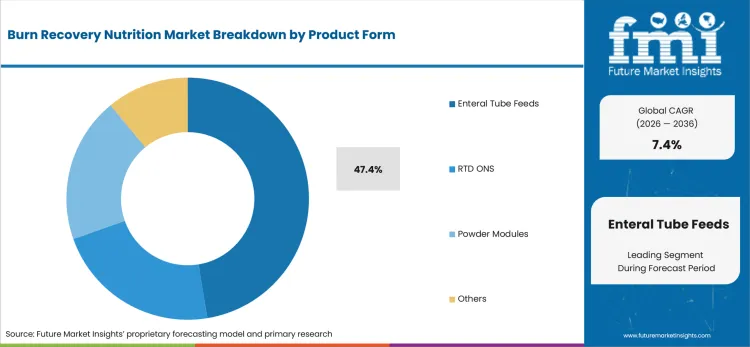
- In 2026, enteral tube feeds are expected to capture 47.4% of product-form demand, owing to clinician control of intake during periods when reliable oral consumption is not feasible.
- Specialty formulations face a higher evidence bar when they claim benefit beyond core protein and energy provision, and feeding tolerance can narrow the usable product set for individual patients.
- Some of the key players in this market include Abbott (Juven), Nestle Health Science, Danone Nutricia, Fresenius Kabi, B. Braun, Baxter, Victus, and Medtrition.
Analyst Perspective
"Burn recovery nutrition should be judged first on protein and energy density, route compatibility, and evidence for use during care transitions. The stronger commercial position belongs to products that stay practical after tube feeding stops and patients move into rehabilitation or supervised oral recovery."
- Nandini Roy Choudhury, Principal Consultant, Future Market Insights
How is the burn recovery nutrition market segmented?
The burn recovery nutrition market is segmented by formulation, burn severity, product form, end user, sales channel, and region.
The market is segmented by formulation, burn severity, product form, end user, sales channel, and region. Formulation covers high-protein high-energy feeds, glutamine and arginine blends, HMB-enriched products, micronutrient blends, and other clinical formulations. Burn severity covers moderate, severe, and critical cases, and product form includes enteral tube feeds, ready-to-drink oral supplements, powder modules, and other forms. End users include burn centers, hospitals, rehabilitation settings, and homecare, and sales channels include hospital pharmacy, retail pharmacy, online channels, institutional tenders, and other routes.
How do enteral tube feeds lead the product form category?
Enteral nutrition lets clinical teams control nutrient delivery during ventilation, procedures, pain, or appetite loss, then oral products take a larger role as intake improves. Kate Farms introduced a strawberry Pediatric Peptide 1.0 formula in February 2025 for oral or tube use, a route combination that can reduce formula changes during recovery.
- In 2026, enteral tube feeds are projected to hold 47.4% of the market due to the controlled delivery an enteral formula provides during periods of inadequate oral intake.
- Hospital adoption depends on formula tolerance, tube compatibility, preparation burden, and the ability to adjust protein density without disrupting feeding schedules.
What makes high-protein high-energy feeds central to the formulation category?
Burn teams need to cover calorie and protein deficits simultaneously, so complete energy-dense feeds can reduce the number of separate products required during acute recovery. Nutricia launched Fortimel PlantBased Protein in October 2025 as a high-protein, high-energy medical nutrition drink for medically driven malnutrition, a step that expands concentrated clinical-format options.
- By formulation, high-protein high-energy feeds account for 46.4% of the market in 2026, driven by simultaneous protein and energy requirements during wound repair.
- Adoption is strongest where dietitians can adjust volume without rebuilding the full regimen. Narrower amino-acid or micronutrient modules remain useful for defined gaps but require separate justification.
Why does moderate (10-20% TBSA) lead the burn severity category?
Moderate burns can require structured wound and nutrition support without keeping every patient in the most intensive burn-care setting for the whole recovery period. Germany's AWMF published version 8.0 of its adult thermal-injury guideline in November 2025, covering systemic burn effects, multidisciplinary treatment, follow-up, and rehabilitation.
- Moderate (10-20% TBSA) is estimated to represent 56.1% of the market in 2026, shaped by a broad eligible population with sustained recovery needs.
- Products that remain available after transfer can preserve the same regimen in general wards or rehabilitation, unlike formats tied to one administration route or recovery phase.
What supports burn centers in the end user category?
Burn centers concentrate surgery, intensive care, dietetics, pharmacy, rehabilitation, and transfer decisions, so they establish the nutrition regimen that downstream settings inherit. South Korea's Ministry of Health and Welfare approved support in May 2025 for specialist fields including burns that provide 24-hour care and coordinated referrals.
- Burn centers are expected to capture 41.0% of the market in 2026, influenced by multidisciplinary teams that set nutrition targets during rapid changes in wounds, feeding access, and metabolic demand.
- Manufacturers gain more from center access if the same regimen can be supplied after transfer. Products that lose availability outside the specialist account face a break in nutrition continuity.
What are the drivers, restraints and opportunities in the Burn Recovery Nutrition Market?
Burn recovery nutrition demand rises with protein and energy needs, narrows after feeding-route failure, and can extend beyond acute care if products remain usable from tube feeding into oral recovery.
- Driver: Elevated protein and energy requirements turn wound burden into repeat clinical-nutrition use during acute healing.
- Restraint: Feeding-device compatibility, tolerance, and formulation-specific evidence can interrupt or narrow an otherwise appropriate nutrition regimen.
- Opportunity: Products that preserve nutrient goals as patients shift from tube feeding to oral intake can extend use beyond the acute admission.
Burn recovery demand begins with open wounds and catabolic stress that raise nutrient needs during periods of poor intake. The American Burn Association's 2025 Annual Burn Injury Summary recorded 32,993 cases in 2024 from 114 participating burn centers. A concentrated specialist caseload keeps purchasing decisions close to dietitians who must maintain intake during procedures, pain, or ventilation.
Administration reliability can limit otherwise suitable nutrition, and a July 2026 FDA recall covered 82,900 Medela enteral extension sets whose incorrect connectors could prevent attachment or delay enteral fluids. For burn teams, a blocked tube feeding formula route turns otherwise suitable nutrition into a supply problem with clinical consequences and forces a fallback route.
Nutrition needs often continue after intensive tube feeding stops, which gives oral medical nutrition a later role in recovery. Nestle introduced Compleat Paediatric Oral Blends in March 2026 for children with special medical nutrition needs and planned launches in several European markets. The launch targets pediatric medical nutrition, but it demonstrates how manufacturers are extending oral clinical nutrition beyond tube feeding into formats patients can use during outpatient or home recovery.
Which country CAGRs are profiled in the Burn Recovery Nutrition Market?
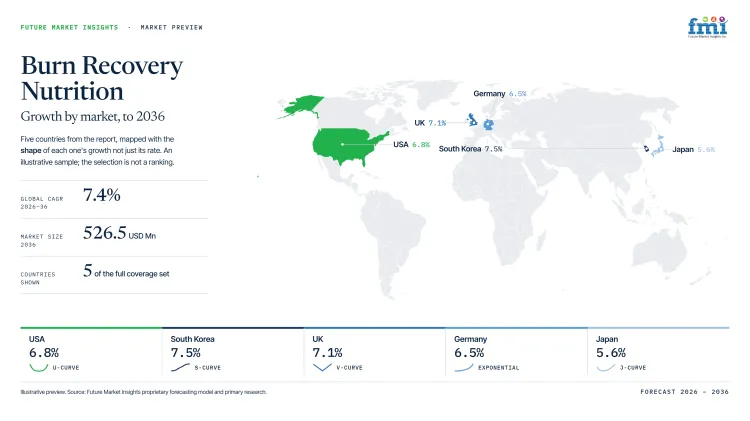
| Country | CAGR |
|---|---|
| South Korea | 7.5% |
| UK | 7.1% |
| USA | 6.8% |
| Germany | 6.5% |
| Japan | 5.6% |
How do country-level CAGRs compare in the Burn Recovery Nutrition Market?
The five profiled CAGRs span 1.9 percentage points, with South Korea and the UK above the USA and Germany, and Japan at the lower endpoint. The narrow ranking means CAGR alone does not explain entry conditions; small numerical gaps can coexist with larger differences in hospital concentration, discharge pathways, and purchasing routes.
- South Korea concentrates recovery nutrition demand in organized hospital rehabilitation pathways.
- UK discharge planning makes continuity of tolerated oral nutrition commercially important.
- USA hospital purchasing spreads demand across large clinical-nutrition formularies.
- Germany's rehabilitation network favors products that fit institutional dietetic protocols.
- Japan's slower growth places more weight on compact, well-tolerated formats.
Local hospital structure can outweigh small CAGR differences in entry planning. The full report provides country-level CAGR analysis across North America, Latin America, Europe, East Asia, South Asia, Oceania and the Middle East and Africa.
Country-wise Analysis
- Specialist burn care in South Korea is concentrated in hospitals that can coordinate emergency transfer, surgery, rehabilitation, and nutrition support under one clinical team. The Korea Disease Control and Prevention Agency counted 1,315 burn cases among 86,633 injury visits in its August 2025 emergency-department data, a concentrated base of treated cases. South Korea is projected to expand at 7.5% CAGR over the assessment period, aided by reimbursement support for centers that maintain 24-hour specialist services and coordinated referrals. The concentration favors firms that can enter through specialist hospitals first, then maintain local oral-supplement and home-delivery availability after discharge.
- Within the UK's small specialist-care network, national referral pathways move patients between services, but local hospital formularies choose clinical nutrition products. England recorded 6,848 non-fatal fire casualties in the year ending March 2026, according to the Ministry of Housing, Communities and Local Government. Local formulary control is the main commercial friction because national referral pathways do not produce one national nutrition choice. The UK is forecast to grow at 7.1% CAGR through 2036, on the back of centralized referrals that carry nutrition plans into rehabilitation. The 7.1% outlook does not translate into one national buying decision despite centralized referrals.
- Purchasing USA burn recovery nutrition is an account-by-account process involving burn centers, hospital systems, group-purchasing organizations, rehabilitation providers, and home-nutrition channels. Burn recovery nutrition demand in the USA is forecast to rise at 6.8% CAGR during the forecast period, because fragmented formularies slow uniform conversion despite specialist-network scale. The American Burn Association stated in January 2025 that more than 398,000 people seek medical care for burns each year. Large health systems can simplify distribution, but different formulary decisions keep product conversion local. National-account coverage reaches many hospital systems only if manufacturers also maintain evidence packages and replenishment after discharge.
- Guided by national burn-care standards, German specialist teams work within hospital protocols that define clinical responsibilities and local nutrition choices. Destatis documented 1,841 hospitals and about 26,000 intensive-care beds in November 2025 data covering 2024, which confirms a broad acute-care base. Germany is likely to register 6.5% CAGR over the forecast period, given strong inpatient capacity and multidisciplinary treatment alongside slower conversion for unfamiliar formulations. Manufacturers can target many acute-care accounts, but local hospital formularies prevent one national conversion route. Local rehabilitation coverage after acute treatment still depends on detailed German-language clinical evidence and distribution beyond the hospital.
- Before transfer to less intensive settings, Japanese burn teams can establish enteral feeding within a protocol-oriented acute-care system. Burn recovery nutrition sales in Japan are forecast to expand at 5.6% CAGR by 2036, tied to inpatient protocols and slower category conversion. The Fire and Disaster Management Agency reported in November 2025 that 5,805 people were injured in fires during 2024. Those 5,805 injuries document a continuing burn-care workload for hospitals treating fire-related trauma. Local labeling requirements add friction for imported products, especially formats that need explanation outside specialist accounts. Distribution partners determine how much hospital use carries into outpatient recovery after patients transfer to other settings.
Who are the notable companies in the Burn Recovery Nutrition Market?
Abbott (Juven), Nestle Health Science, Danone Nutricia, Fresenius Kabi, B. Braun, Baxter, Victus, and Medtrition are the notable companies profiled in this market.
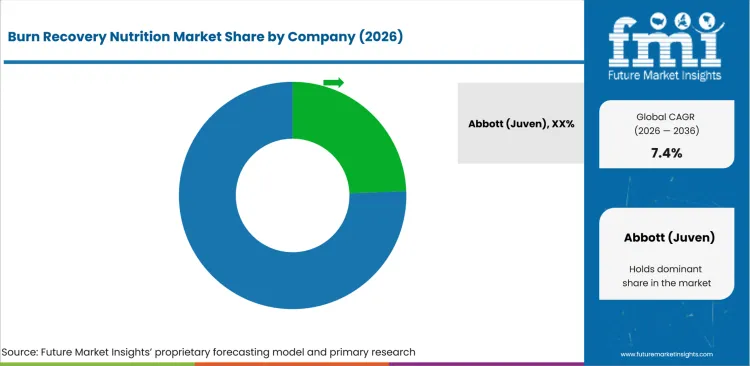
Competition separates companies that cover several stages of clinical nutrition from specialists focused on one route or nutrient problem. Nestle Health Science, Danone Nutricia, and Fresenius Kabi serve broad enteral and oral workflows. B. Braun and Baxter are stronger where parenteral nutrition and hospital delivery are required. Abbott (Juven), Victus, and Medtrition compete more directly on targeted protein or wound healing nutrition. Entry barriers come from clinical evidence, formulary access, route compatibility, and distribution continuity that corporate scale alone cannot remove.
- Abbott (Juven), Nestle Health Science, Danone Nutricia, and Fresenius Kabi cover clinical nutrition from targeted supplementation to complete feeding, with different depth by route.
- B. Braun and Baxter concentrate on hospital nutrition and infusion systems, so their strongest fit is with patients whose oral or enteral intake cannot meet nutrition requirements.
- Victus and Medtrition occupy narrower recovery and protein-supplement positions, so their value depends more directly on formulation fit and institutional access.
Competitive Benchmarking: Burn Recovery Nutrition Market
| Company | Protein-Dense Recovery Nutrition | Enteral-to-Oral Continuity | Hospital Access Depth | Geographic Reach |
|---|---|---|---|---|
| Abbott (Juven) | High | Medium | High | United States and international nutrition markets |
| Nestle Health Science | High | High | High | Global |
| Danone Nutricia | High | High | High | Global with strong North American and European medical nutrition |
| Fresenius Kabi | High | High | High | Europe and international clinical nutrition markets |
| B. Braun | Medium | Low | High | Europe and international hospital markets |
| Baxter | Medium | Low | High | More than 100 countries through hospital channels |
| Victus | Medium | Medium | Medium | United States and selected Latin American markets |
| Medtrition | High | High | High | United States and international institutional distribution |
Scoring basis: High protein-dense recovery nutrition requires a documented high-protein or wound-oriented clinical nutrition offer. Protein scoring uses Medium for clinically relevant nutrition with narrower protein positioning and Low for a documented route centered outside protein delivery. Enteral-to-oral continuity is High with documented tube and oral use, Medium with one route plus an adjacent supervised format, and Low with one documented nutrition route. Hospital access depth is High for broad institutional or national-account reach, Medium for established but narrower institutional access, and Low for limited documented hospital reach. Geographic reach is shown descriptively in the table because it does not affect the three capability ratings.
Key Developments in the Burn Recovery Nutrition Market
- In June 2026, Fresenius Kabi launched the Pedismof range in Europe, adding ready-to-use pediatric three-chamber parenteral nutrition for patients whose oral or enteral intake cannot meet requirements.
- In July 2025, Danone completed its majority acquisition of Kate Farms, widening its USA medical-nutrition platform in hospital, home, online, and retail channels.
- In March 2025, Medtrition launched ProSource Cup and ProSource Cup Plant with 20 grams of complete protein for oral or tube-fed use, followed by national-account and group-purchasing availability.
Key Players in the Burn Recovery Nutrition Market
Integrated Clinical Nutrition Platforms
- Nestle Health Science
- Danone Nutricia
- Fresenius Kabi
Critical-Care Nutrition and Delivery Systems
- B. Braun
- Baxter
Targeted Wound and Protein Modules
- Abbott (Juven)
- Victus
- Medtrition
Burn Recovery Nutrition Market - Report Scope
| Coverage field | Report scope |
|---|---|
| Market breakdown | By formulation, burn severity, product form, end user, sales channel, and region. |
| Quantitative Units | USD million. |
| Market Definition | Revenue includes commercial clinical nutrition products sold for burn recovery within the defined formulation, severity, product-form, end-user, sales-channel, and regional scope. It includes complete feeds and targeted nutrition modules used during acute treatment, rehabilitation, or supervised recovery. Adjacent general wellness products and nutrition revenue without direct burn-recovery relevance are excluded. |
| Regions Covered | North America; Latin America; Western Europe; Eastern Europe; East Asia; South Asia and Pacific; Middle East and Africa |
| Countries Covered | USA, UK, Germany, Japan, South Korea, and more than twenty-five additional countries in the full report. |
| Key Companies Profiled | Abbott (Juven); Nestle Health Science; Danone Nutricia; Fresenius Kabi; B. Braun; Baxter; Victus; Medtrition |
| Forecast Period | 2026 to 2036. |
| Approach | Primary and secondary research with market triangulation. |
Burn Recovery Nutrition Market - Research Methodology
| Method | Approach |
|---|---|
| Primary Research | FMI analysts gathered input from manufacturers, service providers, technology developers, distributors, end users, procurement teams, and subject-matter experts. Interviews examined purchasing decisions, product or service evaluation, adoption barriers, approval requirements, pricing considerations, and expectations for technical or commercial support. Respondents were also asked what evidence is required before a trial, pilot, or initial order develops into regular purchasing. |
| Desk Research | Desk research covered government statistics, regulatory publications, trade data, industry associations, technical literature, standards, company filings, product information, and official corporate announcements. Sources were reviewed for relevance, publication date, geographic coverage, and consistency with the defined market scope. Claims relating to performance, applications, approvals, capacity, investment, and commercial activity were retained only when supported by credible public evidence. |
| Market Sizing and Forecasting | The market model combined the baseline value with historical performance, segment structure, pricing and volume indicators, adoption levels, company participation, and country-level demand conditions. Forecast assumptions considered economic activity, investment trends, regulatory developments, technology adoption, purchasing cycles, supply availability, and barriers to wider market use. Segment and regional estimates were reconciled before the final market total was calculated. |
| Data Validation | Estimates were checked against multiple independent indicators, including public data, company activity, trade patterns, industry developments, and findings from primary interviews. Validation also tested whether products, services, applications, and company revenues fell within the defined market boundaries. Adjacent categories, unsupported claims, overlapping revenues, and activities without direct market relevance were excluded to reduce double counting and maintain consistency across segments and countries. |
Burn Recovery Nutrition Market by Segments
Burn Recovery Nutrition Market segmented by Formulation:
- High-Protein High-Energy Feeds
- Complete High-Protein Feeds
- Energy-Dense Feeds
- Glutamine & Arginine Blends
- Glutamine-Enriched Products
- Arginine-Enriched Products
- HMB-Enriched Products
- HMB Protein Modules
- HMB Combination Formulas
- Micronutrient Blends
- Vitamin & Mineral Blends
- Antioxidant-Enriched Blends
- Other Clinical Formulations
- Specialized Modular Blends
- Condition-Specific Nutrition
Burn Recovery Nutrition Market segmented by Burn Severity:
- Moderate (10-20% TBSA)
- Adult Moderate Burns
- Pediatric Moderate Burns
- Severe (20-40% TBSA)
- Adult Severe Burns
- Pediatric Severe Burns
- Critical (>40% TBSA)
- Adult Critical Burns
- Pediatric Critical Burns
Burn Recovery Nutrition Market segmented by Product Form:
- Enteral Tube Feeds
- Standard Complete Formulas
- Energy-Dense Formulas
- Ready-to-Drink Oral Supplements
- High-Protein RTD
- High-Energy RTD
- Powder Modules
- Protein Powders
- Amino-Acid Modules
- Other Forms
- Liquid Modules
- Semi-Solid Clinical Nutrition
Burn Recovery Nutrition Market segmented by End User:
- Burn Centers
- Specialist Burn Centers
- Burn Units
- Hospitals
- Tertiary Hospitals
- General Hospitals
- Rehabilitation Settings
- Inpatient Rehabilitation
- Outpatient Rehabilitation
- Homecare
- Home Enteral Support
- Oral Recovery Support
Burn Recovery Nutrition Market segmented by Sales Channel:
- Hospital Pharmacy
- Inpatient Formulary
- Hospital Outpatient Pharmacy
- Retail Pharmacy
- Chain Pharmacy
- Independent Pharmacy
- Online Channels
- Pharmacy E-Commerce
- Home-Delivery Platforms
- Institutional Tenders
- Public Health Tenders
- Group Purchasing Organizations
- Other Channels
- Specialist Distributors
- Homecare Providers
Burn Recovery Nutrition Market by Region:
- North America
- USA
- Canada
- Latin America
- Brazil
- Mexico
- Chile
- Rest of Latin America
- Western Europe
- Germany
- UK
- Italy
- Spain
- France
- Nordics
- Benelux
- Rest of Western Europe
- Eastern Europe
- Russia
- Poland
- Hungary
- Balkan and Baltic States
- Rest of Eastern Europe
- East Asia
- China
- Japan
- South Korea
- South Asia and Pacific
- India
- ASEAN
- Australia and New Zealand
- Rest of South Asia and Pacific
- Middle East and Africa
- Kingdom of Saudi Arabia
- Other GCC Countries
- Türkiye
- South Africa
- Other African Union Countries
- Rest of Middle East and Africa
Research Sources and Bibliography
- Fresenius Kabi. (2026, June 2). Fresenius Opens Innovation Center for Medical Nutrition in Bad Homburg.
- Fire and Disaster Management Agency, Japan. (2026, May 28). 令和7年(1~12月)における火災の状況(概数)について.
- Nutricia. (2025, October 1). Nutricia’s new savory plant-based medical nutrition proven to improve patient adherence.
- Association of the Scientific Medical Societies in Germany. (2025, November 27). Behandlung von thermischen Verletzungen bei Erwachsenen, Version 8.0.
- Kate Farms. (2025, February 19). Kate Farms introduces Pediatric Peptide 1.0 in an organic natural strawberry flavor.
- Ministry of Health and Welfare, Republic of Korea. (2025, May 22). 지속가능한 의료개혁을 위한 필수특화 분야 강화, 과잉 비급여 관리 등 추진.
- American Burn Association. (2025). Burn Care Quality Platform: 2025 Annual Burn Injury Summary Report.
- USA Food and Drug Administration. (2026, July 1). Class 2 Device Recall: Medela Enteral Extension Set.
- Nestlé. (2026, March 30). Nestlé introduces an innovative complete nutritional solution for children with special medical nutrition needs.
- Korea Disease Control and Prevention Agency. (2025, August 28). 질병관리청, 「2024 손상유형 및 원인 통계」 발표 연령별 손상 위험 요소 상이… 영유아는 ‘가구’, 청소년은 ‘자전거’.
- American Burn Association. (2025, January 21). National Burn Awareness Week 2025: Steps to prevent burn injuries where you live.
- Ministry of Housing, Communities and Local Government. (2026, August 19). Detailed analysis of fires and response times to fires attended by fire and rescue services, England, year ending March 2026.
- Federal Statistical Office of Germany. (2025, November 6). 2,0 % mehr stationäre Krankenhausbehandlungen im Jahr 2024.
- Fire and Disaster Management Agency, Japan. (2025, November 25). 令和6年(1~12月)における火災の状況(確定値)について.
- Fresenius Kabi. (2026, June 8). Fresenius announces European launch of Pedismof® range.
- Danone. (2025, July 1). Danone completes the acquisition of Kate Farms, enhancing its USA specialized nutrition offerings.
- Medtrition. (2025, March 25). MEDTRITION, INC. LAUNCHES THE PROSOURCE® CUP PORTFOLIO.
- Abbott Laboratories. (2026, February 20). Form 10-K for the fiscal year ended December 31, 2025.
- Nestlé. (2026, February 19). Publication of 2025 Annual Report.
- Danone. (2026, March 4). Danone publishes its 2025 Universal Registration Document.
- Fresenius. (2026, March 25). Fresenius publishes 2025 Annual Report - REJUVENATE: Delivering accelerated performance for long-term value creation.
- B. Braun. (2026, March 26). Fiscal year 2025: B. Braun meets targets and drives innovation.
- Baxter International Inc. (2026, February 12). Form 10-K for the fiscal year ended December 31, 2025.
- Victus. (n.d.). Victus Nutrition.
- Kate Farms. (2025, July 8). Kate Farms unveils new High Protein Nutrition Shake: Protein with purpose, built for real change.
- Nestlé. (2026, March 23). 2025 Operating segments and information by products restated.
- Abbott. (2026, May 13). Abbott launches Ensure® Strength Pro in India to support healthy ageing.
- Fresenius Kabi. (2026, March 18). Innovating in PLANT-BASED Nutrition.
- Ministerio de Industria, Energía y Minería. (2025, March 14). Boletín de la Propiedad Industrial N.º 329 - 2025.
- Medtrition. (2025, May 27). MEDTRITION®, INC. RECEIVES QUALITY AND SERVICE AWARD FOR THEIR FOOD SERVICE PORTFOLIO.
- B. Braun. (2025, September 18). Digital Medical Technology: B. Braun Receives ISO 27001 Certification for Information Security.
This bibliography is provided for reader reference and is not exhaustive. The full report contains the complete reference list and detailed citations.
This Report Answers
- How large is the burn recovery nutrition market in 2026 and how large is it forecast to be by 2036?
- What CAGR is projected for the burn recovery nutrition market from 2026 to 2036?
- Why do high-protein high-energy feeds hold the leading formulation share?
- How does moderate burn severity shape the addressable nutrition pathway?
- Why do enteral tube feeds hold the leading product-form position?
- Which care settings establish nutrition regimens that continue into rehabilitation or homecare?
- What evidence, tolerance, and device factors can restrict product adoption?
- Which profiled countries record the fastest growth and what explains the differences?
- Which companies serve complete feeding, critical-care nutrition, and targeted wound or protein needs?
- How do route compatibility and post-discharge availability affect competitive positioning?
Frequently Asked Questions
How big is the burn recovery nutrition market in 2026?
The burn recovery nutrition market is valued at USD 257.9 million in 2026 and is projected to reach USD 526.5 million by 2036. Growth follows sustained protein and energy requirements during wound healing if ordinary food cannot meet recovery needs.
What is the CAGR of the burn recovery nutrition market from 2026 to 2036?
The burn recovery nutrition market is projected to grow at a CAGR of 7.4% between 2026 and 2036. Expansion is supported by protocol-led clinical nutrition use, specialist burn care, and continued nutrition needs after acute treatment.
Which formulation leads the burn recovery nutrition market?
The high-protein high-energy feeds segment is expected to hold 46.4% of the burn recovery nutrition market in 2026, driven by simultaneous calorie and protein needs. Concentrated feeds can cover both needs in one regimen and reduce separate core nutrition products during acute recovery.
Which product form leads the burn recovery nutrition market?
The enteral tube feeds segment is expected to hold 47.4% of the burn recovery nutrition market in 2026, attributable to controlled nutrient delivery during poor oral intake. Clinicians can then shift toward oral supplements as appetite and swallowing improve during later recovery.
Which countries are projected to record the highest growth in the burn recovery nutrition market?
South Korea is projected to grow at 7.5% CAGR, followed by the UK at 7.1% and the USA at 6.8% through 2036. Their growth paths differ because specialist-care concentration, formulary control, and discharge supply vary by country.
Which companies are active in the burn recovery nutrition market?
Key companies in the burn recovery nutrition market include Abbott (Juven), Nestle Health Science, Danone Nutricia, Fresenius Kabi, B. Braun, Baxter, Victus, and Medtrition. They differ in hospital access, route coverage, and the depth of protein-focused or wound-oriented nutrition.
Preview the report firsthand - request a free sample
Get SampleGet the brochure for pricing and purchase details.
Get PDFTable of Content
- Key Takeaways
- Market Size and CAGR
- Top Growth Driver
- Fastest Growing Segment
- Leading Region
- Key Companies
- Emerging Opportunities
- Executive Summary
- Global Market Outlook
- Demand-side Trends
- Supply-side Trends
- Technology Roadmap Analysis
- Analysis and Recommendations
- Analyst Perspective (What is happening? Why now? What should investors know?)
- Key Questions Answered
- How large is the market?
- What is the CAGR?
- What are key trends?
- Which region dominates?
- Who are the leaders?
- Market Overview
- Market Coverage / Taxonomy
- Market Definition / Scope / Limitations
- Research Methodology
- Chapter Orientation
- Analytical Lens and Working Hypotheses
- Market Structure, Signals, and Trend Drivers
- Benchmarking and Cross-market Comparability
- Market Sizing, Forecasting, and Opportunity Mapping
- Research Design and Evidence Framework
- Desk Research Programme (Secondary Evidence)
- Expert Input and Fieldwork (Primary Evidence)
- Tooling, Models, and Reference Databases
- Data Engineering and Model Build
- Quality Assurance and Audit Trail
- Market Background
- Market Dynamics (Drivers, Restraints, Opportunity, Trends)
- Scenario Forecast (Optimistic, Likely, Conservative)
- Impact Analysis
- AI Impact
- Sustainability Impact
- Regulatory Impact
- Technology Impact
- Consumer / Buyer Analysis
- Purchase Drivers
- Adoption Barriers
- Buyer Journey
- Opportunity Map Analysis
- Product Life Cycle Analysis
- Supply Chain Analysis
- Investment Feasibility Matrix
- Value Chain Analysis
- PESTLE and Porter's Analysis
- Regulatory Landscape
- Regional Parent Market Outlook
- Production and Consumption Statistics
- Import and Export Statistics
- Global Market Analysis and Forecast, 2021 to 2036
- Historical Market Size Value (USD Million) Analysis, 2021 to 2025
- Current and Future Market Size Value (USD Million) Projections, 2026 to 2036
- Y-o-Y Growth Trend Analysis
- Absolute $ Opportunity Analysis
- Global Market Pricing Analysis, 2021 to 2036
- Global Market Analysis and Forecast, By Formulation, 2021 to 2036
- Introduction / Key Findings
- Historical Market Size Value (USD Million) Analysis By Formulation, 2021 to 2025
- Current and Future Market Size Value (USD Million) Analysis and Forecast By Formulation, 2026 to 2036
- High-Protein High-Energy Feeds
- Glutamine-Enriched
- Arginine + Micronutrient Blends
- HMB-Enriched
- Others
- High-Protein High-Energy Feeds
- Y-o-Y Growth Trend Analysis By Formulation, 2021 to 2025
- Absolute $ Opportunity Analysis By Formulation, 2026 to 2036
- Global Market Analysis and Forecast, By Burn Severity, 2021 to 2036
- Introduction / Key Findings
- Historical Market Size Value (USD Million) Analysis By Burn Severity, 2021 to 2025
- Current and Future Market Size Value (USD Million) Analysis and Forecast By Burn Severity, 2026 to 2036
- Moderate (10-20% TBSA)
- Severe (20-40% TBSA)
- Critical (>40% TBSA)
- Moderate (10-20% TBSA)
- Y-o-Y Growth Trend Analysis By Burn Severity, 2021 to 2025
- Absolute $ Opportunity Analysis By Burn Severity, 2026 to 2036
- Global Market Analysis and Forecast, By Product Form, 2021 to 2036
- Introduction / Key Findings
- Historical Market Size Value (USD Million) Analysis By Product Form, 2021 to 2025
- Current and Future Market Size Value (USD Million) Analysis and Forecast By Product Form, 2026 to 2036
- Enteral Tube Feeds
- RTD ONS
- Powder Modules
- Others
- Enteral Tube Feeds
- Y-o-Y Growth Trend Analysis By Product Form, 2021 to 2025
- Absolute $ Opportunity Analysis By Product Form, 2026 to 2036
- Global Market Analysis and Forecast, By End User, 2021 to 2036
- Introduction / Key Findings
- Historical Market Size Value (USD Million) Analysis By End User, 2021 to 2025
- Current and Future Market Size Value (USD Million) Analysis and Forecast By End User, 2026 to 2036
- Burn Centers
- Hospitals
- Rehab & Homecare
- Others
- Burn Centers
- Y-o-Y Growth Trend Analysis By End User, 2021 to 2025
- Absolute $ Opportunity Analysis By End User, 2026 to 2036
- Global Market Analysis and Forecast, By Sales Channel, 2021 to 2036
- Introduction / Key Findings
- Historical Market Size Value (USD Million) Analysis By Sales Channel, 2021 to 2025
- Current and Future Market Size Value (USD Million) Analysis and Forecast By Sales Channel, 2026 to 2036
- Hospital Pharmacy
- Retail Pharmacy
- Online
- Institutional Tender
- Others
- Hospital Pharmacy
- Y-o-Y Growth Trend Analysis By Sales Channel, 2021 to 2025
- Absolute $ Opportunity Analysis By Sales Channel, 2026 to 2036
- Global Market Analysis and Forecast, By Region, 2021 to 2036
- Introduction
- Historical Market Size Value (USD Million) Analysis By Region, 2021 to 2025
- Current Market Size Value (USD Million) Analysis and Forecast By Region, 2026 to 2036
- North America
- Latin America
- Western Europe
- Eastern Europe
- East Asia
- South Asia and Pacific
- Middle East & Africa
- Market Attractiveness Analysis By Region
- North America Market Analysis and Forecast, By Country, 2021 to 2036
- Historical Market Size Value (USD Million) Trend Analysis By Market Taxonomy, 2021 to 2025
- Market Size Value (USD Million) Forecast By Market Taxonomy, 2026 to 2036
- By Country
- USA
- Canada
- By Formulation
- By Burn Severity
- By Product Form
- By End User
- By Sales Channel
- By Country
- Market Attractiveness Analysis
- By Country
- By Formulation
- By Burn Severity
- By Product Form
- By End User
- By Sales Channel
- Key Takeaways
- Latin America Market Analysis and Forecast, By Country
- Historical Market Size Value (USD Million) Trend Analysis By Market Taxonomy, 2021 to 2025
- Market Size Value (USD Million) Forecast By Market Taxonomy, 2026 to 2036
- By Country
- Brazil
- Mexico
- Chile
- Rest of Latin America
- By Formulation
- By Burn Severity
- By Product Form
- By End User
- By Sales Channel
- By Country
- Market Attractiveness Analysis
- By Country
- By Formulation
- By Burn Severity
- By Product Form
- By End User
- By Sales Channel
- Key Takeaways
- Western Europe Market Analysis and Forecast, By Country
- Historical Market Size Value (USD Million) Trend Analysis By Market Taxonomy, 2021 to 2025
- Market Size Value (USD Million) Forecast By Market Taxonomy, 2026 to 2036
- By Country
- Germany
- UK
- Italy
- Spain
- France
- Nordic
- BENELUX
- Rest of Western Europe
- By Formulation
- By Burn Severity
- By Product Form
- By End User
- By Sales Channel
- By Country
- Market Attractiveness Analysis
- By Country
- By Formulation
- By Burn Severity
- By Product Form
- By End User
- By Sales Channel
- Key Takeaways
- Eastern Europe Market Analysis and Forecast, By Country
- Historical Market Size Value (USD Million) Trend Analysis By Market Taxonomy, 2021 to 2025
- Market Size Value (USD Million) Forecast By Market Taxonomy, 2026 to 2036
- By Country
- Russia
- Poland
- Hungary
- Balkan & Baltic
- Rest of Eastern Europe
- By Formulation
- By Burn Severity
- By Product Form
- By End User
- By Sales Channel
- By Country
- Market Attractiveness Analysis
- By Country
- By Formulation
- By Burn Severity
- By Product Form
- By End User
- By Sales Channel
- Key Takeaways
- East Asia Market Analysis and Forecast, By Country
- Historical Market Size Value (USD Million) Trend Analysis By Market Taxonomy, 2021 to 2025
- Market Size Value (USD Million) Forecast By Market Taxonomy, 2026 to 2036
- By Country
- China
- Japan
- South Korea
- By Formulation
- By Burn Severity
- By Product Form
- By End User
- By Sales Channel
- By Country
- Market Attractiveness Analysis
- By Country
- By Formulation
- By Burn Severity
- By Product Form
- By End User
- By Sales Channel
- Key Takeaways
- South Asia and Pacific Market Analysis and Forecast, By Country
- Historical Market Size Value (USD Million) Trend Analysis By Market Taxonomy, 2021 to 2025
- Market Size Value (USD Million) Forecast By Market Taxonomy, 2026 to 2036
- By Country
- India
- ASEAN
- Australia & New Zealand
- Rest of South Asia and Pacific
- By Formulation
- By Burn Severity
- By Product Form
- By End User
- By Sales Channel
- By Country
- Market Attractiveness Analysis
- By Country
- By Formulation
- By Burn Severity
- By Product Form
- By End User
- By Sales Channel
- Key Takeaways
- Middle East & Africa Market Analysis and Forecast, By Country
- Historical Market Size Value (USD Million) Trend Analysis By Market Taxonomy, 2021 to 2025
- Market Size Value (USD Million) Forecast By Market Taxonomy, 2026 to 2036
- By Country
- Kingdom of Saudi Arabia
- Other GCC Countries
- Türkiye
- South Africa
- Other African Union
- Rest of Middle East & Africa
- By Formulation
- By Burn Severity
- By Product Form
- By End User
- By Sales Channel
- By Country
- Market Attractiveness Analysis
- By Country
- By Formulation
- By Burn Severity
- By Product Form
- By End User
- By Sales Channel
- Key Takeaways
- Key Countries Market Analysis
- USA
- Pricing Analysis
- Market Share Analysis, 2025
- By Formulation
- By Burn Severity
- By Product Form
- By End User
- By Sales Channel
- Canada
- Pricing Analysis
- Market Share Analysis, 2025
- By Formulation
- By Burn Severity
- By Product Form
- By End User
- By Sales Channel
- Mexico
- Pricing Analysis
- Market Share Analysis, 2025
- By Formulation
- By Burn Severity
- By Product Form
- By End User
- By Sales Channel
- Brazil
- Pricing Analysis
- Market Share Analysis, 2025
- By Formulation
- By Burn Severity
- By Product Form
- By End User
- By Sales Channel
- Chile
- Pricing Analysis
- Market Share Analysis, 2025
- By Formulation
- By Burn Severity
- By Product Form
- By End User
- By Sales Channel
- Germany
- Pricing Analysis
- Market Share Analysis, 2025
- By Formulation
- By Burn Severity
- By Product Form
- By End User
- By Sales Channel
- UK
- Pricing Analysis
- Market Share Analysis, 2025
- By Formulation
- By Burn Severity
- By Product Form
- By End User
- By Sales Channel
- Italy
- Pricing Analysis
- Market Share Analysis, 2025
- By Formulation
- By Burn Severity
- By Product Form
- By End User
- By Sales Channel
- Spain
- Pricing Analysis
- Market Share Analysis, 2025
- By Formulation
- By Burn Severity
- By Product Form
- By End User
- By Sales Channel
- France
- Pricing Analysis
- Market Share Analysis, 2025
- By Formulation
- By Burn Severity
- By Product Form
- By End User
- By Sales Channel
- India
- Pricing Analysis
- Market Share Analysis, 2025
- By Formulation
- By Burn Severity
- By Product Form
- By End User
- By Sales Channel
- ASEAN
- Pricing Analysis
- Market Share Analysis, 2025
- By Formulation
- By Burn Severity
- By Product Form
- By End User
- By Sales Channel
- Australia & New Zealand
- Pricing Analysis
- Market Share Analysis, 2025
- By Formulation
- By Burn Severity
- By Product Form
- By End User
- By Sales Channel
- China
- Pricing Analysis
- Market Share Analysis, 2025
- By Formulation
- By Burn Severity
- By Product Form
- By End User
- By Sales Channel
- Japan
- Pricing Analysis
- Market Share Analysis, 2025
- By Formulation
- By Burn Severity
- By Product Form
- By End User
- By Sales Channel
- South Korea
- Pricing Analysis
- Market Share Analysis, 2025
- By Formulation
- By Burn Severity
- By Product Form
- By End User
- By Sales Channel
- Russia
- Pricing Analysis
- Market Share Analysis, 2025
- By Formulation
- By Burn Severity
- By Product Form
- By End User
- By Sales Channel
- Poland
- Pricing Analysis
- Market Share Analysis, 2025
- By Formulation
- By Burn Severity
- By Product Form
- By End User
- By Sales Channel
- Hungary
- Pricing Analysis
- Market Share Analysis, 2025
- By Formulation
- By Burn Severity
- By Product Form
- By End User
- By Sales Channel
- Kingdom of Saudi Arabia
- Pricing Analysis
- Market Share Analysis, 2025
- By Formulation
- By Burn Severity
- By Product Form
- By End User
- By Sales Channel
- Türkiye
- Pricing Analysis
- Market Share Analysis, 2025
- By Formulation
- By Burn Severity
- By Product Form
- By End User
- By Sales Channel
- South Africa
- Pricing Analysis
- Market Share Analysis, 2025
- By Formulation
- By Burn Severity
- By Product Form
- By End User
- By Sales Channel
- USA
- Market Structure Analysis
- Competition Dashboard
- Competition Benchmarking
- Market Share Analysis of Top Players
- By Regional
- By Formulation
- By Burn Severity
- By Product Form
- By End User
- By Sales Channel
- Emerging Startups
- Innovation Benchmarking
- Competition Analysis
- Competition Deep Dive
- Abbott (Juven)
- Overview
- Product Portfolio
- Profitability by Market Segments
- Sales Footprint
- Strategy Overview
- Marketing Strategy
- Product Strategy
- Channel Strategy
- Nestle Health Science
- Danone Nutricia
- Fresenius Kabi
- B. Braun
- Baxter
- Victus
- Medtrition
- Abbott (Juven)
- Case Studies
- Success Stories
- Recent Developments
- Competition Deep Dive
- Assumptions & Acronyms Used


