

- Market Size (2026)
- USD 151.6 Mn
- Forecast (2036)
- USD 330.2 Mn
- CAGR (2026 to 2036)
- 8.1%
How big is Bowel Resection Recovery Nutrition Market in 2026?
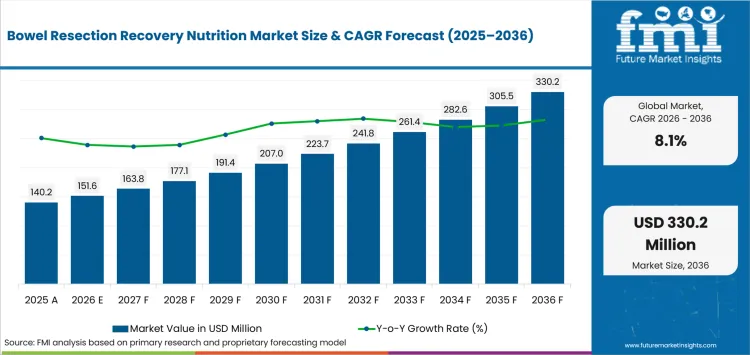
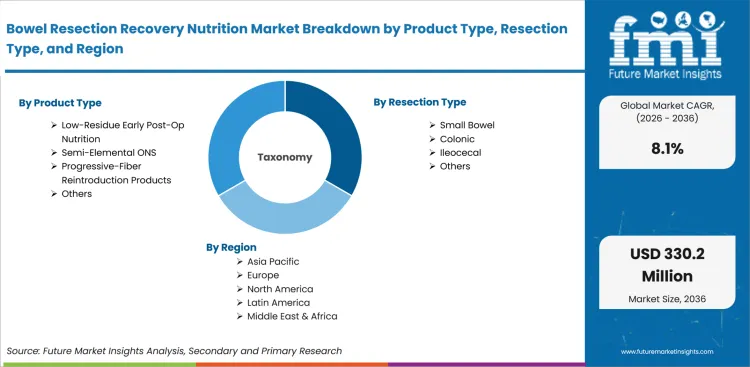
USD 151.6 million in 2026 and USD 330.2 million by 2036 at an 8.1% CAGR.
Demand in the bowel resection recovery nutrition market is projected to grow from USD 151.6 million in 2026 to USD 330.2 million by 2036, representing an 8.1% CAGR. Recovery protocols increasingly treat nutrition as an early therapeutic component. The September 2025 ESPEN surgery guideline recommends initiating oral or enteral feeding within hours of surgery in clinically stable patients as tolerated. Earlier nutritional intervention places formula selection closer to the point of care and expands use throughout the recovery pathway. Growth therefore reflects the growing incorporation of structured nutrition support into routine postoperative management following bowel resection procedures.
Conversion after discharge is less uniform because reimbursement and documentation determine whether hospital choices become repeat orders. CMS updated its enteral nutrition compliance guidance in February 2026 and reported a 23.8% Medicare improper-payment rate for the 2024 reporting period. The payment measure does not quantify nutrition demand. It does show why funded home supply can fail despite a clinically established feeding plan.
Key Takeaways
- Early postoperative feeding moves nutrition selection closer to surgery and increases the need for formulations matched to short-term tolerance.
- Low-residue early post-op nutrition accounts for 48.2% of the market in 2026 because early diet progression favors limited residue and manageable portions.
- By resection type, small bowel is estimated to represent 49.9% in 2026 owing to absorption losses that can extend specialized nutrition needs.
- In 2026, in-hospital is projected to hold 57.3% by phase as surgical teams initiate and adjust nutrition under direct clinical observation.
- Anatomy-specific intolerance and reimbursement documentation can interrupt product continuity before patients complete the intended recovery nutrition course.
- Some of the key players in this market include Nestle Health Science, Abbott, Danone Nutricia, Fresenius Kabi, Kate Farms, B. Braun, Nutrisens Group, and Ajinomoto Co., Inc.
Analyst Perspective
"Bowel resection recovery nutrition should be evaluated by recovery stage because the same formula rarely fits early healing and later adaptation. Commercial value is earned through tolerance evidence and a reliable hospital-to-home route that keeps the prescribed nutrition available after discharge."
- Nandini Roy Choudhury, Principal Consultant, Future Market Insights
How is the Bowel Resection Recovery Nutrition Market segmented?
The market is segmented by product type, resection type, phase, end user and sales channel.
Product type includes low-residue early post-op nutrition, semi-elemental ONS, progressive-fiber reintroduction products and others. Resection type covers small bowel, colonic, ileocecal and other resections. Phase separates in-hospital care from 0-8 weeks home recovery and long-term adaptation. End users include hospitals, homecare and others. Sales channels include hospital pharmacy, retail pharmacy, online supply, institutional tender and other routes.
What makes Low-residue early post-op nutrition central to the Product type category?
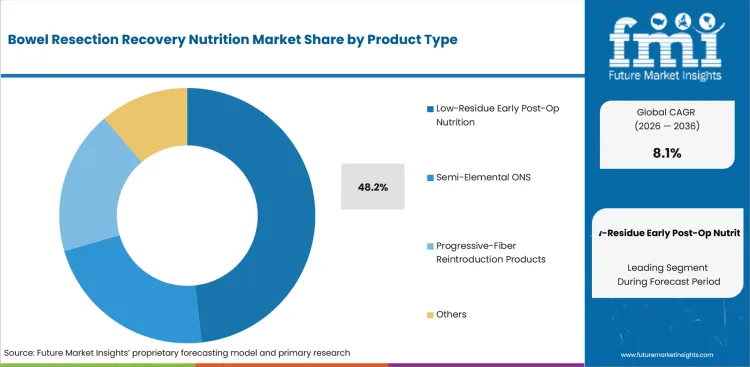
Early recovery centers on bowel tolerance and reduced stool burden while appetite remains limited after surgery. University Hospital Southampton states in its 2026 bowel-surgery guidance that a lower-fibre diet is recommended for four to six weeks before gradual reintroduction. That clinical sequence gives low-residue products a defined use window instead of an indefinite dietary role.
- By product type, low-residue early post-op nutrition is estimated to hold 48.2% in 2026 owing to easier diet progression during early healing.
- Patients with small appetites also use oral nutritional supplements to increase protein and energy intake without requiring large portions during the first recovery weeks.
Why does Small bowel lead the Resection type category?
Small bowel resection can reduce absorptive surface and increase fluid losses before intestinal adaptation stabilizes intake. Leeds Teaching Hospitals reviewed its short-bowel guidance in June 2025 and states that the small intestine releases about four litres of digestive juices each day. Loss of absorptive length therefore changes formula selection more directly than a routine colonic resection.
- In 2026, small bowel is expected to lead resection type with 49.9% share because reduced absorption can extend specialized nutrition requirements after surgery.
- Peptide-oriented enteral formulas become relevant where standard nutrients are poorly absorbed and clinicians need a feeding route that reduces digestive work.
What supports In-hospital leadership in the Phase category?
The first diet changes occur under hospital observation because nausea and stool output can alter the feeding plan within hours. UCLH updated its bowel-surgery patient pathway in July 2025 and directs patients to take concentrated oral supplements from the day after surgery. That supervision gives hospitals the strongest influence over initial formula choice.
- In-hospital is projected to hold 57.3% share in 2026 owing to direct clinical observation during the highest-intensity phase of nutrition adjustment.
- Hospital access to tube-feeding formulas lets clinicians change route or nutrient density before the discharge plan transfers responsibility to community care.
How do Hospitals remain central to the End user category?
Hospitals document poor intake and gastrointestinal tolerance before a recovery formula becomes part of the discharge plan. Danone completed its majority acquisition of Kate Farms in July 2025 and said the combined medical nutrition business would reach patients in hospitals and at home. That channel coverage reinforces the hospital as the first commercial access point.
- Hospitals are forecast to represent 51.3% of the market in 2026 driven by direct nutrition assessment and supervised product initiation after resection.
- Hospital choices influence medical foods used after discharge because community teams often preserve a formulation that already proved tolerable during admission.
What are the drivers, restraints and opportunities in the Bowel Resection Recovery Nutrition Market?
Earlier postoperative feeding raises demand, variable tolerance and coverage rules interrupt continuity, and coordinated discharge nutrition offers the clearest revenue route.
- Driver: Early oral and enteral feeding protocols bring nutrition intervention into the first postoperative day for suitable patients.
- Restraint: Resection anatomy and payer documentation requirements can force product changes or interrupt funded use after discharge.
- Opportunity: Stage-specific portfolios can carry patients from low-residue intake into peptide support and later fibre reintroduction.
Hospitals now treat food intake as an active recovery task instead of waiting for normal appetite to return. UCLH published its enhanced bowel-surgery pathway in 2025 and directs patients to drink two bottles of Ensure Plus each day after surgery. Earlier initiation expands the purchasing window for clinical nutrition supplements because intake shortfalls become visible before discharge planning begins.
Coverage barriers extend beyond product cost because reimbursement often depends on documentation that demonstrates medical necessity for the selected feeding route. CMS reported in February 2026 that insufficient documentation accounted for 48.8% of improper Medicare enteral payments during the 2024 reporting period. That threshold exposes USA oral clinical nutrition providers to a split between clinically useful short-term support and reimbursable durable supply.
One significant opportunity is a discharge pathway that preserves nutrition access while bowel tolerance changes outside the hospital. Nutricia reported in its Spring 2026 Homeward Times that the service supported 35,000 patients during 2025. Homecare coordination strengthens enteral nutrition continuity because a large established service can carry repeat supply beyond hospital discharge.
Which country CAGRs are profiled in the Bowel Resection Recovery Nutrition Market?
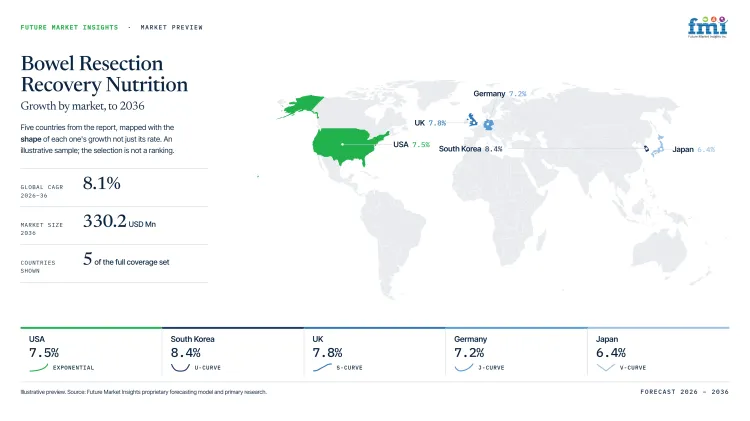
| Country | CAGR |
|---|---|
| South Korea | 8.4% |
| UK | 7.8% |
| USA | 7.5% |
| Germany | 7.2% |
| Japan | 6.4% |
How do country-level CAGRs compare in the Bowel Resection Recovery Nutrition Market?
The 2.0-point CAGR range separates an upper pair from a tighter middle group. South Korea at 8.4% and the UK at 7.8% lead while the USA at 7.5% and Germany at 7.2% remain close. Japan at 6.4% grows more slowly. The pattern tracks hospital-to-home continuity more closely than current patient volume.
- South Korea standardizes perioperative practice through specialist societies and concentrated cancer centers.
- The UK uses staged food progression under hospital dietitian supervision after colorectal surgery.
- USA retail supplement channels provide a fallback for shorter self-funded recovery courses.
- German hospital nutrition practice keeps dietitian oversight close to formula-selection decisions.
- Japan keeps postoperative nutrition review closely tied to specialist surgical follow-up.
Similar CAGRs can therefore produce different order-conversion conditions after discharge. The full report provides country-level CAGR analysis across North America, Latin America, Europe, East Asia, South Asia, Oceania and the Middle East and Africa.
Country-wise Analysis
- South Korean cancer centers manage a large colorectal survivor population through concentrated tertiary-care networks. This structure keeps nutrition review close to surgical follow-up. The National Cancer Center updated national prevalence data in January 2026 and recorded 340,064 colorectal cancer survivors for 2023. South Korea is estimated to post an 8.4% CAGR over the forecast period as this clinical base sustains repeat postoperative nutrition assessment. Continuation after discharge still depends on formula tolerance and benefit eligibility. Companies therefore need Korean clinical support and reliable replenishment, because distributor readiness affects availability during the first weeks at home.
- UK bowel-surgery services move patients from hospital food to smaller meals and concentrated supplements before community dietitians take over follow-up. BAPEN reported in November 2025 that the NHS supports more than 40,000 people using home enteral tube feeding. It also documented substantial service variation during home management. Bowel resection recovery nutrition demand in the UK is forecast to rise at a 7.8% CAGR over the forecast period, supported by this national homecare base. Companies are better positioned when they preserve a tolerated formula from ward initiation into community supply, backed by training and dependable delivery after surgical discharge.
- USA health systems can initiate specialized oral or tube feeding quickly because large hospital formularies already carry broad clinical nutrition portfolios. The country is projected to grow at a 7.5% CAGR through 2036, supported by broad hospital access. CMS updated its enteral guidance in February 2026 with a limit of one month of nutrients per payment period. Short recovery courses can fall between institutional supply and durable-benefit rules. Companies therefore need documentation support, retail access or commercial coverage routes for patients whose use ends before permanent enteral eligibility applies.
- German clinicians can prescribe balanced enteral diets under statutory insurance after ordinary dietary measures fail to correct inadequate nutrition. The G-BA adopted an evaluation concept in June 2025, then surveyed manufacturers and clinical organizations about enteral nutrition provision under the statutory prescription framework. Germany is estimated to expand at a 7.2% CAGR through 2036 because this formal route supports adoption. Reimbursement still depends on documented medical need and precise prescription evidence. Hospital formulary access alone does not guarantee reimbursed continuation at home after surgery.
- Japanese colorectal services handle a large disease burden within specialist hospital systems. These systems keep nutrition decisions close to surgical follow-up. The National Cancer Center published 2025 cancer forecasts showing about 160,000 colorectal cancer cases and a sustained treatment base for hospital nutrition assessment. Japan is anticipated to advance at a 6.4% CAGR over the assessment period, tied to continued treatment volume. Community continuation varies by local follow-up practice. One lucrative near-term position belongs to formulations that fit established hospital routines, with pack sizes and replenishment routes suited to shorter outpatient recovery after discharge.
Who are the notable companies in the Bowel Resection Recovery Nutrition Market?
Nestle Health Science, Abbott, Danone Nutricia, Fresenius Kabi, Kate Farms, B. Braun, Nutrisens Group and Ajinomoto Co., Inc. are the notable companies serving this market.
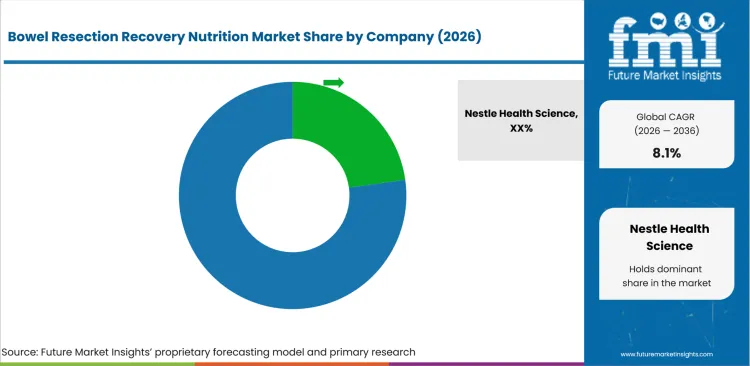
The field mixes global medical nutrition platforms with specialized nutrition companies that concentrate on peptide formulas or recovery support. Entry barriers come from hospital formulary access and the evidence needed to match nutrition with impaired gastrointestinal function. A company with a wide catalogue does not automatically have stronger bowel-resection positioning because discharge continuity and tolerance-specific options carry separate commercial weight.
- Nestle Health Science, Abbott, Danone Nutricia and Fresenius Kabi maintain broad hospital nutrition portfolios with oral and enteral routes.
- Kate Farms and B. Braun focus on specialized enteral formats for patients who need controlled tolerance or tube-feeding options.
- Nutrisens Group serves oral and enteral medical nutrition channels while Ajinomoto Co., Inc. has invested directly in perioperative nutrition programs.
Competitive Benchmarking: Bowel Resection Recovery Nutrition Market
| Company | Clinical Nutrition Route Breadth | GI-Recovery Fit | Hospital-to-Home Access | Geographic Reach |
|---|---|---|---|---|
| Nestle Health Science | High | High | High | Global |
| Abbott | High | High | High | Global |
| Danone Nutricia | High | High | High | Global |
| Fresenius Kabi | High | High | High | Global |
| Kate Farms | Medium | High | High | North America and selected international markets |
| B. Braun | High | Medium | Medium | Europe and international markets |
| Nutrisens Group | Medium | Medium | High | Europe and Latin America |
| Ajinomoto Co., Inc. | Low | Medium | Low | Japan, USA, UK and Ireland |
Scoring basis: High route breadth requires at least three documented oral or enteral nutrition routes while Medium requires two and Low identifies one. High GI-recovery fit requires multiple documented tolerance or digestion-oriented options while Medium requires one defined GI-oriented route and Low identifies general nutrition only. High hospital-to-home access requires documented institutional and community channels while Medium confirms one linked continuation route and Low reflects institution-only access. Ratings summarize current public evidence and do not represent company market-share rankings.
Key Developments in the Bowel Resection Recovery Nutrition Market
- In July 2025, Danone Nutricia completed its majority acquisition of Kate Farms and expanded its North American medical nutrition reach through hospital and home channels.
- In June 2025, Fresenius Kabi opened an expanded enteral nutrition R&D center in Gurugram to support faster product development and new nutrition projects.
- In March 2025, Nutrisens Group acquired a majority stake in Prodiet Medical Nutrition and expanded its oral and enteral nutrition presence in Latin America.
Key Players in the Bowel Resection Recovery Nutrition Market
Global Medical Nutrition Platforms
- Nestle Health Science
- Abbott
- Danone Nutricia
- Fresenius Kabi
Specialized Enteral and Tolerance-Focused Providers
- Kate Farms
- B. Braun
Regional and Perioperative Nutrition Providers
- Nutrisens Group
- Ajinomoto Co., Inc.
Bowel Resection Recovery Nutrition Market - Report Scope
| Coverage field | Report scope |
|---|---|
| Market breakdown | By product type, resection type, phase, end user, sales channel and region. |
| Quantitative Units | USD Million. |
| Market Definition | Commercial nutrition products used during recovery after bowel resection when ordinary intake is inadequate or poorly tolerated. |
| Regions Covered | North America, Latin America, Europe, East Asia, South Asia and Pacific and Middle East and Africa. |
| Countries Covered | USA, UK, Germany, Japan, South Korea, and 30+ countries included in the full report. |
| Key Companies Profiled | Nestle Health Science, Abbott, Danone Nutricia, Fresenius Kabi, Kate Farms, B. Braun, Nutrisens Group, Ajinomoto Co., Inc. |
| Forecast Period | 2026 to 2036. |
| Approach | Primary and secondary research with market triangulation. |
Bowel Resection Recovery Nutrition Market - Research Methodology
| Method | Approach |
|---|---|
| Primary Research | FMI analysts gathered input from manufacturers, service providers, technology developers, distributors, end users, procurement teams, and subject-matter experts. Interviews examined purchasing decisions, product or service evaluation, adoption barriers, approval requirements, pricing considerations, and expectations for technical or commercial support. Respondents were also asked what evidence is required before a trial, pilot, or initial order develops into regular purchasing. |
| Desk Research | Desk research covered government statistics, regulatory publications, trade data, industry associations, technical literature, standards, company filings, product information, and official corporate announcements. Sources were reviewed for relevance, publication date, geographic coverage, and consistency with the defined market scope. Claims relating to performance, applications, approvals, capacity, investment, and commercial activity were retained only when supported by credible public evidence. |
| Market Sizing and Forecasting | The market model combined the baseline value with historical performance, segment structure, pricing and volume indicators, adoption levels, company participation, and country-level demand conditions. Forecast assumptions considered economic activity, investment trends, regulatory developments, technology adoption, purchasing cycles, supply availability, and barriers to wider market use. Segment and regional estimates were reconciled before the final market total was calculated. |
| Data Validation | Estimates were checked against multiple independent indicators, including public data, company activity, trade patterns, industry developments, and findings from primary interviews. Validation also tested whether products, services, applications, and company revenues fell within the defined market boundaries. Adjacent categories, unsupported claims, overlapping revenues, and activities without direct market relevance were excluded to reduce double counting and maintain consistency across segments and countries. |
Bowel Resection Recovery Nutrition Market by Segments
Bowel Resection Recovery Nutrition Market segmented by Product Type:
- Low-Residue Early Post-Op Nutrition
- Semi-Elemental ONS
- Progressive-Fiber Reintroduction Products
- Others
Bowel Resection Recovery Nutrition Market segmented by Resection Type:
- Small Bowel
- Colonic
- Ileocecal
- Others
Bowel Resection Recovery Nutrition Market segmented by Phase:
- In-Hospital
- 0-8 Weeks Home Recovery
- Long-Term Adaptation
Bowel Resection Recovery Nutrition Market segmented by End User:
- Hospitals
- Homecare
- Others
Bowel Resection Recovery Nutrition Market segmented by Sales Channel:
- Hospital Pharmacy
- Retail Pharmacy
- Online
- Institutional Tender
- Others
Bowel Resection Recovery Nutrition Market by Region:
- North America
- United States
- Canada
- Latin America
- Brazil
- Mexico
- Argentina
- Chile
- Western Europe
- Germany
- France
- United Kingdom
- Italy
- Spain
- Benelux
- Nordics
- Eastern Europe
- Poland
- Czech Republic
- Romania
- Hungary
- East Asia
- China
- Japan
- South Korea
- South Asia and Pacific
- India
- ASEAN
- Australia and New Zealand
- Middle East and Africa
- GCC Countries
- South Africa
- Türkiye
- Israel
Research Sources and Bibliography
- Weimann, A., et al.. (2025, September 3). ESPEN guideline on clinical nutrition in surgery - Update 2025.
- Centers for Medicare & Medicaid Services. (2026, February 11). Enteral Nutrition.
- University Hospital Southampton NHS Foundation Trust. (2026). Eating after bowel surgery - patient information.
- Leeds Teaching Hospitals NHS Trust. (2025, June 4). Eating and Drinking with a Short Bowel.
- University College London Hospitals NHS Foundation Trust. (2025). Information for patients undergoing bowel surgery.
- Gemeinsamer Bundesausschuss. (2025, June 18). Arzneimittel-Richtlinie: Konzept zur Evaluation der Entwicklung der Leistungen zur Versorgung der Versicherten mit bilanzierten Diäten zur enteralen Ernährung gemäß § 31 Absatz 5 SGB V.
- Gemeinsamer Bundesausschuss. (2026). Bilanzierte Diäten zur enteralen Ernährung in der Arzneimittelversorgung.
- National Cancer Center Korea. (2026, January).
- National Cancer Center Japan. (2025).
- British Association for Parenteral and Enteral Nutrition. (2025, November 24). BAPEN Publishes New Report on Environmental Sustainability in Home Enteral Tube Feeding.
- Danone. (2025, July 1). Danone completes the acquisition of Kate Farms, enhancing its USA specialized nutrition offerings.
- Nutrisens. (2025, March 14). Nutrisens strengthens its international presence with the acquisition of Prodiet Medical Nutrition in Brazil.
- Fresenius Kabi. (2025, June 26). R&D Innovation - New R&D center in India.
- Nutricia. (2026). Nutricia Homeward Times Spring 2026.
- Ajinomoto Co., Inc.. (2025, March 24). Ajinomoto Co., Inc. Invests in Enhanced Medical Nutrition, a Canadian Startup Developing Nutrition Programs for Surgical Patients.
- Arla Foods Ingredients. (2025, April 29). Arla Foods Ingredients launches new micellar casein isolate for medical nutrition.
- Nestle Health Science. (2026, March 30). Nestle Health Science launches Compleat Paediatric Oral Blends in Europe.
- Abbott. (2026, May 13). Abbott launches Ensure Strength Pro with 30g protein for Indian adults.
- Kate Farms. (2026, July 28). Kate Farms expands High Protein Nutrition Shake distribution to Walmart and CVS.
- Fresenius Kabi. (2025, March 17). Fresenius Kabi invests in new research center KabiLab D20.
- Danone. (2026, March 23). Danone to acquire Huel, extending its portfolio in Functional Nutrition.
- Otsuka Holdings Co., Ltd.. (2026, March 5). Notice of the 18th Annual Shareholders Meeting (for FY2025).
This Report Answers
- How large is the bowel resection recovery nutrition market in 2026 and what value is forecast for 2036?
- Which postoperative feeding changes support earlier demand for recovery nutrition after bowel resection?
- Why does low-residue early post-op nutrition hold the largest product type share in 2026?
- How does small bowel resection change the need for absorption-focused oral and enteral nutrition?
- Why does the in-hospital phase account for 57.3% of market demand in 2026?
- How do country growth rates differ among South Korea, the UK, USA, Germany and Japan?
- Which barriers interrupt the transition from hospital nutrition into funded home recovery supply?
- Which companies compete through broad clinical nutrition portfolios and specialized gastrointestinal nutrition formats?
- What evidence and channel features should hospitals examine before selecting bowel resection recovery nutrition products?
Frequently Asked Questions
How big is the bowel resection recovery nutrition market in 2026?
The bowel resection recovery nutrition market is valued at USD 151.6 million in 2026 and is projected to reach USD 330.2 million by 2036. Earlier postoperative feeding increases use before discharge and extends nutrition decisions into home recovery.
What is the CAGR of the bowel resection recovery nutrition market from 2026 to 2036?
The bowel resection recovery nutrition market is projected to grow at a CAGR of 8.1% between 2026 and 2036. Expansion follows earlier feeding protocols and wider use of stage-specific nutrition after surgical discharge.
Which product type leads the bowel resection recovery nutrition market?
The low-residue early post-op nutrition segment is expected to hold 48.2% of the bowel resection recovery nutrition market in 2026, driven by limited-fibre intake during early diet progression. Its role is strongest before patients tolerate a broader diet.
Which resection type holds the largest share of the bowel resection recovery nutrition market?
The small bowel segment is expected to hold 49.9% of the bowel resection recovery nutrition market in 2026, attributable to reduced absorptive surface after substantial resections. Specialized oral or enteral formulas remain relevant where standard intake does not meet requirements.
Which phase holds the largest share of the bowel resection recovery nutrition market?
The in-hospital segment is expected to hold 57.3% of the bowel resection recovery nutrition market in 2026, supported by supervised diet advancement after surgery. Surgical teams can adjust formula type before patients transition into home recovery.
Which countries are projected to record the highest growth in the bowel resection recovery nutrition market?
South Korea is projected to grow at 8.4% CAGR, followed by the UK at 7.8% and the USA at 7.5% through 2036. Growth is strongest where hospital nutrition plans have a workable route into follow-up supply.
Which companies are active in the bowel resection recovery nutrition market?
Key companies operating in the market include Nestle Health Science, Abbott, Danone Nutricia, Fresenius Kabi, Kate Farms, B. Braun, Nutrisens Group, and Ajinomoto Co., Inc. These companies compete through formula breadth and institutional access with specialized gastrointestinal options providing further differentiation.
Preview the report firsthand - request a free sample
Get SampleGet the brochure for pricing and purchase details.
Get PDFTable of Content
- Key Takeaways
- Market Size and CAGR
- Top Growth Driver
- Fastest Growing Segment
- Leading Region
- Key Companies
- Emerging Opportunities
- Executive Summary
- Global Market Outlook
- Demand-side Trends
- Supply-side Trends
- Technology Roadmap Analysis
- Analysis and Recommendations
- Analyst Perspective (What is happening? Why now? What should investors know?)
- Key Questions Answered
- How large is the market?
- What is the CAGR?
- What are key trends?
- Which region dominates?
- Who are the leaders?
- Market Overview
- Market Coverage / Taxonomy
- Market Definition / Scope / Limitations
- Research Methodology
- Chapter Orientation
- Analytical Lens and Working Hypotheses
- Market Structure, Signals, and Trend Drivers
- Benchmarking and Cross-market Comparability
- Market Sizing, Forecasting, and Opportunity Mapping
- Research Design and Evidence Framework
- Desk Research Programme (Secondary Evidence)
- Expert Input and Fieldwork (Primary Evidence)
- Tooling, Models, and Reference Databases
- Data Engineering and Model Build
- Quality Assurance and Audit Trail
- Market Background
- Market Dynamics (Drivers, Restraints, Opportunity, Trends)
- Scenario Forecast (Optimistic, Likely, Conservative)
- Impact Analysis
- AI Impact
- Sustainability Impact
- Regulatory Impact
- Technology Impact
- Consumer / Buyer Analysis
- Purchase Drivers
- Adoption Barriers
- Buyer Journey
- Opportunity Map Analysis
- Product Life Cycle Analysis
- Supply Chain Analysis
- Investment Feasibility Matrix
- Value Chain Analysis
- PESTLE and Porter's Analysis
- Regulatory Landscape
- Regional Parent Market Outlook
- Production and Consumption Statistics
- Import and Export Statistics
- Global Market Analysis and Forecast, 2021 to 2036
- Historical Market Size Value (USD Million) Analysis, 2021 to 2025
- Current and Future Market Size Value (USD Million) Projections, 2026 to 2036
- Y-o-Y Growth Trend Analysis
- Absolute $ Opportunity Analysis
- Global Market Pricing Analysis, 2021 to 2036
- Global Market Analysis and Forecast, By Product Type, 2021 to 2036
- Introduction / Key Findings
- Historical Market Size Value (USD Million) Analysis By Product Type, 2021 to 2025
- Current and Future Market Size Value (USD Million) Analysis and Forecast By Product Type, 2026 to 2036
- Low-Residue Early Post-Op Nutrition
- Semi-Elemental ONS
- Progressive-Fiber Reintroduction Products
- Others
- Low-Residue Early Post-Op Nutrition
- Y-o-Y Growth Trend Analysis By Product Type, 2021 to 2025
- Absolute $ Opportunity Analysis By Product Type, 2026 to 2036
- Global Market Analysis and Forecast, By Resection Type, 2021 to 2036
- Introduction / Key Findings
- Historical Market Size Value (USD Million) Analysis By Resection Type, 2021 to 2025
- Current and Future Market Size Value (USD Million) Analysis and Forecast By Resection Type, 2026 to 2036
- Small Bowel
- Colonic
- Ileocecal
- Others
- Small Bowel
- Y-o-Y Growth Trend Analysis By Resection Type, 2021 to 2025
- Absolute $ Opportunity Analysis By Resection Type, 2026 to 2036
- Global Market Analysis and Forecast, By Phase, 2021 to 2036
- Introduction / Key Findings
- Historical Market Size Value (USD Million) Analysis By Phase, 2021 to 2025
- Current and Future Market Size Value (USD Million) Analysis and Forecast By Phase, 2026 to 2036
- In-Hospital
- 0-8 Weeks Home Recovery
- Long-Term Adaptation
- In-Hospital
- Y-o-Y Growth Trend Analysis By Phase, 2021 to 2025
- Absolute $ Opportunity Analysis By Phase, 2026 to 2036
- Global Market Analysis and Forecast, By End User, 2021 to 2036
- Introduction / Key Findings
- Historical Market Size Value (USD Million) Analysis By End User, 2021 to 2025
- Current and Future Market Size Value (USD Million) Analysis and Forecast By End User, 2026 to 2036
- Hospitals
- Homecare
- Others
- Hospitals
- Y-o-Y Growth Trend Analysis By End User, 2021 to 2025
- Absolute $ Opportunity Analysis By End User, 2026 to 2036
- Global Market Analysis and Forecast, By Sales Channel, 2021 to 2036
- Introduction / Key Findings
- Historical Market Size Value (USD Million) Analysis By Sales Channel, 2021 to 2025
- Current and Future Market Size Value (USD Million) Analysis and Forecast By Sales Channel, 2026 to 2036
- Hospital Pharmacy
- Retail Pharmacy
- Online
- Institutional Tender
- Others
- Hospital Pharmacy
- Y-o-Y Growth Trend Analysis By Sales Channel, 2021 to 2025
- Absolute $ Opportunity Analysis By Sales Channel, 2026 to 2036
- Global Market Analysis and Forecast, By Region, 2021 to 2036
- Introduction
- Historical Market Size Value (USD Million) Analysis By Region, 2021 to 2025
- Current Market Size Value (USD Million) Analysis and Forecast By Region, 2026 to 2036
- North America
- Latin America
- Western Europe
- Eastern Europe
- East Asia
- South Asia and Pacific
- Middle East & Africa
- Market Attractiveness Analysis By Region
- North America Market Analysis and Forecast, By Country, 2021 to 2036
- Historical Market Size Value (USD Million) Trend Analysis By Market Taxonomy, 2021 to 2025
- Market Size Value (USD Million) Forecast By Market Taxonomy, 2026 to 2036
- By Country
- USA
- Canada
- By Product Type
- By Resection Type
- By Phase
- By End User
- By Sales Channel
- By Country
- Market Attractiveness Analysis
- By Country
- By Product Type
- By Resection Type
- By Phase
- By End User
- By Sales Channel
- Key Takeaways
- Latin America Market Analysis and Forecast, By Country
- Historical Market Size Value (USD Million) Trend Analysis By Market Taxonomy, 2021 to 2025
- Market Size Value (USD Million) Forecast By Market Taxonomy, 2026 to 2036
- By Country
- Brazil
- Mexico
- Chile
- Rest of Latin America
- By Product Type
- By Resection Type
- By Phase
- By End User
- By Sales Channel
- By Country
- Market Attractiveness Analysis
- By Country
- By Product Type
- By Resection Type
- By Phase
- By End User
- By Sales Channel
- Key Takeaways
- Western Europe Market Analysis and Forecast, By Country
- Historical Market Size Value (USD Million) Trend Analysis By Market Taxonomy, 2021 to 2025
- Market Size Value (USD Million) Forecast By Market Taxonomy, 2026 to 2036
- By Country
- Germany
- UK
- Italy
- Spain
- France
- Nordic
- BENELUX
- Rest of Western Europe
- By Product Type
- By Resection Type
- By Phase
- By End User
- By Sales Channel
- By Country
- Market Attractiveness Analysis
- By Country
- By Product Type
- By Resection Type
- By Phase
- By End User
- By Sales Channel
- Key Takeaways
- Eastern Europe Market Analysis and Forecast, By Country
- Historical Market Size Value (USD Million) Trend Analysis By Market Taxonomy, 2021 to 2025
- Market Size Value (USD Million) Forecast By Market Taxonomy, 2026 to 2036
- By Country
- Russia
- Poland
- Hungary
- Balkan & Baltic
- Rest of Eastern Europe
- By Product Type
- By Resection Type
- By Phase
- By End User
- By Sales Channel
- By Country
- Market Attractiveness Analysis
- By Country
- By Product Type
- By Resection Type
- By Phase
- By End User
- By Sales Channel
- Key Takeaways
- East Asia Market Analysis and Forecast, By Country
- Historical Market Size Value (USD Million) Trend Analysis By Market Taxonomy, 2021 to 2025
- Market Size Value (USD Million) Forecast By Market Taxonomy, 2026 to 2036
- By Country
- China
- Japan
- South Korea
- By Product Type
- By Resection Type
- By Phase
- By End User
- By Sales Channel
- By Country
- Market Attractiveness Analysis
- By Country
- By Product Type
- By Resection Type
- By Phase
- By End User
- By Sales Channel
- Key Takeaways
- South Asia and Pacific Market Analysis and Forecast, By Country
- Historical Market Size Value (USD Million) Trend Analysis By Market Taxonomy, 2021 to 2025
- Market Size Value (USD Million) Forecast By Market Taxonomy, 2026 to 2036
- By Country
- India
- ASEAN
- Australia & New Zealand
- Rest of South Asia and Pacific
- By Product Type
- By Resection Type
- By Phase
- By End User
- By Sales Channel
- By Country
- Market Attractiveness Analysis
- By Country
- By Product Type
- By Resection Type
- By Phase
- By End User
- By Sales Channel
- Key Takeaways
- Middle East & Africa Market Analysis and Forecast, By Country
- Historical Market Size Value (USD Million) Trend Analysis By Market Taxonomy, 2021 to 2025
- Market Size Value (USD Million) Forecast By Market Taxonomy, 2026 to 2036
- By Country
- Kingdom of Saudi Arabia
- Other GCC Countries
- Türkiye
- South Africa
- Other African Union
- Rest of Middle East & Africa
- By Product Type
- By Resection Type
- By Phase
- By End User
- By Sales Channel
- By Country
- Market Attractiveness Analysis
- By Country
- By Product Type
- By Resection Type
- By Phase
- By End User
- By Sales Channel
- Key Takeaways
- Key Countries Market Analysis
- USA
- Pricing Analysis
- Market Share Analysis, 2025
- By Product Type
- By Resection Type
- By Phase
- By End User
- By Sales Channel
- Canada
- Pricing Analysis
- Market Share Analysis, 2025
- By Product Type
- By Resection Type
- By Phase
- By End User
- By Sales Channel
- Mexico
- Pricing Analysis
- Market Share Analysis, 2025
- By Product Type
- By Resection Type
- By Phase
- By End User
- By Sales Channel
- Brazil
- Pricing Analysis
- Market Share Analysis, 2025
- By Product Type
- By Resection Type
- By Phase
- By End User
- By Sales Channel
- Chile
- Pricing Analysis
- Market Share Analysis, 2025
- By Product Type
- By Resection Type
- By Phase
- By End User
- By Sales Channel
- Germany
- Pricing Analysis
- Market Share Analysis, 2025
- By Product Type
- By Resection Type
- By Phase
- By End User
- By Sales Channel
- UK
- Pricing Analysis
- Market Share Analysis, 2025
- By Product Type
- By Resection Type
- By Phase
- By End User
- By Sales Channel
- Italy
- Pricing Analysis
- Market Share Analysis, 2025
- By Product Type
- By Resection Type
- By Phase
- By End User
- By Sales Channel
- Spain
- Pricing Analysis
- Market Share Analysis, 2025
- By Product Type
- By Resection Type
- By Phase
- By End User
- By Sales Channel
- France
- Pricing Analysis
- Market Share Analysis, 2025
- By Product Type
- By Resection Type
- By Phase
- By End User
- By Sales Channel
- India
- Pricing Analysis
- Market Share Analysis, 2025
- By Product Type
- By Resection Type
- By Phase
- By End User
- By Sales Channel
- ASEAN
- Pricing Analysis
- Market Share Analysis, 2025
- By Product Type
- By Resection Type
- By Phase
- By End User
- By Sales Channel
- Australia & New Zealand
- Pricing Analysis
- Market Share Analysis, 2025
- By Product Type
- By Resection Type
- By Phase
- By End User
- By Sales Channel
- China
- Pricing Analysis
- Market Share Analysis, 2025
- By Product Type
- By Resection Type
- By Phase
- By End User
- By Sales Channel
- Japan
- Pricing Analysis
- Market Share Analysis, 2025
- By Product Type
- By Resection Type
- By Phase
- By End User
- By Sales Channel
- South Korea
- Pricing Analysis
- Market Share Analysis, 2025
- By Product Type
- By Resection Type
- By Phase
- By End User
- By Sales Channel
- Russia
- Pricing Analysis
- Market Share Analysis, 2025
- By Product Type
- By Resection Type
- By Phase
- By End User
- By Sales Channel
- Poland
- Pricing Analysis
- Market Share Analysis, 2025
- By Product Type
- By Resection Type
- By Phase
- By End User
- By Sales Channel
- Hungary
- Pricing Analysis
- Market Share Analysis, 2025
- By Product Type
- By Resection Type
- By Phase
- By End User
- By Sales Channel
- Kingdom of Saudi Arabia
- Pricing Analysis
- Market Share Analysis, 2025
- By Product Type
- By Resection Type
- By Phase
- By End User
- By Sales Channel
- Türkiye
- Pricing Analysis
- Market Share Analysis, 2025
- By Product Type
- By Resection Type
- By Phase
- By End User
- By Sales Channel
- South Africa
- Pricing Analysis
- Market Share Analysis, 2025
- By Product Type
- By Resection Type
- By Phase
- By End User
- By Sales Channel
- USA
- Market Structure Analysis
- Competition Dashboard
- Competition Benchmarking
- Market Share Analysis of Top Players
- By Regional
- By Product Type
- By Resection Type
- By Phase
- By End User
- By Sales Channel
- Emerging Startups
- Innovation Benchmarking
- Competition Analysis
- Competition Deep Dive
- Nestle Health Science
- Overview
- Product Portfolio
- Profitability by Market Segments
- Sales Footprint
- Strategy Overview
- Marketing Strategy
- Product Strategy
- Channel Strategy
- Abbott
- Danone Nutricia
- Fresenius Kabi
- Kate Farms
- B. Braun
- Medtrition
- Victus
- Nestle Health Science
- Case Studies
- Success Stories
- Recent Developments
- Competition Deep Dive
- Assumptions & Acronyms Used


