

- Market Size (2026)
- USD 242.2 Mn
- Forecast (2036)
- USD 639.8 Mn
- CAGR (2026 to 2036)
- 10.2%
How big is Eating-Disorder Recovery Nutrition Market in 2026?
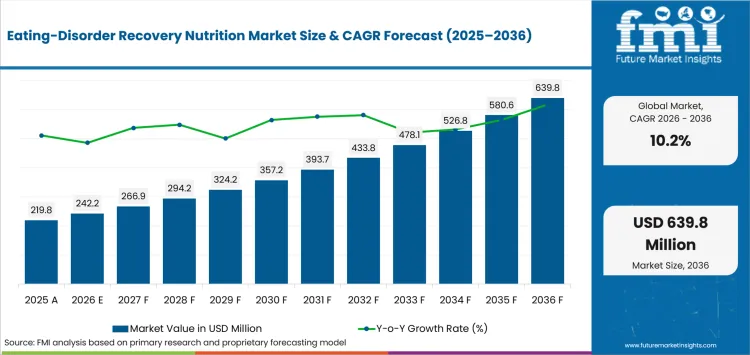
USD 242.2 million in 2026 and USD 639.8 million by 2036 at a 10.2% CAGR.
Demand for eating-disorder recovery nutrition is projected to expand at 10.2% CAGR between 2026 and 2036, increasing valuation from USD 242.2 million in 2026 to USD 639.8 million by 2036. The commercial base expands as more patients enter structured treatment and receive a clinician-defined nutrition plan. NHS England documented 11,174 children and young people starting eating-disorder treatment in 2024/25, up from 8,034 in 2019/20. That rise enlarges the pool assessed for oral nutritional supplements if food-based intake cannot meet prescribed energy goals.
Country conversion differs as treatment capacity does not guarantee equal payment access or channel continuity. A 2026 USA study indexed by PubMed identified 384 intensive eating-disorder treatment centers in 45 states and the District of Columbia, but only about one-quarter accepted Medicaid. This coverage gap can break continuity following stabilization even in markets with specialist capacity. Markets with clearer prescribing and clinical nutrition routes can convert need into repeat orders more consistently.
Key Takeaways
- Treatment entry is increasing the number of recovery episodes in which dietitians must reconcile prescribed energy targets with intake patients can sustain.
- Complete balanced ONS is projected to hold 38.9% share in 2026 owing to broad nutrient coverage in one repeat-use format.
- By care setting, inpatient & residential is estimated to hold 39.7% in 2026 owing to medical stabilization and supervised refeeding.
- The anorexia nervosa segment is likely to capture 46.9% share in 2026 attributable to sustained weight restoration as a central treatment objective.
- Refeeding risk, gastrointestinal tolerance, taste fatigue, and reimbursement limits can slow product use despite an established clinical nutrition plan.
- Some of the key players in this market include Abbott Laboratories, Danone S.A. (Nutricia), Nestlé Health Science, Fresenius Kabi, Kate Farms, Ajinomoto Co., Inc. (Nualtra), Meiji Co., Ltd., and AYMES Nutrition.
Analyst Perspective
"Recovery-nutrition products should be judged on how reliably they deliver a prescribed energy and nutrient plan without adding volume or switching friction. Commercial value is earned when the same approved format can follow a patient from intensive treatment into community and home recovery."
- Nandini Roy Choudhury, Principal Consultant, Future Market Insights
How is the eating-disorder recovery nutrition market segmented?
The eating-disorder recovery nutrition market is segmented by product type, care setting, diagnosis, end user, and sales channel.
The eating-disorder recovery nutrition market is segmented by product type, care setting, diagnosis, end user, and sales channel. Product type covers complete balanced ONS, structured refeeding products, compact high-calorie ONS, micronutrient repletion products, and others. Care setting includes inpatient & residential, PHP / IOP programs, outpatient & home, and others. Diagnosis covers anorexia nervosa, bulimia & binge-purge presentations, and OSFED & others. End users include treatment centers, hospitals, home / family-supported recovery, and others. Sales channels comprise hospital pharmacy, retail pharmacy, online, institutional tender, and others.
Why does Inpatient & Residential lead the Care Setting category?
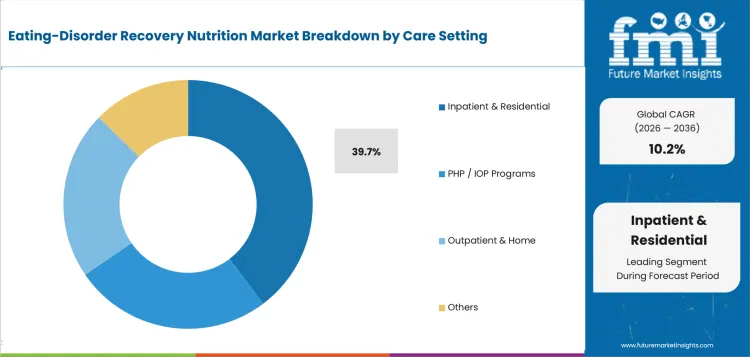
Inpatient & residential programs concentrate nutrition purchasing in programs requiring close observation and rapid adjustment of prescribed intake. Facilities can standardize products within each site as teams review electrolytes, fluid balance, daily meal completion, and serving tolerance.
- In 2026, inpatient & residential is expected to lead care setting with 39.7% share, driven by supervision intensity during stabilization and refeeding.
- NHS England's January 2026 update listed 54 inpatient teams and 93 community teams for children and young people. The inpatient network provides defined buying points for medical nutrition, although supply responsibility becomes more fragmented as therapeutic food delivery shifts toward lower-intensity recovery.
What makes Complete Balanced ONS central to the Product Type category?
Complete balanced ONS belongs to the broader complete nutrition products category but serves a more tightly supervised recovery use. It gives treatment teams predictable energy and protein without building the baseline regimen from several separate products.
- By product type, complete balanced ONS is estimated to hold 38.9% in 2026, owing to broad nutrient coverage that simplifies repeated clinical use.
- Changes in specialized nutrition presentation can disrupt prescribing if ordering references change. AYMES recorded a February 2025 transition from AYMES Complete to ActaGain 1.5 Complete in Tetra Pak with unchanged PIP codes, allowing an updated format without changing the ordering reference.
What supports Anorexia Nervosa within the Diagnosis category?
Anorexia nervosa places weight restoration at the center of treatment since prolonged restriction can produce medical instability until normal eating becomes sufficient. Recovery products therefore enter a supervised medical food plan rather than a general wellness routine.
- Anorexia nervosa is set to lead the diagnosis category with 46.9% share in 2026, attributable to sustained rehabilitation needs in restrictive disease.
- German hospital data establish how heavily anorexia shapes acute eating-disorder care in Germany. Destatis documented 9,000 inpatient anorexia cases in 2024, making anorexia the most common eating-disorder diagnosis among the 12,400 recorded hospital cases.
What drives Hospital Pharmacy in the Sales Channel category?
Hospital pharmacy has greatest influence where clinicians want a controlled product list and rapid access to prescribed nutrition during stabilization. Formulary reviews may compare oral supplements with enteral formula options even though the target market counts recovery-oriented oral products.
- By sales channel, hospital pharmacy is forecast to represent 36.6% in 2026, supported by clinician-led selection and institutional control over high-acuity nutrition.
- The Buckinghamshire, Oxfordshire and Berkshire West formulary recorded March 2025 choice tiers for oral nutrition products from AYMES, Nualtra, and Nutricia. Those tiers show how formulary status can shape which complete or compact formats enter routine prescribing.
What are the drivers, restraints and opportunities in the Eating-Disorder Recovery Nutrition Market?
More patients entering specialist care increase structured nutrition use, service-capacity and reimbursement limits restrain continuity, and portable clinician-approved formats extend purchasing into lower-intensity recovery.
- Driver: Earlier entry into specialist care increases the number of patients assessed for supplementation and prescribed weight-restoration support.
- Restraint: Service capacity, reimbursement, and tolerance can interrupt product use and prevent a recovery plan from reaching its intended intake target.
- Opportunity: Formats that retain clinical approval following discharge can extend supply into community, pharmacy, and home recovery without forcing a new nutrition decision.
Treatment access expands the addressable pool once a specialist team turns referral into a defined nutrition plan. NHS England reported that 81.7% of routine and 78.4% of urgent referrals began treatment within the national standard during September-November 2025. Faster entry raises the number of patients assessed for medical nutrition, but packaged products are purchased if ordinary meals cannot meet the prescribed target.
Service capacity can interrupt a nutrition plan during recovery even if product availability is adequate. The Royal College of Psychiatrists reported in February 2026 that 51% of children and young people's community teams with waiting lists cited demand above capacity, and 23% cited limited workforce. Delayed clinical contact means fewer timely prescribing decisions and less predictable movement from intensive care into community supply.
Step-down continuity is strongest if oral products remain part of the discharge plan instead of becoming a fresh household purchase. The 2025 National Audit of Eating Disorders found 86% of teams used nutritional stability as a discharge-readiness criterion. Texture choice may include oral nutrition desserts if liquid fatigue limits repeated intake, provided local prescribing and delivery remain intact.
Which country CAGRs are profiled in the Eating-Disorder Recovery Nutrition Market?
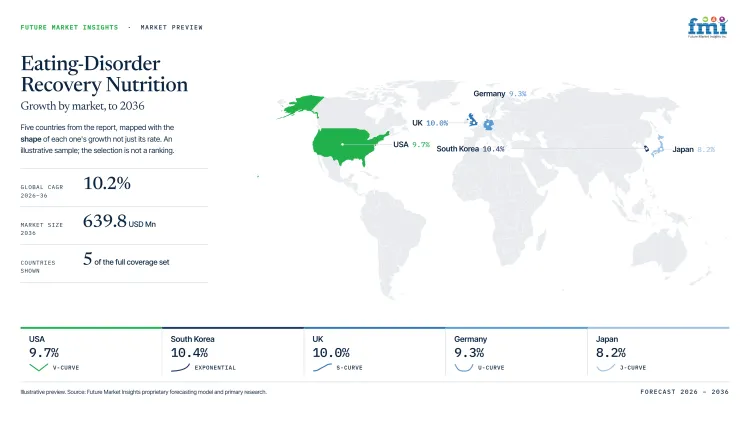
| Country | CAGR |
|---|---|
| South Korea | 10.4% |
| UK | 10.0% |
| USA | 9.7% |
| Germany | 9.3% |
| Japan | 8.2% |
How do country-level CAGRs compare in the Eating-Disorder Recovery Nutrition Market?
The country profile spans 2.2 percentage points, with South Korea at the upper edge and Japan below a compact UK-USA-Germany middle group. With a narrow spread, prescribing routes, specialist capacity, and channel economics matter more to market entry than small differences in forecast pace for each planned national commercial launch.
- South Korea gives hospital access and professional nutrition documentation greater commercial weight.
- UK conversion depends on commissioned services and local formulary pathways.
- USA companies face separate payer and provider decisions as prescriptions become repeat orders.
- Germany's inpatient burden keeps hospital clinical specification central to product selection.
- Japan rewards compact formats and specialist distribution more than broad retail coverage.
Comparable growth rates still produce different order patterns as specification and payment routes differ. The full report provides country-level CAGR analysis across North America, Latin America, Western Europe, Eastern Europe, East Asia, South Asia and Pacific, and Middle East and Africa.
Country-wise Analysis
- Hospital dietitians act as primary gatekeepers for patient nutrition formulas during formulary review, giving technical documentation more weight than wellness-style branding in recovery programs. Eating-disorder recovery nutrition demand in South Korea is forecast to rise at 10.4% CAGR through 2036, driven by stronger professional guidance for patient-formulated nutrition. In April 2026, the Ministry of Food and Drug Safety published information materials for patient nutrition formulations to support selection, nutritional management, medically supervised use, and follow-up. Manufacturers that translate nutrient specifications into Korean clinical materials can shorten evaluation, but hospital access is slower than consumer-channel listing and reimbursement approval in many cases.
- NHS commissioning gives recovery programs a defined route from specialist assessment to prescribed oral nutrition. Local formulary decisions and service capacity still determine whether that route converts into continuous product access. The 2025 National Audit of Eating Disorders found adult community teams carried 1.89 patients for every one patient open to child and young-person teams, an 89% higher demand per team. The UK eating-disorder recovery nutrition market is projected to record 10.0% CAGR over the assessment period, supported by specialist pathways and pharmacy supply. Capacity pressure means a strong formulary position does not guarantee continuous use if assessment or follow-up is delayed.
- Separate payer and provider decisions fragment recovery purchasing among hospital systems, specialist programs, private insurers, Medicaid plans, and home follow-on channels. Authorization therefore carries comparable commercial weight to product specification for repeat clinical nutrition supply. The USA is estimated to post 9.7% CAGR during the forecast period, tied to a large specialist-treatment base and multiple routes into medically supervised nutrition. SAMHSA's May 2026 Center of Excellence notice provided for one national award of up to USD 1.873 million annually for screening, brief intervention, referral, and technical assistance. Brands still need payer contracting and reliable home supply to keep a clinician-approved plan intact nationally.
- Treatment intensity determines the setting for nutrition purchasing, with hospitals concentrating acute refeeding decisions and outpatient specialists carrying longer recovery plans. Destatis reported in August 2025 that 6,000 girls aged 10 to 17 received inpatient treatment for eating disorders in 2023, twice the 2003 count. Germany's eating-disorder recovery nutrition outlook is anticipated to advance at 9.3% CAGR over the forecast period, aided by substantial specialist demand and formal treatment planning. The practical constraint is coordination between inpatient discharge, outpatient follow-up, and reimbursement, so continuity depends on the same product remaining available outside the hospital system for many discharged patients.
- Specialist hospitals and regional eating-disorder hubs concentrate commercial access, giving clinician education and distributor service more influence than mass retail promotion. The National Center of Neurology and Psychiatry documented the August 2025 opening of Nagano Prefecture's eating-disorder support hub at Shinshu University Hospital. Eating-disorder recovery nutrition sales in Japan are forecast to expand at 8.2% CAGR by 2036, attributable to gradual expansion of specialist support and hospital-led nutrition planning. New hubs give clinical teams focal points for medical nutrition education, and Japan's lower growth band favors selective account development over a nationwide consumer-channel launch during early commercial expansion in specialist channels.
Who are the notable companies in the Eating-Disorder Recovery Nutrition Market?
Abbott Laboratories, Danone S.A. (Nutricia), Nestlé Health Science, Fresenius Kabi, Kate Farms, Ajinomoto Co., Inc. (Nualtra), Meiji Co., Ltd., and AYMES Nutrition are the notable companies profiled in this market.
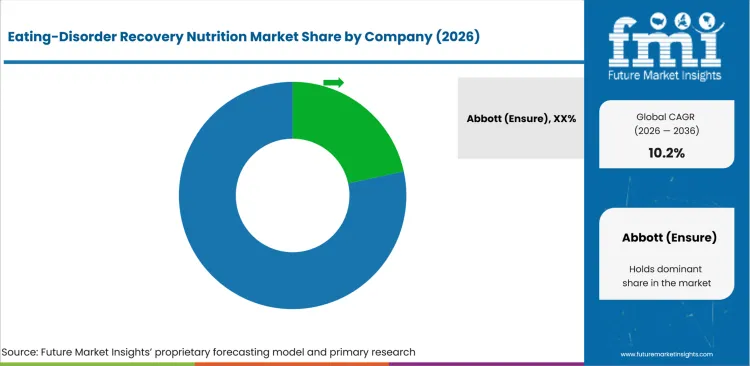
Competition centers on finished oral nutrition breadth, compact energy delivery, and supply continuity following intensive care. The register includes global medical-nutrition groups and smaller ONS specialists with documented clinical channels. Enteral nutrition is treated as adjacent capability and does not by itself establish oral recovery coverage.
- Global platforms such as Abbott, Danone, Nestlé, and Fresenius cover several finished nutrition routes. Specialists such as AYMES and Nualtra differentiate with compact drinks plus cream and pudding formats that can reduce serving volume.
- Kate Farms documents plant-based medical nutrition access, and Meiji serves Japan with compact high-nutrition finished formats.
Competitive Benchmarking: Eating-Disorder Recovery Nutrition Market
| Company | Finished ONS Portfolio Breadth | Compact / High-Density Format Evidence | Clinical-to-Home Access | Geographic Reach |
|---|---|---|---|---|
| Abbott Laboratories | High | High | High | Global |
| Danone S.A. (Nutricia) | High | High | High | Global |
| Nestlé Health Science | High | Medium | High | Global |
| Fresenius Kabi | High | High | High | Europe and international medical-nutrition markets |
| Kate Farms | Medium | Medium | High | United States |
| Ajinomoto Co., Inc. (Nualtra) | Medium | High | High | UK and Ireland |
| Meiji Co., Ltd. | Medium | High | Medium | Japan |
| AYMES Nutrition | High | High | High | United Kingdom |
Scoring basis: A High portfolio-breadth rating requires several documented finished oral nutrition formats in current company evidence. Medium marks a narrower documented range, and Low identifies one limited finished-product route. High compact-format evidence requires several concentrated or small-volume options documented in current company material. Medium requires one concentrated route, and Low indicates limited evidence for smaller-volume nutrition formats. High clinical-to-home access requires documented institutional use plus a continuing supply route outside the facility. Medium indicates partial channel continuity, and Low identifies a narrower documented path beyond institutional care.
Key Developments in the Eating-Disorder Recovery Nutrition Market
- In December 2025, Abbott Laboratories launched two new Ensure Max Protein shakes and extended its ready-to-drink adult nutrition range with higher-protein configurations.
- In July 2025, Danone S.A. completed its majority-stake acquisition of Kate Farms and extended specialized-nutrition reach into hospitals, home care, online, and retail channels.
- In March 2025, Kate Farms launched Kids Nutrition in select Target stores and on Target.com, expanding national retail access for its complete plant-based children's shake.
Key Players in the Eating-Disorder Recovery Nutrition Market
Global Medical-Nutrition Platforms
- Abbott Laboratories
- Danone S.A. (Nutricia)
- Nestlé Health Science
- Fresenius Kabi
Specialized Oral Nutrition Companies
- Kate Farms
- Ajinomoto Co., Inc. (Nualtra)
- Meiji Co., Ltd.
Complete and Compact ONS Specialist
- AYMES Nutrition
Eating-Disorder Recovery Nutrition Market - Report Scope
| Coverage field | Report scope |
|---|---|
| Market breakdown | By product type, care setting, diagnosis, end user, sales channel and region. |
| Quantitative Units | USD million. |
| Market Definition | Revenue from oral and adjacent medical-nutrition products purchased for eating-disorder recovery within the defined product, setting, diagnosis, end-user, and channel universe. Treatment-service fees, ordinary foodservice revenue, tube-feeding equipment, and unrelated consumer nutrition are excluded. |
| Regions Covered | North America, Latin America, Western Europe, Eastern Europe, East Asia, South Asia and Pacific, and Middle East and Africa. |
| Countries Covered | South Korea, UK, USA, Germany, Japan, and 20+ countries included in the full report. |
| Key Companies Profiled | Abbott Laboratories, Danone S.A. (Nutricia), Nestlé Health Science, Fresenius Kabi, Kate Farms, Ajinomoto Co., Inc. (Nualtra), Meiji Co., Ltd., AYMES Nutrition. |
| Forecast Period | 2026 to 2036. |
| Approach | Primary and secondary research with market triangulation. |
Eating-Disorder Recovery Nutrition Market - Research Methodology
| Method | Approach |
| Primary Research | FMI analysts gathered input from manufacturers, service providers, technology developers, distributors, end users, procurement teams, and subject-matter experts. Interviews examined purchasing decisions, product or service evaluation, adoption barriers, approval requirements, pricing considerations, and expectations for technical or commercial support. Respondents were also asked what evidence is required before a trial, pilot, or initial order develops into regular purchasing. |
| Desk Research | Desk research covered government statistics, regulatory publications, trade data, industry associations, technical literature, standards, company filings, product information, and official corporate announcements. Sources were reviewed for relevance, publication date, geographic coverage, and consistency with the defined market scope. Claims relating to performance, applications, approvals, capacity, investment, and commercial activity were retained only when supported by credible public evidence. |
| Market Sizing and Forecasting | The market model combined the baseline value with historical performance, segment structure, pricing and volume indicators, adoption levels, company participation, and country-level demand conditions. Forecast assumptions considered economic activity, investment trends, regulatory developments, technology adoption, purchasing cycles, supply availability, and barriers to wider market use. Segment and regional estimates were reconciled before the final market total was calculated. |
| Data Validation | Estimates were checked against multiple independent indicators, including public data, company activity, trade patterns, industry developments, and findings from primary interviews. Validation also tested whether products, services, applications, and company revenues fell within the defined market boundaries. Adjacent categories, unsupported claims, overlapping revenues, and activities without direct market relevance were excluded to reduce double counting and maintain consistency across segments and countries. |
Eating-Disorder Recovery Nutrition Market by Segments
Eating-Disorder Recovery Nutrition Market segmented by Product Type:
- Complete Balanced ONS
- Structured Refeeding Products
- Compact High-Calorie ONS
- Micronutrient Repletion (Refeeding-Safe)
- Others
Eating-Disorder Recovery Nutrition Market segmented by Care Setting:
- Inpatient & Residential
- PHP / IOP Programs
- Outpatient & Home
- Others
Eating-Disorder Recovery Nutrition Market segmented by Diagnosis:
- Anorexia Nervosa
- Bulimia & Binge-Purge Presentations
- OSFED & Others
Eating-Disorder Recovery Nutrition Market segmented by End User:
- Treatment Centers
- Hospitals
- Home / Family-Supported
- Others
Eating-Disorder Recovery Nutrition Market segmented by Sales Channel:
- Hospital Pharmacy
- Retail Pharmacy
- Online
- Institutional Tender
- Others
Eating-Disorder Recovery Nutrition Market by Region:
- North America
- United States
- Canada
- Latin America
- Brazil
- Mexico
- Chile
- Rest of Latin America
- Western Europe
- Germany
- United Kingdom
- Italy
- Spain
- France
- Nordics
- Benelux
- Rest of Western Europe
- Eastern Europe
- Russia
- Poland
- Hungary
- Balkan and Baltic States
- Rest of Eastern Europe
- East Asia
- China
- Japan
- South Korea
- South Asia and Pacific
- India
- ASEAN
- Australia and New Zealand
- Rest of South Asia and Pacific
- Middle East and Africa
- Kingdom of Saudi Arabia
- Other GCC Countries
- Türkiye
- South Africa
- Other African Union Countries
- Rest of Middle East and Africa
Research Sources and Bibliography
- NHS England. (2026, January 20). NHS staff to train teachers, school nurses, and GPs to spot eating disorders.
- Welch, R., Rao, T., Karakus, M., Scott, E., Doreson, A., & Ghose, S. S. (2026, January 22). State-Level Analysis of Access to Intensive Eating Disorder Care for Medicaid Beneficiaries.
- AYMES Nutrition. (2026, July 30). Introducing AYMES Rebrand Journey.
- Statistisches Bundesamt. (2026, August 11). Klinikbehandlungen von Essstörungen: 48,1 % sind 10- bis 17-jährige Mädchen.
- Buckinghamshire, Oxfordshire and Berkshire West Formulary. (2025, March). Adult oral nutritional supplement formulary positions.
- Royal College of Psychiatrists. (2026, February 26). RCPsych uncovers £2.1million planned spending cuts for children’s eating disorder services in England.
- Royal College of Psychiatrists. (2025, December). National Audit of Eating Disorders: Service mapping report 2025.
- Ministry of Food and Drug Safety, Republic of Korea. (2026, April 29).
- Substance Abuse and Mental Health Services Administration. (2026, May 20). Center of Excellence for Eating Disorders.
- Statistisches Bundesamt. (2025, August 11). Immer mehr junge Mädchen werden wegen Essstörungen stationär behandelt.
- National Center of Neurology and Psychiatry, Japan. (2025, August 1). Activity report: Nagano Prefecture eating-disorder support hub opening.
- Abbott. (2025, December 4). Muscles, the New Flex: Abbott Launches Two New Ensure Max Protein Shakes to Tap into Growing Muscle Health Movement.
- Danone. (2025, July 1). Danone completes the acquisition of Kate Farms, enhancing its USA specialized nutrition offerings.
- Kate Farms. (2025, March 12). Kate Farms Kids Nutrition Launches at Target: A New Standard for Kids Nutrition.
- Kate Farms. (2025, July 8). Kate Farms unveils new High Protein Nutrition Shake: Protein with purpose, built for real change.
- Nestlé. (2025, November 3). Nestlé accelerates open innovation in nutrition and health through academic collaborations and startups.
- Abbott. (2025, November 13). Abbott Launches New And Advanced Ensure Diabetes Care, A Clinically Proven Formula To Help Manage Blood Sugar.
- Kate Farms. (2025, September 23). Kate Farms Launches Kids Nutrition Line to Walmart: Making higher standards for families, easier to find.
- Meiji Co., Ltd. (2025, March 11).
- Abbott. (2026, May 13). Abbott launches Ensure Strength Pro in India to support healthy ageing.
- Nestlé. (2026, March 30). Nestlé introduces an innovative complete nutritional solution for children with special medical nutrition needs.
- Danone. (2025, February 25). Nutricia lanza Fortimel Plantbased Protein, un nuevo suplemento nutricional oral hiperproteico completamente vegetal para el manejo de la DRE.
- Kate Farms. (2025, November 10). Kate Farms Expands Access with Launch of High Protein Nutrition Shakes at Select Walmart Stores.
- Fresenius Kabi. (2026, March 18). Innovating in PLANT-BASED Nutrition.
- Nualtra. (2025, July 11). ARFID (Avoidant Restrictive Food Intake Disorder) Webinar 8th July 2025.
This Report Answers
- How large is the eating-disorder recovery nutrition market in 2026 and 2036?
- Which treatment-system changes increase demand for structured recovery nutrition?
- Why does complete balanced ONS lead the product type category?
- How does inpatient & residential care shape oral nutrition purchasing?
- Why does anorexia nervosa account for the largest diagnosis share?
- How do country growth rates differ among South Korea, UK, USA, Germany, and Japan?
- Which companies provide broad, compact, plant-based, or regionally focused medical-nutrition formats?
- Which refeeding, tolerance, reimbursement, and service-capacity frictions constrain repeat use?
Frequently Asked Questions
How big is the eating-disorder recovery nutrition market in 2026?
The eating-disorder recovery nutrition market is valued at USD 242.2 million in 2026 and is projected to reach USD 639.8 million by 2036. Growth follows rising entry into structured treatment and wider use of clinician-defined nutritional rehabilitation plans.
What is the CAGR of the eating-disorder recovery nutrition market from 2026 to 2036?
The eating-disorder recovery nutrition market is projected to grow at a CAGR of 10.2% between 2026 and 2036. Expansion depends on treatment access, prescribed weight-restoration support, and continuity from intensive care into community recovery.
Which product type leads the eating-disorder recovery nutrition market?
The complete balanced ONS segment is expected to hold 38.9% of the eating-disorder recovery nutrition market in 2026, driven by broad nutrient coverage in one format. Its leading position follows repeated clinician-supervised intake without requiring treatment teams to assemble several separate nutrition products.
Which countries are projected to record the highest growth in the eating-disorder recovery nutrition market?
South Korea is projected to grow at 10.4% CAGR, followed by the UK at 10.0% and USA at 9.7% through 2036. Their order-conversion routes differ as professional guidance, formularies, and payer structures are not equally centralized.
Which companies are active in the eating-disorder recovery nutrition market?
Key companies include Abbott Laboratories, Danone S.A. (Nutricia), Nestlé Health Science, Fresenius Kabi, Kate Farms, Ajinomoto Co., Inc. (Nualtra), Meiji Co., Ltd., and AYMES Nutrition. They compete on oral nutrition breadth, compact formats, clinical channels, and continuity from institutional care into home supply.
Preview the report firsthand - request a free sample
Get SampleGet the brochure for pricing and purchase details.
Get PDFTable of Content
- Key Takeaways
- Market Size and CAGR
- Top Growth Driver
- Fastest Growing Segment
- Leading Region
- Key Companies
- Emerging Opportunities
- Executive Summary
- Global Market Outlook
- Demand-side Trends
- Supply-side Trends
- Technology Roadmap Analysis
- Analysis and Recommendations
- Analyst Perspective (What is happening? Why now? What should investors know?)
- Key Questions Answered
- How large is the market?
- What is the CAGR?
- What are key trends?
- Which region dominates?
- Who are the leaders?
- Market Overview
- Market Coverage / Taxonomy
- Market Definition / Scope / Limitations
- Research Methodology
- Chapter Orientation
- Analytical Lens and Working Hypotheses
- Market Structure, Signals, and Trend Drivers
- Benchmarking and Cross-market Comparability
- Market Sizing, Forecasting, and Opportunity Mapping
- Research Design and Evidence Framework
- Desk Research Programme (Secondary Evidence)
- Expert Input and Fieldwork (Primary Evidence)
- Tooling, Models, and Reference Databases
- Data Engineering and Model Build
- Quality Assurance and Audit Trail
- Market Background
- Market Dynamics (Drivers, Restraints, Opportunity, Trends)
- Scenario Forecast (Optimistic, Likely, Conservative)
- Impact Analysis
- AI Impact
- Sustainability Impact
- Regulatory Impact
- Technology Impact
- Consumer / Buyer Analysis
- Purchase Drivers
- Adoption Barriers
- Buyer Journey
- Opportunity Map Analysis
- Product Life Cycle Analysis
- Supply Chain Analysis
- Investment Feasibility Matrix
- Value Chain Analysis
- PESTLE and Porter's Analysis
- Regulatory Landscape
- Regional Parent Market Outlook
- Production and Consumption Statistics
- Import and Export Statistics
- Global Market Analysis and Forecast, 2021 to 2036
- Historical Market Size Value (USD Million) Analysis, 2021 to 2025
- Current and Future Market Size Value (USD Million) Projections, 2026 to 2036
- Y-o-Y Growth Trend Analysis
- Absolute $ Opportunity Analysis
- Global Market Pricing Analysis, 2021 to 2036
- Global Market Analysis and Forecast, By Product Type, 2021 to 2036
- Introduction / Key Findings
- Historical Market Size Value (USD Million) Analysis By Product Type, 2021 to 2025
- Current and Future Market Size Value (USD Million) Analysis and Forecast By Product Type, 2026 to 2036
- Complete Balanced ONS
- Structured Refeeding Products
- Compact High-Calorie ONS
- Micronutrient Repletion (Refeeding-Safe)
- Others
- Complete Balanced ONS
- Y-o-Y Growth Trend Analysis By Product Type, 2021 to 2025
- Absolute $ Opportunity Analysis By Product Type, 2026 to 2036
- Global Market Analysis and Forecast, By Care Setting, 2021 to 2036
- Introduction / Key Findings
- Historical Market Size Value (USD Million) Analysis By Care Setting, 2021 to 2025
- Current and Future Market Size Value (USD Million) Analysis and Forecast By Care Setting, 2026 to 2036
- Inpatient & Residential
- PHP / IOP Programs
- Outpatient & Home
- Others
- Inpatient & Residential
- Y-o-Y Growth Trend Analysis By Care Setting, 2021 to 2025
- Absolute $ Opportunity Analysis By Care Setting, 2026 to 2036
- Global Market Analysis and Forecast, By Diagnosis, 2021 to 2036
- Introduction / Key Findings
- Historical Market Size Value (USD Million) Analysis By Diagnosis, 2021 to 2025
- Current and Future Market Size Value (USD Million) Analysis and Forecast By Diagnosis, 2026 to 2036
- Anorexia Nervosa
- Bulimia & Binge-Purge Presentations
- OSFED & Others
- Anorexia Nervosa
- Y-o-Y Growth Trend Analysis By Diagnosis, 2021 to 2025
- Absolute $ Opportunity Analysis By Diagnosis, 2026 to 2036
- Global Market Analysis and Forecast, By End User, 2021 to 2036
- Introduction / Key Findings
- Historical Market Size Value (USD Million) Analysis By End User, 2021 to 2025
- Current and Future Market Size Value (USD Million) Analysis and Forecast By End User, 2026 to 2036
- Treatment Centers
- Hospitals
- Home / Family-Supported
- Others
- Treatment Centers
- Y-o-Y Growth Trend Analysis By End User, 2021 to 2025
- Absolute $ Opportunity Analysis By End User, 2026 to 2036
- Global Market Analysis and Forecast, By Sales Channel, 2021 to 2036
- Introduction / Key Findings
- Historical Market Size Value (USD Million) Analysis By Sales Channel, 2021 to 2025
- Current and Future Market Size Value (USD Million) Analysis and Forecast By Sales Channel, 2026 to 2036
- Hospital Pharmacy
- Retail Pharmacy
- Online
- Institutional Tender
- Others
- Hospital Pharmacy
- Y-o-Y Growth Trend Analysis By Sales Channel, 2021 to 2025
- Absolute $ Opportunity Analysis By Sales Channel, 2026 to 2036
- Global Market Analysis and Forecast, By Region, 2021 to 2036
- Introduction
- Historical Market Size Value (USD Million) Analysis By Region, 2021 to 2025
- Current Market Size Value (USD Million) Analysis and Forecast By Region, 2026 to 2036
- North America
- Latin America
- Western Europe
- Eastern Europe
- East Asia
- South Asia and Pacific
- Middle East & Africa
- Market Attractiveness Analysis By Region
- North America Market Analysis and Forecast, By Country, 2021 to 2036
- Historical Market Size Value (USD Million) Trend Analysis By Market Taxonomy, 2021 to 2025
- Market Size Value (USD Million) Forecast By Market Taxonomy, 2026 to 2036
- By Country
- USA
- Canada
- By Product Type
- By Care Setting
- By Diagnosis
- By End User
- By Sales Channel
- By Country
- Market Attractiveness Analysis
- By Country
- By Product Type
- By Care Setting
- By Diagnosis
- By End User
- By Sales Channel
- Key Takeaways
- Latin America Market Analysis and Forecast, By Country
- Historical Market Size Value (USD Million) Trend Analysis By Market Taxonomy, 2021 to 2025
- Market Size Value (USD Million) Forecast By Market Taxonomy, 2026 to 2036
- By Country
- Brazil
- Mexico
- Chile
- Rest of Latin America
- By Product Type
- By Care Setting
- By Diagnosis
- By End User
- By Sales Channel
- By Country
- Market Attractiveness Analysis
- By Country
- By Product Type
- By Care Setting
- By Diagnosis
- By End User
- By Sales Channel
- Key Takeaways
- Western Europe Market Analysis and Forecast, By Country
- Historical Market Size Value (USD Million) Trend Analysis By Market Taxonomy, 2021 to 2025
- Market Size Value (USD Million) Forecast By Market Taxonomy, 2026 to 2036
- By Country
- Germany
- UK
- Italy
- Spain
- France
- Nordic
- BENELUX
- Rest of Western Europe
- By Product Type
- By Care Setting
- By Diagnosis
- By End User
- By Sales Channel
- By Country
- Market Attractiveness Analysis
- By Country
- By Product Type
- By Care Setting
- By Diagnosis
- By End User
- By Sales Channel
- Key Takeaways
- Eastern Europe Market Analysis and Forecast, By Country
- Historical Market Size Value (USD Million) Trend Analysis By Market Taxonomy, 2021 to 2025
- Market Size Value (USD Million) Forecast By Market Taxonomy, 2026 to 2036
- By Country
- Russia
- Poland
- Hungary
- Balkan & Baltic
- Rest of Eastern Europe
- By Product Type
- By Care Setting
- By Diagnosis
- By End User
- By Sales Channel
- By Country
- Market Attractiveness Analysis
- By Country
- By Product Type
- By Care Setting
- By Diagnosis
- By End User
- By Sales Channel
- Key Takeaways
- East Asia Market Analysis and Forecast, By Country
- Historical Market Size Value (USD Million) Trend Analysis By Market Taxonomy, 2021 to 2025
- Market Size Value (USD Million) Forecast By Market Taxonomy, 2026 to 2036
- By Country
- China
- Japan
- South Korea
- By Product Type
- By Care Setting
- By Diagnosis
- By End User
- By Sales Channel
- By Country
- Market Attractiveness Analysis
- By Country
- By Product Type
- By Care Setting
- By Diagnosis
- By End User
- By Sales Channel
- Key Takeaways
- South Asia and Pacific Market Analysis and Forecast, By Country
- Historical Market Size Value (USD Million) Trend Analysis By Market Taxonomy, 2021 to 2025
- Market Size Value (USD Million) Forecast By Market Taxonomy, 2026 to 2036
- By Country
- India
- ASEAN
- Australia & New Zealand
- Rest of South Asia and Pacific
- By Product Type
- By Care Setting
- By Diagnosis
- By End User
- By Sales Channel
- By Country
- Market Attractiveness Analysis
- By Country
- By Product Type
- By Care Setting
- By Diagnosis
- By End User
- By Sales Channel
- Key Takeaways
- Middle East & Africa Market Analysis and Forecast, By Country
- Historical Market Size Value (USD Million) Trend Analysis By Market Taxonomy, 2021 to 2025
- Market Size Value (USD Million) Forecast By Market Taxonomy, 2026 to 2036
- By Country
- Kingdom of Saudi Arabia
- Other GCC Countries
- Türkiye
- South Africa
- Other African Union
- Rest of Middle East & Africa
- By Product Type
- By Care Setting
- By Diagnosis
- By End User
- By Sales Channel
- By Country
- Market Attractiveness Analysis
- By Country
- By Product Type
- By Care Setting
- By Diagnosis
- By End User
- By Sales Channel
- Key Takeaways
- Key Countries Market Analysis
- USA
- Pricing Analysis
- Market Share Analysis, 2025
- By Product Type
- By Care Setting
- By Diagnosis
- By End User
- By Sales Channel
- Canada
- Pricing Analysis
- Market Share Analysis, 2025
- By Product Type
- By Care Setting
- By Diagnosis
- By End User
- By Sales Channel
- Mexico
- Pricing Analysis
- Market Share Analysis, 2025
- By Product Type
- By Care Setting
- By Diagnosis
- By End User
- By Sales Channel
- Brazil
- Pricing Analysis
- Market Share Analysis, 2025
- By Product Type
- By Care Setting
- By Diagnosis
- By End User
- By Sales Channel
- Chile
- Pricing Analysis
- Market Share Analysis, 2025
- By Product Type
- By Care Setting
- By Diagnosis
- By End User
- By Sales Channel
- Germany
- Pricing Analysis
- Market Share Analysis, 2025
- By Product Type
- By Care Setting
- By Diagnosis
- By End User
- By Sales Channel
- UK
- Pricing Analysis
- Market Share Analysis, 2025
- By Product Type
- By Care Setting
- By Diagnosis
- By End User
- By Sales Channel
- Italy
- Pricing Analysis
- Market Share Analysis, 2025
- By Product Type
- By Care Setting
- By Diagnosis
- By End User
- By Sales Channel
- Spain
- Pricing Analysis
- Market Share Analysis, 2025
- By Product Type
- By Care Setting
- By Diagnosis
- By End User
- By Sales Channel
- France
- Pricing Analysis
- Market Share Analysis, 2025
- By Product Type
- By Care Setting
- By Diagnosis
- By End User
- By Sales Channel
- India
- Pricing Analysis
- Market Share Analysis, 2025
- By Product Type
- By Care Setting
- By Diagnosis
- By End User
- By Sales Channel
- ASEAN
- Pricing Analysis
- Market Share Analysis, 2025
- By Product Type
- By Care Setting
- By Diagnosis
- By End User
- By Sales Channel
- Australia & New Zealand
- Pricing Analysis
- Market Share Analysis, 2025
- By Product Type
- By Care Setting
- By Diagnosis
- By End User
- By Sales Channel
- China
- Pricing Analysis
- Market Share Analysis, 2025
- By Product Type
- By Care Setting
- By Diagnosis
- By End User
- By Sales Channel
- Japan
- Pricing Analysis
- Market Share Analysis, 2025
- By Product Type
- By Care Setting
- By Diagnosis
- By End User
- By Sales Channel
- South Korea
- Pricing Analysis
- Market Share Analysis, 2025
- By Product Type
- By Care Setting
- By Diagnosis
- By End User
- By Sales Channel
- Russia
- Pricing Analysis
- Market Share Analysis, 2025
- By Product Type
- By Care Setting
- By Diagnosis
- By End User
- By Sales Channel
- Poland
- Pricing Analysis
- Market Share Analysis, 2025
- By Product Type
- By Care Setting
- By Diagnosis
- By End User
- By Sales Channel
- Hungary
- Pricing Analysis
- Market Share Analysis, 2025
- By Product Type
- By Care Setting
- By Diagnosis
- By End User
- By Sales Channel
- Kingdom of Saudi Arabia
- Pricing Analysis
- Market Share Analysis, 2025
- By Product Type
- By Care Setting
- By Diagnosis
- By End User
- By Sales Channel
- Türkiye
- Pricing Analysis
- Market Share Analysis, 2025
- By Product Type
- By Care Setting
- By Diagnosis
- By End User
- By Sales Channel
- South Africa
- Pricing Analysis
- Market Share Analysis, 2025
- By Product Type
- By Care Setting
- By Diagnosis
- By End User
- By Sales Channel
- USA
- Market Structure Analysis
- Competition Dashboard
- Competition Benchmarking
- Market Share Analysis of Top Players
- By Regional
- By Product Type
- By Care Setting
- By Diagnosis
- By End User
- By Sales Channel
- Emerging Startups
- Innovation Benchmarking
- Competition Analysis
- Competition Deep Dive
- Abbott (Ensure)
- Overview
- Product Portfolio
- Profitability by Market Segments
- Sales Footprint
- Strategy Overview
- Marketing Strategy
- Product Strategy
- Channel Strategy
- Nestle Health Science (Boost)
- Danone Nutricia (Fortisip)
- Kate Farms
- OWYN
- Aymes
- Nualtra
- Medtrition
- Abbott (Ensure)
- Case Studies
- Success Stories
- Recent Developments
- Competition Deep Dive
- Assumptions & Acronyms Used


