

- Industry Size (2026)
- USD 8.7 Bn
- Forecast (2036)
- USD 18.0 Bn
- CAGR (2026 to 2036)
- 6.8%
Therapeutic Food Delivery for Clinical Nutrition Market Size, Market Forecast and Outlook By FMI
The therapeutic food delivery for clinical nutrition market was valued at USD 8.7 billion in 2025. Demand is set to cross USD 9.3 billion in 2026 at a CAGR CAGR of 6.8% over the forecast period. Market valuation is set to reach USD 18.0 billion in 2036 as payers integrate prescribed meal regimens into core post-discharge pathways and are no longer treating these meals as optional supplemental benefits.
Hospital discharge planners face increasing readmission penalties. These penalties necessitate the securement of reliable homecare clinical nutrition services. Such services require authorization prior to patient release. Care coordinators must vet clinical nutrition delivery providers. These providers must assure cold-chain integrity. Protocol-specific dietary compliance must be guaranteed directly to patient doorsteps.
Summary of therapeutic food delivery for clinical nutrition market
- Market Snapshot
- The therapeutic food delivery for clinical nutrition market is valued at USD 8.7 billion in 2025. It is projected to reach USD 18.0 billion by 2036.
- The industry is expected to grow at a 6.8% CAGR from 2026 to 2036. This creates an incremental opportunity of USD 8.7 billion over the period.
- This market covers organized delivery of enteral formulas and oral nutritional supplements. It includes medically tailored meals and disease-specific nutrition foods. These are supplied under medical or dietitian supervision mainly outside acute hospitals.
- The category is compliance-led and care-pathway-driven. Reimbursement, clinical referral, formula tolerance, and homecare logistics matter more than retail merchandising.
- Demand and Growth Drivers
- Demand is rising because health systems are shifting recovery and chronic disease management into the home. This increases the need for delivered therapeutic nutrition after discharge.
- Medically tailored meals are gaining stronger adoption. Industry analysis links them with lower healthcare utilization and lower expenditure in high-risk populations.
- Enteral and oral clinical nutrition delivery is expanding. Post-discharge malnutrition management and home-enteral follow-up are being more formally recognized in China, the UK, Australia, and other community-care systems.
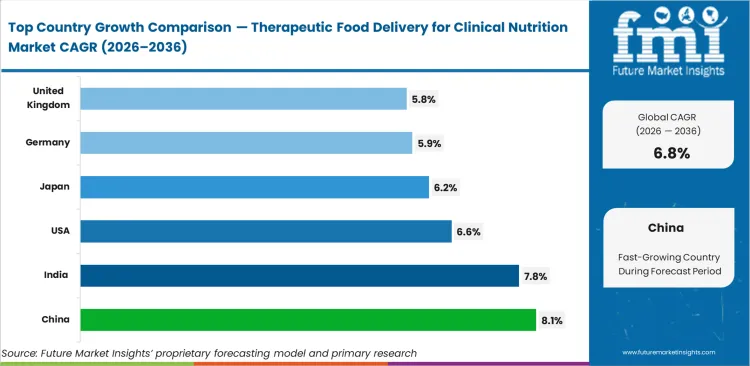
- Among key countries, China is set to expand at an 8.1% CAGR by 2036. India follows at 7.8%, United States at 6.6%, Australia at 6.5%, Japan at 6.2%, Germany at 5.9%, and United Kingdom at 5.8% CAGR through 2036.
- Growth is moderated by reimbursement variability and physician referral friction. The operational cost of cold-chain or diet-specific last-mile delivery for fragile patients acts as a restraint.
- Product and Segment View
- The market covers oral and tube-fed nutrition products plus medically tailored ready meals. These are designed mainly for malnutrition, diabetes, oncology recovery, dysphagia, gastrointestinal impairment, and renal support.
- These products are used across post-acute home recovery and long-term care transitions. They are used in chronic disease management, oncology care, and community-based nutrition support.
- Enteral formulas lead the Product Type segment with a 39.4% share. Tube-feeding regimens are the most protocolized and recurring form of delivered clinical nutrition.
- Oncology leads the Indication segment with a 24.1% share. Cancer treatment pathways frequently require sustained supplemental or tube-fed nutrition support.
- Homecare providers lead the Channel segment with a 46.7% share. They combine prescription handling, benefits checks, caregiver support, and repeat delivery.
- Post-acute home leads the Care Setting segment with a 48.9% share. Discharge shortening pushes more nutrition therapy into home-based recovery windows.
- Adult patients lead the End User segment with a 72.6% share. This reflects the concentration of chronic disease, surgical recovery, metabolic disorders, and oncology burden in adults.
- Scope includes prescribed home delivery of nutrition products and meals. It excludes in-hospital parenteral admixtures, ordinary wellness shakes, and non-clinical grocery subscriptions.
- Geography and Competitive Outlook
- China, India, and the United States are the fastest-scaling national markets. Germany and the United Kingdom remain stable high-value bases. They maintain mature reimbursement and established homecare pathways.
- Portfolio breadth, reimbursement navigation, and home-service capability shape competition. Key participants include Abbott, Nestlé Health Science, Danone Nutricia, Fresenius Kabi, Mom’s Meals, GA Foods, and Performance Kitchen.
- Abbott holds the largest estimated share. The wider market remains moderately fragmented. Delivered nutrition includes global formula suppliers and regional food-as-medicine operators.
- The strongest competitive advantage sits with companies combining clinical formulation and insurance coverage support. Dependable last-mile delivery is required rather than product manufacturing alone.
Therapeutic Food Delivery for Clinical Nutrition Market Key Takeaways
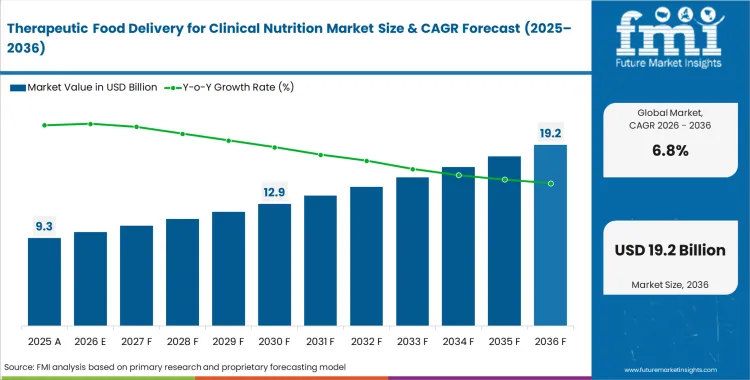
- 2025 market size: USD 8.7 billion
- 2026 market size: USD 9.3 billion
- 2036 forecast: USD 18.0 billion
- CAGR: 6.8%
- Top product type: Enteral formulas (39.4%)
- Top indication: Oncology (24.1%)
- Top channel: Homecare providers (46.7%)
- Top care setting: Post-acute home (48.9%)
- Top end user: Adult patients (72.6%)
| Metric | Details |
|---|---|
| Industry Size (2026) | USD 9.3 billion |
| Industry Value (2036) | USD 18.0 billion |
| CAGR (2026 to 2036) | 6.8% |
Source: Future Market Insights (FMI) analysis, based on proprietary forecasting model and primary research
Failure to establish this logistical link extends expensive inpatient stays by days. This failure modifies the therapeutic food delivery forecast trajectory. Procurement teams often underestimate last-mile logistics. Logistics determine vendor selection more significantly than formula price. Procuring ready to use therapeutic food requires specialized handling. General transportation providers routinely fail to execute this handling. Procurement departments assume clinical formulation superiority secures contracts. Patients abandon optimal formulations if delivery schedules do not align with their availability. Evaluating therapeutic food delivery key players requires assessing routing algorithms. This assessment holds greater importance than evaluating ingredient lists.
Medicare advantage plans mandate specific health-related social needs benefits. These benefits target chronic populations. Payer-funded nutrition support frees up capital for specialized kitchens. These kitchens facilitate the scaling of regional distribution networks. Beneficiaries move away from relying on fragmented local charities. They begin using standardized commercial delivery networks. This transition shifts tailored diets from a niche out-of-pocket expense. It becomes a predictable institutional procurement category. Assessing therapeutic food delivery size expansion relies on tracking policy adoptions.
China expands at 8.1% by expanding post-discharge pathways, followed by India advancing at 7.8%. United States payers support a 6.6% trajectory. They integrate therapeutic food delivery directly into chronic care programs. Australia is set to exhibit 6.5%. Japan grows at 6.2% by optimizing geriatric homecare logistics. Germany advances at 5.9% relying on robust statutory health coverage. United Kingdom maintains 5.8% as established homecare operators saturate zones. This creates a clear split between capacity-constrained mature systems. It contrasts with infrastructure-building Asian networks.
Segmental Analysis
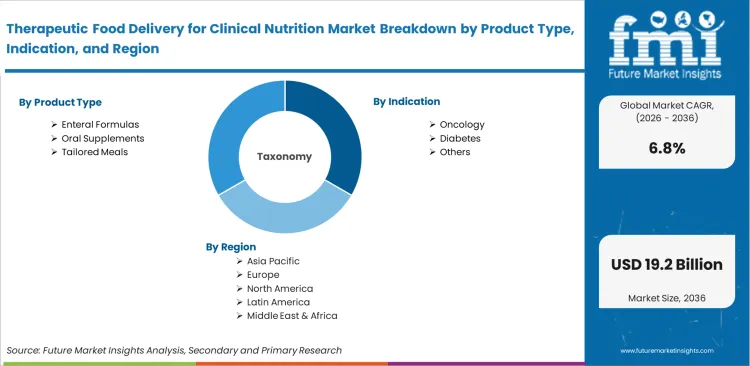
Therapeutic Food Delivery for Clinical Nutrition Market Analysis by Product Type
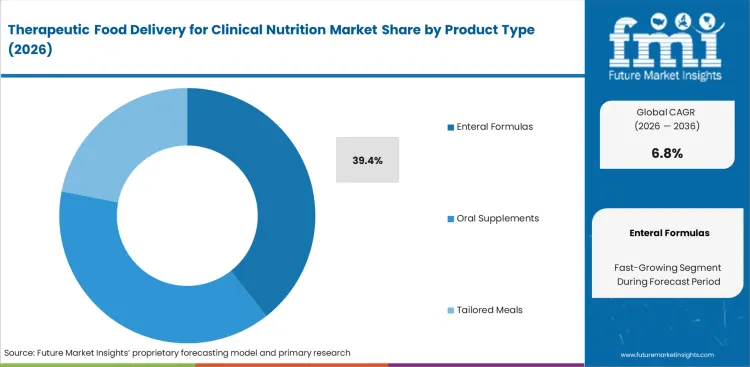
Clinical dietitians consistently encounter a conflict. Selection of highly specialized formulas occurs. Assurance regarding reliable patient access to specific products remains mandatory. Discharge planners cannot release gastrostomy patients without a guaranteed, locked-in supply chain. Exact medical food matches are essential. Reliance on generic home delivery networks frequently causes critical missed feedings. Health economists often misinterpret long-term patient constraints. Pump hardware creates actual vendor lock-in for long-term patients. Liquid formulas avoid this lock-in scenario. Changing a pediatric patient's formulation frequently demands switching proprietary pumps. This logistical impediment compels care teams to maintain incumbent suppliers. Incumbent suppliers are maintained despite lower-cost alternatives. The enteral formulas segment is estimated to account for a 39.4% revenue share in 2026 attributed to tube-feeding prescriptions that require rigid, non-substitutable fulfillment. Assessment of the enteral nutrition home delivery landscape requires evaluation of equipment friction. Homecare departments underestimating equipment transition costs face difficulties. Shifting patient bases becomes a struggle. Volume ultimately concedes to integrated providers.
- Discharge initiation: Hospital nutrition teams select exact formula specifications based on inpatient tolerance trials. Care coordinators must locate a regional distributor carrying that exact SKU. They do this before signing discharge paperwork. This links clinical decisions to localized inventory availability.
- Reimbursement validation: Insurance case managers scrutinize specific diagnostic codes to approve ongoing enteral feeding devices. Procurement specialists spend immense administrative effort appealing initial denials. Seamless benefit navigation becomes a critical vendor selection criterion.
- Long-term renewal: Dietitians adjusting caloric requirements prefer keeping patients within identical manufacturer portfolios. This avoids equipment swaps. Operations departments secure predictable recurring revenue streams. They ensure seamless monthly tube feeding formula replenishment without administrative friction.
Therapeutic Food Delivery for Clinical Nutrition Market Analysis by Indication
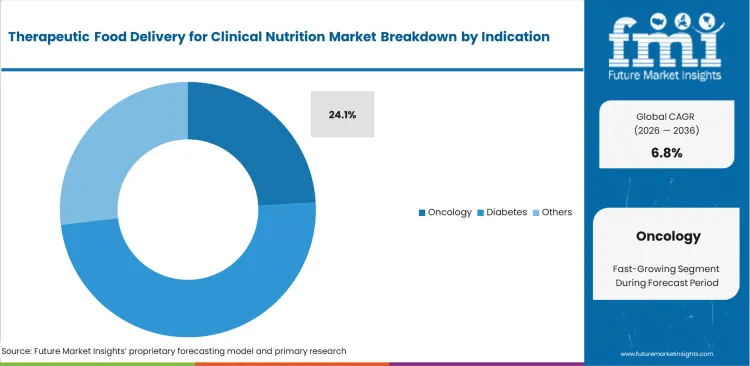
Outpatient oncology departments must determine weight maintenance strategies. They manage patients during aggressive chemotherapy cycles. Oral intake drops precipitously during these cycles. The oncology segment is likely to account for a 24.1% revenue share in 2026, as oncologists increasingly prescribe parenteral nutrition and specialized oral supplements because these are mandatory treatment components rather than optional comfort measures. Clinical coordinators require rapid deployment of nutritional support. They must prevent treatment delays caused by severe weight loss. This accelerates oncology nutrition delivery adoption. Generalist meal fulfillment services lack specific high-protein profiles. They lack taste-modified profiles required by patients experiencing severe dysgeusia. Hidden operational bottlenecks occur frequently. Oncology patients require frequent mid-cycle dietary adjustments. This renders standard thirty-day fixed subscription models completely ineffective. Care coordinators navigating rigid logistics platforms hold unusable inventory. They hold this inventory while patients deteriorate. Providers unable to offer forty-eight-hour prescription modification windows fail. They lose lucrative oncology center referrals entirely.
- Taste profile tolerance: Clinical dietitians evaluate formulations strictly on patient compliance during severe taste alteration phases. Product managers must formulate highly palatable Latin America oral supplements. Failure risks immediate patient rejection and triggers rapid physician discontinuation orders.
- Caloric density delivery: Oncologists require maximum nutrient concentration in minimal fluid volumes for nauseous patients. R&D departments push viscosity limits to achieve target profiles. Overly dense formulations occasionally cause gastrointestinal distress requiring urgent dietary plan recalibration.
- Formulary inclusion standards: Hospital procurement committees demand rigorous clinical trial data demonstrating weight maintenance efficacy. They demand this before authorizing outpatient coverage. Operations departments failing to present compelling peer-reviewed evidence face total exclusion.
Therapeutic Food Delivery for Clinical Nutrition Market Analysis by Channel
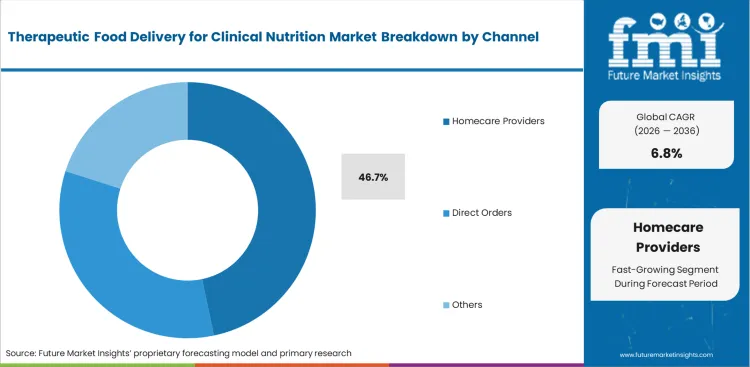
Profound integration into intricate billing structures accounts for the dominance of dedicated homecare networks. The homecare providers segment is expected to hold a 46.7% revenue share in 2026, as homecare providers successfully bundle equipment provision and clinical instruction. Ongoing consumable fulfillment is bundled into a single accountable entity, supporting this composite expansion. Hospital discharge planners predominantly route complex patients to these networks. Seamless care transition and liability transfer are ensured. Managing pumps using a single vendor creates dangerous logistical gaps. Local pharmacy fluid management exacerbates these issues for compromised individuals.
- Specialized fleet deployment: Operations departments manage dedicated temperature-controlled vehicles required for specific medical formulations. Regional dispatchers face extreme scheduling complexity, and route time-sensitive children enteral nutrition deliveries around specific patient availability windows.
- Inventory buffer requirements: Supply chain managers must maintain high safety stock levels of specialized formulations. This prevents life-threatening stockouts. Procurement teams navigating unpredictable global supply chain disruptions must constantly source secondary manufacturers.
- Consolidation trajectory: Regional health systems increasingly prefer contracting with singular national entities. These entities must cover broad geographic footprints. Local operations departments must merge with larger platforms to survive ongoing procurement consolidation.
Therapeutic Food Delivery for Clinical Nutrition Market Analysis by Care Setting
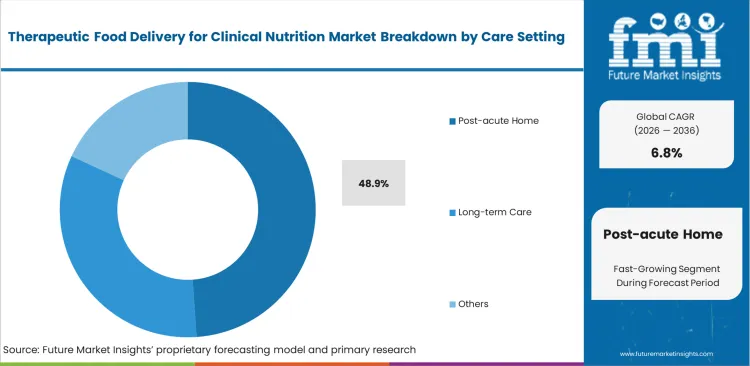
Inpatient recovery windows face continuous pressure for compression, consequently moving higher-acuity nutritional management directly into residential environments. Aggressive transition plans must execute without triggering readmissions. Managing an enteral formula regimen within a domestic kitchen necessitates packaging and training protocols entirely different from those in a structured nursing facility. Competitors offering integrated telehealth monitoring rapidly acquire health system contracts from organizations failing in this manner. The post-acute home segment is expected to account for 48.9% revenue share in 2026, as care coordinators discharge patients with complex feeding tubes several days earlier. Hospital administrators rely on specialized delivery networks for safe execution of these aggressive transition plans.
- Cold-chain breakdown: Logistics managers routing medically tailored meals face severe spoilage risks. Domestic recipients miss delivery windows occasionally. Quality assurance departments must implement expensive thermal packaging solutions. Compromised oral clinical nutritional cream shipments immediately trigger costly full-order replacements.
- Caregiver administration errors: Visiting nurses frequently discover informal caregivers storing formulations incorrectly despite initial training. Clinical education departments must develop intuitive instructional materials. These mitigate dangerous procedural deviations in uncontrolled home environments.
- Proactive intervention tracking: Case managers must actively monitor recurring order patterns to detect subtle signs of patient non-compliance. Operations teams failing to flag missed refills miss critical opportunities. They fail to intervene before severe malnutrition forces expensive emergency department admissions.
Therapeutic Food Delivery for Clinical Nutrition Market Analysis by End User
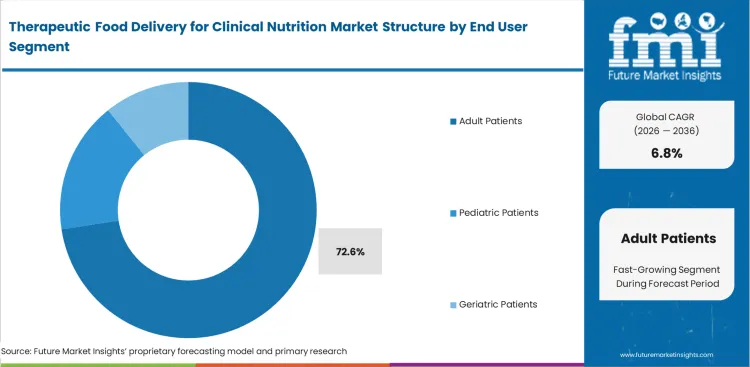
Poorly planned family meal preparations quickly become insufficient for meeting complex metabolic requirements. Elderly populations managing various chronic illnesses require this support. The patient segment comprising adults is likely to account for 72.6% share in 2026, because structured nutritional interventions, authorized by medicaid programs, increasingly support this overall market expansion. These nutritional interventions substitute expensive emergency medical treatments. Health plan organizations recognize funding precise dietary support costs significantly less. Less expense is incurred compared to treating avoidable diabetic or renal emergencies. Providing appropriate nutrition for ASEAN oral supplements demographics necessitates addressing unique cultural preferences. It also requires adherence to strict macro-nutrient limitations. Large suppliers consistently underestimate the impact of meal monotony among chronically ill adults.
- Preventative expenditure offset: Medicaid program departments authorize upfront spending on tailored meal delivery. This drastically reduces downstream hospitalization costs. Actuarial teams continuously analyze claims data to prove specific nutritional interventions yield positive returns.
- Hidden distribution overhead: Operations departments combat severe margin erosion. This is caused by high costs of specialized final-mile delivery to remote patients. Finance departments must constantly optimize routing algorithms. This prevents rural oral clinical nutrition desserts fulfillment from becoming financially unsustainable.
- Lifecycle value realization: Account executives secure maximum profitability by retaining chronic patients. They retain them across multi-year therapeutic trajectories. Customer success managers must proactively manage flavor fatigue and minor logistical hiccups.
Therapeutic Food Delivery for Clinical Nutrition Market Drivers, Restraints, and Opportunities
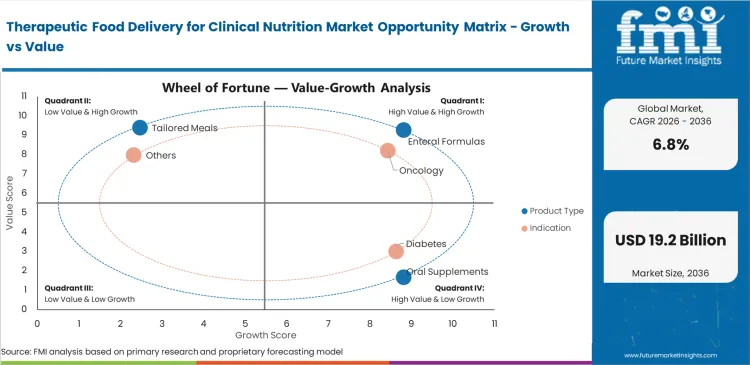
High readmission rates expose hospital administration to severe financial penalties. Discharge planning personnel must therefore establish reliable home-based feeding logistics prior to authorizing the release of complex patients. Care coordinators cannot merely issue a prescription; verification of specialized formulation arrival at the residential address is essential. Coordination delays extend costly inpatient stays by several days, severely impacting departmental margins. The continuous compression of acute care windows intensifies the urgency for dependable United States oral supplements supply chain establishment.
Severe operational friction arises from complex reimbursement documentation requirements. This friction impedes adoption despite strong clinical impetus for initiating home nutrition support. Finance departments at homecare agencies experience difficulty with the intricate pre-authorization protocols. Various commercial and government payers mandate these highly variable protocols. Insurers intentionally maintain rigorous validation hurdles to manage specialized nutrition expenditures. Automated medical nutrition verification software provides partial relief. High denial rates for nuanced clinical indications necessitate agencies maintaining substantial manual billing departments. This outcome severely limits the speed of patient onboarding. Operations departments find scalability of service footprints unprofitable. National payer architectures require standardization of authorization codes across all regional jurisdictions as a precursor.
The imperative to reduce costly hospital readmissions drives demand for reliable home nutrition logistics. Second, the escalating complexity of specialized nutritional formulations necessitates meticulous supply chain management from hospital discharge to patient residence. Finally, the inherent difficulty of navigating varied and rigorous insurance pre-authorization protocols pushes the market toward solutions that streamline financial and operational processes for homecare providers.
Opportunities in the Therapeutic Food Delivery for Clinical Nutrition Market
- Medicaid waiver expansion: Policy departments advocate for broader Section 1115 inclusion to fund specialized meal deliveries. Regional operations departments secure massive captive patient populations. States formally integrate value based care meal delivery programs to enable this.
- Oncology-specific pathway integration: Clinical dietitians design highly customized nutritional support protocols for specific chemotherapy regimens. Product managers developing targeted parenteral formula solutions command premium pricing. They secure exclusive oncology center referrals through specialized formulations.
- Logistics routing optimization: Supply chain departments implement advanced predictive routing software. This software handles complex temperature-controlled fulfillment. Fleet managers reduce last-mile overhead costs significantly. This enables profitable service expansion into previously unserviceable suburban geographic zones.
Regional Analysis
.webp "Top Country Growth Comparison Therapeutic Food Delivery For Clinical Nutrition Market Cagr (2026 2036)")
Based on regional analysis, the therapeutic food delivery for clinical nutrition market is segmented. It covers North America, Europe, Asia Pacific, Latin America, and Middle East & Africa. It spans across 40 plus countries.
| Country | CAGR (2026 to 2036) |
|---|---|
| China | 8.1% |
| India | 7.8% |
| United States | 6.6% |
| Japan | 6.2% |
| Germany | 5.9% |
| United Kingdom | 5.8% |
Source: Future Market Insights (FMI) analysis, based on proprietary forecasting model and primary research
North America Therapeutic Food Delivery for Clinical Nutrition Market Analysis
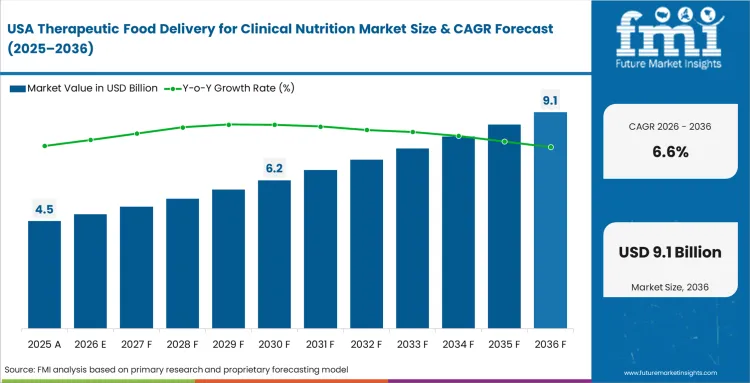
Medicare advantage plans redefine North America nutritional support. Plans embed customized meal benefits directly into primary chronic care payment structures. This transition elevates specialized food delivery from disparate philanthropic initiatives. It becomes a rigorously regulated institutional purchasing category. Care coordinators authorize recurring deliveries. This action lessens severe subsequent medical interventions.
- United States: Health plans use Section 1115 waivers for financing extensive medically tailored meal interventions. Interventions focus on elevated-risk patient populations. The United States market is forecast to register a CAGR of 6.6% over the forecast period, driven by operation departments navigating the intricate payer environment, supported by extensive Medicare Advantage growth, and prioritizing vendors capable of generating seamless compliant billing documentation. Procurement teams prioritize a vendor's capability to generate compliant billing documentation seamlessly; this factor outweighs actual meal unit costs. Businesses must navigate fifty distinct United States therapeutic food delivery state frameworks.
Europe Therapeutic Food Delivery for Clinical Nutrition Market Analysis
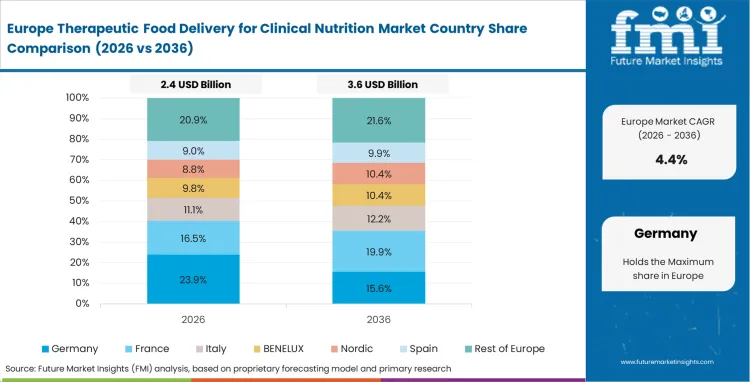
Statutory health systems across Europe maintain rigorous formulary inclusion standards. These standards strictly govern outpatient nutritional reimbursements. Hospital procurement committees demand extensive clinical validation before authorizing homecare product adoption. Operational challenges for suppliers involve navigating dense and highly regulated geographic zones. Established homecare networks already control patient access points in these zones. Clinical dietitians operate within mature guidelines leaving minimal whitespace for unproven formulations. Success in this environment requires specialized operations departments to execute flawlessly. They must manage intricate localized delivery schedules. Minor logistical failures immediately jeopardize long-standing institutional contracts. These failures trigger severe administrative penalties. National health authorities continuously audit these providers. They ensure statutory funds deliver measurable therapeutic outcomes. The Europe segment sustains value through strict compliance.
- Germany: Strict statutory health insurance frameworks, clinically validated outpatient nutritional interventions coverage, and reliance on stable public funding mechanisms for finance departments support a steady 5.9% CAGR during the forecast period. Strong statutory mandates support this CAGR, allowing suppliers successfully navigating rigorous federal qualification procedures to secure long-term revenue streams, remaining highly predictable and immune to broader economic fluctuations.
- United Kingdom: National health trust discharge planners' heavy utilization of established homecare services, efforts to free up critical inpatient bed capacity, and logistics managers' operation within saturated geographic zones are key factors pushing the sector in UK to register a CAGR of 5.8% during the forecast period. Established homecare frameworks support this CAGR, with ongoing capacity constraints within national health infrastructure forcing administrators to adapt by pushing increasingly complex feeding regimens into community settings.
Asia Pacific Therapeutic Food Delivery for Clinical Nutrition Market Analysis
Provincial health commissions across Asia Pacific actively transition from fragmented hospital-centric feeding models. They move toward formalized community nutrition guidelines. Hospital administrators in dense urban centers face immense pressure to clear acute beds. This necessitates robust home-based discharge protocols. Rapid development of specific regulatory frameworks for specialized medical foods provides suppliers legal clarity. This clarity is required to invest in regional distribution infrastructure. Generalist logistics networks are upgrading capabilities to handle cold-chain requirements. This supports secure delivery of sensitive europe oral supplements to suburban populations. This modernization shifts dynamics from ad-hoc family sourcing. It moves to structured and physician-directed home fulfillment. This fundamentally alters regional healthcare systems managing chronic malnutrition and post-surgical recovery. Finance departments anticipate higher upfront costs. They expect these costs to rapidly offset long-term acute care expenditures. The Asia Pacific segment grows rapidly.
- China: Post-discharge nutrition guidelines rapidly expand from top-tier urban hospitals into regional care centers, requiring discharge planners to utilize dependable local distributors for newly formalized pathways. China industry revenue is poised to grow at a rate of 8.1% during the forecast period, supported by provincial health investments and accelerated institutional dependency due to provincial health authorities formalizing frameworks for organized clinical nutrition delivery networks throughout this decade.
- India: Corporate hospital networks are aggressively extending outpatient care models to capture long-term chronic disease management revenue. Supply chain directors building reliable cold-chain logistics in urban centers support the country’s estimated revenue expansion rate of 7.8% during the forecast period. Logistics providers successfully establishing specialized medical delivery capabilities will dominate lucrative tier-one city post-acute care contracts.
- Japan: Care coordinators managing advanced demographic aging curves demand highly optimized geriatric homecare logistics, necessitating operations departments to refine last-mile delivery protocols supporting frail populations. Japan industry is set to grow at a rate of 6.2% during the forecast period, supported by high geriatric care demand, domestic logistics providers holding specialized medical transport certifications, and maintenance of near-impenetrable competitive moats against new entrants attempting to service complex older demographics.
- Australia: In Australia, clinical dietitians depend on well‑structured community enteral support programs to effectively manage patients requiring long‑term feeding tubes. Revenue growth of Australia is expected to expand at a rate of 6.5% during the forecast period, due to consistent funding from national health authorities. By refining and streamlining these established care pathways, regional operations managers are able to significantly lower avoidable emergency department readmissions, particularly among vulnerable rural and suburban populations with compromised nutritional or medical status.
Competitive Aligners for Market Players
Logistics scale dictates competitive survival in this landscape far more than minor formulation advantages. Abbott, Nestlé Health Science, and Danone Nutricia command significant influence. They maintain vast and deeply entrenched distribution networks capable of fulfilling complex prescriptions. Hospital procurement departments evaluate these suppliers on their ability to guarantee uninterrupted home deliveries. They treat logistical reliability as primary qualification criteria.
Deeply integrated reimbursement navigation capabilities provide established incumbents with almost insurmountable barriers against new entrants. Maintaining specialized billing departments capable of processing obscure Medicare claims requires immense capital. It requires vast experiential knowledge. Operations departments at smaller organizations attempting to penetrate this sector routinely fail. They underestimate administrative burdens of validating insurance eligibility for oral supplements share analysis authorizations. Incumbents leverage historical claims data to predict denial patterns and optimize routing efficiency. This creates self-reinforcing operational advantages. Pure-play food manufacturers cannot replicate these through capital expenditure alone. Assessing medically tailored meal vendors for health plans requires verifying their billing infrastructure. They must do this prior to tasting their menus.
Large payer networks and consolidated health systems actively resist vendor lock-in. They design procurement contracts to demand interoperability and standardized reporting. Supply chain departments intentionally qualify multiple top medically tailored meal companies for Medicaid plans. They do this to maintain pricing leverage and ensure backup capacity during localized logistics failures. Dominant suppliers embed proprietary digital ordering platforms directly into hospital electronic medical record systems. They do this to maintain influence and subtly increase administrative friction.
Key Players in Therapeutic Food Delivery for Clinical Nutrition Market
- Abbott
- Nestlé Health Science
- Danone Nutricia
- Fresenius Kabi
- Mom’s Meals
- GA Foods
- Performance Kitchen
Scope of the Report
| Metric | Value |
|---|---|
| Quantitative Units | USD 9.3 billion to USD 18.0 billion, at a CAGR of 6.8% |
| Market Definition | The therapeutic food delivery for clinical nutrition market comprises organized logistical distribution of medically prescribed nutritional regimens directly to patients outside acute inpatient environments. It requires specific compliance mechanisms linking physician orders, reimbursement validation, and specialized handling. |
| Segmentation | Product Type, Indication, Channel, Care Setting, End User, and Region |
| Regions Covered | North America, Europe, Asia Pacific, Latin America, Middle East & Africa |
| Countries Covered | United States, Canada, Germany, United Kingdom, France, Italy, Spain, China, Japan, South Korea, Taiwan, Singapore, Brazil, Mexico, Argentina, GCC Countries, South Africa, Israel, Rest of Middle East & Africa |
| Key Companies Profiled | Abbott, Nestlé Health Science, Danone Nutricia, Fresenius Kabi, Mom’s Meals, GA Foods, Performance Kitchen |
| Forecast Period | 2026 to 2036 |
| Approach | Triangulating active community patient prevalence with documented payer program enrollments, Medicare/Medicaid policy expansion models, and vendor revenue disclosures. |
Source: Future Market Insights (FMI) analysis, based on proprietary forecasting model and primary research
Therapeutic Food Delivery for Clinical Nutrition Market Analysis by Segments
Product Type
- Enteral formulas
- Oral supplements
- Tailored meals
- Disease foods
Indication
- Oncology
- Diabetes
- Dysphagia
- GI disorders
- Renal disease
Channel
- Homecare providers
- Hospital discharge
- Payer programs
- Direct orders
Care Setting
- Post-acute home
- Long-term care
- Community clinics
- Oncology centers
End User
- Adult patients
- Pediatric patients
- Geriatric patients
Region
- North America
- United States
- Canada
- Europe
- Germany
- United Kingdom
- France
- Italy
- Spain
- Asia Pacific
- China
- Japan
- South Korea
- Taiwan
- Singapore
- Latin America
- Brazil
- Mexico
- Argentina
- Middle East & Africa
- GCC Countries
- South Africa
- Israel
- Rest of Middle East & Africa
Bibliography
- USA Department of Health and Human Services, Office of Disease Prevention and Health Promotion. (2024). Food is medicine landscape summary.
- Centers for Medicare & Medicaid Services. (2024, December). Coverage of nutrition interventions under Medicaid and the Children’s Health Insurance Program.
- Washington State Health Care Authority. (2026, January). Enteral nutrition billing guide.
- Clark, J. M., Berkowitz, S. A., Hager, E. R., Yeh, H. C., de Boer, I. H., Appel, L. J., Segal, J. B., Russell, S. D., Sterling, M. R., & Sherman, R. L. (2024, December). Impact of medically tailored meals on clinical outcomes among low-income adults with type 2 diabetes: A pilot randomized controlled trial. Journal of General Internal Medicine.
- Compher, C., Karmally, W., Evans, S., Mittman, N., Seidelmann, S. B., Gillett, S., Guetterman, H. M., Popp, C. J., Silver, A., Beidler, J., & Park, J. (2025, March). The nutritional impact of 7 versus 21 home-delivered medically tailored meals in patients with heart failure and malnutrition risk: A random order crossover feeding trial (MEDIMEALS). BMC Nutrition.
- Bahat, G., et al (2026, February). Nutritional care using oral nutritional supplements: 22 recommendations from a global multidisciplinary working group. Clinical Nutrition.
This bibliography is provided for reader reference. The full FMI report contains the complete reference list with primary source documentation.
Frequently Asked Questions
What is therapeutic food delivery in clinical nutrition?
Therapeutic food delivery involves the organized logistical distribution of medically prescribed or dietitian-governed nutritional regimens directly to patients outside acute inpatient environments, requiring strict compliance with physician orders and specialized handling.
How large is the therapeutic food delivery size anticipated to be?
Valuations indicate revenue is poised to cross USD 9.3 billion in 2026, expanding to reach USD 18.0 billion by 2036 as community care pathways formalize globally.
What is the forecast CAGR from 2026 to 2036?
Demand is expected to expand at a compound annual growth rate of 6.8% over the ten-year forecast period.
Why are medically tailored meals influencing growth?
Hospital administrators and Medicaid plan departments authorize tailored meals as a preventative cost-control mechanism, significantly reducing expensive downstream emergency interventions for patients managing chronic metabolic conditions.
How does enteral nutrition delivery differ from oral supplement delivery?
Enteral delivery requires rigid adherence to specific tube-feeding pump hardware, creating substantial logistical friction and vendor lock-in, whereas oral supplements depend primarily on patient taste compliance and flavor rotation.
Which companies dominate therapeutic food delivery in healthcare?
Established global formula manufacturers like Abbott, Nestlé Health Science, and Danone Nutricia command significant influence alongside specialized food-as-medicine operators including Mom’s Meals, GA Foods, and Performance Kitchen.
Which countries are growing fastest in clinical nutrition delivery?
China leads expansion at an 8.1% compound growth due to rapidly formalizing post-discharge guidelines, followed closely by India expanding as corporate hospital networks build reliable localized cold-chain logistics.
How is Medicaid affecting demand for therapeutic meal delivery?
Medicaid program departments increasingly utilize Section 1115 waivers to fund extensive nutritional interventions, fundamentally shifting tailored diets from fragmented charitable endeavors into highly regulated institutional procurement categories.
Why does homecare dominate the channel structure?
Homecare networks successfully bundle complex prescription billing verification, specialized pump equipment supply, and recurring localized delivery into a single accountable service, entirely insulating hospital discharge teams from fragmented logistics failures.
Is therapeutic food delivery covered by Medicare or Medicaid?
Yes, Medicare Advantage plans and state Medicaid waivers increasingly integrate prescribed meal regimens and formula supplies directly into core chronic care reimbursement architectures.
How does one compare medically tailored meals and oral nutrition supplements?
Tailored meals provide complete, customized culinary interventions designed for specific chronic diseases requiring temperature-controlled delivery, while oral supplements offer ambient-stable, concentrated macro-nutrient support generally prescribed for rapid weight maintenance.
Who are the leading therapeutic food delivery companies?
Major operational participants include Abbott, Nestlé Health Science, Danone Nutricia, Fresenius Kabi, Mom’s Meals, GA Foods, and Performance Kitchen, balancing formulation science with last-mile logistics.
Preview the report firsthand - request a free sample
Get SampleGet the brochure for pricing and purchase details.
Get PDFTable of Content
- Executive Summary
- Global Market Outlook
- Demand-side Trends
- Supply-side Trends
- Technology Roadmap Analysis
- Analysis and Recommendations
- Market Overview
- Market Coverage / Taxonomy
- Market Definition / Scope / Limitations
- Research Methodology
- Chapter Orientation
- Analytical Lens and Working Hypotheses
- Market Structure, Signals, and Trend Drivers
- Benchmarking and Cross-market Comparability
- Market Sizing, Forecasting, and Opportunity Mapping
- Research Design and Evidence Framework
- Desk Research Programme (Secondary Evidence)
- Company Annual and Sustainability Reports
- Peer-reviewed Journals and Academic Literature
- Corporate Websites, Product Literature, and Technical Notes
- Earnings Decks and Investor Briefings
- Statutory Filings and Regulatory Disclosures
- Technical White Papers and Standards Notes
- Trade Journals, Industry Magazines, and Analyst Briefs
- Conference Proceedings, Webinars, and Seminar Materials
- Government Statistics Portals and Public Data Releases
- Press Releases and Reputable Media Coverage
- Specialist Newsletters and Curated Briefings
- Sector Databases and Reference Repositories
- FMI Internal Proprietary Databases and Historical Market Datasets
- Subscription Datasets and Paid Sources
- Social Channels, Communities, and Digital Listening Inputs
- Additional Desk Sources
- Expert Input and Fieldwork (Primary Evidence)
- Primary Modes
- Qualitative Interviews and Expert Elicitation
- Quantitative Surveys and Structured Data Capture
- Blended Approach
- Why Primary Evidence is Used
- Field Techniques
- Interviews
- Surveys
- Focus Groups
- Observational and In-context Research
- Social and Community Interactions
- Stakeholder Universe Engaged
- C-suite Leaders
- Board Members
- Presidents and Vice Presidents
- R&D and Innovation Heads
- Technical Specialists
- Domain Subject-matter Experts
- Scientists
- Physicians and Other Healthcare Professionals
- Governance, Ethics, and Data Stewardship
- Research Ethics
- Data Integrity and Handling
- Primary Modes
- Tooling, Models, and Reference Databases
- Desk Research Programme (Secondary Evidence)
- Data Engineering and Model Build
- Data Acquisition and Ingestion
- Cleaning, Normalisation, and Verification
- Synthesis, Triangulation, and Analysis
- Quality Assurance and Audit Trail
- Market Background
- Market Dynamics
- Drivers
- Restraints
- Opportunity
- Trends
- Scenario Forecast
- Demand in Optimistic Scenario
- Demand in Likely Scenario
- Demand in Conservative Scenario
- Opportunity Map Analysis
- Product Life Cycle Analysis
- Supply Chain Analysis
- Investment Feasibility Matrix
- Value Chain Analysis
- PESTLE and Porter’s Analysis
- Regulatory Landscape
- Regional Parent Market Outlook
- Production and Consumption Statistics
- Import and Export Statistics
- Market Dynamics
- Global Market Analysis 2021 to 2025 and Forecast, 2026 to 2036
- Historical Market Size Value (USD Million) Analysis, 2021 to 2025
- Current and Future Market Size Value (USD Million) Projections, 2026 to 2036
- Y-o-Y Growth Trend Analysis
- Absolute $ Opportunity Analysis
- Global Market Pricing Analysis 2021 to 2025 and Forecast 2026 to 2036
- Global Market Analysis 2021 to 2025 and Forecast 2026 to 2036, By Product Type
- Introduction / Key Findings
- Historical Market Size Value (USD Million) Analysis By Product Type , 2021 to 2025
- Current and Future Market Size Value (USD Million) Analysis and Forecast By Product Type , 2026 to 2036
- Enteral Formulas
- Oral Supplements
- Tailored Meals
- Enteral Formulas
- Y-o-Y Growth Trend Analysis By Product Type , 2021 to 2025
- Absolute $ Opportunity Analysis By Product Type , 2026 to 2036
- Global Market Analysis 2021 to 2025 and Forecast 2026 to 2036, By Indication
- Introduction / Key Findings
- Historical Market Size Value (USD Million) Analysis By Indication, 2021 to 2025
- Current and Future Market Size Value (USD Million) Analysis and Forecast By Indication, 2026 to 2036
- Oncology
- Diabetes
- Others
- Oncology
- Y-o-Y Growth Trend Analysis By Indication, 2021 to 2025
- Absolute $ Opportunity Analysis By Indication, 2026 to 2036
- Global Market Analysis 2021 to 2025 and Forecast 2026 to 2036, By Channel
- Introduction / Key Findings
- Historical Market Size Value (USD Million) Analysis By Channel, 2021 to 2025
- Current and Future Market Size Value (USD Million) Analysis and Forecast By Channel, 2026 to 2036
- Homecare Providers
- Direct Orders
- Others
- Homecare Providers
- Y-o-Y Growth Trend Analysis By Channel, 2021 to 2025
- Absolute $ Opportunity Analysis By Channel, 2026 to 2036
- Global Market Analysis 2021 to 2025 and Forecast 2026 to 2036, By Care Setting
- Introduction / Key Findings
- Historical Market Size Value (USD Million) Analysis By Care Setting, 2021 to 2025
- Current and Future Market Size Value (USD Million) Analysis and Forecast By Care Setting, 2026 to 2036
- Post-acute Home
- Long-term Care
- Others
- Post-acute Home
- Y-o-Y Growth Trend Analysis By Care Setting, 2021 to 2025
- Absolute $ Opportunity Analysis By Care Setting, 2026 to 2036
- Global Market Analysis 2021 to 2025 and Forecast 2026 to 2036, By End User
- Introduction / Key Findings
- Historical Market Size Value (USD Million) Analysis By End User, 2021 to 2025
- Current and Future Market Size Value (USD Million) Analysis and Forecast By End User, 2026 to 2036
- Adult Patients
- Pediatric Patients
- Geriatric Patients
- Adult Patients
- Y-o-Y Growth Trend Analysis By End User, 2021 to 2025
- Absolute $ Opportunity Analysis By End User, 2026 to 2036
- Global Market Analysis 2021 to 2025 and Forecast 2026 to 2036, By Region
- Introduction
- Historical Market Size Value (USD Million) Analysis By Region, 2021 to 2025
- Current Market Size Value (USD Million) Analysis and Forecast By Region, 2026 to 2036
- North America
- Latin America
- Western Europe
- Eastern Europe
- East Asia
- South Asia and Pacific
- Middle East & Africa
- Market Attractiveness Analysis By Region
- North America Market Analysis 2021 to 2025 and Forecast 2026 to 2036, By Country
- Historical Market Size Value (USD Million) Trend Analysis By Market Taxonomy, 2021 to 2025
- Market Size Value (USD Million) Forecast By Market Taxonomy, 2026 to 2036
- By Country
- USA
- Canada
- Mexico
- By Product Type
- By Indication
- By Channel
- By Care Setting
- By End User
- By Country
- Market Attractiveness Analysis
- By Country
- By Product Type
- By Indication
- By Channel
- By Care Setting
- By End User
- Key Takeaways
- Latin America Market Analysis 2021 to 2025 and Forecast 2026 to 2036, By Country
- Historical Market Size Value (USD Million) Trend Analysis By Market Taxonomy, 2021 to 2025
- Market Size Value (USD Million) Forecast By Market Taxonomy, 2026 to 2036
- By Country
- Brazil
- Chile
- Rest of Latin America
- By Product Type
- By Indication
- By Channel
- By Care Setting
- By End User
- By Country
- Market Attractiveness Analysis
- By Country
- By Product Type
- By Indication
- By Channel
- By Care Setting
- By End User
- Key Takeaways
- Western Europe Market Analysis 2021 to 2025 and Forecast 2026 to 2036, By Country
- Historical Market Size Value (USD Million) Trend Analysis By Market Taxonomy, 2021 to 2025
- Market Size Value (USD Million) Forecast By Market Taxonomy, 2026 to 2036
- By Country
- Germany
- UK
- Italy
- Spain
- France
- Nordic
- BENELUX
- Rest of Western Europe
- By Product Type
- By Indication
- By Channel
- By Care Setting
- By End User
- By Country
- Market Attractiveness Analysis
- By Country
- By Product Type
- By Indication
- By Channel
- By Care Setting
- By End User
- Key Takeaways
- Eastern Europe Market Analysis 2021 to 2025 and Forecast 2026 to 2036, By Country
- Historical Market Size Value (USD Million) Trend Analysis By Market Taxonomy, 2021 to 2025
- Market Size Value (USD Million) Forecast By Market Taxonomy, 2026 to 2036
- By Country
- Russia
- Poland
- Hungary
- Balkan & Baltic
- Rest of Eastern Europe
- By Product Type
- By Indication
- By Channel
- By Care Setting
- By End User
- By Country
- Market Attractiveness Analysis
- By Country
- By Product Type
- By Indication
- By Channel
- By Care Setting
- By End User
- Key Takeaways
- East Asia Market Analysis 2021 to 2025 and Forecast 2026 to 2036, By Country
- Historical Market Size Value (USD Million) Trend Analysis By Market Taxonomy, 2021 to 2025
- Market Size Value (USD Million) Forecast By Market Taxonomy, 2026 to 2036
- By Country
- China
- Japan
- South Korea
- By Product Type
- By Indication
- By Channel
- By Care Setting
- By End User
- By Country
- Market Attractiveness Analysis
- By Country
- By Product Type
- By Indication
- By Channel
- By Care Setting
- By End User
- Key Takeaways
- South Asia and Pacific Market Analysis 2021 to 2025 and Forecast 2026 to 2036, By Country
- Historical Market Size Value (USD Million) Trend Analysis By Market Taxonomy, 2021 to 2025
- Market Size Value (USD Million) Forecast By Market Taxonomy, 2026 to 2036
- By Country
- India
- ASEAN
- Australia & New Zealand
- Rest of South Asia and Pacific
- By Product Type
- By Indication
- By Channel
- By Care Setting
- By End User
- By Country
- Market Attractiveness Analysis
- By Country
- By Product Type
- By Indication
- By Channel
- By Care Setting
- By End User
- Key Takeaways
- Middle East & Africa Market Analysis 2021 to 2025 and Forecast 2026 to 2036, By Country
- Historical Market Size Value (USD Million) Trend Analysis By Market Taxonomy, 2021 to 2025
- Market Size Value (USD Million) Forecast By Market Taxonomy, 2026 to 2036
- By Country
- Kingdom of Saudi Arabia
- Other GCC Countries
- Turkiye
- South Africa
- Other African Union
- Rest of Middle East & Africa
- By Product Type
- By Indication
- By Channel
- By Care Setting
- By End User
- By Country
- Market Attractiveness Analysis
- By Country
- By Product Type
- By Indication
- By Channel
- By Care Setting
- By End User
- Key Takeaways
- Key Countries Market Analysis
- USA
- Pricing Analysis
- Market Share Analysis, 2025
- By Product Type
- By Indication
- By Channel
- By Care Setting
- By End User
- Canada
- Pricing Analysis
- Market Share Analysis, 2025
- By Product Type
- By Indication
- By Channel
- By Care Setting
- By End User
- Mexico
- Pricing Analysis
- Market Share Analysis, 2025
- By Product Type
- By Indication
- By Channel
- By Care Setting
- By End User
- Brazil
- Pricing Analysis
- Market Share Analysis, 2025
- By Product Type
- By Indication
- By Channel
- By Care Setting
- By End User
- Chile
- Pricing Analysis
- Market Share Analysis, 2025
- By Product Type
- By Indication
- By Channel
- By Care Setting
- By End User
- Germany
- Pricing Analysis
- Market Share Analysis, 2025
- By Product Type
- By Indication
- By Channel
- By Care Setting
- By End User
- UK
- Pricing Analysis
- Market Share Analysis, 2025
- By Product Type
- By Indication
- By Channel
- By Care Setting
- By End User
- Italy
- Pricing Analysis
- Market Share Analysis, 2025
- By Product Type
- By Indication
- By Channel
- By Care Setting
- By End User
- Spain
- Pricing Analysis
- Market Share Analysis, 2025
- By Product Type
- By Indication
- By Channel
- By Care Setting
- By End User
- France
- Pricing Analysis
- Market Share Analysis, 2025
- By Product Type
- By Indication
- By Channel
- By Care Setting
- By End User
- India
- Pricing Analysis
- Market Share Analysis, 2025
- By Product Type
- By Indication
- By Channel
- By Care Setting
- By End User
- ASEAN
- Pricing Analysis
- Market Share Analysis, 2025
- By Product Type
- By Indication
- By Channel
- By Care Setting
- By End User
- Australia & New Zealand
- Pricing Analysis
- Market Share Analysis, 2025
- By Product Type
- By Indication
- By Channel
- By Care Setting
- By End User
- China
- Pricing Analysis
- Market Share Analysis, 2025
- By Product Type
- By Indication
- By Channel
- By Care Setting
- By End User
- Japan
- Pricing Analysis
- Market Share Analysis, 2025
- By Product Type
- By Indication
- By Channel
- By Care Setting
- By End User
- South Korea
- Pricing Analysis
- Market Share Analysis, 2025
- By Product Type
- By Indication
- By Channel
- By Care Setting
- By End User
- Russia
- Pricing Analysis
- Market Share Analysis, 2025
- By Product Type
- By Indication
- By Channel
- By Care Setting
- By End User
- Poland
- Pricing Analysis
- Market Share Analysis, 2025
- By Product Type
- By Indication
- By Channel
- By Care Setting
- By End User
- Hungary
- Pricing Analysis
- Market Share Analysis, 2025
- By Product Type
- By Indication
- By Channel
- By Care Setting
- By End User
- Kingdom of Saudi Arabia
- Pricing Analysis
- Market Share Analysis, 2025
- By Product Type
- By Indication
- By Channel
- By Care Setting
- By End User
- Turkiye
- Pricing Analysis
- Market Share Analysis, 2025
- By Product Type
- By Indication
- By Channel
- By Care Setting
- By End User
- South Africa
- Pricing Analysis
- Market Share Analysis, 2025
- By Product Type
- By Indication
- By Channel
- By Care Setting
- By End User
- USA
- Market Structure Analysis
- Competition Dashboard
- Competition Benchmarking
- Market Share Analysis of Top Players
- By Region
- By Product Type
- By Indication
- By Channel
- By Care Setting
- By End User
- Competition Analysis
- Competition Deep Dive
- Abbott
- Overview
- Product Portfolio
- Profitability by Market Segments (Product/Age /Sales Channel/Region)
- Sales Footprint
- Strategy Overview
- Marketing Strategy
- Product Strategy
- Channel Strategy
- Nestlé Health Science
- Danone Nutricia
- Fresenius Kabi
- Mom’s Meals
- GA Foods
- Performance Kitchen
- Abbott
- Competition Deep Dive
- Assumptions & Acronyms Used


