

- Market Size (2026)
- USD 340.1 Mn
- Forecast (2036)
- USD 858.3 Mn
- CAGR (2026 to 2036)
- 9.7%
How big is Protein Popcorn Market in 2026?
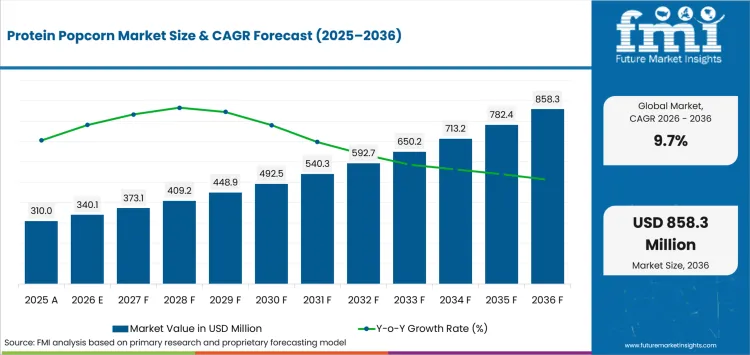
USD 340.1 million in 2026 and USD 858.3 million by 2036 at a 9.7% CAGR.
Demand for protein popcorn is projected to expand at 9.7% CAGR between 2026 and 2036, increasing valuation from USD 340.1 million in 2026 to USD 858.3 million by 2036. Growth depends on whether added protein can broaden the snack occasion without weakening crunch, flavor delivery or the convenience expected from ready-to-eat popcorn.
Popcorn already has a familiar light-snack role, which gives protein formulations a recognizable base instead of asking shoppers to learn a new format. A controlled study indexed by PubMed found that low-fat popcorn produced greater short-term satiety than potato chips at the tested serving conditions, while formulation research on protein-fortified snacks shows that crispness and flavor remain central to acceptance.
Key Takeaways of Protein Popcorn Market
- Protein popcorn demand is forecast to advance at 9.7% CAGR from 2026 to 2036 as functional snack positioning moves into familiar ready-to-eat formats.
- Protein-coated popcorn is projected to account for 44.4% of product type demand in 2026 because the coating carries both flavor and added protein on a recognizable popcorn base.
- Whey is estimated at 37.4% of protein source demand in 2026, supported by concentrated protein delivery and established use in sports and functional nutrition.
- Sweet & caramel is forecast at 38.3% of flavor demand in 2026 as dessert-style coatings make protein popcorn accessible beyond fitness-led occasions.
- Standard bags are projected at 48.3% of pack size demand, while supermarkets & hypermarkets are estimated at 31.0% of sales channel demand in 2026.
- Khloud Foods, ICON Meals and Bucked Up sell direct protein-popcorn propositions, while SkinnyPop, Angie's BOOMCHICKAPOP, LesserEvil, Pip's Heirloom Snacks and Popcornopolis shape the wider popcorn comparison set.
Analyst Perspective
"Protein popcorn earns repeat purchase when the nutrition benefit still feels like a normal snack. Brands need enough protein to make the claim meaningful without losing crunch, pushing sweetness too high or narrowing the product to a post-workout occasion."
- Nandini Roy Choudhury, Principal Consultant, Future Market Insights
How is the Protein Popcorn Market segmented?
The protein popcorn market is segmented by product type, protein source, flavor, pack size, sales channel and region.
Product type covers protein-coated popcorn, ready-to-eat bags, protein puff blends, microwave kits and others. The wider popcorn market provides the familiar base format, while this category adds a measurable protein proposition. Protein source includes whey, pea, soy, milk protein isolate and others. Flavor spans sweet & caramel, cheese, savory & spicy, chocolate drizzle and others. Pack size covers standard bags, single-serve, family packs, multipacks and others. Sales channels include supermarkets & hypermarkets, online / DTC, convenience stores, specialty & health stores and others.
Why does protein-coated popcorn lead the product type category?
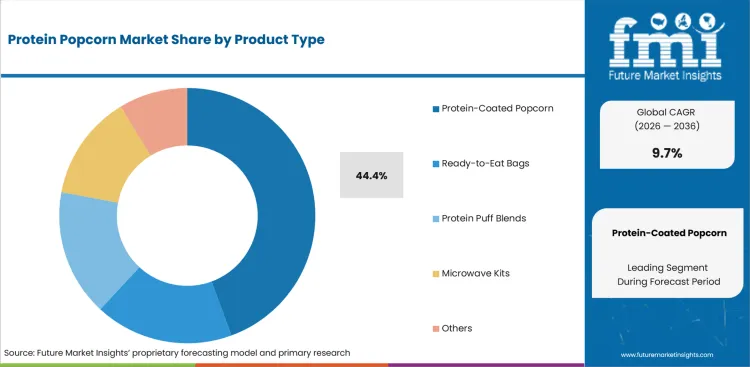
Protein-coated popcorn keeps the visible identity of popcorn while using a surface system to carry protein, seasoning or a sweet finish. This makes the functional benefit easy to explain because shoppers can compare it directly with ordinary ready-to-eat popcorn instead of treating it as a separate nutrition format.
- Protein-coated popcorn is projected to account for 44.4% of product type demand in 2026 as coating systems allow brands to add protein without changing the underlying kernel format.
- Current products show different coating routes. Khloud uses milk protein concentrate in its protein popcorn, while ICON Meals uses whey protein isolate across several sweet and savory popcorn products.
Why does whey lead the protein source category?
Whey offers a concentrated protein input that food formulators already use across sports nutrition and functional foods. Its established supply base makes it easier to formulate a clear protein claim, although dairy allergen declaration and flavor masking remain part of product design. The adjacent whey protein category also gives manufacturers access to isolates and concentrates with different cost and sensory profiles.
- Whey is projected to account for 37.4% of protein source demand in 2026 because it can deliver concentrated protein in coating systems used for both savory and sweet popcorn.
- ICON Meals lists whey protein isolate in current protein popcorn products. The same ingredient choice makes milk-allergen communication a visible part of packaging and channel compliance.
Why does sweet & caramel lead the flavor category?
Sweet & caramel flavors let protein popcorn compete with indulgent popcorn, dessert snacks and afternoon treats rather than relying on a fitness-only use case. The commercial test is whether the protein message remains credible when added sugars and richer coatings raise the nutritional comparison against simpler savory formats.
- Sweet & caramel is forecast to account for 38.3% of flavor demand in 2026 as familiar dessert cues support trial among shoppers who may not normally buy sports-nutrition snacks.
- ICON Meals sells sweet protein popcorn formats, while Khloud offers Sweet & Salty Kettle Corn. Conagra's BOOMCHICKAPOP has also used drizzled kettle corn to extend conventional popcorn into dessert-style occasions.
Why do standard bags lead the pack size category?
Standard bags balance enough volume for repeat snacking with enough front-of-pack area to explain protein content, allergens and nutrition. Single-serve packs fit portion control and on-the-go use, but larger standard bags give brands more room to justify a premium price against regular popcorn.
- Standard bags are projected to account for 48.3% of pack size demand in 2026 because the format fits established snack aisles and household consumption patterns.
- Khloud sells full-size and snack-size protein popcorn, while its 2026 Costco entry added a 12 oz value-size White Cheddar format for a club-channel test.
Why do supermarkets & hypermarkets lead the sales channel category?
Supermarkets and hypermarkets place protein popcorn beside both mainstream popcorn and functional snacks, which makes shelf comparison immediate. That placement can widen trial, but it also forces brands to compete on price, taste and nutrition at the same time. This is the same commercial tension visible across protein snacks, where a nutrition claim must still fit an everyday eating occasion.
- Supermarkets & hypermarkets are estimated to account for 31.0% of sales channel demand in 2026 as national and regional grocery distribution supports repeat household purchase.
- Current expansion by protein-popcorn brands into Costco and other grocery routes shows how the category is moving beyond direct-to-consumer discovery toward regular snack-aisle comparison.
What are the drivers, restraints and opportunities in the Protein Popcorn Market?
Protein-forward snacking expands demand, sensory and claim constraints limit repeat purchase, and broader grocery distribution creates room for scale.
- Driver: Consumers can add protein through a familiar, portable snack without shifting to a bar, shake or meal-replacement format.
- Restraint: Added protein can change texture and flavor, while dairy or soy inputs add allergen and label-management requirements.
- Opportunity: Brands can use grocery, club and convenience channels to move protein popcorn from a niche functional purchase into regular household snacking.
The main demand driver is format familiarity. Popcorn already fits movie nights, lunchboxes and between-meal use, so a protein claim can extend the same behavior rather than create a new eating routine. Research on protein-enriched foods also suggests that familiar carriers can improve acceptance. This supports protein popcorn as one route within the wider healthy snacks space, provided taste remains competitive with ordinary snacks.
The restraint begins at formulation. Research on high plant-protein snacks identifies crispness as an important driver of liking and pea or green flavor notes as a barrier. Protein level, moisture and processing conditions can also affect expansion and texture in fortified snacks. These effects make pea protein attractive for dairy-free formulations but technically different from simply dusting a finished popcorn with seasoning.
The near-term opportunity is distribution. Khloud moved a value-size protein popcorn into participating Costco locations in July 2026, and Bucked Up launched protein popcorn in convenience stores, gas stations and its own online channel in May 2026. As more products appear beside conventional popcorn, brands can test family packs, multipacks and convenience formats without depending on specialist nutrition retail alone.
Which country CAGRs are covered in the Protein Popcorn Market?
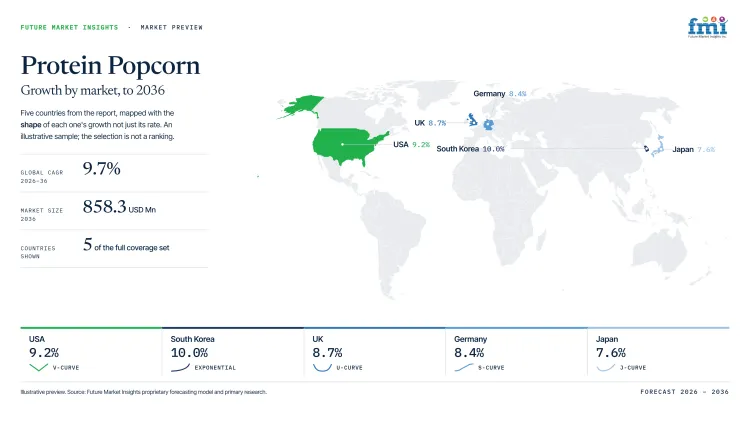
| Country | CAGR |
|---|---|
| South Korea | 10.0% |
| USA | 9.2% |
| UK | 8.7% |
| Germany | 8.4% |
| Japan | 7.6% |
How do country-level CAGRs compare in the Protein Popcorn Market?
The five country CAGRs span 2.4 percentage points. The difference reflects varying retail routes, protein-snack familiarity and labeling conditions rather than a single global adoption pattern.
- South Korea sits at 10.0% CAGR as packaged-snack nutrition labeling and dense convenience retail make the protein proposition easy to compare at point of purchase.
- The USA is projected at 9.2% CAGR, supported by direct protein-popcorn launches and broad grocery, club and convenience distribution.
- The UK is anticipated at 8.7% CAGR as protein-led snacking develops within tighter rules for less healthy food promotions and advertising.
- Germany is expected at 8.4% CAGR, with EU nutrition labeling and protein-claim thresholds shaping product communication across retail channels.
- Japan is forecast at 7.6% CAGR as mandatory nutrition information gives shoppers a standardized way to compare protein content across packaged foods.
Comparable CAGRs can still produce different market-entry conditions. The full report covers country-level analysis across North America, Latin America, Europe, East Asia, South Asia and Pacific, and the Middle East and Africa.
Country-wise Analysis
- South Korea is set to expand at 10.0% CAGR through 2036 as convenience-oriented snack retail supports trial of portioned functional foods. The Ministry of Food and Drug Safety includes snacks within nutrition-labeling requirements, so protein claims must sit beside standardized nutrition information. That transparency can help credible formulations while making weak claims easier to compare against conventional popcorn.
- The USA is expected to grow at 9.2% CAGR over the forecast period as direct protein-popcorn brands widen distribution beyond online channels. FDA rules around nutrient content claims and allergen labeling keep formulation choices visible, especially where whey, milk protein or soy is used. Club and convenience launches should give brands more occasions to test price points and pack sizes.
- The UK is anticipated to advance at 8.7% CAGR through 2036 as functional snack demand develops within changing promotion and advertising rules for less healthy food. Volume-price restrictions took effect in October 2025 and additional advertising restrictions began in January 2026. Protein popcorn therefore has room to grow, but sweet or heavily coated variants need a full nutrition profile that supports the intended positioning.
- Germany is likely to expand at 8.4% CAGR during the assessment period. EU rules require nutrition information on most prepacked foods, and a source-of-protein claim requires protein to provide at least 12% of the food's energy value. These conditions give brands a defined threshold for claim design while keeping taste, price and ingredient simplicity central to repeat purchase.
- Japan is projected to rise at 7.6% CAGR through 2036 as packaged foods operate within standardized nutrition declaration rules covering energy, protein, fat, carbohydrates and salt equivalents. Protein popcorn can use that framework to make its value proposition measurable, although local flavor preferences and portion expectations will influence the best mix of sweet, cheese and savory variants.
Who are the notable companies in the Protein Popcorn Market?
Khloud Foods, ICON Meals, Bucked Up, SkinnyPop (The Hershey Company), Angie's BOOMCHICKAPOP (Conagra Brands), LesserEvil (The Hershey Company), Pip's Heirloom Snacks and Popcornopolis are notable companies serving direct or adjacent protein-popcorn demand.
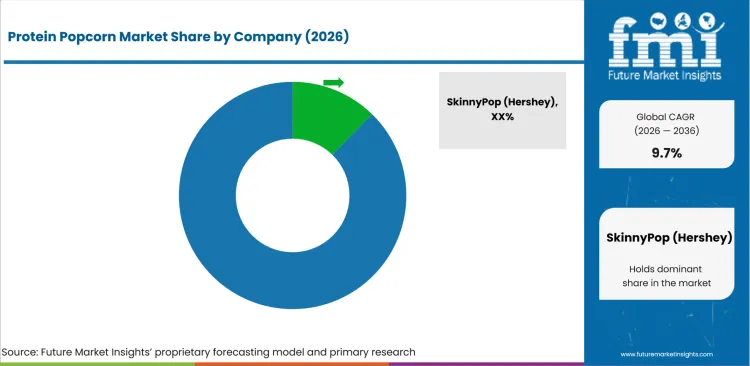
Competition includes two distinct groups. Direct protein-popcorn brands compete on grams of protein, coating performance and flavor, while scaled popcorn platforms compete through shelf access, household familiarity and product breadth. The boundary between the groups is becoming more important as protein formulations move into grocery, club and convenience channels.
- Khloud Foods, ICON Meals and Bucked Up sell current protein-popcorn products with dairy or whey protein systems and multiple flavor options.
- SkinnyPop, Angie's BOOMCHICKAPOP and LesserEvil bring established popcorn or salty-snack platforms that influence shopper expectations for price, texture and availability.
- Pip's Heirloom Snacks and Popcornopolis compete through specialty kernels, gourmet flavors, gifting, wholesale or differentiated popcorn formats that overlap with premium snacking occasions.
Competitive Benchmarking: Protein Popcorn Market
| Company | Direct protein-popcorn offer | Flavor / format breadth | Retail or DTC access | Geographic reach |
|---|---|---|---|---|
| Khloud Foods | High | High | High | USA |
| ICON Meals | High | High | Medium | USA |
| Bucked Up | High | Medium | High | USA |
| SkinnyPop (The Hershey Company) | Low | High | High | North America-led |
| Angie's BOOMCHICKAPOP (Conagra Brands) | Low | High | High | USA-led |
| LesserEvil (The Hershey Company) | Low | High | High | USA |
| Pip's Heirloom Snacks | Low | Medium | Medium | USA |
| Popcornopolis | Low | High | High | USA |
Key Developments in the Protein Popcorn Market
- In July 2026, Khloud entered more than 50 participating Costco locations across Los Angeles and Orange County with a 12 oz White Cheddar Protein Popcorn value pack, extending the brand into a club-channel household format.
- In May 2026, Bucked Up launched Protein Popcorn with 12 g of protein per 2 oz bag across four flavors through convenience stores, gas stations and buckedup.com.
- In November 2025, The Hershey Company completed its acquisition of LesserEvil, adding an organic popcorn and puffs platform to its salty-snack portfolio alongside SkinnyPop.
Key Players in the Protein Popcorn Market
Direct Protein Popcorn Brands
- Khloud Foods
- ICON Meals
- Bucked Up
Scaled Popcorn Platforms
- SkinnyPop (The Hershey Company)
- Angie's BOOMCHICKAPOP (Conagra Brands)
- LesserEvil (The Hershey Company)
Specialty Popcorn Platforms
- Pip's Heirloom Snacks
- Popcornopolis
Protein Popcorn Market - Report Scope
| Coverage field | Report scope |
|---|---|
| Market breakdown | By product type, protein source, flavor, pack size, sales channel and region. |
| Quantitative Units | Revenue in USD million and CAGR in %. |
| Market Definition | Ready-to-eat or preparation-based popcorn products formulated or coated to provide an explicit added-protein proposition. |
| Regions Covered | North America, Latin America, Europe, East Asia, South Asia and Pacific, and Middle East and Africa. |
| Countries Covered | South Korea, USA, UK, Germany, Japan, and 20+ countries included in the full report. |
| Key Companies | Khloud Foods, ICON Meals, Bucked Up, SkinnyPop, Angie's BOOMCHICKAPOP, LesserEvil, Pip's Heirloom Snacks, Popcornopolis. |
| Forecast Period | 2026 to 2036. |
| Approach | Primary and secondary research with market triangulation. |
Protein Popcorn Market - Research Methodology
| Method | Approach |
|---|---|
| Primary Research | FMI analysts gathered input from snack manufacturers, brand owners, protein ingredient suppliers, co-manufacturers, retailers, distributors, buyers and food-industry specialists. Interviews examined formulation choices, protein claims, texture performance, pricing, pack sizes, channel acceptance and requirements for repeat retail orders. |
| Desk Research | Desk research covered government food-labeling rules, regulatory publications, academic literature, company filings, official product information, retail-channel announcements and corporate releases. Claims relating to protein content, ingredients, distribution and product launches were retained only when supported by credible public evidence. |
| Market Sizing and Forecasting | Market sizing combined the 2026 baseline with historical category performance, segment structure, pricing and volume indicators, adoption levels, company participation and country-level demand conditions. Forecast assumptions considered functional-snack adoption, ingredient availability, retail expansion, labeling rules, purchasing cycles and barriers to repeat use. |
| Data Validation | Estimates were checked against independent indicators including public data, company activity, retail developments, academic findings and primary interviews. Validation also tested whether products carried an explicit protein-popcorn proposition. Conventional popcorn, adjacent protein snacks and overlapping revenue were excluded where they fell outside the market definition. |
Protein Popcorn Market by Segments
Protein Popcorn Market segmented by Product Type:
- Protein-Coated Popcorn
- Ready-to-Eat Bags
- Protein Puff Blends
- Microwave Kits
- Others
Protein Popcorn Market segmented by Protein Source:
- Whey
- Pea
- Soy
- Milk Protein Isolate
- Others
Protein Popcorn Market segmented by Flavor:
- Sweet & Caramel
- Cheese
- Savory & Spicy
- Chocolate Drizzle
- Others
Protein Popcorn Market segmented by Pack Size:
- Standard Bags
- Single-Serve
- Family Packs
- Multipacks
- Others
Protein Popcorn Market segmented by Sales Channel:
- Supermarkets & Hypermarkets
- Online / DTC
- Convenience Stores
- Specialty & Health Stores
- Others
Protein Popcorn Market by Region:
- North America
- United States
- Canada
- Latin America
- Brazil
- Chile
- Mexico
- Rest of Latin America
- Western Europe
- Germany
- United Kingdom
- Italy
- Spain
- France
- Nordics
- Benelux
- Rest of Western Europe
- Eastern Europe
- Russia
- Poland
- Hungary
- Balkan and Baltic States
- Rest of Eastern Europe
- East Asia
- China
- Japan
- South Korea
- South Asia and Pacific
- India
- ASEAN
- Australia and New Zealand
- Rest of South Asia and Pacific
- Middle East and Africa
- Kingdom of Saudi Arabia
- Other GCC Countries
- Türkiye
- South Africa
- Other African Union Countries
- Rest of Middle East and Africa
Research Sources and Bibliography
- Nguyen, V. et al. (2012). Popcorn is more satiating than potato chips in normal-weight adults. Nutrition Journal.
- Philipp, C. et al. (2017). Instrumental and sensory properties of pea protein-fortified extruded rice snacks. Food Research International.
- Bresciani, A. et al. (2019). Consumer acceptance and sensory drivers of liking for high plant protein snacks. Journal of the Science of Food and Agriculture.
- USA Food and Drug Administration. (2025). Use of the Healthy Claim on Food Labeling and updated nutrient content claim guidance.
- USA Food and Drug Administration. (2026). Food Allergies: What You Need to Know.
- UK Department of Health and Social Care. (2025). Restricting promotions of products high in fat, sugar or salt by location and by volume price.
- UK Department of Health and Social Care. (2025). Advertising restrictions for less healthy food and drink products from January 2026.
- European Commission. (2026). Nutrition labelling under Regulation (EU) No 1169/2011.
- European Commission. (2026). Nutrition and health claims, including conditions for source-of-protein claims.
- Consumer Affairs Agency, Government of Japan. (2026). Food Labelling and Nutrition Information Label guidance.
- Ministry of Food and Drug Safety, Republic of Korea. (2026). Food Labeling System and nutrition labeling requirements.
- Khloud Foods. (2026). Protein Popcorn product information and Why Khloud ingredient guidance.
- ICON Meals. (2026). Protein Popcorn collection and current product ingredient information.
- Bucked Up. (2026, May 28). Bucked Up Brings the Carnival to the Snack Aisle With Two New Launches.
- The Hershey Company. (2025, November 19). Hershey Completes Acquisition of LesserEvil, Expanding Consumer Choice.
- Conagra Brands. (2024, February 20). Angie's BOOMCHICKAPOP Introduces New Cinnabon Drizzled Kettle Corn.
This bibliography is provided for reader reference and is not exhaustive. The full report contains the complete reference list and detailed citations.
This Report Answers
- How large is the Protein Popcorn Market in 2026 and 2036?
- Which operating conditions support repeat demand for protein popcorn?
- Which product type accounts for the leading 2026 share?
- How does protein source influence formulation and allergen management?
- Which flavor and pack-size choices support broader snack occasions?
- How do grocery and direct channels shape commercial access?
- How do country growth rates affect market-entry conditions?
- Which companies serve direct protein-popcorn and adjacent popcorn demand?
Frequently Asked Questions
How big is the Protein Popcorn Market in 2026?
USD 340.1 million represents the protein popcorn market value in 2026 across ready-to-eat and preparation-based popcorn products sold with an explicit added-protein proposition. The category is expected to reach USD 858.3 million by 2036 as functional snacking moves into familiar popcorn occasions.
What is the CAGR of the Protein Popcorn Market from 2026 to 2036?
A 9.7% CAGR is projected for the protein popcorn market between 2026 and 2036. Growth depends on balancing measurable protein content with the crunch, flavor and convenience shoppers already expect from popcorn.
Which product type is projected to account for 44.4% of the Protein Popcorn Market?
Protein-coated popcorn is projected to account for 44.4% of product type demand in 2026. The format keeps a recognizable popcorn base while using the surface coating to carry added protein and flavor.
How much will the Protein Popcorn Market add between 2026 and 2036?
USD 518.2 million is expected to be added to the protein popcorn market between 2026 and 2036. The increase will depend on repeat purchase, wider retail access and formulation that preserves the sensory qualities of conventional popcorn.
Which companies are active in the Protein Popcorn Market?
Eight companies active in direct or adjacent protein-popcorn demand include Khloud Foods, ICON Meals, Bucked Up, SkinnyPop, Angie's BOOMCHICKAPOP, LesserEvil, Pip's Heirloom Snacks and Popcornopolis. The group spans direct protein formulations, scaled ready-to-eat popcorn and specialty popcorn platforms.
Preview the report firsthand - request a free sample
Get SampleGet the brochure for pricing and purchase details.
Get PDFTable of Content
- Key Takeaways
- Market Size and CAGR
- Top Growth Driver
- Fastest Growing Segment
- Leading Region
- Key Companies
- Emerging Opportunities
- Executive Summary
- Global Market Outlook
- Demand-side Trends
- Supply-side Trends
- Technology Roadmap Analysis
- Analysis and Recommendations
- Analyst Perspective (What is happening? Why now? What should investors know?)
- Key Questions Answered
- How large is the market?
- What is the CAGR?
- What are key trends?
- Which region dominates?
- Who are the leaders?
- Market Overview
- Market Coverage / Taxonomy
- Market Definition / Scope / Limitations
- Research Methodology
- Chapter Orientation
- Analytical Lens and Working Hypotheses
- Market Structure, Signals, and Trend Drivers
- Benchmarking and Cross-market Comparability
- Market Sizing, Forecasting, and Opportunity Mapping
- Research Design and Evidence Framework
- Desk Research Programme (Secondary Evidence)
- Expert Input and Fieldwork (Primary Evidence)
- Tooling, Models, and Reference Databases
- Data Engineering and Model Build
- Quality Assurance and Audit Trail
- Market Background
- Market Dynamics (Drivers, Restraints, Opportunity, Trends)
- Scenario Forecast (Optimistic, Likely, Conservative)
- Impact Analysis
- AI Impact
- Sustainability Impact
- Regulatory Impact
- Technology Impact
- Consumer / Buyer Analysis
- Purchase Drivers
- Adoption Barriers
- Buyer Journey
- Opportunity Map Analysis
- Product Life Cycle Analysis
- Supply Chain Analysis
- Investment Feasibility Matrix
- Value Chain Analysis
- PESTLE and Porter's Analysis
- Regulatory Landscape
- Regional Parent Market Outlook
- Production and Consumption Statistics
- Import and Export Statistics
- Global Market Analysis and Forecast, 2021 to 2036
- Historical Market Size Value (USD Million) Analysis, 2021 to 2025
- Current and Future Market Size Value (USD Million) Projections, 2026 to 2036
- Y-o-Y Growth Trend Analysis
- Absolute $ Opportunity Analysis
- Global Market Pricing Analysis, 2021 to 2036
- Global Market Analysis and Forecast, By Product Type, 2021 to 2036
- Introduction / Key Findings
- Historical Market Size Value (USD Million) Analysis By Product Type, 2021 to 2025
- Current and Future Market Size Value (USD Million) Analysis and Forecast By Product Type, 2026 to 2036
- Protein-Coated Popcorn
- Ready-to-Eat Bags
- Protein Puff Blends
- Microwave Kits
- Others
- Protein-Coated Popcorn
- Y-o-Y Growth Trend Analysis By Product Type, 2021 to 2025
- Absolute $ Opportunity Analysis By Product Type, 2026 to 2036
- Global Market Analysis and Forecast, By Protein Source, 2021 to 2036
- Introduction / Key Findings
- Historical Market Size Value (USD Million) Analysis By Protein Source, 2021 to 2025
- Current and Future Market Size Value (USD Million) Analysis and Forecast By Protein Source, 2026 to 2036
- Whey
- Pea
- Soy
- Milk Protein Isolate
- Others
- Whey
- Y-o-Y Growth Trend Analysis By Protein Source, 2021 to 2025
- Absolute $ Opportunity Analysis By Protein Source, 2026 to 2036
- Global Market Analysis and Forecast, By Flavor, 2021 to 2036
- Introduction / Key Findings
- Historical Market Size Value (USD Million) Analysis By Flavor, 2021 to 2025
- Current and Future Market Size Value (USD Million) Analysis and Forecast By Flavor, 2026 to 2036
- Sweet & Caramel
- Cheese
- Savory & Spicy
- Chocolate Drizzle
- Others
- Sweet & Caramel
- Y-o-Y Growth Trend Analysis By Flavor, 2021 to 2025
- Absolute $ Opportunity Analysis By Flavor, 2026 to 2036
- Global Market Analysis and Forecast, By Pack Size, 2021 to 2036
- Introduction / Key Findings
- Historical Market Size Value (USD Million) Analysis By Pack Size, 2021 to 2025
- Current and Future Market Size Value (USD Million) Analysis and Forecast By Pack Size, 2026 to 2036
- Standard Bags
- Single-Serve
- Family Packs
- Multipacks
- Others
- Standard Bags
- Y-o-Y Growth Trend Analysis By Pack Size, 2021 to 2025
- Absolute $ Opportunity Analysis By Pack Size, 2026 to 2036
- Global Market Analysis and Forecast, By Sales Channel, 2021 to 2036
- Introduction / Key Findings
- Historical Market Size Value (USD Million) Analysis By Sales Channel, 2021 to 2025
- Current and Future Market Size Value (USD Million) Analysis and Forecast By Sales Channel, 2026 to 2036
- Supermarkets & Hypermarkets
- Online / DTC
- Convenience Stores
- Specialty & Health Stores
- Others
- Supermarkets & Hypermarkets
- Y-o-Y Growth Trend Analysis By Sales Channel, 2021 to 2025
- Absolute $ Opportunity Analysis By Sales Channel, 2026 to 2036
- Global Market Analysis and Forecast, By Region, 2021 to 2036
- Introduction
- Historical Market Size Value (USD Million) Analysis By Region, 2021 to 2025
- Current Market Size Value (USD Million) Analysis and Forecast By Region, 2026 to 2036
- North America
- Latin America
- Western Europe
- Eastern Europe
- East Asia
- South Asia and Pacific
- Middle East & Africa
- Market Attractiveness Analysis By Region
- North America Market Analysis and Forecast, By Country, 2021 to 2036
- Historical Market Size Value (USD Million) Trend Analysis By Market Taxonomy, 2021 to 2025
- Market Size Value (USD Million) Forecast By Market Taxonomy, 2026 to 2036
- By Country
- USA
- Canada
- By Product Type
- By Protein Source
- By Flavor
- By Pack Size
- By Sales Channel
- By Country
- Market Attractiveness Analysis
- By Country
- By Product Type
- By Protein Source
- By Flavor
- By Pack Size
- By Sales Channel
- Key Takeaways
- Latin America Market Analysis and Forecast, By Country
- Historical Market Size Value (USD Million) Trend Analysis By Market Taxonomy, 2021 to 2025
- Market Size Value (USD Million) Forecast By Market Taxonomy, 2026 to 2036
- By Country
- Brazil
- Mexico
- Chile
- Rest of Latin America
- By Product Type
- By Protein Source
- By Flavor
- By Pack Size
- By Sales Channel
- By Country
- Market Attractiveness Analysis
- By Country
- By Product Type
- By Protein Source
- By Flavor
- By Pack Size
- By Sales Channel
- Key Takeaways
- Western Europe Market Analysis and Forecast, By Country
- Historical Market Size Value (USD Million) Trend Analysis By Market Taxonomy, 2021 to 2025
- Market Size Value (USD Million) Forecast By Market Taxonomy, 2026 to 2036
- By Country
- Germany
- UK
- Italy
- Spain
- France
- Nordic
- BENELUX
- Rest of Western Europe
- By Product Type
- By Protein Source
- By Flavor
- By Pack Size
- By Sales Channel
- By Country
- Market Attractiveness Analysis
- By Country
- By Product Type
- By Protein Source
- By Flavor
- By Pack Size
- By Sales Channel
- Key Takeaways
- Eastern Europe Market Analysis and Forecast, By Country
- Historical Market Size Value (USD Million) Trend Analysis By Market Taxonomy, 2021 to 2025
- Market Size Value (USD Million) Forecast By Market Taxonomy, 2026 to 2036
- By Country
- Russia
- Poland
- Hungary
- Balkan & Baltic
- Rest of Eastern Europe
- By Product Type
- By Protein Source
- By Flavor
- By Pack Size
- By Sales Channel
- By Country
- Market Attractiveness Analysis
- By Country
- By Product Type
- By Protein Source
- By Flavor
- By Pack Size
- By Sales Channel
- Key Takeaways
- East Asia Market Analysis and Forecast, By Country
- Historical Market Size Value (USD Million) Trend Analysis By Market Taxonomy, 2021 to 2025
- Market Size Value (USD Million) Forecast By Market Taxonomy, 2026 to 2036
- By Country
- China
- Japan
- South Korea
- By Product Type
- By Protein Source
- By Flavor
- By Pack Size
- By Sales Channel
- By Country
- Market Attractiveness Analysis
- By Country
- By Product Type
- By Protein Source
- By Flavor
- By Pack Size
- By Sales Channel
- Key Takeaways
- South Asia and Pacific Market Analysis and Forecast, By Country
- Historical Market Size Value (USD Million) Trend Analysis By Market Taxonomy, 2021 to 2025
- Market Size Value (USD Million) Forecast By Market Taxonomy, 2026 to 2036
- By Country
- India
- ASEAN
- Australia & New Zealand
- Rest of South Asia and Pacific
- By Product Type
- By Protein Source
- By Flavor
- By Pack Size
- By Sales Channel
- By Country
- Market Attractiveness Analysis
- By Country
- By Product Type
- By Protein Source
- By Flavor
- By Pack Size
- By Sales Channel
- Key Takeaways
- Middle East & Africa Market Analysis and Forecast, By Country
- Historical Market Size Value (USD Million) Trend Analysis By Market Taxonomy, 2021 to 2025
- Market Size Value (USD Million) Forecast By Market Taxonomy, 2026 to 2036
- By Country
- Kingdom of Saudi Arabia
- Other GCC Countries
- Türkiye
- South Africa
- Other African Union
- Rest of Middle East & Africa
- By Product Type
- By Protein Source
- By Flavor
- By Pack Size
- By Sales Channel
- By Country
- Market Attractiveness Analysis
- By Country
- By Product Type
- By Protein Source
- By Flavor
- By Pack Size
- By Sales Channel
- Key Takeaways
- Key Countries Market Analysis
- USA
- Pricing Analysis
- Market Share Analysis, 2025
- By Product Type
- By Protein Source
- By Flavor
- By Pack Size
- By Sales Channel
- Canada
- Pricing Analysis
- Market Share Analysis, 2025
- By Product Type
- By Protein Source
- By Flavor
- By Pack Size
- By Sales Channel
- Mexico
- Pricing Analysis
- Market Share Analysis, 2025
- By Product Type
- By Protein Source
- By Flavor
- By Pack Size
- By Sales Channel
- Brazil
- Pricing Analysis
- Market Share Analysis, 2025
- By Product Type
- By Protein Source
- By Flavor
- By Pack Size
- By Sales Channel
- Chile
- Pricing Analysis
- Market Share Analysis, 2025
- By Product Type
- By Protein Source
- By Flavor
- By Pack Size
- By Sales Channel
- Germany
- Pricing Analysis
- Market Share Analysis, 2025
- By Product Type
- By Protein Source
- By Flavor
- By Pack Size
- By Sales Channel
- UK
- Pricing Analysis
- Market Share Analysis, 2025
- By Product Type
- By Protein Source
- By Flavor
- By Pack Size
- By Sales Channel
- Italy
- Pricing Analysis
- Market Share Analysis, 2025
- By Product Type
- By Protein Source
- By Flavor
- By Pack Size
- By Sales Channel
- Spain
- Pricing Analysis
- Market Share Analysis, 2025
- By Product Type
- By Protein Source
- By Flavor
- By Pack Size
- By Sales Channel
- France
- Pricing Analysis
- Market Share Analysis, 2025
- By Product Type
- By Protein Source
- By Flavor
- By Pack Size
- By Sales Channel
- India
- Pricing Analysis
- Market Share Analysis, 2025
- By Product Type
- By Protein Source
- By Flavor
- By Pack Size
- By Sales Channel
- ASEAN
- Pricing Analysis
- Market Share Analysis, 2025
- By Product Type
- By Protein Source
- By Flavor
- By Pack Size
- By Sales Channel
- Australia & New Zealand
- Pricing Analysis
- Market Share Analysis, 2025
- By Product Type
- By Protein Source
- By Flavor
- By Pack Size
- By Sales Channel
- China
- Pricing Analysis
- Market Share Analysis, 2025
- By Product Type
- By Protein Source
- By Flavor
- By Pack Size
- By Sales Channel
- Japan
- Pricing Analysis
- Market Share Analysis, 2025
- By Product Type
- By Protein Source
- By Flavor
- By Pack Size
- By Sales Channel
- South Korea
- Pricing Analysis
- Market Share Analysis, 2025
- By Product Type
- By Protein Source
- By Flavor
- By Pack Size
- By Sales Channel
- Russia
- Pricing Analysis
- Market Share Analysis, 2025
- By Product Type
- By Protein Source
- By Flavor
- By Pack Size
- By Sales Channel
- Poland
- Pricing Analysis
- Market Share Analysis, 2025
- By Product Type
- By Protein Source
- By Flavor
- By Pack Size
- By Sales Channel
- Hungary
- Pricing Analysis
- Market Share Analysis, 2025
- By Product Type
- By Protein Source
- By Flavor
- By Pack Size
- By Sales Channel
- Kingdom of Saudi Arabia
- Pricing Analysis
- Market Share Analysis, 2025
- By Product Type
- By Protein Source
- By Flavor
- By Pack Size
- By Sales Channel
- Türkiye
- Pricing Analysis
- Market Share Analysis, 2025
- By Product Type
- By Protein Source
- By Flavor
- By Pack Size
- By Sales Channel
- South Africa
- Pricing Analysis
- Market Share Analysis, 2025
- By Product Type
- By Protein Source
- By Flavor
- By Pack Size
- By Sales Channel
- USA
- Market Structure Analysis
- Competition Dashboard
- Competition Benchmarking
- Market Share Analysis of Top Players
- By Regional
- By Product Type
- By Protein Source
- By Flavor
- By Pack Size
- By Sales Channel
- Emerging Startups
- Innovation Benchmarking
- Competition Analysis
- Competition Deep Dive
- SkinnyPop (Hershey)
- Overview
- Product Portfolio
- Profitability by Market Segments
- Sales Footprint
- Strategy Overview
- Marketing Strategy
- Product Strategy
- Channel Strategy
- Angie's Boomchickapop (Conagra)
- Protes
- ICON Meals
- Lesser Evil
- Quinn Snacks
- Pipcorn
- Popcornopolis
- SkinnyPop (Hershey)
- Case Studies
- Success Stories
- Recent Developments
- Competition Deep Dive
- Assumptions & Acronyms Used


