

- Market Size (2026)
- USD 250.0 Mn
- Forecast (2036)
- USD 544.7 Mn
- CAGR (2026 to 2036)
- 8.1%
How big is the robot safety scanner integration market in 2026?
USD 250.0 million in 2026 and USD 544.7 million by 2036 at an 8.1% CAGR.
The robot safety scanner integration industry value is forecast to grow from USD 231.3 million in 2025 to USD 544.7 million by 2036 at 8.1% CAGR as factories redesign robot cells for safer human access, dynamic protective fields, and validated stop functions. Safety Laser Scanner Hardware is forecast to represent 41.0% share in 2026 because scanner-led projects usually include mounting, field configuration, controller connection, and validation support. The 5-20 kg payload range is expected to secure 39.0% share in 2026, led by common use across collaborative robots, SCARA systems, and compact material handling cells.
Summary of the Robot Safety Scanner Integration Market
- Demand and Growth Drivers
- Robot cell redesign is raising scanner integration work as plants replace fixed guarding with configurable protective fields.
- AMR/AGV transfer stations are increasing demand for scanner zones that separate vehicle movement from operator access.
- Safety controller upgrades are supporting scanner adoption as buyers request diagnostics and field history.
- Product and Segment View
- Safety Laser Scanner Hardware is projected to hold 41.0% share in 2026, influenced by bundled scanner, controller, mounting, and field configuration projects.
- The 5-20 kg payload range is expected to represent 39.0% share in 2026, led by frequent use in cobot, SCARA, and compact handling cells.
- Collaborative Robots are forecast to secure 35.0% share in 2026, supported by shared work areas that require scanner-based speed monitoring.
- Geography and Competitive Outlook
- China is projected to record 9.4% CAGR by 2036, backed by large robot installation volumes and domestic automation suppliers.
- India is expected to expand at 9.1% CAGR by 2036 as automotive suppliers and general industry add safer robot cells.
- SICK, Omron, Keyence, Leuze, Pilz, Rockwell Automation, and Banner Engineering compete through scanner portfolios and safety automation support.
- ABB Robotics, FANUC, Universal Robots, and KUKA influence integration choices through controller architecture and robot safety functions.
- Analyst Opinion
- Nikhil Kaitwade, Principal Consultant at Future Market Insights for industrial domain, observes, “Robot safety scanner integration is moving from device selection to application proof. Buyers want scanner fields that maintain output during pallet transfer, teach mode, and mixed human access. Suppliers with strong configuration tools, controller links, and local validation support should gain larger projects.”
Robot safety scanner integration is becoming more important as automation moves closer to people and mobile material flows. IFR stated in September 2025 that 542,000 industrial robots were installed globally in 2024, while Asia accounted for 74% of new deployments. ISO 10218-2:2025 addresses industrial robot applications and robot cells across design, integration, commissioning, operation, maintenance, and repair. ABB’s OmniCore platform was developed through more than USD 170 million of investment and supports tighter links between robot motion, sensors, software, and edge systems. These signals support stronger demand for scanner layouts that prove access safety without reducing output.
The robot safety scanner integration market is expected to witness steady expansion through 2036, driven by factories and warehouses seeking safer robot access, lower nuisance stopping, and stronger validation records. Market expansion is further supported by collaborative cells and AMR/AGV transfer stations requiring configurable scanner fields.
Which factors support expansion in the robot safety scanner integration market?
Robot cell safety validation, retrofit access control, and dynamic scanner fields support market value across factory and warehouse applications.
- Market value is supported by scanner integration revenue before service contracts and retrofit documentation add incremental income.
- Supplier pricing reflects scanner count, controller fit, field set complexity, and validation hours before hardware cost is finalized.
- Revenue improves as integrators convert fenced robot cells into flexible shared spaces with safer restart logic.
- Buyer trust rises as documentation packages make stopping distance, field boundaries, and reset behavior easier to audit.
Why is the robot safety scanner integration market growing?
Robot users are adopting configurable scanner fields as shared workcells require safer access without reducing production flow.
Growth outlook has become more structured as robot cells move into compact production and warehouse layouts. The USA Bureau of Labor Statistics reported in January 2026 that private industry employers recorded 2.5 million injury and illness cases in 2024. Scanner integration responds to this pressure by connecting detection zones, safety controllers, robot stop functions, and restart logic. Buyers also prefer systems that can document scanner behavior after layout changes. This makes validation services and configuration support more valuable than standalone scanner sales.
How is the robot safety scanner integration market segmented?
The robot safety scanner integration industry is segmented by robot type, payload, application, end-use industry, and integration component.
- Collaborative Robots are projected to secure 35.0% share in 2026, led by close worker access and the need to shift from simple stop signals toward scanner-guided speed monitoring.
- The 5-20 kg payload range is anticipated to hold 39.0% share in 2026 since medium-duty cells commonly use compact robots for handling, inspection, and assembly workflows.
- Material Handling is expected to capture 32.0% share in 2026 due to scanner fields being needed around pallets, totes, carts, docks, and AMR/AGV handoff points.
- Automotive is forecast to represent 29.0% share in 2026, reflected by body, paint, welding, and parts cells requiring documented safe access and repeat validation.
- Safety Laser Scanner Hardware is projected to account for 41.0% share in 2026, supported by scanner-led integration packages that include field sets, controller links, and commissioning support.
Why do collaborative robots dominate the robot safety scanner integration market?
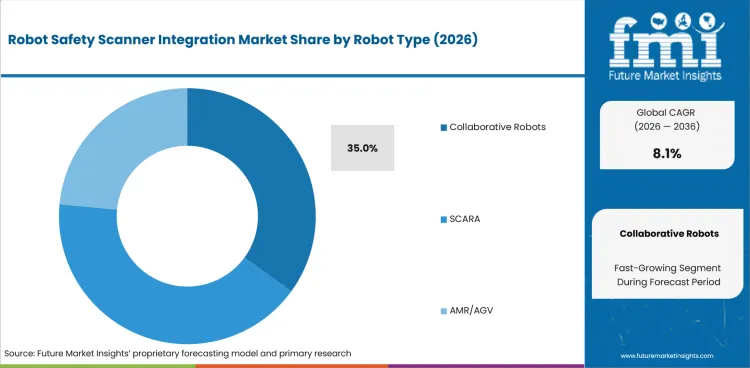
- Collaborative Robots are projected to account for 35.0% share in 2026, influenced by shared workspaces where operators need safe access during loading, inspection, and teach activities.
- Articulated robots gain use in higher-payload cells, but they often require wider protective fields and longer signoff cycles before scanner integration can be approved.
Which payload leads the robot safety scanner integration market?
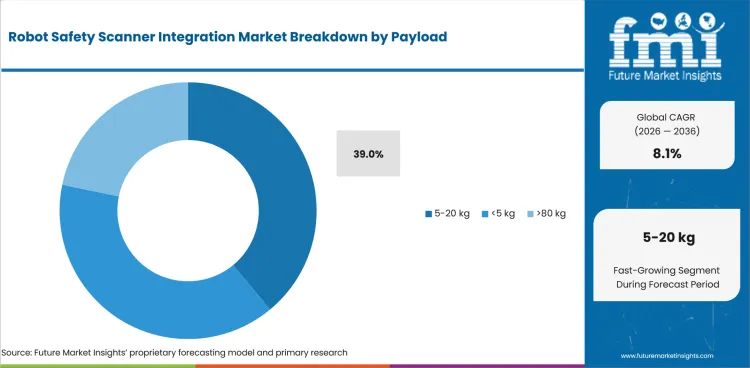
- 5-20 kg payload systems are anticipated to hold 39.0% share in 2026 through frequent use in cobot, SCARA, and compact material handling applications.
- 20-80 kg payload cells need more conservative safety margins because larger robot mass increases stopping distance and validation complexity.
Which application leads the robot safety scanner integration market?
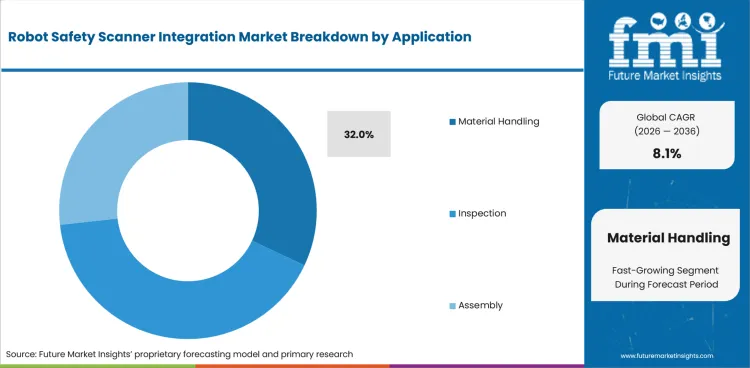
- Material Handling is forecast to secure 32.0% share in 2026, reflected by transfer stations requiring scanner logic around pallet movement and worker entry.
- Machine Tending gains importance where operators need predictable access to fixtures, conveyors, and CNC loading areas without opening full cell guarding.
Which end-use industry leads the robot safety scanner integration market?
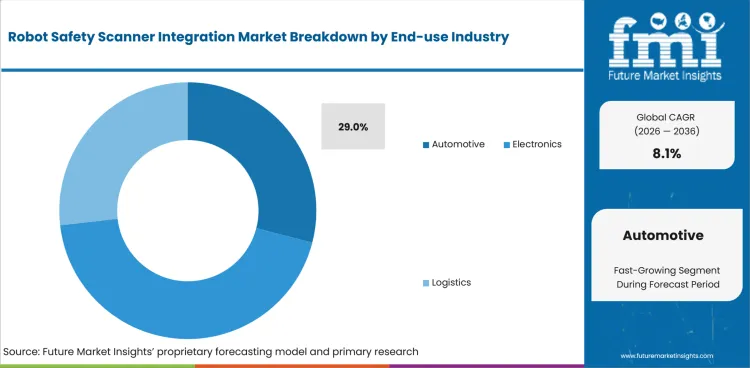
- Automotive is expected to represent 29.0% share in 2026, shaped by audit-sensitive robot cells in welding, body, paint, and parts production.
- Electronics creates additional demand because compact assembly and inspection lines need scanner layouts that avoid false stops in dense production spaces.
Which integration component leads the robot safety scanner integration market?
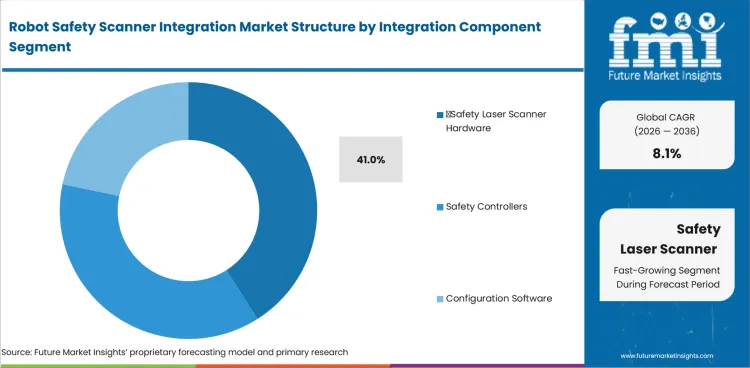
- Safety Laser Scanner Hardware is projected to account for 41.0% share in 2026, led by bundled scanner installation, mounting, field design, and commissioning work.
- Validation Services gain value as buyers need stop-time evidence, field diagrams, and change-control records after scanner setup.
What are the drivers, restraints, and opportunities in the robot safety scanner integration market?
Robot cell flexibility and safety validation support demand while controller mismatch and documentation gaps slow wider adoption.
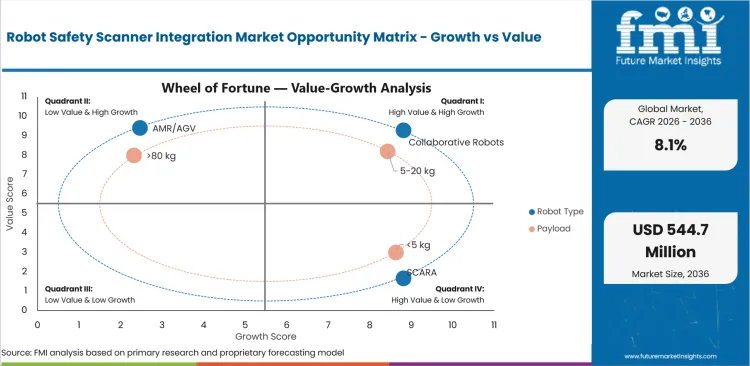
- Dynamic field switching is moving scanner integration into loading, docking, and operator access points because plants need safer human entry without stopping every robot movement.
- Controller compatibility increases engineering time when scanners, safety PLCs, and robot programs are not aligned, raising commissioning risk for retrofit cells.
- Retrofit access control can help older fenced cells support safer shared work, allowing plants to modernize interaction points without rebuilding full lines.
Robot Safety Scanner Integration Market Demand Outlook
Demand outlook is moving toward scanner systems that can prove safe access while protecting robot cycle time. IFR stated that operational industrial robot stock reached 4,664,000 units globally in 2024, expanding the installed base of cells requiring scanner retrofits, field changes, and safety documentation. This installed base supports service revenue because every robot cell change can require reassessment of stopping distance, reset logic, and protective field coverage.
Standards-Driven Scanner Validation Analysis
Standards-driven validation is increasing the value of engineering support in scanner projects. ISO’s industrial robot safety framework includes ISO 10218-1:2025 and ISO 10218-2:2025, giving suppliers a stronger basis to sell integrated robot safety packages rather than isolated scanner hardware. Robot users need proof that a scanner signal can stop hazardous motion before an operator reaches the robot path. This makes documentation, field diagrams, and restart rules central to supplier selection.
Controller Integration and Retrofit Opportunity Analysis
Controller integration is becoming a stronger opportunity as robot users link scanners with safety PLCs, HMIs, and cell-level diagnostics. Pilz states its PSENscan PN supports simultaneous monitoring of up to 8 protection zones and offers rapid diagnostics through a Profinet interface. This helps plants connect scanner status to existing automation networks and reduce downtime after nuisance stops. Integrators that connect scanner data with safety PLCs, HMIs, and robot programs can gain higher-value retrofit work.
Which countries are growing fastest in the robot safety scanner integration market?
China 9.4% CAGR, India 9.1% CAGR, South Korea 8.7% CAGR, United States 8.3% CAGR, Japan 8.0% CAGR, Germany 7.8% CAGR, France 7.5% CAGR, and United Kingdom 7.2% CAGR through 2036.
.webp "Top Country Growth Comparison Robot Safety Scanner Integration Market Cagr (2026 2036)")
| Country | CAGR |
| United States | 8.3% |
| United Kingdom | 7.2% |
| Germany | 7.8% |
| France | 7.5% |
| Japan | 8.0% |
| China | 9.4% |
| South Korea | 8.7% |
| India | 9.1% |
Source: Future Market Insights, 2026.
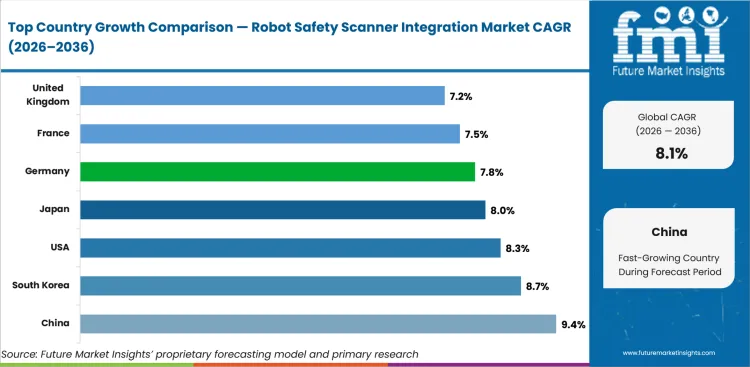
How do country-level CAGRs compare in the robot safety scanner integration market?
China leads country growth while the United Kingdom records the most cautious expansion outlook among profiled markets.
- The United States is forecast to record 8.3% CAGR by 2036 as scanner work follows robot retrofits and warehouse automation.
- The United Kingdom is expected to expand at 7.2% CAGR from 2026 to 2036 due to selective automation and compact factory layouts.
- Germany is projected to grow at 7.8% CAGR through 2036 as machine builders and automotive suppliers prioritize ISO-aligned validation.
- France is estimated to rise at 7.5% CAGR by 2036 with packaging, logistics, and retrofit projects supporting demand.
- Japan is expected to advance at 8.0% CAGR over the forecast period as precision factories refresh compact robot cell safety.
- China is forecast to grow at 9.4% CAGR through 2036 as large robot volumes create repeatable scanner integration opportunities.
- South Korea is projected to post 8.7% CAGR by 2036 as dense electronics and automotive automation require scanner field updates.
- India is expected to expand at 9.1% CAGR through 2036 as new robot cells need integrator-led scanner validation.
What is the robot safety scanner integration market outlook in the United States?
A 8.3% CAGR through 2036 reflects robot retrofit demand, warehouse automation, and strong system integrator participation.
Country Market Snapshot Table
| Parameter | Value |
|---|---|
| Market Size in 2025 (Value) | USD 37.9 million |
| Market Size in 2026 (Value) | USD 41.0 million |
| Market Forecast in 2036 (Value) | USD 91.0 million |
| CAGR (2026 to 2036) | 8.3% |
| Years Considered | 2021 to 2036 |
| Base Year | 2025 |
| Forecast Period | 2026 to 2036 |
| Units Considered | Value (USD million) |
| Leading Sub-Region | Midwest and South Atlantic automation corridors |
United States Robot Safety Scanner Integration Market Outlook
- United States demand is shaped by robot retrofits, warehousing automation, and factory safety documentation needs. Scanner integration is often approved when buyers need flexible guarding around robot loading, pallet movement, and mixed operator access.
- Large integrator networks give suppliers a practical route into automotive, packaging, logistics, and electronics plants. Buyers favor scanner packages that include stop-time calculation, safety PLC links, field diagrams, and post-installation change support.
Key Growth Drivers
- Robot cell upgrades are supported by large installation activity. IFR reported 34,200 industrial robot installations in the United States in 2024.
- Safety data transparency strengthens buyer focus on documented safeguarding. OSHA released data from 370,000 Form 300A reports and more than 732,000 Form 300 and Form 301 records in April 2025.
- Warehouse automation projects need scanner zones around AMR crossings, pallet staging areas, and dock-side robot interaction points.
- Domestic system integrators help translate global scanner platforms into validated robot cells for plant-specific requirements.
Key Restraints
- Engineering labor costs can make small scanner retrofit projects difficult to justify when one cell requires extensive validation work.
- Brownfield factories often use older PLCs and uneven layouts that lengthen scanner placement, cable routing, and restart testing.
- Safety scrutiny can slow project approval. BLS reported 5,070 fatal work injuries in the United States in 2024, keeping audit evidence central to risk decisions.
What makes the United States unique
United States is unique due to a large integrator ecosystem that turns scanner platforms into plant-specific safety projects.
Key Companies
- Rockwell Automation
- Banner Engineering
- SICK Inc.
- Omron Automation Americas
- Keyence Corporation of America
- FANUC America Corporation
- Universal Robots USA
Sales & Marketing Channels
- Certified robot system integrators
- Safety automation distributors
- Direct enterprise sales
- OEM robot partnerships
- Plant EHS consulting routes
- Retrofit service teams
Country Segment Breakdown Table
| Segment | Sub-Segments |
|---|---|
| By Robot Type | Collaborative Robots · SCARA · Articulated · AMR/AGV · Delta Robots |
| By Payload | <5 kg · 5-20 kg · 20-80 kg · >80 kg |
| By Application | Material Handling · Inspection · Assembly · Welding · Packaging · Machine Tending |
| By End-use Industry | Automotive · Electronics · Food & Beverage · Logistics · Pharmaceuticals · Metals |
| By Integration Component | Safety Laser Scanner Hardware · Safety Controllers · Mounting & Interfaces · Configuration Software · Validation Services |
| Key Sub-Regions Covered, Automation Corridors | Midwest · South Atlantic · Texas · California · Pacific Northwest · Northeast |
Frequently Asked Questions
How fast is United States robot safety scanner integration market growing?
Demand in the United States is projected to rise at 8.3% CAGR from 2026 to 2036, guided by retrofit projects and robot cell validation.
Who leads United States robot safety scanner integration market?
Rockwell Automation, Banner Engineering, SICK, Omron, Keyence, and FANUC America compete through scanner, controller, and robot integration channels.
What is driving adoption in United States robot safety scanner integration market?
Warehouse automation, OSHA-linked safety discipline, and robot retrofit projects are moving buyers toward scanner-led cell validation.
What is the robot safety scanner integration market outlook in the United Kingdom?
A 7.2% CAGR through 2036 reflects selective automation projects and compact factory layouts needing flexible safety coverage.
Country Market Snapshot Table
| Parameter | Value |
|---|---|
| Market Size in 2025 (Value) | USD 5.1 million |
| Market Size in 2026 (Value) | USD 5.5 million |
| Market Forecast in 2036 (Value) | USD 11.0 million |
| CAGR (2026 to 2036) | 7.2% |
| Years Considered | 2021 to 2036 |
| Base Year | 2025 |
| Forecast Period | 2026 to 2036 |
| Units Considered | Value (USD million) |
| Leading Sub-Region | Midlands and national logistics corridors |
United Kingdom Robot Safety Scanner Integration Market Outlook
- United Kingdom demand is shaped by retrofit-sensitive automation and compact workcell layouts. Scanner integration is strongest where food, packaging, logistics, and automotive suppliers need safe access without large guarding footprints.
- Buyers usually require practical payback because automation budgets can move with capital allowance cycles. Suppliers with local validation support can gain traction where smaller factories lack internal machine safety engineers.
Key Growth Drivers
- Robot retrofit planning remains tied to recent installation cycles. IFR reported United Kingdom robot installations fell to 2,500 units in 2024 after the earlier tax-credit peak.
- Workplace safety pressure keeps guarding decisions active. HSE reported 680,000 workers sustained a workplace injury in Great Britain during 2024/25.
- Food and packaging lines need scanner zones that allow safe cleaning, maintenance, and loading access around compact robot cells.
- Logistics users need protective fields around AMR loading areas, pallet transfer routes, and mixed human-robot warehouse aisles.
Key Restraints
- Cyclical capital spending can delay scanner projects when automation payback is uncertain after incentive periods end.
- Smaller factories may lack internal safety engineers to maintain scanner settings after line changes and new product runs.
- Reporting requirements create compliance work. HSE recorded 59,219 employee injuries reported under RIDDOR in 2024/25.
What makes the United Kingdom unique
United Kingdom is unique due to retrofit-sensitive demand where scanner integration must prove fast payback in compact factories.
Key Companies
- SICK UK
- Pilz Automation Technology
- Omron Electronics UK
- Leuze Electronic Ltd.
- Rockwell Automation UK
- ABB Robotics UK
- FANUC UK
Sales & Marketing Channels
- Regional system integrators
- Machine safety distributors
- OEM automation partners
- Factory retrofit contractors
- Food-sector equipment builders
- Logistics automation consultants
Country Segment Breakdown Table
| Segment | Sub-Segments |
|---|---|
| By Robot Type | Collaborative Robots · SCARA · Articulated · AMR/AGV · Delta Robots |
| By Payload | <5 kg · 5-20 kg · 20-80 kg · >80 kg |
| By Application | Material Handling · Inspection · Assembly · Welding · Packaging · Machine Tending |
| By End-use Industry | Automotive · Electronics · Food & Beverage · Logistics · Pharmaceuticals · Metals |
| By Integration Component | Safety Laser Scanner Hardware · Safety Controllers · Mounting & Interfaces · Configuration Software · Validation Services |
| Key Sub-Regions Covered, Retrofit Clusters | Midlands · London · Manchester · Birmingham · Leeds · Glasgow |
Frequently Asked Questions
How fast is United Kingdom robot safety scanner integration market growing?
The United Kingdom market is expected to expand at 7.2% CAGR from 2026 to 2036 through compact automation and retrofit projects.
Who leads United Kingdom robot safety scanner integration market?
SICK, Pilz, Omron, Leuze, Rockwell Automation, ABB Robotics, and FANUC compete through safety distributors and local integrators.
What is driving adoption in United Kingdom robot safety scanner integration market?
Food, logistics, packaging, and automotive retrofit projects are moving buyers toward scanner fields that preserve access and output.
What is the robot safety scanner integration market outlook in Germany?
A 7.8% CAGR through 2036 is supported by mature automation, machine builders, and ISO-aligned validation practices.
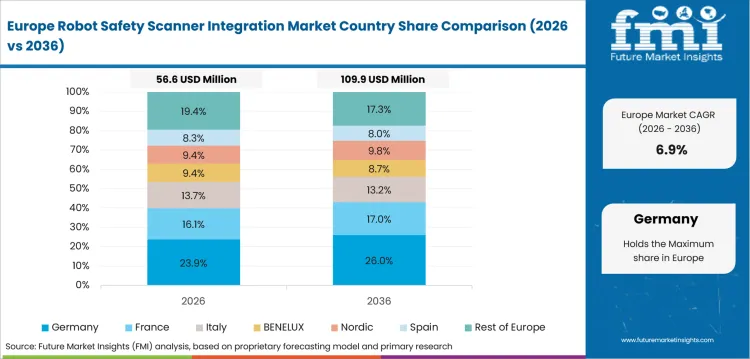
Country Market Snapshot Table
| Parameter | Value |
|---|---|
| Market Size in 2025 (Value) | USD 22.3 million |
| Market Size in 2026 (Value) | USD 24.0 million |
| Market Forecast in 2036 (Value) | USD 50.9 million |
| CAGR (2026 to 2036) | 7.8% |
| Years Considered | 2021 to 2036 |
| Base Year | 2025 |
| Forecast Period | 2026 to 2036 |
| Units Considered | Value (USD million) |
| Leading Sub-Region | Bavaria, Baden-Württemberg, and North Rhine-Westphalia |
Germany Robot Safety Scanner Integration Market Outlook
- Germany demand is shaped by mature automation users and strong machine-safety expertise. Scanner integration is often treated as part of functional safety design rather than a simple component purchase.
- Automotive, machinery, metals, and electronics plants require field stability, controller compatibility, and documentation depth. Local suppliers and integrators benefit from strong links between machine builders, robot OEMs, and safety engineering partners.
Key Growth Drivers
- Robot activity creates a large integration base. IFR reported Germany installed 26,982 industrial robots in 2024.
- Manufacturing order recovery supports automation planning. Destatis reported real manufacturing orders increased 7.8% month on month in December 2025.
- Local safety specialists support repeatable scanner templates across multi-site automotive and machine-building customers.
- Machine builders often embed scanner validation into broader functional safety documentation for export-ready systems.
Key Restraints
- Long validation cycles can slow supplier onboarding when robot cells need conservative signoff and extensive documentation.
- Mature factories may defer upgrades unless downtime, audit findings, or layout changes create a clear safety need.
- Industrial volatility can delay capital projects. Destatis reported energy-intensive industrial production fell 4.0% year on year in August 2025.
What makes Germany unique
Germany is unique due to its combination of high robot use, machine-builder depth, and local safety automation suppliers.
Key Companies
- SICK AG
- Pilz GmbH & Co. KG
- Leuze electronic GmbH + Co. KG
- KUKA AG
- ABB Robotics Germany
- FANUC Deutschland
- Rockwell Automation Germany
Sales & Marketing Channels
- Direct machine builder sales
- Safety engineering partners
- Robot OEM channels
- Automotive tier supplier programs
- Distributor training networks
- Certified retrofit services
Country Segment Breakdown Table
| Segment | Sub-Segments |
|---|---|
| By Robot Type | Collaborative Robots · SCARA · Articulated · AMR/AGV · Delta Robots |
| By Payload | <5 kg · 5-20 kg · 20-80 kg · >80 kg |
| By Application | Material Handling · Inspection, Assembly · Welding · Packaging · Machine Tending |
| By End-use Industry | Automotive · Electronics · Food & Beverage · Logistics · Pharmaceuticals · Metals |
| By Integration Component | Safety Laser Scanner Hardware · Safety Controllers · Mounting & Interfaces · Configuration Software · Validation Services |
| Key Sub-Regions Covered, Machine Safety Hubs | Bavaria · Baden-Württemberg · North Rhine-Westphalia · Saxony · Lower Saxony · Hesse |
Frequently Asked Questions
How fast is Germany robot safety scanner integration market growing?
Germany demand is forecast to grow at 7.8% CAGR from 2026 to 2036 as robot cell validation remains central to automation upgrades.
Who leads Germany robot safety scanner integration market?
SICK, Pilz, Leuze, KUKA, ABB Robotics, FANUC, and Rockwell Automation compete through machine builders and safety engineering channels.
What is driving adoption in Germany robot safety scanner integration market?
Automotive, machinery, and electronics plants are moving toward scanner layouts that support ISO-aligned validation and safe access.
What is the robot safety scanner integration market outlook in France?
A 7.5% CAGR through 2036 reflects selective robot adoption, packaging automation, and retrofit work in compact plants.
Country Market Snapshot Table
| Parameter | Value |
|---|---|
| Market Size in 2025 (Value) | USD 6.0 million |
| Market Size in 2026 (Value) | USD 6.5 million |
| Market Forecast in 2036 (Value) | USD 13.4 million |
| CAGR (2026 to 2036) | 7.5% |
| Years Considered | 2021 to 2036 |
| Base Year | 2025 |
| Forecast Period | 2026 to 2036 |
| Units Considered | Value (USD million) |
| Leading Sub-Region | Île-de-France, Auvergne-Rhône-Alpes, and Hauts-de-France |
France Robot Safety Scanner Integration Market Outlook
- France demand is shaped by retrofit value in packaging, logistics, food, pharmaceuticals, and automotive supplier plants. Scanner integration can win when it allows safer operator access without major line rebuilding.
- French buyers often seek practical documentation and local engineering support. Integrators that reduce audit friction while preserving compact production layouts should gain stronger acceptance.
Key Growth Drivers
- Robot installation activity supports a selective scanner base. IFR reported France recorded 4,900 industrial robot installations in 2024.
- Manufacturing rebound supports automation planning. INSEE reported manufacturing output increased 1.4% month on month in February 2025.
- Packaging and food plants use scanner integration to manage operator access around compact robot cells.
- Logistics automation creates scanner demand around mobile robot crossings and pallet transfer points.
Key Restraints
- Lower annual robot additions than Germany reduce the pace of repeatable new-cell scanner projects.
- Some SMEs choose basic guarding when automation budgets cannot absorb engineering and validation work.
- Workplace accident pressure can increase approval scrutiny. French public service reporting stated 549,614 workplace accidents were declared for general-scheme employees in 2024.
What makes France unique
France is unique due to selective retrofit opportunities where scanner integration must reduce space pressure and audit friction.
Key Companies
- SICK France
- Pilz France
- Omron Electronics France
- Leuze electronic France
- ABB Robotics France
- FANUC France
- Schneider Electric automation partners
Sales & Marketing Channels
- Local automation integrators
- Safety component distributors
- Food equipment builders
- Pharma packaging specialists
- Automotive tier supplier channels
- Maintenance service contractors
Country Segment Breakdown Table
| Segment | Sub-Segments |
|---|---|
| By Robot Type | Collaborative Robots · SCARA · Articulated · AMR/AGV · Delta Robots |
| By Payload | <5 kg · 5-20 kg · 20-80 kg · >80 kg |
| By Application | Material Handling · Inspection · Assembly · Welding · Packaging · Machine Tending |
| By End-use Industry | Automotive · Electronics · Food & Beverage · Logistics · Pharmaceuticals · Metals |
| By Integration Component | Safety Laser Scanner Hardware · Safety Controllers · Mounting & Interfaces · Configuration Software · Validation Services |
| Key Sub-Regions Covered, Industrial Corridors | Île-de-France · Auvergne-Rhône-Alpes · Hauts-de-France · Grand Est · Nouvelle-Aquitaine · Occitanie |
Frequently Asked Questions
How fast is France robot safety scanner integration market growing?
France demand is projected to increase at 7.5% CAGR from 2026 to 2036 through retrofit automation and compact safety projects.
Who leads France robot safety scanner integration market?
SICK France, Pilz France, Omron, Leuze, ABB Robotics, FANUC, and local automation integrators compete through safety-led project channels.
What is driving adoption in France robot safety scanner integration market?
Packaging, logistics, food, and automotive supplier plants are moving toward scanner systems that improve access without expanding cell footprint.
What is the robot safety scanner integration market outlook in Japan?
A 8.0% CAGR through 2036 reflects precision manufacturing, compact robot cells, and strong robot OEM influence.
Country Market Snapshot Table
| Parameter | Value |
|---|---|
| Market Size in 2025 (Value) | USD 29.6 million |
| Market Size in 2026 (Value) | USD 32.0 million |
| Market Forecast in 2036 (Value) | USD 69.1 million |
| CAGR (2026 to 2036) | 8.0% |
| Years Considered | 2021 to 2036 |
| Base Year | 2025 |
| Forecast Period | 2026 to 2036 |
| Units Considered | Value (USD million) |
| Leading Sub-Region | Tokyo, Aichi, Osaka, and Kanagawa automation corridors |
Japan Robot Safety Scanner Integration Market Outlook
- Japan demand is influenced by mature robot users and compact factory layouts. Scanner integration is strongest where electronics, automotive, and machine-tool plants need reliable detection without nuisance stops.
- Local robot OEMs and precision automation suppliers influence safety component selection. Buyers value low downtime, stable scanner fields, and controller-matched validation support.
Key Growth Drivers
- Robot cell activity remains high. IFR reported Japan installed 44,500 industrial robots in 2024.
- Factory output monitoring supports automation planning. METI reported Japan’s industrial production index reached 102.5 in April 2026, with production rising 0.5% from the previous month.
- Electronics factories need compact scanner zones around inspection, assembly, and small-parts handling robots.
- Local robot OEMs create strong channels for controller-matched safety scanner integration.
Key Restraints
- Supplier qualification can be slow where plants rely on long-approved safety architectures and internal standards.
- High uptime expectations make buyers cautious about new scanner field designs that could create nuisance stops.
- Machine safety signoff can slow scanner work around older plants. MHLW’s FY2024 industrial accident report recorded 23 accident cases at the monitored site, including 6 pinched or caught-between machine cases.
What makes Japan unique
Japan is unique due to robot OEM depth, precision production needs, and high expectations for scanner reliability.
Key Companies
- Omron Corporation
- Keyence Corporation
- FANUC Corporation
- Yaskawa Electric Corporation
- Kawasaki Robotics
- SICK Japan
- Pilz Japan
Sales & Marketing Channels
- Robot OEM channels
- Direct factory automation sales
- Certified safety distributors
- Electronics plant integrators
- Automotive equipment builders
- Service and maintenance teams
Country Segment Breakdown Table
| Segment | Sub-Segments |
|---|---|
| By Robot Type | Collaborative Robots · SCARA · Articulated · AMR/AGV · Delta Robots |
| By Payload | <5 kg · 5-20 kg · 20-80 kg · >80 kg |
| By Application | Material Handling · Inspection · Assembly · Welding · Packaging · Machine Tending |
| By End-use Industry | Automotive · Electronics · Food & Beverage · Logistics · Pharmaceuticals · Metals |
| By Integration Component | Safety Laser Scanner Hardware · Safety Controllers · Mounting & Interfaces · Configuration Software · Validation Services |
| Key Sub-Regions Covered, Precision Automation Areas | Tokyo · Aichi · Osaka · Kanagawa · Shizuoka · Fukuoka |
Frequently Asked Questions
How fast is Japan robot safety scanner integration market growing?
Japan demand is expected to rise at 8.0% CAGR from 2026 to 2036 as compact robot cells require validated scanner layouts.
Who leads Japan robot safety scanner integration market?
Omron, Keyence, FANUC, Yaskawa, Kawasaki Robotics, SICK, and Pilz compete through robot OEM and factory automation channels.
What is driving adoption in Japan robot safety scanner integration market?
Precision manufacturing, electronics automation, and robot OEM influence are moving buyers toward controller-matched scanner integration.
What is the robot safety scanner integration market outlook in China?
A 9.4% CAGR through 2036 reflects high robot volumes, domestic robot suppliers, and repeatable scanner templates.
Country Market Snapshot Table
| Parameter | Value |
|---|---|
| Market Size in 2025 (Value) | USD 71.3 million |
| Market Size in 2026 (Value) | USD 78.0 million |
| Market Forecast in 2036 (Value) | USD 191.5 million |
| CAGR (2026 to 2036) | 9.4% |
| Years Considered | 2021 to 2036 |
| Base Year | 2025 |
| Forecast Period | 2026 to 2036 |
| Units Considered | Value (USD million) |
| Leading Sub-Region | Yangtze River Delta and Pearl River Delta automation clusters |
China Robot Safety Scanner Integration Market Outlook
- China demand is shaped by the world’s largest robot installation base and expanding domestic automation suppliers. Scanner integration can scale quickly when validated layouts are reused across EV, electronics, logistics, and machinery plants.
- Large manufacturers ask for advanced scanner systems with diagnostics and repeatable templates. Smaller factories remain price-sensitive, making local engineering support and cost-fit hardware important for wider adoption.
Key Growth Drivers
- Robot installation scale is the main demand anchor. IFR reported China installed 295,000 industrial robots in 2024.
- Manufacturing output supports automation projects. China’s National Bureau of Statistics reported manufacturing value added increased 6.9% year on year in January-February 2025.
- Domestic robot OEMs create new channels for scanner integration packages and local controller compatibility.
- EV, electronics, and logistics factories need compact scanner fields around dense robot cells and mobile transfer routes.
Key Restraints
- Price pressure can compress engineering margins when buyers separate scanner hardware cost from validation effort.
- Local standards interpretation and buyer practices can vary across provinces and industrial clusters.
- Safety investment scrutiny remains active. China reported workplace accident fatalities had dropped 28.4% in 2024 compared with the end of the prior Five-Year Plan period.
What makes China unique
China is unique due to the highest robot installation volume and the ability to scale scanner templates across many factories.
Key Companies
- SICK China
- Omron China
- Keyence China
- Leuze China
- Pilz China
- ABB Robotics China
- FANUC China
Sales & Marketing Channels
- Robot OEM partnerships
- Tier-one factory integrators
- Distributor networks
- EV plant project bids
- Electronics automation channels
- AMR supplier bundles
Country Segment Breakdown Table
| Segment | Sub-Segments |
|---|---|
| By Robot Type | Collaborative Robots · SCARA · Articulated · AMR/AGV · Delta Robots |
| By Payload | <5 kg · 5-20 kg · 20-80 kg · >80 kg |
| By Application | Material Handling · Inspection · Assembly · Welding · Packaging · Machine Tending |
| By End-use Industry | Automotive · Electronics · Food & Beverage · Logistics · Pharmaceuticals · Metals |
| By Integration Component | Safety Laser Scanner Hardware · Safety Controllers · Mounting & Interfaces · Configuration Software · Validation Services |
| Key Sub-Regions Covered, Robot Deployment Clusters | Yangtze River Delta · Pearl River Delta · Beijing-Tianjin-Hebei · Chengdu-Chongqing · Wuhan · Shenyang |
China Robot Safety Scanner Integration Market FAQs
How fast is China robot safety scanner integration market growing?
China demand is projected to grow at 9.4% CAGR from 2026 to 2036 due to large robot volumes and domestic automation depth.
Who leads China robot safety scanner integration market?
SICK, Omron, Keyence, Leuze, Pilz, ABB Robotics, FANUC, and domestic integrators compete through robot OEM partnerships and distributor networks.
What is driving adoption in China robot safety scanner integration market?
EV, electronics, logistics, and machinery automation are moving buyers toward scanner packages that can be repeated across high-volume plants.
What is the robot safety scanner integration market outlook in South Korea?
A 8.7% CAGR through 2036 is supported by dense robot use, electronics production, and automotive safety upgrades.
Country Market Snapshot Table
| Parameter | Value |
|---|---|
| Market Size in 2025 (Value) | USD 17.5 million |
| Market Size in 2026 (Value) | USD 19.0 million |
| Market Forecast in 2036 (Value) | USD 43.8 million |
| CAGR (2026 to 2036) | 8.7% |
| Years Considered | 2021 to 2036 |
| Base Year | 2025 |
| Forecast Period | 2026 to 2036 |
| Units Considered | Value (USD million) |
| Leading Sub-Region | Seoul Capital Area and southeastern manufacturing belt |
South Korea Robot Safety Scanner Integration Market Outlook
- South Korea demand is influenced by high robot density and electronics-led production discipline. Scanner integration is valuable where factories need reliable detection around compact assembly, inspection, and material transfer cells.
- Large manufacturers prefer validated suppliers with fast service response. The market favors scanner systems that reduce false stops, support clean layouts, and fit strict production schedules.
Key Growth Drivers
- Dense automation creates a strong installed base. IFR reported South Korea installed 30,600 industrial robots in 2024.
- Robot density supports retrofit services. IFR reported South Korea reached 1,220 robots per 10,000 manufacturing employees in 2024.
- Electronics plants need scanner zones around high-density assembly and inspection cells.
- Automotive suppliers use scanner upgrades when robot lines are rebalanced for model changes.
Key Restraints
- Flat annual installation trends can slow scanner demand tied only to new robot cells.
- Large enterprise qualification requirements can exclude smaller regional integrators from major projects.
- Industrial safety scrutiny remains a barrier for weakly documented projects. South Korea recorded 589 fatal accidents subject to investigation in 2024.
What makes South Korea unique
South Korea is unique due to the world’s highest robot density and electronics-led production discipline.
Key Companies
- Omron Korea
- Keyence Korea
- SICK Korea
- ABB Robotics Korea
- FANUC Korea
- Yaskawa Korea
- Local automation integrators
Sales & Marketing Channels
- Enterprise automation vendors
- Electronics plant integrators
- Robot OEM channels
- Safety distributor partners
- Automotive supplier programs
- Maintenance contract routes
Country Segment Breakdown Table
| Segment | Sub-Segments |
|---|---|
| By Robot Type | Collaborative Robots · SCARA · Articulated · AMR/AGV · Delta Robots |
| By Payload | <5 kg · 5-20 kg · 20-80 kg · >80 kg |
| By Application | Material Handling · Inspection · Assembly · Welding · Packaging · Machine Tending |
| By End-use Industry | Automotive · Electronics · Food & Beverage · Logistics · Pharmaceuticals · Metals |
| By Integration Component | Safety Laser Scanner Hardware · Safety Controllers · Mounting & Interfaces · Configuration Software · Validation Services |
| Key Sub-Regions Covered, Electronics and Automotive Clusters | Seoul Capital Area · Gyeonggi · Ulsan · Busan · Daegu · Gwangju |
Frequently Asked Questions
How fast is South Korea robot safety scanner integration market growing?
South Korea demand is forecast to increase at 8.7% CAGR from 2026 to 2036 through dense robot use and retrofit validation.
Who leads South Korea robot safety scanner integration market?
Omron, Keyence, SICK, ABB Robotics, FANUC, Yaskawa, and local integrators compete through electronics and automotive automation channels.
What is driving adoption in South Korea robot safety scanner integration market?
Electronics production discipline and dense robot use are moving buyers toward low false-stop scanner integration.
What is the robot safety scanner integration market outlook in India?
A 9.1% CAGR through 2036 reflects rising robot installations, automotive supplier automation, and growing integrator training needs.
Country Market Snapshot Table
| Parameter | Value |
|---|---|
| Market Size in 2025 (Value) | USD 6.9 million |
| Market Size in 2026 (Value) | USD 7.5 million |
| Market Forecast in 2036 (Value) | USD 17.9 million |
| CAGR (2026 to 2036) | 9.1% |
| Years Considered | 2021 to 2036 |
| Base Year | 2025 |
| Forecast Period | 2026 to 2036 |
| Units Considered | Value (USD million) |
| Leading Sub-Region | Pune-Chennai-NCR automotive and industrial corridors |
India Robot Safety Scanner Integration Market Outlook
- India demand is shaped by expanding robot use in automotive suppliers and general industry. Scanner integration often depends on integrators because many buyers need support with scanner selection, field design, and validation evidence.
- Price sensitivity remains visible, but downtime avoidance and customer audits can justify higher integration spend. Suppliers with training, local service, and clear documentation should gain faster acceptance.
Key Growth Drivers
- Robot adoption is rising from a lower base. IFR reported India reached 9,120 industrial robot installations in 2024.
- Automotive policy support strengthens automation demand. India’s Ministry of Heavy Industries stated the PLI-Auto scheme has a budgetary outlay of Rs. 25,938 crore.
- Automotive suppliers need scanner integration around new robot cells and line upgrades.
- Local integrator training can convert safety scanner interest into repeat validation projects.
Key Restraints
- Budget-sensitive SMEs may select basic guarding when scanner engineering and validation costs seem high.
- Limited safety engineering capacity can delay validation after installation and slow repeat project approval.
- Worker injury evidence keeps safety expectations active. Safe in India reported that 42% of factories with more than ten injury cases in its 2025 findings were affiliated with ACMA.
What makes India unique
India is unique due to a fast-growing robot base where integrator education can shape scanner adoption standards early.
Key Companies
- Omron Automation India
- SICK India
- Keyence India
- Pilz India
- ABB Robotics India
- FANUC India
- Indian automation distributors
Sales & Marketing Channels
- Regional system integrators
- Safety product distributors
- Automotive supplier channels
- Robot OEM partners
- Training-led sales routes
- Service contract networks
Country Segment Breakdown Table
| Segment | Sub-Segments |
|---|---|
| By Robot Type | Collaborative Robots · SCARA · Articulated · AMR/AGV · Delta Robots |
| By Payload | <5 kg · 5-20 kg · 20-80 kg · >80 kg |
| By Application | Material Handling · Inspection · Assembly · Welding · Packaging · Machine Tending |
| By End-use Industry | Automotive · Electronics · Food & Beverage · Logistics · Pharmaceuticals · Metals |
| By Integration Component | Safety Laser Scanner Hardware · Safety Controllers · Mounting & Interfaces · Configuration Software · Validation Services |
| Key Sub-Regions Covered, Automation Corridors | Pune · Chennai · NCR · Bengaluru · Sanand · Hyderabad |
Frequently Asked Questions
How fast is India robot safety scanner integration market growing?
India demand is expected to rise at 9.1% CAGR from 2026 to 2036 as automotive and general industry robot cells expand.
Who leads India robot safety scanner integration market?
Omron, SICK, Keyence, Pilz, ABB Robotics, FANUC, and Indian distributors compete through integrator-led sales and training channels.
What is driving adoption in India robot safety scanner integration market?
Automotive suppliers, general industry automation, and customer audit requirements are moving buyers toward validated scanner integration.
Who are the leading companies in the robot safety scanner integration market?
SICK, Omron, Keyence, Leuze, Pilz, Rockwell Automation, and Banner Engineering.
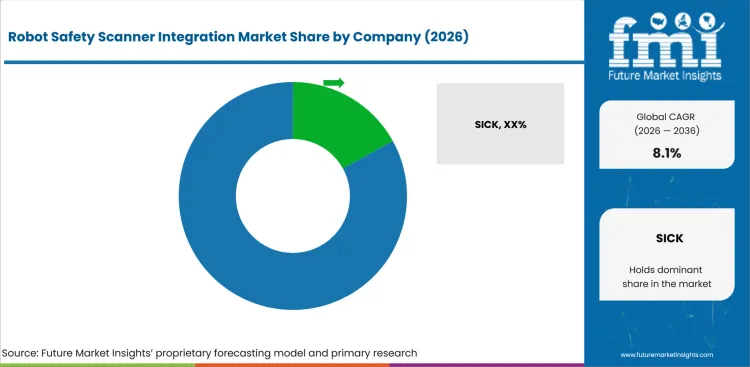
- Safety scanner specialists hold an advantage through scanner range, field set capability, and configuration software.
- Safety automation companies gain project influence by linking scanners with safety controllers and validation tools.
- Robot OEMs influence scanner selection because controller architecture affects stop behavior and restart logic.
- System integrators gain value by turning scanner hardware into audit-ready robot cell safety packages.
Robot safety scanner integration companies compete by combining device performance with controller compatibility and local validation support. SICK, Keyence, Leuze, and Banner Engineering compete through scanner portfolios and factory automation channels. Pilz, Omron, and Rockwell Automation strengthen the market through safety controllers, diagnostics, and machine safety services. Robot OEMs such as ABB Robotics, FANUC, Universal Robots, and KUKA influence scanner integration because robot control platforms determine how stop signals, speed monitoring, and restart rules are implemented.
Scanner suppliers with stronger software support can win higher-value projects because buyers need field diagrams, event records, and change-control evidence after commissioning. Integrators also influence competition by designing field sets around real robot paths, pallet movements, and operator access points. Companies with training networks and local service coverage should gain durable accounts where factories lack internal safety engineering teams. Firms relying only on hardware availability are expected to face price pressure as validation requirements increase.
Regional positioning differs by automation maturity. Germany and Japan favor suppliers with strict validation discipline and machine-builder links. China and India favor suppliers that combine cost-fit hardware with local engineering support. The United States favors integrators that can document safety performance across warehouse, packaging, and automotive applications. South Korea rewards suppliers that reduce nuisance stops in dense electronics and automotive production spaces.
How do top robot safety scanner integration companies compare?
SICK and Keyence score strongly on scanner portfolios while Pilz, Omron, and Rockwell Automation gain relevance through safety control integration.
| Company | Relevance to Market Title | Scanner Portfolio Depth | Controller Integration | Validation Support | Channel Reach | Geographic Footprint |
|---|---|---|---|---|---|---|
| SICK | Very High | Very Strong | Strong | Very Strong | Very Strong | Global |
| Keyence | Very High | Very Strong | Moderate | Strong | Very Strong | Global |
| Omron | Very High | Strong | Very Strong | Strong | Very Strong | Global |
| Pilz | Very High | Strong | Very Strong | Very Strong | Strong | Global |
| Leuze | High | Strong | Moderate | Strong | Strong | Europe and Asia |
| Rockwell Automation | High | Moderate | Very Strong | Strong | Very Strong | Global |
| Banner Engineering | High | Strong | Moderate | Moderate | Strong | Americas and global distributors |
| ABB Robotics | High | Low to Moderate | Very Strong | Strong | Very Strong | Global |
| FANUC | High | Low to Moderate | Strong | Strong | Very Strong | Global |
| Universal Robots | Moderate to High | Low | Strong | Moderate | Strong | Global |
Source: Future Market Insights competitive analysis, 2026.
Who are the key players in the robot safety scanner integration market?
SICK, Omron, Keyence, Pilz, and Leuze are listed with Rockwell Automation and Banner Engineering among other suppliers.
Key global companies leading the robot safety scanner integration market include:
- SICK
- Omron
- Keyence
- Leuze
- Pilz
- Rockwell Automation
- Banner Engineering
- ABB Robotics
- FANUC
- Universal Robots
- KUKA
Key Developments in Robot Safety Scanner Integration Market
- In May 2025, ABB showcased OmniCore for the United States market, with the platform supporting automation systems ranging from single cobots to large multi-robot production cells.
- In September 2025, Pilz introduced PSENscan with a Profinet interface, enabling simpler integration into Profinet networks and faster diagnostics for safety scanner projects.
- In September 2025, SICK expanded its OpenUSD digital sensor models, including safety scanners, to support virtual engineering and sensor-based simulation.
Key Players in the Robot Safety Scanner Integration Market
Safety Scanner Specialists
- SICK
- Keyence
- Leuze
- Banner Engineering
Safety Automation Specialists
- Pilz
- Omron
- Rockwell Automation
Robot OEM Ecosystem Players
- ABB Robotics
- FANUC
- Universal Robots
- KUKA
Robot Safety Scanner Integration Market - Scope & Definition
| Attribute | Detail |
|---|---|
| Market Definition | Engineering, installation, configuration, validation, and service work needed to integrate safety laser scanners with robot cells, mobile robot transfer points, and shared automation spaces |
| Functions Covered | Personnel detection, protective field monitoring, warning zone setup, robot safe stop support, speed control support, restart validation, and event documentation |
| Applications Covered | Material handling, inspection, assembly, welding, packaging, and machine tending robot cells requiring scanner-based access control |
| End-Use Industries | Automotive, electronics, food and beverage, logistics, pharmaceuticals, metals, and related industrial automation users |
| Grades Covered | Scanner integration packages by robot type, payload range, application type, controller link, and validation scope |
| Inclusions | Safety laser scanner integration, safety controller connection, mounting hardware, field configuration, software setup, validation documentation, retrofit service, and robot cell commissioning support |
| Exclusions | Standalone scanner hardware sales without integration, general machine guarding unrelated to robots, consumer robots, medical robotic procedures, defense robots, and non-safety presence sensing projects |
Robot Safety Scanner Integration Market - Research Methodology
| Method | Description |
|---|---|
| Primary Research | FMI analyst interviews with robot integrators, machine builders, safety scanner suppliers, automation distributors, EHS managers, and factory automation buyers across key markets |
| Desk Research | Review of robot installation data, industrial safety standards, government accident datasets, supplier product releases, safety scanner documentation, and automation company disclosures |
| Market Sizing & Forecasting | Bottom-up integration-boundary approach using scanner project volume, robot cell activity, retrofit frequency, controller compatibility, validation time, and country-level automation adoption |
| Data Validation | Cross-verification using robot installation trends, safety scanner portfolios, country automation indicators, supplier channel presence, and project-level integration economics |
Robot Safety Scanner Integration Market - Report Scope
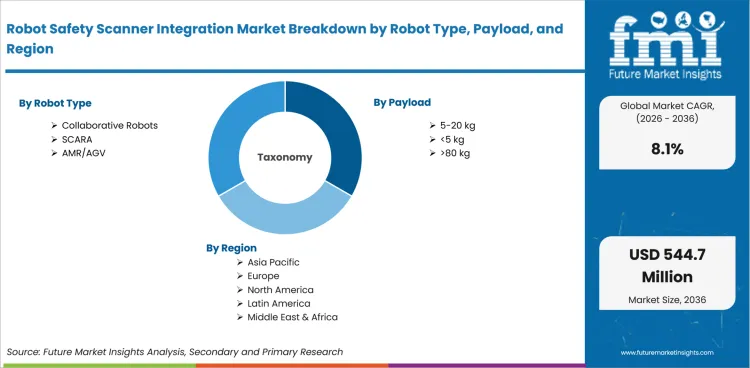
| Parameter | Details |
|---|---|
| Forecast period | 2026 to 2036 |
| Historical period | 2021 to 2025 |
| Quantitative unit | Revenue in USD million |
| By robot type | Collaborative Robots, SCARA, Articulated, AMR/AGV, Delta Robots |
| By payload | <5 kg, 5-20 kg, 20-80 kg, >80 kg |
| By application | Material Handling, Inspection, Assembly, Welding, Packaging, Machine Tending |
| By end-use industry | Automotive, Electronics, Food & Beverage, Logistics, Pharmaceuticals, Metals |
| By integration component | Safety Laser Scanner Hardware, Safety Controllers, Mounting & Interfaces, Configuration Software, Validation Services |
| Regions covered | North America, Latin America, Europe, East Asia, South Asia and Pacific, Middle East and Africa |
| Countries covered | United States, United Kingdom, Germany, France, Japan, China, South Korea, India |
| Key companies profiled | SICK, Omron, Keyence, Leuze, Pilz, Rockwell Automation, Banner Engineering, ABB Robotics, FANUC, Universal Robots, KUKA |
| Approach | Bottom-up integration-boundary approach using robot cell activity, scanner project pricing, validation service demand, controller compatibility, and country-level automation adoption |
Source: Future Market Insights competitive analysis, 2026.
Robot Safety Scanner Integration Market Breakdown by Robot Type, Payload, Application, End-use Industry, Integration Component, and Region
Robot Safety Scanner Integration Market Segmented by Robot Type
- Collaborative Robots
- SCARA
- Articulated
- AMR/AGV
- Delta Robots
Robot Safety Scanner Integration Market Segmented by Payload
- <5 kg
- 5-20 kg
- 20-80 kg
- >80 kg
Robot Safety Scanner Integration Market Segmented by Application
- Material Handling
- Inspection
- Assembly
- Welding
- Packaging
- Machine Tending
Robot Safety Scanner Integration Market Segmented by End-use Industry
- Automotive
- Electronics
- Food & Beverage
- Logistics
- Pharmaceuticals
- Metals
Robot Safety Scanner Integration Market Segmented by Integration Component
- Safety Laser Scanner Hardware
- Safety Controllers
- Mounting & Interfaces
- Configuration Software
- Validation Services
Robot Safety Scanner Integration Market by Region
- North America
- Latin America
- Europe
- East Asia
- South Asia and Pacific
- Middle East and Africa
Research Sources and Bibliography
- ABB Robotics. (2024, June 4). ABB launches next-generation Robotics control platform OmniCore.
- ABB Robotics. (2025, May 5). ABB to unleash the power of OmniCore at Automate 2025.
- Banner Engineering. (2025). Safety laser scanner and machine safety application resources.
- Bureau of Labor Statistics. (2026, January 22). Employer-reported workplace injuries and illnesses, 2024.
- Bureau of Labor Statistics. (2026, February 19). National census of fatal occupational injuries in 2024.
- Destatis. (2025, October 8). Production in August 2025.
- Destatis. (2026, February 5). New orders in manufacturing in December 2025.
- Health and Safety Executive. (2025, November 20). Health and safety at work: Summary statistics for Great Britain 2025.
- Health and Safety Executive. (2025, November 20). RIDDOR reported workplace injuries, Great Britain 2024 to 2025.
- Institut national de la statistique et des études économiques. (2025, April 4). In February 2025, manufacturing output bounced back.
- International Federation of Robotics. (2025, September 25). World Robotics 2025 report: Industrial robots.
- International Federation of Robotics. (2025, September 25). India rises to sixth in global factory robot installations.
- International Federation of Robotics. (2026, April 8). Robot density surges in Europe, Asia, and Americas.
- International Organization for Standardization. (2025). ISO 10218-1:2025 Robotics safety requirements.
- International Organization for Standardization. (2025). ISO 10218-2:2025 Robotics safety requirements for industrial robot applications and robot cells.
- Japan Industrial Safety and Health Association. (2026, March 5). All data of fatal and non-fatal accidents in Japan in 2024.
- Ministry of Economy, Trade and Industry. (2026, June 12). Revised report for April 2026: Indices of industrial production.
- Ministry of Health, Labour and Welfare. (2025, April 24). Report on the occurrence of industrial accidents in FY2024.
- Ministry of Heavy Industries. (2026, January 13). Year End Review 2025: Ministry of Heavy Industries.
- National Bureau of Statistics of China. (2025, March 18). Industrial production operation from January to February 2025.
- Occupational Safety and Health Administration. (2025, April 17). USA Department of Labor releases 2024 injury, illness data.
- Pilz. (2025, September 16). Safety laser scanner PSENscan with Profinet interface.
- Safe in India Foundation. (2025, August 12). CRUSHED2025: Worker safety, India’s unlocked productivity potential.
- Service-Public.fr. (2025, December 4). How to limit serious and fatal accidents at work?
- SICK. (2025, September 26). SICK expands its digital portfolio with new sensor models.
- South Korea Ministry of Employment and Labor. (2025, March 11). 2024 industrial accident statistics supplementary report.
This bibliography is provided for reader reference and is not exhaustive. The full report contains the complete reference list and detailed citations.
This Report Answers
- Market size estimates for 2026 and forecasts through 2036 for the robot safety scanner integration market.
- Insights across regional and country-level robot safety scanner integration opportunities.
- Analysis of demand drivers, retrofit needs, safety validation trends, and scanner integration economics.
- Evaluation of robot type, payload, application, end-use industry, and integration component demand.
- Assessment of standards, workplace safety requirements, controller compatibility, and validation impacts.
- Identification of opportunities across collaborative robot cells, AMR/AGV transfer points, and compact production layouts.
- Evaluation of supply chain dynamics, scanner portfolios, controller architectures, and integrator channel structures.
- Country-level growth analysis covering the United States, United Kingdom, Germany, France, Japan, China, South Korea, and India.
- Assessment of the competitive landscape, including leading safety scanner suppliers and robot automation ecosystem participants.
- Analysis of buyer preferences, project validation needs, and emerging integration opportunities.
- Regional outlooks across North America, Europe, East Asia, South Asia and Pacific, and other markets.
- Delivery of market data, forecasts, and supporting analysis in PDF and Excel formats.
Frequently Asked Questions
What is the growth prospect for robot safety scanner integration?
Demand for robot safety scanner integration is expected to rise at a considerable pace as factories redesign robot cells for safer shared access and flexible automation.
Which companies are expected to shape the robot safety scanner integration market?
SICK, Omron, Keyence, Leuze, Pilz, Rockwell Automation, Banner Engineering, ABB Robotics, FANUC, and Universal Robots are expected to shape market competition.
Why are automation companies investing in robot safety scanner integration?
Automation companies are investing in robot safety scanner integration to support dynamic field switching, scanner diagnostics, controller links, and validated robot cell safety.
Why are system integrators important in the robot safety scanner integration market?
System integrators are important because scanner value depends on placement, field design, controller setup, stop-time validation, and documentation.
Which robot cells are gaining attention in robot safety scanner integration?
Collaborative robot cells, AMR/AGV transfer points, machine tending stations, and material handling cells are gaining attention because they require safe human access.
How do standards influence robot safety scanner integration projects?
Standards influence scanner projects by requiring safer integration, commissioning, functional testing, operation, maintenance, and repair practices across robot applications.
Why is documentation important for robot safety scanner integration?
Documentation is important because buyers need evidence for stopping distance, field boundaries, restart behavior, and change control after robot cell updates.
What role do safety controllers play in robot safety scanner integration?
Safety controllers connect scanner signals with robot stop functions, warning fields, reset logic, diagnostics, and broader machine safety systems.
How do retrofit projects support robot safety scanner integration?
Retrofit projects support scanner integration by allowing older fenced cells to add safer operator access without rebuilding the full production line.
Preview the report firsthand - request a free sample
Get SampleGet the brochure for pricing and purchase details.
Get PDFTable of Content
- Key Takeaways
- Market Size and CAGR
- Top Growth Driver
- Fastest Growing Segment
- Leading Region
- Key Companies
- Emerging Opportunities
- Executive Summary
- Global Market Outlook
- Demand-side Trends
- Supply-side Trends
- Technology Roadmap Analysis
- Analysis and Recommendations
- Analyst Perspective (What is happening? Why now? What should investors know?)
- Key Questions Answered
- How large is the market?
- What is the CAGR?
- What are key trends?
- Which region dominates?
- Who are the leaders?
- Market Overview
- Market Coverage / Taxonomy
- Market Definition / Scope / Limitations
- Research Methodology
- Chapter Orientation
- Analytical Lens and Working Hypotheses
- Market Structure, Signals, and Trend Drivers
- Benchmarking and Cross-market Comparability
- Market Sizing, Forecasting, and Opportunity Mapping
- Research Design and Evidence Framework
- Desk Research Programme (Secondary Evidence)
- Expert Input and Fieldwork (Primary Evidence)
- Tooling, Models, and Reference Databases
- Data Engineering and Model Build
- Quality Assurance and Audit Trail
- Market Background
- Market Dynamics (Drivers, Restraints, Opportunity, Trends)
- Scenario Forecast (Optimistic, Likely, Conservative)
- Impact Analysis
- AI Impact
- Sustainability Impact
- Regulatory Impact
- Technology Impact
- Consumer / Buyer Analysis
- Purchase Drivers
- Adoption Barriers
- Buyer Journey
- Opportunity Map Analysis
- Product Life Cycle Analysis
- Supply Chain Analysis
- Investment Feasibility Matrix
- Value Chain Analysis
- PESTLE and Porter's Analysis
- Regulatory Landscape
- Regional Parent Market Outlook
- Production and Consumption Statistics
- Import and Export Statistics
- Global Market Analysis and Forecast, 2021 to 2036
- Historical Market Size Value (USD Million) Analysis, 2021 to 2025
- Current and Future Market Size Value (USD Million) Projections, 2026 to 2036
- Y-o-Y Growth Trend Analysis
- Absolute $ Opportunity Analysis
- Global Market Pricing Analysis, 2021 to 2036
- Global Market Analysis and Forecast, By Offering, 2021 to 2036
- Introduction / Key Findings
- Historical Market Size Value (USD Million) Analysis By Offering, 2021 to 2025
- Current and Future Market Size Value (USD Million) Analysis and Forecast By Offering, 2026 to 2036
- Controllers
- I/O Modules
- Engineering Software
- Controllers
- Y-o-Y Growth Trend Analysis By Offering, 2021 to 2025
- Absolute $ Opportunity Analysis By Offering, 2026 to 2036
- Global Market Analysis and Forecast, By Deployment, 2021 to 2036
- Introduction / Key Findings
- Historical Market Size Value (USD Million) Analysis By Deployment, 2021 to 2025
- Current and Future Market Size Value (USD Million) Analysis and Forecast By Deployment, 2026 to 2036
- Process Automation
- Discrete Automation
- Hybrid Automation
- Process Automation
- Y-o-Y Growth Trend Analysis By Deployment, 2021 to 2025
- Absolute $ Opportunity Analysis By Deployment, 2026 to 2036
- Global Market Analysis and Forecast, By Application, 2021 to 2036
- Introduction / Key Findings
- Historical Market Size Value (USD Million) Analysis By Application, 2021 to 2025
- Current and Future Market Size Value (USD Million) Analysis and Forecast By Application, 2026 to 2036
- Machine Control
- Line Integration
- Safety Control
- Machine Control
- Y-o-Y Growth Trend Analysis By Application, 2021 to 2025
- Absolute $ Opportunity Analysis By Application, 2026 to 2036
- Global Market Analysis and Forecast, By End-use Industry, 2021 to 2036
- Introduction / Key Findings
- Historical Market Size Value (USD Million) Analysis By End-use Industry, 2021 to 2025
- Current and Future Market Size Value (USD Million) Analysis and Forecast By End-use Industry, 2026 to 2036
- Chemicals
- Food & Beverage
- Pharmaceuticals
- Chemicals
- Y-o-Y Growth Trend Analysis By End-use Industry, 2021 to 2025
- Absolute $ Opportunity Analysis By End-use Industry, 2026 to 2036
- Global Market Analysis and Forecast, By Integration Architecture, 2021 to 2036
- Introduction / Key Findings
- Historical Market Size Value (USD Million) Analysis By Integration Architecture, 2021 to 2025
- Current and Future Market Size Value (USD Million) Analysis and Forecast By Integration Architecture, 2026 to 2036
- PLC-Centric Integration
- DCS-Linked Skids
- Edge and Virtualized Control
- PLC-Centric Integration
- Y-o-Y Growth Trend Analysis By Integration Architecture, 2021 to 2025
- Absolute $ Opportunity Analysis By Integration Architecture, 2026 to 2036
- Global Market Analysis and Forecast, By Region, 2021 to 2036
- Introduction
- Historical Market Size Value (USD Million) Analysis By Region, 2021 to 2025
- Current Market Size Value (USD Million) Analysis and Forecast By Region, 2026 to 2036
- North America
- Latin America
- Western Europe
- Eastern Europe
- East Asia
- South Asia and Pacific
- Middle East & Africa
- Market Attractiveness Analysis By Region
- North America Market Analysis and Forecast, By Country, 2021 to 2036
- Historical Market Size Value (USD Million) Trend Analysis By Market Taxonomy, 2021 to 2025
- Market Size Value (USD Million) Forecast By Market Taxonomy, 2026 to 2036
- By Country
- USA
- Canada
- Mexico
- By Offering
- By Deployment
- By Application
- By End-use Industry
- By Integration Architecture
- By Country
- Market Attractiveness Analysis
- By Country
- By Offering
- By Deployment
- By Application
- By End-use Industry
- By Integration Architecture
- Key Takeaways
- Latin America Market Analysis and Forecast, By Country
- Historical Market Size Value (USD Million) Trend Analysis By Market Taxonomy, 2021 to 2025
- Market Size Value (USD Million) Forecast By Market Taxonomy, 2026 to 2036
- By Country
- Brazil
- Chile
- Rest of Latin America
- By Offering
- By Deployment
- By Application
- By End-use Industry
- By Integration Architecture
- By Country
- Market Attractiveness Analysis
- By Country
- By Offering
- By Deployment
- By Application
- By End-use Industry
- By Integration Architecture
- Key Takeaways
- Western Europe Market Analysis and Forecast, By Country
- Historical Market Size Value (USD Million) Trend Analysis By Market Taxonomy, 2021 to 2025
- Market Size Value (USD Million) Forecast By Market Taxonomy, 2026 to 2036
- By Country
- Germany
- UK
- Italy
- Spain
- France
- Nordic
- BENELUX
- Rest of Western Europe
- By Offering
- By Deployment
- By Application
- By End-use Industry
- By Integration Architecture
- By Country
- Market Attractiveness Analysis
- By Country
- By Offering
- By Deployment
- By Application
- By End-use Industry
- By Integration Architecture
- Key Takeaways
- Eastern Europe Market Analysis and Forecast, By Country
- Historical Market Size Value (USD Million) Trend Analysis By Market Taxonomy, 2021 to 2025
- Market Size Value (USD Million) Forecast By Market Taxonomy, 2026 to 2036
- By Country
- Russia
- Poland
- Hungary
- Balkan & Baltic
- Rest of Eastern Europe
- By Offering
- By Deployment
- By Application
- By End-use Industry
- By Integration Architecture
- By Country
- Market Attractiveness Analysis
- By Country
- By Offering
- By Deployment
- By Application
- By End-use Industry
- By Integration Architecture
- Key Takeaways
- East Asia Market Analysis and Forecast, By Country
- Historical Market Size Value (USD Million) Trend Analysis By Market Taxonomy, 2021 to 2025
- Market Size Value (USD Million) Forecast By Market Taxonomy, 2026 to 2036
- By Country
- China
- Japan
- South Korea
- By Offering
- By Deployment
- By Application
- By End-use Industry
- By Integration Architecture
- By Country
- Market Attractiveness Analysis
- By Country
- By Offering
- By Deployment
- By Application
- By End-use Industry
- By Integration Architecture
- Key Takeaways
- South Asia and Pacific Market Analysis and Forecast, By Country
- Historical Market Size Value (USD Million) Trend Analysis By Market Taxonomy, 2021 to 2025
- Market Size Value (USD Million) Forecast By Market Taxonomy, 2026 to 2036
- By Country
- India
- ASEAN
- Australia & New Zealand
- Rest of South Asia and Pacific
- By Offering
- By Deployment
- By Application
- By End-use Industry
- By Integration Architecture
- By Country
- Market Attractiveness Analysis
- By Country
- By Offering
- By Deployment
- By Application
- By End-use Industry
- By Integration Architecture
- Key Takeaways
- Middle East & Africa Market Analysis and Forecast, By Country
- Historical Market Size Value (USD Million) Trend Analysis By Market Taxonomy, 2021 to 2025
- Market Size Value (USD Million) Forecast By Market Taxonomy, 2026 to 2036
- By Country
- Kingdom of Saudi Arabia
- Other GCC Countries
- Türkiye
- South Africa
- Other African Union
- Rest of Middle East & Africa
- By Offering
- By Deployment
- By Application
- By End-use Industry
- By Integration Architecture
- By Country
- Market Attractiveness Analysis
- By Country
- By Offering
- By Deployment
- By Application
- By End-use Industry
- By Integration Architecture
- Key Takeaways
- Key Countries Market Analysis
- USA
- Pricing Analysis
- Market Share Analysis, 2025
- By Offering
- By Deployment
- By Application
- By End-use Industry
- By Integration Architecture
- Canada
- Pricing Analysis
- Market Share Analysis, 2025
- By Offering
- By Deployment
- By Application
- By End-use Industry
- By Integration Architecture
- Mexico
- Pricing Analysis
- Market Share Analysis, 2025
- By Offering
- By Deployment
- By Application
- By End-use Industry
- By Integration Architecture
- Brazil
- Pricing Analysis
- Market Share Analysis, 2025
- By Offering
- By Deployment
- By Application
- By End-use Industry
- By Integration Architecture
- Chile
- Pricing Analysis
- Market Share Analysis, 2025
- By Offering
- By Deployment
- By Application
- By End-use Industry
- By Integration Architecture
- Germany
- Pricing Analysis
- Market Share Analysis, 2025
- By Offering
- By Deployment
- By Application
- By End-use Industry
- By Integration Architecture
- UK
- Pricing Analysis
- Market Share Analysis, 2025
- By Offering
- By Deployment
- By Application
- By End-use Industry
- By Integration Architecture
- Italy
- Pricing Analysis
- Market Share Analysis, 2025
- By Offering
- By Deployment
- By Application
- By End-use Industry
- By Integration Architecture
- Spain
- Pricing Analysis
- Market Share Analysis, 2025
- By Offering
- By Deployment
- By Application
- By End-use Industry
- By Integration Architecture
- France
- Pricing Analysis
- Market Share Analysis, 2025
- By Offering
- By Deployment
- By Application
- By End-use Industry
- By Integration Architecture
- India
- Pricing Analysis
- Market Share Analysis, 2025
- By Offering
- By Deployment
- By Application
- By End-use Industry
- By Integration Architecture
- ASEAN
- Pricing Analysis
- Market Share Analysis, 2025
- By Offering
- By Deployment
- By Application
- By End-use Industry
- By Integration Architecture
- Australia & New Zealand
- Pricing Analysis
- Market Share Analysis, 2025
- By Offering
- By Deployment
- By Application
- By End-use Industry
- By Integration Architecture
- China
- Pricing Analysis
- Market Share Analysis, 2025
- By Offering
- By Deployment
- By Application
- By End-use Industry
- By Integration Architecture
- Japan
- Pricing Analysis
- Market Share Analysis, 2025
- By Offering
- By Deployment
- By Application
- By End-use Industry
- By Integration Architecture
- South Korea
- Pricing Analysis
- Market Share Analysis, 2025
- By Offering
- By Deployment
- By Application
- By End-use Industry
- By Integration Architecture
- Russia
- Pricing Analysis
- Market Share Analysis, 2025
- By Offering
- By Deployment
- By Application
- By End-use Industry
- By Integration Architecture
- Poland
- Pricing Analysis
- Market Share Analysis, 2025
- By Offering
- By Deployment
- By Application
- By End-use Industry
- By Integration Architecture
- Hungary
- Pricing Analysis
- Market Share Analysis, 2025
- By Offering
- By Deployment
- By Application
- By End-use Industry
- By Integration Architecture
- Kingdom of Saudi Arabia
- Pricing Analysis
- Market Share Analysis, 2025
- By Offering
- By Deployment
- By Application
- By End-use Industry
- By Integration Architecture
- Türkiye
- Pricing Analysis
- Market Share Analysis, 2025
- By Offering
- By Deployment
- By Application
- By End-use Industry
- By Integration Architecture
- South Africa
- Pricing Analysis
- Market Share Analysis, 2025
- By Offering
- By Deployment
- By Application
- By End-use Industry
- By Integration Architecture
- USA
- Market Structure Analysis
- Competition Dashboard
- Competition Benchmarking
- Market Share Analysis of Top Players
- By Regional
- By Offering
- By Deployment
- By Application
- By End-use Industry
- By Integration Architecture
- Emerging Startups
- Innovation Benchmarking
- Competition Analysis
- Competition Deep Dive
- Siemens
- Overview
- Product Portfolio
- Profitability by Market Segments (Product/Region/Sales Channel)
- Sales Footprint
- Strategy Overview
- Marketing Strategy
- Product Strategy
- Channel Strategy
- Rockwell Automation
- Schneider Electric
- ABB
- Honeywell
- Emerson
- Yokogawa
- Siemens
- Case Studies
- Success Stories
- Recent Developments
- Competition Deep Dive
- Assumptions & Acronyms Used


