

- Market Size (2026)
- USD 982.2 Mn
- Forecast (2036)
- USD 1630.7 Mn
- CAGR (2026 to 2036)
- 5.2%
How big is Safety Floor Markings Market in 2026?
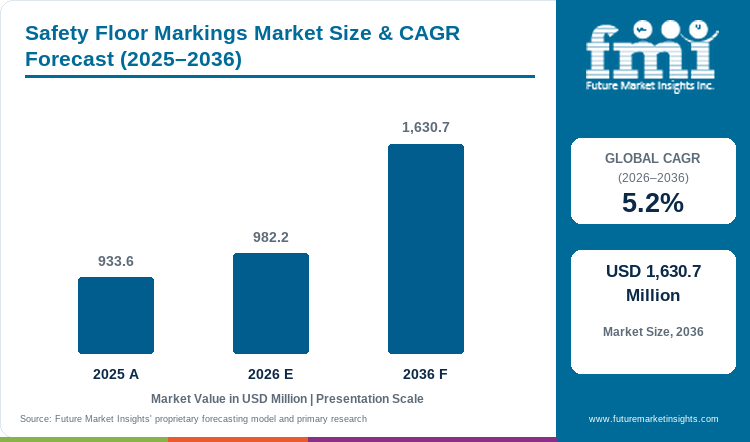
USD 982.2 million in 2026 and USD 1,630.7 million by 2036 at a 5.2% CAGR.
Sales of safety floor markings are estimated to rise at 5.2% CAGR through 2036. Valuation rises from USD 933.6 million in 2025 to USD 982.2 million in 2026 and reaches USD 1,630.7 million by 2036. Facility teams keep permanent aisles visible because safety rules require clear routes. OSHA currently requires permanent aisles and passageways to be appropriately marked. Layout changes can favor removable floor marking tape because repainting can extend a planned shutdown.
U.S. warehouses create a large base for repeat use. In September 2026, the U.S. Bureau of Labor Statistics reported 1.837 million warehousing and storage jobs for August 2026. The USA is projected at 4.5% CAGR through 2036, compared with 4.1% for Germany. German plants give more weight to clear route rules and workplace safety systems. Floor age and traffic also affect product choice and long-term cost. Local stock needs differ too.
Key Takeaways
- Safety rules for marked routes and frequent layout changes keep replacement spending active.
- By product type, floor marking tapes are projected to account for 36.0% in 2026, supported by fast setup and easy section replacement.
- By material, vinyl is estimated to hold 33.0% in 2026, influenced by wide color choice and easy roll or shape use.
- In 2026, warehouses are expected to lead end use with 35.0% share, linked to heavy traffic and frequent route changes.
- Poor floor preparation can shorten product life and make maintenance teams apply markings again.
- Some of the key players in this market include Brady Corporation, 3M, Seton, Jessup Manufacturing, Heskins, Graphic Products, SafetyTac / Creative Safety Supply, Avery Dennison, Tesa and Advance Tapes.
Analyst Perspective
"Floor markings win repeat orders when the adhesive matches the floor and traffic level. Facility teams need clear use limits before they make a product a site standard."
- Nikhil Kaitwade, Principal Consultant, Future Market Insights
How is the safety floor markings market segmented?
The safety floor markings market is segmented by product type, material, end use, application, sales channel and region.
The market is split by product type, material, end use, application, sales channel and region. Product type includes floor marking tapes, painted markings, photoluminescent markings, anti-slip floor signs and pre-cut markers. Material includes vinyl, PVC, epoxy paint, polyester and photoluminescent film. End use includes warehouses, factories, healthcare sites, retail stores and transport hubs. Application includes aisle marking, hazard zones, 5S - lean visual management, emergency egress and social - safety spacing. Sales channel includes safety distributors, industrial catalog - e-commerce, direct manufacturer sales and facility contractors.
What supports floor marking tapes within the product type category?
Maintenance crews often choose tape for route changes because paint needs time to dry. In February 2026, Heskins described warehouse zoning with removable marking tape. Crews can replace damaged sections during short maintenance stops. The same job may also need anti-slip floor tape for grip and clear zones.
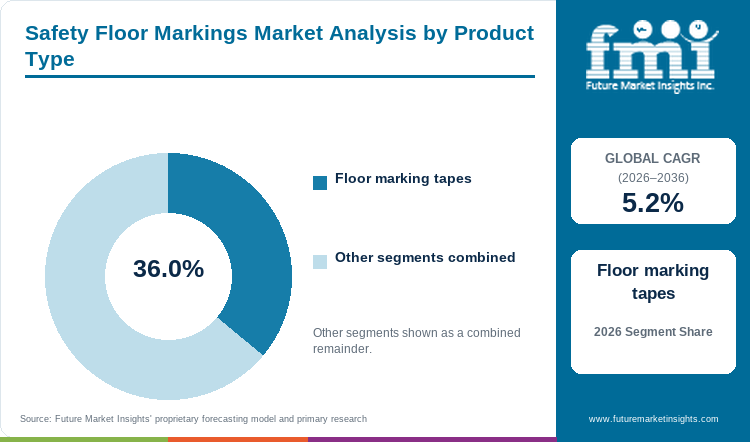
- Based on product type, floor marking tapes are projected to account for 36.0% in 2026, supported by fast setup and easy section replacement.
- Removable rolls make aisle, storage-box and temporary-cell changes easier.
How does vinyl influence selection within the material category?
Vinyl gives manufacturers a flexible base for solid-color lines and printed floor messages. It works well indoors for clean removal and frequent color changes. Polyester and photoluminescent paints can handle heavy traffic or low-light needs. Epoxy paint suits fixed routes. In November 2025, Heskins described Glow Line Tape for low-light routes and hazard areas. Low-light areas need visibility, clear color and clean removal.
- By material, vinyl is estimated to hold 33.0% in 2026, influenced by wide color choice and lower replacement cost.
- Facilities choose tougher films or paint when wear, heat, or long-term use matters more than easy removal.
How do warehouses shape demand within the end use category?
Warehouse aisles separate people, storage areas and powered material handling equipment. In September 2026, BLS reported 1.837 million U.S. warehousing and storage jobs for August. Workers share these sites with moving pallets and changing pick routes. Daily traffic keeps lane checks and repair work on regular maintenance schedules.
- In 2026, warehouses are expected to lead end use with 35.0% share, linked to heavy traffic and route changes.
- High-bay layouts also tie floor zones to storage locations, staging space and changes in warehouse racking.
What makes aisle marking central to the application category?
Aisle lines turn a floor plan into clear routes that workers can follow. OSHA requires permanent aisles and passageways to be appropriately marked. Long routes use more marking material than small warning points. Hazard zones can also use marking coatings when floors need a permanent finish.
- By application, aisle marking is forecast to represent 32.0% in 2026, driven by long routes that need full-length markings.
- Emergency exits, hazard zones, 5S controls and spacing messages matter too, but usually cover smaller floor areas.
Why do safety distributors remain important in the sales channel category?
A floor-marking order often includes tape, signs, shapes and other industrial safety products. Brady said in its 2025 annual report that its safety range includes floor-marking tape and uses broad sales networks. Distributors can keep mixed stock nearby and help customers match products to traffic, floor condition and timing.
- Safety distributors are set to lead the sales channel category with 41.0% share in 2026, supported by local stock and product help.
- Direct sales remain useful for large custom programs. E-commerce handles repeat orders for standard products.
What are the drivers, restraints and opportunities in the Safety Floor Markings Market?
Route-control duties sustain replacement, poor floor preparation can shorten service life and custom visual systems expand application value.
- Driver: Safety rules for marked routes and frequent layout changes create repeat maintenance purchases.
- Restraint: Dirt, oil, rough floors and poor preparation can weaken adhesion before the planned replacement date.
- Opportunity: Printed messages and task-specific products can add clear instructions to marked routes.
Site teams must keep routes clear as traffic and layouts change. In September 2026, BLS reported 1.837 million U.S. warehousing and storage jobs for August 2026. Many warehouses separate people from powered equipment with marked lanes. Durable concrete floor coatings can serve fixed routes. Removable tapes suit areas that change more often. Wear, safety checks and layout changes create new marking work. Site managers compare product life with the labor needed to change a route. They also check whether repairs can avoid closing a larger work area. Crews check removal behavior because leftover adhesive can slow the next layout change.
Adhesive markings can fail early on dirt, oil, or floor cleaner. In February 2026, Graphic Products updated its floor-marking preparation guide. The company tells users to clean, dry and test the surface before use. A weak bond adds removal work and may require another shutdown. Site teams test tape on the real floor before using it on a larger route. Cleaning chemicals and rough surfaces can change the best product choice. Heavy carts can lift weak edges quickly. One small failure can create repeated repair work. Teams also check the floor after normal cleaning. The risk is highest on dirty, rough, or uneven floors.
Custom messages let suppliers offer more than standard color lines. In July 2026, Creative Safety Supply described sites printing floor labels for barcodes, asset tags and workstation data. Electrostatic discharge (ESD)-controlled areas also need clear boundaries that work with ESD tapes and labels. Suppliers can serve these jobs by controlling print life and stating clear use limits. Users do not need to rebuild the full visual system. Custom printing works best if messages stay clear under normal traffic and cleaning. Printed arrows and equipment labels can place task instructions on the floor. This can reduce the need for separate wall signs.
Which country CAGRs are profiled in the Safety Floor Markings Market?
| Country | CAGR |
|---|---|
| Czech Republic | 5.8% |
| Mexico | 5.5% |
| Brazil | 5.1% |
| Italy | 4.8% |
| USA | 4.5% |
| Germany | 4.1% |
| Japan | 3.8% |
How do country-level CAGRs compare in the Safety Floor Markings Market?
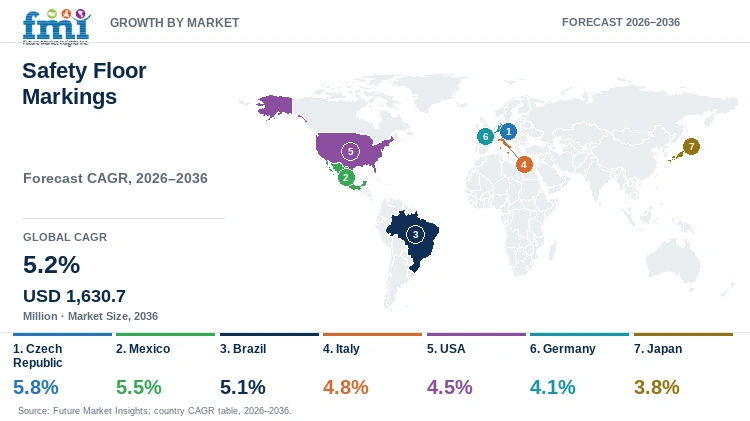
The countries differ by 2.0 percentage points, from 5.8% in the Czech Republic to 3.8% in Japan. Mexico and Brazil are also in the higher-growth group. In the USA, Germany and Japan, older safety systems make replacement more important at many sites. Local buying needs also shape the outlook.
- Czech Republic: Nearby stock helps factories in regional supply networks.
- Mexico: Local distributors help replace worn markings outside major industrial centers.
- Brazil: Contractor access shapes install quality and replacement timing.
- Italy: Contractor-led upkeep favors products with faster installation.
- USA: Large warehouse groups value common colors and nearby stock.
- Germany: Plant upkeep favors wear data and cleaning resistance.
- Japan: Clean removal protects strict site visuals during layout changes.
Similar CAGRs still create different buying conditions. Site age, traffic and replacement needs vary by country. The full report provides country-level CAGR analysis across North America, Latin America, Western Europe, Eastern Europe, East Asia, South Asia and Pacific and the Middle East and Africa.
Country-wise Analysis
- U.S. warehouses are large enough to make lane upkeep a regular site task. By 2036, the USA is projected to grow at 4.5% CAGR, influenced by heavy warehouse traffic and replacement needs. In September 2026, BLS reported 1.837 million warehousing and storage jobs for August. Warehouse racking changes can force aisle and staging lines to move. Large sites also have mixed concrete floors. Suppliers need sample material and simple prep steps before one product is used at many sites. Multi-site operators compare cleanup work and removal behavior because a failed trial can interrupt active picking areas.Warehouse racking
- German plants treat marked routes as part of normal safety work. By 2036, Germany is projected to grow at 4.1% CAGR, shaped by planned plant upkeep and clear route rules. In March 2026, DGUV reported 730,598 work accidents for 2025. Busy plants expose markings to traffic, cleaning and chemicals. Site teams check wear and chemical resistance before choosing tape or coating. They also need steady color supply and clear use limits. Removal work matters during planned shutdowns because extra cleanup can delay the next job. These checks matter more when several plants use the same product.
- Japanese plants often use floor markings as part of strict visual controls and regular upkeep. Adoption of safety floor markings in Japan is estimated to expand at 3.8% CAGR through 2036, linked to a mature installed base. In May 2026, Japan's health and labor ministry reported 135,333 workplace injuries with at least four days away from work in 2025. Factories accounted for 26,371 cases. Safety and operations teams compare new markings with existing site rules before wider use. They also need Japanese instructions and steady supply for routine replacement. Trials focus on clean removal because leftover adhesive can disrupt established visual rules.
- Brazilian sites follow national safety duties while dealing with many floor conditions. By 2036, Brazil is projected to grow at 5.1% CAGR, influenced by workplace safety needs in a large industrial base. A May 2026 study from Brazil's labor ministry recorded 806,011 work accidents during 2025. Rough floors and humidity can weaken the wrong adhesive. Cost pressure can push sites toward short-life products that cost more to replace. Suppliers need suitable products and clear Portuguese instructions. Regional stock helps crews replace worn sections during planned service windows. On-site trials confirm adhesion before wider use.
- Czech employers entered 2026 with a national online system for reporting workplace accidents. By 2036, the Czech Republic is projected to grow at 5.8% CAGR, supported by national safety reporting and factory activity. In January 2026, Czech labor inspectors confirmed that new accidents must be reported through the national portal. Many factories also follow common visual rules set by global owners. Smaller plants may not have dedicated install crews. Simple kits and clear floor-preparation steps can reduce setup problems. Short training helps maintenance staff apply markings correctly during routine work. It can also help crews replace damaged sections without outside help.
- Italian plants often manage older floors during regular safety work. Italy's safety floor markings outlook is anticipated to advance at 4.8% CAGR over the assessment period, reinforced by continued workplace safety activity. In February 2026, INAIL reported 597,710 work-injury reports for 2025. Older concrete may need repair before tape or coatings are applied. Limited shutdown time can also slow large layout changes. Removable products suit areas that change often. Tougher products serve fixed routes with heavier traffic. Clear use limits help site teams choose between these options. Teams can then match product life to normal traffic and cleaning conditions.
- Mexican plants face active federal inspection and use different floor-marking methods. By 2036, Mexico is projected to grow at 5.5% CAGR, supported by factory activity and workplace inspections. In November 2025, Mexico's labor ministry said inspectors had completed more than 33,000 workplace reviews by October, covering 4.4 million workers. Heavy vehicle traffic and mixed floor types can increase wear. Bilingual instructions and abrasion-resistant products can improve setup quality at large sites. Surface tests help crews avoid early lifting on mixed concrete. Plants can use those results before applying one marking system across a larger site.
Who are the notable companies in the Safety Floor Markings Market?
Brady Corporation, 3M, Seton, Jessup Manufacturing, Heskins, Graphic Products, SafetyTac / Creative Safety Supply, Avery Dennison, Tesa and Advance Tapes are active within the defined safety floor markings boundary.
Competition comes from broad safety groups, tape makers and visual-workplace suppliers. Brady Corporation and 3M sell large industrial ranges. Seton remains a Brady Corporation business. Jessup Manufacturing, Heskins, Tesa and Advance Tapes focus on tape and floor-safety products. Graphic Products, SafetyTac / Creative Safety Supply and Avery Dennison focus on printed graphics and visual communication.
- Brady Corporation, 3M and Seton cover facility signs, labels and broad industrial sales channels.
- Jessup Manufacturing, Heskins, Tesa and Advance Tapes focus on tape, special surfaces and technical support.
- Graphic Products, SafetyTac / Creative Safety Supply and Avery Dennison support printed graphics, custom messages and visual-workplace use.
Competitive Benchmarking: Safety Floor Markings Market
| Company | High-Traffic Durability | Specialty Safety Coverage | Customization and 5S Support | Geographic Reach |
|---|---|---|---|---|
| Brady Corporation | High | High | High | Global |
| 3M | High | High | Medium | Global |
| Seton | Medium | High | High | North America and international catalogs |
| Jessup Manufacturing | High | High | High | United States and international distributors |
| Heskins | High | High | High | United Kingdom, Europe, United States, export markets |
| Graphic Products | High | Medium | High | North America and international support |
| SafetyTac / Creative Safety Supply | High | Medium | High | United States e-commerce |
| Avery Dennison | Medium | High | High | Global |
| Tesa | High | High | Medium | Global |
| Advance Tapes | Medium | Medium | Medium | Europe and global distributors |
Scoring basis: High means broad product capability with public proof. Medium means narrower verified coverage. Low means a documented limit. Geographic reach describes sales or distribution and is not scored.
Key Developments in the Safety Floor Markings Market
- In July 2026, Heskins introduced ESD Printed Floor Marking Tape for protected work areas. It marks controlled zones but does not provide anti-static protection.
- In July 2026, Jessup Manufacturing acquired D&K Coating Technologies, adding custom and toll-coating capacity for special films and tapes.
- In May 2026, Tesa marked the topping-out of a 4,500-square-meter Offenburg expansion, adding adhesive-compound production, coating and storage capacity.
Key Players in the Safety Floor Markings Market
Integrated Facility Identification and Broad Industrial Channels
- Brady Corporation
- 3M
- Seton
Specialist Tape and Safety-Surface Manufacturers
- Jessup Manufacturing
- Heskins
- Tesa
- Advance Tapes
Visual Workplace and Graphics Suppliers
- Graphic Products
- SafetyTac / Creative Safety Supply
- Avery Dennison
Safety Floor Markings Market - Report Scope
| Coverage field | Report scope |
|---|---|
| Market breakdown | By product type, material, end use, application, sales channel and region. |
| Quantitative Units | USD million. |
| Market Definition | Revenue includes floor marking tapes, painted floor markings, photoluminescent markings, anti-slip floor signs and pre-cut floor markers used for defined facility applications. Permanent flooring, road markings and separate installation revenue are excluded. |
| Regions Covered | North America, Latin America, Western Europe, Eastern Europe, East Asia, South Asia and Pacific and Middle East and Africa. |
| Countries Covered | USA, Germany, Japan, Brazil, Czech Republic, Italy, Mexico and 20+ countries included in the full report. |
| Key Companies Profiled | Brady Corporation, 3M, Seton, Jessup Manufacturing, Heskins, Graphic Products, SafetyTac / Creative Safety Supply, Avery Dennison, Tesa and Advance Tapes. |
| Forecast Period | 2026 to 2036. |
| Approach | Primary and secondary research with market triangulation. |
Safety Floor Markings Market - Research Methodology
| Method | Approach |
|---|---|
| Primary Research | FMI analysts gathered input from manufacturers, service providers, technology developers, distributors, end users, procurement teams and subject-matter experts. Interviews examined purchasing decisions, product or service evaluation, adoption barriers, approval requirements, pricing considerations and expectations for technical or commercial support. Respondents were also asked what evidence is required before a trial, pilot, or initial order develops into regular purchasing. |
| Desk Research | Desk research covered government statistics, regulatory publications, trade data, industry associations, technical literature, standards, company filings, product information and official corporate announcements. Sources were reviewed for relevance, publication date, geographic coverage and consistency with the defined market scope. Claims relating to performance, applications, approvals, capacity, investment and commercial activity were retained only when supported by credible public evidence. |
| Market Sizing and Forecasting | The market model combined the baseline value with historical performance, segment structure, pricing and volume indicators, adoption levels, company participation and country-level demand conditions. Forecast assumptions considered economic activity, investment trends, regulatory developments, technology adoption, purchasing cycles, supply availability and barriers to wider market use. Segment and regional estimates were reconciled before the final market total was calculated. |
| Data Validation | Estimates were checked against multiple independent indicators, including public data, company activity, trade patterns, industry developments and findings from primary interviews. Validation also tested whether products, services, applications and company revenues fell within the defined market boundaries. Adjacent categories, unsupported claims, overlapping revenues and activities without direct market relevance were excluded to reduce double counting and maintain consistency across segments and countries. |
Safety Floor Markings Market by Segments
Safety Floor Markings Market segmented by Product Type:
- Floor marking tapes
- Painted floor markings
- Photoluminescent markings
- Anti-slip floor signs
- Pre-cut floor markers
Safety Floor Markings Market segmented by Material:
- Vinyl
- PVC
- Epoxy paint
- Polyester
- Photoluminescent film
Safety Floor Markings Market segmented by End Use:
- Warehouses
- Manufacturing plants
- Healthcare facilities
- Retail stores
- Transportation hubs
Safety Floor Markings Market segmented by Application:
- Aisle marking
- Hazard zones
- 5S - lean visual management
- Emergency egress
- Social - safety spacing
Safety Floor Markings Market segmented by Sales Channel:
- Safety distributors
- Industrial catalog - e-commerce
- Direct manufacturer sales
- Facility contractors
Safety Floor Markings Market by Region:
- North America
- United States
- Canada
- Latin America
- Brazil
- Mexico
- Chile
- Rest of Latin America
- Western Europe
- Germany
- United Kingdom
- Italy
- Spain
- France
- Nordics
- Benelux
- Rest of Western Europe
- Eastern Europe
- Russia
- Poland
- Hungary
- Balkan and Baltic States
- Rest of Eastern Europe
- East Asia
- China
- Japan
- South Korea
- South Asia and Pacific
- India
- ASEAN
- Australia and New Zealand
- Rest of South Asia and Pacific
- Middle East and Africa
- Kingdom of Saudi Arabia
- Other GCC Countries
- Türkiye
- South Africa
- Other African Union Countries
- Rest of Middle East and Africa
Research Sources and Bibliography
- Occupational Safety and Health Administration. (n.d.). 29 CFR 1910.176(a): Handling materials - general. Retrieved September 21, 2026.
- U.S. Bureau of Labor Statistics. (2026, September 4). The Employment Situation - August 2026.
- Heskins Ltd. (2026, February 4). Optimizing warehouse space, safety and efficiency with Heskins.
- Heskins Ltd. (2025, November 5). Illuminate safety with Glow Line Tape: Heavy-duty self-adhesive marking that guides the way.
- Brady Corporation. (2025). Annual report 2025.
- Graphic Products / DuraLabel. (2026, February 14). How-to: Floor marking cleaning and prep instructions. Updated resource.
- Creative Safety Supply. (2026, July 20). Printing your own floor labels? Here is how to make them last.
- German Social Accident Insurance (DGUV). (2026, March 25). Workplace safety and health strengthen Germany's resilience. English translation.
- Ministry of Health, Labour and Welfare, Japan. (2026, May 27). 2025 occupational accident statistics released. English translation.
- Ministry of Labour and Employment, Brazil. (2026, May). Work accidents in Brazil, 2016-2025. English translation.
- State Labour Inspection Office, Czech Republic. (2026, January 1). Changes to mandatory occupational accident reporting from January 1, 2026. English translation.
- Italian National Institute for Insurance against Accidents at Work. (2026, February 13). Work injuries and occupational diseases: Preliminary 2025 figures. English translation.
- Secretariat of Labour and Social Welfare, Mexico. (2025, November 9). Annual Inspection Program advances with ethics, technology and an equality focus. English translation.
- Heskins Ltd. (2026, July 22). ESD Printed Floor Marking Tape for Protected Work Areas.
- Jessup Manufacturing. (2026, July 1). Jessup Manufacturing acquires D&K Coating Technologies, expanding manufacturing capabilities.
- tesa SE. (2026, May 7). Marking 65 years of the tesa Offenburg plant: Topping-out ceremony is a milestone in the site expansion.
- Seton. (n.d.). About Seton. Retrieved September 21, 2026.
- Avery Dennison Graphics Solutions. (2025, June 4). New Avery Dennison overlaminate emphasizes sustainability for the films industry.
- tesa SE. (2025, October 20). Strong location, strong future: tesa begins plant expansion in Offenburg.
This bibliography is provided for reader reference and is not exhaustive. The full report contains the complete reference list and detailed citations
This Report Answers
- What is the 2026 market size and 2036 forecast value?
- Which operating conditions sustain repeat floor-marking demand?
- Why do floor marking tapes lead product type in 2026?
- How does vinyl affect material selection?
- Why do warehouses lead end use?
- How do country CAGRs differ across the seven selected countries?
- Which installation conditions shorten tape service life?
- How do safety distributors affect product availability?
- Which companies are active in safety floor markings?
- How are suppliers expanding specialty marking capabilities?
Frequently Asked Questions
How big is the safety floor markings market in 2026?
The safety floor markings market is valued at USD 982.2 million in 2026 and is projected to reach USD 1,630.7 million by 2036. Routine route upkeep and changing facility layouts support this growth.
What is the CAGR of the safety floor markings market from 2026 to 2036?
The safety floor markings market is projected to grow at a CAGR of 5.2% between 2026 and 2036. Worn markings and layout changes keep spending active between major facility upgrades.
Which product type leads the safety floor markings market?
The floor marking tapes segment is expected to hold 36.0% of product type revenue in 2026. Fast setup and easy section replacement reduce disruption as facilities change aisles or storage zones.
Which material leads the safety floor markings market?
The vinyl segment is estimated to hold 33.0% of material revenue in 2026. Its wide color range and easy use in rolls or printed shapes suit many indoor marking programs.
Which companies are active in the safety floor markings market?
Key companies in the safety floor markings market include Brady Corporation, 3M, Seton, Jessup Manufacturing, Heskins, Graphic Products, SafetyTac / Creative Safety Supply, Avery Dennison, Tesa and Advance Tapes. They differ in product life, special products, custom options and sales reach.
Preview the report firsthand - request a free sample
Get SampleGet the brochure for pricing and purchase details.
Get PDFTable of Content
- Key Takeaways
- Market Size and CAGR
- Top Growth Driver
- Fastest Growing Segment
- Leading Region
- Key Companies
- Emerging Opportunities
- Executive Summary
- Global Market Outlook
- Demand-side Trends
- Supply-side Trends
- Technology Roadmap Analysis
- Analysis and Recommendations
- Analyst Perspective (What is happening? Why now? What should investors know?)
- Key Questions Answered
- How large is the market?
- What is the CAGR?
- What are key trends?
- Which region dominates?
- Who are the leaders?
- Market Overview
- Market Coverage / Taxonomy
- Market Definition / Scope / Limitations
- Research Methodology
- Chapter Orientation
- Analytical Lens and Working Hypotheses
- Market Structure, Signals, and Trend Drivers
- Benchmarking and Cross-market Comparability
- Market Sizing, Forecasting, and Opportunity Mapping
- Research Design and Evidence Framework
- Desk Research Programme (Secondary Evidence)
- Expert Input and Fieldwork (Primary Evidence)
- Tooling, Models, and Reference Databases
- Data Engineering and Model Build
- Quality Assurance and Audit Trail
- Market Background
- Market Dynamics (Drivers, Restraints, Opportunity, Trends)
- Scenario Forecast (Optimistic, Likely, Conservative)
- Impact Analysis
- AI Impact
- Sustainability Impact
- Regulatory Impact
- Technology Impact
- Consumer / Buyer Analysis
- Purchase Drivers
- Adoption Barriers
- Buyer Journey
- Opportunity Map Analysis
- Product Life Cycle Analysis
- Supply Chain Analysis
- Investment Feasibility Matrix
- Value Chain Analysis
- PESTLE and Porter's Analysis
- Regulatory Landscape
- Regional Parent Market Outlook
- Production and Consumption Statistics
- Import and Export Statistics
- Global Market Analysis and Forecast, 2021 to 2036
- Historical Market Size Value (USD Million) Analysis, 2021 to 2025
- Current and Future Market Size Value (USD Million) Projections, 2026 to 2036
- Y-o-Y Growth Trend Analysis
- Absolute $ Opportunity Analysis
- Global Market Pricing Analysis, 2021 to 2036
- Global Market Analysis and Forecast, By Product Type, 2021 to 2036
- Introduction / Key Findings
- Historical Market Size Value (USD Million) Analysis By Product Type, 2021 to 2025
- Current and Future Market Size Value (USD Million) Analysis and Forecast By Product Type, 2026 to 2036
- Floor marking tapes
- Painted floor markings
- Photoluminescent markings
- Anti-slip floor signs
- Pre-cut floor markers
- Y-o-Y Growth Trend Analysis By Product Type, 2021 to 2025
- Absolute $ Opportunity Analysis By Product Type, 2026 to 2036
- Global Market Analysis and Forecast, By Material, 2021 to 2036
- Introduction / Key Findings
- Historical Market Size Value (USD Million) Analysis By Material, 2021 to 2025
- Current and Future Market Size Value (USD Million) Analysis and Forecast By Material, 2026 to 2036
- Vinyl
- PVC
- Epoxy paint
- Polyester
- Photoluminescent film
- Y-o-Y Growth Trend Analysis By Material, 2021 to 2025
- Absolute $ Opportunity Analysis By Material, 2026 to 2036
- Global Market Analysis and Forecast, By End Use, 2021 to 2036
- Introduction / Key Findings
- Historical Market Size Value (USD Million) Analysis By End Use, 2021 to 2025
- Current and Future Market Size Value (USD Million) Analysis and Forecast By End Use, 2026 to 2036
- Warehouses
- Manufacturing plants
- Healthcare facilities
- Retail stores
- Transportation hubs
- Y-o-Y Growth Trend Analysis By End Use, 2021 to 2025
- Absolute $ Opportunity Analysis By End Use, 2026 to 2036
- Global Market Analysis and Forecast, By Application, 2021 to 2036
- Introduction / Key Findings
- Historical Market Size Value (USD Million) Analysis By Application, 2021 to 2025
- Current and Future Market Size Value (USD Million) Analysis and Forecast By Application, 2026 to 2036
- Aisle marking
- Hazard zones
- 5S - lean visual management
- Emergency egress
- Social - safety spacing
- Y-o-Y Growth Trend Analysis By Application, 2021 to 2025
- Absolute $ Opportunity Analysis By Application, 2026 to 2036
- Global Market Analysis and Forecast, By Sales Channel, 2021 to 2036
- Introduction / Key Findings
- Historical Market Size Value (USD Million) Analysis By Sales Channel, 2021 to 2025
- Current and Future Market Size Value (USD Million) Analysis and Forecast By Sales Channel, 2026 to 2036
- Safety distributors
- Industrial catalog - e-commerce
- Direct manufacturer sales
- Facility contractors
- Y-o-Y Growth Trend Analysis By Sales Channel, 2021 to 2025
- Absolute $ Opportunity Analysis By Sales Channel, 2026 to 2036
- Global Market Analysis and Forecast, By Region, 2021 to 2036
- Introduction
- Historical Market Size Value (USD Million) Analysis By Region, 2021 to 2025
- Current Market Size Value (USD Million) Analysis and Forecast By Region, 2026 to 2036
- North America
- Latin America
- Western Europe
- Eastern Europe
- East Asia
- South Asia and Pacific
- Middle East and Africa
- Market Attractiveness Analysis By Region
- North America Market Analysis and Forecast, By Country, 2021 to 2036
- Historical Market Size Value (USD Million) Trend Analysis By Market Taxonomy, 2021 to 2025
- Market Size Value (USD Million) Forecast By Market Taxonomy, 2026 to 2036
- By Country
- United States
- Canada
- By Product Type
- By Material
- By End Use
- By Application
- By Sales Channel
- By Country
- Market Attractiveness Analysis
- By Country
- By Product Type
- By Material
- By End Use
- By Application
- By Sales Channel
- Key Takeaways
- Latin America Market Analysis and Forecast, By Country
- Historical Market Size Value (USD Million) Trend Analysis By Market Taxonomy, 2021 to 2025
- Market Size Value (USD Million) Forecast By Market Taxonomy, 2026 to 2036
- By Country
- Brazil
- Mexico
- Chile
- Rest of Latin America
- By Product Type
- By Material
- By End Use
- By Application
- By Sales Channel
- By Country
- Market Attractiveness Analysis
- By Country
- By Product Type
- By Material
- By End Use
- By Application
- By Sales Channel
- Key Takeaways
- Western Europe Market Analysis and Forecast, By Country
- Historical Market Size Value (USD Million) Trend Analysis By Market Taxonomy, 2021 to 2025
- Market Size Value (USD Million) Forecast By Market Taxonomy, 2026 to 2036
- By Country
- Germany
- United Kingdom
- Italy
- Spain
- France
- Nordics
- Benelux
- Rest of Western Europe
- By Product Type
- By Material
- By End Use
- By Application
- By Sales Channel
- By Country
- Market Attractiveness Analysis
- By Country
- By Product Type
- By Material
- By End Use
- By Application
- By Sales Channel
- Key Takeaways
- Eastern Europe Market Analysis and Forecast, By Country
- Historical Market Size Value (USD Million) Trend Analysis By Market Taxonomy, 2021 to 2025
- Market Size Value (USD Million) Forecast By Market Taxonomy, 2026 to 2036
- By Country
- Russia
- Poland
- Hungary
- Balkan and Baltic States
- Rest of Eastern Europe
- By Product Type
- By Material
- By End Use
- By Application
- By Sales Channel
- By Country
- Market Attractiveness Analysis
- By Country
- By Product Type
- By Material
- By End Use
- By Application
- By Sales Channel
- Key Takeaways
- East Asia Market Analysis and Forecast, By Country
- Historical Market Size Value (USD Million) Trend Analysis By Market Taxonomy, 2021 to 2025
- Market Size Value (USD Million) Forecast By Market Taxonomy, 2026 to 2036
- By Country
- China
- Japan
- South Korea
- By Product Type
- By Material
- By End Use
- By Application
- By Sales Channel
- By Country
- Market Attractiveness Analysis
- By Country
- By Product Type
- By Material
- By End Use
- By Application
- By Sales Channel
- Key Takeaways
- South Asia and Pacific Market Analysis and Forecast, By Country
- Historical Market Size Value (USD Million) Trend Analysis By Market Taxonomy, 2021 to 2025
- Market Size Value (USD Million) Forecast By Market Taxonomy, 2026 to 2036
- By Country
- India
- ASEAN
- Australia and New Zealand
- Rest of South Asia and Pacific
- By Product Type
- By Material
- By End Use
- By Application
- By Sales Channel
- By Country
- Market Attractiveness Analysis
- By Country
- By Product Type
- By Material
- By End Use
- By Application
- By Sales Channel
- Key Takeaways
- Middle East and Africa Market Analysis and Forecast, By Country
- Historical Market Size Value (USD Million) Trend Analysis By Market Taxonomy, 2021 to 2025
- Market Size Value (USD Million) Forecast By Market Taxonomy, 2026 to 2036
- By Country
- Kingdom of Saudi Arabia
- Other GCC Countries
- Türkiye
- South Africa
- Other African Union Countries
- Rest of Middle East and Africa
- By Product Type
- By Material
- By End Use
- By Application
- By Sales Channel
- By Country
- Market Attractiveness Analysis
- By Country
- By Product Type
- By Material
- By End Use
- By Application
- By Sales Channel
- Key Takeaways
- Key Countries Market Analysis
- United States
- Pricing Analysis
- Market Share Analysis, 2025
- By Product Type
- By Material
- By End Use
- By Application
- By Sales Channel
- Canada
- Pricing Analysis
- Market Share Analysis, 2025
- By Product Type
- By Material
- By End Use
- By Application
- By Sales Channel
- Mexico
- Pricing Analysis
- Market Share Analysis, 2025
- By Product Type
- By Material
- By End Use
- By Application
- By Sales Channel
- Brazil
- Pricing Analysis
- Market Share Analysis, 2025
- By Product Type
- By Material
- By End Use
- By Application
- By Sales Channel
- Chile
- Pricing Analysis
- Market Share Analysis, 2025
- By Product Type
- By Material
- By End Use
- By Application
- By Sales Channel
- Germany
- Pricing Analysis
- Market Share Analysis, 2025
- By Product Type
- By Material
- By End Use
- By Application
- By Sales Channel
- United Kingdom
- Pricing Analysis
- Market Share Analysis, 2025
- By Product Type
- By Material
- By End Use
- By Application
- By Sales Channel
- Italy
- Pricing Analysis
- Market Share Analysis, 2025
- By Product Type
- By Material
- By End Use
- By Application
- By Sales Channel
- Spain
- Pricing Analysis
- Market Share Analysis, 2025
- By Product Type
- By Material
- By End Use
- By Application
- By Sales Channel
- France
- Pricing Analysis
- Market Share Analysis, 2025
- By Product Type
- By Material
- By End Use
- By Application
- By Sales Channel
- India
- Pricing Analysis
- Market Share Analysis, 2025
- By Product Type
- By Material
- By End Use
- By Application
- By Sales Channel
- ASEAN
- Pricing Analysis
- Market Share Analysis, 2025
- By Product Type
- By Material
- By End Use
- By Application
- By Sales Channel
- Australia and New Zealand
- Pricing Analysis
- Market Share Analysis, 2025
- By Product Type
- By Material
- By End Use
- By Application
- By Sales Channel
- China
- Pricing Analysis
- Market Share Analysis, 2025
- By Product Type
- By Material
- By End Use
- By Application
- By Sales Channel
- Japan
- Pricing Analysis
- Market Share Analysis, 2025
- By Product Type
- By Material
- By End Use
- By Application
- By Sales Channel
- South Korea
- Pricing Analysis
- Market Share Analysis, 2025
- By Product Type
- By Material
- By End Use
- By Application
- By Sales Channel
- Russia
- Pricing Analysis
- Market Share Analysis, 2025
- By Product Type
- By Material
- By End Use
- By Application
- By Sales Channel
- Poland
- Pricing Analysis
- Market Share Analysis, 2025
- By Product Type
- By Material
- By End Use
- By Application
- By Sales Channel
- Hungary
- Pricing Analysis
- Market Share Analysis, 2025
- By Product Type
- By Material
- By End Use
- By Application
- By Sales Channel
- Kingdom of Saudi Arabia
- Pricing Analysis
- Market Share Analysis, 2025
- By Product Type
- By Material
- By End Use
- By Application
- By Sales Channel
- Türkiye
- Pricing Analysis
- Market Share Analysis, 2025
- By Product Type
- By Material
- By End Use
- By Application
- By Sales Channel
- South Africa
- Pricing Analysis
- Market Share Analysis, 2025
- By Product Type
- By Material
- By End Use
- By Application
- By Sales Channel
- Czech Republic
- Pricing Analysis
- Market Share Analysis, 2025
- By Product Type
- By Material
- By End Use
- By Application
- By Sales Channel
- United States
- Market Structure Analysis
- Competition Dashboard
- Competition Benchmarking
- Market Share Analysis of Top Players
- By Regional
- By Product Type
- By Material
- By End Use
- By Application
- By Sales Channel
- Emerging Startups
- Innovation Benchmarking
- Competition Analysis
- Competition Deep Dive
- Brady Corporation
- Overview
- Product Portfolio
- Profitability by Market Segments
- Sales Footprint
- Strategy Overview
- Marketing Strategy
- Product Strategy
- Channel Strategy
- 3M
- Seton
- Jessup Manufacturing
- Heskins
- Graphic Products
- SafetyTac / Creative Safety Supply
- Avery Dennison
- Tesa
- Advance Tapes
- Brady Corporation
- Case Studies
- Success Stories
- Recent Developments
- Competition Deep Dive
- Assumptions & Acronyms Used


