

- Market Size (2026)
- USD 780.6 Mn
- Forecast (2036)
- USD 1259.5 Mn
- CAGR (2026 to 2036)
- 4.9%
How big is Floor Wax Emulsions Market in 2026?
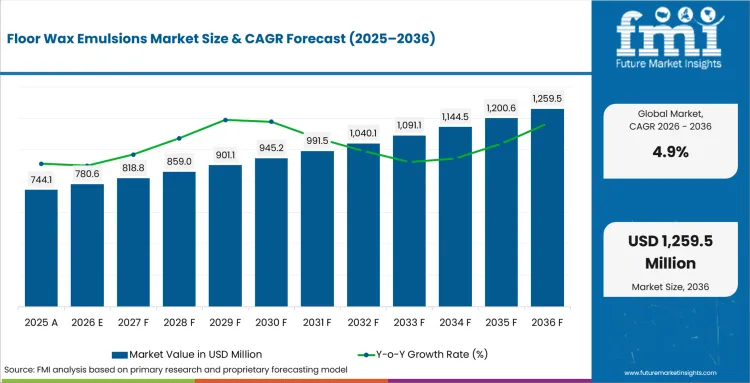
USD 780.6 million in 2026 and USD 1259.5 million by 2036 at a 4.9% CAGR.
Sales of floor wax emulsions are projected to rise at 4.9% CAGR through 2036, increasing valuation from USD 780.6 million in 2026 to USD 1259.5 million by 2036. Commercial finishes use polyethylene wax formulations to improve hardness and scuff resistance without clouding the surrounding polymer film. Complete floor finish systems must also deliver stable leveling, detergent resistance and controlled removal through recurring maintenance.
Commercial qualification depends on the full maintenance system rather than the emulsion chemistry or initial shine alone. United States institutions use ecolabel and contract criteria, while German facilities emphasize product documentation for green floor care chemicals and Japanese contractors prioritize trained application. EPA’s September 2025 Safer Choice guidance states that labeled products undergo ingredient and category-specific performance review. British and Brazilian channels add local safety or sanitary requirements that influence product registration and technical documentation. These routes connect institutional cleaning chemicals with regional technical support, so replacement stock and application guidance often determine whether a successful trial becomes a recurring order.
Key Takeaways of Floor Wax Emulsions Market
- Commercial floor-care programs favor emulsions that preserve gloss and scuff resistance through repeated cleaning and scheduled recoating.
- Polyethylene wax emulsions are projected to hold 31.0% share in 2026 through hardness and film clarity.
- The 25-40% solids range is estimated to represent 49.0% share through practical pumping and freight efficiency.
- Floor polishes are forecast to capture 34.0% share because wax performance directly affects maintenance frequency and appearance.
- Incompatible cleaners and weak drying control can produce uneven films that delay broader commercial approval.
- Michelman, BASF, BYK, MÜNZING, Zschimmer & Schwarz, Paramelt, Micro Powders and Barentz compete through chemistry breadth and formulation support.
Analyst Perspective
“Floor wax emulsions compete on maintenance predictability across repeated service cycles rather than first-coat shine alone. Formulators that validate scuff resistance, cleaner compatibility and stripping behavior together can shorten site trials and protect repeat orders.”
- Nikhil Kaitwade, Principal Analyst, Future Market Insights
How is the Floor Wax Emulsions Market segmented?
The floor wax emulsions market is segmented by wax type, solids content, application, end use, sales channel, and region.
The floor wax emulsions market is organized by wax type, solids content, application, end use, sales channel, and region because each category changes formulation or purchasing decisions. Wax type covers polyethylene, paraffin, carnauba, acrylic and hybrid emulsions with different hardness and buffing behavior. Solids content includes below 25%, 25-40% and above 40% to separate handling and freight economics. Application spans floor polishes, maintenance coatings, stone or terrazzo finishes, industrial floor care, and wood or vinyl floor care. End use covers janitorial products, commercial facilities, institutional cleaning, industrial MRO and household cleaning requirements. Sales channels include chemical distributors, direct formulator supply and private-label cleaning brands, while regional analysis compares service access across emulsifying wax systems.
What makes polyethylene wax emulsions central to the wax type category?
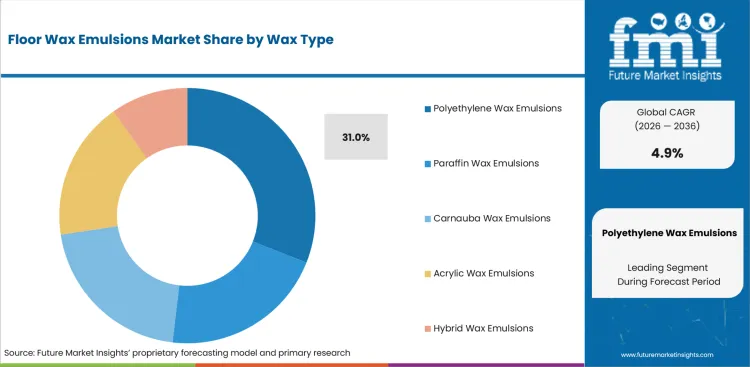
Polyethylene wax emulsions give floor finishes a hard wax phase that can preserve clarity during drying. BASF and BYK identify polyethylene emulsions for commercial floor-polish formulations that require durable gloss and surface resistance.
- By wax type, polyethylene wax emulsions are estimated to hold 31.0% in 2026 owing to their balance of hardness, clarity and scuff resistance.
- Floor-finish laboratories use these grades without changing established water-based processing, which limits plant requalification during formula updates. Compatibility trials with acrylic floor polymers remain necessary because poor interaction can produce haze, uneven leveling or inconsistent removal during scheduled maintenance.
Why does the 25-40% segment shape solids content purchasing?
Medium-solids grades deliver useful wax concentration without the transfer problems associated with very thick dispersions. Michelman lists floor-polish emulsions at 34-36% and 39-41% nonvolatile content, confirming commercial availability within this operating range.
- In 2026, the 25-40% segment is expected to lead solids content with 49.0% share because standard tanks and pumps can handle its concentration reliably.
- Contract manufacturers can run several private-label formulas through familiar equipment while lowering freight per usable wax unit. The operating balance supports predictable replenishment without repeated cleaning, major dosing adjustments or new transfer equipment.
How do floor polishes influence demand within the application category?
Floor polishes turn dispersed wax into a protective film that must retain gloss through cleaning and controlled removal. Commercial trials therefore measure appearance alongside detergent resistance, recoating behavior and controlled stripping across the maintenance cycle.
- Floor polishes are projected to hold 34.0% share in 2026 owing to their direct influence on gloss, scuff resistance and maintenance frequency.
- Schools and commercial properties adopt qualified systems across several sites following trials on representative surfaces. Consistent drying shortens closures, while compatibility with floor cleaning equipment limits retraining across contracted maintenance teams.
What supports janitorial products within the end use category?
Janitorial products must perform consistently across schools, offices and other occupied facilities with varied flooring. Green Seal’s March 2025 GS-40 standard combines environmental criteria with performance requirements for finishes and strippers.
- Janitorial products are set to lead the end use category with 33.0% share in 2026 due to recurring multi-site maintenance contracts.
- Service companies favor documented finishes that dry predictably and work with established cleaners and burnishing machines. A recognized certification route helps eco-label cleaning products enter formal custodial specifications without separate evidence packages for every property.
How do chemical distributors shape sales channel demand?
Smaller formulators often source wax dispersions, polymers and wetting agents through one channel to simplify trials. Barentz’s February 2025 Synthomer agreement added floor-care polymers, technical support and inventory across North America.
- The chemical distributors segment is likely to capture 44.0% share in 2026 attributable to consolidated sourcing and local formulation support.
- Private-label manufacturers use distributors for manageable order sizes, sample coordination and documented substitutions during supply changes. Local laboratories can screen compatibility across complete floor-care chemicals before replacement materials reach commercial sites.
What are the drivers, restraints, and opportunities in the Floor Wax Emulsions Market?
Documented floor-finish performance supports demand, application risk limits approval, and PFAS-free wetting systems provide a clear reformulation route.
- Driver: Institutional specifications reward floor finishes that document durability, cleaner compatibility and controlled removal across recurring service contracts.
- Restraint: Incompatible cleaners, poor drying control and narrow application windows can produce uneven films across occupied facilities.
- Opportunity: PFAS-free wetting systems let formulators meet current chemical criteria without separating leveling performance from wax selection.
Formal purchasing specifications increasingly evaluate floor finishes as complete maintenance systems rather than isolated coating products. Product approval therefore depends on durability, gloss retention and compatibility with the selected cleaning and stripping system. Wax emulsions that support predictable film formation reduce repeat trials and give service contractors a clearer basis for multi-site purchasing.
Application risk can block commercial approval even when laboratory results meet current chemical criteria and performance targets. Incorrect dosage or limited drying time can leave uneven films and expose occupants to slip hazards. Commercial instructions must therefore define coating rates, closure periods and compatible cleaners for each flooring system.
PFAS-free wetting aids give floor-care laboratories a practical route for updating formulas without rebuilding the complete polymer package. The commercial case depends on proving leveling, gloss and later removal through representative floor trials. Regional technical support can shorten reformulation work and protect supply continuity during planned ingredient changes.
Which country CAGRs are profiled in the Floor Wax Emulsions Market?
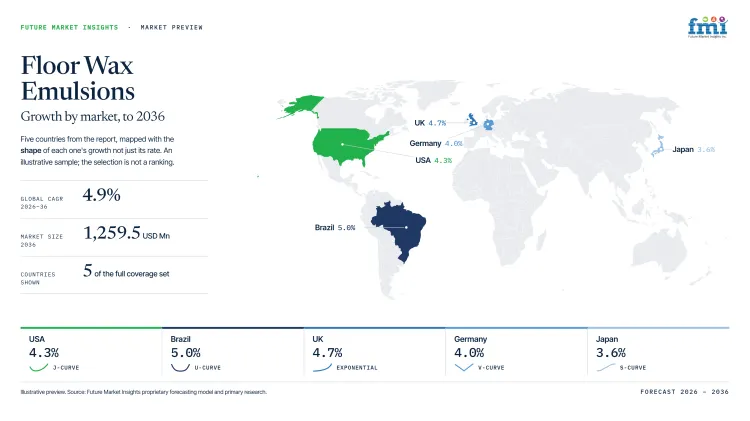
| Country | CAGR |
|---|---|
| United States | 4.3% |
| Germany | 4.0% |
| Japan | 3.6% |
| UK | 4.7% |
| Brazil | 5.0% |
How do country-level CAGRs compare in the Floor Wax Emulsions Market?
The five profiled rates span 1.4 percentage points and remain close despite distinct qualification and service conditions.
- Brazil remains 0.3 percentage point above the United Kingdom through a separate sanitary registration and distribution route.
- The United Kingdom remains 0.4 percentage point above the United States through recurring janitorial contracts and local safety practices.
- The United States remains 0.3 percentage point above Germany within formal purchasing and documentation-led approval routes.
- Germany remains 0.4 percentage point above Japan as environmental criteria and local service models shape qualification.
- Japan closes the displayed range through trained application and detailed troubleshooting across appearance-sensitive commercial floors.
Comparable CAGRs can produce different market entry costs because registration, service distance and maintenance practices vary. Full report coverage includes North America, Latin America, Europe, East Asia, South Asia and Pacific, Middle East and Africa.
Country-wise Analysis
- United States institutions use recognized ecolabels and contract language to screen hard-floor care products for recurring custodial programs. The EPA published custodial model contract language in December 2025 that names applicable certification routes for floor-care products and services. Floor wax emulsion sales in the United States are forecast to expand at 4.3% CAGR by 2036, supported by structured public purchasing and national distribution. New emulsions face longer trials if the approved maintenance system shows different gloss or drying performance during stripping. Technical files must therefore cover the complete finish-and-removal cycle before facilities approve routine multi-site use.
- German institutions examine ingredient records and environmental criteria during approval of unfamiliar floor-care formulations for recurring service programs. Germany’s floor wax emulsions outlook is anticipated to advance at 4.0% CAGR over the assessment period, shaped by detailed purchasing specifications and local chemical distribution. Germany’s EU Ecolabel directory lists hard-surface cleaning products under national license numbers, giving formulation teams a visible documentation benchmark. Approval can slow when a new emulsion changes stripping response or requires additional testing across existing resilient flooring.
- Japanese contractors place strong emphasis on surface preparation and trained application across appearance-sensitive commercial floors. The Japan Building Maintenance Association announced July 2025 training that addressed wax adhesion failures and detergent discoloration on resilient flooring. Floor wax emulsion demand in Japan is forecast to rise at 3.6% CAGR over the forecast period, linked to disciplined maintenance practices and compact service territories. Imported grades can face delays when incomplete Japanese documentation forces remote troubleshooting during an active maintenance cycle.
- United Kingdom contractors schedule floor care around occupied properties that require controlled access and predictable drying. The United Kingdom is estimated to post 4.7% CAGR over the forecast period, reinforced by recurring maintenance contracts and established janitorial distribution. HSE guidance states that smooth floors should remain closed until dry and that cleaning methods must suit the floor type. Commercial trials can extend when a new emulsion requires longer closures or changes the established stripping procedure.
- Brazil requires professional cleaning products to satisfy national sanitary rules for lawful distribution through broad regional channels. Anvisa published RDC 989/2025 and IN 394/2025 in August 2025 to align sanitary-product requirements with Mercosur rules and retain complementary national provisions. By 2036, Brazil is projected to grow at 5.0% CAGR, enabled by clearer product classification and broad distributor coverage. Reformulated finishes can face delays when Portuguese technical records change or replacement stock cannot reach active service contracts across distant customer locations.
Who are the notable companies in the Floor Wax Emulsions Market?
Michelman, BASF, BYK, MÜNZING, Zschimmer & Schwarz, Paramelt, Micro Powders and Barentz are notable companies shaping the floor wax emulsions market.
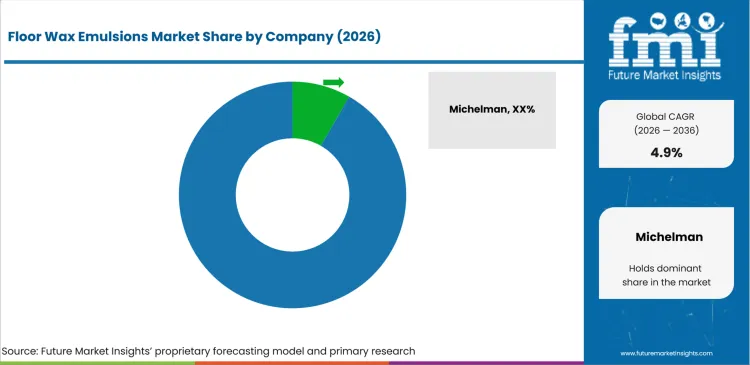
The field is fragmented between dedicated floor-care emulsion producers, broader wax formulators and distributors with application laboratories.
- Michelman, BASF and BYK offer dedicated floor-care emulsions that address hardness, gloss, scuff resistance and stable application across commercial formulations.
- MÜNZING, Zschimmer & Schwarz and Paramelt compete through wider wax families, including polyethylene and carnauba wax grades for polish or surface-care systems.
- Micro Powders and Barentz serve specialist needs through water-based wax additives and regional ingredient supply, supported by formulation testing and regulatory guidance.
Competitive Benchmarking: Floor Wax Emulsions Market
| Company | Floor-Polish Emulsion Fit | Wax-Chemistry Breadth | Regional Documentation | Geographic Reach |
|---|---|---|---|---|
| Michelman | High | High | High | Global or multi-region |
| BASF | High | Medium | High | Global or multi-region |
| BYK | High | High | High | Global or multi-region |
| MÜNZING | High | High | High | Global or multi-region |
| Zschimmer & Schwarz | High | Medium | Medium | Global or multi-region |
| Paramelt | Medium | High | Medium | Global or multi-region |
| Micro Powders | Low | High | Medium | Global distributor network |
| Barentz | Medium | Medium | High | Global or multi-region |
Key Developments in the Floor Wax Emulsions Market
- In January 2025, Barentz launched ECO-SHIELD NF100 as a PFAS-free wetting-aid alternative for floor finishes requiring improved leveling.
- In February 2025, BASF presented non-fluoro floor-care systems combining Hydropalat wetting agents with Acroflor dispersions.
- In November 2025, Midlab and Spartan Chemical became the first companies to gain Green Seal certification for floor finishes formulated without intentionally added PFAS, led by Midlab's Maxim Zinc-Free High Traffic Floor Finish and Spartan's FloorFront.
- In May 2026, Betco introduced Green Earth Multi-Surface Floor Finish with Green Seal certification and multi-surface durability.
Floor Wax Emulsions Market - Report Scope
| Coverage field | Report scope |
|---|---|
| Market breakdown | By wax type, solids content, application, end use, sales channel, and region |
| Market Definition | Water-based dispersions containing wax or wax-like polymers formulated for floor polishes and related floor-care coatings |
| Regions Covered | North America, Latin America, Western Europe, Eastern Europe, East Asia, South Asia and Pacific, and Middle East and Africa |
| Countries Covered | United States, Canada, Brazil, Mexico, Germany, France, United Kingdom, Japan, and 30+ countries |
| Key Companies Profiled | Michelman, BASF, BYK, MÜNZING, Zschimmer & Schwarz, Paramelt, Micro Powders, and Barentz |
| Forecast Period | 2026 to 2036 |
| Approach | Primary and secondary research with market triangulation. |
Floor Wax Emulsions Market - Research Methodology
| Method | Approach |
|---|---|
| Primary Research | FMI analysts gathered input from manufacturers, service providers, technology developers, distributors, end users, procurement teams, and subject-matter experts. Interviews examined purchasing decisions, product or service evaluation, adoption barriers, approval requirements, pricing considerations, and expectations for technical or commercial support. Respondents were also asked what evidence is required before a trial, pilot, or initial order develops into regular purchasing. |
| Desk Research | Desk research covered government statistics, regulatory publications, trade data, industry associations, technical literature, standards, company filings, product information, and official corporate announcements. Sources were reviewed for relevance, publication date, geographic coverage, and consistency with the defined market scope. Claims relating to performance, applications, approvals, capacity, investment, and commercial activity were retained only when supported by credible public evidence. |
| Market Sizing and Forecasting | The market model combined the baseline value with historical performance, segment structure, pricing and volume indicators, adoption levels, company participation, and country-level demand conditions. Forecast assumptions considered economic activity, investment trends, regulatory developments, technology adoption, purchasing cycles, supply availability, and barriers to wider market use. Segment and regional estimates were reconciled before the final market total was calculated. |
| Data Validation | Estimates were checked against multiple independent indicators, including public data, company activity, trade patterns, industry developments, and findings from primary interviews. Validation also tested whether products, services, applications, and company revenues fell within the defined market boundaries. Adjacent categories, unsupported claims, overlapping revenues, and activities without direct market relevance were excluded to reduce double counting and maintain consistency across segments and countries. |
Floor Wax Emulsions Market by Segments
Floor Wax Emulsions Market segmented by Wax Type:
- Polyethylene Wax Emulsions
- Paraffin Wax Emulsions
- Carnauba Wax Emulsions
- Acrylic Wax Emulsions
- Hybrid Wax Emulsions
Floor Wax Emulsions Market segmented by Solids Content:
- 25-40%
- <25%
- >40%
Floor Wax Emulsions Market segmented by Application:
- Floor Polishes
- Maintenance Coatings
- Stone / Terrazzo Finishes
- Industrial Floor Care
- Wood / Vinyl Floor Care
Floor Wax Emulsions Market segmented by End Use:
- Janitorial Products
- Commercial Facilities
- Institutional Cleaning
- Industrial MRO
- Household Cleaning
Floor Wax Emulsions Market segmented by Sales Channel:
- Chemical Distributors
- Direct Formulator Supply
- Private Label / Cleaning Brands
Floor Wax Emulsions Market by Region:
- North America
- United States
- Canada
- Latin America
- Brazil
- Mexico
- Argentina
- Chile
- Western Europe
- Germany
- France
- United Kingdom
- Italy
- Spain
- Benelux
- Nordics
- Eastern Europe
- Poland
- Czech Republic
- Romania
- Hungary
- East Asia
- China
- Japan
- South Korea
- South Asia and Pacific
- India
- ASEAN
- Australia and New Zealand
- Middle East and Africa
- GCC Countries
- South Africa
- Türkiye
- Israel
Research Sources and Bibliography
- USA Environmental Protection Agency. (2025, September 11). Learn About the Safer Choice Label.
- Michelman. (n.d.). Polish Additives | Additives for Polishes.
- BYK. (n.d.). AQUACER 519 - Wax emulsion for aqueous floor polishes.
- Green Seal. (2025, March 11). GS-40 Floor-Care Products for Industrial and Institutional Use.
- Health and Safety Executive. (2026, January 13). Cleaning.
- Barentz. (2025, February 7). Barentz expands Synthomer polymer partnership into Floor Care Market.
- USA Environmental Protection Agency. (2025, December 8). Custodial Model Contract Language.
- Japan Building Maintenance Association. (2025, July 18).
- Agência Nacional de Vigilância Sanitária. (2025, August 22). Anvisa publica novas normas para produtos saneantes.
- Paramelt. (n.d.). High quality wax blends & emulsions.
- Micro Powders. (n.d.). Micro Powders - AquaBead® 525E (Product).
- Barentz. (n.d.). Household, Industrial & Institutional | Floor Care Solutions.
- Barentz. (2025, January 24). Barentz launches new ECO-SHIELD™ NF100, PFAS alternative, for use in Floor Care.
- BASF. (2025, February 25). Stepping Up Sustainably: The Future of Floorcare is Here.
- Green Seal. (2025, November 11). Midlab and Spartan Achieve First Green Seal Certifications for Floor Care Products Formulated Without PFAS.
- Betco. (2026, May 7). Betco® Introduces Green Earth® Multi-Surface Floor Finish.
This Report Answers
- How large is the global Floor Wax Emulsions market, and what is its growth outlook?
- What factors are driving demand for floor wax emulsions across commercial, institutional, and industrial floor-care programs?
- How do key wax type, solids content, application, and end-use segments position themselves within the market?
- How do market growth rates, demand trends, and opportunities compare across major countries?
- What technical, operational, and cost-related barriers affect floor finish qualification and maintenance?
- How is the competitive structure of the Floor Wax Emulsions market evolving?
- Which leading companies are introducing new products, partnerships, and strategic developments in the market?
- What are the commercial implications of changing customer requirements, technology advances, and industry trends?`
Frequently Asked Questions
What is driving growth in the floor wax emulsions market?
Institutional specifications favor durable finishes that work with approved cleaners and strippers, so predictable maintenance performance supports recurring floor-care purchases.
Who are the key players in the floor wax emulsions market?
Michelman, BASF, BYK, MÜNZING, Zschimmer & Schwarz, Paramelt, Micro Powders and Barentz represent the profiled manufacturing and distribution set.
What is a notable restraint in the floor wax emulsions market?
Poor drying control or incompatible cleaners can leave uneven films and extend qualification across occupied facilities.
Why should executives track the floor wax emulsions market?
Floor wax emulsions influence appearance and maintenance labor, while recoating frequency directly affects facility operating costs.
What business problem does the floor wax emulsions market address?
Water-based emulsions distribute wax through protective finishes, adding hardness and scuff resistance while preserving controlled stripping.
What should floor-care teams evaluate in the floor wax emulsions market?
Floor-care teams should compare hardness and clarity alongside drying behavior, cleaner compatibility and removal performance on representative surfaces.
What limits return on investment in the floor wax emulsions market?
Frequent recoating and weak technical support can erase material savings through additional labor, downtime and reformulation.
What supports long-term confidence in the floor wax emulsions market?
Documented performance, stable regional supply and responsive application support strengthen confidence across recurring maintenance programs.
Preview the report firsthand - request a free sample
Get SampleGet the brochure for pricing and purchase details.
Get PDFTable of Content
- Key Takeaways
- Market Size and CAGR
- Top Growth Driver
- Fastest Growing Segment
- Leading Region
- Key Companies
- Emerging Opportunities
- Executive Summary
- Global Market Outlook
- Demand-side Trends
- Supply-side Trends
- Technology Roadmap Analysis
- Analysis and Recommendations
- Analyst Perspective (What is happening? Why now? What should investors know?)
- Key Questions Answered
- How large is the market?
- What is the CAGR?
- What are key trends?
- Which region dominates?
- Who are the leaders?
- Market Overview
- Market Coverage / Taxonomy
- Market Definition / Scope / Limitations
- Research Methodology
- Chapter Orientation
- Analytical Lens and Working Hypotheses
- Market Structure, Signals, and Trend Drivers
- Benchmarking and Cross-market Comparability
- Market Sizing, Forecasting, and Opportunity Mapping
- Research Design and Evidence Framework
- Desk Research Programme (Secondary Evidence)
- Expert Input and Fieldwork (Primary Evidence)
- Tooling, Models, and Reference Databases
- Data Engineering and Model Build
- Quality Assurance and Audit Trail
- Market Background
- Market Dynamics (Drivers, Restraints, Opportunity, Trends)
- Scenario Forecast (Optimistic, Likely, Conservative)
- Impact Analysis
- AI Impact
- Sustainability Impact
- Regulatory Impact
- Technology Impact
- Consumer / Buyer Analysis
- Purchase Drivers
- Adoption Barriers
- Buyer Journey
- Opportunity Map Analysis
- Product Life Cycle Analysis
- Supply Chain Analysis
- Investment Feasibility Matrix
- Value Chain Analysis
- PESTLE and Porter's Analysis
- Regulatory Landscape
- Regional Parent Market Outlook
- Production and Consumption Statistics
- Import and Export Statistics
- Global Market Analysis and Forecast, 2021 to 2036
- Historical Market Size Value (USD Million) Analysis, 2021 to 2025
- Current and Future Market Size Value (USD Million) Projections, 2026 to 2036
- Y-o-Y Growth Trend Analysis
- Absolute $ Opportunity Analysis
- Global Market Pricing Analysis, 2021 to 2036
- Global Market Analysis and Forecast, By Wax Type, 2021 to 2036
- Introduction / Key Findings
- Historical Market Size Value (USD Million) Analysis By Wax Type, 2021 to 2025
- Current and Future Market Size Value (USD Million) Analysis and Forecast By Wax Type, 2026 to 2036
- Polyethylene Wax Emulsions
- Paraffin Wax Emulsions
- Carnauba Wax Emulsions
- Acrylic Wax Emulsions
- Hybrid Wax Emulsions
- Polyethylene Wax Emulsions
- Y-o-Y Growth Trend Analysis By Wax Type, 2021 to 2025
- Absolute $ Opportunity Analysis By Wax Type, 2026 to 2036
- Global Market Analysis and Forecast, By Solids Content, 2021 to 2036
- Introduction / Key Findings
- Historical Market Size Value (USD Million) Analysis By Solids Content, 2021 to 2025
- Current and Future Market Size Value (USD Million) Analysis and Forecast By Solids Content, 2026 to 2036
- 25-40%
- <25%
- >40%
- 25-40%
- Y-o-Y Growth Trend Analysis By Solids Content, 2021 to 2025
- Absolute $ Opportunity Analysis By Solids Content, 2026 to 2036
- Global Market Analysis and Forecast, By Application, 2021 to 2036
- Introduction / Key Findings
- Historical Market Size Value (USD Million) Analysis By Application, 2021 to 2025
- Current and Future Market Size Value (USD Million) Analysis and Forecast By Application, 2026 to 2036
- Floor Polishes
- Maintenance Coatings
- Stone / Terrazzo Finishes
- Industrial Floor Care
- Wood / Vinyl Floor Care
- Floor Polishes
- Y-o-Y Growth Trend Analysis By Application, 2021 to 2025
- Absolute $ Opportunity Analysis By Application, 2026 to 2036
- Global Market Analysis and Forecast, By End Use, 2021 to 2036
- Introduction / Key Findings
- Historical Market Size Value (USD Million) Analysis By End Use, 2021 to 2025
- Current and Future Market Size Value (USD Million) Analysis and Forecast By End Use, 2026 to 2036
- Janitorial Products
- Commercial Facilities
- Institutional Cleaning
- Industrial MRO
- Household Cleaning
- Janitorial Products
- Y-o-Y Growth Trend Analysis By End Use, 2021 to 2025
- Absolute $ Opportunity Analysis By End Use, 2026 to 2036
- Global Market Analysis and Forecast, By Sales Channel, 2021 to 2036
- Introduction / Key Findings
- Historical Market Size Value (USD Million) Analysis By Sales Channel, 2021 to 2025
- Current and Future Market Size Value (USD Million) Analysis and Forecast By Sales Channel, 2026 to 2036
- Chemical Distributors
- Direct Formulator Supply
- Private Label / Cleaning Brands
- Chemical Distributors
- Y-o-Y Growth Trend Analysis By Sales Channel, 2021 to 2025
- Absolute $ Opportunity Analysis By Sales Channel, 2026 to 2036
- Global Market Analysis and Forecast, By Region, 2021 to 2036
- Introduction
- Historical Market Size Value (USD Million) Analysis By Region, 2021 to 2025
- Current Market Size Value (USD Million) Analysis and Forecast By Region, 2026 to 2036
- North America
- Latin America
- Western Europe
- Eastern Europe
- East Asia
- South Asia and Pacific
- Middle East & Africa
- Market Attractiveness Analysis By Region
- North America Market Analysis and Forecast, By Country, 2021 to 2036
- Historical Market Size Value (USD Million) Trend Analysis By Market Taxonomy, 2021 to 2025
- Market Size Value (USD Million) Forecast By Market Taxonomy, 2026 to 2036
- By Country
- USA
- Canada
- By Wax Type
- By Solids Content
- By Application
- By End Use
- By Sales Channel
- By Country
- Market Attractiveness Analysis
- By Country
- By Wax Type
- By Solids Content
- By Application
- By End Use
- By Sales Channel
- Key Takeaways
- Latin America Market Analysis and Forecast, By Country
- Historical Market Size Value (USD Million) Trend Analysis By Market Taxonomy, 2021 to 2025
- Market Size Value (USD Million) Forecast By Market Taxonomy, 2026 to 2036
- By Country
- Brazil
- Mexico
- Chile
- Rest of Latin America
- By Wax Type
- By Solids Content
- By Application
- By End Use
- By Sales Channel
- By Country
- Market Attractiveness Analysis
- By Country
- By Wax Type
- By Solids Content
- By Application
- By End Use
- By Sales Channel
- Key Takeaways
- Western Europe Market Analysis and Forecast, By Country
- Historical Market Size Value (USD Million) Trend Analysis By Market Taxonomy, 2021 to 2025
- Market Size Value (USD Million) Forecast By Market Taxonomy, 2026 to 2036
- By Country
- Germany
- UK
- Italy
- Spain
- France
- Nordic
- BENELUX
- Rest of Western Europe
- By Wax Type
- By Solids Content
- By Application
- By End Use
- By Sales Channel
- By Country
- Market Attractiveness Analysis
- By Country
- By Wax Type
- By Solids Content
- By Application
- By End Use
- By Sales Channel
- Key Takeaways
- Eastern Europe Market Analysis and Forecast, By Country
- Historical Market Size Value (USD Million) Trend Analysis By Market Taxonomy, 2021 to 2025
- Market Size Value (USD Million) Forecast By Market Taxonomy, 2026 to 2036
- By Country
- Russia
- Poland
- Hungary
- Balkan & Baltic
- Rest of Eastern Europe
- By Wax Type
- By Solids Content
- By Application
- By End Use
- By Sales Channel
- By Country
- Market Attractiveness Analysis
- By Country
- By Wax Type
- By Solids Content
- By Application
- By End Use
- By Sales Channel
- Key Takeaways
- East Asia Market Analysis and Forecast, By Country
- Historical Market Size Value (USD Million) Trend Analysis By Market Taxonomy, 2021 to 2025
- Market Size Value (USD Million) Forecast By Market Taxonomy, 2026 to 2036
- By Country
- China
- Japan
- South Korea
- By Wax Type
- By Solids Content
- By Application
- By End Use
- By Sales Channel
- By Country
- Market Attractiveness Analysis
- By Country
- By Wax Type
- By Solids Content
- By Application
- By End Use
- By Sales Channel
- Key Takeaways
- South Asia and Pacific Market Analysis and Forecast, By Country
- Historical Market Size Value (USD Million) Trend Analysis By Market Taxonomy, 2021 to 2025
- Market Size Value (USD Million) Forecast By Market Taxonomy, 2026 to 2036
- By Country
- India
- ASEAN
- Australia & New Zealand
- Rest of South Asia and Pacific
- By Wax Type
- By Solids Content
- By Application
- By End Use
- By Sales Channel
- By Country
- Market Attractiveness Analysis
- By Country
- By Wax Type
- By Solids Content
- By Application
- By End Use
- By Sales Channel
- Key Takeaways
- Middle East & Africa Market Analysis and Forecast, By Country
- Historical Market Size Value (USD Million) Trend Analysis By Market Taxonomy, 2021 to 2025
- Market Size Value (USD Million) Forecast By Market Taxonomy, 2026 to 2036
- By Country
- Kingdom of Saudi Arabia
- Other GCC Countries
- Türkiye
- South Africa
- Other African Union
- Rest of Middle East & Africa
- By Wax Type
- By Solids Content
- By Application
- By End Use
- By Sales Channel
- By Country
- Market Attractiveness Analysis
- By Country
- By Wax Type
- By Solids Content
- By Application
- By End Use
- By Sales Channel
- Key Takeaways
- Key Countries Market Analysis
- USA
- Pricing Analysis
- Market Share Analysis, 2025
- By Wax Type
- By Solids Content
- By Application
- By End Use
- By Sales Channel
- Canada
- Pricing Analysis
- Market Share Analysis, 2025
- By Wax Type
- By Solids Content
- By Application
- By End Use
- By Sales Channel
- Mexico
- Pricing Analysis
- Market Share Analysis, 2025
- By Wax Type
- By Solids Content
- By Application
- By End Use
- By Sales Channel
- Brazil
- Pricing Analysis
- Market Share Analysis, 2025
- By Wax Type
- By Solids Content
- By Application
- By End Use
- By Sales Channel
- Chile
- Pricing Analysis
- Market Share Analysis, 2025
- By Wax Type
- By Solids Content
- By Application
- By End Use
- By Sales Channel
- Germany
- Pricing Analysis
- Market Share Analysis, 2025
- By Wax Type
- By Solids Content
- By Application
- By End Use
- By Sales Channel
- UK
- Pricing Analysis
- Market Share Analysis, 2025
- By Wax Type
- By Solids Content
- By Application
- By End Use
- By Sales Channel
- Italy
- Pricing Analysis
- Market Share Analysis, 2025
- By Wax Type
- By Solids Content
- By Application
- By End Use
- By Sales Channel
- Spain
- Pricing Analysis
- Market Share Analysis, 2025
- By Wax Type
- By Solids Content
- By Application
- By End Use
- By Sales Channel
- France
- Pricing Analysis
- Market Share Analysis, 2025
- By Wax Type
- By Solids Content
- By Application
- By End Use
- By Sales Channel
- India
- Pricing Analysis
- Market Share Analysis, 2025
- By Wax Type
- By Solids Content
- By Application
- By End Use
- By Sales Channel
- ASEAN
- Pricing Analysis
- Market Share Analysis, 2025
- By Wax Type
- By Solids Content
- By Application
- By End Use
- By Sales Channel
- Australia & New Zealand
- Pricing Analysis
- Market Share Analysis, 2025
- By Wax Type
- By Solids Content
- By Application
- By End Use
- By Sales Channel
- China
- Pricing Analysis
- Market Share Analysis, 2025
- By Wax Type
- By Solids Content
- By Application
- By End Use
- By Sales Channel
- Japan
- Pricing Analysis
- Market Share Analysis, 2025
- By Wax Type
- By Solids Content
- By Application
- By End Use
- By Sales Channel
- South Korea
- Pricing Analysis
- Market Share Analysis, 2025
- By Wax Type
- By Solids Content
- By Application
- By End Use
- By Sales Channel
- Russia
- Pricing Analysis
- Market Share Analysis, 2025
- By Wax Type
- By Solids Content
- By Application
- By End Use
- By Sales Channel
- Poland
- Pricing Analysis
- Market Share Analysis, 2025
- By Wax Type
- By Solids Content
- By Application
- By End Use
- By Sales Channel
- Hungary
- Pricing Analysis
- Market Share Analysis, 2025
- By Wax Type
- By Solids Content
- By Application
- By End Use
- By Sales Channel
- Kingdom of Saudi Arabia
- Pricing Analysis
- Market Share Analysis, 2025
- By Wax Type
- By Solids Content
- By Application
- By End Use
- By Sales Channel
- Türkiye
- Pricing Analysis
- Market Share Analysis, 2025
- By Wax Type
- By Solids Content
- By Application
- By End Use
- By Sales Channel
- South Africa
- Pricing Analysis
- Market Share Analysis, 2025
- By Wax Type
- By Solids Content
- By Application
- By End Use
- By Sales Channel
- USA
- Market Structure Analysis
- Competition Dashboard
- Competition Benchmarking
- Market Share Analysis of Top Players
- By Regional
- By Wax Type
- By Solids Content
- By Application
- By End Use
- By Sales Channel
- Emerging Startups
- Innovation Benchmarking
- Competition Analysis
- Competition Deep Dive
- Michelman
- Overview
- Product Portfolio
- Profitability by Market Segments
- Sales Footprint
- Strategy Overview
- Marketing Strategy
- Product Strategy
- Channel Strategy
- BASF
- Lubrizol
- BYK
- Hexion
- Sasol
- Munzing
- Keim Additec
- Paramelt
- DOW
- Michelman
- Case Studies
- Success Stories
- Recent Developments
- Competition Deep Dive
- Assumptions & Acronyms Used


