

- Market Size (2026)
- USD 630.5 Mn
- Forecast (2036)
- USD 1057.0 Mn
- CAGR (2026 to 2036)
- 5.3%
How big is Dock Safety Gates Market in 2026?
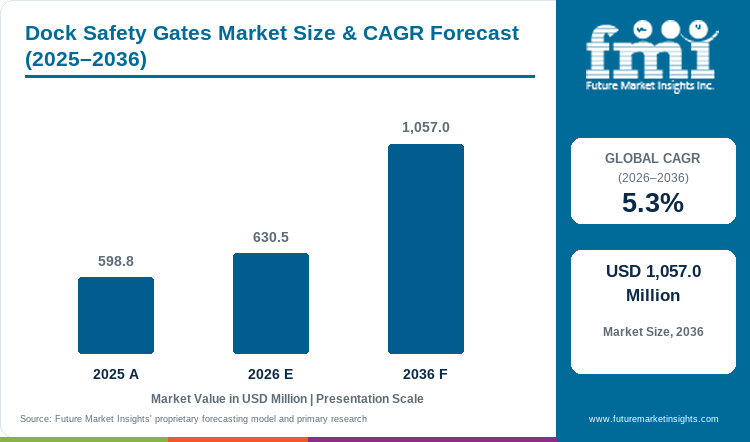
USD 630.5 million in 2026 and USD 1,057.0 million by 2036, expanding at 5.3% CAGR.
Sales of dock safety gates are estimated to rise at 5.3% CAGR through 2036. Valuation rises from USD 598.8 million in 2025 to USD 630.5 million in 2026 and reaches USD 1,057.0 million by 2036. Dock operators need a gate that protects an open edge, which means It must still allow pallet transfer. In September 2025, Mezzanine Safeti-Gates documented six custom rack-supported gates for 42-inch-deep warehouse bays. The project shows why teams must check gate size with material handling equipment movement before approval.
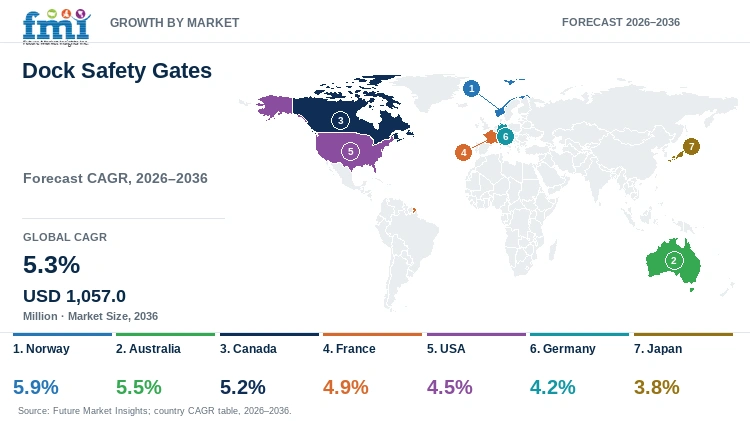
Country adoption moves at different speeds. Norway is projected at 5.9% CAGR, compared with 4.2% for Germany. In March 2026, German Social Accident Insurance reported 730,598 reportable workplace accidents during 2025. The figure keeps workplace safety in focus. Mature sites still need engineering checks before a dock opening changes. Gate travel must also work with dock shelters. Trailer access must remain clear at each bay.
Key Takeaways
- Fixed barriers gain demand at exposed dock edges. Facility teams still need routine loading to move without delay.
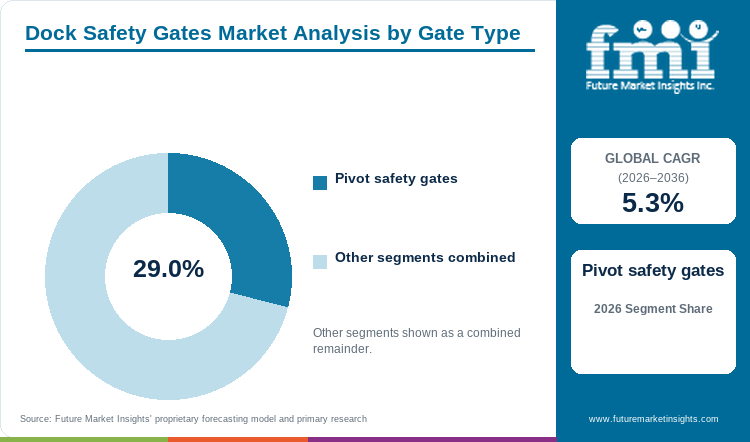
- By gate type, pivot safety gates are projected to hold 29.0% in 2026. Their counterbalanced motion protects the opening during pallet transfer.
- By material, steel is estimated to hold 55.0% in 2026. Familiar fabrication supports custom widths and common anchoring methods.
- In 2026, warehouses are expected to lead end use with 31.0% share. Busy docks create repeated edge-protection needs.
- Nonstandard openings can delay retrofit approval. Installation downtime can also slow work after a facility identifies the hazard.
- Some of the key players in this market include Rite-Hite, Mezzanine Safeti-Gates, Wildeck, Fabenco by Tractel, PS Safety Access, Cisco-Eagle, EGA Products, Vestil Manufacturing, A-SAFE, and Kee Safety.
Analyst Perspective
“Dock safety gates earn approval when they protect the edge without slowing loading work. Careful opening measurements and clear inspection steps reduce redesign risk and make repeat site rollouts easier.”
- Nikhil Kaitwade, Principal Consultant, Future Market Insights.
How is the dock safety gates market segmented?
The dock safety gates market is segmented by Gate Type, Material, End Use, Operation, Sales Channel, and Region.
The dock safety gates market is segmented by gate type, material, end use, operation, sales channel, and region. Gate type covers pivot, vertical lift, roll-up, barrier, and mezzanine dock gates. Materials include steel, aluminum, polymer or composite, and mesh or guarding panels. End use covers warehouses, distribution centers, manufacturing plants, retail loading docks, and cold storage. Operation includes manual, spring-assisted, powered or automatic, and interlocked safety systems. Sales channels include safety equipment distributors, dock equipment dealers, direct manufacturer sales, and facility contractors.
What makes pivot safety gates central to the gate type category?
Pivot gates move one barrier while the opposite side closes. The motion keeps the pallet opening protected during transfer. In June 2026, INRS updated its road-freight material. It lists loading and unloading docks as work areas that need hazard review. Facilities using pallet racking systems still check gate depth and pallet clearance before approval.
- Based on gate type, pivot safety gates are projected to account for 29.0% in 2026. Their motion keeps the edge protected during pallet transfer.
- The June 2026 INRS material treats loading docks as a separate work area. It supports physical controls that match handling activity.
Why does steel hold the largest material share?
Steel works well in welded posts and anchored frames. Installers also use it for custom openings because the methods are familiar. In March 2025, A-SAFE launched a polymer barrier range with impact alerts. The launch gives facilities another material choice. Teams still compare structural response with warehouse racking systems and dock traffic before selecting a gate.
- By material, steel is estimated to hold 55.0% in 2026. Familiar fabrication supports custom widths and established anchoring methods.
- In March 2025, A-SAFE launched a polymer barrier system with impact alerts. The system gives facilities another option when impact recovery matters more than steel familiarity.
How do warehouses shape the end use category?
Warehouses place forklifts, workers, and staging work near many dock openings. In May 2026, BLS reported 286,750 industrial truck and tractor operators in U.S. warehousing and storage during 2025. Gate placement must work with those vehicle paths. Nearby industrial weighing equipment can also affect receiving-area space.
- In 2026, warehouses are expected to lead end use with 31.0% share. Repeated forklift movement creates frequent edge-protection needs.
- BLS published its 2025 employment data in May 2026. It counted 286,750 industrial truck and tractor operators in U.S. warehousing and storage. The count shows the scale of vehicle-handling work.
What supports manual operation within the operation category?
Manual gates avoid changes to control panels. They work well in mechanical retrofits. Powered gates are more useful when gates must follow an equipment sequence. In February 2025, Mezzanine Safeti-Gates launched RobotGate with elevator and conveyor interlocks. automated guided vehicles can make confirmed gate status more important.
- By operation, manual gates are forecast to represent 33.0% in 2026. Standard retrofit bays need less controls work.
- In February 2025, Mezzanine Safeti-Gates launched RobotGate. The powered gate interlocks with automated storage and vertical-transfer equipment.
Why do safety equipment distributors lead the sales channel category?
Distributors compare gate designs with opening width and anchor points. They also check nearby equipment and installation timing. In March 2026, Rite-Hite acquired Johnson Equipment. The deal added 15 regional sales and service offices. The larger network supports projects with automated truck loading and other dock equipment.
- Safety equipment distributors are projected to hold 36.0% of sales channel revenue in 2026. Product choice and local installation support influence purchases.
- In March 2026, Rite-Hite acquired Johnson Equipment. The deal added 15 regional sales and service offices in the United States and Mexico.
What are the drivers, restraints and opportunities in the Dock Safety Gates Market?
Physical edge protection supports demand, tight retrofit geometry slows approval, and connected gate status expands the role of integrated safety systems.
- Driver: Fixed barriers are replacing temporary edge controls at many dock openings. They stay visible between loading cycles.
- Restraint: Existing doors, anchors, staging space, and shutdown needs can make a dock-gate retrofit take longer.
- Opportunity: Powered gates can share status with dock controls. They can also work with automated handling systems that use a set access sequence.
Fixed dock-edge controls reduce reliance on temporary barriers
Facility teams need a fixed barrier that stays at the opening. The barrier still has to work when a trailer leaves the bay. Germany approved its 2026 fall-prevention work program in May 2025. The program includes loading ramps in national prevention work. It supports engineered edge controls but does not require one gate design everywhere. Dock surveys still check opening width, traffic flow, and anchor condition. Sites with conveying equipment must also separate material flow from pedestrian access before gate design is approved.
Retrofit geometry can delay a gate even after the hazard is accepted
Existing docks differ in wall build, door travel, floor condition, bumper position, and staging space. In September 2025, Mezzanine Safeti-Gates documented six rack-supported gates for 42-inch-deep frames. Site measurements showed the standard gate would reach into the picking aisle. Engineers changed the design. The project shows why a safety budget alone does not solve retrofit problems. Facilities still need accurate drawings and confirmed anchor points. They also need an installation window that keeps enough dock space open for daily work.
Connected barrier status creates a practical integration route
Facilities with automated handling need clear proof that a protected opening is closed. Another movement should not start until the opening is safe. In April 2026, Rite-Hite launched Dok-Commander Pro with real-time dock-equipment status and diagnostics. Gate makers can use the same logic when barrier status is part of a bay sequence. Sites with palletizing systems or robotic handling already use verified interlocks. Connected gate status can add value at those sites. Suppliers still need fail-safe operation and clear commissioning duties before a connected gate replaces a manual design.
Which country CAGRs are profiled in the Dock Safety Gates Market?
| Country | CAGR |
|---|---|
| Norway | 5.9% |
| Australia | 5.5% |
| Canada | 5.2% |
| France | 4.9% |
| USA | 4.5% |
| Germany | 4.2% |
| Japan | 3.8% |
How do country-level CAGRs compare in the Dock Safety Gates Market?
The country rates span 2.1 percentage points from Norway to Japan. Norway and Australia form the upper group. Canada and France form the middle group. The USA, Germany, and Japan grow more slowly. The spread shows forecast pace, not current revenue.
- Norway’s cold climate increases maintenance requirements and the importance of durable protective coatings.
- In Australia, long service distances make straightforward inspection and maintenance procedures more valuable.
- Canada’s provincial regulations can add administrative complexity to multi-site dock safety projects.
- France’s facility-upgrade programs increasingly incorporate fixed edge-protection systems into traffic-safety planning.
- Multi-site operators in the USA often prioritize standardized dock-gate designs supported by local service networks.
- Germany’s engineering-focused evaluation process places strong emphasis on documented load ratings and fit specifications.
- Japan’s space-constrained facilities favor gate systems that minimize floor-space usage during operation.
Similar CAGRs can still produce different sales cycles. Site approval, climate, and service reach change the work needed before installation. The full report provides country-level CAGR analysis across North America, Latin America, Western Europe, Eastern Europe, East Asia, South Asia and Pacific, and the Middle East and Africa.
Country-wise Analysis
- Norwegian facilities follow a national rule for loading ramps and bays. Dock safety gate demand in Norway is projected to grow at 5.9% CAGR through 2036, linked to fall-prevention duties and cold weather. The Workplace Regulations were last amended in December 2025. Section 2-20 requires loading ramps and bays to prevent worker falls. Cold conditions also put more focus on coatings, hinges, and simple inspections. Suppliers can ease approval by documenting anchor loads and winter maintenance for repeat installations.
- Australian warehouse teams must separate pedestrians from mobile plant at large sites. Sales of dock safety gates in Australia are forecast to rise at 5.5% CAGR through 2036, influenced by site risk controls and service coverage. In February 2026, Safe Work Australia released a mobile-plant guide. The guide stresses site conditions and suitable controls. Long travel distances can raise installation and follow-up service costs. Regional partners can reduce that burden. Easy-to-check hardware also helps facilities keep gates serviceable after the first project ends.
- Canadian facilities must manage dock condition, forklift traffic, and winter maintenance. Demand for dock safety gates in Canada is forecast to expand at 5.2% CAGR through 2036, supported by repeated warehouse safety reviews. In March 2025, CCOHS revised its forklift incident guidance. It lists dock condition, poor lighting, and pedestrian exposure as workplace design factors. Provincial rules can add more paperwork for multi-site operators. Suppliers also need rust-resistant finishes and service plans that cover adjustment after seasonal movement.
- French industrial sites often build fixed protection into traffic and loading plans. Dock safety gate sales in France are forecast to rise at 4.9% CAGR through 2036, shaped by formal risk-prevention work at loading areas. In June 2026, INRS updated its road-freight TutoPrév material. It lists loading and unloading docks among the work situations used for hazard review. Older bay layouts can still limit gate travel. Facility contractors can cut redesign work by coordinating the gate with doors, traffic paths, and maintenance access.
- U.S. distribution sites have a large vehicle-handling workforce and frequent dock retrofit work. Dock safety gate demand in the USA is projected to expand at 4.5% CAGR through 2036, influenced by repeat facility upgrades and multi-site standardization. In May 2026, the Bureau of Labor Statistics reported 774,420 industrial truck and tractor operators nationwide for May 2025. The large workforce keeps forklift separation important. Each dock can still have different size and service needs. Suppliers need clear site drawings and local service before one gate design can be repeated at several facilities.
- German projects usually need engineering review before a loading-area barrier is installed. The dock safety gates sector in Germany is projected to record 4.2% CAGR during the assessment period, linked to national prevention programs and steady retrofit work. DGUV’s 2026 GDA fall-prevention program includes vehicles and loading ramps in its national work plan. Older openings can still need detailed drawings and traffic-plan checks before fabrication. Adjustable gate dimensions help teams handle those limits. Qualified installers also help manufacturers add protection to existing industrial layouts.
- Japanese logistics sites often use compact loading areas with little room for gate swing. Adoption of dock safety gates in Japan is estimated to expand at 3.8% CAGR through 2036, tied to careful loading procedures and mature facility layouts. In May 2026, Japan’s Ministry of Health, Labour and Welfare reported 15,632 land-freight injuries with at least four lost workdays during 2025. The figure keeps safe loading work in focus. Compact gate motion and low operator effort can matter more than a large barrier footprint during local approval.
Who are the notable companies in the Dock Safety Gates Market?
Rite-Hite, Mezzanine Safeti-Gates, Wildeck, Fabenco by Tractel, PS Safety Access, Cisco-Eagle, EGA Products, Vestil Manufacturing, A-SAFE, and Kee Safety are active within the defined dock safety gates boundary.
Four groups compete in dock safety gates. They include integrated dock-equipment groups, gate specialists, material-handling distributors, and modular barrier providers. Facility teams compare gate motion and clear opening before installation. They also check service access and engineering needs. Suppliers that work with industrial doors can coordinate clearance during larger bay upgrades. Fabenco now operates as Fabenco by Tractel. PS Safety Access remains a PS Industries division.
- Integrated dock and engineered gate systems: Rite-Hite, Mezzanine Safeti-Gates, Wildeck, and PS Safety Access.
- Configurable steel and project-sourcing channels: Fabenco by Tractel, Cisco-Eagle, EGA Products, and Vestil Manufacturing.
- Polymer and modular access protection: A-SAFE and Kee Safety.
Competitive Benchmarking: Dock Safety Gates Market
| Company | Dock-Edge Gate Breadth | Powered or Interlocked Operation | Impact and Material Options | Geographic Reach |
|---|---|---|---|---|
| Rite-Hite | High | High | High | North America plus documented international sales and service |
| Mezzanine Safeti-Gates | High | High | Medium | United States with documented international installations |
| Wildeck | Medium | Medium | Medium | United States dealer and integrator network |
| Fabenco by Tractel | Medium | Low | High | North America with Tractel group reach |
| PS Safety Access | High | High | Medium | North America with export-ready configurations |
| Cisco-Eagle | High | Medium | High | United States project coverage and multi-supplier sourcing |
| EGA Products | Medium | Low | Medium | North America through direct and distributor channels |
| Vestil Manufacturing | High | Medium | High | North America with international distributor availability |
| A-SAFE | Medium | Low | High | Europe, North America, Asia-Pacific, and Middle East |
| Kee Safety | Medium | Low | Medium | Global fall-protection sales and service network |
Scoring basis: High means broad current evidence supports the criterion. Medium means credible evidence supports a narrower position. Low means the capability has a clear limit or little public evidence. Geographic Reach describes sales, service, or project coverage. It is not a score.
Key Developments in the Dock Safety Gates Market
- In April 2026, Rite-Hite launched Dok-Commander Pro. It provides real-time dock-equipment status, diagnostics, and a touchscreen control interface.
- In February 2025, Mezzanine Safeti-Gates launched RobotGate. The powered gate interlocks with elevators or vertical conveyors in automated storage systems.
- In March 2025, A-SAFE launched a new industrial barrier range. Active Technology gives the range immediate impact alerts.
Key Players in the Dock Safety Gates Market
Integrated dock and controlled-access systems
- Rite-Hite
- Mezzanine Safeti-Gates
- Wildeck
- PS Safety Access
Configurable gates and project-sourcing channels
- Fabenco by Tractel
- Cisco-Eagle
- EGA Products
- Vestil Manufacturing
Polymer and modular fall protection
- A-SAFE
- Kee Safety
Dock Safety Gates Market - Report Scope
| Coverage field | Report scope |
|---|---|
| Market breakdown | By gate type, material, end use, operation, sales channel, and region. |
| Quantitative Units | USD million. |
| Market Definition | Revenue includes physical dock safety gate systems and factory-supplied actuation or interlock hardware sold with the gate. Dock levelers, vehicle restraints, dock seals, dock shelters, overhead doors, fixed guardrails without an operable gate, and downstream facility construction revenue are excluded. |
| Regions Covered | North America, Latin America, Western Europe, Eastern Europe, East Asia, South Asia and Pacific, and Middle East and Africa. |
| Countries Covered | Norway, Australia, Canada, France, USA, Germany, Japan, and 20+ countries included in the full report. |
| Key Companies Profiled | Rite-Hite, Mezzanine Safeti-Gates, Wildeck, Fabenco by Tractel, PS Safety Access, Cisco-Eagle, EGA Products, Vestil Manufacturing, A-SAFE, and Kee Safety. |
| Forecast Period | 2026 to 2036. |
| Approach | Primary and secondary research with market triangulation. |
Dock Safety Gates Market - Research Methodology
| Method | Approach |
|---|---|
| Primary Research | FMI analysts gathered input from manufacturers, service providers, technology developers, distributors, end users, procurement teams, and subject-matter experts. Interviews examined purchasing decisions, product or service evaluation, adoption barriers, approval requirements, pricing considerations, and expectations for technical or commercial support. Respondents were also asked what evidence is required before a trial, pilot, or initial order develops into regular purchasing. |
| Desk Research | Desk research covered government statistics, regulatory publications, trade data, industry associations, technical literature, standards, company filings, product information, and official corporate announcements. Sources were reviewed for relevance, publication date, geographic coverage, and consistency with the defined market scope. Claims relating to performance, applications, approvals, capacity, investment, and commercial activity were retained only when supported by credible public evidence. |
| Market Sizing and Forecasting | The market model combined the baseline value with historical performance, segment structure, pricing and volume indicators, adoption levels, company participation, and country-level demand conditions. Forecast assumptions considered economic activity, investment trends, regulatory developments, technology adoption, purchasing cycles, supply availability, and barriers to wider market use. Segment and regional estimates were reconciled before the final market total was calculated. |
| Data Validation | Estimates were checked against multiple independent indicators, including public data, company activity, trade patterns, industry developments, and findings from primary interviews. Validation also tested whether products, services, applications, and company revenues fell within the defined market boundaries. Adjacent categories, unsupported claims, overlapping revenues, and activities without direct market relevance were excluded to reduce double counting and maintain consistency across segments and countries. |
Dock Safety Gates Market by Segments
Dock Safety Gates Market segmented by Gate Type:
- Pivot safety gates
- Vertical lift gates
- Roll-up safety gates
- Barrier gates
- Mezzanine dock gates
Dock Safety Gates Market segmented by Material:
- Steel
- Aluminum
- Polymer - composite
- Mesh - guarding panels
Dock Safety Gates Market segmented by End Use:
- Warehouses
- Distribution centers
- Manufacturing plants
- Retail loading docks
- Cold storage
Dock Safety Gates Market segmented by Operation:
- Manual
- Spring-assisted
- Powered - automatic
- Interlocked safety
Dock Safety Gates Market segmented by Sales Channel:
- Safety equipment distributors
- Dock equipment dealers
- Direct manufacturer sales
- Facility contractors
Dock Safety Gates Market by Region:
- North America
- United States
- Canada
- Latin America
- Brazil
- Mexico
- Chile
- Rest of Latin America
- Western Europe
- Germany
- United Kingdom
- Italy
- Spain
- France
- Nordics
- Benelux
- Rest of Western Europe
- Eastern Europe
- Russia
- Poland
- Hungary
- Balkan and Baltic States
- Rest of Eastern Europe
- East Asia
- China
- Japan
- South Korea
- South Asia and Pacific
- India
- ASEAN
- Australia and New Zealand
- Rest of South Asia and Pacific
- Middle East and Africa
- Kingdom of Saudi Arabia
- Other GCC Countries
- Türkiye
- South Africa
- Other African Union Countries
- Rest of Middle East and Africa
Research Sources and Bibliography
- Mezzanine Safeti-Gates, Inc. (2025, September 24). Retailer adds mezzanine safety gates to pick modules.
Country context: United States. - German Social Accident Insurance (DGUV). (2026, March 25). Occupational safety and health strengthen Germany’s resilience.
Country context: Germany. - Institut national de recherche et de sécurité. (2026, June). TutoPrév welcome - road freight transport.
Country context: France. - A-SAFE. (2025, March 12). A-SAFE launches latest innovation in safety barriers, now with Active Technology.
Country context: Global / United Kingdom. - U.S. Bureau of Labor Statistics. (2026, May 15). Occupational employment and wages, May 2025.
Country context: United States. - Mezzanine Safeti-Gates, Inc. (2025, February 11). New RobotGate provides fall protection for robotic workforce.
Country context: United States. - Rite-Hite. (2026, March 26). Rite-Hite acquires Dallas-based Johnson Equipment Company.
Country context: United States and Mexico. - German Social Accident Insurance (DGUV). (2026). Fall accident work program: The 2026 GDA experimental year.
Country context: Germany. - Rite-Hite. (2026, April 6). Rite-Hite launches Dok-Commander Pro, delivering real-time visibility and connected control at the loading dock.
Country context: United States / Global. - Norwegian Labour Inspection Authority. (2025, December 16). Workplace Regulations, Section 2-20: Loading ramps, loading bays, tipping sites and quays.
Country context: Norway. - Safe Work Australia. (2026, February 4). Mobile plant: New interactive guide on managing ground condition risks.
Country context: Australia. - Canadian Centre for Occupational Health and Safety. (2025, March 12). Forklift trucks - common factors in forklift incidents.
Country context: Canada. - Ministry of Health, Labour and Welfare, Japan. (2026, May 27). Status of occupational accidents in 2025.
Country context: Japan. - A-SAFE. (2025, October 20). A-SAFE launches new barrier range, redefining workplace safety standards.
Country context: Global / United Kingdom. - Kee Safety. (2025, February 28). Railway sector strengthens worker safety with Kee Gate self-closing safety gates.
Country context: Singapore. - Wildeck, Inc. (2025, May 27). Wildeck completes move to new Wisconsin headquarters.
Country context: United States. - SAVOYE North America. (2025, August 13). SAVOYE North America and Cisco-Eagle announce partnership.
Country context: United States. - EGA Products, Inc. (2025, February 13). EGA Products launches pallet rack sprinkler protectors.
Country context: United States. - Vestil Manufacturing. (2026, March 24). Plant 3 expansion update.
Country context: United States. - PS Safety Access. (2026, April 29). Loading-dock gate deployment case study.
Country context: United States.
This bibliography is provided for reader reference and is not exhaustive. The full report contains the complete reference list and detailed citations.
This Report Answers
- How large is the dock safety gates market in 2026 and 2036?
- Which conditions turn an exposed dock edge into a gate purchase?
- Why do pivot safety gates hold 29.0% of gate type revenue in 2026?
- Why does steel hold 55.0% of material revenue in 2026?
- Why do warehouses account for 31.0% of end-use demand in 2026?
- How do manual and powered gate requirements differ at retrofit sites?
- How do country CAGRs differ from Norway to Japan?
- Which companies compete in engineered gates, project sourcing, and modular protection?
Frequently Asked Questions
How big is the dock safety gates market in 2026?
The dock safety gates market is valued at USD 630.5 million in 2026 and is projected to reach USD 1,057.0 million by 2036. Physical edge protection and warehouse retrofit work support the forecast.
What is the CAGR of the dock safety gates market from 2026 to 2036?
The dock safety gates market is projected to grow at 5.3% CAGR between 2026 and 2036. Growth depends on safety barriers that protect dock openings while keeping loading clearance and routine dock work intact.
Which gate type leads the dock safety gates market?
The pivot safety gates segment is projected to hold 29.0% of gate type revenue in the dock safety gates market in 2026. Counterbalanced motion keeps the pallet opening protected and can avoid powered control at standard bays.
Which countries are projected to record the highest growth in the dock safety gates market?
Norway is projected to grow at 5.9% CAGR, followed by Australia at 5.5% and Canada at 5.2% through 2036. Climate, service coverage, and local facility rules create different installation needs in each country.
Which companies are active in the dock safety gates market?
Key companies operating in the dock safety gates market include Rite-Hite, Mezzanine Safeti-Gates, Wildeck, Fabenco by Tractel, PS Safety Access, Cisco-Eagle, EGA Products, Vestil Manufacturing, A-SAFE, and Kee Safety. They compete through gate design, material choice, distribution reach, and local service.
Preview the report firsthand - request a free sample
Get SampleGet the brochure for pricing and purchase details.
Get PDFTable of Content
- Key Takeaways
- Market Size and CAGR
- Top Growth Driver
- Fastest Growing Segment
- Leading Region
- Key Companies
- Emerging Opportunities
- Executive Summary
- Global Market Outlook
- Demand-side Trends
- Supply-side Trends
- Technology Roadmap Analysis
- Analysis and Recommendations
- Analyst Perspective (What is happening? Why now? What should investors know?)
- Key Questions Answered
- How large is the market?
- What is the CAGR?
- What are key trends?
- Which region dominates?
- Who are the leaders?
- Market Overview
- Market Coverage / Taxonomy
- Market Definition / Scope / Limitations
- Research Methodology
- Chapter Orientation
- Analytical Lens and Working Hypotheses
- Market Structure, Signals, and Trend Drivers
- Benchmarking and Cross-market Comparability
- Market Sizing, Forecasting, and Opportunity Mapping
- Research Design and Evidence Framework
- Desk Research Programme (Secondary Evidence)
- Expert Input and Fieldwork (Primary Evidence)
- Tooling, Models, and Reference Databases
- Data Engineering and Model Build
- Quality Assurance and Audit Trail
- Market Background
- Market Dynamics (Drivers, Restraints, Opportunity, Trends)
- Scenario Forecast (Optimistic, Likely, Conservative)
- Impact Analysis
- AI Impact
- Sustainability Impact
- Regulatory Impact
- Technology Impact
- Consumer / Buyer Analysis
- Purchase Drivers
- Adoption Barriers
- Buyer Journey
- Opportunity Map Analysis
- Product Life Cycle Analysis
- Supply Chain Analysis
- Investment Feasibility Matrix
- Value Chain Analysis
- PESTLE and Porter's Analysis
- Regulatory Landscape
- Regional Parent Market Outlook
- Production and Consumption Statistics
- Import and Export Statistics
- Global Market Analysis and Forecast, 2021 to 2036
- Historical Market Size Value (USD Million) Analysis, 2021 to 2025
- Current and Future Market Size Value (USD Million) Projections, 2026 to 2036
- Y-o-Y Growth Trend Analysis
- Absolute $ Opportunity Analysis
- Global Market Pricing Analysis, 2021 to 2036
- Global Market Analysis and Forecast, By Gate Type, 2021 to 2036
- Introduction / Key Findings
- Historical Market Size Value (USD Million) Analysis By Gate Type, 2021 to 2025
- Current and Future Market Size Value (USD Million) Analysis and Forecast By Gate Type, 2026 to 2036
- Pivot safety gates
- Vertical lift gates
- Roll-up safety gates
- Barrier gates
- Mezzanine dock gates
- Y-o-Y Growth Trend Analysis By Gate Type, 2021 to 2025
- Absolute $ Opportunity Analysis By Gate Type, 2026 to 2036
- Global Market Analysis and Forecast, By Material, 2021 to 2036
- Introduction / Key Findings
- Historical Market Size Value (USD Million) Analysis By Material, 2021 to 2025
- Current and Future Market Size Value (USD Million) Analysis and Forecast By Material, 2026 to 2036
- Steel
- Aluminum
- Polymer - composite
- Mesh - guarding panels
- Y-o-Y Growth Trend Analysis By Material, 2021 to 2025
- Absolute $ Opportunity Analysis By Material, 2026 to 2036
- Global Market Analysis and Forecast, By End Use, 2021 to 2036
- Introduction / Key Findings
- Historical Market Size Value (USD Million) Analysis By End Use, 2021 to 2025
- Current and Future Market Size Value (USD Million) Analysis and Forecast By End Use, 2026 to 2036
- Warehouses
- Distribution centers
- Manufacturing plants
- Retail loading docks
- Cold storage
- Y-o-Y Growth Trend Analysis By End Use, 2021 to 2025
- Absolute $ Opportunity Analysis By End Use, 2026 to 2036
- Global Market Analysis and Forecast, By Operation, 2021 to 2036
- Introduction / Key Findings
- Historical Market Size Value (USD Million) Analysis By Operation, 2021 to 2025
- Current and Future Market Size Value (USD Million) Analysis and Forecast By Operation, 2026 to 2036
- Manual
- Spring-assisted
- Powered - automatic
- Interlocked safety
- Y-o-Y Growth Trend Analysis By Operation, 2021 to 2025
- Absolute $ Opportunity Analysis By Operation, 2026 to 2036
- Global Market Analysis and Forecast, By Sales Channel, 2021 to 2036
- Introduction / Key Findings
- Historical Market Size Value (USD Million) Analysis By Sales Channel, 2021 to 2025
- Current and Future Market Size Value (USD Million) Analysis and Forecast By Sales Channel, 2026 to 2036
- Safety equipment distributors
- Dock equipment dealers
- Direct manufacturer sales
- Facility contractors
- Y-o-Y Growth Trend Analysis By Sales Channel, 2021 to 2025
- Absolute $ Opportunity Analysis By Sales Channel, 2026 to 2036
- Global Market Analysis and Forecast, By Region, 2021 to 2036
- Introduction
- Historical Market Size Value (USD Million) Analysis By Region, 2021 to 2025
- Current Market Size Value (USD Million) Analysis and Forecast By Region, 2026 to 2036
- North America
- Latin America
- Western Europe
- Eastern Europe
- East Asia
- South Asia and Pacific
- Middle East and Africa
- Market Attractiveness Analysis By Region
- North America Market Analysis and Forecast, By Country, 2021 to 2036
- Historical Market Size Value (USD Million) Trend Analysis By Market Taxonomy, 2021 to 2025
- Market Size Value (USD Million) Forecast By Market Taxonomy, 2026 to 2036
- By Country
- United States
- Canada
- By Gate Type
- By Material
- By End Use
- By Operation
- By Sales Channel
- By Country
- Market Attractiveness Analysis
- By Country
- By Gate Type
- By Material
- By End Use
- By Operation
- By Sales Channel
- Key Takeaways
- Latin America Market Analysis and Forecast, By Country
- Historical Market Size Value (USD Million) Trend Analysis By Market Taxonomy, 2021 to 2025
- Market Size Value (USD Million) Forecast By Market Taxonomy, 2026 to 2036
- By Country
- Brazil
- Mexico
- Chile
- Rest of Latin America
- By Gate Type
- By Material
- By End Use
- By Operation
- By Sales Channel
- By Country
- Market Attractiveness Analysis
- By Country
- By Gate Type
- By Material
- By End Use
- By Operation
- By Sales Channel
- Key Takeaways
- Western Europe Market Analysis and Forecast, By Country
- Historical Market Size Value (USD Million) Trend Analysis By Market Taxonomy, 2021 to 2025
- Market Size Value (USD Million) Forecast By Market Taxonomy, 2026 to 2036
- By Country
- Germany
- United Kingdom
- Italy
- Spain
- France
- Nordics
- Benelux
- Rest of Western Europe
- By Gate Type
- By Material
- By End Use
- By Operation
- By Sales Channel
- By Country
- Market Attractiveness Analysis
- By Country
- By Gate Type
- By Material
- By End Use
- By Operation
- By Sales Channel
- Key Takeaways
- Eastern Europe Market Analysis and Forecast, By Country
- Historical Market Size Value (USD Million) Trend Analysis By Market Taxonomy, 2021 to 2025
- Market Size Value (USD Million) Forecast By Market Taxonomy, 2026 to 2036
- By Country
- Russia
- Poland
- Hungary
- Balkan and Baltic States
- Rest of Eastern Europe
- By Gate Type
- By Material
- By End Use
- By Operation
- By Sales Channel
- By Country
- Market Attractiveness Analysis
- By Country
- By Gate Type
- By Material
- By End Use
- By Operation
- By Sales Channel
- Key Takeaways
- East Asia Market Analysis and Forecast, By Country
- Historical Market Size Value (USD Million) Trend Analysis By Market Taxonomy, 2021 to 2025
- Market Size Value (USD Million) Forecast By Market Taxonomy, 2026 to 2036
- By Country
- China
- Japan
- South Korea
- By Gate Type
- By Material
- By End Use
- By Operation
- By Sales Channel
- By Country
- Market Attractiveness Analysis
- By Country
- By Gate Type
- By Material
- By End Use
- By Operation
- By Sales Channel
- Key Takeaways
- South Asia and Pacific Market Analysis and Forecast, By Country
- Historical Market Size Value (USD Million) Trend Analysis By Market Taxonomy, 2021 to 2025
- Market Size Value (USD Million) Forecast By Market Taxonomy, 2026 to 2036
- By Country
- India
- ASEAN
- Australia and New Zealand
- Rest of South Asia and Pacific
- By Gate Type
- By Material
- By End Use
- By Operation
- By Sales Channel
- By Country
- Market Attractiveness Analysis
- By Country
- By Gate Type
- By Material
- By End Use
- By Operation
- By Sales Channel
- Key Takeaways
- Middle East and Africa Market Analysis and Forecast, By Country
- Historical Market Size Value (USD Million) Trend Analysis By Market Taxonomy, 2021 to 2025
- Market Size Value (USD Million) Forecast By Market Taxonomy, 2026 to 2036
- By Country
- Kingdom of Saudi Arabia
- Other GCC Countries
- Türkiye
- South Africa
- Other African Union Countries
- Rest of Middle East and Africa
- By Gate Type
- By Material
- By End Use
- By Operation
- By Sales Channel
- By Country
- Market Attractiveness Analysis
- By Country
- By Gate Type
- By Material
- By End Use
- By Operation
- By Sales Channel
- Key Takeaways
- Key Countries Market Analysis
- United States
- Pricing Analysis
- Market Share Analysis, 2025
- By Gate Type
- By Material
- By End Use
- By Operation
- By Sales Channel
- Canada
- Pricing Analysis
- Market Share Analysis, 2025
- By Gate Type
- By Material
- By End Use
- By Operation
- By Sales Channel
- Mexico
- Pricing Analysis
- Market Share Analysis, 2025
- By Gate Type
- By Material
- By End Use
- By Operation
- By Sales Channel
- Brazil
- Pricing Analysis
- Market Share Analysis, 2025
- By Gate Type
- By Material
- By End Use
- By Operation
- By Sales Channel
- Chile
- Pricing Analysis
- Market Share Analysis, 2025
- By Gate Type
- By Material
- By End Use
- By Operation
- By Sales Channel
- Germany
- Pricing Analysis
- Market Share Analysis, 2025
- By Gate Type
- By Material
- By End Use
- By Operation
- By Sales Channel
- United Kingdom
- Pricing Analysis
- Market Share Analysis, 2025
- By Gate Type
- By Material
- By End Use
- By Operation
- By Sales Channel
- Italy
- Pricing Analysis
- Market Share Analysis, 2025
- By Gate Type
- By Material
- By End Use
- By Operation
- By Sales Channel
- Spain
- Pricing Analysis
- Market Share Analysis, 2025
- By Gate Type
- By Material
- By End Use
- By Operation
- By Sales Channel
- France
- Pricing Analysis
- Market Share Analysis, 2025
- By Gate Type
- By Material
- By End Use
- By Operation
- By Sales Channel
- India
- Pricing Analysis
- Market Share Analysis, 2025
- By Gate Type
- By Material
- By End Use
- By Operation
- By Sales Channel
- ASEAN
- Pricing Analysis
- Market Share Analysis, 2025
- By Gate Type
- By Material
- By End Use
- By Operation
- By Sales Channel
- Australia and New Zealand
- Pricing Analysis
- Market Share Analysis, 2025
- By Gate Type
- By Material
- By End Use
- By Operation
- By Sales Channel
- China
- Pricing Analysis
- Market Share Analysis, 2025
- By Gate Type
- By Material
- By End Use
- By Operation
- By Sales Channel
- Japan
- Pricing Analysis
- Market Share Analysis, 2025
- By Gate Type
- By Material
- By End Use
- By Operation
- By Sales Channel
- South Korea
- Pricing Analysis
- Market Share Analysis, 2025
- By Gate Type
- By Material
- By End Use
- By Operation
- By Sales Channel
- Russia
- Pricing Analysis
- Market Share Analysis, 2025
- By Gate Type
- By Material
- By End Use
- By Operation
- By Sales Channel
- Poland
- Pricing Analysis
- Market Share Analysis, 2025
- By Gate Type
- By Material
- By End Use
- By Operation
- By Sales Channel
- Hungary
- Pricing Analysis
- Market Share Analysis, 2025
- By Gate Type
- By Material
- By End Use
- By Operation
- By Sales Channel
- Kingdom of Saudi Arabia
- Pricing Analysis
- Market Share Analysis, 2025
- By Gate Type
- By Material
- By End Use
- By Operation
- By Sales Channel
- Türkiye
- Pricing Analysis
- Market Share Analysis, 2025
- By Gate Type
- By Material
- By End Use
- By Operation
- By Sales Channel
- South Africa
- Pricing Analysis
- Market Share Analysis, 2025
- By Gate Type
- By Material
- By End Use
- By Operation
- By Sales Channel
- Norway
- Pricing Analysis
- Market Share Analysis, 2025
- By Gate Type
- By Material
- By End Use
- By Operation
- By Sales Channel
- Australia
- Pricing Analysis
- Market Share Analysis, 2025
- By Gate Type
- By Material
- By End Use
- By Operation
- By Sales Channel
- United States
- Market Structure Analysis
- Competition Dashboard
- Competition Benchmarking
- Market Share Analysis of Top Players
- By Regional
- By Gate Type
- By Material
- By End Use
- By Operation
- By Sales Channel
- Emerging Startups
- Innovation Benchmarking
- Competition Analysis
- Competition Deep Dive
- Rite-Hite
- Overview
- Product Portfolio
- Profitability by Market Segments
- Sales Footprint
- Strategy Overview
- Marketing Strategy
- Product Strategy
- Channel Strategy
- Mezzanine Safeti-Gates
- Wildeck
- Fabenco by Tractel
- PS Safety Access
- Cisco-Eagle
- EGA Products
- Vestil Manufacturing
- A-SAFE
- Kee Safety
- Rite-Hite
- Case Studies
- Success Stories
- Recent Developments
- Competition Deep Dive
- Assumptions & Acronyms Used


