

- Market Size (2026)
- USD 188.7 Mn
- Forecast (2036)
- USD 521.6 Mn
- CAGR (2026 to 2036)
- 10.7%
How big is Seedling Stress Protectors Market in 2026?
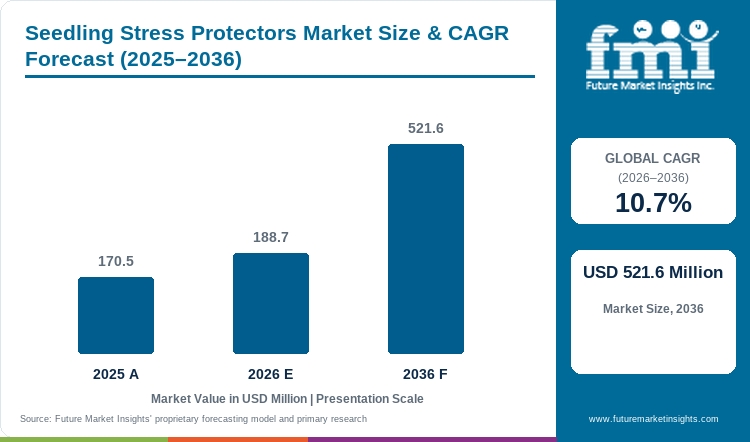
USD 188.7 Million in 2026 and USD 521.6 Million by 2036 at a 10.7% CAGR.
The Seedling Stress Protectors market stood at USD 170.5 Million in 2025, is estimated at USD 188.7 Million in 2026, and is forecast to reach USD 521.6 Million by 2036 at a 10.7% CAGR from 2026 to 2036.
Demand is being pulled forward by the cost of a poor stand rather than by later-season yield claims alone. Products in scope are bought when seed companies, treaters, or growers want more reliable germination and emergence under uncertain moisture or temperature at planting.
The World Meteorological Organization reported in March 2026 that 2015-2025 were the hottest 11 years on record and that extreme heat and heavy rainfall continued to disrupt food systems. That operating backdrop raises the value of treatments that manage water around the seed and improve early nutrient access.
Biological systems can also support root establishment when their viability is protected. The same pressure favors formulations that fit existing seed-treatment workflows without slowing treater throughput.
Purchases therefore shift from optional add-ons toward qualified components of a planting-risk program when stand uniformity has a clear economic consequence.
Country adoption will not move at one speed. In the USA, high-volume row-crop treatment rewards products that meter cleanly through standardized seed operations; USDA NASS estimated 95.2 million corn acres in 2025. The UK entered spring 2025 with unusually warm and dry conditions.
The Met Office recorded the warmest UK spring since 1884 and rainfall about 40% below the long-term average. Germany combines a large winter-cereal base with a need to reformulate some polymer systems under the EU microplastics restriction.
Japan adds a different gate because MAFF’s May 2025 biostimulant guidance emphasizes evidence for effect and use. Safety substantiation is also part of that guidance. Interest converts to purchase only when suppliers prove seed safety and application compatibility within each country’s treatment workflow.
Key Takeaways
- The market is estimated at USD 188.7 Million in 2026 and is forecast to reach USD 521.6 Million by 2036 at a 10.7% CAGR.
- Polymer-Based Systems lead in 2026. Corn & Cereals lead in 2026.
- In-Plant (Seed Companies) lead in 2026. Liquid Slurries lead in 2026. Agri-Input Distributors lead in 2026.
- Driver: Volatile planting-window moisture and temperature conditions raise the economic value of more uniform germination, emergence, and early root establishment.
- Restraint: Qualification requires seed safety and storage stability plus proven chemistry compatibility, treater behavior, and field return before scale-up.
- Opportunity: Microplastic-free carrier systems can be combined with water, nutrient or biological functions if they fit installed treatment equipment. the USA has the highest profiled country CAGR at 10.3%, compared with Japan at 8.6%.
Analyst Perspective
Credible revenue capture will depend on passing treatment-line and field-performance gates together. A product must protect seed quality before agronomic benefit can matter.
- Nikhil Kaitwade, Principal Consultant, Future Market Insights
How is the Seedling Stress Protectors Market segmented?
The market is segmented by Product Type, Crop Type, Treatment Point, Formulation, and Sales Channel.
Product Type separates polymer carriers from biological, microbial, nutrient-loaded, and other systems. Crop Type distinguishes the establishment economics of corn and cereals from pulses, vegetables, cotton, and other crops.
Treatment Point identifies whether the application is completed by seed companies, commercial treaters, farmers, or other operators. Formulation captures the handling differences between liquid slurries, dry powders, film coats and encrusting, and other formats.
Sales Channel shows how technical support and inventory reach the buyer through distributors, cooperatives, agri-retail chains, direct routes, or other channels. The five axes therefore describe both what the protector does and how it reaches the seed before planting.
What makes Polymer-Based Systems central to the Product Type category?
Polymer-Based Systems lead because the polymer layer does several jobs before agronomic additives can deliver their intended function. A water-permeable film can bind treatment components and reduce dust-off. It can also improve seed flow and preserve visual identification.
That makes the system useful at industrial treatment speeds and across mixed treatment stacks. Regulatory change is forcing a material reset in Europe. Commission Regulation (EU) 2023/2055 restricts intentionally added synthetic polymer microparticles and establishes application-specific transition periods.
Suppliers that preserve treatment retention and plantability while moving to compliant materials can defend the workflow value of the category.
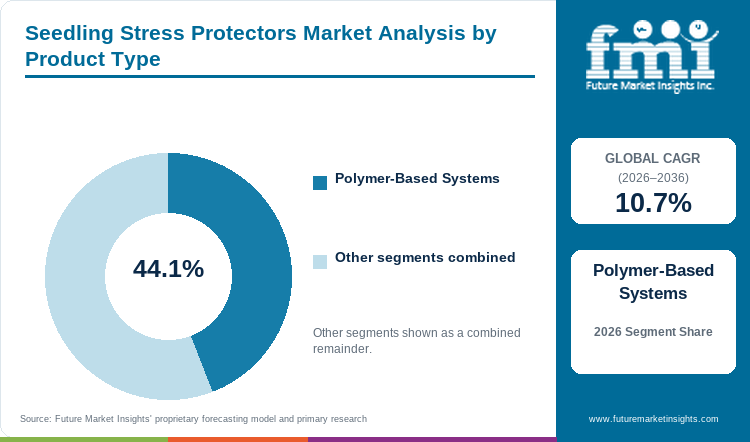
- Polymer-Based Systems account for 44.1% share in 2026 because the carrier layer supports treatment retention, handling, and repeatable application.
- Incotec (Croda) announced on April 8, 2026 that it launched Disco L-1140, a microplastic-free cereal film coat designed for seed-company treatment in Europe. The launch illustrates how polymer suppliers are pairing handling performance with regulatory reformulation.
Why does Corn & Cereals lead the Crop Type category?
Corn & Cereals lead because broad-acre planting concentrates the cost of uneven emergence across large numbers of seeds and tight operating windows. Planter speed makes seed flow and treatment uniformity commercially important.
Early moisture and nutrient constraints can also become visible quickly in stand establishment. USDA NASS estimated 95.2 million acres of corn planted in the USA in 2025. That scale illustrates how small per-seed treatment decisions repeat across a large acreage base.
Biological nutrient platforms add another route to value in cereals because the seed or root zone can act as the delivery point. The segment therefore rewards products that combine operational simplicity with repeatable early-stage performance. The related seed coating material market addresses how an active layer stays on seed during high-speed treatment.
- Corn & Cereals account for 41.5% share in 2026 because high-acreage planting and mechanized treatment amplify the value of uniform seed handling and establishment.
- Pivot Bio announced in March 2025 that PROVEN G3 for corn would be commercially available in 2026 pending state registrations. The product adds a proprietary microbe blend intended to increase nutrient uptake and nitrogen-use efficiency at the root zone.
How does In-Plant (Seed Companies) anchor the Treatment Point category?
In-Plant (Seed Companies) leads because centralized application moves several adoption risks upstream. Seed companies can control dose and drying before treated seed is released. They can also verify coating uniformity and batch consistency.
That is especially valuable when several treatment components must coexist on one seed. Centralized application lets treatment providers qualify storage behavior and plantability at scale instead of leaving mixing decisions to the farm gate.
The trade-off is a higher qualification threshold because a formulation must fit established equipment and seed-quality standards. Once qualified, in-plant treatment removes an extra handling step for the farmer and makes treated-seed performance more consistent.
- In-Plant (Seed Companies) accounts for 42.8% share in 2026 because centralized treatment supports quality control, consistent dosing, and pre-plant convenience.
- Precision Laboratories reported in May 2023 that its seed-applied portfolio covered water-management chemistries and nanoparticle nutrients. It also included seed-coating polymers and colorants distributed to seed producers and conditioners, illustrating the breadth that centralized treatment programs must accommodate.
What supports Liquid Slurries in the Formulation category?
Liquid Slurries lead because they can be metered precisely and spread over seed surfaces at commercial treatment speed. A liquid system also provides a practical vehicle for combining polymers with soluble nutrients or biological additives when compatibility is demonstrated.
That matters when treatment plants need uniform coverage without adding a separate dry handling step. The main qualification questions are viscosity and tank-mix stability. Seed wetness and drying behavior also matter.
Suppliers that control those variables can make stress protection easier to insert into existing treatment recipes. This supports recurring use where the same seed line must move through predictable batch cycles.
- Liquid Slurries account for 45.1% share in 2026 because meterability, blend flexibility, and uniform surface coverage suit high-throughput seed-treatment workflows.
- Novonesis reported in May 2024 that Cell-Tech soybean inoculant is supplied in a convenient liquid formulation for on-farm application. The company also cited a four-day on-seed guarantee with most common chemical seed treatments, underscoring the role of compatibility in liquid biological delivery.
What drives Agri-Input Distributors in the Sales Channel category?
Agri-Input Distributors lead because seedling stress products require timely availability and local interpretation. Growers and commercial treaters often need guidance on crop fit, treatment compatibility, and application timing before planting.
A distributor can bundle that advice with inventory and related seed-treatment inputs. This role becomes more important for biologicals because storage and handling can affect performance. It also matters for newer multifunctional products whose value proposition is not obvious from a label alone.
Distribution partnerships can shorten the distance between technical support and the farm. They convert a complex product choice into a local purchasing decision without requiring every supplier to build a direct sales force.
- Agri-Input Distributors account for 43.3% share in 2026 because local inventory, agronomic support, and channel reach reduce friction close to the planting window.
- Groundwork BioAg announced a strategic partnership with Syngenta in July 2026 to commercialize mycorrhiza-based products under Syngenta’s label. The initial focus on corn, soy, cereals and sunflower in Latin America and Europe shows how channel leverage can widen access to biological technologies.
What are the drivers, restraints, and opportunities in the Seedling Stress Protectors Market?
Weather-driven establishment risk is supporting demand, while multi-stage qualification slows adoption and compliant multifunctional seed treatments create the clearest product opportunity.
- Driver: Volatile planting-window moisture and temperature conditions raise the economic value of more uniform germination, emergence, and early root establishment.
- Restraint: Qualification requires seed safety and storage stability plus proven chemistry compatibility, treater behavior, and field return before scale-up.
- Opportunity: Microplastic-free carrier systems can be combined with water, nutrient, or biological functions if they fit installed treatment equipment.
The primary driver is a higher cost of establishment failure under volatile planting conditions. The World Meteorological Organization reported in March 2026 that 2015-2025 were the hottest 11 years on record. It also documented continued disruption from extreme heat and heavy rainfall.
For seed companies and growers, those conditions increase the value of protecting the short interval between planting and stand establishment. A protector does not need to eliminate weather risk to create value. It needs to make germination or early development more consistent without creating a new handling problem.
That requirement channels demand toward treatments with a clear planting-stage mechanism and repeatable application.
The restraint sits at qualification rather than at awareness. A seed-applied product can perform agronomically and still fail a commercial program if it changes seed flow or drying behavior. Biologicals add viability and shelf-life questions. Polymer systems now face a separate material-compliance test in Europe.
Commission Regulation (EU) 2023/2055 created phased restrictions on synthetic polymer microparticles, with transition periods that differ by agricultural use and extend into 2028 and 2031. Suppliers therefore face reformulation work while customers must requalify treatment behavior.
These gates can delay purchase or narrow eligible programs even when the underlying need for stress protection remains.
The strongest opportunity is a treatment stack that removes complexity instead of adding another pass. Polymer suppliers are moving toward microplastic-free films while biological and nutrient providers are refining on-seed delivery. Incotec (Croda) launched a microplastic-free cereal coating in April 2026.
Verdesian Life Sciences has documented seed-applied nutrient technologies that accelerate germination and establishment. The commercial opening is strongest for formulations that combine compliant carrier chemistry with early moisture, nutrient, or biological support.
Seed companies and commercial treaters are best placed to scale these systems because they control application quality. Winning products must still preserve seed quality and equipment fit; multifunctionality alone is not enough.
Which country CAGRs are profiled in the Seedling Stress Protectors Market?
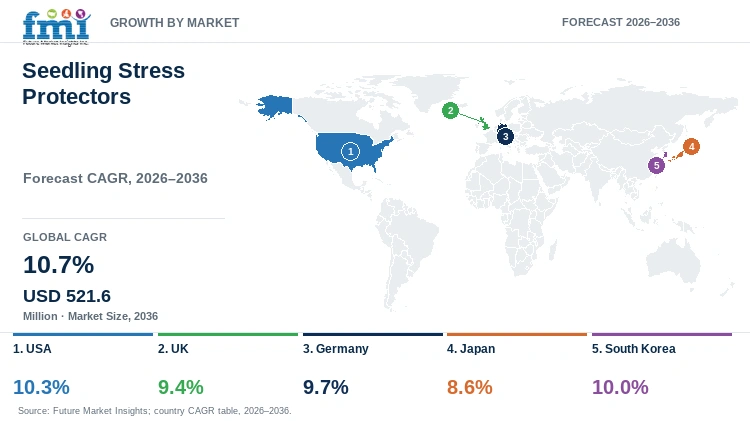
| Country | CAGR |
|---|---|
| USA | 10.3% |
| UK | 9.4% |
| Germany | 9.7% |
| Japan | 8.6% |
| South Korea | 10.0% |
How do country-level CAGRs compare in the Seedling Stress Protectors Market?
The profiled country CAGRs span 1.7 percentage points from the USA at 10.3% to Japan at 8.6% for 2026 to 2036. The USA and South Korea form the upper band at 10.0% or above. Germany and the UK sit in a middle band between 9.4% and 9.7%. Japan is lower but still expands at a high single-digit rate.
The narrow spread means suppliers should not treat the ranking as a proxy for addressable revenue. Each country has a different route from establishment risk to a qualified treatment program, so channel design and validation burden can matter as much as the CAGR itself.
- USA versus South Korea: the 0.3-point gap is small. USA execution favors high-throughput row-crop treatment, while South Korea requires localized adoption models that fit modernization programs and field-crop workflows.
- South Korea versus Germany: the 0.3-point gap does not imply the same buying trigger. Germany adds material reformulation pressure under EU rules, while South Korea’s policy environment emphasizes technology diffusion and practical farm adoption.
- Germany versus UK: the 0.3-point gap points to similar growth pacing but different validation questions. Germany is exposed to polymer compliance work, while UK suppliers must demonstrate value through variable cereal establishment conditions.
- UK versus Japan: the 0.8-point gap is the largest adjacent difference. Japan’s evidence and labeling discipline for biostimulants raises the importance of substantiated claims, localized use instructions, and technical education.
CAGR describes the rate of change from a starting point; it does not identify the largest country market or the most profitable route to entry. Supplier priorities should combine growth rate with crop mix and treatment infrastructure.
Regulation, local proof requirements, and channel economics then determine whether that growth is commercially accessible. The broader regional coverage in the full report is therefore needed to compare absolute opportunity with the pace of adoption.
Country-wise Analysis
- USA: Seedling stress products enter large row-crop programs through seed companies, commercial treaters and agricultural channels that value repeatable application at scale. Demand for Seedling Stress Protectors in the USA is forecast to expand at 10.3% CAGR from 2026 to 2036. USDA NASS reported in June 2025 that growers planted 95.2 million acres of corn, creating a broad base for standardized seed-applied programs. The main friction is proving incremental field return without disrupting treatment throughput or plantability. Suppliers need crop-specific field evidence and formulations that fit established seed-treatment equipment with minimal process change.
- UK: Cereal growers operate across planting windows where dry spring conditions or difficult autumn establishment can change the value of seed support quickly. Demand for Seedling Stress Protectors in the UK is forecast to expand at 9.4% CAGR from 2026 to 2036. The Met Office reported in June 2025 that spring 2025 was the warmest UK spring on record and the sixth driest since 1836. Variable seasonal response makes payback harder to generalize across locations. Suppliers need replicated local trials and clear crop-positioning guidance that connects treatment performance to establishment conditions rather than broad yield claims.
- Germany: Seedling protectors are most commercially relevant where cereal seed is processed through structured treatment programs and where material compliance can be managed centrally. Demand for Seedling Stress Protectors in Germany is forecast to expand at 9.7% CAGR from 2026 to 2036. Destatis reported in May 2025 that expected winter wheat area reached 2.783 million hectares. Germany is also exposed to the EU restriction on synthetic polymer microparticles. The friction is therefore dual: new materials must maintain seed-treatment performance while meeting regulatory timelines. Suppliers should prioritize microplastic-free coatings, low-dust handling, and documented compatibility with existing treatment recipes.
- Japan: Buyers have a strong incentive to distinguish substantiated establishment benefits from broad biostimulant claims before adding a new treatment to crop programs. Demand for Seedling Stress Protectors in Japan is forecast to expand at 8.6% CAGR from 2026 to 2036. MAFF issued biostimulant labeling guidelines in May 2025 that address definitions, evidence for effects and use and safety information. The local friction is the documentation burden for credible product positioning. Suppliers need crop-specific evidence, disciplined labeling and application instructions that make the mechanism understandable to seed companies and agricultural advisers.
- South Korea: Adoption is likely to favor products that fit mechanized field-crop programs and simple treatment workflows rather than adding labor at planting. Demand for Seedling Stress Protectors in South Korea is forecast to expand at 10.0% CAGR from 2026 to 2036. MAFRA published its 2025-2029 smart-farming master plan in February 2025 and targeted smart technology on 20% of major field-crop production areas. The friction is converting technology policy into farm-level evidence and affordable application. Suppliers need local demonstrations, straightforward treatment formats, and channel partners that can connect seed protection with wider farm modernization programs.
Who are the notable companies in the Seedling Stress Protectors Market?
Germains Seed Technology and Incotec (Croda) are profiled. Centor Group and Precision Laboratories are also covered. Novonesis and Pivot Bio are also covered. Groundwork BioAg and Verdesian Life Sciences complete the notable-company set.
Competition separates into three operating positions rather than one broad seed-treatment tier. Germains Seed Technology, Incotec (Croda), and Centor Group compete around coating materials and seed-finishing know-how.
Precision Laboratories and Verdesian Life Sciences emphasize seed-applied chemistry that manages water or nutrients around establishment. Novonesis, Pivot Bio, and Groundwork BioAg use microbial biology to influence nutrient access or root-zone performance. The buyer comparison is therefore not just efficacy.
Seed companies and treaters also assess application-equipment fit and storage behavior. Compatibility with other treatments and technical support are separate gates. Recent activity shows that route-to-market and regulatory readiness are becoming competitive levers.
Suppliers that can document performance at the treatment line and under field stress have a stronger path to repeat programs.
- Coating and Seed-Finishing Platforms: Germains Seed Technology, Incotec (Croda) and Centor Group combine film coating, polymers or seed-finishing capabilities with application know-how.
- Seed-Applied Polymer, Water and Nutrient Systems: Precision Laboratories and Verdesian Life Sciences compete through water-management chemistry and seed polymers. Nutrients and establishment-focused treatment functions extend their offers.
- Microbial and Biological Establishment Platforms: Novonesis, Pivot Bio and Groundwork BioAg use on-seed or root-zone biology to improve nutrient access, stress response or early crop establishment.
Competitive Benchmarking: Seedling Stress Protectors Market
| Company | Seed-Coating & Treater Integration | Biological On-Seed Capability | Early Water & Nutrient Support | Geographic Reach |
|---|---|---|---|---|
| Germains Seed Technology | High | Low | High | UK |
| Incotec (Croda) | High | Low | Medium | Europe |
| Centor Group | High | Medium | Low | India and selected international seed markets |
| Precision Laboratories | High | Low | High | United States, including distribution east of the Rocky Mountains |
| Novonesis | Medium | High | High | Southern and Eastern Africa, with broader global biosolutions reach |
| Pivot Bio | Medium | High | High | United States |
| Groundwork BioAg | Low | High | Low | Latin America and Europe through the announced Syngenta partnership |
| Verdesian Life Sciences | Medium | Low | High | United States |
Scoring basis: Seed-Coating & Treater Integration measures documented coating, polymer or application compatibility with seed-treatment workflows. Biological On-Seed Capability measures documented living biological or inoculant delivery on or with seed. Early Water & Nutrient Support measures documented seed-applied functions tied to moisture management, nutrient acquisition or early establishment. High indicates broad or deep documented capability while Medium indicates credible but narrower coverage. Low would indicate a documented limitation; unavailable public information is left Low.
Key Developments in the Seedling Stress Protectors Market
- In July 2026, Groundwork BioAg and Syngenta announced a strategic partnership to market Groundwork mycorrhizal technology. The initial crop focus covers corn and soy plus cereals and sunflower in Latin America and Europe. Distribution is planned in additional markets. The agreement places a biological stress and root-zone platform inside a larger commercial channel, which can reduce market-access friction for more grower programs.
- During April 2026 Incotec (Croda) launched Disco L-1140, a microplastic-free film coat for cereal seed. Incotec positioned the product for European seed companies that need coating performance while preparing for restrictions on intentionally added microplastics. The launch adds a directly relevant reformulation option to the polymer segment and increases the competitive importance of dust control, plantability and regulatory compatibility in cereal programs.
- During March 2025 Pivot Bio announced PROVEN G3 for corn with commercial availability planned for 2026 pending state registrations. The third-generation product adds a proprietary microbe blend intended to improve nutrient uptake and nitrogen-use efficiency alongside nitrogen fixation. The development moves microbial seed technology toward multiple modes of action. This broadens the performance criteria buyers can evaluate at establishment and planting.
Key Players in the Seedling Stress Protectors Market
Coating and Seed-Finishing Platforms
- Germains Seed Technology
- Incotec (Croda)
- Centor Group
Seed-Applied Polymer, Water and Nutrient Systems
- Precision Laboratories
- Verdesian Life Sciences
Microbial and Biological Establishment Platforms
- Novonesis
- Pivot Bio
- Groundwork BioAg
Seedling Stress Protectors Market - Report Scope
| Coverage field | Report scope |
|---|---|
| Market breakdown | Product Type, Crop Type, Treatment Point, Formulation, Sales Channel |
| Quantitative Units | USD Million |
| Market Definition | Revenue includes commercial seed-applied and planting-stage products whose primary marketed function is to improve germination, emergence, early root development, moisture management, nutrient availability, or seedling tolerance to abiotic stress. Downstream seed revenue, finished crop output, seed-treatment machinery, and adjacent products sold primarily for pest control or later-season use are excluded. |
| Regions Covered | North America; Latin America; Western Europe; Eastern Europe; East Asia; South Asia and Pacific; Middle East and Africa |
| Countries Covered | USA, UK, Germany, Japan, South Korea and more than twenty-five additional countries in the full report |
| Key Companies Profiled | Germains Seed Technology, Incotec (Croda), Centor Group, Precision Laboratories, Novonesis, Pivot Bio, Groundwork BioAg, Verdesian Life Sciences |
| Forecast Period | 2026 to 2036 |
| Approach | FMI applies a hybrid bottom-up and top-down sizing approach, triangulating supplier activity, channel evidence, crop exposure, treatment adoption, and country operating conditions. |
Seedling Stress Protectors Market - Research Methodology
| Method | Approach |
|---|---|
| Primary Research | FMI consults seed-technology makers and commercial treaters. Agronomists and farm buyers explain treatment workflows and adoption barriers. The research tests purchase criteria and adoption barriers. |
| Desk Research | FMI reviews crop statistics and regulatory publications. Company documentation and agronomic sources support product use. Sources are retained when they support the defined market boundary. |
| Market Sizing and Forecasting | FMI reconciles supplier activity with crop exposure and treatment penetration. Forecasts reflect planting risk and regulatory transition. Country conditions and channel structure are checked against the revenue boundary. |
| Data Validation | Findings are checked against independent evidence. The estimate excludes finished-seed revenue and treatment machinery. Duplicate upstream inputs and adjacent products are removed. |
Seedling Stress Protectors Market by Segments
Seedling Stress Protectors Market segmented by Product Type:
- Polymer-Based Systems
- Biological / Microbial Systems
- Nutrient-Loaded Systems
- Others
Seedling Stress Protectors Market segmented by Crop Type:
- Corn & Cereals
- Soybean & Pulses
- Vegetables
- Cotton & Others
Seedling Stress Protectors Market segmented by Treatment Point:
- In-Plant (Seed Companies)
- Commercial Seed Treaters
- On-Farm Treatment
- Others
Seedling Stress Protectors Market segmented by Formulation:
- Liquid Slurries
- Dry Powders
- Film Coats & Encrusting
- Others
Seedling Stress Protectors Market segmented by Sales Channel:
- Agri-Input Distributors
- Cooperatives
- Agri-Retail Chains
- Online / Direct-to-Farm
- Others
Seedling Stress Protectors Market by Region:
- North America
- United States
- Canada
- Latin America
- Brazil
- Mexico
- Argentina
- Chile
- Western Europe
- Germany
- France
- United Kingdom
- Italy
- Spain
- Benelux
- Nordics
- Eastern Europe
- Poland
- Czech Republic
- Romania
- Hungary
- East Asia
- China
- Japan
- South Korea
- South Asia and Pacific
- India
- ASEAN
- Australia and New Zealand
- Middle East and Africa
- GCC Countries
- South Africa
- Türkiye
- Israel
Research Sources and Bibliography
- World Meteorological Organization (2026, March 23). State of the Global Climate 2025.
- European Commission (2023, September 25). Commission Regulation (EU) 2023/2055 concerning synthetic polymer microparticles.
- USDA National Agricultural Statistics Service (2025, June 30). Corn planted acreage up 5% from 2024, soybean acreage down 4% from last year.
- Met Office (2025, June 2). Double record breaker: Spring 2025 is warmest and sunniest on UK record.
- German Federal Statistical Office (2025, May 19). Field crops: Acreage of important crops in Germany.
- Ministry of Agriculture, Forestry and Fisheries of Japan (2025, May 30). Guidelines for labeling and related matters concerning biostimulants.
- Ministry of Agriculture, Food and Rural Affairs of South Korea (2025, February 27). S. Korea’s First Master Plan for Promotion of the Growth of the Smart-Farming Industry for the Years 2025-2029.
- Germains Seed Technology (2024, April 17). Xbeet enrich 300 - The Key to Successful Harvests.
- Incotec (2026, April 8). New high performing microplastic-free seed coating for cereal.
- Centor India (2025, February 23). Indian Seed Congress, 2025: Day-01.
- Precision Laboratories (2023, May 23). Expanding Market Access to Proprietary Seed-Applied Technologies.
- Novonesis (2024, May 8). Andermatt and Novonesis join hands to launch Cell-Tech for soy farmers in Africa.
- Pivot Bio (2025, March 17). Pivot Bio Unveils PROVEN G3, with Powerful New Modes of Action and Patent-Protected Gene-Editing Technology.
- Groundwork BioAg (2026, July 14). Syngenta and Groundwork BioAg enter partnership to bring innovation in biologicals and soil carbon solutions to farmers.
- Verdesian Life Sciences (2015, December 11). New Seed Treatment Technology Accelerates Nutrient Uptake to Give Soybean, Corn and Wheat Crops a Head Start.
This bibliography is provided for reader reference and is not exhaustive. The full report contains the complete reference list and detailed citations.
This Report Answers
- What are the Seedling Stress Protectors Market values in 2026 and 2036, and what CAGR is forecast across the period?
- Which planting-window and crop-establishment pressures support demand for seedling stress protectors?
- Why do Polymer-Based Systems hold the leading position within Product Type?
- How does the scale and treatment intensity of Corn & Cereals influence downstream demand for seedling stress protectors?
- Why does In-Plant (Seed Companies) hold the leading position within Treatment Point?
- How do the profiled country growth rates compare for the Seedling Stress Protectors market?
- Which profiled companies compete through coating, seed-applied nutrient, or biological establishment platforms?
- Which qualification and compatibility issues most often limit adoption of seedling stress protectors?
Frequently Asked Questions
What is driving growth in the Seedling Stress Protectors Market?
Demand is rising because planting-window heat and moisture volatility increase the cost of uneven emergence and weak early establishment. Seed companies and growers are responding with polymer, biological, and nutrient-loaded treatments that protect the planting stage while fitting established seed-treatment workflows.
Who are the key players in the Seedling Stress Protectors Market?
Germains Seed Technology, Incotec and Centor Group are among the profiled companies. The wider set listed under Key Players spans seed coating and water-management systems as well as microbial establishment technologies.
What notable restraint affects the Seedling Stress Protectors Market?
The main restraint is the number of qualification gates that must be cleared before a treatment is scaled across seed programs. Seed safety and storage stability matter alongside chemical compatibility, application behavior, and field return under real operating conditions.
Why should executives track the Seedling Stress Protectors Market?
The market connects seed quality with crop-establishment risk and biological delivery. It also absorbs coating-reformulation pressure, so executives should track which suppliers can convert technical performance into qualified programs because that determines channel access and repeat purchasing more directly than product novelty alone.
What business problem does the Seedling Stress Protectors Market address?
Seedling stress protectors address the risk that a crop loses stand quality before roots and shoots are fully established. They seek to improve germination and emergence while supporting moisture or nutrient access and early vigor without adding treatment complexity that compromises seed handling.
What should seed-company and ag-input procurement teams evaluate in the Seedling Stress Protectors Market?
Teams should evaluate seed safety, treatment uniformity, and equipment fit before qualification; storage behavior and field evidence are equally important. Compatibility with other seed-applied components must be reviewed with channel support and country-specific compliance because a sound treatment still needs a practical commercial route.
What limits return on investment in the Seedling Stress Protectors Market?
Return can be diluted when performance varies by planting condition or when treatment adds drying time, handling complexity, or requalification work. Buyers therefore need to compare the incremental product cost with avoided stand loss and with the operating cost of changing an existing treatment recipe.
What supports long-term commercial confidence in the Seedling Stress Protectors Market?
Long-term confidence is supported by establishment risk and the ability to deliver water or nutrient functions at the seed. Biological and carrier functions widen the toolkit; the forecast rises from USD 188.7 Million in 2026 to USD 521.6 Million by 2036 at 10.7% CAGR.
Preview the report firsthand - request a free sample
Get SampleGet the brochure for pricing and purchase details.
Get PDFTable of Content
- Key Takeaways
- Market Size and CAGR
- Top Growth Driver
- Fastest Growing Segment
- Leading Region
- Key Companies
- Emerging Opportunities
- Executive Summary
- Global Market Outlook
- Demand-side Trends
- Supply-side Trends
- Technology Roadmap Analysis
- Analysis and Recommendations
- Analyst Perspective (What is happening? Why now? What should investors know?)
- Key Questions Answered
- How large is the market?
- What is the CAGR?
- What are key trends?
- Which region dominates?
- Who are the leaders?
- Market Overview
- Market Coverage / Taxonomy
- Market Definition / Scope / Limitations
- Research Methodology
- Chapter Orientation
- Analytical Lens and Working Hypotheses
- Market Structure, Signals, and Trend Drivers
- Benchmarking and Cross-market Comparability
- Market Sizing, Forecasting, and Opportunity Mapping
- Research Design and Evidence Framework
- Desk Research Programme (Secondary Evidence)
- Expert Input and Fieldwork (Primary Evidence)
- Tooling, Models, and Reference Databases
- Data Engineering and Model Build
- Quality Assurance and Audit Trail
- Market Background
- Market Dynamics (Drivers, Restraints, Opportunity, Trends)
- Scenario Forecast (Optimistic, Likely, Conservative)
- Impact Analysis
- AI Impact
- Sustainability Impact
- Regulatory Impact
- Technology Impact
- Consumer / Buyer Analysis
- Purchase Drivers
- Adoption Barriers
- Buyer Journey
- Opportunity Map Analysis
- Product Life Cycle Analysis
- Supply Chain Analysis
- Investment Feasibility Matrix
- Value Chain Analysis
- PESTLE and Porter's Analysis
- Regulatory Landscape
- Regional Parent Market Outlook
- Production and Consumption Statistics
- Import and Export Statistics
- Global Market Analysis and Forecast, 2021 to 2036
- Historical Market Size Value (USD Million) Analysis, 2021 to 2025
- Current and Future Market Size Value (USD Million) Projections, 2026 to 2036
- Y-o-Y Growth Trend Analysis
- Absolute $ Opportunity Analysis
- Global Market Pricing Analysis, 2021 to 2036
- Global Market Analysis and Forecast, By Product Type, 2021 to 2036
- Introduction / Key Findings
- Historical Market Size Value (USD Million) Analysis By Product Type, 2021 to 2025
- Current and Future Market Size Value (USD Million) Analysis and Forecast By Product Type, 2026 to 2036
- Polymer-Based Systems
- Biological / Microbial Systems
- Nutrient-Loaded Systems
- Others
- Y-o-Y Growth Trend Analysis By Product Type, 2021 to 2025
- Absolute $ Opportunity Analysis By Product Type, 2026 to 2036
- Global Market Analysis and Forecast, By Crop Type, 2021 to 2036
- Introduction / Key Findings
- Historical Market Size Value (USD Million) Analysis By Crop Type, 2021 to 2025
- Current and Future Market Size Value (USD Million) Analysis and Forecast By Crop Type, 2026 to 2036
- Corn & Cereals
- Soybean & Pulses
- Vegetables
- Cotton & Others
- Y-o-Y Growth Trend Analysis By Crop Type, 2021 to 2025
- Absolute $ Opportunity Analysis By Crop Type, 2026 to 2036
- Global Market Analysis and Forecast, By Treatment Point, 2021 to 2036
- Introduction / Key Findings
- Historical Market Size Value (USD Million) Analysis By Treatment Point, 2021 to 2025
- Current and Future Market Size Value (USD Million) Analysis and Forecast By Treatment Point, 2026 to 2036
- In-Plant (Seed Companies)
- Commercial Seed Treaters
- On-Farm Treatment
- Others
- Y-o-Y Growth Trend Analysis By Treatment Point, 2021 to 2025
- Absolute $ Opportunity Analysis By Treatment Point, 2026 to 2036
- Global Market Analysis and Forecast, By Formulation, 2021 to 2036
- Introduction / Key Findings
- Historical Market Size Value (USD Million) Analysis By Formulation, 2021 to 2025
- Current and Future Market Size Value (USD Million) Analysis and Forecast By Formulation, 2026 to 2036
- Liquid Slurries
- Dry Powders
- Film Coats & Encrusting
- Others
- Y-o-Y Growth Trend Analysis By Formulation, 2021 to 2025
- Absolute $ Opportunity Analysis By Formulation, 2026 to 2036
- Global Market Analysis and Forecast, By Sales Channel, 2021 to 2036
- Introduction / Key Findings
- Historical Market Size Value (USD Million) Analysis By Sales Channel, 2021 to 2025
- Current and Future Market Size Value (USD Million) Analysis and Forecast By Sales Channel, 2026 to 2036
- Agri-Input Distributors
- Cooperatives
- Agri-Retail Chains
- Online / Direct-to-Farm
- Others
- Y-o-Y Growth Trend Analysis By Sales Channel, 2021 to 2025
- Absolute $ Opportunity Analysis By Sales Channel, 2026 to 2036
- Global Market Analysis and Forecast, By Region, 2021 to 2036
- Introduction
- Historical Market Size Value (USD Million) Analysis By Region, 2021 to 2025
- Current Market Size Value (USD Million) Analysis and Forecast By Region, 2026 to 2036
- North America
- Latin America
- Western Europe
- Eastern Europe
- East Asia
- South Asia and Pacific
- Middle East and Africa
- Market Attractiveness Analysis By Region
- North America Market Analysis and Forecast, By Country, 2021 to 2036
- Historical Market Size Value (USD Million) Trend Analysis By Market Taxonomy, 2021 to 2025
- Market Size Value (USD Million) Forecast By Market Taxonomy, 2026 to 2036
- By Country
- United States
- Canada
- By Product Type
- By Crop Type
- By Treatment Point
- By Formulation
- By Sales Channel
- By Country
- Market Attractiveness Analysis
- By Country
- By Product Type
- By Crop Type
- By Treatment Point
- By Formulation
- By Sales Channel
- Key Takeaways
- Latin America Market Analysis and Forecast, By Country
- Historical Market Size Value (USD Million) Trend Analysis By Market Taxonomy, 2021 to 2025
- Market Size Value (USD Million) Forecast By Market Taxonomy, 2026 to 2036
- By Country
- Brazil
- Mexico
- Argentina
- Chile
- By Product Type
- By Crop Type
- By Treatment Point
- By Formulation
- By Sales Channel
- By Country
- Market Attractiveness Analysis
- By Country
- By Product Type
- By Crop Type
- By Treatment Point
- By Formulation
- By Sales Channel
- Key Takeaways
- Western Europe Market Analysis and Forecast, By Country
- Historical Market Size Value (USD Million) Trend Analysis By Market Taxonomy, 2021 to 2025
- Market Size Value (USD Million) Forecast By Market Taxonomy, 2026 to 2036
- By Country
- Germany
- France
- United Kingdom
- Italy
- Spain
- Benelux
- Nordics
- By Product Type
- By Crop Type
- By Treatment Point
- By Formulation
- By Sales Channel
- By Country
- Market Attractiveness Analysis
- By Country
- By Product Type
- By Crop Type
- By Treatment Point
- By Formulation
- By Sales Channel
- Key Takeaways
- Eastern Europe Market Analysis and Forecast, By Country
- Historical Market Size Value (USD Million) Trend Analysis By Market Taxonomy, 2021 to 2025
- Market Size Value (USD Million) Forecast By Market Taxonomy, 2026 to 2036
- By Country
- Poland
- Czech Republic
- Romania
- Hungary
- By Product Type
- By Crop Type
- By Treatment Point
- By Formulation
- By Sales Channel
- By Country
- Market Attractiveness Analysis
- By Country
- By Product Type
- By Crop Type
- By Treatment Point
- By Formulation
- By Sales Channel
- Key Takeaways
- East Asia Market Analysis and Forecast, By Country
- Historical Market Size Value (USD Million) Trend Analysis By Market Taxonomy, 2021 to 2025
- Market Size Value (USD Million) Forecast By Market Taxonomy, 2026 to 2036
- By Country
- China
- Japan
- South Korea
- By Product Type
- By Crop Type
- By Treatment Point
- By Formulation
- By Sales Channel
- By Country
- Market Attractiveness Analysis
- By Country
- By Product Type
- By Crop Type
- By Treatment Point
- By Formulation
- By Sales Channel
- Key Takeaways
- South Asia and Pacific Market Analysis and Forecast, By Country
- Historical Market Size Value (USD Million) Trend Analysis By Market Taxonomy, 2021 to 2025
- Market Size Value (USD Million) Forecast By Market Taxonomy, 2026 to 2036
- By Country
- India
- ASEAN
- Australia and New Zealand
- By Product Type
- By Crop Type
- By Treatment Point
- By Formulation
- By Sales Channel
- By Country
- Market Attractiveness Analysis
- By Country
- By Product Type
- By Crop Type
- By Treatment Point
- By Formulation
- By Sales Channel
- Key Takeaways
- Middle East and Africa Market Analysis and Forecast, By Country
- Historical Market Size Value (USD Million) Trend Analysis By Market Taxonomy, 2021 to 2025
- Market Size Value (USD Million) Forecast By Market Taxonomy, 2026 to 2036
- By Country
- GCC Countries
- South Africa
- Türkiye
- Israel
- By Product Type
- By Crop Type
- By Treatment Point
- By Formulation
- By Sales Channel
- By Country
- Market Attractiveness Analysis
- By Country
- By Product Type
- By Crop Type
- By Treatment Point
- By Formulation
- By Sales Channel
- Key Takeaways
- Key Countries Market Analysis
- United States
- Pricing Analysis
- Market Share Analysis, 2025
- By Product Type
- By Crop Type
- By Treatment Point
- By Formulation
- By Sales Channel
- Canada
- Pricing Analysis
- Market Share Analysis, 2025
- By Product Type
- By Crop Type
- By Treatment Point
- By Formulation
- By Sales Channel
- Mexico
- Pricing Analysis
- Market Share Analysis, 2025
- By Product Type
- By Crop Type
- By Treatment Point
- By Formulation
- By Sales Channel
- Brazil
- Pricing Analysis
- Market Share Analysis, 2025
- By Product Type
- By Crop Type
- By Treatment Point
- By Formulation
- By Sales Channel
- Chile
- Pricing Analysis
- Market Share Analysis, 2025
- By Product Type
- By Crop Type
- By Treatment Point
- By Formulation
- By Sales Channel
- Germany
- Pricing Analysis
- Market Share Analysis, 2025
- By Product Type
- By Crop Type
- By Treatment Point
- By Formulation
- By Sales Channel
- United Kingdom
- Pricing Analysis
- Market Share Analysis, 2025
- By Product Type
- By Crop Type
- By Treatment Point
- By Formulation
- By Sales Channel
- Italy
- Pricing Analysis
- Market Share Analysis, 2025
- By Product Type
- By Crop Type
- By Treatment Point
- By Formulation
- By Sales Channel
- Spain
- Pricing Analysis
- Market Share Analysis, 2025
- By Product Type
- By Crop Type
- By Treatment Point
- By Formulation
- By Sales Channel
- France
- Pricing Analysis
- Market Share Analysis, 2025
- By Product Type
- By Crop Type
- By Treatment Point
- By Formulation
- By Sales Channel
- India
- Pricing Analysis
- Market Share Analysis, 2025
- By Product Type
- By Crop Type
- By Treatment Point
- By Formulation
- By Sales Channel
- ASEAN
- Pricing Analysis
- Market Share Analysis, 2025
- By Product Type
- By Crop Type
- By Treatment Point
- By Formulation
- By Sales Channel
- Australia and New Zealand
- Pricing Analysis
- Market Share Analysis, 2025
- By Product Type
- By Crop Type
- By Treatment Point
- By Formulation
- By Sales Channel
- China
- Pricing Analysis
- Market Share Analysis, 2025
- By Product Type
- By Crop Type
- By Treatment Point
- By Formulation
- By Sales Channel
- Japan
- Pricing Analysis
- Market Share Analysis, 2025
- By Product Type
- By Crop Type
- By Treatment Point
- By Formulation
- By Sales Channel
- South Korea
- Pricing Analysis
- Market Share Analysis, 2025
- By Product Type
- By Crop Type
- By Treatment Point
- By Formulation
- By Sales Channel
- Poland
- Pricing Analysis
- Market Share Analysis, 2025
- By Product Type
- By Crop Type
- By Treatment Point
- By Formulation
- By Sales Channel
- Hungary
- Pricing Analysis
- Market Share Analysis, 2025
- By Product Type
- By Crop Type
- By Treatment Point
- By Formulation
- By Sales Channel
- Türkiye
- Pricing Analysis
- Market Share Analysis, 2025
- By Product Type
- By Crop Type
- By Treatment Point
- By Formulation
- By Sales Channel
- South Africa
- Pricing Analysis
- Market Share Analysis, 2025
- By Product Type
- By Crop Type
- By Treatment Point
- By Formulation
- By Sales Channel
- United States
- Market Structure Analysis
- Competition Dashboard
- Competition Benchmarking
- Market Share Analysis of Top Players
- By Regional
- By Product Type
- By Crop Type
- By Treatment Point
- By Formulation
- By Sales Channel
- Emerging Startups
- Innovation Benchmarking
- Competition Analysis
- Competition Deep Dive
- Germains Seed Technology
- Overview
- Product Portfolio
- Profitability by Market Segments
- Sales Footprint
- Strategy Overview
- Marketing Strategy
- Product Strategy
- Channel Strategy
- Incotec (Croda)
- Centor Group
- Precision Laboratories
- Novonesis
- Pivot Bio
- Groundwork BioAg
- Verdesian Life Sciences
- Germains Seed Technology
- Case Studies
- Success Stories
- Recent Developments
- Competition Deep Dive
- Assumptions & Acronyms Used


