

- Market Size (2026)
- USD 2980.6 Mn
- Forecast (2036)
- USD 7121.2 Mn
- CAGR (2026 to 2036)
- 9.1%
How big is the Semiconductor Gas Cabinet Market?
The Semiconductor Gas Cabinet Market is projected to grow from USD 2980.6 million in 2026 to USD 7121.2 million by 2036, at a CAGR of 9.1%.
The Semiconductor Gas Cabinet Market was valued at USD 2,731.99 million in 2025 and is expected to reach USD 2980.6 million in 2026. The market is projected to reach USD 7121.2 million by 2036 at a CAGR of 9.1% from 2026 to 2036. Toxic Gases are estimated to hold a 36.8% share by gas type in 2026 while Dual-cylinder Cabinets are projected to account for a 34.2% share by cabinet type.
SEMI reported in January 2025 that 18 new semiconductor fab construction projects were expected to start in 2025.
Most are expected to begin operations during 2026 to 2027 which directly raises demand for certified cabinets that can handle toxic dopants and high-purity process gases.
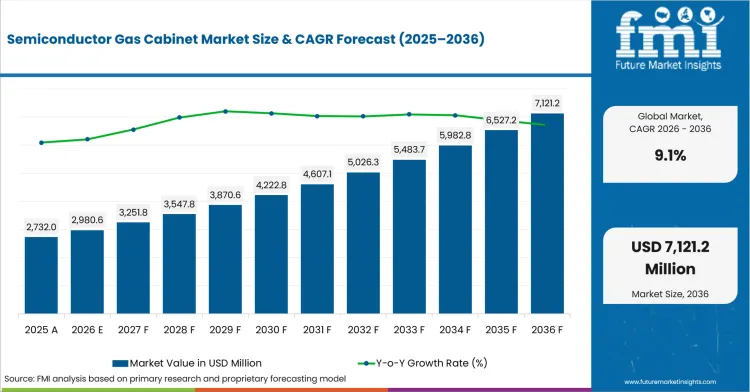
| Metric | Value |
|---|---|
| 2025 Market Size | USD 2,732.0 million |
| 2026 Market Size | USD 2980.6 million |
| 2036 Market Size | USD 7121.2 million |
| Forecast CAGR (2026-2036) | 9.1% |
| Leading Gas Type | Toxic Gases |
| Toxic Gases Share (2026) | 36.8% |
| Leading Cabinet Type | Dual-cylinder Cabinets |
| Dual-cylinder Cabinets Share (2026) | 34.2% |
| Fastest-growing Country | India |
| India CAGR by 2036 | 10.7% |
Summary of the Semiconductor Gas Cabinet Market
| Market Signal | Commercial Impact |
|---|---|
| Demand and Growth Drivers | Demand for semiconductor gas cabinets is increasing as advanced semiconductor fabs require safe, automated, and ultra-high-purity gas delivery systems for critical manufacturing processes.
|
| Product and Segment View | Toxic gas cabinets, dual-cylinder configurations, and foundry applications continue to represent the leading commercial opportunities across the market.
|
| Geography and Growth Outlook | Asia continues to dominate market expansion as semiconductor manufacturing capacity and advanced fabrication investments accelerate.
|
| Competitive Landscape | Competition increasingly focuses on toxic gas safety, ultra-high-purity gas delivery, automation, and regulatory compliance.
|
| Analyst Perspective | Semiconductor gas cabinets are evolving from utility infrastructure into critical risk management systems that enhance fab safety, operational continuity, and advanced process performance.
|
Why is the Semiconductor Gas Cabinet Market growing?
New 300 mm fabs need dedicated gas source cabinets for dopant and etch gases before tool qualification starts. Toxic gas handling raises cabinet value since fabs need purge validation, exhaust control, and leak-tested manifolds.
- New 300 mm fabs need dedicated gas source cabinets for dopant and etch gases before tool qualification starts.
- Toxic gas handling raises cabinet value since fabs need purge validation, exhaust control, and leak-tested manifolds.
- Memory and foundry expansions increase cabinet density as each process module needs dedicated gas delivery paths.
Advanced fab investment is changing cabinet specifications before fabs start pilot production. SEMI reported in April 2026 that worldwide 300 mm fab equipment spending is expected to rise 18% to USD 133 billion in 2026 and 14% to USD 151 billion in 2027. This means cabinets are being ordered as part of front-end tool readiness rather than after facilities are nearly complete. Suppliers that can align gas panel builds with tool install windows gain stronger positions. For buyers, cabinet sourcing becomes a schedule risk when valves, pressure sensors, or certified controllers are constrained. Hazardous gas management is another structural reason the market expands.
How is the Semiconductor Gas Cabinet Market segmented?
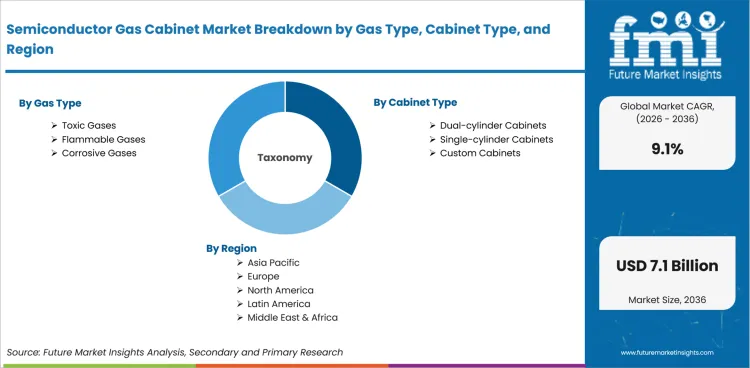
The Semiconductor Gas Cabinet Market is segmented by gas type, cabinet type, end use, automation, sales channel, and region.
- With an estimated 36.8% share in 2026, Toxic Gases is expected to lead the gas type category because dopant gases need the strictest containment routine.
- Dual-cylinder Cabinets are projected to account for 34.2% of Cabinet Type demand in 2026 as fabs need safer cylinder changeover.
- Foundry buyers are expected to represent 38.7% of End Use in 2026 with multi-node process mixes needing flexible cabinet layouts.
How does Toxic Gases contribute to the gas type category?
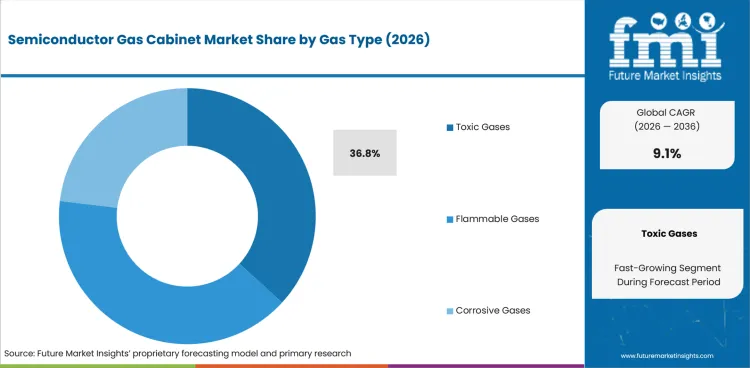
- Toxic Gases are estimated to account for a 36.8% share in 2026 as arsine, phosphine, and germane use makes leak control and purge sequencing central to cabinet specification.
- Sub-atmospheric source handling changes buyer choice since pressure loss can affect delivery. Entegris highlights manifold design for phosphine, arsine, or germane flow from sub-atmospheric sources.
What supports demand for Dual-cylinder Cabinets?
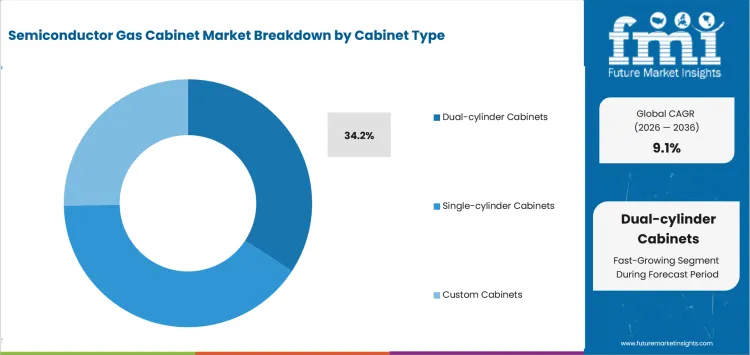
- Dual-cylinder Cabinets are projected to represent a 34.2% share in 2026 as fabs need cylinder changeover without interrupting recipes that depend on stable gas availability.
- The format carries a higher controls burden than single-cylinder units since switchover logic, purge confirmation, and alarm handling must operate without contaminating the line.
How do buyers evaluate Foundries within the end use category?
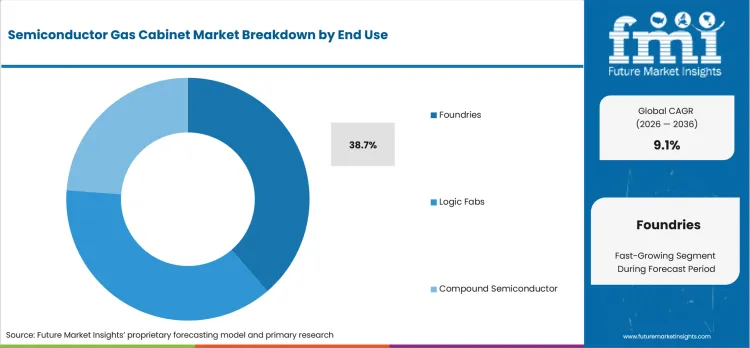
- Foundries are anticipated to account for a 38.7% share in 2026 as multi-customer wafer production needs wider gas compatibility across process modules.
- Foundry gas rooms tend to buy flexible cabinet layouts since node mix can change. That favors configurable manifolds over fixed low-cost cabinet packages.
What market factors influence demand for Fully Automatic?
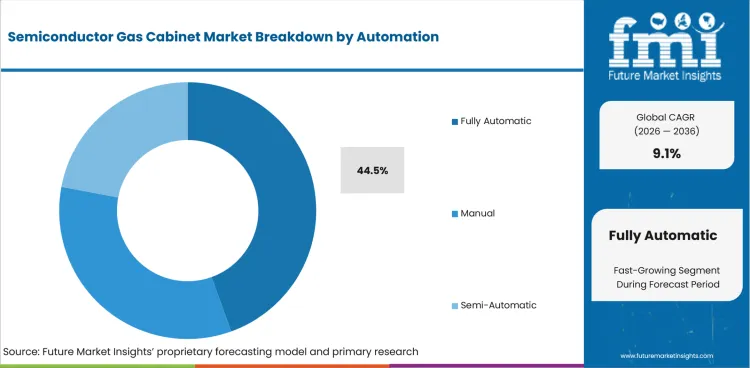
- Fully Automatic cabinets are expected to hold a 44.5% share in 2026 as hazardous gas programs push fabs toward controlled purge, valve sequencing, and alarm interlocks.
- Automation changes service needs since maintenance teams must validate controller logic. This raises the value of field support after installation.
How does Direct OEM affect the sales channel outlook?
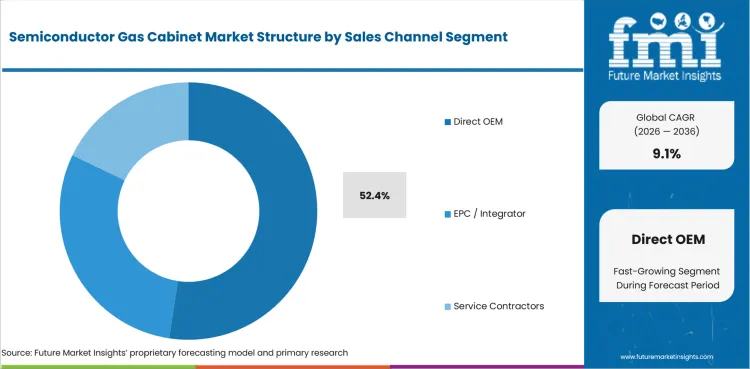
- Direct OEM is projected to account for a 52.4% share in 2026 as fabs and tool suppliers specify gas cabinets during front-end equipment planning.
- EPC and integrator routes stay relevant for greenfield fabs, but direct OEM buying keeps stronger control over qualification documents and approved component lists.
What drives and restrains the market?
Driver: Advanced-node gas recipes create demand for cabinets with stable pressure control and validated purge routines; restraint: The main restraint is long qualification time for custom gas cabinets using approved valves and controllers; opportunity: the opportunity lies in valve manifold box integration that lowers hook-up work inside crowded sub-fab spaces.
The market reflects a balance between the identified demand driver, adoption constraints, and the supplier opportunity outlined below.
- Driver: Advanced-node gas recipes create demand for cabinets with stable pressure control and validated purge routines.
- Restraint: The main restraint is long qualification time for custom gas cabinets using approved valves and controllers.
- Opportunity: the opportunity lies in valve manifold box integration that lowers hook-up work inside crowded sub-fab spaces.
Fab Gas Room Readiness: Gas room readiness is becoming a gating item in fab ramp schedules. SEMI’s World Fab Forecast says the December 2024 update listed more than 1,500 facilities and lines globally and included 180 volume facilities and lines expected to start operation in 2025 or later. That scale creates a long tail of gas cabinet demand beyond large mega-fab projects. The mechanism is simple. Each process bay needs source cabinets before process tools can be signed off.
Toxic Source Containment: Toxic source containment is the premium profit pool in this market. Cabinets for arsine, phosphine, and germane need exhaust interfaces, purge confirmation, and manifold cleanliness that ordinary cylinder enclosures do not provide. Matheson lists a toxic and corrosive gas cabinet with a 9400 Series semiconductor grade panel at USD 17,698.07 and a hydrogen cabinet with switchover at USD 10,652.35. The price gap shows how gas type and panel grade change cabinet value. Buyers therefore assess cabinet architecture by risk class before they negotiate unit price.
Which factors support expansion?
Commercial expansion is reinforced by the value, workflow, and recurring-demand factors below.
- Fab construction timing is a direct value driver as SEMI expects most 2025-start projects to begin operations during 2026 to 2027.
- The market benefits from high purity process systems upgrades as fabs qualify gases for deposition and doping recipes.
- Automatic cabinet demand is rising in 2026 as hazardous gas rooms move toward interlocked valve sequences and remote alarm integration.
Which country markets are included in the CAGR comparison?
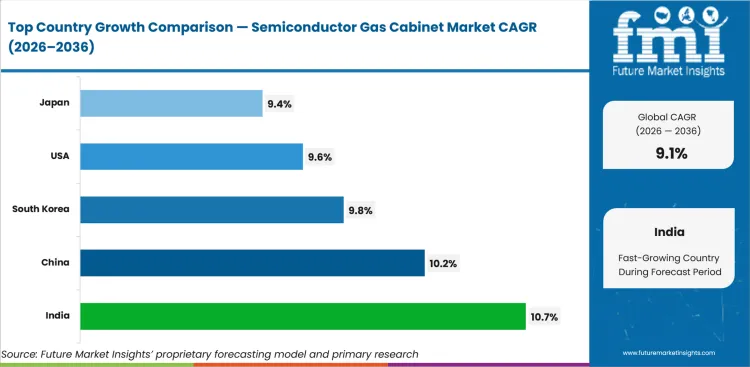
The selected CAGR comparison covers India (10.7%), China (10.2%), South Korea (9.8%), United States (9.6%), and Japan (9.4%) through 2036.
| Country | CAGR |
|---|---|
| India | 10.7% |
| China | 10.2% |
| South Korea | 9.8% |
| United States | 9.6% |
| Japan | 9.4% |
Source: Future Market Insights analysis.
How do country-level CAGRs compare?
- India (CAGR: 10.7%): New fab and ATMP projects create first-time gas cabinet demand.
- China (CAGR: 10.2%): Domestic fab expansion supports broad gas-cabinet demand across multiple semiconductor clusters.
- South Korea (CAGR: 9.8%): Memory and logic clusters in Gyeonggi drive high-purity gas infrastructure demand.
- United States (CAGR: 9.6%): CHIPS incentives support new fab and equipment investment across Arizona, Ohio, Idaho, and New York.
- Japan (CAGR: 9.4%): Kumamoto and Hokkaido projects support advanced gas infrastructure demand.
The global Semiconductor Gas Cabinet Market is forecast to record a CAGR of 9.1% from 2026 to 2036. The study covers 30+ countries across the report regions.
How is the Semiconductor Gas Cabinet Market developing in India?
India is projected to record a CAGR of 10.7% through 2036. The country outlook identifies this demand signal: New fab and ATMP projects create first-time gas cabinet demand.
Country Market Snapshot
| Country | India |
|---|---|
| Forecast CAGR | 10.7% |
| Demand anchor | New fab and ATMP projects create first-time gas cabinet demand. |
| Procurement route | Buyers rely on EPC contractors, global tool OEMs, and government-backed project structures. |
| Policy context | India provides 50% fiscal support for approved semiconductor fabs. |
| Supply structure | Global gas-cabinet vendors serve projects through local engineering, gas-supply, and service partners. |
| Application mix | Dholera fab and compound semiconductor projects support toxic and specialty gas needs. |
| Restraint | Local service and spare parts ecosystems are early-stage for UHP gas cabinets. |
| Company context | Companies active in or serving this market include Entegris, Applied Energy Systems, CVD Equipment Corporation, Linde India, and Air Liquide India. |
Market Outlook
India is projected to record a CAGR of 10.7% through 2036 as domestic semiconductor projects move from approval to construction and start-up. India Semiconductor Mission states that the fab scheme provides fiscal support of 50% of project cost on a pari-passu basis to approved applicants. That support shifts cabinet demand from small cleanrooms toward production-scale gas source infrastructure. India’s demand is early but strategically important.
Key Growth Drivers
- Dholera and Sanand projects create first-wave gas cabinet procurement.
- Fiscal support lowers capital barriers for new fab and compound semiconductor projects.
- Local electronics manufacturing policy widens downstream demand for semiconductor infrastructure.
- New fab and ATMP projects create first-time gas cabinet demand.
Key Restraints
- UHP gas cabinet service depth is still developing across Indian semiconductor clusters.
- Imported components can extend lead times for certified cabinets.
- Local service and spare parts ecosystems are early-stage for UHP gas cabinets.
Country Market FAQs
What should C-suite teams prioritize in India?
C-suite teams should prioritize qualification requirements, procurement routes, local service coverage, and implementation economics before committing capital or supplier volume.
How should suppliers approach the India market?
Suppliers should align technical evidence, local channel support, and account-specific commercial terms with the buying process used by major customers in India.
What can weaken the business case in India?
Local service and spare parts ecosystems are early-stage for UHP gas cabinets. Executives should test this exposure during supplier, investment, and rollout reviews.
How is the Semiconductor Gas Cabinet Market developing in China?
China is projected to record a CAGR of 10.2% through 2036. The country outlook identifies this demand signal: Domestic fab expansion supports broad gas-cabinet demand across multiple semiconductor clusters.
Country Market Snapshot
| Country | China |
|---|---|
| Forecast CAGR | 10.2% |
| Demand anchor | Domestic fab expansion supports broad gas-cabinet demand across multiple semiconductor clusters. |
| Procurement route | Local EPC contractors and fab-owned purchasing teams influence cabinet selection. |
| Policy context | Self-sufficiency programs support domestic gas and equipment infrastructure. |
| Supply structure | Global and domestic gas-system vendors compete through project-specific EPC and fab qualification routes. |
| Application mix | Foundry and mature-node fabs drive multi-cylinder and custom cabinet demand. |
| Restraint | Export controls can affect access to advanced components and approved sensors. |
| Company context | Companies active in or serving this market include Entegris, CKD, Fujikin, Air Liquide, and Linde. |
Market Outlook
China is forecast to grow at a CAGR of 10.2% through 2036 as fab capacity additions raise demand for gas cabinets across mature and advanced process nodes. SEMI reported that mainstream nodes from 8 nm to 45 nm were predicted to surpass 15 million wafers per month in 2025 due partly to China’s chip self-sufficiency strategy and automotive demand. This supports cabinet orders for etch, deposition, and dopant gases across a wide fab mix.
Key Growth Drivers
- Domestic semiconductor capacity programs increase cabinet demand across multiple provinces.
- Mature-node expansion supports larger volumes of standard and dual-cylinder cabinets.
- Local gas infrastructure growth supports custom cabinet and VMB integration.
- Domestic fab expansion supports broad gas-cabinet demand across multiple semiconductor clusters.
Key Restraints
- Export controls can limit access to advanced valves and control components.
- Public project visibility is uneven across regional fabs and private suppliers.
- Large fabs often evaluate whether a cabinet supplier can deliver approved components despite export limits.
Country Market FAQs
What should C-suite teams prioritize in China?
C-suite teams should prioritize qualification requirements, procurement routes, local service coverage, and implementation economics before committing capital or supplier volume.
How should suppliers approach the China market?
Suppliers should align technical evidence, local channel support, and account-specific commercial terms with the buying process used by major customers in China.
What can weaken the business case in China?
Export controls can affect access to advanced components and approved sensors. Executives should test this exposure during supplier, investment, and rollout reviews.
How is the Semiconductor Gas Cabinet Market developing in South Korea?
South Korea is projected to record a CAGR of 9.8% through 2036. The country outlook identifies this demand signal: Memory and logic clusters in Gyeonggi drive high-purity gas infrastructure demand.
Country Market Snapshot
| Country | South Korea |
|---|---|
| Forecast CAGR | 9.8% |
| Demand anchor | Memory and logic clusters in Gyeonggi drive high-purity gas infrastructure demand. |
| Procurement route | Major fabs use direct supplier contracts and long-term gas partners. |
| Policy context | The government supports a mega-cluster across Pyeongtaek, Hwaseong, Yongin, and Icheon. |
| Supply structure | Linde has direct supply relevance at Samsung’s Pyeongtaek semiconductor complex. |
| Application mix | DRAM, NAND, and logic fabs drive toxic and specialty gas cabinet demand. |
| Restraint | Large customers use strict approved supplier lists and high documentation requirements. |
| Company context | Companies active in or serving this market include Entegris Korea, GST, CKD, Fujikin, and Air Liquide Korea. |
Market Outlook
South Korea is expected to record a CAGR of 9.8% through 2036 as memory clusters expand gas source and sub-fab infrastructure. South Korea’s science ministry said the mega-cluster plan includes 19 production fabs and 2 research fabs already present, with 16 new fabs planned through private investment of 622 trillion won by 2047. This gives cabinet suppliers a long project runway across multiple fab sites. Procurement is highly concentrated around large semiconductor manufacturers.
Key Growth Drivers
- Pyeongtaek and Yongin fabs raise demand for high-purity gas source systems.
- AI memory demand supports cabinet orders tied to DRAM and HBM capacity.
- Long-term gas supply contracts create opportunities for cabinet and VMB integration.
- Memory and logic clusters in Gyeonggi drive high-purity gas infrastructure demand.
Key Restraints
- Strict fab qualification narrows supplier access.
- Customer concentration increases price pressure on smaller cabinet makers.
- Large customers use strict approved supplier lists and high documentation requirements.
Country Market FAQs
What should C-suite teams prioritize in South Korea?
C-suite teams should prioritize qualification requirements, procurement routes, local service coverage, and implementation economics before committing capital or supplier volume.
How should suppliers approach the South Korea market?
Suppliers should align technical evidence, local channel support, and account-specific commercial terms with the buying process used by major customers in South Korea.
What can weaken the business case in South Korea?
Large customers use strict approved supplier lists and high documentation requirements. Executives should test this exposure during supplier, investment, and rollout reviews.
How is the Semiconductor Gas Cabinet Market developing in the United States?
The United States is projected to record a CAGR of 9.6% through 2036. The country outlook identifies this demand signal: CHIPS incentives support new fab and equipment investment across Arizona, Ohio, Idaho, and New York.
Country Market Snapshot
| Country | United States |
|---|---|
| Forecast CAGR | 9.6% |
| Demand anchor | CHIPS incentives support new fab and equipment investment across Arizona, Ohio, Idaho, and New York. |
| Procurement route | Large fabs use direct OEM and EPC packages tied to approved gas system suppliers. |
| Policy context | CHIPS for America includes USD 39 billion for facility and equipment incentives. |
| Supply structure | Entegris, Applied Energy Systems, Matheson, and SilPac have direct U.S. gas cabinet relevance. |
| Application mix | Memory, logic, and specialty fabs create demand for toxic and flammable gas cabinets. |
| Restraint | Construction labor and tool-install delays can shift cabinet delivery schedules. |
| Company context | Companies active in or serving this market include Applied Energy Systems, Entegris, CVD Equipment Corporation, SilPac, and Matheson. |
Market Outlook
The United States is projected to record a CAGR of 9.6% through 2036 as domestic fab projects create gas room and tool hook-up demand. NIST states that CHIPS for America includes USD 50 billion across research, development, and manufacturing programs, with USD 39 billion dedicated to incentives for facilities and equipment. This funding widens the buyer pool for gas cabinets beyond legacy fabs. Cabinet suppliers will compete on compliance documentation, service access, and U.S.-based build support.
Key Growth Drivers
- CHIPS-backed facility spending increases cabinet demand before pilot production starts.
- Idaho memory expansion supports ultra-high-purity carrier gas and cabinet infrastructure.
- Arizona and Ohio logic fabs raise demand for toxic dopant gas cabinets.
- CHIPS incentives support new fab and equipment investment across Arizona, Ohio, Idaho, and New York.
Key Restraints
- Long fab construction cycles can delay cabinet shipment recognition.
- Approved vendor requirements limit entry for unqualified cabinet assemblers.
- Construction labor and tool-install delays can shift cabinet delivery schedules.
Country Market FAQs
What should C-suite teams prioritize in the United States?
C-suite teams should prioritize qualification requirements, procurement routes, local service coverage, and implementation economics before committing capital or supplier volume.
How should suppliers approach the United States market?
Suppliers should align technical evidence, local channel support, and account-specific commercial terms with the buying process used by major customers in the United States.
What can weaken the business case in the United States?
Construction labor and tool-install delays can shift cabinet delivery schedules. Executives should test this exposure during supplier, investment, and rollout reviews.
How is the Semiconductor Gas Cabinet Market developing in Japan?
Japan is projected to record a CAGR of 9.4% through 2036. The country outlook identifies this demand signal: Kumamoto and Hokkaido projects support advanced gas infrastructure demand.
Country Market Snapshot
| Country | Japan |
|---|---|
| Forecast CAGR | 9.4% |
| Demand anchor | Kumamoto and Hokkaido projects support advanced gas infrastructure demand. |
| Procurement route | Buyers use domestic component suppliers and global tool OEM specifications. |
| Policy context | Government-backed Rapidus investment supports 2 nm process readiness. |
| Supply structure | CKD and Fujikin have direct relevance through gas facility and integrated gas systems. |
| Application mix | Logic, automotive, and advanced-node work shape cabinet purity requirements. |
| Restraint | Approved component sourcing and tight quality standards slow new supplier entry. |
| Company context | Companies active in or serving this market include CKD, Fujikin, KITZ SCT, Entegris Japan, and Taiyo Nippon Sanso. |
Market Outlook
Japan is projected to grow at a CAGR of 9.4% through 2036 as advanced fab projects move from strategy into installation. The U.S. International Trade Administration noted in November 2025 that Rapidus plans to begin mass production of 2 nm chips in 2027 and that Japan has provided over USD 6.1 billion in funding to Rapidus. This creates high-spec gas cabinet demand around Hokkaido and related tool ecosystems. Japanese buyers place high weight on component reliability and supplier process discipline.
Key Growth Drivers
- Rapidus-related 2 nm readiness raises demand for advanced gas delivery infrastructure.
- Kumamoto fabs create cabinet demand for logic and automotive chip production.
- Domestic valve and control suppliers improve local integration options.
- Kumamoto and Hokkaido projects support advanced gas infrastructure demand.
Key Restraints
- Strict quality expectations raise qualification time for foreign cabinet vendors.
- Advanced process timelines can shift cabinet installation schedules.
- Approved component sourcing and tight quality standards slow new supplier entry.
Country Market FAQs
What should C-suite teams prioritize in Japan?
C-suite teams should prioritize qualification requirements, procurement routes, local service coverage, and implementation economics before committing capital or supplier volume.
How should suppliers approach the Japan market?
Suppliers should align technical evidence, local channel support, and account-specific commercial terms with the buying process used by major customers in Japan.
What can weaken the business case in Japan?
Approved component sourcing and tight quality standards slow new supplier entry. Executives should test this exposure during supplier, investment, and rollout reviews.
Which companies are discussed in the Semiconductor Gas Cabinet Market?
The preview discusses Entegris, Applied Energy Systems, CVD Equipment, Matheson, and SilPac among the companies active in this market.
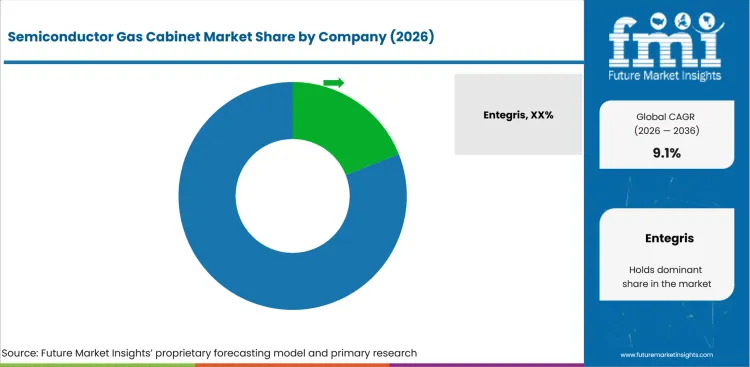
Competition is moderately concentrated as verified toxic gas cabinet expertise is limited to specialized UHP suppliers. established firms win with SEMI compliance, leak-tested manifolds, controller integration, and field service depth. Specialist firms compete in custom gas panels and cabinet packages for research lines or compound semiconductor fabs.
Entry barriers are high because hazardous gas cabinets need process proof, component traceability, and safety documentation. Established competitors stand out when they combine cabinet hardware with validated gas delivery knowledge. Applied Energy Systems’ SEMI-GAS Centurion line lists SEMI S2 compliance, UL labeling, and helium leak testing to 1×10^-9 atm-cm3/sec.
How is competition structured?
Competition reflects differences in specialization, portfolio scope, geographic reach, evidence, and customer access.
Competition is best understood by role because gas cabinet value depends on cabinet manufacturing, gas supply design, and component integration.
- Cabinet and Source System Specialists: Entegris, Applied Energy Systems, CVD Equipment, Matheson, and SilPac compete with gas cabinet and gas source products. Entegris offers TX-4 gas delivery cabinets for toxic semiconductor gases.
- Gas Infrastructure and Fab Supply Leaders: Linde and Air Liquide influence procurement through electronics gas supply contracts and on-site gas infrastructure. Linde’s Pyeongtaek supply expansion for Samsung shows how gas supply planning connects to fab growth.
- Component and Integrated Gas System Firms: CKD, Fujikin, Ichor Systems, and MKS Inc. compete around valves, gas flow systems, process chemicals, and delivery subsystems. CKD and Fujikin supply critical gas facility components used in UHP systems.
How do selected companies compare?
The selected companies differ in portfolio focus, geographic reach, evidence depth, and channel strength.
| Company | Competitive position |
|---|---|
| Entegris | Entegris is assessed for fab qualification, process capability, field service, and regional semiconductor customer support. |
| Applied Energy Systems | Applied Energy Systems is assessed for fab qualification, process capability, field service, and regional semiconductor customer support. |
| CVD Equipment Corporation | CVD Equipment Corporation is assessed for fab qualification, process capability, field service, and regional semiconductor customer support. |
| Matheson | Matheson is assessed for fab qualification, process capability, field service, and regional semiconductor customer support. |
| SilPac | SilPac is assessed for fab qualification, process capability, field service, and regional semiconductor customer support. |
What are the key developments in the Semiconductor Gas Cabinet Market?
- In June 2024, Air Liquide signed a major contract to support Micron’s U.S. memory fab with more than USD 250 million in gas facility investment. This strengthens adjacent gas cabinet demand around Boise.
- In January 2025, SEMI reported that 18 semiconductor fab construction projects were expected to start in 2025. This raises source cabinet needs for greenfield and expansion fabs.
- In April 2025, Linde announced an expansion of ultra-high-purity atmospheric, process, and specialty gas supply to Samsung in Pyeongtaek. This supports future gas cabinet and UHP infrastructure needs.
Selected Companies in the Semiconductor Gas Cabinet Market
Companies referenced in this preview
- Entegris.
- Applied Energy Systems.
- CVD Equipment Corporation.
- Matheson.
- SilPac.
- CKD.
- Fujikin.
- KITZ SCT.
Market Scope & Definition
| Metric | Value |
|---|---|
| Market definition | The Semiconductor Gas Cabinet Market covers enclosed source systems that store and control process gas cylinders used in semiconductor manufacturing. |
| Functions covered | Toxic Gases, Flammable Gases, Corrosive Gases, Inert / Specialty Gases |
| Applications covered | Logic Fabs, Memory Fabs, Foundries, Compound Semiconductor |
| End-use industries | Logic Fabs, Memory Fabs, Foundries, Compound Semiconductor |
| Inclusions | Market scope covers all commercially supplied semiconductor gas cabinet systems by Gas Type, Cabinet Type, End Use, Automation, Sales Channel, and demand across 30+ countries, including the United States, United Kingdom, Germany, France, Japan, China, South Korea, and India. |
| Exclusions | Market scope excludes bulk nitrogen plants, liquid chemical cabinets, burn-wet abatement systems, general industrial cylinder racks, medical gas cabinets, laboratory-only regulators, and gas cabinets sold outside semiconductor fabrication use. |
Research Methodology
| Metric | Value |
|---|---|
| Primary Research | FMI analysts reviewed buying behavior among fab facility teams, gas system engineers, tool OEMs, EPC contractors, and specialty gas suppliers. Interviews focused on cabinet specification timing, purge validation, changeover practices, and safety approval steps. |
| Desk Research | used semiconductor fab expansion data, SEMI equipment outlooks, safety guideline references, company product pages, and official government semiconductor investment documents. Product scope was checked against gas delivery cabinet systems and UHP gas infrastructure categories. |
| Market Sizing and Forecasting | The model combined cabinet volume by fab type, cabinet pricing by automation level, toxic gas intensity, country-level fab activity, and sales channel share. The forecast was cross-checked against gas delivery systems demand and semiconductor equipment spending signals. |
| Data Validation | Forecasts were reviewed against company product evidence, specialty gas investment signals, and fab construction timelines. Segment shares were validated through buyer workflow logic and cabinet configuration use across advanced fabs. |
What does the report cover?
The report covers gas type, cabinet type, end use, automation, sales channel, and region across the 2026-2036 forecast period in 30+ countries.
| Metric | Value |
|---|---|
| Periods | Base year 2025; estimated year 2026; forecast period 2026-2036 |
| Segment axes | gas type, cabinet type, end use, automation, sales channel, and region |
| Regions | North America, Latin America, Europe, East Asia, South Asia and Pacific, Middle East and Africa |
| Countries | United States, United Kingdom, Germany, France, Japan, China, South Korea, India and 30+ countries |
| Companies | Entegris, Applied Energy Systems, CVD Equipment Corporation, Matheson, SilPac, CKD, Fujikin, KITZ SCT, and others |
| Approach | Hybrid bottom-up and top-down methodology using fab activity, cabinet pricing, automation mix, gas risk class, and country-level infrastructure signals. |
Market Segmentation Analysis
Segmented by Gas Type
- Toxic Gases.
- Flammable Gases.
- Corrosive Gases.
- Inert / Specialty Gases.
Segmented by Cabinet Type
- Single-cylinder Cabinets.
- Dual-cylinder Cabinets.
- Multi-cylinder Cabinets.
- Custom Cabinets.
Segmented by End Use
- Logic Fabs.
- Memory Fabs.
- Foundries.
- Compound Semiconductor.
Segmented by Automation
- Manual.
- Semi-automatic.
- Fully Automatic.
Segmented by Sales Channel
- Direct OEM.
- EPC / Integrator.
- Service Contractors.
By Region
- North America.
- United States.
- Canada.
- Mexico.
- Latin America.
- Brazil.
- Chile.
- Rest of Latin America.
- Western Europe.
- Germany.
- Italy.
- Spain.
- France.
- Nordic.
- BENELUX.
- Rest of Western Europe.
- Eastern Europe.
- Russia.
- Poland.
- Hungary.
- Balkan & Baltic.
- Rest of Eastern Europe.
- East Asia.
- China.
- Japan.
- South Korea.
- South Asia and Pacific.
- India.
- ASEAN.
- Australia & New Zealand.
- Rest of South Asia and Pacific.
- Middle East & Africa.
- Kingdom of Saudi Arabia.
- Other GCC Countries.
- Turkiye.
- South Africa.
- Other African Union.
- Rest of Middle East & Africa.
Research Sources and Bibliography
- 1. SEMI. (2025, January 7). Eighteen New Semiconductor Fabs to Start Construction in 2025, SEMI Reports. SEMI.
- 2. SEMI. (2026, April 1). SEMI Projects Double-Digit Growth in Global 300mm Fab Equipment Spending for 2026 and 2027. SEMI.
- 3. National Institute of Standards and Technology. (2026). CHIPS for America. U.S. Department of Commerce.
- 4. European Investment Bank. (2024, January 25). Project Liberty Semiconductor Fab. European Investment Bank.
- 5. Ministry of Science and ICT. (2024, January 16). The government plans to establish a total of 16 new fabs. Government of the Republic of Korea.
- 6. India Semiconductor Mission. (2026). Home. India Semiconductor Mission.
- 7. India Semiconductor Mission. (2025, September 8). Semiconductor Fabs Scheme. India Semiconductor Mission.
- 8. International Trade Administration. (2025, November 20). Japan - Semiconductors. U.S. Department of Commerce.
- 9. Entegris. (2026). Gas Delivery Cabinet Systems. Entegris.
- 10. Applied Energy Systems. (2026). Centurion™ Gas Cabinets. Applied Energy Systems.
- 11. CVD Equipment Corporation. (2026). Gas & Chemical Equipment. CVD Equipment Corporation.
- 12. CKD Corporation. (2026). Gas Facility. CKD Corporation.
- 13. Fujikin Incorporated. (2026). Integrated Gas Systems. Fujikin Incorporated.
- 14. SEMI. (2026). SilPac. SEMI Member Directory.
- 15. Matheson. (2026). Specialty Gas Equipment - Gas Delivery Systems - Gas Cabinets. Matheson.
- 16. Linde. (2025, April 29). Linde to Expand Supply of Industrial Gases to Samsung in South Korea. Linde.
The bibliography is provided for reader reference and uses primary government, regulatory, official trade body, and company-published sources.
This Report Answers
- What is the projected value of the Semiconductor Gas Cabinet Market in 2026?
- What value is forecast for the Semiconductor Gas Cabinet Market by 2036?
- What CAGR is forecast for the Semiconductor Gas Cabinet Market from 2026 to 2036?
- What 2026 share is projected for Toxic Gases within the gas type category?
- What 2026 share is projected for Dual-cylinder Cabinets within the cabinet type category?
- Which demand factors support the Semiconductor Gas Cabinet Market outlook?
- Which restraints and opportunities affect adoption in the Semiconductor Gas Cabinet Market?
- How are country CAGR outlooks, including India at 10.7%, compared?
- Which companies and product developments are covered in the competitive analysis?
- What is included in the market scope, and how is the forecast validated?
Frequently Asked Questions
Why should executives track the Semiconductor Gas Cabinet Market?
Executives should track this market because it can affect capital allocation, supplier strategy, operating risk, and competitive positioning across commercial planning cycles.
What business problem does the Semiconductor Gas Cabinet Market address?
It helps executive teams judge where customer pain, supplier capability, compliance exposure, and implementation economics justify investment, procurement, or portfolio action.
What should procurement leaders evaluate before selecting suppliers?
Procurement leaders should assess evidence quality, integration fit, service coverage, compliance readiness, total cost of ownership, and supplier execution capability.
What can limit return on investment for buyers?
Return on investment can be limited by low utilization, integration delays, training gaps, unclear ownership, pricing pressure, or weak fit with existing workflows.
How can suppliers build executive confidence?
Suppliers can build confidence by proving implementation speed, risk reduction, support depth, reference use cases, and measurable outcomes for budget owners.
Preview the report firsthand - request a free sample
Get SampleGet the brochure for pricing and purchase details.
Get PDFTable of Content
- Key Takeaways
- Market Size and CAGR
- Top Growth Driver
- Fastest Growing Segment
- Leading Region
- Key Companies
- Emerging Opportunities
- Executive Summary
- Global Market Outlook
- Demand-side Trends
- Supply-side Trends
- Technology Roadmap Analysis
- Analysis and Recommendations
- Analyst Perspective (What is happening? Why now? What should investors know?)
- Key Questions Answered
- How large is the market?
- What is the CAGR?
- What are key trends?
- Which region dominates?
- Who are the leaders?
- Market Overview
- Market Coverage / Taxonomy
- Market Definition / Scope / Limitations
- Research Methodology
- Chapter Orientation
- Analytical Lens and Working Hypotheses
- Market Structure, Signals, and Trend Drivers
- Benchmarking and Cross-market Comparability
- Market Sizing, Forecasting, and Opportunity Mapping
- Research Design and Evidence Framework
- Desk Research Programme (Secondary Evidence)
- Expert Input and Fieldwork (Primary Evidence)
- Tooling, Models, and Reference Databases
- Data Engineering and Model Build
- Quality Assurance and Audit Trail
- Market Background
- Market Dynamics (Drivers, Restraints, Opportunity, Trends)
- Scenario Forecast (Optimistic, Likely, Conservative)
- Impact Analysis
- AI Impact
- Sustainability Impact
- Regulatory Impact
- Technology Impact
- Consumer / Buyer Analysis
- Purchase Drivers
- Adoption Barriers
- Buyer Journey
- Opportunity Map Analysis
- Product Life Cycle Analysis
- Supply Chain Analysis
- Investment Feasibility Matrix
- Value Chain Analysis
- PESTLE and Porter's Analysis
- Regulatory Landscape
- Regional Parent Market Outlook
- Production and Consumption Statistics
- Import and Export Statistics
- Global Market Analysis and Forecast, 2021 to 2036
- Historical Market Size Value (USD Billion) & Volume (Unit) Analysis, 2021 to 2025
- Current and Future Market Size Value (USD Billion) & Volume (Unit) Projections, 2026 to 2036
- Y-o-Y Growth Trend Analysis
- Absolute $ Opportunity Analysis
- Global Market Pricing Analysis, 2021 to 2036
- Global Market Analysis and Forecast, By Gas Type, 2021 to 2036
- Introduction / Key Findings
- Historical Market Size Value (USD Billion) & Volume (Unit) Analysis By Gas Type, 2021 to 2025
- Current and Future Market Size Value (USD Billion) & Volume (Unit) Analysis and Forecast By Gas Type, 2026 to 2036
- Toxic Gases
- Flammable Gases
- Corrosive Gases
- Toxic Gases
- Y-o-Y Growth Trend Analysis By Gas Type, 2021 to 2025
- Absolute $ Opportunity Analysis By Gas Type, 2026 to 2036
- Global Market Analysis and Forecast, By Cabinet Type, 2021 to 2036
- Introduction / Key Findings
- Historical Market Size Value (USD Billion) & Volume (Unit) Analysis By Cabinet Type, 2021 to 2025
- Current and Future Market Size Value (USD Billion) & Volume (Unit) Analysis and Forecast By Cabinet Type, 2026 to 2036
- Dual-cylinder Cabinets
- Single-cylinder Cabinets
- Custom Cabinets
- Dual-cylinder Cabinets
- Y-o-Y Growth Trend Analysis By Cabinet Type, 2021 to 2025
- Absolute $ Opportunity Analysis By Cabinet Type, 2026 to 2036
- Global Market Analysis and Forecast, By End Use, 2021 to 2036
- Introduction / Key Findings
- Historical Market Size Value (USD Billion) & Volume (Unit) Analysis By End Use, 2021 to 2025
- Current and Future Market Size Value (USD Billion) & Volume (Unit) Analysis and Forecast By End Use, 2026 to 2036
- Foundries
- Logic Fabs
- Compound Semiconductor
- Foundries
- Y-o-Y Growth Trend Analysis By End Use, 2021 to 2025
- Absolute $ Opportunity Analysis By End Use, 2026 to 2036
- Global Market Analysis and Forecast, By Automation, 2021 to 2036
- Introduction / Key Findings
- Historical Market Size Value (USD Billion) & Volume (Unit) Analysis By Automation, 2021 to 2025
- Current and Future Market Size Value (USD Billion) & Volume (Unit) Analysis and Forecast By Automation, 2026 to 2036
- Fully Automatic
- Manual
- Semi-Automatic
- Fully Automatic
- Y-o-Y Growth Trend Analysis By Automation, 2021 to 2025
- Absolute $ Opportunity Analysis By Automation, 2026 to 2036
- Global Market Analysis and Forecast, By Sales Channel, 2021 to 2036
- Introduction / Key Findings
- Historical Market Size Value (USD Billion) & Volume (Unit) Analysis By Sales Channel, 2021 to 2025
- Current and Future Market Size Value (USD Billion) & Volume (Unit) Analysis and Forecast By Sales Channel, 2026 to 2036
- Direct OEM
- EPC / Integrator
- Service Contractors
- Direct OEM
- Y-o-Y Growth Trend Analysis By Sales Channel, 2021 to 2025
- Absolute $ Opportunity Analysis By Sales Channel, 2026 to 2036
- Global Market Analysis and Forecast, By Region, 2021 to 2036
- Introduction
- Historical Market Size Value (USD Billion) & Volume (Unit) Analysis By Region, 2021 to 2025
- Current Market Size Value (USD Billion) & Volume (Unit) Analysis and Forecast By Region, 2026 to 2036
- North America
- Latin America
- Western Europe
- Eastern Europe
- East Asia
- South Asia and Pacific
- Middle East & Africa
- Market Attractiveness Analysis By Region
- North America Market Analysis and Forecast, By Country, 2021 to 2036
- Historical Market Size Value (USD Billion) & Volume (Unit) Trend Analysis By Market Taxonomy, 2021 to 2025
- Market Size Value (USD Billion) & Volume (Unit) Forecast By Market Taxonomy, 2026 to 2036
- By Country
- USA
- Canada
- Mexico
- By Gas Type
- By Cabinet Type
- By End Use
- By Automation
- By Sales Channel
- By Country
- Market Attractiveness Analysis
- By Country
- By Gas Type
- By Cabinet Type
- By End Use
- By Automation
- By Sales Channel
- Key Takeaways
- Latin America Market Analysis and Forecast, By Country
- Historical Market Size Value (USD Billion) & Volume (Unit) Trend Analysis By Market Taxonomy, 2021 to 2025
- Market Size Value (USD Billion) & Volume (Unit) Forecast By Market Taxonomy, 2026 to 2036
- By Country
- Brazil
- Chile
- Rest of Latin America
- By Gas Type
- By Cabinet Type
- By End Use
- By Automation
- By Sales Channel
- By Country
- Market Attractiveness Analysis
- By Country
- By Gas Type
- By Cabinet Type
- By End Use
- By Automation
- By Sales Channel
- Key Takeaways
- Western Europe Market Analysis and Forecast, By Country
- Historical Market Size Value (USD Billion) & Volume (Unit) Trend Analysis By Market Taxonomy, 2021 to 2025
- Market Size Value (USD Billion) & Volume (Unit) Forecast By Market Taxonomy, 2026 to 2036
- By Country
- Germany
- UK
- Italy
- Spain
- France
- Nordic
- BENELUX
- Rest of Western Europe
- By Gas Type
- By Cabinet Type
- By End Use
- By Automation
- By Sales Channel
- By Country
- Market Attractiveness Analysis
- By Country
- By Gas Type
- By Cabinet Type
- By End Use
- By Automation
- By Sales Channel
- Key Takeaways
- Eastern Europe Market Analysis and Forecast, By Country
- Historical Market Size Value (USD Billion) & Volume (Unit) Trend Analysis By Market Taxonomy, 2021 to 2025
- Market Size Value (USD Billion) & Volume (Unit) Forecast By Market Taxonomy, 2026 to 2036
- By Country
- Russia
- Poland
- Hungary
- Balkan & Baltic
- Rest of Eastern Europe
- By Gas Type
- By Cabinet Type
- By End Use
- By Automation
- By Sales Channel
- By Country
- Market Attractiveness Analysis
- By Country
- By Gas Type
- By Cabinet Type
- By End Use
- By Automation
- By Sales Channel
- Key Takeaways
- East Asia Market Analysis and Forecast, By Country
- Historical Market Size Value (USD Billion) & Volume (Unit) Trend Analysis By Market Taxonomy, 2021 to 2025
- Market Size Value (USD Billion) & Volume (Unit) Forecast By Market Taxonomy, 2026 to 2036
- By Country
- China
- Japan
- South Korea
- By Gas Type
- By Cabinet Type
- By End Use
- By Automation
- By Sales Channel
- By Country
- Market Attractiveness Analysis
- By Country
- By Gas Type
- By Cabinet Type
- By End Use
- By Automation
- By Sales Channel
- Key Takeaways
- South Asia and Pacific Market Analysis and Forecast, By Country
- Historical Market Size Value (USD Billion) & Volume (Unit) Trend Analysis By Market Taxonomy, 2021 to 2025
- Market Size Value (USD Billion) & Volume (Unit) Forecast By Market Taxonomy, 2026 to 2036
- By Country
- India
- ASEAN
- Australia & New Zealand
- Rest of South Asia and Pacific
- By Gas Type
- By Cabinet Type
- By End Use
- By Automation
- By Sales Channel
- By Country
- Market Attractiveness Analysis
- By Country
- By Gas Type
- By Cabinet Type
- By End Use
- By Automation
- By Sales Channel
- Key Takeaways
- Middle East & Africa Market Analysis and Forecast, By Country
- Historical Market Size Value (USD Billion) & Volume (Unit) Trend Analysis By Market Taxonomy, 2021 to 2025
- Market Size Value (USD Billion) & Volume (Unit) Forecast By Market Taxonomy, 2026 to 2036
- By Country
- Kingdom of Saudi Arabia
- Other GCC Countries
- Türkiye
- South Africa
- Other African Union
- Rest of Middle East & Africa
- By Gas Type
- By Cabinet Type
- By End Use
- By Automation
- By Sales Channel
- By Country
- Market Attractiveness Analysis
- By Country
- By Gas Type
- By Cabinet Type
- By End Use
- By Automation
- By Sales Channel
- Key Takeaways
- Key Countries Market Analysis
- USA
- Pricing Analysis
- Market Share Analysis, 2025
- By Gas Type
- By Cabinet Type
- By End Use
- By Automation
- By Sales Channel
- Canada
- Pricing Analysis
- Market Share Analysis, 2025
- By Gas Type
- By Cabinet Type
- By End Use
- By Automation
- By Sales Channel
- Mexico
- Pricing Analysis
- Market Share Analysis, 2025
- By Gas Type
- By Cabinet Type
- By End Use
- By Automation
- By Sales Channel
- Brazil
- Pricing Analysis
- Market Share Analysis, 2025
- By Gas Type
- By Cabinet Type
- By End Use
- By Automation
- By Sales Channel
- Chile
- Pricing Analysis
- Market Share Analysis, 2025
- By Gas Type
- By Cabinet Type
- By End Use
- By Automation
- By Sales Channel
- Germany
- Pricing Analysis
- Market Share Analysis, 2025
- By Gas Type
- By Cabinet Type
- By End Use
- By Automation
- By Sales Channel
- UK
- Pricing Analysis
- Market Share Analysis, 2025
- By Gas Type
- By Cabinet Type
- By End Use
- By Automation
- By Sales Channel
- Italy
- Pricing Analysis
- Market Share Analysis, 2025
- By Gas Type
- By Cabinet Type
- By End Use
- By Automation
- By Sales Channel
- Spain
- Pricing Analysis
- Market Share Analysis, 2025
- By Gas Type
- By Cabinet Type
- By End Use
- By Automation
- By Sales Channel
- France
- Pricing Analysis
- Market Share Analysis, 2025
- By Gas Type
- By Cabinet Type
- By End Use
- By Automation
- By Sales Channel
- India
- Pricing Analysis
- Market Share Analysis, 2025
- By Gas Type
- By Cabinet Type
- By End Use
- By Automation
- By Sales Channel
- ASEAN
- Pricing Analysis
- Market Share Analysis, 2025
- By Gas Type
- By Cabinet Type
- By End Use
- By Automation
- By Sales Channel
- Australia & New Zealand
- Pricing Analysis
- Market Share Analysis, 2025
- By Gas Type
- By Cabinet Type
- By End Use
- By Automation
- By Sales Channel
- China
- Pricing Analysis
- Market Share Analysis, 2025
- By Gas Type
- By Cabinet Type
- By End Use
- By Automation
- By Sales Channel
- Japan
- Pricing Analysis
- Market Share Analysis, 2025
- By Gas Type
- By Cabinet Type
- By End Use
- By Automation
- By Sales Channel
- South Korea
- Pricing Analysis
- Market Share Analysis, 2025
- By Gas Type
- By Cabinet Type
- By End Use
- By Automation
- By Sales Channel
- Russia
- Pricing Analysis
- Market Share Analysis, 2025
- By Gas Type
- By Cabinet Type
- By End Use
- By Automation
- By Sales Channel
- Poland
- Pricing Analysis
- Market Share Analysis, 2025
- By Gas Type
- By Cabinet Type
- By End Use
- By Automation
- By Sales Channel
- Hungary
- Pricing Analysis
- Market Share Analysis, 2025
- By Gas Type
- By Cabinet Type
- By End Use
- By Automation
- By Sales Channel
- Kingdom of Saudi Arabia
- Pricing Analysis
- Market Share Analysis, 2025
- By Gas Type
- By Cabinet Type
- By End Use
- By Automation
- By Sales Channel
- Türkiye
- Pricing Analysis
- Market Share Analysis, 2025
- By Gas Type
- By Cabinet Type
- By End Use
- By Automation
- By Sales Channel
- South Africa
- Pricing Analysis
- Market Share Analysis, 2025
- By Gas Type
- By Cabinet Type
- By End Use
- By Automation
- By Sales Channel
- USA
- Market Structure Analysis
- Competition Dashboard
- Competition Benchmarking
- Market Share Analysis of Top Players
- By Regional
- By Gas Type
- By Cabinet Type
- By End Use
- By Automation
- By Sales Channel
- Emerging Startups
- Innovation Benchmarking
- Competition Analysis
- Competition Deep Dive
- Entegris
- Overview
- Product Portfolio
- Profitability by Market Segments (Product/Region/Sales Channel)
- Sales Footprint
- Strategy Overview
- Marketing Strategy
- Product Strategy
- Channel Strategy
- Applied Energy Systems
- CVD Equipment Corporation
- Matheson
- SilPac
- CKD
- Fujikin
- Entegris
- Case Studies
- Success Stories
- Recent Developments
- Competition Deep Dive
- Assumptions & Acronyms Used


