

- Market Size (2026)
- USD 6200.0 Mn
- Forecast (2036)
- USD 14900.0 Mn
- CAGR (2026 to 2036)
- 9.2%
Semiconductor Water Market Size, Market Forecast and Outlook By FMI
USD 6,200.0 million in 2026 and USD 14,900.0 million by 2036 at a 9.2% CAGR.
The semiconductor water industry value is forecast to grow from USD 5,677.7 million in 2025 to USD 14,900.0 million by 2036 at 9.2% CAGR as fabs treat ultrapure water, reclaim systems, and wastewater handling as production-risk controls. EPC / Turnkey delivery is expected to secure 52.0% share in 2026 because fab owners prefer one accountable project route for high-purity utilities. Ultrapure Water Supply is projected to hold 46.0% share in 2026 as wafer rinsing and chemical dilution require tight control of ions, organics, particles, and dissolved gases.
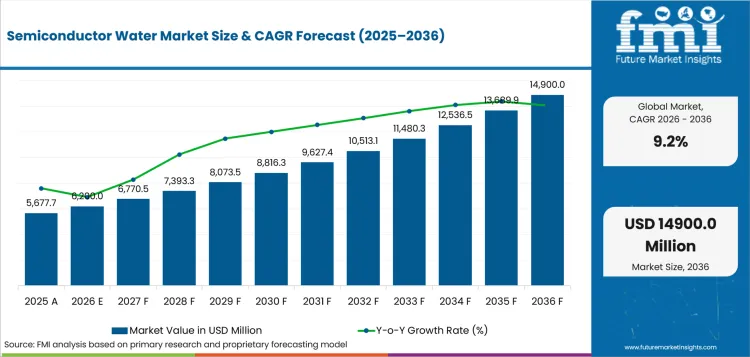
- 2026 Market Size: USD 6,200.0 million
- 2036 Market Size: USD 14,900.0 million
- Forecast CAGR: 9.2% from 2026 to 2036
- Leading Delivery Model: EPC / Turnkey
- EPC / Turnkey Share in 2026: 52.0%
- Leading Water Type: Ultrapure Water Supply
- Ultrapure Water Supply Share in 2026: 46.0%
- Fastest-growing Country: India
- India CAGR: 11.6% by 2036
Summary of the Semiconductor Water Market
- Demand and Growth Drivers
- Fab owners are investing in water systems earlier as ultrapure water and wastewater plants must be ready before tool qualification.
- Reclaim and reuse projects are gaining attention as water intake, discharge permits, and operating costs influence fab site planning.
- High-purity monitoring is becoming more valuable as advanced nodes and dense packaging increase contamination sensitivity.
- Product and Segment View
- EPC / Turnkey is projected to hold 52.0% share in 2026, supported by single-point responsibility across civil works and process utilities.
- Ultrapure Water Supply is expected to secure 46.0% share in 2026, led by wafer rinse quality and chemical dilution requirements.
- Design & Build is anticipated to account for 43.0% share in 2026, driven by greenfield fab projects requiring early utility integration.
- Geography and Competitive Outlook
- India is forecast to record 11.6% CAGR by 2036, supported by first-wave fab and OSAT approvals.
- The United States is expected to expand at 10.1% CAGR by 2036 as CHIPS-backed fabs create large water packages.
- Veolia and Ecolab compete through integrated ultrapure water, reuse, wastewater, and long-term operations capability.
- Kurita Water Industries and Organo Corporation hold strong positions through microelectronics water design, plant service, and Asia-based references.
- Analyst Opinion
- Sudip saha, Senior Consultant at FMI, says, “Semiconductor water is moving from a facilities expense to a production-risk control point. New fab construction creates the first demand route, while water reuse creates the second. Suppliers that can prove ultrapure water stability, reclaim reliability, and wastewater compliance in one operating package should gain stronger buyer trust.”
Fab water outlook is being shaped by wafer capacity, public funding, and process uptime requirements. SEMI expects worldwide 300mm fab equipment spending to rise 18% to USD 133 billion in 2026 and 14% to USD 151 billion in 2027, expanding the process area that needs ultrapure water and recycle loops. The CHIPS supply chain investment tracker shows USD 33.0787 billion in grant awards and up to USD 7.15 billion in loans across 35 companies and 52 projects, widening water-system bidding opportunities. SIA reported global semiconductor sales of USD 791.7 billion in 2025, up 25.6% from 2024, which strengthens capital planning for fab utilities and wastewater reliability.
Which factors support expansion in the semiconductor water market?
Finished fab water system revenue and recurring service contracts support value creation across semiconductor manufacturing sites.
- Market value is supported by UPW generation, reclaim loops, wastewater systems, monitoring hardware, and plant operations support.
- Supplier pricing reflects redundancy, purity level, waste chemistry, and service scope before consumables add recurring revenue.
- Revenue improves as greenfield fabs buy water systems during site design rather than after cleanroom construction.
- Buyer trust rises when suppliers can prove water quality, discharge compliance, spare-parts availability, and emergency response capability.
Why is the semiconductor water market growing?
Greenfield fabs need water systems before tool start-up as UPW and wastewater plants sit on the critical path.
Semiconductor water demand is rising because fabs need reliable ultrapure water, reclaim loops, and wastewater plants before wafer output can scale. SIA reported USD 298.5 billion in global semiconductor sales during Q1 2026, up 25.0% compared with Q4 2025, and this chip-demand base is increasing pressure on fab capacity, tool installation, and supporting water utilities. Water suppliers gain when fabs treat UPW and wastewater readiness as part of ramp assurance rather than a late-stage facilities item.
How is the semiconductor water market segmented?
The semiconductor water industry is segmented by water type, fab segment, service type, component type, and delivery model.
- Ultrapure Water Supply is projected to secure 46.0% share in 2026, led by wafer cleaning, chemical dilution, and process steps requiring stable low-contaminant water at the point of use.
- Foundries are expected to represent 37.0% share in 2026, supported by multi-customer fabs that need flexible water quality control across varied process recipes.
- Design & Build is anticipated to hold 43.0% share in 2026, driven by greenfield plants where UPW, reclaim, and wastewater systems must be planned before tool move-in.
- Membranes & Filtration are forecast to account for 39.0% share in 2026, supported by reuse systems, polishing stages, and particle control requirements.
- EPC / Turnkey is projected to represent 52.0% share in 2026, shaped by fab owners reducing interface risk across civil, utility, and process infrastructure.
Why does Ultrapure Water Supply dominate the semiconductor water market?
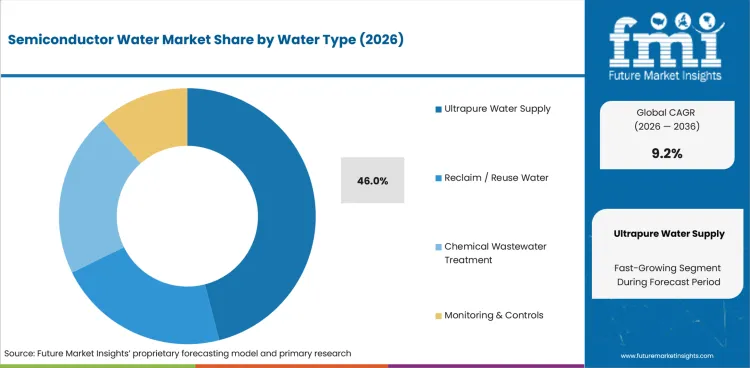
- Ultrapure Water Supply is projected to account for 46.0% share in 2026, influenced by direct wafer contact in cleaning and dilution steps.
- Reclaim / Reuse Water gains value as fabs reduce freshwater intake while protecting water quality for selected reuse points.
Which fab segment leads the semiconductor water market?
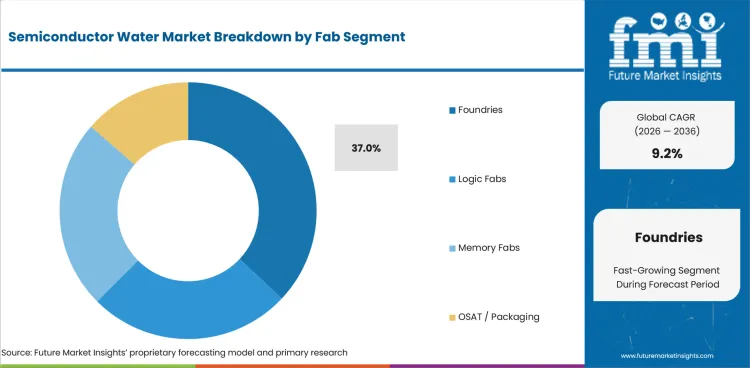
- Foundries are expected to hold 37.0% share in 2026, reflected by multi-customer fabs needing high tool density and strong utility redundancy.
- Memory fabs create high-volume water demand as DRAM and NAND lines require consistent rinsing, cleaning, and wastewater handling.
Which service type leads the semiconductor water market?
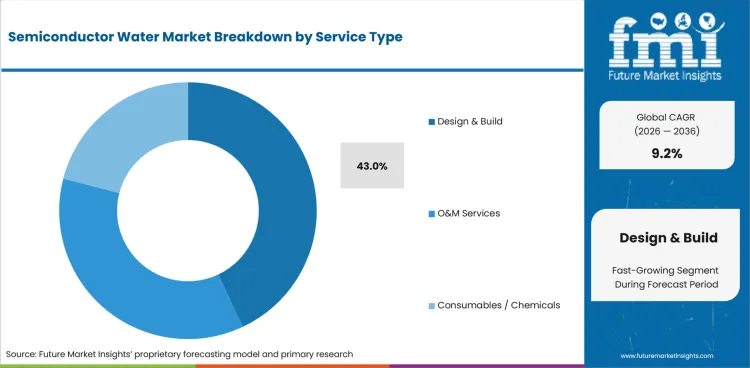
- Design & Build is anticipated to capture 43.0% share in 2026, supported by early-stage fab utility planning and integrated engineering needs.
- O&M Services gain importance after commissioning because water quality excursions can affect wafer yield and production schedules.
Which component type leads the semiconductor water market?
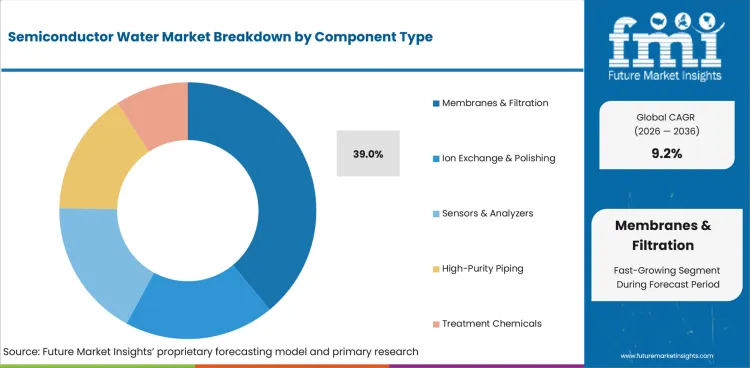
- Membranes & Filtration are forecast to secure 39.0% share in 2026, led by ultrafiltration, reverse osmosis, and polishing needs across fab water systems.
- Sensors & Analyzers gain demand as fabs require real-time alarms and water quality records for production and compliance control.
Which delivery model leads the semiconductor water market?
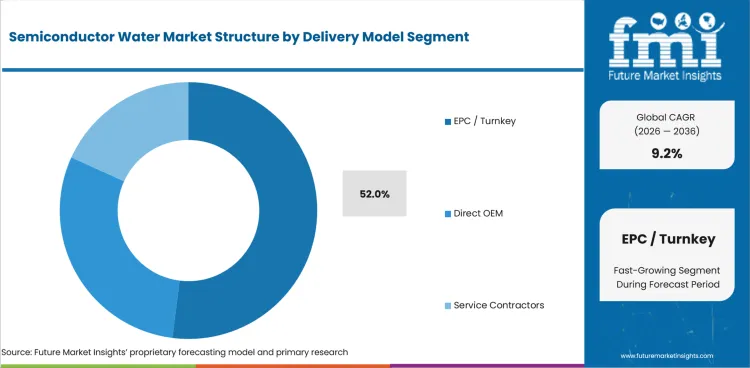
- EPC / Turnkey is projected to account for 52.0% share in 2026, shaped by fab owners preferring one accountable contractor for UPW and wastewater utilities.
- Service Contractors gain use where operating fabs need retrofit work, consumable replacement, and ongoing process-water reliability support.
What are the drivers, restraints, and opportunities in the semiconductor water market?
New fabs and water reuse support demand while capital cost and commissioning complexity limit smaller projects.
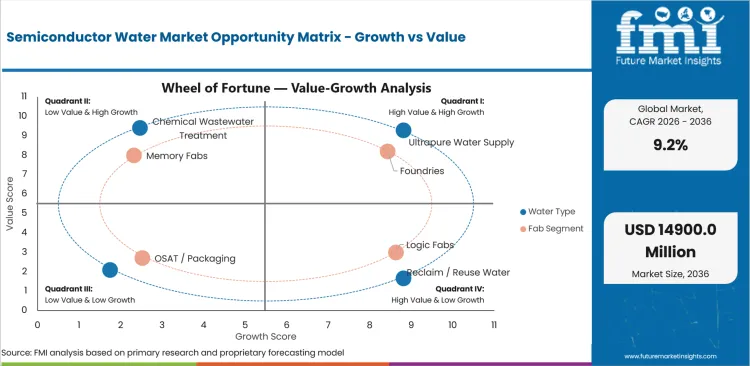
- Driver: New fab construction expands demand as water systems must be ready before process equipment qualification begins.
- Restraint: High capital cost slows smaller fab projects when owners cannot justify redundant water and wastewater capacity.
- Opportunity: Digital monitoring opens service revenue as fabs need real-time alarms and audit-ready quality records. Buyers therefore compare technical performance, qualification support, supply reliability, and downstream processing impact.
Fab Utility Readiness
Fab ramp planning now places water utilities near the front of capital allocation. SIA reported global semiconductor sales of USD 110.5 billion in April 2026, up 93.9% from April 2025, which shows how quickly chip output pressure can translate into new tool and utility demand. Water plants must be commissioned before process tools can run wafers at volume, giving UPW and wastewater suppliers more influence during early site design.
Water Intake and Permitting Pressure
Water availability is a direct restraint for large fab corridors because water-intensive facilities must defend intake and discharge plans. The Bureau of Reclamation said Arizona would contribute 512,000 acre-feet in 2026, about 18.0% of its annual Colorado River apportionment, showing why western fab projects need strong reuse and conservation planning. This makes water balance, recycling, and discharge control central to project approval and long-term cost management.
Digital Monitoring and Service Opportunity
Digital monitoring creates a service opportunity because fabs need continuous quality evidence rather than periodic manual checks. The CHIPS for America program represents USD 50.0 billion for research, development, and manufacturing programs, and such funded projects raise expectations for domestic supplier qualification, traceability, and operational resilience. Water vendors that link sensors, analytics, service teams, and maintenance records can defend stronger lifecycle contracts.
Which countries are growing fastest in the semiconductor water market?
India 11.6% CAGR, United States 10.1% CAGR, China 9.4% CAGR, South Korea 9.3% CAGR, Japan 8.8% CAGR, Germany 8.7% CAGR, France 7.9% CAGR, and United Kingdom 7.2% CAGR through 2036.
.webp "Top Country Growth Comparison Semiconductor Water Market Cagr (2026 2036)")
| Country | CAGR |
|---|---|
| India | 11.6% |
| United States | 10.1% |
| China | 9.4% |
| South Korea | 9.3% |
| Japan | 8.8% |
| Germany | 8.7% |
| France | 7.9% |
| United Kingdom | 7.2% |
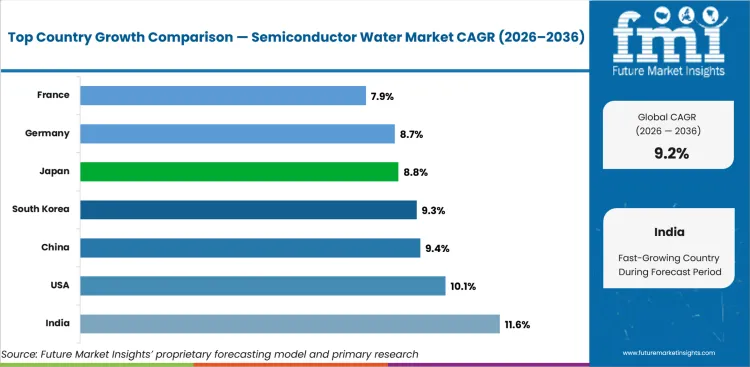
Source: Future Market Insights, 2026.
How do country-level CAGRs compare in the semiconductor water market?
India leads selected countries while the United Kingdom records the most cautious expansion outlook among profiled markets.
- India is projected to record 11.6% CAGR by 2036 as approved fabs and OSAT units create first-wave demand.
- The United States is expected to expand at 10.1% CAGR by 2036 due to CHIPS-backed fab investment and western water constraints.
- China is forecast to grow at 9.4% CAGR through 2036 as integrated circuit output and packaging capacity widen the buyer pool.
- South Korea is estimated to rise at 9.3% CAGR by 2036 with mega-cluster planning supporting high-volume water systems.
- Japan is expected to advance at 8.8% CAGR over the forecast period as public semiconductor support and domestic UPW suppliers align.
- Germany is forecast to grow at 8.7% CAGR through 2036 as Dresden investment expands European fab utility demand.
- France is projected to post 7.9% CAGR by 2036 as Crolles and strategic chip policy support concentrated demand.
- The United Kingdom is expected to rise at 7.2% CAGR through 2036 as specialty semiconductor and pilot-line activity create selective water needs.
What is the semiconductor water market outlook in India?
An 11.6% CAGR through 2036 reflects first-wave fab and OSAT approvals across multiple states.
Country Market Snapshot Table
| Parameter | Value |
|---|---|
| Market Size in 2025 (Value) | USD 237.5 million |
| Market Size in 2026 (Value) | USD 265.0 million |
| Market Forecast in 2036 (Value) | USD 793.0 million |
| CAGR (2026 to 2036) | 11.6% |
| Years Considered | 2021 to 2036 |
| Base Year | 2025 |
| Forecast Period | 2026 to 2036 |
| Units Considered | Value (USD million) |
| Leading Sub-Region | Gujarat, Assam, and Karnataka semiconductor project corridors |
India Semiconductor Water Market Outlook
India demand starts from a smaller installed base, which makes new fab and OSAT approvals highly important for water-system suppliers. The first wave will need UPW, wastewater treatment, monitoring, and operator training.
Global suppliers are likely to work with local EPC firms to support construction, commissioning, and service. Water availability, discharge approvals, and skilled operations teams will shape ramp timelines.
Key Growth Drivers
- Approved semiconductor projects create first-wave water demand. The Press Information Bureau reported 10 projects with total investment of INR 1.60 lakh crore across 6 states as of December 2025.
- Fiscal incentives support front-end and packaging buyers. India Semiconductor Mission states that semiconductor fab schemes provide fiscal support of up to 50.0% of project cost.
- OSAT projects create water demand at lower purity levels than leading-edge wafer fabs. The point matters commercially because material substitution usually needs proof across cost, performance, and compliance.
- Local EPC partnerships can shorten project execution, site coordination, and service response. Suppliers gain advantage when they can show application fit instead of relying only on broad chemistry claims.
Key Restraints
- Water approval pressure can affect project timelines. India’s 2024 groundwater assessment estimated annual recharge at 446.90 bcm and extraction at 245.64 bcm, with an overall extraction stage of 60.47%.
- Skilled UPW commissioning talent is limited relative to the planned project pipeline.
- State-level discharge approvals can affect project sequencing before utilities reach stable operation.
What makes India unique
India is the fastest-growing selected country because it is building semiconductor water demand from a small starting point.
Key Companies
- Veolia
- Ecolab
- Kurita Water Industries
- DuPont Water Solutions
- Entegris
- Aquatech
- Local EPC contractors
Sales & Marketing Channels
- Direct sales to fab and OSAT project owners
- Local EPC partnerships
- Government-supported project procurement
- Distributor routes for filters and chemicals
- Operator training and service contracts
- State industrial park development channels
Country Segment Breakdown Table
| Segment | Sub-Segments |
|---|---|
| By Water Type | Ultrapure Water Supply · Reclaim / Reuse Water · Chemical Wastewater Treatment · Monitoring & Controls |
| By Fab Segment | Logic Fabs · Memory Fabs · Foundries · OSAT / Packaging |
| By Service Type | Design & Build · O&M Services · Consumables / Chemicals |
| By Component Type | Membranes & Filtration · Ion Exchange & Polishing · Sensors & Analyzers · High-Purity Piping · Treatment Chemicals |
| By Delivery Model | EPC / Turnkey · Direct OEM · Service Contractors |
| Key Sub-Regions Covered | Gujarat · Assam · Karnataka · Uttar Pradesh · Tamil Nadu · Odisha |
Frequently Asked Questions
How fast is India semiconductor water market growing?
Demand in India is projected to rise at 11.6% CAGR from 2026 to 2036 with approved fab and OSAT projects.
Who leads India semiconductor water market?
Veolia, Ecolab, Kurita Water Industries, DuPont Water Solutions, Entegris, Aquatech, and local EPC contractors compete through water treatment, filtration, and project delivery.
What is driving adoption in India semiconductor water market?
India Semiconductor Mission approvals, fiscal support, OSAT demand, and local EPC partnerships are supporting early water-system adoption.
What is the semiconductor water market outlook in the United States?
A 10.1% CAGR through 2036 is supported by CHIPS-backed fabs and water-stressed manufacturing corridors.
Country Market Snapshot Table
| Parameter | Value |
|---|---|
| Market Size in 2025 (Value) | USD 1,026.3 million |
| Market Size in 2026 (Value) | USD 1,130.0 million |
| Market Forecast in 2036 (Value) | USD 2,954.1 million |
| CAGR (2026 to 2036) | 10.1% |
| Years Considered | 2021 to 2036 |
| Base Year | 2025 |
| Forecast Period | 2026 to 2036 |
| Units Considered | Value (USD million) |
| Leading Sub-Region | Arizona, Idaho, Ohio, and Texas fab corridors |
United States Semiconductor Water Market Outlook
United States semiconductor water demand is shaped by large private fab investments, public funding, and pressure to control freshwater intake. Fabs in western and midwestern states need UPW, reclaim, and wastewater systems planned early to avoid commissioning delays.
Suppliers with operating references, membrane depth, and long-duration O&M capability should gain stronger buyer confidence. Water reuse, discharge documentation, and qualified service coverage are likely to shape supplier selection.
Key Growth Drivers
- CHIPS-backed fabrication investment creates major water-system packages. The USA Department of Commerce awarded TSMC Arizona up to USD 6.6 billion to support more than USD 65.0 billion in investment across 3 Phoenix fabs.
- Supplier localization strengthens process-side water capability. NIST states that Entegris received up to USD 77.0 million for a Colorado Springs center supporting liquid filter membranes, advanced filters, and fluid handling solutions.
- Western fab sites push buyers toward reuse designs that reduce intake exposure and improve long-term operating resilience.
- National semiconductor procurement encourages fab owners to favor water vendors with domestic service teams and qualified spare-parts channels.
Key Restraints
- Water allocation pressure can slow project planning. The Bureau of Reclamation said Arizona would contribute 512,000 acre-feet in 2026, equal to about 18.0% of its annual Colorado River apportionment.
- Environmental permitting can lengthen water intake and discharge approval timelines before utility construction begins.
- Large projects face skilled labor pressure across civil works, high-purity piping, instrumentation, and commissioning support. Buyers therefore compare technical performance, qualification support, supply reliability, and downstream processing impact.
What makes the United States unique
The United States combines high-value fab incentives with water-stressed regions, making reuse credibility central to supplier selection.
Key Companies
- Veolia
- Ecolab
- Entegris
- DuPont Water Solutions
- Kurita America
- Aquatech
- Xylem
Sales & Marketing Channels
- Direct enterprise sales to fab owners
- EPC partnerships for greenfield projects
- CHIPS-related project procurement routes
- Service contracts with operations teams
- Component supply through qualified OEM channels
- Utility and environmental engineering consultants
Country Segment Breakdown Table
| Segment | Sub-Segments |
|---|---|
| By Water Type | Ultrapure Water Supply · Reclaim / Reuse Water · Chemical Wastewater Treatment · Monitoring & Controls |
| By Fab Segment | Logic Fabs · Memory Fabs · Foundries · OSAT / Packaging |
| By Service Type | Design & Build · O&M Services · Consumables / Chemicals |
| By Component Type | Membranes & Filtration · Ion Exchange & Polishing · Sensors & Analyzers · High-Purity Piping · Treatment Chemicals |
| By Delivery Model | EPC / Turnkey · Direct OEM · Service Contractors |
| Key Sub-Regions Covered | Arizona · Idaho · Ohio · Texas · New York · Oregon |
Frequently Asked Questions
How fast is United States semiconductor water market growing?
Demand in the United States is projected to rise at 10.1% CAGR from 2026 to 2036 through CHIPS-backed fab projects.
Who leads United States semiconductor water market?
Veolia, Ecolab, Entegris, DuPont Water Solutions, Kurita America, and Aquatech compete through UPW systems, membranes, filtration, and service contracts.
What is driving adoption in United States semiconductor water market?
New fab construction, water-stressed locations, and domestic supply chain goals are moving buyers toward integrated UPW and reuse systems.
What is the semiconductor water market outlook in China?
A 9.4% CAGR through 2036 is supported by integrated circuit output, mature-node fabs, and packaging capacity.
Country Market Snapshot Table
| Parameter | Value |
|---|---|
| Market Size in 2025 (Value) | USD 1,462.5 million |
| Market Size in 2026 (Value) | USD 1,600.0 million |
| Market Forecast in 2036 (Value) | USD 3,923.2 million |
| CAGR (2026 to 2036) | 9.4% |
| Years Considered | 2021 to 2036 |
| Base Year | 2025 |
| Forecast Period | 2026 to 2036 |
| Units Considered | Value (USD million) |
| Leading Sub-Region | Yangtze River Delta and Pearl River Delta fab clusters |
China Semiconductor Water Market Outlook
China demand is supported by large electronics manufacturing scale, domestic wafer capacity, and packaging expansion. Mature-node and specialty fabs broaden the buyer pool beyond only leading-edge production.
Suppliers need local service coverage, cost discipline, and compatibility with domestic EPC routes. Global component suppliers can still compete where membranes, filtration, analyzers, and contamination-control performance matter.
Key Growth Drivers
- High integrated circuit output supports a large buyer pool. China’s State Council reported integrated circuit output of 484.3 billion units in 2025, up 10.9% year on year.
- Electronics manufacturing scale supports broad water-system demand. The same official release reported operating revenue of CNY 17.4 trillion in 2025, up 7.4% year on year.
- Mature-node fabs need reliable UPW and wastewater treatment at lower cost than leading-edge facilities. The point matters commercially because material substitution usually needs proof across cost, performance, and compliance.
- Local service networks influence repeat orders, retrofit contracts, and operating-fab upgrades.
Key Restraints
- Export controls can delay advanced-node equipment ramps. The USA Bureau of Industry and Security announced 24 new semiconductor manufacturing equipment controls and 140 Entity List additions in December 2024.
- Price competition from domestic integrators can pressure global supplier margins. Suppliers gain advantage when they can show application fit instead of relying only on broad chemistry claims.
- Advanced process uncertainty can make water-system timing less predictable for some high-end projects.
What makes China unique
China has the broadest mix of mature-node, packaging, and advanced fab buyers among the selected countries.
Key Companies
- Ecolab
- Veolia
- Kurita Water Industries
- Organo Corporation
- DuPont Water Solutions
- Entegris
- Local engineering integrators
Sales & Marketing Channels
- Direct sales to fab owners
- Partnerships with local EPC firms
- Qualified distributor networks
- Component sales to water skid builders
- Service contracts for operating fabs
- Provincial industrial park procurement routes
Country Segment Breakdown Table
| Segment | Sub-Segments |
|---|---|
| By Water Type | Ultrapure Water Supply · Reclaim / Reuse Water · Chemical Wastewater Treatment · Monitoring & Controls |
| By Fab Segment | Logic Fabs · Memory Fabs · Foundries · OSAT / Packaging |
| By Service Type | Design & Build · O&M Services · Consumables / Chemicals |
| By Component Type | Membranes & Filtration · Ion Exchange & Polishing · Sensors & Analyzers · High-Purity Piping · Treatment Chemicals |
| By Delivery Model | EPC / Turnkey · Direct OEM · Service Contractors |
| Key Sub-Regions Covered | Yangtze River Delta · Pearl River Delta · Beijing-Tianjin corridor · Wuhan · Chengdu · Xi’an |
Frequently Asked Questions
How fast is China semiconductor water market growing?
Demand in China is forecast to rise at 9.4% CAGR from 2026 to 2036 as wafer output and packaging capacity expand.
Who leads China semiconductor water market?
Ecolab, Veolia, Kurita Water Industries, Organo Corporation, DuPont Water Solutions, Entegris, and local integrators compete through equipment, membranes, chemicals, and service channels.
What is driving adoption in China semiconductor water market?
Integrated circuit output, broad mature-node capacity, and local service networks are supporting demand for UPW and wastewater systems.
What is the semiconductor water market outlook in South Korea?
A 9.3% CAGR through 2036 reflects memory fab scale and mega-cluster utility planning.
Country Market Snapshot Table
| Parameter | Value |
|---|---|
| Market Size in 2025 (Value) | USD 860.0 million |
| Market Size in 2026 (Value) | USD 940.0 million |
| Market Forecast in 2036 (Value) | USD 2,286.5 million |
| CAGR (2026 to 2036) | 9.3% |
| Years Considered | 2021 to 2036 |
| Base Year | 2025 |
| Forecast Period | 2026 to 2036 |
| Units Considered | Value (USD million) |
| Leading Sub-Region | Pyeongtaek, Yongin, and Hwaseong memory fab corridors |
South Korea Semiconductor Water Market Outlook
South Korea demand is led by memory capacity, dense fab clusters, and reference-driven procurement. High-volume water systems are essential because production is concentrated across a few large semiconductor groups.
Water vendors must prove uptime, contamination control, and scale. Mega-cluster planning increases the value of reuse, utility coordination, and long-term O&M capability.
Key Growth Drivers
- Mega-cluster planning supports high-volume utility demand. South Korea’s science ministry said private investment of KRW 622.0 trillion would support 16 new fabs by 2047.
- Semiconductor ecosystem funds support supplier capability. Korea’s finance ministry said semiconductor ecosystem funds would expand to KRW 1.1 trillion by 2027.
- Memory fab scale creates high-volume UPW demand across dense production corridors. Buyers therefore compare technical performance, qualification support, supply reliability, and downstream processing impact.
- Packaging and foundry activity widen demand beyond DRAM and NAND water requirements. The point matters commercially because material substitution usually needs proof across cost, performance, and compliance.
Key Restraints
- Talent availability remains a commissioning constraint. Invest Korea reported that the government plans to cultivate and supply 150,000 specialized semiconductor professionals by 2030, showing why skilled fab-utility support remains critical.
- Large buyer concentration raises qualification barriers for new suppliers. Suppliers gain advantage when they can show application fit instead of relying only on broad chemistry claims.
- Reference-driven procurement can slow entry for vendors without Korean fab operating history.
What makes South Korea unique
South Korea is a scale market where a few large semiconductor groups drive very high water volume and strict supplier qualification.
Key Companies
- Ecolab
- Kurita Water Industries
- Organo Corporation
- DuPont Water Solutions
- Entegris
- Veolia
- Specialist engineering firms
Sales & Marketing Channels
- Direct enterprise contracts with large semiconductor groups
- EPC partnerships around mega-cluster projects
- Tool supplier qualification channels
- O&M contracts for high-volume plants
- Component distribution to system integrators
- Cluster-level utility planning channels
Country Segment Breakdown Table
| Segment | Sub-Segments |
|---|---|
| By Water Type | Ultrapure Water Supply · Reclaim / Reuse Water · Chemical Wastewater Treatment · Monitoring & Controls |
| By Fab Segment | Logic Fabs · Memory Fabs · Foundries · OSAT / Packaging |
| By Service Type | Design & Build · O&M Services · Consumables / Chemicals |
| By Component Type | Membranes & Filtration · Ion Exchange & Polishing · Sensors & Analyzers · High-Purity Piping · Treatment Chemicals |
| By Delivery Model | EPC / Turnkey · Direct OEM · Service Contractors |
| Key Sub-Regions Covered | Pyeongtaek · Yongin · Hwaseong · Icheon · Suwon · Pangyo |
Frequently Asked Questions
How fast is South Korea semiconductor water market growing?
Demand in South Korea is projected to rise at 9.3% CAGR from 2026 to 2036 through memory capacity and mega-cluster planning.
Who leads South Korea semiconductor water market?
Ecolab, Kurita Water Industries, Organo Corporation, DuPont Water Solutions, Entegris, Veolia, and specialist engineering firms compete through UPW and filtration capability.
What is driving adoption in South Korea semiconductor water market?
Memory fab scale, mega-cluster planning, and reference-driven procurement are supporting demand for high-volume water systems.
What is the semiconductor water market outlook in Japan?
An 8.8% CAGR through 2036 is supported by public semiconductor funding and domestic UPW supplier strength.
Country Market Snapshot Table
| Parameter | Value |
|---|---|
| Market Size in 2025 (Value) | USD 634.2 million |
| Market Size in 2026 (Value) | USD 690.0 million |
| Market Forecast in 2036 (Value) | USD 1,602.4 million |
| CAGR (2026 to 2036) | 8.8% |
| Years Considered | 2021 to 2036 |
| Base Year | 2025 |
| Forecast Period | 2026 to 2036 |
| Units Considered | Value (USD million) |
| Leading Sub-Region | Hokkaido, Kyushu, and Chubu semiconductor corridors |
Japan Semiconductor Water Market Outlook
Japan demand is shaped by policy-backed semiconductor revival, domestic supplier depth, and strict contamination-control culture. New and upgraded fabs require UPW, reuse, wastewater treatment, and process-side polishing systems.
Japanese buyers place high value on reliability, service discipline, and references. Domestic suppliers with microelectronics water experience should remain strong, while global vendors can compete through membranes, filtration, and specialty components.
Key Growth Drivers
- Public support strengthens fab and supply chain upgrades. METI’s 2025 semiconductor strategy material referenced FY 2024 supplemental support for AI and semiconductors totaling JPY 1.6 trillion.
- Advanced logic capacity creates new utility demand. JapanGov stated that Rapidus had government support totaling JPY 330.0 billion and planned a pilot production line in April 2025 before mass production in 2027.
- Domestic UPW suppliers have deep operating references across microelectronics plants and process water systems.
- Materials and specialty chip ecosystems require high-purity water and waste handling across varied process steps.
Key Restraints
- Aging infrastructure can add retrofit pressure. A 2026 water-infrastructure review reported Japan’s pipe aging rate at 23.6%, with about 176,000 km of pipes operating beyond useful-life thresholds.
- Older fabs can face tight utility-space limits when upgrading water loops.
- High service expectations raise entry barriers for suppliers without local engineering and emergency-response teams.
What makes Japan unique
Japan combines domestic UPW supplier strength with advanced materials know-how and strict contamination-control culture.
Key Companies
- Kurita Water Industries
- Organo Corporation
- Ecolab
- DuPont Water Solutions
- Entegris
- Veolia
- Regional engineering firms
Sales & Marketing Channels
- Direct relationships with fab utility teams
- Domestic engineering company partnerships
- Long-term service contracts
- Component qualification through process tool suppliers. Buyers therefore compare technical performance, qualification support, supply reliability, and downstream processing impact.
- Retrofit projects at legacy fabs
- Corporate research and pilot-line channels
Country Segment Breakdown Table
| Segment | Sub-Segments |
|---|---|
| By Water Type | Ultrapure Water Supply · Reclaim / Reuse Water · Chemical Wastewater Treatment · Monitoring & Controls |
| By Fab Segment | Logic Fabs · Memory Fabs · Foundries · OSAT / Packaging |
| By Service Type | Design & Build · O&M Services · Consumables / Chemicals |
| By Component Type | Membranes & Filtration · Ion Exchange & Polishing · Sensors & Analyzers · High-Purity Piping · Treatment Chemicals |
| By Delivery Model | EPC / Turnkey · Direct OEM · Service Contractors |
| Key Sub-Regions Covered | Hokkaido · Kyushu · Kansai · Chubu · Tohoku · Tokyo metropolitan corridor |
Frequently Asked Questions
How fast is Japan semiconductor water market growing?
Demand in Japan is projected to rise at 8.8% CAGR from 2026 to 2036 through fab upgrades and advanced logic investment.
Who leads Japan semiconductor water market?
Kurita Water Industries, Organo Corporation, Ecolab, DuPont Water Solutions, Entegris, and Veolia compete through UPW systems, filtration, and fab service.
What is driving adoption in Japan semiconductor water market?
Public semiconductor support, domestic supplier depth, and strict contamination-control expectations are supporting demand for process water systems.
What is the semiconductor water market outlook in Germany?
An 8.7% CAGR through 2036 is supported by Dresden fab investment and European Chips Act-backed projects.
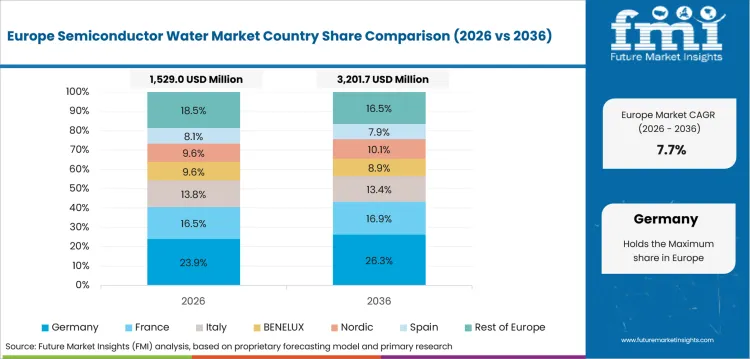
Country Market Snapshot Table
| Parameter | Value |
|---|---|
| Market Size in 2025 (Value) | USD 395.6 million |
| Market Size in 2026 (Value) | USD 430.0 million |
| Market Forecast in 2036 (Value) | USD 990.0 million |
| CAGR (2026 to 2036) | 8.7% |
| Years Considered | 2021 to 2036 |
| Base Year | 2025 |
| Forecast Period | 2026 to 2036 |
| Units Considered | Value (USD million) |
| Leading Sub-Region | Dresden, Saxony, and Bavaria fab corridors |
Germany Semiconductor Water Market Outlook
Germany demand is concentrated around Dresden and Saxony, where semiconductor projects require high-purity water, wastewater treatment, and documented environmental performance. Automotive-grade reliability keeps utility uptime and audit records central to buyer expectations.
Suppliers with German engineering partners and EU compliance experience should gain stronger access. Service continuity and energy-efficient water systems will influence project economics.
Key Growth Drivers
- Dresden fab construction creates large front-end water demand. The European Commission approved a EUR 5.0 billion German measure in August 2024 to support ESMC’s semiconductor manufacturing facility in Dresden.
- Infineon’s Dresden expansion supports long-cycle water services. The European Commission approved up to EUR 920.0 million in German aid for an investment of EUR 3.5 billion in February 2025.
- Automotive semiconductor demand supports power device and specialty chip production that needs stable process water. The point matters commercially because material substitution usually needs proof across cost, performance, and compliance.
- EU state-aid frameworks push buyers toward documented, auditable, and compliant water-system performance. Suppliers gain advantage when they can show application fit instead of relying only on broad chemistry claims.
Key Restraints
- Energy-price volatility can pressure operating costs. Destatis reported German energy producer prices rose 7.5% month on month in March 2026, keeping pump-heavy water plants exposed to cost swings.
- Approval timelines can slow sequencing for utility-heavy construction packages.
- High documentation expectations can make supplier qualification more demanding for smaller water-system vendors. Buyers therefore compare technical performance, qualification support, supply reliability, and downstream processing impact.
What makes Germany unique
Germany links semiconductor water demand to automotive-grade reliability, Dresden fab scale, and strict environmental documentation.
Key Companies
- Veolia
- Ecolab
- Kurita Europe
- Organo Corporation
- DuPont Water Solutions
- Entegris
- Regional EPC firms
Sales & Marketing Channels
- Direct fab utility procurement
- EPC partnerships in Saxony and Bavaria
- Environmental compliance consultants
- OEM-qualified component channels
- Long-term O&M service contracts
- EU-funded project procurement routes
Country Segment Breakdown Table
| Segment | Sub-Segments |
|---|---|
| By Water Type | Ultrapure Water Supply · Reclaim / Reuse Water · Chemical Wastewater Treatment · Monitoring & Controls |
| By Fab Segment | Logic Fabs · Memory Fabs · Foundries · OSAT / Packaging |
| By Service Type | Design & Build · O&M Services · Consumables / Chemicals |
| By Component Type | Membranes & Filtration · Ion Exchange & Polishing · Sensors & Analyzers · High-Purity Piping · Treatment Chemicals |
| By Delivery Model | EPC / Turnkey · Direct OEM · Service Contractors |
| Key Sub-Regions Covered | Dresden · Saxony · Bavaria · Baden-Württemberg · Thuringia · North Rhine-Westphalia |
Frequently Asked Questions
How fast is Germany semiconductor water market growing?
Demand in Germany is projected to rise at 8.7% CAGR from 2026 to 2036 with Dresden-led semiconductor investment.
Who leads Germany semiconductor water market?
Veolia, Ecolab, Kurita Europe, Organo Corporation, DuPont Water Solutions, and Entegris compete through water systems, membranes, chemicals, and service support.
What is driving adoption in Germany semiconductor water market?
Dresden fab projects, automotive semiconductor demand, and EU-backed manufacturing policy are supporting demand for UPW and wastewater systems.
What is the semiconductor water market outlook in France?
A 7.9% CAGR through 2036 reflects concentrated demand from advanced semiconductor sites and sustainability-linked water planning.
Country Market Snapshot Table
| Parameter | Value |
|---|---|
| Market Size in 2025 (Value) | USD 227.1 million |
| Market Size in 2026 (Value) | USD 245.0 million |
| Market Forecast in 2036 (Value) | USD 524.8 million |
| CAGR (2026 to 2036) | 7.9% |
| Years Considered | 2021 to 2036 |
| Base Year | 2025 |
| Forecast Period | 2026 to 2036 |
| Units Considered | Value (USD million) |
| Leading Sub-Region | Crolles and Grenoble-Alpes semiconductor corridor |
France Semiconductor Water Market Outlook
France demand is concentrated in advanced manufacturing corridors where water systems must support high-value process steps and strict sustainability goals. Fewer large sites make each fab and expansion project more important for suppliers.
French buyers are likely to connect water reuse, wastewater control, and energy performance in procurement. Vendors that can document lower intake, reliable discharge handling, and service depth should gain stronger access.
Key Growth Drivers
- European semiconductor targets support French water-system demand. The European Chips Act aims to double Europe’s global semiconductor market share to 20.0%.
- France 2030 supports semiconductor-linked industrial strategy through a EUR 54.0 billion innovation investment plan running from 2022 to 2027.
- Corporate water goals favor reuse, monitoring, and discharge control over simple treatment capacity. The point matters commercially because material substitution usually needs proof across cost, performance, and compliance.
- Concentrated advanced sites allow water suppliers to position lifecycle service as part of production-risk control.
Key Restraints
- EU auditors reported in 2025 that the EU’s microchip strategy remains challenged against the 20.0% production objective, keeping project realism and funding coordination under scrutiny.
- France has fewer large fabs than Germany or East Asia, which limits the number of large turnkey water packages.
- Public evidence on semiconductor water supplier awards remains limited, making reference-building more difficult for new entrants.
What makes France unique
France is a concentrated opportunity where a small number of advanced sites carry a large share of semiconductor water system value.
Key Companies
- Veolia
- Ecolab
- DuPont Water Solutions
- Kurita Europe
- SUEZ
- Xylem
- Regional EPC firms
Sales & Marketing Channels
- Direct sales to advanced fabs
- EPC routes tied to plant expansion
- Corporate sustainability procurement
- Industrial water service contracts
- Component OEM qualification routes
- Environmental permitting consultants
Country Segment Breakdown Table
| Segment | Sub-Segments |
|---|---|
| By Water Type | Ultrapure Water Supply · Reclaim / Reuse Water · Chemical Wastewater Treatment · Monitoring & Controls |
| By Fab Segment | Logic Fabs · Memory Fabs · Foundries · OSAT / Packaging |
| By Service Type | Design & Build · O&M Services · Consumables / Chemicals |
| By Component Type | Membranes & Filtration · Ion Exchange & Polishing · Sensors & Analyzers · High-Purity Piping · Treatment Chemicals |
| By Delivery Model | EPC / Turnkey · Direct OEM · Service Contractors |
| Key Sub-Regions Covered | Crolles · Grenoble · Grenoble-Alpes corridor · Île-de-France · Provence-Alpes-Côte d’Azur · Occitanie |
Frequently Asked Questions
How fast is France semiconductor water market growing?
Demand in France is expected to rise at 7.9% CAGR from 2026 to 2036 with concentrated advanced manufacturing demand.
Who leads France semiconductor water market?
Veolia, Ecolab, DuPont Water Solutions, Kurita Europe, SUEZ, and regional EPC firms compete through industrial water and process support.
What is driving adoption in France semiconductor water market?
Crolles-linked advanced manufacturing, sustainability procurement, and EU semiconductor policy are supporting demand for UPW and wastewater systems.
What is the semiconductor water market outlook in the United Kingdom?
A 7.2% CAGR through 2036 reflects specialty semiconductor activity and smaller high-purity water loops.
Country Market Snapshot Table
| Parameter | Value |
|---|---|
| Market Size in 2025 (Value) | USD 158.6 million |
| Market Size in 2026 (Value) | USD 170.0 million |
| Market Forecast in 2036 (Value) | USD 340.5 million |
| CAGR (2026 to 2036) | 7.2% |
| Years Considered | 2021 to 2036 |
| Base Year | 2025 |
| Forecast Period | 2026 to 2036 |
| Units Considered | Value (USD million) |
| Leading Sub-Region | South Wales and Cambridge specialty semiconductor clusters |
United Kingdom Semiconductor Water Market Outlook
United Kingdom demand is shaped by specialty semiconductor manufacturing, research facilities, and pilot-line expansion. Buyers need modular UPW systems and cleanroom support rather than many large turnkey fab water plants.
Water vendors should focus on flexible systems, service responsiveness, and scale-up support. The strongest route is consultative selling to compound semiconductor clusters, universities, and grant-backed production facilities.
Key Growth Drivers
- Specialty semiconductor activity creates demand for modular UPW systems. The UK government’s 2026 sector study said dedicated semiconductor companies generated GBP 10.6 billion in revenue and directly employed about 16,350 people in 2025.
- Innovation funding widens pilot-line demand. UKRI listed a semiconductor funding opportunity with a total fund of GBP 18.5 million published in February 2026.
- Compound semiconductor clusters support smaller high-purity water loops for research, packaging, and specialty device production. Suppliers gain advantage when they can show application fit instead of relying only on broad chemistry claims.
- University-linked procurement creates opportunities for suppliers that can support low-volume but high-specification process water needs. Buyers therefore compare technical performance, qualification support, supply reliability, and downstream processing impact.
Key Restraints
- Market concentration limits broad supplier access. The UK government’s 2026 sector study estimated that a small number of large companies accounted for 73.0% of revenue and 65.0% of employment.
- The absence of many mega-fabs limits the volume of large turnkey UPW contracts.
- Smaller facilities often stage purchases, making project timing more dependent on grants and private fundraising.
What makes the United Kingdom unique
The United Kingdom is a specialty and scale-up market where modular purity systems matter more than large-volume fab water plants.
Key Companies
- Veolia
- Ecolab
- DuPont Water Solutions
- Xylem
- SUEZ
- Regional engineering firms
- Specialist cleanroom contractors
Sales & Marketing Channels
- Direct sales to specialty semiconductor facilities
- University and research facility procurement
- Engineering consultants serving pilot lines
- Water treatment distributor networks
- EPC support for cleanroom upgrades
- Grant-backed project buying channels
Country Segment Breakdown Table
| Segment | Sub-Segments |
|---|---|
| By Water Type | Ultrapure Water Supply · Reclaim / Reuse Water · Chemical Wastewater Treatment · Monitoring & Controls |
| By Fab Segment | Logic Fabs · Memory Fabs · Foundries · OSAT / Packaging |
| By Service Type | Design & Build · O&M Services · Consumables / Chemicals |
| By Component Type | Membranes & Filtration · Ion Exchange & Polishing · Sensors & Analyzers · High-Purity Piping · Treatment Chemicals |
| By Delivery Model | EPC / Turnkey · Direct OEM · Service Contractors |
| Key Sub-Regions Covered | South Wales · Cambridge · Bristol · Southampton · Scotland · North East England |
Frequently Asked Questions
How fast is United Kingdom semiconductor water market growing?
Demand in the United Kingdom is expected to rise at 7.2% CAGR from 2026 to 2036 with specialty semiconductor activity.
Who leads United Kingdom semiconductor water market?
Veolia, Ecolab, DuPont Water Solutions, Xylem, SUEZ, and cleanroom engineering firms compete through modular systems and service support.
What is driving adoption in United Kingdom semiconductor water market?
Compound semiconductor clusters, pilot-line funding, and cleanroom upgrades are supporting demand for high-purity water systems.
Who are the leading companies in the semiconductor water market?
Veolia, Ecolab, Kurita Water Industries, Organo Corporation and DuPont Water Solutions.
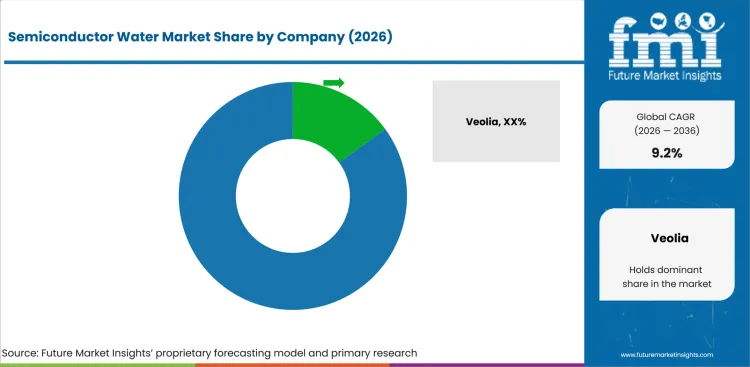
- Integrated water companies hold an advantage through UPW, reclaim, wastewater, and service capability.
- Specialist component suppliers gain fab access through membranes, filters, polishing systems, and contamination-control parts.
- EPC-linked vendors gain stronger positions where greenfield fabs need schedule discipline and one accountable utility partner.
- Service-ready suppliers support repeat demand through water quality monitoring, consumables, operator support, and emergency response.
Semiconductor water suppliers compete by combining engineering depth with fab-operating credibility. Veolia, Ecolab, Kurita Water Industries, and Organo Corporation stand out where buyers need UPW design, reuse reliability, wastewater treatment, and long-term plant operation. Their advantage grows when fab owners want one supplier to support utility design, commissioning, service, and compliance records.
Process-component companies compete through filtration, membranes, fluid handling, and polishing equipment close to process tools. DuPont Water Solutions and Entegris hold strong relevance because high-purity water systems depend on repeatable separation, particle control, and chemical compatibility. These companies gain when fabs upgrade existing water loops or add advanced process modules that require tighter contamination thresholds.
Regional EPC firms and plant-service contractors remain important because semiconductor water projects must fit local permits, utility corridors, and construction schedules. Aquatech, Xylem, SUEZ, and qualified engineering firms can win when fab owners need country-specific execution. Suppliers without local commissioning support or fab references may face longer qualification cycles.
How do top semiconductor water companies compare?
Veolia and Ecolab score strongest on integrated water scope while Kurita and Organo lead on Asia-based UPW depth.
| Company | Relevance to Market Title | UPW System Depth | Reuse and Wastewater Scope | Fab Service Coverage | Channel Reach | Geographic Footprint |
|---|---|---|---|---|---|---|
| Veolia | Very High | Very Strong | Very Strong | Very Strong | Very Strong | Global |
| Ecolab | Very High | Very Strong | Very Strong | Very Strong | Very Strong | Global |
| Kurita Water Industries | Very High | Very Strong | Very Strong | Strong | Strong | Asia and North America |
| Organo Corporation | Very High | Very Strong | Strong | Strong | Strong | Asia and selected global markets |
| DuPont Water Solutions | High | Strong | Very Strong | Moderate | Strong | Global |
| Entegris | High | Very Strong | Moderate | Strong | Strong | Global |
| Aquatech | Moderate to High | Moderate | Strong | Moderate | Moderate | North America and Asia |
| Xylem | Moderate | Moderate | Moderate | Strong | Strong | Global |
| SUEZ | Moderate | Moderate | Strong | Moderate | Strong | Europe and Asia |
| Regional EPC firms | Moderate | Moderate | Moderate | Moderate | Moderate | Country-specific |
Source: Future Market Insights competitive analysis, 2026.
Who are the key players in the semiconductor water market?
Veolia, Ecolab, Kurita Water Industries and Organo Corporation are listed with DuPont Water Solutions and Entegris among other suppliers.
Key global companies leading the semiconductor water market include:
- Veolia
- Ecolab
- Kurita Water Industries
- Organo Corporation
- DuPont Water Solutions
- Entegris
- Aquatech
- Xylem
- SUEZ
- Regional EPC firms
Key Developments in Semiconductor Water Market
- In May 2025, Veolia announced water technology contracts worth over USD 750.0 million, including a USD 550.0 million USA semiconductor plant contract covering design, construction, and 16 years of operation.
- In August 2025, Ecolab announced a definitive agreement to acquire Ovivo’s Electronics business, strengthening its ultra-pure water technology platform for semiconductor manufacturing.
- In December 2024, Entegris and the USA Department of Commerce entered an award agreement providing up to USD 77.0 million under the CHIPS Act for a Colorado Springs manufacturing center supporting liquid filters and fluid handling solutions.
Key Players in the Semiconductor Water Market
Integrated Water Platforms
- Veolia
- Ecolab
- Kurita Water Industries
- Organo Corporation
Process Components and Contamination Control
- DuPont Water Solutions
- Entegris
- Xylem
Regional Engineering and Project Specialists
- Aquatech
- SUEZ
- Regional EPC firms
Semiconductor Water Market - Report Scope
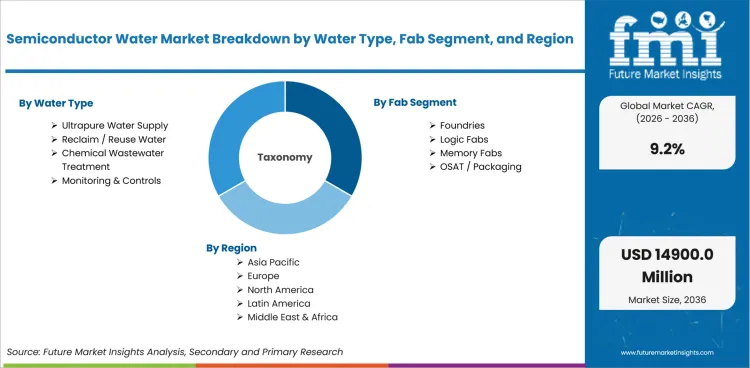
| Parameter | Details |
|---|---|
| Forecast period | 2026 to 2036 |
| Historical period | 2021 to 2025 |
| Quantitative unit | Revenue in USD million |
| By water type | Ultrapure Water Supply, Reclaim / Reuse Water, Chemical Wastewater Treatment, Monitoring & Controls |
| By fab segment | Logic Fabs, Memory Fabs, Foundries, OSAT / Packaging |
| By service type | Design & Build, O&M Services, Consumables / Chemicals |
| By component type | Membranes & Filtration, Ion Exchange & Polishing, Sensors & Analyzers, High-Purity Piping, Treatment Chemicals |
| By delivery model | EPC / Turnkey, Direct OEM, Service Contractors |
| Regions covered | North America, Latin America, Europe, East Asia, South Asia and Pacific, Middle East and Africa |
| Countries covered | United States, United Kingdom, Germany, France, Japan, China, South Korea, India |
| Key companies profiled | Veolia, Ecolab, Kurita Water Industries, Organo Corporation, DuPont Water Solutions, Entegris, Aquatech, Xylem, SUEZ |
| Approach | Hybrid bottom-up and top-down methodology using fab project timing, water intensity, system scope, service demand, and supplier evidence |
Source: Future Market Insights, 2026.
Semiconductor Water Market - Scope & Definition
| Attribute | Detail |
|---|---|
| Market Definition | Systems and services that produce, distribute, monitor, reclaim, and treat water used in wafer fabrication and advanced packaging |
| Functions Covered | Ultrapure water generation, water recycling, chemical wastewater treatment, contamination monitoring, polishing, filtration, and plant operations support |
| Applications Covered | Wafer cleaning, chemical dilution, tool rinse water, reclaim loops, wastewater neutralization, reuse systems, and advanced packaging support |
| End-Use Industries | Semiconductor wafer fabrication, foundries, memory fabs, logic fabs, OSAT / Packaging, and semiconductor materials production |
| Grades Covered | Ultrapure water, reclaim water, process water, wastewater streams, high-purity polishing stages, and monitored distribution systems |
| Inclusions | UPW generation, reclaim systems, wastewater treatment, membranes, ion exchange, sensors, high-purity piping, design, build, O&M services, and consumables |
| Exclusions | Municipal drinking water assets, food and beverage water treatment, pharma water loops, power plant cooling systems, desalination projects outside fabs, and general water softening systems |
Semiconductor Water Market - Research Methodology
| Method | Description |
|---|---|
| Primary Research | FMI analyst discussions with fab utility buyers, water system EPC firms, UPW suppliers, membrane specialists, chemical vendors, and service contractors across key semiconductor regions |
| Desk Research | Review of semiconductor association data, government fab investment releases, company technical literature, official funding documents, supplier product information, and standards references |
| Market Sizing & Forecasting | Hybrid bottom-up and top-down approach using fab project timing, water system scope, fab water intensity, service contract demand, and country-level capacity plans |
| Data Validation | Cross-verification using semiconductor capital spending, fab water demand, supplier contract activity, country investment evidence, and water reuse requirements |
Semiconductor Water Market Breakdown by Water Type, Fab Segment, Service Type, Component Type, Delivery Model, and Region
Semiconductor Water Market Segmented by Water Type
- Ultrapure Water Supply
- Reclaim / Reuse Water
- Chemical Wastewater Treatment
- Monitoring & Controls
Semiconductor Water Market Segmented by Fab Segment
- Logic Fabs
- Memory Fabs
- Foundries
- OSAT / Packaging
Semiconductor Water Market Segmented by Service Type
- Design & Build
- O&M Services
- Consumables / Chemicals
Semiconductor Water Market Segmented by Component Type
- Membranes & Filtration
- Ion Exchange & Polishing
- Sensors & Analyzers
- High-Purity Piping
- Treatment Chemicals
Semiconductor Water Market Segmented by Delivery Model
- EPC / Turnkey
- Direct OEM
- Service Contractors
Semiconductor Water Market by Region
- North America
- Latin America
- Europe
- East Asia
- South Asia and Pacific
- Middle East and Africa
Research Sources and Bibliography
- Bureau of Industry and Security. (2024, December 2). Commerce strengthens export controls to restrict China’s capability to produce advanced semiconductors for military applications. USA Department of Commerce.
- Bureau of Reclamation. (2025, August 15). Reclamation announces 2026 operating conditions for Lake Powell and Lake Mead. USA Department of the Interior.
- Department for Science, Innovation and Technology. (2026, June 12). Semiconductor sector study 2026. UK Government.
- Ecolab. (2025, August 12). Ecolab to acquire Ovivo’s Electronics ultra-pure water business.
- Entegris. (2024, December 5). Entegris and USA Department of Commerce announce entry into award agreement under CHIPS Act.
- European Commission. (2024, August 19). Commission approves EUR 5.0 billion German State aid measure to support ESMC in setting up a new semiconductor manufacturing facility.
- European Commission. (2025, February 19). Commission approves EUR 920.0 million German State aid measure to support Infineon in setting up a new semiconductor manufacturing facility.
- European Commission. (2025). European Chips Act. European Commission.
- European Court of Auditors. (2025). The EU’s strategy for microchips.
- Federal Statistical Office of Germany. (2026, April 20). Correction: Producer prices in March 2026. Destatis.
- India Semiconductor Mission. (2026). Semiconductor fabs scheme. Government of India.
- Invest Korea. (2025, October 2). South Korea’s semiconductor industry and investment status. Korea Trade-Investment Promotion Agency.
- JapanGov. (2024, March 1). Japan’s pursuit of a game-changing technology and game-changing chips. Government of Japan.
- Ministry of Economy, Trade and Industry. (2025, June 3). Reference materials for the fourth report of the Committee on Industrial Structure in 2040. Government of Japan.
- Ministry of Economy and Finance. (2024, June 26). Semiconductor ecosystem support package. Government of the Republic of Korea.
- Ministry of Science and ICT. (2024, January). Government announces plan to build the world’s largest semiconductor mega cluster. Government of the Republic of Korea.
- Press Information Bureau. (2026, February 7). India Semiconductor Mission 2.0. Government of India.
- SEMI. (2026, April 1). SEMI projects double-digit growth in global 300mm fab equipment spending for 2026 and 2027.
- Semiconductor Industry Association. (2026, February 6). Global annual semiconductor sales increase 25.6% to USD 791.7 billion in 2025.
- Semiconductor Industry Association. (2026, May 4). Global semiconductor sales increase 25.0% from Q4 2025 to Q1 2026.
- Semiconductor Industry Association. (2026, June 5). Global semiconductor sales increase 11.0% month-to-month in April.
- The State Council of the People’s Republic of China. (2026, January 30). China’s electronic information manufacturing sector posts steady growth in 2025.
- USA Department of Commerce. (2024, November 15). TSMC Arizona. National Institute of Standards and Technology.
- USA Department of Commerce. (2026). CHIPS for America. National Institute of Standards and Technology.
- USA Department of State. (2024). 2024 investment climate statements: France.
- UK Research and Innovation. (2026, February). Semiconductors and components for smart electronic platforms.
- Veolia. (2025, May 7). USD 750.0 million of new flagship contracts for Veolia in water technologies across energy and semiconductors.
This bibliography is provided for reader reference and is not exhaustive. The full report contains the complete reference list and detailed citations.
This Report Answers
- Market size estimates for 2026 and forecasts through 2036 for the semiconductor water market.
- Insights across regional and country-level semiconductor water demand.
- Analysis of demand drivers, fab construction patterns, water reuse needs, and wastewater treatment requirements.
- Evaluation of water type, fab segment, service type, component type, and delivery model demand.
- Assessment of public funding, semiconductor investment, and infrastructure readiness across key countries.
- Identification of opportunities across UPW systems, reclaim loops, wastewater treatment, monitoring, and O&M services.
- Evaluation of supplier positioning across integrated water platforms, process components, and EPC delivery routes.
- Country-level growth analysis covering the United States, United Kingdom, Germany, France, Japan, China, South Korea, and India.
- Assessment of the competitive landscape, including leading semiconductor water suppliers and other market participants.
- Analysis of fab procurement behavior, water-intensity pressure, and emerging service opportunities.
- Regional outlooks across North America, Europe, East Asia, South Asia and Pacific, and other regions.
- Delivery of market data, forecasts, and supporting analysis in PDF and Excel formats.
Frequently Asked Questions
What is the growth prospect for semiconductor water?
Demand for semiconductor water is expected to rise at a considerable pace as new fabs require ultrapure water, reclaim loops, and wastewater systems before tool qualification.
Which companies are expected to shape the semiconductor water market?
Veolia, Ecolab, Kurita Water Industries, Organo Corporation, DuPont Water Solutions, and Entegris are expected to shape market competition through water systems, components, and service support.
Why are leading water companies investing in semiconductor water systems?
Leading water companies are investing in semiconductor water systems because fabs need high-purity utilities, reuse capability, and wastewater reliability tied to production uptime.
Why are EPC / Turnkey channels important in the semiconductor water market?
EPC / Turnkey channels are important because fab owners need accountable project delivery across civil works, high-purity piping, UPW systems, and wastewater utilities.
Which water formats are gaining attention in semiconductor water?
Ultrapure Water Supply and Reclaim / Reuse Water are gaining attention as fabs seek stable wafer rinse quality and lower freshwater intake.
How do regulations influence semiconductor water projects?
Regulations influence semiconductor water projects through water intake approvals, wastewater discharge permits, public funding rules, and environmental documentation requirements.
Why is monitoring important for semiconductor water systems?
Monitoring is important because trace ions, particles, organics, and dissolved gases can create wafer-quality risks when water quality moves outside process limits.
What role does water reuse play in semiconductor water adoption?
Water reuse supports adoption by reducing freshwater draw and improving site resilience in regions where fab expansion faces water availability pressure.
How do service channels support semiconductor water systems?
Service channels support semiconductor water systems by maintaining plant uptime, replacing consumables, calibrating sensors, and responding to quality excursions.
Preview the report firsthand - request a free sample
Get SampleGet the brochure for pricing and purchase details.
Get PDFTable of Content
- Key Takeaways
- Market Size and CAGR
- Top Growth Driver
- Fastest Growing Segment
- Leading Region
- Key Companies
- Emerging Opportunities
- Executive Summary
- Global Market Outlook
- Demand-side Trends
- Supply-side Trends
- Technology Roadmap Analysis
- Analysis and Recommendations
- Analyst Perspective (What is happening? Why now? What should investors know?)
- Key Questions Answered
- How large is the market?
- What is the CAGR?
- What are key trends?
- Which region dominates?
- Who are the leaders?
- Market Overview
- Market Coverage / Taxonomy
- Market Definition / Scope / Limitations
- Research Methodology
- Chapter Orientation
- Analytical Lens and Working Hypotheses
- Market Structure, Signals, and Trend Drivers
- Benchmarking and Cross-market Comparability
- Market Sizing, Forecasting, and Opportunity Mapping
- Research Design and Evidence Framework
- Desk Research Programme (Secondary Evidence)
- Expert Input and Fieldwork (Primary Evidence)
- Tooling, Models, and Reference Databases
- Data Engineering and Model Build
- Quality Assurance and Audit Trail
- Market Background
- Market Dynamics (Drivers, Restraints, Opportunity, Trends)
- Scenario Forecast (Optimistic, Likely, Conservative)
- Impact Analysis
- AI Impact
- Sustainability Impact
- Regulatory Impact
- Technology Impact
- Consumer / Buyer Analysis
- Purchase Drivers
- Adoption Barriers
- Buyer Journey
- Opportunity Map Analysis
- Product Life Cycle Analysis
- Supply Chain Analysis
- Investment Feasibility Matrix
- Value Chain Analysis
- PESTLE and Porter's Analysis
- Regulatory Landscape
- Regional Parent Market Outlook
- Production and Consumption Statistics
- Import and Export Statistics
- Global Market Analysis and Forecast, 2021 to 2036
- Historical Market Size Value (USD Billion) & Volume (Unit) Analysis, 2021 to 2025
- Current and Future Market Size Value (USD Billion) & Volume (Unit) Projections, 2026 to 2036
- Y-o-Y Growth Trend Analysis
- Absolute $ Opportunity Analysis
- Global Market Pricing Analysis, 2021 to 2036
- Global Market Analysis and Forecast, By Water Type, 2021 to 2036
- Introduction / Key Findings
- Historical Market Size Value (USD Billion) & Volume (Unit) Analysis By Water Type, 2021 to 2025
- Current and Future Market Size Value (USD Billion) & Volume (Unit) Analysis and Forecast By Water Type, 2026 to 2036
- Ultrapure Water Supply
- Reclaim / Reuse Water
- Chemical Wastewater Treatment
- Monitoring & Controls
- Ultrapure Water Supply
- Y-o-Y Growth Trend Analysis By Water Type, 2021 to 2025
- Absolute $ Opportunity Analysis By Water Type, 2026 to 2036
- Global Market Analysis and Forecast, By Fab Segment, 2021 to 2036
- Introduction / Key Findings
- Historical Market Size Value (USD Billion) & Volume (Unit) Analysis By Fab Segment, 2021 to 2025
- Current and Future Market Size Value (USD Billion) & Volume (Unit) Analysis and Forecast By Fab Segment, 2026 to 2036
- Foundries
- Logic Fabs
- Memory Fabs
- OSAT / Packaging
- Foundries
- Y-o-Y Growth Trend Analysis By Fab Segment, 2021 to 2025
- Absolute $ Opportunity Analysis By Fab Segment, 2026 to 2036
- Global Market Analysis and Forecast, By Service Type, 2021 to 2036
- Introduction / Key Findings
- Historical Market Size Value (USD Billion) & Volume (Unit) Analysis By Service Type, 2021 to 2025
- Current and Future Market Size Value (USD Billion) & Volume (Unit) Analysis and Forecast By Service Type, 2026 to 2036
- Design & Build
- O&M Services
- Consumables / Chemicals
- Design & Build
- Y-o-Y Growth Trend Analysis By Service Type, 2021 to 2025
- Absolute $ Opportunity Analysis By Service Type, 2026 to 2036
- Global Market Analysis and Forecast, By Component Type, 2021 to 2036
- Introduction / Key Findings
- Historical Market Size Value (USD Billion) & Volume (Unit) Analysis By Component Type, 2021 to 2025
- Current and Future Market Size Value (USD Billion) & Volume (Unit) Analysis and Forecast By Component Type, 2026 to 2036
- Membranes & Filtration
- Ion Exchange & Polishing
- Sensors & Analyzers
- High-Purity Piping
- Treatment Chemicals
- Membranes & Filtration
- Y-o-Y Growth Trend Analysis By Component Type, 2021 to 2025
- Absolute $ Opportunity Analysis By Component Type, 2026 to 2036
- Global Market Analysis and Forecast, By Delivery Model, 2021 to 2036
- Introduction / Key Findings
- Historical Market Size Value (USD Billion) & Volume (Unit) Analysis By Delivery Model, 2021 to 2025
- Current and Future Market Size Value (USD Billion) & Volume (Unit) Analysis and Forecast By Delivery Model, 2026 to 2036
- EPC / Turnkey
- Direct OEM
- Service Contractors
- EPC / Turnkey
- Y-o-Y Growth Trend Analysis By Delivery Model, 2021 to 2025
- Absolute $ Opportunity Analysis By Delivery Model, 2026 to 2036
- Global Market Analysis and Forecast, By Region, 2021 to 2036
- Introduction
- Historical Market Size Value (USD Billion) & Volume (Unit) Analysis By Region, 2021 to 2025
- Current Market Size Value (USD Billion) & Volume (Unit) Analysis and Forecast By Region, 2026 to 2036
- North America
- Latin America
- Western Europe
- Eastern Europe
- East Asia
- South Asia and Pacific
- Middle East & Africa
- Market Attractiveness Analysis By Region
- North America Market Analysis and Forecast, By Country, 2021 to 2036
- Historical Market Size Value (USD Billion) & Volume (Unit) Trend Analysis By Market Taxonomy, 2021 to 2025
- Market Size Value (USD Billion) & Volume (Unit) Forecast By Market Taxonomy, 2026 to 2036
- By Country
- USA
- Canada
- Mexico
- By Water Type
- By Fab Segment
- By Service Type
- By Component Type
- By Delivery Model
- By Country
- Market Attractiveness Analysis
- By Country
- By Water Type
- By Fab Segment
- By Service Type
- By Component Type
- By Delivery Model
- Key Takeaways
- Latin America Market Analysis and Forecast, By Country
- Historical Market Size Value (USD Billion) & Volume (Unit) Trend Analysis By Market Taxonomy, 2021 to 2025
- Market Size Value (USD Billion) & Volume (Unit) Forecast By Market Taxonomy, 2026 to 2036
- By Country
- Brazil
- Chile
- Rest of Latin America
- By Water Type
- By Fab Segment
- By Service Type
- By Component Type
- By Delivery Model
- By Country
- Market Attractiveness Analysis
- By Country
- By Water Type
- By Fab Segment
- By Service Type
- By Component Type
- By Delivery Model
- Key Takeaways
- Western Europe Market Analysis and Forecast, By Country
- Historical Market Size Value (USD Billion) & Volume (Unit) Trend Analysis By Market Taxonomy, 2021 to 2025
- Market Size Value (USD Billion) & Volume (Unit) Forecast By Market Taxonomy, 2026 to 2036
- By Country
- Germany
- UK
- Italy
- Spain
- France
- Nordic
- BENELUX
- Rest of Western Europe
- By Water Type
- By Fab Segment
- By Service Type
- By Component Type
- By Delivery Model
- By Country
- Market Attractiveness Analysis
- By Country
- By Water Type
- By Fab Segment
- By Service Type
- By Component Type
- By Delivery Model
- Key Takeaways
- Eastern Europe Market Analysis and Forecast, By Country
- Historical Market Size Value (USD Billion) & Volume (Unit) Trend Analysis By Market Taxonomy, 2021 to 2025
- Market Size Value (USD Billion) & Volume (Unit) Forecast By Market Taxonomy, 2026 to 2036
- By Country
- Russia
- Poland
- Hungary
- Balkan & Baltic
- Rest of Eastern Europe
- By Water Type
- By Fab Segment
- By Service Type
- By Component Type
- By Delivery Model
- By Country
- Market Attractiveness Analysis
- By Country
- By Water Type
- By Fab Segment
- By Service Type
- By Component Type
- By Delivery Model
- Key Takeaways
- East Asia Market Analysis and Forecast, By Country
- Historical Market Size Value (USD Billion) & Volume (Unit) Trend Analysis By Market Taxonomy, 2021 to 2025
- Market Size Value (USD Billion) & Volume (Unit) Forecast By Market Taxonomy, 2026 to 2036
- By Country
- China
- Japan
- South Korea
- By Water Type
- By Fab Segment
- By Service Type
- By Component Type
- By Delivery Model
- By Country
- Market Attractiveness Analysis
- By Country
- By Water Type
- By Fab Segment
- By Service Type
- By Component Type
- By Delivery Model
- Key Takeaways
- South Asia and Pacific Market Analysis and Forecast, By Country
- Historical Market Size Value (USD Billion) & Volume (Unit) Trend Analysis By Market Taxonomy, 2021 to 2025
- Market Size Value (USD Billion) & Volume (Unit) Forecast By Market Taxonomy, 2026 to 2036
- By Country
- India
- ASEAN
- Australia & New Zealand
- Rest of South Asia and Pacific
- By Water Type
- By Fab Segment
- By Service Type
- By Component Type
- By Delivery Model
- By Country
- Market Attractiveness Analysis
- By Country
- By Water Type
- By Fab Segment
- By Service Type
- By Component Type
- By Delivery Model
- Key Takeaways
- Middle East & Africa Market Analysis and Forecast, By Country
- Historical Market Size Value (USD Billion) & Volume (Unit) Trend Analysis By Market Taxonomy, 2021 to 2025
- Market Size Value (USD Billion) & Volume (Unit) Forecast By Market Taxonomy, 2026 to 2036
- By Country
- Kingdom of Saudi Arabia
- Other GCC Countries
- Türkiye
- South Africa
- Other African Union
- Rest of Middle East & Africa
- By Water Type
- By Fab Segment
- By Service Type
- By Component Type
- By Delivery Model
- By Country
- Market Attractiveness Analysis
- By Country
- By Water Type
- By Fab Segment
- By Service Type
- By Component Type
- By Delivery Model
- Key Takeaways
- Key Countries Market Analysis
- USA
- Pricing Analysis
- Market Share Analysis, 2025
- By Water Type
- By Fab Segment
- By Service Type
- By Component Type
- By Delivery Model
- Canada
- Pricing Analysis
- Market Share Analysis, 2025
- By Water Type
- By Fab Segment
- By Service Type
- By Component Type
- By Delivery Model
- Mexico
- Pricing Analysis
- Market Share Analysis, 2025
- By Water Type
- By Fab Segment
- By Service Type
- By Component Type
- By Delivery Model
- Brazil
- Pricing Analysis
- Market Share Analysis, 2025
- By Water Type
- By Fab Segment
- By Service Type
- By Component Type
- By Delivery Model
- Chile
- Pricing Analysis
- Market Share Analysis, 2025
- By Water Type
- By Fab Segment
- By Service Type
- By Component Type
- By Delivery Model
- Germany
- Pricing Analysis
- Market Share Analysis, 2025
- By Water Type
- By Fab Segment
- By Service Type
- By Component Type
- By Delivery Model
- UK
- Pricing Analysis
- Market Share Analysis, 2025
- By Water Type
- By Fab Segment
- By Service Type
- By Component Type
- By Delivery Model
- Italy
- Pricing Analysis
- Market Share Analysis, 2025
- By Water Type
- By Fab Segment
- By Service Type
- By Component Type
- By Delivery Model
- Spain
- Pricing Analysis
- Market Share Analysis, 2025
- By Water Type
- By Fab Segment
- By Service Type
- By Component Type
- By Delivery Model
- France
- Pricing Analysis
- Market Share Analysis, 2025
- By Water Type
- By Fab Segment
- By Service Type
- By Component Type
- By Delivery Model
- India
- Pricing Analysis
- Market Share Analysis, 2025
- By Water Type
- By Fab Segment
- By Service Type
- By Component Type
- By Delivery Model
- ASEAN
- Pricing Analysis
- Market Share Analysis, 2025
- By Water Type
- By Fab Segment
- By Service Type
- By Component Type
- By Delivery Model
- Australia & New Zealand
- Pricing Analysis
- Market Share Analysis, 2025
- By Water Type
- By Fab Segment
- By Service Type
- By Component Type
- By Delivery Model
- China
- Pricing Analysis
- Market Share Analysis, 2025
- By Water Type
- By Fab Segment
- By Service Type
- By Component Type
- By Delivery Model
- Japan
- Pricing Analysis
- Market Share Analysis, 2025
- By Water Type
- By Fab Segment
- By Service Type
- By Component Type
- By Delivery Model
- South Korea
- Pricing Analysis
- Market Share Analysis, 2025
- By Water Type
- By Fab Segment
- By Service Type
- By Component Type
- By Delivery Model
- Russia
- Pricing Analysis
- Market Share Analysis, 2025
- By Water Type
- By Fab Segment
- By Service Type
- By Component Type
- By Delivery Model
- Poland
- Pricing Analysis
- Market Share Analysis, 2025
- By Water Type
- By Fab Segment
- By Service Type
- By Component Type
- By Delivery Model
- Hungary
- Pricing Analysis
- Market Share Analysis, 2025
- By Water Type
- By Fab Segment
- By Service Type
- By Component Type
- By Delivery Model
- Kingdom of Saudi Arabia
- Pricing Analysis
- Market Share Analysis, 2025
- By Water Type
- By Fab Segment
- By Service Type
- By Component Type
- By Delivery Model
- Türkiye
- Pricing Analysis
- Market Share Analysis, 2025
- By Water Type
- By Fab Segment
- By Service Type
- By Component Type
- By Delivery Model
- South Africa
- Pricing Analysis
- Market Share Analysis, 2025
- By Water Type
- By Fab Segment
- By Service Type
- By Component Type
- By Delivery Model
- USA
- Market Structure Analysis
- Competition Dashboard
- Competition Benchmarking
- Market Share Analysis of Top Players
- By Regional
- By Water Type
- By Fab Segment
- By Service Type
- By Component Type
- By Delivery Model
- Emerging Startups
- Innovation Benchmarking
- Competition Analysis
- Competition Deep Dive
- Ecolab
- Overview
- Product Portfolio
- Profitability by Market Segments (Product/Region/Sales Channel)
- Sales Footprint
- Strategy Overview
- Marketing Strategy
- Product Strategy
- Channel Strategy
- Veolia
- Entegris
- DuPont Water Solutions
- Kurita America
- Aquatech
- Xylem
- Ecolab
- Case Studies
- Success Stories
- Recent Developments
- Competition Deep Dive
- Assumptions & Acronyms Used


