

- Market Size (2026)
- USD 186.1 Mn
- Forecast (2036)
- USD 465.4 Mn
- CAGR (2026 to 2036)
- 9.6%
How big is Senior Texture-Modified Snack Market in 2026?
The market was valued at USD 169.8 Million in 2025 and is expected to reach USD 186.1 Million in 2026, with growth at a 9.6% CAGR from 2026 to 2036 taking its value to USD 465.4 Million by 2036.
A snack can preserve a familiar eating occasion for someone whose chewing or swallowing needs restrict ordinary foods, but an appealing appearance and a soft feel do not establish suitability. The prepared portion must meet the individual’s specified texture after storage, heating and holding, making clear instructions part of the product’s practical value. Fortification adds another consideration because a recipe change can also affect consistency, so kitchens need a serving method that different staff can follow reliably. Institutions can coordinate prescriptions and checks across repeated servings, whereas a household buying online may need smaller packs and simpler preparation guidance. The USA combines dispersed homecare with institutional demand, while UK and German purchasers place attention on standardized care procedures. The forecast covers the stated modified snack categories and excludes conventional snacks and nonfood care services; texture levels describe products rather than universal recommendations for older people. [5]
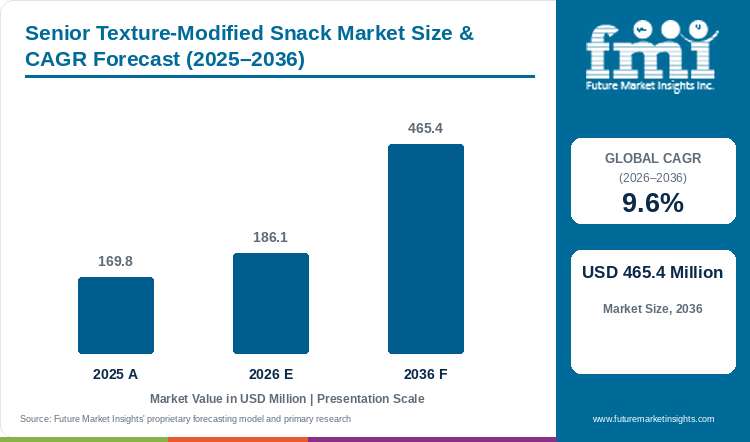
Key Market Trends & Insights
- Level 4 (Pureed) holds 42.8% of IDDSI level in 2026, requiring the specified consistency to be maintained through the actual preparation and service process.
- Soft Cakes & Bakery represents 44.7% of product type in 2026, preserving a familiar snack choice where ordinary dry or crumbly bakery products are unsuitable.
- Protein-Fortified holds 50.4% of fortification in 2026, adding a nutritional contribution that still needs to be assessed separately from the required texture.
- Long-Term Care holds 41.9% of end user in 2026, where coordinated care teams can carry an individual texture prescription through repeated meal and snack service.
Regional Highlights
- Japan has the highest profiled CAGR at 10.0% during 2026–2036.
- The next two profiled growth rates are South Korea at 9.7% and USA at 9.2% over the same period.
Market Size & Forecast
| Metric | Value |
|---|---|
| 2025 market value | USD 169.8 Million |
| 2026 market estimate | USD 186.1 Million |
| 2036 market forecast | USD 465.4 Million |
| Forecast CAGR, 2026–2036 | 9.6% |
The market covers texture-modified snacks for senior consumers across the specified IDDSI, product, fortification and care-setting categories. The specified texture levels describe product categories, not a universal recommendation for an individual. Conventional snacks and nonfood care services are excluded.
Texture-modified snacks combine a familiar eating occasion with requirements associated with clinical nutrition, including suitable nutrient delivery and individual assessment.
Nutrition evidence and practical use
| Documented operating context | Source |
|---|---|
| Cambridge University Hospitals describes the texture characteristics and serving checks for IDDSI Level 4 pureed food. | [1] |
| NICE guidance addresses screening, assessment and delivery of nutrition support in adults. | [2] |
| Clinico announced a June 2026 launch for a 40 g nutritional jelly providing 150 kcal per serving. | [3] |
| Meiji introduced soup-style Mini Cup nutrition in March 2025, including an onion-soup flavor in a 125 mL format. | [4] |
Analyst Perspective
An appealing snack needs a serving method that carers can reproduce within the prescribed texture requirements. Flavor and portion variety can improve the eating experience, while documented preparation and holding instructions help kitchens maintain the required consistency when staff, menus or care settings change.
- Nandini Roy Choudhury, Principal Analyst at Future Market Insights
How is the senior texture-modified snack market segmented?
IDDSI Level covers Level 4 (Pureed), Level 5 (Minced & Moist), Level 6 (Soft & Bite-Sized) and Others. Product Type covers Soft Cakes & Bakery, Pureed Fruit & Dessert Cups, Savory Soft Snacks, Fortified Mousses and Others. Fortification covers Protein-Fortified, Energy-Dense and Standard. End User covers Long-Term Care, Homecare, Hospitals and Others. Sales Channel covers Hospital Pharmacy, Retail Pharmacy, Online, Institutional Tender and Others.
The medical nutrition supply chain offers relevant care-setting access, but texture classification must be established for the specific product and serving conditions.
Why does Level 4 (Pureed) lead IDDSI level demand?
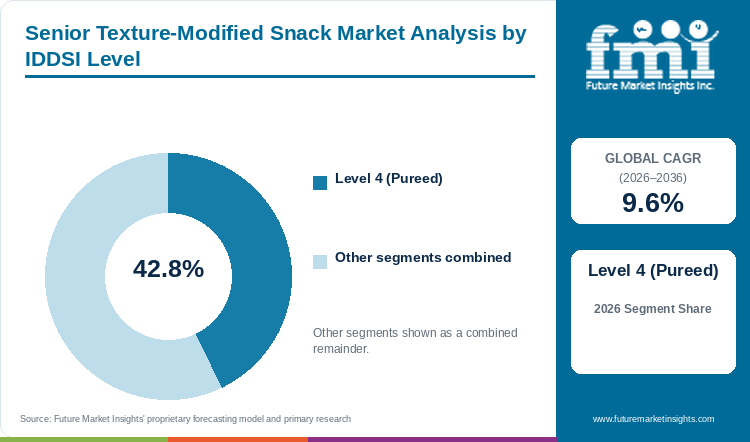
Level 4 (Pureed): 42.8% of IDDSI level in 2026.
Level 4 products require a smooth, cohesive consistency that remains appropriate when the food reaches the person eating it, rather than only when it leaves the manufacturer. Storage and preparation can alter that result, making reproducible instructions and checking procedures useful when staff or recipes change. Attractive presentation can improve the experience of a pureed snack, while selection remains tied to the prescribed texture and actual serving conditions because Level 4 has a defined meaning beyond a general description of softness.
- The Level 4 (Pureed) segment accounts for 42.8% of IDDSI level in 2026.
- Menu changes should preserve the prescribed consistency rather than assume that similar-looking pureed products behave alike during service.
Why does Soft Cakes & Bakery lead product type demand?
Soft Cakes & Bakery: 44.7% of product type in 2026.
An adapted bakery portion can offer a familiar choice when an ordinary dry or crumbly snack is unsuitable, with controlled moisture and preparation helping the finished serving behave as intended. A standard cake that feels soft cannot be assumed to meet the same requirement, so kitchens need a documented method and an appropriate basis for assessing texture. This allows variety to be introduced without leaving staff to improvise consistency for each portion.
- The Soft Cakes & Bakery segment accounts for 44.7% of product type in 2026.
- Bakery-style snacks need assessment after preparation because a familiar appearance does not establish suitability for swallowing difficulties.
What are the drivers, restraints, and opportunities in the senior texture-modified snack market?
Texture adaptation preserves the snack occasion
Chewing and swallowing difficulties can make it harder to maintain adequate intake. A suitable between-meal snack gives care teams another opportunity to offer nourishment without requiring a full meal. The product needs to fit the person's texture requirements and be something they willingly eat. This creates demand for enriched foods that are practical to serve within an existing care routine. Institutions also need enough variety to avoid repeating the same option every day. Suppliers that address preparation as well as flavor can make the snack easier to use consistently.
Preparation variation can undermine texture control
IDDSI Level 4 and Level 5 foods have different characteristics from Level 6 foods. A broad claim of softness does not tell a care team which is appropriate. Texture can change with holding temperature or added moisture and must be checked under the intended serving conditions. Even a correctly prepared product can be rejected because the flavor or appearance is unappealing. Purchasing decisions therefore need feedback on both consistency and intake. Poor instructions create additional work for kitchens and make it harder to reproduce an acceptable portion across different staff shifts.
Recognizable formats improve menu acceptance
Mousses, pureed dessert cups and adapted bakery portions can add recognizable choices between meals when they fit the individual’s texture and nutritional requirements. Storage and serving instructions need to preserve consistency as energy or protein is added, giving kitchens a manageable range of flavors to rotate. Each format still requires its own assessment against the prescribed level and actual preparation conditions.
The nutritional role can be compared with dietary supplements when fortification is a priority, while the snack also needs to retain the required texture through preparation and holding.
Which country and market CAGRs are profiled for senior texture-modified snack?
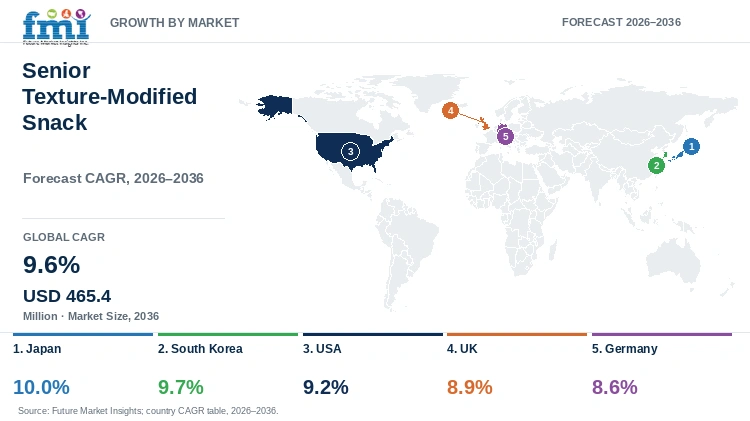
| Country | CAGR |
|---|---|
| Japan | 10.0% |
| South Korea | 9.7% |
| USA | 9.2% |
| UK | 8.9% |
| Germany | 8.6% |
Country-wise Analysis
Japan
- Familiarity with texture labeling gives Japanese suppliers a basis for discussing flavor and menu variety alongside suitability, especially when modified foods are eaten repeatedly. Manufacturers need to show how the snack retains its intended consistency through the kitchen’s preparation steps, allowing different options to fit a controlled serving process. Japan has the fastest profiled forecast, at a 10.0% CAGR from 2026 to 2036, with acceptance by the person eating the food remaining central to regular use.
South Korea
- Senior-friendly positioning can introduce South Korean buyers to foods with adjusted physical properties or nutrition, although a specific snack still needs to match the user’s assessed swallowing requirements. Clear heating or cooling instructions become useful as a product moves between an institutional kitchen and family care. The 9.7% CAGR forecast for 2026 to 2036 places attention on maintaining that distinction while familiar shapes and flavors support acceptance.
USA
- American institutional kitchens and households need different pack sizes and preparation support, with a family buying online often relying more heavily on the product’s own instructions. Hospitals and long-term care teams can coordinate prescribed textures with service, but consistency after storage or heating matters in either setting. Clear classification and nutritional information support practical distribution within the USA’s 9.2% CAGR forecast for 2026 to 2036.
UK
- Standardized dysphagia terminology helps UK care teams communicate requirements between settings; Cambridge University Hospitals describes IDDSI Level 4 food as smooth and lump-free with no chewing required. Suppliers need to translate that specification into clear preparation guidance for both kitchens and home carers while providing enough flavor variety for repeated use. The UK is forecast to grow at an 8.9% CAGR from 2026 to 2036, with classification still dependent on the individual’s prescribed level.
Germany
- German care providers need texture-modified snacks to fit the day’s menu and established clinical nutrition routines without adding excessive preparation work. Pack opening and the amount of adjustment required can affect the value of an otherwise suitable food, particularly where one kitchen supports several texture requirements. Reliable serving methods and flavor variety address these operating conditions as the market grows at a forecast 8.6% CAGR from 2026 to 2036.
Who are the notable companies in the senior texture-modified snack market?
Kewpie; Meiji; Hormel Health Labs; Clinico; Flavour Creations
Care-food manufacturers need to balance familiar flavors with controlled preparation. An adapted cake may offer variety that a dessert cup does not but the kitchen must be able to serve either consistently. Buyers need product-specific instructions rather than a general assurance that the range is suitable for older consumers.
Competitive Benchmarking: Senior Texture-Modified Snack Market
| Participant | Commercial focus | Buyer qualification priority |
|---|---|---|
| Kewpie | Care foods and texture-adapted meals | Texture consistency after preparation |
| Meiji | Nutrition and care foods | Serving suitability and nutrient delivery |
| Hormel Health Labs | Texture-modified foods | Defined texture and kitchen workflow |
| Clinico | Nutritional jellies and care foods | Product-specific texture assessment |
| Flavour Creations | Dysphagia nutrition products | Texture stability and serving conditions |
Key Developments in the Senior Texture-Modified Snack Market
- Clinico announced a June 2026 launch for a 40 g nutritional jelly providing 150 kcal per serving. [3]
- Meiji introduced soup-style Mini Cup nutrition in March 2025, including an onion-soup flavor in a 125 mL format. [4]
Key Players in the Senior Texture-Modified Snack Market
- Kewpie
- Meiji
- Hormel Health Labs
- Clinico
- Flavour Creations
Senior Texture-Modified Snack Market - Report Scope
| Coverage field | Report scope |
|---|---|
| Market breakdown | IDDSI Level; Product Type; Fortification; End User; Sales Channel; Region |
| Quantitative unit | USD Million |
| Market definition | The market covers texture-modified snacks for senior consumers across the specified IDDSI, product, fortification and care-setting categories. The specified texture levels describe product categories, not a universal recommendation for an individual. Conventional snacks and nonfood care services are excluded. |
| Regions covered | North America; Latin America; Western Europe; Eastern Europe; East Asia; South Asia and Pacific; Middle East and Africa |
| Countries / markets profiled | Japan; South Korea; USA; UK; Germany |
| Key companies profiled | Kewpie; Meiji; Hormel Health Labs; Clinico; Flavour Creations |
| Base year / forecast period | 2026 / 2026–2036 |
| Estimate coverage | 2025 and 2026 market estimates; 2036 forecast; segment shares and country / market CAGRs. |
Senior Texture-Modified Snack Market - Research Methodology
| Method | Application |
|---|---|
| Market definition | The analysis follows the stated product or service boundary and distinguishes direct category revenue from adjacent activities. |
| Secondary research | Official technical, regulatory, research and company publications provide the documented operating context and recent developments cited in this report. |
| Forecast and segmentation | Market estimates, segment shares and geographic forecasts are presented as analytical estimates within the stated commercial scope. |
| Competitive assessment | Participants are compared by their relevant products or services, commercial role and buyer qualification requirements. |
| Interpretation | The assessment considers purchasing conditions and the scope of the documented product, service or performance claim. |
Senior Texture-Modified Snack Market by Segments
IDDSI Level
- Level 4 (Pureed)
- Level 5 (Minced & Moist)
- Level 6 (Soft & Bite-Sized)
- Others
Product Type
- Soft Cakes & Bakery
- Pureed Fruit & Dessert Cups
- Savory Soft Snacks
- Fortified Mousses
- Others
Fortification
- Protein-Fortified
- Energy-Dense
- Standard
End User
- Long-Term Care
- Homecare
- Hospitals
- Others
Sales Channel
- Hospital Pharmacy
- Retail Pharmacy
- Online
- Institutional Tender
- Others
Senior Texture-Modified Snack Market by Region
- North America
- United States
- Canada
- Latin America
- Brazil
- Mexico
- Argentina
- Chile
- Western Europe
- Germany
- France
- United Kingdom
- Italy
- Spain
- Benelux
- Nordics
- Eastern Europe
- Poland
- Czech Republic
- Romania
- Hungary
- East Asia
- China
- Japan
- South Korea
- South Asia and Pacific
- India
- ASEAN
- Australia and New Zealand
- Middle East and Africa
- GCC Countries
- South Africa
- Türkiye
- Israel
Research Sources and Bibliography
- [1] Cambridge University Hospitals NHS Foundation Trust. (n.d.). Pureed food: IDDSI Level 4.
- [2] National Institute for Health and Care Excellence. (2017, August 4). Nutrition support for adults: oral nutrition support, enteral tube feeding and parenteral nutrition - Recommendations.
- [3] Morinaga Milk Industry Clinico. (2026, May 29). Launch of Enjoy Small Jelly 150.
- [4] Meiji. (2025, March 11). Meiji Meibalance Mini Cup soup-taste series.
- [5] Future Market Insights. (2026). Senior Texture-Modified Snack Market: Global industry analysis and opportunity assessment, 2026–2036.
This Report Answers
- How large is the senior texture-modified snack market in 2026?
- What value and CAGR are forecast through 2036?
- Which IDDSI level segment leads in 2026?
- Which product type segment has the largest share?
- Which profiled country or market has the fastest forecast growth?
- Which participants are covered in the competitive assessment?
Frequently Asked Questions
How large is the senior texture-modified snack market in 2026?
The market was valued at USD 169.8 Million in 2025 and is expected to reach USD 186.1 Million in 2026.
What value and CAGR are forecast through 2036?
The market is projected to reach USD 465.4 Million by 2036, with a 9.6% CAGR during 2026–2036.
Which IDDSI level segment leads in 2026?
The Level 4 (Pureed) segment accounts for 42.8% of IDDSI level in 2026.
Which product type segment has the largest share?
The Soft Cakes & Bakery segment accounts for 44.7% of product type in 2026.
Which profiled country or market has the fastest forecast growth?
Japan has the highest profiled CAGR at 10.0% during 2026–2036.
Which participants are covered in the competitive assessment?
The assessment covers Kewpie, Meiji, Hormel Health Labs, Clinico and Flavour Creations.
Preview the report firsthand - request a free sample
Get SampleGet the brochure for pricing and purchase details.
Get PDFTable of Content
- Key Takeaways
- Market Size and CAGR
- Top Growth Driver
- Fastest Growing Segment
- Leading Region
- Key Companies
- Emerging Opportunities
- Executive Summary
- Global Market Outlook
- Demand-side Trends
- Supply-side Trends
- Technology Roadmap Analysis
- Analysis and Recommendations
- Analyst Perspective (What is happening? Why now? What should investors know?)
- Key Questions Answered
- How large is the market?
- What is the CAGR?
- What are key trends?
- Which region dominates?
- Who are the leaders?
- Market Overview
- Market Coverage / Taxonomy
- Market Definition / Scope / Limitations
- Research Methodology
- Chapter Orientation
- Analytical Lens and Working Hypotheses
- Market Structure, Signals, and Trend Drivers
- Benchmarking and Cross-market Comparability
- Market Sizing, Forecasting, and Opportunity Mapping
- Research Design and Evidence Framework
- Desk Research Programme (Secondary Evidence)
- Expert Input and Fieldwork (Primary Evidence)
- Tooling, Models, and Reference Databases
- Data Engineering and Model Build
- Quality Assurance and Audit Trail
- Market Background
- Market Dynamics (Drivers, Restraints, Opportunity, Trends)
- Scenario Forecast (Optimistic, Likely, Conservative)
- Impact Analysis
- AI Impact
- Sustainability Impact
- Regulatory Impact
- Technology Impact
- Consumer / Buyer Analysis
- Purchase Drivers
- Adoption Barriers
- Buyer Journey
- Opportunity Map Analysis
- Product Life Cycle Analysis
- Supply Chain Analysis
- Investment Feasibility Matrix
- Value Chain Analysis
- PESTLE and Porter's Analysis
- Regulatory Landscape
- Regional Parent Market Outlook
- Production and Consumption Statistics
- Import and Export Statistics
- Global Market Analysis and Forecast, 2021 to 2036
- Historical Market Size Value (USD Million) Analysis, 2021 to 2025
- Current and Future Market Size Value (USD Million) Projections, 2026 to 2036
- Y-o-Y Growth Trend Analysis
- Absolute $ Opportunity Analysis
- Global Market Pricing Analysis, 2021 to 2036
- Global Market Analysis and Forecast, By IDDSI Level, 2021 to 2036
- Introduction / Key Findings
- Historical Market Size Value (USD Million) Analysis By IDDSI Level, 2021 to 2025
- Current and Future Market Size Value (USD Million) Analysis and Forecast By IDDSI Level, 2026 to 2036
- Level 4 (Pureed)
- Level 5 (Minced & Moist)
- Level 6 (Soft & Bite-Sized)
- Others
- Y-o-Y Growth Trend Analysis By IDDSI Level, 2021 to 2025
- Absolute $ Opportunity Analysis By IDDSI Level, 2026 to 2036
- Global Market Analysis and Forecast, By Product Type, 2021 to 2036
- Introduction / Key Findings
- Historical Market Size Value (USD Million) Analysis By Product Type, 2021 to 2025
- Current and Future Market Size Value (USD Million) Analysis and Forecast By Product Type, 2026 to 2036
- Soft Cakes & Bakery
- Pureed Fruit & Dessert Cups
- Savory Soft Snacks
- Fortified Mousses
- Others
- Y-o-Y Growth Trend Analysis By Product Type, 2021 to 2025
- Absolute $ Opportunity Analysis By Product Type, 2026 to 2036
- Global Market Analysis and Forecast, By Fortification, 2021 to 2036
- Introduction / Key Findings
- Historical Market Size Value (USD Million) Analysis By Fortification, 2021 to 2025
- Current and Future Market Size Value (USD Million) Analysis and Forecast By Fortification, 2026 to 2036
- Protein-Fortified
- Energy-Dense
- Standard
- Y-o-Y Growth Trend Analysis By Fortification, 2021 to 2025
- Absolute $ Opportunity Analysis By Fortification, 2026 to 2036
- Global Market Analysis and Forecast, By End User, 2021 to 2036
- Introduction / Key Findings
- Historical Market Size Value (USD Million) Analysis By End User, 2021 to 2025
- Current and Future Market Size Value (USD Million) Analysis and Forecast By End User, 2026 to 2036
- Long-Term Care
- Homecare
- Hospitals
- Others
- Y-o-Y Growth Trend Analysis By End User, 2021 to 2025
- Absolute $ Opportunity Analysis By End User, 2026 to 2036
- Global Market Analysis and Forecast, By Sales Channel, 2021 to 2036
- Introduction / Key Findings
- Historical Market Size Value (USD Million) Analysis By Sales Channel, 2021 to 2025
- Current and Future Market Size Value (USD Million) Analysis and Forecast By Sales Channel, 2026 to 2036
- Hospital Pharmacy
- Retail Pharmacy
- Online
- Institutional Tender
- Others
- Y-o-Y Growth Trend Analysis By Sales Channel, 2021 to 2025
- Absolute $ Opportunity Analysis By Sales Channel, 2026 to 2036
- Global Market Analysis and Forecast, By Region, 2021 to 2036
- Introduction
- Historical Market Size Value (USD Million) Analysis By Region, 2021 to 2025
- Current Market Size Value (USD Million) Analysis and Forecast By Region, 2026 to 2036
- North America
- Latin America
- Western Europe
- Eastern Europe
- East Asia
- South Asia and Pacific
- Middle East and Africa
- Market Attractiveness Analysis By Region
- North America Market Analysis and Forecast, By Country, 2021 to 2036
- Historical Market Size Value (USD Million) Trend Analysis By Market Taxonomy, 2021 to 2025
- Market Size Value (USD Million) Forecast By Market Taxonomy, 2026 to 2036
- By Country
- United States
- Canada
- By IDDSI Level
- By Product Type
- By Fortification
- By End User
- By Sales Channel
- By Country
- Market Attractiveness Analysis
- By Country
- By IDDSI Level
- By Product Type
- By Fortification
- By End User
- By Sales Channel
- Key Takeaways
- Latin America Market Analysis and Forecast, By Country
- Historical Market Size Value (USD Million) Trend Analysis By Market Taxonomy, 2021 to 2025
- Market Size Value (USD Million) Forecast By Market Taxonomy, 2026 to 2036
- By Country
- Brazil
- Mexico
- Argentina
- Chile
- By IDDSI Level
- By Product Type
- By Fortification
- By End User
- By Sales Channel
- By Country
- Market Attractiveness Analysis
- By Country
- By IDDSI Level
- By Product Type
- By Fortification
- By End User
- By Sales Channel
- Key Takeaways
- Western Europe Market Analysis and Forecast, By Country
- Historical Market Size Value (USD Million) Trend Analysis By Market Taxonomy, 2021 to 2025
- Market Size Value (USD Million) Forecast By Market Taxonomy, 2026 to 2036
- By Country
- Germany
- France
- United Kingdom
- Italy
- Spain
- Benelux
- Nordics
- By IDDSI Level
- By Product Type
- By Fortification
- By End User
- By Sales Channel
- By Country
- Market Attractiveness Analysis
- By Country
- By IDDSI Level
- By Product Type
- By Fortification
- By End User
- By Sales Channel
- Key Takeaways
- Eastern Europe Market Analysis and Forecast, By Country
- Historical Market Size Value (USD Million) Trend Analysis By Market Taxonomy, 2021 to 2025
- Market Size Value (USD Million) Forecast By Market Taxonomy, 2026 to 2036
- By Country
- Poland
- Czech Republic
- Romania
- Hungary
- By IDDSI Level
- By Product Type
- By Fortification
- By End User
- By Sales Channel
- By Country
- Market Attractiveness Analysis
- By Country
- By IDDSI Level
- By Product Type
- By Fortification
- By End User
- By Sales Channel
- Key Takeaways
- East Asia Market Analysis and Forecast, By Country
- Historical Market Size Value (USD Million) Trend Analysis By Market Taxonomy, 2021 to 2025
- Market Size Value (USD Million) Forecast By Market Taxonomy, 2026 to 2036
- By Country
- China
- Japan
- South Korea
- By IDDSI Level
- By Product Type
- By Fortification
- By End User
- By Sales Channel
- By Country
- Market Attractiveness Analysis
- By Country
- By IDDSI Level
- By Product Type
- By Fortification
- By End User
- By Sales Channel
- Key Takeaways
- South Asia and Pacific Market Analysis and Forecast, By Country
- Historical Market Size Value (USD Million) Trend Analysis By Market Taxonomy, 2021 to 2025
- Market Size Value (USD Million) Forecast By Market Taxonomy, 2026 to 2036
- By Country
- India
- ASEAN
- Australia and New Zealand
- By IDDSI Level
- By Product Type
- By Fortification
- By End User
- By Sales Channel
- By Country
- Market Attractiveness Analysis
- By Country
- By IDDSI Level
- By Product Type
- By Fortification
- By End User
- By Sales Channel
- Key Takeaways
- Middle East and Africa Market Analysis and Forecast, By Country
- Historical Market Size Value (USD Million) Trend Analysis By Market Taxonomy, 2021 to 2025
- Market Size Value (USD Million) Forecast By Market Taxonomy, 2026 to 2036
- By Country
- GCC Countries
- South Africa
- Türkiye
- Israel
- By IDDSI Level
- By Product Type
- By Fortification
- By End User
- By Sales Channel
- By Country
- Market Attractiveness Analysis
- By Country
- By IDDSI Level
- By Product Type
- By Fortification
- By End User
- By Sales Channel
- Key Takeaways
- Key Countries Market Analysis
- United States
- Pricing Analysis
- Market Share Analysis, 2025
- By IDDSI Level
- By Product Type
- By Fortification
- By End User
- By Sales Channel
- Canada
- Pricing Analysis
- Market Share Analysis, 2025
- By IDDSI Level
- By Product Type
- By Fortification
- By End User
- By Sales Channel
- Mexico
- Pricing Analysis
- Market Share Analysis, 2025
- By IDDSI Level
- By Product Type
- By Fortification
- By End User
- By Sales Channel
- Brazil
- Pricing Analysis
- Market Share Analysis, 2025
- By IDDSI Level
- By Product Type
- By Fortification
- By End User
- By Sales Channel
- Chile
- Pricing Analysis
- Market Share Analysis, 2025
- By IDDSI Level
- By Product Type
- By Fortification
- By End User
- By Sales Channel
- Germany
- Pricing Analysis
- Market Share Analysis, 2025
- By IDDSI Level
- By Product Type
- By Fortification
- By End User
- By Sales Channel
- United Kingdom
- Pricing Analysis
- Market Share Analysis, 2025
- By IDDSI Level
- By Product Type
- By Fortification
- By End User
- By Sales Channel
- Italy
- Pricing Analysis
- Market Share Analysis, 2025
- By IDDSI Level
- By Product Type
- By Fortification
- By End User
- By Sales Channel
- Spain
- Pricing Analysis
- Market Share Analysis, 2025
- By IDDSI Level
- By Product Type
- By Fortification
- By End User
- By Sales Channel
- France
- Pricing Analysis
- Market Share Analysis, 2025
- By IDDSI Level
- By Product Type
- By Fortification
- By End User
- By Sales Channel
- India
- Pricing Analysis
- Market Share Analysis, 2025
- By IDDSI Level
- By Product Type
- By Fortification
- By End User
- By Sales Channel
- ASEAN
- Pricing Analysis
- Market Share Analysis, 2025
- By IDDSI Level
- By Product Type
- By Fortification
- By End User
- By Sales Channel
- Australia and New Zealand
- Pricing Analysis
- Market Share Analysis, 2025
- By IDDSI Level
- By Product Type
- By Fortification
- By End User
- By Sales Channel
- China
- Pricing Analysis
- Market Share Analysis, 2025
- By IDDSI Level
- By Product Type
- By Fortification
- By End User
- By Sales Channel
- Japan
- Pricing Analysis
- Market Share Analysis, 2025
- By IDDSI Level
- By Product Type
- By Fortification
- By End User
- By Sales Channel
- South Korea
- Pricing Analysis
- Market Share Analysis, 2025
- By IDDSI Level
- By Product Type
- By Fortification
- By End User
- By Sales Channel
- Poland
- Pricing Analysis
- Market Share Analysis, 2025
- By IDDSI Level
- By Product Type
- By Fortification
- By End User
- By Sales Channel
- Hungary
- Pricing Analysis
- Market Share Analysis, 2025
- By IDDSI Level
- By Product Type
- By Fortification
- By End User
- By Sales Channel
- Türkiye
- Pricing Analysis
- Market Share Analysis, 2025
- By IDDSI Level
- By Product Type
- By Fortification
- By End User
- By Sales Channel
- South Africa
- Pricing Analysis
- Market Share Analysis, 2025
- By IDDSI Level
- By Product Type
- By Fortification
- By End User
- By Sales Channel
- United States
- Market Structure Analysis
- Competition Dashboard
- Competition Benchmarking
- Market Share Analysis of Top Players
- By Regional
- By IDDSI Level
- By Product Type
- By Fortification
- By End User
- By Sales Channel
- Emerging Startups
- Innovation Benchmarking
- Competition Analysis
- Competition Deep Dive
- Kewpie
- Overview
- Product Portfolio
- Profitability by Market Segments
- Sales Footprint
- Strategy Overview
- Marketing Strategy
- Product Strategy
- Channel Strategy
- Meiji
- Hormel Health Labs
- Clinico
- Flavour Creations
- Kewpie
- Case Studies
- Success Stories
- Recent Developments
- Competition Deep Dive
- Assumptions & Acronyms Used


