

- Market Size (2026)
- USD 353.0 Mn
- Forecast (2036)
- USD 1,771.0 Mn
- CAGR (2026 to 2036)
- 17.5%
How big is the Sewing & Textile Automation (Sewbots) Market size?
USD 353.0 million in 2026 and USD 1,771.0 million by 2036 at a 17.5% CAGR.
Demand for sewing & textile automation (sewbots) is projected to expand at 17.5% CAGR between 2026 and 2036, increasing valuation from USD 353.0 million in 2026 to USD 1,771.0 million by 2036. Handling floppy textiles during high-speed sewing poses a unique challenge since loose material stretches and wrinkles constantly. Garment factories rely on advanced vision cameras and automated sewing guides to achieve perfect stitching. International Federation of Robotics figures published in September 2025 recorded 542,000 industrial robots installed during 2024. Widespread mechanical familiarity across global production lines provides the ideal foundation for integrating automated sewbots.
Brands in the United States and Europe favor documented seam quality alongside compact upgrade cells to fit inside existing workspaces. Large-scale factories in China and India prioritize quick style-change setups and immediate local maintenance. Operational focus varies depending on local factory layouts and production goals. Real-world testing remains critical to perfecting such systems before wide adoption. EU Textiles Ecosystem Platform documents released in December 2025 highlighted 4 pilot demonstrations under the SOFTMANBOT initiative. These active trials showcase effective modern software helping guide mechanical arms through delicate fabric handling tasks.
-market-value-analysis.webp "Sewing & Textile Automation (sewbots) Market Value Analysis")
Key Takeaways of Sewing & Textile Automation (Sewbots) Market
- Demand for sewing and textile automation is driven by repeated seams requiring steady fabric positioning and consistent stitch paths, with factory decisions reflecting material variability and line integration effort.
- By component, hardware is expected to lead with 62.0% share in 2026, backed by sewing heads and motion systems.
- Direct purchase is the dominant business model segment, projected to hold 46.0% share in 2026, guided by factories seeking ownership across sustained production schedules.
- Automated sewing units are estimated to lead the product category with 34.0% share in 2026, led by direct control around needle movement and seam placement.
- Vision-guided handling and fabric control remain critical to adoption, as technical textile and automotive interior producers require traceable stitching and strict quality consistency.
- China, the United States, and the European Union are expected to form the higher-growth country tier, advancing at 20.5%, 18.5%, and 17.0% CAGR respectively through 2036, supported by textile production scale, labor-saving programs, and flexible manufacturing needs.
- Competition centers on JUKI Corporation, Brother Industries, Dürkopp Adler, PFAFF Industriesysteme und Maschinen, SoftWear Automation, and sewts GmbH, with vendors differentiating through industrial sewing portfolios, specialist automation programs, and robotic cloth handling.
Analyst Perspective
"The Sewbots market is advancing through targeted automation of labor-intensive sewing operations rather than full garment manufacturing. Apparel manufacturers are concentrating on seam consistency, fabric handling, and production flexibility as they evaluate automation across different materials and product styles. Commercial momentum will favor suppliers that simplify changeovers, reduce engineering effort during style transitions, and provide strong application support that enables stable production across diverse manufacturing environments."
- Nikhil Kaitwade, Principal Consultant for Technology at Future Market Insights
How is Sewing & Textile Automation (Sewbots) Market segmented?
The sewing & textile automation (sewbots) market is segmented by technology, application, component, end-use industry, business model, and region.
The sewing & textile automation (sewbots) industry is segmented by technology, application, component, end-use, business model, and region. Technology coverage includes automated sewing units and textile handling systems. Vision-guided fabric alignment supports cutting and preparation automation. AI pattern optimization completes technology coverage. Application coverage includes garment assembly and home textiles. Footwear and accessories form another use area. Technical textiles and upholstery complete application coverage. Component coverage includes hardware and software.
Services complete component coverage. End-use industry coverage includes apparel brands and CMT alongside home furnishing. Automotive interiors and medical textiles form additional groups. Other users complete end-use coverage. Business model coverage includes direct purchase and leasing. Robotics-as-a-service and pilot programs complete commercial coverage. Regional coverage includes North America and Latin America. Western Europe and Eastern Europe follow. East Asia and South Asia and Pacific receive separate analysis. Middle East and Africa completes regional coverage.
How do automated sewing units shape technology selection?
-market-analysis-by-technology.webp "Sewing & Textile Automation (sewbots) Market Analysis By Technology")
Automated sewing units guide technology selection as factories place control near needle movement and fabric feeding. Vision feedback helps adjust edge position during programmed stitch paths across stable operations. JUKI Corporation reported in March 2024 presenting 39 industrial sewing machine models at Texprocess, reflecting extensive equipment choice supporting operation-specific automation reviews.
- Automated sewing units are expected to hold 34.0% share of technology in 2026, driven by direct influence over seam speed and stitch consistency. Production teams evaluate clamps and folders during trials. Control interfaces receive separate review across repeated joins.
- Textile handling and gripping systems address fabric presentation across loading and transfer stages. Vision-guided alignment and automated material handling systems extend cell coverage across preparation tasks needing controlled movement.
How does garment assembly shape application demand?
-market-analysis-by-application.webp "Sewing & Textile Automation (sewbots) Market Analysis By Application")
Eurostat reported in February 2025 noting 45% of European Union residents purchased clothing-related goods online during 2024, reinforcing replenishment pressure across apparel production networks. Garment assembly lead application demand across shirts and trousers. Basic apparel also includes repeated joins suited to programmed movement. Pattern files and prepared edges improve repeatability across stable product families.
- Garment assembly is anticipated to secure 30.0% share in 2026, backed by repeated side seams and hems. Attachment steps add another stable automation entry point. Factory teams select early operations carrying stable geometry and measurable labor content.
- Home textiles and upholstery support larger panels with predictable stitch paths. Footwear and accessory workflows require specialized fixtures aligned with material thickness.
Why does hardware retain component leadership?
-market-analysis-by-component.webp "Sewing & Textile Automation (sewbots) Market Analysis By Component")
Hardware retain component leadership as automated cells require sewing heads and cameras. Grippers and lighting add further physical requirements. Safety equipment completes cell preparation. Physical tooling influences cloth movement prior to stitch placement. JUKI Corporation reported in October 2024 exhibiting 59 industrial sewing machines at JIAM, demonstrating extensive hardware variation across apparel and non-apparel production tasks.
- Based on component, hardware is projected to represent 62.0% share in 2026 owing to initial cell costs and material-specific handling equipment. Integrators compare camera placement and end-effector design across fabric types.
- Software supports pattern storage and motion adjustment across style changes. Services sustain calibration and training across sewing machine components exposed to thread tension and material variation.
Why do apparel brands & CMT lead end-use industry demand?
-market-analysis-by-end-use-industry.webp "Sewing & Textile Automation (sewbots) Market Analysis By End Use Industry")
PEGASUS CO., LTD. reported in August 2025 planning 33 industrial sewing machines for CISMA, demonstrating wide equipment coverage across apparel production tasks. Apparel brands and CMT factories are expected dominate end-use industry demand due to repeated sewing volumes and frequent style turnover. Automation reviews usually begin with seams carrying stable shapes and recurring labor content.
- In 2026, apparel brands and CMT are forecast to command 34.0% share since it is aided by recurring garment programs and measurable operation times. Factory managers assess cell utilization across product families during equipment review.
- Home furnishing and automotive interior producers review systems handling panels and shaped components. Medical textiles and composite textile production equipment support specialist operations requiring documented stitch quality.
How does direct purchase retain business model strength?
-market-analysis-by-business-model.webp "Sewing & Textile Automation (sewbots) Market Analysis By Business Model")
Direct purchase reflect notable share within business model strength across established factories expecting sustained cell utilization. Ownership supports customized fixtures and internal maintenance planning across recurring product lines. European Commission reported in July 2025 finding 67% of surveyed small and medium-sized enterprises expected turnover expansion, indicating investment confidence supporting equipment ownership reviews.
- By business model, direct purchase is predicted to capture 46.0% share in 2026 as factories seek control over equipment availability and production scheduling. Finance teams compare utilization periods against integration and maintenance expense.
- Leasing and robotics-as-a-service reduce initial commitment across uncertain production volumes. Pilot programs support limited evaluation of machine safety and fabric-handling performance prior to wider factory release.
What are drivers, restraints, and opportunities in Sewing & Textile Automation(Sewbots) Market?
Sewbots selection advances through labor pressure and repeatable seam requirements. Fabric variability and integration effort may delay factory acceptance.
- Driver: Repeated seam operations encourage factories to automate labor-heavy steps with controlled stitch placement.
- Restraint: Fabric stretch and surface variation may weaken repeatability across mixed material batches.
- Opportunity: Modular cells and flexible payment models may extend access across factories seeking measured production trials.
Labor-intensive garment production and recurring skill requirements support wider sewbots deployment. International Labour Organization reported in March 2025 stating garment production employed more than 90 million people globally, highlighting an extensive labor base exposed to automation across repeatable sewing operations.
Inconsistent cloth behavior during gripping and transfer may slow system acceptance. Stitch stages introduce further variation across production cycles. Garcia-Camacho and colleagues reported in March 2024 evaluating 5 manipulation primitives, showing material properties altered robotic results across several cloth-handling actions.
Modular robotic cells and application-specific recycling or handling programs influence wider system deployment. European Commission CORDIS reported in April 2026 covering 3 FlexCycle use cases, supporting adaptable automation designs across cloth and other soft materials.
What country CAGRs are profiled in Sewing & Textile Automation (Sewbots) Market?
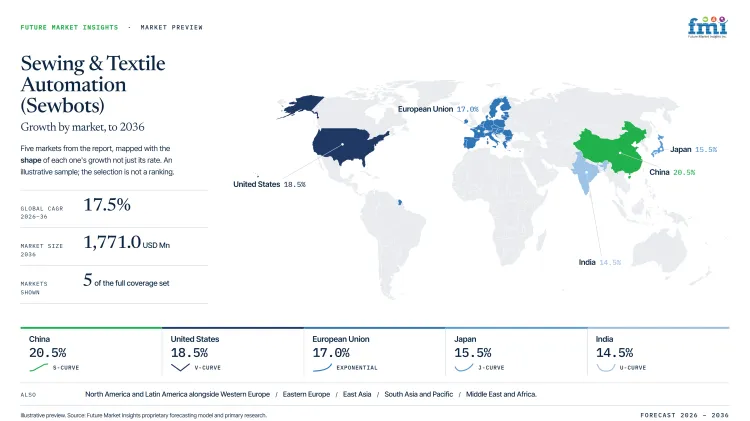
| Country | CAGR |
|---|---|
| China | 20.5% |
| United States | 18.5% |
| European Union | 17.0% |
| Japan | 15.5% |
| India | 14.5% |
Source: Future Market Insights analysis, 2026.
How do country-level CAGRs compare in Sewing & Textile Automation (Sewbots) Market?
The comparison spans 6.0 percentage points across the sewing & textile automation (sewbots) market. China records the highest CAGR at 20.5%, followed by the United States at 18.5%. The European Union reaches 17.0%, while Japan and India post 15.5% and 14.5%, respectively. The ranking reflects different levels of investment in automated garment production and digital textile manufacturing.
- China leads with a CAGR of 20.5%. Textile and apparel manufacturers are expanding the use of sewing automation to improve production consistency, increase manufacturing efficiency and support higher output across large-scale garment facilities.
- The United States follows at 18.5%, 2.0 percentage points below China. Manufacturers are evaluating sewbot technologies to automate labor-intensive sewing processes, improve production flexibility and strengthen domestic apparel manufacturing capabilities.
- The European Union records a CAGR of 17.0%, 1.5 percentage points behind the United States. Investment focuses on automation systems that improve production accuracy and streamline textile manufacturing workflows. Adoption differs among member states because manufacturing specialization, labor costs and capital investment priorities are not uniform.
- Japan posts a CAGR of 15.5%, 1.5 percentage points below the European Union. Textile manufacturers are incorporating automated sewing technologies into production lines to improve process stability, optimize factory operations and maintain consistent product quality.
- India records a CAGR of 14.5%, 1.0 percentage point behind Japan. The market reflects increasing interest in sewing automation as manufacturers modernize production facilities and evaluate technologies that improve operational efficiency while supporting large-volume garment manufacturing.
Comparable CAGRs do not indicate identical market conditions. Differences in textile manufacturing capacity, factory automation, labor economics and investment priorities influence technology adoption and long-term commercial opportunities. The full report provides country-level CAGR analysis across North America, Latin America, Europe, East Asia, South Asia, Oceania and the Middle East and Africa.
Country-wise Analysis
- Sewbots adoption in China is projected to scale at 20.5% CAGR from 2026 to 2036, driven by extensive textile capacity and domestic machinery access. Factory programs are expected to favor repeatable operations offering clear utilization gains. National Bureau of Statistics of China reported in February 2026 stating textile industry value added increased 3.0% in 2025, encouraging factory efficiency programs and automated sewing reviews.
- United States Bureau of Labor Statistics reported in August 2025 recording 124,000 sewing machine operators during 2024, highlighting a sizable repetitive-sewing workforce suited to labor-saving cell evaluation. Production localization reviews are likely to center on repetitive tasks facing limited labor availability. Sales in the United States are estimated to rise at 18.5% CAGR during the study period, guided by localized production and shorter replenishment planning.
- Industry in the European Union is anticipated to expand at 17.0% CAGR during the assessment period, helped by flexible production and documented process control. Factory modernization plans are projected to prioritize adaptable cells supporting shorter production series. European Commission reported in March 2024 publishing 110 textile transition pledges, signaling active industry programs covering technology and skills investment.
- Ministry of Economy, Trade and Industry reported in June 2025 estimating AI-enabled robotics and reskilling could cover an approximate 2 million-worker shortfall in Japan by 2040, supporting factory automation planning. Equipment selection is expected to center on precision tasks needing controlled material movement. Sector in Japan is forecast to increase at 15.5% CAGR between 2026 and 2036, aided by precision machinery expertise and specialist textile production.
- The market in India are expected to progress at 14.5% CAGR by 2036, shaped by garment scale and rising quality consistency requirements. Automation reviews are anticipated to begin across export lines facing consistency and delivery pressures. Press Information Bureau reported in February 2026 stating women represented more than 50% of textile and apparel employment, underscoring a labor-intensive production base influencing ergonomic automation assessments.
Who are notable companies in Sewing & Textile Automation (Sewbots) Market?
JUKI Corporation and Brother Industries, Ltd. are expected to shape equipment selection due to industrial sewing portfolios and factory integration knowledge. Dürkopp Adler GmbH and PFAFF Industriesysteme und Maschinen GmbH add specialist application depth across apparel. Upholstery and automotive sewing receive separate equipment support. SoftWear Automation, Inc. and sewts GmbH support robotic cloth handling and autonomous workline development. AMF Reece - Cars s.r.o. and Tianjin Richpeace AI Co., Limited add application-specific machinery across sewn products. PEGASUS CO., LTD. and Jack Technology Co., Ltd. extend industrial sewing choice.
-market-analysis-by-company.webp "Sewing & Textile Automation (sewbots) Market Analysis By Company")
Competition is anticipated to center on fabric control and repeatable stitch quality. Account teams are likely to compare suppliers based on operation coverage and local engineering support. JUKI Corporation and Brother Industries, Ltd. are projected to receive attention led by installed sewing expertise. Dürkopp Adler GmbH and PFAFF Industriesysteme und Maschinen GmbH are expected to compete due to specialist workstations. SoftWear Automation, Inc. and sewts GmbH are forecast to draw review depending on autonomous cloth handling. AMF Reece - Cars s.r.o. and Tianjin Richpeace AI Co., Limited are anticipated to support tailored production cells. PEGASUS CO., LTD. and Jack Technology Co., Ltd. are likely to strengthen industrial sewing access across apparel factories.
- JUKI Corporation and Brother Industries, Ltd. gain review attention driven by programmable sewing equipment and service networks. Factory teams value equipment families sharing controls and maintenance practices.
- Dürkopp Adler GmbH and PFAFF Industriesysteme und Maschinen GmbH compete depending on specialist seams and automated workstations. Automotive and technical textile accounts assess fixture accuracy and process records.
- SoftWear Automation, Inc. and sewts GmbH support autonomous handling across flexible materials. Application trials determine progress across garment and laundry-related textile operations.
- AMF Reece - Cars s.r.o. and Tianjin Richpeace AI Co., Limited extend supplier choice across technical sewing. PEGASUS CO., LTD. and Jack Technology Co., Ltd. add apparel production coverage. Vendor consideration reflects cell customization and regional service access.
Competitive Benchmarking: Sewing & Textile Automation (Sewbots) Market
| Company | Portfolio Depth | Sewbots Match | Service Support | Service Reach |
|---|---|---|---|---|
| JUKI Corporation | High | High | High | Japan and global |
| Brother Industries, Ltd. | High | High | High | Japan and global |
| Dürkopp Adler GmbH | High | High | High | Germany and global |
| PFAFF Industriesysteme und Maschinen GmbH | High | High | High | Germany and global |
| SoftWear Automation, Inc. | Medium | High | Medium | United States |
| sewts GmbH | Medium | High | Medium | Germany and Europe |
| AMF Reece - Cars s.r.o. | Medium | High | Medium | Czech Republic and global |
| Tianjin Richpeace AI Co., Limited | High | High | Medium | China and global |
| PEGASUS CO., LTD. | High | Medium | High | Japan and global |
| Jack Technology Co., Ltd. | High | High | High | China and global |
Source: Future Market Insights competitive analysis, 2026.
Key Developments in Sewing & Textile Automation (Sewbots) Market
- In April 2025, Dürkopp Adler announced three innovations for Texprocess Americas covering programmable sewing and connected industrial equipment. Product introductions expanded application choice for factories evaluating automated seams and operator-support functions.
- In August 2025, PFAFF Industriesysteme und Maschinen GmbH expanded its PFAFF 8311 automated textile-joining series with long-arm machines offering 1,000 mm clearance. PFAFF stated the expanded configuration supports automated processing of large and voluminous textile components.
- In November 2025, Brother Industries signed an agreement to acquire Konrad Busche’s automotive division. Planned integration was anticipated to expand automated sewing coverage across car seats and airbags. Interior components provide another application path.
Key Players in Sewing & Textile Automation (Sewbots) Market
Industrial sewing and connected-cell manufacturers
- JUKI Corporation
- Brother Industries, Ltd.
- Dürkopp Adler GmbH
- PFAFF Industriesysteme und Maschinen GmbH
Robotic textile handling and autonomous workline developers
- SoftWear Automation, Inc.
- sewts GmbH
Application-specific sewing automation suppliers
- AMF Reece - Cars s.r.o.
- Tianjin Richpeace AI Co., Limited
- PEGASUS CO., LTD.
- Jack Technology Co., Ltd.
Sewing & Textile Automation (Sewbots) Market - Report Scope
-market-breakdown-by-technology,-application,-and-region.webp "Sewing & Textile Automation (sewbots) Market Breakdown By Technology, Application, And Region")
| Coverage Field | Report Scope |
|---|---|
| Market Breakdown | Sewing & textile automation (sewbots) breakdown by technology alongside application, component, end-use industry, business model, and region. |
| Market Definition | Sewbots include automated sewing units, textile handling systems, vision-guided fabric alignment equipment, cutting and preparation automation, software, and services used across sewn-product manufacturing. |
| Regions Covered | North America and Latin America alongside Western Europe, Eastern Europe, East Asia, South Asia and Pacific, Middle East and Africa. |
| Countries Covered | United States and China alongside European Union, Japan, India, Canada, Brazil, Mexico, Germany, United Kingdom, France, Italy, Spain, Poland, South Korea, ASEAN, Australia, New Zealand, GCC countries, South Africa, and Türkiye. |
| Key Companies Profiled | JUKI Corporation and Brother Industries, Ltd. alongside Dürkopp Adler GmbH, PFAFF Industriesysteme und Maschinen GmbH, SoftWear Automation, Inc., sewts GmbH, AMF Reece - Cars s.r.o., Tianjin Richpeace AI Co., Limited, PEGASUS CO., LTD., and Jack Technology Co., Ltd. |
| Forecast Period | 2026 to 2036. |
| Approach | Hybrid bottom-up and top-down methodology using segment share, country CAGR, factory workload, seam repetition, equipment depth, service access, and fabric-handling performance. |
Source: Future Market Insights analysis, 2026.
Sewing & Textile Automation (Sewbots) Market - Research Methodology
| Method | Approach |
|---|---|
| Primary Research | FMI analysts gathered input from manufacturers, service providers, technology developers, distributors, end users, procurement teams, and subject-matter experts. Interviews examined purchasing decisions, product or service evaluation, adoption barriers, approval requirements, pricing considerations, and expectations for technical or commercial support. Respondents were also asked what evidence is required before a trial, pilot, or initial order develops into regular purchasing. |
| Desk Research | Desk research covered government statistics, regulatory publications, trade data, industry associations, technical literature, standards, company filings, product information, and official corporate announcements. Sources were reviewed for relevance, publication date, geographic coverage, and consistency with the defined market scope. Claims relating to performance, applications, approvals, capacity, investment, and commercial activity were retained only when supported by credible public evidence. |
| Market Sizing and Forecasting | The market model combined the baseline value with historical performance, segment structure, pricing and volume indicators, adoption levels, company participation, and country-level demand conditions. Forecast assumptions considered economic activity, investment trends, regulatory developments, technology adoption, purchasing cycles, supply availability, and barriers to wider market use. Segment and regional estimates were reconciled before the final market total was calculated. |
| Data Validation | Estimates were checked against multiple independent indicators, including public data, company activity, trade patterns, industry developments, and findings from primary interviews. Validation also tested whether products, services, applications, and company revenues fell within the defined market boundaries. Adjacent categories, unsupported claims, overlapping revenues, and activities without direct market relevance were excluded to reduce double counting and maintain consistency across segments and countries. |
Sewing & Textile Automation (Sewbots) Market by Segments
Sewing & Textile Automation (Sewbots) Market segmented by Technology:
- Automated sewing units
- Textile handling and gripping
- Vision-guided fabric alignment
- Cutting and preparation automation
- AI pattern optimization
Sewing & Textile Automation (Sewbots) Market segmented by Application:
- Garment assembly
- Home textiles
- Footwear and accessories
- Technical textiles
- Upholstery
Sewing & Textile Automation (Sewbots) Market segmented by Component:
- Hardware
- Software
- Services
Sewing & Textile Automation (Sewbots) Market segmented by End-use Industry:
- Apparel brands and CMT
- Home furnishing
- Automotive interiors
- Medical textiles
- Others
Sewing & Textile Automation (Sewbots) Market segmented by Business Model:
- Direct purchase
- Leasing
- Robotics-as-a-service
- Pilot programs
Sewing & Textile Automation (Sewbots) Market by Region:
- North America
- United States
- Canada
- Latin America
- Brazil
- Mexico
- Argentina
- Western Europe
- Germany
- United Kingdom
- France
- Italy
- Spain
- Eastern Europe
- Poland
- Czech Republic
- Romania
- East Asia
- China
- Japan
- South Korea
- South Asia and Pacific
- India
- ASEAN
- Australia and New Zealand
- Middle East and Africa
- GCC countries
- South Africa
- Türkiye
Research Sources and Bibliography
- Brother Industries, Ltd. (2025, November 10). Strengthening the non-apparel area of the industrial sewing machine business: Acquisition of the automotive division from Konrad Busche.
- Dürkopp Adler GmbH. (2025, April 7). High-tech in action: Dürkopp Adler at Texprocess Americas 2025.
- PEGASUS CO., LTD. (2025, August 27). PEGASUS at CISMA 2025.
- Editorial team. (2025, December 8). The SOFTMANBOT project: Advanced robotic solutions for handling soft materials in manufacturing. Transition Pathways.
- European Commission. (2024, March 1). Transition pathway for the textiles ecosystem: Report on stakeholder pledges and commitments.
- European Commission. (2025, July 2). Europe’s small and medium-sized enterprises remain ambitious but continue to face persistent hurdles in scaling up.
- European Commission, Community Research and Development Information Service. (2026, April 24). Flexible robotic solutions for the recycling of soft materials.
- Eurostat. (2025, February 20). Online shopping in the EU keeps growing.
- Garcia-Camacho, I., Longhini, A., Welle, M., Alenyà, G., Kragic, D., & Borràs, J. (2024, March 7). Standardization of cloth objects and its relevance in robotic manipulation. arXiv.
- International Federation of Robotics. (2025, September 25). Global robot demand in factories doubles over 10 years.
- International Labour Organization. (2025, March 28). Decent work challenges and opportunities in the textiles and clothing sector.
- JUKI Corporation. (2024, March 27). A guide to the JUKI exhibits at Texprocess 2024 in Germany.
- JUKI Corporation. (2024, October 31). JIAM 2024 Osaka: JUKI exhibit outline.
- Ministry of Economy, Trade and Industry. (2025, June). Reference materials for the fourth report of the Committee on New Direction of Economic and Industrial Policies: Industrial structure in 2040 led by growth investment.
- National Bureau of Statistics of China. (2026, February 28). Statistical communiqué of the People’s Republic of China on the 2025 national economic and social development.
- Press Information Bureau. (2026, February 6). Status of textile and apparel manufacturing units.
- United States Bureau of Labor Statistics. (2025, August 28). Data for occupations not covered in detail.
- PFAFF Industriesysteme und Maschinen GmbH. (2025, August 21). PFAFF 8311 long arm.
This bibliography is provided for reader reference and is not exhaustive. The full report contains the complete reference list and detailed citations.
This Report Answers
- What segments shape sewing & textile automation (sewbots) across technology, application, component, end-use industry, and business model?
- How do apparel and technical textile factories assess sewbots during operation-level automation reviews?
- How do country CAGRs differ across profiled manufacturing locations?
- What companies compete through sewing automation depth and fabric-handling support?
- How are forecasts validated through hybrid bottom-up and top-down analysis?
- What factors do account teams assess during expanded factory deployment?
- How do fabric stability and seam repetition affect equipment selection?
- What limits return on investment for factories installing sewbots?
- How do application trials and service access influence vendor approval?
- What supplier capabilities improve long-term account confidence?
Frequently Asked Questions
What supports demand in sewing & textile automation (sewbots) market?
Demand is likely to be supported by factories seeking consistent seams across repeated apparel and textile operations. Account reviews are expected to favor suppliers combining fabric-control evidence with responsive engineering support.
Who are key players in sewing & textile automation (sewbots) market?
Key companies are anticipated to include JUKI Corporation and Brother Industries, Ltd. alongside Dürkopp Adler GmbH and SoftWear Automation, Inc. Competition is likely to focus on operation coverage and regional service access.
What restraint affects sewing & textile automation (sewbots) market?
A primary restraint arises from fabric stretch and edge movement across mixed material lots. Factory acceptance may slow if cells require extensive tuning for every style change.
Why do executives track sewing & textile automation (sewbots) market?
Executives are expected to track sewbots as sewing labor and quality consistency affect production planning. Fabric control and equipment utilization shape capital review across apparel operations.
What business problem does sewing & textile automation (sewbots) market address?
Sewbots address production gaps created by repetitive manual stitching and variable cloth movement across high-volume operations. Factories need systems supporting dependable seam placement and practical changeover routines.
What do account teams evaluate during vendor selection?
Account teams are likely to evaluate seam repeatability and service response during vendor review. Integration effort and operator instruction are expected to guide final approval.
What limits return on investment for factory teams?
Return on investment weakens if cell utilization stays low across changing product mixes. Extended setup periods and material-specific fixtures reduce expected productivity gains.
How do vendors build long-term account confidence?
Vendors build account confidence due to stable equipment quality and evidence linked with targeted sewing operations. Responsive troubleshooting and repeatable material trials are expected to influence expansion decisions.
Preview the report firsthand - request a free sample
Get SampleGet the brochure for pricing and purchase details.
Get PDFTable of Content
- Key Takeaways
- Market Size and CAGR
- Top Growth Driver
- Fastest Growing Segment
- Leading Region
- Key Companies
- Emerging Opportunities
- Executive Summary
- Global Market Outlook
- Demand-side Trends
- Supply-side Trends
- Technology Roadmap Analysis
- Analysis and Recommendations
- Analyst Perspective (What is happening? Why now? What should investors know?)
- Key Questions Answered
- How large is the market?
- What is the CAGR?
- What are key trends?
- Which region dominates?
- Who are the leaders?
- Market Overview
- Market Coverage / Taxonomy
- Market Definition / Scope / Limitations
- Research Methodology
- Chapter Orientation
- Analytical Lens and Working Hypotheses
- Market Structure, Signals, and Trend Drivers
- Benchmarking and Cross-market Comparability
- Market Sizing, Forecasting, and Opportunity Mapping
- Research Design and Evidence Framework
- Desk Research Programme (Secondary Evidence)
- Expert Input and Fieldwork (Primary Evidence)
- Tooling, Models, and Reference Databases
- Data Engineering and Model Build
- Quality Assurance and Audit Trail
- Market Background
- Market Dynamics (Drivers, Restraints, Opportunity, Trends)
- Scenario Forecast (Optimistic, Likely, Conservative)
- Impact Analysis
- AI Impact
- Sustainability Impact
- Regulatory Impact
- Technology Impact
- Consumer / Buyer Analysis
- Purchase Drivers
- Adoption Barriers
- Buyer Journey
- Opportunity Map Analysis
- Product Life Cycle Analysis
- Supply Chain Analysis
- Investment Feasibility Matrix
- Value Chain Analysis
- PESTLE and Porter's Analysis
- Regulatory Landscape
- Regional Parent Market Outlook
- Production and Consumption Statistics
- Import and Export Statistics
- Global Market Analysis and Forecast, 2021 to 2036
- Historical Market Size Value (USD Mn) Analysis, 2021 to 2025
- Current and Future Market Size Value (USD Mn) Projections, 2026 to 2036
- Y-o-Y Growth Trend Analysis
- Absolute $ Opportunity Analysis
- Global Market Pricing Analysis, 2021 to 2036
- Global Market Analysis and Forecast, By Technology, 2021 to 2036
- Introduction / Key Findings
- Historical Market Size Value (USD Mn) Analysis By Technology, 2021 to 2025
- Current and Future Market Size Value (USD Mn) Analysis and Forecast By Technology, 2026 to 2036
- Automated sewing units
- Textile handling & gripping
- Vision-guided fabric alignment
- Cutting & prep automation
- AI pattern optimization
- Automated sewing units
- Y-o-Y Growth Trend Analysis By Technology, 2021 to 2025
- Absolute $ Opportunity Analysis By Technology, 2026 to 2036
- Global Market Analysis and Forecast, By Application, 2021 to 2036
- Introduction / Key Findings
- Historical Market Size Value (USD Mn) Analysis By Application, 2021 to 2025
- Current and Future Market Size Value (USD Mn) Analysis and Forecast By Application, 2026 to 2036
- Garment assembly
- Home textiles
- Footwear & accessories
- Technical textiles
- Upholstery
- Garment assembly
- Y-o-Y Growth Trend Analysis By Application, 2021 to 2025
- Absolute $ Opportunity Analysis By Application, 2026 to 2036
- Global Market Analysis and Forecast, By Component, 2021 to 2036
- Introduction / Key Findings
- Historical Market Size Value (USD Mn) Analysis By Component, 2021 to 2025
- Current and Future Market Size Value (USD Mn) Analysis and Forecast By Component, 2026 to 2036
- Hardware
- Software
- Services
- Hardware
- Y-o-Y Growth Trend Analysis By Component, 2021 to 2025
- Absolute $ Opportunity Analysis By Component, 2026 to 2036
- Global Market Analysis and Forecast, By End-use Industry, 2021 to 2036
- Introduction / Key Findings
- Historical Market Size Value (USD Mn) Analysis By End-use Industry, 2021 to 2025
- Current and Future Market Size Value (USD Mn) Analysis and Forecast By End-use Industry, 2026 to 2036
- Apparel brands & CMT
- Home furnishing
- Automotive interiors
- Medical textiles
- Others
- Apparel brands & CMT
- Y-o-Y Growth Trend Analysis By End-use Industry, 2021 to 2025
- Absolute $ Opportunity Analysis By End-use Industry, 2026 to 2036
- Global Market Analysis and Forecast, By Business Model, 2021 to 2036
- Introduction / Key Findings
- Historical Market Size Value (USD Mn) Analysis By Business Model, 2021 to 2025
- Current and Future Market Size Value (USD Mn) Analysis and Forecast By Business Model, 2026 to 2036
- Direct purchase
- Leasing
- RaaS
- Pilot programs
- Direct purchase
- Y-o-Y Growth Trend Analysis By Business Model, 2021 to 2025
- Absolute $ Opportunity Analysis By Business Model, 2026 to 2036
- Global Market Analysis and Forecast, By Region, 2021 to 2036
- Introduction
- Historical Market Size Value (USD Mn) Analysis By Region, 2021 to 2025
- Current Market Size Value (USD Mn) Analysis and Forecast By Region, 2026 to 2036
- North America
- Latin America
- Western Europe
- Eastern Europe
- East Asia
- South Asia and Pacific
- Middle East & Africa
- Market Attractiveness Analysis By Region
- North America Market Analysis and Forecast, By Country, 2021 to 2036
- Historical Market Size Value (USD Mn) Trend Analysis By Market Taxonomy, 2021 to 2025
- Market Size Value (USD Mn) Forecast By Market Taxonomy, 2026 to 2036
- By Country
- USA
- Canada
- By Technology
- By Application
- By Component
- By End-use Industry
- By Business Model
- By Country
- Market Attractiveness Analysis
- By Country
- By Technology
- By Application
- By Component
- By End-use Industry
- By Business Model
- Key Takeaways
- Latin America Market Analysis and Forecast, By Country
- Historical Market Size Value (USD Mn) Trend Analysis By Market Taxonomy, 2021 to 2025
- Market Size Value (USD Mn) Forecast By Market Taxonomy, 2026 to 2036
- By Country
- Brazil
- Mexico
- Chile
- Rest of Latin America
- By Technology
- By Application
- By Component
- By End-use Industry
- By Business Model
- By Country
- Market Attractiveness Analysis
- By Country
- By Technology
- By Application
- By Component
- By End-use Industry
- By Business Model
- Key Takeaways
- Western Europe Market Analysis and Forecast, By Country
- Historical Market Size Value (USD Mn) Trend Analysis By Market Taxonomy, 2021 to 2025
- Market Size Value (USD Mn) Forecast By Market Taxonomy, 2026 to 2036
- By Country
- Germany
- UK
- Italy
- Spain
- France
- Nordic
- BENELUX
- Rest of Western Europe
- By Technology
- By Application
- By Component
- By End-use Industry
- By Business Model
- By Country
- Market Attractiveness Analysis
- By Country
- By Technology
- By Application
- By Component
- By End-use Industry
- By Business Model
- Key Takeaways
- Eastern Europe Market Analysis and Forecast, By Country
- Historical Market Size Value (USD Mn) Trend Analysis By Market Taxonomy, 2021 to 2025
- Market Size Value (USD Mn) Forecast By Market Taxonomy, 2026 to 2036
- By Country
- Russia
- Poland
- Hungary
- Balkan & Baltic
- Rest of Eastern Europe
- By Technology
- By Application
- By Component
- By End-use Industry
- By Business Model
- By Country
- Market Attractiveness Analysis
- By Country
- By Technology
- By Application
- By Component
- By End-use Industry
- By Business Model
- Key Takeaways
- East Asia Market Analysis and Forecast, By Country
- Historical Market Size Value (USD Mn) Trend Analysis By Market Taxonomy, 2021 to 2025
- Market Size Value (USD Mn) Forecast By Market Taxonomy, 2026 to 2036
- By Country
- China
- Japan
- South Korea
- By Technology
- By Application
- By Component
- By End-use Industry
- By Business Model
- By Country
- Market Attractiveness Analysis
- By Country
- By Technology
- By Application
- By Component
- By End-use Industry
- By Business Model
- Key Takeaways
- South Asia and Pacific Market Analysis and Forecast, By Country
- Historical Market Size Value (USD Mn) Trend Analysis By Market Taxonomy, 2021 to 2025
- Market Size Value (USD Mn) Forecast By Market Taxonomy, 2026 to 2036
- By Country
- India
- ASEAN
- Australia & New Zealand
- Rest of South Asia and Pacific
- By Technology
- By Application
- By Component
- By End-use Industry
- By Business Model
- By Country
- Market Attractiveness Analysis
- By Country
- By Technology
- By Application
- By Component
- By End-use Industry
- By Business Model
- Key Takeaways
- Middle East & Africa Market Analysis and Forecast, By Country
- Historical Market Size Value (USD Mn) Trend Analysis By Market Taxonomy, 2021 to 2025
- Market Size Value (USD Mn) Forecast By Market Taxonomy, 2026 to 2036
- By Country
- Kingdom of Saudi Arabia
- Other GCC Countries
- Türkiye
- South Africa
- Other African Union
- Rest of Middle East & Africa
- By Technology
- By Application
- By Component
- By End-use Industry
- By Business Model
- By Country
- Market Attractiveness Analysis
- By Country
- By Technology
- By Application
- By Component
- By End-use Industry
- By Business Model
- Key Takeaways
- Key Countries Market Analysis
- USA
- Pricing Analysis
- Market Share Analysis, 2025
- By Technology
- By Application
- By Component
- By End-use Industry
- By Business Model
- Canada
- Pricing Analysis
- Market Share Analysis, 2025
- By Technology
- By Application
- By Component
- By End-use Industry
- By Business Model
- Mexico
- Pricing Analysis
- Market Share Analysis, 2025
- By Technology
- By Application
- By Component
- By End-use Industry
- By Business Model
- Brazil
- Pricing Analysis
- Market Share Analysis, 2025
- By Technology
- By Application
- By Component
- By End-use Industry
- By Business Model
- Chile
- Pricing Analysis
- Market Share Analysis, 2025
- By Technology
- By Application
- By Component
- By End-use Industry
- By Business Model
- Germany
- Pricing Analysis
- Market Share Analysis, 2025
- By Technology
- By Application
- By Component
- By End-use Industry
- By Business Model
- UK
- Pricing Analysis
- Market Share Analysis, 2025
- By Technology
- By Application
- By Component
- By End-use Industry
- By Business Model
- Italy
- Pricing Analysis
- Market Share Analysis, 2025
- By Technology
- By Application
- By Component
- By End-use Industry
- By Business Model
- Spain
- Pricing Analysis
- Market Share Analysis, 2025
- By Technology
- By Application
- By Component
- By End-use Industry
- By Business Model
- France
- Pricing Analysis
- Market Share Analysis, 2025
- By Technology
- By Application
- By Component
- By End-use Industry
- By Business Model
- India
- Pricing Analysis
- Market Share Analysis, 2025
- By Technology
- By Application
- By Component
- By End-use Industry
- By Business Model
- ASEAN
- Pricing Analysis
- Market Share Analysis, 2025
- By Technology
- By Application
- By Component
- By End-use Industry
- By Business Model
- Australia & New Zealand
- Pricing Analysis
- Market Share Analysis, 2025
- By Technology
- By Application
- By Component
- By End-use Industry
- By Business Model
- China
- Pricing Analysis
- Market Share Analysis, 2025
- By Technology
- By Application
- By Component
- By End-use Industry
- By Business Model
- Japan
- Pricing Analysis
- Market Share Analysis, 2025
- By Technology
- By Application
- By Component
- By End-use Industry
- By Business Model
- South Korea
- Pricing Analysis
- Market Share Analysis, 2025
- By Technology
- By Application
- By Component
- By End-use Industry
- By Business Model
- Russia
- Pricing Analysis
- Market Share Analysis, 2025
- By Technology
- By Application
- By Component
- By End-use Industry
- By Business Model
- Poland
- Pricing Analysis
- Market Share Analysis, 2025
- By Technology
- By Application
- By Component
- By End-use Industry
- By Business Model
- Hungary
- Pricing Analysis
- Market Share Analysis, 2025
- By Technology
- By Application
- By Component
- By End-use Industry
- By Business Model
- Kingdom of Saudi Arabia
- Pricing Analysis
- Market Share Analysis, 2025
- By Technology
- By Application
- By Component
- By End-use Industry
- By Business Model
- Türkiye
- Pricing Analysis
- Market Share Analysis, 2025
- By Technology
- By Application
- By Component
- By End-use Industry
- By Business Model
- South Africa
- Pricing Analysis
- Market Share Analysis, 2025
- By Technology
- By Application
- By Component
- By End-use Industry
- By Business Model
- USA
- Market Structure Analysis
- Competition Dashboard
- Competition Benchmarking
- Market Share Analysis of Top Players
- By Regional
- By Technology
- By Application
- By Component
- By End-use Industry
- By Business Model
- Emerging Startups
- Innovation Benchmarking
- Competition Analysis
- Competition Deep Dive
- Juki Smart Lines (JP)
- Overview
- Product Portfolio
- Profitability by Market Segments
- Sales Footprint
- Strategy Overview
- Marketing Strategy
- Product Strategy
- Channel Strategy
- SoftWear Automation (US)
- Sewts (DE)
- Juki Smart Lines (JP)
- Case Studies
- Success Stories
- Recent Developments
- Competition Deep Dive
- Assumptions & Acronyms Used


